Goodreads helps you follow your favorite authors. Be the first to learn about new releases!
Start by following Tim Carpenter.

Showing 1-17 of 17
“The photographic enterprise of experimenting with and exploiting all these variables [camera, film, image format, lenses, etc] as a way of creating imaginative correspondences is really just a specialized or concentrated version of the way in which all people know the world in moment-to-moment experience.”
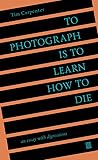
― To Photograph Is to Learn How to Die: An Essay with Digressions
― To Photograph Is to Learn How to Die: An Essay with Digressions
“This is probably the most urgent thing I have to say: We sense in the photograph the very contingency of being alive. This peculiar kind of picture presents itself as an absolute enigma, just as existence does.”
―
―
“While we can’t arrange the world with a camera, we have the ability to create significant associations between the things of the world and time in the photograph, and these purely pictorial correlations can help us to manifest and understand their ineffable counterparts of the within and the without.
The camera is all about creating relationships that are unreal (in that they never existed in the world) among things that are absolutely and recalcitrantly real. In fact that all it can do.”
― To Photograph Is to Learn How to Die: An Essay with Digressions
The camera is all about creating relationships that are unreal (in that they never existed in the world) among things that are absolutely and recalcitrantly real. In fact that all it can do.”
― To Photograph Is to Learn How to Die: An Essay with Digressions
“This divining is a wondrous thing. Because it does not stop, we must now take it a step further: just as the thoughtful viewing of a photograph can help us to understand its maker, the conscientious making of photographs can help one know - and even to create - one’s self.”
― To Photograph Is to Learn How to Die: An Essay with Digressions
― To Photograph Is to Learn How to Die: An Essay with Digressions
“Photographic seeing is an intentional way of continually discovering and rediscovering integrations of self and not-self. In a photograph, the mind of the maker is fleetingly apprehended.”
― To Photograph Is to Learn How to Die: An Essay with Digressions
― To Photograph Is to Learn How to Die: An Essay with Digressions
“As the product of this curious alignment between machine and mind, the photograph is capable of manifesting the transient and the provisional - and thus of becoming a singularly moving work of art.”
― To Photograph Is to Learn How to Die: An Essay with Digressions
― To Photograph Is to Learn How to Die: An Essay with Digressions
“The limitations we sense in the photograph - of the actual and of time - are felt keenly by those who use a camera, in ways that are simply not realized by the painter or the poet or anyone else. Strangely, we can never seem to get enough of these particular limitations.”
― To Photograph Is to Learn How to Die: An Essay with Digressions
― To Photograph Is to Learn How to Die: An Essay with Digressions
“Similarly, we are thinking with and through the camera. This gets back to something I mentioned earlier: real in-the-moment thinking (and not the illustration of previous thoughts) happens when the impetus to the picture and the picture itself are one and the same. It’s not about what the photographer knows, but what she can make.”
― To Photograph Is to Learn How to Die: An Essay with Digressions
― To Photograph Is to Learn How to Die: An Essay with Digressions
“Choices of aspect ratio or lens coverage or film type are not just things that impact how your prints look on the wall or in a book. They are the very structure of your mind when it meets the world with a camera.”
― To Photograph Is to Learn How to Die: An Essay with Digressions
― To Photograph Is to Learn How to Die: An Essay with Digressions
“There is relief in the recognition that we are not so solitary as we suppose ourselves to be. That someone else managed to acquire a vantage that is somehow sufficient. That the longing which seems (and is) so personal is also a shared experience, in significant ways. Shared at the very least with the photographer who made something of it.”
― To Photograph Is to Learn How to Die: An Essay with Digressions
― To Photograph Is to Learn How to Die: An Essay with Digressions
“Technical choices must be made with great care for your pictures, but even more importantly with the utmost respect for your separate self and your intelligence and the contents of your heart (which are - or should be - basically the same thing as your photographs).”
― To Photograph Is to Learn How to Die: An Essay with Digressions
― To Photograph Is to Learn How to Die: An Essay with Digressions
“Preserving the self has meant, in my case, making photographs (lots of them) in a conscious attempt to reconcile the conflict between what is and what is not. This vocation has shown me that such reconciliations - to the extent they are even achievable - could never have just happened in my head. What I seem to require instead is the friction of the materially circumscribed activity of photography: an activity that uniquely entangles the actual and the imaginary, and which results in a beguilingly inscrutable product: a new thing in the world that is itself a conditional accord between what is given in the real and what is possible in the mind.”
― To Photograph Is to Learn How to Die: An Essay with Digressions
― To Photograph Is to Learn How to Die: An Essay with Digressions
“Unlike any other aesthetic object, the photograph is a thing that embodies transience: it is an action made of time (its brief duration noted on the shutter setting) that results in a thing that endures in time. This peculiarity is one source of its unique power.”
― To Photograph Is to Learn How to Die: An Essay with Digressions
― To Photograph Is to Learn How to Die: An Essay with Digressions
“But limitations can also be possibilities. In fact, ours directly indicate the fundamental power of the medium: because the constraints of photography align so intimately with those that we all experience every moment, the photograph is absolutely unique in its ability to convey the human conundrum. Working with a camera allows the maker to approach the predicament - and to tentatively resolve it - in ways unmatched by the use of any other tool, and not just in degree but in kind.”
― To Photograph Is to Learn How to Die: An Essay with Digressions
― To Photograph Is to Learn How to Die: An Essay with Digressions
“I believe that using a camera can draw us away from our selves. That it is a meaningfully constrained way of thinking and knowing that enables us to conjure relationships among otherwise uncooperative earthly things; new and valuable correspondences which never actually existed. That these novel sets of relationships - called “photographs” - are useful because the possess to both defy and embrace impermanence and to convey to other human beings the essence of a separate self’s fleeting and often furtive connections with the obstinate thusness of it all. In short, that such pictures can get us about as close to the ineffable as out mortal shortcomings will allow.”
― To Photograph Is to Learn How to Die: An Essay with Digressions
― To Photograph Is to Learn How to Die: An Essay with Digressions
“The camera enumerates the actual as does no other medium. It is the photographer’s obligation to honor that power by exceeding it.”
― To Photograph Is to Learn How to Die: An Essay with Digressions
― To Photograph Is to Learn How to Die: An Essay with Digressions
“To harp on a theme: it’s all about placing yourself and your machine in various relationships to the world in order to get at relationships between your self and the world.”
― To Photograph Is to Learn How to Die: An Essay with Digressions
― To Photograph Is to Learn How to Die: An Essay with Digressions