Goodreads helps you follow your favorite authors. Be the first to learn about new releases!
Start by following Alexandru Dragomir.

Showing 1-18 of 18
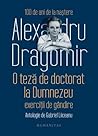
“Un intelectual încrezut e cel care a citit cărți prea bune pentru el”
― O teză de doctorat la Dumnezeu: exerciţii de gândire
― O teză de doctorat la Dumnezeu: exerciţii de gândire
“Any fanciful ambition involves an overloaded opinion of my own capability, a wrong evaluation in an upward direction. If, for example, my dream is to become one of the great philosophers of the world, then my fanciful ambition might be to solve the problem of time. Why is it dangerous to nourish such ambitions? Because the precious mirage of ‘I’m going to do’ gets in the way of ‘I do’. The fanciful ambition is thus the project that prevents you from doing. An example would be the project of reading the works of the great thinkers in the most fundamental way. This is a fanciful ambition, because there can be no definitive reading of the great philosophers. This time it is no longer a matter of personal projection: I start with myself and see myself as a great hero. This time we are dealing with a mystification at the level of action. He who nourishes fanciful ambitions is a man of action sabotaged by his own project of doing. He sets out to do in his own space something that he cannot do. He wants to catch a whale with a flimsy fishing line. It is the very grandeur of his project that puts the brakes on its achievement. This lack of adjustment to one’s own possibilities is another source of failure. In my generation there was a guy called Ştefan Teodorescu who was always making up ample tables of contents. He never even got as far as writing the introduction. However the nourisher of fanciful ambitions is not an agonized failure; his life becomes a dolce far niente, a sort of continuous waltz among a host of projects endlessly taken up and abandoned again. There is a Chinese proverb: ‘Every road starts with the fi rst step’.
The nourisher of fanciful ambitions never manages to make that fi rst step. Or if he does, he leaves the road before he has trodden firmly on it.”
―
The nourisher of fanciful ambitions never manages to make that fi rst step. Or if he does, he leaves the road before he has trodden firmly on it.”
―
“However, I repeat: not every question, but only one that goes down to the origin of the problem, that aims at a global knowledge, a question on which our entire lives depend: what is good and what is evil, what is right and what is wrong? This sort of question, which assumes a super-human knowledge, inevitably leads into the zone of unknowing.
Such a question places one in an interval. We are ‘interval beings’ precisely because we ask questions of this kind. And in this case, the status of the question derives from the human condition itself, which is one of interval: between knowing and unknowing, between good and evil, between life and death.”
―
Such a question places one in an interval. We are ‘interval beings’ precisely because we ask questions of this kind. And in this case, the status of the question derives from the human condition itself, which is one of interval: between knowing and unknowing, between good and evil, between life and death.”
―
“Why does this happen? Why has the ‘advance of knowledge’ not placed us in a more favourable situation than 2500 years ago? For the simple reason that technology has never had any way of tackling the problem of good and evil; indeed it is likely to obscure it. For in knowing something, it thinks it knows everything. The purely technical way of looking at things makes impossible the framework in which the question of good and evil is raised. Science and technology give you the rules by which something works, but they do not tell you when, in the way it is used, evil appears in place of good. Good and evil depend on how exactly you use something, and science and technology are incapable of teaching you anything like that. For the price of specialization in one field is lamentable ignorance of other things.”
―
―
“Plans, Concrete Projects
These represent a third possible source of self-falsification in the context of the future. I say ‘possible’, because not every plan necessarily leads to self-falsification, only one that cannot be abandoned along the way as soon as it proves to be unrealistic or mistaken.
Any activity that I embark on presupposes a concrete plan. However as the activity advances, it may or may not confirm the initial plan. Self-falsification sets in when I lose my flexibility, when I become the slave of a project even when it no longer suits me. To avoid this sort of self-deception, I must, when I have a project or a plan, keep asking myself along the way if it is still appropriate for me to follow it, if it is really good, etc. It is not necessary that things should turn out just as you saw them at the beginning: sometimes you get a better view of them along the way.”
―
These represent a third possible source of self-falsification in the context of the future. I say ‘possible’, because not every plan necessarily leads to self-falsification, only one that cannot be abandoned along the way as soon as it proves to be unrealistic or mistaken.
Any activity that I embark on presupposes a concrete plan. However as the activity advances, it may or may not confirm the initial plan. Self-falsification sets in when I lose my flexibility, when I become the slave of a project even when it no longer suits me. To avoid this sort of self-deception, I must, when I have a project or a plan, keep asking myself along the way if it is still appropriate for me to follow it, if it is really good, etc. It is not necessary that things should turn out just as you saw them at the beginning: sometimes you get a better view of them along the way.”
―
“The question that led to the essential condition of ‘knowing that I do not know’ set European thinking on solid ground. The essential thing is that I should have no illusions. Any method must have its origin here: starting from the fact that he knows that he does not know, man builds something, goes back to zero and finds his way forward. This is what Socrates originated. And where the mind refuses to be exposed and does not build on initial ignorance, there appears dogmatism.”
―
―
“Well then, in the context of this issue, of this relationship with one’s own self, I am going to speak about falsifications of the self, about self-deception. I have seen, with Heidegger, that my life is essentially possibility. Possibility both as reaction and as horizon. It is reaction inasmuch as I can react to a given situation in one way or another. This is one of the senses of the possible for me. The other sense is my projecting, that which I could be. My plan is to talk about the psychological horizon of the possibility of life, and within that, to raise the problem of self-falsif i cation.
Let us see how lack of self-knowledge appears within the context of self-image, and what the relation is between what I am and what I think I am. And all this based on a temporal structure of self-falsification. I am now going to propose an inventory of the ways in which we deceive ourselves, based on the temporal hypostases of the future, the present, and the past.”
―
Let us see how lack of self-knowledge appears within the context of self-image, and what the relation is between what I am and what I think I am. And all this based on a temporal structure of self-falsification. I am now going to propose an inventory of the ways in which we deceive ourselves, based on the temporal hypostases of the future, the present, and the past.”
―
“Let me begin with the idea beloved of Heidegger according to which we are not what we are, but much more what we can be: Seinkönnen, ‘potentiality-for-being’.
We are something possible in relation to our own selves, we are our own projection, what comes towards us out of the future. The image we build of ourselves is largely composed of the sum of our projects and projections. We evolve, of course, on a ground made up of pre-existing determinations: we are our genes, the time and place in which we were born, the society in which we live, and so on. But beyond all that there remains a Spielraum, ‘room to manoeuver’, a space that is not yet occupied by anything, a niche of the possible in which we can install ourselves and freely settle into one direction or another of our lives. Of course this range of possibilities is to some extent predetermined by circumstances that have nothing to do with our freedom: fashions, ideals floating in the air, readymade lifestyles, which limit our freedom while leaving us with the impression that we are choosing.
However it still remains true that my own projections turn back on me and determine my way of being. I am what I really want to be, as well as being the range of possibilities that lie before me.”
―
We are something possible in relation to our own selves, we are our own projection, what comes towards us out of the future. The image we build of ourselves is largely composed of the sum of our projects and projections. We evolve, of course, on a ground made up of pre-existing determinations: we are our genes, the time and place in which we were born, the society in which we live, and so on. But beyond all that there remains a Spielraum, ‘room to manoeuver’, a space that is not yet occupied by anything, a niche of the possible in which we can install ourselves and freely settle into one direction or another of our lives. Of course this range of possibilities is to some extent predetermined by circumstances that have nothing to do with our freedom: fashions, ideals floating in the air, readymade lifestyles, which limit our freedom while leaving us with the impression that we are choosing.
However it still remains true that my own projections turn back on me and determine my way of being. I am what I really want to be, as well as being the range of possibilities that lie before me.”
―
“Wishing to know what exactly the oracle meant in stating that he, Socrates, was the wisest man in Athens, Socrates begins an inquiry. He asks; he does not state anything because he does not know anything. And what exactly does he ask about? Τὰ μέγιστα, the most important things, the things that count most in our lives, the things that ‘weigh’, the problems whose solution determines the way we live our lives.
Socrates asks the people who claim to know the answers, and has a revelation of general pseudo-science, of the illusion of knowledge—in Greek, δοξοσοφία, ‘illu-sory knowledge’. The questions Socrates asks begin with a denunciation of the inconsistency of the answers received and of the contradictions into which those who give them fall. The question thus makes visible their basically ridiculous position: they do not know that they do not know. Look, I am asking you, and where you thought you knew, you do not know. Of course I do not know either, but I have no illusion that I do know. I, Socrates, do not live in the night of illusion. The ridiculous state of those who ‘do not know that they do not know’, which is revealed by the question, is a veritable vice: πονηρία in Greek. Their situation is serious: for Socrates, it is a massive failing. Not to know yourself is a vice, while to know your-self is a virtue (ἀρετή).”
―
Socrates asks the people who claim to know the answers, and has a revelation of general pseudo-science, of the illusion of knowledge—in Greek, δοξοσοφία, ‘illu-sory knowledge’. The questions Socrates asks begin with a denunciation of the inconsistency of the answers received and of the contradictions into which those who give them fall. The question thus makes visible their basically ridiculous position: they do not know that they do not know. Look, I am asking you, and where you thought you knew, you do not know. Of course I do not know either, but I have no illusion that I do know. I, Socrates, do not live in the night of illusion. The ridiculous state of those who ‘do not know that they do not know’, which is revealed by the question, is a veritable vice: πονηρία in Greek. Their situation is serious: for Socrates, it is a massive failing. Not to know yourself is a vice, while to know your-self is a virtue (ἀρετή).”
―
“My dream of what I am going to be is my own projection into a hero, a personal projection par excellence. Dreams begin in childhood. When I was a child, I dreamt of becoming a racing driver.
Perhaps nowadays a child dreams of becoming a cosmonaut or a Formula 1 driver like Nigel Mansell. Dreams begin in childhood and continue in other forms in adolescence: in some cases they remain with us all our lives. One form of life-long dream is that of the (as yet) unrecognized genius, the Van Gogh model, let us say. There are people who paint or write poetry all their lives, convinced that they are unrecognized just as Van Gogh was, but that one day… Others are for ever Don Juan: Ortega y Gasset says that there is not a man alive who does not believe that he was Don Juan, at least in his younger days, that he perhaps still is, or, if he was not and is not, that he could have been but did not want to be. There are hundreds of variants on these dreams, and it is they, these dreams, that create the real failures. These, I emphasize, are personal dreams: i.e. they are formed by my projection of myself into a model or ideal type of person.”
―
Perhaps nowadays a child dreams of becoming a cosmonaut or a Formula 1 driver like Nigel Mansell. Dreams begin in childhood and continue in other forms in adolescence: in some cases they remain with us all our lives. One form of life-long dream is that of the (as yet) unrecognized genius, the Van Gogh model, let us say. There are people who paint or write poetry all their lives, convinced that they are unrecognized just as Van Gogh was, but that one day… Others are for ever Don Juan: Ortega y Gasset says that there is not a man alive who does not believe that he was Don Juan, at least in his younger days, that he perhaps still is, or, if he was not and is not, that he could have been but did not want to be. There are hundreds of variants on these dreams, and it is they, these dreams, that create the real failures. These, I emphasize, are personal dreams: i.e. they are formed by my projection of myself into a model or ideal type of person.”
―
“Where, then, does the question come from? What is its place of origin? It is clear that it does not come from absolute knowledge. When God asks Adam ‘Where are you?’ his question is purely rhetorical. Nor can it come from an absolute lack of knowledge, for if you do not know that you do not know, you do not even want to know. The source of the question is the knowledge of negativity: you know that you do not know, you know what ‘to know’ means and you know that you do not know what you are asking.”
―
―
“Why do you need to read the great philosophers?
Because when you look at Aristotle, for example, after thinking on your own about a problem, you see that out of, let’s say, ten things that he says about the problem you have said three, and two of them badly.”
―
Because when you look at Aristotle, for example, after thinking on your own about a problem, you see that out of, let’s say, ten things that he says about the problem you have said three, and two of them badly.”
―
“We might think that this way of thinking is merely historical, that it is limited to the figure of Socrates, and is of no more concern to us. However the same problem faces us today. The man of science, the technician in a broad sense, lives in the same ambiguity in which Socrates’ partners in dialogue lived. He is at once expert and ignorant. The knowledge that he has about a certain field goes hand in hand with his lack of knowledge about the rest, and likewise with his tendency to extrapolate from what he knows beyond what is permissible. From this point of view, we are no further on today: in the ‘great problems’, we are just as prone to get lost as in the time of Socrates.”
―
―
“Well then, in the context of this issue, of this relationship with one’s own self, I am going to speak about falsif i cations of the self, about self-deception. I have seen, with Heidegger, that my life is essentially possibility. Possibility both as reaction and as horizon. It is reaction inasmuch as I can react to a given situation in one way or another. This is one of the senses of the possible for me. The other sense is my projecting, that which I could be. My plan is to talk about the psychological horizon of the possibility of life, and within that, to raise the problem of self-falsif i cation.
Let us see how lack of self-knowledge appears within the context of self-image, and what the relation is between what I am and what I think I am. And all this based on a temporal structure of self-falsif i cation. I am now going to propose an inventory of the ways in which we deceive ourselves, based on the temporal hypostases of the future, the present, and the past.”
―
Let us see how lack of self-knowledge appears within the context of self-image, and what the relation is between what I am and what I think I am. And all this based on a temporal structure of self-falsif i cation. I am now going to propose an inventory of the ways in which we deceive ourselves, based on the temporal hypostases of the future, the present, and the past.”
―
“The clock has no past and no future, not even a present. That is because the clock is not time; it just shows time. In fact it shows only the present. It is easy to imagine—even if it has not actually been made—a clock with a fixed hand and moving numbers…”
―
―
“However there are questions which philosophy cannot give up, which continue to be problematic even if science also asks them and provides answers to them. A question like ‘what is man?’ is in this sense a question of dual status. Science answers by slices, by levels. From a somatic point of view, genetics, anatomy, physiology, and so on are the sciences that answer this question.
From a psychical point of view, psychology, neurology, psychiatry. From a cultural point of view, cultural anthropology, cultural history. From a social point of view, economics, sociology, political science, history. And after science has answered the question ‘what is man?’ in all these ways, the question remains on its feet and Heidegger comes and writes Being and Time as though the whole labour of science had been in vain.”
―
From a psychical point of view, psychology, neurology, psychiatry. From a cultural point of view, cultural anthropology, cultural history. From a social point of view, economics, sociology, political science, history. And after science has answered the question ‘what is man?’ in all these ways, the question remains on its feet and Heidegger comes and writes Being and Time as though the whole labour of science had been in vain.”
―
“However in revealing the wide discrepancy between the illusion of knowledge and the reality of lack of knowledge, the question opens up the possibility of a cleansing of the mind and thus has a paideic, educational function. It gives the mind an open field, cleansed of the illusion of knowledge; it brings about the elimination, the expulsion of illusion: ἐκβολὴ τῆς δόξης. The word translated as ‘elimination’ or ‘expulsion’, ἐκβολή, has a technical sense, and refers to a cathartic ritual of medical origin: purificatio mentis is a purgative method extended to the mind, a treatment for mental constipation.”
―
―
“In our intellectual circles, the essayist stirs ideas, the logician reasons, and the professor or researcher presents papers. But who actually thinks?”
―
―