Goodreads helps you follow your favorite authors. Be the first to learn about new releases!
Start by following John Carver.

Showing 1-6 of 6
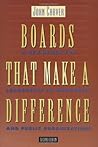
“In the short term, there is scant room for dreaming, for one must choose between being taken seriously and being visionary. In the long term, however, leadership cannot afford to overlook the wisdom of dreams, even the wisdom of playful dreaming. Vision that bounds higher than the barriers that confine us often spring from earnest playfulness.”
― Boards That Make a Difference: A New Design for Leadership in Nonprofit and Public Organizations
― Boards That Make a Difference: A New Design for Leadership in Nonprofit and Public Organizations
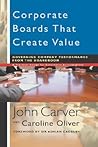
“The board's position is, therefore, to act as the link between owners and management, directing and controlling the company on the owners' behalf. Put another way, the reason owners grant such authority is to enable the board to act as the ownership in microcosm.”
― Corporate Boards That Create Value: Governing Company Performance from the Boardroom
― Corporate Boards That Create Value: Governing Company Performance from the Boardroom
“A move to the Policy Governance model looks straightforward because the logic behind the model is so clear. Precisely because it is driven by logic, it is uncompromising and cannot be bent to fit personalities in the way we usually treat our organizational structures. It requires a disciplined approach, and discipline is uncomfortable, perhaps especially for those of us used to moderately anarchic board procedures. The board has to discipline itself to deal with every issue through policy. This is considerably more demanding than making or agreeing to decisions as they arise and meddling in management from time to time. Thinking is hard work. Directors working under the Policy Governance model have to construct a framework that both gives the CEO a clear remit over the results to be achieved and sets the limits within which those results are to be achieved. The board has both to prescribe and to proscribe, as the authors point out.”
― Corporate Boards That Create Value: Governing Company Performance from the Boardroom
― Corporate Boards That Create Value: Governing Company Performance from the Boardroom
“Clearly chairs, or CGOs, have a leading part to play in ensuring that governance boards work in the way the new model outlines. As Carver and Oliver say, "We believe that the chair's role is one of the most important keys to unlocking the potential of boards, and we are therefore going to give it considerable attention." I strongly support the importance that the model gives to the chair's role. This book stresses that the board must speak with one voice and that the CEO takes directions only from the board as a whole. The board will speak with one voice only as a result of directors' commitment to do so and the skill of the chair. I doubt that what is required of a person to serve well on any type of board or committee is a natural form of behavior. The key task of a chair is to enable the members of a board to work together effectively and to get the best out of them. This is what the servant achieved in the story on which Robert Greenleaf's concept of the servant-leader is based. Chairs have a major leadership task. It is they who are responsible for turning a collection of competent individuals into an effective team. The new model is demanding of its chairs, and much will depend on them.
Another field in which”
― Corporate Boards That Create Value: Governing Company Performance from the Boardroom
Another field in which”
― Corporate Boards That Create Value: Governing Company Performance from the Boardroom
“Because owners are the source of a company's authority, it follows that the need for a governing board arises only when the owners are too numerous to direct and control the company themselves. Therefore, the notion of board authority as a distinct kind of authority occurs only when there is a gap between the ownership of assets and the management of those assets.”
― Corporate Boards That Create Value: Governing Company Performance from the Boardroom
― Corporate Boards That Create Value: Governing Company Performance from the Boardroom
“Underlying this book is the assumption that governing a company and managing it are different activities requiring different job designs. We maintain that governance is best seen as existing outside the phenomenon of management and inside the phenomenon of ownership. Governance operates at a level that transcends current issues and specific company traditions and elevates people to a higher conceptual plane, one from which accountability can be seen more clearly. Governance requires and engenders a passion for leadership, leadership that is not just over others but on others' behalf.”
― Corporate Boards That Create Value: Governing Company Performance from the Boardroom
― Corporate Boards That Create Value: Governing Company Performance from the Boardroom