Goodreads helps you follow your favorite authors. Be the first to learn about new releases!
Start by following Cherry Gilchrist.

Showing 1-7 of 7
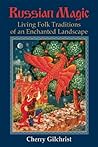
“Everything has its own force and spirit. Seen in this light, inherited folklore beliefs are not just quaint traditions, but part of an active engagement between humans and the ‘otherworld’, a celestial drama fearsome in its scale and awesome in power.”
― Russian Magic: Living Folk Traditions of an Enchanted Landscape
― Russian Magic: Living Folk Traditions of an Enchanted Landscape
“The woven belt once worn around the waist by both men and women symbolized the participation of individuals in society, their place in the community, and the agreement to be, quite literally, bound by its rules. When the reverse was practised, taking off one’s belt signified a readiness to enter the realm of the spirits. For women, the power could be amplified by unbraiding their hair, as mentioned above.”
― Russian Magic: Living Folk Traditions of an Enchanted Landscape
― Russian Magic: Living Folk Traditions of an Enchanted Landscape
“In various traditions it is common to avoid calling a magical creature by its real name; in Russia the bear is often referred to as Mishka, an affectionate nickname, rather than by its proper name of Medved, or ‘honey knower’. (This is paralleled in English, where even today in equestrian terminology, the correct term for a white horse is ‘grey’, once the way of showing respect to the sacred white horse.)”
― Russian Magic: Living Folk Traditions of an Enchanted Landscape
― Russian Magic: Living Folk Traditions of an Enchanted Landscape
“The first recorded representation of Perun was at the end of the tenth century, when Vladimir I established his rule in Kiev, and honoured the prevailing gods by setting up statues to them in an official sanctuary. Perun, as the god of thunder and lightning, was revered as one of the greatest among them, and was fetchingly depicted with a silver head adorned with golden moustaches. The sanctuary was short-lived, however, since only eight years later, when Vladimir converted to Christianity, he had the statues thrown into the river in a fit of piety. Perun, the Slavic god, was officially no more.”
― Russian Magic: Living Folk Traditions of an Enchanted Landscape
― Russian Magic: Living Folk Traditions of an Enchanted Landscape
“According to one narrative, an elderly couple spent the first night in their new home lying awake in terror, as they waited for the approach of domavoi. Not only might he have bad news for them, but it was well-known that he had a nasty habit of trying to strangle the people that he visited. The old woman screamed in terror as she felt something heavy and furry land on her chest, only to discover that it was the family cat! But on further reflection, the couple decided that the cat was the domavoi on this occasion, and that as its fur was soft and warm, good fortune would follow.”
― Russian Magic: Living Folk Traditions of an Enchanted Landscape
― Russian Magic: Living Folk Traditions of an Enchanted Landscape
“The Sun is also a protector of the house, so that a good array of Sun symbols created about the home would guard and guide the family. These too should be of the Sun in motion, such as a ‘walking’ Sun embroidered on a towel, or a ‘rolling’ Sun carved on a lintel. The images themselves would be considered to contain something of the Sun’s power, so that the towel could bring healing when used to wipe the sick person’s face, and the carved Sun on the house front would help to drive away severe weather.”
― Russian Magic: Living Folk Traditions of an Enchanted Landscape
― Russian Magic: Living Folk Traditions of an Enchanted Landscape
“”
―
―