Goodreads helps you follow your favorite authors. Be the first to learn about new releases!
Start by following Elizabeth Hellmuth Margulis.

Showing 1-7 of 7
“Music psychology has been busy looking at the ways in which music might be similar to language, but Richman, Tannen, and others might be understood to be asking the inverse question, when is language processed musically? This question has been examined in terms of beat structure and intonation, but it might also be considered in terms of repetition structure: highly repetitive forms of language, such as chants and nursery rhymes, veer away from the typical syntactic and semantic modes of understanding speech, and toward modes of comprehension that are more characteristically musical—emotive, social, and holistic.”
― On Repeat: How Music Plays the Mind
― On Repeat: How Music Plays the Mind
“A gambit that was unusual and highly charged at one time (say, the diminished seventh at the start of the nineteenth century) can come to seem ordinary and ineffective after repeated use (say, the diminished seventh by the end of the nineteenth century).”
― On Repeat: How Music Plays the Mind
― On Repeat: How Music Plays the Mind
“If all the exposure in elevators and cafés and cars and televisions and kitchen radios was put together, the average person listens to several hours of music every day ["The Music In You," Aeon, January 8, 2015].”
―
―
“When we acknowledge how, just by living and listening, we have all acquired deep musical knowledge, we must also recognise that music is not the special purview of professionals. Rather, music professionals owe their existence to the fact that we, too, are musical. Without that profound shared understanding, music would have no power to move us ["The Music In You," Aeon, January 8, 2015].”
―
―
“Repetition draws us into music, and repetition draws music into us.”
― On Repeat: How Music Plays the Mind
― On Repeat: How Music Plays the Mind
“Familiar songs can continue to play through listeners' minds even after the sound has been paused. We know what it's like to "think a phrase", to be mentally gripped by imagined music. When we know what's coming in a musical excerpt, the listening becomes a motion, an enactment, it "moves" us. We are constantly in the future as we listen, such that we can seem to embody it [...]. My claim is that part of what makes us feel that we're a musical subject rather than a musical object is that we are endlessly listening ahead, such that the sounds seem almost to execute our volition, after the fact.”
―
―
“To this point, musical repetition has been viewed as a particular kind of object. But it can also be viewed as a particular kind of behavior.”
― On Repeat: How Music Plays the Mind
― On Repeat: How Music Plays the Mind
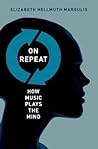
![(On Repeat: How Music Plays the Mind) [By: Margulis, Elizabeth Hellmuth] [Feb, 2014]](https://s.gr-assets.com/assets/nophoto/book/111x148-675b3b2743c83e96e2540d2929d5f4d2.png "(On Repeat: How Music Plays the Mind) [By: Margulis, Elizabeth Hellmuth] [Feb, 2014]")