Goodreads helps you follow your favorite authors. Be the first to learn about new releases!
Start by following Anne Katherine.

Showing 1-30 of 80
“The longer we stay in a violating situation, the more traumatized we become. If we don't act on our own behalf, we will lose spirit, resourcefulness, energy, health, perspective, and resilience. We must take ourselves out of violating situations for the sake of our own wholeness.”
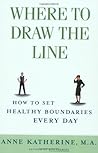
― Where to Draw the Line: How to Set Healthy Boundaries Every Day
― Where to Draw the Line: How to Set Healthy Boundaries Every Day
“We sometimes feel that if a person tromps over us after we've said no, then we must not have been clear. We can get caught in the trap of explaining again and again, meanwhile letting the other person take advantage of us.”
― Where to Draw the Line: How to Set Healthy Boundaries Every Day
― Where to Draw the Line: How to Set Healthy Boundaries Every Day
“Your time is your life. You are absolutely the final authority on how you will use it.”
― Where to Draw the Line: How to Set Healthy Boundaries Every Day
― Where to Draw the Line: How to Set Healthy Boundaries Every Day
“The growth of intimacy will teach us how to love—both ourselves and the other person. If we will allow ourselves to practice the skills of intimacy, we will learn to love. Boundaries protect love and intimacy. Certain behaviors support the integrity of intimacy. Other behaviors, harm, disrupt, or reverse, intimacy. By using skills that promote intimacy, boundaries are created that protect the relationship.”
― Where to Draw the Line: How to Set Healthy Boundaries Every Day
― Where to Draw the Line: How to Set Healthy Boundaries Every Day
“We hurt ourselves when we give our time, the minutes of our life span, to pursuits that don't match our own values.”
―
―
“In every one of your relationships, you are on a continuum between intimacy and separation. You stand on a slide that tilts you toward either intimacy or separateness. Exactly where you stand at any given moment is the result of your decisions, your feelings, how you handle situations, and the way you and the other person communicate.”
― Where to Draw the Line: How to Set Healthy Boundaries Every Day
― Where to Draw the Line: How to Set Healthy Boundaries Every Day
“Your greatest obligation in your use of time is to yourself, so that you are filling the days of your life with the pursuits and activities that reflect your deepest values. Time boundaries protect these pursuits, creating the limits that allow you to interact most fully with what matters to you. When we clutter our lives with imagined obligations, unnecessary activities, and distractions that only kill time, we dilute the power of our lives. You have the ultimate responsibility for the use of your time. At the end of your life, none of the excuses or defenses will matter. What will matter is that you spent your time on the experiences you wanted to have.”
― Where to Draw the Line: How to Set Healthy Boundaries Every Day
― Where to Draw the Line: How to Set Healthy Boundaries Every Day
“We can be assisted but not forced. Our spiritual development comes from our inner selves.”
― Boundaries Where You End And I Begin: How To Recognize And Set Healthy Boundaries
― Boundaries Where You End And I Begin: How To Recognize And Set Healthy Boundaries
“Intimacy absolutely requires that each person in a relationship be whole and individual. Codependence is not intimacy. Enmeshment—two people blending in such a way that one or both lose their identity—is not intimacy either.”
― Where to Draw the Line: How to Set Healthy Boundaries Every Day
― Where to Draw the Line: How to Set Healthy Boundaries Every Day
“Intimacy comes from being known, and being known requires knowing yourself, having a self to know, and having enough of a sense of your own individuality to have something to present to the other.”
― Boundaries Where You End And I Begin: How To Recognize And Set Healthy Boundaries
― Boundaries Where You End And I Begin: How To Recognize And Set Healthy Boundaries
“Generally, stress means we aren’t getting enough help. It can be heightened by self-made rules about doing things perfectly and not making any mistakes; by black-and-white thinking; by not accepting help, not getting advice, not trusting; by thinking we have to do everything ourselves; and by other rules we may have made to survive childhood.”
― Boundaries Where You End And I Begin: How To Recognize And Set Healthy Boundaries
― Boundaries Where You End And I Begin: How To Recognize And Set Healthy Boundaries
“As much as we want to improve our relationships with our fathers or mothers, if your father, for example, hasn’t changed, he’ll probably hurt you again. His response is saying that he can’t handle more intimacy with you. Repeated efforts on your part won’t change this. No matter how much we love someone, they have the choice of holding to their limits. I have a certain relative I love very much. I’ve poured my heart out telling of my wish that we might be closer. I’ve been hurt a hundred times. So I finally got it. No matter how much I want to be closer to my relative, I can’t make him take his barrier away. He has a right to keep it. But I can protect myself from being hurt again. I can stop banging my head on his barrier.”
― Boundaries Where You End And I Begin: How To Recognize And Set Healthy Boundaries
― Boundaries Where You End And I Begin: How To Recognize And Set Healthy Boundaries
“But both physical and emotional boundary development are harmed by distance violations, not just intrusion violations.”
― Boundaries Where You End And I Begin: How To Recognize And Set Healthy Boundaries
― Boundaries Where You End And I Begin: How To Recognize And Set Healthy Boundaries
“Good boundaries, created by the use of good intimacy skills, keep a committed or intimate relationship lightly balanced between the needs of the individual and the needs of the relationship.”
― Where to Draw the Line: How to Set Healthy Boundaries Every Day
― Where to Draw the Line: How to Set Healthy Boundaries Every Day
“Intimacy is the challenge of life. As I sail steadfastly into the deepening seas of my fifties and leave a longer wake behind me, I see that nothing is more important than one’s relationship with self and others—not career, not keeping the house perfect, not amassing possessions. Learning to love, to be genuine, and to gracefully allow others entrance into our hearts—these are the profound challenges for which we were born.”
― Where to Draw the Line: How to Set Healthy Boundaries Every Day
― Where to Draw the Line: How to Set Healthy Boundaries Every Day
“When a person neither knows his feelings nor has healthy ways to handle them, he is vulnerable to whatever will keep his feelings contained—alcohol or other drugs, food, excessive work, stress, compulsive acquiring, compulsive hobbying.”
― Boundaries Where You End And I Begin: How To Recognize And Set Healthy Boundaries
― Boundaries Where You End And I Begin: How To Recognize And Set Healthy Boundaries
“But if the other person is simply incapable of acting in a healthy way because of an addiction or personality disorder, we must protect ourselves. Sometimes we need to leave a job to find a healthier work environment. A company or agency that doesn’t clean up its act always loses the good people. When the employees get healthy, they leave.”
― Boundaries Where You End And I Begin: How To Recognize And Set Healthy Boundaries
― Boundaries Where You End And I Begin: How To Recognize And Set Healthy Boundaries
“In these examples, triangulation becomes a defense. Triangulation becomes a way to offset the abuse of power and to get clarity about the wrongs committed. This kind of triangulation occurs in families where one member is abusing his or her power. Like a poor boss, an abusive parent who is deaf to protest gives the children no choice but to talk about that parent. When a parent refuses to hear the issues of adult children, the children turn either to each other or to outsiders, but both sides lose. The parent loses an opportunity for greater closeness with the child and the adult child must grieve the loss of the sought-for resolution that cannot come about.”
― Boundaries Where You End And I Begin: How To Recognize And Set Healthy Boundaries
― Boundaries Where You End And I Begin: How To Recognize And Set Healthy Boundaries
“We learn about our boundaries by the way we are treated as children. Then we teach others where our boundaries are by the way we let them treat us. Most people will respect our boundaries if we indicate where they are. With”
― Boundaries Where You End And I Begin: How To Recognize And Set Healthy Boundaries
― Boundaries Where You End And I Begin: How To Recognize And Set Healthy Boundaries
“A parent who is too flexible deprives children of the sense of security that comes from having a specific schedule, clear limits, and definite standards. Such a parent isn’t able to protect her own needs and may raise selfish children who never learn to respect the needs of another.”
― Boundaries Where You End And I Begin: How To Recognize And Set Healthy Boundaries
― Boundaries Where You End And I Begin: How To Recognize And Set Healthy Boundaries
“Perhaps your parent is still violating your boundaries—by asking inappropriate questions, by showing up uninvited, by triangulating with your partner, spouse, or children. You have the right to set the same limits with a thoughtless or intrusive parent that you’d set with a friend or a stranger. You can refuse to answer a question. You can insist that your parent come to your house only when invited and refuse to let him in if he hasn’t been invited. You can confront your spouse and your parent about triangulation.”
― Boundaries Where You End And I Begin: How To Recognize And Set Healthy Boundaries
― Boundaries Where You End And I Begin: How To Recognize And Set Healthy Boundaries
“Learning how to win even these seemingly insignificant contests prepares you to protect yourself from the varsity challenges. The strange thing about being taught to be a victim is that our status is somehow communicated to the persecutors. Someone who’s looking to harm someone can pick the victim out of a crowd.”
― Boundaries Where You End And I Begin: How To Recognize And Set Healthy Boundaries
― Boundaries Where You End And I Begin: How To Recognize And Set Healthy Boundaries
“Perhaps you eat more when you feel threatened. Perhaps you eat when you know someone is going to try to take more from you than you want to give. Perhaps you eat when you’re with a person who assaults your boundaries.”
― Boundaries Where You End And I Begin: How To Recognize And Set Healthy Boundaries
― Boundaries Where You End And I Begin: How To Recognize And Set Healthy Boundaries
“Parents are likely to parent as they were parented unless they’ve learned a different way and had their own needs met.”
― Boundaries Where You End And I Begin: How To Recognize And Set Healthy Boundaries
― Boundaries Where You End And I Begin: How To Recognize And Set Healthy Boundaries
“A person whose boundaries are too flexible may feel overwhelmed with life. Each new demand distracts him. He has difficulty setting priorities and following them. He gets started on one thing only to get sidetracked by something else. He may appear disorganized. A too-flexible parent deprives children of the sense of security that comes from having a specific schedule, clear limits, and definite standards. Such a parent isn’t able to protect her own needs and may raise selfish children who never learn to respect the needs of another. A parent who can’t set priorities, who is, for example, perpetually late, can make a child feel unimportant and abandoned. Since he can’t make priorities, he can’t make the child a priority.”
― Boundaries Where You End And I Begin: How To Recognize And Set Healthy Boundaries
― Boundaries Where You End And I Begin: How To Recognize And Set Healthy Boundaries
“Unfortunately, an unlived childhood cannot be lived vicariously. If you missed something as a kid, you have to work it out yourself, not through someone else. A child who grows enmeshed with a parent is likely to enmesh with a mate. Such a wife will take on her husband’s attitudes, interests, and goals as if they were her own. She sees not with her own perspective but with his.”
― Boundaries Where You End And I Begin: How To Recognize And Set Healthy Boundaries
― Boundaries Where You End And I Begin: How To Recognize And Set Healthy Boundaries
“With good boundaries, we can have the wonderful assurance”
― Boundaries Where You End And I Begin: How To Recognize And Set Healthy Boundaries
― Boundaries Where You End And I Begin: How To Recognize And Set Healthy Boundaries
“Being Someone You’re Not Think of the effect it has to pretend you’re different than you really are. Being someone you’re not lets alien behavior and attitudes enter your boundary and replace your true self. When we do this a lot, we begin to feel strange to ourselves. We can lose touch with our true selves and not know what we really want and need.”
― Boundaries Where You End And I Begin: How To Recognize And Set Healthy Boundaries
― Boundaries Where You End And I Begin: How To Recognize And Set Healthy Boundaries
“If, as children, we had to deny our true thoughts or feelings to be safe, as adults we are likely to continue to deny what’s true for us. Telling the truth feels very unsafe, a threat to survival. What a dilemma. Denying ourselves feels safer, but it obscures our sense of who we are. The safe route, however, violates an emotional boundary. What’s the way out of the dilemma? If boundary development was severely harmed when you were a child, therapy may be the most efficient route. When we don’t work ourselves free of the issues that got started when we were children, we are destined to relive them again and again. “Children who suffer trauma to core self and identity …,” writes Jane Middleton-Moz, “work toward resolution of that trauma and completion of development in adult life through repetition of the struggle with authority figures, in intimate relationships, through their own children or in therapy.”3”
― Boundaries Where You End And I Begin: How To Recognize And Set Healthy Boundaries
― Boundaries Where You End And I Begin: How To Recognize And Set Healthy Boundaries
“child can have plenty of food, warm clothes, and a clean home yet be utterly emotionally abandoned. Without parental warmth and attention, emotional development withers.”
― Boundaries Where You End And I Begin: How To Recognize And Set Healthy Boundaries
― Boundaries Where You End And I Begin: How To Recognize And Set Healthy Boundaries