Goodreads helps you follow your favorite authors. Be the first to learn about new releases!
Start by following Todd Rogers.

Showing 1-28 of 28
“BCE, Publilius Syrus, a Latin writer, wrote that “to do two things at once is to do neither.”[”
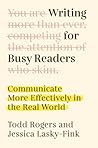
― Writing for Busy Readers: Communicate More Effectively in the Real World
― Writing for Busy Readers: Communicate More Effectively in the Real World
“A picture is worth a thousand words, as the cliché goes—but those thousand words may not be the ones you’re trying to convey. If translating words into an image can save readers time while serving our goals as writers, then using pictures instead can make sense. If the picture increases complexity, confuses, or distracts the reader, though, including it is probably a mistake.”
― Writing for Busy Readers: communicate more effectively in the real world
― Writing for Busy Readers: communicate more effectively in the real world
“Busy readers aim to extract as much value as possible from a communication with as little time and attention as possible. To achieve this, they don’t always read linearly, line by line. They vary how they read to suit their goals. They may closely read one section, skim another, and jump around in yet another, searching for specific information that they consider relevant. In the language of economics theory: Busy readers maximize their expected utility by continuously trying to predict whether the value of spending another second reading the message is greater than the benefit of spending that time and attention on something else.”
― Writing for Busy Readers: communicate more effectively in the real world
― Writing for Busy Readers: communicate more effectively in the real world
“Aim for the least amount of complexity that will allow you to engage your intended reader. You need to pay attention to context, but remember that more readable writing is fundamentally more effective writing.”
― Writing for Busy Readers: communicate more effectively in the real world
― Writing for Busy Readers: communicate more effectively in the real world
“Ineffective writing can deter all readers, but especially readers who have limited literacy, who speak English as a second language, who have learning disabilities, who have limited time due to multiple jobs and challenging personal circumstances, or who face other significant barriers to reading and understanding written communications. In short, effective writing is more accessible, more equitable, and more democratic.”
― Writing for Busy Readers: communicate more effectively in the real world
― Writing for Busy Readers: communicate more effectively in the real world
“If your reader is going to spend just five seconds on your message, what is the most important information you want them to come away with?”
― Writing for Busy Readers: communicate more effectively in the real world
― Writing for Busy Readers: communicate more effectively in the real world
“Knowing your audience is the best way to ensure that your language matches their needs and expectations.”
― Writing for Busy Readers: communicate more effectively in the real world
― Writing for Busy Readers: communicate more effectively in the real world
“Honing your skills as an effective writer will also hone your skills as a lucid thinker. Organizational psychologist and bestselling author Adam Grant makes the point clearly: “Turning thoughts into words sharpens reasoning. What’s fuzzy in your head is clear on the page.”1”
― Writing for Busy Readers: communicate more effectively in the real world
― Writing for Busy Readers: communicate more effectively in the real world
“Not sure how to be an effective rewriter? On each revision, continually ask yourself these two essential questions: “What is the most important information I want my readers to understand?” and “How do I make it easier for my readers to understand it?”
― Writing for Busy Readers: communicate more effectively in the real world
― Writing for Busy Readers: communicate more effectively in the real world
“Focusing helps us avoid mental overload, but it can also deplete our attention system. When we focus on one task for a long period of time or particularly intensely, our ability to stay focused declines. That is one of the reasons why schoolchildren get recess and writers take breaks: Directing and controlling our attention is difficult and tiresome. It doesn’t require a long day of school or intense work to exhaust the resources of our attention system. The brain can run down more rapidly than you might expect.”
― Writing for Busy Readers: communicate more effectively in the real world
― Writing for Busy Readers: communicate more effectively in the real world
“Once we get distracted, it is hard to refocus. According to information scientist Gloria Mark at the University of California, Irvine, workers need an average of twenty-three minutes to return fully to a task after being interrupted.21 Needless to say, this affects how well we do whatever it is we’re doing. Another study, conducted at Carnegie Mellon University, found that being interrupted by a phone call while taking a reading test decreased performance on the test by 20%.”
― Writing for Busy Readers: communicate more effectively in the real world
― Writing for Busy Readers: communicate more effectively in the real world
“Although concise writing saves time and effort on the part of the reader, it requires more time and effort from the writer. The seventeenth-century mathematician Blaise Pascal captured this trade-off when he apologized that “I would have written a shorter letter if I’d had more time.”
― Writing for Busy Readers: communicate more effectively in the real world
― Writing for Busy Readers: communicate more effectively in the real world
“When readers receive a communication, they automatically put it to a test: Is this message worth my time? Should I even bother engaging with it? Economists describe this type of decision-making as “expected utility maximization.” When making decisions between alternatives, people weigh the expected costs and benefits of all possible choices; then they choose the option that maximizes the expected benefits and minimizes the expected costs. People consider their time precious, so the threshold to engage can be quite high.”
― Writing for Busy Readers: communicate more effectively in the real world
― Writing for Busy Readers: communicate more effectively in the real world
“Writing is how you share ideas that are important to you. It is also how you convince other people to do what you want them to do, whether that means reading a memo, picking the restaurant where you’ll have lunch, or signing up to volunteer at a community event. Effective writing gets through to the reader, even the busy reader whose own goal may be to stop reading and move on as quickly as possible. If you lose your reader, it’s not their fault; it is your job as the writer to capture their attention and keep them engaged.”
― Writing for Busy Readers: communicate more effectively in the real world
― Writing for Busy Readers: communicate more effectively in the real world
“Brain research has revealed that when you notice and examine one item in a visual scene, the brain actively suppresses noticing other items that are also present.14 As a result, we often don’t notice the things we’re not looking for. The brain’s natural tendency to zero in on relevant information is an important fact for effective writing.”
― Writing for Busy Readers: communicate more effectively in the real world
― Writing for Busy Readers: communicate more effectively in the real world
“Despite (or perhaps because of) the rise in digital communications over recent decades, paper-based communications are still often effective, especially for readers who are inundated with digital messages via email and text message. Since they can physically persist, they can also serve as physical reminders when a requested action is time-consuming, must be performed later, or requires multiple, staggered steps. One of our studies found that postcards were nearly twice as effective as emails at increasing college students’ enrollment in CalFresh, California’s food stamp program.”
― Writing for Busy Readers: communicate more effectively in the real world
― Writing for Busy Readers: communicate more effectively in the real world
“Regardless of specifics, the likelihood that the reader will perform that action depends heavily on how well the request is communicated and on how easy it is to fulfill.”
― Writing for Busy Readers: Communicate More Effectively in the Real World
― Writing for Busy Readers: Communicate More Effectively in the Real World
“Ineffective writing can lead to real-world problems. Sometimes it is a matter of missed opportunity. In December 2020, Airbnb made its public debut on the stock market. Prior to going public, all Airbnb hosts received an email invitation to buy stock.1 The email invitation was sent with the seemingly mundane and unimportant subject line “Airbnb’s Directed Share Program.” Many hosts reported ignoring or setting aside the email because it didn’t seem especially urgent. The ones who read the email and took advantage of the opportunity made over $15,000. Airbnb and its hosts learned the hard way that messages are likely to go unread when written without a keen focus on how busy readers read.”
― Writing for Busy Readers: communicate more effectively in the real world
― Writing for Busy Readers: communicate more effectively in the real world
“Shortcut #2: Our selective attention can be intentionally and purposefully directed.”
― Writing for Busy Readers: communicate more effectively in the real world
― Writing for Busy Readers: communicate more effectively in the real world
“No matter how appealing the idea may seem, multitasking—doing multiple things at the same time—is no solution to the problem of having too much to do and too little time and attention to do it. Strictly speaking, it’s not even possible to be thinking about two tasks at the exact same time. What we are actually doing when we are “multitasking” is switching rapidly between individual tasks, which is a cognitively costly process. As we switch back and forth, we are slower and more likely to miss important things than when we are tackling just one task at a time. Bouncing from task to task also depletes our focus more quickly. This is not a new insight. In the first century BCE, Publilius Syrus, a Latin writer, wrote that “to do two things at once is to do neither.”23”
― Writing for Busy Readers: communicate more effectively in the real world
― Writing for Busy Readers: communicate more effectively in the real world
“Write so that readers can understand the meaning of a sentence after a single read-through.”
― Writing for Busy Readers: communicate more effectively in the real world
― Writing for Busy Readers: communicate more effectively in the real world
“If you write something that your intended reader thinks is going to be an unpleasant slog, you can bet that they are going to put off reading it until . . . later.”
― Writing for Busy Readers: Communicate More Effectively in the Real World
― Writing for Busy Readers: Communicate More Effectively in the Real World
“Shortcut #1: We most quickly notice elements that have a strong visual contrast with their surroundings.”
― Writing for Busy Readers: communicate more effectively in the real world
― Writing for Busy Readers: communicate more effectively in the real world
“The limited capacity of our busy brains has three implications, each of which profoundly influences how we interact with the world around us, including what and how we read: We cannot notice or process everything in front of us. We can exhaust our focus over time, often in less time than we think. We struggle focusing on multiple things at one time, but we still try.”
― Writing for Busy Readers: communicate more effectively in the real world
― Writing for Busy Readers: communicate more effectively in the real world
“Using introductory text to tell readers what the rest of the text is about is called “signposting.” Signposting is not the core content being written about, but rather a road map for the rest of the writing. Although it typically adds words, it can be helpful for making longer messages or messages with multiple pieces of information easier to navigate.”
― Writing for Busy Readers: communicate more effectively in the real world
― Writing for Busy Readers: communicate more effectively in the real world
“Ultimately, writers must balance their desire to communicate everything relevant with the understanding that the more they add, the less readers will read.”
― Writing for Busy Readers: communicate more effectively in the real world
― Writing for Busy Readers: communicate more effectively in the real world
“Send action-oriented messages close to the time when that action needs to be taken. Communications that request an action should be sent as close as possible to when the action needs to be taken while still leaving enough time for the reader to act on it. Sending a reminder on September 15 to file income taxes due April 15 is unlikely to be effective; by the time April rolls around, most people will have long since forgotten the reminder. At the same time, sending a reminder on April 14 to file income taxes due April 15 is also likely ineffective, but this time since most people need more than one day to complete and file their taxes. You want your readers to feel an appropriate level of urgency—focused but not panicked—when they receive your message.”
― Writing for Busy Readers: communicate more effectively in the real world
― Writing for Busy Readers: communicate more effectively in the real world
“Send messages when your readers are most likely to have time and motivation to read and respond.”
― Writing for Busy Readers: communicate more effectively in the real world
― Writing for Busy Readers: communicate more effectively in the real world