Goodreads helps you follow your favorite authors. Be the first to learn about new releases!
Start by following Stephen G. Breyer.

Showing 1-9 of 9
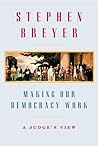
“The Court has a special responsibility to ensure that the Constitution works in practice. While education, including the transmission of our civic values from one generation to the next, must play the major role in maintaining public confidence in the Court's decisions, the Court too must help maintain public acceptance of its own legitimacy. It can do this best by helping ensure that the Constitution remains "workable" in a broad sense of the term. Specifically, it can and should interpret the Constitution in a way that works for the people of today.”
― Making Our Democracy Work: A Judge's View
― Making Our Democracy Work: A Judge's View
“The complexity of modern federal criminal law, codified in several thousand sections of the United States Code and the virtually infinite variety of factual circumstances that might trigger an investigation into a possible violation of the law, make it difficult for anyone to know, in advance, just what particular set of statements might later appear (to a prosecutor) to be relevant to some such investigation.”
― You Have the Right to Remain Innocent
― You Have the Right to Remain Innocent
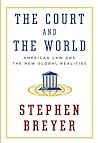
“questioning the lawfulness of a long-standing State Department policy specifying that the birthplace of an American citizen born in Jerusalem be given as “Jerusalem” rather than “Israel or Jordan” in his passport.43 The courts were asked to review this policy in light of a congressional statute requiring the State Department to describe the birthplace as “Israel” if the citizen so wished. Did the statute unconstitutionally interfere with the President’s power to conduct foreign affairs?44 The lower courts had decided that the case presented an unreviewable political question.45 But the Supreme Court held to the contrary. All the justices but one (and I was the one) considered the matter of deciding what the statute meant and whether it was constitutional to be “a familiar judicial exercise.”46 My colleagues believed the courts should not avoid the question by invoking the “political question” doctrine.47 They consequently sent the case back to the lower court for a decision on the merits.48 Though alone, I saw the case differently. “In the Middle East,” I wrote, “administrative matters can have implications that extend far beyond the purely administrative.”49 The secretary of state had argued that requiring her to stamp the word Israel on a passport would represent an “official decision by the United States to begin to treat Jerusalem as a city” under Israeli sovereignty.50 She maintained that upholding the statute would have significant foreign policy implications (a conclusion that others denied). Because of our inability to know the answer to this kind of dispute, I concluded that the merits of the case raised a political question, which the other two branches should resolve between themselves.51 What matters for our purposes, however, is that the other members of the Court disagreed with me. They thought that, even there, the doctrine did not prevent the Court from reviewing the merits of this foreign policy-related question. The upshot is that neither the classical view of Cicero nor the “political question” doctrine prevents today’s Court from reaching, and deciding the merits of, many questions in which security and civil liberties collide. But there are other doctrines, embodied in other cases, that have had much the same effect.”
― The Court and the World: American Law and the New Global Realities
― The Court and the World: American Law and the New Global Realities
“The Court’s insistence that judges and lawyers rely nearly exclusively on history to interpret the Second Amendment thus raises a host of troubling questions. Consider, for example, the following. Do lower courts have the research resources necessary to conduct exhaustive historical analyses in every Second Amendment case? What historical regulations and decisions qualify as representative analogues to modern laws? How will judges determine which historians have the better view of close historical questions? Will the meaning of the Second Amendment change if or when new historical evidence becomes available? And, most importantly, will the Court’s approach permit judges to reach the outcomes they prefer and then cloak those outcomes in the language of history?”
― New York State Rifle & Pistol Association, Inc. v. Bruen
― New York State Rifle & Pistol Association, Inc. v. Bruen
“It is possible that the critics of cross-referencing worry that the practice of citing foreign decisions will lead American judges to decide cases not through legal analysis but through “nose-counting”—that is, tallying up the number of countries on each side.19 There is a further worry, not entirely unfounded, that foreign opinions are subject to misunderstanding, because American judges are unlikely to grasp the foreign contexts in which those decisions arise.20 Moreover, even if the decisions of foreign courts do not bind American judges, they can influence them—indeed, that is the very aim of the cross-referencing practice. Finally, those who see judges throughout the world as belonging to the same social caste—one sharing generally “leftish” political views, and perhaps including state court judges, law professors, and lawyers generally—may not believe that this influence is salutary. Wielded by those whom Americans have virtually no voice in choosing, this influence, it is feared, could easily get out of hand, undermining basic American democratic values.21”
― The Court and the World: American Law and the New Global Realities
― The Court and the World: American Law and the New Global Realities
“In this country, amid the clash of arms, the laws are not silent. They may be changed, but they speak the same language in war as in peace. It has always been one of the pillars of freedom, one of the principles of liberty for which…we are now fighting, that the judges…stand between the subject and any attempted encroachments on his liberty by the executive, alert to see that any coercive action is prohibited in law.100”
― The Court and the World: American Law and the New Global Realities
― The Court and the World: American Law and the New Global Realities
“Ironically, the only two “relevan[t]” metrics that the Court does identify are “how and why” a gun control regulation “burden[s the] right to armed self-defense.” In other words, the Court believes that the most relevant metrics of comparison are a regulation’s means (how) and ends (why)—even as it rejects the utility of means-end scrutiny.”
― New York State Rifle & Pistol Association, Inc. v. Bruen
― New York State Rifle & Pistol Association, Inc. v. Bruen
“be “a familiar judicial exercise.”46 My colleagues believed the courts should not avoid the question by invoking the “political question” doctrine.47 They consequently sent the case back to the lower court for a decision on the merits.48 Though alone, I saw the case differently. “In the Middle East,” I wrote, “administrative matters can have implications that extend far beyond the purely administrative.”49 The secretary of state had argued that requiring her to stamp the word Israel on a passport would represent an “official decision by the United States to begin to treat Jerusalem as a city” under Israeli sovereignty.50 She maintained that upholding the statute would have significant foreign policy implications (a conclusion that others denied). Because of our inability to know the answer to this kind of dispute, I concluded that the merits of the case raised a political question, which the other two branches should resolve between themselves.51 What matters for our purposes, however, is that the other members of the Court disagreed with me. They thought that, even there, the doctrine did not prevent the Court from reviewing the merits of this foreign policy-related question. The upshot is that neither the classical view of Cicero nor the “political question” doctrine prevents today’s Court from reaching, and deciding the merits of, many questions in which security and civil liberties collide. But there are other doctrines, embodied in other cases, that have had much the same effect.”
― The Court and the World: American Law and the New Global Realities
― The Court and the World: American Law and the New Global Realities
“As we have seen, despite holdings by the European Court of Justice that EU law trumps member-state law, many national courts have insisted on retaining the final word as to whether a rule of European law conforms to their own constitutional requirements. And if this is so among nations committed to a measure of political and economic union, how much less likely is foreign law to impinge upon the sovereignty of one not so encumbered?”
― The Court and the World: American Law and the New Global Realities
― The Court and the World: American Law and the New Global Realities