Goodreads helps you follow your favorite authors. Be the first to learn about new releases!
Start by following Charles D'Ambrosio.

Showing 1-30 of 56
“Where exactly do you put your hands on somebody who hurts everywhere?”
― The Dead Fish Museum
― The Dead Fish Museum
“My ideal life is a quiet one. I like to read, to sit still in the same chair, with the lampshade at a certain angle, alone, or with Meagan nearby, and now and then, if I'm lucky, I'll come across a lovely phrase or fine sentiment, look up from my book, and feel the harmony of some notion, the justice of it, and know that everything is there. That's life to me, those privately discovered moments. ”
― The Dead Fish Museum
― The Dead Fish Museum
“her knees, which looked, in the faint blue light, as though they'd been carved by water from a bar of soap.”
― The Dead Fish Museum
― The Dead Fish Museum
“I've often thought that the unit of measure that best suits prose is the human breath”
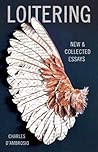
― Loitering: New & Collected Essays
― Loitering: New & Collected Essays
“it’s nearly impossible to convey our deepest passions yet damned easy to share what’s dullest and worst about ourselves.”
― Loitering: New and Collected Essays
― Loitering: New and Collected Essays
“Yeah, well, I wanted to be a screenwriter, and guess what? I am one. That's the other tragedy in life.”
― The Dead Fish Museum
― The Dead Fish Museum
“You want to find your self in the flow of time, miraculously relieved of your irrelevance . . . I saw the pursuit of historical beauty, the yearning for those higher essences other people had staked their lives on, as the hope for some kind of voice, a chance to join the chorus. I was mad for relevance, connection, some hint that I was not alone. I started scribbling in notebooks in part just so I’d have an excuse, a reason for sitting where I sat, an alibi for being by myself.”
―
―
“Being suicidal is really tiring. A lot of suicides are so lacking in affect and so lethargic that they aren’t able to kill themselves until their mood improves—spring, for that reason, has the highest rate of what people in the business call “completed” suicides.”
― Loitering: New & Collected Essays
― Loitering: New & Collected Essays
“...the boy saw faces disinigrate before his eyes, faces that fell to pieces, then disappeared, leaving a hole.”
― The Dead Fish Museum
― The Dead Fish Museum
“The canker of self-consciousness has been long in me, so like a lot of writers I not only do a thing, I see myself doing it too—it’s almost like not being alone. That morning our hero skipped in his skivvies down to the shore of the sea . . . it was dark . . . the fog . . . Storytelling!”
― Loitering: New & Collected Essays
― Loitering: New & Collected Essays
“It's hard to kill yourself by taking Tylenol. You die from liver failure, which takes a long time...”
― The Dead Fish Museum
― The Dead Fish Museum
“By the strident and aggressive tenor of the talk you couldn’t tell if this Bonnie Hart entertained any doubt, then or ever, she was so careful not to cross herself, so careful to arrange her moral outrage along the lines of least resistance. In a sense the whole program was about Hart rendering the round world flat and endorsing lopsidedness, halfness. This seemed a crude and retrogressive project, since what really distinguishes us from apes is not the opposable thumb but the ability to hold in mind opposing ideas, a distinction we should probably try to preserve. But these days you get the impression people think it’s kind of recreant to waver, as if by feeling and expressing, or worst of all admitting, doubt and uncertainty, you’re being disloyal to a guiding idea.”
― Loitering: New and Collected Essays
― Loitering: New and Collected Essays
“We wake out of our dreams and wonder where the blood in our hands came from.”
―
―
“Alone, you're vastly outnumbered; but in the company of another, by some weird miracle of human math, the odds seem wonderfully improved in your favor.”
―
―
“What kind of damage is done to our ability to love or understand and thus fully judge one another when daily we’re encouraged to forget that people are people and view them instead as so much pasteboard, scenery, clutter, generalized instances (of murder, of rape, of embezzlement, etc.)?”
― Loitering: New and Collected Essays
― Loitering: New and Collected Essays
“We are more intimately bound to one another by our kindred doubts than our brave conclusions.”
―
―
“You all have stories, Sandy said. And we have secrets”
― The Dead Fish Museum
― The Dead Fish Museum
“She sighed. Ignatius, do you know what the opposite of love is?
Hate, I said.
Despair, Sister said. Despair is the opposite of love.”
― The Dead Fish Museum
Hate, I said.
Despair, Sister said. Despair is the opposite of love.”
― The Dead Fish Museum
“And while of course everyone, even the most wrecked and destitute among us, has a unique personal history, the problematic nature of trying to gather information about people who’ve severed too many basic ties is this—that in a sense we truly have history only insofar as it’s shared, and too much uniqueness really leads away from individuality to anonymity, the great sea of the forgotten.”
― Loitering: New and Collected Essays
― Loitering: New and Collected Essays
“Hatred’s destination is boredom, and boredom is perhaps a rebellion against time; it’s the finished putting up a fight with the end.”
― Loitering: New and Collected Essays
― Loitering: New and Collected Essays
“Loyalty—in its darkest form, which left so much death as its legacy to the twentieth century—rids the divided self of anxiety and guilt, so that murder smiles.”
― Loitering: New and Collected Essays
― Loitering: New and Collected Essays
“After the onslaught of loss, both personal and historical, do we really believe a good lunch and an aesthetic perception settles the matter?”
― Loitering: New and Collected Essays
― Loitering: New and Collected Essays
“Abstract love is the nosy neighbor of abstract hate; they see right into each other’s windows and they always agree on everything.”
― Loitering: New and Collected Essays
― Loitering: New and Collected Essays
“We shoot our heroes and enjoy peripeteia as a spectacle akin to sport and perhaps harshly disavowing the past protects us from the disappointment of our outsized hopes—who knows, really, but shifts in taste don’t fully account for the phenomenon. At any rate, nearly everything urgent and alive becomes doo-wop down the road, at least in this country’s pop culture, and along the way a somewhat self-hating irony lays waste not only to the work but to the desires it once carried. It’s like we die into adulthood.”
― Loitering: New and Collected Essays
― Loitering: New and Collected Essays
“Meanwhile, back in the real world, my first instinct is a sort of stupid ducking motion I’ve learned from the movies, and I have the sure sense I’m going to be shot in the neck, where I feel particularly exposed and vulnerable.”
― Loitering: New & Collected Essays
― Loitering: New & Collected Essays
“Every fundamentalism focuses on end times, and Armageddon is, in a sense, a rhetorical trope, an emphatic and overwhelming conclusion, meant to wrap up and make tidy the mistaken wanderings of history. For a fundamentalist the end is one of the forms desire takes, a passion no different from lust or avarice, intense with longing and the need for fulfillment and relief. It’s like they’re horny for apocalypse. They get off on denouements, which partly explains why Hell House never amounted to much more than a series of murderous conclusions. It focused only on that part of a story where life finds itself fated. Inside every act a judgement was coiled. Real people with their ragged and uncertain lives, their stumbling desires, their bleak or blessed futures, would only break into the narrative, complicating the story, dragging it on endlessly.”
― Loitering: New & Collected Essays
― Loitering: New & Collected Essays
“In a curious twist, I realize I always knew TV news seemed full of shit, but I never knew it was, in fact, full of shit.”
― Loitering: New and Collected Essays
― Loitering: New and Collected Essays
“Fourier believed the world would eventually contain thirty-seven million poets equal to Homer, thirty-seven million mathematicians equal to Newton, and thirty-seven million dramatists equal to Molière—although, he admitted, these were only “approximate estimates.”
― Loitering: New and Collected Essays
― Loitering: New and Collected Essays
“You know I worry," Drummond said.
"Especially when I talk about God."
"Yeah, especially."
"You believe."
"I do," Drummond said, although of late he wasn't sure that was true. "But that's different."
"There's only one true God," the boy said.
"I know."
"I was thinking of writing a symphony to prove it."
"You want some classical?" Drummond asked, reaching for the radio knob.
"Don't," Pete said.
"Okay, okay."
"I'd show how many ways, how many ideas all lead to one idea. God. I'd get the main structure, and jam around it. The whole thing could be a jam.”
― The Dead Fish Museum
"Especially when I talk about God."
"Yeah, especially."
"You believe."
"I do," Drummond said, although of late he wasn't sure that was true. "But that's different."
"There's only one true God," the boy said.
"I know."
"I was thinking of writing a symphony to prove it."
"You want some classical?" Drummond asked, reaching for the radio knob.
"Don't," Pete said.
"Okay, okay."
"I'd show how many ways, how many ideas all lead to one idea. God. I'd get the main structure, and jam around it. The whole thing could be a jam.”
― The Dead Fish Museum
“what really distinguishes us from apes is not the opposable thumb but the ability to hold in mind opposing ideas, a distinction we should probably try to preserve.”
― Loitering: New and Collected Essays
― Loitering: New and Collected Essays