Goodreads helps you follow your favorite authors. Be the first to learn about new releases!
Start by following Antonin Scalia.

Showing 1-30 of 101
“A Bill of Rights that means what the majority wants it to mean is worthless.”
―
―
“Tyrannies have long lists of rights. What they do not have is structural restraints on the power of government.”
―
―
“Interior decorating is a rock-hard science compared to psychology practiced by amateurs.”
―
―
“Be fools for Christ. And have the courage to suffer the contempt of the sophisticated world.”
―
―
“Grant Gilmore: “In Heaven there will be no law, and the lion will lie down with the lamb….In Hell there will be nothing but law, and due process will be meticulously observed.”
― Scalia Speaks: Reflections on Law, Faith, and Life Well Lived
― Scalia Speaks: Reflections on Law, Faith, and Life Well Lived
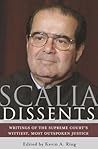
“A written constitution is needed to protect values AGAINST prevailing wisdom.”
― Scalia Dissents: Writings of the Supreme Court's Wittiest, Most Outspoken Justice
― Scalia Dissents: Writings of the Supreme Court's Wittiest, Most Outspoken Justice
“It is myopic to base sweeping change on the narrow experience of a few years.”
― Scalia Dissents: Writings of the Supreme Court's Wittiest, Most Outspoken Justice
― Scalia Dissents: Writings of the Supreme Court's Wittiest, Most Outspoken Justice
“Have the courage to have your wisdom regarded as stupidity. Be fools for Christ. And have the courage to suffer the contempt of the sophisticated world.”
―
―
“To invoke alien law when it agrees with one's own thinking, and ignore it otherwise, is not reasoned decisionmaking, but sophistry.”
― The Nine: Inside the Secret World of the Supreme Court
― The Nine: Inside the Secret World of the Supreme Court
“I attack ideas. I don't attack people. Some very good people have some very bad ideas.”
―
―
“You're looking at me as though I'm weird. My God! Are you so out of touch with most of America, most of which believes in the Devil? I mean, Jesus Christ believed in the Devil! It's in the Gospels! You travel in circles that are so, so removed from mainstream America that you are appalled that anybody would believe in the Devil! Most of mankind has believed in the Devil, for all of history. Many more intelligent people than you or me have believed in the Devil.”
―
―
“We had to do something [in Bush v. Gore], because countries were laughing at us. France was laughing at us.”
― The Nine: Inside the Secret World of the Supreme Court
― The Nine: Inside the Secret World of the Supreme Court
“argle-bargle.”
―
―
“The States may, if they wish, permit abortion on demand, but the Constitution does not require them to do so. The permissibility of abortion, and the limitations upon it, are to be resolved like most important questions in our democracy: by citizens trying to persuade one another and then voting.”
―
―
“Words change meaning over time, and often in unpredictable ways. Queen Anne is said (probably apocryphally) to have commented about Sir Christopher Wren's architecture at St. Paul's Cathedral that it was "awful, artificial, and amusing"—by which she meant that it was awe-inspiring, highly artistic, and thought-provoking.”
― Reading Law: The Interpretation of Legal Texts
― Reading Law: The Interpretation of Legal Texts
“In 1905, the Supreme Court of the United States applied the rule to the country’s founding document: “The Constitution is a written instrument. As such its meaning does not alter. That which it meant when adopted it means now.”
― Reading Law: The Interpretation of Legal Texts
― Reading Law: The Interpretation of Legal Texts
“As Justice Oliver Wendell Holmes put it: “We do not inquire what the legislature meant; we ask only what the statute means.”
― Reading Law: The Interpretation of Legal Texts
― Reading Law: The Interpretation of Legal Texts
“Mere factual innocence is no reason not to carry
out a death sentence properly reached.”
―
out a death sentence properly reached.”
―
“the triad of human perfection”: knowledge, judgment, and character.”
― Scalia Speaks: Reflections on Law, Faith, and Life Well Lived
― Scalia Speaks: Reflections on Law, Faith, and Life Well Lived
“It is in no way remarkable, and in no way a vindication of textual evolutionism, that taking power from the people and placing it instead with a judicial aristocracy can produce some creditable results that democracy might not achieve. The same can be said of monarchy and totalitarianism. But once a nation has decided that democracy, with all its warts, is the best system of government, the crucial question becomes which theory of textual interpretation is compatible with democracy. Originalism unquestionably is. Nonoriginalism, by contrast, imposes on society statutory prescriptions that were never democratically adopted.”
― Reading Law: The Interpretation of Legal Texts
― Reading Law: The Interpretation of Legal Texts
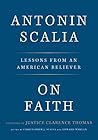
“My father made no such division between faith and reason. He understood that the act of faith does not mean the end of thought.”
― On Faith: Lessons from an American Believer
― On Faith: Lessons from an American Believer
“During the 1788 ratification debates, the fear that the federal government would disarm the people in order to impose rule through a standing army or select militia was pervasive in Antifederalist rhetoric. John Smilie, for example, worried not only that Congress’s “command of the militia” could be used to create a “select militia,” or to have “no militia at all,” but also, as a separate concern, that “[w]hen a select militia is formed; the people in general may be disarmed.” Federalists responded that because Congress was given no power to abridge the ancient right of individuals to keep and bear arms, such a force could never oppress the people. It was understood across the political spectrum that the right helped to secure the ideal of a citizen militia, which might be necessary to oppose an oppressive military force if the constitutional order broke down.”
― Scalia's Court: A Legacy of Landmark Opinions and Dissents
― Scalia's Court: A Legacy of Landmark Opinions and Dissents
“The story is told of a speech Teddy Roosevelt was once giving, in which he was repeatedly heckled by an Irishman standing in the back, who kept shouting, “I’m a Democrat!” Teddy, who was pretty quick-witted, finally decided he would engage the fellow, so he asked, “Why are you a Democrat?” And the heckler replied, “My grandfather was a Democrat, my father was a Democrat, and I’m a Democrat!” “Well,” said Teddy, “if your grandfather was a jackass, and your father was a jackass, what would you be?” “A Republican,” came the reply.”
― Scalia Speaks: Reflections on Law, Faith, and Life Well Lived
― Scalia Speaks: Reflections on Law, Faith, and Life Well Lived
“The Supreme Court of the United States has descended from the disciplined legal reasoning of John Marshall and Joseph Story to the mystical aphorisms of the fortune cookie. [Referring to pronouncement by Justice Anthony Kennedy in Obergefell v. Hodges: "The Constitution promises liberty to all within its reach, a liberty that includes certain specific rights that allow persons, within a lawful realm, to define and express their identity."]”
―
―
“Between the Restoration and the Glorious Revolution, the Stuart Kings Charles II and James II succeeded in using select militias loyal to them to suppress political dissidents, in part by disarming their opponents. Under the auspices of the 1671 Game Act, for example, the Catholic James II had ordered general disarmaments of regions home to his Protestant enemies. These experiences caused Englishmen to be extremely wary of concentrated military forces run by the state and to be jealous of their arms. They accordingly obtained an assurance from William and Mary, in the Declaration of Right (which was codified as the English Bill of Rights), that Protestants would never be disarmed: “That the subjects which are Protestants may have arms for their defense suitable to their conditions and as allowed by law.” This right has long been understood to be the predecessor to our Second Amendment. It was clearly an individual right, having nothing whatever to do with service in a militia. To be sure, it was an individual right not available to the whole population, given that it was restricted to Protestants, and like all written English rights it was held only against the Crown, not Parliament. But it was secured to them as individuals, according to “libertarian political principles,” not as members of a fighting force.”
― Scalia's Court: A Legacy of Landmark Opinions and Dissents
― Scalia's Court: A Legacy of Landmark Opinions and Dissents
“By judicial conservative, I mean a judge who does not advance any political or policy preferences, but whose approach to constitutional and statutory interpretation involves fidelity to the text of the Constitution and adherence to the original understanding of that document or to the intent of its drafters.”
― Scalia Dissents: Writings of the Supreme Court's Wittiest, Most Outspoken Justice
― Scalia Dissents: Writings of the Supreme Court's Wittiest, Most Outspoken Justice
“Jiggery-pokery.”
―
―
“The choice for the judge who believes the death penalty to be immoral is resignation, rather than simply ignoring duly enacted, constitutional laws and sabotaging death penalty cases. He has, after all, taken an oath to apply the laws and has been given no power to supplant them with rules of his own. Of course if he feels strongly enough he can go beyond mere resignation and lead a political campaign to abolish the death penalty”and if that fails, lead a revolution. But rewrite the laws he cannot do.”
―
―
“Mandatory words impose a duty; permissive words grant discretion.”
― Reading Law: The Interpretation of Legal Texts
― Reading Law: The Interpretation of Legal Texts
“A traditional and hence anticipated rule of interpretation, no less than a traditional and hence anticipated meaning of a word, imparts meaning.”
― Reading Law: The Interpretation of Legal Texts
― Reading Law: The Interpretation of Legal Texts