Daniel M. Russell's Blog
November 26, 2025
SearchResearch Method: Control-F for reality (finding books on your shelves)
Ever lose a book on your shelves?

I spent an hour tearing my personal library apart in a desperate search. Ever happen to you? You know, the search for the one book you know you have, but can't find?
Happens to me all the time. I have several bookshelves, totaling around 200 linear feet of books (61 meters). And that's not even counting the bookshelves in secondary storage in the garage.
So, like many of you, I find myself searching my personal stacks for a book by hand, one at a time.
This seems like a classic SearchResearch problem. There must be a better way.
Yes, I could create a personal card catalog or personal book database. And, admittedly, making such a thing used to be a huge hassle. (It's much easier these days with personal catalog apps Libib or LibraryThing.)
New Solution--Use AI to Search Your Shelves: I was playing around with Gemini's text recognizer the other day when it occurred to me that maybe we could use Gemini to scan our bookshelves.
Here are two images of MY book collections. (Don't judge me for neatness, organization or content!)
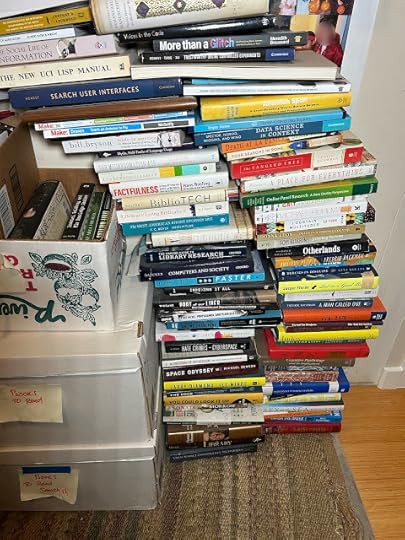 Yes, I know there's a box labeled "Books to Read." Don't judge.
Here's what I did to allow me to Control-F for a book on my shelves. Just uploaded the images, and asked:

That was pretty damn impressive!
If you look at the images, the text on the spine of "Field Guide.." is partly hidden by the book above.
Not only did the AI find the book, but Gemini also gave me directions to the book ("..top shelf, far right-hand side, third book down, with a blue spine, directly underneath Birds of the San Francisco Bay Region").
That gave me the notion to ask more about this collection of books.

This list is complete (I checked!) and as we saw, Gemini gives general directions to the locations of the piles and shelves. Here you see "Image 1 (Wooden shelves)", but later on Gemini tells me where the other books on with directions like "Top Shelf (center horizontal stack)" and "Stacks and boxes (left stack)."
That's about as good of directions as you can expect.
What's more, you can ask questions about your collection:

Or you can ask about your book organization:

And you can ask for some personal reflection... what does Gemini think about you as a reader?

FWIW, it seems Gemini gave me a pretty accurate analysis of my reading habits as seen by these shelves. It noted that I am:
"...obsessed with how humans organize and find information" along with "...you appear to be an academic or a specialized researcher (possibly in Computer Science or Cognitive Science) who is deeply concerned with the "User Experience" of reality. You want to know how to navigate the flood of information in the digital age without losing touch with the biological reality of the physical world."
Gemini kindly concludes this bit of analysis with a suggestion:
"Recommendation: Entangled Life by Merlin Sheldrake? It treats fungi as a biological information-processing network, which fits perfectly in the center of your Venn diagram."
Hope you find this a useful method to let you manage your physical inventory of books.
Question for you: I have to admit I've only done this with 7 different photos of my shelves and stacks. I'll be curious if you try it with 20 or more images. Will Gemini track them all? Will it be as useful? Let us know in the comments!
Also let us know if you ask any interestingly different (and revealing) questions about your bookshelf!
SearchResearch Lessons
1. Taking pictures of your bookshelves can be incredibly useful for locating otherwise lost items. I have to admit that I did this initially out of desperation. I'd lost a book I knew I had (the aforementioned Roger Tory Peterson "Field Guide")... and was able to find it.
2. Keep your book spines visible. I later noticed that a couple of my books don't appear in this list because they were occluded by pieces of paper drooping down from above. Finally, a real rationale for keeping your spines visible!
Keep searching.


November 24, 2025
Answer: How good is AI at recognizing images? What should you know?
Search by image is powerful...
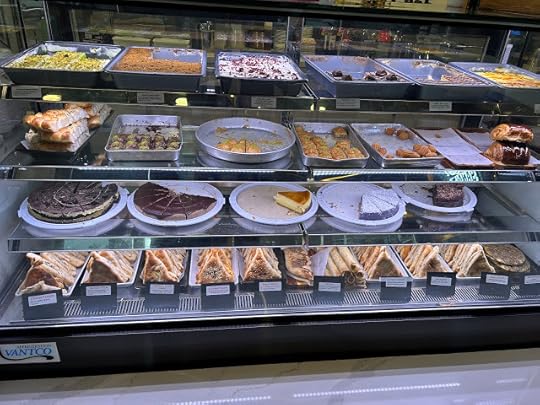 Remarkable desserts. What are they?
 .... but you need to know what it can do (reliably) and what it can't do (unreliably).
Let's talk about what AI powered image search is capable of doing. Here are the questions from last week:
1. The image above (the dessert display) is from a cafe. Can you figure out what KIND of desserts these are? Yes, I know you can read the labels, but these are from a particular region of the world. What kind of cafe is it? (Image link to full image.)
The obvious thing is to do a Search-By-Image (which we last discussed in January, when searching for the El Jebel Shrine, aka the Sherman Event Center in Denver. That was just 11 months ago, but the world has shifted since then.
We can download the image (with the link above) and do an image search (no longer called "reverse image search" since the function no longer does "reverse" image search, but tries to do an analysis of the image). You'll get this:

This is nice, but it's NOT a "reverse image search" in the way we used to think of it.
To get that function, I'd use Bing image search, which gives you a result like this:

In this case, there's no exact match for the image, but there are a lot of similar Middle Eastern restaurants and cafes full of yummy pastries.
On the other hand, the Google answer is interesting. There's a good description of the contents of the pastry case, but over on the right side in the right-hand side panel you'll see a suggested "possibly relevant" link to Sana'a Cafe in Oakland.
It's a bit of a spoiler, but this IS an image of the pastry case at Sana'a Cafe in Oakland, California! The big question for us: How does it know? This is definitely NOT the closest Middle Eastern cafe to my house (which is where I'm writing from).
I checked to see if it was using the GPS location stored in the photo.
(Remember that you can pull the lat/long of the image? Previous SRS discussion about EXIF and the metadata attached to your images.)
To check, I edited the image metadata to alter the lat/long and re-ran the query--and got the same answer!
So what IS going on? Answer: this image has a close-match to an image found in Reddit about the Sana'a Cafe in Oakland!
Notice that you can get to the "similar images" section by simply scrolling down the page to get to "Visual matches," where 3 of the top 5 visually similar images are from Sana'a Cafe. (Note that these images are really similar to the way Image Search used to work--it would show you the nearest matches.)

That's great--at least we now know how to get the old search behavior to function.
Back on the first AI-augmented search page, you probably noticed that there's an option to "Show more." Clicking on this button will give you a more detailed analysis of the image. It looks like this:

So.. yeah. Not a lot of help here--this is just a repeat of what we saw in the first frame. But what happens if you click the "Dive deeper in AI Mode" button?

Ooops. Now Image Search is going off the rails. How does Google know that it's the Levant dessert cafe and bakery? Completely unclear. And no amount of asking it would give me any useful chain of reasoning.
Rather than using plain Google Image Search, I thought I'd give Gemini a chance. One MIGHT hope that the answers would be the same (it's the same company, right?). So I uploaded the image to Gemini and asked it to describe the image. No surprise, it gave me more-or-less the same answer.
But when I asked Gemini a follow-up questions [where is this dessert case located] the Google train goes off the rails and into the river where it crashes and burns.
This is the equally incorrect response, although incorrect with a florid explanation that's completely wrong:

As much as I admire the idea of reading the reflected text of the logo (which reminds me of what we did in SRS 2012 ("Where are you?"), in this case, it's totally wrong! I can't see the "Kunafas" anywhere in the image (can you?).
So I asked Gemini where the "Kunafas" came from. Here's what I got when I asked:

Seems good, right? But let's look at the highlighted region carefully, shall we? Here, I put the original image and the Gemini-created image side-by-side.

As you can see, the "reflected letters" are clearly--at least to you and me--the letters of the cafe's name, Sana'a. The "F A N U K" are all hallucinated.
Even more bizarrely, I was curious and re-did the original query on regular Google Image Search, using the same image as before and asked Google Image search to describe the image. This time, it suggested that the place might be the Sana'a Cafe... but again, not reasoning about why. I assume it's using the "related images" feature and extracting the name from the Reddit thread images. This is bizarre because it's NOT the same answer from earlier!

Bottom line: You absolutely have to check everything that Image Search tells you. Don't just accept it as truth--it could be very far from the truth.
2. Here's a photo I took while on a walk in San Francisco the other day. What a strange, strange place! It's clearly supposed to have a statue on top of the pedestal. What happened here? Why is it bereft? (Image link)
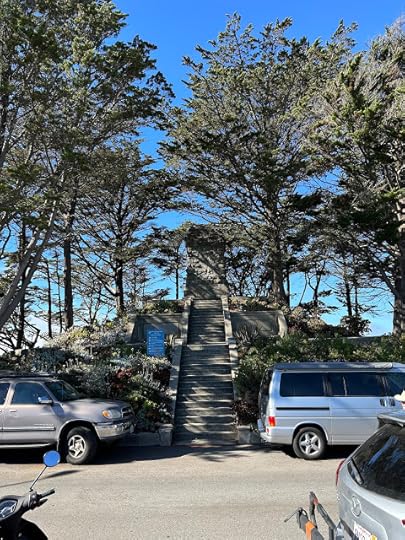
I did the same process as before: regular Image Search on Google and get this as an answer:

The AI overview is completely wrong. This is NOT at Lands End park at all... everything in this result is wrong.
On the other hand, the "Visual matches" section actually gives good results. This IS "Mount Olympus" (the San Francisco version).
So, let's try again with the fancy Gemini-powered AI image identification process. What do we get here?

The first answer ("...likely the Stairs to Mount Olympus Park in San Francisco..") IS correct, while the "another possibility is the One Thousand Steps Beach Access in Santa Barbara" is quite wrong.
As before, if you ask Gemini directly (by uploading the picture and asking "where is this image"), you get another kind of wrong answer:

At least it got the trees right (they are Monterey Cypress), but everything else is seriously wrong.
First off, there IS NO Hilltop Monument at The Sea Ranch. (I've been there quite a bit, and I'm 99.9% sure such a place doesn't exist.) Google might mean the Sea Ranch Chapel, but it's not called the Hilltop Monument, and it's not on a hilltop in any case--it's in the flatlands.
I thought maybe I'd give ChatGPT a chance, but that didn't work either:

Again with the Lands End? The only connection is the Lands End also has a lot of Monterey Cypress, but there's no other connection here. And there IS a monument to the USS San Francisco at Lands End, but again, it has nothing to do with this picture. Hallucinations abound.
And, once again, the "Visual Matches" section of the SERP gives you a much better result than the AI parts of the result:

But you, dear Human, can easily pull the GPS lat/long from the EXIF metadata to find this in Google Maps:

And then, a regular Google search [ Mount Olympus Park San Francisco ] will teach you that Mount Olympus was a park in more-or-less the center of San Francisco, with a pedestal, atop which stood a dramatic statue, "The Triumph of Light." Mysteriously, the statue (made of bronze and weighing probably 500 pounds) vanished from the pedestal years later and has never been found. (See the backstory here at FoundSF.org)
The statue that was there:
 Mount Olympus in SF, with the original statue that mysteriously disappeared sometime after 1955. P/C San Francisco History Center, San Francisco Public Library, via OpenSFHistory.org
 And nobody knows where--or even exactly when--the statue disappeared. The city took it's collective eye off the ball and it just kind of went-away one day in the mid-1950s.
Bottom line: Don't trust the AI analysis. Do the research yourself.
3. Here's a great picture of a cloud that Regular Reader Ramon sent in for identification. What's going on here? (Image link)
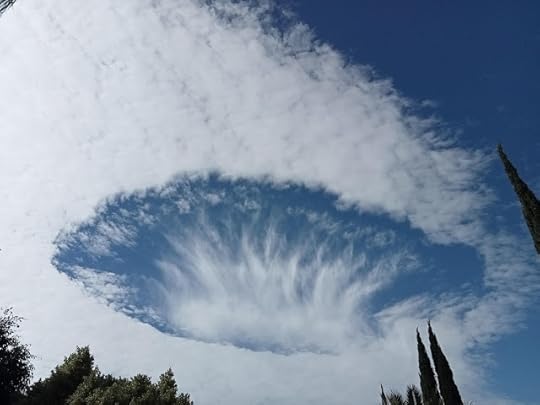 P/C SRS Regular Reader Ramon
A regular Google Image search tells us that this is a fallstreak hole, also known as a "hole punch cloud."

As you'd expect, I checked this out by doing other searches (e.g., for [fallstreak cloud]) and looking at the collection of remarkable and beautiful photos. In this search, the AI result and "Visual matches" images are all pretty good.
And now we know that the fallstreak cloud is caused by supercooled water in the clouds suddenly evaporating or freezing, possibly triggered by passing aircraft passing through the cloud and causing a chain reaction. Such clouds aren't unique to any one geographic area and have been seen in many places.
Bottom line: This worked quite well--not a huge surprise as the image is very visually distinct and there are literally thousands of posts with images describing what this is.
4. This little bridge is in a lovely town somewhere in the world. Can you figure out where it is, and when it was built? (Image link)
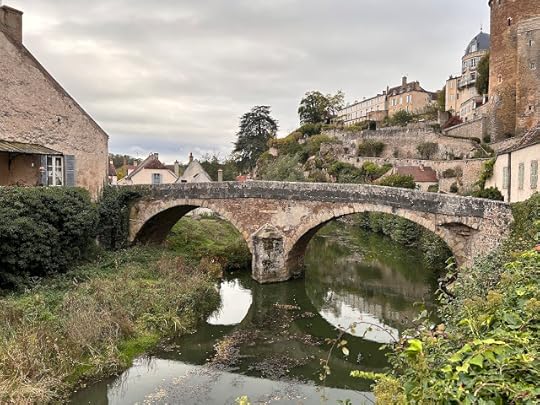
This is a case when image search works quite well. Luckily, this is a famous bridge with LOTS of photos taken over the years.
Yes, it's the Pinard Bridge, located in Semur-en-Auxois. It (and much of the town) date to the 12th century. But it's really hard to determine when it was first built. It will probably take some time searching in old French histories to figure out the original date. But since it's in the river valley that historically floods, it's been rebuilt many times.

Regular Reader Arthur Weiss points out that the city's website of Semur-en-Auxois tells us that "The Pinard bridge, or Pignard on the Belleforest view, provided access to the Pertuisot mountain pasture. It was destroyed or extensively damaged on several occasions by floods, including those of 1613, 1720, 1765 and 1856."
(I also found this website with the search [ville-semur-en-auxois pont pinard] -- this is one of those cases when searching in the local language really helps.)
So while the date of first construction was probably in the 12th or 13th century, it's been rebuilt so many times that little of the original bridge is now left in place. It is, as we would say today, and example of the Ship of Theseus (if Theseus' ship is replaced plank by plank over a long time until all pieces of wood have be replaced by newer wood, is it the same ship?).
1. Be very, very cautious about AI generated results. As we saw, the results can be very, very wrong. My advice: Try the AI methods, but double-check everything. You cannot trust that the answer is correct.
2. Note that "Visual Matches" section of Image search (often below the fold) has the "old style" most similar images from the web. That section also often has great clues to the actual thing you seek. Be sure to check that part of the search results as well.
Keep searching!
November 13, 2025
SearchResearch (11/13/25): How good is AI at recognizing images? What should you know?
Recognizing images is an impressive AI feat. But...
Remarkable desserts. What are they? .... it's true that the state of the art of image recognition has changed over the past several years. It gets better, it gets worse, the functionality changes, some things are removed, others are added.
But it's still an amazing thing... IF you know what works and what doesn't now. I'm afraid that means you have to stay up on what's going on in the world of image search. So let's dive into it...
Here are a few images that I'd like for you to identify--the key question for each is what's going on in this image? What is it? (And if you can, where is it?)
For each image I've given you a link to the FULL image (no sneaky reduction in resolution or removal of metadata, as our blogging tools tend to do). I recommend you use that image for your search.
1. The image above (the dessert display) is from a cafe. Can you figure out what KIND of desserts these are? Yes, I know you can read the labels, but these are from a particular region of the world. What kind of cafe is it? (Image link to full image.)
2. Here's a photo I took while on a walk in San Francisco the other day. What a strange, strange place! It's clearly supposed to have a statue on top of the pedestal. What happened here? Why is it bereft? (Image link)
3. Here's a great picture of a cloud that Regular Reader Ramon sent in for identification. What's going on here? (Image link)
P/C SRS Regular Reader Ramon4. This little bridge is in a lovely town somewhere in the world. Can you figure out where it is, and when it was built? (Image link)
The point of this week's Challenge is to give you a bit of familiarity with the different image reco tools. They're sometimes called "Reverse image search" tools, but as you'll find out, they have very, very different capabilities.
When you write in to let us know what you found, be sure to (a) tell us what tools you tried, (b) if they worked well, and (c) whether or not you find the answer believable.
Next week I'll write up my findings and summarize what everyone else found... along with a description of the tradeoffs involved in the different tools.
Keep searching!
November 7, 2025
SearchResearch (11/5/25): Pro tips on using AI for deep research
A few friends...
 Gemini's conception of [hyperrealistic image of scholar doing deep research].
 Not sure it's hyperrealistic, but definitely interesting.
... have recently written posts of their own about using AI for deep research. Since they've got some great nuggets, I'm going to leverage their writings and give a quick summary of the top methods for doing high quality deep research with LLMs.
In this post, I'm drawing extensively on a post written by Maryam Maleki (UX Researcher at Microsoft) for people doing product research: How to Do High-Quality AI Deep Research for Product Development Here, I've generalized it a bit and given it my own flavor.
Here are the top few tips about getting Deep Research mode to work well for you:
Be clear about what you want.
Keep in mind: You want credible content. Prompt it that way.
In order for the AI to work, you need to tell it what kind of sources you think are reliable and credible. If you can, give it a list of several resources as guidance.
In these patterns below, items in { } and italics are variables. You need to pop in the values you need to get the effect you want.
Pattern:
[ Do deep research on {TOPIC}. Generate {n} credible sources with links that can be used for this research.
Prioritize: {BOOKS / ACADEMIC PAPERS / CASE STUDIES}
For each source, provide: the Title, the URL, a short snippet about why it's relevant, tell me the Source type. ]
Example:
[ Do deep research on Rocky Mountain locusts. Generate 10 credible sources with links that can be used for this research.
Prioritize: academic papers
For each source, provide: the Title, the URL, a short snippet about why it's relevant ]
Doing this in Gemini will create a 4,000 word essay about Rocky Mountain Locusts. It will ALSO give you section VII, which has Ten Credible Sources for Rocky Mountain Locust Research. It also creates a reference list for the entire document, with section VII containing the best of the entire list.
By contrast, doing this in ChatGPT 5/Thinking or Claude Sonnet 4.5 gives you exactly what you asked for--they give you the list-of-ten.
Review the AI-generated results for qualityI note in passing that the Gemini-created document is pretty good, but the list of 10 papers was a little mixed in quality. (One paper was very tangential, one paper was just a link to Wikipedia, and one paper wasn't accessible at all.) I clicked through all of the links to verify that they were real and on-target.
If the results aren't what you want, feel free to iterate until you get the result quality you need.
Press enter or click to view image in fullAsk for contrary points of view
(don't just confirm!)
Research isn’t just about collecting references — it’s also about understanding the space, both in terms of what you know and what counterarguments you might want to consider.
In reading through the Rocky Mountain Locust collection, you'll notice that one of the main hypotheses about the disappearance of the locust is that the rangeland where it lived and bred was increasingly plowed up for farmland.
You should ask about other opinions:
Pattern:
[ GIve me different explanations for {TOPIC}. Are there other points of view that have been considered in the literature?
For each source, provide: the Title, the URL, a short snippet about why it's relevant. ]
Example:
[ Give me different explanations for why the Rocky Mountain Locusts disappeared. Are there other points of view that have been considered in the literature? For each source, provide: the Title, the URL, a short snippet about why it's relevant. ]
Interestingly, Gemini merely did an okay job of this step--ChatGPT was reasonably good, but Claude did a spectacular job of highlighting 11 different hypotheses about what happened. (To see Claude's output, here's the document.) This also suggests that you should get multiple AI opinions to improve the quality of your research!
Double Check Everything
We still live in a hallucinatory world. As great as AI generated content is, I still double check everything. In her post, Maryam has a great set of questions (below). This is what is on my mind as I read through EVERY claim and EVERY linked document. You should too.
Source Quality — Is it recent, reputable, and methodologically sound?Fact Containment — Only use approved notes/sources. Triangulation — Every claim needs at least two independent sources.Original-Source Tracing — Don’t rely on LinkedIn slides, Twitter posts, or a quote in a blog. Find the earliest credible publication.Hallucination Sweep — Audit the final draft. Remove or qualify any claim not directly supported.
When using AI for deep research, keep in mind 3 heuristics:
1. Be clear about what you want. Not just in content, but in form and quality. Be explicit--give examples--ask for everything you want.
2. Review the results for quality. Do this step immediately, and change the prompt if need be to get what you really seek. Iterate!
3. Ask for contrary points of view. Don't give in to confirmation bias--proactively ask about other perspectives on the questions you're researching.
4. Double check everything. No surprise here, but be sure to leave enough time to do this. Don't just copy/paste what you've found.
Thanks again to Maryam for her excellent post.
Keep searching!
October 29, 2025
SearchResearch (10/29/25): The 1 trick you need to know to use AI for deeper, better reading
I absolutely adore...
 P.G. Wodehouse. P/C Wikimedia
... the writings of P. G. Wodehouse. Whenever I need a lift in the old spirits, I pluck a volume from the bookshelf of Wooster and Jeeves, I read a bit, and in the blink of an eye, all is right with the world. As Wodehouse might say, God is in His heaven and the celestial choirs sing again.
If you don't know Wodehouse, drop what you're doing and read a short story or two. Better yet, pick up a Wodehouse novel and dive in.
I'd recommend Right Ho, Jeeves, which is an excellent place to start.
The writing is droll and the language--especially the language--just tickle my humorous bones.
BUT, Wodehouse is satirizing the language and behaviors of the early 1900s upper class. They are a rich vein to mine, but roughly once each page, there is a phrase or word that escapes my understanding or offers up a nuance that completely misses my brain.
For instance:
Butter-and-egg man (An investor with a lot of money)
Absquatulate (To depart suddenly or abscond)
Cattywampus (Used to mean something that was directly across from something else, as opposed to its modern meaning of being askew or in disarray)
Those are fairly easy to look up. But the more tricky phrases are things like:
"Only that she’s a blister.”
Or...
"Deprived of Anatole’s services, all he was likely to give the wife of his b. was a dirty look."
I know what a blister is, but the obvious definition makes no sense here. And what is "...the wife of his b."? That's clearly not the end of a sentence, but feels like an abbreviation for something--but what?
Here's where your friendly, local LLM comes in handy. Here's what I did to figure out each expression: I asked an LLM (Gemini in this case) to explain it to me in the context of the book...

And when you need to be even more specific, give the name of the story in the context you provide to the LLM.

In both of these cases, it's not clear that any amount of contextual reading would have taught me these meanings.
This is a brilliant use of an AI to augment your ability to deeply read a text.
On the other hand, use caution: AI still makes mistakes, and they can be subtle.
Here I asked a question about the mention of a device in a book written about the same time as Wodehouse:

This completely checks out. (Of course I double check everything. Don't you?) The Veeder box is indeed a type of odometer made at the time.
However... see this next part of the explanation:

That mention of "By the time Evelyn Gibb and her husband were bicycling the West Coast in 1909..." is completely made up. The book is NOT about Evelyn Gibb and her husband, but is about Vic McDaniel and Ray Francisco, friends who cycled 1,000 miles from Santa Rosa, California, to Seattle, Washington, for the Alaska-Yukon-Pacific Exposition. The author (Evelyn Gibb) is Vic's daughter, not his wife.
SearchResearch Lessons
1. Using an AI to give insights into obscure texts can be incredibly handy. By virtue of having ingested so much text, an AI can often give you a perspective about a fragment of text that you don't understand.
2. CAUTION: Check everything--there are still hallucinations about! Double check everything!
Hope you find this useful SRS method!
Keep searching.
October 24, 2025
SearchResearch (10/24/25): The shifting of SearchResearch
I've noticed a subtle shift.

The longer I write this blog, SearchResearch, the more changes I see. Content on the web changes, the tools we use change--the whole ecology of writer, reader, producer, and consumer has dramatically shifted since I began writing back in January, 2010. That was 15 years ago. In Internet years, that's about 1500 years. (I figure Internet years are about 100-to-1 with Human years.) I've written 1478 posts and we've had 6.23 million reads. You have written around 10 comments / post, for which I thank you.
In my first blog post I wrote:
Congrats. We've done that. The Joy of Search came out in 2019 to reasonable success. I'm happy about how well it worked as a book.I have to warn you before you start reading: In the back of my head, I want something tangible to emerge from this. Ideally, a book, or a series of books, about how people search... how they research... and how they get good at doing this.
And I see that this blog is shifting a bit too.
As you've seen, our typical pattern is that one week I'll pose a Challenge--usually a question about some interesting aspect of the world that requires using a particular research skill that you, dear reader, need to figure out. Good news here, you figured out some deep skills.
Some of my favorites have been skills like knowing Control-F (the skill of finding text), using site: restriction (to search just within a particular website), or using deep resources like Google Books or the Newspaper archive.
But with the rise of AI tools to help out with doing deep online research, it seems that our skills need to shift as well. You still need Control-F, but I find myself using tools like site: less-and-less these days.
So... I think we need to shift the way the SRS blog will operate. As I wrote in 2010:
When you think about it, search is not something you're born with--there's no inherent, latent skills for research (the way there is, say, for walking or spitting). Some people are really good at it, others just never quite get the basics.
That's still really true--but more people know Control-F these days, and AI is doing a lot of the search-specific skill.
HOWEVER... I still find myself using somewhat more subtle online research skills. The technical problem for this blog is that it's hard to frame the skills in terms of motivating Challenges. So the blog is shifting a bit as well to try and communicate those sensemaking and deep research skills.
I WILL pose interesting Challenges from time-to-time when I just can't resist their siren call, just not every other week as we've been doing.
Instead, I want to point out some of the deep research skills we need to cultivate. And that will require me telling stories, rather than posing a research Challenge.
Bear with me as we try to figure out the new format. I'm confident that we'll find something that's deeply interesting and fun. Stay tuned as SRS starts a few experiments.
In my next post I'm going to point you to some people who are writing about this new, AI-linked research methods. That will be entitled, Key skills you need to have to be an effective online researcher and will be a collection of some posts by other folks who have good things to teach us as well.
Stay tuned. Keep reading, keep leaving comments....
And keep searching.
October 17, 2025
Answer: How can the same locust look so different?
It's difficult to understand...
 Rocky Mountain locust. P/C Wikimedia
... how variable the appearance of an animal might be. In this case, how can this particular insect--the Rocky Mountain locust--be so variable in appearence that biologists thought that the two different forms of the insect were actually different species?
So how could biologists mistake the two different looks of a locust for two different species?
1. How often has it happened that biologists have seen two (or more) species when it was really just one in different clothing? Can you find another case of two (or more) species being reconciled into one?
This seems like a great question for an LLM. When I copy/pasted this into Gemini, I learned that this happens more often than I thought. The Gemini answer talked about "lumping" and "splitting" a species definition--by "lumping together" two organisms that were thought to be different, and "splitting apart" organisms that look the same, but are actually genetically different.
That sounds right, but the words "lumping" and "splitting" are probably NOT what biologists call this process.
A quick query of: [what do you call it when biologists find that two different appearing animals are found to be the same species and they reclassify them in a new species name] taught me that biologists refer to this process (which happens a LOT), as synonymization. ("Synonymization" is the process of identifying and combining different scientific names that refer to the same organism. This happens when a species is described multiple times by different scientists, or when a species is reclassified into a different genus, or when different organisms are discovered to be variants of a common organism.)
I revised the question to learn about "splitting" and learned that this is just regular old speciation, which then leads biologists to a taxonomic revision in the textbooks.
This is often the result of cryptic species, which are species that appear identical but are reproductively isolated.
To find examples of "splitting" I asked the obvious query: [can you give me examples of organisms that seem very similar and were once thought to be one species, but are now understood to be multiple species?] and found several examples. The elephant in the room is obviously the African elephants...
 African elephant (Loxodonta africana). P/C K. Russell
Historically classified as a single species, the African elephant, has now been distinguished as two separate species: the African bush elephant (Loxodonta africana) and the African forest elephant (Loxodonta cyclotis). They have nearly identical appearances, but DNA analysis revealed them to be genetically distinct and reproductively isolated, with the forest elephant being slightly smaller and having straighter tusks.
And the converse: [can you give me examples of organisms that seem very different and were once thought to be different species, but are now understood to be just one species?]
 Leptocephalus, the larval form of Anguilla anguilla. Yes, they are transparent.
A lovely answer: For centuries, the transparent, ribbon-like leptocephalus larva was believed to be a separate species from the adult eel (Anguilla anguilla). It was only in the early 20th century that scientists realized the leptocephalus is the eel’s larval stage and not a different organism.
And when I asked about locusts in particular, I learned that for centuries, naturalists thought that the grasshopper and the swarming locusts were entirely different insects. (For the record, they also wrote that caterpillars and butterflies were completely different insects as well...)
The solitary form of the locust lives alone as a grasshopper, while the gregarious or swarming form appears during outbreaks. It's larger, brightly colored (often yellow and black), with longer wings, stronger flight muscles, and completely different behavior, preferring to fly in massive swarms.
They were so different in appearance and habits that early entomologists gave them different scientific names.
Then, around one hundred years ago (1921), Sir Boris Uvarov recognized that two locust species are one species but appearing in two different phases, a solitarious and a gregarious phase. This phenomenon of phase polymorphism, is now called polyphenism. (See a nice review paper on Uvarov's discovery, "One hundred years of phase polymorphism research in locusts.")
It turns out that under crowded conditions, young locusts experience tactile stimulation on their hind legs and undergo phase transformation, triggering massive physiological and behavioral changes. This transformation affects color, size, brain structure, metabolism, and social behavior, switching them from a solitary to a gregarious form — leading to the famous locust swarming behavior.
2. It's clear that organisms can have multiple shapes / patterns / colors (we've discussed this before in the context of plant mimicry). Can you find an organism that has a huge number of different appearances? Any idea WHY they have such variability? I put this question to Claude as [Can you find an organism that has a large number of variable appearances? That is, what is the most polymorphic organism?]
All of the AIs--Claude (and Gemini and ChatGPT)--gave variations on a good answer, pointing out that both the Great Mormon Butterfly (Papilio memnon) and certain snails (e.g., the Grove snail, Cepaea nemoralis) are famous for their polymorphism, leading biologists to classify the different forms as different species.
 Polymorphisms in Papilio memnon. P/C Wikimedia
The Grove snails have widely varying shells, which can be different colors (brown, pink, yellow) and have various banding patterns. These different morphs can look so distinct they puzzled early researchers, and the variety is controlled by a complex of closely linked genes.
 Polymorphism in Grove snails (Cepaea nemoralis). P/C Wikimedia
And there's the answer: there are many organisms with widely varying morphs--ants, bees, fish, snails, and locusts.
WHY this is so can be seen in the many shapes of dogs around the world. How can one species be SO variable in size, shape, and color, yet all be one species?
Another LLM query: [what are the genetic factors the cause extreme polymorphism in some species?] You can do that query yourself and read the details, but it boils down to this: there are a small number of genes that control a LOT of the variation in coat kind, coat color, size, muzzle shape, etc. With a great deal of selective breeding over the eons (by people), the variation has been amplified into the great number of dog varieties that we see today. (For lots of insights, see: Boyko, Adam R., et al. "A simple genetic architecture underlies morphological variation in dogs." PLoS biology 8.8 (2010).
Search Research Summary
1. The AIs worked well. One of the nice surprises of this Challenge is how well the LLMs answered each question. This is largely due to this being a not-especially controversial area--nobody bothers to push out pathological content about the genetics of insects or dogs.
2. Double check everything. HOWEVER... for each result I write about here, I double-checked each claim. In some cases I triple checked. It's just what you have to do these days.
On the upside, most of the explanations were quite good. (The business about "lumping" and "splitting" aside--those are common terms that work well, but are not terms of art.)
A few times I had to dive a little deeper into the topic area to fully understand what was going on. But that's a big part of The Joy of Search.
Hope you enjoyed this week's Challenge.
Keep searching.
October 8, 2025
SearchResearch Challenge (10/8/25): How can the same locust look so different?
Rocky Mountain locust. P/C Wikimedia... how variable the appearance of an animal might be.
Sure, people look very different around the globe, and both dogs and cats have wildly variable appearances. But in every case, you'd say that they're all of one species.
So how could biologists mistake the two different looks of a locust for two different species?
A bit of background here.
I've been reading Jeffrey A. Lockwood's brilliant book Locust: the devastating rise and mysterious disappearance of the insect that shaped the American frontier . (Basic Books, 2009.)
Part of the book tells the story of the Locust Plague of 1874. Locusts swarmed over an estimated 2,000,000 square miles (5,200,000 square kilometers) of the plains states in North America, causing millions of dollars' worth of damage.
Residents described swarms so thick that they covered the sun for up to six hours. The swarms of Rocky Mountain locusts (Melanoplus spretus) were larger than the state of California and comprised some 12.5 TRILLION insects.
They would eat grass, trees, even the clothes off people's backs.
But less than 30 years later, the entire species was extinct. Gone. Vanished.
That's the subject of Lockwood's book--how is it possible for such a vast number of insects to simply disappear?
 A cartoon of the locusts arriving in Nebraska
Laura Ingalls Wilder’s book, On the Banks of Plum Creek has a description of what it was like to live through the literal plague of locusts arriving on the farm:
Plunk! something hit Laura's head and fell to the ground. She looked down and saw the largest grasshopper she had ever seen. Then huge brown grasshoppers were hitting the ground all around her, hitting her head and her face and her arms. They came thudding down like hail.
The cloud was hailing grasshoppers. The cloud was grasshoppers. Their bodies hid the sun and made darkness. Their thin, large wings gleamed and glittered. The rasping whirring of their wings filled the whole air and they hit the ground and the house with the noise of a hailstorm.
You might think of this extinction as the most spectacular “success” in the history of economic entomology — the only complete elimination of an agricultural pest species. But it seems as if it was a total accident.
(For all the details, I encourage you to read Lockwood's book--a fascinating detective story of a past extinction. Also check out the Wiki articles Locust Plague of 1874 and Rocky Mountain locust. For more details, Lockwood has a short article about his sleuthing, The Death of the Super Hopper.)
But that's not our Challenge for this week. Instead, I want to focus on that first question I raised earlier--So how could biologists mistake the two different looks of a locust for two different species?
1. How often has it happened that biologists have seen two (or more) species when it was really just one in different clothing? Can you find another case of two (or more) species being reconciled into one?
2. It's clear that organisms can have multiple shapes / patterns / colors (we've discussed this before in the context of plant mimicry). Can you find an organism that has a huge number of different appearances? Any idea WHY they have such variability?
It's fascinating stuff--hope you enjoy reading about it as much as I did.
Be sure to tell us HOW you found the answers to this week's Challenge. Regular search? AI? If so, what prompts did you use... and how well did it work for you?
We want to hear about successes as well as disasters!
Keep searching.
October 3, 2025
Answer: What's the story with the greenhouses?
Greenhouses...
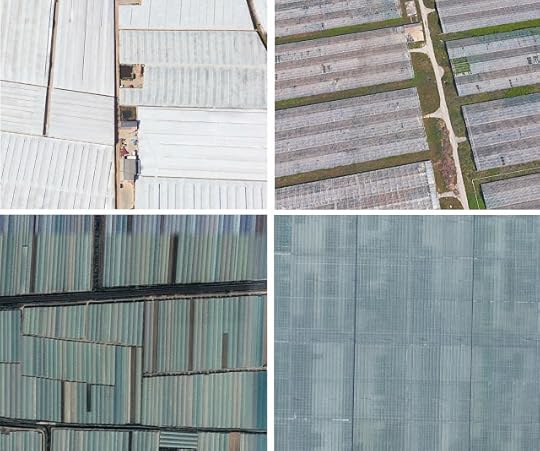
... come in two types--decorative (the ones with beautiful orchids and flowers for visitors to see) and functional ones (see the images above, for growing food and flowers).
In some places, (e.g., Weifang, China) greenhouses spread over more than 820 square kilometers.
Seeing all of these from the air sparked this week's Challenge with a few curious questions for you to ponder. Can you find the answers? If so, what did you do to discover the results?
I started with a simple:1. How long have greenhouses been around? If greenhouses date to around Roman times (as I've heard), what were the greenhouses made of?
[ history of greenhouses]
as a way to find reasonable resources and read from them directly. The Wikipedia article on Greenhouses tells of an early origin (30 AD) when the Roman emperor Tiberius needed a "cucumber a day" to keep him in the best of health. Clever people then made simple frames, "cucumber houses" glazed with either oiled cloth known as specularia or with sheets of selenite. That's according to the historical description by Pliny the Elder.
Oiled cloth I understand, but selenite? It's a crystal that sometimes forms sheets (like mica), but I didn't think it would be very large. But, a quick search for [selenite] and a couple of images of mineral sample showed me that they can form reasonable sizes rectangles that would be good for making greenhouse window panes. (You can even buy nice rectangles of selenite on Amazon. Who knew?)
Of course I read several articles to see if they all agreed--and they do--with the most authoritative voice coming from a paper in Horticultural Science (History of Controlled Environment Horticulture: Ancient Origins, by Jules Janick and Harry Paris)
So... greenhouses have been around for at least 2000 years, with early Roman greenhouses covered in oiled-cloth or small windows of selenite.
2. What is growing under all of those greenhouses? What's grown in Weifang that needs SO many greenhouses?
Searched for:
[ vegetables grown in greenhouses in Weifang ]
led me to lots of sources, including an interesting video on X where poster Teacher James walks through some of those greenhouses, pointing out what's growing there. Answer: LOTS of veggies--I spotted sweet potatoes, pumpkins, tomatoes, eggplants, many kinds of greens, and flowers. There was no one thing in particular--just lots of varieties.
Answer: Everything, mostly veggies, of a huge variety and number.
I also found a really beautiful illustration of side-by-side / before-and-after NASA Earth images at A Greenhouse Boom in China.
 Try this yourself at the NASA website.
If you visit the page, you can pull the slider left and right to see how individual places have changed. On the left, green area are/were regular fields open to the sky. On the right, gray areas are greenhouses. That's a huge change in 37 years!
3. Those robotic greenhouses... how well are they doing? Has there been a boom in robotic and/or vertical greenhouses in the past 10 years? Is it a growth industry?
It's pretty clear that robots are (and will) change the way agriculture works. The bots aren't perfect, but getting better all the time.
Let's split this Challenge into two parts: (a) How well are robots in greenhouses doing? and (b) How well are vertical greenhouses doing?
Robots: I put this question to Gemini
[how well are robots working out in greenhouses? Show analyses of how effective robots are at working in greenhouses. Show both upsides and downsides of robots in greenhouses.]
This gave me a fairly generic answers, and (annoyingly) without citations. I had to do an additional query to get the citations, only to find they were mostly old-ish. In a field that's moving as rapidly as this, references from 2020 are not super-relevant. I had to ask for ONLY works from 2024-2025.
By the 3rd query, I finally got a reasonable answer in the form of a tradeoff table (pluses and minuses). It still didn't give references, so I had to ask a 4th query.
When I tried the same task with Perplexity, I got somewhat better results (with citations and links included), although many of the sources were very upbeat promotional sites for robo-agricutural companies. That's useful data, but they don't show the downsides.
But it DID lead me to a recent paper (late 2024) that's a survey of robots in greenhouses: "Robots in greenhouses: A scoping review" with an extensive set of citations covering all of the issues and tech needed to build successful working greenhouse robots.
The paper concludes by pointing out the key problems in building greenhouse robots: they're slow, they're expensive, and they need constant maintenance.
I also asked Gemini, ChatGPT, Claude, and Perplexity for their opinions (using the above prompts), and mostly got wide-ranging agreement. The tech is cool and is attracting investment, but
Bottom line: There's a lot of promise in putting robots into greenhouses--but there are also a lot of difficult technical and economic problems to solve first.
Some greenhouse-robot companies (like Iron Ox) go under after a few years of promising work. The heavy capital expenditures, combined with the economics of operating in such a competitive and cost-sensitive domain, seems to make sustained growth untenable — a common challenge in high-tech farming circles.
 Vertical farming test installation. P/C USDA
Vertical Greenhouses: I put this question to our favorite LLMs:
[how well are vertical greenhouses working out ? Show analyses of how well vertical greenhouses are performing economically. Show both upsides and downsides of vertical greenhouses. Give citations. Include work done in 2024-2025. ]
Notice that I've learned from the previous queries: This time I added in a focus on economics and explicitly said that I want citations and recent work from 2024-2025.
This change in the prompts gives much more useful results. As Gemini says,
"Vertical greenhouses (or vertical farms) are technically proficient but continue to face significant economic hurdles, primarily high operating costs. While the market is experiencing rapid expansion, the industry is currently undergoing a "shakeout" where many early ventures that scaled too aggressively are failing, while more efficient, specialized operators are beginning to achieve profitability."
They're very efficient, but have large energy costs, and only work well for leafy greens and--significantly--not for the high value veggies that grow on vines or are big and difficult to handle (think cantaloups). ChatGPT pointed out that:
"The business is highly price-sensitive to electricity: with retail/industrial rates spiking the energy component alone can reach ~$6.75/kg lettuce—destroying margin unless prices normalize or power is hedged or renewable."
Bottom line: It's a tough world out there for putting high-tech / new-tech into difficult environments, and vertical greenhouses, while promising, still have the old problem of making money. Economics never goes away, no matter how shiny the tech.
1. As you dig deeper into a topic, modify your query / prompts to get more of what you need. Pay attention! As you saw, between my first and second prompts I realized that I needed more of a research topic focus (economics) AND that I wanted citations AND only results from the past 2 years. That all went into my modified prompts.
2. LLMs (Gemini, ChatGPT, Claude, etc.) work quite well for topics that call for broad ranging synthesis. Yes, there are still errors of the types we've mentioned in previous posts. But as Mike Caulfield helpfully points out in his post When wrong answers get you to the right information, you can often refine your question, ask a follow-up question, or use the citations given by the AI to lead you to useful resources.
3. Be skeptical. Be VERY skeptical of self-serving pronouncements by industry websites, articles, or promo pieces. It's easy to find articles telling you that things are going incredibly well and that the market size will be $X billion in 5 years. Be dubious, be skeptical. Look to see how things are going now, and see if you can plausibly find a path from current conditions to a realistic future.
Keep searching.
September 24, 2025
SearchResearch Challenge (9/24/25): What's the story with greenhouses?
I've seen lots of these odd constructions...
... from the air.
They're greenhouses; a common sight as you fly over agricultural lands.
These images are from: 36.699632, 118.730094 – China Weifang ; 43.547962, 16.293624 – Split, Croatia; 36.878222, -2.370747 – Almería, Spain ; 35.420553, -80.780018 – Huntersville, North Carolina, US
Sometimes they cover an enormous area of land, as in Weifang, China where greenhouses spread over more than 820 square kilometers. (Weifang is a prefecture-level city in Shandong Province in northeastern China.)
You'll also see lots of greenhouses from the air in Europe and the US. Notably in southern Spain, around Almería. Where, by some estimates, the greenhouses cover more than 40,000 hectares (150 square miles)—nearly all of Campo de Dalías.
Naturally, my curiosity is piqued by seeing such giant constructions, and it reminded me that not so long ago, there was a boom in highly efficient greenhouses that were going to be powered by AI, robots, and high-tech lighting.
These lead me to a few curious questions for you to ponder. Can you find the answers? If so, what did you do to discover the results?
1. How long have greenhouses been around? If greenhouses date to around Roman times (as I've heard), what were the greenhouses made of?
2. What is growing under all of those greenhouses? What's grown in Weifang that needs SO many greenhouses?
3. Those robotic greenhouses... how well are they doing? Has there been a boom in robotic and/or vertical greenhouses in the past 10 years? Is it a growth industry?
Let us know what you discover! And just as importantly, tell us how you found the answers.
Forward!
Keep searching.