David W. Webber's Blog
March 15, 2026
The Once and Future Backlash
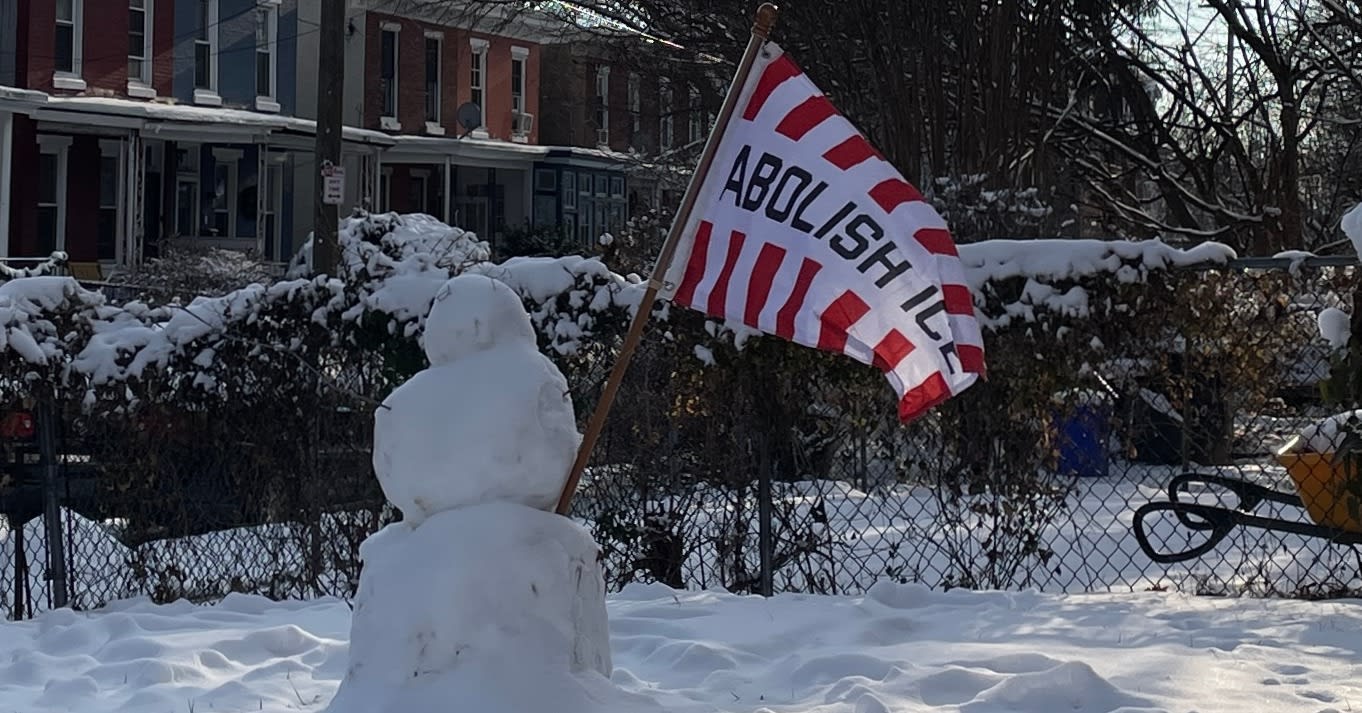 “Abolish ICE,” Germantown (Philadelphia), Jan. 19, 2026.
Thanks for reading The Consequences of a Liberal Education! Subscribe for free to receive new posts and support my work.
Here on Substack, what do a fitness journalist, an English lit PhD (hosting a reading of Milton’s Paradise Lost), and a poetry podcast host have in common?
All of them responded to the lawless violence by federal agents in Minneapolis earlier this year, even though their publications have nothing to do with politics, law enforcement, immigration policy, or current events more generally.
These three writers demonstrated what I’ve been watching for during the past year: that everyone, in their own way and consistent with their personal “appetite for risk” needs to embrace activism in some form—whether you call it The Resistance, the pro-democracy movement, the No Kings movement, or something else.
There are many writers on Substack who have a critical, anti-authoritarian focus on the Trump regime and its policies. Among my favorites is novelist Jeannette Winterson, for example, who writes Mind Over Matter, and who said in a recent post:
It’s been just a little more than a year since I returned to this Substack. I did so because Trump had returned to power.
There’s historian Heather Cox Richardson, who writes the immensely popular newsletter Letters from an American, started in 2019 by covering the first Trump impeachment. Professor Richardson’s daily posts are almost always Trump-related.
Then there’s Andrei Codrescu with his tone of world-weary disdain and Dadaist humor, who routinely finds Trump to be an irresistibly deserving target. Recently, for example, in an essay about real estate development around the Gowanus Canal in Brooklyn, of all things, he dropped a reference to the “kid on the sofa that tends to Trump’s diapers.” It’s an aside that wouldn’t surprise Codrescu’s regular readers.
Here, however, opposition to state-approved violence in Minneapolis appears where you might not expect it.
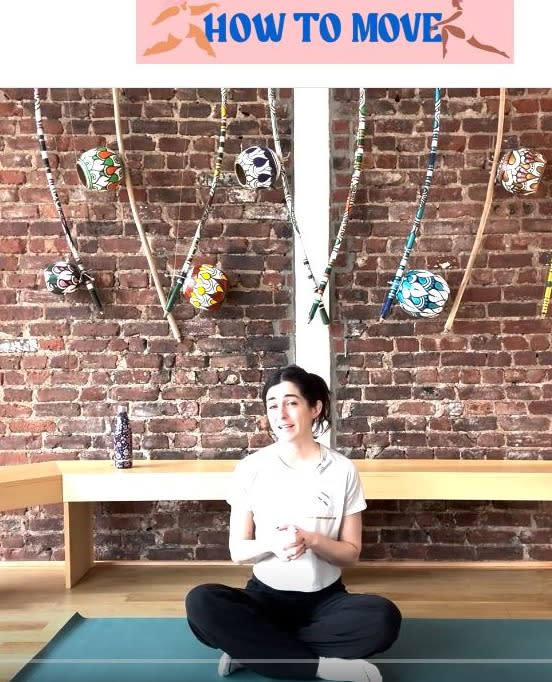 Anna Maltby, health journalist and personal trainer, authors How to Move, a body-neutral newsletter about exercise.
Having seen fitness journalist Anna Maltby’s excellent workout articles and videos in the NY Times, I was pleased to learn that she also publishes How to Move on Substack. Coming across a recent post, “A get-off-the-floor lower body mobility routine,” I thought it might prove to be a great break from working at my desk. It did, but for reasons I wasn’t anticipating.
Before getting to her “great strategies to improve hip and ankle mobility,” Anna surprised me by beginning her post, just two days after ICE agents killed Alex Pretti: “I wanted to start with a note about what’s going on in Minneapolis right now, but I barely know what to say.” She continued:
I’ve experienced such surges of hope seeing the love flowing from neighbors who just want to keep each other safe—and such utter devastation at the violence and depraved murders we’ve witnessed, in clear retaliation against citizens exercising their constitutional rights; against those actions of love.
She concluded by urging her readers to action: make calls to defund ICE, donate money to support local mutual aid efforts, including the Immigrant Law Center of Minnesota, and boycott corporations supporting ICE.
 GlutenbergBible, written by “your favorite Madwoman in an Attic, PhD” is offering a year-long slow read of John Milton’s epic poem, Paradise Lost.
Next, the English Literature PhD, Carson, who self-identifies as “your favorite Madwoman in an Attic, PhD” writes Glutenberg Bible. Late last year, she launched a one-year “slow read” of Milton’s Paradise Lost. I couldn’t resist signing up.
Soon after reading Anna’s anti-ICE post, I was catching up on my Milton slow read online discussion. After posting about Paradise Lost, line 1.756, where Milton uses his coinage “pandaemonium” for the first time, Carson posted again with this comment about her dissertation research:
“One of the areas my research led me to was the idea of the ethics of hospitality—of welcome and shelter as fundamental to the ways we treat others (and ‘Others’).”
She then notes that her academic research wasn’t necessary for her to form her own opinion about “the importance of caring for others and of speaking out against the kind of violence and disinformation we see surrounding immigration today.”
She elaborated:
Who we are informs what we choose to read, and what we read informs who we are, and round and round it goes with literature and worldview acting on each other. There’s no separating what we read from the world we live in, not even in online spaces, not even in discussions of centuries-old literature. I have no interest in making my social media pages a place where people who support the actions of ICE and of this current administration feel comfortable. My social media pages are not, never have been, never will be, apolitical spaces. It’s fuck ICE over here, and that’s not up for debate.
Carson also sets an example for her readers by “donating a portion of my earnings from the Paradise Lost slow read to an organization whose advocacy overlaps with a theme present in the text and/or our discussions.” In recognition of Milton’s opposition to state censorship, her first donation was to the worldwide association of writers, PEN International.

Having happened on these two posts, I was now curious about how common this theme might be, so with a few clicks and a bit of scrolling, I meandered over to another of my favorites, Pádraig Ó Tuama, who hosts the Poetry Unbound podcast. On Pádraig’s weekly podcast, which has been called “an oasis of beauty,” he reads a poem, appreciatively and insightfully analyses it, then re-reads it.
Would the events in Minneapolis somehow be reflected in Pádraig’s most recent poetry post? Sure enough, he began: “This week — a poem from the Twin Cities.”
He explained that a local Minneapolis-based poet, Michael Bazzett, had sent him a new poem, “From Minneapolis in January,” asking if he could recommend a place for its publication. Pádraig’s response was to publish it himself on Substack. It begins:
We live in the numbness of an occupied city where every story has another story curled inside its labyrinth—
I’m quoting just the very beginning, but please read it in its entirety. But I caution you, be prepared for a powerful poem that fits its subject—serious, grim, and dark. It’s about the nightmare brought by ICE. Among Pádraig’s comments on the poem: “I read two imperatives in it: Live. And Awaken.” And it recognizes something of the resilience of the people of Minneapolis whose “nightmare is the waking.”
And in case anyone didn’t get it, Pádraig included in this post his own photo of a graffitied slogan on a blank wall: “Stop Kidnapping Our Neighbors.”
These few examples of speaking out—surely there are many more out there—bring to my mind ACT-UP’s catchphrase, SILENCE = DEATH, which so effectively shared the life-and-death urgency of activism in response to AIDS during the Reagan years. (We might update it to SILENCE = FASCISM.) Or Rita Addessa’s tagline for the Philadelphia Lesbian and Gay Task Force from that same period, “They’ll Never Have the Comfort of Our Silence Again.” Which is an echo of Martin Luther King, Jr.’s famous admonition from 1967:
In the end, we will remember not the words of our enemies, but the silence of our friends.
This fits well with our favorite Madwoman in an Attic’s crucial affirmation that her social media pages are not apolitical spaces. Indeed, our so-called “apolitical spaces” are often illusory, as we are learning. The great metaphor (and real-life demonstration) for this is the John F. Kennedy Center for the Performing Arts after the authoritarians took control. It was once an apolitical space (or, at least, a nonpartisan space). But note what happened there.
Note, too, that each of these anti-ICE posts state not just opposition to ICE’s violence and lawlessness—a fine enough position to articulate. But they also are invitations for us as readers to be involved, to give of ourselves. Anna urges us to perform specific acts of generosity. Carson, too, shows how to set boundaries against what is morally repugnant and how we can express our values through our financial giving. Pádraig, by choosing to publish “From Minneapolis in January,” provided an opportunity for us to give emotionally and to make a deep connection—as we can do experiencing a poem or another work of art—by eliciting our compassion for the people in an occupied city.
I like to view these posts not merely as occurences now in the past, disappearing down the list as more recent posts accumulate, but rather as evidence of a backlash now and in the future.
 Mt Airy (Philadelphia), Feb. 5, 2026.


December 29, 2025
2025 Winter Holiday Playlist
 Evergreen wreath from Germantown Kitchen Garden (red bow and lights not included in original purchase).
I am pleased to share my 2025 Winter Holiday Playlist (a track listing is at the end of this post), which you’ll find on Apple Music—not also on Spotify as in years past. I’m boycotting Spotify and hope that you are too. More about the boycott below.
Thanks for reading The Consequences of a Liberal Education! Subscribe for free to receive new posts and support my work.
This year, my list is perhaps a bit somber and introspective. In fact, it’s not until William Boyce’s “New Year’s Ode” (Symphony No. 1), all the way at Track 8, that things get lived up a bit, and then that doesn’t last long—although I think there’s quite a bit of variety of mood without anything overtly celebratory.
I may have picked up on the predominant emotion of the times we’re living in, or maybe it’s just a seasonal mood. We should indeed admit, as Melissa Kirsch has recently written (in a pay-walled NY Times article), “that the season comes with its own beautiful melancholy.” Or perhaps, as John Berger puts it in a novel I’m reading, “All music is about survival, addressed to survivors.”
Here’s a shout-out for a few tracks that have really charmed me this year:
Tchaikovsky’s “December” from The Seasons, Op. 37a, in a stylish recording by Lydia Artymiw (Track 22)
Cécile Chaminade’s song, Le Noël des oiseaux, in cellist Julian Riem’s enchanting arrangement for cello and piano (Track 26)
Carl Nielsen’s solo piano piece, Drømmen on Glade Jul (“A Dream about Silent Night”) (Track 38).
You’ll find several Philly-related Easter eggs1 tucked among my selections as well.
Unwrap Spotify!
To coincide with Spotify’s “Spotify Wrapped” year-end promotion earlier this month, several pro-democracy groups have launched Spotify Unwrapped, a movement to boycott the streaming service.
Indivisible (one of the organizations supporting the “No Kings” protest movement in the US) and other groups have organized this boycott because of Spotify’s broadcast of recruiting advertisements from U.S. Immigration and Customs Enforcement (ICE):
Spotify is running ads recruiting agents for ICE, the federal agency charged with mass deportation and surveillance of immigrant communities. These ads target vulnerable populations, promise signing bonuses, and normalize fear and intimidation in our neighborhoods.
I’m not a Spotify subscriber, and I am not sharing my playlist on Spotify. Please join me in cancelling Spotify. Switching to another music streaming platform is likely easier than you think.
Recommended Winter Reading
For years, I couldn’t quite get my head around what goes on for me during this dark season of the year. Then earlier this month I came across this essay, recently published in a handsome softcover dustjacket edition by Black Sparrow Press: Winter Solstice by Nina MacLaughlin.
She ponders the meaning of the season, describing, for instance, how winter darkness “creeps in from both sides, and pushes us to that pure ridge, all the way exposed.” “Peer over,” she says. “Scope the abyss.” She continues:
The gape feels wider now, the fear pulsing at a different frequency. The losses—individual, collective, major and minor, the way we move through our days, the way we ache and dream—are too many and too grave to list. Maybe you have felt this, too, involved in whatever moment of your day, a trip to the pharmacy, a walk after dinner, folding the laundry on the bed, when a sense, new, overtakes you, that something has collected above us, that grief itself has become a thin layer of the atmosphere, its particles collecting in the overlap between troposphere and stratosphere, particulates of grief surrounding the whole globe. I feel this sometimes now. From October to December, the polar night jet, a stratospheric westerly wind, gets stronger, swirling around the polar vortex, gusting the cold air into our winters, and it stirs this salted fog of grief that’s collected over these last years. We breathe it in, it gets caught in our hair, it settles on us as we sleep.
Order it on bookshop.org: Winter Solstice

 1
1Yes, I actually used the expression “Easter eggs” to refer to things hidden within a winter holiday playlist.
September 15, 2025
Review: Tom Stoppard’s "The Real Thing" at the Lantern Theater
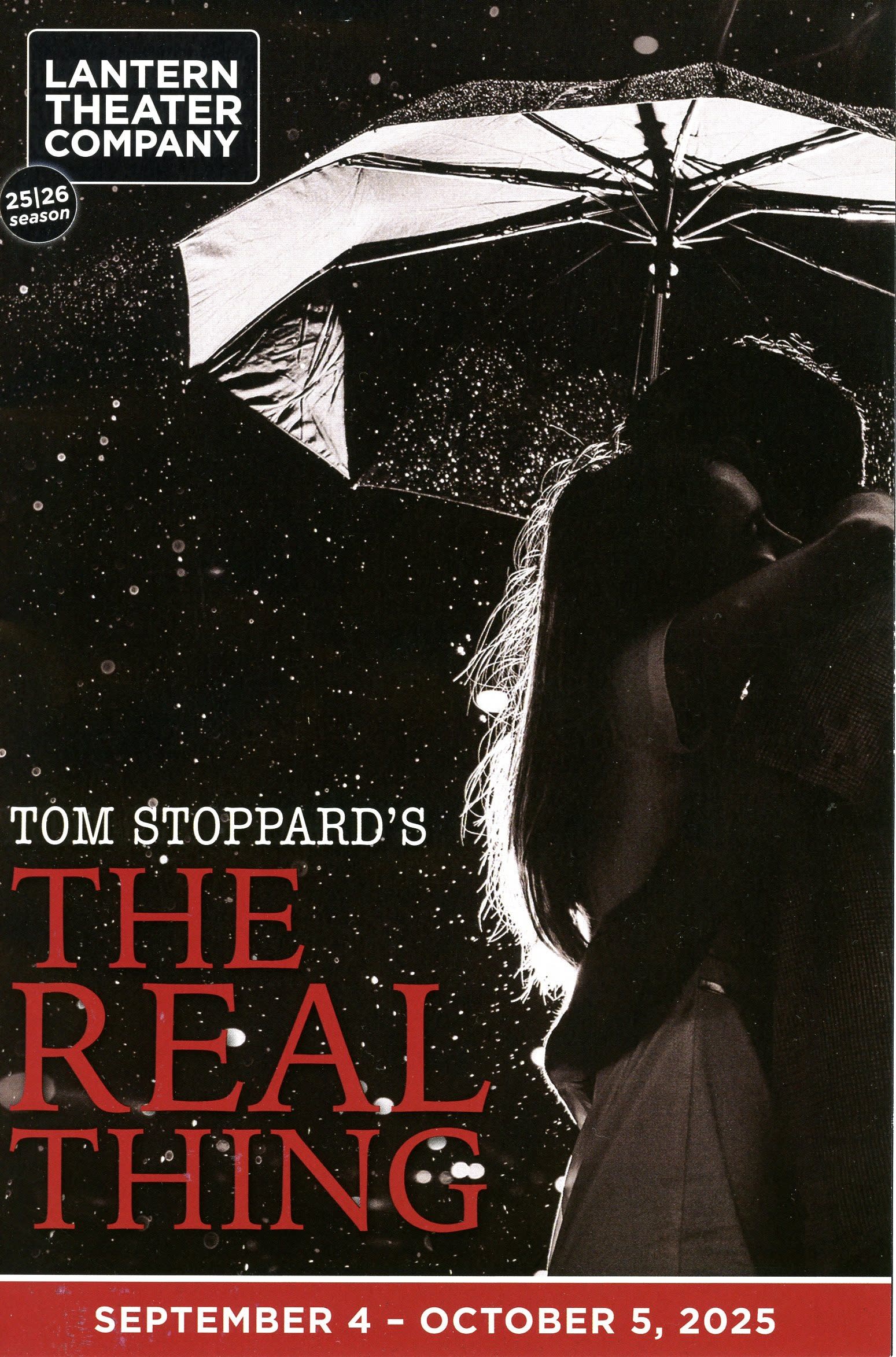
When I picked up a copy of the original 1982 UK edition of The Real Thing at the Free Library of Philadelphia (what would we do without that library?) to compare it to the later US edition that I own, the librarian asked if I was borrowing a play. “Yes,” I said, “Stoppard,” showing her the cover. “Oh! The Real Thing!” she smiled, “My favorite.”
Isn’t The Real Thing everyone’s favorite? It was a hit when it opened in London in 1982, then it had a similarly successful run in New York. It was the play that introduced Stoppard, now 88 and “Sir Tom” (he was knighted in 1997) to a broader US audience.
Thanks for reading The Consequences of a Liberal Education! Subscribe for free to receive new posts and support my work.
A Meta-Theatrical Inquiry into Authenticity in Love and Art
It’s no surprise that Lantern Theater selected it as its season opener. The Real Thing has some problems, but at its core it’s still a witty, comedic examination of authenticity—but with moments of touching poignancy—in that most elemental of human experiences: being in love.
But Stoppard takes on not just the truth of being in love, but also what’s true, genuine, and authentic in art. Stoppard’s use of music (I count at least 30 references to musicians or musical works in the play) to enrich his narrative is worthy of an essay on its own. This is a head-spinning hall of mirrors, with the audience joining the characters on stage in attempting to sort what’s real from what’s false.
The play is set in the world of theater, opening many opportunities for Stoppard to put fictions within fictions. Henry is a playwright, and Brodie, although far from literary, has tried his hand at writing a play. The four other characters are actors (Annie, Max, Charlotte, and Billy), leaving only Henry and Charlotte’s 17-year-old daughter, who appears briefly but with plenty to add to the accumulating ideas about the meaning of love.
There are numerous plays within this play, the “meta-theatricality” that the play is famous for: Brodie’s attempt at writing a play, which is presented in performances of various snippets, as well as extended quotation from Ford’s ‘Tis a Pity She’s a Whore, Strindberg’s Miss Julie, and Henry’s own House of Cards.
Even before the play begins, we can see a meta-reference in the inspired stage design by James F. Pyne, Jr., in which the set walls facing the audience have been turned into giant playing cards—as in Henry’s play, House of Cards, and as though the characters are literally living in that house. And isn’t love and romance a game, perhaps a game of chance? As the scenes change, the cards rotate, as though they are being flipped.
An Exuberant Cast
The cast is so at ease, seemingly loving every second as they make their way through the intricate joking and repartee, with almost instantaneous scene changes and stage lighting that never calls attention to itself.
J Hernandez, as Henry, manages to bring out his character’s considerable unlikableness yet he makes his pontificating directly to the audience (“Where’s my cricket bat?”) somehow endearing. When his vulnerability is finally revealed, it’s with a great naturalness of expression.
Brett Ashley Robinson, as Henry’s wife Charlotte, projects a hard-edged desperation in her early scene with Henry, and then, after the passage of a few years, replaces it with a pitch-perfect wistfulness.
Campbell O’Hare’s Annie is played to be utterly captivating. She makes it immediately obvious why all the men in the play at one time or another have been in love with her.
Those in supporting roles are no less effective. Cheyenne Parks, as Henry and Charlotte’s 17-year-old daughter, was tasked with perhaps the most daunting of assignments: playing a precocious teen who sounds far more like an adult than a teenager. Trevor William Fayle as Annie’s theater partner (and lover), Billy, brings a welcome over-the-top exuberance to his role, energizing every scene that he’s in.
Last, but certainly not least—in fact, he plays the lynchpin that makes the whole contraption work—is Adam Howard, who gives us his take on three different characters: the tipsy Max of the first scene, the deferential Max thereafter, and then in the final scene, Brodie, who has more insight than anyone else on stage, expressed in just a few lines, but with properly weighted gravitas.
Peter DeLaurier’s direction underlies all this, bringing out so many small details. Sometimes just a quick gesture is weighted with significance. At the end of the first act, for example, I never really understood the point of Annie’s perusal of some papers, at least as given in Stoppard’s stage directions. But in this production, before she deals with the papers, Annie stretches to glance through a window we can’t see, making it obvious that she’s confirming that Henry is gone, and then she does what she knows she shouldn’t be doing if Henry were there.
Dressing the 1980s
There are many notable touches in costume designer Kelly Myers’s use of 1980s wear for the cast. Annie’s bright chartreuse miniskirt over black tights, for example, positions her in the fashion history of the time while saying something as well about her personality. Henry’s “peasant chic” look, if that’s what it’s called, looks awfully silly at times, but that’s a good thing. It reduces his tendency to pomposity.
In the play’s final scene, we hear in a significant bit of dialogue about Annie casting her spell while wearing a blue dress, so it’s perfect to see her dressed in one when she makes her first entrance many scenes (and years) earlier. (If this is not a tradition in costuming this character, it should be.) That first scene ends with her plotting a tryst with Henry for later that same afternoon—ah, the power of the blue dress.
Stoppardian Misogyny?
When The Real Thing was staged last year at the Old Vic Theatre in London, at least one reviewer noted that Stoppard’s “dated and unsavoury” sexual jokes had been cut. The Lantern production retains this dialogue, although you’d think Stoppard himself would agree that it should be deleted. Whether or not these lines are funny (our willingness to be amused by this sort of thing is hugely diminished today compared to when the play was written), they offensively perpetuate a false and harmful attitude and do little to advance the dramatic narrative or provide insight about the characters.
In one scene, Henry tells Annie that he had sex with her the night before while she was unconscious because she’d taken a sleep medication. She refuses to believe him and finds his claim laughable. Their brief interaction on this subject does have some dramatic relevance. Nevertheless, attitudes about actual or implied consent to sex have changed vastly since the play was written. Today, what Henry is claiming to have done would be a crime.
Even worse, I think, is the discussion involving Henry and Charlotte with their daughter, who has just turned 17. Debbie explains—brags, really—that she’s had a sexual relationship with her Latin teacher at school. Her parents’ reaction is indifference and mild amusement. Henry even makes a wisecrack in response. Here humor is being used to deny and trivialize sexual harassment and assault experienced by girls and women. Even when Stoppard wrote this scene in the early 1980s, the teacher’s behavior would have been a criminal offense. Should you wish to accuse Stoppard of misogyny, this dialogue could be used very effectively as Exhibit A.
The Confusion is Intentional, Sort Of
But to return to the hall of mirrors concept, I overheard one audience member’s confession—“I was confused”—about Stoppard’s meta-theatrical tricks. That was exactly what Stoppard intended. In this play, everyone should be uncertain about where reality ends and illusion begins. Somewhere well into the second act, I was baffled to hear Bach’s Toccata and Fugue in D minor.
There’s Bach in the play alright, but this was the wrong piece at the wrong time. Had a sound technician somehow missed their cue? Had the director or music designer decided to radically shift the mood of the scene? No, it was yet another technology obtuse audience member, this time with a Bach cell phone ring tone, who ignored all those requests that phones be turned off. As a result, it was impossible to hear the tender dialogue between Henry and Annie. But at least it was Bach—that “cheeky beggar” as Henry puts it—and not something “banal,” say, like the Skater’s Waltz.
A Shift in Perspective on the Politics of The Real Thing
Reviewing the Wilma Theater’s 2014 production of The Real Thing in BSR, Jake Blumgart noted Stoppard’s “too easy mockery of the anti-war and anti-nuclear movements of the 1980s.” (The Lantern remedies this bias in the play with an essay about the historical background in its series of insightful online posts.) Stoppard’s characters, Henry in particular, mock Brodie throughout the evening, and not just about his inadequate skill as a playwright, but for his take on contemporary British politics—quite specifically, Brodie sees the fascism in the Thatcherism of the early 1980s. Well, well, well—turns out Brodie was right all along, and Henry was more of a fool than we might have thought. Now that we have a bunch of fascists running amok with our own national government, perhaps we can now see that our current dire situation had its origins in the Reaganomics and Thatcherism of 40 years ago.
Phew, A Happy Ending … Or Not?
Lantern’s production ends with a kind of happily-ever-after view of Henry and Annie. But is that really the real thing—or yet another illusion?
When Brodie finally comes on stage in the final scene, he states his own view of what’s real and what’s fake. He sizes Henry up to be a hypocrite who, to keep Annie’s affection, has done a rewrite of Brodie’s play. “I don’t really blame you, Henry,” he says. “The price was right.” Annie, on the other hand, has “a thrill coming off of her,” but how real is she? She’s a British actor who doesn’t even know the meaning of the phrase “hoist by my own petard” and who snoops in Henry’s papers when he’s out.
The play ends a few lines later with Stoppard specifying the closing music—there’s nothing casual or accidental about this choice—that we hear coming from Henry’s radio: The Monkees with their hit anthem, “I’m a Believer”—a song about falling in love with someone after having merely seen their face.
I thought love was only true in fairy tales
Meant for someone else but not for me
Oh, love was out to get me
That's the way it seemed
Disappointment haunted all my dreams
Then I saw her face, now I'm a believer
Not a trace of doubt in my mind
I'm in love (mm, ah)
I'm a believer, I couldn't leave her if I tried
A song, penned by a well-known singer (Neil Diamond) who plays but doesn’t sing on the track, nominally performed by what was originally a fictious pop rock band that had a reputation for not playing their own instruments.
The real thing, or is it?
March 3, 2025
Remembrance of Fastnachts Past

Marcel Proust famously meditated on the evocative power of “a biscuit in some tea,” his experience of eating a “petite madeleine”:
… in that moment all the flowers in our garden and in M. Swann's park, and the water-lilies on the Vivonne and the good folk of the village and their little dwellings and the parish church and the whole of Combray and of its surroundings, taking their proper shapes and growing solid, sprang into being, town and gardens alike, all from my cup of tea.
I’ve been thinking lately about Proust’s memory of the village of his childhood. Don’t we all have such memories?
Thanks for reading The Consequences of a Liberal Education! Subscribe for free to receive new posts and support my work.
I was most likely only four years old when my mother took me along with her on an errand to the Bank. In our very small Pennsylvania town, this was a walk of only about two or three blocks. We probably made that trip frequently, but I remember that early spring (or, if you will, late winter) morning vividly— because of a Fastnacht.
At that age, I probably didn’t yet know those many landmarks that would later define my childhood geography. Just before arriving at the Bank, Mom and I would have passed one: Wismer’s, its dark hardwood floor, smooth with wear, pitching and bellying, like the deck of an ancient ship. It was stocked from floor to ceiling—yard goods, twine, an extensive, colorful thread collection. But what drew us kids in was the large display case with its curved-glass front filled with penny candies. There before us were the world’s largest and most imperious jawbreakers, endless licorice strands—in either red or black—and Horehound drops, to name just a few. As Mrs. Wismer waited patiently behind the counter, we each in turn would try to make up our minds, shifting from foot to foot, pennies clutched in our little fists, slow to decide in the face of so many irresistible choices.
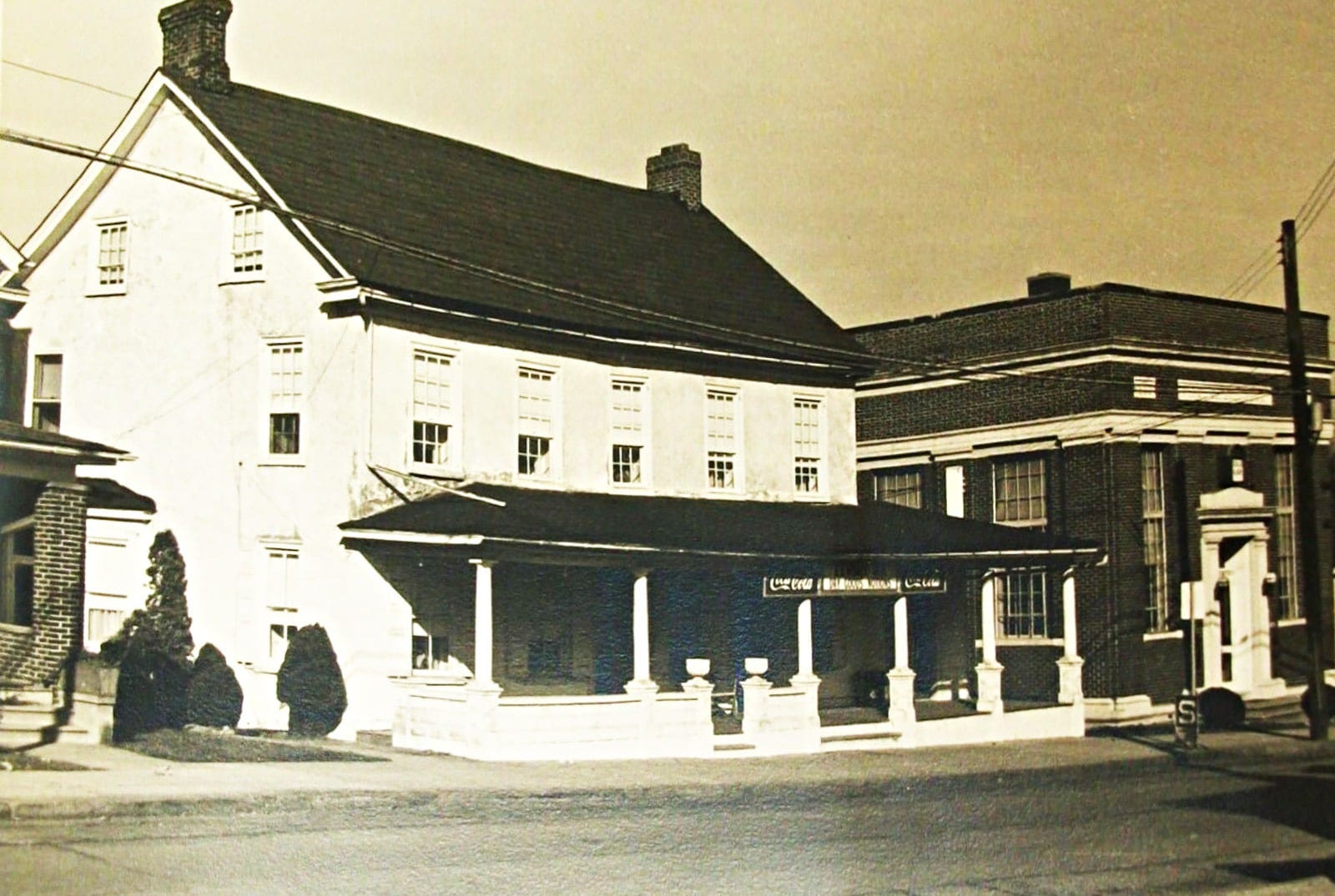 Wismer’s (center), First National Bank of Coopersburg (right). The clock on the Bank is outside the frame of this image. Photo: Lehigh Valley History, 1950.
After passing Wismer’s, my mom and I were then at the Bank—a big box of a brick building, the very embodiment of a solid, reliable institution—with its large four-sided clock attached on its northeast corner, well above the intersection of Main and State—posing the eternal question: is time the friend or enemy of wealth?
Before we went in the Bank, however, I looked up to see a woman standing on the sidewalk next to a small table. I don’t think either of us had seen this woman before. She exchanged a few words with my mother, none of which I understood or recall today. Then she leaned over and handed me a Fastnacht (also spelled Fasnacht), although at the time I had no idea what a Fastnacht was. She was handing them out gratis, apparently, it being Shrove Tuesday—or, as she certainly would have called it, Faasnachtdinschdaag, in the local German dialect. She may have been dressed all in black, slightly bent with age, with a hint of a smile in her very pale blue eyes.
I can’t describe what that Fastnacht tasted like, other to say that it was something I would never forget. Sorry. Just the tiniest degree of sweetness, perhaps, but with a completely satisfying mouthfeel, moist but not greasy with the frying oil (lard, certainly) and a light airiness of a yeasted dough.
Was it the taste of the Fastnacht or was it my awareness of the beauty of that morning that secured it in memory? There is something about the morning sunlight on a day late in February, still slanting low from the eastern sky, the trees without a hint of buds of spring—although the already lengthening days give promise of it—and the chill air so fresh and crisp. And thinking back on it, I’m remembering living in a time of such childhood innocence, before there was any awareness of all that later would be troubling, disturbing, and even terrifying.
Chagall has his fiddler levitating over the rooftops of his Eastern European shtetl, and I similarly can’t think of my childhood village without imaging that woman, her card table loaded with her Fastnachts at her side, floating over the rooftops of the little dwellings and churches, over the town and gardens alike, her black overcoat flapping in the breeze, with her hint of a smile.
Wismer’s and the Bank are long gone. And long ago I gave up any attempt to recreate my experience of that first Fastnacht. Surely that would be an exercise in futility.
I like to think that the recipe for that Fastnacht was passed down for centuries, originating in a Mennonite kitchen somewhere in the Rhineland-Pfalz. The recipe that follows includes a bit of potato (more a symbol than a necessary ingredient), which should satisfy the purists. Although the idea of Faasnachtdinschdaag is to load up on fat and carbs right before the fasting time of Lent, note how frugal this traditional recipe is—one egg, a little sugar, not much butter.

This recipe is loosely derived from Edna Eby Heller’s The Art of Pennsylvania Dutch Cooking (1968).

Ingredients (makes approx. 30 Fastnachts)
1 medium to small potato (for the dough, you’ll only need 1.5 oz./40g)
2 tbsp. butter
½ cup sugar [111g] (consider reducing the sugar by one-half if you want to dredge them in sugar after frying)
1 egg, well beaten
¾ tsp. salt
1 ¼ tsp. active dry yeast [5g]
1/8 cup warm water [16g]
3 cups all-purpose flour [389g]
Oil for frying (2-4 cups)
Preparation
1. Cook the potato in salted water until it is soft for mashing. Save just short of a cup (more precisely, 7/8 cup, 207g, or 7 oz.) of the potato water. You can peel, slice, and measure the potato before cooking, but I usually cook the entire potato with the skin, then when it is cooled, peel and cut it to have a small chunk, about 1/8 cup (approximately 1.5 oz./40g). Mash it.
2. In a large bowl, stir the mashed potato into the sugar until well mixed.
3. Add the beaten egg and salt, mix well. Mix in the potato water and add the yeast.
4. Stir in the flour, starting with about half, then adding the remaining, and mix completely. You should have a shaggy, rough dough.

5. Knead the dough for about five minutes until it’s smooth and elastic. Form the dough into a ball, and place it in a greased bowl, cover, and let rise to double in bulk. (My original recipe calls for 2-3 hours rising time, which is very optimistic in my experience, so I leave it out to rise, then I store it in the refrigerator overnight, and fry the next morning.)
6. About an hour before you plan to fry the Fastnachts, knead the now-risen dough again for about a minute. (If you’ve refrigerated the dough overnight, take it out in time to warm to room temperature.) Roll it into a rectangle or square about 1/3 inch thick. I usually do this right on the counter, very lightly floured. Cut the dough into rectangles, 2-by-3 inches is a traditional shape. Cover with a damp cloth, let rise again for at least an hour.

7. Fry in neutral oil that tolerates higher temperatures (I use canola or safflower oil or a combination, whatever is left over from frying latkes in December—remember, this Shrove Tuesday concept to accomplish some early spring cleaning) at 375 degrees. I use a Dutch oven, which has the high sides that prevent the oil from splashing out. The dough, in batches of about five Fastnachts each, will float in the oil, so you’ll be flipping them to brown them on both sides. I use a thermometer to test the temperature, and I find that 375 might be a bit on the high side; adding the dough to the oil will bring its temperature down, and they seem fine at 350 or so. Once browned on both sides, take them out.
8. After frying, let the Fastnachts cool on paper towels. After they’ve cooled to handle, they can be rolled in granulated sugar, with or without cinnamon, or in confectioner’s sugar.
9. Fastnachts are best eaten right after cooking, although I’ve stored them in an air-tight container for a few days. Very good with coffee or tea, and because they are not that sweet to begin with, they are excellent with jelly or jam, such as Joe’s Jam, which I highly recommend.
Thanks for reading The Consequences of a Liberal Education! Subscribe for free to receive new posts and support my work.
December 26, 2024
2024 Winter Holiday Playlist

What do you think of when you think of the winter holidays? Darkness, bitter cold and snow, and the warmth of home? A rose, a nutcracker, and the birth of a baby mysteriously promising the coming of worldwide peace and justice?
Those are some of the things I’m thinking of and that you’ll find, along with a lot more, reflected in my 2024 Winter Holiday Playlist. It’s on Apple Music (if you have an Apple Music account, you’ll have to search for it as a shared playlist) and on Spotify.
Thanks for reading The Consequences of a Liberal Education! Subscribe for free to receive new posts and support my work.
You can shuffle the playlist, if you want, but please be assured, my dear reader, that I slapped it together … oops, I mean curated it … so that the transition from one track to another is intentional.
Note too that volume levels may vary from track to track — at least this is an issue with my playback, despite my attempts to control it by adjusting the equalization settings. So, I apologize in advance, but also I kind of like being startled by the sudden blast of “Christmas Every Day.”
Here are a few notes on some of what you’ll find on this year’s playlist.
The playlist begins with an annual favorite of mine: Haydn’s intro to the winter section of The Seasons — a not very well-known work that I’ve never even heard in live performance. Haydn gives such a vivid musical portrait of the cold, empty bleakness of a winter landscape; I shiver with each appoggiatura.
Next, on to the warmth of the Nutcracker House, for the first of many references to the 1892 Tchaikovsky classic. I like this very crisp performance by the New York City Ballet Orchestra. The City Ballet performs the Balanchine version from 1954 (what a great year!), which is also performed annually by the Philadelphia Ballet at the Academy of Music — with us in attendance, of course.
Among the other Nutcracker selections on this year’s list include the perennial favorite Ellington-Strayhorn arrangement (I include just the “Overture” from the Nutcracker Suite) — it wouldn’t be the holidays without a listen to this superb recording.
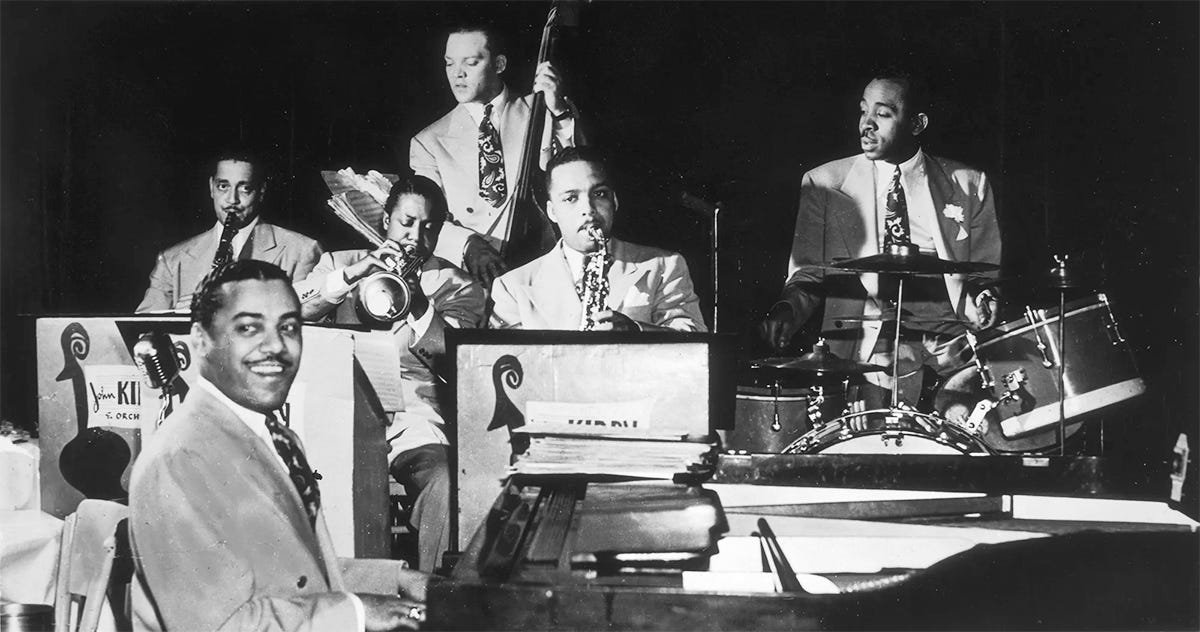 John Kirby, bassist and bandleader, with Billy Kyle, on piano; Buster Bailey, on clarinet; Charlie Shavers, on trumpet; Russell Procope, on alto saxophone; and O’Neil Spencer, on drums. Photo: samepassage.org
I always look for something new and surprising for my playlists, so another of the Tchaikovsky items is the “Bounce of the Sugar Plum Fairy” by John Kirby’s orchestra. The New Grove Dictionary of Jazz concludes its brief article on Kirby by noting that after his sextet disbanded in 1946, he “gradually fell into obscurity.” I already had this track on my playlist when I was delighted to hear Kirby’s version performed on a Monday afternoon Live from Wigmore Hall BBC Radio 3 internet broadcast in early December by the virtuoso clarinetist Julian Bliss and his Pioneers of Jazz Septet. Perhaps Kirby’s obscurity has been greatly exaggerated.
Yet another Nutcracker interpretation is by Sverre Indris Joner, with the Hovedøen Social Club. I was introduced to this arrangement by the “” (formerly and once again the Philly Pops). But I confess, I like this track largely because it’s apparently a group of Norwegians — Joner was born in Oslo and grew up in Bergen — doing a Latin music-inspired arrangement (there’s a live concert YouTube video of Joner performing this arrangement in Havana with the Orquesta Sinfonica del Gran Teatro de la Habana Alicia Alonso — worth checking out).
One more Nutcracker interpretation is Stewart Goodyear’s virtuosic performance of his own stunning piano arrangement of Tchaikovsky’s score.
 Richard Wagner’s Villa Tribschen on the shore of Lake Lucerne, where his Siegfried Idyll was first performed on Christmas Day 1870.
I’m not the only one who associates Richard Wagner’s Siegfried Idyll with Christmas, as it was first performed on Christmas morning in 1870 on the stairs of Wagner’s villa in Lucerne, Switzerland, as a birthday gift to his wife, Cosima. One can imagine Cosima waking to the opening chords (as she describes in her diary for that day), but when I visited the villa and stood on that not very grand staircase, I mostly pondered where the double bassist might have fit in.
I’m of the opinion that the Philadelphia Orchestra has never sounded better, but reading David Patrick Stearns’s article in the Philadelphia Inquirer recently about the Orchestra’s impressive yet uncredited recordings from 1938-1940, I went back into their record catalog to find the 1962 Glorious Sound of Christmas album with Eugene Ormandy. The arrangement of “God Rest Ye Merry, Gentlemen” is … well, remarkable. Can you listen to it without smiling?
I had the good fortune to visit Detroit recently and toured the not-to-be-missed Motown Museum. This 1963 recording by The Miracles (later, Smokey Robinson and the Miracles) is the first of my holiday (unrequited) love songs. Another is Ella Fitzgerald’s rendition of the bittersweet Frank Loesser song, “What are you doing New Year’s Eve?”
Maybe it's much too early in the game
Ah, but I thought I'd ask you just the same
What are you doing New Year's, New Year's Eve?
Sheku Kanneh-Mason, fresh from being denied a seat he had booked for his cello on a flight to Toronto, and thus having to cancel his sold-out concert there, performed brilliantly with his sister, pianist Isata Kanneh-Mason, in the Philadelphia Chamber Music Society’s stellar series at Perelman Theater. He concluded their recital with his arrangement of the Gustave Holst hymn, “In the Bleak Midwinter,” as a second encore.

There’s no better Christmas album than Home for Christmas, released by Anna Sophie von Otter in 1999. It includes “Koppången” (I’ve chosen the English version for the playlist, but I almost prefer to hear her glorious voice singing the Swedish version, which closes her album).
And I stopped for a moment
In this winter paradise,
when I heard a choir singing
through the darkness and the ice.
Anna Sophie von Otter has a special place in my heart after she sang in Philadelphia (once again, the Philadelphia Chamber Music Society deserves the credit) in 2015 and included Bruce Springsteen’s “Streets of Philadelphia” — his Academy-award winning song for the 1993 movie Philadelphia. Backstage afterwards, when I thanked her for performance of this very meaningful song, she confessed how nervous she was to perform it in Philadelphia.
Let’s not forget that Philadelphia is the home of one of the truly great early music ensembles, Piffaro, The Renaissance Band. (Their recent Triomphi concert was as effective as any themed concert I’ve ever seen and heard, combining projected images and a seemingly endless series of voice and instrumental changes, all derived from a Petrachan literary tradition.) I’ve included two tracks from their Nowell’s Delight album.
Could the John Zorn who arranged the “Christmas Song” be the same John Zorn who wrote Jumalattaret — recently performed at the Perelman Theater by the inimitable Barbara Hannigan?
Seven short tracks present George Crumb’s A Little Suite for Christmas, A.D. 1979. After repeated listenings, I’ve gotten very fond of this solo piano work and find that it has an arresting liminality, perhaps through George’s use of silence and ritualistic sounding repetition. More than any other item on this playlist, it examines the mysterious meaning of the birth of Jesus. The performance is by Lambert Orkis, who, back during my undergraduate days, was often performing Crumb’s music on the Penn campus.
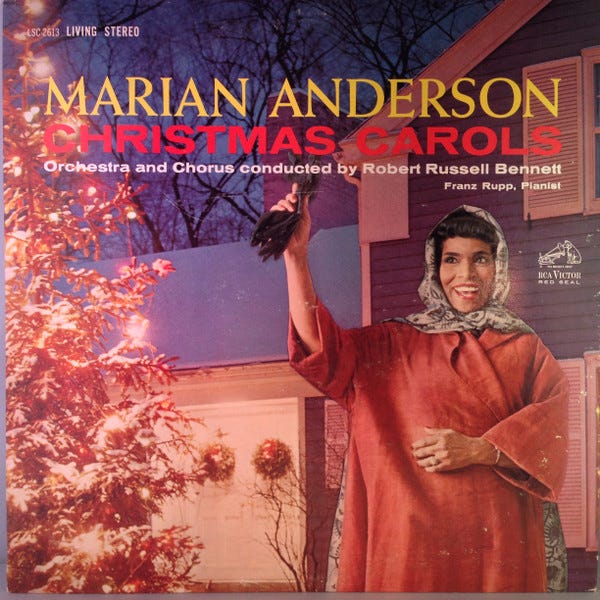
A native Philadelphia artist who is finally getting the recognition she deserves is contralto Marian Anderson. Just this year, the Kimmel Center’s major hall (and home to the Philadelphia Orchestra) was renamed in her honor. “Christmas Angel” is from her 1962 album, “Christmas Carols,” which features a striking image of her waving from what looks like the driveway of a suburban split-level — could it be her actual home at the time in Connecticut?
Now, a shout-out to my beloved Lansdowne Symphony Orchestra, which annually performs the Leroy Anderson “Sleigh Ride” in a highly spirited yet classy manner. In the LSO’s honor, I’ve included Bela Fleck’s version of this old chestnut, which is followed by yet another, very different sleigh ride by Frederick Delius.
I can think of no better way to end the playlist than with Richie Havens’s live performance of George Harrison’s “Here Comes the Sun.” Sheer joy.
Little darling
The smile's returning to the faces
Little darling
It seems like years since it's been here
Here comes the sun
And I say, "It's alright"
It’s alright indeed.
If you have some favorite holiday music that I haven’t included, please let me know. I’m already planning my 2025 Winter Holiday Playlist.
May your winter holidays be joyful and glorious!
Thanks for reading The Consequences of a Liberal Education! Subscribe for free to receive new posts and support my work.
September 16, 2024
Election 2024: How YOU Can Help End Trump's Political Career
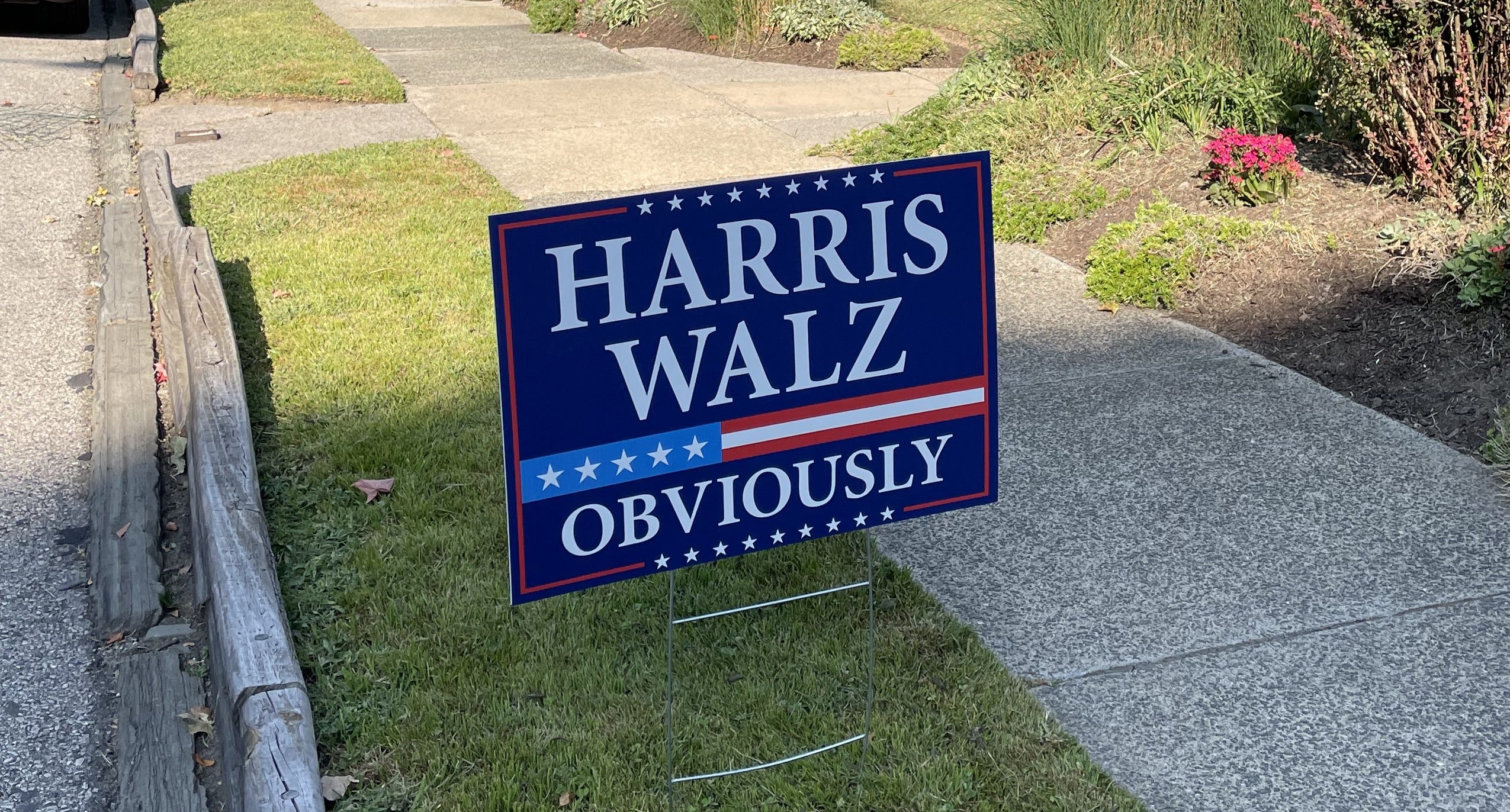 In my neighborhood, as many houses have Harris-Walz yard signs as those that don’t.
This is my quick guide to 2024 get-out-the-vote volunteer opportunities, with a focus on Northwest Philadelphia, although with the links below you can find opportunities anywhere.
It may have been Mark Twain who said, “Everybody talks about the weather, but no one does anything about it.” But my grumpy 2024 election year version has been “everybody talks about Trump, but no one does anything about him.”
Thanks for reading The Consequences of a Liberal Education! Subscribe for free to receive new posts and support my work.
This is one of my pet peeves: I listen to a lot of people complain about Trump who don’t seem to be doing anything about him. Even now, less than two months before the election, there’s a lot to be done.
There was a time when election volunteering—which for me meant poll watching—really didn’t seem to make any difference. As an election activist friend put it, “I got a lot of reading done and helped folks find the bathrooms!” Poll watching is still an option, but there are numerous other effective ways—both in-person and remotely—to be involved in this election in Pennsylvania, which is likely to be a key state in the outcome.
The organizing for these activities is mostly online, and several of these opportunities explain why what they do is effective—yes, an evidence-based approach. They also offer trainings and information sessions, in-person and online, for whatever volunteer activity you might take up.
And don’t forget that these efforts need financial support, too, so even if you can’t volunteer, consider making a contribution to support this important work. Those “donate” buttons are easy to find.
Join the Harris-Walz CampaignTo start at the top, the Harris-Walz campaign is coordinating a wide range of activities, including local door-to-door canvassing. Go to the Harris for President sign-up page, or go directly to the Take Action in Pennsylvania page for a regularly updated listing of events and activities, searchable by zip code. These listings include not only upcoming activities such as door-to-door canvassing efforts, but also include instructions on using social media to share your support.
The campaign has opened 50 offices throughout Pennsylvania, but finding local campaign offices is a little tricky—so much of the organizing now takes place online. But in Northwest Philadelphia, the Germantown office is at 400 W. Chelten Avenue (corner of Morris Street and Chelten Avenue) and the Manayunk office is at 161 Leverington Steet.
The Harris-Walz campaign is using the Reach Progressive Organizing app, and most of the volunteer web pages will lead you to it. The Democratic National Committee has a useful guide to the app as well. It makes it easy to notifications and keep up with volunteer activities and options.
Innovative Canvassing OptionsAn intriguing canvassing opportunity is provided by Changing the Conversation with its “CTC for Progress,” which has developed a highly effective “deep canvassing” approach to reach irregular voters. Currently, CTC appears to be canvassing only in West Philadelphia on weekends. Before joining them, you’ll need to attend a “Story Workshop” where you’ll craft your personal story and learn how to use that story to motivate voters. As CTC explains, “We don’t just hand you a list of voters and a script. Our dedicated coaching team equips you with the tools you need to reach and activate unlikely voters through meaningful, effective conversations.” (CTC was featured in a 2016 New York Times Magazine story, “How Do You Change Voters’ Minds? Have a Conversation.”)
Other volunteer opportunities, including canvassing and making phone calls to neighbors, are available with Philly Neighborhood Networks (using the Action Network platform).
Mobilize has many opportunity listings including voter registration, texting to voters, and upcoming canvassing efforts.
Letter Writing, Anyone?With VoteForward, you can get involved from the comfort of your own home. You’ll need to sign up online to be approved to participate in a letter writing campaign to fellow citizens who have historically been underrepresented in the electorate. While some scripts are provided, there’s also an option for you to personalize them. In its campaign to reach unregistered voters in Pennsylvania, VoteForward notes that volunteers have adopted 16,410 voters in this campaign, comprising 55 percent of the 29,994 targeted voters. Lots more to be done!
Voter Protection ActivitiesThe 2024 Pennsylvania Democratic Coordinated Campaign is working to protect voting rights and make sure that every voter’s voice is heard this November. There’s an array of volunteer options, both remote and in-person, including serving as an election day poll observer, early vote monitor, and ballot canvasser.
Philadelphia’s Satellite Election OfficesBe aware, too, of that the Philadelphia Office of City Commissioners has been setting up Satellite Election Offices (SEOs) in each of the City Council districts. The closest location in Northwest Philadelphia is 5301 Chew Avenue. These SEOs are where voters can register, obtain mail-in voting forms, and even complete and submit the forms. The City Commissioners Office provides a searchable map of locations for SEOs as well as ballot drop-off locations.
If you have addition resources or information about election volunteering you’d like me to share, please comment on this essay or contact me directly.
Thanks for reading The Consequences of a Liberal Education! Subscribe for free to receive new posts and support my work.
August 16, 2024
TonalEnergy (TE) Tuner & Metronome: Creating a "Preset Group" with Complex Meter Changes
Essay Contents
Step-by-Step Guide for Hindemith Preset Group
Sequential Playing of the Presets as a Group
Adding a Count-In to the Preset Group
Changing the Preset Group Tempo
Sharing TE Tuner Preset Groups
Thanks for reading The Consequences of a Liberal Education! Subscribe for free to receive new posts and support my work.
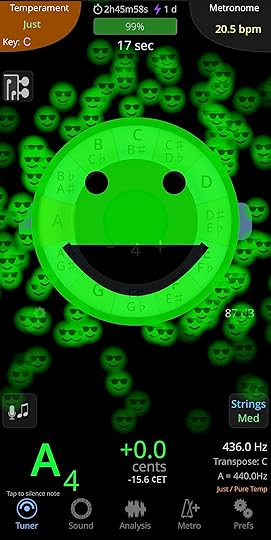
IntroductionThe TonalEnergy (TE) Tuner & Metronome seems to be a very popular app among my musician friends. The disintegrating smiley face tuning feature certainly appeals to kids of all ages.
One complaint about this app might be that users need to navigate a bewilderingly complex number of options, features, and controls. Indeed, one very useful feature of this app is not at all easy to figure out: setting up the metronome for changes in meter—and specifically for changes in time signatures that disrupt the regular placement of the beat or pulse.
Changing meters pose a fundamental limitation when practicing with mechanical or analog metronomes. If the meter change involves asymmetrical meters, the metronome has no way to adjust to those asymmetries—as we’ve all experienced— the result is that the metronome beat note gets displaced from where it should be in the music.
This essay explains how to use the TE Tuner to solve the meter change problem, using a six-measure chamber music excerpt as an example. I also explain how to set up count-in bars that establish the tempo before the musical excerpt begins, how to set accents within the bar that can define the asymmetrical meter patterns, and how to change the metronome tempo for the excerpt. I don’t explain every feature available on the metronome, but enough for you to get started with the advanced features of this very useful metronome app.
PreliminariesIf this essay looks daunting, the actual metronome setup process isn’t—once you understand how to navigate the metronome’s page design and learn the basic features. It took me less than five minutes to create the preset group for this excerpt. Of course … I’ve been practicing. I think it’s well worth the effort.
As you read this essay, you should have the app open on your phone, and in particular with the Step-by-Step Guide for Hindemith Preset Group, you should be able to follow the instructions to learn how to set up meter changes.
I’m using the iOS TE Tuner app (Version 2.3.6) on my iPhone. The instructions and images here are for that version. It has a more compact screen display than the iPad version.
The app is also available for iPad and Apple Watch, and there’s a version for desktop computers (the license is currently $10). There is also an Android version.
The excerpt I’ll be using to demonstrate this app feature is from the beginning of Paul Hindemith’s Clarinet Quintet, which presents some very routine meter change problems. The entire ensemble has the meter changes as presented in the first violin part:
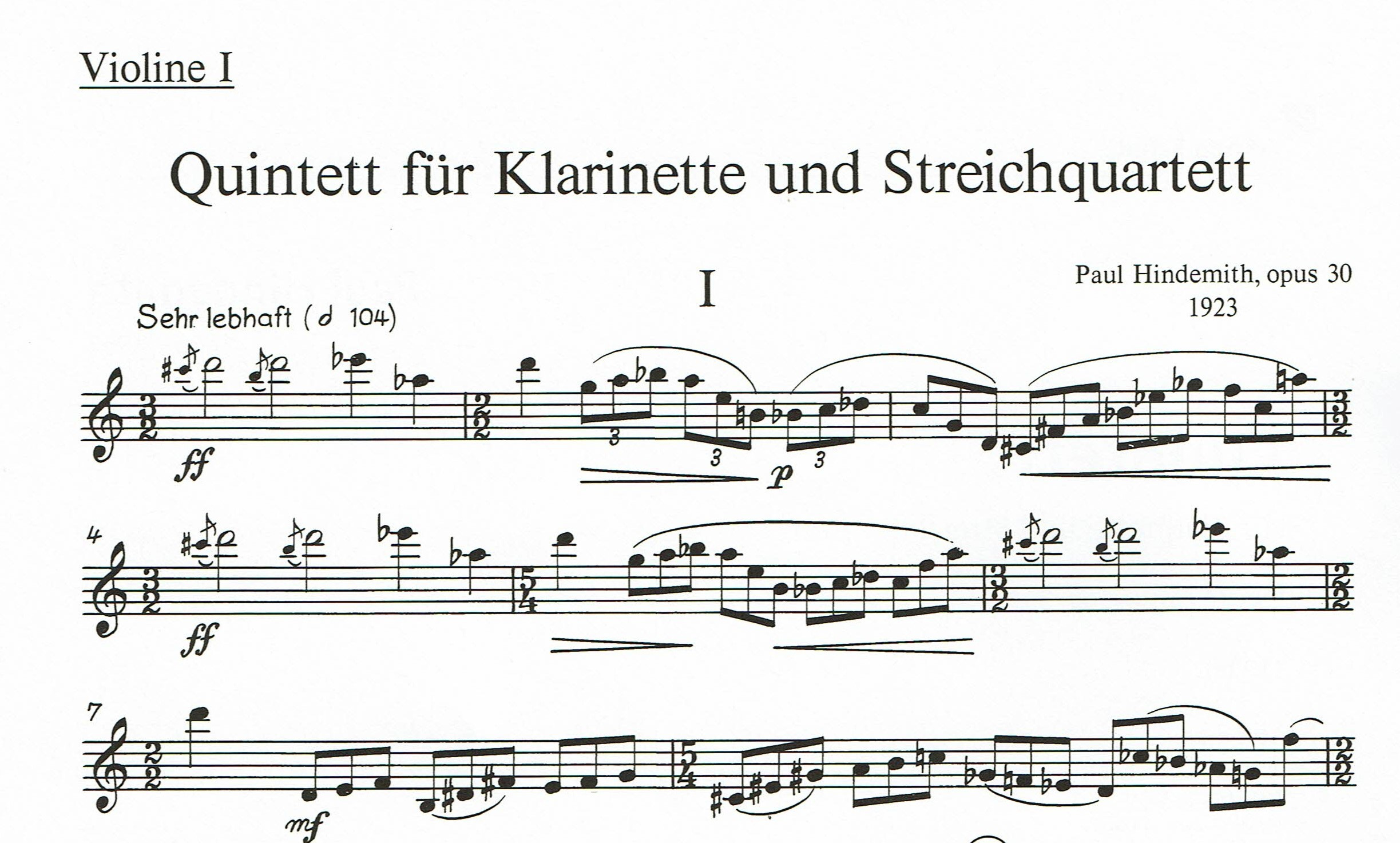 Paul Hindemith, Quintet for Clarinet and String Quartet, opus 30, first movement, violin part, mm. 1-8, Edition Schott (1955).
To understand how the TE Tuner can handle the meter changes in this excerpt, listen to this recording of the metronome track (it loops once) for the first six bars, including a two-bar count-in, at a tempo setting of 82 beats per minute—note how the metronome clicks that 5/4 bar:
Just in case you’re curious about this fabulous work, here’s a recording showing the score and another live video performance (from the 2015 Festival Mosaic).
Simple vs. Advanced MetronomeI’ll be mostly covering Advanced Metronome features in this essay, but please take a quick look at the Simple Metronome if you’re not already familiar with it.
After you open the TE Tuner app by tapping it, open the Metronome by tapping its icon (an image of a mechanical pyramid-type metronome, labeled “Metro”) in the series of tabs for the app’s different functions at the bottom of the screen:
 Accessing the Metro function, among the tuner, sound, analysis, and preferences tabs.
The Simple Metro can be set for tempo, sound, accents on a beat (but not with accents on a subdivision of the beat), a variety of beat subdivisions, and a count-in. These features are controlled by the Metro menu, the second horizontal line of menu tabs from the bottom of the screen. In the Simple Metro, these tabs are:
 Tabs for controlling the Simple Metro function
Tap on Options to open a menu of features for the Simple Metro. Note that Simple and Advanced Metro functions are controlled separately by their own Options settings.
On the Options menu you should be sure to toggle ON the “Presets Change Tempo” setting—if this option is disabled, tempos will not be changed regardless of how they are configured in the preset (and I’ll explain the preset later).
Accent toggles on or off to have an accent on the beat when the Metro is set to click subdivisions of the beat.
Sound changes the sound of the Metronome. I’ve been using the “Doctor” sound because it closely mimics the familiar and very audible sound of a Dr. Beat metronome.
Volume (dB slide control). I keep my volume setting all the way up at 6dB and use the iPhone volume button (upper button on the left side on my model) to further adjust the volume.
For routine metronome practice, the Simple Metro provides all the basic metronome features you should need, including the count-in, which might be useful for metronome practice with two or more musicians. But Simple Metro does not include meter settings and other settings included only in the Advanced Metro.
Note that if you are using a different TE Tuner feature, such as the tuner, you can always return to the metronome by tapping the upper right corner of the screen, which refers to the metronome.
TE Tuner’s “Preset” ConceptTo define changing meters, TE Tuner Advanced Metronome uses two basic concepts:
First, the “preset”—essentially measure or bar of music defined by meter, specified beat counts, or duration of time. Within the preset, you define the beat note or pulse, and its subdivision (if any), accents, and how often the preset should repeat.
The “preset” is not pre-set in the sense of already existing on your TE Tuner metronome. No, you are going to create the presets that you need for practice purposes. (If they had called these things “modules,” I think it would make more sense.)
Second, the “preset group”—this is simply an array of the presets you’ve created. The presets can be ordered to run in a series. Essentially you create a preset group to play the metrical features of a section or passage (or even an entire musical work) that you wish to practice with a metronome.
Step-by-Step Guide for Hindemith Preset GroupFirst, we’ll go to the Preset Group page.
Open the TE Tuner by tapping the app on your device.
Open the Metronome function and choose Advanced Metronome.
Do this by tapping the metronome icon (labeled “Metro”) in the series of icons for the app’s functions at the bottom of the screen, from left to right:
Accessing the Metronome function … select the Advanced Metro, with plus (+) sign.This will bring up the metronome function, and if you tap the Metro icon again, you should see a pop-up menu with “Simple” or “Advanced” metronome choices. Tap Advanced—the metronome icon with a plus sign [+]. The features we’re working with are not available in the Simple Metronome.
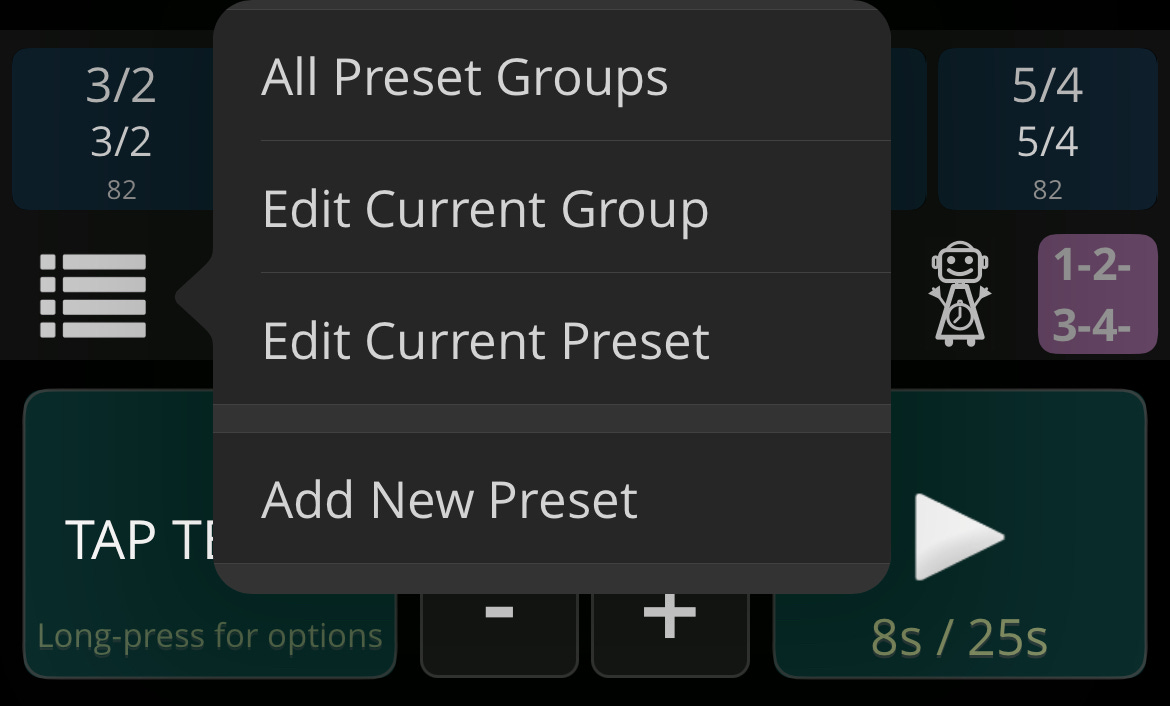
Tap the List icon (four horizontal lines) immediately above the TAP TEMPO button:
 List icon opens a list of choices to access your preset groups or editing or adding new presets.
The List contents are presented as a pop-up menu of four choices:
Open and Name the New Preset Group
Tap the top List choice: All Preset Groups. This takes you to the My Preset Groups page. If you don’t have any preset groups, you should see a default “New Group” listed. (You can also add a new group by tapping the plus sign at the lower left of your screen.)
Tap the info icon (“i”) for New Group on the list, which will open the Group Preset page for that group.
Tap the Name field to bring up the keyboard. Type in a name of the group—then hit RETURN to save the group name. I’ll call my preset group “Hindemith 5.” (Note that changes/edits to presets are automatically saved, except for names for groups or presets that you type in—that’s the only time you need to hit RETURN to save your changes.)
Define the First Preset (Hindemith Quintet, m. 1):
Immediately under the Name field, you can create a “Count-In,” but let’s skip that for now. I’ll explain that a separate section below.
Immediately below the Count-In option, you should see a default preset, numbered 1. Tap the info icon (“i”) to the right of this item, which will take you to the Preset details page.
This first preset has the default label “1. Unnamed Preset.”
For easy reference, I’m going to name my presets with the time signatures from the corresponding bars of the Hindemith excerpt (this will be useful when we want to copy a preset in a specific meter so we can include it later in the Group). But you could name the preset based on measure or rehearsal numbers/letters or some other reference. The first bar is in 3/2, so type “3/2” into the Name field, using the keyboard as you did to name the Preset Group. (If you don’t name the preset, it will be numbered automatically within the group.) When finished, remember to tap RETURN.
Continue making selections, going on down the Preset Set-Up Page:
Meter, Counts, or Time. Choose With Meter by tapping it. (Skip “With Counts” and “With Time.”)
Meter. Tapping the Meter field will open the drop-down list of meters, so slide the menu down to select “3/2.”
Subdivision. In this excerpt, Hindemith indicated the tempo in half notes, so tap the Subdivision field, and select the half note from the drop-down Subdivision slide.
(You could select the quarter note as the subdivision, but you’d probably only do that if you wanted to practice this excerpt significantly under tempo.)
Bars. Select how many bars of this preset there are. In our excerpt, there is only one bar of 3/2 before the meter changes to 2/2, so enter “1” or use the minus and plus buttons to set the number to “1.”
Beat Unit. As just noted, the half note is the beat note, so select the half note.
Use Tempo. Toggle the Use Tempo button ON. Under that button, tap the Fixed field. (Skip the “Gradual” and “Relative” options.)
Tempo. Tap the Tempo field (or use the minus and plus options) to set the tempo. I’ll set the tempo to a reasonable practice tempo of 82 beats per minute (bpm). (Hindemith’s tempo marking of a half note at 104 is much faster and likely faster than anyone would want to try to play this piece.) Later I’ll show how to change the tempo for the entire Preset Group.
Use Metronome Beats. Toggle the button for Use Metronome Beats ON (leave “Meter Polyrhythm” and “Subdivision Polyrhythm” OFF). Your screen should now look like this:
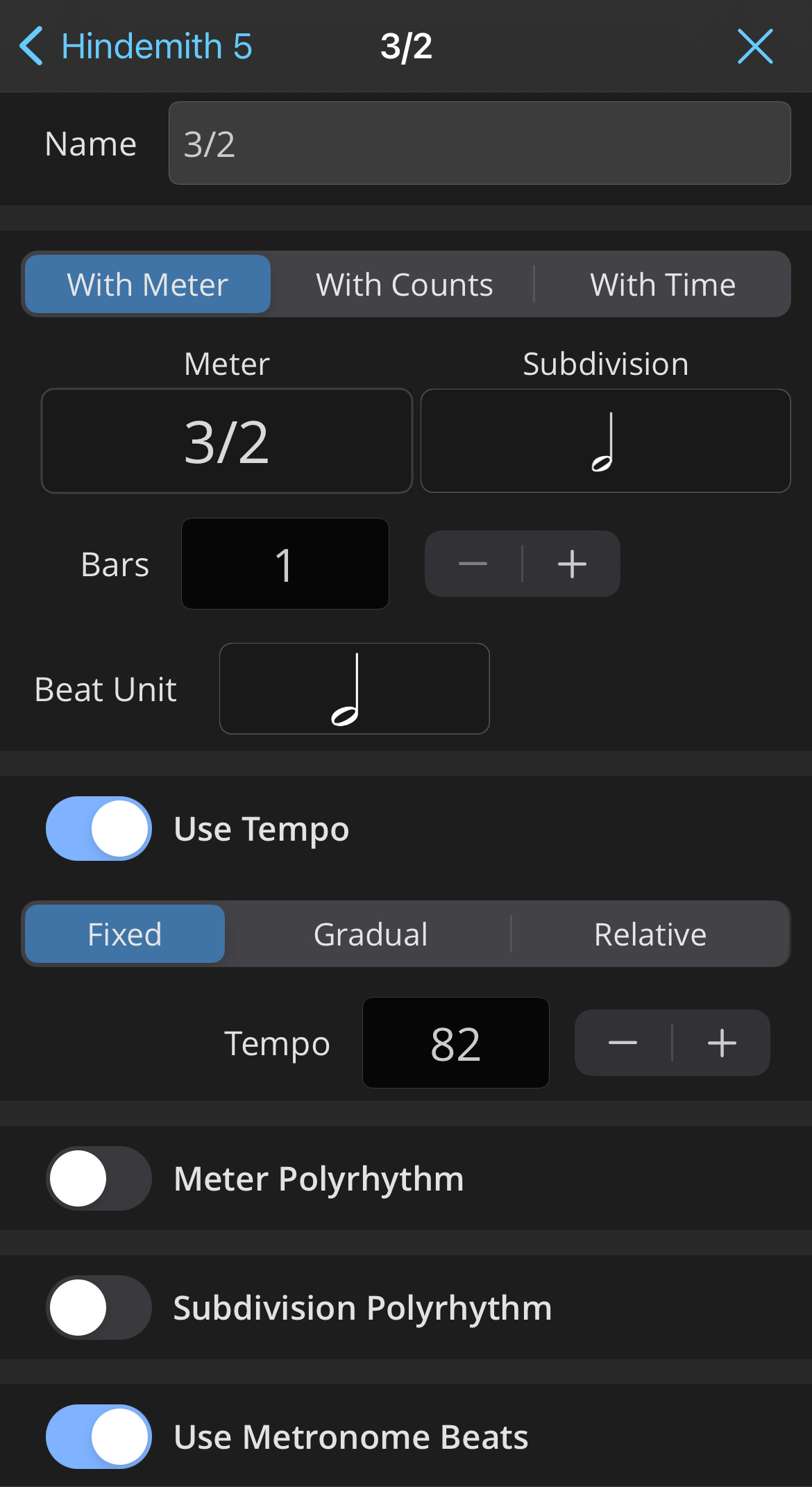 Settings for m. 1 of Hindemith excerpt
Under the setting Use Metronome Beats, set the accent pattern. By tapping the tab for each of the three beats, you can adjust them for accent emphasis or to silence the beat altogether:
Purple is an accented beat
Blue is an unaccented, normal metronome beat
No color (blackened) leaves the beat silent
For this excerpt, you’ll probably want to accent the first beat of the bar, just to make it easy to note each bar change. So, your first beat is purple, the second and third beats are blue:
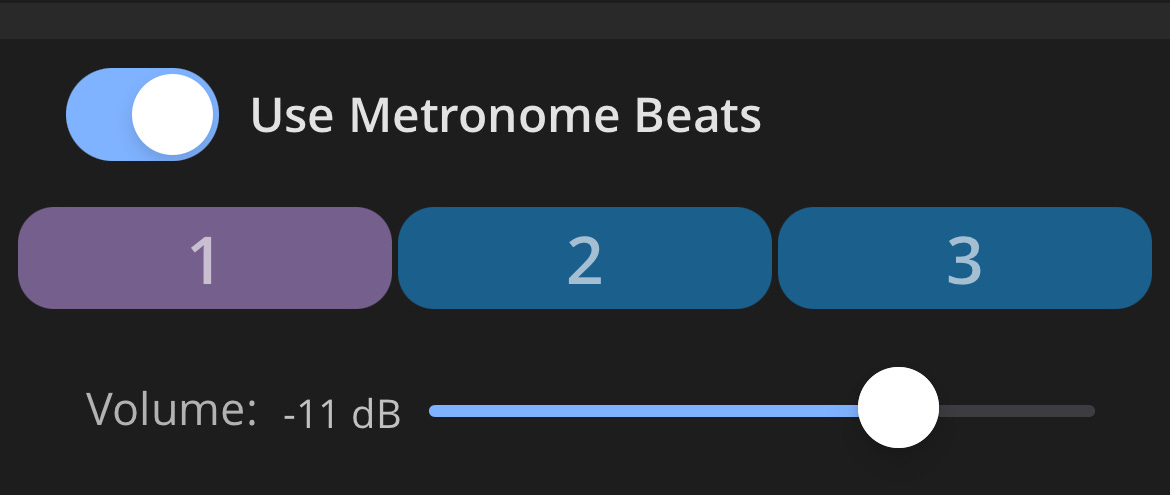 Setting the accent(s) for m. 1; purple on beat 1 indicates accent, blue on beats 2 and 3 indicates non-accented beat
Note that to play back the preset group with accents, you need to activate the accent feature by tapping on Accent (musical accent icon) on the Metronome menu on the Metronome home screen (this is true of both the simple and advanced metronomes).
Volume. Set your metronome volume, if you wish. I find that -11 dB is loud enough.
(Leave other options remaining on this page toggled to OFF.)
Your first preset is done!
Define the Second Preset (mm. 2-3)
Tap the plus sign (+) in the lower right corner of your screen. This will open a new “Unnamed Preset.”
Set up this preset just like the preceding one, except name it “2/2” because it is a preset for the 2nd and 3rd measures, which are in 2/2 meter. After re-naming it on the keyboard, remember to hit RETURN.
You should see settings carried over from the previous preset, so you only need to make two edits:
Change the Meter field to 2/2
Increase the number of bars to 2, to reflect the 2 bars in 2/2 meter in our excerpt
You should see that the two beats are shown in the beats field, with the first (purple) accented and the second (blue) without an accent.
Define the Third Preset (m. 4)
Hindemith’s m. 4 is rhythmically identical to m. 1. You can save time by copying preset 1 to create preset 3 instead of creating the third preset from scratch. Knowing how to copy and paste a preset can be very useful when creating longer preset groups that include repetitions of previously defined presets.
While on the Preset Group page, tap Edit on the lower left of your screen (you’ll then see the edit options icons appear)
Tap the first preset (3/2) to highlight it
Tap the Copy icon (image of two pages) at the bottom of the screen (a “Preset copied” pop-up should appear)
Now tap the second preset (2/2) to select it
Tap the Paste icon (the clipboard image) (a “Preset pasted” pop-up should appear)
The copied preset is pasted directly below the last selected preset.
While in the editing mode for this Preset Group, note that you can easily delete presets in the event that you make a mistake. You can also re-order the sequence of presets from the edit mode.
Tap Done in the lower left of your screen to complete the third preset of the group.
The third preset now appears in the preset group list.
Define the Fourth Preset (m. 5)
Preset 4, for measure 5 of the Hindemith, is when the meter changes from 2/2 to 5/4. For the X/2 bars, the metronome beat is half notes, but now in the 5/4 bar, let’s have it subdivide the beat and sound the quarter notes.
Create this preset by making sure that preset 3 is highlighted by tapping it, then tap the plus sign [+] in the lower right corner of the screen. This creates a new preset that follows preset 3. Name the new preset “5/4” (remember to hit RETURN) and change the subdivision to a quarter note, but keep the beat unit as the half note.
Note: in the 5/4 bar, the pulse is still the half note, even though the metronome will be ticking the quarter notes as a subdivisions of the pulse. Be sure that you don’t have the quarter note indicated as the beat unit. This is may be a bit confusing because the app uses the similar terms “Beat Unit” (our half note) and “Metronome Beats” (our quarter notes in this preset) to mean two different things. The Beat Unit is the half-note rhythmic pulse while the Metronome Beats are the note values that the metronome ticks.
Keep Use Metronome Beats toggled ON. There are many ways to group the quarters in a 5/4 bar by adding accents, but in this one, I suggest accenting beats 1, 2, and 4. This way, beat one can be heard as ending the phrase from the preceding bar, and then the pattern reverts to two half note groupings for the remaining 4 quarters of the bar.1
Your preset screen for the fourth preset should look like this:
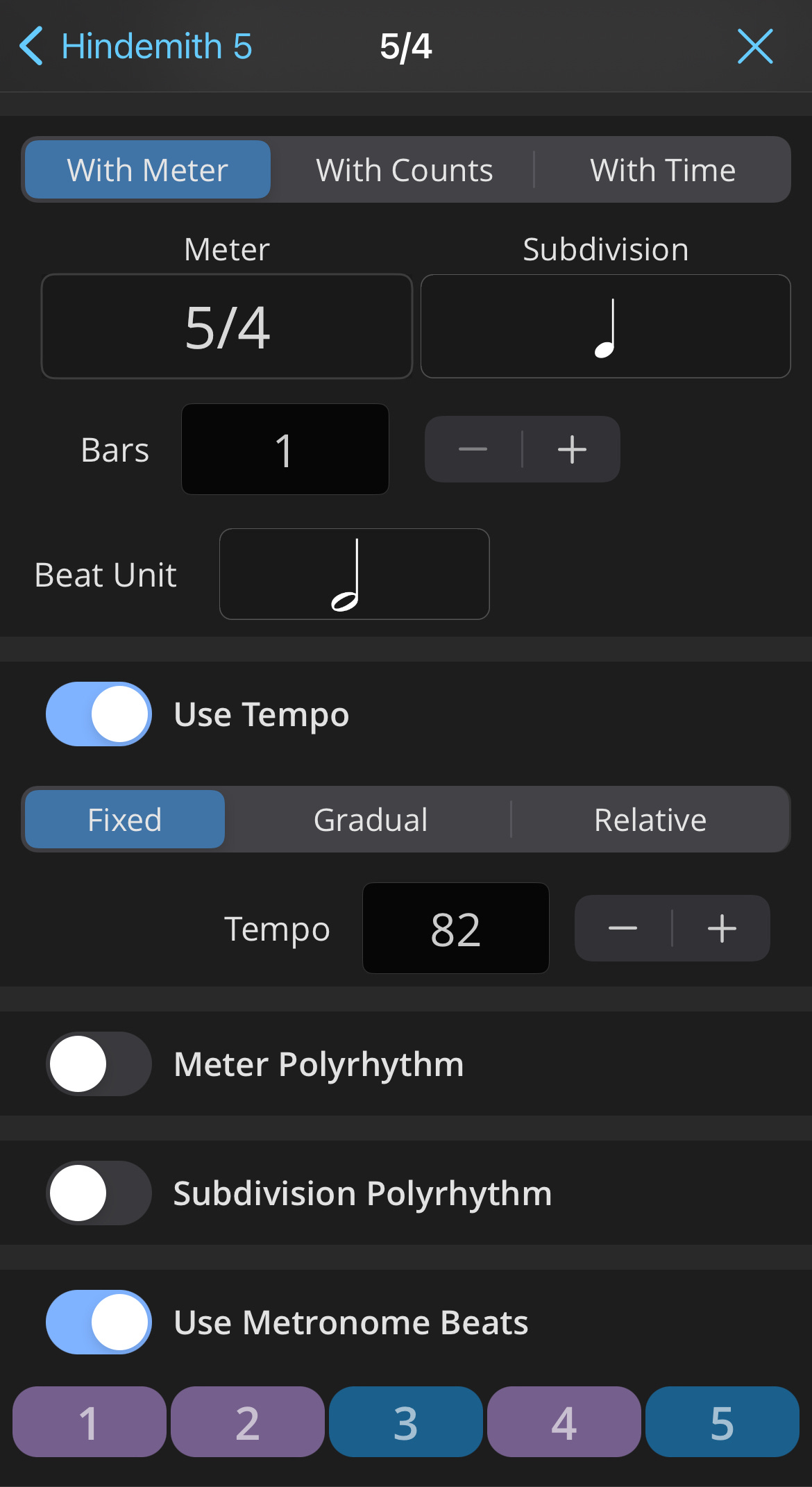 Preset for 5/4 bar (m. 5) of excerpt, indicating quarter note accent pattern.
Define the Fifth Preset (m. 6)
Again, this 3/2 bar preset is the same and presets 1 and 4. Use the copy technique from preset 3 above to copy preset 3 to create the fifth preset.
Your “Hindemith 5” preset group should now look like this:
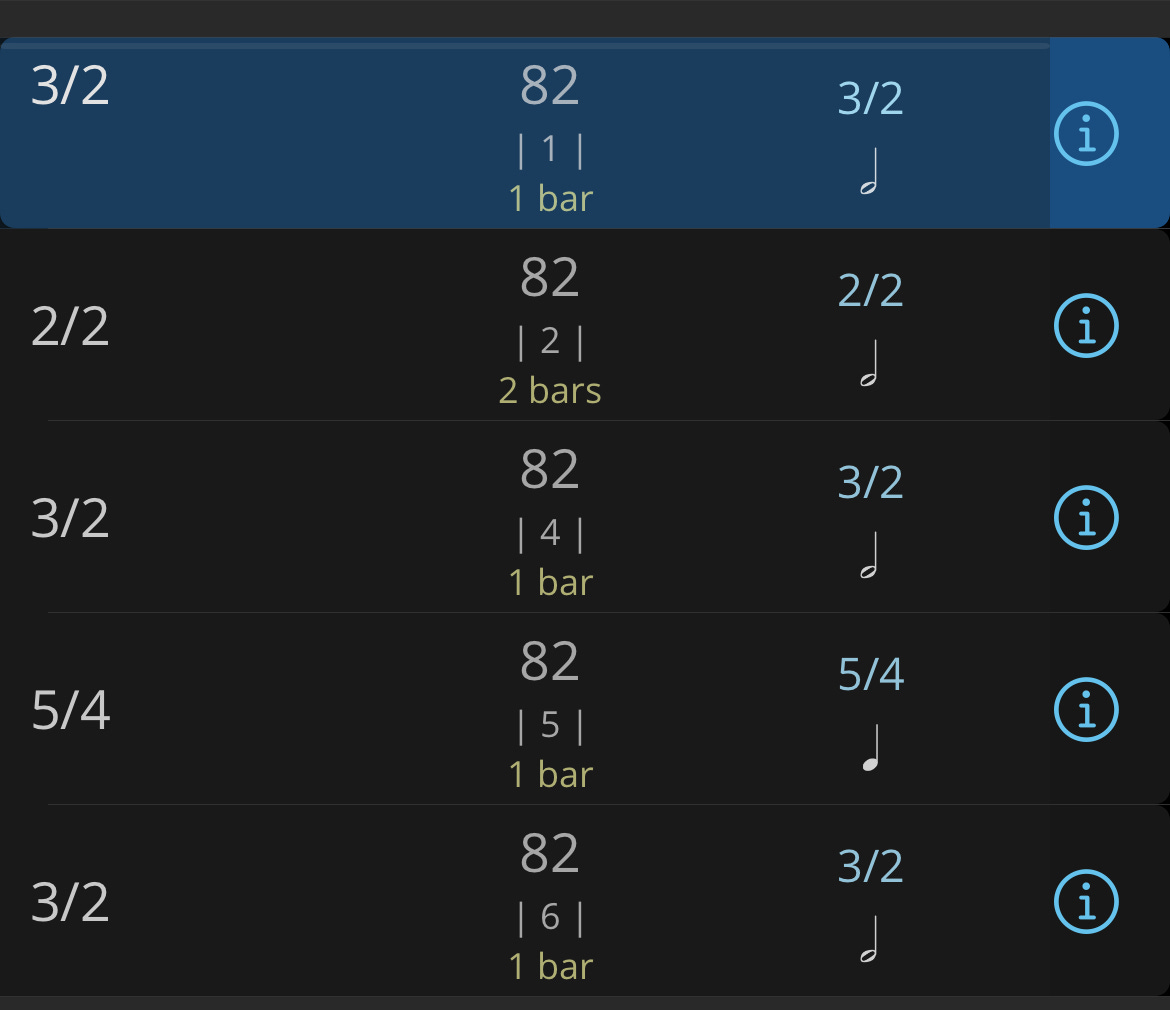 Preset Group page displays the 5 presets for the first 6 bars of the Hindemith excerpt.
The preset group is now done.
The next section explains how to have the preset group play through the group sequentially.
Sequential Playing of the Presets as a GroupTo have the list of presets in the group play as a sequence, as opposed to playing one specific preset, tap the Group Preset Sequence option:

You’ll find this option displayed at the bottom of the screen on both the Preset Group page and the page for each Preset, as well as on the full home page for the Advanced Metronome. Then tap the right-pointing arrow on the metronome home page or at the bottom of the preset groups list page and the page for this preset group.
Also, remember that to play back the preset group with accents, you need to activate the accent feature by tapping on Accent (musical accent icon) on the Metronome menu on the Metronome home screen.
Adding a Count-In to the Preset GroupIt’s entirely optional, but I can’t imagine why you wouldn’t want to add at least one count-in bar to cue you to begin playing along as the metronome goes through a preset group. The Metronome will create a count-in bar that reflects the meter of the first bar.
To create a Count-in, go to the Hindemith 5 Preset Group Page, and tap the Count-In info icon (“i”) to open the Count-In page. Toggle the Count-In button ON (you can also do this from the Preset Group List page), select the Count-In Duration Unit to be Bars, and set the in number of bars of count-in (I’ll select 2 bars).
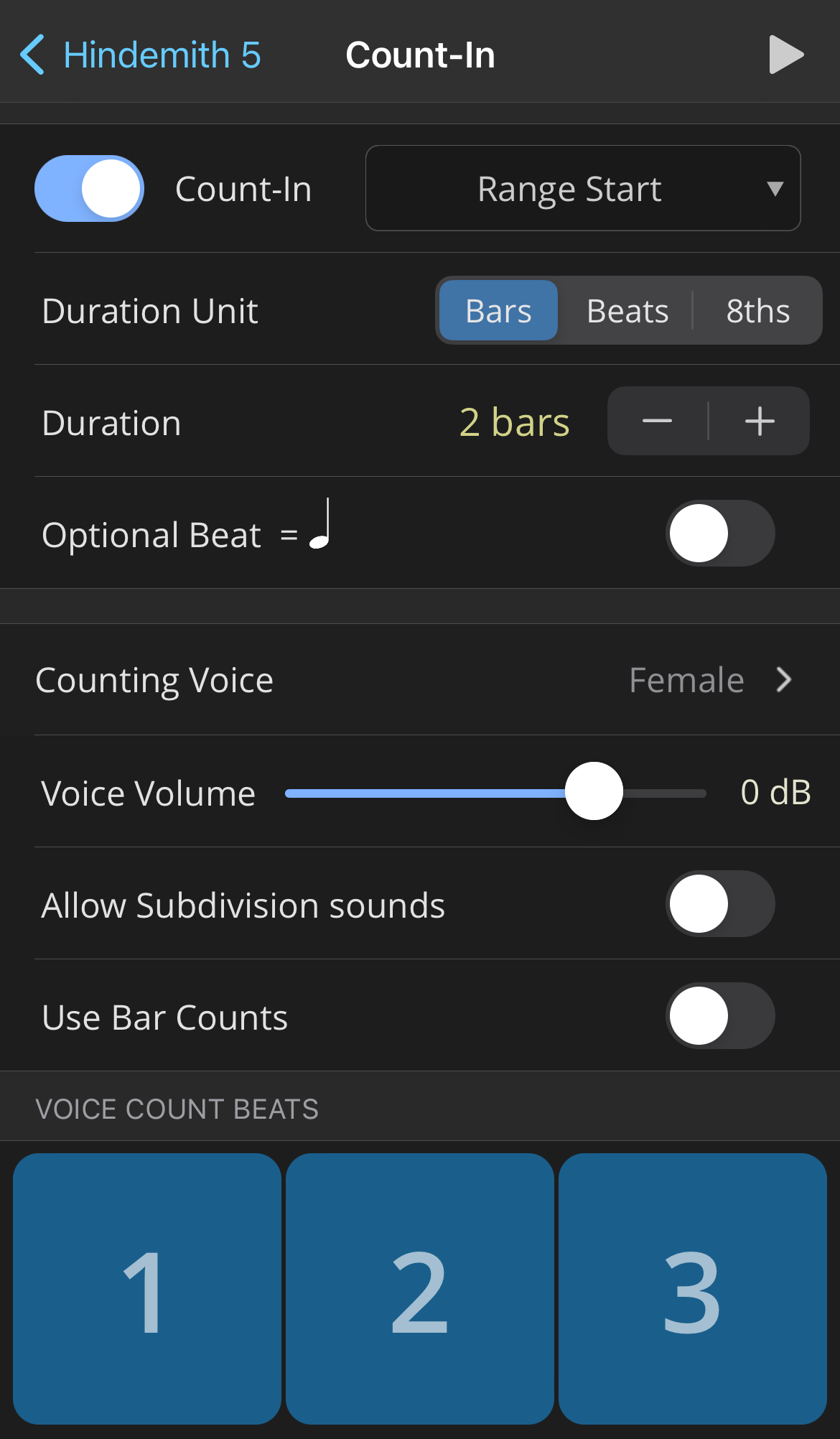
You can adjust other settings here as you like: there is a choice between “female” and “male” gendered voices, odd as it is. You can add accents to the count-in, too, but in this excerpt, I don’t think you need them. But you could add them on the first beats of the bars, to mimic the accents we added to each bar.
Changing the Preset Group TempoRecall that we set the tempo in Preset 1 to 82 bpm. If you want to change that tempo for the Preset Group, go back to the Preset Group List page and tap 82 bpm among the options on the bottom of the screen. This opens the Tempo Adjustment popup. Select Group as the “Apply Change To” option, as the tempo does not change during this excerpt. (Ignore “Preset” and “Selected Range” as to where the change is applied.) (You can also access the Tempo Adjustment popup from the metronome home page to adjust the tempo of the preset group.)
Use the plus or minus buttons to make a tempo change, or tap the Tempo Adjust field, which will open a numeric keyboard. Note that you’ll be changing the tempo up or down by percentages of the original tempo. A 5% increase in tempo, for example, would increase the bpm to 86.1
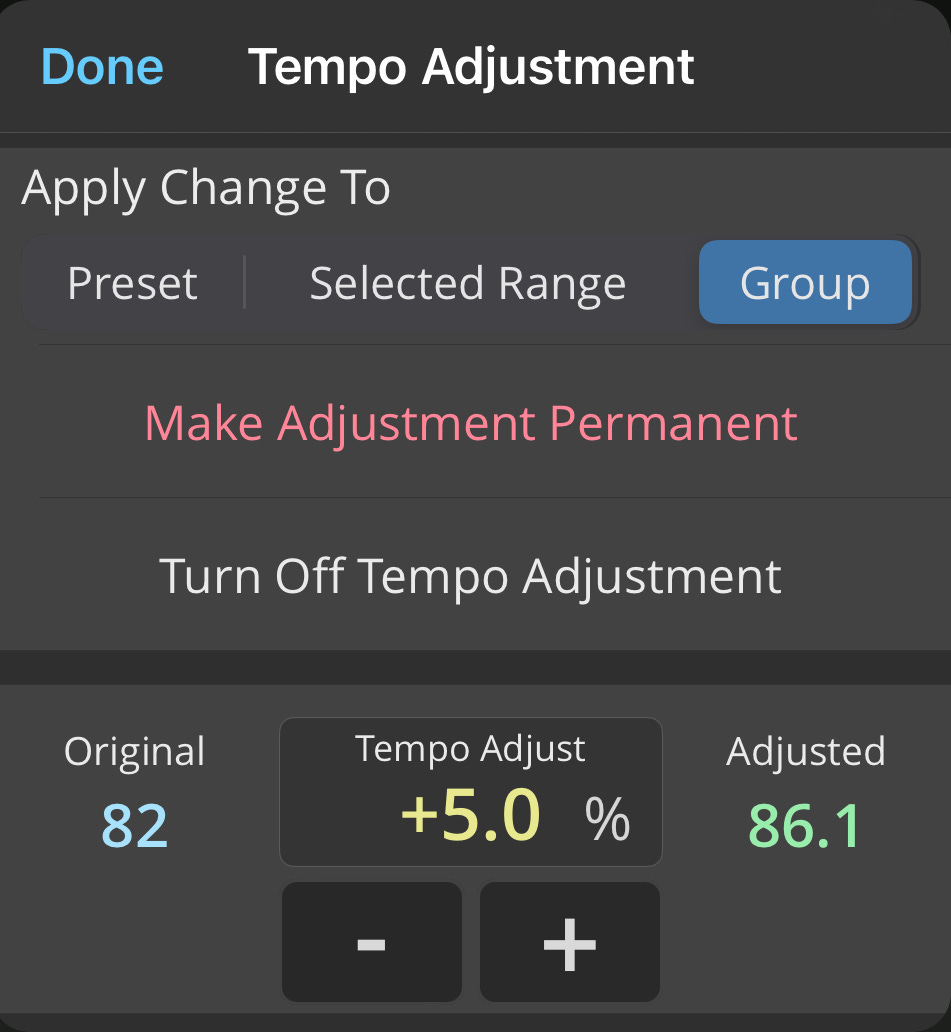 Tempo adjustment pop-up, showing increase in tempo of 5% for the entire preset group.
You also have the option to make the tempo change permanent or you can turn off the tempo adjustment, thus returning to the original tempo setting of 82 bmp.
Tap Done when you’ve completed a tempo adjustment, which makes the tempo change and closes the pop-up.
Looping the Preset GroupI’m skeptical about how effective it is to use the looping function to practice a preset group, but if you wish to have the preset group keep repeating itself, tap on the Looped arrow icon. Then tap the Start arrow at the bottom of the screen.
 Tap the loop icon to have the preset group loop continuously.Using the Tap Tempo Feature
A very useful feature of the Metronome (in both simple and advanced versions) is the Tap Tempo button, which is prominently displayed on the Metronome home screen. Because the app will stay open while you access a music streaming or playback app, such as Apple Music, you can stream a recording and at the same time tap the Tap Tempo button to identify the tempo used in the recording. Press and hold the Tap Tempo button, and you’ll see a menu of choices about how it functions.
Sharing TE Tuner Preset GroupsYou can share your preset group with others by going to the My Preset Groups page, tapping Select in the upper left corner, then tapping the group to select it, then tapping the forward icon in the lower left corner. This will bring up an array of apps that can be used to send or save the preset; apparently, emailing works best, so select your email app, and then complete and send the email. The recipient should open the email, open the attachment (it should show the code for the preset group), and use the forward/upload option, which will open the list of apps. Then select the TE Tuner app. A pop-up message should confirm the addition of the new preset group, which will appear in the recipient’s My Preset Groups page.
Additional ResourcesTE Tuner and Metronome User Guide. The User Guide can be accessed through the “Preferences” tab (which may be under the “More” tab) among the tabs listed at the bottom of the screen. It’s also on the Tonal Energy website. Although it describes the features of the app, it doesn’t take you through the process necessary for setting up presets.
TE Tuner YouTube videos. TE Tuner has numerous videos on its YouTube channel including several that provide metronome instructions, although I believe they all use the app on the iPad. TonalEnergy Tuesday Tune-Up #4 (Metronome & Presets) (7-minutes) covers presets in the Metronome.
TE Tuner user support. I’ve found the folks at TE Tuner to be very responsive. You can submit questions through their Support page or by emailing support@tonalenergy.com.
There are surprisingly few YouTube videos that address these meter change issues I present here: only Justin Foell with WGI Winds “River Valley Sound” (shoutout for Elk River, Minnesota!) has done it in an 11-minute video describing how to create presets for a work involving both 4/4 and 7/8 bars. Ronald Houston has a 27-minute video, which covers a lot of metronome basics and also shows how to create presets in different meters.
1I owe this idea about beat groupings in this bar to the esteemed chamber music coach Judith Eissenberg, from our work on this piece at the Chamber Music Conference and Composers’ Forum of the East (Colgate University, Hamilton, NY) during the summer of 2024.
June 24, 2024
Portraying the Legacy of Lucretia Mott
She’s been called “one of the best-kept secrets in American history.” More than 130 years passed after her death before she was the subject of a scholarly biography by an academically trained historian.
Yet Lucretia Mott was without question the most important white female abolitionist in pre-Civil War period. She was an early and influential proponent of equal rights for women. Her life-long work on social justice issues, her commitment to racial and gender equality, and her opposition to violence in all its forms give her a compelling relevance to our own time.
Thanks for reading The Consequences of a Liberal Education! Subscribe for free to receive new posts and support my work.
An Elusive Subject
In a scholarly but eminently readable 2011 biography, Lucretia Mott’s Heresy, Carol Faulkner observed that she remains a “cipher”—one of Mott’s favorite words—largely invisible, as if obscured in a hidden code or puzzle.
Public evidence of Mott is rare: there are precious few public statues of women in Philadelphia, and Mott is not among them. A Pennsylvania Historical Commission marker identifies the former location her home, “Roadside,” but the house itself was demolished long ago.
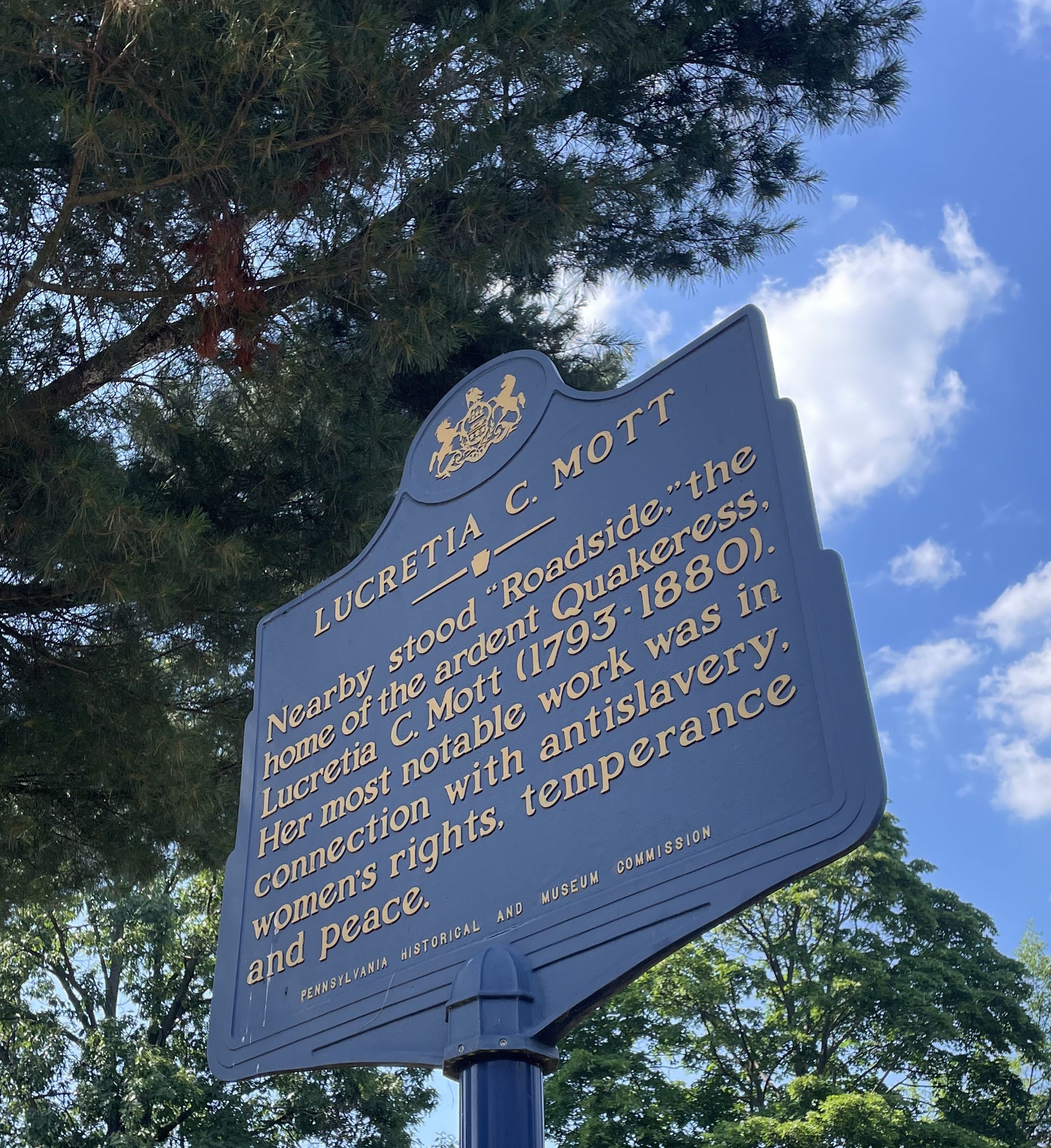 Pennsylvania Historical Commission marker near the former location of Lucretia Mott’s home, Roadside, in Cheltenham, PA. Photo: David W. Webber
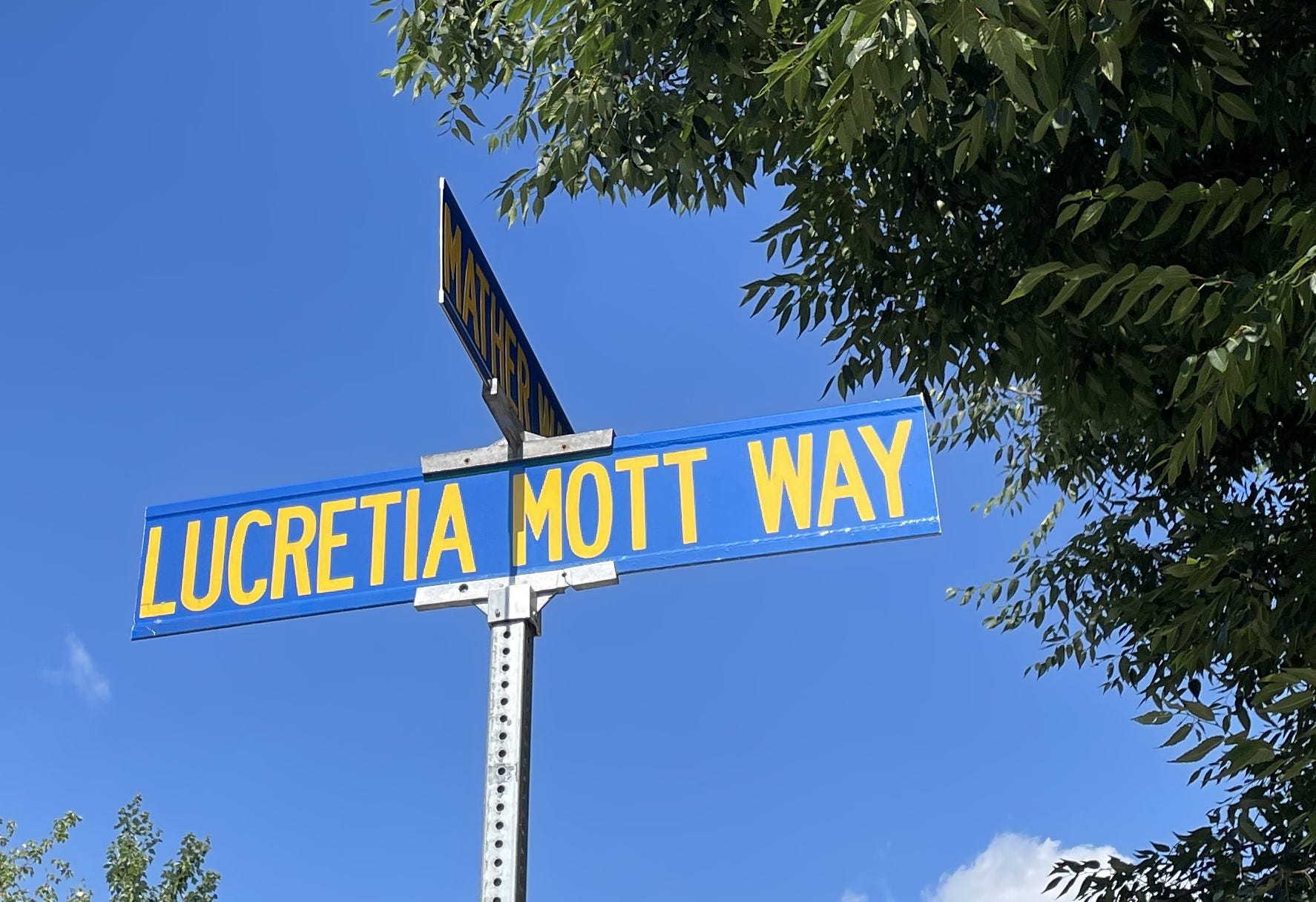
The neighborhood (close by is “Lucretia Mott Way”) was named “LaMott” in her honor, but that distinction reportedly came about because the first choice, “Camptown,” had already been taken.1
She was depicted in a marble sculpture, along with her younger friends and fellow advocates of women’s rights Elizabeth Cady Stanton and Susan B. Anthony, in the U.S. Capitol in 1921 to commemorate the adoption of the 19th Amendment, which extended the right to vote to women. But that sculpture was soon moved to a basement broom closet, where it remained for the next 75 years.
She was an eloquent and captivating public speaker, yet she wrote (other than her private letters to friends and family) and published almost nothing. But as a woman of national fame, she sat for the painting of several portraits, and for many more photographic images, always with a self-effacing persona—her hair hidden under a simple bonnet and dressed in her typical Quaker clothing—modest, plain, unadorned.
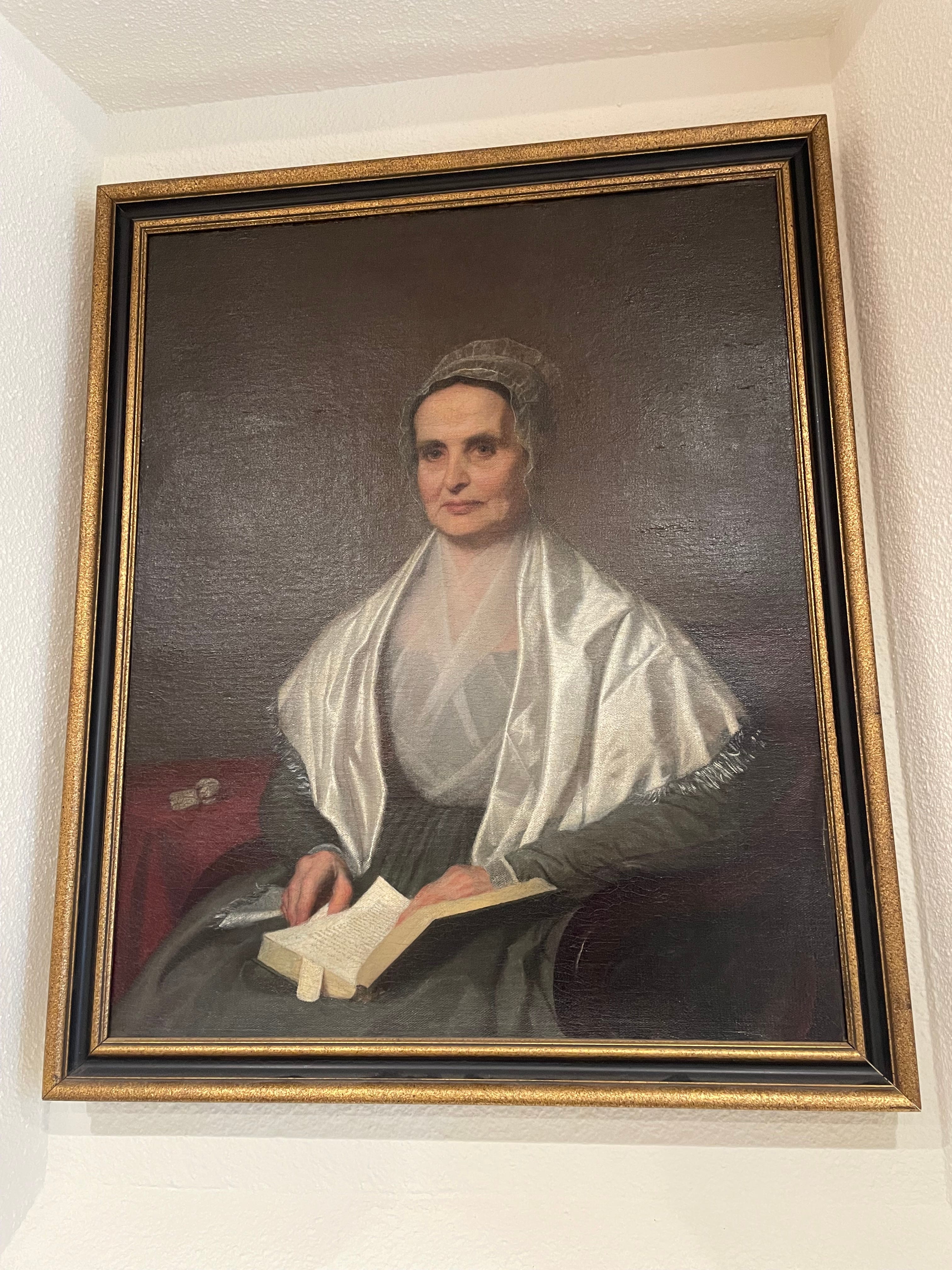 Portrait of Lucretia Mott, by William Henry Furness Jr., ca. early 1850s. Original portrait courtesy of Friends Historical Library of Swarthmore College. Photo: David W. Webber
She spent her 18th century childhood on the island of Nantucket, where she was brought up in a Society of Friends (Quaker) community. That religious upbringing imbued in her the belief that there is an “inner light” from God in every human being. Flowing from that was her opposition to slavery as a practice both immoral and inhumane. She also grew up without strict, customary gender roles. Nantucket women took on what were traditionally male responsibilities when the men were absent on lengthy whaling voyages.
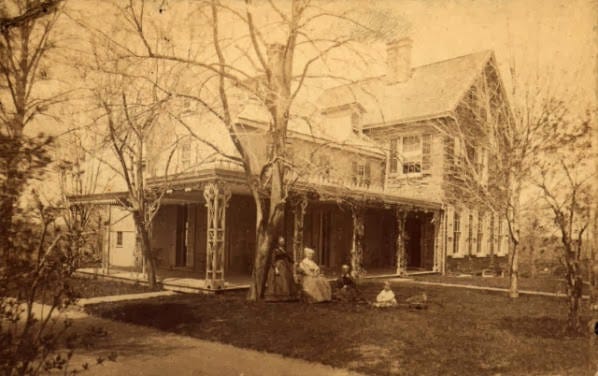 Lucretia Mott seated in front of her home, “Roadside,” photograph by J. W. Hurn, 1319 Chestnut St., Phila., PA, ca. 1865. Courtesy of Library Company of Philadelphia.
She lived almost all her adult life—altogether about 70 years—in Philadelphia or just outside the city in Cheltenham Township, Montgomery County.
Philadelphia was where she married, bore her six children (five would survive to adulthood), worshipped (at the Cherry Street Friends Meeting), and had many of her historically noteworthy speaking engagements—including perhaps her most famous one, delivered in 1849, a transcription of which was later published as “A Discourse on Woman.”2 In 1880, she died at her home in Cheltenham and was buried in North Philadelphia, in the Quaker Fair Hill Burial Ground.
The Union League Portrays Mott
Given our difficulty getting a clear take on Mott, the Union League’s recent unveiling of a newly commissioned oil portrait of her is a celebratory occasion. But consistent with Mott’s elusiveness, the unveiling in late 2022 seems to have gone unreported, perhaps because the Union League was much more in the news then for its controversial award of its Gold Medal—the award that was first given to Abraham Lincoln in 1863—to Florida governor (and former presidential candidate) Ron DeSantis.
The League’s choice of Mott for this honor is bewildering. The portrait, the League explains in its publicity handbill, “serves as a reminder of the important role that women played in the League.”
Perhaps that means after 1986, since the League admitted only men as members for its first 124 years. Mott would not be pleased with that, nor would she have been pleased that the League did not admit any Black men for its first 110 years. After all, she advocated not just for the end of slavery, but for racial equality. The Philadelphia Female Anti-Slavery Society, founded by Mott and others in 1833, was an interracial organization, despite the controversy and violent reactions that their mixed-race meetings provoked.
The League also claims that “Mott worked with the League to establish Camp William Penn, the first training camp for the United States Colored Troops.” But it is unlikely that Mott or the League did anything of the sort. As I’ve written previously, the League shied away from directly recruiting Black soldiers—that was simply too controversial—although the League did recruit for its whites-only regiments. And Mott, with her long-standing pacifism, would not have been one to help set up a military training camp.
I fact-checked this with Professor Faulkner, Mott’s biographer, who agreed, explaining via email that “Mott was a pacifist and opposed to the war on principle.” Faulkner went on to say that “like other Americans, however, she could not help but be connected to the war effort by friends and relatives.” Indeed, Mott’s son-in-law, Edward M. Davis, an ardent abolitionist Quaker, made his personal contribution to the end of slavery by enlisting in the Union Army early in the war. But Mott, writing to her sister in 1861, expressed disapproval of Davis’s joining the army: “He flatters himself that the abolitn. [sic] of slavery – end, justifies means.”3 (Davis’s enlistment also cost him his membership in the Race Street Friends Meeting.) After Davis returned from military service, he leased some of his own land (not the Motts’ land) for the military camp.4
Mott’s View of the Union League
Judging from Mott’s own references to the Union League in her letters, she did not “work with” the League on Camp William Penn—or anything else, for that matter. She expressed thorough-going doubts about the Union League—quite specifically, about its commitment to abolishing slavery.
In a letter to her sister in 1863, less than three months after the founding of the League, Mott reports how she and her good friend, J. Miller McKim, had a lively discussion—“we had it quite spirited, for awhile”—about McKim’s having joined the League. Mott relished such lively discussions and no doubt questioned McKim severely about what he was up to. As Mott explained:
“Miller was defending himself while here for joining the Union League—we being doubtful whether it would be anti-slavery enough to warrant his ‘crying a confederacy.’” 5
So she was quite skeptical about McKim’s view that the League would be a part of an anti-slavery “confederacy.” She went on to comment that “Miller thought their League would at least be equal to our Cherry St. Meeting,” referring to the strongly anti-slavery Quaker meeting where Mott worshipped. But Mott also told her sister that McKim was invited to join the League because of “his abolitionism and he thinks there’s an amazing change taking place among the politicians.” This spirited discussion between Mott and McKim took place less than two months after Lincoln’s Emancipation Proclamation, so it evidences how attitudes about slavery were perceived to be changing. And it evidences the existence of an abolitionist element among the League’s members.
More than a year later, Mott attended a meeting where the Union League advocated for support for those recently escaped from slavery. Writing now to another of her sisters, Mott said of this meeting:
“It is ‘as good as a play’ to mingle with the audience in the middle of the hall and let the Freedman’s and Union League committees bear all the burdens—and they may have all the glory too if they will only persevere until every slave is forever free.” 6
Her reference to “as good as a play” probably reflects her attitude that the meeting was both entertaining and a bit unreal, while she goes on to emphasize her uncertainty that the League would “persevere” in the abolitionist effort. Indeed, another year and a half had to pass before ratification of the 13th Amendment abolished slavery in the United States. Yet Mott’s questioning of the League’s commitment to ending slavery was not unwarranted: after all, her anti-slavery work preceded the founding of the League not by years, but by decades. And as Mott seemed aware, the abolition of slavery was not one of the League’s stated purposes.
After the Civil War, the Union League sought to glorify and celebrate the Union’s victory. Mott, again, followed a very different path amid the horrific aftermath of the war. In 1866, she was a founder of the Pennsylvania Peace Society, an anti-war organization.
Bringing Mott Portraiture to the Public
Neither of the two local portraits of Lucretia Mott is on full public view. The Union League’s new portrait can be seen only by League members and their guests. An appointment is needed to see the 1850s portrait in the Reading Room of the Friends Historical Library at Swarthmore College. To see Mott painted from life, you’ll need to travel to Washington, where the National Portrait Gallery displays an 1842 portrait by Joseph Kyle.
Let’s hope that the Union League soon displays its portrait publicly—and makes Lucretia Mott less of a best-kept secret in history.
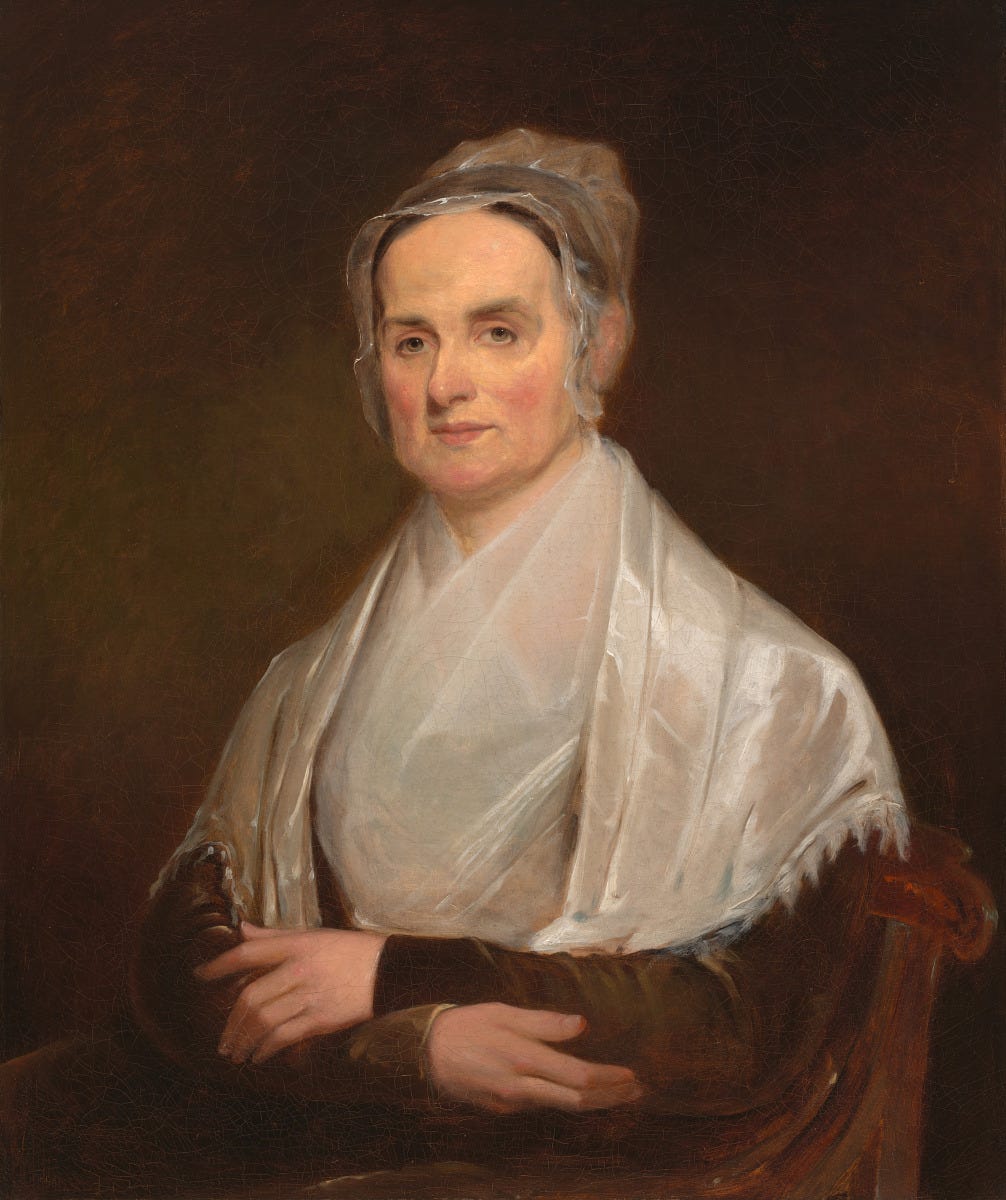 Joseph Kyle, 1842 portrait of Lucretia Mott, from National Portrait Gallery, Washington, DC.
Acknowledgements
I thank the staff of the Friends Historical Library of Swarthmore College for their generous help in making Mott’s original letters available (including a copy of an unpublished letter) quoted herein and for allowing me to photograph and include here the Mott portrait in their Reading Room.
Special thanks to Professor Carol Faulkner for her kind reading and commenting on an earlier draft of this essay.
Special thanks as well to David Lee Preston, who provided excellent editorial assistance and publishing advice on earlier drafts.
1David Jenkins Morrison, A Guide Book to Historic LaMott (Cheltenham Township Historical Commission, 1974). Morrison’s account appears to be based on Wallace Triplett, Jr., History of LaMott (1949).
2Reprinted in Lucretia Mott Speaks: The Essential Speeches and Sermons (Christopher Densmore et al., eds., Urbana: U. Illinois Press, 2017), p. 68.
3Letter of Lucretia Mott to Martha Coffin Wright, August 20, 1861. Mott Manuscripts, Friends Historical Library of Swarthmore College (PSCHi). Quoted in Selected Letters of Lucretia Mott (Beverly Wilson Palmer, ed., Urbana: U. Illinois Press, 2002), p. 316, n. 3.
4That the Union League erred in claiming that Mott helped establish a military training camp is quite remarkable. As long ago as 1884, Mott’s attitudes about the war and training of Black troops at Camp William Penn were described in Mott’s granddaughter’s biography of Lucretia and James Mott. “While Lucretia Mott strongly disapproved of war and its attendant barbarities, she nevertheless could not resist the interest that this public acknowledgment of the negro's rights as a soldier called forth. As an abolitionist, she gave the movement her sympathy, but as an advocate of peace, she condemned any resort to carnal weapons. With these conflicting feelings, she seldom visited the camp, and seemed indifferent to its affairs as a military body; but she found many chances to befriend its inmates, both officers and privates, as individuals.” Anna Davis Hallowell, James and Lucretia Mott: Life and Letters (Boston: Houghton, Mifflin & Co., 1884), pp. 406-407.
5Letter of Lucretia Mott to Martha Coffin Wright, Feb. 28, 1863. Photostatic copy in the collection of Friends Historical Library of Swarthmore College. Edited transcription in Anna Davis Hallowell, James and Lucretia Mott: Life and Letters, pp. 405-406.
6Letter of Lucretia Mott to Martha Mott Lord, April 22, 1864 (A00182036, Mott Manuscripts, SFHL-MSS-035) Friends Historical Library of Swarthmore College.
November 16, 2023
Review: Dancing with History: A Life for Peace and Justice, by George Lakey
This review originally appeared in a somewhat different form in Broad Street Review and is reprinted with permission.
In my social circle, I’m always surprised that so many people know or know of George Lakey—about half of them, it seems, know him for hosting an annual holiday sing-in of Handel’s Messiah, and half know him from his life-long social activism in the Greater Philadelphia area and beyond.
Thanks for reading The Consequences of a Liberal Education! Subscribe for free to receive new posts and support my work.
He details that work and the life around it in his new memoir, Dancing with History: A Life for Peace and Justice.
I met Lakey in the 1980s, when he was with Jobs with Peace, and we shared office space along with other attorneys and activists. I was soon invited to join in his annual Messiah sing-in when it was still crammed into his communal living room in his West Philadelphia home, and I returned in 2018 for the 50th anniversary sing-in, which was held at the Philadelphia Friends Center, having long previously outgrown that living room. (The back of my head is featured prominently in his book’s photo of that event.)
Sociology in practice
In his memoir, published at age 85—it’s his 11th book, depending on how you count them—Lakey takes us through his “life for peace and justice,” beginning with his childhood in the working-class shale-mining community of Bangor, Pennsylvania. He describes his formal education: he left West Chester State Teachers College (today, West Chester University) in opposition to the stifling censorship on campus, then finished college at Cheyney State Teachers College (today, Cheyney University of Pennsylvania), the oldest historically Black college in the country. In 1958, Lakey was the only white student living on campus.
He studied sociology in graduate school at the University of Pennsylvania (the notable sociologist Philip Rieff was a mentor), until he realized that his use for sociology was not as a professional field of study leading to an academic appointment, but instead as a means for understanding and planning the processes of nonviolent social change.
Beginning with his arrest during a racial-justice campaign in Chester, Pennsylvania, in 1963, Lakey went on to involvement in other civil-rights campaigns (he co-wrote the 1964 Manual for Direct Action—a seminal work for the civil-rights and anti-war movements) and anti-war efforts during the 1960s (he led Quaker efforts to deliver medical supplies through the naval blockade of Vietnam in the South China Sea). He has championed LGBTQ rights and labor rights issues, and recently he led a Quaker effort for the environment (resulting in his arrest at age 83 during a protest at a Chase Bank, the “number one financier of fossil fuels in the United States.”)
Choosing democracy
In 2020, as it became clear that President Trump might attempt to remain in office despite the presidential election results, Lakey and others led the Choose Democracy campaign, involving thousands of people in preparations and training to “prevent and, if necessary, stop an undemocratic power grab or coup.”
After January 6, 2021, when it became clear that Trump would not remain in power, Choose Democracy shut down, but offered its online resources “to anyone to support pro-Democracy, anti-coup efforts anywhere around the world.”
The “dancing with history” in his memoir’s title, Lakey explains, is his preferred metaphor because:
“It gives considerable weight to history’s drive, but it leaves open the possibility that we, too, might at times move so strongly as to lead history. Further, dancing invites in other dimensions that matter to me—namely, music and spirit. As a young, highly impressionable activist in the civil rights movement, I experienced music mobilizing spirit in ways that spurred action more powerful than I previously imagined possible.”
Ahead of his time?
Into this account, Lakey weaves stories of his personal life—his childhood and then adult relationships with his parents, his marriage to Berit Mathiesen in 1960 in her native Norway, the challenges of parenting, and his romantic relationships with other men, such as activist Alan Tuttle.
Reading Dancing with History, one gets a sense that Lakey’s advocacy was often, if not always, ahead of its time. As a 12-year-old in 1949, he gave a sermon on the subject of racial equality to his all-white church congregation. As you might guess, it was not well received. In 1974, Lakey came out as bisexual in a plenary speech delivered at the Friends General Conference Gathering.
As Lakey put it, “It would be a chance to come out to a thousand Quakers, all at once!”
Again, the response was far from enthusiastic. But with these issues, as with many others, Lakey’s dance has him always landing on the right side of history.
Update: George Lakey reports that his coast-to-coast Dancing with History book tour took him to “about 20 states, 50 cities and towns, a dozen universities and dozens of religious congregations, not to mention bookstores and libraries.” But, now reaching age 86, he has said that this was his last book tour. But the George Lakey Documentary Film Project, directed by Glenn Holsten, is nearing completion, so that should be a significant additional record of George’s life-long non-violent social change commitment.
George Lakey, Dancing with History: A Life for Peace and Justice (New York City: Seven Stories Press, December 6, 2022). 424 pages (indexed, including photographs), paperback; $22.95. Get it from Seven Stories Press (currently $16.06) or bookshop.org.
Thanks for reading The Consequences of a Liberal Education! Subscribe for free to receive new posts and support my work.
November 2, 2023
Review: The Union League’s Revisionist History
At the Union League Heritage Center, 140 S. Broad Street (ring doorbell for access through street level door at front of building; accessible entrance reportedly available through side door on Sansom Street). The exhibit runs through December 2024. Admission is free.
Public hours: Tuesday and Thursday, 3:00-6:00 PM; second Saturday of every month, 1:00-4:00 PM.
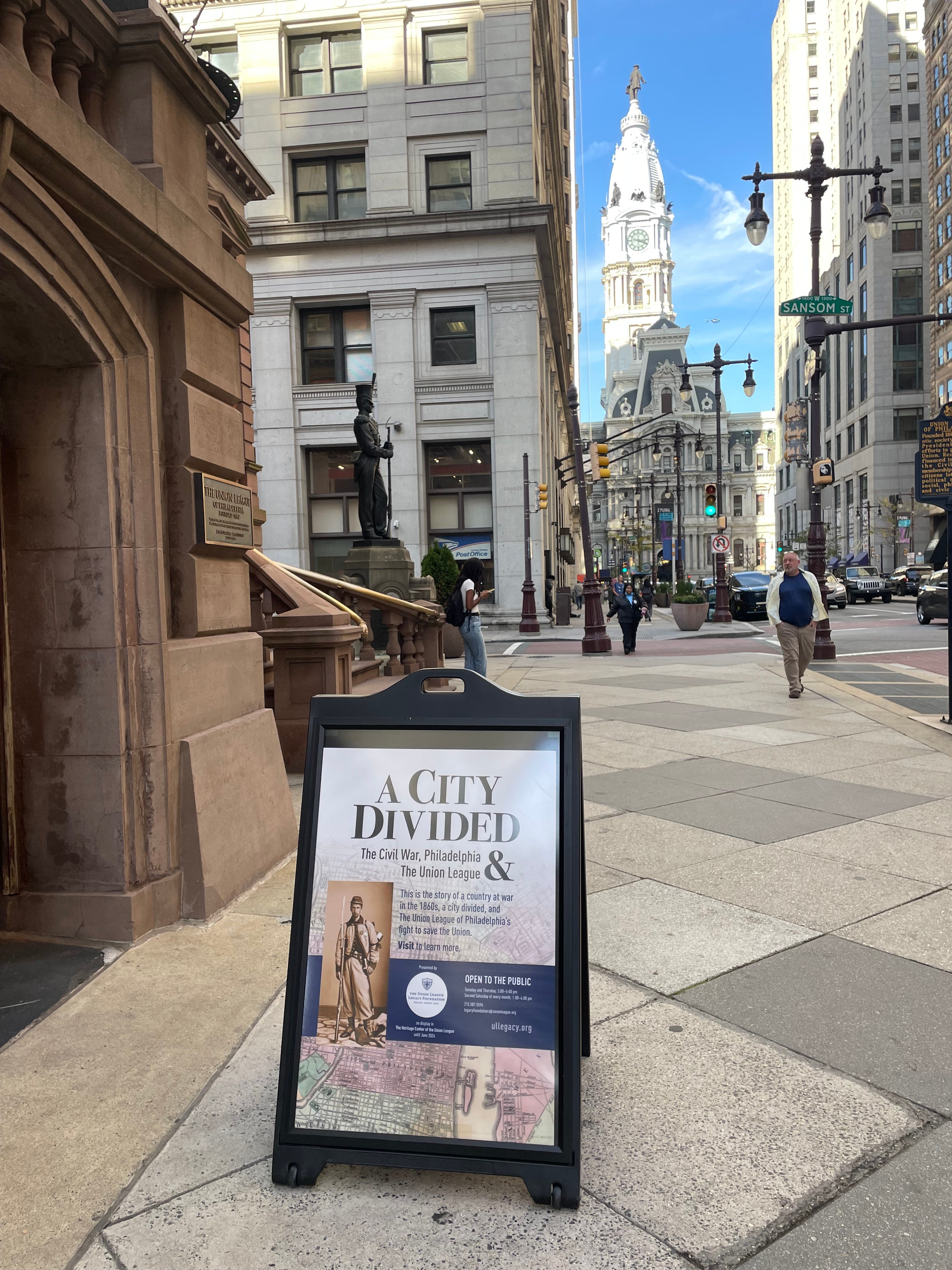 South Broad Street entrance to Union League Heritage Foundation’s exhibit. Photo: David Webber
The Union League’s museum exhibition, “A City Divided: The Civil War, Philadelphia & The Union League,” should be of interest not just to Civil War history buffs, but to anyone curious about Philadelphia’s political, racial, and cultural history—past and not so past. And not just for what it reveals about the Civil War period, but how it reflects on the Union League today.
From Honoring Lincoln to Honoring DeSantis
By way of background, the Union League, founded in 1862 to support the Union during the Civil War, has been in the news for the controversy about its presentation of the League’s gold medal of honor earlier this year—the same award given to President Lincoln in 1863—to Florida Governor (and now Republican presidential candidate) Ron DeSantis.
Outside the League’s award ceremony, members of the local NAACP and others joined in a large street protest, and the League received a thorough drubbing in news media opinion pieces.
With this background in mind—a city divided, indeed—I stepped through the street-level door at the front of the League clubhouse on Broad Street.
And as always when thinking about this conservative Republican organization, I experienced a moment of almost dizzying cognitive dissonance—how did the Republican Party of the Civil War Union League—yes, the party of Lincoln—become the party of Donald Trump?
According to Vox, this can be answered in 13 maps or 7 minutes.
Inside, “A City Divided” is presented in only one large room, but it is a full and information-packed display, heavy on written narratives that accompany period sepia-toned maps and images enlarged floor to ceiling. A detailed Civil War timeline organizes the exhibit, and included are a smattering of period documents, objects, and art works (not one, but two Lincoln busts), and, perhaps surprisingly, only a few weapons.
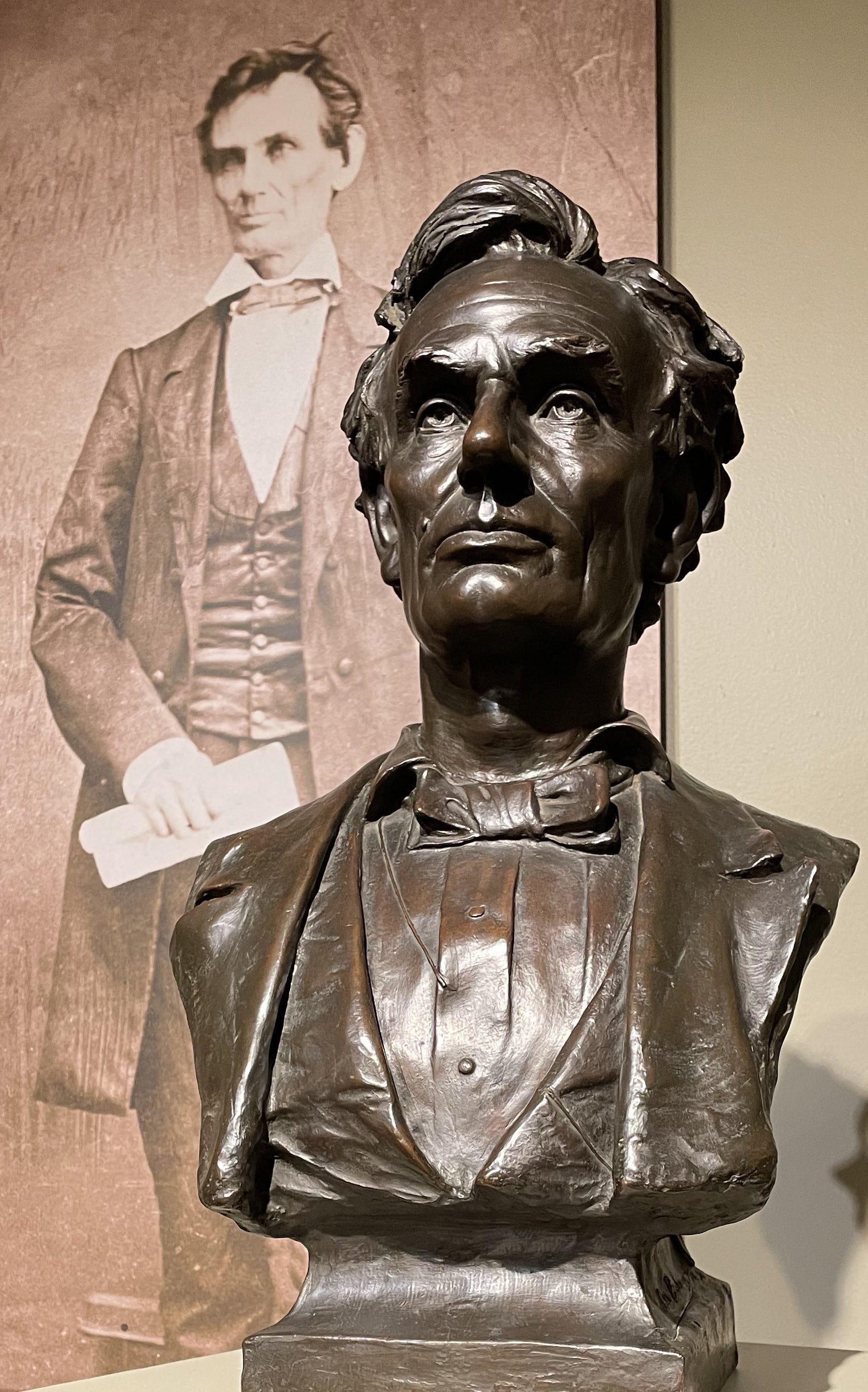 Images of Lincoln of predominate the exhibit (front: Bachmann 1905 Lincoln bust). Photo: David Webber
Confronting Common Myths
At the outset, the exhibit attacks some common myths. Foremost is that Philadelphia, as a “northern city,” was uniformly on the side of Lincoln, supporting the war to end slavery and establishing full citizenship for the formerly enslaved. On the contrary, the exhibit explains, Philadelphia was the “most southern of Northern cities,” and it quotes Frederick Douglass: “there is not perhaps anywhere to be found a city in which prejudice against color is more rampant than Philadelphia.”
The exhibit then goes on ask some seemingly edgy questions. Might our revered Constitution have been a pro-slavery document? Does Lincoln deserve his “Great Emancipator” reputation? This latter question is a somewhat of a surprise, given how the League engages in Lincoln worship.
A False Dichotomy
But what’s missing is the League’s own origin story. The who, when, and why of its founding.
Instead, the exhibit creates its own mythology. On one side were pro-slavery Southerners and their sympathizers, while in opposition was the Union League, which supported the Union, Lincoln, and the abolition of slavery—working “side by side” as “important allies” with abolitionist Frederick Douglass.
Juxtaposed quotations frame this narrative. The abolitionist Douglass faces off against the white supremacist Chief Justice of the United States, Roger Taney; Abraham Lincoln is quoted against Alexander Stephens, the Vice President of the Confederacy. Of course, we don’t have to ask which side the Union League was on.
The problem, however, is that this tidy framing doesn’t reflect the far messier truth about the League in its early days.
Divided City, Divided Social Club
When it was launched in early 1863—the Civil War was already almost half over—the Union League’s stated objective was “to discountenance and rebuke by moral and social influences all disloyalty to the Federal government.”1 Notice that there’s not a word about being a partisan political club, yet alone any disapproval of slavery.
A majority of the early members were probably not even strong supporters of Lincoln. If a contemporaneous League survey is even partially correct,2 significantly more League members were Democrats—the opposition party to Lincoln—than were Republicans. As a League charter member reminisced later, “Lincoln was not a popular President in the early days, not even in active circles of the Union League.”3
Pro-Union, Not Pro-Racial Equality
League members were certainly pro-Union—they had to be, to qualify for membership—and thus they viewed the Southerners in rebellion, and their supporters in the North, as traitors. But being in favor of the Union didn’t equate with being pro-Lincoln or anti-slavery.
Many of these men would have been pleased to see the Civil War end, even if that meant leaving slavery intact.
Philadelphia attorney Daniel Dougherty, a prominent League charter member, held views on Black emancipation that were probably typical of many members. According to another League charter member, Dougherty “had no interest in the negro, and would not have fired a gun for all the negroes that ever came from the Congo lands.”4
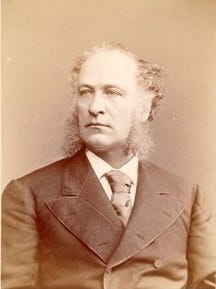 Prominent attorney Daniel Dougherty helped start the League, yet he was a Democrat and outspokenly opposed to Lincoln. Photo: Public domain (W. Curtis Taylor, courtesy of Free Library of Philadelphia, 1876)
The League’s first president, Pennsylvania Attorney General William Morris Meredith, is another example of the range of attitudes on racial equality within the League. The League’s members elected him unanimously at their start-up meeting, expecting, as one official League history put it, that his “judiciously conservative” attitude “would naturally draw many moderate and hesitating men into [the League’s] current.”5
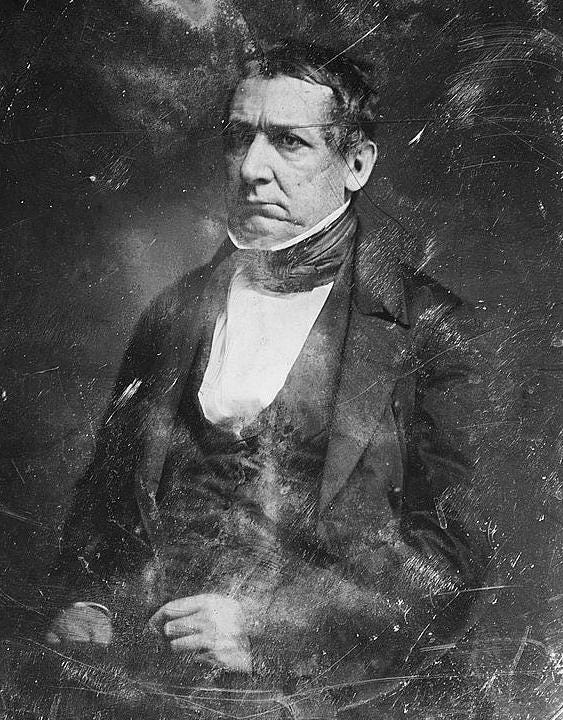 The League’s first president, William M. Meredith, believed that only white men should be able to vote. Image: Matthew B. Brady, ca. 1844-49, courtesy of Library of Congress.
That “judiciously conservative” attitude apparently included a life-long belief that only white men should have the right to vote. Although Meredith’s personal views were anti-slavery, in 1838, as a delegate to the Pennsylvania constitutional convention, he voted for an amendment that stripped free Black men in Pennsylvania of their right to vote.6 Roughly 30 years later, he opposed the post-Civil War amendment to the U.S. Constitution that extended voting rights to Black men.7
This, then, was the League at the outset: white men who came together because they wanted to preserve the Union against the rebellious Southern states. They also wanted membership in a social club that would evidence their privileged position in society. Beyond that, however, it’s impossible to say that they all would have agreed on much of anything—certainly not on issues of Black civil rights. The League itself reflected these differences of view and opinion.
The League’s White-Only Regiments
“A City Divided” repeatedly references the League’s support for the Union war effort through military recruiting, including the recruitment of Black troops. The exhibit states that the League “led the recruitment, funding, and establishment of an additional 11,000 United States Colored Troops (USCTs, federal black soldiers).” The League did nothing of the sort.
When presented with the opportunity to recruit and train Black troops, the Union League rejected it.
The enlistment of Black soldiers was among the most controversial of Union war-time issues. Racist whites opposed it, believing that Black men lacked the bravery, loyalty, and resolve necessary for military service. The idea of Black men being armed and trained to fight was unthinkable to those wishing to see them confined only to servile roles. At the same time, everyone seems to have understood that the participation of these men in the war could be (perhaps would be) a direct route to their achieving equality—and that again was something many whites resisted.
In mid-1863, just six months after the League’s founding and just before the Battle of Gettysburg, the League launched its “Committee on Enlistments,” an in-house effort that recruited only white soldiers by offering significant enlistment bonuses.
At roughly the same time, and after some internal League meetings with Frederick Douglass, who was active in the local Black recruitment effort, the League backed away from any similar effort for Black enlistment. As the League’s first official history, written only 20 years after the event, put it, Black recruitment “involved so much conflict with latent prejudice that the officers of the League were unwilling to commit the organization to its advocacy.”8
To their credit, a “faction of the Union League”9 (as described by a modern historian) formed, along with some non-members, an organization independent of the League and with its own bylaws—the “Supervisory Committee for the Recruitment of Colored Troops.” That faction—presumably they were the ones without that “latent prejudice”—was only a small minority of the entire League membership. The Supervisory Committee ultimately did raise and train, even though it was unable of offer enlistment bonuses, those 11,000 Black soldiers.
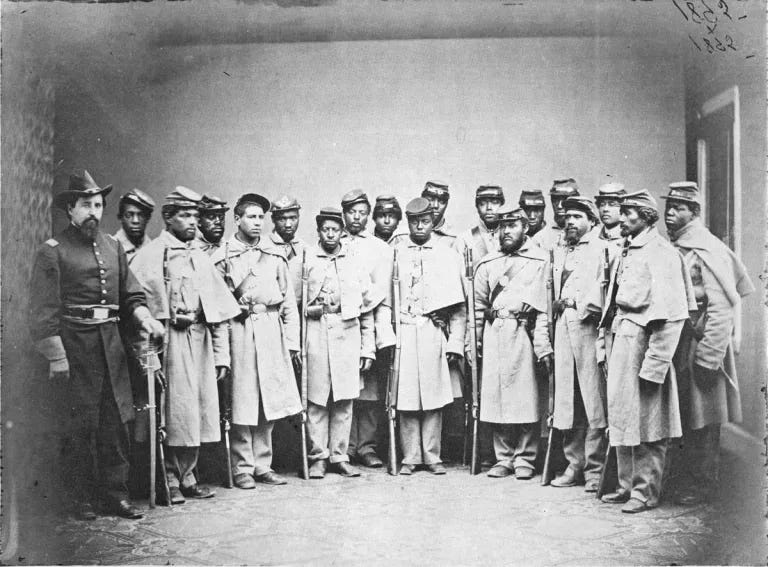 Photograph, ca. 1863, of Black soldiers from Camp William Penn with their white commanding officer; this image was used to produce the “Come and Join Us Brothers” lithographic recruiting poster included in the exhibit. Photo: Public domain (courtesy Journal of the Civil War Era, Aug. 24, 2016).
On the issue of Black recruitment, “A City Divided” gives us an account that is both historically inaccurate and essentially a “white savior” narrative. It omits the fact that the successful effort to raise and train Black troops in Philadelphia depended both on the advocacy of leaders within the Black community and on the initiative of the Black enlistees who responded to that advocacy.
The Vantage Point of Privilege
The Union League’s history is essentially the history of whiteness, yet in the Civil War context the history of Black people is integral and indispensable. This results in an inherent and problematic historical tension in the exhibit’s design and presentation. After all, the League is notorious for not accepting a Black member until more than a century after the end of the Civil War.
Is it really any surprise that Black people seem, at best, to be only on the periphery of the League’s Civil War story?
But on a recent follow-up visit to the exhibit, I was pleased to see a significant new addition on loan from the Lest We Forget Museum of Slavery: a display case, positioned so that it can’t be missed at the entrance, containing a set of wrist shackles “used on enslaved Africans in the transatlantic slave trade.” The accompanying label explains how the agricultural economy in the South was based on an enslaved population of 4 million—32 percent of the entire southern population at the outbreak of the Civil War. This horrifically powerful artifact, which doesn’t directly relate to the League itself—an after-thought on the part of exhibit organizers?—connects with Black history like nothing else in the exhibit.
 Shackles that bound enslaved Africans during their transatlantic voyage on loan to the City Divided exhibit from the Lest We Forget Museum of Slavery. Photo: David Webber.
While “A City Divided: The Civil War, Philadelphia & The Union League” falls far short as an accurate account of the Union League’s Civil War origin story, what it reveals about the League today may be far more telling.
Share The Consequences of a Liberal Education
Thanks for reading The Consequences of a Liberal Education! Subscribe for free to receive new posts and support my work.
1Chronicle of the Union League of Philadelphia (Philadelphia: Union League, 1902), p. 58.
2Maxwell Whiteman, Gentlemen in Crisis: The First Century of the Union League of Philadelphia (Philadelphia: Union League, 1975), p. 26.
3Chronicle of the Union League of Philadelphia (Philadelphia: Union League, 1902), p. 50 (reprinting John Russell Young reminiscence of Daniel Dougherty from the Evening Star, Sept. 17, 1892).
4Chronicle of the Union League of Philadelphia (Philadelphia: Union League, 1902), p. 50 (reprinting John Russell Young reminiscence of Daniel Dougherty from the Evening Star, Sept. 17, 1892).
5George Parsons Lathrop, History of the Union League of Philadelphia (Philadelphia: J. B. Lippincott & Co., 1884), p. 42.
6Proceedings and Debates of the Convention of the Commonwealth of Pennsylvania, to Propose Amendments to the Constitution, Commenced and Held at Harrisburg, on the Second Day of May, 1837, vol. 9, pp. 352-354, and vol. 10, p. 106 (Harrisburg, PA: Packer, Barrett, and Parke, 1837–38). Meredith’s support for inserting the word “white” as a qualification of suffrage in the Pennsylvania Constitution is also noted in Richard Lewis Ashhurst, “William Morris Meredith 1799-1873,” 55/46 American Law Register (1907), p. 221.
7Richard Lewis Ashhurst, “William Morris Meredith 1799-1873,” 55/46 American Law Register (1907), p. 241.
8George Parsons Lathrop, History of the Union League of Philadelphia (Philadelphia: J. B. Lippincott & Co., 1884), p. 52.
9James M. Paradis, Strike the Blow for Freedom: The 6th United States Colored Infantry in the Civil War (White Mane Books, 1998), p. 7 (citing Whiteman, Gentlemen in Crisis, p. 46).