Katie Singer's Blog
October 9, 2026
Another Important Story
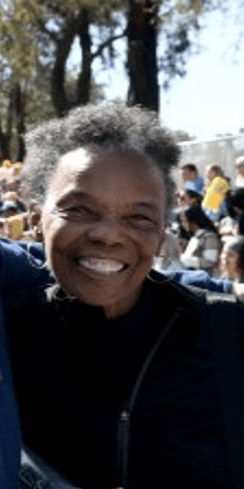 Pasadena Star News, February 2025
SOME PEOPLE DON’T KNOW HOW IMPORTANT THEIR STORIES ARE. Mrs. Henrietta Hendrix is one of them. Henrietta is a friend of mine and I am lucky for that connection. I say this in part selfishly; she is a great cheerleader of my work. I have a feeling she has been a cheerleader for many others as well.
I’d like to share a bit about this woman’s life, a few things that I’ve learned from talking with her – and from the extensive oral history interview she granted me a little while back. One thing that becomes clear as all these women’s life stories unfold is just how much intersection there is between the famous and the less recognized. This is due in large part to the fact that they are all African-American women making their way during Los Angeles’ Great Migration era. And whether they see themselves this way or not, all are activists in one form or another.
To be a Negro in this country and to be relatively conscious is to be in a state of rage almost, almost all of the time — and in one’s work.
James Baldwin, “’The Negro in American Culture,’ a group discussion.” YouTube.
My friend Henrietta was born in San Mateo, California. Her mother was from San Francisco. And just to keep with one of the many themes in these women’s stories, her mother at one time wrote for a Black newspaper in Oakland, The Oakland Tribune. There is just no way to overstate the centrality of these periodicals to 20th century Black history.
Hendrix’ early life was a map of crisscrossing this country. Ohio, Pennsylvania, West Virginia, California… Not every Great Migration story is based on a one-way trip. There were so many varied reasons why African Americans were moving around the country during this part of the twentieth century. Some certainly had or chose to move more than once.
Henrietta attended twelve different high schools before graduating. She then received her bachelor’s from California State University, Los Angeles. She would later earn teaching certifications that launched her career as a Pasadena Unified School District teacher.
One story that Henrietta shared was about living in Ohio with her mother and stepfather, and the hard time they had securing housing. (Yet another common theme). The family ended up moving “across the river and down the river” to Parkersburg, West Virgina. This is where Henrietta remembers experiencing racism for what she believes was the first time:
It was a segregated school. And it was the first time that I actually experienced prejudice…Anyway, the first day [the principal] introduced my sister and I as Black Yankees. Wow. We were the first Black Yankees at the school. And about that time, it must have been about in the fifth grade… And then the next thing I knew, one of the kids called me a n***er and I hit him.
Oral history interview with author, April 30th, 2025
What was that James Baldwin said? Also recall my last profile, on Rita Walters, referencing her experience of going to a segregated school. Walters said it taught her early that she had to stand up for her rights. Yup.
Ultimately, Henrietta and one of her sisters were sent back to Oakland to live with family, where Henrietta ended up graduating from St. Joseph Notre Dame High School. After giving up the idea of being a nun, Henrietta headed to Los Angeles — rosary in hand — to stay with her mother for a little while. She had been working at a local juvenile hall. Mom eventually returned to Oakland but Henrietta remained in LA.
Somewhere around 1959, Henrietta ended up in the West Adams neighborhood, on 35th place. This is a neighborhood mentioned many times before, a community where African Americans were better able to secure housing at the time. It was a heavily immigrant neighborhood, according to Hendrix, and she felt fortunate to have found a Black landlord. She believes that is why she was able to get into such a nice apartment and to attract nice roommates. “Black bungalows,” she called them, set around a sort of courtyard.
If you recall, Edythe Espree also spoke about feeling lucky that she and her husband came upon a Chinese landlord when renting their first apartment as a couple. Luck played such a large role in the often tenuous lives of Black Angelenos.
Henrietta ended up being the property manager at those bungalows, receiving everybody’s rent checks at the end of the month. They “had to be in a check or money order, no cash,” she explained. She was working a decent job at City Linen for a while, as a “production girl.” She explained, “And what the production girl does is she goes in the factory, and she records hourly how much production each segment is doing.” This entailed working inside the laundry factory area, she pointed out, whereas the white women had the office jobs.
It was the women in the office, which was in another division, you can imagine, the hot box is in the actual laundry… They were very Caucasian, very nice, but very elitist in their little minds. Well, yeah. Yeah. And so I probably got the job because of that. None of them would ever step in that laundry.
Oral history interview with author, April 30th, 2025
Her coworkers “…were Hispanic and Black, and a few immigrants…” She had initially tried to get a job at the telephone company, probably Pacific Telephone and Telegraph. But she was told she had too much education as a person with a college degree. This experience has also been echoed by many other African Americans of the time. It was, sometimes, a company’s way of keeping out anyone who might know better than to accept unequal pay or other labor inequities so commonly perpetrated upon Black Americans in the workplace.
I asked Henrietta what she did for fun in Los Angeles, even as life was hard for her – and would soon become even harder.
Very little, yeah…when I had Gracie, as my roommate, we went skating, and there used to be on Washington Boulevard off Vermont, there’s a skating rink, and we would go skating, that was fun. But other than that, very little.
Oral history interview with author, April 30th, 2025
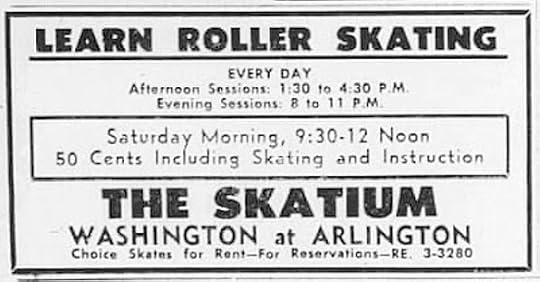 Courtesy Ken McIntyre, Los Angeles Theatres blog
This was probably at the Skatium, located on the site of the old Arlington Theatre. It opened in 1954.
I also asked if she ever went to the famous Central Avenue district, to go hear music or anything. By her time the area was not quite in its heyday anymore, but it still held much Black history and culture. “Only on a date,” she replied. “I never put out any money of my own for recreation. Yeah. Just wasn’t there.”
Henrietta had her daughter, Sharon, in 1962. Times were hard. She was a single mother. At one point when I asked her if she had any souvenirs like bus tickets or programs, she explained why she in fact did not:
I lost my storage, because I couldn’t afford to pay the storage. So I [haven’t] anything from that time. Yeah, well. Oh, it’s your child or it’s your storage you know? So it’s your child, forget the storage, you know?
Oral history interview with author, April 30th, 2025
Henrietta worked a few jobs after having her daughter. There was a short stint at Haggerty’s department store, founded in Los Angeles in 1906. It was located on the 9500 block of Wilshire Blvd. in Beverly Hills by the time Henrietta worked there.
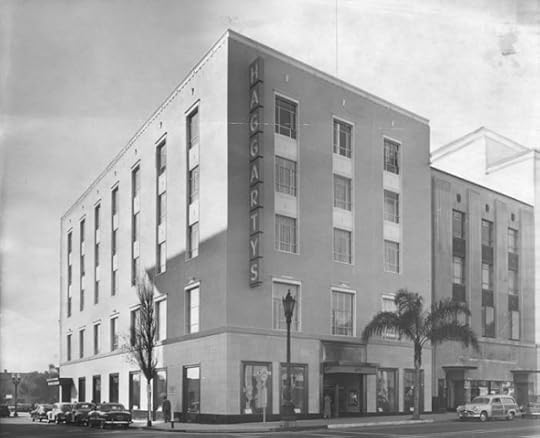 Haggarty’s, Los Angeles Public Library (February 7, 1951)
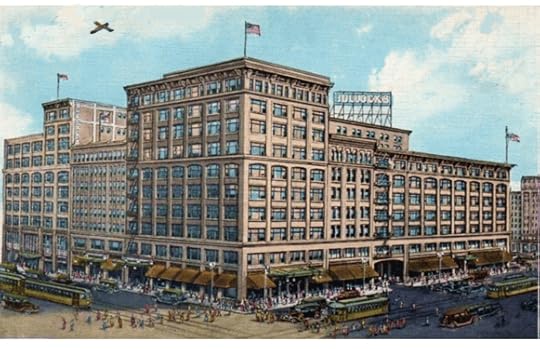 Bullock’s, Pacific Coast Architecture Database (circa 1929)
Then she worked at Bullock’s department store.
There is so much more I want to ask her about working at these department stores. (Oral history interviews almost always have a second phase if possible). Many African-Americans of the Great Migration era tell stories about just how light-skinned one needed to be to get any kind of public facing jobs at these kinds oof stores– whether they be in Los Angeles, California or Newark, New Jersey. Henrietta did share one related story:
I had an awakening with Bullock’s. I could see Bullock’s was as prejudiced as they could ever be…they had a class about them and their prejudices. And they had elevator operators, women oh, they looked sharp. But I realized – I looked at them, I looked at myself, and I said, they have no real future in this company. As long as they wear that uniform, they will be here…And I met one of the girls I knew in college and she was there, and she said, “Go to Pasadena.”
Oral history interview with author, April 30th, 2025
And go to Pasadena, Mrs. Hendrix did. And that is yet another part of her story to tell at yet another time. It is one of many stories that will ultimately appear in full in this book I’m working on. Because these women’s lives are so very full, and they deserve so many, many pages.


October 4, 2026
Stand Up for Your Rights
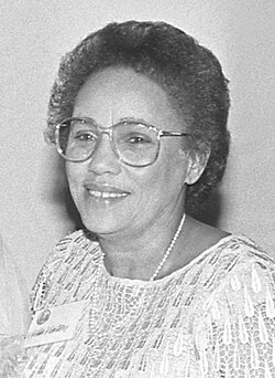 Rita Walters 1986, Wikipedia
I had come from Kansas City, where segregation was just–you lived it, breathed it every day. But I had worked in these environments where I was the only Black employed…so, you know, I wasn’t afraid…going to a segregated school we were taught, ‘Stand up for your rights’…
UCLA Library Center for Oral History Research
Rita Dolores White came to Los Angeles in 1955, very much a part of the Great Migration. While historians often mark two general waves of the Migration – coinciding with the World Wars – like the rest of history, it’s not quite that neat and tidy.
Listening to her oral history interview, it is clear that Walters was an activist from jump. This is one of the many invaluable aspects of an oral history, the way we get to see the evolution of a life. Much like history itself, each personal action is spurred on by a previous event. Some of us, since quite young, have felt some kind of way when witnessing inequities. And some of us did something in response to that witnessing. Ms. Rita was doing that something from a young age.
She mentions, in her interview, that her grandparents were activists in their own right. (Please imagine, being a Black activist circa turn of the 20th century and what those folks might have faced in being so). Activism ran in the family:
My father’s first cousin left Kansas City…He came out here as a young man and started a newspaper, The Los Angeles Sentinel, and it was in the 1930s where he started this campaign, ‘Don’t buy where you can’t work… so the papers had information and pictures about Leon’s campaign on Central Avenue, to not buy, because that was the heart of the Black community in those days, and they had all kinds of stores up and down there, and didn’t have a Black person working in any of them.”
UCLA Library Center for Oral History Research
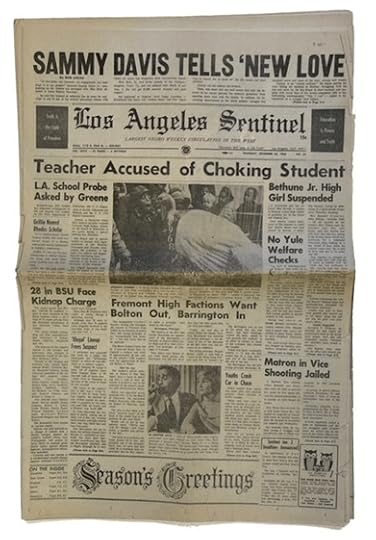 McBlain Books (December 26, 1968)
I subscribe to the Sentinel today. The importance of the Black newspaper in American History cannot be overestimated. Note my past blog on Charlotta Bass and the Eagle, for example.
Rita Dolores White was born in 1930. At the time of her move to Los Angeles, she was living with her parents in Kansas City. Her father was a Pullman porter, a career that has its own important history in our country. Rita had been ready to leave Kansas for some time:
There in Kansas City, and perhaps the whole Midwest, anybody who knew anybody in California, they’d come back with all these stories about California is this and California is that, it was the land of milk and honey, you know. The weather was gorgeous, jobs were plentiful, you could live where you wanted to, up to a point.”
UCLA Library Center for Oral History Research
Rita’s first job in LA was for the probation department. She was told they didn’t want “Negroes,” but she got the job anyway because she was willing to work on Sundays. As a seventh Day Adventist, her worship took place on Saturdays.
Life went on. (Remember, this is the short version!) and Rita married and had her first child. Her husband’s job then took them to Orange County, a place Rita never really felt was home:
We moved out there in February ’58, and this guy had had his house bombed. And people, you know, a lot of these people had bought homes on the G.I. Bill, and they didn’t want to live in the tract with Black folks…so they walked away from the houses, and here was this… we bought the house from the VA…Then the state came along and decided they would build a freeway through part of it. The 57 Freeway… And so once the state bought the land they wanted, then they started renting the homes, and Black folks and Mexicans moved in, and there were a few white folks, but not many.
UCLA Library Center for Oral History Research
Mrs. Walters expands on this later in the interview:
But we could not buy a house under the G.I. Bill. When they did allow Blacks to utilize the G.I. Bill here in California, it was for older inner-city property only, not for the newer subdivisions.
UCLA Library Center for Oral History Research
Not everything is for everybody.
Much to Walters’ relief, her family moved back to Los Angeles after a time. But it was not necessarily a cinch to do so. While California had a reputation as a relatively racially equal state, there were all sorts of racist property and business owners who had no interest in perpetuating that reputation. As so many have testified, including in the oral histories I have taken myself, securing a place to live was not always easy for an African American.
It was around 1957 when they returned to LA looking for a place to house their growing family:
We had people right here in town turn us down, tell us, ‘No, you can’t buy a house here in this neighborhood.’ One place it happened was… a perfect little house, and it was our price range, and the guy, the owner was there, you know, “for sale by owner” sign sitting out there. We went there and he was very nice. He said, ‘Oh, I promised my neighbors that I wouldn’t sell to Blacks.”
[And] Leimert Park was then opening up to Blacks, but there was a neighborhood association that was trying to keep it from being a run on Blacks. The real-estate folks, you know, would go in and scare folks to death that the Blacks are coming. So they formed an organization, and they had these signs out on their lawns, ‘This home is not for sale to anyone of any color.’
UCLA Library Center for Oral History Research
Our country’s history, I will repeat, is predicated on land ownership.
Walters lived with a fire under her. And there was so much fuel for those flames. It was the time of the Civil Rights Movement, the bus boycott, the lunch-counter sit-ins. And then Dr. King came to Los Angeles, drawing a crowd of 20,000 she estimates, at Wrigley Field.
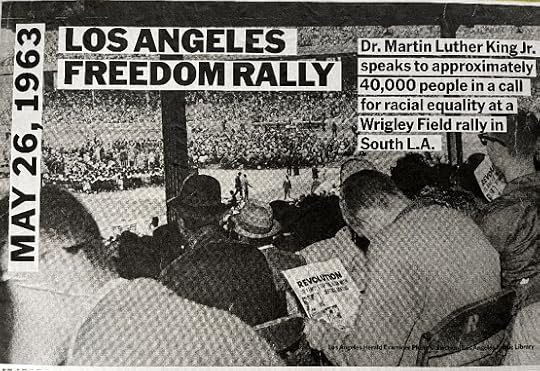 Author’s photo of display at Autry Museum of the American West
At this point Walters is already active with her PTA and coming up against the school board on a regular basis.
Oh, my word, yes. I tell folks, the best preparation for public office is PTA service.
UCLA Library Center for Oral History Research
Walters started working – and sometimes disagreeing – with the NAACP. And so it went, as she discovered that her avenue for changemaking lay in the participation of local politics. Very fast-forwarding, Rita Walters eventually joined the Los Angeles Board of Education in 1979, in response to years of wrestling with various schools about numerous issues — especially concerning her son with special needs. And then, seeing just how much needed changing, she ran for city council. In 1991 became the first Black woman to sit on the Los Angeles city council.
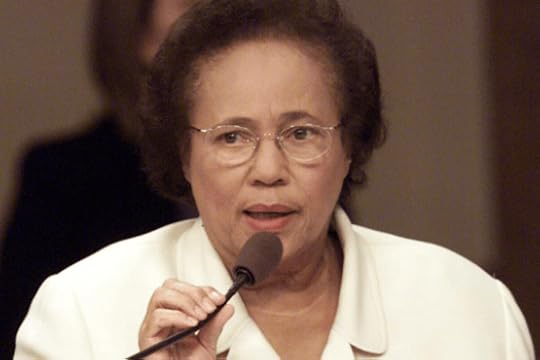 Los Angeles Times
And this here is a short bit of her very long story. Often when we read about “firsts,” the narrative provided is flat and on the surface. But perhaps we’d like to know, who is this person who became a first? And I always wonder, why did it take as long as it did?
Walters died at the age of 89 in the year 2020. Just as with so many other African-American women of her time, Rita Walters changed Los Angeles. To understand LA we must understand these underpublicized lives that make it what it is today.
September 13, 2026
Amen and Hallelujah: A Brief Story of Edythe Mae Espree
 Courtesy Lezlie Porter
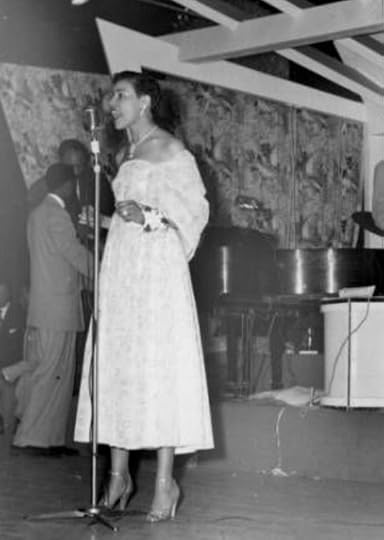
IT WAS HER CLOTHES I NOTICED FIRST: Silver lamé sweater, deep purple velvet skirt — even though it was July at the 11am church service. The clothes looked big on her, but I could imagine they once fit just right. She wore them now as I imagined she wore them then, with great confidence.
This is a short story on the long life of Edythe Mae Espree, the mother of my friend Lezlie Porter. Ms. Edythe’s story is a part of the Great Migration, of women’s history, of African-American history. It is her story to tell, and although she no longer remains on this earth, her words and deeds still do.
Interviews, oral histories, and personal items will tell Ms. Edythe’s story, along with so many other underrecognized African-American women of the Great Migration — women whose lives shifted Los Angeles in ways large and small, quiet and loud. Even in an oral history interview conducted with both Edythe and her husband a while back, the interviewer introduces the project as her husband’s story. And his is quite a story. But must the woman literally sit in the background, on the couch, her voice appearing only on the recording now and again? This is why so many of us feel the need to foreground these particular women’s stories.
Ms. Edythe challenged systems in her own way, in her work and in her daughter’s education. She was never amenable to taking only what was offered. I was fortunate enough to know Mrs. Edythe Espree – or Mother Espree, as she once instructed me to call her. But my “knowledge” is not central here. I may set the scene, but the stage is hers. This will be a very short version of this woman’s long life. The book I am working on will provide the opportunity to learn a much longer version.
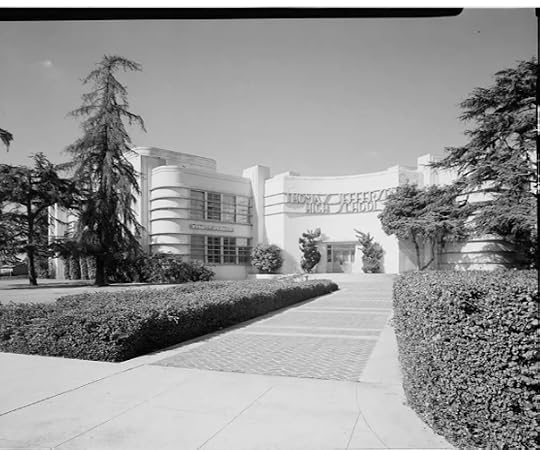
Edythe Mae Carr came to Los Angeles, California from Dallas, Texas in March of 1929. She was five years old, born on May 23rd, 1924. She remembered coming on the train to Los Angeles with her mother and four sisters. Years passed and Edythe May graduated from Jefferson High School, a place known for its many famous alumni – musicians, writers, and judges to name a few. Many children of the Great Migration were at Jefferson High, their families typically coming from places like Louisiana, Texas, and Arkansas. Always active in social groups, and deeply loyal to the institutions that served her well, Edythe would later become a part of the Jefferson High Alumni Association.
 1319 East 41st street, Public Domain Media
As a girl, Edythe lived in Los Angeles with her mother, at 1031 East 49th Street, the South Park neighborhood of South LA. She remained living there, sharing a King-size bed with her sister Lottie, until she was married in June of 1957.
Edythe wrote about her old neighborhood in a recent journal, defining it as from Vernon Avenue to Slauson Avenue, North to South. She remembered two bowling alleys; a library she would go to on Friday afternoons by herself for story hour; four food stores; a clothing store; the Elks Dance Hall; and the 49th Street Park. That park is still there today – situated between Pedro Street and Avalon Boulevard. Edythe remembers the playground there and that on Saturdays she would walk to the park alone to see children’s plays. She makes note often in her journal of how she did things alone as a child, foreshadowing the independence she would display as an adult, all the way through her last days on this earth.
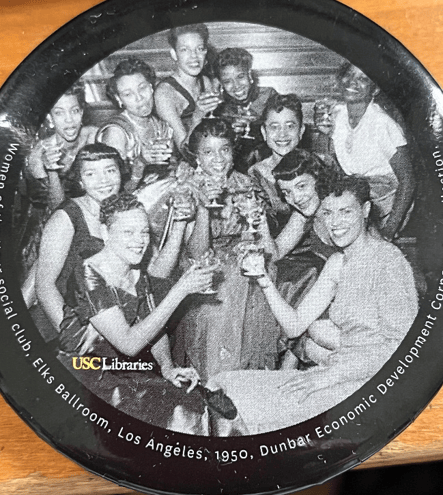 Pin given out USC Archives Festival featuring Edythe Espree (bottom right) with sisters and friends
Her mother was a talented dressmaker, making all of her girls’ clothes. Edythe, tall and beautiful from a young age, would often be asked to model her mother’s workmanship.
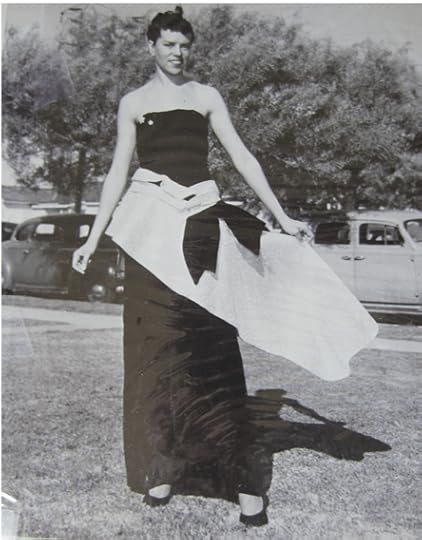 Photo courtesy the Esprees
Her mother also worked at a French Hand Laundry, the only Black woman employed there. They did not know when they hired her that she was African-American, because of her fair skin. A trait inherited by her daughter Edythe.
This was a common 20th century experience for African Americans with lighter complexions and it reminds me of an oral history included in my previous book, Alien Soil: Oral Histories of Great Migration Newark. In it, a Mrs. Beatty tells her interviewer how she was mistaken by her new employer as white:
“And at my lunchtime I went over to the Black girls and introduced myself. And when I came back to my bench to work – the white lady said to me, ‘Now, just because I said that the Blacks were clean here, that didn’t mean that you have to go over there and eat with them.’ And I politely let her know that I was Black… Now the Black women, they knew I was Black.”
from Alien Soil: Oral Histories of Great Migration Newark
After graduating high school, Edythe became a real-life Rosie the Riveter, working in Los Angeles’ defense plants during World War II. She was also a part of the American Women’s Voluntary Services (AWVS) during the War. The members did everything from selling war bonds to mending clothing in support of the country and its troops. (It turns out a young Betty White happened to be a member as well).
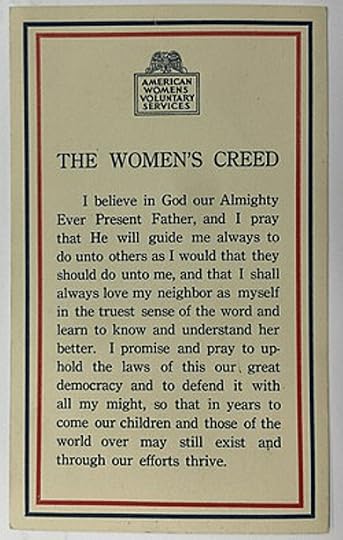 “A prayer card issued by AMVS ,” Wikipedia
Yet another connection with past women’s stories in this blog Edythe, too, made sure to get high school diplomas to her Japanese classmates who had been rounded up by our government after the attack on Pearl Harbor. Just like Mollie Wilson, Edythe felt she had to do something as she watched her peers carted away from their homes and school. So she collected their diplomas and delivered them to the Santa Anita racetrack where many of the Japanese/Japanese Americans were being detained.
And thus ends a very brief segment of this woman’s lengthy story. I will fast forward to the year 1998 where she is featured in a Los Angeles Times article entitled, “6 Decades and a Few Quakes Later, It’s Back to School.” Edythe Espree had returned to her elementary school, at the age of seventy-four, to volunteer as a reading tutor for the Rolling Readers, a philanthropic group.
The 49th Street School had been demolished years earlier by an earthquake, its brick façade simply crumbling under pressure. “Espree was a fourth-grader when the 1933 Long Beach earthquake struck. ‘Fortunately, school was out for the day,’” she said, according to the Times. “We just stood there and cried when we saw our school was demolished.” (Bob Pool, LA Times). And there she was 60 years later at that school, ready to help the latest generation. That was who she was and had always been.
Mrs. Edythe Espree lived a life that mirrored Los Angeles’ Great Migration history. In my future book, her story will receive much more attention because there is so much more to tell. She lived her life in front of the backdrop of Great Migration Los Angeles – from the clubs to the churches to the schools. Suffice it to say that women like Mother Espree need to be known, in order for this history to truly be known.
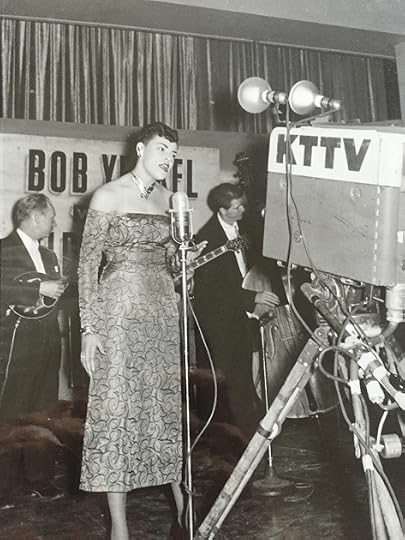 The multi-faceted Edythe Mae Carter,
 courtesy KTTV archives
September 4, 2026
Yet Another Moses
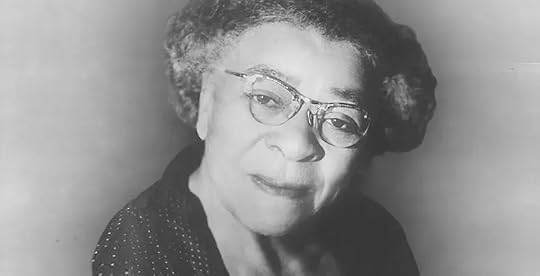 LA Public Library
“History repeats itself, first as tragedy, second as farce.”
-Karl Marx, “The Eighteenth Brumaire of Louis Bonaparte”
SUCH IS THE FARCE REPEATING ITSELF NOW. History is certainly repeating our society’s rocky relationship with the media. For many of us on the left, we are indignant at the complicity and bent knees we see in today’s journalists. On the other end of the spectrum, those same journalists are seen as the mouthpiece of the unpatriotic. None of this is new. The role of the media has been a contested one since the beginning of news reportage. And here I will share the story of one African-American woman of Los Angeles’ Great Migration era who circumnavigated this contentious relationship, bringing notoriety of various kinds to herself and to her newspaper.
But wait, the reader might say, you said you were committed to unearthing those stories of Los Angeles’ Black women who were not previously noted. To that I will answer, that is correct. And even with an autobiography, several biographies, and some pretty deep archives, too few people know what this fierce woman actually accomplished and the role that her newspaper, The California Eagle, played in Southern California history. And widening the lens, this story also helps us see how this roiling relationship between the media and its consumers has been going on for quite some time.
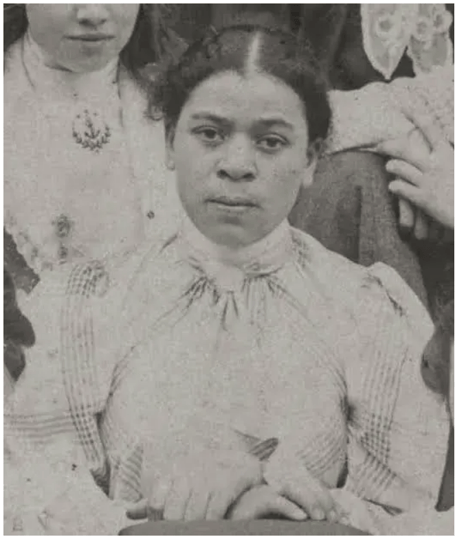 Los Angeles Public Library, “’I Promise I Will Do My Best’: The Integrity of Charlotta Bass”
Charlotta Bass, known before marriage as Charlotta Amanda Spears, was born somewhere between 1874 and 1879. Sources for her birthdate are all over the place. And apparently her place of birth is also up for debate; it may have been Rhode Island or could have been down south. The fact is, all that did not seem too important to Mrs. Bass, who started her autobiography with her life in Los Angeles. So we will start there, too.
Charlotta Spears came to LA in 1910 to recuperate from an illness. This was a common practice as Southern California was touting itself at the time as a wellness center – way before Gwyneth Paltrow and Erewhon ever showed up.
 David Pollack Vintage Posters
Miss Spears comes to LA and secures a job as “office girl” at The California Eagle, a newspaper finding its way in the African-American media landscape. Spears had sold ads for a newspaper back in Rhode Island and noticed early on how pretty much the only way Black people got into white newspapers was if they were accused of a crime. So, while she may well have had an activist bent prior to coming to LA, once working for John Neimore at The Eagle, Spears deeply understood her position as opportunity.
“John Neimore knew that a better life was possible for his people. He knew there were some cities and some states in the Union where Negroes were allowed to exercise the right of suffrage; where, by use of the ballot they could correct some of these evils. One such city was Los Angeles. Like a veritable pillar of fire leading the Children of Israel into the Promised Land, John Neimore set himself the task of leading his people to this Land of Promise to Los Angeles, the City of the Angels.”
As qtd in Los Angeles Public Library
Bass ended up making a promise in 1912 to the dying Neimore that she would carry on the torch of his paper. It was not an easy task, as you might imagine. She was a Black woman in the early twentieth century, after all. But she was smart and had a vision. She eventually made a deal with a man with some money and turned the newspaper into a nationally famous local periodical. While these last two sentences do not come close to describing all the obstacles that Bass came up against, I think the most compelling part of her story is what she accomplished.
One obstacle that initially stood in the way of The Eagle’s growth was the desire by some well-to-do African Americans to keep dry, boring politics out of their newspaper. They wanted to highlight dances and celebrities, and the houses they had managed to acquire through much effort. This was a politics of respectability moment, wherein some African Americans did not see the merit in looking at what was still wrong, but instead at all that had been accomplished. This would be a better representation of Black life to white society, some believed. And gaining white approval had to be top of mind for some – consciously or not. This conservative group did not want to read about unions, nor especially hear about the kind of entertainment that was making its way onto Central Avenue. The Eagle published pieces on all such things, nevertheless, and eventually found an audience for this kind of reporting.
“But, I thought to myself, aren’t there many more important issues in the community than who had a party at the Waldorf and Golden West Hotels? Or who were among the guests invited to sip tea with Mrs. Robert Owens on a certain date? Yes, l decided, there were.
There was, by this time, a definite trend in Los Angeles to prescribe certain districts in which Negroes could live. Negroes were denied swimming pool privileges. They were refused cafe service, discriminated against in employment, and often mistreated by the police. There were many reforms, corrections and corruptions to be exposed. It was incumbent upon a newspaper such as The California Eagle to deal with these problems. The California Eagle would print social news to please the people who wanted it, but it would also discuss the important issues of the day for those more patriotically inclined.”
– as qtd in Los Angeles Public Library, “’I Promise I Will Do My Best’”
*For the record, one Joseph Bass eventually joined the newspaper as an editor under Charlotta’s watch and they ended up getting married in 1914.
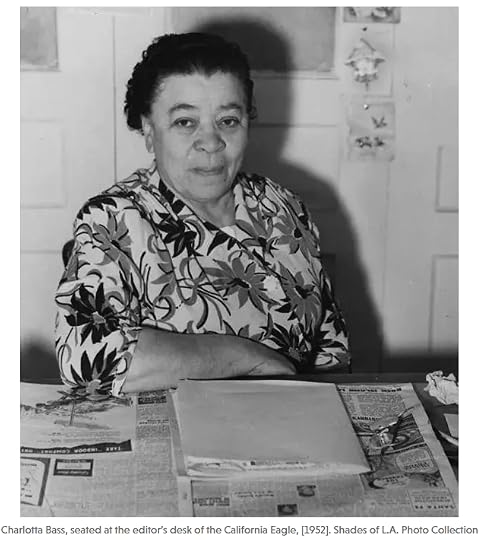
Mrs. Bass was in the thick of things, politically. The Communist Party was going strong in Los Angeles, and elsewhere, especially among African Americans who saw it as the one political group willing to advocate for their rights. According to the book, Radical L.A. by Errol Wayne Stevens, in 1946 leftist Democrats and Communists formed the Progressive Citizens of America party. Its leadership included Mrs. Bass – as well as Charlie Chaplin and Katharine Hepburn, by the way. Two years later, during the presidential election, they reorganized into the Independent Progressive Party. Much like today, there was a split among the progressives who believed that a new party was the only answer, and those who thought it best to reform the Democratic Party from the inside. Repeated patterns.
Needless to say, Bass did not shy away from both writing about politics and immersing herself in them as well. In fact, in 1952 Bass ran for Vice President on the Progressive Party ticket – something the author of the aforementioned book failed to note, even as he named other political candidates who ran for various offices around the same time. (As I said, even the most famous of Black women tend to have their life stories underreported). At any rate, Bass was the first “Negro woman” to run for the VP position in the United States. Before Chisolm there was Bass!
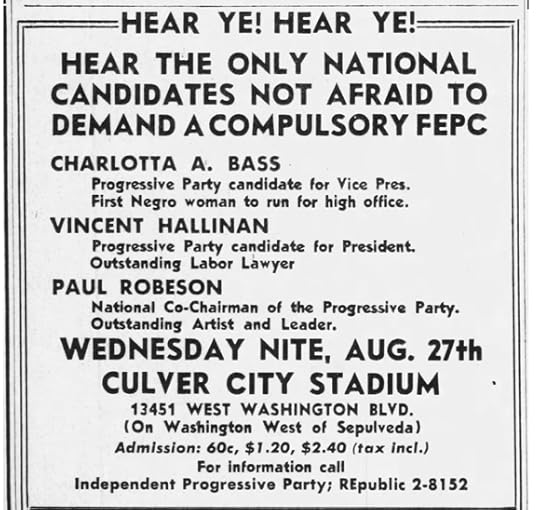 * Fair Employment Practice Committee (FEPC)
– Los Angeles Public Library, “’I Promise I Will Do My Best’”
Bass’ newspaper took a stand on many pressing issues in the Los Angeles area during her period as owner and chief editor. These issues included segregated schools, housing discrimination, and job discrimination, specifically at Los Angeles County General Hospital and the Los Angeles Rapid Transit Company. Together the Bass’ also fought to prevent the premiere of The Birth of a Nation, ultimately landing City Council’s support in the process. Bass also called out the very active KKK – suffering major harassment because of it. In fact, a group of Klan members reportedly showed up at her offices one night while she was there working alone. Bass wrote in her autobiography that she took a gun out of the desk drawer and pointed it at the group of men, even though she was unsure of how to actually use it. “They made a hasty retreat,” Bass reported.
Bass also amplified the national campaign of “Don’t Buy Where You Can’t Work.” The importance of Black newspapers across the country is so clear here. Initiatives, campaigns, and the like, when it came to African-American life, were rarely reported in mainstream media. Publications like The Chicago Defender, The Afro-American, and The Eagle kept a Black activist movement growing.
Mrs. Bass, after the death of her husband, continued the work she had started so early on in her life. She ran for L.A. City Council and later became the first African American to serve on a Grand Jury in Los Angeles. There were so many causes for which she labored and it is fortuitous that she recorded many of them in her own words. We are not always fortunate enough to learn the stories of Black women in their own voices. (Unfortunately the autobiography is not currently in print; one must delve into the archives for the manuscript).
Ultimately, Bass sold The Eagle in 1951and the newspaper finally closed up shop in 1964. But Charlotta Bass was not done with her efforts to lead her people to “The Land of Promise in Los Angeles.” In the next decade Mrs. Bass remodeled her garage into a full-scale reading room and voter registration site. As is so often the case, this Black woman stepped into the void created by our government’s inequitable systems. Mrs. Charlotta Bass passed away in 1969 at the age of 81.
NB: In 2020 the fabulous Schomburg Center in New York City sponsored a program of two short films entitled Unladylike: Unsung Women Who Changed America. The film on Charlotta Bass is available through PBS and is a must-see if you are at all interested in hearing a little bit more of this important woman’s story and her connection to present-day journalists. One day, perhaps, the extra labor of living as an African-American woman will not be so demanding. Until that time, many of us will insist on making this fact known through their life stories. Because they are American history.
August 16, 2026
She Brought the Music
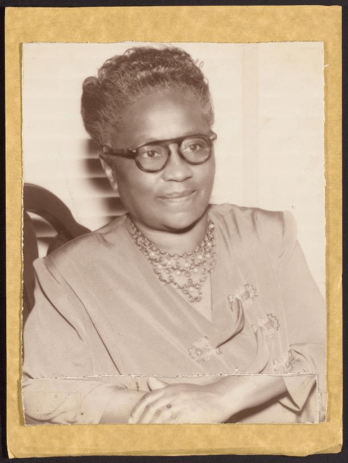 Mrs. Alma Hightower,1930; Internet Archive
WHEN YOU KEEP HEARING THE SAME NAME in others’ stories, it’s time to check out that name! Alma Hightower is one of those names. Listening to and reading interviews of musicians, their parents, and just regular ol’ people who took music lessons as kids, Hightower was THE music teacher for African Americans in mid-20th-century Los Angeles. Mrs. Hightower taught everyone, including the children who would become some of the most famous musicians of the time, like Dexter Gordon, Charles Mingus, and Melba Liston. Robinson Pierson, the father of Dale Lya Pierson who I wrote about last week, happened to be a student of Hightower’s.
“Any great musician in Los Angeles – Black – probably studied with Alma Hightower…”
Clarence McDonald, keyboard player and record producer (Southern California Public Radio
Alma Julia Webster was yet one more Louisiana-to-LA Great Migration participant. She was born in Baton Rouge, in 1888 and moved to Los Angeles in her 30s. The first place Hightower/née Webster lived was with her nephew, musician Alton Redd – the father of Vi Redd who has already been featured in this series. In 1927 Hightower adopted the daughter of a Louisiana friend. Her name was Minnie. Thanks to her mother’s tutelage, Minnie would become a working musician in her own right, at one time playing saxophone in an all-female band alongside Clora Bryant — recently mentioned in my piece on Club Alabam. Los Angeles might be a big city but it often proves to be a very small world.
From 1936 to 1943 Hightower directed students in a “training band” out of Ross Snyder Recreation Center in South Central LA. This ensemble came out of the Works Progress Association (WPA), a federal program created to support artists during the Depression. The band often performed in the recreation center’s adjoining park and included many soon-to-be famous musicians, including her daughter Minnie.
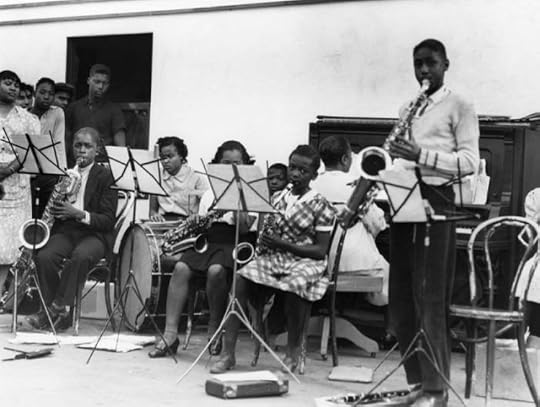 Mrs. Alma Hightower plays piano and leads youth band, December 13, 1939.
 LA Public Library
Her youth bands would also perform in and around the Central Avenue area, the center of Black cultural life at the time. Sometimes playing at churches or YMCAs, they could also be found playing on a Central street corner, especially during the war, Hightower was probably trying to get the kids some recognition, drum up her teaching business, and maybe make a few dollars on the side.
Melba Liston was a part of that group and recalls the male dominance of the situation:
“We’d play on street corners and pass the hat and all that kind of thing. The boys would steal all the money, cause the girls weren’t allowed to pass the hat you know.”
– as qtd. in doctoral essay by Bailey Grogan
In 1939 and 1940 Hightower’s Melodic Dots band was invited to play at the California State Fair, where they were awarded best performance by a youth group — both years!
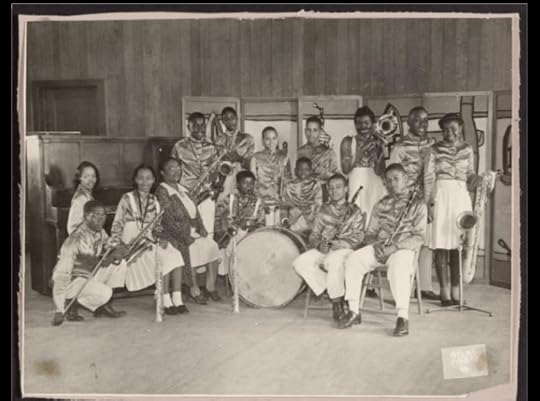 Alma Hightower and the Melodic Dots, WPA Children’s Band 1940. Internet Archive
The school Alma opened in 1943 would be called Hightower Music Studio and Conservatory, located at 466 East Vernon Avenue. This was her married name at the time, and one she kept throughout her career, even as the marriage itself was reportedly short-lived. There were also rental apartments available on property, because Hightower was not only an artist but a businesswoman.
Hightower believed in the centrality of community, especially among young people. All of her classes and bands were about working together, allowing African-American youth to feel both safe and empowered at the same time. While many of her protégés traveled the world performing Hightower preferred to remain in Los Angeles, nurturing the community she had created and focusing on the next group of young musicians coming up.
Hightower’s teaching style, according to some of her past students like Clarence McDonald, was gentle but direct. Because she herself could play drums, saxophone and piano, her approach to music education was also broad. And while she may have taught some of the most famous jazz musicians in the world, she did not believe in genre musicians per se. “If you couldn’t play all of them you couldn’t call yourself a musician” was her approach according to McDonald. Hightower taught her students to play Souza marches and the Stars and Stripes, pieces they might not have ordinarily been practicing as “jazz musicians.” And, of course, she insisted on including Gospel and the Blues.
Alma Hightower died in 1970 in her beloved city of Los Angeles. While her name is mentioned in most every history bookand article on Black Los Angeles’ Great Migration era — as a teacher and sometime musician — there seems to be no comprehensive work centered on her life alone. And maybe that is exactly as she would have wanted it. But maybe, I fear, she is another African-American woman whose rich life has been boiled down to the service of others. As I continue my research I hope to find that I have overlooked an archive or publication located in one place or another.
According to Grokipedia(an AI-generated encyclopedia – argh), on November 30, 2007 Alma Hightower was publicly honored as one of thirty-two entertainers celebrated at an event sponsored by the Community Build Youth Program in Leimert Park. Unfortunately, I can find no confirmation of such an event. This could be because AI got it wrong – as it often does! – or it may simply be that Black history has once again fallen through the cracks. Either way, let’s consider this post a small celebration of Alma Hightower’s life.
July 31, 2026
Documenting Black Culture
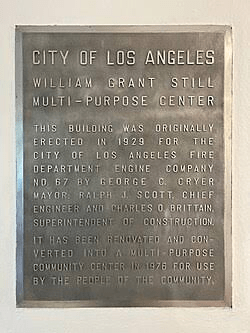 Wikipedia
SOME CALL IT THE “MINORITY TAX.” These are the unreasonable expectations placed upon people of color to do the extra work wherever they may be. I have witnessed this firsthand in academia. The women, especially, are often expected to perform service way outside the requirements and responsibilities of their positions. A Forbes article from two years back addresses how these expectations can ultimately end up being deadly.
In my research on African-American women of Los Angeles’ Great Migration, I see Black women doing the heavy lifting when it comes to keeping their history alive. So much of the work we cultural historians do relies on the efforts made by relatives and private organizations to preserve stories of people and their times. Quite often these history keepers are history makers as well. Thus is the case with Dale Lya Pierson. So here I want to share a bit of her story, as well as the myriad stories she has kept in the daylight.
Dale Lya Pierson grew up in the West Adams neighborhood of Los Angeles in the 1940s and ‘50s. Like many of the other stories I’ve already shared, Central Avenue and music were central to her life. Early on Pierson saw that she, her family, and neighbors were living history and would go on to perform tasks large and small in order to preserve and publicize that history for others. One of the tasks that she undertook was the founding of Build Crenshaw Arts, at one time a local arts-advocacy organization meant to preserve the history of LA’s jazz scene. This scene happened to include her father and grandfather, both musicians.
In 2004 Pierson told a reporter for LA Weekly that she also wanted to erect a memorial at Crenshaw and Washington Boulevards, the site of the old Parisian Room. “It’s like an Indian burial ground of jazz,” she said. “I’m trying to construct concrete memory… But I’m also documenting Black culture. Recognizing the contributions of these artists is my way of fighting the racism of their time.”
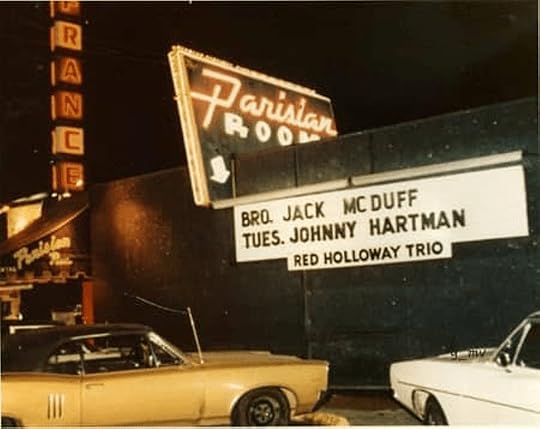 From “Images and Memories of Los Angeles”on Facebook
The Parisian Room was located at La Brea and Washington and stayed open all the way through the 1980s. There is apparently a post office there now, at 4960 W. Washington Blvd, named after Ray Charles. At the beginning of this year the Community Coalition of South LA posted on Instagram: “The Historic South Los Angeles Black Cultural District is officially getting a monument recognizing the legacy, culture, and movement that’s been built right here in our community for generations. Now the question is: where should it go? Should it stand on Central Avenue, where jazz legends made history? In Leimert Park, the heart of Black arts and culture? Near Exposition Park? Or somewhere along Crenshaw that holds its own deep roots?” It looks like Pierson will eventually get her wish and that others see this documenting as important, too.
Pierson’s name shows up regularly as a photo credit for archival images of LA’s Black history. She worked hard to collect and donate materials, much in the same way that Mollie Wilson Murphy did with those letters she received from her Japanese friends in internment camps. Both of these women knew the importance of saving and disseminating these complicated and oft-marginalized histories.
Pierson also contributed an entry to the Encyclopedia of Arkansas about John Marshall Robinson, a physician, civic leader, and co-founder and president of the Arkansas Negro Democratic Association (ANDA). It seems he was the first husband of her famous grandmother – who I will be telling you about shortly. The couple was later divorced but Pierson thought him important enough that his story be recorded. And then, with the intentionality of a trained archivist, Ms. Pierson took to collecting and researching her famous grandmother’s papers.
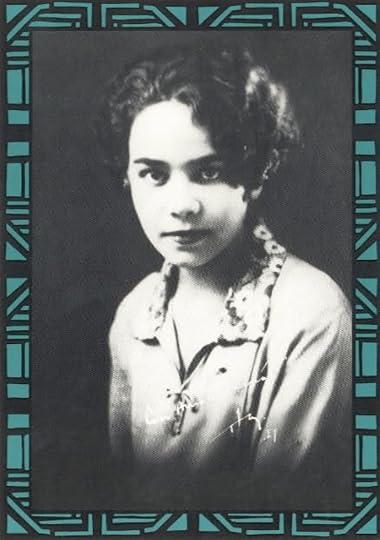 Fay M. Jackson, “Brown Girl Collective” on Facebook
Fay M. Jackson was born in 1902 in Dallas and came to Los Angeles with her family when she was sixteen. This makes her one of many during the Great Migration who came to LA from the state of Texas. Jackson grew up to be a pioneering African-American women, a journalist who founded the first Black west coast news magazine, Flash, in the 1920s; and then became the first Black Hollywood correspondent for the Associated Negro Press. (There were apparently other Black news magazines called Flash at the time, produced in east coast cities like New York and Baltimore). Jackson later founded the California News in the 1940s.
One of her journalistic assignments was to cover the coronation of King George the VI, in 1937. While at the London ceremony Jackson said she wanted to provide a “Black slant,” so she interviewed attendees such as Haile Selassie, Paul Robeson and Josephine Baker. In her reporting, she even called out the notorious diamond mining trade of South Africa.
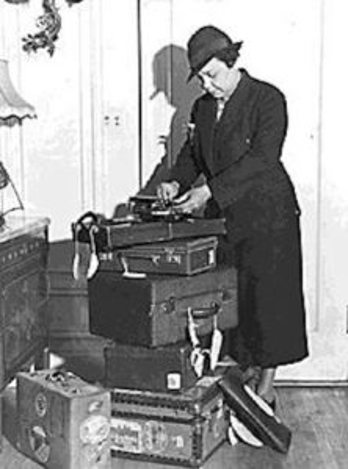 Fay Jackson, African American Registry
Ms. Jackson was achieving so much even as she lived in a city and a time where segregated pools and racial housing covenants were the norm. Jackson’s granddaughter believed it was important that people knew about her grandmother, such that it became her “mission,” as she told the LA Times in 1988. Notably, at the time of her interview, Ms. Jackson was the events coordinator for the Southern Christian Leadership Conference of Los Angeles. No grass grew under her feet!
A bit more on the journal, Flash, which contained serious and even controversial journalism: For instance, Jackson wrote about the stereotypes that Black Hollywood actors were forced to contend with. And we know this to be the case from last week’s profile of actress Evelyn Preer. Jackson also addressed what she called the “color fad,” wherein famous white people were flocking to LA’s Black entertainment venues as a sort of adventure. This trend was happening on both coasts, with performers at times feeling more like exhibits than artists.
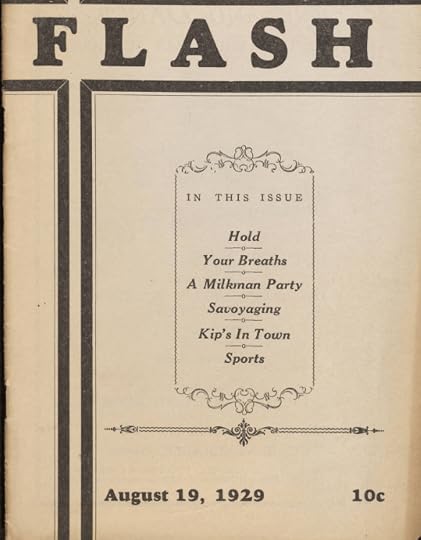 The Huntington Digital Library
Clearly not intending to keep these stories to herself, after organizing her grandmother’s papers — years of writings and observations, especially on Black film – Ms. Pierson handed everything over to the curatorial staff at the William Grant Still Community Arts Center. (The Center was named after the late Dr. William Grant Still (1895-1978), a highly acclaimed African-American composer who lived in the West Adams neighborhood). Pierson’s hopes were that the collection ultimately is housed at a university or museum, for “public education.”
Pierson also did a perhaps smaller task, by hanging a sign on her grandmother’s house, located at 1325 S. Van Ness Avenue. It simply read, “FAY M. JACKSON.”
 Current image of 1325 S. Van Ness Avenue from Redfin
Pierson wanted people to know that this is where the fabulous Ms. Jackson once lived. And maybe, had they had not heard of her before, they would wonder who that was and then find out her accomplishments. This happened to be the house that Ms. Pierson grew up in, along with her grandmother and grandmother’s sister, a beautician named Annie who apparently passed for white. Pierson continued to live in the house after the matriarchs had passed on.
Ms. Pierson should be eighty-eight years old at this point. I am unable to find any current information on her or her work. This seems, unfortunately, par for the course, apropos of what I referenced at the beginning of this piece. It seems Ms. Pierson spent most of her in the foregrounding of stories of other African Americans while her story (and even image) remains more in the shadows. We are so fortunate to have the interviews and materials that she has shared; they provide us insight into so many things, including the life and times of her incredibly brave and committed grandmother, Fay M. Jackson.
July 24, 2026
Cheerfully, but with Argument
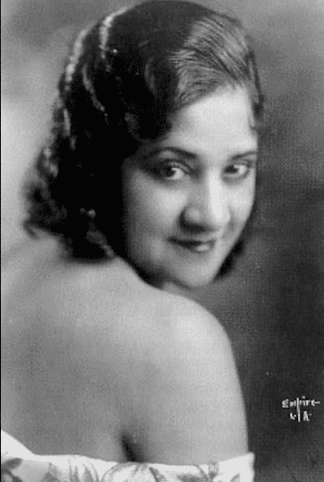 Jackson Advocate
AFRICAN-AMERICAN ACTRESSES WERE ALL OVER HOLLYWOOD in the 20th century, yet their names are rarely spoken. While most of us know the interesting and inspiring story of Hattie McDaniel, there were other Black woman taking on the very white – and very male – Hollywood scene, too. Today you’re going to get to know a little bit about one of these multi-talented women. Her name is Evelyn Preer, a woman who fellow actor Paul Robeson called, “the race’s most famous and versatile actress.” She was a true movie star and yet many of us have never heard of her.
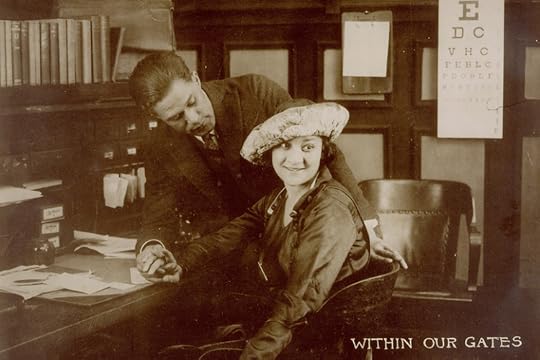 JSTOR Daily
Evelyn Preer starred in numerous films, many directed by the famous Oscar Micheaux, including his renowned feature, Within Our Gates. Doing most of her work in the 1920s and 30s, she had a reputation as an actor who could play most any part – but would not always agree to do so. She was clearly an independent, strong woman, yet much of the writing about Ms. Preer identifies her as “Micheaux’s actress” or in some other similarly possessive form. She may have been made famous by the director’s well-known films, but Preer was working hard – and successfully – as an actress before he “discovered” her. “Miss Preer could play any role assigned her and always did so cheerfully and without argument,” Micheaux said, according to the Kennedy Center. Apparently Mr. Micheaux appreciated the actress’ good behavior.
(Now, let me say that Micheaux was an incredibly important person in the history of Black film. He made movies with all-Black casts that eschewed most every stereotypical role assigned to Black actors – and African Americans, more generally – in a time where that was not the norm. I am only wanting to emphasize here that Ms. Preer was not quietly waiting to be plucked out of oblivion. She was busy acting, traveling the country, and Micheaux was wise enough to recognize her talent when he saw it).
Evelyn Preer started her career in Chicago, with the famous Black acting troupe the Lafayette Players who originated in New York City. The group was founded by yet another pioneering African-American woman by the way, Anita Bush. Preer’s family was a part of the Great Migration, having moved to Chicago with her mother and three siblings from Mississippi in 1898, at the age of two. She was attracted to acting early, some say spurred on by her mother’s street preaching which she often participated in as a child. Ultimately Preer traveled with several acting troupes, first in high school with the group Lady American Minstrels. When she was nineteen, club owner Frank Preer saw her sing in a show and apparently fell in love with her. They were married. And Mr. Preer worked hard to promote his new wife, including to his friend, the director Oscar Micheaux.
Evelyn Preer ended up making eleven films with Micheaux and her reputation as a sort of activist artist is due in part to the themes of these films. Micheaux made films expressly countering the multitude of discriminatory and dismissive stories around African American history and culture that were being promoted in movie theaters at that time. Preer’s unwillingness to compromise herself by participating in anything that she found demeaning only added to her identity as a “race woman.” At least once she was asked to blacken her light skin in order to appear more “Black.” And another time, it was suggested that in order to secure more roles she leave the business altogether, for a short while, then return and pass for white.
In Hollywood, Preer signed with Paramount, made three short films, and then ended up walking out of her contract because the studio was asking her to perform roles that she did not find representative of her race. Her reputation continued to precede her. And yet there is not that much in the form of primary sources to share her story of these battles in her own words or images.
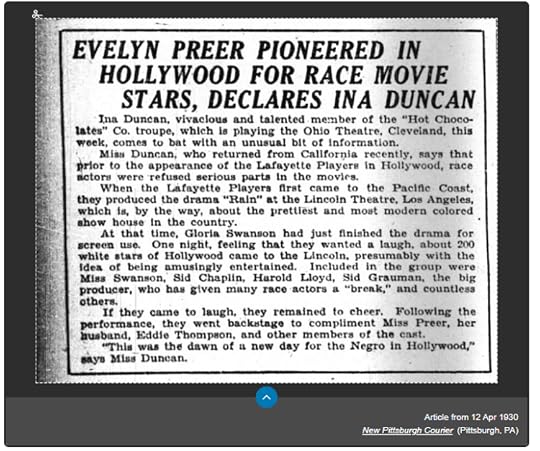
In 1928 Evelyn Preer performed in the play Rain, based on a short story by Somerset Maugham. It was staged at Los Angeles’ Lincoln Theater – often referred to as the Apollo of the west. The Lincoln was located in the famous Central Avenue Black arts district that I have previously written about. Described as a “New York style” production, Preer played the starring role of Sadie Thompson, seen as a major breakthrough for a Black actress. The play was also staged by the famous Lafayette Players, that group that originated in New York. This acting troupe is a major memory in a lot African-American oral histories surrounding Los Angeles’ Great Migration era.
NB: For the record, Google’s “AI Overview” emphatically states: “The stageplay Rain did not directly play in Los Angeles in 1928, as its legendary original star, Jeanne Eagels, had finished her multi-year theatrical run and transitioned to vaudeville and film.” Eagels is, need I say, a white actress. Yet, multiple reliable sources have this play being staged in 1928 in Los Angeles, starring Ms. Preer. It turns out, when I added “African-American” to my search our friendly robot corrected itself to let me know that indeed there was a play staged by this name. (Though it says it was staged at the Alhambra Theater – a downtown movie theater – and not the famous Lincoln Theater where much Black entrainment occurred beginning in 1927. And this, my friends, is how we come to lose so much African-American history – and why AI is only making things worse. AI scrapes what’s already there. Nothing there? Wrong information? AI reports what it finds – or doesn’t.
Okay, back to the regularly scheduled program…
As is so often the case, this Black woman had multiple talents and wore many hats. During her time as an actress in Los Angeles, she also sang with Duke Ellington, making recordings under the name “Hotsy” Jarvis. Here she is singing “If You Can’t Hold the Man You Love” with the Duke Ellington Band in 1927.
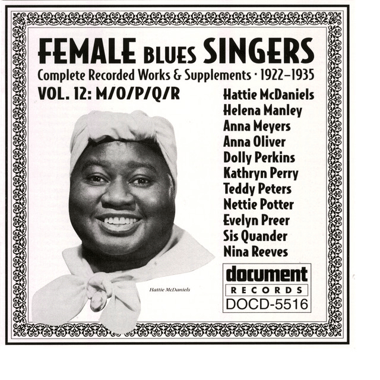
And here’s a slightly confusing album cover I found via Spotify. (Not sure why Ms. McDaniel is featured in her “Mammy” outfit for this; and also her name does not have an “s” at the end).
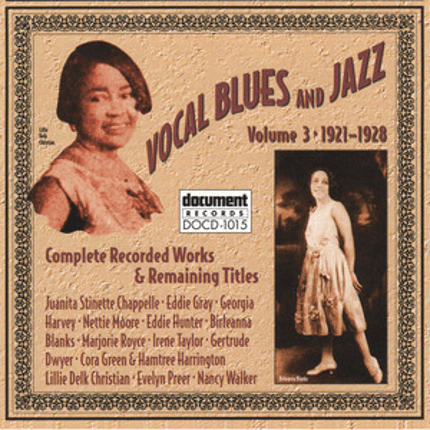
Here’s another Spotify cover:
While working in Los Angeles, Evelyn Preer became pregnant with her daughter, Edeve, perhaps a combination of her name and her new husband’s, Edward Thompson, also an actor. Her daughter is now known as Sister/Dr. Francesca Thompson. She lost her mother when she was just seven months old. There are varying stories concerning Preer’s death, some attributing it to giving birth. But her daughter insists that Preer died of pneumonia due to prolonged exposure to bad weather.
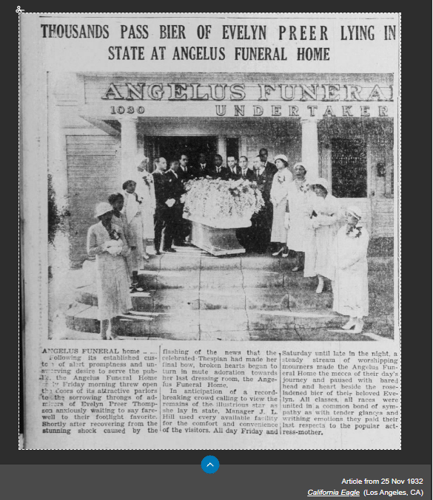
There is no star on Hollywood’s Walk of Fame for Evelyn Preer. And most of the information about her comes from either her daughter’s work or writings focused on the director Oscar Micheaux. So I offer up a little bit of a biography of this incredibly talented woman of deep integrity. We really must do better when it comes to the knowledge of our country’s African-American history. And using AI is clearly not the answer.
July 17, 2026
Executive Order 9066
AFRICAN-AMERICAN AND JAPANESE-AMERICAN HISTORIES collide in this upcoming story. And as per usual, a Black woman is central to the telling. Mollie Wilson Murphy (or Molly, sources differ) grew up in the Boyle Heights neighborhood of Los Angeles. Born on January 6, 1926, Mollie lived on Boulder Street between Evergreen and Sloat, just north of the Evergreen Cemetery. She was a 1943 graduate of Roosevelt High School. World War II had begun.
Boyle Heights was one of the most diverse communities in Los Angeles at the time. While the majority population was Jewish, there were also Russian, Mexican, Black and Japanese residents as well. The lack of restrictive covenants – rules that said houses could only be sold to white people, basically – invited this diverse population.
In her oral history for the Japanese American National Museum Ms. Murphy recalled:
As a child, I vividly remember that on my street alone there were ten different ethnic families residing harmoniously together. My mother learned to cook from Jewish people, because she had not been taught by her own mother. It often amazed me how my mother could communicate with Mrs. Kokoris or Mrs. Akahoshi, because neither of them could speak English and my mother couldn’t speak Greek nor Japanese! It goes to show, that when it comes to mutual problems, you don’t always need words to express your thoughts.
As the War progressed, Mollie saw friends of hers being taken away to concentration camps. She did not understand how this could be happening to her classmates.
I had a lot of emotions, but one was the unfairness and stuff. That really got to me. But since I can’t do anything about that, I have to deal with whatever I can. They were still my friends. So yeah, I felt… You know, you’re asking me how I felt forty-some-odd-years ago. I can’t honestly tell you, because I can’t remember. But there was pain, and there was a feeling of… See, I have to always think, if they can do it to them, they can do it to me, too. So that’s always in the back of your mind. And from then on, they seemed to be doing okay from their letters, so you make the best of it.
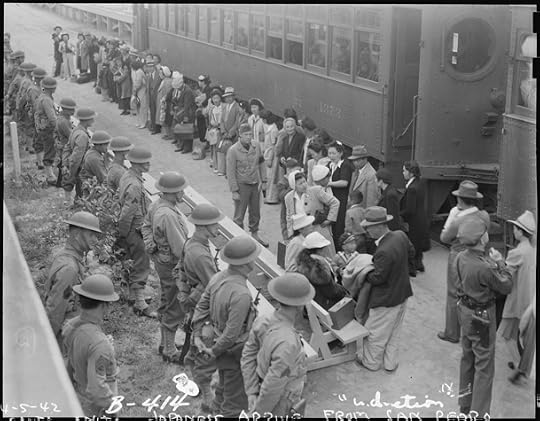 L.A. residents arrive under guard at the Santa Anita Racetrack in California before being taken to inland camps, 1942. Photo by Clem Albers/Courtesy of National Archives, photo no. 537040
Mollie Wilson decided to stay in touch with some of the girls she knew through letter-writing. She even sent care packages sometimes. In fact, African-American families were known to travel to the concentration camps to deliver items for their Japanese neighbors and friends. If you go to the Densho Digital Repository’s Mollie Wilson Murphy Collection you can read so many letters sent by Mollie’s friends from the camps. Unfortunately there are none in the collection written by Mollie *to* her friends.
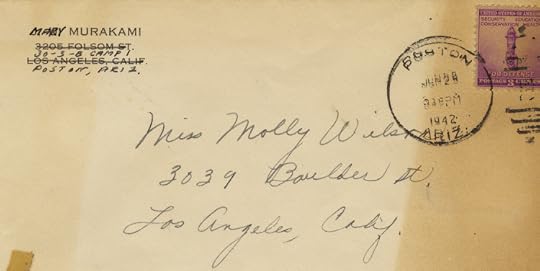 Japanese American National Museum
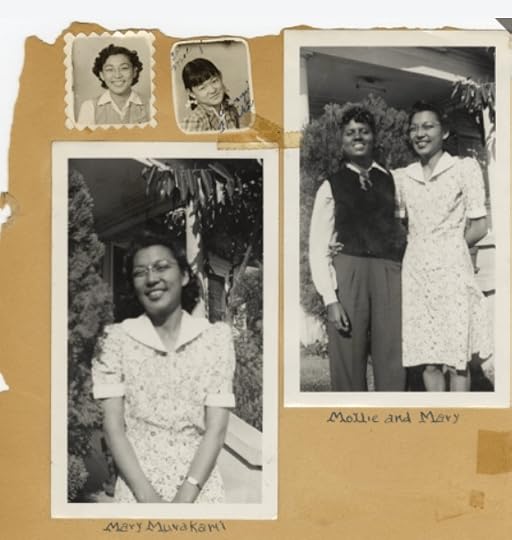
This is an envelope that contained one of those letters, from a friend since elementary school, Mary Murakami. (Notice how she had to scratch out her home address and include the camp address instead).
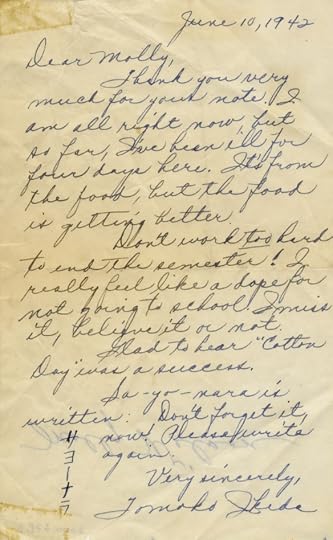
And here’s a transcript of one letter from Mary, courtesy of the Japanese American National Museum: (Mollie donated her papers to the Museum so they could have all these artifacts as a part of their story telling project):
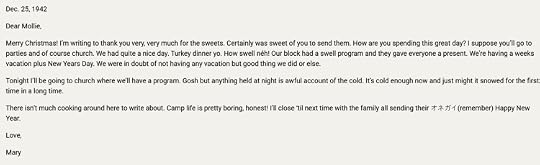
 Japanese American National Museum
And here’s an old scrap book page of Mollie’s with photos of Mary and Mollie, date unknown.
I’m also including a letter from another friend to Mollie. There is something so typical-teen in these words written within such terrible conditions. It’s just girlfriends talking about life, even as we hear about the camp’s cooking and the cold Arizona nights.
Once the War was over and some of the students had returned, Mollie ended up delivering their high school diplomas to them. Although they were not permitted to return to the West Coast during the War, some Japanese American students who met specific requirements were allowed to leave the camps to work or attend school elsewhere. Others received a kind of education in the camps.
 Japanese American National Museum
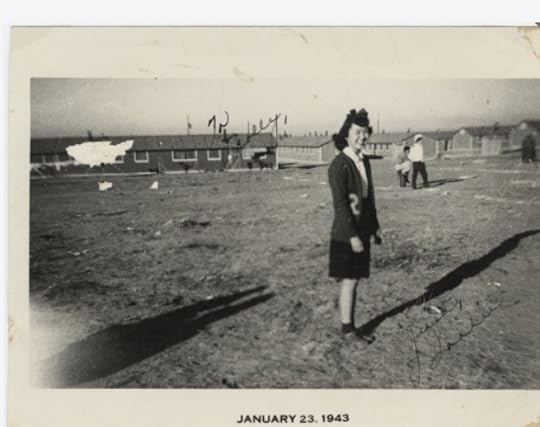
One of Mollie’s friends, Sandi, sent her a postcard from Oberlin College in 1944. This is a picture of Sandi wearing her Roosevelt High School letter sweater. She is standing at the end of the football field at the Granada (Amache) Incarceration Camp.
Mollie, herself, ended up graduating from the University of California, Los Angeles, and becoming a Spanish teacher. She remained friends with many of her Japanese-American classmates long after World War II. There is not a lot written about Mollie herself, which is unfortunately typical when it comes to the history of African-American women. There is a full oral history available but it must be listened to in person. And that is now on my to-do list.
Mollie passed away at the age of 88 on August 23, 2014. Her generosity and forethought in keeping, and then donating, her papers makes her an incredibly important historical figure in Los Angeles’ Great Migration Era.
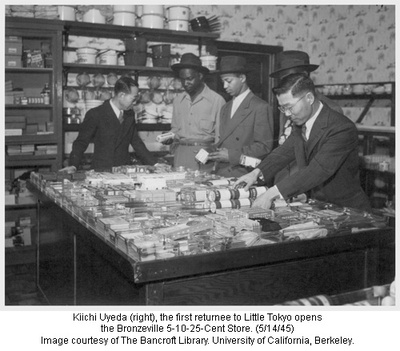
POSTSCRIPT: There is another historical connection between these two cultures, the fact that African Americans moved into many of the homes left abandoned by the Japanese internment. World War II brought incarceration for the Japanese Americans while at the same time being a major moment in the Great Migration — that exodus of African Americans from the American South. Defense work was opening up to Blacks and women and Los Angeles was a center of this industry. Because of the prevalence of racial covenants, most of these Black workers and their families did not have many choices as to where to live. But the Little Tokyo neighborhood was open – due to the incarceration of the majority of its residents – and so African Americans flocked there, turning it into a vibrant Black community. The area became known as Bronzeville. According to the Densho Archive, about 80,000 people ended up moving into that neighborhood that initially housed more like 30,000. Overcrowding and all that comes with that eventually ensued.
After the War, when some of the Japanese families returned, they of course hoped to be back in their homes. But the neighborhood had changed and for some of them their dreams of resuming the life they had left would not come to fruition. (This occurred for myriad reasons worthy of research, if you are so inclined). Notably, an interracial activist movement sprung out of this historical moment, and for some relationships would be forever forged between African Americans and Japanese Americans. And yet, of course, there was also resistance to this collective organizing, from inside and outside of these communities.
There is so much to the history of African Americans and Japanese Americans in this country. Suffice it to say it has been very complicated at times, and yet quite often these two groups have been in solidarity born of shared struggle. See the Densho Archive’s page, “Intersections of Black and Japanese American History: From Bronzeville to Black Lives Matter” for a wonderful overview and lots of resources for further research.
Keep wondering!
July 3, 2026
“The Horn Has Always Gotten Me Into a Lot of Trouble”

As our so-called government actively works to bury and dispute any history that includes people of color, queer citizens and the poor, my activity of Great Migration story-gathering sometimes feels futile. Like trying to swim against a giant ocean wave. (Which I would never even come close to doing because I’m scared of those things). But my understanding and observation is that when one is swimming or surfing or in some way contending with the ocean’s overwhelming power, if one works with it, swims through it, then success might be possible.
And so we amplifiers of history continue to share these often-unknown stories, not in an attempt to push back against the prevailing wave of racist, xenophobic, homophobic forces but simply to continue what was started so many centuries ago, a story-telling tradition that has held up through constant intentional erasure. Story as resistance is a real thing. And when we can employ the people’s own words – as I am able to do here – even better!
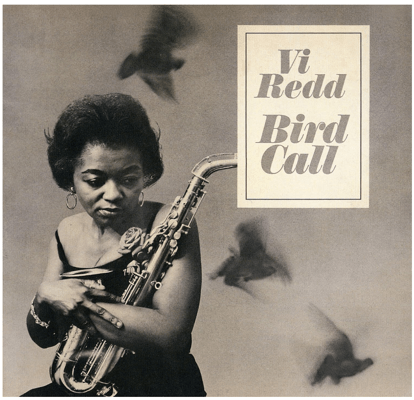
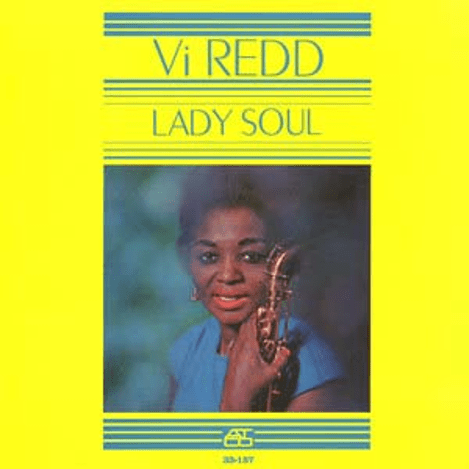
Today I want to share a few notes about the fabulous, under-recognized, Los Angeles musician, Vi Redd. While this piece intersects with my first post on Club Alabam and the Central Avenue jazz district of LA, it also continues the theme of my last two posts, centering as it does an enormously talented, intelligent, thoughtful Black woman who went through some things and yet came out willing to share her gifts with others. And so thanks to a few good sources scattered hither and thither, here’s a (not the) story of Vi Redd, singer, saxophonist and — I’m going to go ahead and say — feminist.
Vi Redd is best known for her singing and saxophone playing. Check her out here doing both with Count Basie. She was also known as the daughter of the famous Louisiana-born musician, Alton Redd; one more Louisiana-to-LA Great Migration tale. She was, of course asked about him in an oral history interview:
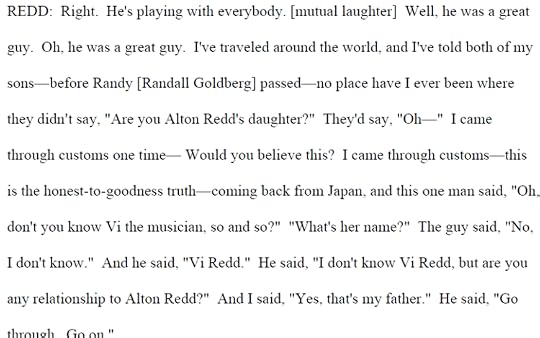
In this oral history conducted by Steven Isoardi for UCLA’s Center for Oral History Research, Ms. Redd relays her experience, without animosity. And yet I cannot help but wonder if this experience of being recognized as much as someone’s daughter as instead a woman and musician in her own right, in some way informs a person’s identity. (Perhaps I am simply projecting based on my own personal experiences).
Elvira Louise Redd (having the same middle name as I) was born in Los Angeles in 1930. It was in 1949 that a fellow musician started calling her Vi, and that became her name going forward. Both sides of her family came from Louisiana, again highlighting the centrality of a few states’ migrants to certain points across the country. As mentioned before, Los Angeles had a preponderance of people coming from Louisiana, Arkansas and Texas during the Great Migration.
Vi started high school at Jefferson, where so many of the “Eastsiders” went back then. The school is full of famous alumni, from Dexter Godon to Alvin Ailey. But Vi’s dad wanted her to go to a different school, perhaps deemed a “better” school by some, as it was on the west side. Dorsey High School was her father’s choice for his daughter, and so he bought a house so they could live in the school district. This was pushing the western geographical boundaries for a Black family at the time, around 1944. But Ms. Redd reports that they didn’t have any kind of “trouble” from her new mostly Jewish and Greek neighbors. That said, some African Americans tried their luck a little too far west. Vi remembers when singer Nat King Cole had moved to the Hancock Park area. That was pretty much Hollywood back then and, while Cole was able to buy the house, “there had been problems,” said Redd.
Another “problem” that the women musicians endured was verbal, physical, and emotional abuse – by men who were sometimes domestic partners, and other times fellow musicians. Redd said she really didn’t deal with those issues herself but remembered a fellow musician’s plight with an abusive husband. She and another woman musician ended up “rescuing” her one night.

Trained by her aunt, the famous Mrs. Alma Hightower, Redd grew up with a slight naiveté when it came to being a woman in the music business. Hightower played all instruments and took no tea for the fever. Redd would often be surprised by the responses that she got from the male musicians.

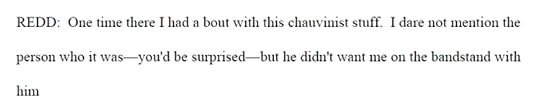
Some men would simply walk off the bandstand when a woman took the stage. Looking back she also realized that her famous father didn’t hire a lot of women for his band either.
 twssmagazine
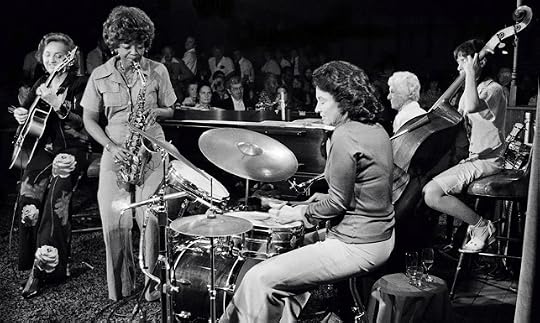
Music writers often deem that Redd was “underecorded.” While she toured with all the great (male) names, her own music is not so easy to find. She has but two albums under her name and was recorded as a part of other bands on a few records. While playing music full time in Los Angeles, Redd had to secure a job as a teacher in order to make a living. This is such a familiar story for so many African-American women, getting their flowers only years after they pass – if at all.
 Curt’s Jazz Café blog
Vi Redd died four years ago, at the age of 93. She knew everyone and they knew her back. Her story is a lived history of Los Angeles, jazz music, feminism, racism, and global relations. What I offer here is simply a sample of her very full life. I urge you to read the oral history I previously linked if you are interested in one or more of the many subjects that encompass her life.
June 19, 2026
Come On In, The Water’s —
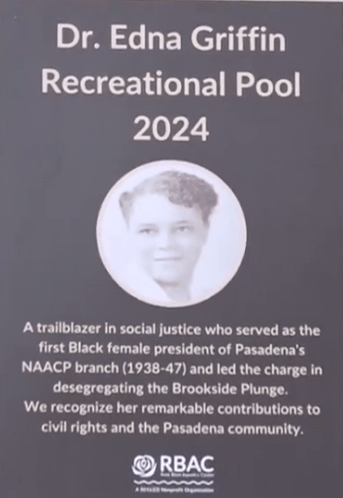 Pasadena Media
IF YOU EVER GO SWIMMING AT THE ROSE BOWL, you’ll see that the Recreational Pool deck has a plaque with a name on it. Do you know whose name that is? Well, the pool is named after Dr. Edna Griffin who, among many things, was the first Black female physician in Pasadena. But why would they name a pool after a doctor, one might ask. The answer is, because this doctor was an activist, a role that many Black women – especially of her generation – still go unnoticed for. That is why they are the focus of my present work on Los Angeles’ Great Migration era history.
In 2024 the Rose Bowl Aquatics Center renamed its recreational pool after Dr. Griffin. The city’s Recreation and Parks Commission had voted in 2023 to recommend that the City Council name the new municipal swimming pool after the doctor – despite public support for naming it after former councilmember, the late John Kennedy, instead. So “only” thirty-two years after the doctor’s death, the naming ceremony took place. Why does it always seem to take so long for Black women’s work to be acknowledged? If it gets acknowledged at all? This is a madly recurring theme such that more and more scholars and public historians are working to rectify this situation. I digress. And I’m going to do so a little bit more!
Ms. Edna was born in 1905 in Fort Smith, Arkansas. This state, along with Louisiana and Texas, are some of the primary states from whence so many African Americans came to Los Angeles during the Great Migration. According to the Encyclopedia of Arkansas, during the Great Migration, “among the destinations for Arkansans who left the state, California received the largest number of people. Census records show that roughly 313,000 native Arkansans lived [in California] in 1960.”
Some twenty years later Dr. Griffin obtained her medical degree from the HBCU, Meharry Medical College. (She had wanted to go to USC’s medical school but in the 1920s no Black students were allowed). After interning at Tuskegee’s John Andrew Hospital, Dr. Griffin finally settled in Pasadena in 1935.
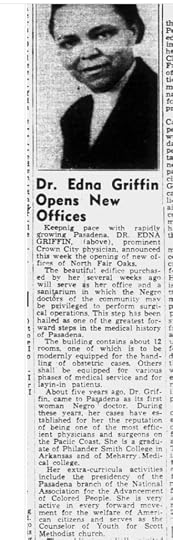 The California Eagle,
27 Mar 1941
The California Eagle,
27 Mar 1941Throughout her time in the city, Dr. Griffin went to great lengths to see Pasadena’s institutions desegregated. A few years after arriving, she became the first woman president of the Pasadena branch of the National Association for the Advancement of Colored People (NAACP), holding that position from 1939 to 1947. As mentioned, she was intent on desegregating her new home. So, in 1942 Dr. Griffin sued the city to allow African Americans to freely swim at the Brookside Plunge swimming pool. (This pool was eventually demolished and the area rebuilt into the Rose Bowl Aquatics Center). You see, the rules at Brookside were that African Americans could only swim there one day per week, that was Wednesdays. According to the Pasadena Library’s website the city then drained the pool afterwards each week so that the water would be nice and clean for the white swimmers those other six days of the week.
This is not a surprise, but rather a common occurrence across the country during this time. In fact, around this same time, all the way over in Newark, New Jersey, a Black family had to rent out the local YMCA pool in order to allow their daughter to practice for the Girl Scout swimming badge. And it might surprise the reader to know that this practice did not stop as early as some might think. While the 1964 Civil Rights Act mandated the desegregation of public accommodations, many cities strategized ways to avoid following this new law. As far as swimming was concerned, sometimes this meant simply shutting down the public pool altogether, rather than allow Blacks to go swimming in it. And these attempts at “work-arounds” still exist today. In fact, according to the Pennsylvania Capital-Star, in 2009 the owner of a private swim club in Philadelphia banned Black children from a local day care center, saying they would change the “complexion” of the club.
While the municipal court eventually ruled in favor of desegregating Pasadena’s Brookside Plunge in 1942, that law was not fully implemented until five years later. Again, a common theme; laws do not necessarily equal implementation when it comes to deeply entrenched racist practices.
Anyway, during her life, Dr. Griffin ended up filing over twenty lawsuits against businesses and other institutions in Pasadena that practiced segregation. Her association with the NAACP was crucial as the organization played a major role in the courts during this time – nationwide – when it came to challenging segregation.
Dr. Griffin’s former medical office is located at 891 N. Fair Oaks Avenue. You might recognize the orange door if you drive through that intersection of Mountain and Fair Oaks ever. There’s even a self-guided audio walking tour, created by the NAACP, of Pasadena’s African-American History that includes Dr. Griffin’s former office. In the 1930s and ’40s, in particular, North Fair Oaks Avenue was home to many Black residences and businesses. In the early 2020s the N. Fair Oaks Empowerment Initiative began work to rebuild this community that had been devastated by the all too common act of eminent domain in the name of urban development.
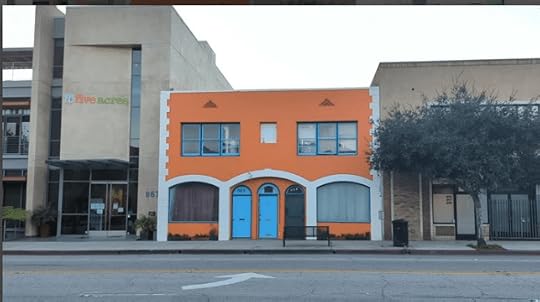 Walking Tour of the African American History of Pasadena
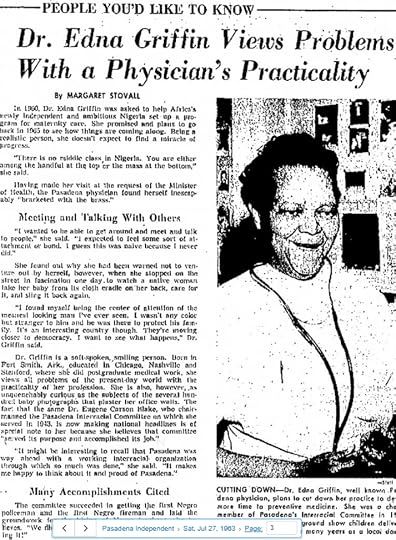
In 1947, author Helen Kitchen Branson – a nurse and health care administrator – published a biography of Dr. Griffin entitled, Let There Be Life: The Contemporary Account of Edna L. Griffin, M.D. It is available at the Huntington and other local libraries. There’s also an interesting-looking article that I am unable to access at the moment entitled, “’She Thought California Was Without Prejudice’: Race and Medicine in Jim Crow California” by Alicia Gutierrez-Romine.
On this Juneteenth, when the idea is to celebrate freedom, it seems fitting to honor a person who worked so hard for the freedom of her people. Dr. Griffin believed it was only fair that African Americans enjoy the same liberties as people of other races. And that included the freedom of going swimming at the local public pool whenever they wanted.