
Rod White's Blog
August 24, 2026
Hope: The quality of aliveness in our own backyard
Contemplative prayer is often, even typically, presented in the language of personal healing and self-discovery:
I enter stillness in order to purify my unconscious, heal the emotional wounds of a lifetime, find my true self, and so on.
But there is a natural self-corrective mechanism built right into the prayer itself if we are willing to take it far enough:
my true self is found only in communion with others.
The personal can find its identity only in relation to the whole, which is the mercy of God.
— Cynthia Bourgeault in Mystical Hope
This month I kept running into hope. Sometimes it made me cry.
As soon as Pastor Sean began to speak at Algernon Baker’s memorial, I teared up. He insisted we turn into hope, since we knew our brother was ready to wake up into the dawn of his eternity. Then the young adult choir sang the most joyful song I have ever heard.Then I watched my latest episode of Star Trek: Strange New Worlds and felt something good is happening in the world because this moralistic, positive, super-woke show can still manage to get made and appear on the Ellisons’ network.Then, a TikTok doctor and a new book I am reading reminded me that my grandmother’s attention was one of the ways God reached out to me and undermined the toxic shame we all deal with.I felt a bit by Dorothy, who has always been strangely central to my theology:
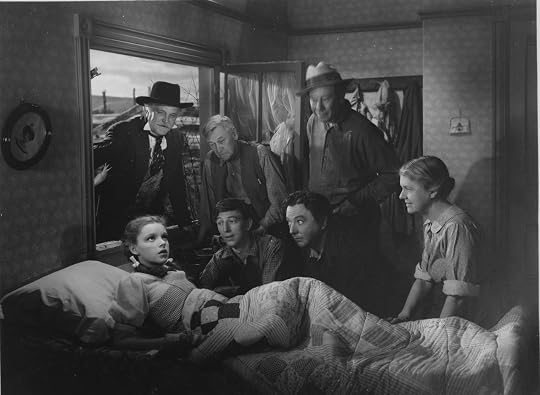 Click the pic if you want to see the scene
We’re often like Dorothy waking up from her vision and realizing her heart’s desire was right under her nose the whole time and among those who love her. What a wonder it is that so many of us are drawn beyond our ordinary awareness and turn away from the death-dealing world to find God “in our own back yard,” so to speak.
Hope is that “quality of aliveness” we feelAs Cynthia Bourgeault ends her book Mystical Hope she tries to sum up her profound teaching about finding hope right under our noses — while rolling down Broad St., even, and especially in the moments of love we give and receive. She teaches us to find hope in a new way — not as merely an object of our desire, but as the Subject who is as near as the turn of our hearts. I am going to quote quite a bit of it for you:
I have tried to suggest a new way of picturing hope. In this new positioning, the underlying sense of corporateness is physically real, the that “electromagnetic field of love” is the Mercy – and the Mercy is the body of Christ. Through this body hope circulates as a lifeblood. It warms, it fills, it connects, it directs. It is the heart of our own life and the heart of all that lives.
Hope’s home is the innermost point in us, and in all things. It is a quality of aliveness. It does not come at the end, as the feeling that results from a happy outcome. Rather, it lies at the beginning, as a pulse of truth that sends us forth. When our innermost being is attuned to this pulse it will send us forth in hope, regardless of the physical circumstances of our lives. Hope fills us with the strength to stay present, to abide in the flow of the Mercy no matter what outer storms assail us. It is entered always and only through surrender; that is through the willingness to let go of everything we are presently clinging to. And yet when we enter it, it enters us and fills us with its own life – a quiet strength beyond anything we have ever known.
And since that strength is, in fact, a piece of God’s purposiveness coursing like sap through our own being, it will lead us in the right way. It sweeps us along in the greater flow of divine life as God moves – and in the western religions, God does move – toward the fulfillment of divine purpose which is the deeper, more intense, more subtle, more intimate revelation of the heart of God.

Long before we knew Jesus, we had experiences of being swept up in the flow of God’s good purpose — maybe beside a stream like the one above. This “quality of aliveness” was called “righteousness” in the Old Testament, as in Psalm 23: “He restores my soul; he guides me in the paths of righteousness.”
Unfortunately, many people read that couplet as if the psalmist means we will be OK if we stay on the path, within the lines of a moral template so we will succeed at building an ideal replica of God’s kingdom and be justified by it. Far from that egoic reading, the psalmist is reminding us we live in a Spirit-charged “force field” (as we might picture it), a force field in which everything we do must move in order to come to fruit.
The reality of God with us, restoring and guiding us, is much more important than my ability to stay on “the path.” The psalmist is calling the inner (our souls) and the outer (our feet) to sync up, to move with the Great Mover who is giving us life. As our souls are restored and our feet are guided, Jesus says, we become good trees that bear good fruit. As Psalm 1 says, we are then like good trees planted by flowing streams of righteousness.
In the New Testament, Paul calls this territory “in Christ.” In Christ we find that quality of aliveness we were made to enjoy, in which we hope.
To [his saints] God chose to make known how great among the Gentiles are the riches of the glory of this mystery, which is Christ in you, the hope of glory. It is he whom we proclaim, warning everyone and teaching everyone in all wisdom, so that we may present everyone mature in Christ….I want their hearts to be encouraged and united in love, so that they may have all the riches of assured understanding and have the knowledge of God’s mystery, that is, Christ himself, in whom are hidden all the treasures of wisdom and knowledge…As you therefore have received Christ Jesus the Lord, continue to live your lives in him, rooted and built up in him and established in the faith, just as you were taught, abounding in thanksgiving…For in him the whole fullness of deity dwells bodily, and you have come to fullness in him, who is the head of every ruler and authority. – Colossians 1:27-2:10
The phrases “Christ in us” and “us in Christ” are another way to say “moving in the Mercy.” For Bourgeault, the mercy of God is a place of assured understanding, a place of loving mystery which continues to unfold as we experience it in our hearts. As we are “encouraged and united in love,” Christ in us is the “hope of glory.” In Christ we come to “fullness.”
Paul sounds a lot like Cynthia Bourgeault as she piles up metaphors and viewpoints, circling around the mystical hope she can feel better than describe. Her everyday way to live “in Christ” is meditation that turns her in toward that golden kernel of her true self, protected and saved by God. In a somewhat seamless movement, that everyday prayer then turns her out to write her book, knowing that no self-giving love is wasted in the world, not on her and not on us, either. Our prayer, especially the prayer of meditation, is not only what saves us from the world, it is also the key thing we do to save the world. It is our way to hope, our way to become a people of hope, and our way toward embracing others with hope.
I have enjoyed sharing these five posts inspired by Bourgeault’s book. I’d love to hear how your own prayer was encouraged or developed as a result. Let me know.
More on Mystical Hope
Previous: Mystical hope in a deteriorating world
Swimming in the Mercy: The experience of hope
Anxious and tired: Meditation that turns us toward hope
There is hope: Death will help you enjoy it
The post Hope: The quality of aliveness in our own backyard appeared first on Development.


August 17, 2026
There is hope: Death will help you enjoy it

I’m still savoring the memory of Cynthia Bourgeault’s book, Mystical Hope, laying in my lap, a tear trickling down my cheek and a smile broadening across my face in deep relief and joy. I had just reached the part in which she quoted a little piece of a Thomas Merton cassette (!) speaking to his novices. As I read it, I laughed out loud, since he recalled an image that was very similar to one I had experienced in prayer during a rich period of my thirties — an image that has sustained me ever since.
God is near to us at the point that is just before final destruction. Take away everything else down to that point of final destruction, and the last little bit that’s left before destruction, a little kernel of gold which is the essence of you–and there is God protecting it…And this is something terrific. …[We] don’t normally get into that center unless we’re brought to the edge of what looks like destruction. In other words, we have to be facing the possibility of the destruction of everything else to know this will not be destroyed.
Merton sounds a bit like he is inviting his novices to jump off a spiritual cliff, doesn’t he?! I suppose he is. I suppose I jumped. But he is also inviting relative beginners into a life of prayer, like my three previous posts have been doing. It is a life that leads to the place of surrender and revelation he describes in the quote above. It is a life filled with the mystical hope that does not come through ordinary means.
Meditation “puts us immediately in touch with that ‘little kernel of gold which is the essence of’ us and allows us to begin to recognize it and trust it.” That might be the best feeling in the world.
Unfortunately, your faith journey may not have led you into meditation yet. So much religion these days relies on a “good offense” or a “good defense.” On the one hand, many Christians offer victorious living when they promise an overcoming hope that seems hollow in the cancer ward, or when the baby is born with disabilities, or when the house is destroyed and a lifetime of memories seems washed away. On the other hand the Buddhist track and most of what “mindfulness” is about teaches us an equally deficient approach when they call us to release our preoccupation with death and suffering in order to experience blissful, mindless oneness with all life.
Deeper than having a good offense or good defense and more in line with the Lord’s example is mystical hope. On the other side of suffering and death is hope. Bourgeault says, “Only if we are still hanging on…only in the measure that we fail to yield completely into the mercy of God, will hope fail us. If we are willing to take it all the way, it will take us all the way.”
Jesus went beyond destruction to hope.This the journey of yielding completely Jesus took all the way. When he was arrested, he told his disciples to put away their swords because he, like us, needed to pass through his own powerlessness and hopelessness. He purposely did not put his hope in some nuclear arsenal of angels or call on a victory-making God to save him. When he was in the garden praying and meditating (as the disciples fainted), he found that “protecting nearness” at the center of reality. How he went “to the edge of what looks like destruction” is an example for us. It is the Lord’s death as well as his resurrection that is our salvation.
Words on a page don’t work as well as art to explain this basic Christian truth. But this old song gets to it:
O soul, are you weary and troubled?No light in the darkness you see?
There’s light for a look at the Savior,
And life more abundant and free.Turn your eyes upon Jesus,
Look full in His wonderful face,
And the things of earth will grow strangely dim,
In the light of His glory and grace.Through death into life everlasting
He passed, and we follow Him there;
The wonderful old movie, Babette’s Feast, gets at it, too. In this film the wonder centers around a sumptuous meal that reveals many secrets. It is like another last supper, only this one is full of old Danish people facing death. They are gathered full of faith and full of their regrets. The General gets up and names the wonder that is happening among them, the same wonder that was seen when Jesus, the living truth, yielded himself faithfully into the Mercy. The General says, “Mercy and faithfulness have met; justice and peace have embraced.” And all the joys and regrets become one in love as the Alpha and Omega is present in fullness.
There is hopeIn our Transhistorical Body blog, we look toward the people who have gone before us for the assurance that this wild thought is true: if I move over the edge of destruction, God will still protect the golden kernel of the true me. If I dare to meet the living God, my old self — my fallen, scarred, angry, abandoned, intolerably vulnerable self, might die, but I will live. We get this assurance not only from our ultimate example, Jesus, but last week we celebrated Claire of Assisi, who could have quoted Albert Camus: “In the middle of winter I discovered in myself an invincible summer.”
There is hope.
I remember a letter to the our old church from a new member. He was telling the church his story before he made a covenant at the Love Feast. He had gone through so much — and went through a lot more, but even now he has hope. He wrote, “There had always been an emptiness inside me and after my mom passed, I fell into the grips of addiction. When I moved to Philadelphia to get sober, I was fortunate enough to meet Jimmy , in what will always be a “God shot” to me….I was immediately drawn to Circle of Hope and I now realize I was also being called to Christ. This journey brings me joy and deep connection. At times Circle Of Hope is all I felt I had, but the fellowship, my Cell, and my growing relationship with Christ have filled me and helped me to thrive again.”
There is hope.
God is protecting that golden true self at the heart of each of us, calling us to meet in that open-to-the-Spirit place where life moves us and draws us. The everyday way to living comfortably and securely outside our present-oriented injuries and fears and into our eternal now with God is the listening, feeling and releasing prayer of meditation. It seems like a new way, as Bourgeault says, “beyond linear, discursive thinking” into “inspired visionary knowing where Christianity finally becomes fully congruent with its own highest truth and its mystical treasures can be received into an awakened heart.”
If all that beautiful teaching from Merton and Bourgeault seem a bit much to you, just listen to Jesus and see where he leads. Or meditate on Claire of Assisi when you pray. Or appreciate the love that guards the members of the church, even when they have just been called back from far away.
There is hope.
More on Mystical Hope
Previous: Mystical hope in a deteriorating world
Swimming in the Mercy: The experience of hope
Anxious and tired: Meditation that turns us toward hope
The post There is hope: Death will help you enjoy it appeared first on Development.
August 10, 2026
Anxious and tired: Meditation that turns us toward hope
The notion that God is absent is the
fundamental illusion of the human condition.
— Thomas Keating
“Fundamental illusion” can be a way of life! But it does not have to be that way. Most of the wise people we all admire have a story about how they moved beyond their self-contained understanding to become who they became. Some found a hope deep inside that is vastly better than wishing and waiting for one’s illusions to be validated.
I think the best and deepest way that leads beyond ordinary, self-limited thinking and into hope is the way of meditation. Cynthia Bourgeault, my inspiration for this series, agrees:
Meditation, more than any other spiritual practice, nurtures the latent capacities within us that can perceive and respond to divine hope. In the classic language of our tradition, these capacities are known as the “spiritual senses.”
That little paragraph might have seemed so weird to a few of you, it drove you right back into your egoic thinking! So hang on.
“Egoic thinking” is another way of describing our limited, ordinary awareness. It simply means we humans have the capacity to stand outside ourselves and look at ourselves. As far as we know, we are the only species who can do this. Tigers don’t think, “I have a quick temper.” And whales don’t say, “I am really glad to be going north; I’m a cold-water kind of whale.” And tigers and whales don’t write children’s books where tigers and whales seem cute when they reflect. Humans can imagine these different realities, looking back and forward, dreaming and visioning. It is a great thing about us.

The downside of this reflexive capacity, Bourgeault says, “is the tendency to experience one’s personal identity as separate — composed of distinct qualities, defined by what holds one apart from the whole.” We can basically live in “our own little world” (my mother used to say!), revolving around our own sun — ourselves.
As a result of being alone and trapped within the boundaries of our limited senses, we all have a separation anxiety streak running through us because we really need and want to be together, not separate. To feel secure, the ego needs a lot of reassurance from others. It can’t get enough praise, security, accomplishment, etc. to help it overcome that dreadful sense of being left out, or thrown out, or just generally failing to be a full self in community. You can see how quickly we have all been driven into sin by this innate anxiety. And you can see why Jesus calls us to see our true selves in God’s grace, to look at ravens and lilies flourishing, to stop worrying and “seek first for the kingdom of God” as the means of becoming free of what is depriving us of joy.
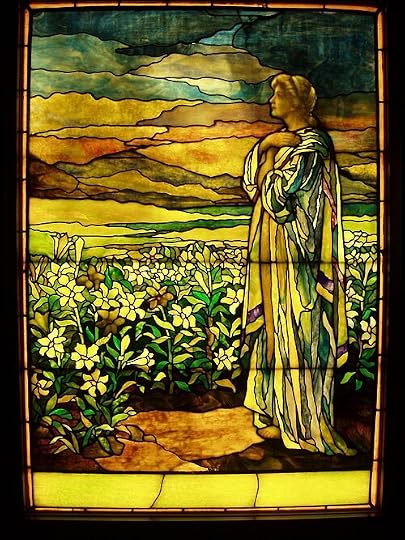 Field of Lilies – Tiffany Studios, c. 1910.
Meditative prayer is a way of discovering and nurturing the latent capacity to see and experience life beyond our ordinary awareness. We can all perceive and respond to “the Mercy” I talked about last week. Nurturing our spiritual awareness is the primary way to experience the “mystical hope” I talked about the week before, the hope which is near and not the outcome of all our striving.
The centering prayer Bourgeault teaches is “a basic, no-nonsense method of self-emptying — simply letting go of thoughts as they arise — to help practitioners break out of their compulsive attachment to thinking and entrust themselves to the deeper stillness of God.” [Here is Martin Laird’s take on it.] The essence of this kind of meditation is not keeping a perfectly clear mind. The essence is recognizing the moment when one is distracted and willingly turning back into the stillness of the Mercy, toward hope. The essence is turning toward the meeting place we have inside as an act of faith and honor; letting go of our own stuff and holding a space open for all God gives and all God is.
We need to get beyond self-awareness and its evil twin: self-centerednessWe have a “self” awareness that is beyond the egoic capacity that makes us human — we also have spiritual awareness. Meditation leads us out of ego-centered consciousness and into a space where we meet God.
You may know almost every other feeling you can have better than the feeling of communion with God! Even so, someone has said we can meet God without even trying by 1) having a near-death experience or by 2) falling deeply in love. I do not wish you the first short cut and I do wish for you the latter. But I wish for us most of all the careful cultivation of meditation, which is the everyday path to knowing and loving God. Meditation is the discipline that helps us “die daily” as Paul says he does, and helps us be one in love as he hopes we will be. The prayer of meditation puts a stick in the spokes of our outer awareness and leads us into the warmth and abundance of our inner awareness and into hope in the Mercy.
It is a hard world right now. Maybe you are pretty numb like a newscaster said she was after covering the damage Trump and Hegseth have done to Iran and to the future of the U.S. Or maybe you are afraid of more smoke from Canada and the extreme weather of our new climate. If it were not a hard world, we’d probably make it one. So it is time to pray.
Have you listened to Jesus saying this to you lately?
Come to me, all you that are weary and are carrying heavy burdens,
and I will give you rest.
Take my yoke upon you, and learn from me;
for I am gentle and humble in heart,
and you will find rest for your souls.
For my yoke is easy and my burden is light.
Basic to that easy yoke is the prayer of meditation. We keep turning to it in our anxiety and fatigue and it keeps turning us toward hope.
Try it again. We certainly fit into the first two lines, for the most part. Maybe his “easy yoke” is meditation where we experience his gentleness and self-giving heart. As a result of staying in that “yoke” maybe we do find rest for our souls. Sounds like Jesus would love to bring us into the hope he carries, even through his suffering, doesn’t it?
More on Mystical Hope
Previous: Mystical hope in a deteriorating world
Swimming in the Mercy: The experience of hope
August 3, 2026
Swimming in the Mercy: The everyday experience of hope

Lynn Bauman’s poetic rendition of Psalm 103:11 warms my heart:
As the heavens reach beyond earth and time,
we swim in mercy as in an endless sea.
I need to hang on to that deeply hopeful picture! Don’t you? Read it again and feel it. May that deep, old biblical truth ascend as new Christian memes lose their strength.
I am longing for sayings like this to descend:
“Only God can turn a mess into a message, a test into a testimony, a trial into a triumph, a victim into a victory.”
And
“I know God has a plan. I pray for direction to follow it, patience to wait on it, and knowledge to know when it comes.”
I don’t think those hopefully-descending proverbs are evil. And I can honestly say they have generally proven true in my life — unlike for many other people I know. But they are more based on outcomes than connection.
I object to the way those cliches reduce hope to something that must be proven. They beg skepticism: “What if the mess does not become a message?” and “We got divorced and it still hurts.” and “I lost my leg in Jordan and I am impoverished as a result.” You may be kinder than I am, but televised stories of trials that turned to triumph often feel a little thin or strained to me. And, what’s more, neglected children learn to turn their trials into triumph because there is no one taking care of them. They only trust themselves, not some parental God. They often spend a lifetime proving they are worth caring about. They hear “turn a trial into a triumph” and there first reaction may be “One more thing to do.”
What’s more, I personally object to the idea that God has a specific “plan” as if she were making sure we get to her preferred outcome: the right job, the safe neighborhood, the healthy family that all “prove” God is good (and us, as a result). Even more, I dread the denial I am called to master in response to terrible outcomes that must be “part of God’s plan” for me — while Kim Kardashian gets rich. People who have chronic illnesses or some unapproved identity can, indeed, take some comfort that this was somehow God’s plan for them, but most people don’t have that kind of willpower. Isn’t that why the Barbie theme song was such a hit?
The mercy is not about meMy commitment to wait on the Lord is not the source of my hope. My passionate acts of goodness and faith do not necessarily result in hope. I can’t really manufacture hope. The Lord is my hope.
For God alone my soul waits in silence,
for my hope is from him. —
Psalm 62:5
Now you’ve read that line. Try waiting in silence for 30 seconds.
Thanks. Now I want to reinforce what the Psalm says. We are not the source of our hope. I dare not apply my meager sense of what outcome I need in order to have it.
Even though we are not the source of hope, the source is deep within me. It flows to me with unrestrained abundance. It is so endless it would be more accurate to say I am deeply within it. The Mercy is like an ocean.
Maybe we are all like the proverbial little fish who just heard a rumor and swam up to his mother and asked, “Mama, what is water? I have to have it!” We are immersed in mercy like that, the everlasting, living water of hope. We don’t lack hope because we are doing something wrong so it is far away, or because we are waiting for what we expect to be fulfilled some day in the far future and just need to be pateint. We lack hope because it is so close, like air, or like a feeling, such as love. It is more intimate than our own sense of being.
As the heavens reach beyond earth and time,
we swim in mercy as in an endless sea.
Cynthia Bourgeault in her book Mystical Hope, describes the “embodying fullness” in which we live as “the Mercy.” Mercy is the water in which we swim. Mercy is what we know of God and the light by which we know it.
I adopted “Mercy” as my main prayer when I got used to the Jesus prayer: “Jesus Christ, Son of God, have mercy on me, a sinner.” As I was riding my bike through town, avoiding car doors, potholes and pedestrians, I realized one day that the curses rising up in me, which added to my frustration and sense of alienation, could be replaced with a one-word prayer that turned me toward my center, toward a realization that I was still in the water, still swimming. Now I am likely to face a distressing or even hope-draining moment with “Mercy!” So much better.
Bourgeault explains “the Mercy” so beautifully:
When we think of mercy, we should be thinking first and foremost of a bond, an infallible link of love that holds the created and uncreated realms together. The mercy of God does not come and go, granted to some and refused to others. Why? Because it is unconditional – always there, underlying everything. It is literally the force that holds everything in existence, the gravitational field in which we live and move and have our being.
Just like that young fish looking for water, we “’swim in mercy as in an endless sea.’ Mercy is God’s innermost being turned outward to sustain the visible and created world in unbreakable love.” We see that so clearly as Jesus turns himself out on the cross and God turns creation inside out to return him to life.
The interpreters of the work of Christ keep looking for words to describe what they experience. Paul says:
Hope does not disappoint us, because God’s love has been poured into our hearts through the Holy Spirit that has been given to us. — Romans 5:5
The basic work of the Christian ends up being a quest for the “water,” for an everyday, moment by moment experience of The Mercy.
It only sounds easyPreachers often get up front and give the congregation a lesson in CBT: how to change you mind and thought patterns to get a Christian outcome. Some people get the lessons and many others get the shame of never effecting the perfect outcome. Either way, we are kind of in charge of making our own hope or responsible for the lack of it. The Jesus way is much deeper than what we can already do, if we just try hard enough.
If the narrow way of living in mystical hope were easy, we’d all be hopeful. It isn’t easy, but it is possible. The more we experience it, the more we get used to our true selves. Instead of living in a world run by scientific principles waiting to be proven again, or worse, a nobody-in-charge universe run by whoever manages to get into power, we become aware that we are “inside a warm-hearted and purposive intelligence, a coherence” of which we are part of the expression. We live in the creation of the Mercy.
Instead of God as a distant “other” we are restored to God as our “source and substance, the ground of our own arising, the foundation of our hope.” I want to talk more about how we might experience this reality in the coming weeks, since, for me, once experienced, it is undeniable and irreplaceable — and we really need it these days.
As I wrote that sentence, I was on hold with Citibank, which bought my credit card from Barclay’s, which did not process a fraudulent purchase for $15K (!!) before they unloaded me. Then Citi did not follow up after I called them. Now i was starting over a month later! Welcome to 2026. The climate-change-induced storm last week left a log from a dead tree in my back yard. The brazenly-corrupt Donald Trump is still president and desperate to undermine the elections which people think are their only hope. Yes. I am turning into my irreplaceable source of hope as I write. It feels good. The turn is energizing. God is my hope.
So for now, I will leave you in hope. Whatever energy you exercise striving for some outcome you hope for would be better used for turning in to hope and swimming for joy in the Mercy. Then, when whatever outcomes emerge, miraculous or not, you can swim right up to them.
[Part One of this series: Mystical hope in a deteriorating world.]
*******
Today is Flannery O’Connor Day! Get to know her and her wild God at The Transhistorical Body.
The post Swimming in the Mercy: The everyday experience of hope appeared first on Development.July 27, 2026
Mystical hope in a deteriorating world
We founded my former church, Circle of Hope, in a ripe moment of history and the outcome was beautiful. Then it wasn’t. And then Eliza Griswold wrote a book about how badly it all turned out that sealed its legacy through her lens. It made some of her reviewers weep.
When it all started in 1995, we sat in a small circle discussing what our name would be. We ended up with several versions of a name with “hope” in it. But some people did not like any of those versions. A few people (and in a circle of ten, a few is relevant!) thought it was just too much to put “hope” right out there in the church’s name.
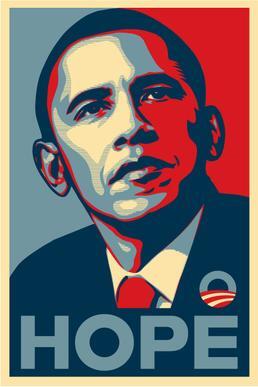 Barack copied us?
Maybe they were right to be cautious. Regardless, they were certainly representative of many others, since many people think hope is far-fetched, even dangerous — mainly because they think it is something tied to outcome. If you are a “circle of hope” you invite expectations that might not be met.
So many people are laboring under all the “outcomes” required of them, and under all the “outcomes” they were promised which never came to fruit.
For many people, “hope” is an optimistic feeling — or at least a willingness to go on, because they sense things are going to get better. But is that sense about worn out these days? What if you put “hope” right out there on your poster, like President Obama did, and then everything does not get better like you promised? Instead, there are drones, recession and bailouts. What if your church implies that Jesus is going to get you a job, provide a mate and cure your cancer and those things don’t happen? Won’t the name of your church just point out the fact that it did not happen? For some people, hoping just makes you look naive, at best, and like just another gaslighter, at worst.
We had a few people on our little team whose hopes had been dashed. What’s more, some of them had grown up in the church, where they even memorized Bible verses like in Psalm 116: “I love the Lord, because he has heard the voice of my supplication…I was brought very low and he helped me.” But their lives had not worked out just like the verse seemed to promise, empiricistettes as they were.
After a while, it is hard to figure out what to do with dashed hopes. Sometimes they are like a secret you would not disclose among people who still hope for some bright future.
I have memorized some Bible verses myself and I am an optimistic guy — and God has repeatedly helped me when I was “brought low.” Even so, I have never thought it was wise to make promises God was not going to keep, at least was not wise to act as if God were the Amazon of human want.
Another way of experiencing hopeThe Bible does, indeed, promise God will meet our needs. But if you look deeper, it teaches that the promise is deeper than just meeting our expectations. I am re-reading a little book that beautifully points out there is another kind of hope represented in the Bible which is a complete reversal of our usual way of looking at hope in terms of outcomes. We can see that hope in Habakkuk 3:17-19 where the prophet dances on the heights even though the land is devastated, and we can see it when Jesus offers inside water for outwardly thirsty people in John 4:13-14, and we can see it in the “total immersion course” in the school of hope that the book of Job is where he ends up singing Job 19:25-26: “I know my redeemer lives.”
Cynthia Bourgeault calls this deeper hope “mystical hope” — and that is the title of her book, too. Mystical hope has three characteristics in contrast to our usual notions of hope. These usual notions, based on outcomes, are not bad, they just aren’t complete or entirely useful. She says, in light of the three biblical examples I just mentioned:
Mystical hope is not tied to a good outcome, to the future. It lives a life of its own, seemingly without reference to external circumstances and conditions.This kind of hope has something to do with presence – not a future good outcome, but the immediate experience of being met, held in communion, by someone intimately at hand.This hope bears fruit within us at the psychological level in the sensations of strength, joy , and satisfaction: and “unbearable lightness of being.” But mysteriously, rather than deriving these gifts from outward expectations being met, it produces them from within.Our mystical hopeI think we had enough mystical hope when were were planting a church to work for good outcomes even when people thought they were not good enough. We came to know our existence was resistance. Our assessment of our value and impact did not define our worth.
But maintaining that view our ourselves was hard. We were just discovering the seismic shifts among the youth of the nation (our focus demographic) which experts have been talking about ever since. For instance, one week in 2017 our pastors passed around a couple of pieces that tested our hope. One was from the Census Bureau.

The map above shows the increase in the number of young adults (18-34) in the United States living at home with their parents in 2015 compared to 2005. The changes in that decade, and certainly the last preceding 40 years were staggering. More than 1 in 3 young people lived in their parents’ home in 2015. That was a huge increase in one decade. What’s more, of those people, 1 in 4 were idle; that is, they neither went to school or worked. Many people saw that reality as a poor outcome. Were all these people hopeless? Ten years later many of the men in the study are the incels of the manosphere.
The other piece the pastors passed around was about alone and lonely men. A journalist who researched psychology was pondering the horrible Las Vegas shooting. An apparently completely alone man was the shooter. As a “lone wolf” he was not that unusual among men. The author says:
As a man, you might be thinking, “Not me, I’ve got drinking buddies. I play poker with the guys. I’ve got friends.”
But do you have confidants? Do you have male friends who you can actually be vulnerable with? Do you have friends whom you can confide in, be 100% yourself around, that you can hug without saying “No homo,” without feeling tense or uncomfortable while you’re doing it?
For many men, the answer is “no.” So, we spend our time posturing instead.
From an early age, we have an unhealthy ideal of masculinity that we try to live up to. Part of that ideal tells us that Real men do everything on their own. Real men don’t cry. Real men express anger through violence.
The byproduct is isolation. Most men spend the majority of their adult lives without deeper friendships, or any real sense of community. Not to mention a complete inability to release anger or sadness in a healthy way.
Many woman feel exactly the same way, of course. And the evil ways of late capitalism have made a perfect environment to create unhealthy, isolated people — A.I. is just making it worse. I experience the outcomes all the time. Some days it just feels hopeless.
There is something other than bad outcomesI want to say more about Cynthia Bourgeault’s book in the coming weeks. But for now, let me end with a quote from the early pages of Mystical Hope which talk back to twentysomethings who feel their future is bleak, and call to parents who feel their children are hopeless cases, and whisper to men and women who feel isolated and friendless, stuck in some pattern which feels hopeless. There is something deeper than your situation. Jesus has a promise that is better than you expect.
You’ll need to read her little book to get the full effect and all the references, but maybe you can get a taste from these lines:
Hope is not intended to be an extraordinary infusion, but an abiding state of being. We lose sight of the invitation – and in fact , our responsibility, as stewards of creation – to develop a conscious and permanent connection to the wellspring. We miss the call to become a vessel, to become a chalice into which this divine energy can pour; a lamp through which it can shine.But what if we are intended to become this vessel, this body of hope? What if, in fact, this effervescent, “lightness-of-being” energy is the fuel that drives our human life toward its divine fulfillment? What if our insistence on treating it as a rare and exceptional phenomenon is a way of ducking the invitation that was permanently extended at the Samaritan well that blazing midday?The journey to the wellspring, the to secret of Jesus, the Master of Galilee, is the great inner journey to which we Christians are called.I am glad we put hope right out there in the name of our expression of the Church back in the day. It dared people not to meet Jesus. On the one hand, God produced outcomes that were MUCH greater than we imagined as we sat in a little circle of ten in our living room. We hoped good things would happen and even more than we hoped happened. So that’s great. But what about all that did not happen? What about when it all fell apart 20+ years later? What sustained us when we failed, broke up, died, lost faith, were betrayed and confused?
It is always that mystical hope, that turning toward the living water which energizes us to get up and live in joy as we follow Jesus through what is next.
[As you can tell, this is the first in a set of updates of 2017 posts. They seem even more important now than when I first wrote them.]
*******************
Today is Pantaleon Day! The martyr who gave away his wealth and doctored the poor for free. He used to be wildly famous, as a result. Meet him at The Transhistorical Body.
The post Mystical hope in a deteriorating world appeared first on Development.July 20, 2026
Kayfabe: Does this key ingredient of WWE explain Trump?
We took a road trip to Monticello. My grandson bought an oversized nickel as a memento. The preservationists who maintain Thomas Jefferson’s lifelong rehab project posted a sign on the way up the mount to remind us we were entering a “sacred” space. Jefferson’s star-studded, science-driven plantation is an altar for the religion of America.
The mansion overlooks Charlottesville. That’s the city lately famous for a torch parade, the white supremacist march on August 11, 2017. Hundreds of white nationalists, neo-Nazis, and alt-right activists stormed through the University of Virginia campus. They chanted antisemitic and racist slogans as they marched around Jefferson’s statue. The spectacle served as a prelude to the violent “Unite the Right” rally the following day.
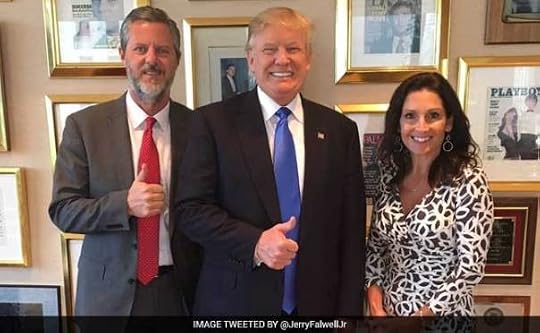 Jerry Falwell Jr Says Donald Trump Offered Him Education Secretary Job
Not long after we left Charlottesville, we approached Lynchburg, VA, home of Jerry Falwell Airport and Liberty University, where the Moral Majority was born in the 80’s — that movement mobilized millions of politicized Evangelicals to combat what it viewed as the moral decline of the United States, championing traditional family values and heavily influencing postmodern American politics. (Falwell Jr., above, played the champion when dad died, but missed the morality). On the way there, I shouted as we turned a corner, “Look at that Confederate flag!” It was huge. Someone bought a gigantic flagpole and some company made an enormous flag to threaten me. The Christian radio station nearby had just aired a serious news story featuring Mike Johnson saying the Congress needed to pass the SAVE Act and he intended to attach it to a budget reconciliation bill soon.
The Thomas Jefferson impersonator at the Monticello Theater, had pointed out that in 1824 only 6% of the population was eligible to vote (white male landowners) and only 3% voted. Trump is now trying to get voting back to white people, at least. I think he can find many supporters in western Virginia.
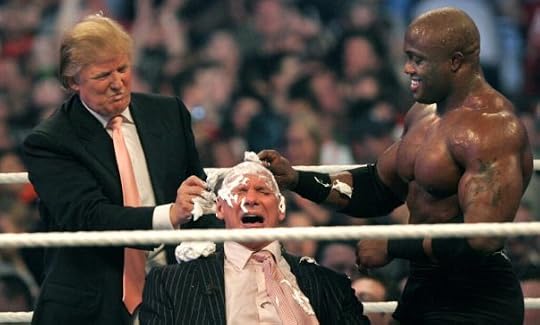 Then WWE chairman Vince McMahon has his head shaved by Donald Trump and Bobby Lashley after losing a bet in the Battle of the Billionaires at the 2007 WrestleMania in Detroit, Michigan.Monticello took some Kayfabe
Yes, traveling makes you think. I started connecting dots, like Jefferson and UFC.
Trump’s birthday fight on the White House lawn was a lesson in performative domination with the goal of ginning up support for his white-centered dictatorship [see Stephen Miller last week]. I learned a new word when I was wondering what he was trying to do by tearing up the White House grounds for a mixed martial arts arena. A.I. took the spectacle seriously, and even called it “historic” when I looked it up:
UFC Freedom 250, a historic mixed martial arts event held on the South Lawn of the White House on June 14, 2026. The unprecedented spectacle celebrated both the United States’ 250th anniversary and President Donald Trump’s birthday, and drew national headlines as a major, high-stakes sporting event.
A.I. sounds like a publicist for UFC. The Ultimate Fighting Championship is an American MMA promotion company based in the Las Vegas metro. It is owned and operated by TKO Group Holdings, a “premium sports” and entertainment company formed in 2023 by the merger of the UFC and WWE (World Wrestling Entertainment). WWE is a majority-owned subsidiary of The WME Group (William Morris Endeavor), the world’s longest-running talent agency. Ponder that.
Swallowing Jefferson’s Frenchified Monticello as a sacred space, was a bit like rolling over for what WWE/Trump does, and maybe it’s like what most Evangelical church members are doing most of the time. They all take some “kayfabe.” [Check out this scholarly article].
Kayfabe is the tacit agreement/code professional wrestlers keep as they present staged matches, scripted rivalries, and predetermined characters as completely genuine even though they are fake. The term originating as secret carny slang to keep audiences in the dark, as in “Keep the kayfabe.” Postmodern kayfabe is used to maintain emotional immersion in the fiction rather than strict deception. Maybe you know all about this.
Like I noted, in the era of social media, kayfabe has evolved. Rather than attempting to fool the audience, postmodern kayfabe functions as a type of psychological storytelling where fans are in on the secret but willingly suspend their disbelief to enjoy the narrative. The term has also bled into mainstream culture, often used to describe performative political theater or calculated, winking online behavior.
At Monticello we were asked to play our part in the same story Jefferson enacting when he lived there. He is the Declaration of Independence writer who owns slaves. We overlook the slaves, even though we know they exist, in order to keep his shrine in Washington D.C. making sense. He is the UVA founder where a white supremacist mob rolled over people protesting the domination he enjoyed and employed. We overlook how he managed the white supremacist Constitution so he always looks enlightened.
Jefferson was not as expert or as self-conscious as Trump and his followers are when it came to kayfabe, of course. I never knew how much Trump was practicing it until I wondered about that bizarre UFC fight. I may be the last person in the country who finds such a thing odd.
It is not just politics, it is the churchThe term has increasingly crossed over into mainstream culture. In everyday contexts, “kayfabe” is used to describe a tacit agreement to pretend that something is real, sincere, or competitive when it is actually performative—often used to describe political theater, marketing, or corporate posturing
Trump’s first election was straight out of the pro wrestling playbook. Voters knew it was fake, but they loved it. [See this article from The Guardian]. They knew he was playing a character (he kept talking about himself in the 3rd person!) and they knew who they were in the story. Here is a representative fan homage:
WWE is a hybrid form of sport, street fight, ballet, spectacle, and soap opera that defies easy categorization. Trump is in the WWE Hall of Fame. His WWE pedigree influenced his political campaigning style. It developed his boisterous, over-the-top character. The way he argues, insults and makes crass remarks all make perfect sense in the context of Trump the WWE entertainer. Trump’s pro-wrestling role is a celebrity who is a “no bullshit” straight talker who gets things done better than anyone else
Naomi Klein (2017) claimed that pro-wrestling is “invisible as a cultural force to most liberal voters.” I am one of them. My ignorance might go back to my father, who would not allow pro wrestling from KTLA, Channel 5, on his TV because it was all fake — which we doubted. We could, however, watch roller derby because we all knew that was staged. Now I am supposed to play along and help enact simulated emotions to produce alternative realities as if life were WWE. It’s a leap.
I can’t really do kayfabe. It is intrinsically unChristian, of course, but I also didn’t encounter it early enough, I think. I didn’t even play Dungeons and Dragons (D&D). Kayfabe now describes a form of audience engagement that involves, in the first instance, a willing suspension of disbelief within which performers, promoters and the audience, ALL “keep kayfabe.” For the latter, keeping kayfabe involves the active choice to participate in “performance conventions” such as cheering the “face” and booing the “heel.” In doing so, fans do not simply pretend to be fooled by the “game;” rather, in the new kayfabe, everyone is invested and involved in the playing of the game itself — Magic: The Gathering (MTG) with flying folding chairs, perhaps.
To refer to the “real” of wrestling today is to refer to backstage politics, writers’ rooms, booking decisions, and corporate judgments about who has star potential, who is popular in the locker room, or who is unpopular with management. It is a kind of real that, strangely, even contradictorily, embraces the fake. When it leaks into everyday life, newscasters always talk about the strategies of politicians and who is winning the latest contest rather than informing the listeners about the substance and consequences of what is going on.
Politics and church have largely followed suitTo enjoy WWE, fans must not only be aware of the inner workings of the business (the off-camera, backstage processes) but also able to construct hypotheses about them when they lack knowledge. The whole thing has become an active, collaborative relationship, a co-production in which fans both create and sustain kayfabe while simultaneously dissecting it, parsing the elements that construct the performance with a discerning eye on how well performers “follow the rules of the performance practice and play their role” and “read through the fiction to glean hidden truths.” If this sounds to you like conspiracy theories being monetized, you might be right.
Part of the fan’s participation becomes “a game of prediction and interpretation to which they apply their understanding of wrestling techniques, character histories, performers and WWE as a company.” For instance: Why did the bookers decide upon that outcome? Does the fact that the wrestler is “selling” the leg (acting as if it is injured) mean the match “finish” will involve that limb? Did an aggressive “promo” signal a “heel turn” by a “face?” It seems like anything can be “gamified” these days to increase fan devotion and profit.
So it was not surprising that at his post-2016-election thank-you rallies, Trump was able to level with his voters about the manipulative nature of his campaign tactics. When he referred to the redundant “Lock her up!” chants at his events, Trump now laughed with his supporters, telling them, “You people were vicious, violent, screaming, ‘Where’s the wall? We want the wall!’ Screaming ‘Prison! Prison! Lock her up!’ I mean you are going crazy!” The chants, he told them, contemplatively, “plays great before the election. Now we don’t care.” Far from his revelations undermining their enthusiasm for his Presidency, Trump’s supporters laughed along – after all, only marks truly believed all that stuff even if, while self-conceived smarts, they too chanted along.
That last point is the key to understanding Trump’s appeal. The country (and the church) may be more WWE, UFC, gamified, prediction addicted, and back-room cynical than you think. Politics happens like pro-wrestling — the chance that Mitch McConnell is actually dead is more interesting than his actions as a Senator or the future of the democracy. In WWE the smarts differentiate themselves from the imagined marks (the people who actually believe WWE is a contest). Nevertheless, the “smarts” retain the “overt knowledge that the core wrestling narrative relies, to a significant degree, on their successful performance as dupes not in on the con” – that is, the capacity to suspend disbelief is predicated upon the collected audience playing the part of a “true believer” sports spectator. To retain its “dramatic appeal” pro-wrestling requires smarts to perform as marks when attending events. Just like Marco Rubio (and Lindsay Graham, RIP) act like they are taking Trump seriously, a successful WWE event or Trump rally requires its attendees cheer and chant, performing their role as supporters-who-believe in their own exposition of smart fandom.
The evangelical church has always been a step away from such carnival, since the carnival works better than actual faith to draw a crowd and fill the plates. One of the reasons it is hard to make a Christian in the U.S. is the thin line between willingness to disbelieve and actual faith. The atmosphere is filled with Christians who picked up Trump just like they picked up Jesus. They were in it for the feels and vicarious sense of power, not the truth.
When Kelly Conway blithely talked about alternative facts, it was exposing kayfabe. When Paula White compares Trumps “sufferings” to that of Jesus, it is performing kafaybe. She actually stated, “No one has paid the price like you have,” likening his experiences to being “betrayed, and arrested, and falsely accused.” Furthermore, she has publicly declared that “to say no to President Trump would be saying no to God”
People on my feed shake their heads and say “Trump lives in his own world.” True. When he talks about Trump in the third person, he is talking about his persona, his WWE Hall of Fame persona. What he does as the real Trump may be lost on him at this point, I don’t know. But “his own world” is shared by millions who live in “their own world” with him. They are perfecting the unreality which accompanies the world we all share.
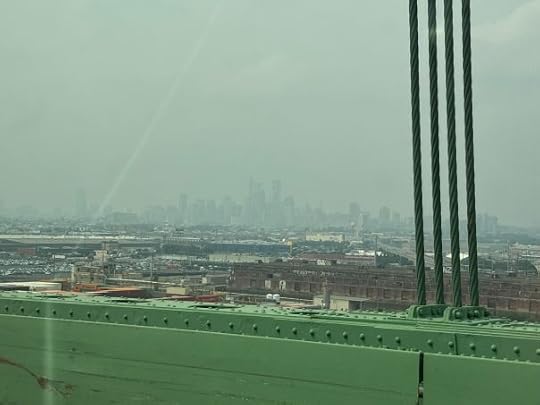
As we came home over the Walt Whitman Bridge, we snapped a picture of our smoke-dimmed home town. Canadian fires are climate-change induced — some facts are difficult to undermine. As the smoke started rolling in last week, the president got on TV to repeat his lie about the 2020 election. He said that China had meddled because it obtained voter registration info that anyone with enough money can purchase legally. He did not hit anyone over the head with a chair, which probably would have garnered even more attention, but he did implicitly call on us to “keep the kayfabe” with him as the world burned.
The super-analog Proverbs in the Bible includes this one: Truthful lips endure forever, but a lying tongue is but for a moment (12:19).
The post Kayfabe: Does this key ingredient of WWE explain Trump? appeared first on Development.July 13, 2026
A new church is emerging post-pandemic: Even in TEC
Our church is reading an interesting sociology book by Christian Smith: Why Religion Went Obsolete: The Demise of Traditional Faith in America. We had a good discussion on Sunday, and I admire my pastor for bringing up what amounts to a delicate subject: your church is obsolete. We agreed that our church, The Episcopal Church, has, generally, been obsolete for years. If it were not so well endowed we’d be in big trouble.
Nevertheless, we have strengths. Our church, in particular, is a small group of intelligent, hard-working and openly loving people. We’re mostly over 55 — but our pastor is 45 and my wife was having a conversation during coffee hour with a lovely member who is 5.
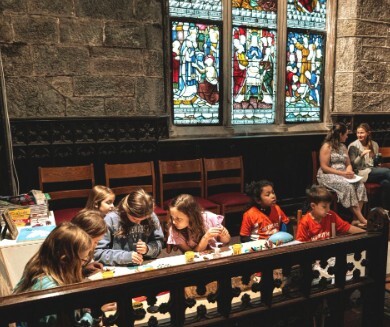
I came away from our dialogue encouraged and stimulated. People said some interesting things.
“I belonged to the church for quite a while before I believed.”In this day, especially, if anyone is going to become part of the church, belonging probably precedes believing.
“Why aren’t we writing our own songs instead of rehearsing the past?”Our pastor noted the present hymn book of TEC was published the year he was born and has not been updated. My wife pointed out that the composers whose songs are in the hymnbook wrote from the zeitgeist and inspiration of their day. I noted that the 1660 hymn we had just sung that morning probably sounded fresh in its century, but is it sure weird and boring now.
So Smith is helping us get into some good discussion. If anything is overdo in most churches, it is discussing what are we going to do, now, since our model for being the church is obsolete. It may have been misguided to begin with and that is WHY it is obsolete. Regardless, if we want to be the body of Christ with any integrity and purpose, we’d better come up with what were are called to do now.
Further dialogue will meet up with difficultyI think most dialogue is good, even when it is bad. The fact it can uncover problems on the way to solving them, makes conflict-avoidant folks steer away from it. For instance, I have issues with the book we’re exploring and I feel reticent to share them. I’m not sure I respect Smith’s methods and conclusions. My issues can be encapsulated in two words: traditional religion. Smith is a 65-year-old Roman Catholic professor at Notre Dame. So when he talks about “traditional religion” (throughout this book) he is smack dab in the middle of one. I think it shows.
1) When he talks about “religion” (like in his book title), he’s actually talking about American faith, which means Christianity. Religion is a modern concept which reinforces the notion people have that “all religions are basically alike.” They think that because European intellectuals “identified” them and put them in the same category: “religions” in the 1800’s – genus and species, etc.
2) When he talks about “traditional” he seems to mean “mainstream” or “what the TV might say about it.” I think that term should have been obsolete a long time ago when it came to describing the church — at least in Christian circles. Now that I have met hundreds and seen thousands of Christians around the world, it is hard to nail down “traditional.” I think stereotypic Christianity, or enculturated Christianity, or hollow Christianity, or modern Christianity might all be obsolete. Jesus, however, is historically and presently hanging in there.
But the main thing Smith’s book is missing, in my opinion, comes from being so autobiographical. This book appeared in 2025. But he is really talking about what happened during his lifetime – forty years of studying the data. Much of what he is saying follows up on his books in 2000 and 2005 (George Bush). While I admire him for writing about most of the controversial topics of his day, I get the impression his latest book is kind of out of date. It is light on our recent past.
Any inspiration in a spiritual storm is welcomeI’m not prone to “going to church,” but discussing Smith’s book juiced my normal devotion to building the church. Two things I found missing in his book may be just what we dare not miss as we live out our lives as the body of Christ in the post-Trump era.
Transcendence may be the missing elementWhat people need to to find when they explore faith in Jesus is transcendence and belonging, not sociological data dumps and critical conclusions. Smith’s sociology, itself, actually sounds a bit obsolete. In an age of mistrust, he asks us to trust his very rational argument.
Experts will not save the church from becoming “obsolete,” which it will never be and is not now. The church in the U.S. Smith is painstakingly criticizing (objectively of course) undoubtedly needed to go as soon as Ronald Reagan pretended to be a part of it and Evangelicals bent the knee anyway. It needed to die when it became about power, not love and service – and martyrdom.
All our dialogue needs to consider how people’s lives are pre- and post-pandemic, now.The pandemic changed everything. It was like the tornado-like storm in our part of town last weekend — it toppled dead trees that could not stand the wind. The pandemic damaged our societal infrastructure. And it undermined the fragile new growth of the next church.
As soon as Reagan became president, thousands of young people saw the handwriting on the wall and started building a new church; I was among them. They did well. I think I did well and hundreds with me. But we did well before the pandemic. It was amazing what that storm did to all those new expressions. The impact resembles what happened in the Black Plague in 1347 — that year marks the big outbreak of bubonic plague, hung around for centuries, and you can still get it. People thought strangers caused caused the plague. Europeans said Jews were poisoning the wells. The church abandoned the public roles that made it a mainstay in the culture and people felt alone. Social disparities were exposed: the wealthy could escape to their country places but the poor (essential workers”) had to stay in their roles — just one example of many. The church had been a big part of what glued the society together and it came unglued.
Covid is not the bubonic plague, but the experience sounds quite similar, doesn’t it? The enculturated church fractured with society. I was personally shocked and dismayed at how the new, unenculturated churches started fighting and splitting, not just my own. They threw out great leaders and installed leaders who resembled the powermonger Trump. Good grief, the country elected Trump! (maybe). I think Smith’s whole book basically leads up to the tragedy of Covid.
He observes how the church is diminishing, mainly tracking membership and attendance over his lifetime. He’s kind of shouting from the deck of the Titanic — for every 100 new Catholics, 800 leave the church. If he evacuated his viewpoint, he could just as easily tracked the groundswell of attention to what is transcendent during his lifetime. The emerging churches were all focused on transcendence and community, just what his studies show the obsolete church is missing. They got knocked out by the pandemic and the subsequent tsunami of social fragmentation caused by the unmasked sociopaths in charge. But that desire is still there.
Even our little group in TEC was saying “emerging things.” Belonging and finding one’s path into transcendence, into an actual, personal experience of the Spirit and eventually into a life in love with God is just what the church, nontraditional, of course, disempowered and marginalized, was doing all along. And that is what it is still doing wherever it gets a chance. It is getting a chance right now, since the previous church that Smith eulogizes is quickly dying out, even if it has an endowment and Pete Hegseth thinks he’s protecting it.
The post A new church is emerging post-pandemic: Even in TEC appeared first on Development.July 6, 2026
Faith is the little night light that burns in a sick room
I spent part of last week studying the life of Abbe Huvelin (1838-1910). I was creating an entry for The Transhistorical Body where he will appear on July 10. Just like his life and teaching influenced many of his contemporaries, he is sticking with me.
I am especially taken with his persistent admonition to keep it small, focus on love, and listen for the presence of Christ instead of listening to the voice of fear in us or listening to the powerful voices from the world threatening suffering if we don’t conform. He held out his little light as a local priest instead competing for prestige among the high-flying Parisians giving birth to “modernity” during his lifetime.

I suppose it is strange source of meditation, but a text from one of my friends is stuck in my mind. So few things stick (like the plot of Disclosure Day), I take the things that do stick seriously. Maybe I should be telling you about some atrocity, or last Saturday’s protest – and there will be time to speak up, but I think you might be better served if I share the small blessing of our text exchange about peonies. She offered to populate my garden and I accepted her gift.
Let’s just pause for a second. Aren’t flowers great? If you don’t stop and appreciate flowers, what kind of person are you? And isn’t it great that I have this new friend who takes an interest in my new garden? I have flowers and I have this friend. Life is good.
I wrote to her: It is Rod. I did not get the peony. Tomorrow OK?
I knew it would be fine if I did not get the pot off the porch when I said I would. But I like the little niceties between friends, so I texted an extra mile. I know people who hate receiving texts and calls. But I am not among them. I like attention, and I like attending. It makes me happier and more one with God, who made us by intending us, and lives from an intention to love. Such attention to loved ones seems in short supply in the world; I am moved to contribute.
It only seems like the world is ungenerousShe answered: Not a limited offer!
Those four words are sticking with me. For one thing, I can see the look on her face — that wry, but warm smile. But even more, I know she wrote that exclamation with commitment! She could have said “No problem,” which implies dealing with people is usually a bother. Instead, the first thing she thought to say came right out of the eternity in which she lives. I don’t know her as well as I will, yet, but I already imagine I could call on her to do whatever I needed, and she would do it if she could. She is not a limited offeror.
She continued: Tomorrow is fine; we’ll be away, but the plants are out for you.
(They look dead, but aren’t)
I have no idea how to plant or grow peonies, yet, Maybe they will sprout in my place, maybe not. But I enjoy the little effort I am making to get them and plant them. And I like the idea of planting something to see if it will grow.
My friend has planted a little seed of generosity in me by putting them on her porch. I am trusted with her porch! Being generous heals the wounds of our fear-filled world.
A mystery-filled word, here and thereAbbe Huvelin was known for meeting someone and, in a very brief time, speaking or doing something that was exactly appropriate, though often unexpected. St. Charles Foucauld began his journey when, as a disillusioned young man, he went to the confessional at St. Augustin Church and Huvelin did not debate with him at all, discerning he would just get into a fruitless power struggle. He told him to kneel and confess and receive the Eucharist. That was the moment. The act of a loving, assertive person, who sees someone and calls out their best and truest self is like a miracle.
My friend was helping my discernment when she warned me about the spent peonies on her porch. Her word was: “They look dead, but aren’t.”
Each of us is surprisingly and prospectively alive and blooming, as well, don’t you think?
I got some encouragement and a a call from God, as you can see, from my friend’s text. She called me right out of the grave. I sometimes look and feel prematurely dead. But I am not. A friend, a plant, a word can push me in the right direction.
She concluded with: Happy fourth to you and Gwen.
I don’t think my new friend knows the extent of my political and theological views. At one point last week, my own wife said with a little exasperation, “You are a radical you know.” My friend might not know I am not going to have a traditional “happy fourth.” The happiest thing I did was find my way into the protest on Washington Square at 9am to Declare Independence from Billionaires! I feel alive when I’m doing that, even though sometimes the whole movement feels like it is on life support, and I feel the power the billionaires to blunt any opposition.
Regardless, I love the fact my friend took the time to type out good wishes to me. How cheerful! How ennobling! — I was worthy of a blessing! That little act was a pretty good protest in itself. It is the blessings that make the world — even if Peter Thiel thinks he makes it.
If you think this whole story is making a mountain out of a molehill, I say, “Absolutely.” Abbe Huvelin said:
Faith is the little night light that burns in a sick room; as long as it is there, the obscurity is not complete, we turn towards it and await the daylight.
When we turn toward that little light we can see in our darkness and respond to it, inwardly and out. That turning makes all the difference. We are never really short of opportunities to do that, are we? — surely not, as long as there are peonies! In the middle of my sick society I saw a little light in my friend and thank God it met the little light in me. Let it shine.
****************
Today is Jan Hus Day! Get in touch with your family-of-faith history at The Transhistorical Body.
The post Faith is the little night light that burns in a sick room appeared first on Development.June 29, 2026
“the cure”: Olivia Rodrigo explores her view of self and God.
 Latest album cover: “You Seem Pretty Sad for a Girl So in Love”
Maybe I like Olivia Rodrigo because she says what is on her mind and dares you to do something about it. Plus, I like that she does not have any pretense of being profound — she knows she became famous when she was 17 and knows she is still figuring things out on her latest album.
I first caught up with her when I realized, “Hey, Olivia Rodrigo is Nini from High School Musical on the Disney Channel! (something to occupy grandchildren and Papa during Covid). I loved how talented she is — but when I heard her songs I really liked how hysterically brazen she is.
She is a strange kind of prophet as she analyzes her own dualities and takes down the presumptions and misconceptions all around her.
This quite often makes her depressed.
 A mural on Melrose announced the new albumthe cure
Today’s song “the cure” (#3 on Spotify recently) caught my attention for how it reveals things about the dialogue each of us is having inside and hints at how one’s view of God makes a difference.
About the song, she says, “It’s karaokable if you’re sad.” Try it!
“the cure” was first teased in May, when two lyric snippets were painted on Olivia’s wall mural in Los Angeles (above). She officially announced the song’s release the following day. She hosted an hour-long session of NTS Radio, where she played sad songs to tease her album, and ended her set by premiering “the cure” two hours early. The mural had fans in a tizzy. As you can see, Google calls it an L.A. tourist attraction. If I were out there, I would probably go see it, too.
Rodrigo has said quite a bit about how this song was written, since it is one of her favorites on the album — and maybe her favorite, so far, in her rather successful career. She says:
I remember trying to fit “I’m unraveled” into another song and thinking that was just a really perfect, poignant way of describing what it feels like to know someone really deeply and feel like, “Oh my God, it’s really terrifying, I’m really raw right now, I’m unraveled.” I think when you’re in a deep, intimate relationship, it just sort of feels like everything you thought you knew about yourself kind of comes unraveled, a little bit, and you’re just naked. I thought that was a really cool choice of word. I remember trying to fit it into this song, and it works perfectly.
I like how, in the verses, the lyrics are super specific. “Tally up the girls that he fucked ‘til I start to cry,” does it get more specific and dark than that? And then, the chorus opens up into this metaphor. There’s poison in my blood and you try to cleanse me of it, but it doesn’t matter because it’s who I am. I just like the dichotomy of those two living together.
She was a rather wise teenager, and she sounds more like Qoheleth all the time.
Her view of selfWe have an internal dialogue going most of the day. The messages we speak to ourselves reveal our view of self (VOS) and affect emotions and behaviors. Most days, therapy includes inviting clients to identify and examine their self-talk (those internal messages) in order to see who they believe they are and so mitigate depression and anxiety. If our self-talk affirms our worth and enhances our ability to endure or overcome life’s stressors, then we are more likely to have a healthy response to those problems. If our self-talk contains a distorted or destructive narrative, then it is much more likely that we will feel and act accordingly.
For instance, imagine sitting down for that first cup of coffee in the morning and just as you are placing the cup to your lips, you spill it all over the front of your clothing. If your self-talk goes something like, “I can’t believe you did that! Stupid! This is going to be an awful day,” then your chance of carrying a lousy mood through the day increases. (VOS: I am a clumsy idiot). But if your self-talk sounds more like, “Oh no! I really love this shirt! Better get some water on that and get a new one,” then you are probably going to feel temporarily annoyed but you will be able to move past the incident and not set yourself up to have a bad day. (VOS: I am a person who overcomes troubles).
Olivia is having a profound internal dialogue in her song.
All the pretty girls in the foreground of my mind
I thought I’d done enough, but they keep moving the line
VOS: “I’m not good enough” keeps playing in my thoughts. I’m competing with other girls to to be worthy of attention and love, but I never seem to make it.
I thought I found the antidote this time
VOS: I’m waiting for someone to find me and know me. If you love me, I am good.
And all the nights I spent fighting bad thoughts in my room
Feeling so alone, might as well be on the moon
I thought I found the antidote with you
VOS: If I just had another person I would not feel so alone with my terrible self, talking back to the terrible self-talk I do and feeling defeated.
But my head is full of poison, and my heart is full of doubt
I got toxins in my bloodstream, you tried hard to suck ’em out
And it feels like medication, and it’s good for me, I’m sure
VOS: My head, heart and body are yucky and out of control.
The chorus keeps repeating the dichotomy she is examining – great mentalizing! She’s not known for being a Christian, but she often sounds like one. Here she is considering her mind, her heart and her body and wondering why what feels like medication isn’t quite enough:
But it don’t matter how your love feels anymore
It’ll never be the cure
VOS: I’m beyond relying on someone else’s love to make me someone.
Most of the time, the view of self that used to dominate us is still around, but smaller, as our new development takes hold. It has been fun to travel with Olivia Rodrigo as she matures in her art and psychological health. The realization above is one many people twice her age are still working on! — Who I am starts in me, it does not come from you.
I thought I found the antidote this time
But I’m unraveled (I’m unraveled)…
Why can’t it ever be enough? (I’m unraveled)
It’s not enough…
It will never be the cure
It’ll never be
VOS: Like she said in her interview: “Oh my God, it’s really terrifying, I’m really raw right now, I’m unraveled.”
She did heart, mind, strength and now soul as she unravels down into it. I think this is her favorite song on the new album because a new consciousness is being unveiled by love. Becoming naked at the deepest level reveals her own sense of “I am.” For her, singing about it solidifies her confidence in being herself. I appreciate her sense of wonder as she watches it happen.

Olivia is not singing a song about God, per se. But God is never far from her process, it seems. On the #1-played-song on Spotify, also from her new album: “stupid song,” she says:
Walking through the park with my head high
Past all the college girls and the drunk guys
And if there is a god, he’s the bond that’s between us two
She mentions God (or “a god” in this case) quite a bit in her songs. I love how she identifies the mystery of love in the bond she feels as God between them. She could be writing 1 John.
In the song of the day, “the cure,” she veers right up to the edge of God:
And it feels like medication, and it’s good for me, I’m sure
But it don’t matter how your love feels anymore
It’ll never be the cure
She is bold enough to beg the question, “If this loving guy is not the cure, then what is?” I think her basic answer, so far, is: “The cure is being myself, troubles and all, and accepting my place in the world.” This is amazing for a 23-year-old! It might be easier for her, since she is worth $45 million.
But I get the impression she does not think she is, ultimately, the cure, either.
There has been a lot of consideration, throughout history, about the correlation between spirituality and health. One of the most interesting findings recently is how much of a difference your view of God can make in your well-being, especially your mental health.
Since many of my clients come to me because I am a Christian, we often get into their concept of God or their relationship with God. Many people are skeptical or distant when it comes to God because they have an entitlement mentality or a punishment mentality. They see God as either being out to get you, or God is there to give you whatever you want. Neither matches who Jesus reveals God to be, but they are common views. And neither view will make us pleased to keep getting to know God better.
Research demonstrates how much your view of God can impact your health. Over the past several years Baylor University has conducted several surveys on religion among American adults, and many scholarly articles have been produced using the data. The most recent survey revealed more on the connection between one’s view of God and mental health.
The general views of God fell into three broad categories:
A “deistic” God. God is real, but He is not significantly involved in what happens on this Earth or in one’s daily life.A “punitive” God. God is angered by sin, is looking to punish sinners, and one has little hope of meeting His high demands.A “benevolent” God. God is good. He is closely involved in the world and in one’s daily life, and His involvement results in good things.The Baylor University data showed how powerfully one’s view of God can predict the presence of mental health problems. Briefly, belief in a punitive God means more anxiety, paranoia, and other symptoms. Belief in a benevolent God is associated with fewer such symptoms.
This effect holds true even in prayer. If one is unsure of one’s connection with God, or trying to avoid God (possibly out of fear), prayer only results in more anxiety. If one’s connection with God is secure, prayer decreases anxiety and related symptoms.
We will see where Olivia ends up. I hope she’s still making music when she is 30. It would be interesting to see what she thinks about this lyric then:
And it feels like medication, and it’s good for me, I’m sure
But it don’t matter how your love feels anymore
It’ll never be the cure
I’d like to ask her then, “What do you believe to be the cure now?”
*******
The is Peter and Paul Day! Catch up with how the two influential disciples of Jesus became tied together in the history of the Church at The Transhistorical Body.
The post “the cure”: Olivia Rodrigo explores her view of self and God. appeared first on Development.June 21, 2026
Juneteenth is the better freedom day: Just look at Philly on July 4th
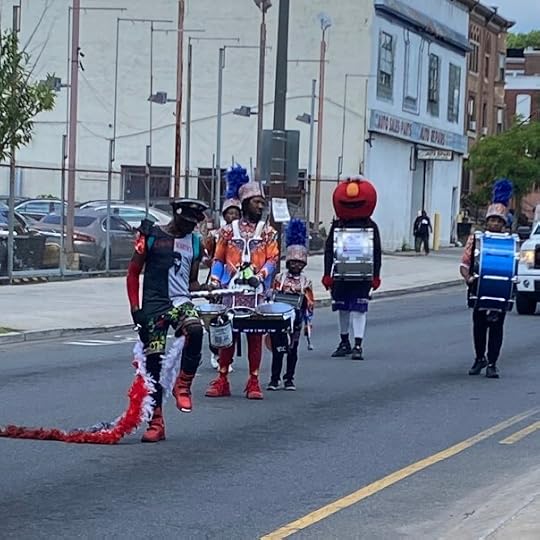 Fan favorite at the Juneteenth Parade 52nd and GirardThis Fourth of July is yours, not mine.
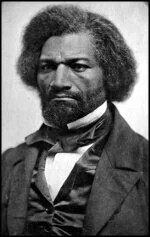 Frederick Douglass ca. 1852
Frederick Douglass could not, in good conscience, celebrate July 4th. He celebrated July 5 as his declaration day instead. July 5 became Emancipation Day in New York State when slavery was officially over. It was the day after everyone completed the gradual process of becoming free in 1827. Douglass was 8 years old when it happened, still 11 years away from escaping slavery in Maryland and landing in New York.
Once liberated, he became a national leader of the abolitionist movement in New York and Massachusetts. In his iconic July 5 speech, given in 1852 to the Rochester Ladies’ Anti-Slavery Society, he said:
I say it with a sad sense of the disparity between us. I am not included within the pale of glorious anniversary! Your high independence only reveals the immeasurable distance between us. The blessings in which you, this day, rejoice, are not enjoyed in common. The rich inheritance of justice, liberty, prosperity and independence, bequeathed by your fathers, is shared by you, not by me. The sunlight that brought light and healing to you, has brought stripes and death to me. This Fourth of July is yours, not mine. You may rejoice, I must mourn.”
Douglass is still an inspiration. The U.S. no longer has chattel slavery. But there is a lot left to mourn. So I am leaning into Juneteenth and letting whatever the oligarchs decide to give us for July 4th up to them.
We’ve been whitelashed back into having yearly white supremacy parties on the 4th and I don’t want to be part of it. Even though Philadelphia is right at the center of this year’s celebration, as usual, I’m not feeling it. From what I hear from a lot of people, the whole 250th is sort of “meh.” What country are we talking about and what freedom is likely to be left by #251?
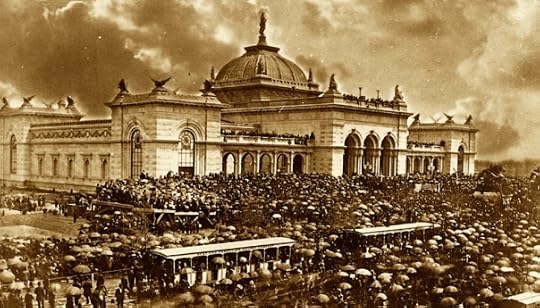 Memorial Hall on opening dayPhiladelphia 1876
Philadelphia has always been at the center of major patriotic observances — since 1776, of course. The remnants of the spectacle organized for the Centennial of the Declaration of Independence in 1876 can still be seen in Fairmount Park.
The remnants of Reconstruction after the Civil War, when freedom was won for everyone, were already being torn down in favor of “progress” by that year. Though the decade after the Civil War elevated former slaves and empowered black people in general, by 1875 the winds had shifted, and the former enemies from the North and South were ready for reconciliation.
Frederick Douglass was there on the first day of the big event in Philly. He was invited to sit among the dignitaries on the main platform as President Grant spoke about the “Progress of the Age.” He was not invited to speak; the greatest orator of the day was reduced to window dressing. He almost didn’t make it into the event. First, he had to pass through the crowd gathered outside the gates before the exhibition opened. Then, once he got to the entrance, the Philadelphia police refused to admit him. They did not believe that “a n****r” would be allowed among the dignitaries. Senator Conkling of New York spotted him and got him over the line.
A year before, in the summer of 1875 on July 5 in Anacostia, Douglass predicted that day to a crowd of black listeners. He said:
“Men cannot, ought not and will not quarrel and fight forever,”…So sure as the stars shine in the heavens, and the rivers run to the sea, so sure will the white people North and South abandon their quarrel and become friends. The whole American horizon is already fringed with the portents of this coming union. Boston, Lexington and Bunker Hill have already sent forth their silvery notes of peace and unity to the whole nation, and next year Philadelphia, the birthplace of the Declaration of Independence, will lift to the sky its million voices in one grand Centennial hosannah of peace and good will to all the white race of this country.
Eddie S. Glaude Jr. of Princeton says: “He understood what was happening: the centennial celebrations would tell a story of the nation that rejoiced in reunion, and that reunion required the erasure of Black people. The event would be a national affair in which the “silvery notes of peace and unity” from sacred places in our national history would render the true cause of the Civil War invisible in a national ritual of disremembering. The country would revel in its technological advancements, as capitalists celebrated America’s economic resolve despite the Panic of 1873, and as white people reasserted the superiority of white Anglo-Saxon blood. An idea of America, alabaster white, would rise from the ashes of war and Reconstruction.”
Does that sound familiar to you, too?

The 1926 extravaganza to celebrate the sesquicentennial was also scheduled for Philadelphia. This time the country was still recovering from WW1 and the Spanish Influenza epidemic. What’s more, although holding the event was procured in order to make Philadelphia look less squalid and corrupt, the whole project was squalid and corrupted.
You can still see remnants of the fairgrounds in FDR Park. The rest is covered by today’s stadiums. If you travel on Vare Ave. to beat the traffic on 76 sometime, remember it is named after Rep. William S. Vare and his brothers who were called the “Dukes of South Philadelphia.” They organized most of the kickbacks and political patronage.
President Calvin Coolidge was there on July 5th, since July 4th was on a Sunday and some people still thought opening the celebration on Sunday was unseemly. He had a prophecy to deliver:
No other theory is adequate to explain or comprehend the Declaration of Independence. It is the product of the spiritual insight of the people. We live in an age of science and of abounding accumulation of material things. These did not create our Declaration. Our Declaration created them. The things of the spirit come first. Unless we cling to that, all our material prosperity, overwhelming though it may appear, will turn to a barren scepter in our grasp.
Coming later in the year, Mayor Kendrick initially approved a “Klan Weekend” on September 9-11. Thousands of the 250,000 Klan members in PA planned a massive parade down Broad St. and a cross-burning at the fairgrounds. The public outcry was so great they were denied their permit, but they held private meetings and hovered over the city. Inspired, in part, by the successful film The Birth of a Nation, the Ku Klux Klan had reemerged in 1915 “to unite white male persons, native-born Gentile citizens of the United States…to maintain forever white supremacy…and {the} ideals of pure Americanism.”
Almost 200,000 black people lived in Philadelphia, in 1926. They had lived through the European War over the spoils of colonialism which spent millions of lives to decide which white nation would rule the world. Imagine your Mayor thinking it was fine if the Klan claimed Broad St and dominated the Nation’s celebration of freedom! W.E.B. Du Bois had named the monster they were up against in 1910 in “The Souls of White Folk:”
It is curious to see America, the United States, looking on herself, first, as a sort of natural peacemaker, then as a moral protagonist in this terrible time. No nation is less fitted for this role. For two or more centuries America has marched proudly in the van of human hatred,—making bonfires of human flesh and laughing at them hideously, and making the insulting of millions more than a matter of dislike,—rather a great religion, a world war-cry: Up white, down black; to your tents, O white folk, and world war with black and particolored mongrel beasts!
Sounds familiar, right?
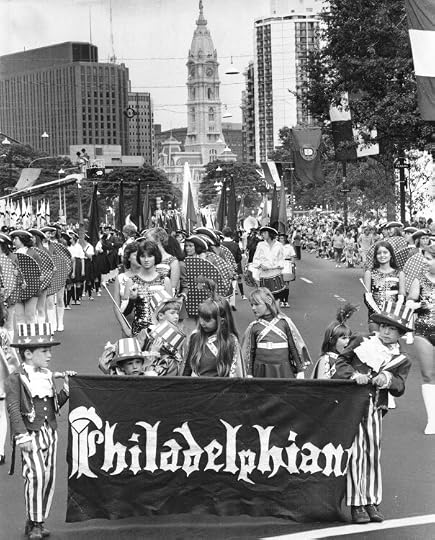 Parade on the Parkway
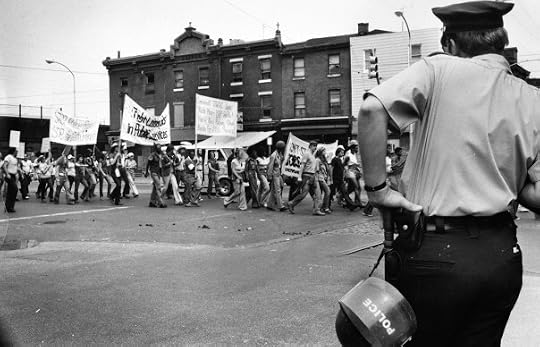 July 4th Coalition counter parade through North PhillyPhiladelphia 1976
Plans for Bicentennial celebration in Philadelphia did not go completely as planned — but there was a 50,000-pound Sara Lee birthday cake served at Memorial Hall the week before! Plus, there was plenty of ceremony to reassert the nation’s myths. For instance, on July 3, six wagon trains totaling 200 wagons, which had traveled for months from all over the nation, converged at the newly-formed Valley Forge National Park in front of a crowd of nearly a half a million people.
On July 4th, a ceremony on the new Independence Mall featured President Gerald Ford — the wounds of Watergate and the evacuation of Saigon still fresh. Governor Milton Shapp and Mayor Frank Rizzo were on the platform. Charlton Heston was master of ceremonies. Following the ceremony there was a five-hour parade featuring floats from every state and 40,000 marchers. An estimated two million visitors came to Philadelphia to attend these events.
Meanwhile, the July 4th Coalition led a counter-parade through North Philly on the same day. Puerto Rican socialists, Vietnam veterans, women’s rights advocates, Black liberation groups like the Black Panthers, and unemployed workers joined into one march that proceeded west along Lehigh Avenue and into Fairmount Park at Oxford Street, ending with a sprawling concert and cookout on the fairgrounds built for the 1876 Centennial. They took issue with the Bicentennial Corporation’s progress narrative and illuminated all the forms of oppression that remained alive and well in the late seventies.
Gil Scott-Heron, “the Godfather of rap,” was formed in the Philadelphia area. Here’s what he had to say about the Bicentennial:
America has got the blues and it’s a bicentennial edition
America has got the blues
It’s got the blues because of partial deification
Of partial accomplishments
Over partial periods of time
Halfway justice
Halfway liberty
Halfway equality
It’s a half-ass year
Here’s the full piece:
It all sounds very familiar, partly because the protest has been the background music of my adulthood and fundamental to my Anabaptist Christianity.
Philadelphia 2026Now, for the Semiquincentennial, we have Trump putting his name on everything and renaming places — which had just been renamed, after Civil War traitors — again. It has been a hard slog to get some semblance of Declaration-of-Independence-equality for everyone in the U.S. over the country’s history. But even given the progress, it is hard to stomach what the present Administration and Supreme Court have done to reaffirm and protect white supremacy on the eve of the 250th.
Rigging the vote
Gutting the Voting Rights Act: The Supreme Court made it significantly harder to challenge discriminatory election maps that dilute the power of minority voters.Race-Conscious Redistricting Limits: The Court struck down maps specifically drawn to address racial imbalances in states like Louisiana, setting off a wave of gerrymandering.Dumping DEI
Banning Systemic Discrimination Tools: The Trump administration aggressively dismantled the use of the “disparate impact” standard—a key tool used for decades to challenge seemingly neutral policies that end up disproportionately harming minority groups in housing, employment, and healthcare.DEI Restrictions: Executive orders have been implemented that severely limit or outright ban diversity and equity training across federal agencies, government contractors, and grant recipients like UPenn. The chilling effect remains.Sacking safeguards
Workplace Equality Enforcement: The Equal Employment Opportunity Commission was directed to stop investigating certain complaints regarding company policies that inadvertently harm specific demographic groups.Education and Discipline: Civil rights guidance meant to address race- and disability-based discrimination in school discipline policies was rescinded.Limiting Affirmative Action: The Court struck down race-conscious admissions programs at colleges and universities, dismantling decades of precedent aimed at rectifying historical educational inequities.Dismantling Civil Rights Offices: Funding and personnel have been severely reduced across federal civil rights offices, including those in the Departments of Education, Homeland Security, and Justice.Eliminating Inequality Data: The administration has rolled back data-collection efforts previously used to track disparities in environmental hazards, special education, and racial inequality. [For a detailed breakdown of these policy changes, you can explore the ACLU’s Report on Anti-Discrimination Law.]Whitening citizenship
Threats to Birthright Citizenship: Legal challenges and administrative efforts have targeted the 14th Amendment, threatening the automatic citizenship of children born in the U.S. to undocumented immigrants.Language and Ethnic Profiling: The administration rolled back requirements for language-assistance services for people with limited English proficiency and adopted practices that effectively treat ethnicity and accents as legitimate reasons for immigration stops.All these actions have been played out with a soundtrack of Trump, Hegseth, and Miller, et al, spouting off reasons the government has had enough of all this whining about equality: “Y’all have freedom because we say so, and we will tell you when you exercise it too much.”
There is a lot more of their wreckage that could be listed, and they are just getting started combing through the nooks and crannies of government and society looking for threats to whiteness. On July 4th (and every day) we are supposed to pretend America is just and good, a beacon of light to the world, and forget about what happens right before our eyes. Such pretending is essential to the national myth that forms our patriotic religion.
So I am focusing on Juneteenth. And I will again say there is no room for slaveholder religion in the Church of Jesus Christ. We’re all poor in the eyes of God and that, if nothing else, is a great equalizer. Whether you believe that or not, Juneteenth, when we all were technically as free as any other citizen, is the real Independence Day for the U.S., at least until it gets to a better one.
The post Juneteenth is the better freedom day: Just look at Philly on July 4th appeared first on Development.
