
Darcy Pattison's Blog
July 14, 2020
How to Set up an Online Bookstore
The post How to Set up an Online Bookstore appeared first on Fiction Notes.
As an indie publisher, I rely on the POD (Print on Demand) printers. Many indies make most of their money from ebook sales. But for children’s books, the market has consistently been print-driven with only 10-25% of income from ebooks. That can vary widely, as some authors do very well on the Kindle Unlimited platform. But 10-25% is probably a good average. This discussion centers around how indies provide print books to customers. While I’ll talk about full-color picture books, this POD strategy also applies to my novels.
POD Printing
POD means that a book is uploaded to a printer where it’s held until someone orders the book, i.e. there’s a demand for the book. Once ordered, the book is printed. Most POD printers will drop ship the book to the customer for you. It’s slick. You never touch the book. The appeal of this printing method is that you do nothing to fulfill the order. You spend your time on writing/producing the book and then on marketing. The printing and shipping—the fulfillment—is done by the POD printer.
The biggest disadvantage of POD printing is that printing costs are significantly higher per copy. However, the actual deliver-to-customer cost can be reasonably comparable because for POD there’s no cost of shipping, warehousing, fulfilling, and associated costs of listing a book on a site such as Amazon. Offset printing is generally considered to be the best quality printing available; printing overseas is generally considered to be the best price point. But for those who want to simplify life, POD is a profitable alternative.
However, all of the POD printers are also distributors. They take a percentage (10-25%) to distribute books to the market. Your book is considered a wholesale sale from the printer to the distributor (even if the distributor is also owned by the printer).
IngramSpark wholesales its POD books to Ingram Wholesale, the biggest book wholesaler in the U.S. Ingram Spark charges for both printing and distribution. If you use their Aer.io online bookstore, you pay the distribution fee, too. Then Ingram Wholesale fulfills the book, taking care of ordering, payment, and shipping.
If you POD with KDP Print (Amazon), they wholesale your book to Amazon.com. KDP charges both printing and distribution fees. Amazon.com fulfills the book, taking care of ordering, payment, and shipping.
The advantages of POD are many! You have less upfront costs because you don’t invest in a large print run that has to be warehoused. When a book is ordered, you never touch it; the system is slick and seamless, making sure the customer receives your book quickly. You just collect the profits (which POD companies tend to mistakenly call royalties.)
The disadvantage is clear, as well. You don’t “own” the customer or the retail environment. Amazon.com sets prices and their policies can and do change often. No customer information is ever shared with the book publisher (you!), so you’ve no idea about your customer or any way to develop a relationship or encourage follow-up sales.
For many, that disadvantage means little as they only want to write/publish a book and collect revenue from the sales. But for those who want independence from Amazon or other wholesalers, it’s frustrating.
The Hunt for a New POD Strategy
I’ve hunted high and low for a POD printer that would 1) only charge for printing, and 2) would fulfill the order by sending the printed book to the customer.
I finally found one, and it was a surprise!
LuluXpress + Shopify
One POD printer who’s been around a while is Lulu. In April 2018, Lulu announced the creation of LuluXpress, an app that would link their services to a Shopify store. (NOTE: Lulu still provides POD with distribution. I’m not talking about that here. I’m only talking about the LuluXpress app for Shopify.) Shopify is a well-respected online ecommerce platform for creating on online store. With this integration, LuluXpress will act as a printer and will fulfill the order by shipping books to the customer. Period.
What? I read and reread their information. Where was the distribution fee?
They do NOT charge a distribution fee. They ONLY charge a print fee and a shipping fee.
Wow! Through a Shopify store, I would be in total control of the retail process. I could choose an email marketing platform and connect it to the store. I could develop relationships with customers. I could set pricing MY way.
An eCommerce Store?
The downside? You must run an online store.
This isn’t for everyone. I don’t recommend it for beginners or for those with a small catalog. But for anyone who has mastered the other platforms and still wants to dig into the sales process, this is an amazing option.
Print Quality
My first cautious step was to set up one color picture book in both paperback and hardcover and order a copy. Wow!
Here’s the amazing thing! It’s gorgeous.
For a full-color children’s book, the best paper is a coated paper, which allows the interior pages to be a smooth matte finish. At Ingram, Standard70 printing uses a 70# uncoated paper. KDP is similar. LuluXpress offers an 80# coated paper, which you can choose for either premium print or standard print. For paperbacks, I chose standard printing with the 80# coated paper; for hardcovers, I used premium printing with 80# coated paper. (For novels, LuluXpress offers 60# uncoated paper.)
Many POD companies use the uncoated papers because they are less expensive. But they have a rougher texture and don’t absorb color as well. Colors are muted, instead of vibrant. For novels—which are probably the most common printed book—it doesn’t matter. But for full-color picture books, the preferred paper is a coated paper which absorbs the ink for a more vibrant result.
When I received my first trial book, I was shocked. LuluXpress’s premium print almost rivals offset printing, the standard against which every print job should be compared. Comparing LuluXpress’s standard and premium prints, there’s a noticeable difference. For standard print, details aren’t as clear. But these were paperbacks, which most people understand will not be printed in as high a quality. And the quality was much better than other POD books printed on uncoated paper.
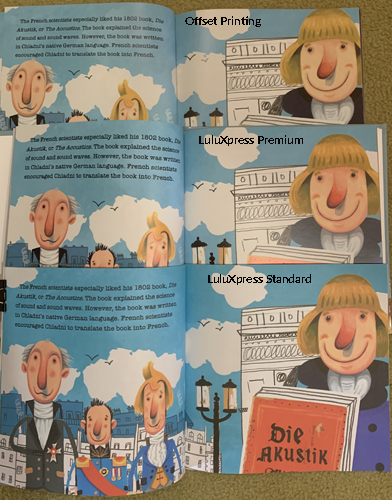 TOP: Offset printing; MIDDLE: LuluXpress Premium; BOTTOM: LuluXpress Standard. Click to view this book on MimsHouseBookscom
Companies like Ingram or KDP will add extra pages at the end of a picture book. The companies say they need those pages to add a bar code that will indicate where the book has been printed. These are generally hated by indie publishers. And, by the way, you’re charged for those extra pages. I create a standard 32-page picture book, but I’m usually charged for a 34-page book. In the past, I’ve just shrugged and considered them part of the pain of POD printing.
No longer. LuluXpress doesn’t add those dreaded extra pages. Instead, they add a narrow barcode on the last page almost in the gutter. It’s almost unnoticeable.
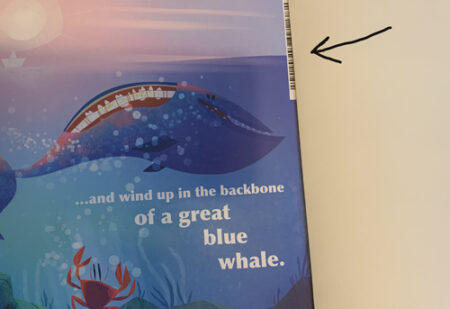
Gorgeous coated paper with excellent printing. No extra blank pages.
What about reliability and timeliness of delivery?
You Made Me Look Good!
During May, 2020, at the height of the COVID-19 epidemic, an educational distributor contacted me. Their customer, a school district in North Carolina, usually gave each elementary student a summer book. They wanted to give my paperback book, NEFERTIT THE SPIDERNAUT, to each fourth grader. That was an order of 1672 books! That’s exactly the kind of special order that keeps my business going. I had to work it out despite COVID.
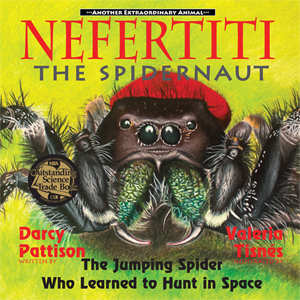 Click to view on MimsHouseBooks.com
At the time, Ingram said it would take about three week to fill an order.
LuluXpress filled the order within seven days. The distributor ordered from five publishers to fill the school district’s order. My order was received first. Thanks, LuluXpress! You made me look good! And, they were the well-printed 80# paper version without the hated extra blank pages. What an amazing thing that kids are reading my book this summer.
MimsHouseBooks.com
The LuluXpress app is only available for Shopify stores. Since January, 2020, I’ve been working to develop a store that will be profitable, and it’s a daunting process. Developing traffic, advertising, integrating an email program, and figuring out how to merchandise (how to present books or book collections) is a whole new learning curve. And frankly, there’s not much help out there because so few are doing this for books. I have to re-interpret everything for selling children’s books online. But I’m finding it a creative (and daunting!) and fulfilling process on its own.
By the way, I also sell ebooks and audiobooks, with fulfillment by Bookfunnel.com. That’s another fantastic arrangement! And I’m cautiously adding some merchandise – tshirts and stickers.
I’m in charge. Finally. In my indie publishing career, I’ve longed for the independence that Mark Coker says we need. Finally, I decide everything from idea to reader. By starting my online bookstore at MimsHouseBooks.com, the buck stops here. I will live or die by my creative and business decisions. Hurrah!
As Mark Coker says, “Shouldn’t the conversation be about how to please readers?” Finally, I’m having THAT conversation! (And it’s a hard, multi-faceted discussion, believe me!)
Jumpstarting an Online Store in the Midst of a Pandemic
I started the online bookstore in January 2020. With the onset of COVID-19 and schools closing early in March 2020, I felt passionately that I needed to support families and educators. From March 23 to June 1, I set all my ebooks and audiobooks to free, giving away over 10,000 books.
An unintended, but nice side benefit was that it created traffic to the nascent bookstore, giving lots of feedback on page design, merchandising, advertising and more. With the knowledge we learned, we’ll continue to develop the online platform and hope that by Christmas season, we’re dialed in to make some profit.
Surprising Benefits
An unexpected benefit of the store is the ability to order from LuluXpress for large orders. We’re funneling special sales through the store to take advantage of the excellent printing and fulfillment from LuluXpress. The quality is so much better for picture books!
Another unexpected benefit is that LuluXpress ships internationally. I’ve sent books to people in France, UK, and Canada with no problems. LuluXpress says they will ship anywhere that FedEx delivers.
The Money
OK, you’re all wondering if the pricing will work. Let’s take an example of an 8.5” x 8.5” full-color paperback picture book, 32 pages. Because profit margins are so small with my current POD printers, I put a list price on a paperback of $11.99. This is high! I know that sales will be smaller as a result, but I can’t make a profit otherwise.
KDP figures your profits like this:
(Royalty rate x list price) – printing costs = royalty
(.60 x 11.99) – $3.65 = royalty
$7.19 – $3.65 = $3.54 royalty
LULU Xpress + Shopify figures your gross profits like this:
List price – print cost = gross profit
$11.99 – $3.29 = $8.70 gross profit
POD PrinterPrint chargeDistribution feeWholesale DiscountOther feesProfitKDP $3.6540% of list price; 60% for Expanded DistributionSet by KDP $3.54; Expanded $1.15Ingram – either IngramSpark or LightningSource$2.83 Standard Color 7040% of list priceYou set as 40-55%Set up fees, and yearly distribution fees of $12/title$4.36-$2.57LuluXpress + Shopify$3.29 Color Standard 80# coatedDNADNADNA$8.70
Another Unexpected Benefit
With that kind of profit margin, could I lower pricing to $9.99, a more reasonable retail price?
List price – print cost = gross profit
$9.99 – $3.29 = $6.70
Our Manufacturer Suggested Retail Price is still $11.99, because we still POD with KDP and Ingram. But on our store—go direct and save!—we offer a price of $9.99 for our paperback picture books.
Gross Profits – Not Net Profit
Remember! The profit listed here is “gross profit.” From that you must deduct your operating costs such as the Shopify store fees, email program, credit card fees, etc. But you decide how elaborate or simple you go on that. YOU are in charge! The profit margin is large enough to work with.
For now, I’m still leaving my titles as POD with Amazon and Ingram. I plan to develop the bookstores as another income stream. Will there come a time when I only do the online bookstore? I don’t know. For now, I just know that I’m in the game.
This is NOT for Everyone
Some people will not want to “bother” with an online bookstore. Fine.
Concentrate on what you love best.
Some people will not have enough titles to make it a reasonable effort. Fine.
Build up your catalog or backlist until it makes sense to try this.
Some people will be cautious about this (rightly so!). You need to learn the ins and outs of Shopify, how to advertise, customer service, and so much more.
It’s not for everyone.
Some people will be excited about the possibilities!
For me, I’m finally able to be the independent publisher.
I’m in charge of everything from idea to reader. I’m not doing this as a super-woman just to do it. When the profit is right, I will hire help. Not with the writing, because first and foremost, I’m a writer. That’s what started all this, and that’s what will end it all. I write. The rest is just there to connect a reader with my work.
But here’s what’s always been true: I care more about my work than anyone else ever will. If I don’t champion my books, who will?
Come! Visit my online bookstore at MimsHouseBooks.com
The post How to Set up an Online Bookstore appeared first on Fiction Notes.


January 29, 2020
When Will a Self-Published Book Win a Major Book Award?
The post When Will a Self-Published Book Win a Major Book Award? appeared first on Fiction Notes.
Dear Librarians who serve on one of the ALA Youth Media Awards committees (Newbery, Caldecott, Coretta Scott King, Michael L. Printz, Schneider Family, Alex, Mildred L. Batchelder, Odyssey, Pura Belpré, Robert F. Siebert, Excellence in Early Learning Digital Media, Stonewall, Theodor Seuss Geisel, William C. Morris, YALSA Award for Excellence in Nonfiction for Young Adults, Asian/Pacific American Award for Literature, Sydney Taylor, and American Indian Youth Literature):
I greet you, fellow readers.
Monday’s announcement of the 2020 ALA children’s book awards is one of my favorite days of the year. I’ve watched the awards for many years and am always amazed at how you respond to the current moment in choosing award books. You aren’t afraid to break new ground and to recognize those previously marginalized. Just the breadth of the awards is amazing.
In 2016, you awarded the Newbery to Last Stop on Market Street by Matt de la Pena, the first time a picture book was given the award. This year, New Kid by Jerry Craft won the Newbery, the first time for a graphic novel to be honored as the “most distinguished contribution to American literature for children.”
(NOTE: In this essay, I will refer to the “most distinguished contribution to American literature for children,” the criteria for the Newbery award, as an all-encompassing shorthand for the various criteria for each award. I know each award has its own selection criteria, but can’t reference them all each time.)
I ask you: when will a self-published book win one of your awards?
The barriers are great:
Access. Because you read widely for the awards, you must use some sort of filter to manage the process. Usually that means reviews, recommendations, marketing support from the publisher, meeting authors at conferences, and so on. These are hard for indie publishers to navigate. How can I put my book in your hands? Only with great difficulty.Reviews. Currently, the only two reliable review sources for me are School Library Journal (about 75% of my books are reviewed), and Kirkus Indie Reviews (100% are reviewed at the cost of $350/book). Publisher’s Weekly, through the awkward and unreliable Book Life program, will sometimes review free (about 25% of my books are reviewed). BCCB and Horn Book will not review any self-published book. Booklist also has a paid service only.Conferences. Attending a national conference is a costly affair unless you happen to live close. It’s a business investment for a self-publisher, but at best, it’s an unreliable investment. There’s no way a self-publisher can host a meet-and-greet party for influential committee members.Marketing. Any small business must advertise. But I must carefully weigh the return-on-investment for any advertising venture. Currently, I only do online advertising because it gives me a direct measure of results. Traditional methods, such as sending out postcards, has no direct measurable result. I can’t afford it.
The Questions: A FAQ for Self-Published Books Considered for Awards
Why did you choose to self-publish? Frankly, it’s none of your business. The only question is what do you think of the book I published?
Do you make any money self-publishing your books? Frankly, it’s none of your business. The only question is what do you think of the book I published?
Are your books copyrighted? Do you know the BISAC categories for your books? Do you have an LCCN? And so on… Sigh. Read the copyright page.
Are any self-published books good? How good is the book I just put in your hand? That’s the only question.
OK. Maybe there’s some legitimacy to this question. Because I know my own books, let me give you an example. My publishing company is MimsHouse.com, a wholly-author-owned publisher; I am the only author published by Mims House. POLLEN: Darwin’s 130-Year Prediction was released in May, 2019. It has been honored for excellence in these ways:
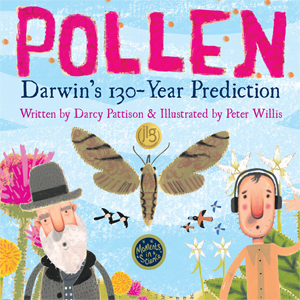 For review copies, email suefoster@mimshouse.com
Junior Library Guild Selection Kirkus Review – *Starred*SLJ ReviewEureka! Non Fiction Book Award Honor – California Reading Association2020 NSTA Outstanding Science Trade BookChinese rights to Dandelion Children’s Books
However, even with these accolades, I’m sure that the book was never seriously considered by any award committee. Certainly no committee member asked themselves if POLLEN was a “distinguished contribution to American literature for children.”
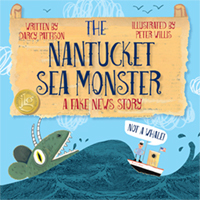 For review copies,
 email suefoster@MimsHouse.com
Wait! How did you get a book recognized as an NSTA Outstanding Science Trade Book award? “I wrote a book that science teachers thought was good and helpful in their classrooms,” she says, tongue-in-cheek.
Mims House is a member of the Children’s Book Council, who administers several awards from teacher organizations. Mims House has four books recognized as NSTA Outstanding Science Trade Books (2015, 2017, 2019, 2020). Beyond that, my book, THE NANTUCKET SEA MONSTER: A Fake News Story is A 2018 NCTE Notable Children’s Book in Language Arts and a Junior Library Guild selection. Here’s my full bio and bibliography.
Is the book widely available? Good question. An award winning book should be widely distributed so it’s available to anyone in the United States. Mims House books are available here:
Print Distribution: Ingram, Mackin, Amazon, BN, Child’s Plus, Follett School Solutions, Permabound and other educational distributors.eBook Distribution: iBook, Kindle, Nook, Kobo, Follett eBooks, MackinVIA, Permabound, Overdrive, EPIC!, Google Plus, other educational distributors, and MimsHouse.comAudio: TalestoGo, EPIC!, Follett, Mackin, Overdrive, JLG Audio, Findaway and other educational distributors
(If I left something out, let me know, and I’ll remedy that tomorrow.)
Who is the reader for your books? Good question. Children, ages 5-14. Each book is targeted to a certain age group, and often targeted to curriculum needs. Each book has a Lexile reading level officially recorded to make it more useful to teachers and parents. All books are submitted to Renaissance Learning for consideration for an Accelerated Reader quiz. We have a variety of lesson plans and discussion guides for our books. Need something else to make the books more useful or available? Email suefoster@mimshouse.com and we’ll make it happen.
There are award programs for self-published books already. Why don’t you just go for one of those? Yes, there are programs that put my books into a ghetto category. Writers organizations have wrestled with the question of award access for the last ten years and solved it with varying degrees of acceptability. Some require insulting documentation: Provide documentation that you’re applied for a copyright. Supply your editor’s name so we know it was edited correctly. For those, I won’t submit. It’s even more aggravating when the establishment of a self-published award means I’m no longer eligible to enter the organization’s main award categories. My books are marginalized by such awards, not honored. The only question should be this: what is the quality of the book I published?
I don’t want a separate award. I want to compete for the “most distinguished contribution to American literature for children” along with everyone else. I’m not afraid of competition or unduly upset by losing. I just want access.
Here’s my point. Self-publishing in a business decision; it says nothing about quality.
It merely says that I’m a small business person with a literary bent. Period. To understand the quality of a book, you must READ THE BOOK.
I’m optimistic, dear librarians. You break expectations all the time. As a group, you’re the clear-headed thinkers. Self-publishing as an industry has grown up in the last decade and there are many excellent books being self-published for young readers. So, read them.
My goal as an author has always been to win a Newbery award. Now, it’s morphed. I want to write the first (but not the last) self-published book recognized for its distinguished contribution to American literature for children.
When Kittens Go Viral
One of the joys of running a micro-publishing company is that the buck stops here. I am the CEO, CFO, accountant, mail clerk, webmaster, librarian liaison, chief cook and bottle-washer…and publicist. I’m putting on my publicist hat here and this is an unabashed self-promotion for this self-published author.
Coming April 8: WHEN KITTENS GO VIRAL, pictures by Nicole Standard.
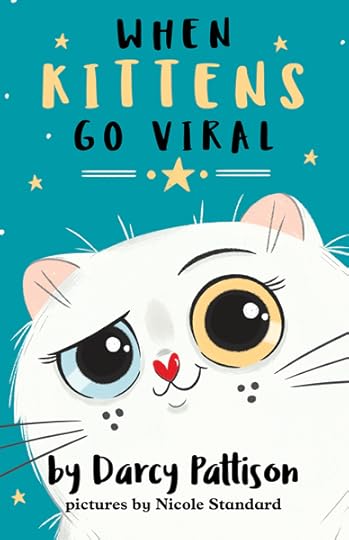 Now available for preorder. For review copies,
email suefoster@mimshouse.com
Discover the secret world behind the scenes of your favorite cat videos.
On a glittering night of destiny, a cat star is born.
The Majestic Kennels, home to the famous cats of KittyTube, welcomes a new kitten, Angel Persian. Angel is eager to follow in the footsteps of her famous mother and father and become a Kittytube sensation. When DaddyAlbert’s new movie goes bankrupt, leaving him stranded in France, Angel desperately works harder. Her videos must go viral, so she’ll win a cash prize and bring him home.
Will Angel become a water cat, a piano cat, a ghost cat, or something new? Will this tiny kitten find her courage—and her audience on KittyTube? Will she have what it takes to win?
What will it take for this tiny kitten to become a star?
Librarians, Please Read Our Books
To the award committee members and to any and all children’s book librarians, I urge you to read self-published books. Sure, there are bad ones just like there are bad traditionally published books. But you’re trained to recognize the good from the bad, yes?
Let me repeat. Self-publishing is a business decision; it says nothing about quality.
Thanks for listening. Librarians Rock!
The post When Will a Self-Published Book Win a Major Book Award? appeared first on Fiction Notes.
January 7, 2020
Indie Means Indie
The post Indie Means Indie appeared first on Fiction Notes.
Smashwords’ Mark Coker is sounding the alarm about indie publishers (those who write and publish their own works—let’s get the terminology right–it’s INDIE publishers, not the deprecating “self-published”) relying too much on Amazon.
I agree with Coker.
Two and half years ago, I started advertising on Amazon’s AMS platform. It doubled my sales. But then, everyone else found the platform and the cost of advertising has sky-rocketed. I get it. There’s competition, as there should be. But what I don’t get is that the platform is confusing, frustrating, and most of all, inconsistent. You may advertise using Keyword A and get fantastic results. If you try to duplicate that with a similar title, say the second in a series, however, you’ll probably get zilch. Nothing. Zero. Zip. Nada. There’s no consistency. That’s a simple example, but the inconsistency extends throughout the platform.
I’ve been a member of a Facebook group devoted to figuring out Amazon’s algorithms and advertising policies for about those same two and a half years. In that time, no one can consistently figure out, well, anything. Theories abound. I’ve tried them all.
Respect for My Own Creativity
So. A couple weeks ago, I set a bid at a high level of $0.83. Except, I accidentally set it at $83.00 instead. Fortunately, I monitor the ads closely and caught it within 24 hours. Here’s the thing: it sold books. The ad served, and there were sales. Of course, at the high bid (it charged me about $4-5/bid), I wasn’t profitable. But everything else was right on. I know my audience; they like my book; the keywords were solid; and, conversion rates were solid which means the cover/description were doing their jobs. It’s just that Amazon won’t serve my ads without crazy-high pricing. For whatever reason, Amazon’s algorithm deprecates my title and won’t serve the ads.
I remember going to writer’s conferences and being put off by how people treat editors. Speaking was a baby editor—a fresh-out-of-college-20-something, the only type person who can afford to live on an assistant editor’s salary. She was smart and intelligent, but not experienced. Her opinions on literature were still forming, guided by her senior editors and realities of the marketplace. I cringed at how people treated her, as if she were a princess who, with her magic publishing wand, could change their lives forever. If only she would notice them and their work. They fawned over her. Smart, intelligent, creative people debasing themselves before the Goddess of Publication.
As Emily Dickinson says,
“Publication – is the Auction
Of the Mind of Man –
Poverty – be justifying
For so foul a thing.”
Indie-publishing is hard. It’s a lot of learning, trying, failing, and trying again. But it’s honest and creative work. I no longer have to beg a baby editor to notice me. And I’m not going to beg Amazon’s algorithms to notice me, either.
Of course, I will always need Amazon on some level. They are, after all, the biggest bookstore in the US. My books will always be listed there.
But this is a year to lessen my dependence on Amazon. I’m building an online store—details to come—and will take charge of my own advertising. When I run ads, it’ll be to MY platform, to MY books. Not to Amazon’s platform. I’m an Indie!
Why? Because I respect my work too much NOT to do this. Respect for my own creativity is why I started indie publishing, and it’s the foundation of decisions I’ll make this year about controlling my own sales platform.
The post Indie Means Indie appeared first on Fiction Notes.
December 10, 2019
Control Or Creativity?
The post Control Or Creativity? appeared first on Fiction Notes.
Who’s in control of the publishing process? Once the contract is signed, does the author have any say in what happens to the story? Traditional contracts specify that the publishing company will publish as they see fit. In other words, control is given to the publisher by the contract.
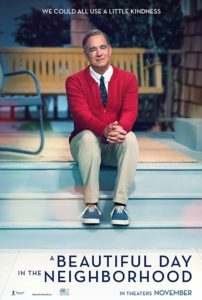 Director Marielle Heller talks about creativity in the directing process.
One criticism of indie authors is that are control freaks. Indeed, many indies will say that control is one of their main issues in choosing how to publish. And that’s seen in a disparaging light, as if the indie author isn’t a team player. From this perspective, the indie author doesn’t understand of the publishing process. Editors edit, illustrators provide the art, and each does their professional jobs as part of a team. An author’s professional job stops when the text is finished.
Let’s examine this issue of “control” in the publishing process. To do that, I want to look at an interview on Terri Gross’s Fresh Air NPR program with Marielle Heller, director of “A Beautiful Day in the Neighborhood.”
Hard to believe in your point of view?
Talking about directing a film, Gross asks, “Was it ever hard for you to believe in your point of view?”
Heller responds by talking about moving from an actor to a director.
“But as I started directing, it felt incredibly natural to me more because as an actor, I sort of always felt like I was holding my tongue. Like, when you’re an actor, you’re not supposed to get involved in certain things. You’re not supposed to get involved in every discussion, you know? Like, even if I was acting in a play, and it was a new play, and we were discussing how a scene was working or not working, you know, the director and the playwright might be discussing whether a scene’s working or not. But as an actor, you’re not really supposed to get involved in that conversation. You’re sort of there to do your work.
And I was – I spent a lot of years when I was working as an actor doing theater kind of holding my tongue where I wanted to be involved in those bigger creative discussions, but I knew it wasn’t my place. And when I started directing, it was like, oh, great. Now I get to actually be involved in all of the deeper creative discussions and figure these things out and the problem-solving of storytelling.”
Traditional publishing treats authors similar to Heller experience as an actor. She wasn’t supposed to be involved in the larger discussions, just do the acting and keep quiet. Likewise, publishers make storytelling and marketing decisions without the author’s input. The unspoken comment is that the publishers/editors know best. The unspoken attitude is that the author doesn’t have anything useful to add to the bigger conversation. It’s true that some editors treat authors with more respect and discussed storytelling issues, but not all of them.
Like Heller, I learned a lot by keeping my mouth shut and doing just my part as an author. It’s important to remember that everyone can learn from experienced professionals.
However, there’s also a time for the authors to be brought into the “bigger creative discussions.” And when they aren’t—for whatever reason—one choice is to publishing independently.
For me, and for many other indie authors, self-publishing is a way to become a director of our own stories, to be involved in the “deeper creative discussion and figure these things out and the problem-solving of storytelling.”
Picture Books – Deeper Creative Discussions
Here’s an example of the deeper creative discussions about storytelling for my picture book, The Journey of Oliver K. Woodman, which was published by Harcourt and illustrated by Joe Cepeda. It’s a story of a wooden man, Oliver, who crossed the United States to connect a family. An Uncle builds Oliver and sends him on his journey. As Oliver crosses the US, he’s given a ride by various people who write postcards and letters back to the Uncle.
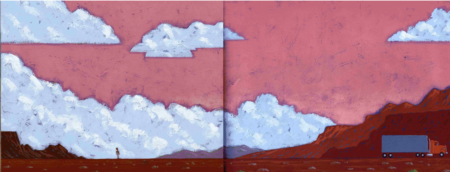 Oliver is shown as a tiny figure in a huge western landscape. It evokes loneliness and the distance that Oliver has traveled. The double-page spreads are a creative decision that added to the storytelling of the book.
There were two crucial decisions. First, Oliver travels from South Carolina to California, a long transcontinental journey. When the book was laid out in the standard 32-page format, it didn’t seem right. Instead, it became a 48-page book with wordless double-page spreads to depict the travel from one location to the next. When the book is read, those extra wordless spreads make it feel like a big journey. A 32-page book wouldn’t have had the same effect.
Second, the editor called me to ask, “Do you mind if we make the family a mixed-race family?”
As Oliver crossed the U.S., he would, of course, encounter a wide range of ethnic groups or sub-cultures. The story already stopped at a Navajo reservation in New Mexico, and Miss Utah was a young Navajo woman. This is counter-pointed by three old white-women who love afternoon tea. A mixed-race family complemented what the story already presented, the amazing multicultural aspect of the United States today.
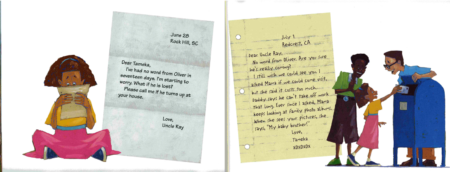 Illustrating the story with a mixed-race family was part of the creative decision making about this book.
I was left out of the discussion about 32-pages versus 48-pages. Partly, that’s because it was a matter of budget (48 pages costs more to print than 32), and it was also very much the illustrator’s and art director’s decision. But it was also because, as the author, I was expected to be silent on the issue. But I was brought in on the tail end of the discussion of the family’s make-up.
These two creative storytelling choices—the 48-page length and the emphasis on the US’s multicultural population—helped define the story. It received starred reviews from Kirkus and the BCCB, and was named an honor book for the Irma Black Award, which is given to the story where the story and text are fully integrated.
Indie Published Creativity
As an indie author-publisher, I enjoy the problem-solving involved in turning a story into a picture book. Like Heller directing a film, I enjoy choosing an illustrator and dividing text into page breaks. The Nantucket Sea Monster: A Fake New Story had a great possibility for a dramatic page turn. This is the story of a publicity stunt about a balloon created for the Macy’s Thanksgiving Day parade. People on Nantucket Island are looking for the sea monster.
The text says, “They couldn’t believe their eyes.” This is a good place for a dramatic page turn.
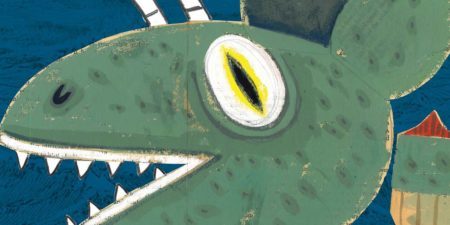 Double-page spread from THE NANTUCKET SEA MONSTER showing the sea monster in a close-up.
I asked the illustrator to set up the page turn followed by a wordless page that showed the sea monster’s face up-close. At first, he didn’t understand the reason for the wordless spread. But it’s one of the most effective page turns of the book. The text sets up the sea monster’s face close up, which enthralls the reader. However, it’s so close up that the reader is still slightly overwhelmed and doesn’t understand the bigger picture. Zooming in so close reveals and hides at the same time. The next page-turn finally resolves the issue by explaining the sea monster is a rubber balloon, and showing that from a distance. The sequence makes the story more exciting and keeps the reader’s interest.
Exciting page turns and storytelling pacing are just some of the creative storytelling discussions that now dominate my time. As a traditional author, I was mostly excluded from the decisions, but now, I’m responsible for those very decisions.
Heller says, “…I try to involve my actors in that way as well and let them feel like they’re not required to hold their tongue and that we can all be parts of these bigger discussions.”
Like Heller, I try to involve the illustrators and other professionals that work on a project in the creative storytelling discussions and decisions. That’s far from the perception of being a “control freak.” Instead, for this indie author, it’s not a matter of control. It’s a matter of being responsible for the creative storytelling and being able to include others in the deeper discussions.
The post Control Or Creativity? appeared first on Fiction Notes.
June 10, 2019
The Wayfinder: YA Fantasy
The post The Wayfinder: YA Fantasy appeared first on Fiction Notes.
READ A FREE HEARTLAND TALES SHORT STORY: CLICK HERE
The Wayfinder was my first published novel, 2000 Greenwillow/Harpercollins. I remember where I was when I heard the news that someone wanted to publish this manuscript. I was with my oldest daughter, Sara, at a local mall. I had to use a pay phone to call the editor back, Standing there in the hallway, near the mall office, the pay phone was noisy.
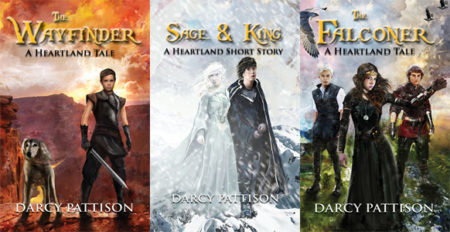 The Heartland series: middle grade fantasy novels. Kirkus Reviews says, “…a charismatic YA fantasy…”
Why a Wayfinder? A Pleasant Mountain Hike
It started when we got lost in the mountains of New Mexico at 10,000 feet elevation. The day began as a simple hike in the mountains for about eight members of my family, about 4-5 adults and 4-5 kids. We planned to walk to a snow-fed lake, eat a picnic lunch and hike over the mountains to another parking lot.
It was a beautiful day, clear with puffy clouds. The walk to the lake was easy, even if it climbed. The lake was cold, the picnic lunch great. When we left the lake, we expected 30 minutes to an hour walk to the parking lot on the opposite side of the mountain.
At that elevation, on June 17, there was till snow under the trees. As we walked, bits of snow fell into my boots making my socks wet. We came upon beautiful alpine meadows with wildflowers in full bloom. We scared a porcupine.
One valley had a narrow ditch running through it that was full of ice-cold water. You could easily jump over it. Yet when we thrust a stick in it to discover how deep it was, we couldn’t touch the bottom. It must have been over ten feet deep. I kept thinking of how dangerous that would be at night. You’d be walking along and suddenly boom, you’d be over your head in water.
Lost!
We came to a post in the ground. At it’s feet lay several trail signs. Apparently, the snow had knocked the signs off and they hadn’t been replaced. We tried positioning the signs on the post, but we had no idea which way they should point.
We were lost.
Not only that, but the sky had darkened, clouds blocking out the sun. We couldn’t tell our direction from the sun at all. At this point, two things would’ve helped. A compass or a map.
My brother, the smartest man I know, had a map. It was in his car, back at the original parking lot. I had a compass, but it was back home in a drawer.
We were truly lost.
From Bad to Worse
Could things get worse? Oh, yes.
It started to hail. Not small hailstones, but marble sized bits of ice. My husband pulled out his one rain poncho and stretched it out for the eight of us to huddle beneath. The hail stopped, and we hurried along the trail that we “thought” was right.
At one point, my husband ran (at 10,000 feet elevation) back to the signpost, in hopes of better clues, and ran back to us. He learned nothing new and we still didn’t know if we were on the right trail.
It hailed on us again.
We came to another valley where the ground was spongy from snowmelt. I bounced up and down, looking at a line of posts. It was hopeful that there were signs of people—someone had set those posts in a straight line. We continued on and finally came to the edge of the mountain where we could look out and see the path below us. Within 15-20 minutes we were safe at our car.
Lost? How do We FIND Our Way?
The mountain hike and getting lost made we wonder about how we find our way around. How do we navigate? It turns out that this varies widely.
For example, people who live on an island only need two directions: toward the sea or away from the sea. Native Americans of the Pacific Northwest only had two directions: upriver or downriver.
If navigating or finding our way is negotiable, then it’s up for grabs as a fantastical element. I created a special skill of FINDING. Those with the skill could Find anything: a lost ring, the best fruit in a market, a buried treasure, or someone in a deep fog.
Relaunch and a New Heartland Fantasy
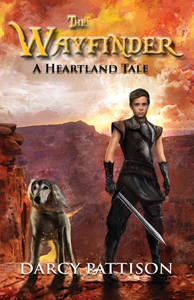
I’m thrilled that THE WAYFINDER is relaunching tomorrow! But I’m also thrilled that in July, a new Heartland story will launch.
Creating the Heartland, the landscape, political climate, traditions, and so on is part of the fun of writing fantasy. But it takes a long time!
That’s why there are so many trilogies and series in fantastical worlds. After spending time creating a special world, it’s hard to abandon it for other stories.
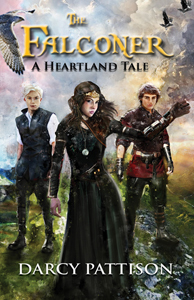
THE FALCONER skips a generation and focuses on Winchal Eldras’s granddaugher, Brittney Eldras. She has trained a gyrfalcon, the largest and most noble of the hawks, and comes striding out of the north just in time to save the Heartland from the vicious Zendi invaders from the south.
The post The Wayfinder: YA Fantasy appeared first on Fiction Notes.
October 12, 2018
AudioBooks are Growing: Listen Up!
Audiobook sales are on the rise, which means indie or self-published authors need to pay attention.
Goodereader reports that audiobooks are the fastest growing digital segment of book publishing in 2017. 26% of the US population has listened to an audiobook in the last year, creating a $2.5 billion market. PW reports that audiobook sales jumped 22.7% in 2017. Other reports say that the children’s book market is about 10% of the overall market:
“#11. Young adult and children’s audiobooks account for over 10% of industry sales on the average year. In total, about 18% of youth in the United States will listen to an audiobook at least once over the course of a year. (Statista)”
It’s clear that audiobooks are on the rise. But how do you get YOUR audio to readers?
Narrators for Audiobooks
The first hurdle is to get the audio recording. I’ve done it three different ways.
First, ACX.com is Amazon’s audiobook portal for self-publishers. There, you can set a book for audition and listen to narrators read a sample. You have two choices on contracts with ACX. Option 1 is a 40% royalty, but you must give ACX a 7-year exclusive. Option 2 is 25% royalty for a non-exclusive contract, which means you can take the audio anywhere. See all the details here.
A second way I’ve obtained audio is a private contract with a narrator. One was a local personality, and another I found by listening to audiobooks and then contacting the narrator.
Finally, I’ve hired a company to do the audio. I’m not free to share that info, but look for companies who deal with lots of audiobooks.
There’s a new way to commission audio these days, and that’s Findaway Voices, either going there straight or through your relationship with the ebook distributor Draft2Digital. Findaway is similar to ACX in that you can listen to narrators auditioning for your story. Read more about Findaway’s process here.
Distribution of Audiobooks
Since we’re discussing Findaway, let’s start with them as a distributor of your audiobooks. One interesting option from Findaway is their Authors Direct app which allows you to sell or giveaway audio directly to the consumer. They must listen through this app, and can’t just download files. It’s currently by invitation but you can email to ask for an invitation. It opens many options for advertising and selling audio.
Another nice thing about Findaway is their reach. ACX only reaches Audible, Amazon and Apple. With Findaway, you have the freedom to choose any, all, or none of the following distribution options:
Retail
Audible, Amazon, Apple
Google Play
Kobo, Walmart
Barnes and Noble NOOK
Scribd
eStories (formerly eMusic)
Playster
24symbols
Downpour
Audiobooks.com
Hummingbird
Libro.fm
hibooks (formerly Otto)
Instaread
Nextory
Beek
Library & K-12
3Leaf Group
Biblioteca
EBSCO
hoopla
Odilo
Overdrive
Perma-Bound
Wheelers
Honestly, will this long list of distributors mean more sales? Not really. Right now, Audible still dominates the audiobook market. But if you’re wide, then you should be as wide as possible. For my audiobooks, the other distribution channels are growing, but are still a small percentage of sales.
ACX remains one of the main channels for distributing your ebooks because they reach both Audible and Amazon.
Go Direct for Your Audiobooks
Some distributors have said that they’ll take direct submissions of audio files soon. Kobo|Walmart is one exciting avenue for going direct. That should get you into Overdrive, as well, since Kobo’s parent company, Rakuten, owns Overdrive; but we’ll have to wait for the announcement. Mackin, an education distributor, will begin distributing it’s own audiobooks instead of through Findaway this year. Expect this trend to continue; however, you can always choose an aggregator for audiobook files, just as you do for ebook files.
Apple recently rebranded their books app and it now includes audiobooks. Expect them to allow direct uploads soon, or to allow them through aggregators.
Audiobooks to Read-Aloud ePub3 ebooks
A final use of audiobook files for children’s books is to create a Read-Aloud ebook. For this type ebook, the audiofile is synced so that every time a word is read, the word is highlighted. You can see these type books at the ListenAndRead.Store.
The ePub3 standards have allowed the integration of ebook/audio for a long time, but the distributors couldn’t handle the files until recently. The easy way to create these files is to use the Circular Flo add-on to Indesign, because no coding is required. If you or your designer already use InDesign, this is a great option. Circular Flo charged about $50/book to create these files. These stores take the ePub3 read aloud ebooks: GooglePlay, Mackin and Overdrive. Look for more to accept these files in the future.
If you don’t have audiobooks you’ll want to add this option to your publishing program soon. Sales are poised to take off and you want to be included in that gold rush!
See Darcy’s Audiobooks here.
The post AudioBooks are Growing: Listen Up! appeared first on Fiction Notes.
Related Post
Should Authors Promote Books?
.yuzo_related_post img{width:126.5px !important; height:88px !important;}
.yuzo_related_post .relatedthumb{line-height:15px;background: !important;color:!important;}
.yuzo_related_post .relatedthumb:hover{background:#fcfcf4 !important; -webkit-transition: background 0.2s linear; -moz-transition: background 0.2s linear; -o-transition: background 0.2s linear; transition: background 0.2s linear;;color:!important;}
.yuzo_related_post .relatedthumb a{color:!important;}
.yuzo_related_post .relatedthumb a:hover{ color:}!important;}
.yuzo_related_post .relatedthumb:hover a{ color:!important;}
.yuzo_related_post .relatedthumb:hover .yuzo__text--title{ color:!important;}
.yuzo_related_post .yuzo_text, .yuzo_related_post .yuzo_views_post {color:!important;}
.yuzo_related_post .relatedthumb:hover .yuzo_text, .yuzo_related_post:hover .yuzo_views_post {color:!important;}
.yuzo_related_post .relatedthumb{ margin: 0px 0px 0px 0px; padding: 5px 5px 5px 5px; }
September 10, 2018
Christmas, Self-Publishing & Self-Editing: Book Reviews and Software Review
Book reviews and a software review. Are you books ready for the Christmas shopping season? Do you need information on self-publishing options? Or do you need to improve your self-editing skills?
Today, I’ll review a couple books and a software program.
BOOK REVIEW: 50 Ways to Sell a Sleigh-Load of Books: Proven Marketing Strategies to Sell More Books for the Holidays

50 Ways to Sell a Sleigh-Load of Books: Proven Marketing Strategies to Sell More Books for the Holidays
Price: Check on Amazon
Penny C. Sansevieri from Author Marketing Experts is known for savvy marketing tips to the indy community. I’ve read blog posts and listened to podcasts where she explains marketing in simple terms.
This book is a how-to book that inspires and explains how to get ready for the Christmas season. And it’s almost too late! As the title says, there are 50 tips, plus a handy checklist. If you’re actually marketing your books, many of these are obvious things: get your website ready, freshen up your cover, and make sure you have social media accounts in order. Some tips, however, are definitely on my to-do list: create a Pinterest board for book-centric gift buying ideas, create more videos, and plug your holiday connection via author central.
In other words, she covers the basics, but also stretches for the unusual strategies. I went into this book with some skepticism, but came out with some solid ideas.
That have to get done.
Tomorrow.
Because if you wait until November, you’re sunk.
This is a book to buy today! But it won’t work unless you get to work on some strategies immediately, she says to herself!
BOOK REVIEW: How to Self-Publish and Market a Children’s Book

How to Self-publish and Market a Children's Book: The key steps to self-publishing in print and as an eBook and how to get your story into young readers' hands
Price: Check on Amazon
Karen Inglis, British children’s book author, does a solid job of explaining self-publishing to beginners. She makes the world of self-publishing simple and easy to understand. This isn’t a how-to book, with in-depth instructions on how to create files, upload them, or create a marketing plan. Instead, it provides an overview of her process, which is quite valuable. Karen is UK based, so many of her recommendations tie into the UK indy community, but she also extends it to the international community.
As usual, what I liked best was her transparency in revealing sales numbers, the growing pains, and the successes. It’s a successful intimate look at a successful children’s book author and her process. (She writes children’s books under the name Karen Inglis, but non-fiction under Karen P Inglis.)
SOFTWARE REVIEW: Pro Writing Aid Software
Do you ever wish you had a copy editor in your pocket? I’ve tried several software programs lately, searching for something that will help me create cleaner first drafts. Pro Writing Aid (Affiliate Link) has a nice variety of ways to analyze text and that finally pulled me in. I’m great at spelling, avoiding passive voice, and most style issues. But I recently analyzed a section of text that was about 500 words long and found that I had repeated “would” 30 times. Pro Writing Aid suggested that I reduce that to 11 times.
It’s a computer text analysis, so it’s merely telling you what is in your text. You decide if and when to revise. Maybe all 30 instances of “would” were appropriate, it doesn’t know. It’s just programmed to notice words that are used too frequently. You can download their free ebook that explains the various text items that the program flags: style, grammar, overused words, readability, cliches, sticky (too many common words in a sentence), diction, repeats, echoes, sentence variety, dialogue, consistency, pacing, pronouns and alliteration.
I loved the echoes, repeats, and overused words because it’s often hard to see these in your work. You know they creep in, but you can’t see it. I was surprised by the alliteration results because it’s not something I’m conscious of at all. It found things like “live a life,” “we wanted,” and “when we.” (Again, it’s a computer program that is merely reporting what it finds in certain categories; I might change zero items, but at least I can see what I’ve done.) Pacing was fascinating when it highlighted slowly paced passages, and then listed the word phrases that slowed it down.
If you’re an indy author, it’s not a replacement for a copy editor. But I want to deliver a clean manuscript to a copy editor, so they can find the things that really matter instead of the silly errors. This is a fascinating (if somewhat nerdy) program! Happy editing!
NOTE: The software analyzed this write-up about the software and identified these areas of concern:
Style: 2 passive verbs, 8 adverbs outside dialogue.
Overused words:
It/there – used 13 times, recommend removing 4.
That – used 12 times, recommend removing 5.
-ly adverbs – used 8 times, recommend removing 1.
see/saw – used 3 times, recommend removing 1.
knew/know – used 2 times, recommend removing 1.
Readability: Reading time, 1 minute, 23 seconds. Easy to read. “It’s a computer text. . . .” is a slightly difficult paragraph.
Cliches. None.
Sticky. None.
Diction. Word choices.
Vague & Abstract Words (11)
– would – would (2)
– all – all (2)
– about – about (1)
– like – like (1)
– certain – certain (1)
– slowly – slowly (1)
– down – down (1)
– really – really (1)
– silly – silly (1)
Diction or Word Choices
– in – in (1)
– appropriate – appropriate (1)
– frequently – frequently (1)
– down – down (1)
Sentence Variety. Avg Sentence Length (16.5) target 11 to 18
– 346 words in sentences / 21 sentences. Good sentence variety.
Pacing. Zero slow-paced passages.
Pronouns. Initial pronoun percentage unusually high (52.4%) Target 0%-30%
– Num initial pronouns (11) / Num sentences (21) * 100
Alliteration. None.
I revised nothing, so you can see what the program has highlighted.
Pro Writing Aid Writing Softwarehas a free trial, which allows you to analyze the first 500 words of a text.
The post Christmas, Self-Publishing & Self-Editing: Book Reviews and Software Review appeared first on Fiction Notes.
August 27, 2018
Author Newsletters
Author newsletters are crucial, whether you’re an indie author or not. But for Indies, your newsletter could make or break your business.
This blog, Fiction Notes, has been going since 2008 (Yes! 10 years of archives! So search for topics!) My approach to author newsletters has been to sign up folks to get new blog posts by email. My author newsletter, in effect, has been an RSS feed, or the blog posts delivered to your email inbox. That’s worked well. But I think I need to consider some other options. This post won’t have answers. Instead, it’s me, thinking out loud about what I should do differently, and how to do it. Come back in a couple months or a year, if you want a structured How-To. This post is about options and thinking through those options.
Author Newsletters v RSS Blog Feed
Really? Do I have to write twice as much? That’s my first complaint about the idea of doing both an author newsletter and a blog post each week. I love y’all! I love that you read my blog. But I also want to spend time on my fiction. The indie author’s life is always one of balancing different needs and desires.
The blog-feed-as-author-newsletters has the advantage of killing two birds with one stone. I write once, and it goes out to readers, but also provides information to the internet at large, bringing in traffic and building readers one at a time. It’s simple to set this up through any email provider, from Mail Chimp to Convert Kit to Drip to Active Campaign. It’s a basic service for all providers. Why? Because it’s so simple and meets the needs of so many.
Crucial Question: Audience
But there’s a crucial question. Who are the audiences for author newsletters and blog feeds? I see the advantage of a separate newsletter because I’d write it for a different person. If you’ve bought, for example, Novel Metamorphosis: An Uncommon Way to Revise, you’d be more familiar with my work. Or if you’ve bought one of my children’s books, for example, The Nantucket Sea Monster: A Fake News Story, then you’d be familiar with my work in a different way.
How would I write differently to fans of my work? Would I tell you about different events? For example, in private author newsletters, I might write about recently negotiating Korean rights for The Nantucket Sea Monster. I regularly hire international illustrators, so it was interesting to see how different the Korean negotiations were. They definitely wanted paper contracts, and didn’t want to sign via a digital platform. Would that sort of personal story interest you?
And how many different author newsletters would I need to write? Too many.
So, here’s one of my particular problems: I write on very different topics.
Is there a way to write for both the nonfiction how-to-write fans and the children’s novels fans? Could one newsletter interest both audiences?
Right now, I have two websites: Fiction Notes at DarcyPattison.com and MimsHouse.com. That’s two blogs that need to be fed. If I try to add an author newsletters for fans on top of that, well, that’s a lot of writing.
So, can I do without a blog? Cut out one or both of the blogs?
That seems unthinkable. Fiction Notes is a way of life.
Mims House is a place to talk about my writing for kids.
I’m writing in a circle here, because it comes back to writing blogs and letting the newsletter be the blog-feed-as-author-newsletters. That still seems like a great option. After all, I have about 3000 people on my list. Not bad. I keep it clean and healthy, which means I regularly delete subscribers who don’t open emails.
And yet.
Here’s why I hesitate to accept that answer.
A Tale of Two Marketing Systems: My Response
David Gaughran wrote a set of crucial essays on his blog last year about the difference in Going Wide v Going Exclusive to KU. There aren’t right or wrong answers to this question. Instead, it’s a complicated moving-parts kind of decision. I’ve tried KU this year by going exclusive with a sci-fi trilogy, The Blue Planets World series. My page reads were growing nicely, until Amazon suddenly clamped down on some scam or other. If you had a sudden growth in page reads, they suspected that you were click farming. The weekend that happened is the weekend that I had scheduled some advertising efforts.
Instead of page reads climbing, they tanked. No one accused me personally of click farming or anything. They just erased the increase in page reads. I know the ads I had scheduled should’ve worked because I’d used them about four months earlier to nice effects. The day the ads went into effect, page reads tanked.
In other words, for me, I don’t want to ever again give Amazon control over my business.
Instead, I’ll go wide.
Going back to Gaughran’s post, then, what should I do to be successful?
Email marketing! Author newsletters, reader magnets, author newsletters swaps, competitions, Bookfunnel promos, Instafreebie promos, group promos. Without Amazon’s recommendation engine, I must find ways to bring an audience to my books. I also need to advertise on an ongoing low level all the time.
I’ve spent 15 months now faithfully working AMS ads with success. Scaling up is hard, but I think the low-level ads are fine. Gaughran says Wide Authors will have a slow burn, with slow growth, rather than the ups & downs, highs & lows of a KU Author. I’ve experimented with Bookbub CPC ads and need to return with a passion for optimizing. Maybe, I should try Facebook ads again, with a passion for optimizing. As Gaughran says, with permafree books, you have time to optimize ads.
EMail Marketing
So, I’m revisiting my options for email marketing, and especially the author newsletters which focuses on building a relationship with readers.
I’ll focus my efforts for the next six months to a year on doing some of these things:
Automation Sequence. About 18 months ago, I moved from MailChimp to ConvertKit because I wanted multiple signup forms and the ability to tag readers. Automation sequences start with a sign up form.
The multiple signup forms are great – except they get messy after time. You put up a sign up form here or there – and you don’t write down which page it’s on. So, when your business goals change or the signup is no longer timely, it’s still lingering there on that blog post. I still get signups on a writing course that’s no longer active because somewhere on my blog, there’s a post with that signup form.
I need to go through everything and clean up the signup forms!
Then, there’s the automation sequence. This is usually 3-10 emails that are scheduled to go out after a certain event, such as a person signing up for your author newsletters. The purpose is to introduces you and your work to the new newsletter recipient. Essentially, you get them up to speed so they’ll get what you’re writing about.
I have several of those written. But are they effective.
And gee, how many of these things do I have to write? Could I write multiple email #1, and then feed the readers into the same Emails 2-10? In other words, customize the first email that a reader receives, depending on the sign-up form, but then, they go into the general sequence? I need to figure out how to streamline and optimize these automated sequences.
Segmentation. The idea here is to meet the needs of the readers by inferring their interests from the information you have. What info do you have? Where they signed up, what books they signed up for, and anything else you ask them. Of course, you usually ask for very little because if you ask for a lot, they won’t sign up. That leaves the signup forms as crucial, as are links that they click on. Most email software can track clicks, and some can tag a reader. For example, if you clicked on a link to my book to the Apple store, The Nantucket Sea Monster, I could set up the software to tag you with any or all of these: picture book, children’s nonfiction, Nantucket, Apple.
Later, when I have a new picture book nonfiction book come out, I can send that person a link to the Apple store and reasonable expect that they’ll be interested.
This type of capability is going to be crucial. But. Wow! It’s overwhelming. How do you get a handle on all the options. Do I need tags for each of the possible ebook stores: Apple, Kobo, Kindle, GooglePlay, MimsHouse website?
Where does segmentation end? How granular do you get?
Gaining Readers. The other ongoing, never-ending question is where do you find readers? I’ve done a variety of things on a casual basis. I need to look again at advertising, promotions, newsletter swaps, and so on. What has worked on a casual basis and what has potential to scale up?
There are no right and wrong answers on these questions. There’s no business book to pick up that says, “Do this and you’ll succeed!” Even if there was, I wouldn’t trust it because each author is different and the answers will vary. There are only interesting articles like Gaughran’s A Tale of Two Marketing Systems that provoke thought. I think slowly about things. I do small experiments. I hedge my bets.
But sometime this year, I’ll start making decisions about where I want to head on email marketing. It’s a crucial question and it’s not easy to figure out. But I’m close to making decisions that I hope will 10x my business and sales of books this year! Close. Still a couple more small experiments to watch and evaluate. But close.

The post Author Newsletters appeared first on Fiction Notes.
August 13, 2018
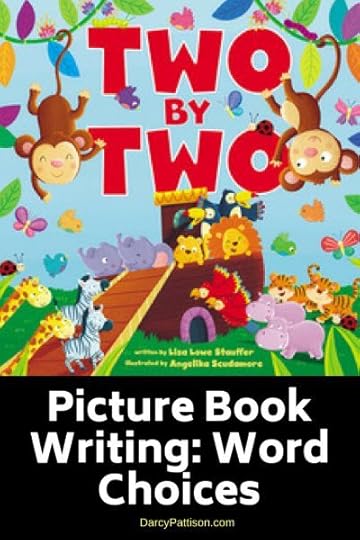
Word Choices for Picture Books: Two by Two by Wordsmith Lisa Stauffer
Guest post by Lisa Lowe Stauffer
-10%
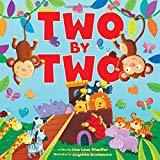
Two by Two
Price: $8.09
Was: $8.99
Twice I’ve had the opportunity to participate in Darcy Pattison’s Novel Metamorphosis retreat.
Although I gained a lot of great tips and information, and have revised several novels via the NOVEL METAMORPHOSIS workbook, one thing in particular that Darcy talked about blew me away. At the 2006 retreat, she walked us through how she word-smithed her picture book, 19 GIRLS AND ME.
She talked about word choices involving more than just moving the characters through the plot. She considered hard and soft consonants, and analyzed where sounds were physically created in the mouth, so that the plot and emotional arc could be fine-tuned even further. As someone who came from a just-the-facts journalism and marketing background, looking at words at this level was a revelation to me.
For instance, I remember Darcy talking about choosing the word “yeti” instead of “abominable snowman.” Not only is yeti easier to say, its final syllable is formed by touching the tongue to the roof of the mouth. When paired with “peak,” as in the phrase “yeti’s peak” it’s as if the sound is climbing through your mouth when you say the words. (Go ahead, say “yeti’s peak” out loud. See?)
Making Poetry Sing!
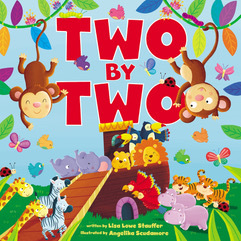
So when endlessly revising the poem that became the book TWO BY TWO, I remembered Darcy’s talk. And took that little poem to a whole new level.
Here are some phrases from my book as examples of what I learned:
In the first stanza, choosing “shut” instead of “close” was an easy choice with its hard t ending mimicking the banging finality of a closed door:
Two by two,
Board the boat.
Shut the door.
Time to float.
This opening stanza is followed by another staid stanza setting up the journey. These first two stanzas’ precise meter reflects the beginning of the ark’s journey when Noah’s in charge. But then the monkeys take over and I change the meter. The first word in this next section is the verb “scamper,” which also brings home the notion that the monkeys are mischievous scamps.
A few stanzas later the monkeys have let all the animals out to play, and it’s getting more and more chaotic on the ark:
Anaconda limbo,
Tigers race in pairs.
Ring toss on the caribou,
Pin the tail on bears!
In this section, my word choices included “Anaconda limbo” for the repeating a and o which makes your tongue wiggle as if it’s limbo-ing, touching the roof of your mouth repeatedly. Plus the o ending on “limbo” leaves the mouth open, functioning as a sort of questioning or surprised sound. Similarly the “ou” ending on caribou leaves the reader’s mouth open.
Another line is “Kookaburras keep the beat” which is one of my favorites. It has lots of hard consonants, two instances of alliteration, plus it exemplifies what it’s saying by having stressed and unstressed syllables that mimic a drum. (Say it out loud. See?)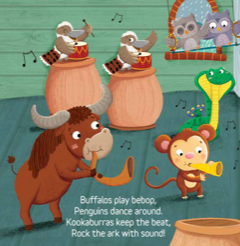
Near the end when the animals are leaving the ark, is the line “Tall and small zoom past.” This started as “Big and small,” went through “Small and tall” which has the nice internal rhyme, and then ended as “Tall and small” because the initial t starts it off with a crisp sound which launches the softer sounds that come after it. Plus since the line ends with “past,” the two t sounds bracket the line, nice and crisp to show none of the animals were dawdling.
The Importance of the Last Line
Oh, and the key thing I learned from Darcy? It’s this: The final sentence and especially the final word choices will linger in the reader’s brain, so end on a hard consonant.
The last line in TWO BY TWO is “Tuckered out at last.”
It’s rare that you get to reach out to a teacher who’s made a difference in your life. It’s been fun to write this blog post about Darcy (I can feel her blushing all the way in Atlanta) and how important she’s been to my writing journey. Darcy, without your incisive, thoughtful, comprehensive teaching, I wouldn’t have my first published book.
(See how I ended on a hard consonant?)
Although Lisa Lowe Stauffer secretly longed to write fiction, first she had to write her way though journalism, marketing, consulting, and travel writing. When she’s not writing, she enjoys traveling, in part because all those hours waiting at the airport are a great excuse to read more books. Publication of TWO BY TWO (Zonderkidz, July 2018) finally fulfills her childhood wish for a pet monkey . . . at least in print. Learn more at http://lisalowestauffer.com.
WANT TO LEARN MORE ABOUT WRITING PICTURE BOOKS? CLICK HERE FOR MORE INFO.
The post Word Choices for Picture Books: Two by Two by Wordsmith Lisa Stauffer appeared first on Fiction Notes.
August 9, 2018
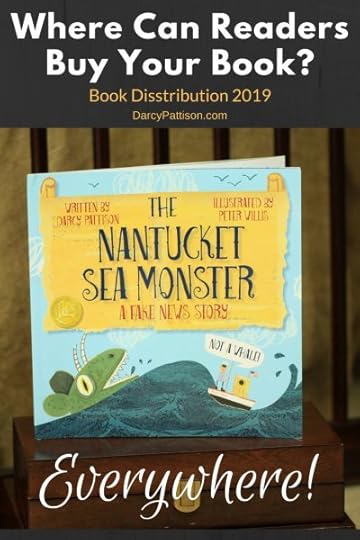
Book Distribution 2018
Book distribution, where your books are connecting with people, is a crucial decision for selling books. If a reader hears about your book and they try to buy it in their favorite format from their favorite store/vendor, it must be available. That means you should know where your customer shops. Children’s librarians use educational distributors. Parents might use Amazon, BN, Kobo, or a local bookstore.
Adding book distribution is an ongoing effort and changes frequently. Someone recently asked where I currently distribute. So, this is it for right now, mid-2018.
I use print-on-demand services that also include distribution. They don’t advertise the book, have salesmen who pitch the book to bookstores, or in any way promote the titles. They simply list the book in their catalog, which puts it on Amazon.com.
Createspace or KDPPrint – Upload here to reliably ensure that you’ll be available on Amazon. Rumors abound that CS will be closed, but there’s nothing official. It’s all rumors.
Ingram Spark – Upload here for print distribution everywhere else. This includes internationally, local bookstores, education distributors, and more. The books are included in the Ingram Wholesale catalog which makes them available to the general market.
TIPS:
Find discount codes to avoid setup pricing.
The same interior file works for CS/IS.
Use Ingram templates for covers, they include bar codes. Do NOT embed a price in the barcode, or you’ll have to change covers any time you change pricing.
Set your discount to 55% (standard) or 53% (standard with a bit of fudging but still allowed). Anything less is considered a “short discount” which means poorer distribution.
To reliably be available to bookstores, you must choose to allow returns. With the just-in-time ordering of modern bookstores, returns are fewer. Bu you must still budget for returns. Or set it to No Returns and accept that bookstores will not stock the book.
ON THE OTHER HAND, read Aaron Shepard’s book AIMING AT AMAZON (lots outdated but the basic idea is solid) and use the short discount to your advantage. He sells at 20% discount and has for years. Basically, you only plan to sell on Amazon and don’t care about any other market.
If you get a large order, call IS and ask for bulk discounts. Or do a small offset print run.
eBooks – I directly upload to KDP, BN, Apple, Kobo, Overdrive and use PublishDrive to reach GooglePlus (and a lot of other places that rarely make sales). You can reach many of those through D2D and/or Smashwords. You need a spreadsheet to keep track of who distributes where so you don’t duplicate distribution when you choose to enable/disable distribution on a certain platform.
I also sell direct on my website (not much) using WordPress/Woocommerce and use Bookfunnel to deliver the correct format to customers. (see mimshouse.com).
I also direct upload to education distributors: Follett, Mackin, Permabound, EPIC!.
AudioBooks – ACX, some exclusive and some non-exclusive. Findaway for non-exclusive.
GET A LIST OF EDUCATIONAL DISTRIBUTORS, INCLUDING FULL CONTACT INFORMATION
Indie Kids Book News Subscribe to Receive the Indie Kids Books Resources Sheet – Includes contact information for 4 education distributors
Success! Now check your email to confirm your subscription. As soon as that's done, you'll receive your free copy of the Indie Kids Books Resource Sheet.
There was an error submitting your subscription. Please try again.
Email Address I'd like to receive the free email course. Subscribe Powered by ConvertKit /* Layout */ .ck_form.ck_minimal { /* divider image */ background: #f9f9f9; font-family: 'Helvetica Neue', Helvetica, Arial, Verdana, sans-serif; line-height: 1.5em; overflow: hidden; color: #666; font-size: 16px; border: solid 1px #d1d1d1; -webkit-box-shadow: none; -moz-box-shadow: none; box-shadow: none; clear: both; margin: 20px 0px; text-align: center; } .ck_form.ck_minimal h3.ck_form_title { text-align: center; margin: 0px 0px 10px; font-size: 28px; } .ck_form.ck_minimal h4 { text-align: center; font-family: 'Open Sans', Helvetica, Arial, sans-serif; text-transform: uppercase; font-size: 18px; font-weight: normal; padding-top: 0px; margin-top: 0px; } .ck_form.ck_minimal p { padding: 0px; } .ck_form, .ck_form * { -webkit-box-sizing: border-box; -moz-box-sizing: border-box; box-sizing: border-box; } .ck_form.ck_minimal .ck_form_fields { width: 100%; float: left; padding: 5%; } /* Form fields */ .ck_errorArea { display: none; /* temporary */ } #ck_success_msg { padding: 10px 10px 0px; border: solid 1px #ddd; background: #eee; } .ck_form.ck_minimal input[type="text"], .ck_form.ck_minimal input[type="email"] { font-size: 18px; padding: 10px 8px; width: 68%; border: 1px solid #d6d6d6; /* stroke */ -moz-border-radius: 3px; -webkit-border-radius: 3px; border-radius: 3px; /* border radius */ background-color: #fff; /* layer fill content */ margin-bottom: 5px; height: auto; float: left; margin: 0px; margin-right: 2%; height: 42px; } .ck_form input[type="text"]:focus, .ck_form input[type="email"]:focus { outline: none; border-color: #aaa; } .ck_form.ck_minimal .ck_subscribe_button { width: 100%; color: #fff; margin: 0px; padding: 11px 0px; font-size: 18px; background: #0d6db8; -moz-border-radius: 3px; -webkit-border-radius: 3px; border-radius: 3px; /* border radius */ cursor: pointer; border: none; text-shadow: none; width: 30%; float: left; height: 42px; } .ck_form.ck_minimal .ck_guarantee { color: #626262; font-size: 12px; text-align: center; padding: 15px 0px 0px; display: block; clear: both; } .ck_form .ck_powered_by { display: block; color: #aaa; font-size: 12px; } .ck_form .ck_powered_by:hover { display: block; color: #444; } .ck_converted_content { display: none; padding: 5%; background: #fff; } .ck_form.ck_minimal.width400 .ck_subscribe_button, .ck_form.ck_minimal.width400 input[type="email"] { width: 100%; float: none; margin-top: 5px; } .ck_slide_up, .ck_modal, .ck_slide_up .ck_minimal, .ck_modal .ck_minimal { min-width: 400px; } .page .ck_form.ck_minimal { margin: 50px auto; max-width: 600px; }
The post Book Distribution 2018 appeared first on Fiction Notes.


