Steven Fies's Blog
April 5, 2023
Employee Mindset vs. Entrepreneurial Mindset: Understanding the Key Differences
The terms “employee mindset” and “entrepreneurial mindset” are often used to describe the different attitudes, beliefs, and behaviors that distinguish full-time employees from business owners and executives. While these mindsets can be found in any industry, it’s important to understand the key differences between them to foster growth, innovation, and adaptability in today’s fast-paced business environment.
My personal experience with employee mindset vs. entrepreneurial mindset.At this particular moment in time, I have spent roughly half of my career working as an employee and the other half as a small business owner (a.k.a. entrepreneur). Along the way, I have noticed that some of my thought patterns, paradigms, and beliefs have shifted now that I am a business owner.
Over the years, I have often caught myself observing the behavior of another person and thinking to myself, “Aha! That’s a good example of employee mindset!” Or alternatively, “Yep, there’s someone who clearly has the mindset of a seasoned entrepreneur!”
Which brings me to the Big Question: Are these mindsets good, bad, or neutral?
This is a trick question, because frankly – it depends!
In my own personal case, having the benefit of both perspectives – I believe that in certain situations, it’s squarely “better” to think like a business owner, whereas in other cases it’s better to think like an employee.
In most situations, however, I believe the most optimal strategy is to consider both perspectives, and to allow both to guide planning and decision-making.
On that note, I have done my best to unpack some of the key differences between these mindsets in this article, so that you can potentially draw on the key themes in your own business moving forward.
The key themes, ideas, and nuances of Employee Mindset vs. Entrepreneurial MindsetBelow we will delve into the nuances of each mindset, explore their advantages and disadvantages, and discuss how individuals can develop a more flexible and balanced approach to their professional lives.
1. Risk ToleranceOne of the most significant differences between an employee mindset and an entrepreneurial mindset is the level of risk tolerance. Employees typically seek stability and predictability in their careers, avoiding high-risk situations that could jeopardize their job security. This cautious approach can be beneficial in ensuring steady progress and maintaining a consistent level of performance.
On the other hand, business owners and executives often embrace risks, understanding that taking chances can lead to new opportunities, growth, and innovation. Entrepreneurs are aware that failure is an inherent part of the journey, and they use these experiences to learn and adapt. By developing a higher risk tolerance, individuals can unlock their potential and explore uncharted territory in their professional lives.
2. Decision-makingDecision-making processes also differ significantly between employees and entrepreneurs. Employees tend to follow established procedures and protocols, making decisions within the context of their specific roles and responsibilities. This approach ensures that tasks are executed efficiently and effectively, contributing to the overall success of the organization.
By contrast, business owners and executives are responsible for making strategic decisions that impact the entire organization. They consider various factors, such as market trends, competition, and financial performance, to make informed choices that drive the company’s growth and long-term success. By adopting a more strategic approach to decision-making, individuals can develop a broader perspective and better anticipate the consequences of their actions.
3. Creativity and InnovationCreativity and innovation are essential components of a successful business, but the employee mindset may not always prioritize these qualities. Employees often focus on executing their tasks efficiently and effectively, sticking to established procedures rather than exploring new ideas or challenging the status quo. While this can contribute to a stable and well-functioning organization, it may also hinder progress and stifle innovation.
On the other hand, business owners and executives prioritize creativity and innovation, recognizing their importance for business growth and adaptability. Entrepreneurs are constantly searching for new ideas, products, and services that can set their business apart from the competition. By fostering a culture of creativity and innovation, organizations can remain agile and responsive to the ever-changing market landscape.
4. AccountabilityAccountability is another area where the employee and entrepreneurial mindsets differ. Employees are generally responsible for their individual performance and the tasks they are assigned, and their success or failure is often determined by their ability to meet specific objectives or targets.
By contrast, business owners and executives bear the responsibility for the overall success and failure of the business. This broader sense of accountability drives entrepreneurs to make decisions that are in the best interest of the organization, considering the long-term implications of their actions. By embracing a higher level of accountability, individuals can develop a greater sense of ownership and commitment to their work.
5. Time ManagementTime management is an essential skill for any professional, but employees and entrepreneurs often approach it differently. Employees tend to work within fixed schedules, focusing on their day-to-day tasks and ensuring they meet deadlines and expectations. This structured approach to time management can contribute to a balanced and productive work environment.
However, business owners and executives often need to manage their time more flexibly, juggling multiple priorities and dealing with unexpected challenges. Likewise, entrepreneurs must be able to adapt to changing circumstances and make quick decisions to capitalize on new opportunities or mitigate potential risks. By developing strong time management skills and learning to prioritize effectively, individuals can navigate the complexities of their professional lives with greater ease and success.
6. Goal SettingGoal setting is another area where the employee and entrepreneurial mindsets diverge. Employees usually have goals that are defined by their job description, immediate supervisor, or the organization’s performance management system. These goals often focus on specific tasks, projects, or performance metrics, and employees work towards achieving them within a designated timeframe.
By contrast, business owners and executives set long-term strategic goals for the organization, considering factors such as market trends, competition, and financial performance. These goals may encompass product development, market expansion, or organizational restructuring, and they require a comprehensive understanding of the business and its environment. By setting ambitious and well-informed goals, entrepreneurs can drive their organizations towards success and maintain a competitive edge in the market.
7. Financial RewardsThe relationship between financial rewards and professional success is another key difference between the employee and entrepreneurial mindsets. Employees typically receive a fixed salary or hourly wage, with bonuses or raises based on performance, seniority, or company profitability. This structure provides a sense of stability and predictability, allowing employees to plan for the future and make decisions based on their expected income.
On the other hand, business owners and executives often have a more direct connection between their financial rewards and the success of the business. Their compensation may be tied to company performance through profit sharing, equity ownership, or stock options. This arrangement can create a strong incentive for entrepreneurs to drive their businesses towards growth and profitability, but it also introduces a higher level of financial risk and uncertainty.
Finding Balance: Adopting the Best Qualities of Both MindsetsWhile the employee and entrepreneurial mindsets offer distinct advantages and disadvantages, many successful entrepreneurs and executives have learned to adopt the best qualities of both approaches. By combining the stability and attention to detail of an employee mindset with the creativity, risk-taking, and leadership of an entrepreneurial mindset, individuals can develop a more balanced and adaptable approach to their professional lives.
For instance, employees can cultivate an entrepreneurial mindset by taking calculated risks, seeking out new opportunities, and embracing a broader sense of accountability for their work. Likewise, business owners and executives can benefit from incorporating the discipline, structure, and focus on execution that characterizes the employee mindset.
ConclusionUnderstanding the key differences between the employee mindset and the entrepreneurial mindset is essential for individuals who wish to grow and succeed in their professional lives.
By recognizing the unique strengths and challenges of each approach, individuals can develop a more flexible and balanced mindset that enables them to thrive in today’s dynamic business environment. Whether you are an employee looking to transition into entrepreneurship or a business owner seeking to improve your leadership skills, cultivating a blend of both mindsets can help you achieve your professional goals and unlock your full potential.
Note: This article was written in part with the assistance of AI technology.
The post Employee Mindset vs. Entrepreneurial Mindset: Understanding the Key Differences appeared first on Steven Fies.


March 10, 2023
Reaching $1M in annual revenue for the first time
When I started my business, I knew I was taking a risk.
I had invested my time, money, and energy into an idea that I believed in, but there was no guarantee that it would work out. However, I was also aware of the opportunity that entrepreneurship brings. By creating something from scratch, I could potentially build something meaningful and contribute to society in a more direct and fulfilling way.
My doors officially opened in July of 2015, but as a fully remote business there were no actual doors to open at the time – and there still aren’t (unless you count my home office door – ha). Zoom was very new back then, and the concept of remote work wasn’t fully understood or embraced like it is now. Uber & Lyft were also new, and I was a driver for both platforms during my first year, in order to make ends meet while I was getting my business off the ground.
Also notable is the fact that I started a different business in July of 2015 than the one I am primarily operating today.
My original business, which I do still own and operate – just more passively – is called ThinkPlanLaunch. That venture is a business consulting company that offers solutions for leadership training, team-building, and employee selection.
By contrast, the business that I am primarily focused on today – the one that reached over $1M in revenue last year – is called S.MICHAEL Creative Branding. This company is focused on providing solutions in the areas of branding, marketing, and technology; with heavy emphasis on brand strategy, marketing consulting, custom-logo swag and apparel, and web design and development.
S.MICHAEL Creative Branding – Then & NowOver the years, my business has progressed organically through different stages of growth. The core concept of branding, marketing, and technology has generally remained at the center; but the specific clients and projects have changed, and new offerings have emerged.
My early work primarily focused on web design, development, and consulting in the areas of branding, digital marketing, and technology. The web design portfolio on my business website showcases many examples of this work. Recently, I completed a project for chess master GM Elshan Moradiabadi, who co-won the 2022 US Open and participated in the 2022 US Championship.
However, despite my roots in web design and digital marketing, the bigger and faster-growing side of my business is branded swag and apparel. As a licensed promotional products distributor through ASI, I can offer more than a million different products to my clients through my supplier network. This network consists of hundreds, if not thousands, of individual suppliers domestically and overseas. Additionally, I have direct relationships with over a dozen factories in China and countless companies that produce and decorate custom-logo merchandise within the United States.
Before starting my business, I worked for a promotional products distributor in California, where I learned about screen printing, embroidery, promotional products, and custom company webstore programs. One of my most successful projects was the Makita Power Tools branded swag store, which I developed and managed at the time. Today, my business manages a number of similar programs for select clients, as well as a steady volume of “one-off” orders outside of any programs.
I also offer consulting on branding, marketing, and technology, which has helped businesses like my law firm client grow from $1M/yr to $5M/yr over the past five years. While I do not always advertise the full extent of my consulting services, I believe this is where my small business clients truly get the most value.
Which brings me to some key lessons that I’ve learned over the years, having worn all the hats, and having worked the equivalent of a dozen or more “traditional” job roles, over the course of nearly eight years of self-employment.
Key lessons learned after eight years of self-employmentThere are three lessons I have learned over the years that stand out more clearly than any others:
Over time, I’ve learned that running a business is more about people and relationships than tasks and systems. Building strong relationships with employees, customers, vendors, and partners is absolutely essential to success. It’s important to treat people with respect, communicate transparently, and collaborate to achieve common goals. The fact I was trained in leadership and communication skills through my original company, ThinkPlanLaunch, is something that I believe gave me a significant advantage when starting my business.As a smaller business, it’s also essential to understand that every client is unique. While I have a general framework for how I operate, I have learned to customize my approach to fit each client’s specific needs. This could mean adjusting my workflow, communicating differently, offering customized services, or providing a more personalized experience. Understanding my clients’ needs and tailoring my approach to meet those needs is crucial for building long-term relationships and achieving success.Hitting $1M in revenue last year was a significant milestone and I am very proud. However, it was not an easy achievement, and there is no guarantee that it will happen again. It’s also important to note I didn’t take home $1M+ last year, primarily because of the hard costs associated with branded swag orders. Nonetheless, it was a strong year by all measures, and it makes me even more grateful for having taken the risk of starting my business in the first place. Which brings me to my last point, which is that financial success nearly always requires the assumption of risk – and in many cases debt, too.Continuing on that last point: Entrepreneurship provides a vehicle for accepting risk and debt in a manner that is generally accepted by society, at least here in the United States. Furthermore, entrepreneurship is something I tend to promote and encourage. However, it’s not for everyone.
At the end of the day, whether shrouded in the veil of entrepreneurship or not, you are gambling with your time and money – and sometimes you are gambling with others’ time and money, too.
If you proceed with starting (or taking over) a business, you should be sure you understand what this means and make your peace with the array of potential outcomes in advance. If you do, then you can get on with your life and business. If you don’t, it will undermine your ability to think clearly and to make quality decisions under pressure, especially when you are buried in the day-to-day activities of your business.
In ConclusionThrough this article I am proud to celebrate the $1M milestone, share my story, and pass along some insights from my experience to date. There are many paths entrepreneurship can take, and mine is just one of them. Others will have different experiences, advice, and outcomes – and likely, some really good advice as a result, some of which may differ from mine.
If you take nothing else from this article, though, I would encourage you to be inspired.
While there are never any guarantees in life or business, there are always possibilities, and with a bit of inspiration (and perhaps some curiosity and drive for good measure), we can often stumble into those possibilities more easily than it would seem at first.
The post Reaching $1M in annual revenue for the first time appeared first on Steven Fies.
June 3, 2019
Restructure JSON array of objects in Zapier to access object key data
Let’s explore how to restructure a JSON array of objects in Zapier to access object key data. More specifically, how to reduce a JSON array to make the values for each object key available in subsequent zap steps.
Notably, this is designed to “solve” the issue of Zapier grouping object key values into a comma-separated list (frustrating in many cases). With this method, we can access each individual object key’s value as a variable.
In other words, if you are tired of seeing something like this:

…and you want to see something more like this:

…then read on.
How to restructure a JSON array of objects in Zapier
In many cases, you will receive a JSON array of objects after making a webhook GET request in Zapier. You may also receive a JSON array of objects back after doing the same thing via their Code module with fetch.
My preferred method is to use fetch via the Zapier code module (Node). First, we request the raw HTML response body as follows:
In my case, this yielded a JSON array of objects with the following structure:
{“Success”:true,”Error”:null,”TotalPages”:1,”TotalRecords”:26,”CurrentPage”:1,”PayLoad”:[{“ItemName”:”Product A”,”QuantityOnHand”:147},{“ItemName”:”Product B”,”QuantityOnHand”:155}]}
At this point, I wanted to access the object key values in subsequent zap steps as shown here:
Product A QuantityOnHand – 147
Product B QuantityOnHand – 155
To accomplish this, we must process the raw JSON response in another Code step as follows:
Note that I passed the raw JSON response into a variable named “response” in this second step:

This is where the inputData.response variable comes from in the above code. Likewise, the PayLoad variable in the above code is the name of my specific array of objects. You will need to change this to match the name of your array, of course. Finally, you will note that ItemName and QuantityOnHand are the names of the object keys I am targeting.
In the end, this creates a new object with the individual key values from each object nested under each ItemName. And it’s this structure that allows the individual key values to be accessible in subsequent zap steps for each ItemName, without running into the issue of a comma-separated list or looped zap.
Thanks also to Chris Burgin over at Daily JS for this helpful article, which is largely where the second part of this code came from: https://medium.com/dailyjs/rewriting-javascript-converting-an-array-of-objects-to-an-object-ec579cafbfc7
The post Restructure JSON array of objects in Zapier to access object key data appeared first on Steven Fies.
April 4, 2018
Find records in TrackVia API without the Record ID
TrackVia should really improve their API.
As of the writing of this article, they don’t provide a means of looking up:
Records by Field within a View
Records by exact match query string
The search functionality they do provide (GET /openapi/views/{viewId}/find) is difficult at best, because this (inconsistently) returns partial matches and close variants.
For example, if you search for a record containing the exact string “Steven Fies – 123-456-7890” (keeping in mind you can’t search by field/column) — TrackVia’s API may also return things like “Steve Fies – 567-890-1234” and “John Doe – 123-456-7890”.
Not to mention, those partial matches and variants may reside in other fields (columns) that you don’t intend to target or query.
Without getting into a huge explanation, here’s an easy JavaScript solution that I coded today:
You will probably need to adjust the code to work with your specific application, but hopefully this will save you some time at least.
The post Find records in TrackVia API without the Record ID appeared first on Steven Fies.
October 29, 2017
The Difference Between Success & Well-Being
What’s the difference between success & well-being? According to the dictionary:
Success is the accomplishment of an aim or purpose; the attainment of popularity or profit.
Well-being is the state of being comfortable, healthy, and happy.
Success vs. Well-Being
Looking at the above definitions, would you rather achieve success or well-being?
I believe we often strive for success, when in reality we want well-being. This probably happens because we associate “the trappings of success” with well-being (money, popularity, status, etc.).
After all, the dictionary definition of success includes “…the attainment of popularity or profit.”
And society constantly reinforces this definition. Think of all the movies, magazines, advertisements, articles, and social media posts that suggest money, power, fame, sex, and materialism are “the ultimate state of being.”
Especially in America we hoist these things up on a pedestal. We admire the beautiful, the rich, and “the successful” for their perceived greatness.
But it’s important to remember:
Success ≠ Well-Being
(Success does not equal Well-Being.)
This is an important distinction to make, because the odds are, what you’re really after is well-being. And like so many others, it would be all too easy to spend your life pursuing success at the expense of your well-being.
Like Tony Robbins says, “Success without fulfillment is the ultimate failure.”
It’s Time to Redefine “Success”
I’d like to argue the dictionary’s definition of success is perpetuating misery and suffering for millions of people. By including “…the attainment of popularity or profit” in its definition, the message is basically:
“You aren’t successful unless you achieve popularity or profit.”
Which might as well be rephrased:
“Your fundamental value as a human being is lower, without the achievement of popularity or profit.”
And frankly, what a bunch of hogwash!
Time for a paradigm shift
We desperately need to shift our paradigm here. Let’s keep the definition of success objective and accurate:
“(Success) is the accomplishment of an aim or purpose.”
In other words, when you set a goal and achieve it – you have succeeded.
Furthermore, separate internal identity from external achievement
Moreover, let’s recognize we can “fail” in a given endeavor (in accordance with the objective definition of success) – but still be considered “successful” as human beings.
After all, everyone will succeed and fail at various points in their lives. This is being human and it’s perfectly okay!
It’s sad when people get depressed, become unhealthy, or even commit suicide because they view themselves as “unsuccessful.” Maybe they failed in business, lost their job, or had an important relationship end.
No doubt these things are extremely tough – but they’re even tougher if you fail to separate your internal identity from external achievements.
External factors are almost always outside of your control, so it doesn’t make sense to build your identity around them. Yet this is exactly what so many people do, and I really believe it’s (in part) because of our society’s unhealthy definition of success.
Hence the reason we must redefine “success” by keeping it objective, and by dissociating it from our identities and self-worth.
My Experience with Success
At the ripe old age of 30, it’s become abundantly clear that well-being is more important than success.
For many years, I pursued “success” like so many others. And interestingly enough, attaining “success” helped me identify the problem – because well-being didn’t always accompany success.
You see, I’ve been rather fortunate over the years. In terms of society’s definition of “success”:
As a kid, I did well in sports, skipped the 6th grade, and won all kinds of awards for this and that.
As a young adult, I got good grades, stayed in good shape, and dated attractive women.
As a working adult, I’ve earned six figures, bought the luxury car, and even outsold Donald Trump on Amazon.com.
Sounds pretty good, right? Well… coming from the guy who’s been there, I can tell you it’s not the answer.
Now, it sure seemed like these things would be “the answer” before I had achieved them. But in virtually every case, the effect wore off within a matter of days, weeks, or months – or altogether was more underwhelming than originally expected.
Awards faded into the background; the car didn’t seem as fast or luxurious anymore; and money didn’t buy happiness. I could go on – but for the sake of brevity, you get the idea.
To be fair, I have extracted some well-being from these things. Furthermore, there’s nothing wrong with becoming successful in society’s terms. But at least for me, seeking “success” in society’s terms has often been a hollow pursuit – especially in cases where I’ve put most (or all) of my energy into it for an extended period of time.
I think the key issue boils down to this: if the pursuit of “success” becomes a central focus in your life, then you may be at risk for decreased well-being. This is what my good friend and collaborator, Justin Foster, would describe as “Pale, Male, and Stale.” And he’s right!
Bottom line, even though there’s nothing wrong with success in itself, it might be smart to evaluate whether or not your relationship with success is healthy.
My Experience with Well-Being
By contrast with the above, what has given me a lasting sense of well-being? Let’s take a look:
As a kid (and adult), forming lifelong friendships with people who share similar values
At all ages, spending quality time with family, close friends, and colleagues
As a young adult, learning another language and culture when studying abroad (Madrid, Spain)
As a young adult, volunteering often and making a positive impact in my community
As a husband, marrying an amazing woman and deepening our relationship over the past decade
As a dog dad, looking after two of the sweetest chihuahuas on the planet
As a business owner, providing real value to my customers and helping them succeed
At all ages, playing music and enjoying hobbies like surfing, board games, and cooking
At all ages, eating healthy and staying in shape for purposes of health and wellness
You’ll notice none of these things are related to fame, fortune, or sex appeal.
Instead, the dominant themes are cultivating relationships, helping others, learning, creativity, and health (emotional, mental, and physical).
You could also include recreation and pleasant events (experiences), which are advocated for maximum well-being in cognitive behavioral therapy.
Putting it All Together: Success & Well-Being
Are you stuck in the “success” trap, marred by society’s constant reminders that you should be rich, famous, and good-looking? Be honest with yourself. I’ve been there and you probably have too.
Speaking from experience, I know it’s not always easy to re-calibrate your definition of success. But it’s important – and not only for your mental health, but for the sake of becoming a more socially-conscious and productive society.
If you’ve been heavily influenced by society’s (unhealthy) definition of success, perhaps it’s time for a change in perspective. And if you’ve already figured all this out, awesome! Maybe pass along the good word to someone else.
I’m hopeful that sharing my experience will help others (namely younger ambitious men, but really anyone) avoid wasting time with hollow pursuits, and more quickly get on the path to real meaning and fulfillment.
The post The Difference Between Success & Well-Being appeared first on Steven Fies.
July 18, 2017
The Difference Between Being Efficient & Effective
These days it seems everyone is obsessed with efficiency.
Everyone wants to squeeze more out of their limited 24-hour day. But what they really want is to be more productive – and productivity is more a function of being effective than being efficient.
Defining Effectiveness and Efficiency
Examine the definitions of effective and efficient:
Effective: successful in producing a desired or intended result.
Efficient: achieving maximum productivity with minimum wasted effort or expense.
Now ask yourself, would you rather be efficient but ineffective – or effective and inefficient?
I’ll take the latter any day.
Don’t Fall Into The “Efficiency Trap”
Given the modern-day obsession with efficiency, productivity, life-hacking, and the like, it’s easy to fall into the “Efficiency Trap.”
The Efficiency Trap is where you focus mostly on efficiency at the expense of effectiveness. You wake up early, follow a strict schedule, drink extra coffee, and follow every trick in the book to squeeze more juice out of your orange.
Contrast this with being effective, which is like having a larger orange from which to squeeze. Even with a weak half-assed squeeze, you end up with more juice. You don’t need that extra drop or two from the smaller orange, because you’re growing an orange grove with larger, juicier oranges.
Clearly being effective is better. Why, then, are we so easily led astray by productivity hacks?
Being Efficient Makes Us Feel Better
Being effective is where bottom-line results are created, but being efficient makes us feel better. We are relieved of guilt if we follow the perfect schedule, keep our homes and office spaces spick and span, and grind ourselves to the point of 100% productivity. It gives us a sense of order and progress.
But in fact, being efficient is often a procrastination mechanism. This looks something like, “Hey, look how hard I’m working! I’m doing my best and couldn’t possibly fit anything else in…”
This is little more than a clever self-deception, and a distraction that takes away your strategic focus from being effective.
Work On Your Business, Not In It
When you’re being effective, you are working on your business – not in it.
When you’re working on your business, you are in a state of proactive control.
When you are working in your business, you get lost in a chain of continuously reactive decisions.
Think of it this way: being effective is the result of calm, focused, and strategic thought. In your mind, you are separating yourself from the business and looking in from the outside, asking questions like “What needs to happen next?”
This is critical to long-term success, because you are always reorienting your mind towards the bottom line. By contrast, efficiency seems like a bottom-line task, but is really just effectiveness’ helpful assistant.
Efficiency matters, but only if you have something worth making efficient.
Remember to Be Effective
In summary, it’s best to make sure you’re being effective before you worry about efficiency. Otherwise, you might just become increasingly quick at producing no results.
The post The Difference Between Being Efficient & Effective appeared first on Steven Fies.
July 6, 2017
The Real Reason People Hate Marketing
Why People Hate Marketing
Not everyone hates marketing, but many people do hate marketing quite a bit. Why?
People don’t hate marketing because it’s impersonal. People don’t hate marketing because it’s an interruption.
In fact, people don’t even hate marketing because the “message” doesn’t “speak to them.”
People hate marketing because it’s often mis-targeted. In other words, because the underlying product/service has no bearing on their interests, needs, or life and work.
And in such cases, people are right to hate marketing, because these scenarios are a complete waste of their time. (It’s also a waste of the advertisers’ time and money in such cases.)
The Future of Marketing: 100% Consumer/Advertiser Alignment
I’m going to make a bold claim that one day, marketing will never again be mis-targeted.
That one day, every ad you see will be 100% in line with your interests, needs, life and work.
That one day, every ad will be music to your ears and resonate deeply in your core.
That one day, every ad will offer the perfect solution to a problem you’re having (or perfectly satisfy a need you have, etc.).
It may even be possible that, one day, you will look forward to advertisements because they are so well-targeted, well-timed, and valuable, that you can’t imagine life without them.
After all, it’s hard to imagine anyone complaining about ads, if, every ad shown answered the exact question (or solved the immediate problem) at hand.
Examples of 100% Consumer/Advertiser Alignment
Here are a few examples what this future might look like, where ads are gourmet dishes served up on a silver platter to the end-user:
Imagine you’re shopping for a car. Your budget is $10K and you’re looking for a black sedan. Suddenly, in your news feed, an ad pops up listing 15 black sedans in your area for $10K or less, and with a single click it emails you a list of owner/dealer names, numbers, and addresses to view the cars.
Imagine you’re looking for a job. You’re a top-performing salesperson looking to bring your skills into a larger, higher earnings role. As you scroll through Facebook, an ad pops up showing 50 companies hiring for a person that fits your exact profile, experience, and skills. One click submits your resume to all of their hiring managers instantly.
Imagine you’re hungry. You’re a vegetarian but you hate shopping. As you browse the net, just when hunger strikes, suddenly a notification slides out from the side of your browser that says, “Hungry? Click here to eat dinner.” After which you are taken immediately to a beautiful landing page, where with a single click, you order from one of several local restaurants (and your order is delivered by local courier, i.e. Amazon, Uber Eats, etc.). All non-vegetarian options were automatically excluded from your landing page menu, making your choices far simpler.
The list goes on – I could be here all day coming up with examples. But you get the idea.
Ads that work for you.
In fact, this is what most honest advertisers are already striving to do – create win-win outcomes for them and their customers.
But of course, as we all know, it’s hard to serve the perfect advertisement (much less at the perfect time) to everyone – even in our current modern age of technology.
Privacy Concerns with 100% Consumer/Advertiser Alignment
We will eventually arrive in all-ads-are-served-on-a-silver-platter land, but until we do, there are a number of logistical obstacles that must be addressed.
For example, the economic problem of “perfect information” would need to be completely solved, which also drums up privacy concerns. Returning to our examples above, here are some Q&As to consider:
Q: How do advertisers know you’re shopping for a black sedan for $10K or less?
A: Let’s say you have an AI in your home like Amazon’s Alexa or Google Assistant. Perhaps it overhears you talking about car shopping with your spouse, and pretty soon knows exactly what you’re looking for. If you allow it, it then feeds all that information into their advertising database, which it in turn sells to advertisers who purchase the information, and use it to display dynamic ads to car buyers.
Q: How do advertisers know your job profile matches so well with every job listed, and that you’re even looking at the time?
A: Even now there’s quite a bit of information available on LinkedIn, for example. But for advanced, real-time job matching (which might be fantastic for the economy – and your salary – by the way), imagine one day companies like LinkedIn, match.com, Tinder, and others merge together and partner with leading psychologists to create the “ultimate” matching database, capable of effecting perfect job matches, relationship matches, flings and encounters, and more, all on demand, all matched around an optimization algorithm that matches everyone in the best possible manner for the best outcomes, all the time.
How do advertisers know when you’re hungry (in fact, just when hunger strikes!)?
A: This one probably requires lots of number crunching, but is most likely quite possible with big data / predictive analysis, even without any bio-connected device (to your body or mind). And perhaps one day, you will wear a device (think: Neuralink), to get even better menu recommendations with even better timing.
Thinking through these scenarios, you can understand the privacy concerns. Television shows like Black Mirror come to mind, and perhaps there are even concerns around personal safety and danger.
Then again, most of us would probably love to be matched with the most fulfilling / highest-paying job (instantaneously) if given the chance, just as would I love to have my browser slide out a menu right about now with local cuisine for delivery…
Logistical Obstacles to 100% Consumer/Advertiser Alignment
Beyond privacy concerns, there are also logistical obstacles to achieving perfect consumer/advertiser alignment.
Consider the great debacle most people go through, just trying to figure out what they want from their lives and careers, much less when they start businesses / innovate new products and services, going through costly trial and error to figure out what the market wants.
This implies a market research and product development component, which almost by definition, is constantly in flux – and thus hard to predict or measure, even with the assistance of quantum computers and advanced AI.
From that perspective, how can “advertisers” and their fleets of humans and machines possibly ever know exactly what everyone else wants and needs, and just at the right times? It seems impossible.
Then again, the guy who invented the radio thought television was impossible, and before him, another bloke said something about all inventions having already been invented.
Since then, we’ve done some interesting things, like put man on the moon, invent computers and the internet, and so on.
So let’s not get ahead of ourselves, but let’s also not be naive.
Approaching the limit of perfection in marketing is likely to happen over enough time.
Why I Love Marketing
Speaking as a business owner, former salesperson, and branding/marketing consultant, I love marketing. Even now, even in its uncertain (and often frustrating) state of affairs, it’s a fun game to play. And it’s necessary to my survival.
Not to mention, the imperfections of marketing today are why it’s fun. The risk, the reward, the “game” of figuring out what works and what doesn’t – it can be very compelling.
Marketing is also necessary for business growth and economic prosperity.
This is true on local/individual levels and macro levels throughout our economy. It’s hard to imagine capital flowing freely, hard to imagine a high velocity of money… without consumers coming to market and advertisers prodding them to do so.
Not to mention, it is the marketers – and not the consumers – who struggle to meet the demands of “the people” in this world. This doesn’t mean all marketers are saints, but it’s worth giving credit where it’s due. It also doesn’t mean the “consumers” don’t become producers when they wake up and go to work every morning, or that they don’t have their own struggles.
Whether you love or hate marketing, it simply means all marketers aren’t evil, and that we should appreciate their hard work, since most are simply doing their best to connect with and fulfill the needs of their fellow man.
The post The Real Reason People Hate Marketing appeared first on Steven Fies.
June 8, 2017
Why You Should Become a Generalist (Not a Specialist)
Back in my undergrad days at UC San Diego, I majored in Management Science (basically a more math-heavy version of Economics). Eventually in my senior year, I became a teaching assistant in my department.
This always made me feel important, because UCSD’s Econ Dept is Top 10 in the nation – and apparently, I was good enough to teach the fundamentals of microeconomics to incoming freshman. But enough about me.
One of the “lessons” taught in Economics is that of specialization.
The idea behind specialization is simple: there are clear benefits to specialization when you account for opportunity costs. You can literally create productivity out of thin air, in a seemingly magical way, where it did not exist before. For the same production inputs, you get more production output.
Example: Sally can produce two (2) baseball bats per hour and six (6) gloves per hour. John can produce four (4) baseball bats per hour and four (4) gloves per hour.
If they split their time evenly, each of the two spending equal time producing baseball bats and gloves, then Sally’s total output (per hour) is one (1) baseball bat and three (3) baseball gloves, while John’s total output is two (2) baseball bats and two (2) baseball gloves. Together between the two of them, they collectively produce three (3) baseball bats and five (5) baseball gloves.
But if they specialize at what they’re best at, Sally would focus entirely on gloves while John would focus entirely on baseball bats, and in the same span of time they will collectively produce four (4) baseball bats and six (6) baseball gloves.
Same cost of labor, higher production output.
However, as I’ve grown older and approach two years running my own business, I’ve realized specialization is subject to context. While specialization is generally smart, there are disadvantages to specializing for specific individuals and firms in an economy.
The entire economy suffers when workers are displaced
Consider for instance, what would happen if Sally & John specialize for so long that eventually, Sally forgets how to make baseball bats and John forgets how to make gloves altogether. Then, one day, the market decides it no longer needs baseball bats. John will be okay – but Sally is out of a job, and incapable of reintegrating into the market anytime soon.
This is the “flip side” of specialization. As the labor force becomes more specialized, job mobility decreases – and any given group of specialty workers risks unemployment if the market shifts.
And when the market does inevitably shift, the effects of those workers losing their jobs negatively impacts all of us (on top of just affecting them personally). Here are just a few examples of why:
They collect unemployment, placing a tax burden on everyone
Their spending power decreases, reducing trade and the velocity of money
Most of all, their fundamental ability to contribute to the economy vanishes, at least temporarily, while they get retrained on new skills and re-enter the job force
It often becomes political and sucks up time and attention from legislators and the general public, who could focus on bigger and better things were this not an issue
From a global standpoint, then, despite the relative advantages of specialization in the short term, so too we must weigh the cost of these ripple effects when they occur.
This isn’t an easy calculation, but intuitively you can understand how it weakens the argument for specialization.
Entrepreneurs, business owners, and executives are better off as generalists anyways
While there’s still a good argument for employee specialization within key roles, some “positions” don’t lend as well to specialization. Namely entrepreneurs, business owners, and executives.
Speaking from personal experience, on a daily basis I must exercise a wide variety of skills to complete “my job.” One moment I’m writing code, the next I’m giving a sales presentation to a potential client, and the moment after that I’m filing my taxes. To be even halfway functional, I need to have:
People and communication skills
Task-specific skills (like design & coding)
Project management skills
Administrative skills (like accounting and record-keeping)
Sales, marketing, and branding skills
The effectively juggle all these simultaneously, and
To consistently make (good) decisions under uncertainty
Frankly, without this array of “generally” developed skills there’s no way I’d still be in business.
I’ve also heard it spoken elsewhere that entrepreneurs, marketers, and online business owners all perform better as generalists with “a few dominant skills.” In my case, the list of general skills is quite long, while my “dominant skills” are in design, coding, merchandising, people/communication, and consulting.
Should you become a generalist with a few “dominant skills?”
To answer this question, it really comes down to where you’re headed in your career. If you want to open your own business, be a startup founder, become an entrepreneur, etc., then absolutely Yes.
On the other hand, if you are pursuing a more traditional career path within an organization, continuing to specialize in one area that’s in high-demand (i.e., accounting, sales, programming) may still be your best option.
But even if the latter applies to you, consider growing your skills – you never know when you might need them.
The post Why You Should Become a Generalist (Not a Specialist) appeared first on Steven Fies.
June 7, 2017
Mobile Detect: When @media queries aren’t enough
Today I came across a fantastic, lightweight PHP class for detecting mobile devices. It’s called Mobile Detect, and you can download it here: http://mobiledetect.net/
The use case from today involved swapping in a lighter-weight slider element on mobile, while allowing a heavier-weight slider to render on desktop.

Media queries and “display: none;” aren’t sufficient for this, because you’d wind up loading two sliders (whether on desktop or mobile).
Since the heavier-weight video slider in my client’s case is 40MB+, this would be a huge impact on data for mobile users and completely unacceptable.
Mobile Detect also allows you to target tablets, and is currently in beta for detecting browsers (i.e., iOS, Chrome, etc.).
Hats off to Şerban Ghiţă, Nick Ilyin, and Victor Stanciu for developing and authoring this easy-to-use PHP class.
The post Mobile Detect: When @media queries aren’t enough appeared first on Steven Fies.
May 27, 2017
FIXED: Woocommerce 100% Full Width on Avada
Finally I discovered how to make Avada’s woocommerce pages 100% full width. And it only took modifying a single word, in one line of code, in the appropriate theme file.
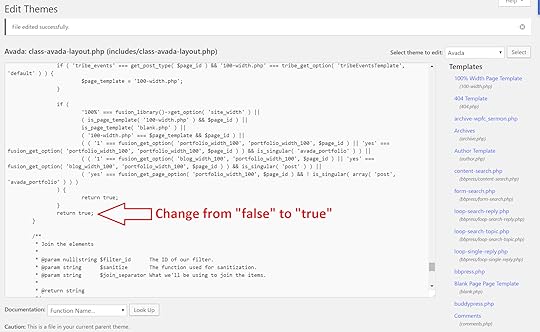
You’ll need to access the following template, which you can do from the WordPress editor:
Avada: class-avada-layout.php (includes/class-avada-layout.php)
Now scroll down and find the following php function (you can do a CTRL+F for this easily enough):
public function is_hundred_percent_template
At the very end of the function where it says return: false; change this to return: true; and you’re done.
Note: This will force all of your pages to full-width, so this fix may not be “perfect” for everyone.
However, it’s the most straightforward way to fix Avada’s asinine code injections, which wrap around any full-width “main” class wrappers you attempt to use (such as in a custom child theme template) thereby destroying your ability to go full width even with a custom template.
Feel free to let me know if you have any questions. Cheers!
The post FIXED: Woocommerce 100% Full Width on Avada appeared first on Steven Fies.