
William Eamon's Blog
January 15, 2014
The Invention of DiscoveryPart 1: Travel and Discovery in Antiquity
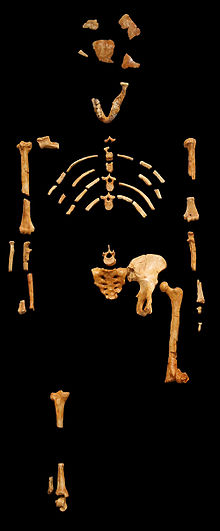
“Lucy”
[Note: This post is dedicated to my friend Jack Wright, Regents Professor of Geography at New Mexico State University, like Herodotus an inveterate traveler, like Pytheas a curious wanderer.]
Humans are by nature discoverers. Anthropologists tell us that our earliest discoveries, the ones that have been taken to define human nature—the invention of tools, for example—were in fact the discoveries of our distant ancestors. The first known pre-human tool wielder was Australopithecus afarensis, whose most famous representative was the slender, toothy, small-brained skeleton “Lucy,” discovered by Mary Leakey. So built into our DNA is the urge to discover that it’s impossible to imagine human beings without it.
But the idea of discovery—the self-conscious perception of ourselves as discoverers and advancers of knowledge—is, in the Western intellectual tradition, a relatively modern invention. In fact, it was a product of the Renaissance, an age of seemingly boundless curiosity.
Curiosity, the engine of discovery, was by no means a Renaissance invention. To travel and observe the new was something characteristically Greek as well. The prototype was Odysseus, “who wandered much, . . . who saw the cities of many men and knew their minds.” Of course, Odysseus “wandered much” not because he had embarked on an intentional expedition of discovery but because he was blown off course so many times in his journey home. Odysseus wasn’t an explorer or a man in search of discovery. He wasn’t even a traveler. He was only just a wanderer whose most earnest hope and desire was to find the way back home to the familiar surroundings of Ithaca.
The ancient Greeks considered wandering to be a regression to the natural state—a state directly the opposite of the stability and civilization for which the Athenians so prided themselves. Odysseus says, “For mortals, nothing is more wretched than wandering.” To wander was to be thrust into the realm of suffering. Fittingly, Oedipus was condemned to a life of wandering when he was exiled after being discovered as the murderer of his father and the lover of his mother.
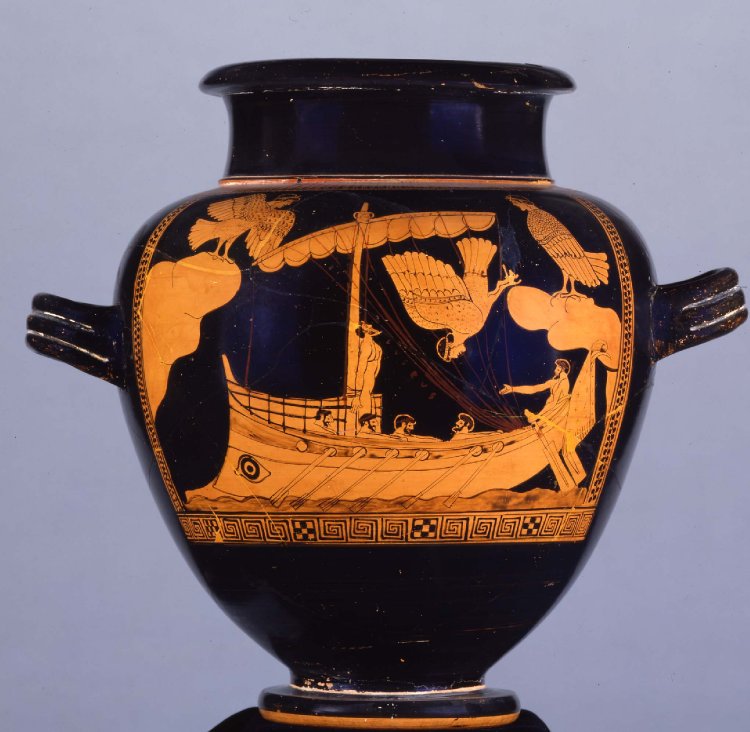
The Siren Vase, depicting the ship of Odysseus passing the Sirens(c. 480BC-470BC). British Museum.
Worse still was the wandering of madness—wandering with no return. Alienated not only from society, the madman is also alienated from himself. Orestes cries, “my mind, ungovernable, has won me over and drags me.” Like a charioteer careening off-course, Orestes feels his rebellious senses bolting, whirling him around like a conquered prey, and his mind is “borne by steeds distraught” to a desolate nowhere. Mad wandering is the compulsive response to this terrifying external agent that hunts, pursues, chases and finally possesses, the self.
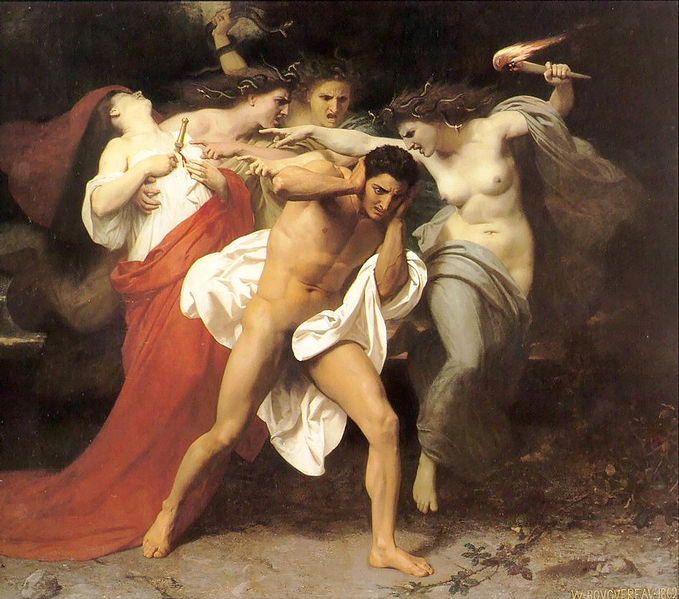
William-Adolphe Bouguereau, “Orestes Pursued by the Furies” (1862)
Herodotus, on the other hand, was an inveterate traveler. While he is often called the Father of Anthropology, Herodotus was really more of a tourist than an ethnologist. Although he was inexhaustibly curious about the world that lay beyond the Greek Peloponnese, he wasn’t interested in the strange cultures he observed in order to understand them on their own terms, but only as oddities that confirmed the correctness of the Greek view of the world. He describes flying snakes, fox-sized ants that mined gold dust, men with the heads of dogs and men with no heads at all, whose eyes are set in the middle of their chests. Yet, as with reports of the intervention of the gods, he often distances himself, remarking that he’s not sure he can believe all that he’s heard.
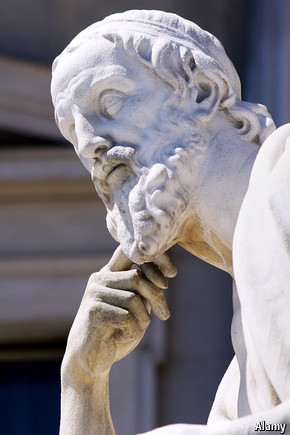
Roman copy of a Greek bust of Herodotus from the first half of the 4th century BC. Metropolitan Museum of Art
While not ethnography, Herodotus’s Histories was nevertheless a heroic attempt to push back the frontiers of knowledge, whether in customs, cultures, or nature. His project, of subjecting the world to historie, or “inquiry,” was a product of the age. He wrote the Histories around 440 BC, in the middle of the most vibrant century in the history of ancient Greece. For Horodotus and his contemporaries, living in an intellectual environment heady with a sense of discovery, seemingly infinitude of wonders awaited being identified and explained—without recourse to the supernatural.
Travel in the Mediterranean and Aegean worlds was easier for Herodotus’s generation than it had ever been before. Though never completely safe, travel in Herodotus’s day imposed fewer hardships and dangers. New roads were built; inns appeared; pilgrimages increased, producing sightseeing and tourism. The Athenians were passionate travelers. Thucydides said that young Athenians were eager to embark on the (as it would turn out disastrous) Sicilian expedition because they longed to see the sights far away from home.
In the ancient world, the Pillars of Heracles, Antiquity’s name for the two promontories that flank the entrance to the Strait of Gibraltar, symbolized the limits of knowledge. The farthermost limits reached by Heracles, whose legendary labors took him westward as far as Erythia, but no further, the Pillars of Heracles delineated the frontier of the known world. Renaissance tradition held that the pillars bore the warning Nec plus ultra (“nothing further beyond”), serving as a warning to sailors and navigators to go no further. In antiquity, the Atlantic Ocean was still a fearful place.
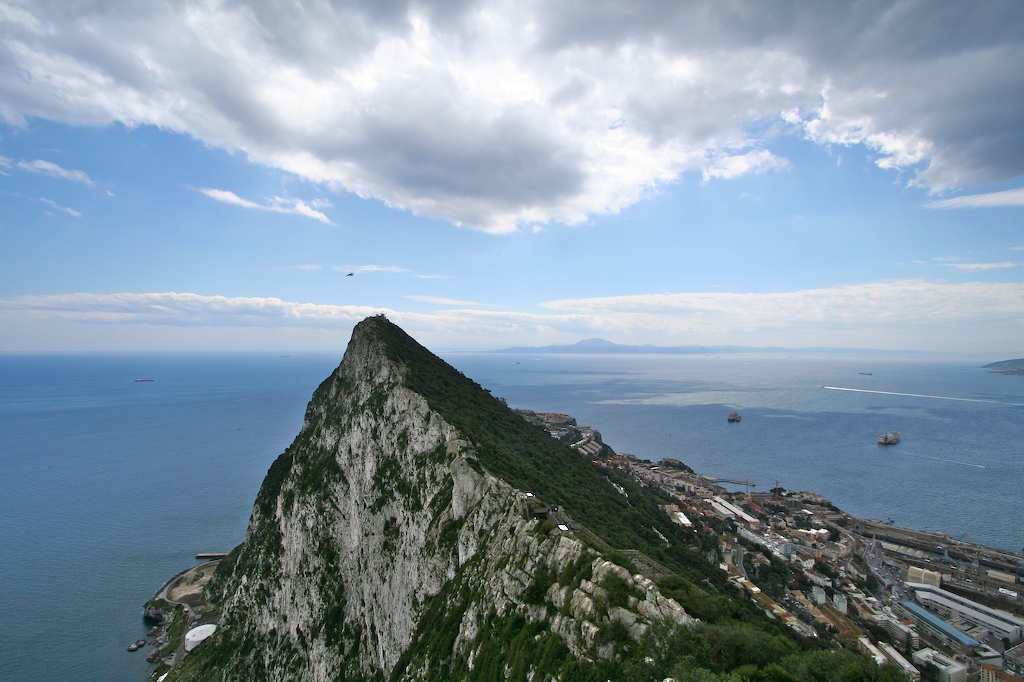
Pillars of Hercules viewed from Ceuta, Spain
A few Greeks did venture beyond the Pillars of Heracles, including some accidentally, such as Kolaios of Samos, a merchant enroute to Egypt around 630 BC, who was blown wildly off course and ended up on the southwestern coast of Iberia.
The only known “voyage of discovery” venturing beyond the Pillars of Heracles was the one undertaken by Pytheas of Massalia, a geographer and explorer from the Greek colony of Massalia (modern day Marseilles). Around 325 BC, Pytheas journeyed to northwestern Europe, becoming the first Mediterranean sailor known to have circumnavigated Britain and visited the amber coasts of the North Sea and Baltic.
Remarkably, Pytheas even reached the remote island of Thule, or Iceland, a place of frozen seas and boiling seas, where it is daylight for six months during a year, things never seen by anyone confined to the Mediterranean. Such extreme contrasts—a unique feature of Iceland—must have seemed bizarre beyond belief. Even a modern visitor to Iceland has the feeling of being on an alien planet.
Pytheas was also something of an ethnologist. His observations about the people of Thule included descriptions of storing grain in huts, gathering herbs and roots, and manufacturing mead. His ethnological survey of this distant hunter-gathering society with few domesticated animals and living barely above a subsistence level must have seemed positively exotic to the cultivated Athenians.

Statue of Pytheas outside the Palais de la Bourse, Marseilles
Returning home from his voyage, Pytheas produced a treatise titled On the Ocean. Although the work no longer survives, it was well known in antiquity. The text was cited by at least 18 Greek and Roman writers. Though only a provincial from Marseilles, Pytheas’s scientific research connected him to the Athenian world. He made his voyage during the time when Aristotle’s Lyceum flourished. Historians have speculated that he may have come to Athens and reported on his findings in the Lyceum. In fact, the first reports of Pytheas’s voyage were by Aristotle’s pupil Dicaearchus.
To the profoundly Mediterranean Greeks of the time, Pytheas’s reports of Atlantic wonders seemed barely credible. The geographer Strabo regarded rumors of the frozen land of Thule as nothing more than the “lies of Pytheas.” To Strabo, Pytheas was nothing more than a fabricator of tall tales. “Any man who has told such great falsehoods about the known regions,” he scoffed, “would hardly be able to tell the truth about places that are not known to anybody.” The historian Polybius was equally dismissive of reports of Pytheas’s voyage into the unknown.
Which of the two—the wanderer or the traveler—is the true discoverer? Since the Odyssey, world discoveries have resulted not from planned journeys to the periphery, like those a tourist makes, but of voyages that pass through the margins of the known. The ancient Greeks saw a parallel between wandering and scientific inquiry. Polybius, who made numerous voyages through the Mediterranean countries, admired Odysseus for having wandered to many places instead of gathering material from books. Like Odysseus, Polybius too is said to have “wandered over every land and sea.”
Unlike Herodotus the tourist, who went to known regions and, as American Express reminds us, “never left home without it” (that is, the comfort kit of being Greek), Pytheas wandered to places unknown, without any knowledge of what was “out there.” Like all tourists, Herodotus wore invisible blinders and tended to regard the rest of the world as being designed, however imperfectly, for the amusement and wonderment of the Greeks.
Tourists never really leave home; they bring home with them. Only wanderers discover the world.
Further Reading:
Barry Cunliffe, The Extraordinary Voyage of Pytheas the Greek (New York, 2003)
Silvia Montiglio, Wandering in Ancient Greek Culture (Chicago, 2005)
Pytheas of Marsalia, On the Ocean, edited by Christina Redman (Chicago, 1994)
Duane W. Roller, Through the Pillars of Herakles: Greco-Roman Exploration of the Atlantic (New York, 2006)
Note: In Part 2 of this post, “Curiosity and Discovery,” I shall look more closely at the idea of discovery and explore the relation between curiosity and discovery from antiquity to the Renaissance.


December 24, 2011
Kepler and the Star of Bethlehem
On the evening of the 17th of October 1604, as the clouds finally lifted over the city of Prague to reveal a clear night sky, the German astronomer Johannes Kepler observed a new star in the feet of the Constellation of Serpens.
The supernova (now known as SN 1604) burned brightly through the night and was even visible the following morning. The star blazed and glittered "like the most beautiful and glorious torch ever seen when driven by a strong wind."
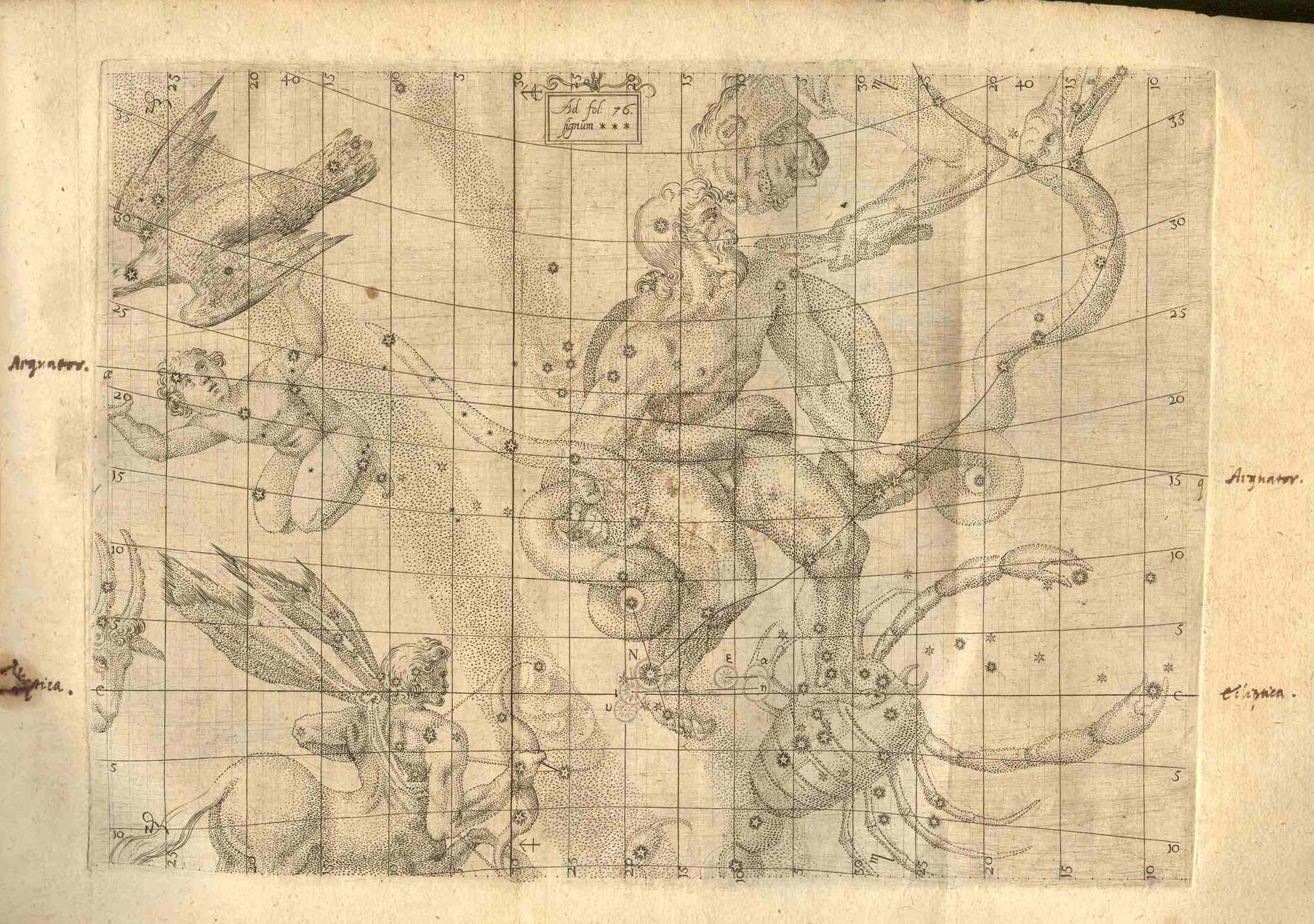
Depiction of the 1604 supernova in the constellation Serpens (labelled N in the foot, lower left) observed by Kepler (from 'De stella nova,' 1606)
Kepler, who was then serving as Imperial Mathematician to the Holy Roman Emperor Rudolf II, continued to chart the supernova for several months, making his last observation of the star a year later, after which it faded from view.
Kepler believed that the new star was a portent of deep significance. It was, he concluded, "an exceedingly wonderful work of God." In 1606, he published a pamphlet, De stella nova in Pede Serpentarii (On the New Star in the Foot of Serpens), describing his discovery.
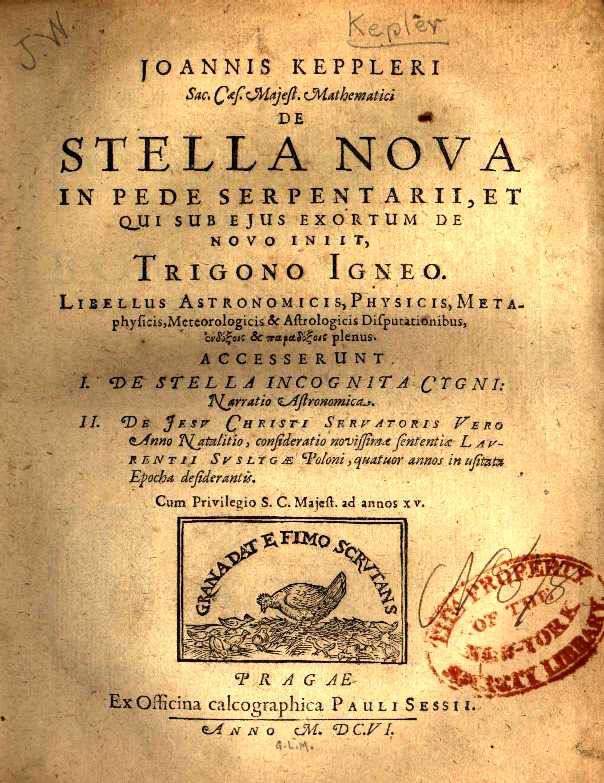
Johannes Kepler, 'De stella nova in Pede Serpentarii' (1606)
Kepler was convinced that the new star was the same as the one that the Three Kings followed on their way to Bethlehem. With somewhat tortured logic, he reasoned that the new star was the equivalent of one that appeared in the same constellation around the time of the birth of Christ. He identified the supernova with a star that appeared in a conjunction of Jupiter and Saturn during the years 7-5 B.C. Since the supernova of 1604 appeared in the same conjunction, he reasoned, it had to be the same as the Star of Bethlehem that showed the Magi the way to Jesus.
Kepler was one of the greatest scientists of the Renaissance. His discovery of the laws of planetary motion was one of the foundation stones of the Scientific Revolution. Yet he saw no inconsistency between science and religion, and was capable of deploying his mathematical genius to determine the correct birth date of Jesus.
If Kepler could believe in the Three Kings, perhaps we, even in our skeptical age, can read in the warmth and glow of this season a portent of peace, goodwill, and better times to come.
May the stars be favorable to you, and may you be as fortunate as Kepler as you gaze upon the heavens during these days and all the days of the New Year.
[I am grateful to my friend and colleague Susana Gómez, of Madrid, who in a personal communication reminded me of Kepler's discovery, thus giving me the idea for this post. Much scholarly (and non-scholarly) ink has been spilled over Kepler's interpretation of SN 1604. For a nice short piece on the subject, see Martin Kemp, "Johannes Kepler on Christmas," Nature 462, no. 7276 (December 24, 2009): 987. For a detailed discussion of the historical significance of Kepler's discovery, see Robert S. Westman, The Copernican Question: Prognostication, Skepticism, and Celestial Order (Berkeley, 2011)].
Kepler and the Star of Bethlehem
On the evening of the 17th of October 1604, as the clouds finally lifted over the city of Prague to reveal a clear night sky, the German astronomer Johannes Kepler observed a new star in the feet of the Constellation of Serpens.
The supernova (now known as SN 1604) burned brightly through the night and was even visible the following morning. The star blazed and glittered “like the most beautiful and glorious torch ever seen when driven by a strong wind.”
Depiction of the 1604 supernova in the constellation Serpens (labelled N in the foot, lower left) observed by Kepler (from ‘De stella nova,’ 1606)
Kepler, who was then serving as Imperial Mathematician to the Holy Roman Emperor Rudolf II, continued to chart the supernova for several months, making his last observation of the star a year later, after which it faded from view.
Kepler believed that the new star was a portent of deep significance. It was, he concluded, “an exceedingly wonderful work of God.” In 1606, he published a pamphlet, De stella nova in Pede Serpentarii (On the New Star in the Foot of Serpens), describing his discovery.
Johannes Kepler, 'De stella nova in Pede Serpentarii' (1606)
Kepler was convinced that the new star was the same as the one that the Three Kings followed on their way to Bethlehem. With somewhat tortured logic, he reasoned that the new star was the equivalent of one that appeared in the same constellation around the time of the birth of Christ. He identified the supernova with a star that appeared in a conjunction of Jupiter and Saturn during the years 7-5 B.C. Since the supernova of 1604 appeared in the same conjunction, he reasoned, it had to be the same as the Star of Bethlehem that showed the Magi the way to Jesus.
Kepler was one of the greatest scientists of the Renaissance. His discovery of the laws of planetary motion was one of the foundation stones of the Scientific Revolution. Yet he saw no inconsistency between science and religion, and was capable of deploying his mathematical genius to determine the correct birth date of Jesus.
If Kepler could believe in the Three Kings, perhaps we, even in our skeptical age, can read in the warmth and glow of this season a portent of peace, goodwill, and better times to come.
May the stars be favorable to you, and may you be as fortunate as Kepler as you gaze upon the heavens during these days and all the days of the New Year.
[Note: I am grateful to my friend and colleague Susana Gómez, of Madrid, who in a personal communication reminded me of Kepler’s discovery, thus giving me the idea for this post. Much scholarly (and non-scholarly) ink has been spilled over Kepler’s interpretation of SN 1604. For a nice short piece on the subject, see Martin Kemp, “Johannes Kepler on Christmas,” Nature 462, no. 7276 (December 24, 2009): 987. For a detailed discussion of the historical significance of Kepler’s discovery, see Robert S. Westman, The Copernican Question: Prognostication, Skepticism, and Celestial Order (Berkeley, 2011)].
November 27, 2011
Renaissance Astrology and the Vagaries of Markets
J. P. Morgan is supposed to have said, "Millionaires don't use astrology; billionaires do."
Morgan would have known. He hired the best astrologer money could buy, the famous Evangeline Adams, whose clients also included Enrico Caruso, J. Paul Getty, Wallis Simpson, and Mary Pickford.
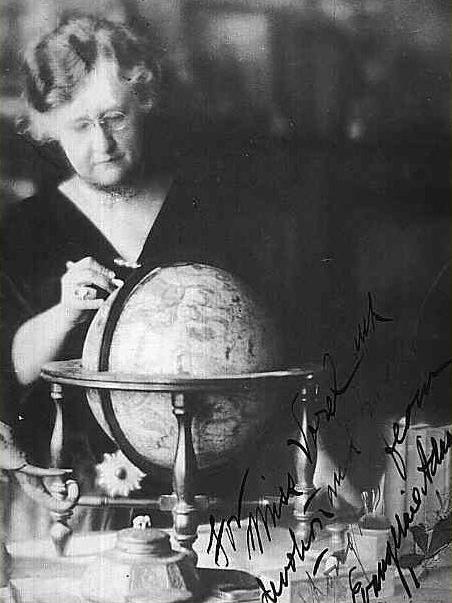
Evangeline Adams, the twentieth century's most famous astrologer
Operating out of a suite in the Carnegie Hall Building, Adams is said to have predicted the duration of Lindbergh's transatlantic flight within 22 minutes, forecast the stock market crash of '29, and guessed Rudolf Valentino's death within a few hours. A shameless self-promoter, the matronly Adams would dress up as a gypsy and read palms at clubs and private parties. She charged $50 for a 30-minute consultation and employed a brigade of secretaries to type up mail-order readings for her out-of-town clients. In 1914, Adams won a highly publicized court case that had challenged her right to practice astrology as a profession.
Morgan was hardly the first billionaire (or would-be billionaire) to consult an astrologer; nor would he be the last. In fact, merchants and bankers had been seeking the help of astrologers at least since the Renaissance. In that age of unparalleled mercantile opportunity and incalculable risk, businessmen sought every conceivable way of predicting market fluctuations.
Trade in East Asian spices was the mother lode in the Renaissance, and pepper was its black gold. Of all the East Asian spices, pepper was by far the most widely used. Once a costly and rare spice that graced only the tables of the wealthy, by the sixteenth century pepper was considered the "seasoning of rustics," fit even for the lowly beans and peas of peasants. Though no longer exotic and fashionable, due to its huge demand pepper still fetched exorbitant prices.
A Portuguese monopoly, the pepper trade could net astonishing profits while risking ruinous losses: it was no business for the timid. Yet, because the price of pepper was incalculable and jumpy, trade in the commodity offered unparalleled opportunities for speculators.
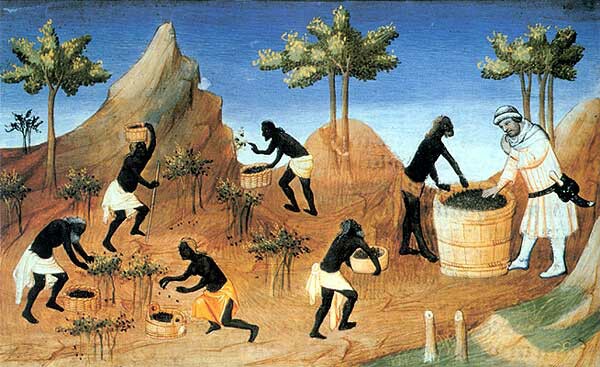
Harvesting pepper in Asia, from a French manuscript of the 'Book of Travels of Marco Polo' (Paris, Bibliothèque Nationale, Ms Français 2810 folio 84)
All of this contributed to making commodity trading in cities like Antwerp, one of the centers of the northern European spice trade, an extremely hazardous enterprise. Spice traders often bought cargoes while still at sea, giving the King of Portugal (who always needed the money), large advances, and repaid themselves by charging high prices. Any mistake in guessing at future prices could be disastrous. Where was a merchant to turn for aid in such uncertain circumstances?
Naturally, to an astrologer.
That seems to have been the case with the Lienhard Tucher, a highly respected German commodities trader in Antwerp. In the 1540s, Tucher corresponded with a Nuremberg astrologer named Christopher Kurz, who claimed to have devised an astrological system by which he could foretell the prices of pepper and other spices.
"Trade in spices requires great foresight," Kurz informed Tucher. Though himself a professional astrologer, Kurz warned the merchant against consulting his competitors: "For our astrologers aforetime have written much, but little with reason." Kurz preferred to find his own rules by experiment. After three years of searching, he claimed, he had discovered a system for predicting a fortnight in advance the prices of pepper, ginger, and saffron. "I think God has given it to me," he told Tucher. "In the same manner I have known how to show for the matter as touching cinnamon, nutmegs and cloves from one market to another." Kurz assured Tucher that his system was already in use in many business houses in Antwerp.
That, evidently, was enough for Tucher. The merchant was convinced. He diligently followed Kurz's advice and became a highly successful commodities trader—although how much he owed his success to Kurz's prognostications we do not know. Tucher even inquired about the Infante Philip (later Philip II), sending Kurz exact details concerning his birthday. Kurz cast a sad horoscope. "A worse nativity hath not come to one this year past," he wrote; then, in the same breath, continued, "Cloves will be profitable and it could do no damage to make trial with eight or ten sacks."
Tucher was hardly an isolated example of a Renaissance businessman turning to an astrologer for advice. Venetian merchants consulted experts such as Bartolomeo Raines, a specialist in geomancy and astrology, for help in predicting market fluctuations. Another astrologer, the friar Aurelio di Siena, was brought before the Venetian Inquisition on charges, among others, of using astrology to determine "whether merchants would have good fortune on their expeditions."
Anxious merchants and ship-owners routinely sent for astrologers when a cargo ship was delayed. When a merchant planned a voyage to a distant market town, he would in all likelihood have consulted an astrologer to choose the appropriate day to embark. Astrologers even answered questions about the risk of pirates.
Today's mercants and financiers turn to other experts—such as economists—for many of the same answers. In his biography of the Renaissance astrologer and polymath Girolamo Cardano, Anthony Grafton makes a revealing parallel between the social roles of the Renaissance astrologer and the modern economist:
Like the economist, the astrologer tried to bring the chaotic phenomena of everyday life into order by fitting them to sharply defined quantitative models. Like the economist, the astrologer insisted, when teaching or writing for professional peers, that astrology had only a limited ability to predict the futures. Like the economist, the astrologer generally found that the events did not match the prediction; and like the economist, the astrologer normally received as a reward for the confirmation of the powers of his art a better job and higher salary.
The similarities do not end there, however. Just as cutthroat competition among astrologers defined the Renaissance practice of the art, today's economists encounter fierce disagreements among their ranks. Economists disagree over policy, prediction, and matters of theory. They even disagree about why they disagree. Christopher Kurz's warning against competitors has an almost exact parallel in today's arguments among economists about whether stimulus or austerity is the better path to getting us out of the current recession.
Renaissance astrologers provided a host of services that no other experts could provide. They served a plethora of servant girls asking about future husbands, widows wondering whether or not to remarry, men asking how rich their proposed brides were (or whether they were virgins), wives and husbands wondering whether their spouses were cheating on them, fathers and mothers inquiring about the life expectancies of their children. Practically every conceivable kind of domestic problem, question, or entanglement was vetted in the astrologer's consulting room.
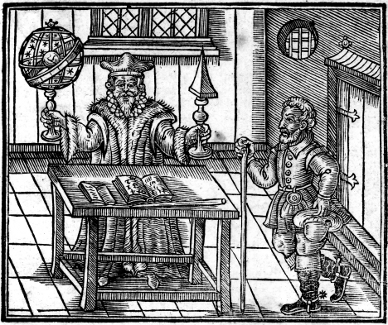
The astrologer's consulting room. Frontispiece to to John Melton, 'Astrologaster' (1620).
In the absence of experts such as economists, marriage counselors, and financial advisors, Renaissance people turned to astrologers, because there was nowhere else to turn. In a chancy world where the "human factor" continually befuddles our best predictions, it's fair to ask: are we, with our experts, much better off?
SELECTED REFERENCES
Richard Ehrenberg, Capital & Finance in the Age of the Renaissance: A Study of the Fuggers and their Connections, translated by H. M. Lucas (New York, 1928).
Guido Ruggiero, Binding Passions. Tales of Magic, Marriage, and Power at the End of the Renaissance (Oxford: 1993).
Jack Turner, Spice: The History of a Temptation (New York, 2004).
Renaissance Astrology and the Vagaries of Markets
J. P. Morgan is supposed to have said, “Millionaires don’t use astrology; billionaires do.”
Morgan would have known. He hired the best astrologer money could buy, the famous Evangeline Adams, whose clients also included Enrico Caruso, J. Paul Getty, Wallis Simpson, and Mary Pickford.
Evangeline Adams, the twentieth century’s most famous astrologer
Operating out of a suite in the Carnegie Hall Building, Adams is said to have predicted the duration of Lindbergh’s transatlantic flight within 22 minutes, forecast the stock market crash of ’29, and guessed Rudolf Valentino’s death within a few hours. A shameless self-promoter, the matronly Adams would dress up as a gypsy and read palms at clubs and private parties. She charged $50 for a 30-minute consultation and employed a brigade of secretaries to type up mail-order readings for her out-of-town clients. In 1914, Adams won a highly publicized court case that had challenged her right to practice astrology as a profession.
Morgan was hardly the first billionaire (or would-be billionaire) to consult an astrologer; nor would he be the last. In fact, merchants and bankers had been seeking the help of astrologers at least since the Renaissance. In that age of unparalleled mercantile opportunity and incalculable risk, businessmen sought every conceivable way of predicting market fluctuations.
Trade in East Asian spices was the mother lode in the Renaissance, and pepper was its black gold. Of all the East Asian spices, pepper was by far the most widely used. Once a costly and rare spice that graced only the tables of the wealthy, by the sixteenth century pepper was considered the “seasoning of rustics,” fit even for the lowly beans and peas of peasants. Though no longer exotic and fashionable, due to its huge demand pepper still fetched exorbitant prices.
A Portuguese monopoly, the pepper trade could net astonishing profits while risking ruinous losses: it was no business for the timid. Yet, because the price of pepper was incalculable and jumpy, trade in the commodity offered unparalleled opportunities for speculators.
Harvesting pepper in Asia, from a French manuscript of the ‘Book of Travels of Marco Polo’ (Paris, Bibliothèque Nationale, Ms Français 2810 folio 84)
All of this contributed to making commodity trading in cities like Antwerp, one of the centers of the northern European spice trade, an extremely hazardous enterprise. Spice traders often bought cargoes while still at sea, giving the King of Portugal (who always needed the money), large advances, and repaid themselves by charging high prices. Any mistake in guessing at future prices could be disastrous. Where was a merchant to turn for aid in such uncertain circumstances?
Naturally, to an astrologer.
That seems to have been the case with the Lienhard Tucher, a highly respected German commodities trader in Antwerp. In the 1540s, Tucher corresponded with a Nuremberg astrologer named Christopher Kurz, who claimed to have devised an astrological system by which he could foretell the prices of pepper and other spices.
“Trade in spices requires great foresight,” Kurz informed Tucher. Though himself a professional astrologer, Kurz warned the merchant against consulting his competitors: “For our astrologers aforetime have written much, but little with reason.” Kurz preferred to find his own rules by experiment. After three years of searching, he claimed, he had discovered a system for predicting a fortnight in advance the prices of pepper, ginger, and saffron. “I think God has given it to me,” he told Tucher. “In the same manner I have known how to show for the matter as touching cinnamon, nutmegs and cloves from one market to another.” Kurz assured Tucher that his system was already in use in many business houses in Antwerp.
That, evidently, was enough for Tucher. The merchant was convinced. He diligently followed Kurz’s advice and became a highly successful commodities trader—although how much he owed his success to Kurz’s prognostications we do not know. Tucher even inquired about the Infante Philip (later Philip II), sending Kurz exact details concerning his birthday. Kurz cast a sad horoscope. “A worse nativity hath not come to one this year past,” he wrote; then, in the same breath, continued, “Cloves will be profitable and it could do no damage to make trial with eight or ten sacks.”
Tucher was hardly an isolated example of a Renaissance businessman turning to an astrologer for advice. Venetian merchants consulted experts such as Bartolomeo Raines, a specialist in geomancy and astrology, for help in predicting market fluctuations. Another astrologer, the friar Aurelio di Siena, was brought before the Venetian Inquisition on charges, among others, of using astrology to determine “whether merchants would have good fortune on their expeditions.”
Anxious merchants and ship-owners routinely sent for astrologers when a cargo ship was delayed. When a merchant planned a voyage to a distant market town, he would in all likelihood have consulted an astrologer to choose the appropriate day to embark. Astrologers even answered questions about the risk of pirates.
Today’s merchants and financiers turn to other experts—such as economists—for many of the same answers. In his biography of the Renaissance astrologer and polymath Girolamo Cardano, Anthony Grafton makes a revealing parallel between the social roles of the Renaissance astrologer and the modern economist:
Like the economist, the astrologer tried to bring the chaotic phenomena of everyday life into order by fitting them to sharply defined quantitative models. Like the economist, the astrologer insisted, when teaching or writing for professional peers, that astrology had only a limited ability to predict the futures. Like the economist, the astrologer generally found that the events did not match the prediction; and like the economist, the astrologer normally received as a reward for the confirmation of the powers of his art a better job and higher salary.
The similarities do not end there, however. Just as cutthroat competition among astrologers defined the Renaissance practice of the art, today’s economists encounter fierce disagreements among their ranks. Economists disagree over policy, prediction, and matters of theory. They even disagree about why they disagree. Christopher Kurz’s warning against competitors has an almost exact parallel in today’s arguments among economists about whether stimulus or austerity is the better path to getting us out of the current recession.
Renaissance astrologers provided a host of services that no other experts could provide. They served a plethora of servant girls asking about future husbands, widows wondering whether or not to remarry, men asking how rich their proposed brides were (or whether they were virgins), wives and husbands wondering whether their spouses were cheating on them, fathers and mothers inquiring about the life expectancies of their children. Practically every conceivable kind of domestic problem, question, or entanglement was vetted in the astrologer’s consulting room.
The astrologer’s consulting room. Frontispiece to to John Melton, ‘Astrologaster’ (1620).
In the absence of experts such as economists, marriage counselors, and financial advisors, Renaissance people turned to astrologers, because there was nowhere else to turn. In a chancy world where the “human factor” continually befuddles our best predictions, it’s fair to ask: are we, with our experts, much better off?
SELECTED REFERENCES
Richard Ehrenberg, Capital & Finance in the Age of the Renaissance: A Study of the Fuggers and their Connections, translated by H. M. Lucas (New York, 1928).
Anthony Grafton, Cardano’s Cosmos: The Worlds and Works of a Renaissance Astrologer (Cambridge, MA, 1999).
Guido Ruggiero, Binding Passions. Tales of Magic, Marriage, and Power at the End of the Renaissance (Oxford: 1993).
Jack Turner, Spice: The History of a Temptation (New York, 2004).
November 20, 2011
Astrology and Prophecy in the Renaissance
The biggest media event of the sixteenth century occurred in 1523-24, when scores of astrologers jumped onto a bandwagon of collective hysteria by proclaiming the imminent end of the world. The final days, the astrologers announced, would occur as a result of a second Deluge brought on by a conjunction of the three upper planets, Jupiter, Saturn, and Mars, in the sign of Pisces.
News of the prophecy spread quickly through sermons, broadsides, and almanacs. More than 160 works by 56 different authors weighed in on the dire prognostication, either by offering astrological evidence confirming the prophecy or denouncing it as a mad delusion. In January 1524 the Venetian chronicler Marin Sanudo reported that the mainland "is in great fear" over the impending catastrophe.
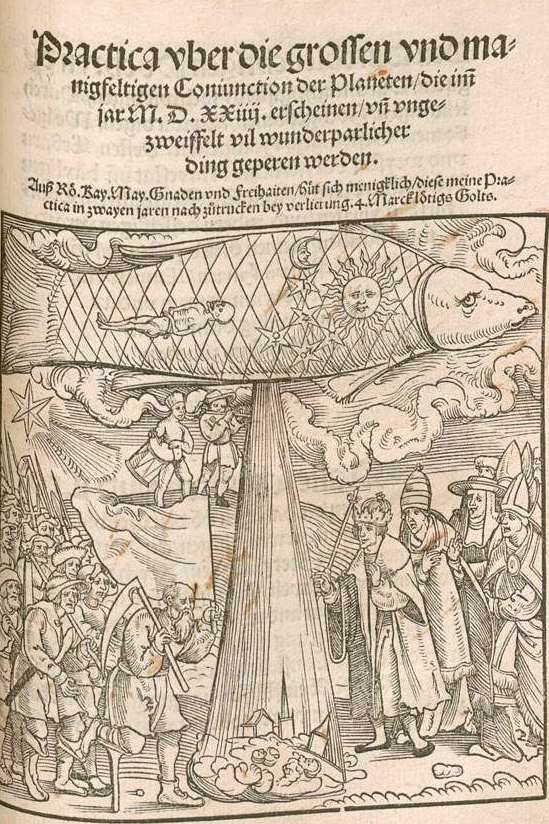
The great conjunction in Pisces, portending a second deluge. Leonhard Reinman, Practica uber die grossen und manigfeltigen Coniunction der Planeten (Nuremberg, 1524)
As intellectuals debated, people all over Europe frantically moved their places of residence in anticipation of the deluge. In Toulouse, a president of the parliament anxiously built an ark upon a mountaintop. Year by year as the dreaded date approached, apprehension increased and the prophecies grew more ominous. In a 1523 tract, the German astrologer Leonhard Reinmann predicted not only a great deluge but also a general uprising of peasants and common people. In Rome, general panic broke out.
Of course, the great flood never materialized. Torrential rains fell in some parts of Italy, but civilization was not swept away by the floods that ensued. Other parts of Europe remained dry. Yet the incident illustrates the extraordinary power that astrological prognostications held over intellectuals and common people alike.
The failure of this prophecy, upon which so many astrologers staked their professional careers, some scholars have argued, severely damaged the social authority of astrology. Some historians have suggested that the failure of the 1524 prophecy to materialize was one of the signal events determining astrology's demise.
If that was the case, the end was a long time coming. Signs in the heavens continued to convey great significance down through the end of the seventeenth century. Astrology flourished in the Renaissance because it made sense to people and offered the power to predict the future, however imperfectly, in uncertain times.
The times were ripe for a groundswell of apocalyptic prophecies. The Black Death, famine, religious crisis, and political instability created a climate in which intense hopes and fears for the future took hold. The sense of historical crisis spawned innumerable predictions of the world's end. By the time of the Great Schism (1378-1414), apocalyptic ideas were rife in Western Europe.
The Great Schism, when the papacy was divided between opposing "obediences" and two, then three rival popes claimed to lead the church, stirred up fervent expectations of the proximity of Antichrist's reign. Countless apocalyptic visions and prophecies circulated. To many, the division of Christendom was a preamble to the advent of Antichrist.
Not everyone concurred. Initially Pierre d'Ailly, who was chancellor of the University of Paris from 1389 to 1395, agreed with those who saw the Schism as a sign of the approaching end of the world. But as the fissure widened, d'Ailly worried that the apocalyptic interpretation of the Schism served only to widen the rupture in the body of Christendom.
Turning to astrology for insights, D'Ailly, came to the conclusion that the return of the Antichrist would not occur until 1789, "if the world shall last that long." Armed with this astrological knowledge, d'Ailly could refute the false prophets and visionaries, postpone the apocalypse to the distant future, and get on with the task at hand of healing the Schism.
While for d'Ailly astrology tempered the exuberant predictions of the apocalypse, others saw in the stars dire prophecies for Christendom. Despite the denunciations of astrology by Protestant reformers, including both Luther and Calvin, the sixteenth century was a veritable golden age of astrological prophecy. Indeed, Lutheran Germany was one of the hot spots of prophetic astrology.
The Reformation heightened society's anticipation of the end of days. By making Scripture more generally accessible to readers, the reformers riveted the attention of believers on prophetic passages in the books of Daniel and Revelation, which they searched with ever-greater care for insights into the relationship between the present and the future
Johann Lichtenberger, one of Germany's most prominent stargazers, churned out a string of prognostications in the 1470s and 1480s that continued to be published in German and Latin down through the sixteenth century. (Lichtenberger was most remembered for having predicted the German Peasants' War of 1524-1525.) By 1600, some 60 editions of Lichtenberg's Pronosticatio of 1488—one of ten astrological publications by him that survive—had been published.
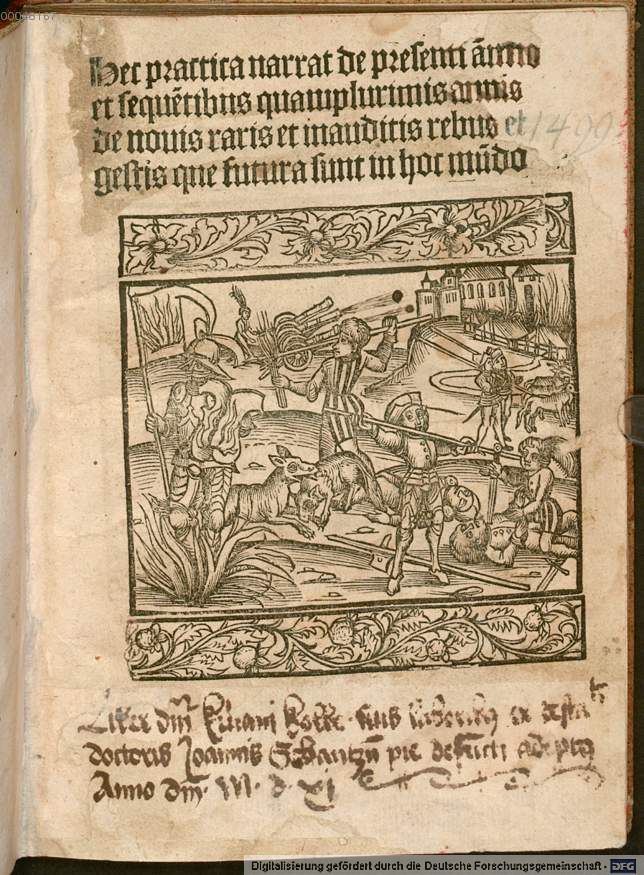
Johannes Lichtenberger, Prognosticatio (1492)
Even Luther couldn't stem the tide of Lichtenberger's growing popularity: despite giving astrology a cold shoulder, he published a German edition of Lichtenberg's prophecies in 1527, adding a preface spelling out his own position on the art. Luther denounced Lichtenberger as a false prophet intent on sowing confusion among rulers with his vague hints of future happenings.
In the second half of the sixteenth century, astrologers everywhere were pointing to signs in the skies that indicated deterioration and chaos so pronounced that it could only culminate in the end of the world. Tensions increased when, in 1572, a new star appeared in the heavens—the first since the star of Bethlehem announcing the birth of Christ. A few years later, in 1577, a bright comet blazed through the night sky, carrying all sorts of eschatological messages.
Soon astrologers were warning of another, far more ominous event looming on the horizon. In 1583, a rare conjunction of the superior planets Saturn and Jupiter would occur.
The reason why this conjunction was so menacing is that it was predicted to happen at the end of the "watery trigon" (comprised of the signs linked to water, Pisces, Cancer, and Scorpio), and at the beginning of the "fiery trigon," the triplicity defined by the fiery signs of Aries, Leo, and Sagittarius. So exceptional was the fiery trigon conjunction that many astrologers connected it with an old prophecy for the year 1588 predicting major upheavals and the end of the world.
The European fascination with the Wonder Year of 1588 can be traced back to the supposed discovery among the papers of the German astronomer Regiomontanus (Johannes Müller) of a doggerel verse predicting great calamities for that year, which he was alleged to have scribbled on a leaf of paper.
Regiomontanus's prediction was probably a fabrication, though this hardly seems to have mattered at the time. Once published in 1553, the prophecy was quickly endorsed by leading astrologers, including the Bohemian astronomer Cyprian Leowitz. In his De coniunctionibus magnis insignioribus superiorum planetarum (1564), Leowitz offered his interpretation of the conjunction's significance: "Since . . . a new trigon, which is the fiery, is now imminent, undoubtedly new worlds will follow, which will be inaugurated by sudden and violent changes." Leowitz went on to proclaim that the conjunction "undoubtedly announces the second coming of the son of God."
The predicted fiery trigon conjunction spawned a huge body of prophetic literature, and the prophecies it generated were remembered long after the conjunction had come and gone. The message of the prophecies was clear, unmistakable, and always the same: The end is nigh; repent and do penance; turn to God while there was still time
As in 1524, the annus mirabilis came and went without calamitous results—much less the Second Coming. Astrologers, who had gone out on a limb predicting the end of the world, became the butt of ridicule. Philip Stubbes, in his Anatomy of Abuses (1583) chided the "foolish star tooters," whose "presumptuous audacity and rash boldness . . . brought the world into such wonderful perplexity." Henry Howard, Earl of Northampton, wrote that the astrologers should be shunned "like a dragon's den.
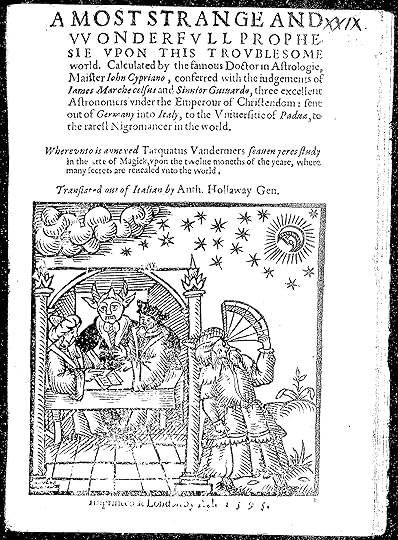
Prophecies of doom traveled well in the sixteenth century, traversing both geographical borders and social class lines. In 1595, many of them were collected in a pamphlet published by the London printer Abel Jeffes titled A Most Strange and Wonderfull Prophesie upon this Troublesome World. In his pamphlet, which included some of the more sensational German prognostications updated for the times, Jeffes cobbled a multitude of heavenly portents, all meant to "move us to a penitent life that God may withhold his grievous scourge from us."
According to some historians, astrology also fueled religious wars in France. Denis Crouzet, in his magisterial work, Les guerriers de Dieu, argues that an "intelligentsia of prophets" in sixteenth-century France created a "climate of anguish" among Catholics and encouraged them to implement Divine vengeance directly on the all-too-visible heretics around them. According to Crouzet, the extravagant rituals of violence and destruction that characterized the religious wars in France may be directly attributed to the "eschatological anguish" that resulted from the astrological prognostications.
The sixteenth century was an anxious age. Europeans trembled before the uncertainty surrounding death, the deterioration of social relationships, lingering questions about spiritual judgment, and the breakdown of the medieval cosmos, which had created an order seemingly rooted in the eternal principles of nature.
In the face of dissolving certainties, people turned to astrologers to find a pathway and guide to an indeterminate future. Whether it was to find a lost child, ascertain the most propitious moment take a journey, or determine the best time to start a business, astrology gave answers to questions that still vex humans. Even if the astrologer's report was disappointing or grim, perhaps the news itself provided some relief and brought closure to nagging doubts.
While astrology might have given assurance in certain of life's arenas, it also contributed to the anxieties of the time. Astrological prophecies of doom and the apocalypse may have been intended to encourage people to repent and prepare themselves for the end of days; but they cannot have provided much comfort in the face of the uncertainties surrounding their own life and death.
Ironically, astrology both confirmed the popular belief that humans are part of a larger whole and hence that their actions are not merely the result of chance or whim; and, at the same time, contributed to the heightened anxiety that would become a permanent feature of western culture.
Note: This post is adapted from my essay, "Astrology in Renaissance Society," to be published in Astrology in the Renaissance, edited by Brendan Dooley (Brill).
SELECTED BIBLIOGRAPHY
Margaret Aston, "The Fiery Trigon Conjunction: An Elizabethan Astrological Prediction." Isis 61 (1970): 159-87.
Robin Bruce Barnes, Prophecy and Gnosis. Apocalypticism in the Wake of the Lutheran Reformation. Stanford: 1988.
William J. Bouwsma, "Anxiety and the Formation of Early Modern Culture," in A Usable Past: Essays in European Cultural History (Berkeley, 1990), pp. 157-89.
Denis Crouzet, Les guerriers de Dieu : la violence au temps des troubles de religion, vers 1525-vers 1610. Seyssel: 2005.
C. Scott Dixon, "Popular Astrology and Lutheran Propaganda in Reformation Germany." History 84 (1999): 403-18.
Laura A. Smoller, History, Prophecy, and the Stars: The Christian Astrology of Pierre D'Ailly, 1350-1420 (Princeton, 1994).
November 19, 2011
Astrology and Prophecy in the Renaissance
The biggest media event of the sixteenth century occurred in 1523-24, when scores of astrologers jumped onto a bandwagon of collective hysteria by proclaiming the imminent end of the world. The final days, the astrologers announced, would occur as a result of a second Deluge brought on by a conjunction of the three upper planets, Jupiter, Saturn, and Mars, in the sign of Pisces.
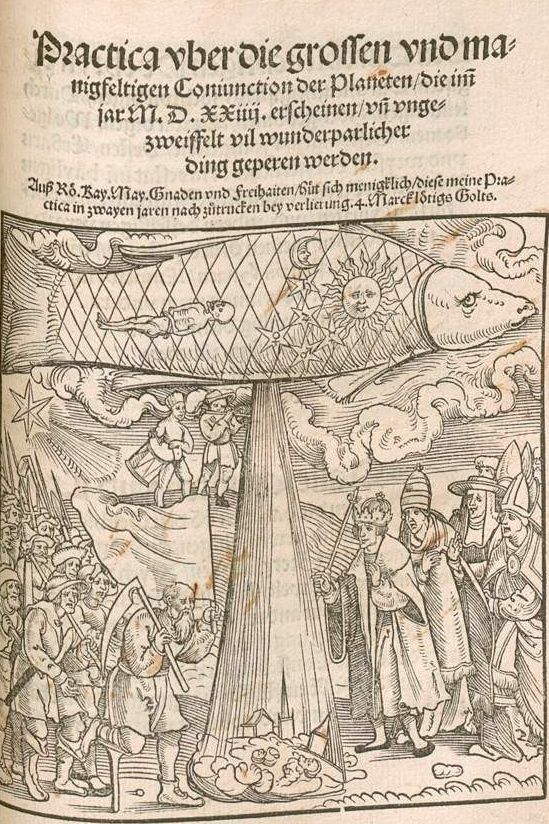
The great conjunction in Pisces, portending a second deluge. Leonhard Reinman, Practica uber die grossen und manigfeltigen Coniunction der Planeten (Nuremberg, 1524)
News of the prophecy spread quickly through sermons, broadsides, and almanacs. More than 160 works by 56 different authors weighed in on the dire prognostication, either by offering astrological evidence confirming the prophecy or denouncing it as a mad delusion. In January 1524 the Venetian chronicler Marin Sanudo reported that the mainland “is in great fear” over the impending catastrophe.
As intellectuals debated, people all over Europe frantically moved their places of residence in anticipation of the deluge. In Toulouse, a president of the parliament anxiously built an ark upon a mountaintop. Year by year as the dreaded date approached, apprehension increased and the prophecies grew more ominous. In a 1523 tract, the German astrologer Leonhard Reinmann predicted not only a great deluge but also a general uprising of peasants and common people. In Rome, general panic broke out.
Of course, the great flood never materialized. Torrential rains fell in some parts of Italy, but civilization was not swept away by the floods that ensued. Other parts of Europe remained dry. Yet the incident illustrates the extraordinary power that astrological prognostications held over intellectuals and common people alike.
The failure of this prophecy, upon which so many astrologers staked their professional careers, some scholars have argued, severely damaged the social authority of astrology. Some historians have suggested that the failure of the 1524 prophecy to materialize was one of the signal events determining astrology’s demise.
If that was the case, the end was a long time coming. Signs in the heavens continued to convey great significance down through the end of the seventeenth century. Astrology flourished in the Renaissance because it made sense to people and offered the power to predict the future, however imperfectly, in uncertain times.
The times were ripe for a groundswell of apocalyptic prophecies. The Black Death, famine, religious crisis, and political instability created a climate in which intense hopes and fears for the future took hold. The sense of historical crisis spawned innumerable predictions of the world’s end. By the time of the Great Schism (1378-1414), apocalyptic ideas were rife in Western Europe.
The Great Schism, when the papacy was divided between opposing “obediences” and two, then three rival popes claimed to lead the church, stirred up fervent expectations of the proximity of Antichrist’s reign. Countless apocalyptic visions and prophecies circulated. To many, the division of Christendom was a preamble to the advent of Antichrist.
Not everyone concurred. Initially Pierre d’Ailly, who was chancellor of the University of Paris from 1389 to 1395, agreed with those who saw the Schism as a sign of the approaching end of the world. But as the fissure widened, d’Ailly worried that the apocalyptic interpretation of the Schism served only to widen the rupture in the body of Christendom.
Turning to astrology for insights, D’Ailly, came to the conclusion that the return of the Antichrist would not occur until 1789, “if the world shall last that long.” Armed with this astrological knowledge, d’Ailly could refute the false prophets and visionaries, postpone the apocalypse to the distant future, and get on with the task at hand of healing the Schism.
While for d’Ailly astrology tempered the exuberant predictions of the apocalypse, others saw in the stars dire prophecies for Christendom. Despite the denunciations of astrology by Protestant reformers, including both Luther and Calvin, the sixteenth century was a veritable golden age of astrological prophecy. Indeed, Lutheran Germany was one of the hot spots of prophetic astrology.
The Reformation heightened society’s anticipation of the end of days. By making Scripture more generally accessible to readers, the reformers riveted the attention of believers on prophetic passages in the books of Daniel and Revelation, which they searched with ever-greater care for insights into the relationship between the present and the future
Johann Lichtenberger, one of Germany’s most prominent stargazers, churned out a string of prognostications in the 1470s and 1480s that continued to be published in German and Latin down through the sixteenth century. (Lichtenberger was most remembered for having predicted the German Peasants’ War of 1524-1525.) By 1600, some 60 editions of Lichtenberg’s Pronosticatio of 1488—one of ten astrological publications by him that survive—had been published.
Johannes Lichtenberger, Prognosticatio (1492)
Even Luther couldn’t stem the tide of Lichtenberger’s growing popularity: despite giving astrology a cold shoulder, he published a German edition of Lichtenberg’s prophecies in 1527, adding a preface spelling out his own position on the art. Luther denounced Lichtenberger as a false prophet intent on sowing confusion among rulers with his vague hints of future happenings.
In the second half of the sixteenth century, astrologers everywhere were pointing to signs in the skies that indicated deterioration and chaos so pronounced that it could only culminate in the end of the world. Tensions increased when, in 1572, a new star appeared in the heavens—the first since the star of Bethlehem announcing the birth of Christ. A few years later, in 1577, a bright comet blazed through the night sky, carrying all sorts of eschatological messages.
Soon astrologers were warning of another, far more ominous event looming on the horizon. In 1583, a rare conjunction of the superior planets Saturn and Jupiter would occur.
The reason why this conjunction was so menacing is that it was predicted to happen at the end of the “watery trigon” (comprised of the signs linked to water, Pisces, Cancer, and Scorpio), and at the beginning of the “fiery trigon,” the triplicity defined by the fiery signs of Aries, Leo, and Sagittarius. So exceptional was the fiery trigon conjunction that many astrologers connected it with an old prophecy for the year 1588 predicting major upheavals and the end of the world.
The European fascination with the Wonder Year of 1588 can be traced back to the supposed discovery among the papers of the German astronomer Regiomontanus (Johannes Müller) of a doggerel verse predicting great calamities for that year, which he was alleged to have scribbled on a leaf of paper.
Regiomontanus’s prediction was probably a fabrication, though this hardly seems to have mattered at the time. Once published in 1553, the prophecy was quickly endorsed by leading astrologers, including the Bohemian astronomer Cyprian Leowitz. In his De coniunctionibus magnis insignioribus superiorum planetarum (1564), Leowitz offered his interpretation of the conjunction’s significance: “Since . . . a new trigon, which is the fiery, is now imminent, undoubtedly new worlds will follow, which will be inaugurated by sudden and violent changes.” Leowitz went on to proclaim that the conjunction “undoubtedly announces the second coming of the son of God.”
The predicted fiery trigon conjunction spawned a huge body of prophetic literature, and the prophecies it generated were remembered long after the conjunction had come and gone. The message of the prophecies was clear, unmistakable, and always the same: The end is nigh; repent and do penance; turn to God while there was still time
As in 1524, the annus mirabilis came and went without calamitous results—much less the Second Coming. Astrologers, who had gone out on a limb predicting the end of the world, became the butt of ridicule. Philip Stubbes, in his Anatomy of Abuses (1583) chided the “foolish star tooters,” whose “presumptuous audacity and rash boldness . . . brought the world into such wonderful perplexity.” Henry Howard, Earl of Northampton, wrote that the astrologers should be shunned “like a dragon’s den.
Prophecies of doom traveled well in the sixteenth century, traversing both geographical borders and social class lines. In 1595, many of them were collected in a pamphlet published by the London printer Abel Jeffes titled A Most Strange and Wonderfull Prophesie upon this Troublesome World. In his pamphlet, which included some of the more sensational German prognostications updated for the times, Jeffes cobbled a multitude of heavenly portents, all meant to “move us to a penitent life that God may withhold his grievous scourge from us.”
According to some historians, astrology also fueled religious wars in France. Denis Crouzet, in his magisterial work, Les guerriers de Dieu, argues that an “intelligentsia of prophets” in sixteenth-century France created a “climate of anguish” among Catholics and encouraged them to implement Divine vengeance directly on the all-too-visible heretics around them. According to Crouzet, the extravagant rituals of violence and destruction that characterized the religious wars in France may be directly attributed to the “eschatological anguish” that resulted from the astrological prognostications.
The sixteenth century was an anxious age. Europeans trembled before the uncertainty surrounding death, the deterioration of social relationships, lingering questions about spiritual judgment, and the breakdown of the medieval cosmos, which had created an order seemingly rooted in the eternal principles of nature.
In the face of dissolving certainties, people turned to astrologers to find a pathway and guide to an indeterminate future. Whether it was to find a lost child, ascertain the most propitious moment take a journey, or determine the best time to start a business, astrology gave answers to questions that still vex humans. Even if the astrologer’s report was disappointing or grim, perhaps the news itself provided some relief and brought closure to nagging doubts.
While astrology might have given assurance in certain of life’s arenas, it also contributed to the anxieties of the time. Astrological prophecies of doom and the apocalypse may have been intended to encourage people to repent and prepare themselves for the end of days; but they cannot have provided much comfort in the face of the uncertainties surrounding their own life and death.
Ironically, astrology both confirmed the popular belief that humans are part of a larger whole and hence that their actions are not merely the result of chance or whim; and, at the same time, contributed to the heightened anxiety that would become a permanent feature of western culture.
Note: This post is adapted from my essay, “Astrology in Renaissance Society,” to be published in Astrology in the Renaissance, edited by Brendan Dooley (Brill).
SELECTED BIBLIOGRAPHY
Margaret Aston, “The Fiery Trigon Conjunction: An Elizabethan Astrological Prediction.” Isis 61 (1970): 159-87.
Robin Bruce Barnes, Prophecy and Gnosis. Apocalypticism in the Wake of the Lutheran Reformation. Stanford, 1988.
William J. Bouwsma, “Anxiety and the Formation of Early Modern Culture,” in A Usable Past: Essays in European Cultural History (Berkeley, 1990), pp. 157-89.
Denis Crouzet, Les guerriers de Dieu : la violence au temps des troubles de religion, vers 1525-vers 1610. Seyssel: 2005.
C. Scott Dixon, “Popular Astrology and Lutheran Propaganda in Reformation Germany.” History 84 (1999): 403-18.
Anthony Grafton, Cardano’s Cosmos. The World and Works of a Renaissance Astrologer. Cambridge, MA, 1999.
D. Kurze, “Prophecy and History: Lichtenberger’s forecasts of events to come (from the fifteenth to the twentieth century); their reception and diffusion,” Journal of the Warburg and Courtauld Institutes 21 (1958): 63-85.
Laura A. Smoller, History, Prophecy, and the Stars: The Christian Astrology of Pierre D’Ailly, 1350-1420 (Princeton, 1994).
June 21, 2011
"Two hundred thousand hardships, privations, and dangers": A Spanish Naturalist in the New World
Fourteen hundred ninety-two has gone down in history as Spain's annus mirabilis—and the year the modern world began. The year commenced, appropriately enough, with great fanfare in a field outside the fabled city of Granada. Its main characters were King Ferdinand of Aragon and Queen Isabella of Castile, who by marriage had united Spain's two greatest kingdoms and by warfare had retaken the lands held for 5 centuries by the Muslims.
For more than a decade the Catholic Monarchs had waged relentless warfare in their attempt to expel the Moors, as they called the Muslims, from Andalusia. By 1490, they had closed in on Granada, the last Moorish stronghold in Spain. The war, though seen as a necessary crusade, had taken its toll on the monarchs' subjects, who were obliged to pay heavy taxes to support the effort.
Finally, on the 2nd of January 1492, in a solemn ceremony in an open field outside the walls of Granada, with the Alhambra glistening golden in the sunlit background, the last Nasrid ruler of al-Andalus, Mohammed XII, also known as Boabdil and to the Spanish as "El Chico," handed over the keys to the palace to King Ferdinand, who passed them to the Queen. A chronicler reported that as the Moorish king placed the keys in Ferdinand's hands, he said, "God must love you well, for these are the keys to his paradise."

The Surrender of Granada, by Francisco Pradilla y Ortiz (1882). In this purely fictional portrayal, Boabdil appears before Ferdinand and Isabella and hands the keys to the Alhambra to King Ferdinand.
Witnessing the splendid pageant was a 14-year-old mozo de cámara (page) in the service of the Infante, Juan, the Catholic Monarchs' only son and heir to the throne. The boy, Gonzalo Fernandez de Oviedo, was the scion of a distinguished Asturian family that had settled in Madrid. He would serve the monarchy in one capacity or another his entire life.
Also present at the ceremony was the Genoese adventurer Christopher Columbus, who had come to Granada not to take part in the siege but to present Queen Isabella, for the third time, his proposed "Enterprise of the Indies," a daring—court cosmologists said preposterous—plan to reach Asia by sailing west. By finding a western route to the Indies—meaning Asia—Columbus claimed, he would circumvent the Ottoman blockade of the rich Asian spice trade that Europeans had enjoyed before the fall of Constantinople in 1453.
Years later, Oviedo remembered the events in the field near Granada. He like other contemporaries had no doubt that the defeat of the Moors after 500 years of rule in the Iberian Peninsula was the greatest achievement of the Catholic Monarchs' reign. The victory, according to a chronicler in the Basque country, "redeemed Spain, indeed all Europe." The surrender of Granada signified that Spain's moment in history had arrived.
In the fullness of time, historians would conclude that the greatest achievement of the Catholic Monarchs' reign was not the victory at Granada but the discovery and colonization of America. But this was hardly apparent on that January day in 1492. In fact, despite the fanfare that celebrated the victory, Columbus had no better luck on this occasion than he had the two previous times he offered his proposal to Queen Isabella.
Perhaps it was the enormous package of emoluments that Columbus demanded, including a knighthood, a coat of arms, and substantial revenues; or, possibly, it was the doubts cast on his project by the board of experts assembled to evaluate the proposal. Certainly Columbus's estimate of the distance of the westward voyage to Asia was far less than current scholarly wisdom—or, for that matter, modern calculations—allowed. Whatever it was that gave the queen pause, Columbus's proposal was turned down again.
It was only through the intervention of friends at court that Isabella reconsidered. Columbus, who had given up hope on Spain and was already on his way to France to present his idea to King Charles VIII, made it only ten miles before he was overtaken by a messenger and given orders to return to Santa Fe, the town near Granada where the court was then residing. This time, the monarchs—possibly worried over the loss of African gold tribute the Moors had traditionally paid and seeking other sources of the precious metal—agreed to finance the enterprise.
Gonzalo Fernández de Oviedo, Prince Juan's young page, was there to witness the ensuing negotiations between Columbus and the Catholic Monarchs, which resulted in the so-called "Capitulations of Santa Fe," the Articles of Agreement naming Columbus Admiral of the Ocean Sea and viceroy over all the lands that he might discover. The monarchs also provided Columbus with letters of introduction to the Great Khan of Cathay, just in case.
Oviedo was also present at Barcelona in April 1493, when the Great Discoverer returned triumphantly to Spain after his first voyage to the New World and was led into the court along with a flock of iridescent, cackling parrots, specimens of medicinal plants, and 7 frightened Taino captives—"the first Indians of the discovery," Oviedo matter-of-factly recounted. "I do not speak from hearsay of any of these events," he wrote, "but as an eyewitness."
Oviedo never forgot having seen Columbus in the Catholic Monarchs' court—once as a humble supplicant, then as the most famous man in Spain. Nor, it seems, did he never cease dreaming of the possibility of visiting the New World himself. In 1514, at the age of 36, he finally got his chance. As the newly appointed supervisor of mines and smelting gold in Tierra Firme (now part of Central America), he joined the expedition of Pedrarias Dávila, which embarked from Seville with fifteen hundred men.
Oviedo lived a total of 27 years in the New World, most of them in Santo Domingo. He made 12 crossings back and forth from Spain to the Indies, both as mine supervisor and, later, as the official royal chronicler of the Indies. By the time of his death in 1557, he was a representative of an entirely new personality: a citizen of both the Old the New Worlds.
An indefatigable collector and shrewd observer, Oviedo meticulously recorded his impressions of the plants, animals, mines, and indigenous ways that he observed in the New World. He was an ethnologist, a geologist, a climatologist, and natural historian; and he piled up thousands of pages of notes on natural history and Native American culture.
Oviedo first wrote of his New World experiences in the form of a report to Charles I (later Holy Roman Emperor Charles V), Ferdinand's grandson, who had succeeded the Catholic King after the latter's death in 1517 (Isabella had did in 1504). Printed in 1526 under the title De la natural hystoria de las Indias (Natural History of the Indies), the book was widely read in Spanish as well as in English, French, and Italian translations. It was through Oviedo's book that Europeans first learned about the hammock, which henceforth was adopted as the bed of choice by seamen throughout the world, and about avocadoes, pineapples, bananas, papayas, tobacco, and hundreds of other plants and animals used and hunted by the Native Americans.
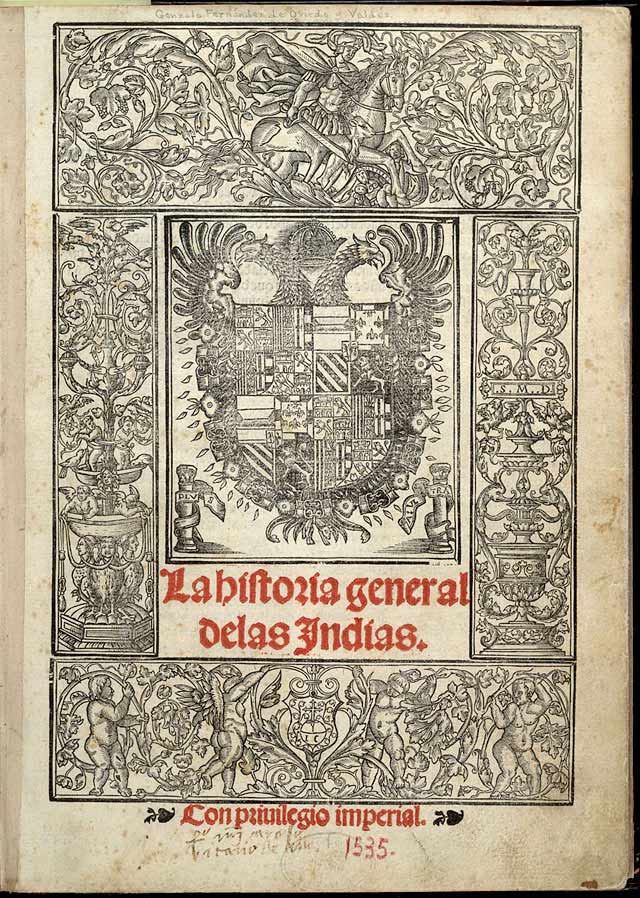
Title page of Oviedo's Historia natural de las Indias (1535)
De la natural hystoria de las Indias, better known as the Sumario, or Summary, was but a précis of the great treatise that Oviedo would later publish under the title Historia general y natural de las Indias (General and Natural History of the New World). The result of more than 20 years of recording data, the massive work was printed in Seville in 1535. Oviedo returned to Spain to personally oversee its publication.
The General and Natural History—the first comprehensive descriptive history of the New World—was fully 50 books long in manuscript, although the 1535 printed edition included only the first 19, which were dedicated to Columbus's voyages and the Caribbean islands. The 20th book was published in 1557. The remainder—contained in a 2,000-page manuscript known today as the Monserrat manuscript after the monastery in whose care Oviedo left it—was not published until the 19th century.
Like all Renaissance writers on natural history, Oviedo was profoundly influenced by the ancient Roman naturalist Pliny the Elder. Yet, although Oviedo admired Pliny and mined his Natural History extensively, he was hardly a slavish follower of the ancient naturalist. In fact, while using Pliny's work as a literary model, Oviedo self-consciously distanced himself from Pliny's methods, writing that he had not simply "culled [his experiences] from two hundred thousand volumes," as Pliny did:
I, however, compiled what I here write from two hundred thousand hardships, privations, and dangers in the more than twenty-two years that I have personally witnessed and experienced these things.
Oviedo's independent attitude is everywhere apparent. Take, for example, his treatment of the jaguar, unknown in the Old World:
In my opinion these animals are not tigers, nor are they panthers or any of the numerous known animals that have spotted skins, nor some new animal that has a spotted skin and has not been described. The many animals that exist in the Indies that I describe here, or at least most of them, could not have been learned about from the ancients, since they exist in a land that had not been discovered until our own time. There is no mention made of these lands in Ptolemy's Cosmography, nor in any other work, nor were they known until Christopher Columbus showed them to us.
Oviedo's were the first reports about American natural history by a European who had actually been to the New World. Though some of the new world animals—such as foxes and deer—were similar to those seen in Spain, others were completely new. One can only imagine what Europeans thought when reading about such strange creatures as the armadillo, the anteater, or the sloth, which Oviedo judged to be "the stupidest animal in the world."
Parrots—"better subjects for painters' brushes than for words"—fascinated Oviedo. So worthy of royal attention did he find them that he brought back 30 specimens of 12 different species to present to King Ferdinand only a few weeks before the monarch's death. Then there were these fascinating creatures:
There are some little birds so small that they are no larger than the end of the thumb. . . . Not only is this bird exceptionally small, but it is so swift in flight that it is as impossible to see its wings as it is those of a beetle or bumblebee. Everyone who sees it fly thinks it is a bumblebee.
The "bumblebee," of course, was the hummingbird, an animal never before seen by Europeans. This quintessentially American creature would fascinate Europeans for centuries—as much as anything because it was always beyond their reach, restricted to the Americas and never successfully transplanted to Europe.
The longer Oviedo stayed in the New World, the less he relied on European formulas and schemas. Instead of describing things in terms of the familiar, he focused more on the particular. Because his subject was so out of the ordinary, he was forced to describe it on its own, peculiar terms. He insisted that only by being an "eyewitness" (un testigo) was he able to describe the marvels of the New World.
Increasingly Oviedo relied on visual images—though his own drawings were far from accomplished. Though simple and austere, they demonstrate that Oviedo took great pains to portray his subjects accurately. In drawing plants, for example, he tried to capture the generic characteristics of the plant rather that the features of any particular specimen, thus making identification in the field easier.
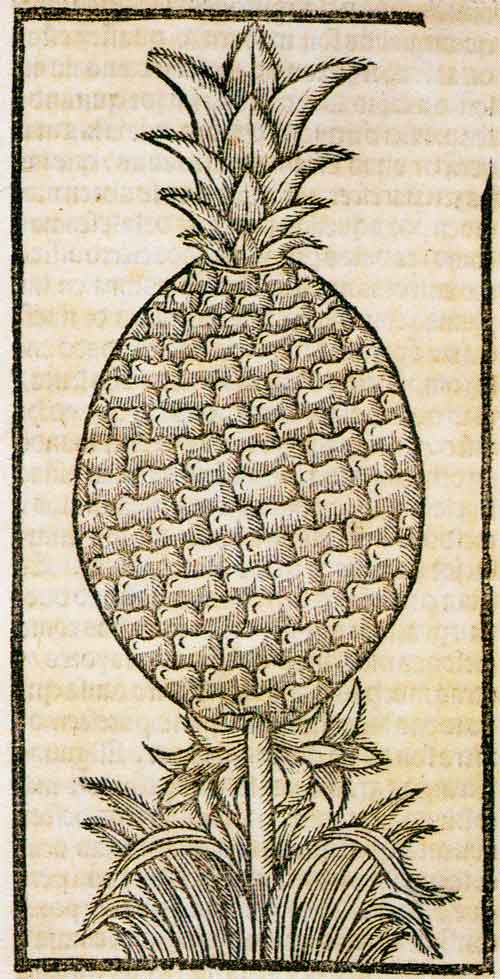
Oviedo's illustration of a pineapple, one of the more puzzling New World plants.
Oviedo's treatment of the pineapple illustrates the predicament naturalists faced when attempting to name and describe new species. In certain respects, the plant resembles the artichoke; on the other hand, it also resembles a pinecone. So which is it? In fact, Oviedo concludes, it is neither, for the taste of its fruit is incomparable. "No other gives such contentment . . . there is no comparison between a good pineapple and any of the other fruits I have seen." Oviedo acknowledges that he cannot adequately describe the plant in words; hence he must resort to a drawing—and even that could impart only a partial understanding.
Oviedo was the first European naturalist to confront what would become the perennial problem of the explorer-scientist: describing species and objects for which there were no familiar analogues. And there were thousands of completely new species to describe. As the Spanish explorers who followed Oviedo fanned out across Central and South America and sent back their reports to Spain, Europe's scientific vocabulary, its pharmacopoeia, and even its cuisine changed dramatically. Words such as huracán (hurricane) entered the languages of Europe, and Europeans awakened to the realization of new and different peoples and cultures in distant lands.
There was also a darker side of the encounter that would eventually manifest itself: slavery, the inhuman treatment of the Indians, and new diseases—including syphilis, which Columbus's crew brought back with his first voyage, and which quickly became an epidemic. It was not long before a New World cure for the disease was also discovered (according to the belief that God ordained that wherever a disease originates its cure should be found), in the form of guaiacán (Lignum Sanctum, the Holy Wood), which became a hot commodity, filling the coffers of the Fugger bank, which held a monopoly on its trade. After the New World encounter, everyday life in Europe would never be the same.
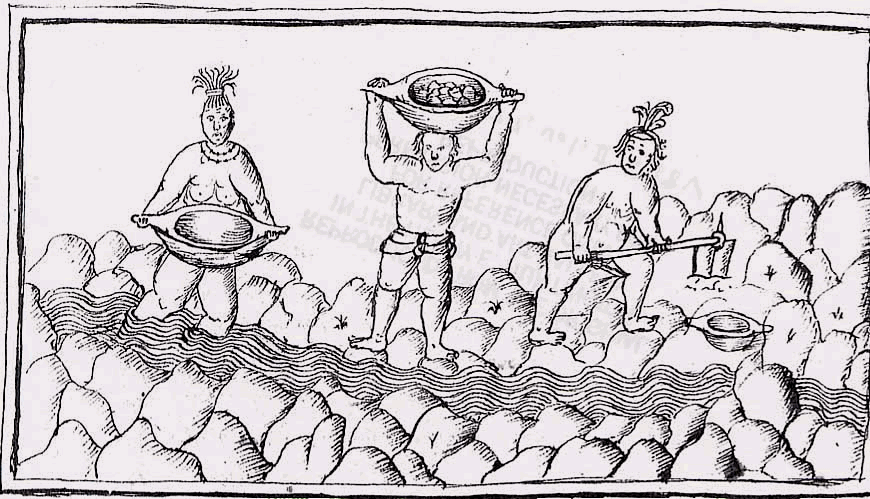
Gold panning scene from the Montserrat manuscript of Oviedo's Historia natural. Oviedo depicted numerous scenes from everyday life in America.
To Oviedo, it was the wondrous diversity of all things American that stood out the most. Addressing Charles V, he waxed enthusiastically about it:
What mortal understanding can comprehend such diversity of languages, habits, and customs among the people of the Indies? Such variety of animals, from domestic to wild and savage? Such an unutterable multitude of trees, some laden with diverse kinds of fruit and others barren, both those which the Indians cultivate and those produced by Nature's own work without the aid of human hands? How many plants and herbs that are useful and beneficial to man? How many innumerable others unknown to him, whose flowers and sweet fragrances are so different from the ones he knows? . . . How many mountains more astonishing and frightening than Etna or Mongibel, Vulcan and Strogol, with one and all under your rule?
On and on he went in celebration of the Spanish conquest of America, which Oviedo thought was the most important accomplishment in history. And he was not modest about his own accomplishments. Future generations will be "awestruck," he boasted, "that a single man could have written such a multitude of histories and secrets of nature." Yet he was still being read with profit 3 centuries after his death. The great explorer-naturalist Alexander Von Humboldt admired Oviedo's writings and considered him to be the founder of physical geography.
Though lauded in the 18th century by Von Humboldt, Oviedo is a largely forgotten figure when viewed from the perspective of the history of the Scientific Revolution. Sadly, the same can be said of almost all the Spanish naturalists and explorers who followed Oviedo in the 16th and 17th century. Such figures as José de Acosta, Nicolas Monardes, and Francisco Hernandez are barely mentioned in conventional histories of the Scientific Revolution.
That, unfortunately, is the case with Iberia in general. Spain's absence from the "Grand Narrative" of the Scientific Revolution is puzzling. It is almost as if historians of the Scientific Revolution are living a dream world in which only Latin, English, French, Italian, and occasionally German is spoken.
Yet a world without Spain was certainly not the world that early modern Europeans thought they were living in. The Spanish Empire under the Hapsburgs reached from Madrid to Potosí and from Naples to Antwerp, not to mention the distant Philippines. The world's first global empire, Spain produced the first worldwide scientific network—a fact that in the predominant interpretation of the history of science is met with stubborn ignorance or mute puzzlement. Remarkably, the situation today is not very different than it was when, in 1914, Julián Juderías coined the term "Black Legend" (leyenda negra) to describe the stereotype of early modern Spain as "Inquisitorial, ignorant, fanatical, incapable of taking a place among the cultured nations, always inclined toward violent repression, an enemy of progress and innovation."
The Spanish and Portuguese confidently saw themselves as the first moderns surpassing the ancients. The English were the first to recognize this and to imitate the institutions the Iberians had created to gather scientific knowledge. Indeed, it was England, not Spain, which occupied the periphery in the 16th century. How it gained the center should be one of the leading questions about the Scientific Revolution.
Clearly, we need a new history of the Scientific Revolution—one that places Oviedo and the other Iberian explorers at the center, not the periphery.
REFERENCES
Antonio Barrera, Experiencing Nature: The Spanish American Empire and the Early Scientific Revolution (Austin, 2006)
Jorge Cañizares-Esguerra, "The Colonial Iberian Roots of the Scientific Revolution," in Nature, Empire, and Nation: Explorations of the History of Science in the Iberian World (Standford, 2006), pp. 14-45
Antonello Gerbi, Nature in the New World: From Christopher Columbus to Gonzalo Fernández de Oviedo, trans. J. Moyle (Pittsburgh, 1985)
Kathleen Ann Myers, Fernandez de Oviedo's Chronicle of America: A New History for a New World (Austin, 2007)
June 20, 2011
“Two hundred thousand hardships, privations, and dangers”: A Spanish Naturalist in the New World
Fourteen hundred ninety-two has gone down in history as Spain’s annus mirabilis—and the year the modern world began. The year commenced, appropriately enough, with great fanfare in a field outside the fabled city of Granada. Its main characters were King Ferdinand of Aragon and Queen Isabella of Castile, who by marriage had united Spain’s two greatest kingdoms and by warfare had retaken the lands held for 5 centuries by the Muslims.
For more than a decade the Catholic Monarchs had waged relentless warfare in their attempt to expel the Moors, as they called the Muslims, from Andalusia. By 1490, they had closed in on Granada, the last Moorish stronghold in Spain. The war, though seen as a necessary crusade, had taken its toll on the monarchs’ subjects, who were obliged to pay heavy taxes to support the effort.
Finally, on the 2nd of January 1492, in a solemn ceremony in an open field outside the walls of Granada, with the Alhambra glistening golden in the sunlit background, the last Nasrid ruler of al-Andalus, Mohammed XII, also known as Boabdil and to the Spanish as “El Chico,” handed over the keys to the palace to King Ferdinand, who passed them to the Queen. A chronicler reported that as the Moorish king placed the keys in Ferdinand’s hands, he said, “God must love you well, for these are the keys to his paradise.”
The Surrender of Granada, by Francisco Pradilla y Ortiz (1882). In this purely fictional portrayal, Boabdil appears before Ferdinand and Isabella and hands the keys to the Alhambra to King Ferdinand.
Witnessing the splendid pageant was a 14-year-old mozo de cámara (page) in the service of the Infante, Juan, the Catholic Monarchs’ only son and heir to the throne. The boy, Gonzalo Fernandez de Oviedo, was the scion of a distinguished Asturian family that had settled in Madrid. He would serve the monarchy in one capacity or another his entire life.
Also present at the ceremony was the Genoese adventurer Christopher Columbus, who had come to Granada not to take part in the siege but to present Queen Isabella, for the third time, his proposed “Enterprise of the Indies,” a daring—court cosmologists said preposterous—plan to reach Asia by sailing west. By finding a western route to the Indies—meaning Asia—Columbus claimed, he would circumvent the Ottoman blockade of the rich Asian spice trade that Europeans had enjoyed before the fall of Constantinople in 1453.
Years later, Oviedo remembered the events in the field near Granada. He like other contemporaries had no doubt that the defeat of the Moors after 500 years of rule in the Iberian Peninsula was the greatest achievement of the Catholic Monarchs’ reign. The victory, according to a chronicler in the Basque country, “redeemed Spain, indeed all Europe.” The surrender of Granada signified that Spain’s moment in history had arrived.
In the fullness of time, historians would conclude that the greatest achievement of the Catholic Monarchs’ reign was not the victory at Granada but the discovery and colonization of America. But this was hardly apparent on that January day in 1492. In fact, despite the fanfare that celebrated the victory, Columbus had no better luck on this occasion than he had the two previous times he offered his proposal to Queen Isabella.
Perhaps it was the enormous package of emoluments that Columbus demanded, including a knighthood, a coat of arms, and substantial revenues; or, possibly, it was the doubts cast on his project by the board of experts assembled to evaluate the proposal. Certainly Columbus’s estimate of the distance of the westward voyage to Asia was far less than current scholarly wisdom—or, for that matter, modern calculations—allowed. Whatever it was that gave the queen pause, Columbus’s proposal was turned down again.
It was only through the intervention of friends at court that Isabella reconsidered. Columbus, who had given up hope on Spain and was already on his way to France to present his idea to King Charles VIII, made it only ten miles before he was overtaken by a messenger and given orders to return to Santa Fe, the town near Granada where the court was then residing. This time, the monarchs—possibly worried over the loss of African gold tribute the Moors had traditionally paid and seeking other sources of the precious metal—agreed to finance the enterprise.
Gonzalo Fernández de Oviedo, Prince Juan’s young page, was there to witness the ensuing negotiations between Columbus and the Catholic Monarchs, which resulted in the so-called “Capitulations of Santa Fe,” the Articles of Agreement naming Columbus Admiral of the Ocean Sea and viceroy over all the lands that he might discover. The monarchs also provided Columbus with letters of introduction to the Great Khan of Cathay, just in case.
Oviedo was also present at Barcelona in April 1493, when the Great Discoverer returned triumphantly to Spain after his first voyage to the New World and was led into the court along with a flock of iridescent, cackling parrots, specimens of medicinal plants, and 7 frightened Taino captives—“the first Indians of the discovery,” Oviedo matter-of-factly recounted. “I do not speak from hearsay of any of these events,” he wrote, “but as an eyewitness.”
Oviedo never forgot having seen Columbus in the Catholic Monarchs’ court—once as a humble supplicant, then as the most famous man in Spain. Nor, it seems, did he never cease dreaming of the possibility of visiting the New World himself. In 1514, at the age of 36, he finally got his chance. As the newly appointed supervisor of mines and smelting gold in Tierra Firme (now part of Central America), he joined the expedition of Pedrarias Dávila, which embarked from Seville with fifteen hundred men.
Oviedo lived a total of 27 years in the New World, most of them in Santo Domingo. He made 12 crossings back and forth from Spain to the Indies, both as mine supervisor and, later, as the official royal chronicler of the Indies. By the time of his death in 1557, he was a representative of an entirely new personality: a citizen of both the Old the New Worlds.
An indefatigable collector and shrewd observer, Oviedo meticulously recorded his impressions of the plants, animals, mines, and indigenous ways that he observed in the New World. He was an ethnologist, a geologist, a climatologist, and natural historian; and he piled up thousands of pages of notes on natural history and Native American culture.
Oviedo first wrote of his New World experiences in the form of a report to Charles I (later Holy Roman Emperor Charles V), Ferdinand’s grandson, who succeeded the Catholic King after the latter’s death in 1517 (Isabella died in 1504). Printed in 1526 under the title De la natural hystoria de las Indias (Natural History of the Indies), the book was widely read in Spanish as well as in English, French, and Italian translations. It was through Oviedo’s book that Europeans first learned about the hammock, which henceforth was adopted as the bed of choice by seamen throughout the world, and about avocados, pineapples, papayas, tobacco, and hundreds of other plants and animals used and hunted by the Native Americans.
Title page of Oviedo’s Historia natural de las Indias (1535)
De la natural hystoria de las Indias, better known as the Sumario, or Summary, was but a précis of the great treatise that Oviedo would later publish under the title Historia general y natural de las Indias (General and Natural History of the New World). The result of more than 20 years of recording data, the massive work was printed in Seville in 1535. Oviedo returned to Spain to personally oversee its publication.
The General and Natural History—the first comprehensive descriptive history of the New World—was fully 50 books long in manuscript, although the 1535 printed edition included only the first 19, which were dedicated to Columbus’s voyages and the Caribbean islands. The 20th book was published in 1557. The remainder—contained in a 2,000-page manuscript known today as the Monserrat manuscript after the monastery in whose care Oviedo left it—was not published until the 19th century.
Like all Renaissance writers on natural history, Oviedo was profoundly influenced by the ancient Roman naturalist Pliny the Elder. Yet, although Oviedo admired Pliny and mined his Natural History extensively, he was hardly a slavish follower of the ancient naturalist. In fact, while using Pliny’s work as a literary model, Oviedo self-consciously distanced himself from Pliny’s methods, writing that he had not simply “culled [his experiences] from two hundred thousand volumes,” as Pliny did:
I, however, compiled what I here write from two hundred thousand hardships, privations, and dangers in the more than twenty-two years that I have personally witnessed and experienced these things.
Oviedo’s independent attitude is everywhere apparent. Take, for example, his treatment of the jaguar, unknown in the Old World:
In my opinion these animals are not tigers, nor are they panthers or any of the numerous known animals that have spotted skins, nor some new animal that has a spotted skin and has not been described. The many animals that exist in the Indies that I describe here, or at least most of them, could not have been learned about from the ancients, since they exist in a land that had not been discovered until our own time. There is no mention made of these lands in Ptolemy’s Cosmography, nor in any other work, nor were they known until Christopher Columbus showed them to us.
Oviedo’s were the first reports about American natural history by a European who had actually been to the New World. Though some of the new world animals—such as foxes and deer—were similar to those seen in Spain, others were completely new. One can only imagine what Europeans thought when reading about such strange creatures as the armadillo, the anteater, or the sloth, which Oviedo judged to be “the stupidest animal in the world.”
Parrots—“better subjects for painters’ brushes than for words”—fascinated Oviedo. So worthy of royal attention did he find them that he brought back 30 specimens of 12 different species to present to King Ferdinand only a few weeks before the monarch’s death. Then there were these fascinating creatures:
There are some little birds so small that they are no larger than the end of the thumb. . . . Not only is this bird exceptionally small, but it is so swift in flight that it is as impossible to see its wings as it is those of a beetle or bumblebee. Everyone who sees it fly thinks it is a bumblebee.
The “bumblebee,” of course, was the hummingbird, an animal never before seen by Europeans. This quintessentially American creature would fascinate Europeans for centuries—as much as anything because it was always beyond their reach, restricted to the Americas and never successfully transplanted to Europe.
The longer Oviedo stayed in the New World, the less he relied on European formulas and schemas. Instead of describing things in terms of the familiar, he focused more on the particular. Because his subject was so out of the ordinary, he was forced to describe it on its own, peculiar terms. He insisted that only by being an “eyewitness” (un testigo) was he able to describe the marvels of the New World.
Increasingly Oviedo relied on visual images—though his own drawings were far from accomplished. Though simple and austere, they demonstrate that Oviedo took great pains to portray his subjects accurately. In drawing plants, for example, he tried to capture the generic characteristics of the plant rather that the features of any particular specimen, thus making identification in the field easier.
Oviedo’s illustration of a pineapple, one of the more puzzling New World plants.
Oviedo’s treatment of the pineapple illustrates the predicament naturalists faced when attempting to name and describe new species. In certain respects, the plant resembles the artichoke; on the other hand, it also resembles a pinecone. So which is it? In fact, Oviedo concludes, it is neither, for the taste of its fruit is incomparable. “No other gives such contentment . . . there is no comparison between a good pineapple and any of the other fruits I have seen.” Oviedo acknowledges that he cannot adequately describe the plant in words; hence he must resort to a drawing—and even that could impart only a partial understanding.
Oviedo was the first European naturalist to confront what would become the perennial problem of the explorer-scientist: describing species and objects for which there were no familiar analogues. And there were thousands of completely new species to describe. As the Spanish explorers who followed Oviedo fanned out across Central and South America and sent back their reports to Spain, Europe’s scientific vocabulary, its pharmacopoeia, and even its cuisine changed dramatically. Words such as huracán (hurricane) entered the languages of Europe, and Europeans awakened to the realization of new and different peoples and cultures in distant lands.
There was also a darker side of the encounter that would eventually manifest itself: slavery, the inhuman treatment of the Indians, and new diseases—including syphilis, which Columbus’s crew brought back with his first voyage, and which quickly became an epidemic. It was not long before a New World cure for the disease was also discovered (according to the belief that God ordained that wherever a disease originates its cure should be found), in the form of guaiacán (Lignum Sanctum, the Holy Wood), which became a hot commodity, filling the coffers of the Fugger bank, which held a monopoly on its trade. After the New World encounter, everyday life in Europe would never be the same.
Gold panning scene from the Montserrat manuscript of Oviedo's Historia natural. Oviedo depicted numerous scenes from everyday life in America.
To Oviedo, it was the wondrous diversity of all things American that stood out the most. Addressing Charles V, he waxed enthusiastically about it:
What mortal understanding can comprehend such diversity of languages, habits, and customs among the people of the Indies? Such variety of animals, from domestic to wild and savage? Such an unutterable multitude of trees, some laden with diverse kinds of fruit and others barren, both those which the Indians cultivate and those produced by Nature’s own work without the aid of human hands? How many plants and herbs that are useful and beneficial to man? How many innumerable others unknown to him, whose flowers and sweet fragrances are so different from the ones he knows? . . . How many mountains more astonishing and frightening than Etna or Mongibel, Vulcan and Strogol, with one and all under your rule?
On and on he went in celebration of the Spanish conquest of America, which Oviedo thought was the most important accomplishment in history. And he was not modest about his own accomplishments. Future generations will be “awestruck,” he boasted, “that a single man could have written such a multitude of histories and secrets of nature.” Yet he was still being read with profit 3 centuries after his death. The great explorer-naturalist Alexander Von Humboldt admired Oviedo’s writings and considered him to be the founder of physical geography.
Though lauded in the 18th century by Von Humboldt, Oviedo is a largely forgotten figure when viewed from the perspective of the history of the Scientific Revolution. Sadly, the same can be said of almost all the Spanish naturalists and explorers who followed Oviedo in the 16th and 17th century. Such figures as José de Acosta, Nicolas Monardes, and Francisco Hernandez are barely mentioned in conventional histories of the Scientific Revolution.
That, unfortunately, is the case with Iberia in general. Spain’s absence from the “Grand Narrative” of the Scientific Revolution is puzzling. It is almost as if historians of the Scientific Revolution are living a dream world in which only Latin, English, French, Italian, and occasionally German is spoken.
Yet a world without Spain was certainly not the world that early modern Europeans thought they were living in. The Spanish Empire under the Hapsburgs reached from Madrid to Potosí and from Naples to Antwerp, not to mention the distant Philippines. The world’s first global empire, Spain produced the first worldwide scientific network—a fact that in the predominant interpretation of the history of science is met with stubborn ignorance or mute puzzlement. Remarkably, the situation today is not very different than it was when, in 1914, Julián Juderías coined the term “Black Legend” (leyenda negra) to describe the stereotype of early modern Spain as “Inquisitorial, ignorant, fanatical, incapable of taking a place among the cultured nations, always inclined toward violent repression, an enemy of progress and innovation.”
The Spanish and Portuguese confidently saw themselves as the first moderns surpassing the ancients. The English were the first to recognize this and to imitate the institutions the Iberians had created to gather scientific knowledge. Indeed, it was England, not Spain, which occupied the periphery in the 16th century. How it gained the center should be one of the leading questions about the Scientific Revolution.
Clearly, we need a new history of the Scientific Revolution—one that places Oviedo and the other Iberian explorers at the center, not the periphery.
REFERENCES
Antonio Barrera, Experiencing Nature: The Spanish American Empire and the Early Scientific Revolution (Austin, 2006)
Jorge Cañizares-Esguerra, “The Colonial Iberian Roots of the Scientific Revolution,” in Nature, Empire, and Nation: Explorations of the History of Science in the Iberian World (Standford, 2006), pp. 14-45
Antonello Gerbi, Nature in the New World: From Christopher Columbus to Gonzalo Fernández de Oviedo, trans. J. Moyle (Pittsburgh, 1985)
Kathleen Ann Myers, Fernandez de Oviedo’s Chronicle of America: A New History for a New World (Austin, 2007)
María Portuondo, Secret Science: Spanish Cosmography and the New World (Chicago, 2010)
May 13, 2011
The Age of How-To
What makes us modern?
The list of the attributes of modernity keeps growing and changing. Once modernity meant "progress"; but that one took a huge shellacking in the last century, when some of the most "modern" nation-states behaved worse than the worst barbarian states of the Dark Ages.
Then it was science—until anthropologists forced us to recognize that that practically every "pre-modern" culture had some form of science. Then science became "science," with all the equivocations the scare quotes imply.
Did capitalism make us modern, as Marx said? Or was it globalization and the commodification of practically everything? Or, maybe it was simply the emergence of the bureaucracies that intrude in our daily lives. A strong case has been made that it was the communications revolution ushered in by printing and culminating in the internet that made us modern.
One thing historians do agree about is that modernity began with the "early modern"—that is, during the period between about 1500 and 1750, when a host of developments—including, of course, science, capitalism, and centralized bureaucracies—coalesced to reshape the Western consciousness.
The result was a transformation far more characteristic of modernity than any of those individual developments: the slow but steady secularization of society. Like the rise of the middle class, with which it is often associated, secularization was a process that was crucial to the development of the modern world.
Secularization did not mean godlessness: early modern European society remained, for the most part, profoundly Christian. It was rather that the boundary between the religious and the secular became more distinct than ever before. As the 17th-century English philosopher Sir Thomas Browne put it, humans live "in divided and distinguished worlds." The sphere of religion was diminished, so that many of the hopes and fears formerly expressed in religious terms became more readily expressed in worldly terms. According to historian William Bouwsma, "Secularization rested on a deep conviction that eternal truths are inaccessible to the human intellect, and that only the limited insights afforded by experience in this world are relevant to the earthly career of the human race."
Certainly the main causes of this far-reaching intellectual change were the emergence of a market economy, the rise of the middle class, and the growing dominance of cities in the political and economic life of Europe. No less important, however, was the inculcation of new attitudes toward materials and material life.
In an earlier post, I wrote about the German craft manual, Künstbuchlein, noting that this humble little handbook spawned scores of similar works detailing the "secrets" of the arts. The most popular early modern book of secrets, Alessio Piemontese's Secrets, was continuously published down through the 17th century. More than 100 editions of the work appeared in Italian, French, German, English, Dutch, Spanish, Danish, and even Polish. Thanks to the printing press, hundreds of thousands of "books of secrets" were published in the 16th and 17th centuries. They were bought and read by artisans and middle class readers as well as by members of the nobility and intelligentsia.
The "professors of secrets"—as one contemporary called the authors of these books—sincerely believed that they were laying bare the recondite secrets of nature—secrets that could be known only by experiment. But for most readers, the books of secrets were simply repositories of useful information.
Typical of such books was an Italian household manual titled Dificio di ricette (Palace of Recipes), first published in Venice in 1520 and then reprinted dozens of times all across Italy. The author's name is unknown; possibly the book was put together by a printer. Beautifully designed though distinctly downmarket, Palace of Recipes provided recipes for making soap, perfume, dyes, and cosmetics, along with gardening tips and parlor tricks such as how a make a candle burn under water and how to make a ring dance on a table. An extremely popular work, Palace of Recipes was later translated into Dutch and French and became a staple chapbook for centuries.
Dificio di ricette (1528)
There were how-to books for practically every conceivable craft and activity, including how to do "it"—that is, sex. There were manuals teaching how to choose a good spouse, manuals teaching married couples how God and the medical experts thought they should behave in bed, manuals that taught midwives the proper techniques of childbirthing, and manuals to teach parents how to rear their children properly. The ideology of how-to permeated daily life in early modern Europe.
One might speculate that the widespread availability of craft recipes tended to demystify trade secrets, reducing them to simple formulas and procedures. The explosion of printed "how-to" books made it clear as never before that a recipe might effectively replace the artisan's cunning, and that what had formerly passed as magic could now be seen as mere hocus-pocus and sleight of hand.
Did these booklets also give readers a sense of empowerment, of having some tangible means of controlling the forces of nature and the vicissitudes of life? Did technical literacy contribute in some measure to the "disenchantment of the world" that Max Weber noted was a hallmark of modern culture?
It seems likely; at the very least, the avalanche of self-help manuals showing readers how to assay metals, dye fabrics, and handle all manner of tools and instruments must have contributed to a greater understanding of the artificially created world. Recipe-books translated craft "secrets" into simple rules and procedures, and replaced the artisan's inexplicable shrewdness with the technologist's know-how.
To anyone not familiar with the arts, craft "mysteries" can seem occult and magical. Spelling out artisanal secrets and expressing them in the form of mundane recipes demystifies the arts. That is what the books of secrets did. Readers of books of secrets may not have understood why certain materials hardened iron or made fast dyes, but they had a better idea of how to do it. The books of secrets gave answers to the timeless question, "How in the world did he do that?"
The circulation of recipes in popular culture did something else, too: It instilled a sense that humanity's lot could be bettered by technological—that is, human—means, not just through prayer or other spiritual methods, thus sharpening the distinction between the sacred and the profane.
Knowing "how-to" didn't just empower readers by giving them tangible means of controlling the forces of nature; it made us modern.
REFERENCES
Rudolph M. Bell, How to Do It: Guides to Good Living for Renaissance Italians (Chicago, 2000).
William J. Bouwsma, "The Secularization of Society in the 17th Century," in A Usable Past: Essays in European Cultural History (Berkeley, 1990).
William Eamon, Science and the Secrets of Nature: Books of Secrets in Medieval and Early Modern Culture (Princeton, 1994).
Paul Gehl, Humanism for Sale: Making and Marketing Schoolbooks in Italy, 1450-1650.
Allison Kavey, Books of Secrets. Natural Philosophy in England, 1550-1600. (Urbana, 2007)


