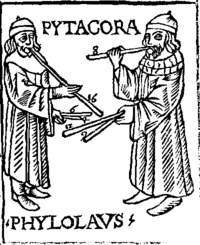
Philolaus of Croton, in southern Italy, was a Greek philosopher/scientist, who lived from ca. 470 to ca. 385 BCE and was thus a contemporary of Socrates. He is one of the three most prominent figures in the Pythagorean tradition, born a hundred years after Pythagoras himself and fifty years before Archytas. He wrote one book, On Nature, which was probably the first book to be written by a Pythagorean. There has been considerable controversy concerning the 20+ fragments which have been preserved in Philolaus' name. It is now generally accepted that some eleven of the fragments come from his genuine book. Other books were forged in Philolaus' name at a later date, and the remaining fragments come from these spurious works. Philolaus argues thPhilolaus of Croton, in southern Italy, was a Greek philosopher/scientist, who lived from ca. 470 to ca. 385 BCE and was thus a contemporary of Socrates. He is one of the three most prominent figures in the Pythagorean tradition, born a hundred years after Pythagoras himself and fifty years before Archytas. He wrote one book, On Nature, which was probably the first book to be written by a Pythagorean. There has been considerable controversy concerning the 20+ fragments which have been preserved in Philolaus' name. It is now generally accepted that some eleven of the fragments come from his genuine book. Other books were forged in Philolaus' name at a later date, and the remaining fragments come from these spurious works. Philolaus argues that the cosmos and everything in it is made up of two basic types of things, limiters and unlimiteds. Unlimiteds are continua undefined by any structure or quantity; they include the traditional Pre Socratic material elements such as earth, air, fire and water but also space and time. Limiters set limits in such unlimiteds and include shapes and other structural principles. Limiters and unlimiteds are not combined in a haphazard way but are subject to a “fitting together” or “harmonia,” which can be described mathematically. Philolaus' primary example of such a harmonia of limiters and unlimiteds is a musical scale, in which the continuum of sound is limited according to whole number ratios, so that the octave, fifth, and fourth are defined by the ratios 2 : 1, 3 : 2 and 4 : 3, respectively. Since the whole world is structured according to number, we only gain knowledge of the world insofar as we grasp these numbers. The cosmos comes to be when the unlimited fire is fitted together with the center of the cosmic sphere (a limiter) to become the central fire. Philolaus was the precursor of Copernicus in moving the earth from the center of the cosmos and making it a planet, but in Philolaus' system it does not orbit the sun but rather the central fire. The astronomical system is a significant attempt to try to explain the phenomena but also has mythic and religious significance. Philolaus presented a medical theory in which there was a clear analogy between the birth of a human being and the birth of the cosmos. The embryo is conceived of as composed of the hot and then as drawing in cooling breath immediately upon birth, just as the cosmos begins with the heat of the central fire, which then draws in breath along with void and time from the unlimited. Philolaus posited a strict hierarchy of psychic faculties, which allows him to distinguish human beings from animals and plants. He probably believed that the transmigrating soul was a harmonious arrangement of physical elements located in the heart and that the body became ensouled when the proper balance of hot and cold was established by the breathing of the new-born infant. Philolaus' genuine book was one of the major sources for Aristotle's account of Pythagorean philosophy. There is controversy as to whether or not Aristotle's description of the Pythagoreans as equating things with numbers is an accurate account of Philolaus' view. Plato mentions Philolaus in the Phaedo and adapts Philolaus' metaphysical scheme for his own purposes in the Philebus....more

 Sign in with Facebook