
Lynn C. Tolson's Blog: Beyond the Tears: A True Survivor's Story by Lynn C. Tolson, blog
June 14, 2017
Tolson 4 TEARS* Reviews "Childhood Disrupted: How Your Biography Becomes Your Biology"
Childhood Disrupted: How Your Biography Becomes Your Biology, and How You Can Heal by Donna Jackson Nakazawa
Childhood Disrupted examines the relationship between adverse childhood experiences and adult onset illness and disease. The author’s information is based on the ground-breaking research called ACE: Adverse Childhood Experience, spear-headed by Vincent J. Felitti, M.D. and Robert Anda, M.D. in conjunction with the CDC. The foundation of the research is the ACE survey, which measures ten types of childhood trauma. The results of the study indicate that chronic unpredictable toxic stress increases the risk of health consequences.
Ms. Nakazawa, a science journalist, explains: “Adverse childhood experiences can lead to deep bio-physical changes in a child that profoundly alter the developing brain and immunology in ways that also change the health of the adult he or she will become … Childhood adversity damages us on a cellular level in ways that prematurely age our cells and affect our longevity.” The toxic stress erodes the developing child / adolescent brain so that the individual is less able to deal with subsequent stressors. Nakazawa sites specific case histories of the relationship between childhood trauma and adult illness, blending scientific study with personal narratives.
Childhood Disrupted is informative in detailing the connections between childhood adversity and depression / childhood adversity and suicide / childhood adversity and immune disease, etc. This knowledge can empower those individuals with traumatic experiences to approach the medical community with evidence culled from research; the knowledge can enlighten practitioners towards more compassionate care and treatment of such individuals.
Also included in the book is a “Resiliency Questionnaire” that helps the reader to understand the strengths and support that impacts overcoming adversity. Additionally, Donna Nakazawa includes a chapter on parenting well, with methods to help mitigate children’s exposure to trauma.
As someone who scores too high on the ACE survey, I applaud this book for its significant contribution to my personal healing journey. I’ve learned that healing is not a matter of will-power and self-discipline; I can’t outsmart a brain that’s been fundamentally damaged by multiple traumas. But I can re-train my brain through various re-processing techniques that Ms. Nakazawa suggests, such as EMDR, meditation, neurofeedback, and guided imagery.
p.p1 {margin: 0.0px 0.0px 0.0px 0.0px; font: 14.0px Helvetica; color: #000000; -webkit-text-stroke: #000000} p.p2 {margin: 0.0px 0.0px 0.0px 0.0px; font: 14.0px Helvetica; color: #000000; -webkit-text-stroke: #000000; min-height: 17.0px} span.s1 {font-kerning: none}
I highly recommend Childhood Disrupted as a resource for awareness and insight as to the repercussions of adverse childhood experiences over the course of a lifetime.
Review completed by Lynn C. Tolson, author of Beyond the Tears: A True Survivor's Story*Tolson 4 TEARS: Telling Everyone About Rape & Suicide, so no shed tear is wasted
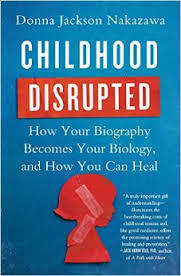

Childhood Disrupted examines the relationship between adverse childhood experiences and adult onset illness and disease. The author’s information is based on the ground-breaking research called ACE: Adverse Childhood Experience, spear-headed by Vincent J. Felitti, M.D. and Robert Anda, M.D. in conjunction with the CDC. The foundation of the research is the ACE survey, which measures ten types of childhood trauma. The results of the study indicate that chronic unpredictable toxic stress increases the risk of health consequences.
Ms. Nakazawa, a science journalist, explains: “Adverse childhood experiences can lead to deep bio-physical changes in a child that profoundly alter the developing brain and immunology in ways that also change the health of the adult he or she will become … Childhood adversity damages us on a cellular level in ways that prematurely age our cells and affect our longevity.” The toxic stress erodes the developing child / adolescent brain so that the individual is less able to deal with subsequent stressors. Nakazawa sites specific case histories of the relationship between childhood trauma and adult illness, blending scientific study with personal narratives.
Childhood Disrupted is informative in detailing the connections between childhood adversity and depression / childhood adversity and suicide / childhood adversity and immune disease, etc. This knowledge can empower those individuals with traumatic experiences to approach the medical community with evidence culled from research; the knowledge can enlighten practitioners towards more compassionate care and treatment of such individuals.
Also included in the book is a “Resiliency Questionnaire” that helps the reader to understand the strengths and support that impacts overcoming adversity. Additionally, Donna Nakazawa includes a chapter on parenting well, with methods to help mitigate children’s exposure to trauma.
As someone who scores too high on the ACE survey, I applaud this book for its significant contribution to my personal healing journey. I’ve learned that healing is not a matter of will-power and self-discipline; I can’t outsmart a brain that’s been fundamentally damaged by multiple traumas. But I can re-train my brain through various re-processing techniques that Ms. Nakazawa suggests, such as EMDR, meditation, neurofeedback, and guided imagery.
p.p1 {margin: 0.0px 0.0px 0.0px 0.0px; font: 14.0px Helvetica; color: #000000; -webkit-text-stroke: #000000} p.p2 {margin: 0.0px 0.0px 0.0px 0.0px; font: 14.0px Helvetica; color: #000000; -webkit-text-stroke: #000000; min-height: 17.0px} span.s1 {font-kerning: none}
I highly recommend Childhood Disrupted as a resource for awareness and insight as to the repercussions of adverse childhood experiences over the course of a lifetime.
Review completed by Lynn C. Tolson, author of Beyond the Tears: A True Survivor's Story*Tolson 4 TEARS: Telling Everyone About Rape & Suicide, so no shed tear is wasted


April 23, 2017


August 9, 2016
On Characteristics of Victims + Offenders in Domestic Abuse via Tolson 4 TEARS*
*Tolson 4 TEARS: Telling Everyone About Rape & Suicide, so no shed tear is wasted
By looking at this picture, no one would ever know that I was in a marriage fraught with domestic violence I was so familiar with abusive relationships that I did not know what a healthy relationship was like.
In therapy sessions during my twenties, I learned that "People often seek a life partner who serves to resolve issues of the past.” The implication was that I had done so by marrying a man who preyed on my vulnerabilities, repeating what I had experienced as a child via my father, my stepfather, and my older brother. I responded to my therapist's comment by saying that I was not looking for a mate who abused me! My therapist said, “No, not consciously. We sometimes operate on an unconscious level, which may lead to repetition of unhealthy patterns." She encouraged me to become more aware of patterns that pertained to my husband and family.
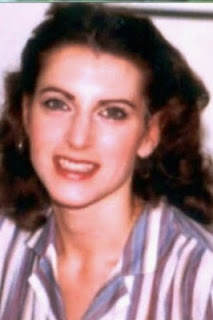 Lynn C. TolsonIt’s not unusual to do things as we saw them done. When we examine our motives, we make better choices. This illustrates why it is important to understand the dynamics of dysfunction: "If I know why I did what I did, I might do it better next time.” Realizing the characteristics of victims and offenders helps in determining whether it's an unhealthy relationship. You can't see the physical evidence of me as victim in this picture, but you can sense the traits that led me to perpetuate the roles.
(victims and offenders may have some and/or not have all of these characteristics)
VICTIM
Loyal
Socially isolated
Low self esteem
Believes traditional stereotypes
Often compliant with trivial demands
Suffers from guilt, denies terror and anger
Convinced she is responsible for the abuse
Believes all the myths about domestic violence
May have witnessed or experienced abuse as a child
Attempts to manipulate the environment to maintain safety
OFFENDER
Emotionally dependent
Abused as children (typically)
Loses temper frequently and early
Displays unusual amount of jealousy
Has weapons & threatens to use them
Contradictory, unpredictable personality
Has limited capacity for delayed gratification
Drinks alcohol excessively (and/or other substance)
Commits acts of violence against people, pets, and objects
compiled by Lynn C. Tolson, author of Beyond the Tears: A True Survivor's Story
By looking at this picture, no one would ever know that I was in a marriage fraught with domestic violence I was so familiar with abusive relationships that I did not know what a healthy relationship was like.
In therapy sessions during my twenties, I learned that "People often seek a life partner who serves to resolve issues of the past.” The implication was that I had done so by marrying a man who preyed on my vulnerabilities, repeating what I had experienced as a child via my father, my stepfather, and my older brother. I responded to my therapist's comment by saying that I was not looking for a mate who abused me! My therapist said, “No, not consciously. We sometimes operate on an unconscious level, which may lead to repetition of unhealthy patterns." She encouraged me to become more aware of patterns that pertained to my husband and family.
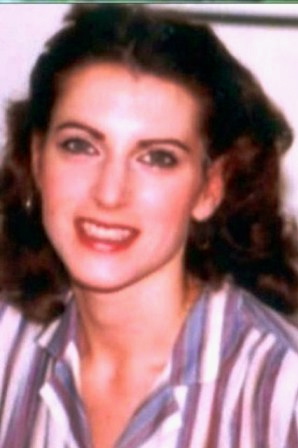 Lynn C. TolsonIt’s not unusual to do things as we saw them done. When we examine our motives, we make better choices. This illustrates why it is important to understand the dynamics of dysfunction: "If I know why I did what I did, I might do it better next time.” Realizing the characteristics of victims and offenders helps in determining whether it's an unhealthy relationship. You can't see the physical evidence of me as victim in this picture, but you can sense the traits that led me to perpetuate the roles.
 (victims and offenders may have some and/or not have all of these characteristics)
VICTIM
Loyal
Socially isolated
Low self esteem
Believes traditional stereotypes
Often compliant with trivial demands
Suffers from guilt, denies terror and anger
Convinced she is responsible for the abuse
Believes all the myths about domestic violence
May have witnessed or experienced abuse as a child
Attempts to manipulate the environment to maintain safety
OFFENDER
Emotionally dependent
Abused as children (typically)
Loses temper frequently and early
Displays unusual amount of jealousy
Has weapons & threatens to use them
Contradictory, unpredictable personality
Has limited capacity for delayed gratification
Drinks alcohol excessively (and/or other substance)
Commits acts of violence against people, pets, and objects
compiled by Lynn C. Tolson, author of Beyond the Tears: A True Survivor's Story
July 16, 2016
Tolson 4 TEARS* on Why Write "Beyond the Tears"
*Tolson 4 TEARS: Telling Everyone About Rape & Suicide
The most frequently asked question of me, as an author, is WHY I wrote Beyond the Tears: A True Survivor's Story. Why write such a personal and revealing story?
First I lived it. Then I was numb to it. Then I suppressed it. Then I remembered it. Then I regurgitated it in counseling. Then I examined and felt it. Then I wrote about it.We are accustomed to keeping our secrets, hiding our flaws, and stuffing our feelings. After all, what will people think of us? The truth is, it took me twenty years to write my story. When I was in my twenties, my therapist told me I had a story to tell that would help others to find hope. However, it was not until my forties, when another therapist offered the same suggestion, that I took it seriously. I wrote what has become Beyond the Tears: A True Survivor's Story, which chronicles my personal counseling sessions. I was motivated to publish because that the problems I discussed in therapy are universal. My desire to encourage others to seek healing became greater than my need to remain private.Why I Wrote Beyond the Tears: A True Survivor's Story
Why did you decide to write a book? Was it difficult writing about such a personal story?The book [ Beyond the Tears: A True Survivor's Story ] began by putting pen to paper in journal writing sessions. Themes emerged regarding the ramifications of sexual abuse, like drug addiction and suicide attempts. Eventually, a story of transformation to wholeness evolved. Journal writing was a cathartic experience. However, writing the book was difficult because I had to find the courage to face my fears: What would others think? What would my family think? But my conviction to tell the truth became greater than the difficulty of writing a personal story. I realized that I was writing about personal yet universal issues. My desire to share a message of healing from trauma became too strong to ignore; the book became my mission despite the difficulty. Sexual assault, addiction, and suicide are unsolved social problems that carry stigmas. The stigmas cast a code of silence that do not solve problems. The result from not speaking about the crime of sexual assault is too often tragic. Thus, there is a need for real stories of recovery. By bringing my dark secrets to light, it is my hope that others who have had similar events will know that they are not alone.

The most frequently asked question of me, as an author, is WHY I wrote Beyond the Tears: A True Survivor's Story. Why write such a personal and revealing story?
First I lived it. Then I was numb to it. Then I suppressed it. Then I remembered it. Then I regurgitated it in counseling. Then I examined and felt it. Then I wrote about it.We are accustomed to keeping our secrets, hiding our flaws, and stuffing our feelings. After all, what will people think of us? The truth is, it took me twenty years to write my story. When I was in my twenties, my therapist told me I had a story to tell that would help others to find hope. However, it was not until my forties, when another therapist offered the same suggestion, that I took it seriously. I wrote what has become Beyond the Tears: A True Survivor's Story, which chronicles my personal counseling sessions. I was motivated to publish because that the problems I discussed in therapy are universal. My desire to encourage others to seek healing became greater than my need to remain private.Why I Wrote Beyond the Tears: A True Survivor's Story
Why did you decide to write a book? Was it difficult writing about such a personal story?The book [ Beyond the Tears: A True Survivor's Story ] began by putting pen to paper in journal writing sessions. Themes emerged regarding the ramifications of sexual abuse, like drug addiction and suicide attempts. Eventually, a story of transformation to wholeness evolved. Journal writing was a cathartic experience. However, writing the book was difficult because I had to find the courage to face my fears: What would others think? What would my family think? But my conviction to tell the truth became greater than the difficulty of writing a personal story. I realized that I was writing about personal yet universal issues. My desire to share a message of healing from trauma became too strong to ignore; the book became my mission despite the difficulty. Sexual assault, addiction, and suicide are unsolved social problems that carry stigmas. The stigmas cast a code of silence that do not solve problems. The result from not speaking about the crime of sexual assault is too often tragic. Thus, there is a need for real stories of recovery. By bringing my dark secrets to light, it is my hope that others who have had similar events will know that they are not alone.
June 29, 2016
On Self-Love via Tolson 4 TEARS*
*Tolson 4 TEARS: Telling Everyone About Rape & Suicide, so no shed tear is wasted.
From Beyond the Tears: A True Survivor's Story
At the suggestion of my counselor, to increase my self-confidence, I peeked into the mirror each morning and repeated: I can, I can, I can. Once, I would have considered this a corny gimmick, but now I viewed it as a tool to get myself together. Prior to using this believing mirror technique, I would only glance in the mirror, afraid to face the image of shame, guilt, anger, and regret that reflected back. My counselor, Karen, said, “You don’t see yourself as others see you.”
Afraid of the answer, I asked, “How do others see me?”
Karen responded: “I see a bright, beautiful woman with talent. You have paid too much attention to negative traits while neglecting your positive qualities. Try accepting all aspects of your identity, both your strengths and weaknesses. You are greater than the sum of all parts. Let’s consider the concept of self-love.”
I said, “Self-love? Isn’t that conceited?”
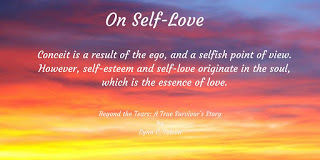
Karen said, “Conceit is a result of the ego, and a selfish point of view. However, self-esteem and self-love originate in the soul, which is the essence of love.”
Don't YOU deserve to be loved by Y-O-U?
Post completed by Lynn C. Tolson, author of Beyond the Tears: A True Survivor's Story

What is the concept of self-love? And how can you apply it?
From Beyond the Tears: A True Survivor's Story
At the suggestion of my counselor, to increase my self-confidence, I peeked into the mirror each morning and repeated: I can, I can, I can. Once, I would have considered this a corny gimmick, but now I viewed it as a tool to get myself together. Prior to using this believing mirror technique, I would only glance in the mirror, afraid to face the image of shame, guilt, anger, and regret that reflected back. My counselor, Karen, said, “You don’t see yourself as others see you.”
Afraid of the answer, I asked, “How do others see me?”
Karen responded: “I see a bright, beautiful woman with talent. You have paid too much attention to negative traits while neglecting your positive qualities. Try accepting all aspects of your identity, both your strengths and weaknesses. You are greater than the sum of all parts. Let’s consider the concept of self-love.”
I said, “Self-love? Isn’t that conceited?”
Karen said, “Conceit is a result of the ego, and a selfish point of view. However, self-esteem and self-love originate in the soul, which is the essence of love.”
Don't YOU deserve to be loved by Y-O-U?

Post completed by Lynn C. Tolson, author of Beyond the Tears: A True Survivor's Story
June 26, 2016
Tolson 4 TEARS* on Surviving Child Abuse
What is it like to be a survivor of child abuse? How does a victim L-I-V-E after being in the heavy cauldron of verbal, emotional, mental, physical, psychological, religious, and sexual abuse? The steam of putrid abuse is so hot it burns the skin and melts the mind into a pile of lifeless ashes. How does a child teach him/herself to rise up and carry on after being sexually assaulted by family members or other trusted adults?
What if the mix of nature versus nurture or neglect is toxic, like poison boiling over, and the family that was supposed to protect her is spewing witch's stews of evil? There is no life juice; to L-I-V-E daily in that environment is like drinking from a bottle with a skull and crossbones on it, taunting, teasing, tempting suicide as a remedy. She doesn't live; she exists in a context where she is scared-to-death of the world at large.
Surviving means standing over the cauldron with a big stick of strength, stirring the pot despite the acrid fumes that choke the breath. It takes mighty courage to dredge up the heavy dark scum. Recovering means turning the brew upside down and inside out to see it for what it is: LIES! The ladle is heavy with betrayal and deceit. Stir the pot, sift through the garbage and discard the vile crud that drained your power!
When truth and clarity come into focus, your healing can begin. Take back your power by straining your truth from their lies.
Thriving means educating, empowering, and enlightening your S-E-L-F. You were designed to L-I-V-E. You were created to breathe in the fragrance of connection, to cultivate clarity of thought, to sow seeds of integrity, to reap relationships of L-O-V-E. To thrive means to embrace a love-of-life perspective.
I have laughed, lived, loved and lost.I have cried, mourned, and grievedhoped, prayed and healed.I have found strength and true beauty. I am a SURVIVOR
Post completed by Lynn C. Tolson, Beyond the Tears: A True Survivor's Story*Tolson 4 TEARS: Telling Everyone About Rape & Suicide, so no shed tear is wasted

What if the mix of nature versus nurture or neglect is toxic, like poison boiling over, and the family that was supposed to protect her is spewing witch's stews of evil? There is no life juice; to L-I-V-E daily in that environment is like drinking from a bottle with a skull and crossbones on it, taunting, teasing, tempting suicide as a remedy. She doesn't live; she exists in a context where she is scared-to-death of the world at large.
Surviving means standing over the cauldron with a big stick of strength, stirring the pot despite the acrid fumes that choke the breath. It takes mighty courage to dredge up the heavy dark scum. Recovering means turning the brew upside down and inside out to see it for what it is: LIES! The ladle is heavy with betrayal and deceit. Stir the pot, sift through the garbage and discard the vile crud that drained your power!
When truth and clarity come into focus, your healing can begin. Take back your power by straining your truth from their lies.
Thriving means educating, empowering, and enlightening your S-E-L-F. You were designed to L-I-V-E. You were created to breathe in the fragrance of connection, to cultivate clarity of thought, to sow seeds of integrity, to reap relationships of L-O-V-E. To thrive means to embrace a love-of-life perspective.
I have laughed, lived, loved and lost.I have cried, mourned, and grievedhoped, prayed and healed.I have found strength and true beauty. I am a SURVIVOR
Post completed by Lynn C. Tolson, Beyond the Tears: A True Survivor's Story*Tolson 4 TEARS: Telling Everyone About Rape & Suicide, so no shed tear is wasted

June 25, 2016
On Abuse & Memory via Tolson 4 TEARS*
Tolson 4 TEARS* Telling Everyone About Rape & Suicide, so no shed tear is wasted
Blocked memory is a method of coping with the incomprehensible. My father had committed acts of violence upon me before I was a teen, all the while telling me, “You will remember...Nothing.” But my mind took pictures with photographic precision. I remembered what he’d done and how he had reasoned that it was my duty as his daughter.
When I was twelve, my brother raped me. He also used that phrase, telling me, “You will remember…. Nothing.” (How did he learn that phrase? Had our father used it with him?) What rationalization did my brother have? None! My brother committed a calculated crime of unspeakable betrayal upon my mind, body, and soul.
While others my age were training their brains to pass a test, score a goal, or learn a foreign language, I practiced forgetting, willing my mind to zoom in on one event (my father) and zoom out on another (my brother). There was no clear focus; multiple transposed images soaked in a solution too corrosive for my brain to process.
I trained myself to forget. But nightmares would awaken me with their shrewd yet senseless messages; the nightmares lingered long into the days. The images did not fade; they developed into flashbacks. What were they telling me? The nightmare-images-flashbacks cycle was more than I could handle, and I attempted suicide at age 25.
At age 43, the memories suddenly re-surfaced with a photographic clarity that could no longer be denied or dismissed. It was time to tell my self what my brother had done to me thirty years prior. It was time to release my memories from the prison of forced amnesia and feel the freedom of truth, that leads to peace of mind.
Memories are not chronological, linear, or mathematical. They advance, retreat, and erase themselves according to the quantity/quality of the information the individual can manage at the time.
Anna Freud wrote: “Human beings are acquainted with only a fragment of their own inner life, and know nothing about a great many feelings and thoughts which go on within them, that is to say, all these things happen unconsciously without their awareness…. The importance of any event is by no means a guarantee of its permanence in our memory; indeed, on the contrary, it is just the most significant impressions that regularly escape recollection.” Anna Freud, Psychoanalysis for Teachers and Parents: Introductory Lectures (New York: Norton, 1935), pp. 65-66Completed by Lynn C. Tolson, author of Beyond the Tears: A True Survivor's Story

Blocked memory is a method of coping with the incomprehensible. My father had committed acts of violence upon me before I was a teen, all the while telling me, “You will remember...Nothing.” But my mind took pictures with photographic precision. I remembered what he’d done and how he had reasoned that it was my duty as his daughter.
When I was twelve, my brother raped me. He also used that phrase, telling me, “You will remember…. Nothing.” (How did he learn that phrase? Had our father used it with him?) What rationalization did my brother have? None! My brother committed a calculated crime of unspeakable betrayal upon my mind, body, and soul.
While others my age were training their brains to pass a test, score a goal, or learn a foreign language, I practiced forgetting, willing my mind to zoom in on one event (my father) and zoom out on another (my brother). There was no clear focus; multiple transposed images soaked in a solution too corrosive for my brain to process.
I trained myself to forget. But nightmares would awaken me with their shrewd yet senseless messages; the nightmares lingered long into the days. The images did not fade; they developed into flashbacks. What were they telling me? The nightmare-images-flashbacks cycle was more than I could handle, and I attempted suicide at age 25.
At age 43, the memories suddenly re-surfaced with a photographic clarity that could no longer be denied or dismissed. It was time to tell my self what my brother had done to me thirty years prior. It was time to release my memories from the prison of forced amnesia and feel the freedom of truth, that leads to peace of mind.
Memories are not chronological, linear, or mathematical. They advance, retreat, and erase themselves according to the quantity/quality of the information the individual can manage at the time.
Anna Freud wrote: “Human beings are acquainted with only a fragment of their own inner life, and know nothing about a great many feelings and thoughts which go on within them, that is to say, all these things happen unconsciously without their awareness…. The importance of any event is by no means a guarantee of its permanence in our memory; indeed, on the contrary, it is just the most significant impressions that regularly escape recollection.” Anna Freud, Psychoanalysis for Teachers and Parents: Introductory Lectures (New York: Norton, 1935), pp. 65-66Completed by Lynn C. Tolson, author of Beyond the Tears: A True Survivor's Story
June 23, 2016
Tolson 4 TEARS* on "How Are You Feeling?"
In therapy, clients talk about their feelings. Therapists ask, "How are you feeling today?"
Conversations with my therapist(s) frequently sounded like this:
“Lynn, what are you feeling?”
“I don’t know.”
“You must be feeling something.”
“No, nothing.”
“Please, tell me what it feels like.”
“I don’t know.”
I shrugged my shoulders, which was not an acceptable answer to the question of “how are you feeling?” from my therapist. How should I know? I had no clue, no compass, and no map to lead me through the hot and sweaty tropical jungle of twisted emotional thorny vines that lay strangled with family secrets and lies.
My step-father had taught me to deny my feelings at seven years old. He said, “Whenever someone asks you how you are doing, you say, ‘Fine, thank you,’ no matter what.” He added, “Speak only when you are spoken to.” He raised me under his curse of “children should be seen and not heard.” These powerful authoritarian childrearing dictates led to the cold, calculating climate of control that froze all feelings into a block of ice that could only be released when talk-therapy chipped at the surface decades later.
What I felt was numb, which is a suppression of real feelings. Talking about my experiences and emotions in therapy years later did not feel good. If/when I felt, I felt crappy. Even in the company of a therapist I sensed I was safe with, one whom I trusted and developed rapport with, I dared not enter the realm of emotion. I was afraid to unlock my heart and uncover emotions. If I felt a bona fide feeling, I would surely go insane.
I felt all alone. Loneliness envelopes my being, seals me in a tomb lacking air. I am trapped in the darkness of my heart, all alone, Choking and grasping to find tender loving care.
With that admission of feeling in the form of prose, my therapist taught me that putting words to experiences and the emotions they carry can dispel the hold they had on me. She said, “As your fears recede, courage will emerge. Love was locked inside, shielded by fear. When the darkness of fear disappears, the light of love appears. You built walls around yourself to block out bad feelings, so you also blocked out any good that could come your way. You perpetuate pain by locking up feelings.”
My therapist explained that the depression used to cover up emotions can become a permanent part of the personality. She said, “The symptoms of anxiety and depression you experience are not personality flaws but the consequence of childhood wounds. When you excavate and explore emotions, you allow the fear to fade.” Digging deep like this may alleviate the depression, and allow room for expansion of joyful feelings.
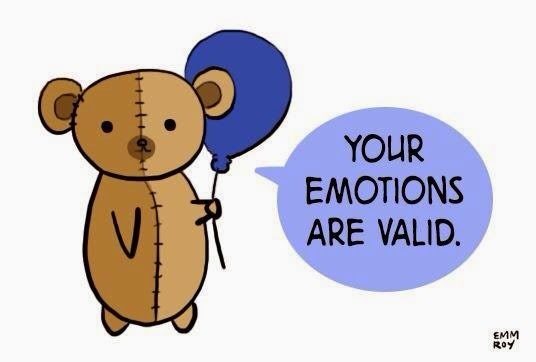
I also had to accept that emotions are transitory, universal, and can co-exist. I had to trust that feeling would not drive me crazy. I learned that feeling could lead to positive emotions, especially L-O-V-E. I understood that in my head, but I needed to feel it in my heart.
Transformation from fear to love requires more than rationalization and intellectualization. Healing transpires from fully feeling emotions, and then taking necessary action, like this: determine the cause of an emotion, identify the feeling, and acknowledge its presence. Honor an emotion in the moment; just be with it, and that is more like going sane.
My therapist and I started with where I was at: scared to death of the world at large. There was a pervasive apprehension that cast an ominous shadow on my world. Slowly, we examined the fear to make it manageable. With each exhale of fear, I could inhale the courage to face my fears, feeling compassion for myself and others. As Eleanor Roosevelt says, “You gain strength, courage, and confidence by every experience in which you really stop to look fear in the face. . . You must do the thing which you think you cannot do.” That is how we learn how to feel.
Post completed by Lynn C. Tolson, author of Beyond the Tears: A True Survivors Story
*Tolson 4 TEARS: Telling Everyone About Rape & Suicide, so no shed tear is wasted

Conversations with my therapist(s) frequently sounded like this:
“Lynn, what are you feeling?”
“I don’t know.”
“You must be feeling something.”
“No, nothing.”
“Please, tell me what it feels like.”
“I don’t know.”
I shrugged my shoulders, which was not an acceptable answer to the question of “how are you feeling?” from my therapist. How should I know? I had no clue, no compass, and no map to lead me through the hot and sweaty tropical jungle of twisted emotional thorny vines that lay strangled with family secrets and lies.
My step-father had taught me to deny my feelings at seven years old. He said, “Whenever someone asks you how you are doing, you say, ‘Fine, thank you,’ no matter what.” He added, “Speak only when you are spoken to.” He raised me under his curse of “children should be seen and not heard.” These powerful authoritarian childrearing dictates led to the cold, calculating climate of control that froze all feelings into a block of ice that could only be released when talk-therapy chipped at the surface decades later.
What I felt was numb, which is a suppression of real feelings. Talking about my experiences and emotions in therapy years later did not feel good. If/when I felt, I felt crappy. Even in the company of a therapist I sensed I was safe with, one whom I trusted and developed rapport with, I dared not enter the realm of emotion. I was afraid to unlock my heart and uncover emotions. If I felt a bona fide feeling, I would surely go insane.
I felt all alone. Loneliness envelopes my being, seals me in a tomb lacking air. I am trapped in the darkness of my heart, all alone, Choking and grasping to find tender loving care.
With that admission of feeling in the form of prose, my therapist taught me that putting words to experiences and the emotions they carry can dispel the hold they had on me. She said, “As your fears recede, courage will emerge. Love was locked inside, shielded by fear. When the darkness of fear disappears, the light of love appears. You built walls around yourself to block out bad feelings, so you also blocked out any good that could come your way. You perpetuate pain by locking up feelings.”
My therapist explained that the depression used to cover up emotions can become a permanent part of the personality. She said, “The symptoms of anxiety and depression you experience are not personality flaws but the consequence of childhood wounds. When you excavate and explore emotions, you allow the fear to fade.” Digging deep like this may alleviate the depression, and allow room for expansion of joyful feelings.
I also had to accept that emotions are transitory, universal, and can co-exist. I had to trust that feeling would not drive me crazy. I learned that feeling could lead to positive emotions, especially L-O-V-E. I understood that in my head, but I needed to feel it in my heart.
Transformation from fear to love requires more than rationalization and intellectualization. Healing transpires from fully feeling emotions, and then taking necessary action, like this: determine the cause of an emotion, identify the feeling, and acknowledge its presence. Honor an emotion in the moment; just be with it, and that is more like going sane.
My therapist and I started with where I was at: scared to death of the world at large. There was a pervasive apprehension that cast an ominous shadow on my world. Slowly, we examined the fear to make it manageable. With each exhale of fear, I could inhale the courage to face my fears, feeling compassion for myself and others. As Eleanor Roosevelt says, “You gain strength, courage, and confidence by every experience in which you really stop to look fear in the face. . . You must do the thing which you think you cannot do.” That is how we learn how to feel.

Post completed by Lynn C. Tolson, author of Beyond the Tears: A True Survivors Story
*Tolson 4 TEARS: Telling Everyone About Rape & Suicide, so no shed tear is wasted
June 22, 2016
On PTSD Symptoms via Tolson 4 TEARS*
*Tolson 4 TEARS Telling Everyone About Rape & Suicide
so no shed tear is wasted
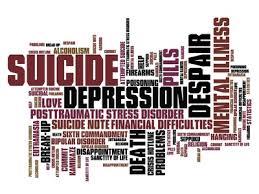
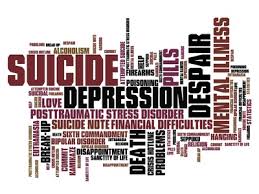
Those suffering from PTSD (post-traumatic stress disorder) often use common terms to describe the phenomena of the symptoms, citing "anxiety" "depression" "nightmares" etc. But how do those symptoms materialize, and how does it feel for the individual thus afflicted?
The nature of PTSD** is such that a somewhat distressing experience in the present can morph into a devastating situation for the individual that has post-traumatic stress. Why is that? An individual with PTSD carries within his-her psyche the entirety of the horrible experiences that caused post-traumatic stress. The pain of the past experiences can be alleviated, but how can the experiences be exorcised, eradicated, erased? (I don't think they can be). So a seemingly innocuous change in the controlled routine of a PTSD individual (I'm talking about a minor-to-moderate inconvenience) can escalate to a threat of imminent danger and impending doom in the mind of one with PTSD. Thoughts and feelings get twisted, and the individual feels overwhelmed and unable to cope.
Metaphorically speaking, a nice spring rain shower, with a single benign thunderclap, can suddenly turn malignant as it increases power to that of a wild hurricane, with thunder and lightening and uncontrollable wind. The person with PTSD can become swept away by a gentle breeze in the present when those breezes collide with the brutal winds of the past, the hurricane gusts that knocked him-her down to the ground to begin with. PTSD is aggravated by the chaos and confusion of an upset, and a breakdown ensues.
The challenge for the person with PTSD is to determine ways in which he-she can transform a breakdown into a BreakThrough. It takes diligent practice to see that every minor inconvenience need not evolve to a major catastrophe. (Note to self: Keep a sense of perspective.)
Lynn C. Tolson, author of Beyond the Tears: A True Survivor's Story
**It is my opinion that the "D" in PTS-D be dropped because it is not I who is disordered but what was done to me that is disordered.
For more on the nature of PTSD click here

so no shed tear is wasted
Those suffering from PTSD (post-traumatic stress disorder) often use common terms to describe the phenomena of the symptoms, citing "anxiety" "depression" "nightmares" etc. But how do those symptoms materialize, and how does it feel for the individual thus afflicted?
The nature of PTSD** is such that a somewhat distressing experience in the present can morph into a devastating situation for the individual that has post-traumatic stress. Why is that? An individual with PTSD carries within his-her psyche the entirety of the horrible experiences that caused post-traumatic stress. The pain of the past experiences can be alleviated, but how can the experiences be exorcised, eradicated, erased? (I don't think they can be). So a seemingly innocuous change in the controlled routine of a PTSD individual (I'm talking about a minor-to-moderate inconvenience) can escalate to a threat of imminent danger and impending doom in the mind of one with PTSD. Thoughts and feelings get twisted, and the individual feels overwhelmed and unable to cope.
Metaphorically speaking, a nice spring rain shower, with a single benign thunderclap, can suddenly turn malignant as it increases power to that of a wild hurricane, with thunder and lightening and uncontrollable wind. The person with PTSD can become swept away by a gentle breeze in the present when those breezes collide with the brutal winds of the past, the hurricane gusts that knocked him-her down to the ground to begin with. PTSD is aggravated by the chaos and confusion of an upset, and a breakdown ensues.
The challenge for the person with PTSD is to determine ways in which he-she can transform a breakdown into a BreakThrough. It takes diligent practice to see that every minor inconvenience need not evolve to a major catastrophe. (Note to self: Keep a sense of perspective.)
Lynn C. Tolson, author of Beyond the Tears: A True Survivor's Story
**It is my opinion that the "D" in PTS-D be dropped because it is not I who is disordered but what was done to me that is disordered.
For more on the nature of PTSD click here
June 21, 2016
Tolson 4 TEARS* Says "BE REAL" for Sexual Abuse Victims
*Tolson 4 TEARS: Telling Everyone About Rape & Suicide, so no shed tear is wasted
What can you do if someone reveals to you that he/she has been abused? You can
BE REAL
B Believe her and believe in her*E Educate yourself; share your knowledgeR Reassure her that is was not her faultE Empower with information and resourcesA Ask what you can do and do your bestL Listen without judgment to what is said
*It is estimated that 1 in 3 women and 1 in 5 men will be abused in his/her lifetime.
Prepared by Lynn C. Tolson, author of Beyond the Tears: A True Survivor's Story

What can you do if someone reveals to you that he/she has been abused? You can
BE REAL
B Believe her and believe in her*E Educate yourself; share your knowledgeR Reassure her that is was not her faultE Empower with information and resourcesA Ask what you can do and do your bestL Listen without judgment to what is said
*It is estimated that 1 in 3 women and 1 in 5 men will be abused in his/her lifetime.
Prepared by Lynn C. Tolson, author of Beyond the Tears: A True Survivor's Story

Beyond the Tears: A True Survivor's Story by Lynn C. Tolson, blog

This is the blog at goodreads for the author Lynn C. Tolson. The blog will keep readers up-to-date on her memoir Beyond the Tears: A True Survivor's Story. The blog has links to interviews, videos, po
...more
- Lynn C. Tolson's profile
- 33 followers
Lynn C. Tolson isn't a Goodreads Author
(yet),
but they
do have a blog,
so here are some recent posts imported from
their feed.

