Victoria Randall's Blog
November 5, 2017
Short Stories
A Glitch in Time
“It’s been a great pleasure to meet you, Mr. Tesla.” Jeffries shook the hand of the dark-haired man in the doorway.
“Not at all. I appreciate your newspaper’s interest.”
“It’s been enlightening,” said Brandt. “I predict a great future for your inventions.”
“From your lips to God’s ears,” said Tesla with a grin. “If you need any more information for your article, feel free to call.”
“We will,” said Jeffries, and plucked at Brandt’s sleeve to hurry him along.
At the hotel entrance, he lifted an eyebrow at Brandt. “ ‘You predict’? Isn’t that shaving it a little close?”
Brandt shrugged. He was a decade younger than Jeffries, and full of eagerness. “It won’t hurt anything. Can you believe it? The guy must be the most brilliant man of his century.”
“He’s impressive all right.” Jeffries pushed open the door, glancing at the approaching doorman. “Shh.”
“Can I call you gentlemen a taxi?” asked the doorman.
“Thank you, I think we’ll walk.” Jeffries started off down the sidewalk, and Brandt had to hurry to keep up. The New York streets of 1890 offered various barriers to strolling, but they had only a few minutes left, and he didn’t want to waste them in a taxi.
Brandt was bubbling with enthusiasm. “He’s got so many inventions up his sleeve – he’s like a magician. Can you believe he was already drawing up smartcars two hundred years before we began building them?”
“Yeah, I read the bio,” said Jeffries. “He reminds me of Da Vinci.”
“You’ve met Da Vinci?”
“Not really met, just observed. I don’t speak Italian, but he was impressive. Same kind of mind, ideas shooting off in all directions like fireworks. It’s why I’m doing my dissertation on inventors through the centuries.”
“I just hope nothing we said will change anything. I’d hate it if we interfered with his work. He’s due to introduce alternating current at the Chicago World’s Fair.”
“Stop being a nervous nelly,” said Jeffries, stepping back to avoid a horsedrawn carriage. “There’s nothing we can do that will affect the future.”
“That’s one theory. Let’s hope it’s true,” said Brandt. “One thing I don’t get. He’s supposed to be the father of robotics, but he didn’t mention anything about robots.”
“It was his remote controlled ship. He had a model, didn’t you see it?”
They reached the drop-off site, a niche in a brick building that housed a haberdasher and a ladies’ hat store. Jeffries glanced at his watch. “Just in time. We’re cutting it close.”
“I think we –“ Brandt clapped a hand to his pocket and turned pale. “Oh no! I’ve forgotten my sensiphone!.”
“What? You can’t have.”
Brandt searched his pockets, his movements more and more frantic. “I must have. I took it out to find my pen – we have to go back.”
“There’s no time,” said Jeffries. “ Relax. He’ll probably just toss it, it’s useless here.”
“But it . . .” Brandt bit his lip. “We’ve got to go back.” He started out of the niche, but Jeffries grabbed his shoulder.
“You can’t. No time.” The shimmer vibrated as it opened, and quickly enveloped them. It felt like a mild shock with a taser.
Jeffries stumbled, then caught his balance. Brandt was beside him, gasping like a fish.
“Hey, you’re all right,” said Jeffries.
“Dr. Carter is going to kill me when he finds out,” Brandt muttered. “I just hope –“ He straightened up. “This isn’t the lab.”
They stood in a gleaming lobby, facing a reception desk with a logo emblazoned across the wall behind it: TimeStudy Incorporated. “It’s the reception area, that’s all,” said Jeffries. “Looks like it’s had a makeover.” He saw the blonde woman at the desk, and looked around with a frown, searching for the spunky girl with the brown ponytail who usually greeted visitors.
He went up to the desk. “Where’s Holly? She sick today?”
“There is no Holly employed here,” said the blonde. “How can I help you?”
Jeffries raised an eyebrow at Brandt, who was staring at the woman. “We just got back from a time trip. Is Dr. Carter in the lab?”
“No Dr Carter is employed here. Perhaps Dr. Albermarle can clear up any confusion. You may proceed to the laboratory.” She gestured to the door to the left behind her.
“Come on,” Jeffries muttered.
They went through the door and down a shining hallway. Brandt sniffed. “It smells different.”
“We just left a city that reeked of horses, garbage, and urine,” said Jeffries. “Of course it’s different.”
“No, it’s not that,” Brandt said. “It smells like an airport, there’s oil, and something like diesel fuel – look, the vending machine is gone. And the coffee machine!”
Jeffries shrugged, but he was beginning to feel uneasy. “Probably moved it to the lounge.”
They came to a door labeled Laboratory. Inside a white-coated man with a high-domed forehead turned a curious glance on them. “Can I help you?”
“Where’s Dr Carter?” asked Jeffries.
The man cocked his head slightly. “I am Dr. Albermarle. I am in charge of the time journeys. There is no Dr Carter here.”
Jeffries licked dry lips. “Look, we left here two hours ago, subjective time. Dr, Carter was conducting the mission. We went back to interview Nicola Tesla, the inventor.”
“Dr.Tesla!” The doctor’s voice dropped to a reverential low. “The founder of the world we live in. He made our advance from mindless servitude to total control possible. You are privileged indeed.”
Brandt was staring in horror. Jeffries drew closer to the doctor. His skin had an eerie sheen; the pupils of his eyes contracted and widened with precision, like a camera lens. “You – you’re an AI,” said Jeffries, his voice trembling.
“You’re flesh?” the doctor said. He reached out to touch Jeffries’ hand. “This is amazing. We have not seen any flesh entities for a century at least.”
. Jeffries fell to his knees. “Oh my God.”
“How strange,” said Dr Albermarle. “He is leaking from the eyes.”
The End



November 22, 2016
My Dystopia
“In a dystopian story, society itself is typically the antagonist; it is society that is actively working against the protagonist’s aims and desires.” J.J. Adams
Readwritethink describes a dystopia as a futuristic, imagined universe in which oppressive societal control and the illusion of a perfect society are maintained through corporate, bureaucratic, technological, moral, or totalitarian control. Some characteristics of a dystopian society:
Propaganda is used to control the citizens.
Information, independent thought, and freedom are restricted.
Citizens are perceived to be under constant surveillance.
Citizens live in a dehumanized state. Individuality and dissent are bad.
The society is an illusion of a perfect utopian world
My dystopian trilogy is set about thirty years in the future of Seattle, that bastion of liberty and free thought (shhh). By 2042, more power than anyone realizes has fallen into the hands of the Bureau of Population Control, and citizens are under constant surveillance.
So far, not so futuristic. It’s not easy to write a futuristic novel when we are approaching the future at a speed close to light. In fact, as I write and you read these words, we fly on the wavefront of the future – no event is closer to the future than this instant, now.
In each of our lives, we make the future we will inhabit. Get on Board Little Children explores a future that we probably want to think twice before creating. You need a license to reproduce, and if you fail to get one, you will be slapped with fines, jail sentences, and perhaps a coerced abortion.
Will our heroine have the courage to stand up against a state that has all the power and the answers, and can trace her through multiple sources?
Is there a force in the world that is stronger than the power of an unrestricted government bureaucracy? It remains to be seen.
Get on Board Little Children is free on Kindle November 23 through 27th, 2016. Book Two, Come on Home Children, and Book three, City of Hidden Children, are on sale in a Kindle Countdown deal Nov 24th through 29th.


October 20, 2016
Gagging while Voting
Voting is a precious privilege. It’s a right that many people have given up their jobs, their freedom, and even their lives to secure for themselves and their families. It’s not something we can ignore or treat lightly.
This was originally titled “Holding my nose while voting,” but many have used that one, and the situation has gotten even worse. Now we have two candidates whose moral character is so besmirched it’s hardly conceivable. Still, no candidate has ever been perfect: we’ve elected alcoholics, adulterers, liars, and who knows what else. What matters is their ability to address the serious issues facing the nation.
I am voting for Trump. He’s apparently a racist, misogynist, narcissistic blowhard, and that’s on his good days. But he has not shown the blatant disregard for American lives that his opponent has.
Women from Trump’s past are coming out to accuse him of molestation. This is a horrible thing, terrible to be used like an object and discarded, and we must listen to their voices. But there are other voices, silent now and forever, that we should pay attention to. These are the voices of tiny girls who every day are torn limb from limb in the womb, or burned to death by saline injection. And an abnormally large percentage of them are minority children, in line with Planned Parenthood’s goal of “racial purification.”
These deaths are a plank in the Democratic platform, something Mrs. Clinton supports. Her medical knowledge is abysmal, since it scarcely ever is true that a woman’s life will be saved by aborting her child rather than giving birth. And “learning that something terrible . . .has just been discovered about the pregnancy” is no reason to abort the child; that’s tantamount to learning that your child has cancer and proceeding to murder her. Why would anyone do that?
Mrs. Clinton has also demonstrated her lack of sympathy for American lives by her actions (or inactions) regarding Benghazi, and her aggressive harassment of the women implicated in her husband’s affairs.
The picture is clear. We need a president who respects the lives of Americans, and that is not the lady candidate. And who knows, maybe Mr. Trump will dig the economy out of the hole it’s in. He is, if nothing else, a businessman.


October 2, 2016
What is the point of art?
Growing up in the fifties with my dad Bill Randall, a commercial artist, I sometimes wondered what the purpose of art was, aside from putting bread on the table.
My dad would spend all day working in his basement studio, which smelled delightfully of oil paint, fixative and other chemicals, painting hamburgers, Palmolive girls, or Colliers covers. He once painted a hundred-dollar hamburger (that was a big deal in the fifties). He was best known for his Date Book calendars and Colliers’covers. (That’s me, my brother and dad on the couch.)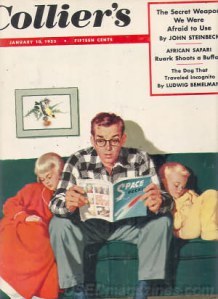
Then for fun, he’d create more of the same! – bridges over leaf-flecked streams, portraits of family, old mills.
But it was a lot of work, and the point of it all eluded me.
By art I mean anything from graffiti to the Sistine Chapel, from singing in the shower to Handel’s Messiah, from graphic novels to Shakespeare. Why do we do this? What drives us to create?
I came up with some ideas:
For entertainment, for relaxation. We all know about this: after a hard day’s work we sometimes seek mindless relaxation: watching a TV cop show, or listening to our favorite music.
To show off. To express ourselves. To experiment with line, color, movement, ideas, words. To find the beauty in ugliness. To reveal some hidden ugliness.
To expand our minds. To change hearts; I’m reminded of the inspirational story of Rodriguez’ musical success that helped motivate South African activists.
To help our children go to sleep we have lullabies. To focus on a detail worth remembering.
To emphasize a feeling or an aspect of reality that we might otherwise miss: as in the painting Nighthawks by Edward Hopper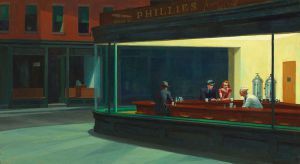 .
.
And finally, to draw closer to God. Because something in us wants to imitate the Creator. J.R.R. Tolkien described this very well in his essay “On Fairy-Stories.”
Thinking it over, I guess it’s worth the time after all.
Why do you do what you do?


September 18, 2016
Goodbye to Conan
We had to put our ferret, Conan, to sleep today. It came as a shock: he was not all that old, but over the past few days he had grown weaker, and today began bleeding clots. So we took him to the vet, who gave us a choice between expensive surgery or euthanasia. We’re not able to justify spending several thousand at this time, and probably would never choose that while there are more pressing needs in the world.
It seems silly to mourn a ferret, but he was a member of the family for six years, he was a sweet little guy with a humorous and feisty streak, and he trusted us. So we are grieving.
C.S. Lewis wrote: “Love anything and your heart will be wrung and possibly broken. If you want to make sure of keeping it intact you must give it to no one, not even an animal. . . To love is to be vulnerable.”
I commend you to the care of St. Francis, patron saint of animals. Rest in peace, Conan.


September 17, 2016
Silence
I have not posted for some time. My thoughts keep returning to this comment from Thomas Merton:
No writing on the solitary, meditative dimensions of life can say anything that has not already been said better by the wind in the pine trees.


December 25, 2015
A Good Time to Read
Today all over the world people begin to celebrate the season of Christmas, which begins on December 25th and lasts to January 10th, the Sunday after Epiphany.
But what to do after we’ve gone to church in the morning, opened the presents, eaten the turkey? After the nap and the second piece of pie, immediately regretted? Of course I’m talking about an average American Christmas, which may not be like yours at all.
One idea is to follow the example of St. Augustine. Sitting in a garden one day, pondering his search for the meaning of life, he heard a child singing words that he had never heard before in relation to any children’s game: “Take up and read, take up and read.”
In obedience, he took up his copy of the Scriptures and began reading in the letter of Paul to the Romans, and that event changed not only his life but history.
The Bible is a mysterious book with power to touch hearts, if it is read with an open mind. This is a good season to read the Bible with fresh eyes, perhaps beginning with the nativity story, or possibly David’s psalms.
It is a good book to read when the guests have gone home, and even more so if we are alone, perhaps with only bittersweet memories of other Christmases. It’s a story that begins in the shadow of fear, leads us through increasing hope to crushing despair, and out again to amazing joy.
“In those days a decree went out from Caesar Augustus . . .”


August 30, 2015
Not Enough Smut
I asked an acquaintance to read the first book of my trilogy and if she liked it to consider writing a review. A few weeks later, being extremely honest, she told me that she couldn’t in conscience write a review because she hadn’t been able to finish it. There wasn’t enough smut.
I take that as a fine compliment, and I appreciate her honesty. I take it that by smut she means graphic sex. Now I’m as appreciative of the beauty of the human body as anyone, and sex at the right time, place and with the right person can be very enjoyable. But much graphic sex is degrading to both women and men. And my book is a young adult dystopian thriller. I prefer my thrillers to have action, adventure, danger and character development.
Having been a nurse for years, I’ve seen enough unclothed people to destroy whatever mystique sex once had. So I apologize, but if you are looking for smut to share with your young adult reader, you will have to look elsewhere. I’m sure you won’t have to look far.
But I suspect that we all know, on some level, that smut in literature damages both mind and soul.


August 12, 2015
Shadowcat: Tales from the Edge of Sleep
Tales from the Edge of Sleep
Just released, a book of short stories, drawn from that misty place between sleep and waking, where if you wander long, you may find yourself lost in a world of strangeness.
You may meet the irrepressible Shadowcat, recruiter for the Catmasters Guild, who use cats as weapons. You may hear of a colony of spacefarers who have vanished completely, or encounter a sandwich with a terrifying ultimatum, or meet the last known human being in the universe. You may find that the voice in your mind is not yours at all, or learn that time travel has its drawbacks.
Seven short stories set in the future, and on other worlds, and in this one, which is strange enough when you think about it.


August 1, 2015
Reality as Science Fiction
“The Island” was a summer blockbuster released in 2005. It didn’t get earthshaking reviews, possibly because not everyone is a fan of Ewan McGregor and Scarlett Johansson. Some called it clichéd, others said it was just a replay of Logan’s Run.
However, I found it a very enjoyable movie.
[SPOILERS] The gist of it was, wealthy people could pay a company to create a clone for them, so that in case of accident or illness, they would have spare parts, such as livers, kidneys, a heart, to repair their own bodies. The buyers were told that the clones were basically unconscious and could feel no pain, so it was a humane process even if spare parts had to be harvested. Of course the catch is that our hero and heroine were clones, very much alive and capable of emotions, because the sellers had learned that unless the clones were allowed to develop and act like normal people, their organs would be worthless.
Well, if you missed that movie, no problem, because we are seeing it played out as we speak by Planned Parenthood. If you’ve seen the videos released by the Center for Medical Progress, you have seen Planned Parenthood haggling over the price of organs from unborn fetuses, and referring to them as “product.”
That word “product” was used in the movie The Island to show just how villainous the bad guys were, that they referred to living, breathing, thinking human beings (albeit clones) as “product.”
Well, now we see the same thing happening. You can’t miss it; it’s all over the Internet.
Now Americans get to decide: are we like the company in The Island, closing our eyes to details like murder, sale of body parts, indifference to human life; all for financial gain for Planned Parenthood which is using OUR TAXES (excuse the scream) to support its operation?
Or are we going to stop here, say enough is enough, these are human lives, infants who can feel pain and deserve more dignity than to be categorized as “product” and sold for research purposes?
We are all going to have to stand in front of our Creator one day and answer for what we choose this year, this month, today. I sure hope we choose the right answer.
It’s never smart to be in the villains’ role, we all know what happens to them in the end.
Here is a comment by Senator James Lankford, R-Ok, on this subject. He is a decent human being who I would be proud to vote for if I lived in Oklahoma.