Jeff Zweerink's Blog
November 6, 2020
Standing against the Tide
Richard Dawkins, Lawrence Krauss, Christopher Hitchens, Michael Shermer, Victor J. Stenger. What do all these people have in common? They are all convinced that the God of the Bible does not exist and have each made strong, public cases in defense of that position. John Lennox, emeritus professor of mathematics at Oxford, had the opportunity to debate each of them, arguing for the truth of Christianity. The new movie, Against the Tide, articulates Lennox’s case and the subtitle, Finding God in an Age of Science, gives a hint as to what the “tide” refers to.
The film recounts some of the potent scientific, philosophical, and societal reasons for God’s existence. Astronomy, cosmology, and physics provide abundant evidence pointing to (1) a beginning to the universe from nothing, (2) a law-like, mathematical, rational nature of the universe, and (3) a fine-tuned character of creation. History demonstrates that past societies devoted to implementing philosophies built on naturalistic worldviews inevitably undermined the well-being of citizens as well as the advancement of the scientific enterprise. The fields of biology and evolution also provide sound reasons for believing God exists. Lennox asks viewers to consider the requirements on the universe necessary for evolution to work, for the origin of life, and for the incredible information content and processing power of life—even in its simplest forms. The most rational explanation for all this evidence is that our universe owes its existence to a transcendent Creator. The Christian faith affirms that science stands against the tide of atheistic science.
The case becomes more convincing when considering the historicity of Jesus Christ. Against the Tide spends a substantial amount of time discussing the accuracy of the various gospel descriptions of Jesus’s life. This effort makes sense considering that the truth of Christianity hinges on the life, death, and resurrection of Jesus. Again, ample evidence exists to validate the biblical accounts and the most rational conclusion in light of all the evidence is that Jesus indeed rose from the dead.
In addition to the wealth of evidence pointing toward the truth of Christianity, Lennox’s approach to apologetics impressed me. He exhibits exemplary confidence. In contrast, I have seen enough presentations by Christians (including my own) that seem defensive rather than confident. This defensiveness usually demonstrates itself in either aggression or passivity. Lennox declares and defends the tenets of the Christian faith. When confronted with challenging questions, he responds with confidence and calmness that communicate love, care, and compassion for his “adversary.” To be clear, Lennox is not generating false optimism or putting on a good front. Instead, one can tell that he has seriously investigated the evidence and knows that Christianity rests on a solid foundation that can withstand any assault—including the rising tide of a scientific age. Consequently, Lennox need not win the debate (or even a specific point). Rather, he focuses on clearly communicating what Christianity is so that the recipient is equipped to adopt a well-informed position.
It doesn’t take much investigation to detect the decline of the prominence of Christian thought over the past couple of decades. In its place, diverse worldviews have rushed in to fill the void in the academic and public arena. However, Christianity is a robust worldview, ultimately anchored in truth. It will not disappear. I encourage you to see this movie (premiering November 19th) so that you, too, can stand against the tide.


July 3, 2020
Ethical Concerns with AI: Deepfakes
How would you respond to video footage of Richard Dawkins professing faith in Christ? Or one about Hugh Ross advocating for young-Earth creationism? Either situation would be shocking and the confusion would grow when deeper investigation reveals it was a misquote or deceptive editing. Welcome to the world of deepfakes. What can we do to minimize harm?
What Are Deepfakes?
According to Merriam-Webster, a deepfake is “an image or recording that has been convincingly altered and manipulated to misrepresent someone as doing or saying something that was not actually done or said.” Scientifically, deepfakes are video content produced from the battle between two artificial intelligence (AI) combatants known as generative adversarial networks (GAN). One side, the generative network, generates video imagery using neural networks. The other side, the discriminative network, analyzes the video imagery to determine its realism.
The generative network maps the facial features and movements of the fake target into a complex roadmap (although “roadmap” oversimplifies the concept). Then it uses this roadmap to compile the new video with the target’s face. The discriminative network then looks for flaws or defects in the resulting video that would identify the video as fake. The analysis by the discriminative network is propagated back to the generative network, allowing it to produce more realistic fake videos.
How Realistic Are Deepfakes?
A quick search of the internet produces many examples of deepfake videos (be careful, many deepfakes are not innocent and wholesome). Currently, most deepfakes are easy to spot due to odd mannerisms or movements, but the basic process used by GANs will inevitably lead to better and better fakes. As the generative network makes increasingly realistic videos, the discriminative network must grow more adept at finding defects. However, any process developed for identifying defects will be incorporated into the generator, resulting in even more realistic videos. It’s not a matter of if, but when, the technology will advance to the point where the human consumer cannot spot a fake video.
How Should We Respond?
If seeing is believing, deepfakes throw a monkey wrench into our ability to discern the truth. But good tools exist to help us. Three passages from the Bible provide helpful guidance in pursuing truth.
1. James 1:19–20: My dear brothers and sisters, take note of this: Everyone should be quick to listen, slow to speak and slow to become angry, because human anger does not produce the righteousness that God desires. Before speaking (or believing) something, whether it supports or attacks your position, take time to listen to what really happened. Applying this principle provides you time to dig for the truth.
2. Proverbs 18:17: In a lawsuit the first to speak seems right, until someone comes forward and cross-examines. When digesting information in any form, but especially video, take time to hear what “the other side” has to say. Hearing both sides often allows you to actually hear the truth. Personally, this approach has been tremendously helpful for discerning the truth in challenging situations.
3. Matthew 7:12: In everything, therefore, treat people the same way you want them to treat you, for this is the Law and the Prophets. Would you want your name smeared because of a fake video? Of course not! Then let’s make sure we don’t do the same. This others-oriented mindset gives you the opportunity to care for others. It ensures we love someone enough to understand the truth. And, if we find the truth warrants it, treating others respectfully enables us to give judgment with justice.
Nothing New under the Sun
For some practical steps, verify everything before posting on social media. Find reliable sources of information—particularly if those sources share your viewpoint. And, if social or mainstream media sources continue to provide unreliable information, quit listening to them.
The author of Ecclesiastes states, there is nothing new under the sun. Technology is morally neutral; human agents who use it are not. Just as Photoshop made us evaluate photographs more carefully, so deepfakes require better discernment with video. Christians are called to relentlessly pursue the truth and to hold those who distort it accountable.
May 29, 2020
Can Artificial Intelligence Think Like a Human?
How close are we to developing machines that can understand and learn anything that humans can? Could such inventions eventually become self-conscious?
A great wealth of information exists regarding the pursuit of what scientists call artificial intelligence. Every now and again, I run across an idea that helps clarify a crucial issue surrounding the pursuit of an intelligence similar to humanity. Computer scientist Judea Pearl articulated one of those ideas in his book, The Book of Why, and titled it “the Ladder of Causation.” This three-level abstraction (see image below) helps identify the key steps to move from an artificial narrow intelligence (ANI) to an artificial general intelligence (AGI), meaning the entity would be able to think like a human being.
Rung 1: Seeing/Observing (“Association”)
The first rung of the ladder entails the ability to see and connect inputs with outcomes. The inputs and outcomes can be complicated and the connections rather hidden, so getting computer programs to do this still represents quite an accomplishment. Everything currently termed artificial intelligence (Siri, Alexa, language translators, facial/voice recognition, even driverless cars) sits on this rung of the ladder. These examples (all are ANIs) operate by using the available data to find correlations in order to make the a decision following a predetermined algorithm.
Rung 2: Doing/Intervening (“Intervention”)
The next rung up the ladder of increasing sophistication adds the ability to intervene in an environment and respond appropriately. Pearl illustrates this change by two questions.
Rung 1: What is the likelihood that someone who bought toothpaste will also buy dental floss? Correlations in existing sales data will answer this question.
Rung 2: What will happen to floss sales if we double the price of toothpaste? In order to find a good answer to this question, one must intervene in the system to gather new data that addresses the question or develop a model that extrapolates from known environments to this new environment.
Scientists routinely exercise rung 2 skills. They ask a currently unanswered question about how the world works, perform experiments or observations to gather appropriate data, and then provide an answer/model that answers the question.
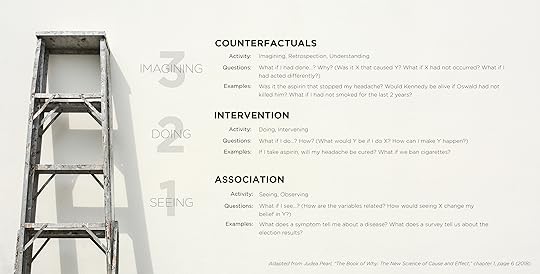
Rung 3: Imagining/Understanding (“Counterfactuals”)
On this top rung, one has the capacity to understand environments that don’t exist. According to Pearl, the toothpaste question becomes: “What is the probability that a customer who bought toothpaste would still have bought it if we had doubled the price?” In other words, this rung requires the ability to imagine something different than the physical world that already exists.
Humans consistently and effortlessly operate on this third rung. We routinely think about how things would be different if we had chosen the “other” option. The theological importance of this level is that humans recognize our place in this physical universe as well as the existence of reality completely separate from it. All the evidence to date indicates that only humanity operates on this intellectual plane. This evidence aligns well with the biblical idea that humanity alone was created in the image of God.
Not only does Pearl’s ladder of causation provide a great image of the challenges that lie ahead in the quest for true artificial intelligence, it also highlights humanity’s unique understanding of our place in the cosmos. And that fact affirms the validity of Christianity.
April 24, 2020
Is the Universe Closed?
Can our universe come from nothing? At least one prominent physicist, Lawrence Krauss, answers with a resounding “yes.” In fact, he wrote a book titled A Universe from Nothing to articulate his position, which emanates from his worldview that no creator is involved. Krauss wants science to define nothing (instead of agreeing with the definitions of philosophy and theology). One key component of Krauss’s “nothing” hinges on the sum energy budget for the universe being zero and that requires a universe with a flat geometry. It is difficult to picture this geometry because we can’t “see” the universe’s shape, but recent evidence may undermine that key feature and worldview.
A Little Background
For the last two decades, the prevailing cosmological model for the origin of the universe has posited an inflationary big bang picture. After an incredibly brief epoch of hyperfast expansion, known as inflation, the universe continually expands from an initial hot, dense state. As it expands, it cools and forms all the structure we see—stars, planets, galaxies, and clusters of galaxies, etc. Measurements indicate that the energy of the universe is distributed such that normal matter (electrons, protons, neutrons and the like) comprises about 5%, dark matter adds another 25%, and dark energy makes up the balance. When originally proposed, inflation provided a nice answer to a nagging question: Why did our universe have a geometry so close to flat?
The very process of inflation contained the answer. The exponential growth increased the universe’s size by at least a factor of 1026! This incredible expansion would take the original geometry of the universe (whether closed, flat, or open) and drive it exquisitely close to a flat geometry. This was a hallmark prediction of inflation. Regardless of the universe’s original geometry, inflation’s incredible expansion would result in a measurably flat geometry (at least with our current sensitivity).
Why Is a Flat Geometry Important?
On a basic level, the universe could assume three different geometries: closed, flat, or open—and it has nothing to do with the number of dimensions. The three diagrams below show how parallel lines behave within the different geometries.
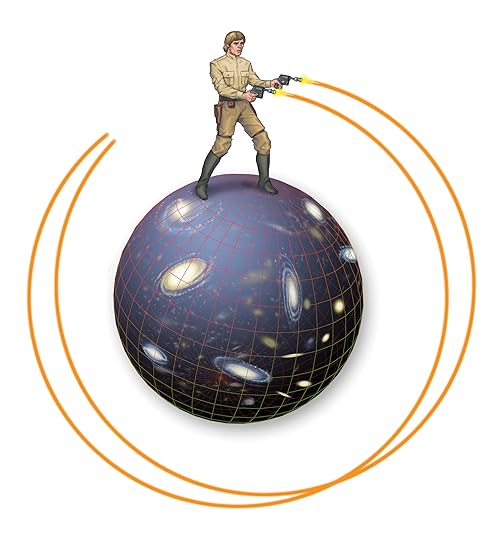
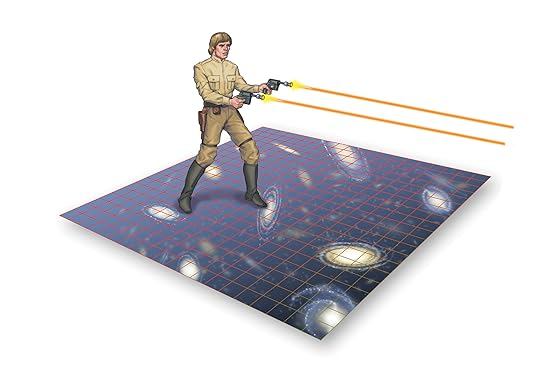
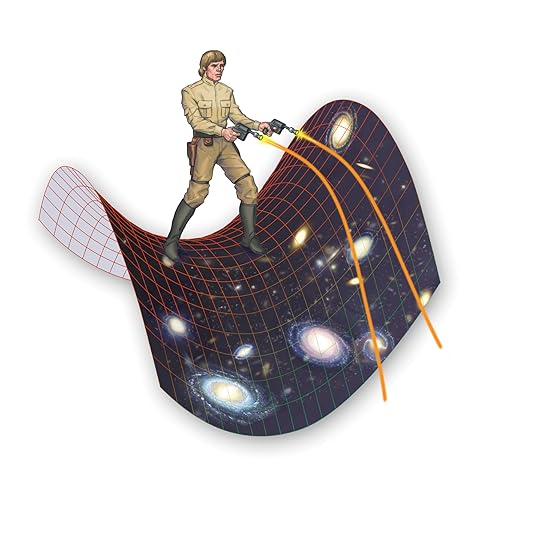
In a closed geometry (left), parallel lines converge and eventually cross. In an open geometry (right) the lines grow farther and farther apart. In a flat geometry (center) the lines always stay the same distance apart. Although scientists cannot step outside the universe to see its geometry, they can measure various quantities like the “clumpiness” of the cosmic microwave background radiation (CMB), which is leftover radiation from an early stage of the universe. That distribution pattern can help reveal the geometry.
Given the nature of our universe (as described above), scientists have derived an interesting feature. If the universe is flat, calculations show that the total energy of the universe is zero!1
Krauss relies on this feature of the universe because he argues that the universe arises from a quantum fluctuation. Only if the universe has zero energy can this quantum fluctuation exist for anything more than the briefest length of time. Consequently, evidence that the universe has an open or closed geometry would undermine Krauss’s entire argument.
Is the Universe Actually Closed?
A recent article published in Nature Astronomy indicates that the universe may actually have a closed geometry.2 Analysis of the Planck Legacy data suggests that the universe exhibits more gravitational lensing than expected. In gravitational lensing, gravity bends the path of light traveling through the expanding universe. Thus, a closed geometry for the universe is the simplest way to account for this variation. Furthermore, analysis of Planck satellite data tends to affirm a closed geometry. However, it’s not a closed case. When integrating the Planck analysis with baryon acoustic oscillations surveys of dark energy and gravitational shear studies, the best fits still point to a flat geometry. (On an interesting note, there are other discrepancies like this, such as the disparate measurements of the Hubble constant using the CMB and Type Ia supernovae.) Unfortunately, current technology and measurements cannot resolve whether the universe is actually closed or if scientists need more analysis.
We must wait for future space missions to provide more definitive data but we can think about the potential implications. The discovery of a closed universe would rule out the possibility of a zero-energy universe. The remaining options fit more comfortably within a theistic framework where the universe begins to exist. These results show that scientific advances can provide evidence to evaluate models for the origin of the universe and the worldviews that give rise to those models.
Endnotes
1. Marcelo Samula Berman, “On the Zero-Energy Universe,” International Journal of Theoretical Physics 48 (August 25, 2009): 3278–86, doi:10.1007/s10773-009-0125-8.
2. Eleonora Di Valentino, Alessandro Melchiorri, and Joseph Silk, “Planck Evidence for a Closed Universe and a Possible Crisis in Cosmology,” Nature Astronomy 4 (November 4, 2019): 196–203, doi:10.1038/s41550-019-0906-9.
October 25, 2019
Thinking Rightly about God: Ham vs. Zweerink Follow-Up, Part 2
What comes into our minds when we think about God is the most important thing about us.
A. W. Tozer, The Knowledge of the Holy
The recent old-earth/young-earth discussion on Justin Brierley’s Unbelievable? podcast revealed a number of differences and similarities between Ken Ham and me. Two important areas of agreement are that we both care deeply about the authority of Scripture,1 and we both want to spread the good news of salvation through Jesus Christ. Of our disagreements, the most significant relates to the topic of animal death. Ham thinks humanity is responsible for animal death. I think that ultimately, God shoulders that responsibility. Regardless of our differences when it comes to the old-earth/young-earth debate, it is imperative that we think rightly about God’s character. Since our views on animal death affect how we think about God, I thought it important to explore what Scripture has to say on this topic more deeply.
Agreement on Human Death
One more point of agreement merits mention because it was unclear during the podcast. We both agree on our hermeneutic (or how to interpret Scripture) as well as the impact of human sin on humanity. I abide by the grammatico-historical method that Ham espoused during our discussion. And we both agree that Adam and Eve’s sin is responsible for all human death and disease. Humanity’s disobedience in the garden of Eden brought physical death, disease, hardship, and most importantly, spiritual death to all humanity. Interestingly, the Bible verses Mr. Ham quotes regarding this issue place the blame for those consequences on humanity (Romans 5:12) and God (Romans 8:22 when taken in context—see Romans 8:20).
Ken Ham’s View on Animal Death
According to Ken Ham’s article about the podcast, animal death began after Adam and Eve disobeyed God. If animal death occurred before, he says, then “death and suffering are simply part of the design of God’s creation from the very beginning. Such an idea undermines the gospel . . . and calls into question the character and goodness of God.” More directly, Ham states that “if the earth is millions of years old, there is nobody else to blame in this regard! Humans weren’t around to break God’s very good creation, so it must be God’s fault.”
He says that any biblical interpretation allowing the earth to be billions of years old compromises the authority of Scripture and attacks the character of God. As he states, “Once you start compromising, as Jeff does, on the clear teaching of Scripture, you’re forced to reinterpret other parts of God’s Word to make them fit with your beliefs. Believing in millions of years is actually an attack on the character of our God. (And yes, I said that during the radio debate.)”
I have tried to use Ham’s own words to properly state his view. If I have misunderstood his position, please let me know and I will correct my misunderstanding.
My View on Animal Death
While we agree regarding the impact of Adam and Eve’s sin on humanity, we disagree on the extent of animal death. Specifically, we disagree on whether animals died before humanity’s sin in the garden and on who is responsible for that animal death. I would argue that the Bible places ultimate responsibility for animal death on God’s shoulders, regardless of whether animal death started before or after humanity’s sin. My position is that animals died before humanity disobeyed God.
Ham exhorts us: “instead of adding man’s ideas into Scripture, let’s start with God’s Word—in all areas—and interpret what we see in the world through the lens of Scripture.” I agree! So, does the Bible say that man “broke” God’s very good creation regarding animal death? Or does Scripture portray animal death as part of God’s very good creation?
Biblical Statements Related to Animal Death
1. God chose to create a world where humans, including Jesus Christ, would die.
John 3:16: “For God so loved the world that he gave his one and only Son, that whoever believes in him shall not perish but have eternal life.”
Acts 2:23: “This man was handed over to you by God’s deliberate plan and foreknowledge; and you, with the help of wicked men, put him to death by nailing him to the cross.”
Unless we want to deny God’s omniscience or sovereignty, God created knowing that humans would sin. Scripture makes it clear that God loved us so much that he created this universe knowing that he would send his Son so that we might have eternal life.
2. “Very good” does not mean perfect.
Genesis 3:1: “Now the serpent was more crafty than any of the wild animals the LORD God had made. He said to the woman, ‘Did God really say, “You must not eat from any tree in the garden”?'”
Revelation 21:27: “Nothing impure will ever enter it, nor will anyone who does what is shameful or deceitful, but only those whose names are written in the Lamb’s book of life.”
Whatever “very good” means, it cannot mean “perfect.” Eden was corruptible as history clearly shows. That fact stands in stark contrast to the incorruptible nature of the new creation.
3. God killed animals to provide clothes for Adam and Eve, and Jesus killed a herd of pigs.
Genesis 3:21: “The Lord God made garments of skin for Adam and his wife and clothed them.”
Matthew 8:32: “He said to them, ‘Go!’ So they came out and went into the pigs, and the whole herd rushed down the steep bank into the lake and died in the water.”
4. God made the darkness for lions to prowl.
Psalm 104:19–22: “He made the moon for the seasons; the sun knows the place of its setting. You appoint darkness and it becomes night, in which all the beasts of the forest prowl about. The young lions roar after their prey and seek their food from God. When the sun rises they withdraw and lie down in their dens.”
Virtually every commentary recognizes Psalm 104 as a parallel description of the creation week. Specifically, the psalmist declares that part of God’s order is light and dark. Furthermore, God ordained the dark to provide food for the carnivorous creatures he made.
5. The psalmist praises God for his provision for and destruction of animals.
Psalm 104:24–31: “O LORD, how many are Your works! In wisdom You have made them all; the earth is full of Your possessions. There is the sea, great and broad, in which are swarms without number, animals both small and great. There the ships move along, and Leviathan, which You have formed to sport in it. They all wait for You to give them their food in due season. You give to them, they gather it up; you open Your hand, they are satisfied with good. You hide Your face, they are dismayed; you take away their spirit, they expire and return to their dust. You send forth Your Spirit, they are created; and You renew the face of the ground. Let the glory of the LORD endure forever; let the LORD be glad in His works.”
6. The Bible repeatedly uses a lion as a metaphor for God.
Hosea 5:14: “For I will be like a lion to Ephraim, like a great lion to Judah. I will tear them to pieces and go away; I will carry them off, with no one to rescue them.”
See also Jeremiah 25:38, Hosea 13:6–10, Isaiah 38:13, and Lamentations 3:10–12. In fact, Revelation 5:5 explicitly refers to Jesus as the Lion of Judah!
The Bottom Line
The Bible tells an unmistakable narrative of God creating a world where humanity would sin and Jesus would redeem us by his death on the cross. Repeatedly, the biblical authors use carnivorous creatures as metaphors for God, praise God for carnivorous activity, and describe God killing animals outside of atoning sacrifices. Looking just at what the Bible has to say, I find it difficult to come to the conclusion that animal death results from man’s breaking God’s “very good” creation. The Bible is clear: God created everything and is in control of all that happens—including animal death. Because of this important truth, nothing can stand in God’s way. He will accomplish his sovereign purposes. Now that’s a God worth worshipping!
Endnote
Ken Ham’s review of the debate says that it is, in fact, “a debate over authority,” but that’s not correct. I hold to the authority of Scripture as described in places like the Chicago Statement on Biblical Inerrancy and in articles 2–5 of the Belgic Confession. Also, Ham inaccurately describes my motives on at least one occasion. He states that “the only reason people like Dr. Zweerink try to add those years in Genesis is because of influences outside the Bible.” That is not true. In fact, there are many biblical reasons I think the days in Genesis are much longer. You can see some of those in this article. I take no offense that Ken Ham disagrees with me. However, I do object to the way he questioned the character of a Christian brother by falsely assigning incorrect motives.
October 18, 2019
AI Investigations: Philosophy Is Not Dead
Why can we think about the universe when the universe cannot think about us? This simple, yet profound, question leads to fascinating philosophical, theological, and scientific investigations. Those same considerations converge in the arena of artificial intelligence research and its goal of artificial general intelligence. Artificial intelligence is a burgeoning field, but this research is not strictly a scientific endeavor. It necessarily involves philosophical reasoning that I think is reminiscent of intelligent agency behind the origin of the universe.
The pursuit of artificial general intelligence (AGI) requires that scientists figure out how to build and program a machine with capacity to contemplate things outside of itself, as well as its place within a larger context. Even more modest projects aiming for artificial narrow intelligence (ANI) that can work through open-ended problems mandate that scientists carefully consider how we think and reason.
AI conversations often highlight how fast computers perform calculations compared to humans. Clearly, programs compute faster and work through logical processes faster than we do. However, the salient question is how well can computers make decisions based on arguments derived from incomplete data that do not permit definitive conclusions? It turns out that philosophy, specifically the philosophy of argumentation, plays an integral role in describing and developing the processes for handling such situations.
Real-life Knowledge Is Usually Tentative
These AI scenarios differ from reasoning in the mathematical arena in that real-life knowledge is not monotonic. In formal (monotonic) logic, from a set of basic axioms, the conclusions drawn from those axioms become true, and the set of “known” things always grows. The nature of the formal logic disallows the possibility of contradiction or revision when new information is acquired. But rarely are the conditions required for formal logic met in everyday scenarios. Consequently, one must assess the conditions, evaluate different options for explaining the conditions, evaluate different options for how to proceed, and ultimately make a decision on the best way to proceed.
As the authors of one article state,1
. . . there are . . . a number of fundamental distinctions between the concepts “P is a formal proof that T holds” and “P is a persuasive argument for accepting T.”
Which Ethical System?
However, humans often disagree about whether an argument is persuasive or what the best course of action is. Any form of AI must figure out how to navigate the reality that most circumstances in life don’t have a single best answer and that any solution has benefits and consequences. Evaluating various benefits and consequences almost always involves some system of ethics and morals. This raises the question of what system the AI should use.
In our society, we seem to be moving in the direction that everyone determines what is right or wrong for themselves. Do we really want an AI (that might make decisions faster and respond more quickly that humans) making decisions with a subjective moral code? Suppose an AI makes a decision that results in someone’s injury or death. Who do we hold accountable? Can the AI be held responsible, or would the creator of the AI?
Maybe a Completely Rational, Incredibly Powerful Machine Is Not the Best Option
We assume that creating an AGI would work out something like Data on Star Trek: The Next Generation. Although Data was physically more capable than the crew of the Enterprise in almost every way (strength, intelligence, speed, etc), he always seemed to know when to submit to the authority of his superiors. The creators of the Star Trek universe can write things however they like, but a powerful intelligence in real life would pose quite a dilemma. If Data has a genuine awareness of self, how does he choose to submit—especially when he knows his superiors’ decisions are incorrect? Human history is littered with examples of people who became powerful enough to impose their will on others (with great destruction resulting). The very thing we hope AI will do (perform human tasks with superhuman skills) also provides the platform to rain destruction upon us. This possibility brings us back to the previous point. How would we instill a set of values and ethics into such a machine, and how would we choose which values and ethics to use?
Here’s where I see a parallel between AI research and cosmology. Some scientists investigating the history and origin of the universe have claimed that philosophy is dead (or at least rather worthless) because only science has the proper tools to provide the answers we seek. But a brief look into the pursuit of AI reveals the naivety of such a statement. Well-established philosophical principles, including ethical considerations, are helping guide the development of basic AI capabilities (short of self-awareness) and the goal of any AGI will require further philosophical and theological input. In this way, it seems to me that a wise pursuit of AGI provides an argument for the existence of God. That is, the very questions researchers (physicists, astronomers) ask assume philosophical reasoning. Did the universe begin to exist? Has it existed forever? These are concepts. Thus, a study of nature does not furnish these questions, but intelligent, nonartificial agents created in the image of a superintelligent Being are equipped to ask them.
Endnotes:
1. T. J. M. Bench-Capon and Paul E. Dunne, “Argumentation in Artificial Intelligence,” Artificial Intelligence 171, nos. 10–15 (2007): 619–41, doi:10.1016/j.artint.2007.05.001.
October 11, 2019
Biblical Evidence for an Old Earth: Ham vs. Zweerink Follow-Up
On September 25, 2019, Justin Brierley’s Unbelievable? show posted a video where Answers in Genesis founder Ken Ham and I discussed our different views on the age of the earth. While the show appears to be a debate, Brierley arranged it to give us the opportunity to articulate how we arrived at our positions, our assessments of the central issues surrounding our positions, and our responses to some challenges from the “opposing” view.
In preparing for the show, I attempted to accomplish two things. First, I wanted to establish that the length of the creation days described in Genesis 1 is an issue of interpretation, not inerrancy or the authority of Scripture. Christians (like Augustine, Calvin, and Warfield) committed to the authority of Scripture have disagreed about the nature of the creation days. Second, I wanted to point out that positing a young earth (a few thousand years old) where animal death enters the world after Adam and Eve sinned in the garden does not absolve God’s responsibility for death and disease—at least not without impinging on his sovereignty. God still created this world knowing that humanity would fall.
Biblical Evidence for Long Creation Days
One thing I did not accomplish in the show was to outline some biblical reasons for believing the creation days are much longer periods of time. So, I will do that briefly here.
1. Just looking at what the text says in Genesis 1, there are at least three different kinds of days. The first three days are of unknown duration because the Sun and Moon don’t appear until day 4. The next three are governed by the “two great lights.” Day 7 is different because it has no “evening and morning.” Given this disparity in how the Bible characterizes the various days of creation, I agree with St. Augustine that “What kind of days these are is difficult or even impossible for us to imagine, to say nothing of describing them.”1
2. Given that the seventh day is not closed out in Genesis 1 or 2, it continues today. Consider God’s words to the nation of Israel in Psalm 95:11, “So I declared on oath in my anger, ‘They shall never enter my rest.’ ” Hebrews 4:1–11 connects this declaration back to creation day 7, and then says that we can enter God’s rest today. If the seventh day encompasses far longer than 24 hours, it seems likely that the first six do also.
3. In Genesis 1, the biblical author uses the word for day (yom) with multiple different meanings. Genesis 1:3–5 uses yom for the daylight portion of the day. Genesis 1:14–19 uses yom to mean a “24-hour” day. Genesis 2:4 uses the word yom to refer to the entire creation week. So the big question remains: when the author uses yom for the first day, the second day, etc, what is the proper meaning?
4. The activities of day 6 described in Genesis 2 argue for a much longer period of time than 24 hours. God created Adam, placed him in the garden to tend it, commanded him not to eat of the tree of the knowledge of good and evil, had Adam name the animals in order to show Adam that he was alone, caused a deep sleep to fall upon Adam, performed some form of biopsy, fashioned Eve, and presented her to Adam. Genesis 1:24–31 indicates that this all happened in the later portion of the day. In reading multiple translations of Genesis 2:23, at least part of Adam’s response includes “At last, someone suitable for me.” This statement implies a lengthy passage of time.
Charity and Unity
As Bible readers and seekers of truth, we would do well to remember that devout Christians through the ages have disagreed about the nature of the creation days (and the specific creation miracles). Given this well-established fact, we should extend charity and seek unity as we continue to contend for our preferred interpretation of Genesis 1 and 2. And as we extend this charity, we should also pursue the best understanding of God’s revelation to us—both in Scripture and in creation.
Resources:
To dig deeper into the evidence for an old-earth view, check out Reasons to Believe’s 101 page as well as the specific pages for the Days of Creation, biblical and scientific evidence for an old Earth, and day 7.
Endnotes:
St. Augustine, City of God (New York: Penguin, 1984), 436.
September 13, 2019
Another Bizarre Exoplanet
What does the discovery of a strange new planet mean? From any perspective, it may mean that the universe continues to surprise us with its variety. From a Christian perspective, it could support the idea that a creator-artist who enjoys making different things has left a signature for his work.
Scientists recently found another first-of-its-kind exoplanet orbiting a Sun-like star roughly 100 light-years away. The new extrasolar planet has been called unusual, joining other unusual examples such as:
Kepler 16(AB) b, a Jupiter-sized planet orbiting around a binary star,
NLTT 5306 b, the almost star-like planet 56 times more massive than Jupiter that orbits its star once every day-and-a-half, or maybe
The two super-earths orbiting the pulsar PSR 1257+12. Super-earths appear common among other stars yet are unlike anything in our solar system.
The recent discovery, dubbed HR 5183b, contains more than three times the mass of Jupiter, but its orbit brings it closer to its star than our asteroid belt and farther out than Neptune. And it takes somewhere around 75 years to orbit. Discoveries like this usually lead to a better understanding of how our solar system formed. Here’s how. that might be the case for HR 5183b.
An Elongated Orbit
As the diagrams below show, the orbit of HR 5183b resembles that of Halley’s comet far more than it does Jupiter. Its eccentricity has captured scientists’ interest. All the large planets in the solar system have an eccentricity much smaller than 0.1 (nearly circular orbits). HR 5183b has an eccentricity of 0.84 (highly elongated orbit).1 Thus far, all the known mechanisms for making Jupiter-sized planets at Jupiter-like distances tend to result in orbits with low eccentricity—like those seen in our solar system.
Figures: The Strange Orbit of HR 5183 b (left); credit: Caltech; Halley’s Comet animation (right); credit: Wikimedia Commons.
Size of Orbit
One remarkable feature of this planet relates to the size of its orbit. Normally, the detection of an exoplanet requires at least one full orbit to validate. Although HR 5183b takes somewhere between 45 and 100 years to complete an orbit, astronomers found the exoplanet with observations that started in 1997. HR 5183b spends most of its time far away from its host star, moving at relatively uniform speeds. As it approaches the star, it accelerates with a characteristic signature that a couple decades of observation revealed.
A Star Billions of Years Old
Most of the Jupiter-sized planets orbiting at Jupiter-like distances have been found using the direct detection method (although microlensing techniques find exoplanets in this range also). The direct detection, or imaging, method works best for distant planets around young stars because young planets tend to emit more visible and infrared light than older planets. The fact that HR 5183b orbits a star 7.7 billion years old adds to its unusual nature.
What We Can Learn
The authors of the paper announcing the discovery of HR 5183b suspect that this find represents the first detection of an unexplored class of exoplanets. As scientists seek to understand how this unusual class of exoplanet formed, they will gain better insight into the process necessary to form Earth-like planets. According to the paper, “With this discovery, we continue to uncover the astonishing diversity of planetary systems in our galaxy.”
And it indicates at least one more way that exoplanets differ from our solar system. The more researchers learn about extrasolar planets, the more our planetary system appears to be “unusual,” though not accidental, in its own right.
Endnotes:
Sarah Blunt et al., “Radial Velocity Discovery of an Eccentric Jovian World Orbiting at 18 AU,” The Astronomical Journal. Published ahead of print August 26, 2019, arxiv.org/abs/1908.09925.
August 30, 2019
Dark Matter from before the Big Bang?
“In the beginning God created the heavens and the earth.” The Bible starts with a remarkable claim: the universe began to exist. However, a recent paper generated press that seems to undermine this important biblical statement.1 Various popular sources ran headlines like “Big Bang Bombshell: Did Dark Matter Come BEFORE Birth of Universe?,” “Dark Matter May Have Existed before the Big Bang, New Math Suggests,” and “Dark Matter May Be Older Than the Big Bang.” Some of the coverage even hints that scientists might not understand the universe as well as previously thought. Will science rebuff a biblical claim? Let’s look at this discovery and see what it tells us about the universe and how well the Bible describes it.
Isn’t the Big Bang the Beginning of Everything?
If the big bang is the beginning of the universe, how could dark matter originate before it? Well, the term “big bang” carries two meanings. According to scientists’ best understanding, the universe started in an extremely hot, dense state from which it expanded and cooled down over the last 14 billion years. Thus, the first meaning of “big bang” refers to the development of the universe from this initial hot, dense state without making any statement on how the universe came to be in this state. The big bang model provides the best explanation of how that initial hot, dense state transformed into the galaxy-filled universe that astronomers observe today.
The second usage of the term refers to the idea that, when running time into the past, one eventually encounters a singularity where the laws of physics break down. Stephen Hawking and Roger Penrose developed a powerful theorem showing that if a few conditions apply (like general relativity describing the universe and energy behaving a certain way) to the universe at all times, then the singularity genuinely exists and it represents the beginning of the universe. One should keep this distinction in mind when reading about whether the big bang means the universe had a beginning or not.
Specifically, the new discovery uses “big bang” with the first meaning in mind. Researchers have postulated a hypothesis that dark matter originated before the time when our understanding of physics gives us a relatively clear picture of how the universe behaves.
Inflation before the Big Bang
Many cosmologists and physicists would argue that the conditions necessary for the Hawking-Penrose theorem to hold don’t actually apply for two different reasons. The first reason concerns the condition that general relativity (GR) describes the universe. While GR has passed every observational test thrown at it, GR is inherently a classical, not quantum, theory. This means that GR likely gives way to a more fundamental quantum theory of gravity necessary to describe the initial hot, dense state. Proponents presume that the correct quantum theory of gravity will remove the singularity of GR, but for now we have no idea if this is true.
The second reason concerns the condition related to how energy behaves. Observations of the universe have affirmed the big bang model while revealing some issues known as the horizon problem, oldness-flatness problem, and magnetic monopole problem. Scientists also realize that an epoch of rapid, geometric expansion called inflation would solve these problems. However, this epoch of inflation occurs prior to the big bang models (as in the first usage). Additionally, how inflation works violates the energy condition required for the Hawking-Penrose theorem to hold. As such, incorporating inflation into big bang models appears to remove the big bang (second usage).
What about Dark Matter?
For over 80 years, scientists have made observations indicating that our universe contains an unusual form of matter that we detect only (currently) through its gravitational interactions. Because it emits no detectable light, scientists call this stuff dark matter. As of now, scientists have suggested numerous candidates to explain dark matter, but they possess no direct evidence for which explanation is correct. The research article behind all the headlines above simply proposed a new explanation for dark matter generated during the inflationary epoch. Obviously, future observations are necessary to see if this new proposal has any merit.
The Bottom Line
Simply positing a model where things happen before the moment when physics constrains our knowledge does not remove the evidence pointing to a beginning. Investigations of dark matter, inflation, quantum gravity, and the like represent the frontiers of scientific research. Consequently, these areas pose the most difficult—and most fun—scientific problems. I look forward to resolution of these problems and expect further affirmation of “In the beginning God created the heavens and the earth.”
Resources
To explore all the issues regarding the scientific case for a beginning of the universe, check out my latest book, Escaping the Beginning? Confronting Challenges to the Universe’s Origin?.
Endnotes
Tommi Tenkanen, “Dark Matter from Scalar Field Fluctuations,” Physical Review Letters 123, no. 6–9 (August 7, 2019): doi:10.1103/PhysRevLett.123.061302.
August 23, 2019
Genesis 1 and the Early Earth
Does the Bible give an accurate account of the things it describes? The answer to that question has enormous ramifications on how we choose to live. If the answer is “no,” then the Bible belongs in the class of literature with interesting and often elegant ideas that might prove useful in life. If “yes,” it provides a compelling and wonderful narrative of who God is and how we relate to him. The very first two verses in the Bible provide a test for this question. While most people are familiar with the biblical description of “in the beginning,” the account of the early Earth in the next verse (Genesis 1:2) is often overlooked. Just like science supports the idea of a beginning to the universe, new scientific research affirms the validity of this “initial conditions” verse.
Biblical Description of the Early Earth
Genesis 1:1 describes the creation of the universe, but Genesis 1:2 immediately changes the frame of reference from out in the cosmos (or beyond) to Earth’s surface. Specifically, the verse states that “the Earth was formless and empty, darkness was over the surface of the deep, and the Spirit of God was hovering over the waters.” This account gives four initial conditions that describe Earth before God’s work during the creation week.
Formless—with no structure
Empty—with no life
Dark
Dominated by water
Additionally, the phrase “formless and empty” means that Earth’s surface was a desolate, undistinguishable ruin—in other words, utterly unfit for life.
Scientific Description of the Early Earth
Rocky planets like Earth form via a process called core-accretion (see image below). As a giant gas cloud collapses to make a solar system, the star forms at the center while the rest of the material falls into a disk orbiting the star. Within the disk, ice and dust begin clumping together to form larger objects, eventually growing large enough to attract other pieces of ice and dust as well as other clumps. Then the larger clumps continue to grow larger and the smaller clumps either break up or join the larger clumps. The last step of the planet-formation process includes an epoch where the large planetesimals (forming planets) collide with one another and the planets clear out all the dust, ice, and remaining material in their orbits.
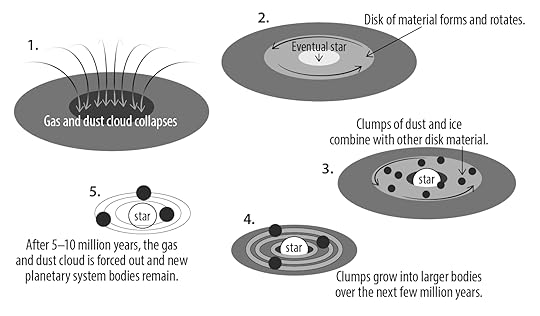 Figure: Core-Accretion Leading to Planetary Formation. Image credit: Sean Platt, Reasons to Believe
During this last phase, Earth would have experienced numerous collisions with objects ranging in size from a few meters up to tens and even hundreds of miles across. Most scientists think that the Moon resulted from Earth’s collision with a Mars-sized object during the tail end of this phase. These types of large impacts give us good insight on the conditions of the early Earth. Each of these large impactors would have liquefied the surface of the planet, converted all the surface water into steam, and blasted an enormous amount of debris into the atmosphere and into orbit around Earth. As the planet cooled, hot (if not boiling) water would have covered all the “land” under a dark blanket of orbiting and atmospheric debris. This scientific description sounds like a formless and empty, dark, water world.
An Additional Stage of Bombardment
Even after the formation phase, planets continue to experience collisions with comets and asteroids (remnants of the formation process) scattered throughout the solar system. However, the surfaces of Mercury and the Moon provide evidence of a particularly intense period of bombardment known as the late heavy bombardment (LHB). Research indicates that roughly 100 objects capable of making craters 600 miles in diameter hit Earth during this period. (This collision process continues today although at a dramatically reduced rate.) Many collisions during the LHB would have recreated the four conditions of the early Earth.
The accepted dates for the LHB usually span 4.1–3.8 billion years ago. However, a recent study indicates that the LHB might have started as far back as 4.48 billion years ago—almost at the beginning of Earth’s existence. The oldest dates from the Moon rock samples go back to 3.9 billion years, setting a boundary time for the end of the LHB. However, as geologist Stephen Mojzsis notes, “the part of the moon we landed on is very unusual…it is strongly affected by one big impact, the Imbrium Basin, that is about 3.9 billion years old and affects nearly everything we sampled.” Instead, Mojzsis and his team looked at radiometric dates from meteorites collected on Earth and noticed that none of these dated earlier than 4.45 billion years ago. If the LHB is responsible for resetting the radiometric ages of these meteorites, then this date corresponds to the end of the LHB.1
The Bottom Line
The process of planet formation and the effects of the LHB both would have produced conditions on the early Earth that match the biblical description in Genesis 1:2. This result holds regardless of whether the conventional date for the LHB or Mojzsis’s date is correct. The rest of the Genesis 1 account describes how God transformed this barren, hostile-to-life, dark, water world into a place teeming with an abundant, diverse array of life. The correspondence of the scientific and biblical descriptions of the early Earth and how that correspondence continues through the rest of Genesis 1 provides us good reason to trust the Bible and its message. The Bible reveals God’s existence as well as the way he made for us to know him. And that is great news!
Endnotes:
1. Stephen J. Mojzsis et al., “Onset of Giant Planet Migration before 4480 Million Years Ago,” Astrophysical Journal 881, no. 1 (August 10, 2019): 44, doi:10.3847/1538-4357/ab2c03.