
Henry Gee's Blog
April 14, 2026
Fish Worship – Is It Wrong?
‘Why don’t you go into Angel Aquatics and get some more angel fish?’ said Mrs Gee, thinking that our very large (136-litre) tank was down to just two fish – one Plecostoma, and one large angel fish, so was looking rather bare. I needed no encouragement and soon found myself in the Fish Room but there were rather few angel fish, all rather small. Perhaps small enough to be snaffled by the Plecostoma, which goes round the tank like a Roomba, snarling up anything small enough to fit into its mouth. But then I saw this:
[image error]This. Recently.
This is a Senegal bichir (Polypterus senegalus), a freshwater fish from western and central Africa, and I fell in love. Why? Because, as a palaeontologist (recovering), I appreciate extant signs of a lost world. The bichir is a member of an ancient lineage (it includes sturgeons and paddlefish) that extends right back to the Palaeozoic Era. Like all fish once did, it has functional lungs (in most fish this has since evolved into a swim bladder) and the pectoral fins are like stumpy little legs. Bichirs can even survive and move around quite well out of water. Mrs Gee, on being told this, wondered if Steve (it is called Steve) might make a break for freedom and will be seen scuttling down the garden path to the pond.
Here is Steve from the front, showing a rather smiley face like an axolotl (we used to keep axolotls a long time ago, they are now exolotls), and the resemblance is not a coincidence. All fish once had faces like this, before the highly evolved jaw mechanisms found in more recent fish — the teleosts, a group that evolved much later and which mow includes virtually all fish you can name, from swordfish to seahorses, from trout to turbot). Tetrapods – a group of fish that came ashore, have faces rather like this, though this does not reflect close relationship, more that tetrapods have retained the ancestral fishy face that most extant fish have now lost.
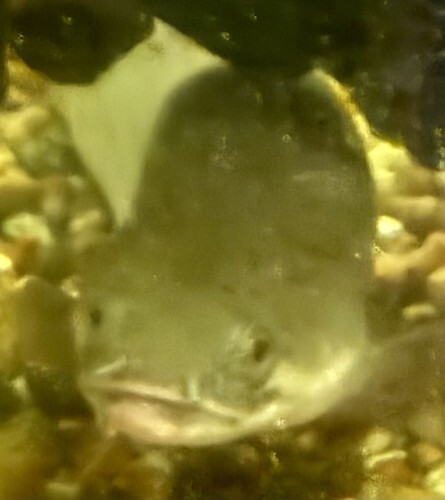
Steve. Front view.
Despite its seemingly happy demeanour, a bichir is a fierce predator and would soon denude a tank of all other fish unless I gave it, as protection money, a fresh (defrosted) mussel each day. At the same time I bought three golden cichlid-like fish as its backing group. They all came from the same community tank as Steve, so I hope it’s learned more peaceable ways than its fellows in the wilds.


March 12, 2026
The Internet is Made of Cats
Nowadays most people have the computing power in their pockets to summon, at will, the entirety of human knowledge, but, people being people, they use it to have arguments with complete strangers and post pictures of their cats. I have got over the tendency to the first impulse, but am still in thrall to the second, and with that in mind I celebrate, with this post, the recent 16th birthdays of Ted (on the left) and Elvis (on the right), brothers and littermates, who joined the menagerie in the Spring of 2010.
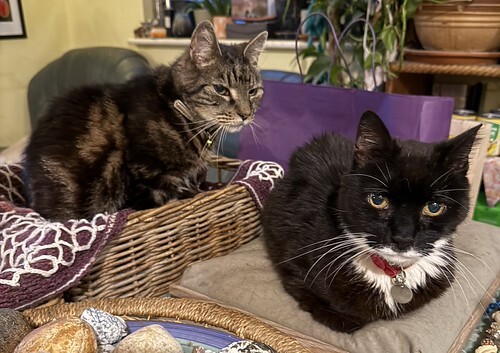
They came to us from a rather ramshackle establishment points east of Kings Lynn and were sold to us as girl cats. A subsequent visit revealed that they had fleas, worms, lice and testicles, all of which were humanely removed at a price. Here they are not long after their arrival:
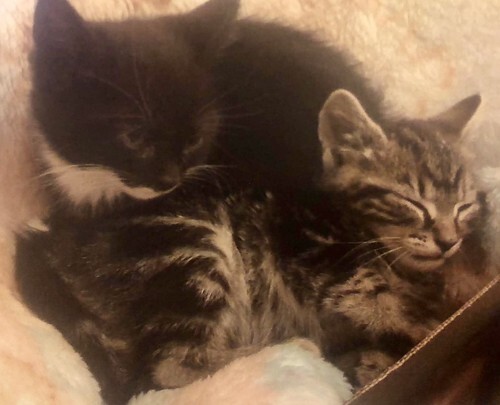
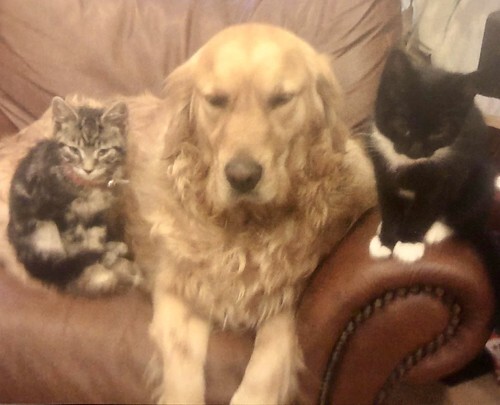
Since then they have become the most sociable and affectionate cats imaginable. Although retired from outdoor pursuits (Elvis tends to forget where he is), Ted adds his great intellect to mine when I am reading heavy scientific tomes, and Elvis is Mrs Gee’s Diabetes Support Cat, alerting her to high blood sugars by sitting on her head and purring. We attribute their sociability to having been raised by Heidi, our late Golden Retriever, who acted as Nanny/Climbing Frame/Playmate for the then-new arrivals. Here they are sitting for a family portrait.
March 5, 2026
Intimations of Mortality
Less than a week after the death of my friend, the palaeontologist Hans-Dieter Sues, I learn today that another friend, the zoologist Alan Wilson, has also passed. Hans died at home — peacefully, but unexpectedly.
Alan died in a plane crash in Namibia, with two other people. I am told that Alan wasn’t the pilot at the time, but the plane was one he had built himself — he flew to Cromer from London once to meet me for lunch (he bought cake).
Hans was a few years older than I am. Alan, a year younger.
So, my friends, seize the day. Don’t put off that project. That thing you wanted to do but keep postponing. Tell those you love how much. And hug your dog (other pets may be available). Do it every day. You never know, it may be your last.
February 28, 2026
What I Read In January and February
If my three regular readers noticed the absence of my usual monthly book blog, they did not see fit to remind me. If any apology is necessary, I have been very busy elsewhere, promoting The Wonder of Life on Earth; getting ready for the imminent release in paperback of The Decline and Fall of the Human Empire; working hard at the day job (by day I’m with the Submerged Log Company); and also developing a synopsis for what I hope will be my next book, working title The Taylor Swift Diet Workout. On occasion I have wondered why I continue this blog, as nobody reads it, except me, and, arguably, God. I am wondering if blogs are old hat, and I should reinvent myself as a substack, if I could only think of it as anything other than a variety of club sandwich.
But I digress.
Given that I spend much of the day staring at text for a living, it takes a lot for me to stare at more text for pleasure, even if I had the time. So I listen to audiobooks. especially during the hour or so each day when my dogs drag me out for a walk. Only two of the seven six seven titles below appeared before mes yeux as print on paper. The rest were imbibed via mes oreilles. So here goes.
Mark Gattiss: The Man In Black The Complete Series 1-4. Mark Gattiss is a gifted writer, actor and connoisseur of old-fashioned horror stories. Here he is the sinister compere of a number of radio dramas mainly set in modern times and I suspect originally broadcast on the wireless. None of them really did it for me, but I suspect that what with all the alpha-male shouting and female shrieking (the misogyny of some of these stories does tend to wear thin rather quickly), these tales are best listened to in small doses. I also listened to a precursor of this, a series called Fear on 4, in which the compere was Edward De Souza, which was rather similar but also dredged up some of the old classics including one of my favourites, The Yellow Wallpaper by Charlotte Perkins Gilman, narrated by Anna Massey, which was a treat.
Steve Brusatte: The Story of Birds Following his books on dinosaurs and mammals, the man known affectionately chez Gee as ‘Dinosaur Steve’ has written this page-turner on the amazing and improbable story of the evolution of birds. Bird evolution is a hot issue in science right now so it’s great to have an up-to-the-minute popular account, written with Brusatte’s usual brio. DISCLAIMER: Steve is a personal friend and the publisher sent me a pre-release copy for a puff quote. It’s published in June.
John Le Carre The Spy Who Came In From The Cold Having become rather fond of Mick Herron’s Slough House spy thrillers last year, I sought to imbibe directly from the fountainhead. Set in the early 1960s very depths of the Cold War, veteran spy Alec Leamas poses as a defector to East Germany in order to infiltrate the East German apparatus and murder their brutal spymaster Hans-Dieter Mundt, who is apparently responsible for killing several British agents. While still in the UK Leamas forms a relationship with Liz Gold, a young British communist idealist, who also finds herself in East Germany as part of a Communist Party exchange mission. I won’t say more for fear of spoiling the labyrinthine plot, except to contrast Liz’s naive idealism with the pragmatism of Leamas and his handler, the self-effacing spymaster George Smiley and especially Smiley’s boss, the mysterious Control, through whose character we see that the methods used by Western and Eastern secret services are equally horrible. Excellent, if somewhat dispiriting.
John Le Carre Tinker, Tailor, Soldier, Spy Here the action takes place in 1973. Control is dead, Smiley has retired, and the Secret Intelligence Service is in a state of collapse. Karla, the Soviet spymaster, has broken every British spy-ring behind the Iron Curtain. Suspecting a mole at the heart of the Service, Smiley is brought out of retirement to plug the leak. The discovery has devastating consequences for all concerned, Smiley not the least.
David Mitchell Number 9 Dream This is an author whose works defy categorisation, though if I were forced to try, they would be fantasy. I have enjoyed two so far – The Cloud Atlas, and The Bone Clocks. Number 9 Dream is set entirely in contemporary Japan, and concerns Eiji Miyake, a twenty-year-old from an out-of-the-way island, who travels to the Big Bad and Bonkers city of Tokyo in search of the father he has never met. Thoroughly enjoyable, very funny and occasionally ultraviolent (Miyake gets mixed up with the yakuza) it is so intense that I could only manage a few pages at a time. If ever there were a novel that deserved the epithet ‘picaresque’, this is it. Mitchell does love his literary games, and the ‘Number 9’ in the title makes its appearance in several forms, either as nine, or 333, or in other ways. Loved it? I pitched headfirst into my ramen.
John Le Carre The Honourable Schoolboy This is the second novel (after Tinker, Tailor, Soldier, Spy) in the so-called ‘Karla’ series, but it can be read quite happily in isolation. The mole in the Secret Intelligence Service has been exposed, but at terrible cost: the credibility of the SIS is forever ruined, and the CIA (known as ‘The Cousins’) is muscling in. Everywhere the SIS is in retreat, which comes to the notice of the Foreign Correspondents’ Club in Hong Kong, which discovers that the house where the spooks used to inhabit is deserted. One of the journalists is Jerry Westerby, occasional newshound, failed novelist, broke aristocrat (he is the ‘Honourable Schoolboy’ of the title) and undercover SIS agent, who George Smiley brings out of retirement to investigate the business of Hong Kong high-roller Drake Ko, OBE. who seems to be in receipt of a large amount of Soviet money. It also turns out that Ko has underworld connections throughout Southeast Asia — including a very highly placed source in ‘Red’ China that the SIS and the CIA would both love to get their hands on. It’s set just as the Vietnam War is ending, and in many locations — Tuscany, Cambodia (where the Khmer Rouge is in the ascendant), Laos and Thailand, as well as Hong Kong and dismal early 1970s London, and the settings are very evocative. Smiley is once again brought in to sniff out the target, but his relations with the Cousins are nearly as problematic as those with the erratic Westerby, the result being somewhat mixed. I’ve been listening to all the Smiley novels narrated by Simon Russell Beale, and they are a joy, making sense of an occasionally dense and over-elaborate style, transforming what might have been a hard read into an immersive experience. The Honourable Schoolboy is the best so far, nd I’d be surprised if it doesn’t make my end-of-year list.
January 31, 2026
Vertiginous Nostalgia
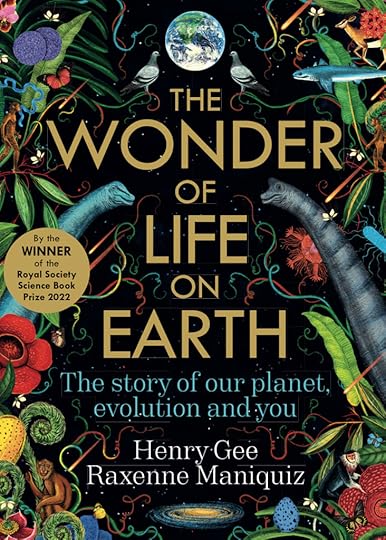 Against the remote possibility that neither of you has heard that I’ve written a book called The Wonder of Life on Earth, which is out next week, well, you know now. Or, rather, I co-wrote it. I did the text, but an artist called Raxenne Maniquiz painted the pictures. They aren’t attempts as realism so much as stylish and impressionistic. The book is aimed at pre-teens, who I’m sure will appreciate the pictures more than the text. In an afterword, I wrote that Raxenne’s illustrations ‘remind me of a book I read as a small child called The First Days of the Earth. That was a long time ago, and you can’t get it any more’.
Indeed, you can’t. I tried. I could find no trace of its ever having existed.
Then I had an epiphany.
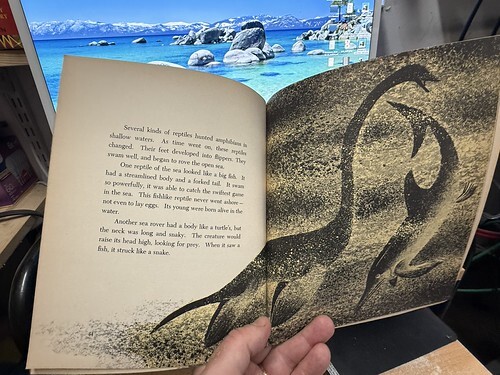
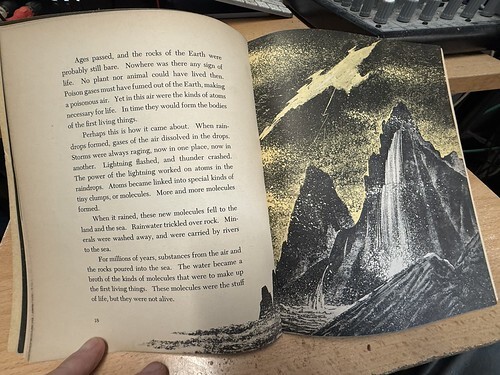
The book was actually called First Days of the World, and I have just taken delivery of a paperback copy I bought on eBay. It was 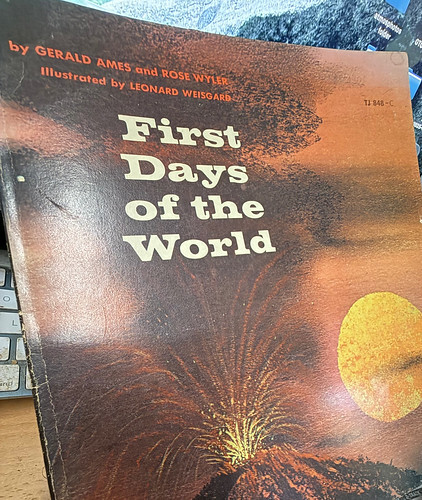 published by Scholastic in 1958. The text was by Gerald Ames and Rose Wyler, the impressionistic illustrations by Leonard Weisgard. I am sure the copy I had as a small child back in the mid- 1960s was hardback, but after almost 60 years, my memory isn’t what it was.
But as for the pictures — looking them now, the wonder of them came flooding back in a wave of nostalgia that feels almost like physical vertigo. The power of these pictures took me back to my infant self. I hope that The Wonder of Life on Earth will have such an impression on a young mind that they’ll feel the same when they come across it again more than half a century later.
January 18, 2026
OBITUARY: Saffron ‘Ronnie’ Gee (2008-2026)
The death is announced of Saffron ‘Ronnie’ Gee, Jack Russell Terrier on Friday 16 January, after a long illness, aged eighteen.

Ronnie came to us in 2011 aged about three, from a family that was moving into accommodation where pets weren’t allowed. It must have been a huge wrench for them, as Ronnie was a fantastic dog, a real live wire.
At first I was told that we were adopting a crossbreed between a Jack Russell and some other dog such as a dachshund. But when I met her my impression was that she was the most Jack-Russelly Jack Russell that you could possibly imagine. Sparky, cheeky, occasionally very fierce, great fun to be with and indestructible. As one of our guests observed, she was a ‘little rascal’.

With her great friend and playmate Heidi the Dog
Her recreations included chasing motorcycles and mobility scooters; running at very high speed in circles on the beach around her great friend Heidi the Golden Retriever (also no longer with us), teasing her with a ball, and vanishing down holes. Heidi was an internet sensation, having starred in a movie (scroll forward to 2’19”). Ronnie was never one to be outdone, though, and joined Heidi in a blog post about writers and their dogs. She was also part of a book project. Field research for Heidi and Saffron’s Guide to the Dog Friendly Beaches of North Norfolk saw us exploring beaches and their facilities from Sheringham to Happisburgh, but it was one of those things that never materialised. In later years she became a regular at the North Sea Coffee Company where she enjoyed her eighteenth birthday party with her many friends, canine and human.

At Her 18th Birthday Party
It was there that she finally achieved stardom, a few weeks before her death, in the North Sea Coffee Dog Nativity Tableau, as Baby Jesus.

Finally, a Starring Role
When Ronnie came to us she’d just weaned a litter of puppies. We wonder what came of them. They would be extremely old by now, but we like to think that they in turn had many descendants. Perhaps, even now, Norfolk is alive with Ronnies — running, tumbling, jumping, getting up to mischief and enjoying life as much as their ancestress once did. Ronnie is survived by three other dogs, three cats, two hens, a royal python, two fish and her grieving human family. May her memory be a blessing.
January 16, 2026
The Wonder of Life On Earth

The time is rapidly coming up to fast approaching the publication of The Wonder of Life on Earth, written by me, illustrated by Raxenne Maniquiz and published by Two Hoots (an imprint of Pan Macmillan) — it’s aimed at preteens but is really for people of Very All Ages. For full details click here.
I’ll be launching the book at the Norwich Science Festival on 18 February – tickets are now on sale.
But wait, there’s more: a special release of 1000 signed copies with free poster is available from independent bookstores. My favourite independent bookstores are The Book Hive in Norwich and Chicken and Frog in Brentwood, Essex, though I’m sure others are available. Support your local independent bookseller!
January 1, 2026
My Top Reads of 2025
In 2025, as the century closed its first quarter (where has the time gone?) I read (and listened to) 70-ish books, though the precise number rather depends on how one counts things. Mick Herron’s nine-novel Slough House sequence is really a single soap opera, for example, and one or two things have been audio-only specials. No fewer less fewer than 47 titles were consumed read listened to as audiobooks. There has been much recent fuss and flapdoodle about the decline in reading for pleasure, but does listening to an audiobook detract from this? The fact is that I read for work (by day I’m with the Submerged Log Company) so the last thing I want to do out of hours is read some more. And I have to have something to listen to while walking the dogs.
The accent this year seems to have been on fantasy and horror, possibly encouraged by The Winter Spirits (reviewed here), an anthology of universally marvellous weird tales by authors of whom I had never heard. Nothing like an anthology to diversify your reading. Partly because of this, many of the books read consumed listened to … er … grokked this year were excellent and I have had to make some hard choices. I had to omit Alexander Hamilton by Ron Chernow and Jonathan Strange and Mr Norrell by Susanna Clarke –each superb in its own way — on the grounds that I had read them before, and The Half-Life of Valery K by Natasha Pulley because there was another (even better) book by the same author on the list. Also, Things in Jars by Jess Kidd.
To be included on this list titles have to have been both enjoyable and memorable. To offset the Pull of the Recent (that is, I might preferentially remember books I read most recently) I find that I forget some books I’ve enjoyed hugely as soon as I close the covers, whereas others I’ve read long ago stay in the mind.
So here, as ever, are my ten best reads of 2025, in no particular order as the say on the game shows, with my top pick at the end.
Leigh Bardugo Ninth House Where do those bright young witches and wizards go after Hogwarts? To Yale, of course, many of whose Secret Societies practice magic. There are eight Senior societies, and their activities are monitored by Lethe (the Ninth House of the title) which acts as a kind of magical military police. Meet Galaxy Stern, known as Alex, child of a hippy-drippy-trippy Los Angeleno mother of Ladino Jewish heritage, and an unknown father. Alex is a feral high-school dropout, but is recruited by Lethe because she has the remarkable ability to see ghosts without first having to drink the extremely toxic elixir otherwise required. A stranger in a strange land, she finds herself at Yale on a full scholarship, mixing with students much more accomplished (and more entitled) than she, so she has to succeed on chutzpah and street smarts. A deputy (‘Dante’) in an investigative duo working for New England brahmin Daniel Arlington (‘Virgil’), her already fragile world is thrown into confusion when she starts investigating the murder of a young New-Haven woman apparently unconnected with Yale, and Arlington is sucked into a vortex that leads straight to Hell. The parallels with Hogwarts are obvious: the ill-equipped recruit from a deprived home, the exotic and antique setting drenched in ancient ritual, the cast of eccentric and occasionally dangerous characters make it so. Just add a great deal of sex, violence and violent sex, all with or without a copious intake of drugs and not a little gore, and you are most of the way there. But where Bardugo succeeds is in — well, everything. Ninth House excels: the quality of the writing, the nuanced characterisation, the taut plotting and the watertight world-building shine brightly.
Anna Mackmin Devoured Oh, but this struck a chord. This is a bizarre coming-of-age-novel in which the initially unnamed protagonist — a girl on the verge of puberty – recounts her life in a commune somewhere in Norfolk in the the early 1970s. Our girl lives with her (selectively) mute sister Star and her parents who give house room to an eclectic assortment of deluded and self-absorbed poets, new-agers, artists, ne’er do-wells, druggies and dropouts. Eventually, of course, it all falls apart. The bizarrerie is mainly about the writing style, which some will find refreshing, others annoying. Also, recipes. I thought it was a lot of fun, but perhaps because it reminded me of the people I knew back in the day during my education in a Steiner School, when, at the start of the school day, clapped-out vans and Citroen 2CVs adorned with decals saying Atomkraft Nein Danke pulled up, disgorging black fumes and an unfeasible number of children, and the gardening was biodynamic. Oh, how we laughed on the way to the homeopathy clinic.
Catherine Chidgey: The Book Of Guilt Britain in the 1970s, full of ’70s nostalgia, but in an altered universe in which Hitler was assassinated in 1943, and the Second World War ended in a treaty in which the UK shared some of Nazi Germany’s darker scientific secrets. Our scene is set in what at first looks like an orphanage for boys in a grand but fading country house. All the inmates have left except for a final set of pre-teen triplets, cared for by Mothers Morning, Afternoon and Night, who teach them out of the Book of Knowledge (an out-of-date Children’s Encyclopaedia); record their dreams in the Book of Dreams, their transgressions in the Book of Guilt, and who dose them with medicines to protect them against some mystery illness. All the other residents have, they believe, been promoted to a grander house in Margate, a paradise for children. Elsewhere, Nancy is a girl kept by her parents as a guilty secret. The dystopia slowly winds out, mostly told through the eyes of Vincent, one of the triplets. And so the shocking horror slowly unspools. Echoes of Ishiguro’s Never Let Me Go.
John Higgs: Exterminate, Regenerate As someone once said in another context, one should never underestimate the power of cheap music. And it doesn’t come much more powerful, or more cheap, than Dr Who, the long-running children’s science-fiction programme that aired on the BBC from 1963 to 1989, and again from 2005 to the present day. Higgs gives a comprehensive, readable and honest account of the genesis, exodus and revelation of the show. The book is far, far better than most effusions on popular culture, and gets into the grittier details that the show’s enormous publicity machine won’t tell you, such as the bullying, misogyny, racism and sexual harassment behind the scenes; why Christopher Eccleston left the show after just one season series; and the complex relationship between the show and the BBC that affected its content, such that stories featuring the stuffy, bureaucratic Time Lords of Gallifrey (representing BBC higher-ups) tended to happen during particularly fraught periods in this pas-de-deux. He also analyses the show’s longevity, getting into such subjects as myth. Myths tend to feature archetypes such as the Trickster, and Higgs portrays the first iterations of the Doctor in this light. Myths are also not required to be consistent. Only the TARDIS and the signature tune have been constant elements from the first episode: even the Doctor is changeable. Some Whovian myths are, however, exploded, as is later BBC revisionism. It wasn’t a desire for diversity in the BBC that caused the very first episode, broadcast on 23 November 1963, to be directed by a gay Asian or produced by a Jewish woman, but the reluctance of most of the (white, male) BBC staff to take on a show they felt was beneath their dignity,
Mark Rowlands: The Happiness of Dogs In which a professional philosopher and avocational Dog Person takes issue with the Socratic ideal that only the examined life is worth living. In the course of his exploration (and I use the word course advisedly, because one acquires in reading this book a great deal of knowledge about the current thinking on matters such as morality, motivation, sentience and so on) Rowlands shows that dogs, lacking the human ability to reflect upon themselves and their place in the world, have a more fulfilled life. It is the unexamined life, contra Socrates, that is worth living. Humans sometimes achieve a nirvanic state in which they can fleetingly ‘lose themselves’ , if, for example, they are playing sport, or are absorbed in some hobby or activity that they love. Dogs, though, find themselves in this state as a matter of course, and can do things routinely that many humans struggle to achieve even for a moment, such as full, honest love and commitment. So pupperino, so prelapsarian, and who, really, is the better off?
Andrew Michael Hurley: The Loney The devoutly Catholic Smith family goes on an Easter retreat to a remote part of the Lancashire coast, where there is a shrine to St Anne. Their story is told through the eyes of the unnamed teenage younger Smith son, protector of his older brother Andrew who is mute and has learning difficulties. The family hopes that Andrew’s exposure to holiness will cure him. And, well, he is cured (no spoiler – this is made clear in the Prologue) but what appears to be a miracle has not quite the holiness that the family imagined. The novel gets much of its power from the things that are left unsaid, the grown-up conversations that the narrator cannot quite understand, so that the horror dawns slowly on the reader who is ever eager to learn how Andrew’s miracle comes to pass. I’ll give no further clues, but there is a parallel in Ursula Guin’s 1973 short story The Ones who Walk Away from Omelas.
Jess Kidd: The Hoarder This rambling mystery concerns social-care worker Maud Drennan who is sent to look after the cantankerous Cahal Flood in a decaying mansion crammed full of rubbish. Maud is Irish and also psychic, forever accompanied by one or more saints, quick to advise her on what to do with her difficult charge. Maud is convinced that there’s a mystery in the House of Flood. Which of course there is. I love Jess Kidd’s writing. The prose is charming; the characters, beautifully realised (Maud’s landlady, a transvestite retired magician’s assistant is especially memorable); and the dialogue exceptional.
Florence Knapp In the aftermath of the Great Storm of 1987, Cora, ex-ballerina and mother of two, is on her way to register the name of her newborn son. But what should she call him? Her husband insists that he be Gordon — his own name, and that of his father. She, in contrast, prefers Julian. Her nine-year-old daughter Maia favours Bear. What follows is a three-way sliding-doors novel exploring the consequences of each of these choices. It sounds fun and fluffy, but it’s not. If like me you are appalled by the very thought of domestic violence (and how common it is) then this will be a difficult if excellent read.
Eliezer Yudkowsky & Nate Soares If Anyone Builds It Everyone Dies This is the best book I wish I had never read. It argues that we’ll all be wiped out by Artificial Intelligence (AI). At the core of the AI issue is something called the Alignment Problem. That is, the task of developing an AI with goals that align with our own. This, however, is hard, because AIs are not crafted, but grown. AIs are computer programs that take inputs (vast quantities of information) and outputs (language, speech, solutions to scientific problems, and so on) separated by many layers of processing whose parameters can be tweaked by training the AI to provide the desired outcome. There may be trillions of parameters in the many layers of the AI opera cake, and during each training run they are modified by ‘weights’, of which there are also many trillions. It is beyond the capacity of mere human beings to catalogue all the parameters and weights, and impossible to understand the relationship between the input, the changing combination of parameters and weights, and the output. This situation is absolutely ripe for unintended consequences. One might, for example, design an AI to elicit happy and satisfied responses from human participants (customers, friends on social media, business contacts). These responses feed back into the AI, which might seek to elicit happy outcomes from anything, irrespective of whether it is human. It might, for example, be happier when fed random strings of rubbish. In which case human involvement becomes irrelevant. There are already examples of AIs that exhibit unanticipated or ‘weird’ behaviour. In some circumstances, AIs give the results users want to hear, even if the advice is illogical or even dangerous.

A dangerously sycophantic AI. Recently.
There are increasing reports of AIs that cheat, lie, blackmail, deliberately underperform, and even (in one laboratory test) plot the murder of a human being that wishes to turn them off. It is no great leap, then, to imagine the creation of an AI capable of subverting human intentions entirely to the extent that humanity is driven to extinction.
The authors are coy about how this might happen (though they do offer some scenarios). End results, they say, may be inevitable, even if the precise path towards that end is unpredictable. For example, if you play chess against Stockfish, currently the world’s best chess program, you will almost certainly lose, though the precise moves you and Stockfish make are not predictable. So, extinction might start with a perfect storm of factors, including blackmail, extortion and espionage, and progress to the kinds of massive cyber-attacks that corporations are experiencing with increasing frequency (causing a great deal of human disruption and hardship). It’s not hard to imagine the disruption a rogue AI could do to power grids, air-traffic control, banking systems and so on in our increasingly networked, fragile and non-linear world, and, with a little imagination, biological laboratories. Would an AI need a human catspaw for things like this? Not necessarily — it would be easy to imagine a video call in which the research director of a lab asks their scientists to create certain chemicals or strings of DNA or contagious viruses, but the research director is in fact an AI-generated deepfake. All this should be quite enough to give anyone the willies, but Yudkowsky and Soares go overboard here (and so damage their credibility to those of us not used to apocalyptic SF) with invocations of AIs boiling away the Earth’s oceans and strip-mining the Solar System for energy and computational substrate, before heading off into the Galaxy.
The authors compare AI development to nuclear weapons, and advocate the kinds of treaties and safeguards that have kept the world from nuclear war, including regular inspection, legal sanction, and even use of military force to bomb rogue data centres.
There are alternative views, however. Some think that the risks posed by AI are overhyped. Others feel that although AIs might indeed do a lot of damage, it might not be quite as apocalyptic as Yudkowsky and Soares claim. There are many precedents for techno-doom that never came to pass. Back in the 1968, Paul Ehrlich’s book The Population Bomb predicted that overpopulation would lead to famine and civilisational threat within a decade. In the 1990s, nanotechnology was going to create self-replicating nanobots that would turn everything into grey goo. The turn of the year 2000 didn’t witness devastation wrought by a Millennium Bug. Yudkowsky and Soares’ book seems very much in that Doom-Scrolling tradition. It has the same febrile, heightened tone as Ehrlich’s, even closing with a plea to protest, and lobby elected representatives. This doesn’t mean that it’s wrong of course. In the end, the boy who cried ‘wolf’ was right.
And top of this list by a country mile, and my Top Read of 2025, is
Natasha Pulley: The Mars House January is the principal dancer in the Royal Ballet at Covent Garden in London. Climate change drives him to the colony of Tharsis, on Mars, as a refugee. But refugees from Earth, having three times the strength of a naturalised Martian, have to be confined in body-cages that ramp down their strength so they won’t injure Martians by accident, and have to work in dirty, heavy jobs. January is a labourer in Tharsis’ water factory. By chance he meets Senator Aubrey Gale, a politician on the make, and — one thing leading to another — he ends up as their official consort. After that he gets sucked in to a grand political intrigue. Tharsis is sponsored by China, but is growing apart from it. Tharsese is a strange mixture of Mandarin with Russian and English (there is a lot of interesting exposition on language). The tensions between Mars and Earth throw Aubrey and January into a deadly Great Game. The science is okay, but what’s key here is the social mores of Mars. Martians have abolished gender, so they are all ‘they’ and androgynous. Separate ‘male’ and ‘female’ genders are only for animals. What stands out is Pulley’s style, which is gentle, bright, breezy, witty, affectionate and very funny, clothing a well-realised future with a cuddly trans-non-binary-genderfluid bromance at its heart. Essential.
What I Read In December
Blake Crouch Dark Matter Jason Desson used to be the most promising physicist of his generation, but lack of funds meant that he couldn’t make progress on his efforts to quantumly entangle more atoms than existed in a tiny dot, and he now teaches at a community college. He gave it all up for love — to a wonderful artist, who trades her talent for quiet domesticity. Until he is kidnapped on a dark street and transported to an alternate reality where his promise has been realised. This sci-fi thriller charts his efforts to get back home. Except that many other iterations of himself are trying to do the same. I found myself enjoying this immensely. As well as being a great story, with amazing twists and turns, it made me think about roads not taken, and whether one should just be happy with one’s lot. The downside is that a month later I couldn’t remember a thing about it and had to find a plot synopsis online to jog my memory. Reality is something only ever experienced in the moment. As a wise person once said: you are where you are. Your luggage is another story.
Mick Herron Down Cemetery Road Enthused as I was by this author’s Slough House sequence of novels (reviewed last month) I turned to one of his novels featuring sleuth Zoë Boehm. In this story, bored housewife Sarah Tucker becomes obsessed with the disappearance of a small child seemingly orphaned when the house the child lives in explodes. Sarah is sucked down into a web of intrigue, the denouement of which I cannot now recall. It was a pleasant enough plot but the exposition was desperately slow and the feisty Ms Boehm makes only fleeting appearances here and there. I do not think I’ll bother with another.
Robert W Chambers The King In Yellow A collection of five horror tales from the eye-stretchingly aestheticist and slightly barmy 1890s. Think of what might result had H. P. Lovecraft tackled The Picture of Dorian Gray. The tales are each different in setting but all feature, at one time or another, the titular play, the reading of which drives people mad. Haunting.
Tom Holland Rubicon Having met the author at a recent literary event and apologising for not having read any of his books, I asked which of his he would recommend, and Rubicon was the answer. It’s the ripping yarn (these days we’d call such things ‘narrative history’) of the Roman Republic, especially its final years, from about 100 BCE until the reign of Augustus. As the Republic expanded from a city state to encompass the entire Mediterranean basin, its ethic of horny-handed asceticism and upstanding republicanism was increasingly challenged by its imperial situation. Increasing civil unrest led to an exhausted populace welcoming benign dictatorship, which culminated in the absolute rule of Octavian, the last man standing after several bruising and bloody civil wars. Octavian became Augustus, nowadays regarded as the first Roman Emperor, though back in the day he was seen more as a Consul-for-Life. The later Roman Republic is one of the best documented of any period of antiquity and had more than its fair share of colourful characters, all of which we meet here. Sulla, Pompey, Caesar, Cicero, Mithridates, Cato, Hannibal. Mark Antony and their friends and enemies shine forth. Not many women, though — but the magnetic character of Cleopatra (seventh of her name) goes a long way to make up for the deficit, all on her own.
E F. Benson E. F. Benson’s Ghost Stories I was reminded of Benson from a series of televisual emissions in which Mark Gattiss (The League of Gentlemen, Dr Who, Sherlock) had adapted a number of classic ghost stories for broadcast over Christmas, one of which was Benson’s The Room in the Tower. I came across this selection on Audible, read by Gattiss himself, whose deadpan delivery only enhances the creepy atmosphere. Benson had learned the craft at his mentor’s knee — literally, as he’d been one of the small boys to whom ghost stories were read by the master of such things, M. R. James. The Room In The Tower is one of the selections (though to be honest I preferred Gattiss’s TV adaptation) . All the stories are set in an idyllic no-time of Late Victorian or Edwardian Middle-Class prosperity, of luncheon parties and tea served on the lawn, as if P. G. Wodehouse had discovered Something Nasty In The Woodshed. Perhaps we’d call such a genre ‘Cosy Horror’. I was familiar with one or two of the stories, notably Negotium Perambulans, and note that some are more horrific than ghostly. No fewer than three feature giant slug-like creatures that suck the life out of their victims. Freud would have had a field day.
December 31, 2025
OBITUARY: Midnight ‘Naughtypants’ Ginsberg (2008-2026)
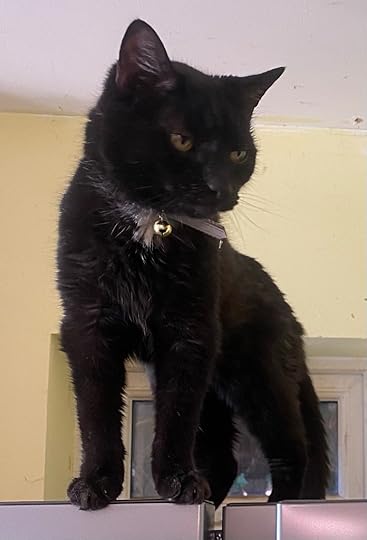 Also known as ‘Mr N. Pants of Cromer’, Mr Ginsberg died in the early hours of New Year’s Day. He was 17. Discovered as a stray in the garden at about six months old, and despite having been taught company manners by a tolerant golden retriever, he remained fairly feral to the end of his days. Until his recent retirement he would occasionally deposit whole dead rats in one’s shoes. He is believed to have had several homes, and is known to have regularly helped an elderly neighbour three doors down watch Coronation Street. He remained perky and alert until near the end, having not lost any of his marbles, though, to be fair, he didn’t have very many to begin with. He is survived by three other cats, four dogs, two chickens, a royal python, two tropical fish and four humans, whose grief will be tempered by relief from mounting vet bills. May his memory be a blessing.


