
Cathy Ostlere's Blog
September 12, 2016
Bouldering?Yeah, huge fun.And it turns out it's good for ...
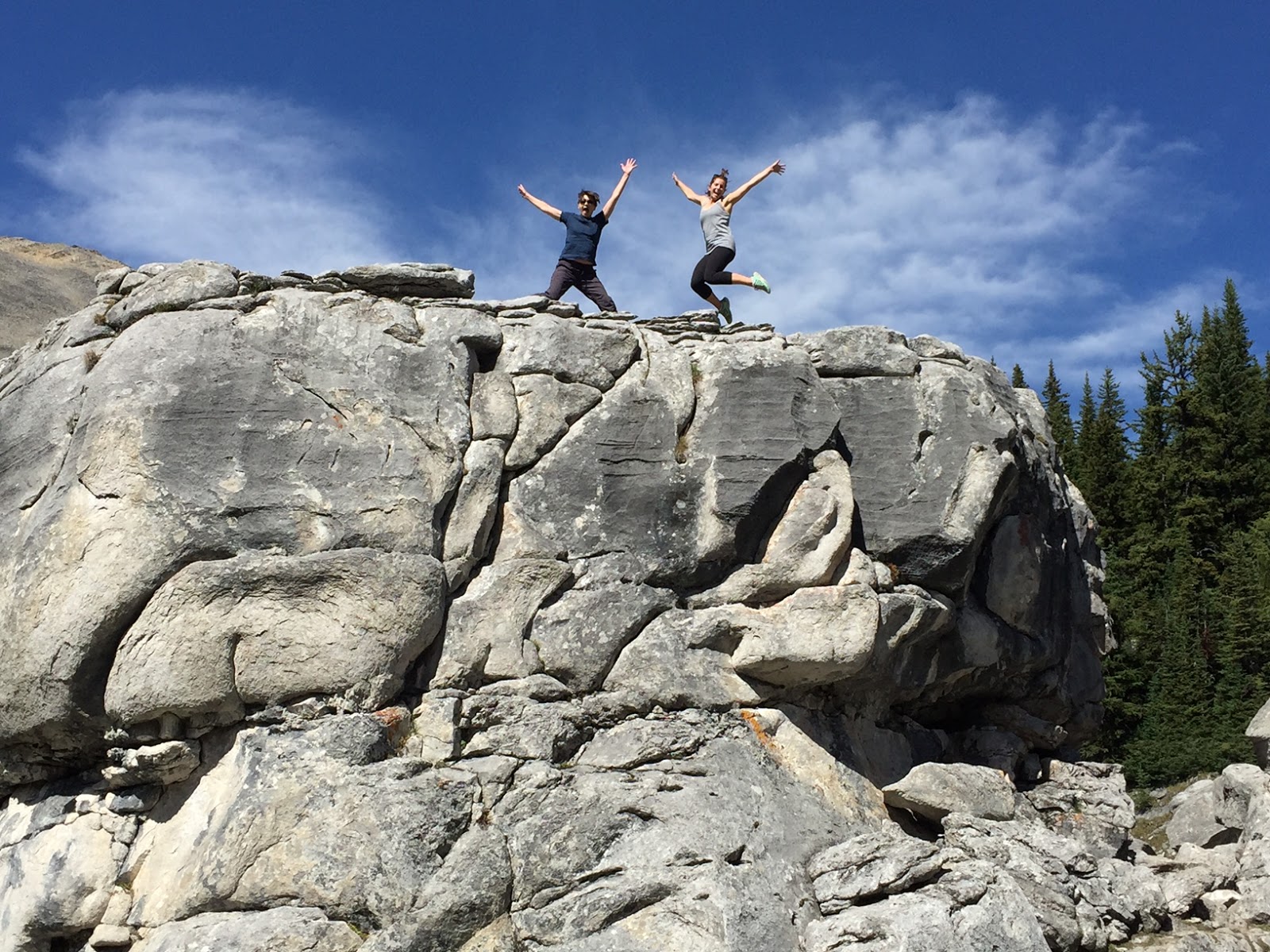 Yeah, huge fun.
And it turns out it's good for the brain - this writer's brain, in particular.
Need brute strength? Nope.
Just a desire to be off balance - inside and out.
So here are the benefits:
Decision making.
Do I really need this character?
Visualization. Scenes!
Problem Solving.
All creativity is about problem solving.
Determination. Need this more than money.
Spatial awareness. Where's my coffee cup?
Planning. Well, not for all writers ... seat of the pants works too.
Concentration. Can you say headache?
Ok, so if bouldering is a vertical problem: what to hold (keep), where to step (let go and move forward), how to balance (find the right word), where to rest (white space) - well, so is writing.
And climbing competes against gravity, time, fatigue, and the mind (Myles Moser). Just like writing!
Ok, enough.
It's all in the photo taken at Chester Lake, Alberta. Joy, joy, joy ....
Cathy


June 25, 2013
The Canadian Verse Novel
Canada Day is coming up – July 1 – so I’m celebrating our super-talented, home-grown verse novelists.
For a writer, crafting a verse novel is a thrilling exploration of language, form and story. No niggling voices nagging about punctuation and capitalization – only free-floating ideas, images, playful language and that wonderful white space – the drama of the implied thought.
Writing a verse novel requires huge leaps of faith to soar over terrifying doubt. It’s a risky, sometimes crazy way to tell a story – but verse novelists have exceptional conviction: if they’re exhilarated by writing these narratives they believe that their readers will be too.
Canadian writers have been slower to experiment with this beautiful, thoughtful genre – American and Australian writers have been doing it much longer – but we have finally arrived. So, Canadian verse novelists – take a well-deserved bow. Our list may be short but every book on it is pure joy.
Ann and Seamus by Kevin Major,2004, illustrated by Kevin Blackwood In 1828, Ann and her father rescue 163 Irish immigrants from a shipwreck off the coast of Newfoundland. Inspired by historical events.
Audacious by Gabrielle Prendergast, to-be-released October 2013 Sixteen-year-old Raphaelle says the wrong thing, antagonizes the wrong people and has the wrong attitude. She can't do anything right except draw, but she draws the wrong pictures that get her into a heap of trouble. This is a wild, bold story. Kudos to Gabrielle.
Burn by Alma Fullerton, 2010 Usually, when Casey's famous mom went on tour, Casey got to go. But since settling down with a new husband and baby, things have changed. Casey begins building fires to send smoke signals to her mother, hoping her mother will see her message.
Counting Back from Nine by Valerie Sherrard, 2012Laren Olivier knows the rules, but her attraction to a friend’s ex-boyfriend is strong. When tragedy strikes, Laren finds herself struggling with a discovery so shocking it rocks the very foundation of her world. This quiet book sneaks up on you and then bam – hits you in the heart.
Fishtailing by Wendy Phillips, 2010Natalie moves to a new school and entangles others in her forbidden world of partying and rebellion. A perfect book.
Ghost Horse of the Mounties by Sean O Huigin, 1991 illustrated by Barry Moser In this narrative poem, a storm overwhelms the Royal Canadian Mounties, scattering their horses in all directions and resulting in the mysterious disappearance of one horse. I love this book – though hard to find.
I’ll Be Watching by Pamela Porter, 2011Set in Canada during the Great Depression, orphans, sixteen-year-old Ran, fourteen-year-old Nora, twelve-year-old Jim and little Addie find a way to make ends meet under the watchful eye of their dead parents. Told from multiple points of view, this book offers a compelling tale of faith and courage in the face of suffering and evil.
In the Garage by Alma Fullerton, 2006 A grief-stricken BJ deals with the aftermath of her friend Alex’s death as we read Alex’s journal.
Karma by Cathy Ostlere, 2011After her mother’s suicide, 15-year-old Maya and her father travel from Canada to India for a traditional burial. The year is 1984, and on the night of their arrival in New Delhi, Prime Minister Indira Gandhi is assassinated. The city erupts in chaos and Maya is separated from her father. This one’s mine!
Libertad by Alma Fullerton, 2008When Libertad's mother is killed in an accident at the Guatemalan city dump where the family picks trash, Libertad and his little brother make the trip to the United States to find their father. Beautiful.
My book of life by Angel by Martine Leavitt, 2012Sixteen-year-old Angel is coerced into drugs and prostitution by a man she meets in a mall. You’ve never read a verse novel like this one. Based on real events.
Nix Minus One by Jill MacLean, 2012When Nix's older sister, Roxy, starts breaking the rules things spiral out of control. This is a heartbreaking story told with grace.
The Apprentice’s Masterpiece by Melanie Little, 2009Ramon, 15, is a Jew forced to convert to Christianity. His family takes in Amir, born Muslim, also forced to give up his faith, during the Spanish Inquisition. Sophisticated and profound.
The Crazy Man by Pamela Porter, 2005Emaline, 12, is maimed in a freak farm accident. Her father shoots the dog and storms off and doesn't return. Her mother, in need of help around the farm, takes in Angus, a gentle giant from the mental hospital. A Canadian classic.
Walking on Glass by Alma Fullerton, 2007A young man's mother has attempted suicide and is left in a coma.
Yellow Mini by Lori WeberMark has inherited a yellow mini from his deceased father. Stacey, his girlfriend, Mary and Annabelle alternate voices as they find their niches, be it concert pianist or activist. Dramatic and perfect for teenagers.
Zorgamazoo by Robert Paul WestonPart Roald Dahl, part Dr. Seuss, this rhyming novel tells the story of Katrina, Morty, and the missing Zorgles. Sheer talent.
To see more fabulous verse novels from all over the world check out Sarah Tregay’s list.
September 28, 2012
REVIEW: The Night Wanderer
Today, I’m posting a YA book review to support the A More Diverse Universe Tour to raise awareness and celebrate People of Colour Speculative Fiction Authors. You can read more about this tour on the blog BookLust - Aarti’s site and see a list of all participants.When my friend, Dale Lee Kwong, asked me if I planned to participate in the blog tour I thought, ok, here’s an opportunity to expand on my reading habits. So, because I’m Canadian, I decided to seek out a Canadian writer who might qualify. The YA list was small but when I saw that Canadian-Ojibway writer Drew Hayden Taylor wrote a teen book about a 350 year-old aboriginal vampire, I was in!
 The book is called The Night Wanderer. It has a spirited and wry sixteen-year-old character named Tiffany and a weary, soul-seeking vampire named Pierre L’Errant who returns from Europe to his birthplace on what is now a First Nations reserve in Ontario. Three hundred and fifty years ago he was a curious, adventurous teen who left his land and family to cross the Atlantic with French fur traders. In France, he contracts an illness that should have killed him but by a twist of fate he’s bitten on the neck and he becomes a bloodthirsty vampire. But now he’s back – to save his soul, and in a strange way, to save Tiffany too.Tiffany lives with her father, Keith, and Anishinabe grandmother, Granny Ruth, on the reserve. Her mother has abandoned the family and lives with a white man in another part of Canada. Tiffany has a white boyfriend, Tony, but when they’re out shopping he takes advantage of her tax-free status card. In a nutshell, Tiffany’s life is about as happy as a whole lot of other teenagers’ lives in North America: she lives in a town where nothing happens; her mother has abandoned her; her father is angry all the time; she fights with her boyfriend; she’s bullied; and she is failing History. But what Tiffany has that most teens don’t have is a father who rents out her room to a stranger who sleeps all day and wanders the land at night.“Tiffany was close enough to smell the mustiness coming off the vertical green carpet. The first thing she noticed was that there was no light coming from the room. Only darkness. This in itself was not all that unusual, considering it was a windowless part of the basement. Still, it was an odd darkness, like the difference between Coke and diet Coke. It was … unusual. There was still no sound so she decided to chance it and take that peak. Why, she didn’t know. Her hand brushed the border of the carpeted door as she began to push it aside.” page 98, The Night Wanderer
The Night Wandereris expertly written in a third person voice that tells the tale with a tense yet comic touch. Tiffany’s self-deprecating humor is a highlight that makes this character unforgettable. The vampire is formidable and admirable in his struggle to fight his hunger while he contemplates longingly the land of his birth. The gothic vampire myth is served well here by the Northern Canadian landscape. The land is dark and shadowy. There are noises in the forest. Animals scurrying. Twigs and branches breaking. Long roads and a deep lake. The reserve is a mysterious but not menacing place as it is home for both Tiffany and Pierre – two native Canadians who are struggling for clarity and expression of their true selves.
Taylor explores many themes in his 200 page novel: coming-of-age, prejudice, bullying, family, education, history, aboriginal language, and suicide. This isn’t a book for readers who expect a more traditional vampire tale with sexual overtones. Instead Hayden writes a smart tale about a smart teenage girl, an aging vampire, and what happens when they meet in the middle of a dark Canadian forest.
Drew Hayden Taylor is a well-known Canadian-Ojibway playwright, author, journalist, filmmaker, and stand-up comedian from the Curve Lake First Nations in Ontario. He is a writer who’s committed to educating the world about issues that impact the lives of Canada’s First Nations. The Night Wanderer, Taylor’s first teen novel, was published by Annick Press in 2007. Read more here.
 A little more ... here's an image of Edvard Munch's The Night Wanderer:
June 23, 2012
Quinoa Chocolate Cake

2/3 cup white or golden quinoa
1 1/3 cup water1/3 cup milk4 large eggs1 tsp. pure vanilla extract3/4 cup butter, melted and cooled1 1/2 cups sugar1 cup cocoa powder1 1/2 tsp. baking powder1/2 tsp. baking soda1/2 tsp. saltBring the quinoa and water to a boil in a medium saucepan. Cover, reduce to a simmer and cook for 10 minutes. Turn off the heat and leave the covered saucepan on the burner for another 10 minutes. Fluff with a fork and allow the quinoa to cool.Preheat the oven to 350°F. Lightly grease two 8-inch round or square cake pans. Line the bottoms of the pans with parchment paper.Combine the milk, eggs and vanilla in a blender or food processor. Add 2 cups cooked quinoa and the butter and continue to blend until smooth.*Whisk together the sugar, cocoa, baking powder, baking soda and salt in a medium bowl. Add the contents of the blender and mix well. Divide the batter evenly between the 2 pans and bake on the center oven rack for 40 to 45 minutes or until a knife inserted in the center comes out clean. Remove the cake from the oven and cool completely in the pan before serving. Frost if desired. Store in a sealed container in the refrigerator for up to 1 week or freeze for up to 1 month. Serves 8-16.
*I would recommend food processor over blender as I could not get it smooth enough in the blender. Finished with hand mixer on high and turned out great!

June 14, 2012
The 22 Rules of Storytelling
#1: You admire a character for trying more than for their successes.#2: You gotta keep in mind what's interesting to you as an audience, not what's fun to do as a writer. They can be v. different.#3: Trying for theme is important, but you won't see what the story is actually about til you're at the end of it. Now rewrite.#4: Once upon a time there was ___. Every day, ___. One day ___. Because of that, ___. Because of that, ___. Until finally ___.#5: Simplify. Focus. Combine characters. Hop over detours. You'll feel like you're losing valuable stuff but it sets you free.#6: What is your character good at, comfortable with? Throw the polar opposite at them. Challenge them. How do they deal?#7: Come up with your ending before you figure out your middle. Seriously. Endings are hard, get yours working up front.#8: Finish your story, let go even if it's not perfect. In an ideal world you have both, but move on. Do better next time.#9: When you're stuck, make a list of what WOULDN'T happen next. Lots of times the material to get you unstuck will show up.#10: Pull apart the stories you like. What you like in them is a part of you; you've got to recognize it before you can use it.#11: Putting it on paper lets you start fixing it. If it stays in your head, a perfect idea, you'll never share it with anyone.#12: Discount the 1st thing that comes to mind. And the 2nd, 3rd, 4th, 5th – get the obvious out of the way. Surprise yourself.#13: Give your characters opinions. Passive/malleable might seem likable to you as you write, but it's poison to the audience.#14: Why must you tell THIS story? What's the belief burning within you that your story feeds off of? That's the heart of it.#15: If you were your character, in this situation, how would you feel? Honesty lends credibility to unbelievable situations.#16: What are the stakes? Give us reason to root for the character. What happens if they don't succeed? Stack the odds against.#17: No work is ever wasted. If it's not working, let go and move on - it'll come back around to be useful later.#18: You have to know yourself: the difference between doing your best & fussing. Story is testing, not refining.#19: Coincidences to get characters into trouble are great; coincidences to get them out of it are cheating.#20: Exercise: take the building blocks of a movie you dislike. How d'you rearrange them into what you DO like?#21: You gotta identify with your situation/characters, can't just write ‘cool'. What would make YOU act that way?#22: What's the essence of your story? Most economical telling of it? If you know that, you can build out from there.
June 7, 2012
The Heart is a Muse
I wrote this article last April for Hunger Mountain, the Vermont College of Fine Arts Journal of the Arts.
An excerpt:
"I see writers as caretakers: We hold complete worlds (real or imagined) in our palms. What fear! What joy! What mystery! And what responsibility. By writing Karma I learned something that my memoir, Lost, could not teach me. Lostpulled me into the muscle of my body where memories had to be re-experienced and grief needed to be faced. Even though loss is a universal experience, my story was personal. But writing Karmatook me directly into the heart—and not just my heart, but the heart of a people, a culture, a nation, and the larger heart of humanity. Acts of murder targeted at religious or cultural groups are acts of violence against every human being. When writers choose to speak about injustice, whether it is genocide or bullying, they lift the world from their hands and heave it onto their shoulders."
To read the entire essay:
http://www.hungermtn.org/the-heart-is-a-muse/

April 13, 2012
2012 Alberta Literary Award Shortlist


The Writers Guild of Alberta (WGA) has announced the finalists for the 2012 Alberta Literary Awards! The Alberta Literary Awards recognize and celebrate the highest standards of literary excellence from Alberta authors.
Awards jurors have deliberated 195 submissions to select 23 finalists in eight categories. Finalists represent extraordinary literary work written by Alberta authors and published in 2011.
See the full list here:
2012 Alberta Literary Awards Shortlist
Winners will be announced and awards presented at the Alberta Book Awards Gala on Saturday June 9, 2012 in conjunction with Book Publishers Association of Alberta’s (BPAA) Alberta Book Publishing Awards. The celebration will take place in Calgary alongside the WGA’s 2012 Writers Conference.
I am thrilled to announce that KARMA has been shortlisted for the R. Ross Annett Award for Children's Literature.The two other books nominated are Jacqueline Guest's "Ghost Messages" and Barb Howard's "The Dewpoint Show". You can read more about these wonderful Alberta writers at their sites:
Barb Howard http://www.barbhoward.ca/
Jacqueline Guest http://www.jacquelineguest.com/
April 5, 2012
The Verse Memoir

I have just finished reading the exquisite memoir titled Learning to Swim by Ann Turner. First published in 2000 this small book is an excellent example of the power of the verse narrative to tell a sensitive, emotional, and redemptive story. Ms. Turner bravely recounts being abused by an older boy when she is at her family’s summer home. In spare, lyrical prose we experience the wonder of a young girl’s world – a tree hanging over a pond where she is trying to learn to swim, a net of cobwebs covering a blueberry bush, her baby brother’s hair where she whispers her terrible secret. We also see her confusion as to what is happening to her and her silent pleading for a grownup to notice. Reading Learning to Swim is a sobering even terrifying experience. And it is a testament to the need for abuse survivors to tell the truth. If the story was told in traditional prose, I think the writer may have required a more detailed story; instead Miss Turner focuses on relating the experience from the perspective of a young girl, and this is a powerful voice.
March 27, 2012
New to the Verse Novel?

Love That Dog by Sharon Creech
Here's a book that the moment you finish it (under 30 minutes!) you'll want to begin again.
It's also a book that you'll want to give away – but not your own copy – so call your local bookstore and have them order five or maybe ten copies so you can give them to your friends.
Love That Dog is about a dog, sort of. It’s also about a boy named Jack. And his teacher, Miss Stretchberry. But best of all, it’s about poetry: learning to love to read it and learning to love to write it.
Love That Dog opens with the straight-talking voice of our young narrator:
I don’t want to
because boys
don’t write poetry.
Girls do.
But as the school year goes on Jack endearingly changes his mind. Through the encouragement of his teacher, poems and poets start to come alive. My favourite stanza:
I think Mr. Robert Frost
has a little
too
much
time
on his
hands.
By the end of the book Jack has finally found a way to talk about his beloved dog, Sky, by using verse.
If the verse novel is new to your reading experiencing, Love that Dog is the perfect place to begin. Published by HarperTrophy Books. Definitely all ages.
October 25, 2011
Diwali -- Festival of Lights
October 26-30, 2011
Tomorrow is the start of the five-day Indian festival – Diwali – the Festival of Lights, a time to rejoice in the Inner Light, the uplifting out of spiritual darkness, and the triumph of good over evil. Homes are decorated with lights; sweets and gifts are distributed between family members and friends; fireworks often light up the sky. Deepavali is an official holiday in India, Nepal, Sri Lanka, Myanmar, Mauritius, Guyana, Trinidad & Tobago, Suriname, Malaysia, Singapore, and Fiji.
For a list of Canadian celebrations:
http://www.deepavali.net/canada.php
For a list of American celebrations:
http://www.deepavali.net/usa.php


