Carol Bodensteiner's Blog
May 31, 2024
Poems are a declaration of hope
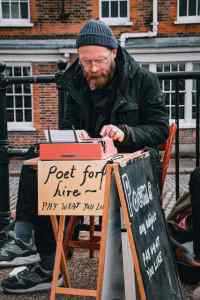
Photo by Tony Zohari
“Poems are a declaration of hope in language” – Maya Chung
voices echo, beckon, come; even
tree frogs sing, cicadae’s fiddle, coyotes howl. If
we but sit quietly, listen attentively, though we
believe it’s just noise, that it’s nothing that we can’t
resist, knowing the mind-numbing, soul crushing pull
of insidious arguments, slip the shackles, shrug negativity off
accept possibility, prepare ourselves for something
Magnificent
listen with new ears, as tree frogs, cicadas, coyotes show us we
may tolerate, accept, embrace the different. Then we can
learn to speak a new tongue, at
every juncture do more than the least.
a symphony of voices on evening breezes echo, try.
For this Golden shovel poem, I use the words of Maya Chung, Associate Editor, The Atlantic, as she wrote about the power of poetic language on the passing of writer Paul Auster. Chung wrote, “Even if we can’t pull off something magnificent, we can at least try.”
The post Poems are a declaration of hope appeared first on Carol Bodensteiner, author.


February 13, 2024
How do we care for our kids?
People talk often about how children are our future, and I expect we all like to think we do well by our children. But recent events make me believe we as a country must do better in caring for our kids. There are issues at the federal and state levels, and a new memoir shines the light on the foster care system.
At the federal level, programs like the refundable child tax credit helped slash child poverty in the U.S. almost in half, according to Nicholas Kristof in a New York Times opinion piece. Republican opposition caused the program to expire and child poverty has soared again.
In Iowa, where I live, we’re not doing better. Since 2021, Governor Reynolds has refused to claim $243 million in federal assistance to improve access to early childhood learning, for COVID testing in schools and summer food assistance, and for rental assistance for low-income families.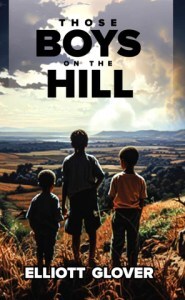
The foster care system creates especially difficult problems as young people age out. Blogger and friend Shirley Hershey Showalter delved into this topic after reading a memoir, written by Elliot Glover. In Those Boys on the Hill, Glover details the experiences he and his two brothers had with the foster care system in Pennsylvania.
Showalter reports that of the thousands of young people who age out of the foster care system, 40% face homelessness within three years. Rates are also high for pregnancy, substance abuse, incarceration and premature death.
I urge you to go to Showalter’s blog where she shares more about the book as well as a Zoom interview with Glover. Also check out Glover’s website and blog.
We as a society need to do a better job caring for our kids.
* Those Boys on the Hill is available now in Kindle version, and will be available in paperback and hardcover on February 16, 2024.
The post How do we care for our kids? appeared first on Carol Bodensteiner, author.
January 15, 2024
Icicles, blizzards & hanging out
A line of stalactite icicles dangle from the eaves of our house this year, icicles thick and thin, long and short, like a line of daggers both deadly and beautiful. It takes just the right conditions to create so many icicles, and it doesn’t happen often. But when it does, I can’t help but feel excitement.

Icicles ring our house this year.
A day like we had this week – with a blizzard wind blowing snow sideways, every event cancelled, and icicles reminding us just how cold it is – signaled a special day when I was a child. This was a day when we all hung out in the house.
There wasn’t much time for hanging out on the farm. We always needed to do something. Feed the calves. Clean out the pens. Make hay. Weed the garden. Wash clothes. Chop thistles. You get the picture. Even us kids. But when it happened, hanging out was on a day like today. Even Dad didn’t go outside until it was time to milk the cows.
It was odd for all of us to be in the house for an extended period of time. What would happen, we kids wondered? What would we do? When icicles hung from the eaves, though, we might make ice cream!
Making ice cream as a familyWhile Mom cooked the custard, Dad took a gunnysack and filled it with icicles he pulled off the garage. Down in the basement, my sisters and I beat the bag of ice with hammers to make small chunks as Mom filled the canister and inserted the paddle. Dad put the canister in the wooden ice cream bucket, attached the handle, and packed ice around the canister, sprinkling the ice with coarse salt to speed the melting and lower the temperature. Then we cranked. And cranked. And cranked.
“Is it ready yet?” we asked again and again. “My arm is tired,” we complained. As the custard thickened and turning the crank became more difficult, the task fell entirely to Dad who never seemed to wear out.
Eventually – probably sooner in real time than it felt to us – the ice cream set. Dad pulled out the paddle and we all stood around scooping the ice cold, slightly salty tasting, sweet treat into our mouths. Delicious. Exotic. So precious in its rarity.
Looking out the window at this year’s icicles and watching the blizzard rage, I considered how wonderful it is that nature hands us these moments. When we’re diverted from our normal routines, when we let go of getting the next task done, and open ourselves to the joy of just spending time with those we love.
The post Icicles, blizzards & hanging out appeared first on Carol Bodensteiner, author.
November 28, 2023
On turning 75
I turned 75 this year, an age I’ve looked forward to. It’s a cool number, don’t you think? Since I’ve arrived here with good health, good family and friends, and an active mind, I consider myself so fortunate.
Yet when I actually turned 75, I found myself ambivalent. During the past year, I had a hip replaced. Though I was back to standing without pain and walking as I’m accustomed to, it took longer to regain my energy. The inevitable discussions surrounding doctors and health led to thoughts of mortality, which I’ve never shied from, but which now I take more personally.
Poetry gave me an outlet for describing this ambivalence. In writing this, I gained perspective on this remarkable age and how I think about it. During the writing, my energy also returned. A coincidence? Perhaps. But the writing may have influenced my thinking by focusing on the balance of this age.
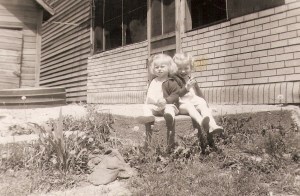
I lived in a century-old farm house until I was four.
At 75 – A SonnetAt 75, my body gives way,
sagging like a century-old farmhouse.
Knees and stairs creak, a weary dirge they play,
a tune to cause groans and tempt me to grouse.
Off-kilter windows like memories stick;
I pray they break loose, and I can recall.
Joints have worn out, and I’m no longer quick.
Activity grinds to a halt. What gall!
Yet my mind is sharp, experience vast,
curiosity and will abundant.
Upkeep and attention ensure I’ll last;
My body shifts but remains resplendent.
In body and mind, I have much to give.
I’m grateful for life I have yet to live.
###
I’m curious how you think about aging. Have you been surprised at how reaching a particular landmark age affected you? How have you managed the change?
The post On turning 75 appeared first on Carol Bodensteiner, author.
October 3, 2023
A new creative venture – poetry
I’ve undertaken a new creative venture – poetry. Inspired by Poetry Palooza, a poetry-focused event I attended last April, I’ve joined friends who are also interested in giving poetry a try.
Most people I mention this new venture to tell me they don’t read or like poetry. They had a bad experience with it in high school and lever looked back.
I can relate. My early efforts at poetry revolved around ‘roses are red, violets are blue…’ You can take it from there. In spite of that, from time to time over the years, I’d write a haiku verse or two. The ability to have a thought and express it creatively in very few words appealed to me. In the past months, I’ve enjoyed the mental challenge of poetry and dabbled in poetry forms both new and old.
I do not call myself a poet. I’m just a writer trying on a new creative venture. From time to time, I’ll share something with you. Here’s a piece inspired by recent headlines.
Miracles
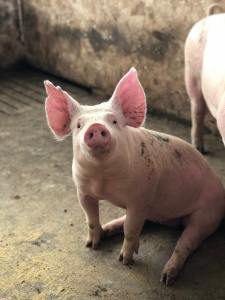
Photo by Barbara Barbosa
A miracle happened: a pig heart
successfully transplanted in a human
I will fight tooth and nail for
every breath I can take, the man said
We can sit on the porch a few
more times, his wife agreed
The surgery ensured no human organ
need be wasted on the man
who couldn’t make a transplant list
Meanwhile, another miracle:
scientists discovered mice talk
to each other in pitches
too high for human ears
Mice use language
quaking aspens communicate
whales sing, porpoises click
They talk
in languages we have yet
to interpret
with intelligence we
are slow to respect
It’s a miracle –
A man gets to enjoy life for
a little longer.
But did anyone ask the pig?
Free Verse
This poem is written in free verse. According to Poets.org, free verse is “poetry not dictated by an established form or meter and often influenced by the rhythms of speech.” This website’s glossary is my new go-to resource for learning more about poetry.
Thanks for reading.
The post A new creative venture – poetry appeared first on Carol Bodensteiner, author.
September 19, 2023
Back to school – Teaching English
Back to school is an exciting time. New books. New subjects to learn. New friends to make. I went back to school this fall, too, but not as a student. Now, I teach. My students are adult refugees and immigrants learning to read, write, and speak English.
A year ago, the refugee situation in Iowa reached a crisis level when new refugees started to come into the United States. However, refugee resettlement services cut deeply during the previous administration struggled to keep up. I felt I needed to do something to help.
I reached out to Oakridge Neighborhood where I’ve served on the board for many years. Oakridge is a Section 8 housing neighborhood providing a vast system of support services to help residents prosper. I signed up to volunteer in the English Language Learners (ELL*) classes.
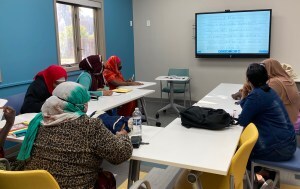
Adults go back to school to learn to read, write, and speak English at Oakridge Neighborhood.
Des Moines Area Community College provides the head teacher and books. My students are from east African nations. Some of them were well educated in their own countries while others had never been in a classroom in their lives.
In truth, I am learning as much as the students, and often the learning is most unexpected.
Cultural learningOne story we read told about a family going camping by a river. A student struggled with the word ‘tent’ and what it meant. It took several moments as the students spoke in Kunama before this student looked at me in disbelief. “Tents aren’t safe,” she said. “The lions claw through them.” Her comment made me see life in the refugee camp where she and her children lived for six years in a whole new way.
Repetition, pantomime, flexibility and patience are all required teaching skills. Practice, dedication, persistence, are required learning skills. And the students have made excellent progress.
I shared in the joy and pride one student showed after she called the doctor’s office to make an appointment. She explained every step she took: finding the office number and calling, saying her name, spelling it, explaining why she needed to see the doctor, settling on a date and time. Previously, she relied on one of her English-speaking children to make these calls.
Resilience and dedicationThe longer I work with these students, the more I am impressed by their resilience. They work night jobs and still make it to class, struggling sometimes to stay awake, but still there. They’re in class while they worry about a child who’s in the hospital and they can barely understand what the doctor tells them. They keep on even when they’ve heard that the wars in Sudan or Eritrea have moved near the villages where family members still live.
These students are learning to live in a strange, new country. English isn’t easy, but in learning to speak, read, and write English, they make a complicated life infinitely easier. They open a world of possibility. I’m grateful to help them succeed.
* ELL – English Language Learners – rather than ESL – English as a Second Language? ELL recognizes that many students already speak several languages and English is yet another.
The post Back to school – Teaching English appeared first on Carol Bodensteiner, author.
August 29, 2023
Standing up for justice & equality
Human rights have been under attack in Iowa. The onslaught of abortion bans, book bans, and laws targeting LGBTQ+ children – all laws passed by the Iowa legislature this year – has been soul crushing. How can we continue standing up for justice and equality when things are dark and likely to get darker?
This past weekend, I received a much needed boost when the Iowa Women’s Hall of Fame inducted three trailblazing women and awarded the Cristine Wilson Medal for Equality and Justice.

Teree Caldwell-Johnson (left) received the Cristine Wilson Medal for Equality and Justice. Inducted into the Women’s Hall of Fame were Paula Dierenfeld, Romanda Belcher, and Bridget Reed.
I was honored to introduce Teree Caldwell-Johnson, the recipient of the 2023 Cristine Wilson Medal for Equality and Justice. President and CEO of Oakridge Neighborhood and Chair the Des Moines Public School Board, Teree has dedicated her life to standing up for the marginalized and those who cannot speak for themselves.
Teree centered her remarks on the lyrics of the Stand – a song that inspires her and keeps her going.
Stand by Donnie McClurkin
What do you do when you’ve done all you can
And it seems like it’s never enough?
And what do you say
When your friends turn away
And you’re all alone, alone?
Tell me, what do you give when you’ve given your all
And it seems like you can’t make it through?
Well, you just stand when there’s nothing left to do
You just stand, watch the lord see you through
Yes, after you’ve done all you can
You just stand.
Teree talked about her parents who were involved in the Civil Rights movement. Her father served as principal of the segregated school in Salina, Kansas, before the Brown v. Board of Education decision and went on to become the first African American elected to the Salina city council and later to serve as mayor. Turbulent times that needed someone willing to stand and offer calm, wise leadership.
She talked about how all the advances in equality and justice fought for over decades are going backwards – not just in Iowa, but nationally – but that we can’t give up.
I came away from Teree’s presentation wishing everyone could have heard it, especially my grandchildren. How can we continue standing up for justice and equality when things are so dark and likely to get darker? A better question is, How can we not?
***
During the last session, the Iowa legislature passed a six-week abortion ban; passed a ban on books depicting sex for all public schools, including classics like The Color Purple, A Farewell to Arms, Sophie’s Choice, Brave New World, and Ulysses, as well as current books giving voice to people of color and those who are LGBTQ+; and passed laws targeting, restricting, and stigmatizing LGBTQ+ children.
The Iowa Women’s Hall of Fame ceremony coincided with the anniversary of the passage of the 19th Amendment (in 1920), giving women the right to the vote and the 60th anniversary of the 1963 March on Washington where Martin Luther King Jr. gave his famous “I Have a Dream” speech.
Click and read more about Teree Caldwell-Johnson and the other Inspiring inductees: Romanda Belcher, Paula Dierenfeld and Bridget Reed.
The post Standing up for justice & equality appeared first on Carol Bodensteiner, author.
August 25, 2023
Drought on the prairie
We are in the third, maybe fourth, year of drought here in Iowa. Capricious rains tease us into thinking the drought may be over, but there’s no denying the affect of too little water on my flower gardens. The drought is even taking a toll on my prairie.
Prairies are adapted to the Midwest weather and soil, whatever moisture they receive supplied by nature. But I’m seeing that even prairies may need more water than they get.
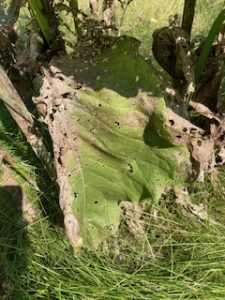
Drought-stressed Cup plant leaf
Plant damage – But why?A few years ago, I started to see leaf damage on some Cup plants. Leaf edges curled and turned crispy brown. The plants were less attractive, but they still blossomed. I observed this happening, and wondered: Was the leaf damage a fungus? Why did it only affect cup plants? I didn’t connect the damage to the drought, at least in part because none of the other plants in the prairie were affected.
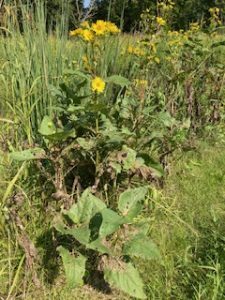
Drought-stressed Cup plants can still bloom.
Every year since I first noticed it, there has been more leaf damage on more Cup plants. This year the damage covered entire Cup plants, turning them a charred brown/black, looking as though a forest fire had swept through, leaving only a skeleton plant.
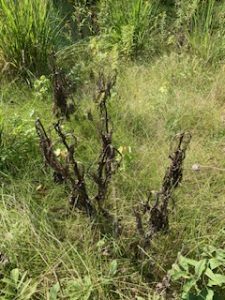
These cup plants didn’t survive the drought.
Finally, I contacted the county conservation office to get their thoughts. From them, I learned that Cup plant is a wetland species so the plants may be extra stressed because of the drought and incorrect soil type or planting location. They explained that Cup plants require a decent amount of consistent water in order to flourish.
I purchased a prairie seed mix to establish the prairie. It contained a wealth of seeds about which I knew almost nothing. The conservation office folks said it was good to have plants like Cup plant in the seed mix even though it is on the wetter end of the spectrum. They explained that it’s important to plant species that have different moisture requirements across a new planting to make sure every moisture/soil type is filled. They also pointed out something that I’ve seen time and again in my prairie: “Ecosystems are forever changing and almost always in flux.”
The changing prairie ecosystemMy prairie is ‘new’ every year. Last year, for instance, the prairie produced an abundance of Butterfly milkweed. I loved these beautiful orange blossoms and the butterflies they attracted.
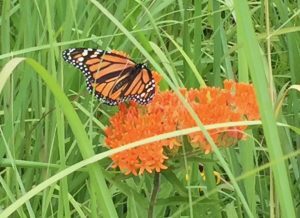
Monarch enjoying butterfly milkweed.
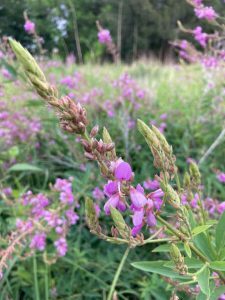
Showy Tick Trefoil bloomed in abundance this year.
This year, there were only a few Butterfly milkweeds. Instead, the prairie produced an abundance of Showy Tick Trefoil. Early on in my prairie’s life, I’d been delighted to see Rattlesnake Master plants. They flourished for 2-3 years and then disappeared. Turns out, this plant also requires consistent moisture.
The drought is affecting significant changes on my prairie. Maybe the drought is just sorting out the right plants for this area. Maybe when it rains regularly in future years (fingers crossed that it will!) the Cup plants and Rattlesnake Master will return. After all, the seeds produced all these years are still in the ground. Ultimately, the prairie will decide.
What changes have you seen in your gardens caused by changes in the weather?
The post Drought on the prairie appeared first on Carol Bodensteiner, author.
August 18, 2023
White man’s footsteps – weed or something more?
I’m always delighted to learn something new. Even better when I’m totally surprised by the discovery. This week, I was surprised and delighted to find that a plant I’d always considered nothing more than a weed, was actually a much more desirable plant: White man’s footsteps.
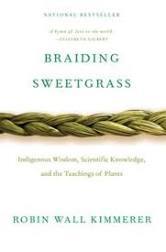 I’ve been reading Braiding Sweetgrass, Robin Wall Kimmerer’s book sharing indigenous wisdom, scientific knowledge, and the teachings of plants. A scientist, professor and member of the Citizen Potawatomi Nation, Kimmerer writes in such a way that I yearn to be as connected to nature as she.
When my husband and I moved to an acreage 16 years ago, I set about establishing a prairie. Over years, the desired forbs and grasses emerged. I relished each new native plant I identified. Weeds (plants not on my native seed list) also appeared. I admit I looked at the weeds with annoyance, removing them if they were invasive and letting them remain if they were not.
One such weed was one I’ve seen all my life, from the Iowa farm where I grew up to the yard of every home I’ve ever owned. A weed so common and harmless I never even sought to identify it.

White man’s footsteps is the common plantain and has many valuable uses.
Kimmerer brought this “weed” to my attention in a chapter about becoming indigenous to place. She explained that Natives called the plant “White man’s footsteps,” because it was introduced by Europeans when they came to this continent. She described the plant as: “a low circle of leaves, pressed close to the ground with no stem to speak of.”
Upon reading the plant description, I immediately sought out images and realized I knew this plant and had seen it recently. There is a White man’s footsteps growing not 15 feet from my back door.
White man’s footsteps is the common plantain. While Kimmerer says Native people were originally distrustful of the plant considering who brought it, they came to see it had many valuable uses. The leaves can make a poultice to treat cuts, burns, and insect bites, to stop bleeding and heal wounds without infection. The seeds are medicine for digestion. A nutritious food, the leaves may be eaten raw when they are young and tender, and cooked when they are older and tougher. Kimmerer said that while White man’s footsteps is not native to North America, it has proved itself useful over 500 years and so joins us as a ‘naturalized’ native plant.
I cannot think of White man’s footsteps as an annoying weed anymore. It is so much more. Quite likely part of the next salad I make.
The post White man’s footsteps – weed or something more? appeared first on Carol Bodensteiner, author.
June 12, 2022
She Had No Regrets
“What epitaph do you want on your tombstone?” the workshop facilitator asked. After a little thought, I scribbled down, “She Had No Regrets.”
At that time I’d recently experienced a moment of clarity about my life. I intended to decide what I wanted to do in my life, and I was going to do it. I would continue to care about what other people thought and wanted, but I was no longer going to let their wants override my own. As I looked forward, anything was possible. I would live life fully, grab every opportunity.
I was not, however, thinking about the past. A bit of hubris on my part, as it turns out. Looking back, I realize I have said and done plenty of things in my life that I regret. Things I wish I’d said. Or not said. Things I did. Or didn’t do. Minor and major decisions that hang over me, some of which I have never been able to let go. Some that still hurt my heart. Oh, if I could just erase all of those!
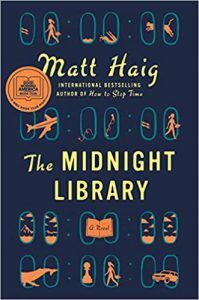
The Midnight Library by Matt Haig
Life regrets and how I’ve dealt with them came to mind because my book club chose Matt Haig’s The Midnight Library to read this month.
In this thought-provoking book, the protagonist Nora Seed’s life has been full of misery and regret. To the point that she decides to end her life. In the split second between life and death, Nora arrives in the Midnight Library. There she meets a librarian from her youth who gives Nora an opportunity to make things right. Each book in the library represents a world in which Nora made different choices. With the librarian’s help, Nora can undo every decision she regrets and search for her perfect life.
As Nora chooses different lives and works through her regrets, I thought through my own. What if I’d made other choices? Would my life have turned out better? Worse? Or just different? What would I have gained or lost with each different choice? We can’t know every outcome of a different decision, of course, because even the smallest decision can cause big ripples on ourself and on others. As Nora learns.
How we process the moments we regret in our life is, of course, the key. Do we pile regret on regret until we’re spiraling downward and see no way out? Or do we accept that that poorer choices are part of anyone’s life, learn from those moments, and try for better next time?
The Midnight Library is an excellent book club choice. There’s so much wisdom packed within the pages, I’m sure our discussion with be rich and deep.
Would I still choose “She Had No Regrets” as my epitaph? It has taken many years to own some of my regrets as the learning experiences they were. Actions and words that have, I hope, taught me to be a more thoughtful, caring, empathetic person. So, maybe yes, maybe no. I’d hate to find it was a decision I regretted.
How do you view regrets? How have regrets had an impact on your life?
The post She Had No Regrets appeared first on Carol Bodensteiner, author.