
Kenneth C. Davis's Blog
March 4, 2026
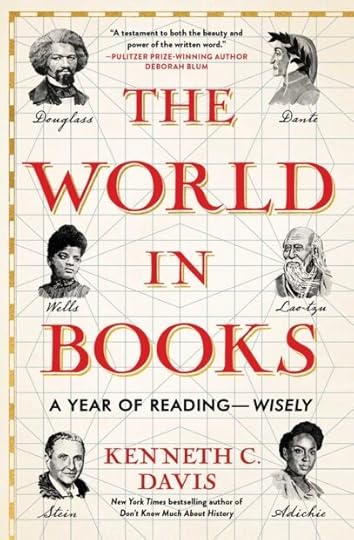
The World in Books: A Year of Reading–Wisely
NOW AVAILABLE IN PAPERBACK
THE WORLD IN BOOKS: A YEAR OF READING–WISELY
Named to “The Most Anticipated: The Great Fall 2024 Preview” by The Millions
“Kenneth C. Davis’s The World in Books is a testament to both the beauty and power of the written word. And also, a very smart guide to books that have changed the way we think – and sometimes even changed us.”
–Deborah Blum, Pulitzer-Prize winning author of The Poison Squad and the bestseller, The Poisoner’s Handbook.
First Trade review from Kirkus Reviews
“A wealth of succinct, entertaining advice.” Full review
Now out from Scribner Books and Simon & Schuster Audio and available in paperback on October 21, 2025
Read more and order copies here.
More Praise for The World in Books:
“In his accessible, well-written, and unanticipatedly humorous The World in Books, Kenneth C. Davis takes readers on a journey that highlights fifty-two short yet provocative works of non-fiction. Highlighting both traditional favorites and contemporary classics, Davis offers his sharp insights in ways that appeal to the inquisitive mind, regardless of its familiarity with the selected texts. His poignant “Introduction” sets the stage for the contemporary relevance of why books like these matter in contemporary times, which makes this collection all the more relevant. Highly recommended for every person who treasures the freedom to read and values the transformative power it has for us all.”
—Dr. J. Michael Butler, Kenan Distinguished Professor of History, Flagler College and author of Beyond Integration
What a “Year of Reading–Wisely” looks like….
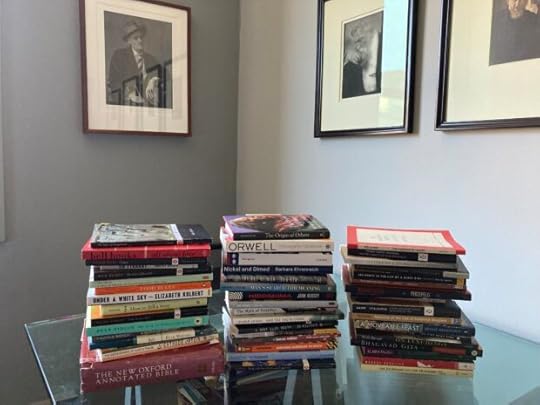
Photo credit Kenneth C. Davis
Among the 52 titles I have included are The Epic of Gilgamesh, Genesis, the poetry of Sappho, Meditations by Marcus Aurelius, and such profoundly influential writers as Frederick Douglass, Henry David Thoreau, Virginia Woolf, Helen Keller, James Baldwin, Susan Sontag, and Timothy Snyder.
The essential message of this book is that books matter–now more than ever. We must continue to educate ourselves. I believe that Open Books Open Minds.
I look forward to sharing my fundamental belief that books can change us and the world.
And please read and enjoy my guide to 58 excellent short works of fiction: Great Short Books: A Year of Reading–Briefly
The post The World in Books: A Year of Reading–Wisely first appeared on Don't Know Much.


February 12, 2026
It is NOT Presidents Day. Or President’s Day. Or Even Presidents’ Day.
(Earlier post updated 2/12/2026)
“Presidents Day” weekend is upon us. But it isn’t really “Presidents Day.”
So What Day Is it After All?
Okay. We all do it. It is printed on calendars and posted in bank windows. We mistakenly call the third Monday in February Presidents Day, in part because of all those commercials in which George Washington swings his legendary ax and “Rail-splitter” Abe Lincoln hoists his ax to chop down prices on everything from mattresses and linens to SUVs.
But, this February holiday is officially still George Washington’s Birthday.
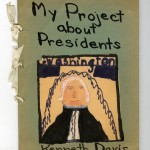
I wrote My Project About Presidents in 3rd Grade when I was 9. Even then I was asking questions about history and presidents
Washington’s Birthday has become widely known as Presidents Day (or President’s Day, or Presidents’ Day). The popular usage and confusion resulted from the merging of what had been two widely celebrated Presidential birthdays in February —Lincoln’s on February 12th, which was never a federal holiday– and Washington’s on February 22, which was.
Created under the Uniform Holiday Act of 1968, which gave us three-day weekend Monday holidays, the federal holiday on the third Monday in February is technically still Washington’s Birthday. But here’s the rub: the holiday can never land on Washington’s true birthday because the latest date it can fall is February 21, as it did in 2011.
But we cannot discuss the presidency or much of United States history without discussing the role that slavery played in the foundation and establishment of the republic.
And that is why this year is so different. The current administration is eradicating much of that history in an effort to sanitize American history. Recently, the Park Service used crowbars to remove references to Washington’s role as an enslaver as president in Philadelphia. That is part of a much larger effort to rewrite American history and remove some of the stubborn facts about America’s past. It is taking place in national parks, historical museums and even the service academies.
Read “How the National Park Service is Deleting American History” (New York Times)
This attempt to control the past is a tactic of the Strongman. To control the past is to control the present and future.
READ MY ARTICLE in Social Education: “The American Contradiction: Conceived in Liberty, Born in Shackles”
George Washington’s role as an enslaver is fully explored in my book IN THE SHADOW OF LIBERTY: The Hidden History of Slavery, Four Presidents, and Five Black Lives. 
There is a wealth of information about the First President at his home Mount Vernon.
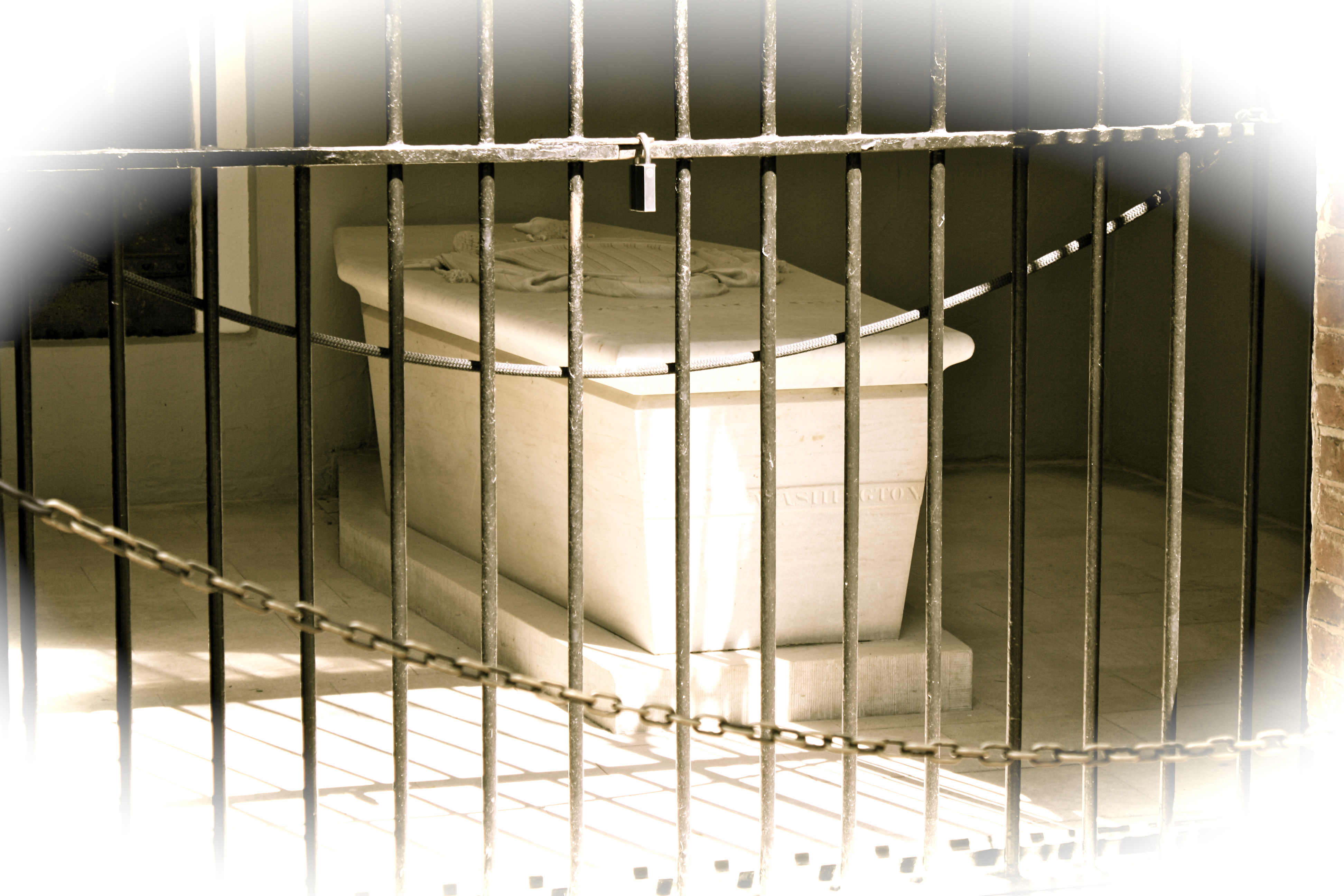
Washington’s Tomb — Mt. Vernon (Photo credit Kenneth C. Davis 2010)
And read more about the creation of the Presidency, George Washington, his life, and administration in DON’T KNOW MUCH ABOUT® THE AMERICAN PRESIDENTS. Washington’s role in the American Revolution is also highlighted in Chapter One of THE HIDDEN HISTORY OF AMERICA AT WAR.

The Hidden History of America At War (paperback)

Don’t Know Much About® History: Anniversary Edition
Don’t Know Much About® the American Presidents (Hyperion paperback-April 15, 2014)
The post It is NOT Presidents Day. Or President’s Day. Or Even Presidents’ Day. first appeared on Don't Know Much.
January 20, 2026
In the Shadow of Liberty
[Post revised January 20, 2026]
As we approach February –Black History Month– and the celebration of George Washington’s Birthday (AKA “Presidents Day”) on Monday February 16, it is an appropriate time to reflect on the connection of Presidents and Black History. That is especially true in this year that marks 250 years since America declared its independence with Jefferson’s timeless words –“All men are created equal.” This is what I have called “The American Contradiction”–that a nation “conceived in liberty” was also born in shackles. (READ “THE AMERICAN CONTRADICTION”
Recognizing that fundamental truth is all the more important in the current political landscape, when teaching an accurate version of American History is under assault.
As the New York Times reported last year,
“Recent polls show that a majority of Americans of all political stripes are open to complex history that shows the bad along with the good. But Mr. Trump’s recent actions, some observers say, are part of an escalating attempt to use history as a wedge that separates ‘real’ Americans from naysayers who threaten the body politic.” New York Times, April 19, 2025, “Trump’s American History Revolution”
Having spent much of my career trying to correct the false narrative so many Americans were once taught, I believe the nation must honestly confront the role that enslavement played in the nation’s founding and development. In the Shadow of Liberty tells that story.
Did you know that many of America’s Founding Fathers—who fought for liberty and justice for all—were slave owners?
Through the powerful stories of five enslaved people who were “owned” by four of our greatest presidents, this book helps set the record straight about the role slavery played in the founding of America. These dramatic narratives explore our country’s great tragedy—that a nation “conceived in liberty” was also born in shackles.
BILLY LEE, who became George Washington’s valet and fought in the American Revolution alongside him.ONA JUDGE, who escaped from Washington’s Philadelphia household—only to be tracked down by the president’s men.ISAAC GRANGER, who survived the devastation of Yorktown before returning to Thomas Jefferson’s Monticello.PAUL JENNINGS, who was present at the burning of James Madison’s White House during the War of 1812.ALFRED JACKSON, who was born into slavery at Andrew Jackson’s Hermitage, survived the Civil War, and lived at the plantation into the 20th century.
The post In the Shadow of Liberty first appeared on Don't Know Much.
January 2, 2026
The World in Books: A Year of Reading–Wisely
NOW AVAILABLE IN PAPERBACK
THE WORLD IN BOOKS: A YEAR OF READING–WISELY
Named to “The Most Anticipated: The Great Fall 2024 Preview” by The Millions
“Kenneth C. Davis’s The World in Books is a testament to both the beauty and power of the written word. And also, a very smart guide to books that have changed the way we think – and sometimes even changed us.”
–Deborah Blum, Pulitzer-Prize winning author of The Poison Squad and the bestseller, The Poisoner’s Handbook.
First Trade review from Kirkus Reviews
“A wealth of succinct, entertaining advice.” Full review
Now out from Scribner Books and Simon & Schuster Audio and available in paperback on October 21, 2025
Read more and order copies here.
More Praise for The World in Books:
“In his accessible, well-written, and unanticipatedly humorous The World in Books, Kenneth C. Davis takes readers on a journey that highlights fifty-two short yet provocative works of non-fiction. Highlighting both traditional favorites and contemporary classics, Davis offers his sharp insights in ways that appeal to the inquisitive mind, regardless of its familiarity with the selected texts. His poignant “Introduction” sets the stage for the contemporary relevance of why books like these matter in contemporary times, which makes this collection all the more relevant. Highly recommended for every person who treasures the freedom to read and values the transformative power it has for us all.”
—Dr. J. Michael Butler, Kenan Distinguished Professor of History, Flagler College and author of Beyond Integration
What a “Year of Reading–Wisely” looks like….
Photo credit Kenneth C. Davis
Among the 52 titles I have included are The Epic of Gilgamesh, Genesis, the poetry of Sappho, Meditations by Marcus Aurelius, and such profoundly influential writers as Frederick Douglass, Henry David Thoreau, Virginia Woolf, Helen Keller, James Baldwin, Susan Sontag, and Timothy Snyder.
The essential message of this book is that books matter–now more than ever. We must continue to educate ourselves. I believe that Open Books Open Minds.
I look forward to sharing my fundamental belief that books can change us and the world.
And please read and enjoy my guide to 58 excellent short works of fiction: Great Short Books: A Year of Reading–Briefly
The post The World in Books: A Year of Reading–Wisely first appeared on Don't Know Much.
January 1, 2026
GREAT SHORT BOOKS: A Year of Reading–Briefly
NOW IN PAPERBACK
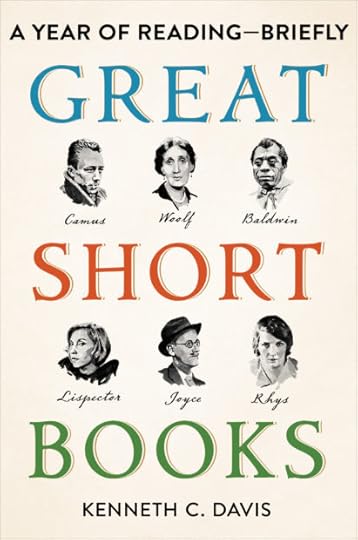
GREAT SHORT BOOKS:
A YEAR OF READING — BRIEFLY
Scribner/Simon & Schuster and Simon Audio (Unabridged audio download)
“An exciting guide to all that the world of fiction has to offer in 58 short novels — from ‘The Great Gatsby’ and ‘Lord of the Flies’ to the contemporary fiction of Colson Whitehead and Leïla Slimani — that, ‘like a first date,’ offer pleasure and excitement without commitment.” New York Times Book Review
Booklist “Editors’ Choice Adult Books 2022″
“…The most exceptional of the best books of 2022 reviewed in Booklist…”
“Delightfully accessible, Great Short Books: A Year of Reading–Briefly presents 58 fact-filled reviews of short books, a smorgasbord of titles sure to entice readers.” –Cheryl McKeon, Shelf Awareness
“I consider Davis’ ‘Great Short Books’ a gift to readers, a true treasure trove of literary recommendations.” —Sue Gilmore, SFGate
“Anyone who’s eternally time-strapped will treasure Kenneth C. Davis’ Great Short Books. This nifty volume highlights 58 works of fiction chosen by Davis for their size (small) and impact (enormous). Each brisk read weighs in at around 200 pages but has the oomph of an epic.” —Bookpage Full Review
“An entertaining journey with a fun, knowledgeable guide…. “ Kirkus Reviews
“A must-purchase for public and school libraries.” ALA Booklist
FIRST TRADE REVIEWS FROM KIRKUS, PUBLISHERS WEEKLY, BOOKLIST
“Davis feels that novels of 200 pages or less often don’t get the recognition they deserve, and this delightful book is the remedy…A must-purchase for public and school libraries.” *Starred Booklist review
“An entertaining journey with a fun, knowledgeable guide…. His love of books and reading shines through. From 1759 (Candide) to 2019 (The Nickel Boys), he’s got you covered.” –Kirkus Reviews
Full KIRKUS review here
“Davis’s conversational tone makes him a great guide to these literary aperitifs. This is sure to leave book lovers with something new to add to their lists.” FULL PUBLISHERS WEEKLY REVIEW here
During the lock-down, I swapped doom-scrolling for the insight and inspiration that come from reading great fiction. Inspired by Boccaccio’s “The Decameron” and its brief tales told during a pandemic, I read 58 great short novels –not as an escape but an antidote.
“A short novel is like a great first date. It can be extremely pleasant, even exciting, and memorable. Ideally, you leave wanting more. It can lead to greater possibilities. But there is no long-term commitment.”
–From “Notes of a Common Reader,” the Introduction to Great Short Books
Read “The Antidote to Everything,” an excerpt from the Introduction published on Lit Hub
The result is a compendium that goes from “Candide” to Colson Whitehead, and Edith Wharton to Leïla Slimani. And yes, Maus and many other Banned Books and Writers.

What “A Year of Reading–Briefly” looks like

Voltaire in Great Short Books
Art © Sam Kerr

Edith Wharton in Great Short Books
Art © Sam Kerr
Advance Praise for Great Short Books: A Year of Reading—Briefly
“GREAT SHORT BOOKS is a fascinating, thoughtful, and inspiring guide to a marvelous form of literature: the short novel. You can dip into this book anywhere you like, but I found myself reading it cover-to-cover, delighting in discovering new works while also revisiting many of my favorites. GREAT SHORT BOOKS is itself a great book—for those who are over-scheduled but want to expand their reading and for those who will simply delight in spending time with a passionate fellow reader who on every page reminds us why we need and love to read.”
–Will Schwalbe, New York Times bestselling author of THE END OF YOUR LIFE BOOK CLUB
“This is the book that you didn’t know you really needed. I began digging into this book as soon as I got it, and it was such a delight to read beautiful prose, just a sip at a time, with Kenneth Davis’ notes to give me context and help me more fully appreciate the stories. Keep this book near your bed or on your coffee table. It will be read and loved.”
–Celeste Headlee, journalist and author of WE NEED TO TALK and SPEAKING OF RACE

Recording audio book of Great Short Books (Sept. 2022) Photo by Katherine Cook
From hard-boiled fiction to magical realism, the 18th century to the present day, Great Short Books spans genres, cultures, countries, and time to present a diverse selection of acclaimed and canonical novels—plus a few bestsellers. Like browsing in your favorite bookstore, this eclectic compendium is a fun and practical book for any passionate reader hoping to broaden their collection— or anyone who is looking for an entertaining, effortless reentry into reading.
Listen to a sample of the audio book of Great Short Books
And Indie booksellers weigh in:
“Need something grand, something classic, uh…. something short to read, but don’t know where to start? Check out Kenneth Davis’s guide to Great Short Books and you’ll soon find just the right tale to delight your literary palate. For each suggestion, Davis gives us first lines, a plot summary, an author’s bio, a reason for reading it, and, finally, what you should read next from the author’s canon. Pick up a copy… you’ll be glad you did. You’re welcome!”—Linda Bond, Auntie’s Bookstore (Spokane, WA)
“Kenneth Davis has presented the perfect solution for too many books, not enough time—a collection of exceptional short books perfect for reading in a society seemingly without any free time. Many of the books may be familiar by name, some are obscure, some even forgotten, but all belong in the canon of superb literature. He teases with a brief synopsis and explains why each book deserves attention. An absolutely intriguing bonus is a short biographical sketch of each author, many of whom had fascinating but traumatic lives. It is the perfect book to provide comfort literature for busy readers.”—Bill Cusumano, Square Books (Oxford, Miss.)
More early reviews from readers at NetGalley.com
“GREAT SHORT BOOKS is a wonderful, breezy but deep look at the outstanding short books of the last 150 years. Kenneth C. Davis is a genius at summarizing each book and making the reader want to read said book post haste. This is a book I didn’t know the world needed but the world did.” –Tom O., reviewer
“…an incredibly valuable tool for book clubs and readers everywhere! Some authors/titles are well-known and others will be new discoveries….HIGHLY RECOMMENDED for any book group looking to find new titles or any reader who wants to know what to read next.” –Ann H. reviewer
“I found over a dozen new authors or titles I want to now read that were included in his main list, and the Further Reading at the end of each chapter and at the end of the volume itself.
As others have suggested, this is a great tool for Book Clubs!
Not Lit Crit, it is mostly focused on necessary, just-the-facts-mam information on one person’s reading of short books over a year. Well worth a read, and great for browsing!” –Stephen B., Librarian
“What better way to introduce new readers to more than 50 ‘short’ books. This handy book is full of non-spoiler descriptions and cultural context that situate these stories within our world.” –Kelsey W., librarian
S0urce: Great Short Books via NetGalley
I can’t wait to start talking about this book with readers everywhere.
Teachers, Librarians, Book Clubs and Other Learning Communities:
Invite me for a visit to your school, classroom, library, historical group, book club or conference.
The post GREAT SHORT BOOKS: A Year of Reading–Briefly first appeared on Don't Know Much.
December 7, 2025
Who Started the “War on Christmas?”

“In the interest of labor and morality” (1895: Image Courtesy of Library of Congress Prints and Photographs Division Washington, D.C. 20540 USA http://hdl.loc.gov/loc.pnp/pp.print)
(12.07.2025 revision of a post first published 12.11.2o13. But it never gets old.)
Fortunately, the so-called “War on Christmas” seems to have disappeared.
Proclaiming a secular assault on the religious significance of the holiday has been a seasonal tradition, just like the Macy’s Parade with Santa Claus. Claiming that “Happy Holidays” or “Season’s Greetings” instead of “Merry Christmas” was a betrayal of Christian America became a staple of conservative talk show hosts and part of America’s political culture wars.
The basic premise: Christmas is under attack by Grinch-y atheists and secular humanists who want to remove any vestige of Christianity from the public space. Any criticism of public displays devoted to religious symbols –mangers, crosses, stars — was seen by these folks as part of a wider attack on “Christian values” in America. Mass market retailers who substituted “Happy Holidays” for “Merry Christmas” were part of the conspiracy to “ruin Christmas.”
But in fact, most religious displays are not banned in America. Courts simply direct that one religion cannot be favored over another under the Constitutional protections of the First Amendment. Christmas displays are generally permitted as long as menorahs, Kwanzaa displays, and other seasonal symbols are also allowed.
In other words, the “War on Christmas” is pretty much a phony war. But where did this all start?
The first laws against Christmas celebrations and festivities in America came during the 1600s –from the same wonderful folks who brought you the Salem Witch Trials — the Puritans. (By the way, H.L. Mencken once defined Puritanism as the fear that “somewhere someone may be happy.”)
“For preventing disorders, arising in several places within this jurisdiction by reason of some still observing such festivals as were superstitiously kept in other communities, to the great dishonor of God and offense of others: it is therefore ordered by this court and the authority thereof that whosoever shall be found observing any such day as Christmas or the like, either by forbearing of labor, feasting, or any other way, upon any such account as aforesaid, every such person so offending shall pay for every such offence five shilling as a fine to the county.”
–From the records of the General Court,
Massachusetts Bay Colony
May 11, 1659
The Founding Fathers of the Massachusetts Bay Colony were not a festive bunch. To them, Christmas was a debauched, wasteful festival that threatened their core religious beliefs. They understood that most of the trappings of Christmas –like holly and mistletoe– were vestiges of ancient pagan rituals. More importantly, they thought Christmas — the mass of Christ– was too “popish,” by which they meant Roman Catholic. These are the people who banned Catholic priests from Boston under penalty of death.
This sensibility actually began over the way in which Christmas was celebrated in England. Oliver Cromwell, a strict Puritan who took over England in 1645, believed it was his mission to cleanse the country of the sort of seasonal moral decay that Protestant writer Philip Stubbes described in the 1500s:
‘More mischief is that time committed than in all the year besides … What dicing and carding, what eating and drinking, what banqueting and feasting is then used … to the great dishonour of God and the impoverishing of the realm.’
In 1643, Parliament banned Christmas celebrations.
“The Puritans sought to turn Christmas into a fast day, with an act of Parliament in 1643 declaring that it should be observed ‘with the more solemn humiliation because it may call to remembrance our sins, and the sins of our forefathers who have turned this Feast, pretending the memory of Christ, into an extreme forgetfulness of him, by giving liberty to carnal and sensual delights.’ Two years later, the Directory of Public Worship was unequivocal that feasts such as Christmas had no warrant in scripture.”
–Bruce Gordon, “The Grinch That Didn’t Steal Christmas”
Attending mass was forbidden. Under Cromwell’s Commonwealth, mince pies, holly and other popular customs fell victim to the Puritan mission to remove all merrymaking during the Christmas period. To Puritans, the celebration of the Lord’s birth should be day of fasting and prayer.
In England, the Puritan War on Christmas lasted until 1660. In Massachusetts, the ban remained in place until 1687.
So if the conservative broadcasters and religious folk really want a traditional, American Christian Christmas, the solution is simple — don’t have any fun.
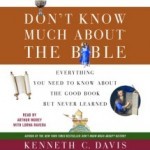
My latest work, The World in Books (Scribner, 2024) includes an entry on the gospel of Luke, which commences with one version of the Nativity. The history behind Christmas is also told in Don’t Know Much About® The Bible.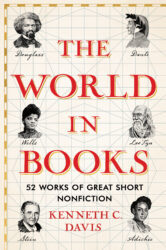
And read my article on religion in America, “America’s True History of Religious Tolerance” (Smithsonian)
Read more about the Puritans in Don’t Know Much About® History and America’s Hidden History.

America’s Hidden History, includes tales of “Forgotten Founders”
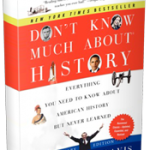
Don’t Know Much About History (Revised, Expanded and Updated Edition)
The post Who Started the “War on Christmas?” first appeared on Don't Know Much.
December 2, 2025
The World in Books: A Year of Reading–Wisely
NOW AVAILABLE IN PAPERBACK
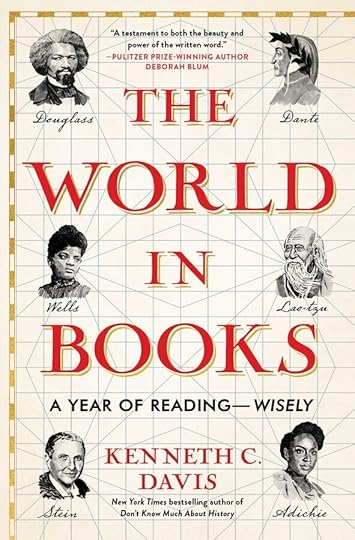
THE WORLD IN BOOKS: A YEAR OF READING–WISELY
Named to “The Most Anticipated: The Great Fall 2024 Preview” by The Millions
“Kenneth C. Davis’s The World in Books is a testament to both the beauty and power of the written word. And also, a very smart guide to books that have changed the way we think – and sometimes even changed us.”
–Deborah Blum, Pulitzer-Prize winning author of The Poison Squad and the bestseller, The Poisoner’s Handbook.
First Trade review from Kirkus Reviews
“A wealth of succinct, entertaining advice.” Full review
Now out from Scribner Books and Simon & Schuster Audio and available in paperback on October 21, 2025
Read more and order copies here.
More Praise for The World in Books:
“In his accessible, well-written, and unanticipatedly humorous The World in Books, Kenneth C. Davis takes readers on a journey that highlights fifty-two short yet provocative works of non-fiction. Highlighting both traditional favorites and contemporary classics, Davis offers his sharp insights in ways that appeal to the inquisitive mind, regardless of its familiarity with the selected texts. His poignant “Introduction” sets the stage for the contemporary relevance of why books like these matter in contemporary times, which makes this collection all the more relevant. Highly recommended for every person who treasures the freedom to read and values the transformative power it has for us all.”
—Dr. J. Michael Butler, Kenan Distinguished Professor of History, Flagler College and author of Beyond Integration
What a “Year of Reading–Wisely” looks like….
Photo credit Kenneth C. Davis
Among the 52 titles I have included are The Epic of Gilgamesh, Genesis, the poetry of Sappho, Meditations by Marcus Aurelius, and such profoundly influential writers as Frederick Douglass, Henry David Thoreau, Virginia Woolf, Helen Keller, James Baldwin, Susan Sontag, and Timothy Snyder.
The essential message of this book is that books matter–now more than ever. We must continue to educate ourselves. I believe that Open Books Open Minds.
I look forward to talking about this book in the coming months and sharing my fundamental belief that books can change us and the world.
In the meantime, please read and enjoy Great Short Books: A Year of Reading–Briefly
The post The World in Books: A Year of Reading–Wisely first appeared on Don't Know Much.
December 1, 2025
GREAT SHORT BOOKS: A Year of Reading–Briefly
NOW IN PAPERBACK
GREAT SHORT BOOKS:
A YEAR OF READING — BRIEFLY
Scribner/Simon & Schuster and Simon Audio (Unabridged audio download)
“An exciting guide to all that the world of fiction has to offer in 58 short novels — from ‘The Great Gatsby’ and ‘Lord of the Flies’ to the contemporary fiction of Colson Whitehead and Leïla Slimani — that, ‘like a first date,’ offer pleasure and excitement without commitment.” New York Times Book Review
Booklist “Editors’ Choice Adult Books 2022″
“…The most exceptional of the best books of 2022 reviewed in Booklist…”
“Delightfully accessible, Great Short Books: A Year of Reading–Briefly presents 58 fact-filled reviews of short books, a smorgasbord of titles sure to entice readers.” –Cheryl McKeon, Shelf Awareness
“I consider Davis’ ‘Great Short Books’ a gift to readers, a true treasure trove of literary recommendations.” —Sue Gilmore, SFGate
“Anyone who’s eternally time-strapped will treasure Kenneth C. Davis’ Great Short Books. This nifty volume highlights 58 works of fiction chosen by Davis for their size (small) and impact (enormous). Each brisk read weighs in at around 200 pages but has the oomph of an epic.” —Bookpage Full Review
“An entertaining journey with a fun, knowledgeable guide…. “ Kirkus Reviews
“A must-purchase for public and school libraries.” ALA Booklist
FIRST TRADE REVIEWS FROM KIRKUS, PUBLISHERS WEEKLY, BOOKLIST
“Davis feels that novels of 200 pages or less often don’t get the recognition they deserve, and this delightful book is the remedy…A must-purchase for public and school libraries.” *Starred Booklist review
“An entertaining journey with a fun, knowledgeable guide…. His love of books and reading shines through. From 1759 (Candide) to 2019 (The Nickel Boys), he’s got you covered.” –Kirkus Reviews
Full KIRKUS review here
“Davis’s conversational tone makes him a great guide to these literary aperitifs. This is sure to leave book lovers with something new to add to their lists.” FULL PUBLISHERS WEEKLY REVIEW here
During the lock-down, I swapped doom-scrolling for the insight and inspiration that come from reading great fiction. Inspired by Boccaccio’s “The Decameron” and its brief tales told during a pandemic, I read 58 great short novels –not as an escape but an antidote.
“A short novel is like a great first date. It can be extremely pleasant, even exciting, and memorable. Ideally, you leave wanting more. It can lead to greater possibilities. But there is no long-term commitment.”
–From “Notes of a Common Reader,” the Introduction to Great Short Books
Read “The Antidote to Everything,” an excerpt from the Introduction published on Lit Hub
The result is a compendium that goes from “Candide” to Colson Whitehead, and Edith Wharton to Leïla Slimani. And yes, Maus and many other Banned Books and Writers.
What “A Year of Reading–Briefly” looks like
Voltaire in Great Short Books
Art © Sam Kerr
Edith Wharton in Great Short Books
Art © Sam Kerr
Advance Praise for Great Short Books: A Year of Reading—Briefly
“GREAT SHORT BOOKS is a fascinating, thoughtful, and inspiring guide to a marvelous form of literature: the short novel. You can dip into this book anywhere you like, but I found myself reading it cover-to-cover, delighting in discovering new works while also revisiting many of my favorites. GREAT SHORT BOOKS is itself a great book—for those who are over-scheduled but want to expand their reading and for those who will simply delight in spending time with a passionate fellow reader who on every page reminds us why we need and love to read.”
–Will Schwalbe, New York Times bestselling author of THE END OF YOUR LIFE BOOK CLUB
“This is the book that you didn’t know you really needed. I began digging into this book as soon as I got it, and it was such a delight to read beautiful prose, just a sip at a time, with Kenneth Davis’ notes to give me context and help me more fully appreciate the stories. Keep this book near your bed or on your coffee table. It will be read and loved.”
–Celeste Headlee, journalist and author of WE NEED TO TALK and SPEAKING OF RACE
Recording audio book of Great Short Books (Sept. 2022) Photo by Katherine Cook
From hard-boiled fiction to magical realism, the 18th century to the present day, Great Short Books spans genres, cultures, countries, and time to present a diverse selection of acclaimed and canonical novels—plus a few bestsellers. Like browsing in your favorite bookstore, this eclectic compendium is a fun and practical book for any passionate reader hoping to broaden their collection— or anyone who is looking for an entertaining, effortless reentry into reading.
Listen to a sample of the audio book of Great Short Books
And Indie booksellers weigh in:
“Need something grand, something classic, uh…. something short to read, but don’t know where to start? Check out Kenneth Davis’s guide to Great Short Books and you’ll soon find just the right tale to delight your literary palate. For each suggestion, Davis gives us first lines, a plot summary, an author’s bio, a reason for reading it, and, finally, what you should read next from the author’s canon. Pick up a copy… you’ll be glad you did. You’re welcome!”—Linda Bond, Auntie’s Bookstore (Spokane, WA)
“Kenneth Davis has presented the perfect solution for too many books, not enough time—a collection of exceptional short books perfect for reading in a society seemingly without any free time. Many of the books may be familiar by name, some are obscure, some even forgotten, but all belong in the canon of superb literature. He teases with a brief synopsis and explains why each book deserves attention. An absolutely intriguing bonus is a short biographical sketch of each author, many of whom had fascinating but traumatic lives. It is the perfect book to provide comfort literature for busy readers.”—Bill Cusumano, Square Books (Oxford, Miss.)
More early reviews from readers at NetGalley.com
“GREAT SHORT BOOKS is a wonderful, breezy but deep look at the outstanding short books of the last 150 years. Kenneth C. Davis is a genius at summarizing each book and making the reader want to read said book post haste. This is a book I didn’t know the world needed but the world did.” –Tom O., reviewer
“…an incredibly valuable tool for book clubs and readers everywhere! Some authors/titles are well-known and others will be new discoveries….HIGHLY RECOMMENDED for any book group looking to find new titles or any reader who wants to know what to read next.” –Ann H. reviewer
“I found over a dozen new authors or titles I want to now read that were included in his main list, and the Further Reading at the end of each chapter and at the end of the volume itself.
As others have suggested, this is a great tool for Book Clubs!
Not Lit Crit, it is mostly focused on necessary, just-the-facts-mam information on one person’s reading of short books over a year. Well worth a read, and great for browsing!” –Stephen B., Librarian
“What better way to introduce new readers to more than 50 ‘short’ books. This handy book is full of non-spoiler descriptions and cultural context that situate these stories within our world.” –Kelsey W., librarian
S0urce: Great Short Books via NetGalley
I can’t wait to start talking about this book with readers everywhere.
Teachers, Librarians, Book Clubs and Other Learning Communities:
Invite me for a visit to your school, classroom, library, historical group, book club or conference.
The post GREAT SHORT BOOKS: A Year of Reading–Briefly first appeared on Don't Know Much.
November 17, 2025
Pilgrims, Parades, and Pigskin: A Thanksgiving Primer
As the fourth Thursday in November approaches, our country is gearing up for a diet-busting meal to celebrate those somber folks in clunky shoes and buckled hats who sailed to the New World aboard the Mayflower. The Pilgrims wore black clothing, right? And ate turkey with the Native Americans, remember? And their peaceful relations with the Indians was long lasting, correct?
Well, not exactly. But first the parade.
•When did Macy’s start its iconic parade?
The Macy’s tradition began in 1924 (Philadelphia’s is older) and started as a “Christmas parade” –stepping off in Harlem and ending at Herald Square with Santa Claus enthroned as “King of the Kiddies.” (New York Times)
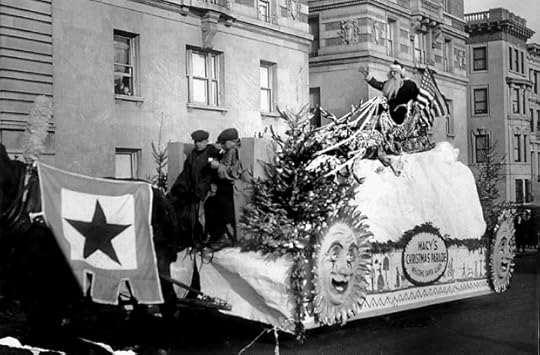
Santa’s Sleigh 1924 Macy’s Christmas Parade https://en.wikipedia.org/wiki/File:Sa...
Macy’s employees were the marchers –there were floats but no balloons yet—and many of them were recent European immigrants. The idea of a grand parade was an old European tradition. This underscores the notion that Thanksgiving is a holiday of immigrants. And over the years, many cultures and nationalities have contributed to the evolution of Thanksgiving.
The parade has only been interrupted three times –all during World War II (in 1943, 1943, and 1944) due to rationing and shortages.
So, who were these “Pilgrims” and what were they looking for in the first place?If you say religious freedom, you get only partial credit. The Pilgrims were an offshoot sect of Puritans, people who were challenging the Church of England and the English monarchy itself. But the Pilgrims went another step—they wanted to separate from the Church of England completely. These Separatists left England to take refuge in Holland. Unhappy there, they set up a company that would start a new colony in America where the Virginia colony had been established in 1606.
The Mayflower Pilgrims did not call themselves “pilgrims.” They referred to themselves as “saints” or “First Comers.” Only later did William Bradford call them Pilgrims. But not even all of the passengers on the Mayflower were Pilgrims. Of 102 people on board, only about 50 were Pilgrims. The others were members of the Church of England who had signed on simply as laborers, soldiers or those looking to gain property in the “New World.” The Pilgrims called them “Strangers.”
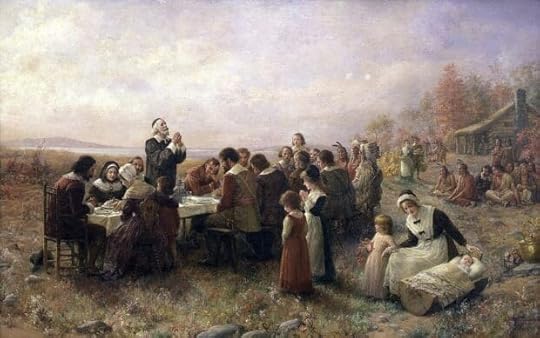
“The First Thanksgiving at Plymouth” (1914) By Jennie A. Brownscombe (Public Domain, Source Wikimedia)
Okay. If it’s not a small car, what is the Mayflower Compact?Before the Mayflower landed, it became clear that the Saints and the Strangers didn’t see eye to eye. To preserve order in the colony, the men aboard the ship agreed to a rudimentary system of democracy under the so-called Mayflower Compact; it was, in essence, the first written Constitution in American history. (Sorry ladies, only adult males could vote.)
IN THE NAME OF GOD, AMEN. We, whose names are underwritten, the Loyal Subjects of our dread Sovereign Lord King James, by the Grace of God, of Great Britain, France, and Ireland, King, Defender of the Faith, &c. Having undertaken for the Glory of God, and Advancement of the Christian Faith, and the Honour of our King and Country, a Voyage to plant the first Colony in the northern Parts of Virginia; Do by these Presents, solemnly and mutually, in the Presence of God and one another, covenant and combine ourselves together into a civil Body Politick, for our better Ordering and Preservation, and Furtherance of the Ends aforesaid: And by Virtue hereof do enact, constitute, and frame, such just and equal Laws, Ordinances, Acts, Constitutions, and Officers, from time to time, as shall be thought most meet and convenient for the general Good of the Colony; unto which we promise all due Submission and Obedience. IN WITNESS whereof we have hereunto subscribed our names at Cape-Cod the eleventh of November, in the Reign of our Sovereign Lord King James, of England, France, and Ireland, the eighteenth, and of Scotland the fifty-fourth, Anno Domini; 1620.
[The Mayflower Compact: Complete text and signers Source: Yale Law School Avalon Project
One child named Oceanus was born during the voyage. Another named Peregrine was born on board after the Mayflower landed. And one in six Americans can still claim a relative who came aboard the Mayflower. Among them are Presidents John Adams and John Quincy Adams, Zachary Taylor, Ulysses S. Grant, James Garfield, Franklin D. Roosevelt, and both Bushes.
How did Squanto learn to speak English?One piece of the Pilgrim story is that two different indigenous men came to the Pilgrim camp and spoke English. The first was Samoset. He returned a few days later with Squanto (probably a shortened version of Tisquantum). Squanto had been taken captive by an English sea captain, sold into slavery in Spain, and later made his way to London where he learned to speak English. His value as an interpreter was recognized and he returned to Massachusetts on an English ship only to discover his entire village had been wiped out—probably by disease introduced by Europeans. That village was the future site of Plymouth and he indeed helped the English settlers survive their difficult first year.
What did the Pilgrims eat on their Thanksgiving Day?Nothing, literally. To the Pilgrims, a true day of thanksgiving simply meant a day of prayer and fasting –not what most of us have in mind when turkey day comes around.
What we now call “Thanksgiving” was in fact a harvest festival for the Pilgrims who celebrated in October –not November—1621. Those Pilgrims were mostly grateful just to be alive –half of their company had died during the bleak first winter in Massachusetts after they had landed at Plymouth in December 1620. (And by the way, there was no mention of Plymouth Rock at the time. That’s clearly a notion cooked up more than a hundred year later.)
So, once and for all, was there turkey at that first “thanksgiving” or harvest feast?Yes, sort of. There was turkey, but not the one we know and love. It was wild turkey (the animal, not the beverage). The menu for this major feast was a colonial era surf-and-turf which included ducks, geese, cod, salmon, lobster, mussels, eels and clams, along with wild onions to make sallet (salad) and vegetables, including pumpkins (but no pie) and “crane berries” (but no cranberry jelly). Dessert would have been cornmeal breads and puddings.
Who else was there?In addition to about fifty Pilgrims, unexpected company arrived. About ninety Wampanoag warriors showed up with their chief Massasoit. The Indians went out like good guests and brought back plenty of venison, which was added to the menu. The harvest feast then lasted three days.
The peace and good will of that celebration lasted about a generation. First, the English settlers fought a brutal war against the nearby Pequot, wiping them out in 1637. Then, in 1676, Massasoit’s son Metacom – known as King Philip—led the Wampanoag in a war of survival against the English. (“King Philip’s War”). This bloody conflict nearly wiped out the colonists who ultimately prevailed. Metacom’s head was placed on a pole; his wife and son – grandson of the chief who came to dinner in 1621—were sold into slavery. The Wampanoag and other native nation were decimated.
During that war, a settler named Mary Rowlandson was taken captive and spent three months traversing the Massachusetts wilderness with Metacom. She later wrote an account of her captivity, The Sovereignty and Goodness of God (1682), which has been described as the first bestselling book by a woman in America. (Rowlandson’s book is among the 52 works in my new book, The World in Books.)
#image_title
• What is the difference between a Pilgrim and a Puritan?
The Puritans wanted to “purify” the Church of England –that is to get rid of any vestige of Roman Catholicism. This was not a polite religious argument over how to say your prayers, but a phase of the Protestant Reformation that eventually led to a bloody English Civil War and the beheading of King Charles I in 1649.
The Pilgrims were more radical and wanted to separate from the Church of England which is why they were banished.
While the Pilgrims arrived first, they were soon followed by a mass wave of Puritan emigration during the 1620s, and the Pilgrims were eventually absorbed into the Puritan-dominated Massachusetts Bay Colony.
What does “Mary’s Little Lamb” have to do with Thanksgiving? And why don’t we celebrate in October just like the Pilgrims did?Thanksgiving was first celebrated as an official holiday in 1777, to mark the patriot victory at Saratoga in the Revolutionary War. When Washington later tried to proclaim a Thanksgiving Day, some in Congress complained that he had no right to make such a proclamation.
Gradually Presidents routinely proclaimed days of “thanksgiving,” but the custom died out in the 19th century. In 1837, a writer and magazine editor named Sarah Josepha Hale began a campaign to reinstate the holiday. Hale was also the author of the poem, “Mary Had a Little Lamb.”
At Hale’s persistent urging, Abraham Lincoln finally proclaimed a national holiday of Thanksgiving in October 1863, to be marked in November.
It has seemed to me fit and proper that they should be solemnly, reverently and gratefully acknowledged as with one heart and one voice by the whole American People. I do therefore invite my fellow citizens in every part of the United States, and also those who are at sea and those who are sojourning in foreign lands, to set apart and observe the last Thursday of November next, as a day of Thanksgiving and Praise to our beneficent Father who dwelleth in the Heavens. And I recommend to them that while offering up the ascriptions justly due to Him for such singular deliverances and blessings, they do also, with humble penitence for our national perverseness and disobedience, commend to His tender care all those who have become widows, orphans, mourners or sufferers in the lamentable civil strife in which we are unavoidably engaged, and fervently implore the interposition of the Almighty Hand to heal the wounds of the nation and to restore it as soon as may be consistent with the Divine purposes to the full enjoyment of peace, harmony, tranquillity and Union.
[Abraham Lincoln’s Proclamation of Thanksgiving, Source: American Battlefield Trust]
• What happened on Thanksgiving 1864?
Lincoln issued a second proclamation the following year while General Grant’s army was besieging Petersburg, Virginia.
“Around the same time, the heads of Union League clubs – Theodore Roosevelt’s father among them – led an effort to provide a proper Thanksgiving meal, including turkey and mince pies, for Union troops. As the Civil War raged on, four steamers sailed out of New York laden with 400,000 pounds of ham, canned peaches, apples and cakes – and turkeys with all the trimmings. They arrived at Ulysses S. Grant’s headquarters in City Point, Va., then one of the busiest ports in the world, to deliver dinner to the Union’s “gallant soldiers and sailors.” This Thanksgiving delivery was an unprecedented effort – a huge fund-raising and food-collection drive. One soldier said, ‘It isn’t the turkey, but the idea we care for.’”
[“How the Civil War Created Thanksgiving” New York Times “Disunion” blog]
• What is “Franksgiving?”
During the Great Depression, Franklin D. Roosevelt moved the date to the third Thursday in November at the request of retailers who wanted to extend the holiday shopping season. Republicans balked at this break with tradition and there were two Thanksgivings that year. In 1941, with individual state governors declaring separate thanksgiving days, Congress declared a national holiday and it was fixed on the fourth Thursday in November, where it remains.
• What made Football and Thanksgiving an American tradition?
The tradition of college football dated to 1876 when Yale and Princeton played. It was transferred to the pros when the NFL formed. The Detroit Lions played a game in 1934 that was televised nationally, establishing the NFL tradition of Thanksgiving games in Detroit. The Dallas Cowboys were later awarded a second Thanksgiving Day game.
•Were the Mayflower’s passengers the first “Pilgrims” in America?
The Spanish in the Caribbean, Mexico, the American southeast, Central and South America all got to America before the Pilgrims. So did the Jamestown colonists in 1607 in Virginia. Remember 1619. And they all probably had harvest feasts before the Pilgrims too. But the true first Pilgrims in American were a group of French colonists who landed in Florida in 1654, Huguenots, or French Protestants, they came to American for the same reason the Pilgrims would more than fifty years later –to escape persecution in Catholic France.
Settling near modern day Jacksonville, they built Fort Carolina. One year later in 1655, a Spanish fleet arrived and established St. Augustine. Their purpose was simple –to eliminate the French “heretics” in Spanish Florida. In a series of massacres, hundreds of French Protestants were put to the sword by the Spanish—ending America’s first “pilgrim” experiment in a sectarian bloodbath.
Read more about this episode in America’s Hidden History.

The post Pilgrims, Parades, and Pigskin: A Thanksgiving Primer first appeared on Don't Know Much.
Two for Thanksgiving: Real First Pilgrims & Holiday’s History
On the holiday calendar, once we leave Veterans Day behind, we round towards Thanksgiving — perhaps America’s most beloved, widely shared, and mythologized celebration.
But this reminds me of the fact that Abraham Lincoln’s first Thanksgiving proclamation came in 1863. Lincoln called for a day of Thanksgiving in the midst of the Civil War. The date fell shortly after Lincoln offered the Gettysburg Address.
It must have felt like there was little to celebrate– or to be grateful for.
Like the Macy’s parade, this is my Thanksgiving tradition. I post two articles about the holiday with some “Hidden History” that appeared on the Op-Ed page of the New York Times.
So here’s something to read–either before or after the feast.
The first article, from 2008, is called “A French Connection” and tells the story of the real first Pilgrims in America. They were French. In Florida. Fifty years before the Mayflower sailed. It did not end with a happy meal. In fact, it ended in a religious massacre.

Illustration by Nathalie Lété in the New York Times
TO commemorate the arrival of the first pilgrims to America’s shores, a June date would be far more appropriate, accompanied perhaps by coq au vin and a nice Bordeaux. After all, the first European arrivals seeking religious freedom in the “New World” were French. And they beat their English counterparts by 50 years. That French settlers bested the Mayflower Pilgrims may surprise Americans raised on our foundational myth, but the record is clear.
The complete story can be found in America’s Hidden History.
America’s Hidden History, includes tales of “Forgotten Founders”
The second is “How the Civil War Created Thanksgiving” (2014) and tells the story of the Union League providing Thanksgiving dinners to Union troops.
Of all the bedtime-story versions of American history we teach, the tidy Thanksgiving pageant may be the one stuffed with the heaviest serving of myth. This iconic tale is the main course in our nation’s foundation legend, complete with cardboard cutouts of bow-carrying Native American cherubs and pint-size Pilgrims in black hats with buckles. And legend it largely is.
In fact, what had been a New England seasonal holiday became more of a “national” celebration only during the Civil War, with Lincoln’s proclamation calling for “a day of thanksgiving” in 1863.
Enjoy them both.
Don’t Know Much About® History: Anniversary Edition
Don’t Know Much About the Civil War (Harper paperback, Random House Audio)

Now In paperback THE HIDDEN HISTORY OF AMERICA AT WAR: Untold Tales from Yorktown to Fallujah
The post Two for Thanksgiving: Real First Pilgrims & Holiday’s History first appeared on Don't Know Much.


