
 Sign in with Facebook
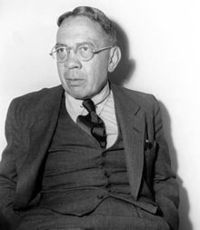
Bernard DeVoto’s Followers (51)


Bernard DeVoto
Born
in Ogden, Utah, The United States
January 11, 1897
Died
November 13, 1955
Genre


|
Across The Wide Missouri
—
published
1947
—
36 editions
|
|

|
The Year of Decision 1846
by
—
published
1943
—
43 editions
|
|

|
The Hour: A Cocktail Manifesto
by
—
published
1948
—
15 editions
|
|

|
The Course Of Empire: The Dramatic History of Exploration That Defined America―From Balboa to Lewis and Clark
—
published
1952
—
23 editions
|
|

|
The Journals of Lewis and Clark
|
|

|
The Western Paradox: A Bernard DeVoto Conservation Reader
by
—
published
2001
—
4 editions
|
|

|
Mark Twain's America
by
—
published
1932
—
13 editions
|
|

|
Mark Twain: Letters From the Earth
|
|

|
Mountain Time
—
published
1947
—
5 editions
|
|

|
The Journals of Lewis and Clark Bernard devoto
|
|


“One may lack words to express the impact of beauty but no one who has felt it remains untouched. It is renewal, enlargement, intensification. The parks preserve it permanently in the inheritance of the American citizens.”
―
―
“They came to Virginia City as soon as the true value of the Comstock was perceived. They constituted, no doubt, a deplorable source of gambling, pleasure and embroilment. They were not soft-spoken women, their desire was not visibly separate from the main chance, and they would have beheld Mr. Harte’s portrayal of them at Poker Flat with ribald mirth. But let them have a moment of respect. They civilized the Comstock. They drove through its streets reclining in lacquered broughams, displaying to male eyes fashions as close to Paris as any then current in New York. They were, in brick houses hung with tapestries, a glamour and a romance, after the superheated caverns of the mines. They enforced a code of behavior: one might be a hard-rock man outside their curtains but in their presence one was punctilious or one was hustled away. They brought Parisian cooking to the sagebrush of Sun Mountain and they taught the West to distinguish between tarantula juice and the bouquet of wines. An elegy for their passing. The West has neglected to mention them in bronze and its genealogies avoid comment on their marriages, conspicuous or obscure, but it owes them a here acknowledged debt for civilization.”
― Mark Twain's America
― Mark Twain's America
“And by the end of March one of them had already begun his journey. Twenty-two years old, an A.B. and LL.B. of Harvard, Francis Parkman was back from a winter trip to scenes in Pennsylvania and Ohio that would figure in his book and now he started with his cousin, Quincy Adams Shaw, for St. Louis. He was prepared to find it quite as alien to Beacon Hill as the Dakota lands beyond it, whither he was going. He was already an author (a poet and romancer), had already designed the great edifice his books were to build, and already suffered from the mysterious, composite illness that was to make his life a long torture. He hoped, in fact, that a summer on the prairies might relieve or even cure the malady that had impaired his eyes and, he feared, his heart and brain as well. He had done his best to cure it by systematic exercise, hard living in the White Mountains, and a regimen self-imposed in the code of his Puritan ancestors which would excuse no weakness. But more specifically Parkman was going west to study the Indians. He intended to write the history of the conflict between imperial Britain and imperial France, which was in great part a story of Indians. The Conspiracy of Pontiac had already taken shape in his mind; beyond it stretched out the aisles and transepts of what remains the most considerable achievement by an American historian. So he needed to see some uncorrupted Indians in their native state. It was Parkman’s fortune to witness and take part in one of the greatest national experiences, at the moment and site of its occurrence. It is our misfortune that he did not understand the smallest part of it. No other historian, not even Xenophon, has ever had so magnificent an opportunity: Parkman did not even know that it was there, and if his trip to the prairies produced one of the exuberant masterpieces of American literature, it ought instead to have produced a key work of American history. But the other half of his inheritance forbade. It was the Puritan virtues that held him to the ideal of labor and achievement and kept him faithful to his goal in spite of suffering all but unparalleled in literary history. And likewise it was the narrowness, prejudice, and mere snobbery of the Brahmins that insulated him from the coarse, crude folk who were the movement he traveled with, turned him shuddering away from them to rejoice in the ineffabilities of Beacon Hill, and denied our culture a study of the American empire at the moment of its birth. Much may rightly be regretted, therefore. But set it down also that, though the Brahmin was indifferent to Manifest Destiny, the Puritan took with him a quiet valor which has not been outmatched among literary folk or in the history of the West.”
― The Year of Decision 1846
― The Year of Decision 1846
Topics Mentioning This Author
| topics | posts | views | last activity | |
|---|---|---|---|---|
The History Book ...:
 ARCHIVE TWO: PLEASE INTRODUCE YOURSELF ~
|
6144 | 5128 | Sep 19, 2015 03:18AM | |
| Books & Coffee Bo...: TBR Randomizer- 2016 | 53 | 61 | Dec 19, 2016 10:44PM | |
| Book Nook Cafe: Poetry -- 2018 | 46 | 27 | Sep 24, 2018 10:30AM | |
|
The Reading For P...:
*
RFP's DIARY of Bookish Events 2018 - The PEPYS PROJECT
|
1984 | 215 | Dec 31, 2018 08:06AM | |
| NonFiction Pulitzers: * History List | 15 | 104 | May 04, 2020 04:29PM | |
| The History Book ...: RECENTLY ACQUIRED BOOKS | 665 | 887 | Jun 11, 2020 04:08PM | |
| Gigi's Company: The Last Letter Game (Book Titles) | 4842 | 939 | Jul 08, 2023 03:29PM | |
| 2026 Reading Chal...: July - The Greatest Show on Earth | 109 | 172 | Aug 12, 2023 11:23AM | |
| 2026 Reading Chal...: Q3 - Terra Incognita | 177 | 195 | Oct 07, 2023 10:28AM |
