Kerry Sharp's Blog
June 5, 2016
Internal Design
Internal Design – Really?
This was my initial thought, having completed the cover design,I wondered why I needed Internal Design, I was reasonably happy with words.
As is obvious, I didn’t know what Internal Design actually was, it is for a Novel:
Typeface
Font
Spacing
Margins
Gutters
Spacing – Top and bottom.
and for non- fiction books, additionally:
sub-headings
bulleted lists
in-line text quotes
Photos/images/charts/graphics
Professional Services
For example – Karrie Ross is one of many offering a professional design service. The design service in Karrie case costs $4.50 per page for fiction and $6 per page for a basic non- fiction untroubled with photos. My book has 390 pages, it would cost $1,750 to have your similar book professionally designed.
If you have a desire for an individual professional design service, there are many offer available on the net. I do not recommend Karrie other than her service was on the front page of the search.
Templated Services
Createspace
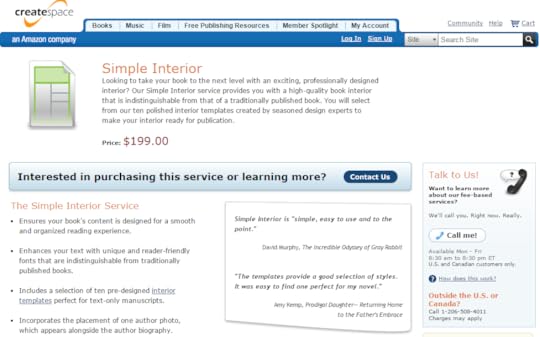 https://www.createspace.com/Services/SimpleInterior.jsp
As you can see Createspace offer the use of their templated designs, a choice of five for $199 could be better for someone on a budget.
Bookow
Another Templated Service is Bookow.
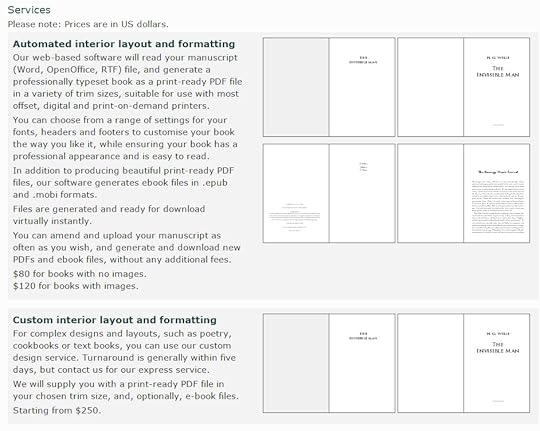 Bookow offers a cheaper service juts $80 for a book with no images.
Bookow will feature in another post, they offer a great free ISBN barcode generator, but more later.
There are many other services on offer, again a good search will offer you much variety.
DIY
As you can see below Createspace features again. CreateSpace is a POD publisher. OK, I was just being esoteric, POD is Print on Demand. The service allows you to Sef Publish your book as a paperback. Each time a purchase request is received the book is individually manufactered to order. More in another Blog.
Createspace could well be a first port of call for all your self-publishing questions.
Createspace
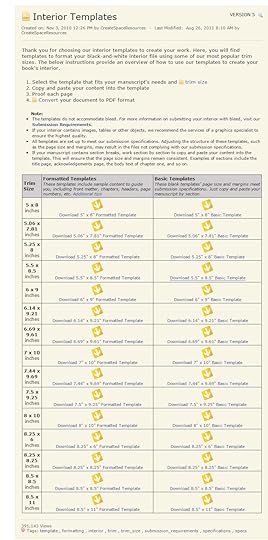 As you can see there is an extensive range of Internal designs. You should find something here to match your trim size. If not re-trim your book!
Click below for the earlier blog on Trim Size:
The templates can be found here:


May 31, 2016
Writer’s Block
Writer’s Block
What a popular question –
Do you get Writer’s Block, and how do you deal with it?
Well, what is it?
I presume it is sitting in front of an empty page or screen and being unable to write. If this is the definition then I don’t get it. Maybe I have the more terminal version – if I have nothing to write I stay away from pages and screens.
So within the paragraph above we have a few hundred words. Let’s go back to an earlier blog – Mechanics Of Writing – Blog Post
I touched briefly on writing style you can either be a Pantser – Someone who writes from the seat of their pants if you believe the press they let their characters write the book and are theoretically are as surprised as their readers at the outcome. Or you can be a Plotter – Someone who outlines each chapter and the interactions within the chapter. No surprises here the characters do as they are told. Or of course, you can be both.
It is easy to believe that a Pantser can sit in front of the computer waiting for inspiration or his characters to speak to him. I suppose it is not too far-fetched to imagine a plotter overcome with plot intricacies causing seizure.
I confess to being neither of the above
I plot points which need to be covered but not necessarily how I will cover them. I plan the outcome of each chapter ensuring it fits the overall master plan but even at this macro level I am still surprised that the characters sometimes rebel. So the only way to deal with rebellious characters is to re-write the macro to fit their shenanigans.
So why I don’t I get Writer’s Block.
Anti-Block Strategy 1 – Have a goal.
Firstly, I am quite goal driven. My plan is to write a chapter per week. A chapter for me is between 3000 and 4000 words, never less, never more. For me, that takes (on average) 10 hours of writing and possibly 5 hours of research. (Some chapters more than others.)
This means that I can complete a 90,000 Novel in about half a year. I find with a track to run on all I need is a push.
Should I write a Book – Blog Post
The push is knowing what I’m going to write.
Anti-Block Strategy 2 – Know the Ultimate outcome of the Novel.
Macro – I hope you know that I write Crime Fiction (If not, shame on you – Buy the book). So before I even start I need to know the Who, what, when, where, how, and why of the plot and the subplots. I like sitting quietly and let these issues circulate until they resolve themselves.
Anti-Block Strategy 3 – Know what you are going to write.
Weekly Goal – Yes, it is to write a chapter but first I need to know what I am going to write. So more thinking. Before I sit to write I need to know what plot points need to be covered. Roughly who says what to whom where and why. Of course, it needs to be consistent.
I want to say, at this point that I am not a plotter, (well not fully) the structure I am describing allows me the comfort I need to write. The characters and plots move all the time. I once tried to write a series on-line, I got up to episode three and couldn’t continue. The earlier chapters were published and the story was going nowhere near where those chapters indicated. I am still the same, I re-write chapters all the time to adjust for a new subplot or because one of the characters would not do as they were told. I like the narrative taking control, (but I’m not a Panster either)
Anti-Block Strategy 4 – Concurrence
Knowing where you think the book will go means that you have given thought to many (most) elements of the book. You know that your protagonist is going to get run off the road by the mafia and the likely outcomes. You think this will be about (say) chapter 11, even though you may be working on chapter 7. If things get hard write chapter 11 instead. When you eventually get to chapter 11 your characters have probably walked so you will need to fix it up.
For me all I need to do is finish one chapter, it doesn’t need to be the next one.
Anti-Block Strategy 5 – Momentum
I have religiously written a chapter a week for over a year. But over the last two months, my focus has slipped.
Ignoring the queue of publishers and Literary Agents (NOT) I decided to self-publish ‘Pea Pod Murder’ and as part of the strategy, I had to also build this website. Now I have to write three blog posts a week too. I have allowed my religious goal to slip.
I had not written for over four weeks. I decided that I should try and maintain my writing but after that delay. I found it difficult to re-start.
This experience is very valuable as it demonstrates the value of momentum. For me, writing has only become hard when I left the plan.
Mechanics Of Writing – Blog Post
Anti-Block Strategy 6 – Just Write
Well, isn’t this a great bit of advice – To avoid being unable to write, just write – duh! But it’s not quite that obvious. I have spent two hours on one sentence, it was a fabulous sentence which got diluted with the 8,000 other sentences. Please don’t think I am denigrating my effort if that is what the book or my mood demands that is just fine. My point here is get it down. I have occasionally stared at the screen being unable to start. My solution is – start. I find I write maybe a paragraph or two of rubbish but the characters then demand to be properly represented and the writing kicks in.
I constantly review my chapters, I am not a write and fix it when it’s finished sort of person. I enjoy reading and re-reading previous chapters. This allows me to refine them and get rid of any sloppiness. So you can see writing rubbish is better than not writing.
Anti-Block Strategy 7 – Take a walk
My goal is a goal of a chapter per week, not so many words whenever I sit down to write. This is an important distinction. If it’s not working, pick it up again tomorrow. Your mind will probably have sorted out the problem for you without a conscience effort on your behalf. So take a walk, have a coffee, come back tomorrow but you still must finish the chapter by Friday.
Anti-Block Strategy 8 – Know yourself
In my – Boldly Do! – Blog Post I encourage any reader to ignore this advice and even their own research, instead just do.
If you find my strategy useful fantastic, if you can adapt it even better. Knowing yourself will be the protection you need against Block. Create your own rules, goals and strategies.
If you reckon their any good – let me know.
May 27, 2016
How to Create a Great Book Cover

I am going to start with a bit of Philosophical Behavioural Finance.
There some basic rules around money. Now your brother’s second cousin knows a girl who went to college with the daughter of a man whose best friend – Spent nothing, planned nothing, knew nothing, yet still achieved something. For us normal beings, me in particular, these rules apply:
Spend a lot earn a little – This is what too many of us do. Without knowledge, we are probably unlikely to spend wisely. With wisdom, it is vaguely possible to-
Spend a lot earn a lot – With good strategy sound knowledge this is a possibility.
Spend a little earn a little – This describes me exactly. I am happy to garnish an occasional acknowledgment as an author rather than money, I don’t want to spend a heap either.
This may seem like a strange way to start a discussion on book cover design but I think it is the crux of a good decision. If you have ticked all the boxes in the previous blog, Book Cover you may just have enough knowledge to commence a successful commissioning.
I ponced about for a long time trying to decide how my ambitions, knowledge and the financial wisdom discussed above, would interact to a successful outcome. I found information like this below helpful.
Case Study 1 – Outcome of insufficient knowledge.
In my case, I sadly didn’t have any knowledge that came later. So this is what happened. I like Fiverr I have had some good outcomes from some skilled people in the past.

Even knowing I would be disappointed I ordered a $5 cover. The designer merely wanted an idea of what I wanted so I sent him this:

This is what I got back. The only mistake I made in the process was expecting anything more than the adequate cover I received.
Back to my financial wisdom –Spend a little get a little.
So – back to square one. I spent some time spinning in circles.
Case Study 2 – Outcome of scant knowledge.
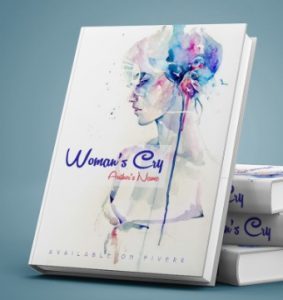
I looked at The Creative Penn (link above) for assistance and many other web sites. All of the options I discovered there were too expensive… well that isn’t really true – I concluded that they offered me insufficient control for the price. Weeks wasted I returned to Fiverr and search for EXPENSIVE cover design. I found this:
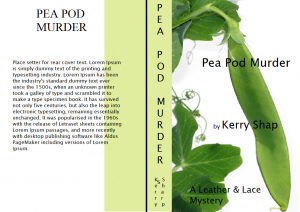
I thought it was impressive so with my 10 steps fully completed (he would not proceed without it)* and an improved graphics of my own making using a book cover design template. I bought the gig.
*I don’t think he relied on it, it was an attempt to have the Author think about what he wanted.
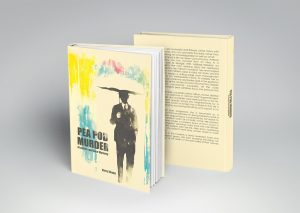 This is what was returned: I was not at all happy. The gig was $100Aus and I figured I’d been templated. My limited knowledge of Fiverr also caused a problem. I was waiting for an email advising completion when I logged in to complain I found the work had been completed days earlier and the Artist had been paid as I had requested no alterations.
Deciding that I needed to be more in control of the process I found a Book Cover Creative Brief by Erica Liodice – Link here.

I didn’t bother spinning in circles I gave the artist a major serve, which he returned with top spin. To cut a long story short we decided a negotiated outcome was better than playing tennis. He agreed to reopen the GIG (he was not obliged to do so) and with a little creative discourse, he offered this cover.
Those of you who have played on this website know that this cover is the one that I chose. I couldn’t have been happier.
Case Study 3 – Outcome of enough knowledge.
Having developed a sound working relationship with Zach Link Here I would thoroughly recommend him. He didn’t understand how much he helped. He prepared covers for Kindle, Create Space, Smashwords and IngramSpark (more in another blog) without these submitting the book on these sites would have been all but impossible.
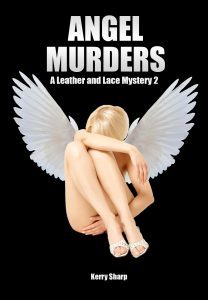
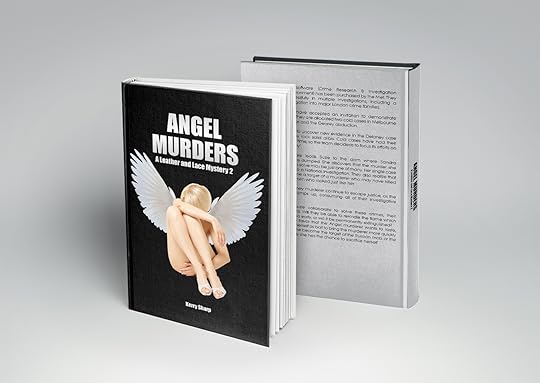
So as we had developed a great working relationship and I liked the template for Pea Pod Murder I decided to design the cover of book two Angle Murders, which a few month away from completion.
![Pageflex Persona [document: PRS0000035_00025]](https://i.gr-assets.com/images/S/compressed.photo.goodreads.com/hostedimages/1464356081i/19230906.jpg) Enough knowledge gave me the confidence to exploit Zach’s obvious talent. We started with;
Enough knowledge gave me the confidence to exploit Zach’s obvious talent. We started with;
We discussed developing a theme for the series (I have three books outlined) I suggested the continuation of the black theme.

And offered this.
We shared ideas until ultimately the finished product (Below)
Why did I have enough Knowledge to gain a painless successful outcome, these were the elements.
How to gain a painless outcome
Understand your requirements
Create a design brief, even if it isn’t shared with the designer it will help you cement your thoughts.
Understand the process and protocols of the service you are using.
Clarify what formats you require the cover images in Create Space and Ingram Spark will require a full cover Kindle just a front image. The format for each service is different make sure your designer understands what is required.
You should be in a position now where you know exactly what you want, now you can talk about design.
Mash up an outline that you like but don’t emasculate the designer. The Pea Pod gun was all Zach’s idea if I had demanded my concept be realized I would have missed it .
Have the confidence to be demanding, but back to the opening comment don’t expect to spend a little and get a lot. Don’t be afraid to buy extra services to get exactly what you want.
May 24, 2016
Book Cover
The Cover – A peg in the ground
As I previously mentioned, deciding to self-publish for me was a time of running around in circles, trying to gain enough knowledge to make a start.
Deciding that I should start with the cover, for me, was a foundation from which to build.
I will talk later about the design process, I want to focus on the line of action that commenced from this decision.
10 or more things to know before you can commission the cover:
1. Your cover title and subtitle
I suppose you know the title of the book you are writing. Now is the time to be certain. I had decided Pea Pod Murder but did I want ‘The Pea Pod Murder or just Pea Pod Murder. You can see I eventually decided. The concept of a sub- title was new. I ultimately decided that this was the Series Title, in my case A Leather and Lace Mystery.
2. Author Name
Another nice simple question – Did I want Kerry Sharp, K.W. Sharp or pseudonym.
3. Synopsis
Should I use the outline I prepared for the submission to Literary Agents, or should it be something different?
4. Type
Again, pretty simple until you think about it. Is it a Mystery, Crime Fiction, Police Procedural and lots of other types and categories that I hadn’t heard of before that request. If you are as baffled as I was, go and play on Amazon. They list all the options.
5. Target market
I wondered, did I have a target market, or was I happy to allow anyone to read it. In my response to the graphic artist did not answer the question.
6. Number and type of pages ( to create spine)
Now you see why I have blogged about Trim Size and how to calculate the number of pages in your book. Following the concept of Boldly Do I compiled a version in ePub from Scrivener it had 300 pages, so that was my response.
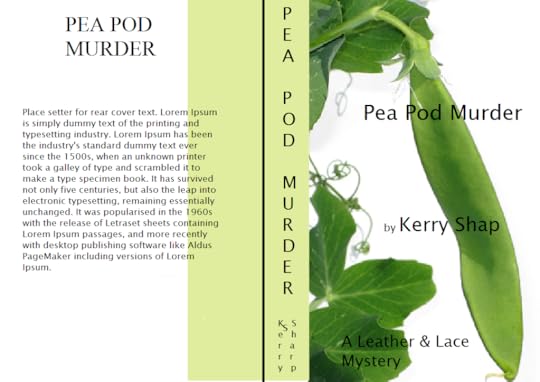
At that stage, I understood little about Internal Design. When I had designed the book properly I ended up with 390 pages. This error causes the black on the front cover to bleed into the green on the spine. This is a mistake I will not make again.
7, Text for back cover and author’s bio
Oh Dear, is this the same as the synopsis? So I redid both of them.
8 .IMPORTANT: provide Guidelines of your cover (dimensions at least)
You can see from the request that the designer was not unfamiliar with dealing with authors who knew little about self-publishing. Given the importance of spine width, which is controlled by Trim Size and Internal Design, I think he is cutting his clients entirely too much slack. If you have read this blog before you specify your cover you will be a pleasure to deal with.
9. Describe your idea of the cover
Well looking back the cover I submitted as an idea was not too bad.
10. Author’s Bio
I was not comfortable (at this early stage) to tell the world my story. I decided no one would be interested so I ignored it.
In the next blog, I will talk about selecting a Cover Designer.
May 20, 2016
Ignoring Your Own Advice (Boldly Do)

This seems like a stupid topic for a blog but the key to the SELF PUBLISHING is SELF.
Trying and doing things are different.
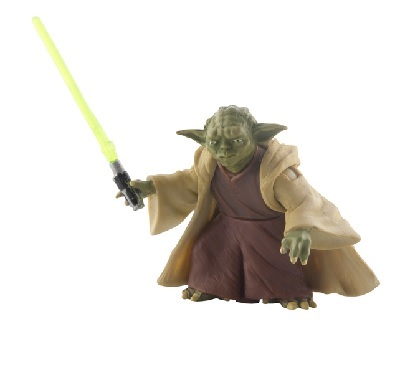
YODA’s wisdom was:
Do or Do Not.
There is no Try
So having researched, understood (or at least partially) and planned, feel free to desert all that deliberation. Trying to make your plan fit a reality that you didn’t know existed, rather than adapt is stupidity.
The sad part is that all my blogging topics pontificate boldly about realities I barely understand. The planning is necessary, though, even if it is ignored.
I seem to be going all SciFi!!
Boldly go – where no man has gone before.
Ok, so It is a major exaggeration.
I mean – DO boldly, go where you have never been before.
Between Starwars and Startrek we have got there. Research and planning in this unknown, strange and creative space should just allow you to get your wheels rolling. If you can run the plan to the end – excellent, if not adapt.
Research, by all means but IGNORE ALL ADVICE (INCLUDING MINE AND YOUR OWN) if it stops you from DOING.
JUST – BOLDLY DO.
May 18, 2016
Calculating how many Pages

It may seem a silly consideration but the size of the book can be an important issue for purchasers. Also, as mentioned earlier if you are using a Print on Demand service the more pages in the book the more costly it is to produce.
For me when selecting a book on Kindle I am always happiest if it is in the 300 – 400 page range, I would probably miss on a page count below say 250. I guess this attitude has been engendered by being caught in purchasing 80-page novellas.
Giving greater thought to internal design many designers quote on a page rate so I needed additional information.
This info is cut from: http://www.mcnallyjackson.com/selfpublish/interior-design
And as additional information often does it only complicates the issue,
Clearly the font and point type effects the number of pages.
COPPERPLATE – BOOK ANTIQUA
6″ x 9″ – 10 point type (approx. 310 words per page)
6″ x 9″ – 11 point type (approx. 230 words per page)
6″ x 9″ – 12 point type (approx. 190 words per page)
5-1/8″ x 8″ – 10 point type (approx. 215 words per page)
5-1/8″ x 8″ – 11 point type (approx. 170 words per page)
5-1/8″ x 8″ – 12 point type (approx. 135 words per page)
HELVETICA NEUE – GARAMOND 11
6″ x 9″ (approx. 315 words per page)
5-1/8″ x 8″ (approx. 230 words per page)
CHAMPIGNON – GOUDY OLD STYLE
6″ x 9″ (approx. 440 words per page)
5 -1/8″ x 8″ (approx. 305 words per page)
FUTURA – PALATINO 11
6″ x 9″ (approx. 265 words per page)
5-1/8″ x 8″ (approx. 220 words per page)
GILL SANS – CASLON 10
6″ x 9″ (approx. 235 words per page)
5-1/8″ x 8″ (approx. 160 words per page)
Determining the Font to Use.
This chart is stolen from a post by Walton in a Create Space discussion.
Fontfeed
Self-Pub
Linotype
The Bookdesigner
Ezinearticles
Fontshop
Minion
Times New Roman
Stemple Garamond
Garamond
Palatino
ITC New Baskerville
ITC New Baskerville
Garamond
Times Ten
Janson
Book Antiqua
FF Scala
FF Scala
Bookman Old Style
ITC Weidemann
Bembo
Georgia
Minion Pro
FF Scala Sans
Book Antiqua
Sabon Next
Caslon
Adobe Garamond
Electra
Adobe Garamond
Palatino
Electra
Bookman
Adobe Garamond
Trade Gothic
LinoLetter
Century Schoolbook
Dante
Electra
Fairfield
Bembo Book
Fournier
Linotype Camptil
Dante
Linotype Finnegan
Din
Trajanus
Note 12/5: It seems I ignore my own advice often. I used Palatino Linotype (11) , again due to the internal design template I used.
Maybe a blog on ‘Ignoring your own advice’ would be good!
May 16, 2016
Trim Size of the Book
The Trim Size of the book is pretty much the outside dimensions. The size of the book is almost as important as the cover design and determines how the book looks.
Do you know how you want your book to look?
The considerations are;
Your preferences – No further comment needed.
Industry standards
Printer requirements
Number of pages
Industry Standards/Printer Requiements
These are really quite broad, for example should you choose Amazon’s ‘Create Space’ these are the allowable trim sizes;
5 x 8 Inches – (12.7 x 20.32 centimeters)
5.06 x 7.81 Inches – (12.9 x 19.8 centimeters)
5.25 x 8 Inches – (13.335 x 20.32 centimeters)
5.5 x 8.5 Inches – (13.97 x 21.59 centimeters)
6 x 9 Inches – (15.24 x 22.86 centimeters)
6.14 x 9.21 Inches – (15.6 x 23.4 centimeters)
6.69 x 9.61 Inches – (17 x 24.4 centimeters)
7 x 10 Inches – (17.78 x 25.4 centimeters)
7.44 x 9.69 Inches – (18.9 x 24.6 centimeters)
7.5 x 9.25 Inches – (19.1 x 23.5 centimeters)
8 x 10 Inches – (20.32 x 25.4 centimeters)
8.25 x 6 Inches – (20.955 x 15.24 centimeters)
8.25 x 8.25 Inches – (20.955 x 20.955 centimeters)
8.5 x 11 Inches – (21.59 x 27.94 centimeters)
8.5 x 8.5 Inches – (21.59 x 21.59 centimeters)
Even the most restrictive digital publishers allow;
5 x 8 Inches – (13 x 20 cm)
6 x 9 Inches – (15 x 23 cm)
7 x 7 Inches – (18 x 18 cm)
8 x 10 Inches – (20 x 25 cm)
10 x 8 Inches – (25 x 20 cm)
13 x 11 Inches – (33 x 28 cm)
12 x 12 Inches – (30 x 30 cm)
So I guess unless you were being driven by a particular look it could be wiser to choose from the restricted list. Should you do this for a novel, rather than a non fiction or picture book, industry standards produces an even smaller list, namely;
5 x 8 Inches – (13 x 20 cm)
6 x 9 Inches – (15 x 23 cm)
Your choice above will affect the number of pages your book contains. As the number of pages directly impacts the cost price of your book, this in turn can affect your commission from a Print on Demand Service. So if commission is a driving factor reducing the number of pages will give you cheaper production costs, so you may select the 6 x 9 option.
It looked complicated but we now have a choice between two. It’s time to get a tape measure and explore your own library. Which of these two sizes would you prefer?
I often think to myself, “Am I wasting my time writing this blog?” and it’s a good question? Years ago in an earlier life, I was a Trade Teacher, the wisdom in the college was… if you want to understand a subject – teach it. When I was doing this research I became side-tracked with internal book design, as it too affects the number of pages contained within the book. I was glad I decided to write this section as it has clarified my thinking.
For me, income is not the deciding factor and I much prefer the less pretentious 8 x 5, so there we go… one decision made.
Note added 12/5 – I ultimately ignored my own advice and used the 5.5 x 8.5-inch format. This was because I found an ‘Internal Design Template’ that saved me money and because the finished book was 385 pages. My preference when choosing books from Amazon is for more pages rather than less.
Useful sources:
http://www.thebookdesigner.com/2010/09/self-publishing-basic s-how-to-pick-the-size-of-your-book/
https://www.bookfuel.com/blog/2015/01/how-determine-ideal-tr im-size-your-book
May 14, 2016
Author’s Website

I don’t write to make money but my ego demands success so I need a marketing strategy. The first step is a web page.
As I am writing a series, readers of any book in the series (Angel Murders due soon) should have easy access to the others, published or yet to be published. The only major way that this can be achieved is via a website referral page at the back of the novel. Here is mine:
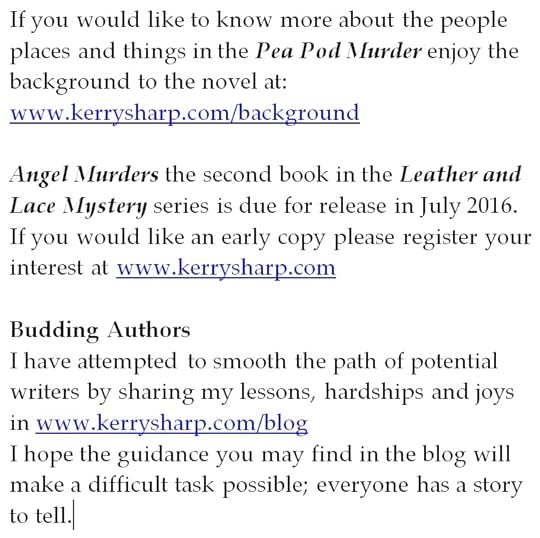
As you can see the author is being promoted directly to those who like her (a fair assumption if they get to the back of the book) and maybe like her enough to engage. The Authors website makes that engagement easier.
Look and Feel (and how to get it)
I have over the years had a number of websites promoting various businesses I have owned or promoted. In all instances (but one, more on that in a later blog) I paid to have the website designed.
The process was:
troll the web for a design I liked as a template, (ohps that should have been ‘guide’)
put together some things to say
leave the rest to the designer.
This always resulted in a pleasant but static outcome. All alterations/additions were made through the designer, who maybe should have ensured I was self-sufficient, but heck, they have to eat too. The result was not a dynamic representation of my business.
I was educated using books, the nearest computer was probably, a mainframe in the bowels of the closest University, so unlike my children, I think ‘C++’ is a vitamin supplement, ‘Python’ is a snake and ‘Java’ is the fourth largest island in Indonesia. Despite this obvious deficiency, my experience leads me to believe the only way to get a responsive web presence is to do it yourself. (DIY Website blog will follow)
You have clearly found this website – What do you think?
May 12, 2016
Self Publishing

Well, I sent out almost enough query letters to Literary Agents. Who all failed to recognize that they were dealing with an author of Pulitzer prize-winning potential and a novel which was the decade’s greatest literary work.
This group failure actually tends to validate the Literary Agents role. I certainly haven’t written a great literary work instead, I have written a book with barely believable characters and almost feasible plot lines and as an ‘I will write a book one-day’ author, I would have difficulty differentiating between a Pulitzer and a Raffle prize. I am not disparaging myself; I have written the sort of book I enjoy reading. Given that I accept that riches will not flow through my endeavours, what else would I do?
I sadly can’t even blame the Query itself, I had a few bites but they decided the bait, my book, was not for them.
So now my planned timeline demanded that I self-publish, and now the trouble starts…
These are the things that I figure need consideration, I only plan to touch on them here but hope to flesh them out as the blog grows.
After hours of circular research, I tired of waving at myself across the diameter of my endeavours and decided a decision needed to be made somewhere. So I decided to pay for the production of a cover.
This was a good decision, not intrinsically so, but because it unwound my circle giving me a chronology. (You may have deduced if you have read previous blogs, that I like order, even if I am incapable of maintaining it.)
So from the cover I needed to know the following:
The size of the book.
The title and sub-title
The Authors name (Pseudonym or not?)
A concept of who my audience was and how to attract them.
A starting idea for a design
Front
Back
Spine
A synopsis for the graphic artist, (he claimed that he would be influenced by it)
I further had to consider:
Where I would self-publish, (each has a differing design requirement.)
ISBN numbers and Barcodes.
If I was planning to use the graphics in promotional material.
As I was planning a series, should I create a series template?
Was I going to create an Authors website so it could be referenced in the published work?
So as you can see, all this thinking was good for me. Now I have a track to run on I hope I will no longer get dizzy.
I hope to cover each of the above in following blogs.
May 10, 2016
The Mechanics of writing

Here are some of the issues, I had to resolve before I started, there are a few, and I only plan to touch on them here and hope to flesh them out as the blog grows.
Tense:
The conventional wisdom in novel writing is quoted speech in first person, and the narrative voice in third person. We see speech patterns changing in the wild. ‘So I go to her and say.’ to describe a past event rather than ‘I went to her and said.’ After the initial shock, I have even enjoyed novels written in the present tense.
The narrative voice: Narrative voice (POV – Point of View) is the description of events other that direct quotes. The most popular narrative voice is Third Person Omniscient. This POV lets you act like god who knows everything. You can expand the story in ways that other POV’s do not allow. It lets you move freely through time and space, and is an efficient way of adding information even from multiple sources.
www.crofsblogs.typepad.com/fiction/2003/07/narrative_voice.html
How many words?
For a new author the range is 75,000 – 90,000 words.
How many chapters?
Now we are really breaking it down, follow this plan and your writing goals are almost written. I decided 25 chapters at 3000 words would give me 75,000 words.
So for me the goal was one chapter or 3000 words per week. If you see me posting to this blog, it is because I have finished my 3000 word, chapter for the week.
I found that with the 3000 word target, the chapters ranged from 3100 to 3800 words giving me a 90,000 word novel, maybe I’ll have tighter control on the next book, but some of the characters were irrepressible.
Time input.
I can write 3000 words in about 10 hours, with maybe 5 hours of research. So a book would take (10+5) x 25 = 375 hours or 47 x 8 hour days. You can see that you need drive in your goals to achieve this outcome.
Pantser or Plotter?
Pantser – Someone who writes from the seat of their pants, if you believe the press they let their characters write the book and theoretically are as surprised as their readers at the outcome.
Plotters – Someone who outlines each chapter and the interactions within the chapter. No surprises here the characters do as they are told.
Reality (for me)
I don’t believe either of the above is possible in practice. I know on a macro level, before writing, I plot points which need to be covered but not necessarily how I will cover them. I plan the outcome of each chapter ensuring it fits the overall master plan but even at this macro level I am still surprised that the characters sometimes rebel. So the only way to deal with rebellious characters is to re-write the macro to fit their shenanigans. More on planning to come.
Controlling Characters
We have heard from great writers who say that the book writes itself, well with great respect it doesn’t unless you are sitting in front of the computer hitting the keys. I did find that the characters developed a voice. (I suspect that my novel is not a great literary work so maybe you should ignore these points) For me if the characters wanted to go somewhere else I let them, for those of you who read ‘Pea Pod Murder’ I was up to about chapter 15 when Wesley, Donny’s friend turned into Von his female cousin. I am glad she insisted on the sex change I think the book is better because of it. I guess you could claim that it is all metaphysical bullshit, and maybe you are right, let me know what happens to you?
Concurrence
If I had a good chapter 10, I would write it, even though I hadn’t written chapter 2. There is great joy in getting a chapter written irrespective of where it lays in the chronology this is in part because I doubted my ability to create the fantastic chapter 10 after chapter 9.
The problem is that you need a good memory as you can be sure that when you get to your great chapter 10 (which probably ends up as chapter 12) your characters have walked and it will need serious review. I think that’s better than being orderly and missing out on your great writing.
Maintaining your Goal
I have religiously written a chapter a week for over a year. But over the last month, my focus has slipped to self-publishing ‘Pea Pod Murder’ and building this website. I have not written for over four weeks. I decided that I should try and maintain my writing but after that delay, I am finding it difficult to re-start. When these distractions are over I will get back into it.
This experience is very valuable as it demonstrates the value of momentum. For me, writing has only become hard when I left the plan.