Susanne Lord's Blog
August 13, 2017
$3.31 on sale at Amazon
Discovery of Desire is on sale at Amazon for $3.31. This is the lowest I've seen the paperback, so I hope you get a chance to read!
ON SALE


November 7, 2016
Kindle Giveaway: DISCOVERY OF DESIRE
Sign up to receive my e-newsletter between now and Thursday, Nov. 10, for a chance to win a FREE DOWNLOAD from Amazon.

Sign Up Here
October 15, 2016
Giveaway Alert
Add 'Discovery of Desire' to your "Want To Read" shelf at Goodreads, and you'll be emailed when the giveaway goes live!
Goodreads.com - Want to Read
October 5, 2016
Free for 48 Hours! Oct. 5-6
IN SEARCH OF SCANDAL is a free download for 48 hours only, on Kindle, nook and ibooks. Hope you get a chance to read! Also, if you finish the book, I'd so appreciate your rating on Amazon. Ratings and reviews really help authors stay published. Thanks so much!
Download for Kindle
Download for nook
download for ibook
September 29, 2016
Why Historical is My Favorite Romance Genre
Like most of you, I have little stacks of to-be-read books teetering around the house, and waiting patiently on my kindle and nook. For the past few years, the breakdown by genre looks a lot like this pie chart. Historical is obviously the favorite, with other romance genres lagging way, way behind. I’ve tried contemporaries, but I find them less enjoyable to read, as I’m always inserting my cynical, day-to-day reality into them.
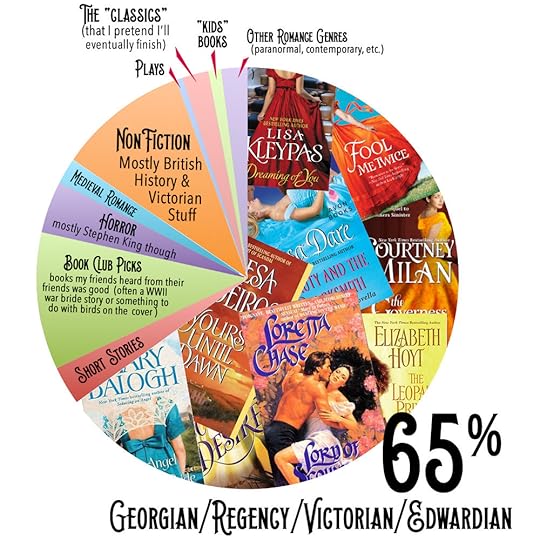
If you’ve ever wondered why you like a particular romance genre, the answer isn’t really all that easy to come to. When I tried, here’s what I came up with…
There’s Loads of Time for Heroes to Brood
My newest historical romance, Discovery of Desire, is set in the mid-Victorian era (1851) and is the story of an English explorer and a shy, but determined, Derbyshire woman, who sail by steamship from England to Bombay, and back. Seth Mayhew and Wilhelmina Adams make the perilous journey for different reasons: Seth to find a lost sister, and Mina to wed a civil servant stationed in India. (Spoiler alert: Mina’s plans are gonna change.)
In 1851, that journey takes over three months, with caravan travel across Egypt before getting back on a boat at Suez. 165 years later, Seth could fly to India in 9 hours with a $600 round-trip ticket.
Travel took a lot of time, never mind overseas travel. In-country, the carriages moved at three to six miles per hour, and then there was all the stops and horse re-freshing at the posting inns. Today, we demand speed, and coffee in a cardboard cup, and constant entertainment. I can’t help but think: what’s a contemporary Heathcliff going to brood over if there’s Pokemon Go in the world?
No First-World Problems
My hero, Seth, is tormented by not knowing where his lost sister is. She could be anywhere in the whole of Asia, or she might have succumbed to cholera or hypothermia or bandits. And there’s no google maps, or navigators, or epi-pens or safe anesthesia. A contemporary hero’s answers could be one text message away.
Contemporary writers possess a whole other dimension of creativity that I don’t. I’m limited in thinking up complications for a modern-day hero and heroine. The big, existential struggles are always there, of course, but I can’t help but think what else would there be? Would they be miffed that their Whole Foods was out of stock of their gingerberry kombucha? What angst couldn’t be soothed by a day of zip-lining or maybe a pumpkin spice latte?
Men Didn’t Wear Flip Flops (and other un-sexy accoutrements)
19th century men didn’t wear…
Adidas shower shoes with tube sockssports jerseysskinny jeans made from imported, Japanese denimtennis shoes priced higher than my mortgageSeth Mayhew wears a coarse, second-hand coat that was sewn by hand, and carries survival stuff like rifles and hatchets and whiskey for disinfecting cuts. There wasn’t a Fitbit tracking his 30 mile-per-day treks. And I really am old fashioned, because there is something decidedly unattractive about people who have their noses in their smart phone. I really ought to pretend they’re reading a book (but they’re usually not).
One writer I know said historicals are adult fairy tales set in England, and that has always rung true for me. The 19th century was real, and yet unreal. We can study the past, read diaries and letters of our ancestors, but can never really know it. It’s possible but also a little fantastical, like science fiction. The world seems simpler, though reason tells me it certainly wasn’t. It’s that remove from the everyday that I expect and seek out.
Reading historical romance is, for me, an escape from all that’s disappointing in modern life, so I’m so grateful there are so many wonderful historical writers out there producing my adult fairy tales.
September 8, 2016
Top 5 Favorite Places to Travel Back in Time
My new historical is the story of an English explorer and a shy heroine who sail by steamship from England to Bombay, and back. Seth Mayhew and Wilhelmina Adams make the perilous journey for different reasons: Seth to find a lost sister, and Mina to wed a civil servant stationed in India. (Spoiler alert: Mina’s plans are gonna change.)
In 1851, that journey takes 99 days, with caravan travel across Egypt before getting back on a boat at Suez. In 2016, that journey takes 20 hours. There’s almost no place on the globe we can’t go, and yet there’s one country we’ll never reach. As Hartley famously wrote, ‘The past is a foreign country…’.
If only time-travel were possible! Instead, we rely on historians to understand how those foreign people of the past lived. Traveling in England, I’ve caught vivid glimpses of the past in five glorious places and wanted to share them with you.
Carlyle’s House, London
In 1834, Thomas Carlyle leased a house in Chelsea, a less posh area of London, to escape the more-fashionable crowds. Rather than retreat to the country, the literary superstar enjoyed entertaining metropolitan guests in his front parlor. Or, as many accounts suggest, holding forth as lesser writers, like Dickens and Thackeray, listened meekly.
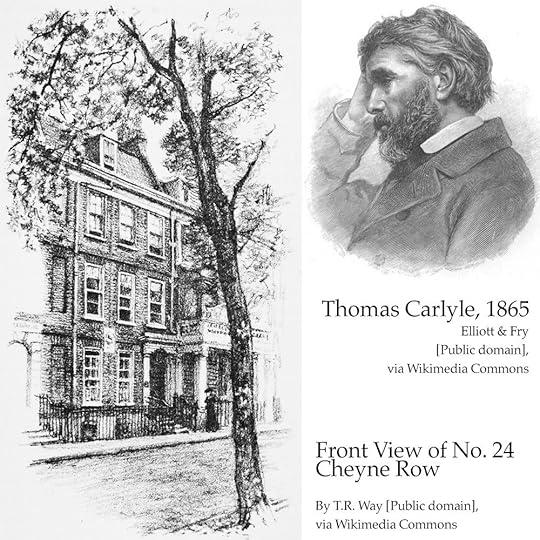
Nothing from the drab façade hints at the amazing rooms within. The property is as it was when the Carlyles lived there. You enter into a narrow hall, directly before a steep stairwell. The Carlyle’s kept separate bedrooms on the second and third floors, but the fourth is remarkable: Carlyle’s attic study built without windows, a large retractable “skylight,” and double-walls to cut back on noise. In the basement kitchen, there’s a narrow bed for a servant. In the Carlyle’s 35 years at the house, they employed 32 different maids-of-all-work. Must have been the worst job if even Victorian-era servants were throwing in the towel. Sad servitude aside, there’s not a more perfect example of a middle-class Victorian home.
Haddon Hall, Derbyshire
Arguably, the most romantic and brooding house ever if three adaptations of Jane Eyre were filmed there. I’ve never visited a house that had such presence. Maybe it’s because the 11th century hall just looms the moment you enter its sloping courtyard. The paving stones are so old, uneven and tilted beneath your feet, you enter with your foundation already shaken, and once you enter the perfectly-preserved medieval hall, you sense its ghosts have never left.

Chiswick Gardens, Richmond
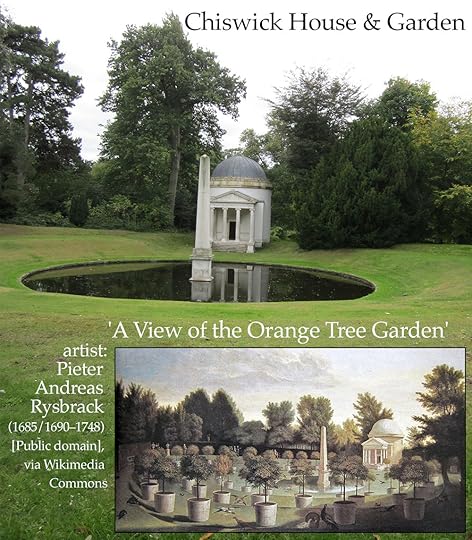
From Rysbrack’s paintings of Chiswick House, we know the care and attention the Earl of Burlington took in creating one of England’s most gorgeous pleasure gardens. The 18th century garden is the most serene, and surprising, landscape I’ve ever encountered. I’ve been drawn to the Orange Tree Garden again and again, and set a pivotal scene in my newest book there. The Neo-Palladian house is gorgeous, and rightly draws much attention, but the gardens! There’s something magical in how the past comes to life in them.
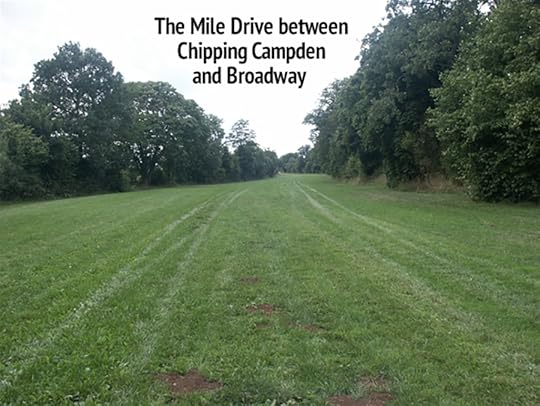
The Mile Drive, Gloucestershire
Between the villages of Chipping Campden and Broadway, there is a mile-long stretch of grass hemmed in by woods. The old carriage road between the villages is now a hiking trail, and you can easily imagine yourself a Regency-era woman seeing the same landscape to do a bit of shopping. This is still my most exhilarating hike ever, no mountains, no sheer cliffs—just a silent stretch of grass.
Calke Abbey, Derbyshire
To reach shy, secluded Calke Abbey, set in the middle of a vast landscape-park, I hiked from the main road, down the long, winding drive, past the gatehouse, into a herd of staring long-horn cattle (not fun), around a brick ice house embedded in the earth, and over a rise for my first glimpse of the house.
Calke Abbey is a beautiful ruin of a country house. The stone is dark with age, with moss clinging to its corners. Built in the early 1700’s, Calke would house generations of the eccentric Harpur-Crewe family until 1985, when a death tax of 8 million pounds (on an estate valued at 14) forced the transfer of the property to England’s National Trust for preservation.
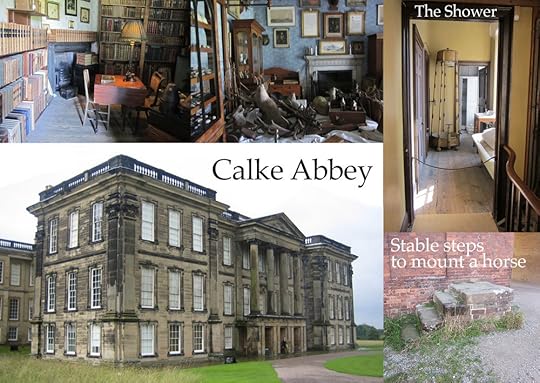
The Harpur-Crewes were both shy of society and intellectually ravenous, so a secluded mansion-cum-museum was really perfect. Their amassed collection of art, books and zoological specimens was left largely intact, and in receiving these treasures, The National Trust decided to use Calke as an illustration of the decline of the aristocratic country house amidst crippling death taxes and the passage of time.
Rather than display the antiques prettily, the only preservation work has been to stop further deterioration. What’s left is a house frozen in time: marble busts shoved in a pantry, stuffed animal heads strewn across a bed, stables filled with crumbling carriages, and a gardener’s bothy with 19th century tools. There is a haunting sadness walking through those cluttered rooms, with your vision split between 18th century splendor, and the hopelessness of a family unable to keep their legacy intact.
Originally posted at USA Today HEA, on Sept. 8, 2016
September 6, 2016
My Research in Writing DISCOVERY OF DESIRE
What kind of research did you do to write Discovery of Desire? What was the most interesting thing you discovered?
ORIGINALLY POSTED ON LORI'S READING CORNER, 5 September, 2016
Seth and Mina’s story begins in 1850’s Bombay (now called Mumbai) before returning to London, so I had a fascinating (and dark) history to research. In 1850, India was under British rule, a colonization made possible by the first forays into the territory by the East India Company, an organization that came into existence modestly-enough in the late 16th century and grew into a powerful, militarized, multi-national corporation.
The East India Company was the British government’s agent in India until 1857, and because of its long history of trade and foreign competition, the company had formed enormous security forces, and a vast administrative network. That meant English men in India, hundreds of soldiers and civil servants, with the means and desire to marry.
I had a really basic knowledge of India’s history, but somewhere along the way, I saw an article about a book by Anne de Courcy, titled The Fishing Fleet: Husband Hunting in the Raj. De Courcy had written a fascinating book about women in the late-19th and early-20th century who had travelled to India to marry the English civil servants, soldiers and businessmen living and making their fortunes in India.
But in reading that book, I learned that English women had been traveling to wed men in India for far longer than that. A couple centuries longer, in fact. These venture girls, as they were called, left their homes—prepared to leave them forever—in hope of marriage.
The prospect of life and marriage in India frightened some of the women, and thrilled others. Some regretted their choice, others found contentment. The reality of living in India for many meant living an isolated existence on remote plantations, or losing their children to illness, or sending them back to England to be educated and not seeing them for years on end.
As the daughter of an Okinawan woman who married a white American, and adopted a new country as her home, I was moved by the courage and struggles these women faced. While my mother flies to Okinawa from Chicago, via Tokyo, in about 15 hours, these women sailed for three months, over a dangerous ocean. When I think of all that they left, all the comforts of fluency in their native language, the easy understanding of their culture and humor and slang, the sense of acceptance and belonging living among your countrymen, I can’t help but mourn their lives a little.
Sending my heroine, Wilhelmina Adams, along with her sister, Emma, across that ocean to India, tearing them away from their five sisters in Chesterfield, England, to wed, to survive, I was reminded of those Venture Girls. Adventurous or desperate, their lives are endless fascinating and poignant.
September 5, 2016
Setting DISCOVERY OF DESIRE outside of England
Discovery of Desire is set in a very unique location for a Victorian romance, what inspired you to set the book outside of England?
Originally posted on RAMBLINGS FROM THIS CHICK, 2 September, 2016
The beginning of Discovery of Desire is set in Bombay, and the second half returns my hero and his heroine to London, and parts north of London, in Derbyshire. I needed to send my explorer-hero, Seth Mayhew, away from England as he’s on a quest to find his lost sister. The search for Georgiana Mayhew, and an orphaned child, is at the center of a mystery that runs through the first three London Explorer books.
Seth, the burly, good-natured, handsome explorer for the East India Company, has just disembarked from a steamship from England and set foot on Bombay soil after a three-month sail—but he hasn’t sailed alone. The ship’s other passengers include nearly four-dozen “Venture Girls,” who are potential brides for the hundreds of Englishmen living and working in India. Among these hopeful women is Wilhelmina Adams, a woman from a neighboring village to Seth’s. The two had failed to meet both in England, though they were both in the same county, and during the sail, as passengers in steerage class (such as Seth) were strictly forbidden from entering the first class passenger’s areas (where Wilhelmina and the other Venture Girls spent their days and nights).
I could have sent Seth to China, Tibet, or Burma in search of his sister—I could have sent him nearly anywhere in Asia. But when I learned of the existence of these Venture Girls in the 18th and 19th century—these brave, perhaps desperate, women casting their fortunes to the wind and sailing east to marry—I had to put Seth on a boat to Bombay.
I’m sure a great deal of my interest in these women stems from the fact that I’m a product of two cultures: Okinawan and American. Having lived several years in both countries, and witnessing each of my parent’s experiences and struggles in a foreign culture, I feel a certain poignancy in imagining the lives of the Venture Girls, and all that they left behind. Only by the fortune of fate did I find myself a child of two stable, civilized and free countries. I can fly to Okinawa in around 15 hours, I can skype with my cousins, I can see pictures of their children on facebook.
But these women in 1850, leaving their home, sailing for three months over a dangerous sea, sailing into even a dangerous harbor, would have faced so much uncertainty. I had so many questions, wondering about the many reasons a woman would have found a new world more tenable than their existing one. Did they regret setting foot on that ship? What did they fear most? How did they change in dealing with their culture shock? Who was able to acclimate happily and kindly? Who grew bitter and hateful towards everything around them? What did they regret all their lives? Did they die wondering how much better or worse their lives would have been had they stayed in the country of their birth?
I tore Wilhelmina away from her home, her sisters, and the landscapes she loved. I made her afraid, but resolute. I made her strong in her love for her sister and for Seth, and put her on a course of sacrifice to serve the people she cared about. And then I gave her the happiest of endings, which not every Venture Girl had.
If you’d like to learn more about the lives of these women, I encourage you to read Anne de Courcy’s book, The Fishing Fleet.
September 4, 2016
¢99 TODAY ONLY!

First sale ever, and for 1 day only! Sunday, September 4, buy IN SEARCH OF SCANDAL, for ¢99.
September 3, 2016
The Best Writing Advice I Ever Received

Probably one of the best bits of writer’s “life” advice I received came from my editor, Deb Werksman, at Sourcebooks, who wisely told me: Don’t read the bad reviews. I’ll tell you if you’re doing something wrong. Reading reviews is crazy-making, and that goes for both good reviews and the bad ones. Sharing something you’ve written is a vulnerable space to live in and too often, romance writers question whether all the effort and emotion they put into their book is even worth it. But I can expand on Deb’s wonderful advice: don’t read other writer’s reviews, either. There is no truer adage in the business of writing than this: comparison is the thief of joy.
But when it comes to writing advice, Sol Stein’s books on craft are among my favorites. His books are loaded with great information—so much that it’s difficult to retrieve it all during the writing. During the revision stage, though, I have a little Sol Stein cheat sheet that I refer to.
The one guideline of his that I try to remember during the drafting is this: On every page, is there something active and visible?
That idea was simple enough to hold in my mind as I wrote, and it shifted my perspective. Writing became a little more like creating a play in my mind, where everything happens right in front of the audience. Or, in my case, in front of the reader. Dialogue is always active, so when I’m tempted to have my hunky, wounded hero brood and stare unseeing off into the horizon (because dreamy), I stop myself and ask whether or not I might have him talk or do something, so the reader can infer his emotion (and find him even dreamier).
Sol Stein says this is courteous to the reader, because it’s more fun for her. I don’t always accomplish it, but I see my favorite writers manage this quite often. There’s that saying that a writer starts the story, and the reader finishes it, so you have to give them the room to do that. Sol Stein’s books are among the ones I recommend to writers at any stage in their career.
Originally posted on The Sassy Bookster, 2 September, 2016