Eve Human's Blog: Eve's Thoughts
June 7, 2015
J.'s review
For he is also my greatest fan and he was the first one to hear the story. He listened to me, while I read every chapter and sometimes just part of a chapter out loud to him asking for feedback and getting it and he encouraged me.
He told me once that he loves the kind of scifi which gives you a hope for the future, but not the kind of future the transhumanists want to bring about, a post-human world with as few left-over humans as possible, imprisoned in a scientific dictatorship.
And so even if Amazon doesn’t like the review it is precious to me and so it will stay up on the website
Here it is:
As a fan of sci-fi and adventure stories I found this one very captivating. I had a great time following the main characters into their minds to see both the present through the eyes of the future and vice versa.
About the story:
David, the protagonist, lives in present day New York City. He is about to jump in front of the subway when he is stopped by a strange teenage girl called Hope Morgan. She claims to come from the future and that David is her ancestor. Unfortunately however time traveling is not a physical but a mental process. Thus Hope is only visible to David himself.
While David doubts his own sanity, Hope has come only reluctantly to David’s time. Via flashbacks from their respective memories and the people they encounter, David and Hope compare notes on their different realities.
About the setting:
The vision of the 23rd century is unconventional yet fascinating. Among many aspects are the lack of high risers and countries; instead smaller communities dot the landscape: Despite that the world is highly technologically advanced, sophisticated and peaceful to a fault.
The present time, just like the future, are shown both at their ugliest as well as most beautiful.
In conclusion:
I can highly recommend ‘When Hope Came’ to anyone who is interested in science fiction, time travel, adventure or just anyone in general.


J.’s Review
As a fan of sci-fi and adventure stories I found this one very captivating. I had a great time following the main characters into their minds to see both the present through the eyes of the future and vice versa.
About the story:
David, the protagonist, lives in present day New York City. He is about to jump in front of the subway when he is stopped by a strange teenage girl called Hope Morgan. She claims to come from the future and that David is her ancestor. Unfortunately however time traveling is not a physical but a mental process. Thus Hope is only visible to David himself.
While David doubts his own sanity, Hope has come only reluctantly to David’s time. Via flashbacks from their respective memories and the people they encounter, David and Hope compare notes on their different realities.
About the setting:
The vision of the 23rd century is unconventional yet fascinating. Among many aspects are the lack of high risers and countries; instead smaller communities dot the landscape: Despite that the world is highly technologically advanced, sophisticated and peaceful to a fault.
The present time, just like the future, are shown both at their ugliest as well as most beautiful.
In conclusion:
I can highly recommend ‘When Hope Came’ to anyone who is interested in science fiction, time travel, adventure or just anyone in general.
———————–
Amazon deleted this review, since they found out that J. is related to me. But this review is most certainly honest and J. knows what he is writing about, he did not skim the book, didn’t miss a single line.
For he is also my greatest fan and he was the first one to hear the story. He listened to me, while I read every chapter and sometimes just part of a chapter out loud to him asking for feedback and getting it and he encouraged me.
He told me once that he loves the kind of scifi which gives you a hope for the future, but not the kind of future the transhumanists want to bring about, a post-human world with as few left-over humans as possible, imprisoned in a scientific dictatorship.
And so even if Amazon doesn’t like the review it is precious to me and so it will stay up on the website

June 2, 2015
My Twitter Campaign (part 1)
Do you love war or do you love humans?
Can you even imagine a world without war ?
What do you care for in life or in fiction, the un-dead or the living?
Where do you breath better, in space or on earth?
Do you know Solidarity and Subsidiarity?
Do you accept Catholic social teachings?
Are you a student of theology?
Do you study Catholic philosophy? Then this is for you:

Have you ever asked yourself what the #future will think about us?
In what kind of age do we live?
What if we could change the path of time?
What world would be worth saving?
Did you know that war hurts civilians and soldiers alike?
Can you imagine the pain of a soldier?
Do you care about the Gospel of Life?
Have you heard about Evangelium Vitae?
Do you believe human life is sacred?
Do you respect human life and dignity?
Do you believe in the eternal value of all human beings?

Dream Time
of another time that would seem
so much better than appears this one.
But in that dream-time it’s been done
such a miraculous change of hearts
when somehow and someway it starts
that the human and so the divine
will in such a new way combine
that it will show a beauty unseen
one that never before has been
a time where only love will reign
where people will no more disdain
one another or hate and fight
instead in peace they will delight
compassion will rule all human acts
and promises then will become facts
that swords to plowshares will be made
that war and violence will fade
reality then the words of old
spoken once in a trust so bold
in the mercy of what is beyond
more than what is only fond
but a goodness that is so bright
that for now it blinds the sight
but in my dream I still can see
a time to come when we’ll be free.
June 1, 2015
An Intelligent Dystopian Sci-Fi
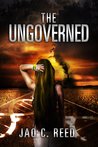 The Ungoverned by Jaq C. Reed
My rating: 5 of 5 stars
Ara is seventeen and lives in the "Nation", a world where everything is controlled from birth to early death.
She has been taught, that the "Nation" under its protective dome is the only safe place to live after an ecologic catastrophe -caused by the mistakes of past generations- has brought on the genetic deterioration of all life-forms and destroyed the capacity of Earth to sustain human, animal or plant life.
Every child is now called a "model". Conceived and grown in a laboratory 9 months later the "model" is delivered to the couple -called "patents"- from whose DNA it has been produced, but only if it is without any genetic flaws like extra fingers or toes.
By age ten every "model" will be color-coded which includes a time-clock.
After her ten year test and examination Ara has been coded a "Yellow". And therefor her destiny is to be a cleaner for the "Nation", just like her patents have been. One of her cleaning tasks is to pick up bodies after the yearly "culls" and to the deliver them to the incinerators, where they become the fuel for the energy running the "Nation's" factories.
Arturo's, Ara's twin "model", however has been given a different code. It is "Orange", and so he is destined to be one of the Regimin, the "Nation's" relentless security forces.
After this years "cull" it is announced that due to further optimization of production and therefore a reduced need for workers for the proper functioning of the "Nation" everyone's time-clock would now be reduced from once 50 to now 40 years of life permission.
Next year Ara will be assigned a mate, a male "Yellow", somebody she probably won't even know. A year later she and her mate will receive a "model" to raise. And this will also be the year of her patent's "cull".
But Ara has secrets.
She is in love with Felix, a "Grey" and so a member of the highest level of citizens in the "Nation", and on top of it he is the governor's son.
Ara might also have found a way to prevent her "patent's" cull.
But those secrets are dangerous, at least as dangerous as owning forbidden items like jewelry or worse... forbidden books.
If her secrets would ever to be found out, they would get her "Black-Coded", a public and painful execution.
"The Ungoverned" is a true dystopian novel, which allows the reader to deeply enter into Ara's world, her predicament and her feelings, as well as to cry and fear for her, her family and her friends every step of the way.
I highly recommend this book to those readers who prefer intelligent speculative fiction to the shoot-ups and space-battles of most modern sci-fi novels.
View all my reviews
May 28, 2015
Review of "Invisible" by Daniel Fuller
Evelyn herself, however, can easily be hurt by people or objects crashing into her. And so for two years Evelyn lives a totally isolated and lonely life, until she meets Adam, a young man her own age.
Adam also has seen tragedy in his life. And though he cannot see or hear Evelyn either, he can feel her presence and she appears to him in his dreams, dreams Evelyn herself cannot remember.
And so Adam falls in love with the invisible girl, a love Evelyn returns. It is this love which finally makes it possible that Adam is able to see Evelyn with his physical eyes.
From there a beautiful love story develops between the two, while at the same time dark and dangerous forces are threatening both their lives and their love.
I absolutely loved this beautifully poetic love story, which also is a very unusual sci-fi book, different from all others I have read before.
Here you won't find the usual glorification of violence or explicit descriptions of sexual acts, on the contrary. This is a story about the purest form of love in self-giving and sacrifice, and about mercy and forgiveness even towards enemies.
Review of "Illusion of Choice" by Eric Ponvelle
However those nano-bots can also be programmed to control the human mind.
After murdering Dr Collins and with the help of his nano-technology and a group of like-minded rich and powerful individuals Traven Daraby creates a totalitarian world regime with a territory spanning over most countries of the earth.
Fifty years later the dictatorship of this elitist group has grown immensely in brutality and control over every aspect of human life, including reproduction, food selection and even the naming of cities and other things.
It operates via torture of men, women and children, arbitrary arrests, destruction of homes and property as well as the disappearing of people in dungeons and unmarked graves. It is enforced by tribunals in a legal system, which does not tolerate even the slightest verbal criticism someone utters in private, just as all religions are banned under threats of severe punishment.
Racist and supremacist in nature the security system of the state targets in particular the poor and the ethnic minorities who live in the outer districts of the mega-cities.
David Warren is a police officer who works as an enforcer for the government. In spite of occasional pangs of his conscience he still fulfills his "duties" including the torture of sentenced offenders diligently. His main work task is to prevent and fight a growing insurgency against the government. David and his fellow officers are ordered to do so by either busting into the homes of people and brutally abducting them or by using listening devices which are able to randomly monitor what people are saying to each other while driving in their cars.
However, when a fellow officer, a sergeant, is about to kill Calvin, a driver without an ID card, who was "only" sentenced to a pain punishment, David interferes. Now the sergeant goes berserk and David kills him in self-defense.
Although David is cleared of all charges by the tribunal, his superiors still conspire to have him killed secretly.
This time it is Calvin who saves David's life. Calvin reveals to David that he is part of the insurgency and David has no longer any choice but to join the "liberators" in their long fight against tyranny.
The book in itself is action-packed and fast-paced. And like in most stories about dystopian worlds the lines between the "good" guys and the "bad" ones are not always clear-cut, and there is often the question of the ends justifying what means exactly.
I agree with the premises of the book that concentrated power in the hands of a small group of individuals is extremely dangerous and will eventually always lead to tyranny.
The reason for the use of those nano-bots, namely the Zombie plague, reminds me a bit of H.G. Wells short-story" Things to Come", where after a 30 year war, a final plague -created by biological weapons- and its resulting chaos also causes the take-over of world-power by an authoritarian scientific oligarchy. They quench all dissent through the generous use of a debilitating and mind-altering "peace-gas" on their population.
Wells in comparison however, who was at the time a highly influential member of the British elite, saw this kind of state as a beneficial utopia.
On the other hand I don't believe that in a real world scenario an armed insurrection could have even the sliver of a chance against a government so powerful, well-armed and so much in control of their security forces as the one portrayed in the book.
In the real world tyrannical regimes welcome violent "terrorist" attacks, because it allows them to justify ever more increased oppressive actions against any opposition group.
In the past fascist regimes have either been defeated by foreign military forces -as the Nazi or Mussolini's regimes- or by their own inner decay and the power of truth overcoming the deceptive lies which keep those regimes going.
The mind-control not only of a few but of the majority population (via nano-bots or media-deception) would have to be disabled first for people, including those from within the security forces to support the opposition. And then violence would no longer be needed to end the rule of tyrants.
There still are miracles
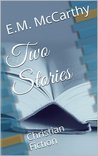 Two Stories: Christian Fiction by E.M. McCarthy
My rating: 5 of 5 stars
This book contains, as the title already says, two short stories.
And though those stories are fictional, they actually could happen to people like you and me every day.
In the first story "Charity Begins at Home" we meet a family that is about to be evicted from their home. With no place to go everyone is in fear of a future, which looks terribly bleak. And then a miracle happens in form of a kind person close to them.
While the story is set in the 1930s, it's events could easily happen in our time.
The second story "A Day Gone Bad" is about the terrifying experience of a teacher and young mother when she becomes victim of a crime. The help she receives comes from a very much unexpected source.
As in the first story we also learn here, that God works miracles even in the most desperate situations, and He does so by using the people around us.
I can recommend the book for older children from age 10 upwards. It can also be used as a teaching tool for Sunday school and Catechism classes.
View all my reviews
Review of "Dear Mr. Knightley" by Katherine Reay
And most of all it was clear from the very start that the Catholic Church and the Christian faith would not be portrayed in a dark light as in so many other contemporary works of fiction. And Father John who runs the group home where Samantha Moore, the writer of the letters, lives is portrayed as kindly and wise, a modern day Father Flanagan(the founder of Boy's Town).
Although throughout the story Samantha is supported in the healing process from her traumatic childhood by people of faith, the book doesn't seem overly preachy. Faith seems more like a natural part of people's life, not so much talked about but lived, forming their characters toward a kindness that includes forgiveness and understanding of others.
While Samantha learns to overcome her tendencies toward isolation and hiding herself behind fictional characters (mostly from Jane Austin and other classics) and learns to relate to other people, some of the people around her also change with Samantha's help overcoming their own problems and taking steps into a better future, a never-ending chain of love.
Review of The Year of the Badgers by Paul Howsley
After 6 month of unemployment, which has left his self-respect and self-confidence in shatters he is finally placed into the government's work program. But soon he realizes that the promises of a chance for permanent employment after the trial period are empty and the program is nothing else but a slave-labor deal created by insiders by which the government finances the labor force of corporations, while the workers become indentured servants, forever paid below minimum wage via their welfare recipient badges. Those "badges" even restrict what kind of products the workers inside the system are allowed to purchase with their meager "wages".
Once Badger refuses a particularly humiliating placement he is "sanctioned", which inevitably means homelessness.
Badger is drawn out of his isolation and despondency when he meets beautiful Joanna, who helps him to realize that becoming active and helping others is the only way to regain one's pride and self-esteem.
Having some time ago -during the worst year of my life- struggled with unemployment and the threat of homelessness myself, I was easily able to sympathize with Badger.
When Badger is trapped in anonymous corporate and government bureaucracies where he is nothing more than a number on a file, while losing all hope of ever getting out of there, I kept nodding, yes, yes, yes, been there, done that.
I agree with the premises of the book that our political and economic system is becoming increasingly dehumanizing (which is helped along by the media's demonization of the poor).
I also agree that solidarity and some kind of political activism, against those conditions is needed, though in my opinion the detailed description of this process in the book could be a bit shortened