Haydn Wilks's Blog - Posts Tagged "ethereum"
Goodreads Giveaway: Win 1 of 100 copies of my new novel $hitcoin.
My new novel $hitcoin. will be released on July 3. You can win one of 100 digital editions of $hitcoin through my Goodreads giveaway.
The novel is about a group of students in the Netherlands who launch their own cryptocurrency at the height of the 2017 digital gold rush. They dream up the idea while watching rap videos and fantasising about big yachts, Lamborghinis, and five-star sushi served on the naked bodies of supermodels. Their shitcoin proves wildly successful and they're soon helming a multi-billion dollar enterprise. Chinese bitcoin miners and bar girls, Korean office workers, and drug-crazed American tech billionaires are drawn into their world as the shitcoin skyrockets in value. $hitcoin plays out across five continents in a wild tale of excess, exchange hacks, sex, drugs, betrayal, and death.
Read more about $hitcoin. on Goodreads or at https://deadbirdpress.com/shitcoin
This giveaway is just for the ebook format. A separate giveaway will be launched later where you can win a physical copy of the book.
The novel is about a group of students in the Netherlands who launch their own cryptocurrency at the height of the 2017 digital gold rush. They dream up the idea while watching rap videos and fantasising about big yachts, Lamborghinis, and five-star sushi served on the naked bodies of supermodels. Their shitcoin proves wildly successful and they're soon helming a multi-billion dollar enterprise. Chinese bitcoin miners and bar girls, Korean office workers, and drug-crazed American tech billionaires are drawn into their world as the shitcoin skyrockets in value. $hitcoin plays out across five continents in a wild tale of excess, exchange hacks, sex, drugs, betrayal, and death.
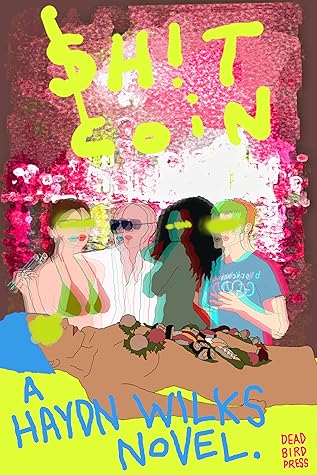
Read more about $hitcoin. on Goodreads or at https://deadbirdpress.com/shitcoin
This giveaway is just for the ebook format. A separate giveaway will be launched later where you can win a physical copy of the book.


Five Books, One TV Show, and a Movie Which Inspired My New Novel $hitcoin.
I started working on $hitcoin. in 2017. It will finally be released this Friday - apparently the Friday immediately before the Saturday on which the lockdown ends and pubs reopen in Britain. After months of spiking book sales during the lockdown. Yeah, the timing probably could have been better on that one. But what’s done is done and $hitcoin. is done and now just about fit for public consumption. Those who graciously accepted advance review copies of $hitcoin. may be wondering “why the hell did he write this?” Over the next couple of weeks, I’m going to share a few blog posts on why I wrote this mad mess of a novel, how deeply I developed cryptomania, and some of the real-life craziness that inspired the insanity my book depicts. First, I’d like to share a quick list of six other works which inspired me to write this book. Four novels, one movie, and a TV show.
1. From the Fatherland, with Love by Ryu Murakami
The second I heard the premise I had to read this one. North Korea invades the Japanese island of Kyushu. Not wanting to risk a full-blown war, the government in Tokyo let the North Koreans keep it. Murakami’s masterpiece depicts all kinds of people living under brutal North Korean rule in Kyushu’s largest city of Fukuoka.
The only Murakami book I had prior to this was Popular Hits of the Showa Era. By most accounts, it’s one of his weakest books. I’m working my way through some of his other novels at the moment and would definitely agree with that assessment but I did find his depiction of disaffected Japanese youth in that book pretty enjoyable. ‘Disaffected’ is maybe not the best term - Murakami’s youths are often complete degenerates. And in From the Fatherland…, it’s a gang of these miscreants who are Fukuoka’s last line of defense against the North Koreans.
I loved everything about From the Fatherland, With Love. Having lived in both Korea and Japan, books which deal with the fraught relationship between the countries are always very interesting to me. Pachinko by Min Jin Lee is another fantastic read in this niche. Murakami researched the hell out of North Korea for his book and it really shows. Every member of the North Korean invading force is fully fleshed and wholly, often terrifyingly, believable. Just as impressive is the deft with which Murakami captures the citizens living under their new masters. Many quickly turn collaborator and always with completely sympathetic and believable motives. There’s the low-level government official who helps the NK forces with their day-to-day administration of the new province so that she can earn enough to provide her kids with organic foodstuffs. There’s an awkward blossoming romance between a Japanese news anchor and her new NK army co-host. The only characters who come across as less than fully realistic are the miscreant oddball heroes, but their bizarre quirks are described so engagingly that it really doesn’t matter.
$hitcoin. has a few outright nods to From the Fatherland, With Love. My novel’s character Alicia stays a few nights in the Fukuoka Hilton, which is where the North Korean forces set up their headquarters and detention centre in Murakami’s novel. But my attempt to tell the interconnected international tale of a cryptocurrency’s rise and fall by showing the breadth of characters invested in its fortunes was purely inspired by Murakami’s novel. I’m sure I didn’t get close to handling such a sweep as expertly as Murakami, but I’d be thrilled if anyone found my book close to half as engaging as I found this one. Murakami’s epic spans close to 700 pages but I read the entire thing in a week. When I had to offload books to friends before leaving Japan for Korea and then Korea to return to the UK, this was one book that I had to keep hold of.
2. The Rules of Attraction by Brett Easton Ellis
I could just as easily have listed American Psycho or Glamorama as influences on $hitcoin as this one, but having been a huge fan of Roger Avery’s amazingly inventive movie adaptation for years, I finally read Rules of Attraction towards the end of writing $hitcoin. and it had a big impact on how I approached some of the later chapters. The Rules of Attraction is sort of the story of a love triangle, but it’s a love triangle where each of the characters is completely mistaken about how the triangle’s other corners feel. It’s a tragicomic coming of age story and like much of Murakami’s oeuvre it focuses on disaffected/degenerate youth. If you’re not familiar with the book, one of the central trio is Patrick Bateman’s younger brother, though Sean is less psycho and more nihilistic hedonist.
3. Ulysses by James Joyce
Yeah, I know, it sounds amazingly pretentious to list Ulysses as an influence. Joyce’s modernist epic is purportedly the book that people most commonly lie about reading. I may not have made it through the whole thing myself if I didn’t have an entire module dedicated to it at university. But with a seminar and lecture devoted to each of the book’s chapters, that was easily my favourite module from my university days. Joyce’s magnum opus depicts 24 hours in Dublin through a dizzying array of textual styles. It is the blueprint for all later transgressive fiction and everything I’ve written apes some aspect of it. $hitcoin. is obviously nowhere near the level of Ulysses, but then again, what book is? “Certainly not fucking $hitcoin, mate,” you may answer, but I’ll pretend I didn’t pretend to hear you saying that and continue. Joyce’s work is rigorously yet playfully structured and it opened up all later writers to so much freedom in form. $hitcoin. has sections that read like a screenplay, non-fiction book extracts, and a newspaper article. Yeah, it ain’t exactly Ulysses, but it does owe a massive debt to it.
4. Five Star Billionaire by Tasha Aw
This is the only work on this list I’m not completely in love with or awe of and it’s also the one I stole from most directly. Picasso famously said good artists copy and great artists steal. Tarantino movies are a tissue of quotations with characters and camera shots lifted from his encyclopedic knowledge of film and twisted into something fresh. The character of Alicia in $hitcoin. was directly lifted from the character of Phoebe in Tasha Aw’s novel. Like Phoebe, Alicia moves to China from Malaysia thinking she’ll live a glamorous life in a glittering metropolis of the world’s fastest rising economy. Instead, she discovers a world of sweatshops, seedy karaoke bars, and co-workers who look down on her as a Chinese-in-appearance-only foreigner.
A slight digression here that may be of interest to anyone who read my first book, The Death of Danny Daggers: the initial premise of that book was writing a warped Cardiff-set rip-off of The Girl with the Dragon Tattoo. Rory Gallagher is Mikael Blomqvist and Ji Eun is Lisbeth Salander. I’m a big believer in stealing freely from other works in this way. Take elements that interest you wherever you find them, mix them up with your own life experiences and anecdotes nicked from mates and the internet, throw them together, and boom: you’ve got yourself a novel.
5. The Pale King by David Foster Wallace
This one inspired $hitcoin. in a very specific way. Of the early reviews that my book has received, the most common criticism has been the pacing. On reflection, the pacing is very ‘off’ in the way chapters are arranged. It’s clearly a weakness of the book as many readers have brought it to my attention. But it is a weakness with an origin.
The Pale King was published after Wallace’s death using an unfinished manuscript. The oddness of its structure may have otherwise been smoothed over in later edits. But I absolutely loved one weird quirk of the way The Pale King is structured. Wallace’s novel is a unique mediation on boredom, concerning the daily goings on during a brief stint the author had with the Inland Revenue Service. One IRS employee gives an interview to camera for the purposes of creating an IRS recruitment video. The camera’s left running and the character tells an elaborate story of his father’s death with random tangents about the introduction of a bungled progressive sales tax in Illinois. This portion of the novel stretches on for about 40 or 50 pages. This jarring section is completely at odds with how other chapters in the novel are structured. It’s bizarre and something I’ve never quite encountered the likes of in any book.
I had this in mind when structuring $hitcoin. I wanted to create a feel where the reader has no idea from one chapter to the next what the next chapter will entail. Some are short snappy pieces broken up into fast-paced sections. Others are long meandering things running many pages without a section break.
I’m not sure how successful this Wallace-inspired experiment has been. Judging from reviews so far, reaction to that element of the novel is mixed leaning on general dislike. In future books, I’ll probably err more towards creating a structure which maintains reader engagement rather than throwing them constant curveballs. But if you found $hitcoin.'s structure bewildering, frustrating, or just outright annoying, then Wallace is at least partly responsible for that.
6. Nathan Barley
This series was first broadcast on Channel 4 in 2005 and it’s incredibly ahead of its time. Facebook was created in a Harvard dorm room the year before this aired and the first generation iPhone wasn’t released until 2007. But Nathan Barley spectacularly captures a culture of “self-facilitating media nodes” that was very much a niche concern at the time it was created. Barley is a dimwit desperately seeking the approval of Dan Ashcroft, an edgy writer for a definitely-not-Vice-Magazine London hipster mag played by The Mighty Boosh’s Julian Barratt. Barley owns and operates trashbat.co.ck, a super-cool website registered in the Cook Islands.
The series was created as a collaboration between two of Britain’s most inventive television writers, Charlie Brooker and Chris Morris. Brooker had made a minor name for himself writing a fake TV listings website, one of the recurring shows on which was simply called Cunt. Nathan Barley is the titular Cunt in this adaptation of Brooker’s TVGoHome texts. Brooker would go on to huge success with the similarly prescient Black Mirror. Chris Morris has made a career out of offending right wing newspapers and delighting comedy fans with efforts like satirical TV news shows The Day Today and Brass Eye and the brave and hilarious suicide bomber comedy Four Lions.
In $hitcoin., the character of Graham Jones draws quite heavily from Dan Ashcroft in Nathan Barley. Like Ashcroft, Graham struggles to feel at one with the empty hipster bullshit the magazine he writes for is obsessed by. Ashcroft’s most iconic line in Nathan Barley is “the idiots are winning.” In $hitcoin., Graham finds success in chronicling the idiots’ triumph.
7. The Wolf of Wall Street
One of the taglines I’ve given $hitcoin. is ‘Wolf of Wall Street for the Instagram generation.’ Scorsese’s epic revels in the debauchery and lack of morality of its protagonist, Jordan Belfort. Leonardo DiCaprio has never been more charismatic than as the stockbroker turned penny stock pusher turned super-rich Wolf of Wall Street Jordan Belfort.
I find this movie endlessly rewatchable. From beginning to end, it’s a whirlwind. Scorsese caught some criticism for glamorising Belfort’s crimes in a film which never explicitly condemns what its characters do. But that’s the reality: Belfort spent a short time in a comfortable prison and then moved into a highly successful career as an author and motivational speaker.
The world of cryptocurrency is even more fast-paced and insane than the off-Wall Street world of shady side finance depicted in this movie. Huge fortunes are amassed and lost at breakneck speed and the debauchery in $hitcoin. is ratcheted up to go along with it.
$hitcoin.
Over the coming weeks and days, I plan to share some stories about the real-world events which inspired my novel. Cryptocurrency is full of colorful characters and insane rags-to-riches and riches-to-rags tales. There was a hell of a lot to draw from. Hopefully you’ll enjoy what they’ve inspired.
1. From the Fatherland, with Love by Ryu Murakami
The second I heard the premise I had to read this one. North Korea invades the Japanese island of Kyushu. Not wanting to risk a full-blown war, the government in Tokyo let the North Koreans keep it. Murakami’s masterpiece depicts all kinds of people living under brutal North Korean rule in Kyushu’s largest city of Fukuoka.
The only Murakami book I had prior to this was Popular Hits of the Showa Era. By most accounts, it’s one of his weakest books. I’m working my way through some of his other novels at the moment and would definitely agree with that assessment but I did find his depiction of disaffected Japanese youth in that book pretty enjoyable. ‘Disaffected’ is maybe not the best term - Murakami’s youths are often complete degenerates. And in From the Fatherland…, it’s a gang of these miscreants who are Fukuoka’s last line of defense against the North Koreans.
I loved everything about From the Fatherland, With Love. Having lived in both Korea and Japan, books which deal with the fraught relationship between the countries are always very interesting to me. Pachinko by Min Jin Lee is another fantastic read in this niche. Murakami researched the hell out of North Korea for his book and it really shows. Every member of the North Korean invading force is fully fleshed and wholly, often terrifyingly, believable. Just as impressive is the deft with which Murakami captures the citizens living under their new masters. Many quickly turn collaborator and always with completely sympathetic and believable motives. There’s the low-level government official who helps the NK forces with their day-to-day administration of the new province so that she can earn enough to provide her kids with organic foodstuffs. There’s an awkward blossoming romance between a Japanese news anchor and her new NK army co-host. The only characters who come across as less than fully realistic are the miscreant oddball heroes, but their bizarre quirks are described so engagingly that it really doesn’t matter.
$hitcoin. has a few outright nods to From the Fatherland, With Love. My novel’s character Alicia stays a few nights in the Fukuoka Hilton, which is where the North Korean forces set up their headquarters and detention centre in Murakami’s novel. But my attempt to tell the interconnected international tale of a cryptocurrency’s rise and fall by showing the breadth of characters invested in its fortunes was purely inspired by Murakami’s novel. I’m sure I didn’t get close to handling such a sweep as expertly as Murakami, but I’d be thrilled if anyone found my book close to half as engaging as I found this one. Murakami’s epic spans close to 700 pages but I read the entire thing in a week. When I had to offload books to friends before leaving Japan for Korea and then Korea to return to the UK, this was one book that I had to keep hold of.
2. The Rules of Attraction by Brett Easton Ellis
I could just as easily have listed American Psycho or Glamorama as influences on $hitcoin as this one, but having been a huge fan of Roger Avery’s amazingly inventive movie adaptation for years, I finally read Rules of Attraction towards the end of writing $hitcoin. and it had a big impact on how I approached some of the later chapters. The Rules of Attraction is sort of the story of a love triangle, but it’s a love triangle where each of the characters is completely mistaken about how the triangle’s other corners feel. It’s a tragicomic coming of age story and like much of Murakami’s oeuvre it focuses on disaffected/degenerate youth. If you’re not familiar with the book, one of the central trio is Patrick Bateman’s younger brother, though Sean is less psycho and more nihilistic hedonist.
3. Ulysses by James Joyce
Yeah, I know, it sounds amazingly pretentious to list Ulysses as an influence. Joyce’s modernist epic is purportedly the book that people most commonly lie about reading. I may not have made it through the whole thing myself if I didn’t have an entire module dedicated to it at university. But with a seminar and lecture devoted to each of the book’s chapters, that was easily my favourite module from my university days. Joyce’s magnum opus depicts 24 hours in Dublin through a dizzying array of textual styles. It is the blueprint for all later transgressive fiction and everything I’ve written apes some aspect of it. $hitcoin. is obviously nowhere near the level of Ulysses, but then again, what book is? “Certainly not fucking $hitcoin, mate,” you may answer, but I’ll pretend I didn’t pretend to hear you saying that and continue. Joyce’s work is rigorously yet playfully structured and it opened up all later writers to so much freedom in form. $hitcoin. has sections that read like a screenplay, non-fiction book extracts, and a newspaper article. Yeah, it ain’t exactly Ulysses, but it does owe a massive debt to it.
4. Five Star Billionaire by Tasha Aw
This is the only work on this list I’m not completely in love with or awe of and it’s also the one I stole from most directly. Picasso famously said good artists copy and great artists steal. Tarantino movies are a tissue of quotations with characters and camera shots lifted from his encyclopedic knowledge of film and twisted into something fresh. The character of Alicia in $hitcoin. was directly lifted from the character of Phoebe in Tasha Aw’s novel. Like Phoebe, Alicia moves to China from Malaysia thinking she’ll live a glamorous life in a glittering metropolis of the world’s fastest rising economy. Instead, she discovers a world of sweatshops, seedy karaoke bars, and co-workers who look down on her as a Chinese-in-appearance-only foreigner.
A slight digression here that may be of interest to anyone who read my first book, The Death of Danny Daggers: the initial premise of that book was writing a warped Cardiff-set rip-off of The Girl with the Dragon Tattoo. Rory Gallagher is Mikael Blomqvist and Ji Eun is Lisbeth Salander. I’m a big believer in stealing freely from other works in this way. Take elements that interest you wherever you find them, mix them up with your own life experiences and anecdotes nicked from mates and the internet, throw them together, and boom: you’ve got yourself a novel.
5. The Pale King by David Foster Wallace
This one inspired $hitcoin. in a very specific way. Of the early reviews that my book has received, the most common criticism has been the pacing. On reflection, the pacing is very ‘off’ in the way chapters are arranged. It’s clearly a weakness of the book as many readers have brought it to my attention. But it is a weakness with an origin.
The Pale King was published after Wallace’s death using an unfinished manuscript. The oddness of its structure may have otherwise been smoothed over in later edits. But I absolutely loved one weird quirk of the way The Pale King is structured. Wallace’s novel is a unique mediation on boredom, concerning the daily goings on during a brief stint the author had with the Inland Revenue Service. One IRS employee gives an interview to camera for the purposes of creating an IRS recruitment video. The camera’s left running and the character tells an elaborate story of his father’s death with random tangents about the introduction of a bungled progressive sales tax in Illinois. This portion of the novel stretches on for about 40 or 50 pages. This jarring section is completely at odds with how other chapters in the novel are structured. It’s bizarre and something I’ve never quite encountered the likes of in any book.
I had this in mind when structuring $hitcoin. I wanted to create a feel where the reader has no idea from one chapter to the next what the next chapter will entail. Some are short snappy pieces broken up into fast-paced sections. Others are long meandering things running many pages without a section break.
I’m not sure how successful this Wallace-inspired experiment has been. Judging from reviews so far, reaction to that element of the novel is mixed leaning on general dislike. In future books, I’ll probably err more towards creating a structure which maintains reader engagement rather than throwing them constant curveballs. But if you found $hitcoin.'s structure bewildering, frustrating, or just outright annoying, then Wallace is at least partly responsible for that.
6. Nathan Barley
This series was first broadcast on Channel 4 in 2005 and it’s incredibly ahead of its time. Facebook was created in a Harvard dorm room the year before this aired and the first generation iPhone wasn’t released until 2007. But Nathan Barley spectacularly captures a culture of “self-facilitating media nodes” that was very much a niche concern at the time it was created. Barley is a dimwit desperately seeking the approval of Dan Ashcroft, an edgy writer for a definitely-not-Vice-Magazine London hipster mag played by The Mighty Boosh’s Julian Barratt. Barley owns and operates trashbat.co.ck, a super-cool website registered in the Cook Islands.
The series was created as a collaboration between two of Britain’s most inventive television writers, Charlie Brooker and Chris Morris. Brooker had made a minor name for himself writing a fake TV listings website, one of the recurring shows on which was simply called Cunt. Nathan Barley is the titular Cunt in this adaptation of Brooker’s TVGoHome texts. Brooker would go on to huge success with the similarly prescient Black Mirror. Chris Morris has made a career out of offending right wing newspapers and delighting comedy fans with efforts like satirical TV news shows The Day Today and Brass Eye and the brave and hilarious suicide bomber comedy Four Lions.
In $hitcoin., the character of Graham Jones draws quite heavily from Dan Ashcroft in Nathan Barley. Like Ashcroft, Graham struggles to feel at one with the empty hipster bullshit the magazine he writes for is obsessed by. Ashcroft’s most iconic line in Nathan Barley is “the idiots are winning.” In $hitcoin., Graham finds success in chronicling the idiots’ triumph.
7. The Wolf of Wall Street
One of the taglines I’ve given $hitcoin. is ‘Wolf of Wall Street for the Instagram generation.’ Scorsese’s epic revels in the debauchery and lack of morality of its protagonist, Jordan Belfort. Leonardo DiCaprio has never been more charismatic than as the stockbroker turned penny stock pusher turned super-rich Wolf of Wall Street Jordan Belfort.
I find this movie endlessly rewatchable. From beginning to end, it’s a whirlwind. Scorsese caught some criticism for glamorising Belfort’s crimes in a film which never explicitly condemns what its characters do. But that’s the reality: Belfort spent a short time in a comfortable prison and then moved into a highly successful career as an author and motivational speaker.
The world of cryptocurrency is even more fast-paced and insane than the off-Wall Street world of shady side finance depicted in this movie. Huge fortunes are amassed and lost at breakneck speed and the debauchery in $hitcoin. is ratcheted up to go along with it.
$hitcoin.
Over the coming weeks and days, I plan to share some stories about the real-world events which inspired my novel. Cryptocurrency is full of colorful characters and insane rags-to-riches and riches-to-rags tales. There was a hell of a lot to draw from. Hopefully you’ll enjoy what they’ve inspired.
Why I Wrote My New Novel $hitcoin.
My new novel $hitcoin has just been released this week. I've written a short piece detailing some of the true stories and my own real life experiences which inspired the novel. If you're interested in reading it, you can check it out at https://medium.com/@haydnwilks/why-i-...
Thanks!
Thanks!
$hitcoin: The first novel to capture the insanity of cryptocurrency ($hitcoin Trailer)
I've uploaded a trailer for $hitcoin to YouTube.
You can check it out at https://www.youtube.com/watch?v=byhsH...
You can check it out at https://www.youtube.com/watch?v=byhsH...