
David Johnson's Blog
April 30, 2020
Anxiety and Medication
What about medication for your anxiety?
For decades, the go-to medication for anxiety was a benzodiazepine, either valium, klonopin, or Xanax, especially Xanax. These medications do a really good job of pushing down the terrifying symptoms of anxiety and panic. I’m just not a big fan of using benzos, as they are called, because they are so addictive, but also because they get in the way of people learning coping tools for managing their symptoms.
Many people who use Xanax will say, “I started having a panic attack, so I took a Xanax and immediately felt better.” If that is a true statement, and I don’t doubt that it is, the reason they felt better wasn’t because of the Xanax. It hadn’t even reached their stomach yet, or been digested, passed into the intestines and into the blood stream. That process takes at least thirty minutes (or more). The relief they feel truly is ‘all in their head.’
In recent years, numerous studies have shown medications in a class known as SSRIs are more effective in managing anxiety (Paxil and Zoloft are a couple of well-known ones). The major difference between these medications and benzos is they do not work quickly. You have to take them for several weeks before they reach a therapeutic level in your blood stream. But after that, they maintain a steady level, not the up and down spikes of a benzo.
In very recent years, there are reports (not controlled studies) that using CBD products are helpful in managing anxiety.
I need to quickly add there are people whose anxiety is so severe that neither coping tools nor SSRIs are enough to manage their symptoms. In those cases, using a low dose of klonopin seems to work best and is warranted.
All of the information I’ve shared in this particular post is not meant to advise you on what to do about medications. It is my hope you will be able to have a more informed conversation with your medical provider about what is best for you.


April 27, 2020
Focus On What You Know
An anxious brain is a busy brain. It can’t sit still and be quiet. Instead, it scurries around picking up any tiny thing it can find and starts picking it apart, looking for something to worry about.
The anxious brain makes mountains out of molehills by telling you lie after lie.
So, here’s today’s suggestion: FOCUS ON WHAT YOU KNOW (rather than on what you suppose).
I’ll use COVID19 to illustrate.
At this moment, I know:
1. I am alive.
2. I feel fine.
3. I have enough food in the house to satisfy my appetite.
4. My wife, my children, and my grandchildren are alive.
5. I have toilet paper!
But my anxious brain wants to take me by the hand and drag me around in search of trouble by saying:
1. What if something happens to you? What will happen to everyone who depends on you? Who will take care of them? How will the funeral be handled? Can everyone come who wants to? Will they have to cremate my body to destroy the virus?
2. You feel fine right now, but that virus takes days before it shows symptoms. What if you have the virus right now and are infecting everyone in the house? What if you get sick and have to go to the hospital? Will you need a ventilator? Will there be a ventilator available? Will there even be a bed available in the hospital?
3. What if the food in the house runs out? Will there be food available at the store? Will someone read this post and decide to break in your house and steal your food? What if you catch them? Will you shoot them? Will they shoot you? Will they kidnap your wife? What will they do to her? Will you ever see her again?
4. I heard your wife cough during the night. Does that mean she’s getting sick with the virus? Is she going to die? How will you survive without her? Will you ever marry again? Would she be upset with you if you did? What would your children and grandchildren think of you if you remarried? And what if the new marriage doesn’t work out and they divorce you? What will people think about you?
5. What if you run out of toilet paper? What if whatever you use in it’s place is too rough and it creates an abrasion you-know-where? What if that sore gets infected? What if the infection spreads into your colon? Will your colon have to be removed? Will you have to wear a colostomy bag? How will that change your life? How will your wife feel differently about you? What if she can’t tolerate it, and she divorces you. What if nobody else will have anything to do with you?
WHEW! That was exhausting, anxiety producing, and hilarious to write!
Look at the difference in volume between what I KNOW and WHAT I SUPPOSE. It’s amazing, isn’t it?
That’s why I say, take a breath, slow down, and FOCUS ON WHAT YOU KNOW.
April 24, 2020
Go Ahead, Have a Panic Attack
The worst thing about having a panic attack is that it makes you believe you are going to die. Emergency room physicians are very familiar with patients showing up thinking they are having a heart attack, but after a bundle of very expensive tests, the diagnosis is anxiety or panic attack.
Remember the first thing I told you in this series of posts? ANXIETY IS A LIAR. The truth is, a panic attack can’t kill you; it just makes you think you’re going to die.
My suggestion? GO AHEAD, HAVE A PANIC ATTACK. Sounds crazy and counterintuitive, doesn’t it? All I ask is that you hear me out.
If you’re anxiety spikes and none of the previous suggestions I’ve made have worked, you and I both know a panic attack is sure to follow. What everyone does in that situation is grit their teeth, tense their body and silently scream, “I am not going to have a panic attack! I am not going to have a panic attack!”
Unfortunately, this will only make the panic attack more certain and more severe, because your body is already on the cusp of the Flight/Fight/Freeze mode and you stiffening your body and screaming in your head will trigger the release of adrenalin. When that happens, you are done for. The Panic Train is going to run you over.
It’s much like standing waist-deep in the ocean and bracing yourself for the incoming waves. You tell yourself, “I’m not going to let these waves knock me down.” But, eventually, you will lose that battle.
To lessen the severity of the panic attack, tell yourself these things:
1. I’m going to have a panic attack.
2. A panic attack won’t kill me.
3. I’ve had panic attacks before and survived every one of them. I will survive this one, too.
4. A panic attack only lasts 10-20 minutes. Only 10-20 minutes!
5. I’m going face the beach and body surf to the shore. Then, I’ll get out, rest, catch my breath and get on with my day.
April 21, 2020
Breathe Your Anxiety Away
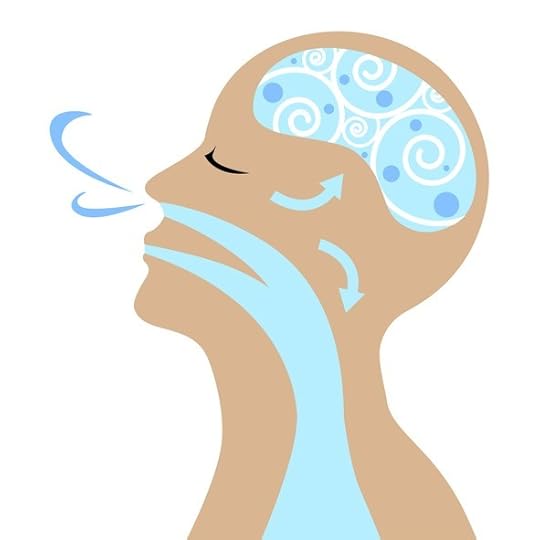
When your anxiety is high, your body reacts by increasing your heart rate and blood pressure and quickening your breathing, which triggers a release of adrenalin. All of which makes your anxiety worse, which makes those symptoms worse, etc.
So, IF YOU CAN CONTROL YOUR BREATHING, YOU CAN CONTROL YOUR ANXIETY.
I’m going to give you an exercise that will help, but first I need to explain how to breathe in a very specific manner. Some call it ‘belly breathing’ others call it ‘diaphragmatic breathing.’ Place your hand on your stomach and make it expand as you take a deep breath, making sure your shoulders don’t lift and your chest doesn’t expand. It takes a little bit to find the right muscles to use, so take your time. (It’s much easier to breathe this way if you are lying down on your back.)
Once you’ve mastered the technique, you’re ready to do the exercise.
STEP ONE: Every night, when you go to bed, lie on your back and make sure you can breathe the way I’ve explained.
STEP TWO: Inhale very slowly. Make that one inhale last about 15 seconds.
STEP THREE: Hold the breath for a second or two.
STEP FOUR: Exhale the same way you inhaled—slowly, over the course of about 15 seconds.
STEP FIVE: Repeat the process for about two minutes.
STEP SIX: Go to sleep.
This technique is a tool that’s not likely to help your anxiety until you have practiced it for quite a while. But the more you practice, the better you’ll get at it.
Eventually, you’ll be in a situation in which you feel your anxiety rising. As soon as you do, immediately start using this breathing tool. Because you’ve practiced it so much, you can do it in practically any setting.
What you’ve done is you’ve trained your body to respond in a very specific way to this breathing. Therefore, by the time you take in the third inhale, your brain says, ‘Hmmm, we must be getting ready to go to sleep,’ and it floods your body with messages to relax. It lowers your heart rate and blood pressure. All those muscles that were beginning to tense up, simply unwind and relax.
I’ve both taught and used this technique for decades. I assure you, it will work.
April 17, 2020
Try a ‘Worry Hour’
One thing you must remember is that ANXIETY AND WORRY feed off each other. More anxiety = more worry. More worry = more anxiety.
It is NOT helpful to tell someone to quit worrying. And, trust me, it is VERY difficult to teach someone to not worry.
But there is a technique you can practice that will keep worry from contaminating every moment of your day. It is called A Worry Hour. Here’s how it works: You set aside a specific hour in your day, let’s say 7:00 p.m. Nothing is to interfere with you keeping that appointment—nothing. When Worry Hour arrives, find a solitary place (your bedroom, a closet, the bathroom, etc.), and begin writing down everything you are worried about. Write down all the scary ‘what ifs’ your anxiety is telling you. You must not think about anything else except your worries. Dwell on them; let your imagination run wild to horrible places.
If you get finished before your hour is up, go back and read everything you’ve written. Concentrate on it. Add any additional worries that you can think of.
When your worry hour is up, you must stop.
Make this a regular, daily practice, even if you feel like you don’t need to. You must be vigilant. But here is a very important rule—if you find yourself worrying during any other moment of the day, you must tell yourself, “I can’t worry about that right now. I have to save it for my Worry Hour.”
After you have practiced this every day for some time, if you believe sixty minutes has become too much time to set aside for worrying, you can reduce the Worry Hour by ten minutes and see how that works for you.
Going forward with this practice, you are allowed to reduce the Worry Hour to a number that works for you. And, as challenging events come and go in your life, you can increase it or decrease it based on your need.
April 14, 2020
Anxiety is a LIAR!
DON’T LISTEN to your anxiety—IT’S A LIAR! Anxiety fills your head with all the scariest, darkest, edge-of-the-world possibilities it can imagine. And trust me, it has a very LARGE imagination.
The possibilities anxiety presents you with are always prefaced with “What if?” It will wear you out with all of its ‘what ifs?’.
I’m not going to tell you, “Don’t worry,” because that NEVER helps. (And just so you know, worry and anxiety go hand in and.)
What I’m suggesting is, don’t believe everything Anxiety tells you. It’s a liar.
If your anxiety is running high during these days of the pandemic, there are a couple of things you can do that will absolutely help.
First of all, cut out all caffeine from your diet. I know, I know … I hear your wails of protest. But caffeine irritates the part of the brain that produces anxiety. What’s interesting to me is that a lot of people who have high anxiety ingest a lot of caffeine. (Hmmm, could there be a correlation? 
January 3, 2020
The Long View of the Bible
[image error]
For over fifty years I have been a serious student of the Bible and have read it all numerous times. But up until this past year, I have never read it through in a chronological manner. My studies had always focused on the micro rather than the macro in that I would delve deeply into studying a particular book of the Bible, or perhaps a specific chapter, even one verse, or even tinier by focusing on one word. But having now read it ‘cover to cover’ in a year’s time I’ve come away with some conclusions (hopefully accurate ones) that I’d never seen before.
FIRST – God’s workings in my life have little to do with me, rather, they are about a bigger purpose that only He can see at the time. All the plagues that God brought upon Egypt in order to convince Pharaoh to ‘let my people go’ were to let all the nations around Egypt learn of the one true God’s power. And indeed, when the children of Israel crossed the Red Sea on their journey toward the Promised Land many nations laid down their weapons of war because they knew they were powerless in the face of this people’s God.
God didn’t save Jonah from the belly of that giant fish for Jonah’s sake but so Jonah could travel to Nineveh and convict the people to repent and turn to God. Esther did not become Queen Esther in order to benefit her but in order that she would be in a position to save God’s people. All the calamities that befell Job were not about him. They were about giving the world an example of how a person should cope when trials come. And the horrible death Jesus endured was not about him—it was about you and me.
It’s an important lesson for me to remember whenever good or bad things happen to me and I want to feel either puffed up or pitiful. There’s always a bigger reason than I can see, and I need to be thankful in both circumstances that God thought enough of me to use me in his Grand Plan.
SECOND – No wonder people were startled at the teachings of Jesus. The Old Testament teachers, kings, and prophets of God always spoke with a ‘thus saith the Lord,’ or ‘God has spoken to me’ or ‘hear now what God has to say.’ Over and over again they made sure to credit God as being the source of their words to the people. But Jesus’ manner was completely different. His words were ‘I say to you.’
He spoke with his own authority, something the religious leaders of his day did not do. Jesus even openly contradicted some of their teachings: ‘You have heard it said … But I say to you,’ and they despised him for it. They felt threatened and feared losing their power base, which led to the decision to kill Jesus.
THIRD – The children of Israel missed the point. They believed that God chose them because they were special, they were better than the people around them. The truth, though, is the only thing that made them special was that God chose them, a choice made as a manifestation of his grace.
God needed a vehicle to show the world how he deals with mankind and all its frailties. And the children of Israel were a perfect vehicle. It’s by studying their history in the Bible that we gain such a full understanding of all the facets of God’s nature.
There have been times in my life that I thought God chose Americans over other nationalities because of who we are, because we are more special in his eyes than anyone else. I now see this as a very arrogant attitude. Has God blessed America? Absolutely! But God has blessed every nation that has ever existed.
The only thing that can make a person special is when they acknowledge God as the creator of the universe and make a decision to live their life in devotion and obedience to him.
FOURTH – The outward display of devotion to God has never been the most important thing to Him. I’ve often heard it explained that under the Old Law the emphasis was on the outward acts of worship—burning incense, making animal sacrifices, washing hands, etc., and that the New Law (Testament) focuses on the heart. I no longer believe that to be the case.
What God has consistently asked for, since the beginning, is a changed heart in the lives those who are devoted to him. Jesus made this abundantly clear when he talked about people who looked and acted in a pious manner but in their hearts were full of corruption and were very far from God.
There have been too many times in my life when I practiced a ‘check-the-box’ religion, making sure I did the things that people expected a faithful Christian to do: dress a certain way, talk a certain way, go to church a certain number of times, etc., but my heart wasn’t what it should have been.
Don’t get me wrong. Those devoted to God should act and look differently from those who are not devoted. God does, and has always, demanded obedience. But it’s really easy to look and act right and be dead to God on the inside.
If you’ve never read through the Bible in the manner I did in 2019 I really encourage you do to so. It’s so easy now with all the Bible’s available on tablets and phones and most of them have a reading plan that you can use. It’s not too late to start (even though you’re a few days behind).
By setting aside 15-20 minutes a day you can read the whole Bible in a year.
August 10, 2019
These Two Men Nearly Got Me Killed!
When I was in high school, I was not the rabble-rouser sort of teen. No fast-and-furious hot rod for me nor getting drunk on weekends. That’s not to say I had a halo around my head, for there might have been a time or two that my friend, Bob, and I went to town on an errand during school for a teacher and we somehow got lost and found ourselves at the Northside Drive-In (a memory-making diner) eating one of their delicious hamburgers. And it seems like I mighthave been sick the morning of opening day of dove season but made a miraculous recovery that enabled me to go hunting at noon.
No doubt my teen years were tempered by my brushes (yes, that’s plural) with death when I was a pre-teen during the 1960’s because of two men— Johnny Weissmuller and Roy Rogers.
My Saturday mornings involved an hour or two of being mesmerized by reruns of Tarzan movies, starring the famous Johnny Weissmuller. I could hardly believe my eyes as he sailed through the jungle while swinging from one vine to another or by grabbing a limb and flipping to another.
Enter my vivid imagination. One place we lived had a field with deep ravine in it, cut through by a creek and rain runoff. To cross it, I normally climbed down one side and up the other. However, one Saturday, I noticed a tree that leaned out over the ravine. I spied a limb hanging just about halfway across, and an idea sprang up. Yes, I would be Tarzan by taking a running leap, grabbing the limb and flipping to the other side.
My heart pounded as I leaned over into a three-point racers stance, thirty feet from the edge, my eyes glued on that one limb. This was my chance to make history (at least in my mind). I told that tiny voice in my head that was saying, This might not be such a good idea, to shut up and leave me alone. I was on the verge of greatness!
I sprang forward, legs and arms pumping in perfect rhythm. Just as my foot touched the edge of the ravine, and I was about to launch myself toward the limb, I looked down. (You know, they tell you not to look down, and there’s a good reason for that.) I let out what I hoped sounded like a Tarzan yell as I flew through the air. The truth, though, was that it was a scream of sheer terror.
I stretched my arm as far as I could, but my hand closed around thin air inches from the limb. I plummeted toward the yawning ravine. Up until that moment in my life I had no idea that the human body could bounce like a tennis ball. I ricocheted from one side to the other. Sharp rocks fileted my flesh and shredded my clothes until I splashed into the creek. The Death Angel circled overhead, laughing.
Miraculously, I was able to drag my broken body and bruised ego up the side of the ravine and crawl back home.
One would think that that experience would lessen a boy’s imagination. One would think that.
A few weeks later, I was watching a rerun of a Roy Rogers’ movie. Mounted banditos were in hot pursuit of him as he urged his horse, Trigger (the most beautiful horse ever created), raced across the plain. As he rounded a large rock, there was a tree up ahead. Instead of going around it, he went under it, grabbed a long-hanging limb and pulled himself into the tree’s canopy as Trigger continued running, drawing the banditos after him.
Undeterred by my Tarzan escapade, I went out and caught my steed (who may or may not have been swaybacked and may or may not have had vision problems in one eye). I quickly saddled her and headed to the pasture in search of the perfect tree for my adventure.
And there it was—a sassafras tree, standing like a sentinel in the middle of the field, its low hanging branches beckoning me. Immediately, I kicked my trusty horse in the flank, and she sprang forward, nearly throwing me off her back. But I recovered quickly and leaned forward. Her mane flapped in my face as we raced toward the tree. Her ears were laid back and the wind whistled in mine. Neither she nor I had ever gone that fast. It was like she was doing her best imitation of Trigger. (Or perhaps she knew what was going to happen and couldn’t wait to have a good laugh on me.)
I timed it all perfectly, which is not the same as saying I planned it perfectly. Either my horse was taller than I remembered, or the limb was lower than I calculated, because as I sat up to grab the limb, it struck me right across the chest, dislodging me from the saddle. I hung in mid-air for a split second before crashing to the ground and landing flat on my back, after which, everything went black.
How long I lay there, suspended between life and death, I do not know. It might have been days. But the next thing I knew, I was awakened by my horse nudging me with her nose and doing her best to stifle a laugh.
I won’t bore you with what happened after I watched runners doing the high hurdles in the 1964 Olympics, and I decided jump a barbed-wire fence. Suffice it to say, I nearly made it. Nearly.
Now you understand why my teenage years were rather sedate in comparison to my peers.
July 18, 2019
Do We Really Need Local Libraries and Small-Town Newspapers?
With the world at our fingertips via the click of a mouse or the touch of a mobile phone screen, are libraries and newspapers necessary anymore, especially in small towns? It’s a legitimate question that’s being asked across the country, a question that’s often driven by economics as the cost of newspapers increases and the strained budgets of cities struggle with funding a library.
How a person answers the question will be determined by two things: how they themselves use the two resources and what they believe the functions of local libraries and small-town newspapers are.
I will admit that I am now a senior citizen and that I have not checked out a book from a public library in decades, even though as a child I loved going to the library and checking out books. So, on the surface you would think that I would see no point in having a local library, but the truth is the opposite and that is because what libraries used to be a long time ago and what they need to be in the present and for the future are radically different.
According to a recent Pew Research study, 53 percent of Millennials (those 18-35) in the United States visited a library at least once in 2016, more than in any other generation. Why is that?
Books are more expensive than ever (even though there are hundreds of thousands of books on Amazon for 99 cents, it’s important to remember that not all young people have the necessary technology nor the money to get them)
Libraries offer quiet spaces for young people to gather and work on projects, do research, or do homework. Quiet, conflict-free spaces in homes are harder and harder to find.
Successful libraries are offering services that people can’t find elsewhere: learning English as a second language, teaching how to build a resume, filling out a job application online, a place where self-help groups (like divorce recovery, grief recovery, 12-Step groups) can meet, mentors can meet with their mentees without being disturbed, parenting classes, classes on divorce recovery, meeting place for book clubs.
Children’s libraries promote literacy through scores of specialized programs and events.
“Libraries are the great symbols of the freedom of the mind.” —Franklin D. Roosevelt.
“If information is the currency of democracy, then libraries are its banks.” Senator Wendell Ford
“Freedom is found through the portals of our nation’s libraries.” David McCullough
My research on the topic of local libraries led me to the conclusion that people today who have wealth and position have less of a need for libraries than those who do not, which leads to the problem that the very ones who will have to help pay for a library don’t want to because they think it is an unnecessary expense. However, it is vital in our narcissistic world of today to remember the obligation we have to help those who are less fortunate than ourselves, and supporting a local library is just one of the ways that can be done.
So, where do small-town newspapers fit into this discussion? First of all, to compare small-town newspapers to large metropolitan newspapers or national news organizations is to miss the point. Small-town newspapers are about me and my friends and neighbors. They are chock-full of good news (as opposed to the doomsday spin the national media puts on every story) and feel-good stories. It is there that I can learn what has been going on down the street or what is going to be happening soon. They make an effort to keep the local government honest by reporting on what happens in council meetings and board meetings. Citizens are invited to air their unedited gripes and concerns on the editorial page. A photographic record is displayed of children who have achieved success of every conceivable kind—sports, music, dance, reading, academics, beauty pageants. Local, small businesses are promoted.
If we lose our local library or small-town newspaper, then we lose a piece of ourselves and what connects us to each other. Therefore, both are worthy of our generous support.
June 14, 2019
My Story of Amazing Grace
IN CASE YOU DON’T follow me on Facebook, here is the link to a recent interview I did in which I shared my experiences as an author, counselor, and choral director.
I hope you enjoy it!


