Lakis Polycarpou's Blog
May 9, 2016
Cyprus: War or Reconcilliation? Notes from 1996
August in the Vanishing City, Book 1 of my trilogy, The Cyprus Chronicles,takes place on the island of Cyprus in the mid 1990s. While the book is fiction, it’s setting and context is based on extensive reporting I did about “The Cyprus Problem” in the 1990s — in particular a long piece of narrative journalism that I wrote about the events of 1996.
The piece was later submitted as my journalism master’s thesis, but has never been published. I’m posting an edited version here as backdrop for the book.
The situation in Cyprus has improved in some ways in the 20 years since this piece was written. In 2003, for example, the border between the Turkish-occupied northern Cyprus and the Greek Cypriot controlled south was opened up to at least allow for some freedom of movement. However, there has been little progress on the bigger questions. Will refugees from the 1974 invasion ever be allowed to reclaim their homes? Will the country ever be reunited politically?
Cyprus: War or Reconcilliation? Notes from 1996
In Ayios Pavlos, a suburb of Nicosia on the island of Cyprus, the elementary school teachers often gossip about a Greek Cypriot who they say periodically gets drunk, crosses the Green Line and pulls down the Turkish flag, while Turkish guards sleep. Then, he runs back through the United Nations-controlled buffer zone waving it and shouting.
The teachers at the elementary school have good reason to take interest in what happens on the line, since it runs no more than 200 yards from the school. From the playground, the children could wave at the soldiers opposite, if they wanted to; Ayios Pavlos is one of the many places in Nicosia where the Greeks and Turks of the de facto partitioned island can almost hear each other breathing. People in this neighborhood say they’ve heard sporadic gunfire from the Turkish side since 1974, but never as much as last year, when in addition to the distant cracking sound, several windows were shattered by bullets late at night. Nineteen ninety-six has been the tensest year between Greeks and Turks since 1974, both on and off the island.
Inside the old city of Nicosia, the twisting medieval roads are cut off abruptly by permanent roadblocks of sandbags and barbed-wire. In the heart of the city, a visitor might look up at an old Turkish minaret and not know which side it was on until he heard the rich baritone chant that is the Muslim call to prayer. Young Greek Cypriots walking in the old town can hear this call five times a day even though they have likely never met a Turk in their entire lives.
On a map, the 1974 cease-fire line appears straight, cutting neatly through the island to divide the two sides. In reality, the line weaves arbitrarily, so that driving along the winding roads on the government controlled Greek side, for example, one will suddenly see a Turkish guard-post to the south, a hundred feet away from the road.
From their posts, the Turkish and Greek soldiers impassively watch the cars going by. If one stops, they will wave it on, to keep moving. Taking pictures is prohibited, lest a visitor photograph something that could be tactically compromising. Nevertheless, on the Greek side, people build their houses with verandas facing the Pentathaktilos mountain range, which is inaccessible to them. They see it as a kind of defiance of the Turkish occupying forces. On the side of the mountains opposite, an enormous Turkish flag is painted, next to a quote from the founder of modern Turkey, Kemal Attaturk, which says, “It’s best to be a Turk.”
Read the rest on my medium site, The Novel Project.
The post Cyprus: War or Reconcilliation? Notes from 1996 appeared first on The Novel Project.


March 18, 2016
What I’m Thinking About This Week: Genre vs. Literary vs. Mainstream vs. Commercial vs. Kitsch—What Makes Great Fiction?
Featured Image Photo Credit: benoit_d via Compfight cc
One of the great things about being an aspiring writer in the pre-indie publishing era was that it was easy to bracket out questions of things like “market” and just focus on the “work” itself. After all, figuring out the market was what publishers were for, assuming you could get an agent or publisher to read your stuff. If these gatekeepers didn’t let you in, so much the better, because now you have an entity to blame for not giving you your shot.
But once “literary” or “serious” writers realize how easy it is to publish their own work these days, one of two things tends to happen. Either they resign themselves to obscurity—reasoning that really the most important thing is to just “get the work out there”—or they start to take adjectives like “genre,” “commercial,” and “page-turning” a little more seriously.
Having spent many years aspiring to be a “serious” author, I now find myself in the second camp. At the same time, I have realized that the works that have moved me most in recent years have come straight out the genres of fiction that I loved when I was a kid, but which were implicitly off-limits for anyone with literary aspirations. The best examples I can think of lately come from television: My wife and I have been watching The Walking Dead and Jessica Jones which are both quintessentially genre fiction (horror/sci-fi and superhero fiction respectively) and some of the most compelling explorations of character and 21st century issues that I’ve seen.
There is of course more to be said, but it’s time to get back to actually writing books. In the meantime, here some posts on the subject that I’ve been mulling over.
“At Long Last, Sci-Fi and Fantasy Have Infiltrated the Literary Mainstream,” Joe Hill,Wired Magazine:
Adams hopes The Best American Science Fiction and Fantasy will prove that readers don’t have to choose between wild concepts and literary quality. Good sci-fi and fantasy deliver both, which is what makes them so hard to write.
“Why We Should Rethink the Term ‘Literary Fiction,’” Michelle Richmond, Submitable:
Spacemen and spies are not the enemy of good literature. Novels in any genre can be literary if the writer pays close attention to craft.
“A Better Way to Think about the Genre Debate,” Joshua Rothman, The New Yorker:
The thing is that genre doesn’t have to be vexing. It can be illuminating. It can be useful for writers and readers to think in terms of groups and traditions. And a good genre system—a system that really fits reality—can help us see the traditions in which we’re already, unconsciously, immersed. As it happens, there is such a system: it was invented by the Canadian literary critic Northrop Frye, and laid out in his 1957 masterwork, “Anatomy of Criticism” … In his view, the world of fiction is composed of four braided genres: novel, romance, anatomy, and confession. “Pride and Prejudice” is a novel. “Wuthering Heights” isn’t: it’s a romance, an extension of a form that predates the novel by many hundreds of years.
Finally, a quote from Milan Kundera discussing “kitsch” that I just remembered the other day:
For the French, the opposite of real art is entertainment. The opposite of serious art is light, minor art. But for my part, I never minded Agatha Christie’s detective novels. Whereas Tchaikovsky, Rachmaninoff, Horowitz at the piano, the big Hollywood films like ”Kramer vs. Kramer,” ”Doctor Zhivago” (poor Pasternak!) – those I detest, deeply, sincerely. —Milan Kundera, The Art of the Novel
The post What I’m Thinking About This Week: Genre vs. Literary vs. Mainstream vs. Commercial vs. Kitsch—What Makes Great Fiction? appeared first on The Novel Project.
December 4, 2015
The Cyprus Chronicles, Book 2 Update
The seed for The Cyprus Chronicles was planted over two decades ago, when I received a grant as an undergraduate to travel to Cyprus and collect stories from people who had lived through extraordinary times.
To me, these stories transcended genre. Part great adventure, part tragedy, part black comedy, they were stories I wanted to tell, not through the dry lens of history, but with eyes for deeply personal narratives that, paradoxically, can only be drawn out through fiction.
 What I’m reading: General Grivas was the leader of the armed campaign against the British in Cyprus from 1955 to 1959.
Book 1 of the Cyprus Chronicles novels, August in the Vanishing City takes place in the mid 1990s, in those years when I was first beginning my research. The mood I sensed at that time—at least among Greek Cypriots—was primarily one of cynicism, bitterness, fear and futility. The coup of 1974 and the subsequent Turkish invasion had driven a stake through the heart of a centuries-old nationalist dream of union with motherland Greece. The Kabuki theater of dead-end negotiations between the internationally recognized but politically impotent Greek Cypriots and the isolated, militarized Turkish proxy “state” of Northern Cyprus (a “state” controlled not just by Turkey but by radical right-wing, deep-state forces within it) seemed as pointless as ever.
In the novel, the main character, a young Greek Cypriot, goes on a quest to recover a precious heirloom that connects to the past—but more importantly to figure out how to find personal meaning amidst the tenuous, unjust reality he finds himself in.
Now I’m working on Book 2, with the working title, The Kyrenia Road. This story goes backward, to the 1950s, when the Greek Cypriot population staged a guerrilla campaign to liberate Cyprus from the British Empire. The novel, like the story of the campaign itself, is one of audacity and courage, heroism and sacrifice, but also of bitterness and irony.
In his book, The Bitter Lemons of Cyprus, the great writer Lawrence Durrell wrote:
Journeys, like artists, are born and not made … They flower spontaneously out of the demands of our natures—and the best of them lead us not only outwards in space, but inwards as well.
Alas, Durrell was an imperialist, and his memoir of Cyprus was at heart a patronizing apology for the inexcusable behavior of his country.
My story, though fiction, is, by contrast, the story of the underdog who stood up to an unjust ruler against overwhelming odds, with ripples that are still reverberating through the lives of individuals and the history of the region.
Stay tuned …
November 26, 2015
Book News: August in the Vanishing City Now Available in Print
It’s taken longer than expected (it was supposed to happen shortly after the ebook came out in July…) but Book 1 of The Cyprus Chronicles, August in the Vanishing City, is now available at Amazon.com via CreateSpace. To all friends, supporters and interested readers who prefer print books—thank you for your patience!

It turns out the self-publishing in print is a little more complicated than getting an ebook out. The reasons this is so are instructive and curious, and probably a good topic for a longer post. (At some point I will also write about the great blessings and curse of Scrivener, the curse of justified margins, incorrect facing pages, mysteriously dropped formatting and my hopes for a better process using Ulysses III…).
For now though, it’s time to move along on Book 2.
As always, I love to get reader feedback on the book, the blog or anything else I’m working on, so drop me a line, leave a comment or Tweet me @lakispolyarpou.
September 1, 2015
Could the Vanishing City Soon Be Returned to its Rightful Inhabitants?
The New York Times reports that Varosha, Cyprus--the once-booming seaside city that became the largest ghost town in the world after the Turkish invasion of 1974--may soon be returned to its rightful owners. 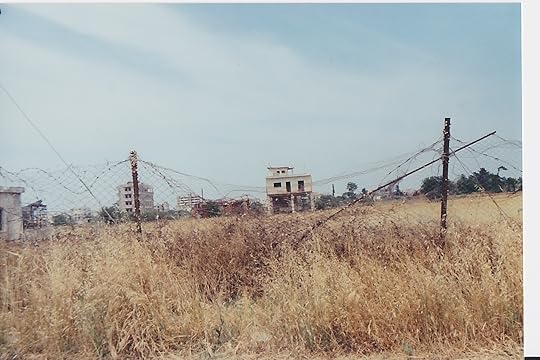 Photograph by Lakis Polycarpou
"In July, places like this around the Mediterranean are normally crowded with thousands of tourists. Yet a nearby beach, once visited by the likes of Elizabeth Taylor, Sophia Loren and Paul Newman, is different ...
Finding Varosha empty, Turkish troops sea...
Could the Vanishing City Soon Be Returned to its Rightful Inhabitants?
The New York Times reports that Varosha, Cyprus–the once-booming seaside city that became the largest ghost town in the world after the Turkish invasion of 1974–may soon be returned to its rightful owners.
 Varosha, the Ghost City in 2003. Photograph by Lakis Polycarpou.
In July, places like this around the Mediterranean are normally crowded with thousands of tourists. Yet a nearby beach, once visited by the likes of Elizabeth Taylor, Sophia Loren and Paul Newman, is different …
Finding Varosha empty, Turkish troops sealed it off with a wall of barbed wire, turning it into a so-called military forbidden zone. It has remained that way since, a symbol of an intractable problem in a region that is riddled with them.
Now, though, hopes are at their highest in years that this ghost resort may soon come back to life.
The story sites the “prevailing positive climate” in current negotiations between Cyprus president Nicos Anastasiades and Turkish Cypriot leader, Mustafa Akinci to reunite the partitioned island.
There is no doubt that the mood between the two communities in Cyprus has changed. When I visited in the 1993 and 1996 to collect oral histories and research my master’s thesis (research that would become the basis for August in the Vanishing City(http://august-in-the-vanishing-city.com/) and the coming Cyprus Chronicles books), bicommunual relations between Greek and Turkish Cypriots was at probably the lowest point since the invasion.
In 1996, the Greek Cypriot Motorcycle Federation staged a protest in which they rode from now-open Berlin all the way to the Green Line to show how Cyprus was the only place left in Europe without freedom of movement. They were met by neo-fascist Turkish counter-protesters (Grey Wolves) armed with clubs and iron rods; clashes led to the deaths of two Greek Cypriot protesters in the Dead Zone just south of Varosha.
 Greek Cypriot Protestor Tassos Isaak killed by Grey Wolves in 1996. Source: Wikipedia.
Even as it was trying to calm the street protests, the Greek Cypriot government was in the process of purchasing a Russian surface-to-air missile defense system to counter Turkey’s overwhelming military superiority–a move that the Turkish government regarded as casus belli and threatened full-fledged military action to stop it.
By the time I returned in 2003, however, the tenor had changed. Part of the reason was no doubt Cyprus’ imminent accession to the European Union. Turkish Cypriot leaders knew that without a settlement, they would never reap the benefits of being part of Europe. New leadership on the Turkish side led to the unilateral opening of the border to Greek Cypriots for the first time in 29 years (albeit without actually addressing the sticky question of sovereignty).
Traveling to Northern Cyprus for the first time in memory with my father was at once fascinating, depressing and surreal. The landscape had been systematically stripped of its Greek character. Ancient, historic churches had been turned into museums; villages of friends and relatives turned over to mainland Turkish settlers.
 Photograph by Lakis Polycarpou
But nothing was as strange as driving along the fenced edge of the ghost city of Varosha, a suburb of the ancient city of Famagusta. Unlike the rest of northern Cyprus, for which Turkish leaders had clearly had a resettlement plan, it seemed that they took Varosha by mistake after the Greek Cypriot population fled when the city was bombed.
As a result, the seaside town (and its incredible beaches) were wrapped up in barbed wire and set off-limits to anyone. It seemed the Turkish side at first intended only to keep Varosha as a bargaining chip to offer in return for international recognition of the rest of its occupation–recognition that never came.
 Photograph by Lakis Polycarpou
As a result, Varosha decayed and fell apart, year after year. In his book, The World Without Us, Alan Weisman visited Varosha and cited it as an example of what would happen to human infrastructure if all the humans suddenly disappeared.
By 2004, as Cyprus accession the European Union neared, the United Nations and the international community put immense pressure on the two sides to come up with an agreement to reunify the island.
The eventual U.N. plan that was presented to the Cypriot people (“The Annan Plan”) would have returned Varosha to Greek Cyprus as part of a broader scheme that would have dissolved the Republic and created a new bi-communal federated state.
Unfortunately, the whatever the U.N.’s intentions, the plan was fundamentally flawed (among other things, it would have recreated the divisive structure of the failed 1960s constitution, and would have allowed Turkish troops to remain in Cyprus in perpetuity) and was therefore rejected by the Greek Cypriot side in referendum.
Can the forthcoming plan succeed where previous attempts have failed? On the down side is the fact that many of the same core issues that have divided the two sides remain. On the plus side for settlement is the discovery of enormous gas deposits of the coast of Cyprus that would be much more easily exploited within a unified state.
 Gas discoveries around Cyprus. Source: Alternet.
As for Varosha, there is a possibility that it will be opened even without a comprehensive settlement: according to an article in Bloomberg last May(http://www.bloomberg.com/news/article...), Akinci has indicated that he is open to returning Varosha in exchange for opening Turkish Cypriot airports and ports to international traffic.
My novel, August in the Vanishing City, is a story about a young Greek Cypriot soldier who decides to return to Varosha, Famagusta to recover a keepsake that will help him win the heart of his childhood love.
August 23, 2015
The Cyprus Chronicles
It is with excitement, relief and nervous anticipation that I announce the publication of my first novel, August in the Vanishing City, the first book of my Cyprus Chronicles series. After writing some 86,000 words, I confess that at the moment I can think of little more to say about it right now–only that I hope my stories do this beloved island and its people justice.
Your second life starts when the world cracks you open — usually against your will. —Justine Musk
It seems reasonable, then...
July 20, 2015
The Cyprus Chronicles
Your second life starts when the world cracks you open — usually against your will.—Justine Musk
It seems reasonable, then, to suppose that dreams have always had some effect on human behavior; and it seems likely …. that they helped to make the whole structure of human culture possible. Creativity begins in the unconscious; and its first human manifestation is the dream.—Lewis Mumford

It is with excitement, relief and nervous anticipation that I announce the publication of my first novel,...