Jared Del Rosso's Blog
May 12, 2025
Whip-poor-wills were once the sound of spring
As spring unfolds, nightjars return to the northern United States. Whip-poor-wills are perhaps the best known and best loved species in this enigmatic family. They return with their famous song -- whip-poorwill, whip-poorwill, whip-poorwill. In a single exhalation of a small brown bird that few of us will ever see, the early spring night seems to turnover into summer.
Not surprisingly, the song of Whip-poor-wills is among the most iconic of the eastern U.S. It carries with it centuries of lore and superstition.
The call of the year's first Whip-poor-will was especially important. Part of long-standing phenology, it ended the threat of frost.
But the song of Whip-poor-wills has long meant more than that. From life to death to love, the song of the species once told us so much about ourselves.
For more, checked out my essay, "What does it mean when you a Whip-poor-will?"
Not surprisingly, the song of Whip-poor-wills is among the most iconic of the eastern U.S. It carries with it centuries of lore and superstition.
The call of the year's first Whip-poor-will was especially important. Part of long-standing phenology, it ended the threat of frost.
But the song of Whip-poor-wills has long meant more than that. From life to death to love, the song of the species once told us so much about ourselves.
For more, checked out my essay, "What does it mean when you a Whip-poor-will?"


June 21, 2024
The Literature of Nightjars: Thoreau's adventures with a Common Nighthawk
I'm unsure I can prove it, definitively but I think the Nightjar family is among the most influential in English literature.
Sure, there's a case to be made for other families of birds. The Corvids -- Crows, Jays, Magpies, and Ravens -- have their true believers. And who doesn't like an owl?
But from nature writing to poetry, song, and horror fiction, nightjars like Whip-poor-wills have been our fellow travelers. The book I'm writing on Whip-poor-wills is meant to uncover our journeys with this species and its family. To that end, I'm collecting all sorts of references, descriptions, and other cultural artifacts mentioning nightjars.
Lately, I've been smitten with Henry David Thoreau's writing about Common Nighthawks. A relative of Whip-poor-wills, nighthawks are the spark bird that brought me to this work on Whip-poor-wills.
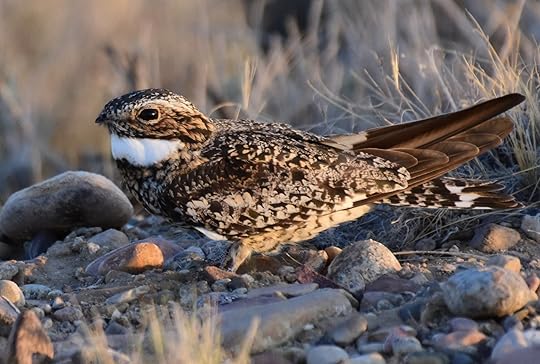
Over a century and a half ago, Thoreau discovered a nighthawk nest. This is a difficult thing, indeed -- for nighthawks, like other nightjars, are incredibly well camouflaged. He returned to the nest a few times in the summer of 1871, documenting the behavior of the mother nighthawk and her young chick.
He offers an extraordinary account of rarely seen behavior.
For more, including others' photographs of nesting nighthawks and young chicks, visit my blog.
Sure, there's a case to be made for other families of birds. The Corvids -- Crows, Jays, Magpies, and Ravens -- have their true believers. And who doesn't like an owl?
But from nature writing to poetry, song, and horror fiction, nightjars like Whip-poor-wills have been our fellow travelers. The book I'm writing on Whip-poor-wills is meant to uncover our journeys with this species and its family. To that end, I'm collecting all sorts of references, descriptions, and other cultural artifacts mentioning nightjars.
Lately, I've been smitten with Henry David Thoreau's writing about Common Nighthawks. A relative of Whip-poor-wills, nighthawks are the spark bird that brought me to this work on Whip-poor-wills.
Over a century and a half ago, Thoreau discovered a nighthawk nest. This is a difficult thing, indeed -- for nighthawks, like other nightjars, are incredibly well camouflaged. He returned to the nest a few times in the summer of 1871, documenting the behavior of the mother nighthawk and her young chick.
He offers an extraordinary account of rarely seen behavior.
For more, including others' photographs of nesting nighthawks and young chicks, visit my blog.
May 31, 2024
The Song of the Whip-poor-will
I recently had the opportunity to spend the May full moon with Eastern Whip-poor-wills in southern Missouri. And the birds put on a show. From nearly everywhere, nearly all night, they sang.
Everyone knows that Whip-poor-wills sing their name: "whip-poor-will." But listening to several, as their songs intertwined and sped up, I realized that this phrase doesn't do justice to their iconic call.
For more, including recordings of their songs, check out my new post at lonesomewhippoorwill.com.
Everyone knows that Whip-poor-wills sing their name: "whip-poor-will." But listening to several, as their songs intertwined and sped up, I realized that this phrase doesn't do justice to their iconic call.
For more, including recordings of their songs, check out my new post at lonesomewhippoorwill.com.
May 11, 2024
"As the Whip-poor-will's Chant Wanes."
Last September, I traveled to New York State to try to hear a Whip-poor-will. The time was only partly right to hear them, which is another way of saying it was partly wrong.
Sure, the moon was full, and Whip-poor-wills sing more vigorously under a full moon. But it was September. Autumn migration approached. Whip-poor-wills tend not sing regularly in late-summer and early-autumn.
And so, for days, the trip seemed futile. My brother and I drove around the Hudson Valley — stopping at roadside pull-offs, state parks, camp sites. We put our hands to our ears, amplifying distant sounds. A Barred Owl. Endless frogs. Passing traffic. But no Whip-poor-will.
After three or four nights like this, I began worrying at I’d crossed the country to tell a story of not hearing a Whip-poor-will. And as I free wrote, that’s what, in fact, it was.
And then it became something else: a story of environmental worry, a story of loss and nostalgia, and a story, eventually, of the icon of the eastern woods.
A few days ago, Audubon published my essay “As the Whip-poor-will’s Chant Wanes, Our Cultural Loss Grows,” about all of this.
"As the Whip-poor-will's Chant Wanes" addresses many of the themes I'm writing about in my new book about Whip-poor-wills.
For more, visit my website The Lonesome Whip-poor-will.
Sure, the moon was full, and Whip-poor-wills sing more vigorously under a full moon. But it was September. Autumn migration approached. Whip-poor-wills tend not sing regularly in late-summer and early-autumn.
And so, for days, the trip seemed futile. My brother and I drove around the Hudson Valley — stopping at roadside pull-offs, state parks, camp sites. We put our hands to our ears, amplifying distant sounds. A Barred Owl. Endless frogs. Passing traffic. But no Whip-poor-will.
After three or four nights like this, I began worrying at I’d crossed the country to tell a story of not hearing a Whip-poor-will. And as I free wrote, that’s what, in fact, it was.
And then it became something else: a story of environmental worry, a story of loss and nostalgia, and a story, eventually, of the icon of the eastern woods.
A few days ago, Audubon published my essay “As the Whip-poor-will’s Chant Wanes, Our Cultural Loss Grows,” about all of this.
"As the Whip-poor-will's Chant Wanes" addresses many of the themes I'm writing about in my new book about Whip-poor-wills.
For more, visit my website The Lonesome Whip-poor-will.