Linda Egenes's Blog
July 13, 2023
Fetching Dreams by Mary Bleckwehl: A Book Review
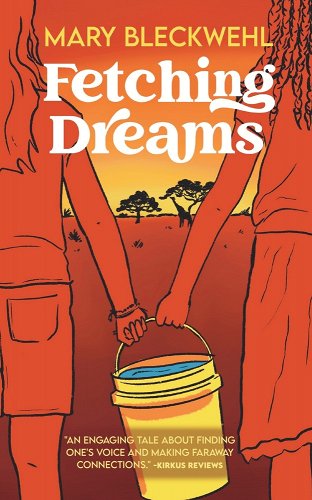 Fetching Dreams by Mary Bleckwehl is essential reading in 2023. Consider these summer headlines: “Heat Records Broken Around the Globe as Earth Warms, Fast” (New York Times). “The Colorado River is in crisis. And it’s getting worse” (Washington Post). “Supreme Court Rules Against Navajo Nation in Water Rights Case” (Wall Street Journal).
Now consider that 2.2 billion people in the world do not have access to safe drinking water. I was stunned to read this fact in the author’s notes of Mary Bleckwehl’s middle-grade novel Fetching Dreams. A moving account of one girl’s fight to bring water to her rural village in Africa, this story packs a powerful punch with relevance to communities all over the globe today.
The story opens when 12-year-old Neyah, who lives in a rural village in Africa, becomes pen pals with Abby, a girl her own age living in a Minneapolis suburb. Neyah dreams of becoming a doctor but as the only daughter must spend six or more hours a day fetching water for her family while her brothers attend school. On one of the few days a month that she is free to attend school, she learns that microbes in their muddy water are making her father and brother sick. With Abby’s fundraising help, the two girls vow to build a well with pure water in Neyah’s village—even when it brings Neyah in direct conflict with her tradition-bound father, who wants to sell her off to a wealthy farmer in exchange for more cattle. When Neyah slowly comes to understand that Abby is facing her own life-or-death struggle, the two girls help each other to grow and mature.
While the story has two middle-grade protagonists and is intended for children aged 10-12, I found it to be moving and meaningful as an adult reader. And while it’s clear that the biggest obstacle to safe water is poverty (only with Abby’s help and the help of an NGO can the well be dug), we also see Neyah struggling to find her voice to educate her family and village about safe water practices like boiling the water and washing their hands. It becomes clear that her father’s resistance is bound up in long-held beliefs in patriarchy, child marriage and fear of science. Yet through perseverance, Neyah not only saves her father, brother and other villagers from deadly sickness but frees herself and other young girls from the crushing burden of fetching water. Now they can attend school like their brothers and fetch dreams instead.
Fetching Dreams by Mary Bleckwehl is available in bookstores and online vendors such as bookshop, org and amazon.com. Find out more about Mary, her other books and her passionate mission to spark students’ creativity at www.marybleckwehl.com.



January 15, 2022
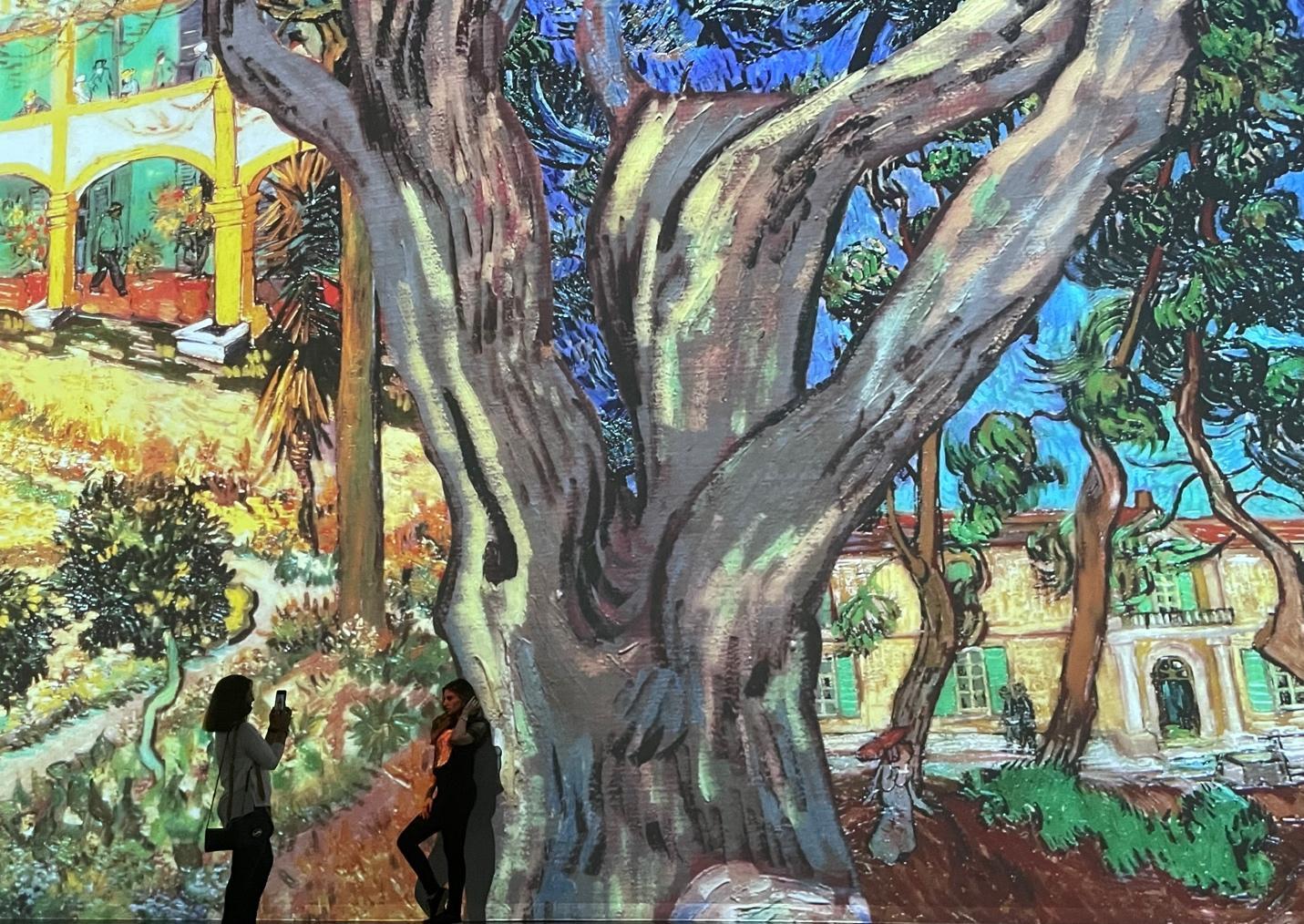
Stories from the Immersive Van Gogh
For me, there is only one other peak art experience that compares with the Immersive Van Gogh. When I was about ten years old my mother and her friend Ann Anderson took their kids on the commuter train to Chicago to see the movie FANTASIA. It was a grand adventure as my sister and I had never been on a train and rarely to the city even though we lived in Naperville, a suburb only thirty miles away.
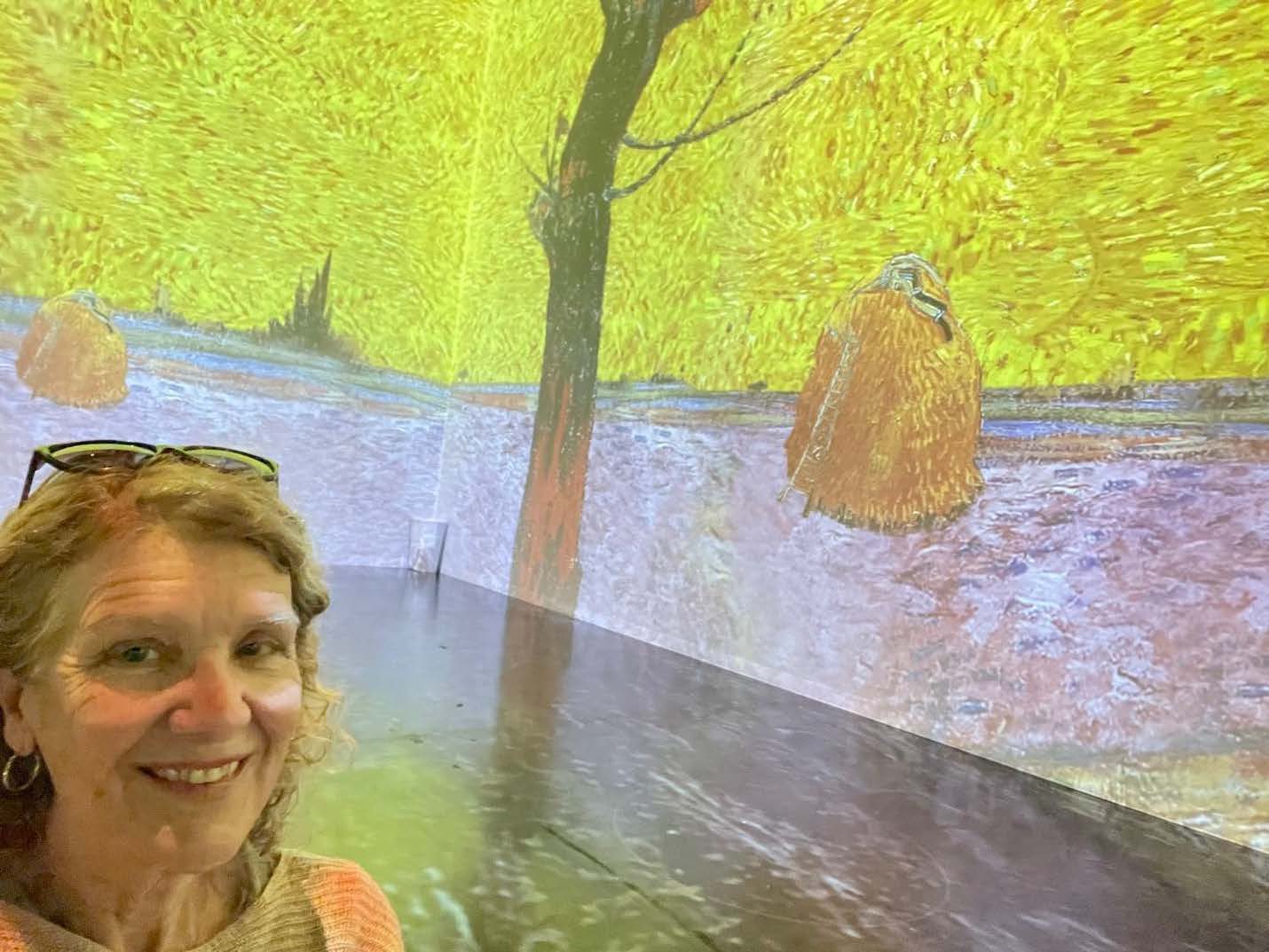
FANTASIA is still one of my favorite movies, just for the sheer beauty of it—not only the images but the music. Can I ever forget the Sourcerers’ Apprentice? I was reminded of the mesmerizing impact of seeing it on the big screen when I visited the Immersive Van Gogh last week in Orlando. It’s one of 14 cities where the exhibition is playing, and we just happened to be driving through on our annual trek to spend the winter in Florida.
Like FANTASIA, the Immersive Van Gogh is basically a movie, only it covers all four walls and the floor. Also like FANTASIA, it’s a painting in motion—it’s as if we are the artist creating the iridescent irises, the fields of wheat, the blooming sunflowers as they emerge and merge and melt away.
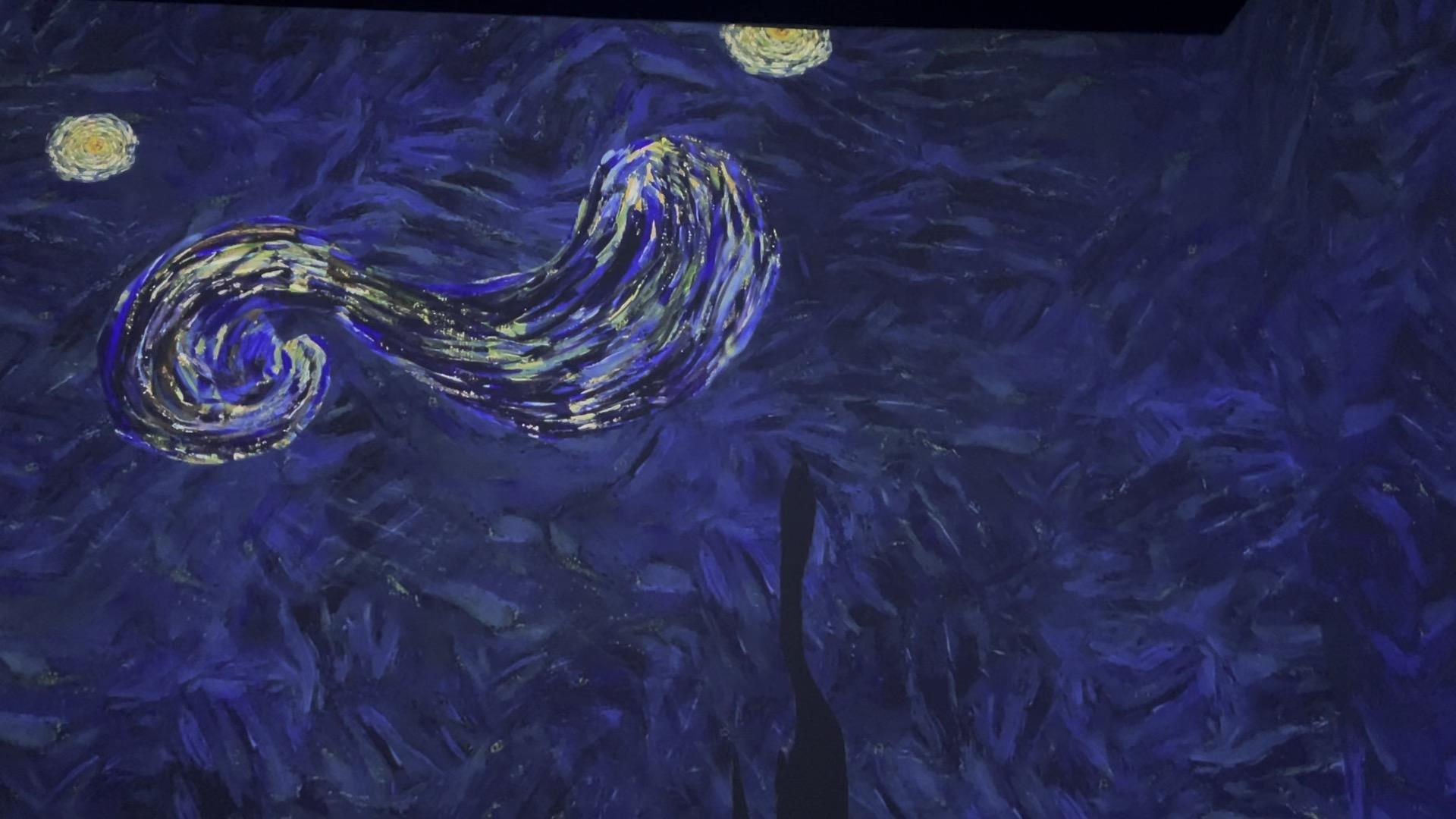
And like FANTASIA, it’s a movie that’s not big on story. It’s an experience, an ecstatic one at that. The stories, I found, were in the people who were viewing it—the family grouped on their socially distanced, Covid-spaced circle on the floor, with the two kids sliding out and bouncing back with a few acrobatics thrown in—dark figures against the vibrantly colored walls, a dance especially for me. Or the mother-daughter pair—the daughter preening like a fashion model as the screen changed from Dutch peasants to the city of Arles to the starry nights and the mother tirelessly took photos. They stopped for a while and sat on the circle that the family had vacated, only to step up and start again.
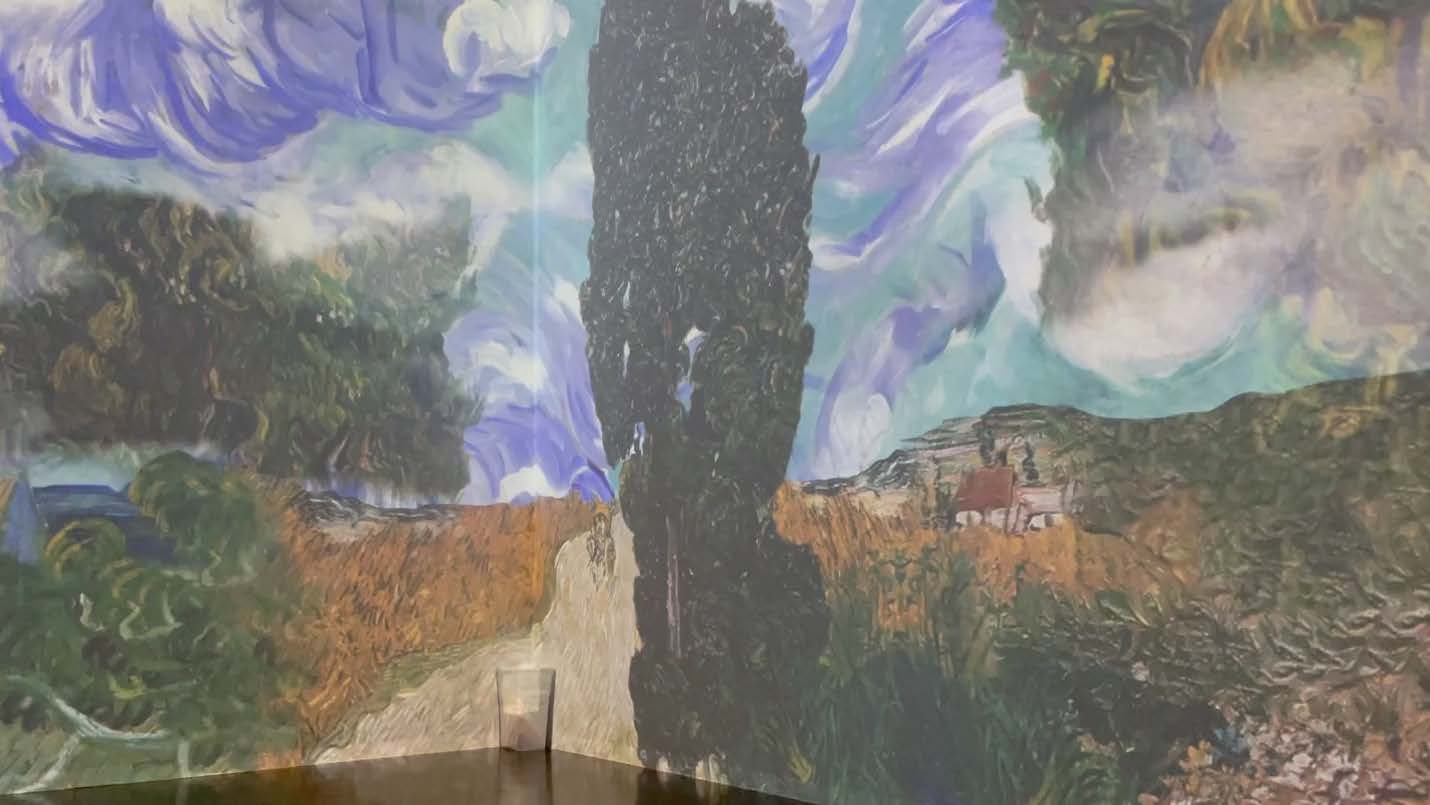
I took some shots myself—it was impossible not to. (And it was encouraged by the producers to share photos and videos of the exhibit.)
I do recommend the Immersive Van Gogh if you can Gogh—their Covid-safe policies of required masks, limited crowds and social distancing made me feel like it would be OK to risk going.
January 10, 2022
The Magic of Research
I’ve heard some writers say that research is their favorite part, when the universe yields the exact fact or story or connection you need for your project. This is the magic of research.
While wrapping up my YA historical novel set in Kalona, Iowa, in 1944, I still feel like writing is my favorite part. But I have had quite a few moments of universes colliding that make the research part equally magical.
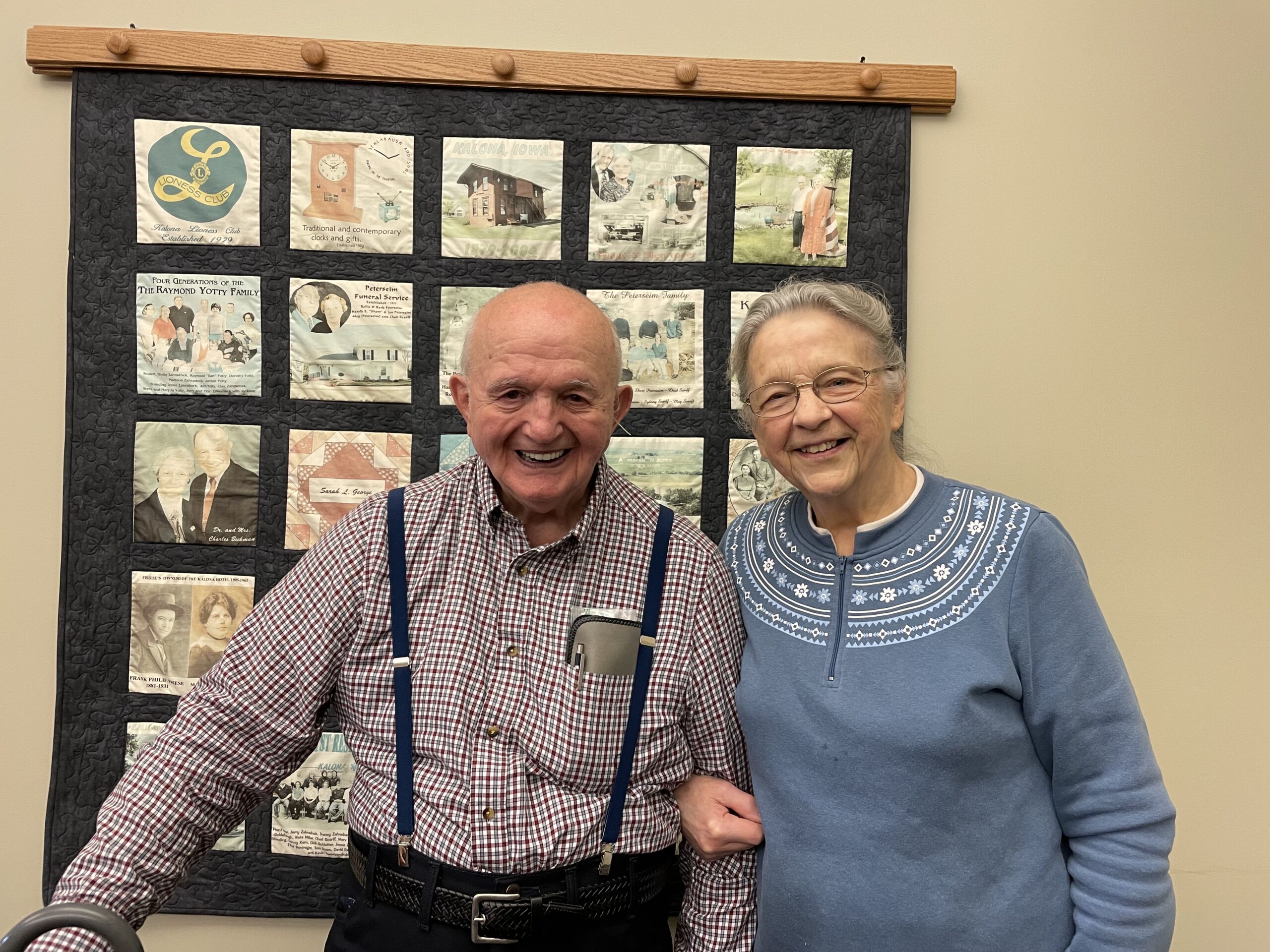
Frank and Ada Yoder, two angels who have helped me with my research since the 1990s.
Every time I go to Kalona, something magical happens. This started while researching my book of nonfiction essays, Visits with the Amish: Impressions of the Plain Life, published first in 2000 by Iowa State University Press and then in 2010 by the University of Iowa Press. I had been meeting Amish families in Bloomfield, Iowa, but to complete my book I needed some contacts in Kalona. One thing I’d learned—when meeting Amish families for the first time, it helps to be introduced by someone they know.
So this was a problem—I didn’t know a soul in Kalona.
Then in November of 1994, I was driving home from Iowa City in the dark with my friend Charlotte. We had been shopping for a wedding gift for her daughter, and had stayed too long. Suddenly we were driving through fog. It was cold, it was dark, it was about 6:00 in the evening and we were tired. We wanted to get home. So I kept driving—not knowing the heat gauge had broken and it wasn’t fog but my engine smoking—until the car stopped altogether.
None of that was magical, but the next part was. My car stalled in front of a farmstead along Highway 1 in Kalona. We walked to the nearest building, a tidy trailer to the left of the driveway. Inside were two of the kindest people you could ever meet, Frank and Ada Yoder. They not only let us use their phone to call my husband, they fed us snacks while we waited for him to borrow a car and drive all the way from Fairfield to Kalona to pick us up.
It turns out that Frank and Ada had both grown up in the Kalona Amish community, met on the playground at Evergreen School, and had been together ever since. A few years after they got married, they left the Amish to become Conservative Mennonites. The property where they lived had been in Ada’s family for generations, and their son and family now lived in the big house while they lived in the smaller grandfather (grossdaddi) house, as is the tradition among the Amish.
Little did I know then, this was the beginning of a friendship that spanned decades.
A few weeks after my car was towed away, Frank and Ada did another immense favor for me. They introduced me to four Amish families in Kalona who I visited and wrote about in my Visits with the Amish book.
In 2009 I started researching my historical novel and returned to Kalona whenever possible to interview Amish and Mennonite people who lived there during WWII and to research documents in the Mennonite Museum and Archives. I reconnected with Frank and Ada, who spent many hours answering my questions and helping me understand what it was like to grow up on an Amish farm.
I found out that Frank was also a writer, writing a weekly column in the Kalona News about his experiences growing up in Kalona. He later gathered these stories in a delightful book called Lena’s Boys: Adventures on the County Line Road, 2019. Frank’s stories make life in the 1930s and 40s as tangible as the taste of homemade ice cream eaten on a hot summer’s day. Frank’s true and charming stories became a major resource for imagining the life of my protagonist (Ida Mae) on an Amish farm in 1944.
And our connection doesn’t stop there. This past fall Frank and Ada became one of the first readers of my manuscript, vetting it for historical accuracy and cultural authenticity. While discussing their reactions, Ada mentioned that David Yoder—a Mennonite minister I had interviewed in 2009 and mentioned in my historical notes because he told a true story that became one of my plot points—was Frank’s older brother! David and the others I interviewed in 2009 have now passed away, so I was so lucky to have had the opportunity to hear their stories of serving in CPS (service camps for conscientious objectors) during WWII. .
This fall I was invited to a book reading of Frank’s at the Kalona Public Library (staffed by librarians who have been incredibly generous in sharing their amazing resources and have also been among my first readers—thank you, Olivia and Treavor!!!). This reading was for Frank’s sixth book, Miss Hattie Gibbs and Her Amish Friend, Katie Lapp. It’s the last book in a trilogy that includes Roy’s Story: Renewing His Faith in God. Frank is 93 and still writing—truly an inspiration to me.
I can never thank Frank and Ada enough for their help and encouragement with both of my books. And in keeping with the faith of the Amish, I no longer view my chance meeting with them as magic. I see it as the hand of God.
The Kalona News featured a story by reporter Molly Roberts about the book signing that mentions me–read about it here.
January 5, 2022
Favorite Book of 2021: Poet Warrior by Joy Harjo
This year it was easy to choose my favorite book: Poet Warrior by Joy Harjo. Usually when someone asks me to name my best-loved book or movie, I have a really hard time figuring it out. Do you mean the favorite book and movie of my childhood (that would have to be The Five Little Peppers and How They Grew by Harriet Lothrop and Dr. Zhivago) or the book that made me want to be a teacher (Education and Ecstasy by George Leonard) or maybe the one that introduced me to the magical realism of South American literature (Eva Luna by Isabel Allende). Then there are the ones that made me love South Asian, Southern, and Native America fiction . . . . well, you get the idea.
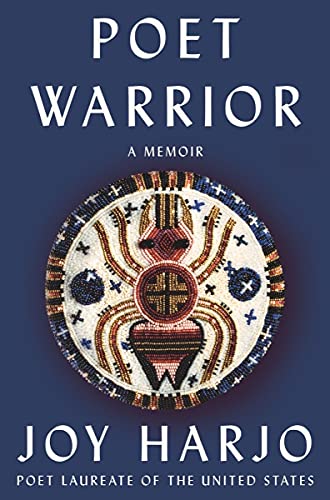
So I’m being really specific here when I say that my favorite book of 2021 was Poet Warrior by Joy Harjo. For one thing, it’s one of the rare times I’ve splurged on a brand new book so I can write about it during the year it came out. For another, it’s mesmerizing.
I love that it’s a hybrid text, part memoir, part poetry. Not surprising since she has been our nation’s poet laureate for the past three years. While her poetry is often narrative, her prose reads like lyrical poetry. Together they weave a tale of loss and love, hardship and forgiveness, exile and coming home.
As a member of the Muskogee (Creek) nation, her narration of societal abuse, racism and family dysfunction is unsparing. Yet she manages to infuse her past with such tender forgiveness toward the people who have harmed her—and to find her path forward by embracing the music, stories, spirituality and creativity of her people, all the while creating something so moving and original that it feels like a sacred revelation.
I’m not sure how Joy Harjo works her magic, because her words are simple, not at all showy. I can only feel that it’s her very soul that she lays on the page—and it’s a wise and beautiful one, nurtured by the spirits of her ancestors, who are with her daily. She shares the journey, helping us learn what she has learned.
In her preface Joy Harjo writes:
“To imagine the spirit of poetry is much like imagining the shape and size of the knowing. It is a kind of resurrection light; it is the tall ancestor spirit who has been with me since the beginning, or a bear or a hummingbird. It is a hundred horses running the land in a soft mist, or it is a woman undressing for her beloved in the firelight. It is none of these things. It is more than everything.
‘You’re coming with me, poor thing. You don’t know how to listen. You don’t know how to speak. You don’t know how to sing. I will teach you.’”
January 1, 2022
New Year New Website
As you can see, it’s a New Year and new website for me. And I’m also trying a new format for my blog—now called A Writer’s Journal instead of Green and Healthy Inside Out. Since I’ve been focusing on fiction writing lately (finishing a novel started in a prehistoric form twenty-five years ago) and will be teaching as a faculty mentor in the new MFA in Creative Writing program at MIU in spring 2022, I decided to make my blog more about the writing process itself.

The green and healthy themes will still be there as I’m passionate about both topics, but I’ll be sharing creative thoughts and images and inspiration for writing too. And the green and healthy posts from the past are still there—you can access them by topic or date in the sidebar.
Another impetus for change came when my website was hacked in August 2021. A friend emailed “Did you know that your site is selling viagra pills?” That was a wake-up moment.
In the process of getting my site restored, I turned for help to Cindee Van Dijk of Van Dijk Consultants. She explained that my website/blog was so old (yikes—did I really start it in 2009?) that I was vulnerable to further attacks. And really, it was time to rebrand. And I was so lucky to have Chosie Titus do the clean, simple design–I’m thrilled with it!
So here it is—a new year, a new look as they say.
Hope you enjoy.
December 15, 2021
This Enduring Gift
“A poem is…it cannot be otherwise… seldom explained…it spreads its words…on a page…hovering in a white sky…” So begins world-famous singer/songwriter Donovan in his poetic foreword to This Enduring Gift.
Here’s one of my poems from This Enduring Gift, a poetry collection by 76 poets of Fairfield, Iowa
Lin’s Hammock
A garden room,
waxen white gardenia in a pot,
cool, sweet relief from summer’s heat.
A whiff of rosemary
and the
hammock suspended on a wooden frame.
I lie down and
drift into a reverie
of cloud and leaf
bird and flit
shadow sunshine sky.
Distant shouts,
children laughing,
a bicycle passing
on the path below.
and then stillness.
A sudden sadness
for the rush of life–
when all we ever wanted
was to be cradled by air.
Praise for This Enduring Gift:
“This Enduring Gift is a wonderful compilation of the many rich voices and gifted poets who live in Fairfield, IA–a unique spot on the map. This anthology should not only endure, but inspire, enlighten and entertain all who touch its pages.” Mary Swander, former Poet Laureate of IowaAuthor of Girls on the Roof “This Enduring Gift is a testament to the abiding power of poetry within a particularly unique community and, by extension, speaks to poetry’s universal relevance. Here, a convergence of voices from places near and far, gathered in a small Midwestern town observe, reflect, meditate, and wonder. From evocative lyrics to compelling narratives, from precise moments of deeply felt experience to inquiries of mystical complexities, these poems resonate with individual authenticity and true collective spirit.” Walter E. Butts2009-2014 Poet Laureate of Hampshire Previous NextBeing Our Own Heroes
What started as a meeting of minds quickly became a melting of hearts. What did I expect at our first gathering, a continuing education class in memoir writing? I have to admit, I didn’t anticipate how deeply these writers of my parent’s age would connect to writing. In this collection of their works, you will find simple, honest stories that reveal deep truths of life. You will be sent back in time to touch the plush velvet of a special dress, smell the smoke pouring from a Model T engine, hear the winds of a prairie childhood. After so many years of accommodating others on this planet, these writers stood up to be heard, to sing the song of their Self in their authentic voices—undoubtedly the most important difficult writing skill to master. It was a privilege and an honor to be called their teacher, when they, in fact, taught me.
BUY NOWThe Plain Reader
I was honored when Scott Savage, my editor at Plain magazine, included one of my essays in his collection. I was even more honored when I found my story wedged between selections by Bill McKibben, David Kline, and Wendell Berry. Here’s the opening paragraph of my essay, “Among the Amish.”
“Like the wrinkles of a colorful Amish quilt, the peaks of the Blue Ridge gradually soften into gentle hills by the time you reach Yadkin County, North Carolina. It’s along the neatly paved back roads, rising and dipping with the land, that the quiet beauty of spring-green hay fields, rimmed by distant mountains, takes over. Buck Shoals Road is one of the few here not named for a church, but it compensates by riding past three houses of worship in less than three miles.”
And here’s an excerpt from the back cover of the book:
On roads far from the intrusions of modern technology, the Amish, Quakers, and other “plain folk” live their unencumbered lives, close to the land, in peaceful, smoothly-run communities. The thought-provoking, often challenging essays in The Plain Reader are written by men and women who rarely speak outside the borders of their local townships, and provide us with unique perspectives on life stripped down to necessity. Originally published in Plain Magazine, these pieces are sure to inspire reflection.
Reading about a garden cooperative in Connecticut, the raising of a home with only plaster and straw in hand, a fascinating trip to New York City through Amish eyes, compels each of us to wonder: Can I too survive without television or that high-tech appliance cluttering my kitchen counter? Am I just a cog in the wheel of the global economy? Is isolation from one another and from the earth the simple destiny of humankind? Each rich, personal essay in this provocative collection offers solace, wisdom, joy, and quiet space for contemplation.
BUY NOWNovember 20, 2021
Conquering Chronic Disease
Millions of Americans suffer from chronic disease ranging from life-threatening cancer and heart disease to allergies, asthma, and arthritis. Many of these chronic complaints can be prevented with a natural approach to health. This groundbreaking book explains the origins of chronic disease and offers simple and effective ways to deal with it through Ayurvedic medicine.
You will learn:
• how chronic disease arises and how to prevent it
• how it can be diagnosed and treated in its early stages
• how to regain your health and maintain a healthy lifestyle
• how scientific research supports Ayurvedic medicine and this natural approach to healthy living
BUY NOWPraise for Conquering Chronic Disease
“This natural approach to chronic disease is much needed right now. It is essential for people to have more peace, tranquility, and a balanced approach to living as a basis for better health.” Patricia BraggHealth crusader and best-selling authorSuper Healthy Kids
All parents want the best for their children. Yet when caring for a sick child, it’s hard to know what to do. The time-tested wisdom of Ayurvedic medicine offers surprisingly effective solutions to children’s health problems today—from ADHD to obesity.
This step-by-step guide explains how to use natural solutions such as diet, lifestyle, daily routine, meditation, massage, exercise, yoga postures, herbal remedies, and aroma therapy to prevent illness and restore balance. With this practical book in hand, you can keep your children healthy without negative side effects.
Inside you’ll find:
• Insights into your child’s mind-body type
• Top five foods to boost immunity and prevent disease
• Healthy recipes kids will love
• Daily stress-relief habits to teach your child
• A directory of common childhood illnesses with holistic remedies from Ayurvedic medicine
• The role of digestion in creating mental and physical balance
• Ten ways to protect your child against environmental toxins
BUY NOWPraise for Super Healthy Kids
“At a time when many parents are leery about over-using antibiotics and prescription drugs, Reddy and Egenes make a clear case for natural Ayurvedic medicine. This book is a ‘must have’ for all creative, responsible parents. John C. Peterson, M.D.Board Certified in Family Practice, practitioner of Maharishi Ayurveda health care since 1984 “This knowledge of Maharishi Ayurveda for your child’s health is invaluable for preventing imbalances and promoting strength and happiness. Thanks to Reddy and Egenes for providing this comprehensive book for parents and health-care professionals." Chris Clark, M.D.Author of CONTEMPORARY AYURVEDA “This book should be a principal reference book for all mothers and mothers-to-be who want to nurture and care for their children using the best natural preventive methods available for maintenance of health and a disease-free life.” Mousumi Dey, M.D.Former consultant for the World Health Organization (WHO) Previous Next