Hannah Ross's Blog
July 17, 2024
Cursed Earth Is Out Today!
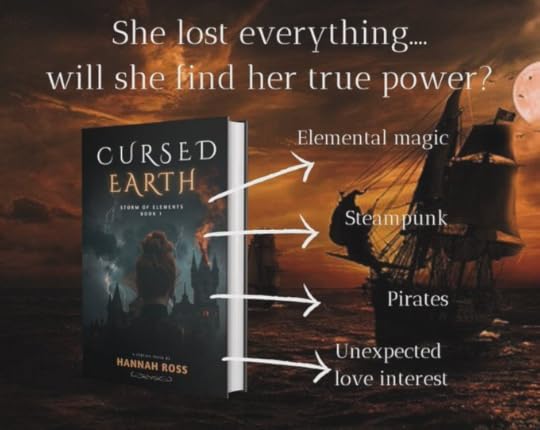
I'm thrilled to announce that Cursed Earth, the first installment in my new elemental fantasy series, is now available on Kindle and in paperback! Check it out on Amazon and enjoy a wild dark fantasy ride with a steampunk-y backdrop and Pirates of the Caribbean vibes.
“I can never go back to Terrenia,” Maxine said in a low voice. “If someone finds out…”
“… that you have unusual abilities?”
“That I’m a freak – yes, a freak – I will be facing worse than deportation.”
#newreleasebooks #indieauthors #indiebooks #steampunk #fantasybooks #cleanindieread #elementalfantasy


July 6, 2023
Exploring Cultural Clashes Through Sci-Fi and Fantasy

As human beings living on Planet Earth, by default everything we write – even the most imaginative science fiction and fantasy – mirrors our culture in some way. One thing I really appreciate about fantasy and sci-fi is the way these genres allow us to explore difficult social concepts, historical trends, and other complex topics in a way that’s comparatively safe and non-confrontational (because, after all, we’re dealing with an imaginary world and not levelling accusing fingers at anyone).
As I was writing Frozen World, my environmental science fiction series set in Antarctica, I was thinking a lot about indigenous cultures worldwide. I won’t go into specifics here, but we know that, as a rule, contact with Europeans has been devastating to so many indigenous people worldwide. From the civilizations of Mesoamerica to Australian aborigines, native people suffered staggering losses.
A question I asked myself was, “What if a completely new indigenous civilization were discovered today, in an era of (hopefully) more advanced ethics and greater cultural sensitivity?” – and this is one of the core questions I explore in Frozen World.
The key premise of the books is that there is a warm and fertile oasis in Antarctica, and this oasis hosts the ancient people of Anai, a stone-age type civilization that has built a harmonious and socially evolved culture. The U.S. government stumbles upon the Anai, and instead of encroaching upon this civilization in any way, it issues an official policy of preserving the Anai culture in its pristine, original state.
Of course, this approach is arguably better than an outright violation of indigenous people’s rights or taking over their lands. But as the plot unfolds, we begin to understand how this attempt to preserve living people as a type of Stone Age relic is also highly unethical and patronizing. Someone up there has decided that, for these people’s own good, they should have no access to modern technology, information about the outside world, or even life-saving medical care – the “do not interfere” policy leads to death when a native hunter sustains serious injuries that modern medicine could have treated.
Scott Buckley, one of the main characters of Frozen World, fights for freedom of choice for these indigenous people. They have the right to decide, he argues, whether they want to partake of the modern world, and to what degree. Free choice is a universal concept in just about any fiction genre, especially as it clashes with the plans and ulterior motives of high-powered people pulling the strings.
What I love to show through my books is how basic human patterns are ubiquitous, whether the plot takes place in Ancient Rome or on Mars. Greed, thirst for power, and the desire to control others are entirely universal, just as are love, selflessness, and the desire to be understood and accepted. At our core, we always stay human – and that’s a key message of many great fantasy and science fiction works.
May 3, 2023
Frozen World Is Now Available as a Book Set
Just a short notice: Frozen World is now available in a convenient Kindle box set edition. You can grab all six books of this epic sci-fi series for only $4.99!
April 10, 2023
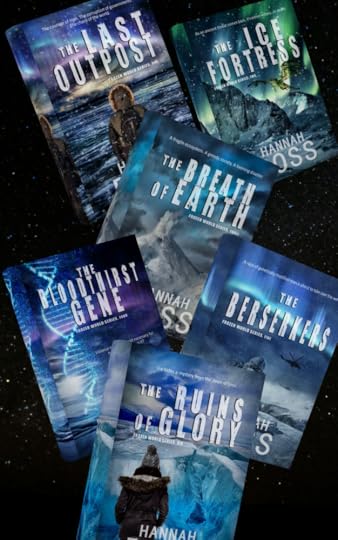
The Frozen World Series is Finally Complete!
Six books. Over 350,000 words. Five years. A host of beloved characters and an endless rollercoaster of plot twists. Every series has its Grand Finale, and now it has happened for Frozen World, with the release of the sixth and final installment, The Ruins of Glory.

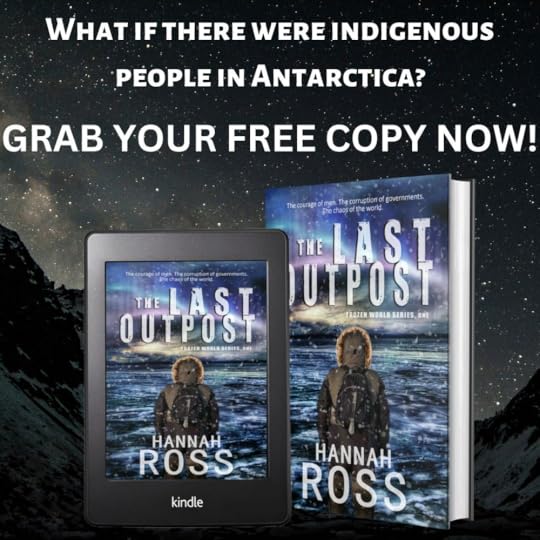
Also, to celebrate the launch, I'm making The Last Outpost, the first book in the saga, FREE on Kindle until April 14th, so now is the perfect time to grab your copy and dip your toes into this action-packed series.
January 16, 2023
Walking on eggshells: diversity in literature

Here is another article that serves as a perfect example of how diversity in literature is becoming a scattering of sharp eggshells authors find extremely hard to walk on, because whatever you do (or don't do), there will be people wielding a large magnifying glass, scrutinizing your work and tsk-tsk-ing about your shortcomings. And the shortcomings are there, believe me. Because whether you underplay or emphasize race, whether you include many minority characters or not enough, someone out there will complain.
And even if you have the perfect nonwhite, non-standard main character and do it all perfectly, it's a shame you had written this at all, because #ownvoices, you know?!
A disclaimer: I hate racism and bigotry. I hate those things with a passion and whenever I encounter them, my blood pressure rises, my heart starts racing, and I normally won't walk away without taking a stand. You want some background? Hitler nearly wiped out my family. Being Jewish, I belong to one of the most ethnically diverse peoples in the world, with a Jewish diaspora having existed in almost every country from Finland to Ethiopia (and yes, they are all MY people! Jews from Yemen and Jews from Ukraine. People who speak Yiddish, Arabic, Amharic. People who make gefilte fish and people who make couscous. Isn't that awesome?)
I find the very beginning of this article - "adding diversity to your writing is a difficult task" - a bit problematic. I can honestly tell you I have never gone through a manuscript saying, "hmm, is this diverse enough? Have I included enough minority characters?" - nor do I think it would be reasonable. My books don't generally focus on race. Neither do, or should, most books. I do have characters of various ethnicity, but it has always been a part of who I was, not a "let's include this character and that character because DIVERSITY!" thing.
And how about, "Also, don’t dehumanize us. A common example is equating skin tone to food. Avoid this insensitive technique as it’s a grave reminder of our history as slave labor involving commodities like coffee, cacao, sugar, et cetera. We are not products to be consumed, so do not treat us as such."
Really?! What about peaches-and-cream skin? Honey-colored hair? I could go on but you get the idea. Once, I recall reading about a farm worker's freckles described as "a smattering of golden wheat grains". Does this allude to social oppression?
It is true, however, that description of characters' looks shouldn't boil down to redundant cliches. I have learned some important lessons in this during my work as an editor of translated Chinese novels. In books written by Chinese authors where all the characters are Chinese, nobody has "silky black hair and almond-shaped eyes" (you could as well describe someone as 'the dude with two ears and one nose'). Characters are described as having heavy brow ridges, high cheekbones, light or heavy build, thin or puffy lips, and so on. And the occasional European or American foreigner? He doesn't get any description beyond "the middle-aged Caucasian man".
My own novel, Land of the Lost Tribe, takes place in Ethiopia. You can bet I didn't describe any character as "dark-skinned" or "with kinky hair" (beyond the encounter with different-looking foreigners). I had to get a lot more creative!
As usual with diversity posts, I feel I could go on and on. But you know what? I won't. Just go ahead and write that story. A darn good story with awesomesaucy characters and spot-on brilliant descriptions. Write what fires up your imagination and don't worry about anything else, because you can't please everyone anyway.
January 4, 2023
Author Spotlight: Cassie Greutman
Today, we meet Cassie Greutman, an indie author who published Regeneration and other books in the action-packed YA urban fantasy Penchant for Trouble series.
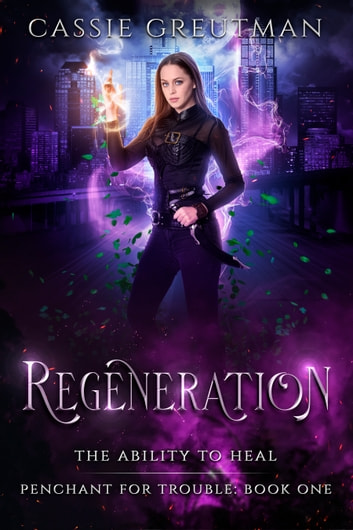
Regeneration, the first volume of Penchant for Trouble, just won the regional Indie Author Project contest and is up for the national title. Here's an excerpt from the book description:
"At sixteen years old, Trisha has been in the foster care system for years and has barely survived. She has always felt different. An outsider. That’s how it must be. After all, she has a secret to protect.
But the time to hide her truth may be at an end.
Dragged before the Faerie Council, her fae lineage makes it mandatory for her to bend to their will. A hunt is underway for a fae fugitive and she is to join the team tracking him. Saying no isn’t an option. The stories of what they do to those who disobey orders chill her to the bone."
Sounds like the perfect read for those looking to escape into a world of magic and adventure.
About more about Cassie Greutman: Cassie is a small-town Ohio girl who has always loved stories in any form. You can usually find her typing away at her computer or playing out in the barn with her ponies.
You can find Cassie's books on:
To get the latest updates about Cassie's upcoming books, follow her Facebook page. Penchant for Trouble is definitely going on my reading list this year!
December 22, 2022
The Downside of Discipline: A Throwback to 2019

Those who have been reading my blog for a while know that my biggest point of writing advice is: Consistency! Consistency! Consistency! Write 1000 words a day, every day. I don't believe in writer's block. My "writer's block" consists of a kid or three blocking my way to my laptop because they want to watch cartoons on it.
I do know, however, that there is such a thing as burnout. I was quite alarmed, once, at my sudden intense aversion to books and daydreaming of never having to write a single darn thing again. Was this me? Me, the one who has identified as a writer and storyteller since the age of six?
I give myself more slack now. Well, perhaps "slack" is not the right term. I work as a fiction editor, so basically, my whole life revolves around books. Every month, I edit the equivalent of two full-length novels. I read no less than 50 pages of fiction, sometimes written so poorly it makes my eyes water, every day just for work. Is it any wonder that when night rolls around I often feel so run down I can't bring myself to read anything but crochet patterns?
In 2017 and 2018, I released four books per year. In 2019, I released two, and my output is not about to increase in 2020 if the volume of work I perform each month remains the same. I enjoy what I do, but I just had to come to terms with the fact that it takes up, in addition to time, some of the "writing space" in my brain.
So I just had to let my brain lie fallow for a while. Remember the concept of the Sabbatical year? Not working the land and just leaving it to soak up the rain and dew and letting the worms work their magic? A year might be a bit excessive, but after the release of The Breath of EarthI stepped back and allowed myself to slip into hibernation mode. Read for fun, no review copies. Watch inspirational videos (Antarctic scenery. Who doesn't love to watch whales frolic and call it research?). Just sort of vegetate until writing started to be fun again, rather than a lifetime penance.
Now that the mojo is back, it's time for some discipline again. Time to tell myself, No, you won't just 'check your email for a moment'. You won't get up to get yourself another piece of chocolate, you glutton. You'll keep at it until your 1000 words are added to the daily word count, you lazy slug.
December 14, 2022
Can editors be affordable?

"How are indie authors supposed to be able to afford editors?" - this is a question I have encountered numerous times on social media lately, sometimes accompanied by "I have a budget of $300 for this. Is it enough?" And someone somewhere in the comments usually suggests, "there are plenty of affordable editors out there".
As both an indie author on a budget and an editor doing my best to offer my clients quality service and fair prices, I understand both sides of the equation, and I will look at them both here. First, let's try to do some math and figure out whether editors are overpriced and what a reasonable fee would be.
While editing, I put in close to one hour per 2,000 words, on average. Does that sound too long? Consider that this includes corrections, comments, and suggestions for the author, and often revision. How long would it take you to revise your own book? An editor would likely spend more time on it because they would see more stuff that needs to be addressed.
So that comes up to 50 hours of work per a 100,000-word novel.
How much would you say an editor should earn per hour?
If I charge $1,000 for the editing of a 100K book, I earn roughly $20 per hour. It is a modest fee, but something I can live upon. Many people, however, expect to have their epic novel edited for $500, or lower. That would mean the editor earns $10 per hour or less.
You won't find someone experienced for $10 an hour, because people who charge so little don't stay in the field. They cannot support themselves and their families. They quit in burnout and frustration and go flipping burgers because it's more financially rewarding.
So that's the editor's side of the story.
Authors, on the other hand, are often told, "Save up for self-publishing. Don't even think of releasing a book before you have a $2,000 budget for editing, cover design, and marketing."
The sad truth, however, is that many self-published books will never make enough to pay off a $2000 launch budget. Even if they are well-written, well-edited, and have a great cover. Many wonderful books just don't make it, and it's really hard to predict which ones will.
For an author who is struggling financially, pouring that much money into a single project can be devastating. They can literally discover they had taken bread out of their children's mouths for nothing. I understand perfectly well that authors aren't simply being cheap. People are struggling to put food on the table.
Sometimes you get lucky and can find an editor who's really good but just starting out, and they'll work on your book for $500. Or maybe you happen to be a brilliant cover designer and can arrange for an exchange of favors with an author-editor who needs cover design. But otherwise, yeah, when you say that you can't afford an editor, I hear you. I couldn't have afforded me if I had to pay myself to work on my own books.
There are no easy answers to this conundrum, that's for sure.
So what I suggest might sound harsh, but if you can't afford an editor, you can't. Revise the heck out of your book, invest in programs like ProWritingAid, and arrange for swap reads with other authors. Try your best and save up what you make from this book for editing the next one. It is not an ideal solution, but it's better and fairer than trying to find someone who will work for $5 an hour.
December 11, 2022
How much should you work?

Recently, I had the chance to stumble upon this great article, which confirmed something I have been thinking for quite a while.
"We are not here to work to work to work to die.
We aren’t.
There was a stage in building my business where I hustled and built connections with publications that had large followings and an audience so that when my work went viral, said audience followed me which now leads to revenue with cultural influencer jobs, clients, public speaking opportunities etc. etc. however, I truly believe that I chose to struggle unnecessarily for a few years of that.
I chose that because I grew up wired to believe that good people couldn’t have lots of money, and that artists had to starve and work a second job."
I actually found this article while Googling "tired of hustling"... and for good reason, it seems. I think this lady is insanely lucky, and things certainly don't work this way for everyone, but there is still a lot of truth in what she says.
I work as a freelance editor, proofreader, and copywriter, besides authoring and publishing my own books. When I first started freelancing, I was unfamiliar with the platforms, didn’t know anybody, had no experience, and had to hunt and hustle for every project. Thankfully, I am not in that place anymore, and usually have more incoming work than I can reasonably commit to, so I have to be choosy and know when and how to say no.
It isn’t always easy when a client asks specifically for you and you value that professional relationship, but I do have one principle to guide me: I chose to freelance and work from home, rather than opt for more traditional employment, because I wanted the freedom and flexibility to be with my children. I wanted to be there to teach them, take care of them when they are sick or need me for other reasons, and to have a flexible schedule that would enable me to set work aside for a while and just go out to enjoy the sunshine on a nice day.
The problem is, when you are an independent entrepreneur, you don’t have set hours. You don’t just punch a card and you’re done for the day. There are always new projects to check out, books to work on, clients to communicate with, emails to send, research to do… And it’s quite easy to get caught in all that, so that you get annoyed with life for getting in the way of work – which is not very reasonable.
My top tips for maintaining a healthy balance are as follows:
1. Know and accept you will never be able to do it all or to please everyone. There will always be projects and clients you miss – but the good news is, life is dynamic, and there will also be new ones.
2. Be realistic. How many hours a day can you reasonably commit to? Without overworking and compromising the quality of your work? Without snapping at your children? Without pulling half- or all-nighters?
3. Be your own boss, but as if you were the boss of someone else. I mean it this way: if you were employing someone, and that someone had no time for lunch break or recreation or adequate sleep hours, would you consider yourself a very good employer? Would you expect high productivity and quality work from a harassed, overwhelmed employee? You see my point. Treat your body and mind with kindness and respect, and you will enjoy a routine that is both more peaceful and more productive.
How to survive with no support network: for authors

You know those heart-warming statements by successful authors who say, "I would never have been able to get to this point without my spouse/family/significant other. Their support meant everything to me along the way"?
This is great, it really is. I'm always happy for authors who had that support from their nearest and dearest while they were clawing their way up the rocky, lonely path from first draft to publishing success (whatever success means to them - a trad publishing deal, critical acclaim, a significant income stream). But what you don't often hear, despite how common it is, are experiences such as, "My wife would pull faces and come up with random to-do lists every time I sat down to write, and just couldn't stand me 'wasting my time' like that. Whatever I have achieved, I have achieved despite her lack of support and appreciation."
A fellow author once told me, "My husband and kids complained constantly that I never paid attention to them. I was always writing, they said. Cooked dinners, housecleaning, and the full time paycheck I made went unnoticed. What mattered was the fact that not every single second of my day was focused on them or serving their needs."
It's hard not to grow resentful. It does chafe and grate when your husband looks up from his phone, on which he's been busy browsing AliExpress, and asks, "are you sure you can afford to waste so much time on this?" - which brings me to my first point of advice:
Don't hate them. As popular as it is to say that our spouses/family are supposed to stand 100% behind our every venture and give unconditional support, the fact is that writing, like any entrepreneurial venture really, is a steep, uphill climb with a very uncertain outcome. Your family/spouse may be genuinely concerned that you are investing your all into something that is unlikely to ever pay off. It really is easy to neglect our own needs and the needs of our families, and to pour money into something that may yield no return, which brings me to point number two:
Balance, balance, balance. When you're on your own, it means you're also the one responsible for taking care of yourself. If you find yourself hovering over the keyboard with your fingers shaking, bleary-eyed from lack of sleep and faint with hunger; if you find yourself resenting your bladder for demanding relief and your kids for asking, at 3 PM, whether lunch will be happening anytime today, you should probably slow down, or you risk going the fast track to burnout. Few writers at the start of their road can afford to write full-time. I know I'm not even part-way there.
But don't give up, either. Carve out every possible moment to write. Make use of those little pockets of time that inevitably occur each day. We all have them; on the train, waiting in line at the doctor's office, or when you catch yourself goofing around on Pinterest. Don't worry about efficiency. Just write a few paragraphs, even on your phone or in longhand. Don't wait for that perfect moment when you're on your computer with a cup of tea at hand, the house is quiet and you're at leisure. For more advice on how to find time for writing, check out my free e-book, Writing Tips for Busy People.
Finally...
Make sure you aren't all alone. The online writing community is amazing. It can make the difference between giving up and plunging onward. There are so many people out there just like you, just like me - or people who had been in the same place until not too long ago. A supportive network is worth its weight in gold, and I'm so thankful for it.