
Noel Hunter's Blog
August 12, 2024
How to Know if You Have an Abusive Therapist

This may be a strange thing to consider, but your therapist is, first and foremost, a regular person. No matter how many degrees, years of training, or fancy certificates, they are still human. With this, unfortunately, comes the reality that flaws will abound. Sometimes, in worst case scenarios, you may even have an abusive therapist.
School doesn’t teach therapists how to, well, handle their s$@#. Used to be that to become a therapist you were required to go through years, if not decades, of therapy and analysis so as to not impute your problems onto vulnerable others. Sadly, this is no longer the norm nor even encouraged in most training programs.
Good quality therapy, which does exist, helps people to better understand their patterns and their positive and negative (and everything between) qualities and tendencies. Such therapy also helps you to gain insight into your long-standing defenses, to realize your underlying impulses and biases, and to work through unresolved trauma and wounds. It is a space that is empowering, safe, and compassion, even while also being challenging.
When a therapist has not gone through this process themselves, not only is it difficult to really empathize with what it’s like to be on the couch, so to speak it is almost guaranteed that the therapist will act out their unconscious and unresolved issues with their clients.
This was exemplified in a recent New York Times article entitled “Is Cutting Off Your Family Good Therapy?” The tik-tok therapist who is central to this story is described as a controversial and popular therapist who is fighting back against oppressive old-world norms in society and therapy.
It is true that blaming the client for their problems, insisting upon forgiveness or maintaining familial relationships, and ignoring trauma are well-documented issues in many practices. However, a full swing to the opposite extreme is just as damaging. What is apparent is that this influencer therapist is engaging in egregiously inappropriate and unethical practices.
This man has been reported to the ethics board on multiple occasions, to no avail. It is clear that he is striving to be a constant rescuer to his patients, projecting his past trauma onto their issues, and never seeing any individual for who they are, separate from him. His aggressive insistence on a singular form of resolving one’s problems is about control, not care.
Therapists shouldn’t be imposing their beliefs one way or the other. Families may be central and important to some and not so much to others. It is a therapist’s job to help clients learn the skills to identify and stand up to abuse, in their own unique ways. Sometimes that may mean cutting off parents or others family members. Certainly, not always.
The above-mentioned example of an emotionally manipulative and possibly even abusive therapist is particularly disturbing because of just how popular he is. It is incredibly difficult for vulnerable people, especially those with histories of abuse, to recognize an abusive therapist and get out. And this example is normalizing it in a major way.
Such forms of abuse are difficult to identify and therefore also end up being insidious, like an invasive disease you don’t even know you have. There are, however, some ways to tell the difference between a human therapist who makes mistakes (hint: that’s every single one of us!) and the much rarer individual who is recreating abusive dynamics that are detrimental to your mental health.
Therapists Who Make MistakesThe longer you are in therapy, the more mistakes your therapist will make. There’s no avoiding this and it’s often an opportunity rather than a problem. A good therapist will use such moments to model taking responsibility without excessive shame or guilt, to teach skills to navigate conflict in respectful and healthy ways, and to normalize acceptance of flaws. Possibly more importantly, these experiences of conflict can help you learn in the moment that your concerns and needs/feelings are valid; that it’s ok to express feelings of hurt or anger without retaliation.
If you think of something that annoys you, your therapist will probably do it eventually. However, some mistakes are more common than others, for instance:
Being too forceful in trying to build insight; inadvertently making an off-hand insulting remark; seeming dismissiveness, especially at the end of a session; forgetting important information … on rare occasion; colluding with you in such a way that you both are in denial of something important; becoming defensive in a heated or difficult moment; and invalidating or misunderstanding you.
These are also ordinary issues that arise in almost every relationship you will ever be in. Which is why #1 you can’t avoid them in the therapy relationship and #2 when they do arise, it’s an opportunity to learn how to navigate these moments in a healthy and productive way.
What differentiates a mistake vs harmful behavior is how your therapist responds to these moments. If they respond by ignoring you, denial, frequently turning it back on you and your issues, profusely apologizing to the point you feel you must now take care of them, or gaslighting, then you might need to consider if there is a bigger problem.
Inappropriate But Not AbusiveLike with anything, not all therapists are created equal. Of course, attributional bias will dictate that most therapists will firmly believe that they are the exception and everyone else is the problem. Fortunately, there are some clear objective red flags that indicate a problematic therapist.
Most frequently, you are likely to encounter inexperienced and undertrained therapists who are more focused on fixing immediate problems rather than deeper long-lasting change. These professionals are likely very lovely people who are doing their best with limited resources. Nevertheless, it’s still a problem for you, the client, and just because they are nice or good people doesn’t mean you owe them anything or need to continue in a space that isn’t really helping.
A few examples of this are a therapist who: is more like a paid friend who never challenges you; always agrees with you or tells you what you want to hear; doesn’t have good boundaries (lets session run over, discloses their personal information, is inconsistent with expectations and scheduling); frequently gives you advice; arm-chair therapizes and diagnoses other people in your life; does things for you instead of teaching you the skills or exploring barriers to doing them yourself; makes therapy always feel comfortable and easy; frequently offers sweet platitudes that are meaningless; ignores exploration of difficult emotions and trauma; etc.
If the above issues sound familiar to you, please know that this is not therapy. At best, it’s supportive counseling. Counseling can be nice when going through a tough time, but it doesn’t lead to fundamental change or growth in most circumstances.
More flagrant situations of an inappropriate or problematic therapist can be a bit harder to define or identify because often it’s about frequency and intensity of mistakes more than the act itself. At other times, though, one mistake is enough. For instance, if diagnoses are used to blame you for conflict in the therapy room instead of exploring why the conflict is happening from both sides this is a red flag. Diagnoses should never feel like name-calling, even if that’s often what they end up being anyway. Further, you are coming to the therapy space for help and hopefully your issues are not weaponized against you.
Having said that, sometimes it is your issues that are arising in the therapy space, and they need to be identified and explored. But this should be done in a non-shaming and compassionate manner. If the therapist never takes responsibility or frequently comes across as accusatory/shaming rather than trying to understand, the line might be getting crossed into inappropriate territory.
Some other red flags: falsely guaranteeing some kind of outcome; insisting that some kind of activity or intervention MUST work for you because it does for everyone else; frequently inserting their opinions, rather than trying to understand your perspective or sticking with science and research; recurrently changing schedules, being late, or missing sessions; rarely remembering important information; seeming cold and neglectful; or talking about themselves.
Crossing the Line into AbuseOvert and obvious signs of an abusive therapist are quite rare and often pretty easy to identify. Sexual harassment, sexual advances, racism, derogatory statements, or conversion therapy are all forms of objective, clear abuse. If you ever find yourself on the receiving end of these acts, report the therapist immediately.
More frequently, however, is the therapist who has not worked through their issues and is acting them out in the therapy relationship. It usually would fall under the loose umbrella of emotional or narcissistic abuse—it’s a lot harder to identify.
Some signs that you might be in an abusive dynamic with your therapist are: you feel bad about yourself within the therapy relationship most of the time; you are afraid of your therapist and they don’t change to help you feel safe; you feel frequently invalidated or dismissed; you often feel you need to take care of your therapist; you never know which version of your therapist you’re gonna get; you’ve come to believe that you’ll be in therapy forever and your therapist has no specific goals to end; or generally feeling something is really off but you can’t talk about it and don’t know what it is.
Here are also some complicated dynamics to watch out for:
Your therapist shares their own trauma history in an effort to help you feel understood. Not just in a brief moment, but as a central part of the work. This might feel amazing to you – “Wow, a therapist who understands!” But that’s not what’s happening. This is an unskilled therapist who is using your time and your money to insert their issues. They are trying to bond with you over trauma instead of being your therapist.You start to view your therapist as your savior … and they agree. It’s normal to feel grateful for ways in which your therapist might have helped you. But it becomes abusive when the therapist needs to be in the role of rescuer; if they reinforce this dynamic instead of building your own sense of self-empowerment. This dynamic overtime will lead to you feeling small and helpless, overly dependent on your therapist, and will become a situation that relies upon you always being in need of saving.Finding that your therapist makes you feel guilty, on a regular basis, for your lack of appreciation of them. They may become withholding or cold when you’ve “done them wrong” somehow, like missing or cancelling a session or not agreeing with them.They badmouth your family and friends to such an extent that you are solely reliant upon the therapist. Or, like the therapist in the NY Times article, they insist that you cut off friends or family instead of helping you figure out for yourself what is right for you. Isolating you away from any other support system is a common first step in an abusive relationship.You start feeling overly dependent on your therapist and they don’t encourage you to seek out support in other relationships or help you learn how to build those relationships. It’s normal to feel dependent. It’s not normal if the therapist doesn’t push back for you to learn how to build a social network of your own.They aggressively insert their opinions and leave no room for disagreement. If you try to disagree, you are manipulated into agreeing anyway or left to feel something is wrong with you for not agreeing.How to Know the DifferencePeople with histories of abuse are both the most likely to end up in an abusive dynamic with their therapist and also have the most difficulty knowing the difference. The problem is that if you have a history of abuse (i.e., feeling neglected, chronic invalidated or misunderstood, intense fear or dread, chronically criticized and humiliated, etc.) you WILL feel that your therapist is doing these things to you! If you don’t, it is likely that your therapist is avoiding the difficult stuff.
But you should be able to talk about these feelings. Your therapist should be able to take ownership of any ways in which they may be contributing to these feelings, rather than frequently or always putting it back on you. And these feelings should be part of the process of therapy, not made to be bad, wrong, or unwelcome in the therapy space.
In general, if you feel like something is off, it probably is. It may or may not be abusive, but there are enough therapists out there for you to move on.
On the flip side, if you feel like the only way you can do anything is if you keep going back to your therapist for them to remind you of what you MUST do, get out.
Just because someone is super popular, doesn’t mean they are helpful. It could instead mean they are more like a cult leader. Having someone be so passionate about how to solve all your problems might feel good or like you’re being taken care of.
Sometimes, however, what’s happening is that you’re becoming a pawn in the therapist’s own trauma enactment.
The post How to Know if You Have an Abusive Therapist appeared first on Noel Hunter, Psy.D..


December 9, 2022
New York Mayor’s Plan to Round Up Homeless People Is a Trauma-Inducing Horror

Photo by Matteo Modica on Unsplash
It is a horrific rights violation to give police the power to forcibly hospitalize people for being homeless.Share on Facebook
Share
Share on TwitterTweet
Share on LinkedIn
Share
Send email
*Originally posted on TruthOut
The new mayor of New York City wants to use the police to clear the streets and subways of homeless people and send them straight to hospitals. No mental health teams, no offer of shelter, no medical evaluation to determine whether they pose a threat to anyone — just a bunch of police officers determining if they think someone has the capacity to think clearly. The decision to use police to round up vulnerable individuals and lock them away because they have no home is, quite frankly, a terrifying development.
On November 29, New York City Mayor Eric Adams announced his plan to involuntary commit large numbers of the city’s homeless to mental hospitals. The new policy also expands the use of Kendra’s Law, which allows for court-ordered outpatient “treatment.” This makes it easier to force unhoused people who aren’t exiled to a hospital onto tranquilizing drugs, regardless of any history or threat of violence.
Adams, a former NYPD police captain, plans to send the police and emergency medical personnel, not mental health treatment teams, out into the subways to determine whose beliefs they find too delusional. In other words, the police are being empowered to medically incarcerate unhoused people with virtual impunity.
For many individuals who have been involuntarily committed in the past, these hospitals can feel like jails, or even worse. Barry Floyd, a current peer support specialist who was hospitalized five times against his will, was enraged by this new policy. “What he’s doing is like a concentration camp,” he told Truthout. “Just corralling them into a terrible situation. I think that’s unfair. It’s jail. Just putting people in jail.”
Essentially, Adams is criminalizing homelessness in a city known for its ostentatious displays of wealth and its dearth of affordable housing.
While this dangerous plan is currently local to New York City, it builds upon efforts in California and Oregon to rid the streets of unhoused individuals, not by providing affordable housing, but by banishing those who already have nowhere to turn.
If this policy takes hold, it could be a short matter of time before other major cities around the country follow. One need only look at recent developments regarding reproductive rights, voting and immigration to see how quickly oppressive policies can spread.
Kendra’s LawIn 1999, a woman named Kendra was pushed to her death in front of an oncoming New York City subway train by a man with a long history of hospitalizations and psychotic diagnoses. Soon thereafter, “Kendra’s Law” was enacted. It allowed for court-ordered outpatient “treatment,” euphemistically called Assisted Outpatient Treatment (AOT), requiring individuals to follow strict psychiatric plans to remain out of the hospital.
Technically, Kendra’s Law does not force people to be drugged. But in reality, psychiatric “treatment” often offers little else. If people don’t follow orders, they are brought by police back to a hospital until they abide. Agreeing to take psychiatric drugs and adhere to the psychiatrists’ plans is also often a condition of being discharged from a hospital. Already, most people committed under this law have never displayed any evidence of violence and, unsurprisingly due to racist policing practices and racism within the medical system, they tend to be disproportionately people of color. Specifically, roughly 35 percent are Black while only 33 percent are white. The group of individuals involuntarily committed to hospitals also tend to be disproportionately Black and Brown.
According to the New York Civil Liberties Union: “Kendra’s Law unconstitutionally expands the circumstances under which the State may compel people with mental health challenges to undergo treatment against their will or to participate involuntarily in mental health programs, including potential hospitalization and/or medication.” Mayor Adams’s policy aims to expand an already unethical and inhumane law even further.
New York’s outpatient commitment statute was one of the first of its kind. Today, some form of Kendra’s Law, or AOT, exists in 47 states and the District of Columbia.
Mandated psychiatric treatment, especially without any evidence or threat of violence from the patient, constitutes a deprivation of liberty and lack of due process. Worse, it drives people away from voluntarily seeking shelter and support, leading to an overall increase in the number of people not receiving the services they need.
Policing the SubwaysIn the New York City subways, specifically, violent crime is up by 44 percent from the year before, with most of that being robberies, according to the NYPD. Mayor Adams already dispatched 1000 additional police officers into the underground to monitor the subway system. So far, however, this staffing surge has only led to an increase in arrests for minor offenses like fare evasion, largely targeting people of color.
The greater number of police officers has not had any effect whatsoever on the overall subway crime rate.
Over 60,000 unhoused New York City residents slept in the city’s shelter system in September 2022, and over 2,000 additional unsheltered people live in the city’s subways. The number of people living on the streets, in subways or in encampments in major cities around the globe is increasing every year. For many, shelters — with limited beds, difficult living conditions, and often strict requirements for residence — are not a viable option.
J. Gonzalez-Blitz has experience living in a shelter for women with mental health and substance abuse issues. In describing her experience, she told Truthout, “There’s enough confusion and weirdness in the shelters to make anyone lose it some. Staff messes with people for the hell of it. Nurse’s offices aren’t open when they’re supposed to be so people can’t access medication … [and] there’s always a chance it could get stolen from your locker.”
It is already well-established that non-police outreach teams on the streets improve outcomes for the homeless. Yet, Mayor Adams recently slashed $12 million from the behavioral health division responsible for sending out these teams. Instead, the police are being given their responsibilities.
Coercive Tactics Aren’t NecessaryHousing first programs, or programs that provide independent housing regardless of whether a person is adhering to psychiatric treatment and/or substance abuse recovery programs, are far more effective at reducing homelessness and hospitalization rates. They also tend to be cheaper than more coercive and callous approaches such as AOT.
Connecticut is one of the three states that has not adopted an outpatient commitment law. Politicians listened to advocates and instead implemented a Peer Specialist Initiative, incorporating individuals as participants in their own recovery and as staff on community-based treatment teams. Researchers in Connecticut, including from Yale University, did rigorous studies on the project over the course of several years and found that those receiving voluntary peer support had superior results compared to those receiving standard clinical services without peer involvement.
The evidence shows that successful crisis response and mental health care promotes civil liberties, rather than hauling people to hospitals against their will. Programs like Connecticut’s offer alternatives to the use of abusive AOT policies implemented by a police department notorious for violating human rights.
Compassionate CareIn a dramatic and fear-mongering speech announcing the new policy, Mayor Adams claimed the city’s interventions would involve compassionate care and a trauma-informed approach.
Trauma-informed care is about understanding that many of the beliefs and fears that a person experiences are likely to stem from past trauma. Unhoused people are often traumatized by experiences of poverty, abuse, isolation, extreme inequality and oppression. To respond with more of the same is not trauma-informed; it’s trauma-inducing.
Peer support specialist Floyd told Truthout: “When I heard about it, I immediately thought about myself and when I was hospitalized and put in an institution. Because I wouldn’t march to their drumbeat. I did have a drug problem, but I didn’t need to be locked up.”
Floyd, who has been sober now for almost 19 years, added: “They’re taking away the rights of people and all because of this stupid Kendra’s Law. Some people just need a break, ya know, and someone to talk to. That might help. That’s what helped me. Talking to people.”
According to Gerard Quinn, UN special rapporteur on the Rights of Persons with Disabilities, until more holistic practices that do not involve coercion, abuse and restraint are adopted, “the discrimination that prevents people with mental health conditions from leading full and productive lives will continue.”
Dorothy Dundas, who was involuntarily hospitalized and forced to undergo electric shock therapy decades ago, agreed. “Until we have kind and compassionate places for people to live when they are feeling overwhelmed by this cruel world, this policy will only randomly imprison people with NO compassionate care,” she told Truthout. “This is a very short-sighted and cruel policy. This policy will further hurt those it is trying to help.”
This cruel and abusive push to lock people up simply for being homeless is leaving vulnerable people, many of whom are already consumed by fear, even more afraid. Gonzalez-Blitz summed it up precisely: “What scares me about Eric Adams is his overall cruelty towards homeless [people] and talking about how he wants to lock people up who have an illness whether they’re posing a threat or not. That’s a type of bigotry, that’s punishing us even if we haven’t done anything.”
Share this entryShare on FacebookShare on TwitterShare on Google+Share on PinterestShare on LinkedinShare on VkShare on RedditShare by MailThe post New York Mayor’s Plan to Round Up Homeless People Is a Trauma-Inducing Horror appeared first on Noel Hunter, Psy.D..
June 21, 2020
Defunding the Police: Replacing Guns With Prescription Pads Is Not the Answer
 Defunding the Police: Replacing Guns With Prescription Pads Is Not the Answer
Share on Facebook
Share
Share on TwitterTweet
Share on LinkedIn
Share
Send email
*Originally posted on
As calls for police defunding and reform become louder amidst the powerful Black Lives Matter movement, the suggestion that mental health workers step into the void is also taking hold.
Why is it that so many people seem to think it’s a good idea to replace certain functions of police with mental health workers?
It is likely that deep down, people know that the mental health system, particularly psychiatric hospitals, serve much the same function as the police and jails: social control.
As stated by Stefanie Lyn Kaufman-Mthimkhulu, in her recent article We don’t need cops to become social workers: We need peer support + community response networks,
“Psychiatric institutions are, in fact, part of the carceral state. This means that they are part of the many systems that function to: contain people, take away their locus of control, offer surveillance, isolate them from their communities, and limit their freedom.”
To be clear, replacing police presence with mental health interventions will look nothing like a cozy visit to one’s beloved therapist in a private practice office, sipping oolong tea and smelling lavender oils.
There may be times when a caring social worker listens, de-escalates the situation, mediates conflict, and directs the person and/or family toward resources without violence and without force. This stuff works and I’m certainly here for it.
More often, however, mental health workers responding to emergency calls and crises results in coercion, labelling and othering, paternalism, force, and, yes, even violence, all under the guise of “for your own good.” The penal system and that of mental health are both spokes of the same wheel: built on patriarchy, oppression, isolation, silencing, and control.
And, before the refrain of “not all professionals” or “not me” or “not anyone I’ve ever known” starts to reverberate, know that these words are always the words of an oppressor. So, please, just stop. This is about systems, not individuals, even if individuals within such systems inevitably become part of the problem.
The Mental Health System is Built on Racism and Bias
It is nothing new to point out that the mental health professions have been designed to act in the role of regulating the marginalized and reinforcing White male control.
Since its beginnings, psychiatry has used its medicalized language and pseudoscience to deny experiences of abuse, tyranny, and assault as delusional or, worse, the uneducated perceptions of lesser stock that cannot appreciate help when they see it. Drapetomania, a purported “peculiar” mental illness that made slaves run away, is certainly a prime example.
Mental health professionals played a central part in the development and legitimization of the Eugenics movement. Psychological tests were designed based on White, American norms to determine intelligence and mental fortitude. Those who did not do so well were thought to be genetically inferior and in need of either help from the superior genetic class and/or sterilization or, worse, extermination as in the Nazi camps.
Though it may be believed that much has changed, only just this last month did universities in California decide to stop using the SAT due to its inherent racial and socioeconomic prejudices. This test was designed in a not dissimilar manner to those of a century ago. And it’s 2020.
Aside from such egregious arrogance, the current bio-medical paradigm is also fundamentally racist (and sexist, and heteronormative, etc., etc., etc.) at its core. Diagnostic categories exist based on whatever deviates from the social norm, which, of course, is that of the upper-class White Western man.
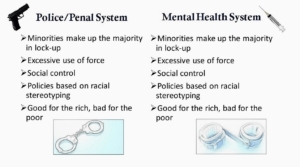
Think that’s an unfair overstatement? First, diagnoses are based on committees that consist of almost entirely White men. Second, these categories are nothing more than descriptions of behaviors, not a disease that one can locate and define. Lastly, in an effort to legitimize these made-up categories by looking at the brain, fMRIs have been used to suggest that these diseases can be found in the brain. How do they know? By comparing “ill” patients to “controls.” Who are the controls? White middle-upper class college kids in America. For added fun, these brain scans aren’t even that useful in telling scientists anything about any individual’s brain anyway.
But, there’s more.
Rates of admission into psychiatric facilities, even without bringing more mental health professionals into Black communities, are three or more times higher among various Black groups. These admissions are also more likely to be by force. In other words, Black individuals are being forcefully locked up far more than White people—Does this sound familiar?
And, as soon as a person becomes diagnosed as mentally ill, the contextual and societal factors (racism, poverty, lack of education, chronic stress, oppression, abuse, neglect, violence, etc.) that underly the emotional distress in the first place immediately become secondary or forgotten altogether.
Giving greater power to mental health professionals to diagnose and institutionalize is directly antithetical to finally giving weight to these social traumas and putting them front and center.
People Do Die as a Result of Mental Health Care
Granted, when a mental health professional shows up to an emergency call, it’s much less likely that someone will be murdered. That’s a good thing. But, this doesn’t absolve the mental health professions.
This article in the Huffington Post begins with the very confident statement: “So far there have been zero deaths at the hands of social workers.”
Confident absolutes do not equal truth.
While it is true that social workers do not show up to a person’s home, pull out a gun, and cold-heartedly kill them, insinuating that no one ever dies due to psychiatric interventions is inaccurate, at best.
, by up to 25 years, is frequently found to be associated with long-term use of neuroleptics/tranquilizers (euphemistically called “anti-psychotics). And guess who’s most likely to be forced to take these dangerous drugs? Black people.
While some may suggest that the odds would be worse without the drugs, anyone reading Mad in America should be familiar with Robert Whitaker’s work in this area, showing this suggestion to be complicated and largely false. The socially accepted, but scientifically invalid, idea is that these drugs are insulin for schizophrenia. They are not.
Oh, and guess who’s most likely to be diagnosed with schizophrenia? Black people.
In fact, as outlined by Jonathan Metzl in his book The Protest Psychosis, schizophrenia has essentially become a Black disease. Its very definitions and clinical portrayals are designed to epitomize the stereotype of the angry Black man. This was purposefully done in reaction to the Civil Rights Movement of the ’60s, with ads at the time almost exclusively depicting a caricature of a rabid Black man.
The relationship between early deaths associated with cardiovascular disease, actual diabetes, hypertension, and suicide among those with severe mental illness diagnoses is complicated, but there is no doubt that the effects of the drugs play a large role in much of this. So, too, do the larger traumatizing interventions.
Suicide, in fact, is directly associated with mental health care. Acknowledging mental illness early on after a diagnosis of schizophrenia is directly associated with depression and suicide attempts. Simply being given a diagnosis of schizophrenia is enough to make a person take his or her own life.
Completed suicide is also to increase in tandem with increased involvement in mental health services, especially when such interventions are forced or coerced—which would be the case in almost every instance of replacing police with doctors.
Oppression is oppression whether the uniform is a badge and gun or a white lab coat and prescription pad. Many who have experienced both prison and psychiatric hospitalizations prefer the police. Psychiatric survivors have described their forced hospitalizations as . Many would rather be beaten with a baton than to be forcefully injected with mind altering substances that invade one’s core internal being, a process that has been described as akin to rape. As documented by Mindfreedom, Michael Heston, who committed suicide as a result of his psychiatric “care,” wrote:
“I’m sure you’ve heard it all before, but I am being tortured. Force injected in solitary. Medicine makes my spirit sick and torments the very soul within me. As well my legs shake and my feet are all antsy. This bodily torture is intolerable. The rape, and not having determination about what goes into my very blood is having extreme psychological effect of me. The forced Risperdal injections are causing my body to deteriorate and I am in mental agony nearly all the time.”
Secondary to all of this is the fact that people with a psychiatric diagnosis receive a lower quality of care for their actual physical health, which also increases the rates of mortality.
Even when people don’t die, there is plenty of violence involved with involuntary commitments. Restraints, take-downs, seclusion, and, of course, forced injections of mind-altering drugs, are commonplace in most psychiatric facilities throughout the country.
Beatings Hurt, But Psychological Abuse Sometimes Hurts More
Being beaten, bullied, abused, and/or assaulted can scar a person for life. But, doing these same things emotionally, and telling the person that they should appreciate it is devastating beyond belief. This is emotional and psychological abuse. Period.
In fact, studies have shown that psychological abuse has effects that are at least as dangerous, if not more so, than physical abuse. Emotional pain and assault are real, and sometimes worse than physical pain.
One of the worst ways that emotional manipulation, oppression, abuse, paternalism—call it what you will—deeply harms is by fundamentally changing one’s sense of self and agency. If you’ve spent a lifetime experiencing microaggressions, lack of opportunities, surveillance, poverty, and/or overt racism and then meet a doctor who tells you that the emotional distress and fear you experience as a result are, in fact, symptoms of a brain/genetic illness in need of drugs (of course, their drugs, not yours!!!), your sense of defectiveness and helplessness risks becoming solidified at the very core.
Replacing the taser guns and brute force of militarized police with needles and the psychological manipulation and gaslighting from medicalized authoritarian do-gooders is flipping the same coin on its head. It’s like entering the Upside Down in Stranger Things.
I mean come on! Is this the best answer we, as a society, can come up with when calling for dismantling systems of oppression and racism?
Black Voices Matter
More than anything, being labeled as mentally ill and given mind-altering, numbing, and tranquilizing drugs serves first and foremost to silence and to tame the voices of the suffering. Trauma and oppression give way to chemical imbalances and brain diseases, despite no physical or scientific evidence to justify this.
People are not ill for being angry, crazed, overwhelmed, fearful, suspicious, hurt, sad, and/or unable to express it in ways others find tolerable. And, they sure as heck are not sick because they’re poor, despite the apparent fact that poverty has, quite literally, been medicalized and pathologized as “mental illness.”
The voices of the traumatized, the tortured, the oppressed, the abused, and the hurting deserve to be heard. Psychiatry will ensure that that only happens if it is done in a docile, pleasant, and non-discomforting, straightforward, logical manner. Even then, you’ll still be gaslighted into thinking you’re crazy or be told you’re just paranoid.
As stated in this recent article in The Atlantic: “The country needs to shift financing away from surveillance and punishment, and toward fostering equitable, healthy, and safe communities.”
Who can argue with that? If funding were directed toward programs and initiatives that provide basic needs, hope, and empowerment; if oppressive patriarchal systems were dismantled and rebuilt on a diverse platform of equality; if humanity and relationship were valued above money, retribution, and preparing for war, then we all might find the peace in our communities that we are hoping for. If we had universal healthcare, universal childcare, caring and empathic doctors of all kinds who were trained to listen instead of know everything, and interventions based on safety, validation, and empowerment, then maybe people might actually start to heal.
Sadly, however, the movement towards progress appears to be suggesting taking a parallel road that leads to reliance upon yet another racist system based on oppressive patriarchal ideals. While it might sound caring and kind to turn towards the mental health system to respond to community distress, it must be recognized that this is an intertwined system with that of the (in)justice system and is one equally built on , surveillance, punishment, and abuse.
Having social workers, peer workers, and other advocates respond to emergency calls by providing de-escalation of crises through listening and facilitating problem-solving, and by offering home visits (particularly to the elderly and disabled) along with housing connections, food, supplies, family interventions, supportive relationships, and assessment of abuse is a promising initiative that should most certainly be funded to a greater extent than it is currently. More efforts toward inclusion of peers and community members versus healthcare workers is an even more promising step.
At the same time, having social workers, medicalized peer workers, psychologists, and psychiatrists respond to distress calls or community violence through the lens of getting them mental health treatment is simply replacing one racist, oppressive regime with another. They may not come in guns a-blazing or physically beating up innocent bystanders, but, as a system, they are granted the authority to psychologically manipulate your reality, beat you down with words and restraints, and drug you into submission—and insist you thank them for it afterward.
What is needed is anti-violence, preventative, humane, community-based initiatives, not another racist, White-centered, patriarchal, oppressive, violent, forceful system that is dictated by powerful White men and demands a submissive and complacent sort of happy silence.
People need to be brought together with compassion and harmony, not split apart and isolated through diagnosing their pain as existing in the brain, drugging them, and locking them away in a veiled jail cell.
Please, if change is gonna come, can we at least try to do better than this?
Share this entryShare on FacebookShare on TwitterShare on Google+Share on PinterestShare on LinkedinShare on VkShare on RedditShare by Mail
The post Defunding the Police: Replacing Guns With Prescription Pads Is Not the Answer appeared first on Noel Hunter, Psy.D..
March 22, 2020
6 Ways Trauma Might Inform Your Current Life
 6 Ways Trauma Might Inform Your Current Life
Share on Facebook
Share
Share on TwitterTweet
Share on LinkedIn
Share
Send email
*Originally posted on
An all too common experience of trauma survivors is hearing the suggestion, “Why don’t you just get over it?” The idea is that, well, it happened in the past, so it shouldn’t still be affecting you now. It’s as if each moment in life exists in a vacuum, separate and untouched by anything that happened prior to this moment.
The thing is, everything that’s happening right now is impacted by everything that has preceded it.
Our brain filters each perception through a lens of past experience, it predicts the next moment based on past experience, and it reacts with primitive automatic reactions that are—you guessed it—based on past experience.
Obviously, then, our past experiences influence everything in our current life.
Of course, not everyone who has survived trauma in their life will continue to be haunted and controlled by it. Many can and do heal, going on to live content and successful lives with the past nothing more than a fading scar.
At the same time, many others continue to struggle in various ways.
Many mental health systems push for positive, trauma-informed practices and awareness. Unfortunately, their policies are typically based in re-traumatizing narratives and reinforcement of trauma-based self-perceptions.
The following are some ways in which trauma commonly impacts a trauma survivor’s life.
Imagine, as you read through, how different our society might be if systems of care and justice were as trauma-informed as your life might be…
Sense of Self
War, violence, sexual assault, physical and emotional abuse, physical and emotional neglect, chronic invalidation, chronic racism, chronic oppression, poverty—these things profoundly shape and/or re-shape how people view themselves.
If you’ve been ignored, gaslit, blamed, or chronically invalidated, you’re probably going to pretty quickly get the idea that you don’t matter. Worthlessness, feeling invisible, constantly doubting yourself, and feeling two inches tall become a way of life.
Being violated, assaulted, or even assaulting another creates such a fundamental sense of shame deep within one’s soul that it festers like hidden mold behind a layer of glossy paint. Feelings of defectiveness and self-hatred appear reasonable and can be taken as objective fact.
If you’ve been told your whole life that you’re a piece of shit, guess what? You’re probably going to believe that you’re a piece of shit.
You don’t just snap out of these kinds of thinking simply because you get older. And, you definitely don’t stop thinking this way just because someone tells you to get over it.
Relationships
Our sense of self directly impacts how we interact with others. Self-hatred and feelings of inferiority and worthlessness make it pretty difficult to make small talk or engage in light-hearted verse. Not to mention that these feelings get projected onto others—we love to assume that everyone thinks just like us. If you look at yourself with disdain and fury, you’re pretty likely to assume everyone’s looking at you like that. And, who wants to engage with someone who thinks you’re defective and awful?
We are taught from our first breath how to interact with those around us and what to expect from others. If those people to whom you are closest hurt you, then you learn that everyone will hurt you. Despite “knowing” that it’s inevitable, you will likely spend a great deal of energy trying your darndest to stop that hurt from happening; never really allowing yourself to just be with another.
It is fairly common for those who have experienced interpersonal trauma, specifically, to view people through the lens of the “drama triangle.” This trauma lens perceives all humans to play one of three roles: the perpetrator, the victim, or the rescuer. The thing is, these roles are ever shifting. Any one individual will be perceived as taking on one of these roles at any given time… including oneself.
When people are perceived as always playing a role of a savior, someone to feel sorry for, or a monster, it becomes really difficult to actually see the person before you (or yourself!) for who they really are. Worse, someone always has to be a monster. The fear and anger never end.
Parenting
We all know that trauma tends to repeat itself across generations. Perhaps there’s some epigenetic piece to this, but there is no doubt as to the role of direct trauma and stress as well.
If you (or those closest to you) are always a potential monster, this sets up an extremely precarious situation in which to bring up a helpless and totally dependent baby. You fear becoming the monster and so might become passive or over-protective. Or, perhaps you do become the monster and repeat the cycle of abuse. Worse, you might start to perceive the child to be the monster.
Often, parents whose needs were never met as a child will look to their own children to get their needs met. This sets up a cycle of parentification, lack of attunement, and emotional neglect. This is the cycle of trauma that stays hidden behind layers of enmeshed love and toxic interdependence.
Parenting is hard when you’ve never had a healthy parent to learn from.
Career
Trauma is a tricky devil. There is no singular path away from pain; what for one person might be a life of self-sabotage and expected failures is, for another, a life of over-achievement and incredible success.
What is shared underneath these seemingly opposite paths is a fundamental sense of inferiority.
For the person who struggles to get ahead and/or to keep a job there are a plethora of merging factors that can cause this. Perhaps academic capabilities have been stunted by severe neglect. Intense stress and emotional overwhelm makes it nearly impossible for many to focus on silly things like algebra or Charles Dickens. If you’re the sort to act out your pain, from the get-go you might be labeled a troublemaker and have others instill repeated messages of your hopeless future. Authority figures are frequently seen as dangerous and hypocritical; if you can’t get along with authority, you’re not likely to do so well in school or job.
Worse, when in chronic survival mode, the future is bleak—if it’s possible to believe in its existence at all. And, so, going to college or saving for what’s ahead just seems, frankly, dumb.
Let’s not forget, of course, that having a mental health diagnosis, especially the more severe ones that are themselves directly associated with trauma, leads to prejudiced hiring and discrimination in the workplace.
On the other hand, hyperfocusing on academics and/or a job might become itself a coping tool to escape the horrors of home/community/peers, etc. Feelings of inferiority might fuel a never-ending effort to prove yourself. Life might become motivated solely or largely by fleeting moments of praise and accolades.
Whichever divergent path you might find yourself on, it’s an exhausting one that rarely is fulfilling and often reinforces that gnawing sense of emptiness and self-hatred.
Freedom
If you’re controlled by the past, it’s hard to feel free regardless of your external circumstances. It also exponentially increases your odds of losing your external freedom as well.
Increased traumatic experiences directly relate to increased chances of jail, hospitalization, addiction, , AOT orders, guardianships, and severe health issues.
If you’re trapped by the past, you’re very likely to be trapped, literally, in the present.
Experiencing chronic and multiple traumatic events drastically increases the odds that someone will be arrested and incarcerated. Almost half of all women in jail and a third of men have a lifetime history of PTSD. And that’s just including overt, DSM-defined traumatic experiences. Add in racism, oppression, emotional abuse, and emotional neglect and I would venture to guess that the prevalence approaches 100%.
Being locked up in a psychiatric hospital is inherently associated with past trauma. One study showed that 91% of admitted patients report overt trauma, with 69% reporting repeated, chronic trauma. Another found that almost 100% report overt trauma. Not to mention how common it is for people to be directly traumatized by the treatment experience itself.
The homeless population consists nearly entirely of trauma survivors, particularly childhood trauma. And once homeless, it is common to be trapped in a cycle of housing problems, jailtime for minor infractions, and being sent to the psych ward.
Physical Health
It shouldn’t be that surprising that chronic stress and trauma would leave your body in a toxic state.
Traumatic experiences have been shown repeatedly to be directly associated with: autoimmune disease, heart disease, stroke, cancer, diabetes, obesity, adolescent obesity, drug and alcohol abuse, and Alzheimer’s.
And when you consider all of the above, you can see how quickly things compound.
If you’re lonely and filled with hate for yourself, you’re not likely to be so interested in healthy eating. Conversely, you might become obsessed with some factor of your body like, say, weight, and starve or purge or excessively exercise to make up for your perceived defectiveness.
If you aren’t making money, you can’t even afford to eat healthy or go to some fancy gym. If you live in the United States, you’ll also likely have terrible healthcare, if you have it at all.
The meals in locked facilities are about as healthy as what is fed to lab rats to keep them merely alive. The drugs given and/or forced in these places not only can result in obesity, digestive issues, brain damage, and blood problems, they also can make a person numb, hyperactive and/or shut down, and agitated, leading to its own cascade of health issues.
If you’re addicted to street drugs, alcohol, food, and/or risky lifestyles, health declines fairly rapidly.
Even if you are relatively healthy, trauma can be felt in the body through chronic pain, pseudoseizures, unexplained pain, digestive issues, memory problems, numbness, clumsiness, tight muscles, headaches, teeth erosion and jaw pain, and breathing issues. Any one of these can itself directly lead to more severe injury or health issues over time.
Having a diagnosis, history of hospitalization, and/or history of incarceration directly results in discrimination by healthcare workers. So, even if you’re fortunate to have access to decent healthcare, you’re still not likely to receive it.
Trauma and all of the additive effects of the sequelae of trauma understandably may lead to suicidality, self-harm, and passive suicidal behaviors.
Is it that surprising, then, that those with a significant trauma history have a lifespan decreased by 20 years?
Imagine if our systems of care and our governments understood this. Imagine if they developed programs around these ideas. Imagine if all the money spent on finding the genetic roots of everything mentioned here, or on pharmaceutical interventions, was instead spent on helping people heal from trauma?
Better, what if such funds were directed towards creating a less traumatic society? More equality, more compassion, more social services, greater access to quality healthcare, access to healing modalities not couched in further prejudice, more protection for children, more rehabilitative rather than punitive reactions, more relaxation, and more love and connection. Imagine.
Share this entryShare on FacebookShare on TwitterShare on Google+Share on PinterestShare on LinkedinShare on VkShare on RedditShare by Mail
The post 6 Ways Trauma Might Inform Your Current Life appeared first on Noel Hunter, Psy.D..
December 16, 2019
The healing power of relationship
 Photo by Annie Spratt on Unsplash
The healing power of relationship
Share on Facebook
Share
Share on TwitterTweet
Share on LinkedIn
Share
Send email

Bill and Ted are the cutest!
Recently, my household welcomed two new cats – Bill and Ted (excellent, right?). These little cuddlers are brothers who were rescues from the ASPCA. There was no doubt as to their intense trauma history, though I’ll spare you the details. What was surprising was how quickly they both started to recover, grow, and thrive. My observations led me to conclude that there was only one reason why they demonstrated such incredible resilience: their relationship.
They had each other. They were bonded from birth, and together they could withstand almost anything.
Watching how they soothed and nurtured each other, how they both were so attuned and aware of the other, and how they could play no matter how hurt they’d been was a lesson in the power of relationship. It was so very clear just how much we can learn from animals.
We are not robots. We are a social species that needs contact in order to heal, grow, and thrive. We need each other for survival.
‘Tis the season
Our health and well-being rely on relationships more than just about anything. During the holiday season, the need for connection and love can become even more clear, for better or worse.
Everywhere any of us turn, there are advertisements, flyers, and overheard talk of the importance of family and friends during this festive time of year. There are parties and gatherings, tear-jerking movies, and glowing trees. Stores and restaurants are closed, offices run empty, and children gleefully run through the streets celebrating their break from the tortures of school.
For those without family or intimate friends, this can feel like being punched in the gut over and over and over again, to no avail.
The loneliness epidemic
Loneliness has become a true epidemic in the West, and, particularly, in the United States.
People who feel lonely are up to 32% more likely to die early. Loneliness is so dangerous that it is equivalent to smoking almost a pack a day. And, at least half of us are feeling this way.
Sadly, biotechnology is replacing human interaction. Increasing claims are being made that this is all we need to heal feelings of depression or problems of substance abuse. However, such claims rely upon an assumption that our emotional pain is due to a problem that lies within, rather than between, us.
Mental suffering is rarely the result of faulty brains or personalities. Rather, it is more often the result of the interpersonal wounds we carry with us (and sometimes continue to play out in the present). Certainly, it is not helpful to further alienate those in pain by sending the message that they need to be ‘fixed’ or figure out their issues on their own. Healing requires nurturance.
No matter how advanced our technology becomes, it will never be able to nurture us in the way we truly need. My cat might enjoy a motorized mouse, but that will not feed him. And, it certainly won’t replace the wrestling partner he has in his brother or the warmth of his brother’s tongue while grooming. Plus, I’m sure it just tastes disgusting.
Coping
When family does not provide the nurturance and support we need, it must be found somewhere. The conundrum, of course, is that in order to take in love and support from others, we must be open to it. There must be some belief that it is deserved. Otherwise, it frequently gets ignored, dismissed, or minimized, if it even comes at all. This is when one tends to resort to filling the gaping hole that is left with substances, material goods, self-harm, or worse.
Therapy can help with this, at least when there is value given to the healing power of the therapeutic relationship. But, so, too, can a phone call to an old friend. A teacher or boss who takes a special interest. Even just a pleasant conversation with a cashier. Oh, and pets, of course.
There are also a number of strategies and coping tools one can use to get through periods of time (like the blasted holidays) when loneliness creeps in.
Coping and superficial human interaction can only get us so far, however. As a society, we need to remind ourselves of the importance of us. Of community and intimate bonding. We need to learn how to connect, be vulnerable, and love openly and freely. We need to find compassion and empathy for our neighbors and foes alike. Most animals know how to do this instinctively. Sadly, most humans do not.
People are crying out constantly for connection, yet everyone just keeps swiping left.
Returning to our animal roots
We have moved perhaps too far away from our animal instincts. Technical and medical advancements will be nothing if we don’t have us.
A healthy, supportive relationship might be the single most important medicine any of us has. Take it from Bill and Ted – a loving bond can help us heal from almost anything.
Share this entryShare on FacebookShare on TwitterShare on Google+Share on PinterestShare on LinkedinShare on VkShare on RedditShare by Mail
The post The healing power of relationship appeared first on Noel Hunter, Psy.D..
December 13, 2019
Rep. Katie Hill was terrorized. Suicidality came next. Mental illness had nothing to do with it.
 Photo by Darren Halstead on Unsplash
Rep. Katie Hill was terrorized. Suicidality came next. Mental illness had nothing to do with it.
Share on Facebook
Share
Share on TwitterTweet
Share on LinkedIn
Share
Send email
Mail
This is about bullying. It’s about the sexual exploitation and objectification of women. It’s about the cruelty that can be unleashed through social media and technology that cuts deeper than any IRL weapon.
It’s also about finding hope in bleak darkness.
What it’s not about is an imagined illness of the mind.
Katie Hill was a United States Congresswoman. She was one of the youngest women to be elected to the House. Ever. For all intents and purposes, she is the ideal American woman.
On December 7, 2019, she also published an op-ed in the New York Times discussing her desire to self-harm and kill herself.
What made her want to die was not a sudden attack from her brain wires, a disordered personality, or nefarious neurochemicals gone array. It was the cruel actions of others that left her feeling hopeless, alone, and stuck in a life no longer worth living.
Hill does not deny that she engaged in unethical acts in having a sexual relationship with a staffer during her congressional campaign. In fact, this is what led her to resign from Congress.
Whatever her faults, she certainly did not deserve what amounted to intense cyberbulling on the part of journalists and commenters, revenge porn allegedly on the part of her ex-husband, or non-consensual viewing of her naked body by millions of strangers.
This was a strong, successful woman who found herself so overwhelmed by hopelessness in the face of bullying, exploitation, and utter humiliation that she saw no other option than to die. The conversation needs to be about how cruelty can impact any of us. Especially those who are most vulnerable to fatal consequences and/or potential lifelong difficulties resulting from such abuse: our children.
When a grown woman who is an elite representative of the United States of America feels her only option is to die when faced with humiliation and cyberbullying, how do any of us expect a child to cope?
Teens and bullying
Suicidal ideation and self-harm are an unfortunate reality in our modern world. People who are in such anguish and despair and have no hope will understandably want to escape such hell.
This is not “illness”.
How can it be abnormal when more than half of the victims of revenge porn resort to the possibility of suicide as a way out?
Self-harm and suicidal ideation are known to be common responses to cyberbullying, in particular. In fact, teenagers who experience any form bullying are twice as likely to attempt suicide than their peers.
The answer is not to numb the pain, drug away the problem, or pretend that one’s pain is what is abnormal. Solutions lie in healing relationships, in fighting back against bullies, in finding meaning and purpose in the face of shame, and being honest about what is happening in our society.
Finding hope and healing
Katie Hill described in her op-ed how finding meaning and advocating for other women allowed her to find purpose in living. She has supportive allies and family. And, she recognized her actions were greater than just herself – that her current pain was temporary and could possibly cause a far greater pain for millions of other women and girls who might look up to her.
Unfortunately, our current mental health system tends to respond to suicidality and self-harm with it’s own form of shaming and humiliation. The response too often is to further isolate the person who is suffering by blaming the brain, the mind, some abstract illness, or the person’s core personality. Clinicians frequently will resort to words of invalidation, punitive behaviors, and ridiculous safety contracts rather than understand the deep pain and fear that the person is experiencing. Even the so-called trauma-informed oases consistently fail those who are feeling suicidal or who harm themselves.
The perpetrators of harm, the bullies, and the abusers need to be held to blame, not the body of the victim. The body is likely already suffering enough.
The targets of bullying and revenge porn need to be heard and seen through compassionate, non-judgmental eyes. They need to be reminded of what makes them worthwhile as a human being. Like Katie Hill, they need to find meaning and purpose that helps kindle the flames of hope.
Let us learn from those who have been there.
Share this entryShare on FacebookShare on TwitterShare on Google+Share on PinterestShare on LinkedinShare on VkShare on RedditShare by Mail
The post Rep. Katie Hill was terrorized. Suicidality came next. Mental illness had nothing to do with it. appeared first on Noel Hunter, Psy.D..
November 14, 2019
Got a Gene for That? The Latest from the Chronicles of Gene Worshiping
 Got a Gene for That? The Latest from the Chronicles of Gene Worshiping
Share on Facebook
Share
Share on TwitterTweet
Share on LinkedIn
Share
Send email
*Originally posted on
After almost three decades and 20 billion dollars in funding for genetics research and so-called neuropsychiatry, we’ve learned exactly nothing that is clinically useful.
At the same time, there have been many clinically identifiable consequences resulting from this seemingly never-ending elusive mission:
A sense of helplessness and hopelessness for those who believe that they are genetically destined to become addicted to alcohol, trapped in psychosis, depressed for “no reason,” a criminal, a Jets fan, etc.
Blaming the body instead while often ignoring the horrors of the world and/or the need to change our lives
Allowing for the scapegoating of the poor little gene so that those in power never have to worry about losing said power.
Perhaps most excitingly, it has also resulted in amazing capitalistic opportunities beyond just the world of academia…
Need a New Pair of Genes? On Sale Now for Only $499!
In one of the latest examples of profiteering from the gene fad, there is now an app to determine your personal level of gayness. This is not a joke.
For about the same price as a Starbucks latte, one can take their genetic data (supplied by 23andme for your convenience if you’d like), upload it, and BAM! You’ll be placed along a gradient of gay.
Cool, right?!
No matter the fact that the study upon which this app is based determined that across half a million subjects, at most 25% of sexuality could be explained by genetics. So, at least ¾ of who you are attracted to has to do with a bazillion other factors besides your genes. But such facts would not make for a nice app.
Let’s definitely not consider the tyrannical regimes that determine homosexuality a crime deserving of the death penalty. Do not wonder how easy it would be for a government official to grab a sample of your saliva and determine you gay. Then kill you. Legally. No, whatever you do, ignore this reality — someone’s making money off an app!
Soon they’ll have one to determine your level of schizophrenia, too!
Sure, the best studies to date looking for genetic associations to the category of schizophrenia find a link that might explain about .25 to 2% of the variance in the population (i.e., it explains nothing). But researchers who “know” that “schizophrenia” is clearly genetic won’t let that stop them.
The most recent exciting headline has announced that researchers have finally found real biomarkers to diagnose schizophrenia! And it can be done through a simple hair sample!
Wow! What a headline!
I mean, once one reads on to the nitty gritty silly little details, it seems that this was really about a “subtype” of schizophrenia never before identified, that the tests done on real humans rather than mice were done postmortem (and therefore on people who had been on decades of psychiatric drugs and who knows what else), that the researchers themselves determined that the likely root cause was early inflammatory stress in childhood (*cough* trauma/stress), and that the altered gene expressions were epigenetic (*coughing fit* environmentally caused *dies coughing*).
But, hey, what’s a little bit of nuance or science when it comes to making a name for yourself?
The President of the United States has even suggested that “neurobehavioral” technology can predict mass shootings. Alternative facts have now become our new reality. What a great day and age for Silicon Valley!
It’s only a matter of time before there is an online section of Amazon offering new and improved genes for all who 23andme determines to be less than ideal. Personalized ads based on your genetic code!
Healthy Stock Only Please
In the early 20th century, academic scholars, philanthropists, and liberal governments were also very excited about research coming out of a blossoming field of study. It was called eugenics.
In brief, eugenics was a field that was determined to create a master race, free from idiocy, poverty, criminality, color, and non-Christians. The Nazis didn’t invent this. Psychologists did for the most part.
For a bit of detailed commentary on eugenics and psychology, see here, , and here.
Eugenics researchers amassed an enormous amount of work detailing all the ways in which those perceived as flawed in some way were shown to be of defective stock. Eugenics was also based on research from horses and peas.
After WWII, and Hitler, understandably such research was frowned upon. Eventually, however, organizations and groups under this umbrella rebranded. The new acceptable line of study became known as the field of genetics (note: not all genetics research is bad).
Which leaves us where we are today.
Researchers have now embraced the idea that PTSD is a heritable disease with a genetic base. A recent study has claimed to have actually found the loci of the genetic risk! This exciting new finding explains up to a whopping 5-20% of variation across tens of thousands of people. In other words, once again, it means absolutely nothing. At least according to scientists who actually care about truth and, um, science. But, hey, who needs nuance or, say, empathy. Nay, we can now celebrate our newfound proof that even PTSD is a result of defective stock!
US military officials may be having a heart attack en masse with the sheer excitement of it all. Training men and women to become killing machines and then balking when they cannot just revert to the domesticated drone that is many a modern-day citizen is a US military specialty. Now, they have psychological science on their side!
The soldier is not haunted to his very soul by death, cruelty, injustice, terror; nope, he clearly has faulty coding in his brain and soon we’ll have just the pill to fix it.
And, of course, such research doesn’t just affect veterans. The wider population of trauma survivors are also included.
Oh, how abusers across the globe must be getting their party hats on!
The girl subjected to many years of sexual abuse is not wounded to her core by violations, gaslighting, deathly fear; negatory, she is of inherently faulty design passed down through her substandard bloodline for being upset or untrusting or haunted by her past.
Bow Down to the Science Gods
Make no mistake: this is about the religion of scientism, not about science.
The ideological quest for the genetic underpinnings of supposedly un-understandable phenomena such as hearing voices, atypical beliefs, and altered states is one based on faith, not fact. To give the benefit of the doubt, acknowledging the horrors of the world and how our lifestyles unjustly affect, at random, people (and other animals) is terrifying. Feeling helpless in the face of existential dread is intolerable.
But, this is not an excuse.
With the ever-increasing evidence of trauma and its innumerable aftereffects, it is becoming increasingly impossible to ignore.
It seems, though, that if we can no longer deny the traumatic origin of such experiences, then instead we must still blame someone or something so as not to feel helpless or at the mercy of the random chaos of the world. And the religion of geneticism appears to dictate that any reaction to trauma that is not some variation of “get over it” is a result of a defect in the phantasmal gene.
Pull Those Darned Boot Straps Up Already
“What’s the matter? Why are you still upset about [murder, rape, child abuse, chronic oppression]? Get over it already.”
That’s the sentiment of much of Western society and internalized by survivors of tragedy. And these beliefs only serve to further solidify self-hatred and pain.
Perhaps a study needs to be developed to search for the faulty gene variations that result in a complete lack of compassion. Or the gene that makes people worship money and success. Or the gene that causes people to function just fine in the face of horror and go on as if nothing ever happened. Perhaps we can create an app for that.
The thing is, these gene studies show little, if any, identifiable pathway between genes and the numerous traits and behaviors suggested to be caused by our wiring. Even E. Fuller Torrey, star disciple of the medical model, has called the Human Genome Project, aptly, “a dud.”
It is downright frightening where this stuff will lead us.
I Want Off This Ride
If newspapers and other outlets started placing “studies” and apps and other nonsense in their entertainment sections right alongside the horoscopes, then perhaps this would all be fine. Everyone’s entitled to their beliefs, right? Well, unless your beliefs involve aliens, the CIA, or wanting fairness and compassion in the world. Those beliefs can be found in your hair as a result of your coding.
The problem with taking these ideological proclamations as fact is that people are suffering, even dying. Politicians argue for increasingly restrictive policies and scapegoating those deemed “mentally ill” for violence. Suicide rates continue to increase, particularly for our supposedly respected veterans. We have skyrocketing rates of substance abuse and depression. The opioid epidemic.
Will this train stop before it crashes and burns and flies right off the side of a mountain into the fiery pits of molten lava?
“Pickle!” “Pickle!” It’s a safe word. I’m screaming it at the rooftops. “Pickle!” I forfeit. Get me off this train. Just please, please make it stop.
Share this entryShare on FacebookShare on TwitterShare on Google+Share on PinterestShare on LinkedinShare on VkShare on RedditShare by Mail
The post Got a Gene for That? The Latest from the Chronicles of Gene Worshiping appeared first on Noel Hunter, Psy.D..
April 10, 2019
A Faux Test for a Faux Disease Promoted by Real Psychiatrists
 A Faux Test for a Faux Disease Promoted by Real Psychiatrists
Share on Facebook
Share
Share on TwitterTweet
Share on LinkedIn
Share
Share on Google Plus
Share
Send email
*Originally posted on
“Influential psychiatrists last week called on the NHS to make a faux schizophrenia test available to patients and their families. The condition has never been demonstrated to be genetic, but it’s proving inconvenient to claim otherwise.” — Mental Health Today, March 25, 2019
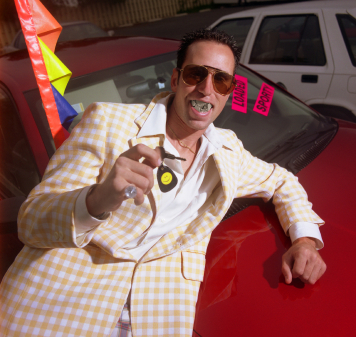
The stereotype of a used car salesman depicts a person trying to get a naïve person of little means to purchase a heap of garbage through manipulative, dishonest, aggressive, and brash tactics. Everyone knows they’re being taken advantage of, but it becomes an accepted means to an end in a culture built on values of greed and consumerism. Used car salesmen, hated and reviled as they are, get away with their behaviors because they hold enormous power and wear tacky suits that exude authority.
What if people in an ostensibly trusted position were to don the metaphoric used car salesman coat?
On March 22, 2019, Professors Kam Bhui, David Curtis, and trainee Katherine Adlington published an article in the British Journal of Psychiatry, one of the most well-respected authorities on mental health policy and research, advocating the use of theoretical methods and policies based on findings that might one day emerge in order to convince patients and families to comply and agree with their perceived theories and best practices. In other words, they are promoting practices that would amount to lying in order to manipulate people to buy into what they, as psychiatrists, have to sell.
What is most astounding about the actions of these particular psychiatrists is the utter and complete lack of pretense. “We are so certain of our power and righteousness that we are going to tell you to your face that we are lying, and yet, we will still get our way.” In the same vein as the archetypal used car salesman, they dare the public to challenge their powerful hold on people in a less privileged position by not even pretending to be honest.
This brings to mind the storied fable of teaching a man to fish:
Give a man a fish, and you feed him for a day. Teach a man to fish, and you feed a man for a lifetime.
Tell a man that he is genetically incapable of feeding himself fish, and you get a lifetime of dependency to help pay for your lake house on a lake full of fish.
History of lies
The entirety of psychiatry’s history is built upon manipulation of evidence, assertion of truths that are anything but, and efforts to claim and hold onto power and control. Probably the most familiar campaign of lies is that pertaining to the “chemical imbalance theory.”
The theory of chemical imbalances is based on claims that experiences such as depression, anxiety, and even psychosis are a result of an imbalance of neurotransmitters in the brain. Conveniently, this theory first developed in the rigorous research labs of the Pfizer marketing department.
The idea that “antidepressants” had a specific effect on the brain, leading to identifiable and predictable improvements in mood and behavior, was certainly convenient to pharmaceutical companies. It didn’t matter that no one’s brain chemicals ever got tested for their level of balance, and that no standard base for what a balanced brain is existed.
This marketing campaign also provided a steady stream of consumers, willing or not, for psychiatrists. It supported their theories that emotional problems were the result of dysfunction in the brain, and legitimized their profession as a whole.
The problem, of course, is that the chemical imbalance theory isn’t true. That hasn’t stopped professionals from perpetuating the idea anyways.
In written by Philip Hickey for MIA in 2014, several eminent psychiatrists are quoted promoting theories of chemical imbalances, brain disease, and the curative nature of psychiatric drugs as fact, despite the lack of evidence for such claims. These “little white lies” were justified by Ronald Pies, MD* as acceptable practices.
While this decades-long manipulation has been increasingly rebuked as the public becomes more informed, it certainly is not the first (and clearly not the last) example of psychiatry’s attempt at social control through dishonest and aggressive tactics.
Emil Kraepelin may be considered the father of the medical model of emotional distress. He popularized the term “dementia praecox” in the early 20th century, as a description of what was being experienced by the mostly poor, minority individuals he was seeing in hospital.
His theory was that these individuals were suffering from an incurable brain disease, aka early dementia, that was genetic and biological in nature. Although he acknowledged at the time that it was not possible to delineate those with this brain disorder from those suffering from “hysteria,” and that no physical pathology could be identified, he nonetheless insisted on the truth of his conceptualization.
This assumption has lived on through the category of “schizophrenia,” despite the known racial biases inherent in this diagnosis, the lack of any specific biomarkers, and the ongoing difficulties of delineating this category from trauma and mood disorders.
Of course, the diagnostic system itself is an example of a set of theoretical assumptions being promoted as facts despite their being anything but. This system is based on a medical concept of categorizing emotional distress, originally considered “reactions” and now called “disorders,” into distinct clusters of emotions and behaviors. They are descriptive labels that have morphed into explanatory models and suggest that concrete entities exist in the brain and might one day be found.
While promoted by most mental health professionals as identifiable entities, they are only loose descriptions of behaviors that lack predictive value, are based on subjectivity, cultural values, biased observations, and general guesswork, lack any clinical usefulness, and are not warranted by scientific research.
Yet, the public continues to be inundated by the lie that “mental illness is an illness like any other” and that these “diseases” can be scientifically diagnosed and predictably treated by trained professionals. The public is being sold a rusted-out jalopy missing a transmission.
Instead of lying, why not look at the actual evidence?
Psychiatrists such as Bhui and Curtis justify their lies and manipulative tactics because they sincerely believe that they are right, and that it’s only a matter of time before they are proven so. This is the same reasoning behind terrorism, religious warfare, and the Pied Piper of Hamelin.
In this, they actively continue to ignore a much greater reality. To continue to rigidly insist that their perception is truth in the face of overwhelming evidence to the contrary is itself delusion at its finest.
Around the same time Kraepelin was promulgating his theories of dementia-raddled brains, Sigmund Freud was developing his theories of psychoanalysis. Originally, Freud observed and wrote about how so many of his patients were suffering the results of childhood trauma and abuse. He recognized how people developed defenses to cope with overwhelming and confusing experiences, and how these defenses were at the root of many of the problems with which people were presenting.
Sadly, this wasn’t so popular among the elite and powerful. Freud shifted his focus to more acceptable ideas, like accusing women of making up sexual assault or, worse, wanting it. This was perhaps best exemplified in Freud’s story of Dora, a 14-year-old girl who saw him and complained of sexual advances from an adult family friend. Rather than validate this girl’s trauma, he instead proclaimed her accusations to be projections of her own sexual fantasies and symptoms of hysteria. His reaction to her vehement disagreement was to further blame her for being disagreeable, declaring her “incurable.”
Nothing has changed.
Despite the ever-increasing evidence that childhood trauma, sexual abuse, racism, poverty, and other adversities are nearly universal in “serious mental illness,” individuals continue to be blamed, ignored, gaslit, and proclaimed sick and incurable.
For instance, 80-90% of individuals diagnosed with borderline personality disorder report overt childhood trauma. Developmental trauma is a major risk factor for diagnoses of ADHD and bipolar disorders. PTSD and psychotic disorders highly overlap, with numbing and avoidance factors being closely associated with psychotic experience. Psychosis is commonly diagnosed in economically deprived areas, minorities and immigrants, and those who’ve experienced childhood abuse and bullying, with an apparent dose-response, causal relationship.
Meanwhile, all the public hears about is faulty genes, glitchy brains, and the need for drugs, more drugs, and even more drugs.
Those who dare to question the heap of trash being fed to them get dismissed through accusations of “anosognosia” — a fancy term that basically means “you don’t agree with me, so I think you’re crazy” — or of being “antipsychiatry,” a term that gets equated with the likes of flat-earthers.
The ways in which adversity and other environmental harms get ignored in favor of the mental gymnastics necessary to promote theories of genetic inferiority are no more pronounced than in the category of schizophrenia. It was only three years ago that researchers were flooding the media with claims that the and its biological origins had been discovered.
It boggles the mind that three years ago the genetic basis for schizophrenia had finally been found, and yet in 2019 psychiatrists are outwardly suggesting the need to create public policy built on overt lies because they lack evidence to actually back up their claims.
Huh.
You might want to check beneath the hood of that absurdly cheap BMW being sold to you at cost. It just may be that beneath the surface, it’s actually a 1979 Pinto with an Oldsmobile diesel engine. And, if you dare to drive it, you might find it leads you right off a cliff.
Never hesitate to question authority.
* Editor’s note: Dr. Pies has requested clarification regarding his take on the “chemical imbalance theory” and his use of the term “little white lie.” Dr. Pies offered a link to an article published in The Behavior Therapist, which he states provides a full discussion of the issue at hand. As the statement in question was referencing an article written by Philip Hickey for MIA in 2014, readers may be interested in reading Hickey’s response to Pies’ concern .
Share this entryShare on FacebookShare on TwitterShare on Google+Share on PinterestShare on LinkedinShare on VkShare on RedditShare by Mail
The post A Faux Test for a Faux Disease Promoted by Real Psychiatrists appeared first on Noel Hunter, Psy.D..
December 21, 2018
Holiday Blues: 7 Realistic Coping Ideas For Getting Through This Most Wonderful Time of the Year
 Photo by Elias Tigiser from Pexels
Holiday Blues: 7 Realistic Coping Ideas For Getting Through This Most Wonderful Time of the Year
Share on Facebook
Share
Share on TwitterTweet
Share on LinkedIn
Share
Share on Google Plus
Share
Send email
The Holiday Season is a magical time of year, full of giggling children, songs that were overplayed 40 years ago, and excitement for what’s to come with the beginning of a new year.
But, what about when it’s not? For too many, this focus on all that is family and friends, glittering bright, it can be a slap in the face with reminders of loss, trauma, loneliness, and gut-wrenching pain.
Although it is a myth that suicide rates are higher at this time (they actually might be lower), it does not negate how just plain HARD it can be to get through these times.
When the pressure is on to buy, buy, buy, and you just have no funds; when family time is as healthy and enjoyable as drinking the water in Flint; when you’ve lost someone you love and can only think of what once was; when maybe you’ve never loved at all; and, when “It’s Beginning to Look a Lot Like Christmas” is a blaring warning to HIDE, this time of year may feel like pure torture.
For those folks, here is a list of 7 realistic coping strategies to get you through…
Protest capitalism
If you can’t afford gifts, especially lots of pricey ones, this is a great time to stop trying to play the game. You can always try to make your loved ones gifts that show your thoughtfulness and willingness to spend time creating just for them. Of course, in this day and age, you run the risk of sneers in response to your handmade scarf/reminiscent video/ sculpted family portrait/ teapot. Honestly, that is more about them than you. There’s no point in trying to impress such individuals. So don’t try.
Be Selfish (within reason)
This is a time of year when giving is a moral priority for society. Sometimes, however, we are so depleted that only fumes are left to give. You are allowed to say “no”, whether it is for the office holiday party, you mother’s dinner, or Christmas mass (have you even been to church this year?). Say “no” to touring the light displays in that neighborhood (you know which one). Don’t hesitate to say “no” to the pressure to stay out past bedtime and get drunk as a celebration of changing the last digit of the date (which you won’t remember to finally do until March anyway). You can definitely say “no” family rituals that mask all the conflict and suppressed emotions over the years. And, above all, you must say “no” to the self-hating, critical voices in your head that tell you you aren’t lovable or good enough. Just, no.
Pamper yourself. Take a bath. Wrap yourself up in a cozy blanket. Go to the movies. Have your own party. Make your own rituals. Connect with others who are struggling. Give yourself the proverbial oxygen mask first – you have to be able to breathe to give anything to anyone else.
Be around other people
If you are able to reach out to friends, family, or other supportive people in your life, DO SO! Go to a friend’s house for the holidays, write a letter to your therapist, call your long-lost 3rd cousin, and utilize the network you have. On the other hand, if you are in a place right now where this won’t work, then find other people. No matter where you are, there’s a Chinese restaurant open on Christmas. There’s a Starbucks open on New Year’s Day. Or there’s an Irish Pub open at 8a on every day. Drinking at 8a might be helpful for about 5 minutes, but if you can nurse a drink and not get carried away, this might be an option for you. Being around people who also are alone, not celebrating, or from an entirely different culture can ease that lonely ache just enough to make things bearable. Get out of your house and be near humans.
Immerse yourself in nature
Cats, squirrels, and damning beavers could care less that it is yule time. Go somewhere that allows you to connect to the earth. Watch the Discovery Channel. Observe how animals interact and engage with the world around them – it’s pretty messed up if you watch long enough. Trees, fresh air, and water are surprisingly healing if we can take it in. With all the money you saved by protesting capitalism and saying no, you can use it for an AirBNB in the deep woods or, alternatively, south Florida. Or, you can just spend the day in your local park. Either way, connecting with nature can be physically relaxing, nurturing, and maybe even peaceful.
Get out of your head
It doesn’t matter where you are or what you’re doing if you cannot escape the painful thoughts in your head. Distraction is key. You might need a list of 500 things to occupy you during this next week, but it’s a list worth cultivating. Because, remember, this time will pass and you just need to get through it intact. So, clean your home, do some laundry (when was the last time you washed your jeans?!), learn how to solve a Rubik’s cube, cook an elaborate meal just for yourself, write your memoirs, take up Rosetta Stone, move on to Italian once you’ve mastered Spanish, sew a sweater (bonus if you give this as a gift next year), finally understand the real story of Peter Pan, or start your taxes early. Just keep busy.
Exercise
Even though this might be the time of year where you want nothing more than to curl up under a blanket and never come out, you cannot give in to this. Be selfish and give in …. To a point. Then get up and move your body. It will love you for it. Hate exercising? Make it fun. Find an old Jane Fonda or Richard Simmons video and do that. Go for a long walk, walk up and down some stairs, or take a boxing class. In some cities, they now have rooms you can rent where you can just smash stuff. No matter how much you want to shut down and do nothing, force yourself to move anyway. It can make all the difference in the world.
Laughter
Tears and pain may be never-ending right now. All the more reason to find moments to laugh. Netflix and YouTube have no shortage of videos, bloopers, tv shows, stand-up specials, and sketches to fit your individual needs. Dogs that ride on ponies, cats attacking an alligator, or hedgehogs getting bellies rubbed – there’s a video for you. Sometimes we like to wallow in our pain, but this can inevitably lead to a point of such overwhelm that we start to suffocate. Finding moments of laughter is not negating the suffering you are experiencing, it is not a betrayal of your needs, and will not solve all your problems. But, it is like medicine for the soul. So treat yo self and laugh a little.
At the end of the day, remember that this is a relatively short-lived period of time that you can and will get through. The more you can take care of yourself and find moments of your own joy and pleasure during it, the stronger you’ll be.
Also, don’t watch the news. JUST STAY AWAY.
Be kind to yourself, be kind to others, and believe in your inherent beauty and worth. More than anything, that’s what this season is about. So embrace you.
Share this entryShare on FacebookShare on TwitterShare on Google+Share on PinterestShare on LinkedinShare on VkShare on RedditShare by Mail
The post Holiday Blues: 7 Realistic Coping Ideas For Getting Through This Most Wonderful Time of the Year appeared first on Noel Hunter, Psy.D..
November 17, 2018
Trauma-Informed Care: How the ‘Trauma-Informed’ Trend Falls Short
 Trauma Outside the Box: How the ‘Trauma-Informed’ Trend Falls Short
Share on Facebook
Share
Share on TwitterTweet
Share on LinkedIn
Share
Share on Google Plus
Share
Send email
*Originally posted on
Increasingly, it is becoming fashionable for mental health agencies and practitioners to provide “trauma-informed” care. Ostensibly, this is a good thing. But what is happening in reality is far from ideal.
There is a pressing need to understand how abuse, poverty, oppression, injustice, racism, and other adversity impact our overall well-being. Common sense, of course, would tell us that it essentially drives a person mad over time. But in this day and age common sense is perceived as juvenile or less-than “science.”
Regardless, it’s imperative that any person or system in a helping position consider the context of suffering and what has happened in a person’s life that led to his or her current state of mind.
The thing is, this is time-consuming, complex, highly subjective, and individual — everything the system is designed against.
What appears to happen in reality when one is oriented in trauma-informed care is that old formulas simply get re-mixed with all the trauma ingredients and check-boxes and with none of the actual meaning. It becomes yet another way to advance one’s career and feel good about oneself while doing little different. It’s once again about boxing-in human beings being human beings.
Of course, this is not universal — there are many dedicated genuine trauma-informed programs and workers out there that do help many. This article is not about them. But if you’re uncomfortable reading this or find yourself feeling defensive, it might be about you.
The following is a glimpse into the numerous ways in which mainstream services and trauma specialists within this mainstream are perpetuating harm while patting themselves on the back for being so progressive and aware.
Ignores invisible “trauma”
Perhaps one of the more problematic ways that studies of “trauma” have impacted larger society is the implicit message that if an experience is not considered traumatic by the DSM, then it isn’t “bad enough” to cause a person to suffer intensely and greatly.
The DSM specifically describes trauma as either directly experiencing or witnessing some life-threatening event, such as violence, war, or sexual assault.
Witnessing or experiencing literal threats of death is horrible. But what is considered to be life-threatening to a two-year-old is very different than to a 22-year-old. And what threatens our psyches on an existential level is not always tangible or easily identifiable.
Take ostracism, for example. Being ignored, disliked, and left out, no matter how subtle, can be a death sentence for some. It can be more painful and more damaging than physical bullying or abuse. Yet, in the world of the DSM, it barely counts at all. It’s just not bad enough.
Smoking cigarettes is vastly different than taking a gun to my head. But both are likely to kill me at some point.
In the 1960s and 70s, family-systems-oriented therapists seemed to grasp a pretty good understanding of the toxic and insidious effects of covert interpersonal dynamics, such as gaslighting, double-binds, and scapegoating. It was understood that psychological dysfunction tended to exist within the complex family or social system rather than within any one individual. This was true even if one individual might take on the symptoms, so to speak, for the whole.
This complexity and holistic view has been lost in the age of diagnosis and individual disease, including within family therapy. Because none of these destructive dynamics count as trauma and are nearly impossible to measure or capture on a questionnaire, they somehow become irrelevant.
The mental health and trauma fields have come to a place where, essentially, if something cannot be easily identifiable and measurable, it apparently doesn’t matter.
Questionnaires and manualized treatments commodify life experience
Just because something cannot be boiled down to a simplistic question and measured on a 5-point Likert scale does not mean that it doesn’t matter.
No one can truly capture experiences of chronic oppression, microaggressions, or the struggle of injustice with an arbitrary rating scale. Not everything can be quantified.
Qualitative research, which is based on the subjective and attempts to capture nuanced narratives, is predictably criticized by those who believe themselves to be serious scientists. In theory, quantitative research is supposed to be objective, unbiased, demonstrating new discoveries, reliable or consistent across studies and investigators, formalized, generalizable, and valid.
This is what social sciences value — predictability,lack of complexity, lack of subjectivity or emotion, and robotic-like formulas.
Yet, consider that the simple use of different statistical procedures can determine vastly different results using the same data. Or that millions of dollars are spent on brain research so that we can understand totally groundbreaking, non-common sense findings such as that sadness is associated with areas of the brain associated with emotions (and not even all the time!). Think about how researchers tend to find support for their particular affiliation (pharmaceutical, theoretical, etc.) more often than not, or that negative findings are almost never published.
Do we really need 100s of studies to tell us that when bad stuff happens, it affects us and can drive us mad?
It’s fun to play with numbers and prove ourselves right. Who doesn’t like to be right? It also is super good for job security. But, it isn’t science. And it isn’t helpful.
Quite the opposite. It threatens to take a person’s subjective and very personal life narrative and shove it into a formulaic box that is then said to somehow lead to an explanation for why they suffer.
Oh, you say that you never felt understood within your family? Like you were bad or not good enough for most of your life? You felt like no matter how hard you tried, nothing ever worked to help you get ahead or find validation and connection with others? Well, none of these things are on my validated trauma questionnaire nor is it included in the ACE’s scale. So nothing has ever happened to you. Sorry. You just have a chemical imbalance and are in need of expert treatment for your genetic mental illness.
Dictates understandable vs. not-understandable ways of reacting to stress
Even if a person is lucky enough to have their life experiences recognized and validated, there still is the problem of what is acceptable in response to such experiences.
If a person can articulate his or her fear as directly related to the identifiable event that a mental health professional deems bad enough to warrant a distressed response, then it might be considered understandable. Should the fear becomes diffuse or symbolized, however, or does not directly link to some overt event, now the person is said to be paranoid or delusional.
If someone holds their pain and cries out in ways that disturb others, the person is almost guaranteed to be diagnosed with a non-trauma-related disorder that insinuates internal defect. Lest the person scream too loud or make others feel their pain, their personality is said to be disordered. What does this even mean?!
This is preposterous. It is not science.
Diagnoses are almost entirely based on how any given individual clinician understands the person in front of them. One of the defining differences, for instance, between a dissociative disorder and psychosis is the story one puts to internal experiences.
When one feels that some “not-me” forces are controlling the mind or body and attributes this to “alters” or other people living in the body, well this is understandable and said to be dissociation. If the clinician believes that dissociative disorders don’t exist, then the person is told they’re making it up or just seeking attention.
Alternatively, if, instead, this possessive experience is attributed to aliens beaming radioactive light waves into the brain (which one might argue is more plausible), now the person has a genetic brain disease called schizophrenia that requires toxic drugs for life.
Basically, if a person is in extreme distress and seeks help from a mental health professional, the odds of getting understanding and trauma-informed care are vastly enhanced if you can articulate your experience and pain in a way that the professional understands, is not disturbed by, and can fit into a checkbox or validated scale.
Trauma theories have largely become just another disease model
There are many things that are helpful for understanding the correlates of what’s happening in the brain with sometimes confusing behaviors or feelings. When a person is in a freeze state, for example, the brain literally goes offline. Aside from basic functions for sustaining life, the brain is playing dead. Trying to talk to a person or forcing such a person to talk back when in such a state is a futile effort akin to making rain return to its cloud. Non-verbal techniques are prudent in this instance.
For sure, there are distinct brain changes that appear to be associated with child abuse, chronic stress, and other forms of adversity. The hippocampus tends to shrink, executive functioning is altered, the ways in which emotions are processed are different, and ventricles tend to be enlarged.
BUT, this DOES NOT equal dysfunction or disease!
The brain is an amazing organ that adapts to its environment. One study that actually looked at cognitive differences from the perspective of adaptation showed how a group that had experienced trauma had difficulty with inhibition (i.e., they were “impulsive”). Yet, on the other hand, they were also better at quickly switching tasks and working in uncertain and stressful situations. These are people who might make excellent cops, paramedics, ER doctors, or soldiers. At the same time, they might make terrible librarians.
All we hear about, however, is how trauma damages the brain and impairs the victim.
And, of course, that a victim is a victim. Experiencing trauma and living with pain and suffering does not absolve a person of responsibility for his or her behaviors. Every perpetrator was once a victim. Too often, however, responsibility is conflated with blame, in that if a person is held responsible for his or her behaviors that person is somehow being blamed or is bad.
Victims are good. Perpetrators are bad. People who have experienced trauma are one or the other. Everything is simple.
Worse, there rarely is discussion of how the brain actually heals and can adapt to new, safer, calmer environments over time and with a healthy support system. It may get harder to overcome early experiences the older one gets and the more added layers of pain and adversity are added over the years, but the possibility for healing is always there.
Healing, though, just might mean something different to the person suffering than the professional needing to fix someone or feel good about his or herself for being a helper and getting rid of symptoms and disease like a real doctor.
Many things have been shown to alter the brain’s function and structure: yoga, meditation, relationship, therapy, aerobic exercise, nutrition, and more. And, for most of these, no mental health professional is needed. This is trauma-informed care.
Trauma can be incredibly damaging, toxic, and difficult to overcome. But it is not a disease nor is it a life sentence.
Modern Missionaries: Intervening where you are not needed or wanted
Mental health professionals love to tell the world how they should or should not behave, what are and are not acceptable behaviors, beliefs, and emotions, and how drugs and therapy are needed in almost any given situation. But what they love even more is showing how helpful and needed they are.
In the early 20th Century, Christian missionaries turned their efforts to sub-Saharan Africa. No doubt that they were benevolent in their efforts — believing wholly in the power of the gospel and the goodness of the words of Jesus, surely they wanted to give to others by sharing their knowledge and beliefs in far off lands. The outcome of these efforts, however, led to the eradication of centuries-old African customs and the eventual implementation of apartheid.
Similarly, it has now been widely recognized that when mental health professionals go into other cultures, especially after a natural disaster or other major tragic social event, they have made things worse. The idea that someone needs to “process” the traumatic event by specific trauma-informed therapy guidelines with a professional has led to prolonged suffering and worse long-term outcomes than those who were just left alone.
The book Crazy Like Us: The Globalization of the American Psyche, by Ethan Watters, describes how the exportation of the American mental health industry has led to the loss of local customs and alternative ways of understanding and coping with human suffering. And some of those cultures were better off before our psychiatric missionaries intruded on their society.
In the end, any ideology risks becoming polemic and authoritarian; psychiatry has already crossed that line. When business and career interests bias those with a strong identity of being the “good guy” or “helper,” then any suggestion that they are not needed or are doing harm goes unheard and dismissed. Such individuals have incredible difficulty holding anger, acknowledging when they are wrong, saying “I’m sorry,” or, better, “I don’t know.”
In the process, the helper risks becoming the destroyer.
It is time we started embracing diversity, difference, complexity, and humility. Mental health professionals would do well to consider that we are a tiny speck among the history of healers, believers, story-tellers, philosophers, charlatans, snake oil salesman, lovers, judges, and ideologists. No checklist or questionnaire will ever change that.
Share this entryShare on FacebookShare on TwitterShare on Google+Share on PinterestShare on LinkedinShare on VkShare on RedditShare by Mail
The post Trauma-Informed Care: How the ‘Trauma-Informed’ Trend Falls Short appeared first on Noel Hunter, Psy.D..
Noel Hunter's Blog

- Noel Hunter's profile
- 7 followers


