
Ikram Hawramani's Blog
November 25, 2025
Ali Shariati: Being for Yourself and Being for Others
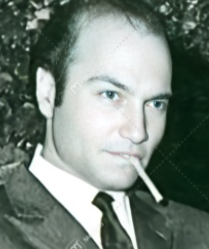
Dr. Ali Shariati.
From Ali Shariati’s (Farsi) poem One and In Front of It Zeroes Without End (يك ،جلوش تا بينهايت صفر ها), translated by me into Arabic, then into English, for my book Learning Standard Arabic (MSA) for Complete Beginners.
And when you want to be for yourself only; And to be alone; And when you want to be only with the zeros; Your life, like a bent line, will coil around yourself; Like zero.

And in the end, you reach the starting point! You stay, you decay; Like a swamp, like a pond; You become closed, like a circle; Like zero!
But if you want to be only for the sake of “one”; To come out of nothingness and emptiness; And to be a companion of “one”… You must live for the sake of others;
Then your life will move forward like a horizontal line; Like a road; Like a river; And when you want to distance yourself from your “self”; You will eventually reach an inhabited, not ruined and desolate, land; And you will eventually pour into the sea; Like a river …
If you want to be only for the sake of “one”; To come out of nothingness and emptiness; And to be a companion of “one”… You have to die for the sake of others…
Among wolves, among foxes, among rats, among sheep; He rises up and stands;

You will rise up and stand;
Amidst the zeroes,
Like “one”.
Ali Shariati


November 3, 2025
An update for November 2025
I have been able to work somewhat consistently since July, and by that I mean “real” work, not routine but creative work: writing code, or articles, or designing things.
Some clarificationsSince I have seen these mistakenly quoted on the Internet:
I have never been an Azhar University researcher or student: I was completing its PhD curriculum on my own. This was just in order to show people “I have done my homework”. The curriculum didn’t actually contain much that was new or interesting to me, and I am more interested in working on unsolved problems (like the one mentioned below), instead of routine learning. I may still get back to going through the rest of it, Allah knows.
My about page: I add or remove things from it according to my thinking at the present moment, but I do not deny anything that has already been on there, and it can all be deduced from the rest of my site. Right now there’s basically nothing in it because whatever I had on there seemed like self-flattery.
Parler de soi, c’est se louer.
To speak of oneself is to praise oneself.1
And no matter what I say about myself, it will not make a person lacking in sufficient background knowledge and critical thinking ability to take me more seriously. I am not a photogenic Islamic Internet personality and I don’t plan to be one.
My lack of updates for some years: Since 2019 I have barely been able to get any (creative) work done, and so I couldn’t do anything on this website. I have seen some Internet posts say this is because I had depression or even mental illness.
I don’t deny that I suffer from depression (which I have probably mentioned a number of times on this website), and that since 2016 I have probably never looked forward to waking up alive the next day, but my troubles started long before that.
I have a number of health conditions, and almost every day since 2012, and more especially since 2014, has been a struggle to be able to work, or even just to feel “ok”. Almost every morning I wake up feeling sick. No one knows why. My life has been one of seeing doctors, trying endless medicines and supplements, and finding dozens of solutions that seemed to work for a few days and then suddenly stopped working.
I never know if the next day I will be able to work or not. I have to steal time form my conditions to be able to do any work at all, and I do not know if this is going to change.
However, it seems that getting COVID-19 five to seven times in a row may have had something to do with my total loss of ability to work starting from December 2019 (around the time of the real start of the COVD pandemic).
Sequency and SimultaneityMy most important work this year might be my essay (not yet published) on reconciling God’s “eternity” or “timelessness” with the fact that we experience time. Or one might call it reconciling sequency (the fact that things happen one after another) with simultaneity (the fact of the “at-the-same-time-ness” of all events from God’s perspective), words I like that are from Ursula Le Guin’s novel The Dispossessed. This is what the scientist Shevek works to achieve in Ursu Le Guin’s novel, which I happened to read in 2024. I had on idea I had been busy, on and off, trying to do what is in some sense the same thing. Unfortunately my theory cannot lead to the creation of an ansibel (a faster-than-light communication device) like Shevek’s does.2
One interesting and completely unexpected result was that my theory solves time paradoxes: can a computer with infinite storage and processing power calculate all the digits of pi, which are known to be infinite? The answer is it cannot, because God and the universe operate according to sequency, and the paradox creates a classic unreachable code path situation. But this will all be made clear in the essay once I actually finish writing it.
The essay, which has grown to 14,000 words (one third the length of a typical novel), will make these matters clear, once I finish writing and rewriting it a dozen times.
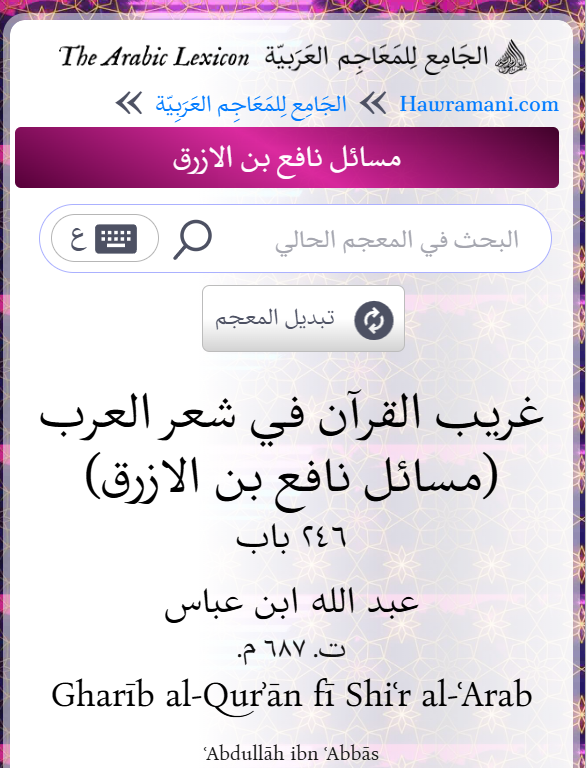
I have been mostly busy these months updating my sites and correcting, updating and expanding articles. My main project right now is the new, mobile-friendly version of The Arabic Lexicon that I have been working on since mid-September. This could have been a quick job except that I am not satisfied unless I bring every vision to life, whether it is making back-end improvements to the search system, adding new features, making the UI and features more logical and easier to use, or spending too much time on the visual design. InshaAllah soon I will get to adding new dictionaries to it, especially the Hans Wehr, which every other person on the Internet seems to bring up as being missing when my site is mentioned.
I have added a great deal of additional detail to my controversial article:
Hawramis are Not Kurds: On the different origins of Kurds, Hawramis and Zaza People
June 23, 2024
Why is Hell eternal? Who deserves eternal burning punishment?
Why is Hell eternal? Does anyone really deserve eternal fiery punishment in Hell, or is the view of Ibn al-Qayyim correct that by "eternity" the Quran means a very long time, not time without end?
About the eternity of Hell, unfortunately I do not have anything new to offer. But I feel that most ordinary people (especially in the West), at least those who grow up with middle class values, due to being wholesome people, have a hard time imagining what the deservers of Hell are really like. We have so much empathy for others, and we see them as like ourselves even if slightly worse, that we cannot imagine what it is like to be so deprived of all goodness to deserve Hell.
But look at what the Israelis are doing to the Palestinians. They are filled with so much arrogance and pride and bloodthirst that they consider the Palestinians animals that have to be butchered so that they can enjoy the lands they have stolen.
Or think of the bankers in the West who probably orchestrated the war on Iraq knowingly, knowing that millions of innocent people could die. Look at the US knowingly arming the Afghans in the 1980’s, knowing it would cause millions of innocent deaths, just so that they could force the Soviet Union to invade Afghanistan and in this way weaken the Soviet Union by making it lose money and men.
What do such people deserve? I used to have difficulty accepting eternity in Hell until I started thinking of such people, not of individual sinners. I feel that such people deserve eternity in Hell. They have knowingly given up their ticket to Paradise, they have rejected all goodness, they have rejected God and insulted Him and killed His innocent creatures.
It would be the greatest injustice to let such people into Paradise, because they have changed their own nature, they have utterly corrupted their own souls.
I still have difficulty accepting the horrible punishments mentioned in the Quran for sinners. They seem extreme, I cannot imagine an eternity burning as equal to any sin on earth.
There is also the fact, mentioned in the Quran, that when people believe their punishment has a restricted period, that it will come to an end, they stop taking it seriously and give up on goodness. This is what the Quran mentions about some of the Jews believing and being corrupted by it (The Quran 2:80). So the only way to have truly good people may be to threaten them with a horrible eternal punishment.
But what God ends up doing in the afterlife is another matter. Perhaps things are very different there.
The great philosopher Tabataba’i (he is Shia, but his views on this matter are based on Quranic arguments, not on any Shia sources) says that entering Hell is not God’s action, but a natural consequence of human action. That is, the way the soul is made, when it becomes utterly evil and unworthy of forgiveness, its nature changes to a different thing, a creature of fire (perhaps like the Balrogs in the Lord of the Rings) that burns and suffers torment by his/her own nature. It is like if someone is told “If you do that and persist in it, you will become permanently a creature of fire and will suffer torment”, and they do it anyway. They take the choice, and the laws of nature or reality causes that change in them.
This also seems to be C. S. Lewis’s view, although he does not mention burning, he mentions Hell as simply utter distance from God, which in his view is as bad as any fiery punishment.
So if a person chooses to permanently a creature of fire, who is to blame? And such a choice is not taken in one go. They get a million chances to repent, they get endless signs from God that shows them that they are going in the wrong direction, that threaten them with punishment, and yet they persist in doing evil. And one day they change permanently. The Quran calls this “surrounded by his evil deeds” (The Quran 2:81). They have crossed a line from which there is no return. God “seals their hearts” and even if they see “every sign” (The Quran 6:25) they will not believe, because they have become creatures of fire, they have changed their own species, they have chosen to enter into a different category of creature.
These are theories that I have come up with, over time, to explain why Hell exists and why it is eternal, but I cannot say that it is the correct view.
June 22, 2024
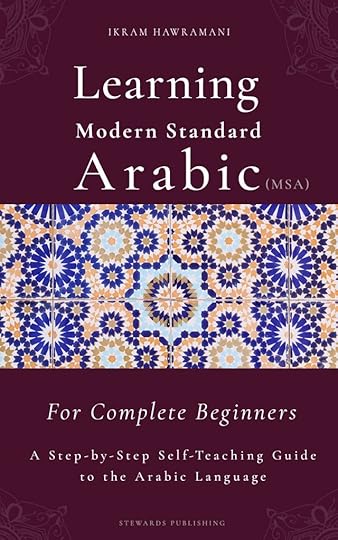
My new book: Learning Modern Standard Arabic for Complete Beginners
 Buy it on Amazon (US): Kindle | Paperback
UK: Kindle | Paperback
In August last year I thought I could start working again, but I was wrong. In March this year things changed and I was able to start working on my book Learning Standard Arabic (MSA) for Complete Beginners, a book I have wanted to write since 2019. It is based on the same learning method as my other book, Learning Quranic Arabic for Complete Beginners.
In over 350 pages, readers begin by learning the alphabet and go on read a fable from Aesop, a story about a boy’s trip through Jerusalem with his grandfather, then move on to modern Arabic poetry. Meanwhile proper transliterations and pronunciation are provided for every single sentence of Arabic, using my beloved Brill Encyclopedia of Islam system.
Buy it on Amazon (US): Kindle | Paperback
UK: Kindle | Paperback
From then on I take readers through what is perhaps the greatest Arabic poem written in the past century or two, the 119-line Rain Song by the Iraqi poet Badr Shaker al-Sayyab.(1926-1964). This poem is the only piece of Arabic writing I have read that is almost as hard-hitting as the Quran, making shivers run through your skin.
In the fourth part learners read a poem by the Persian intellectual Ali Shariati (1933-1977) called One and Beside it Zeroes Without End. There was no proper Arabic translation of it, so I had to translate it from Persian to Arabic, and of course from Arabic to English. It is written in the form of a Persian fable with a strong spiritual meaning it, starting from God creating the world.
It is strange but what I have discovered (I could be wrong, though) is that when I stop trying to work toward big goals and missions, when I simply tell myself that my job is simply to live, to be, with no greater goal in life, that is when I can actually work on the things I love. It is like a dark cloud is removed and my energy and inspiration comes back.
I have written an article about this, and once I’m reasonably sure I’m not mistaken I will publish it. I may be able to come back to my regular work in Islamic studies, but I do not know.
August 27, 2023
On Using HadithGraph
Link to the tool: HadithGraph
I have been quietly working on a tool that automatically “verifies” hadiths (based on my hadith verification method) and draws diagrams of the hadith’s chains, and recently I finished it, and the results far exceeded my expectations, alhamdulillah. The tool is simply a calculator and diagrammer, so that instead of having to do the probability calculations and diagramming manually, they all take place automatically.
Users can use the tool merely for diagramming hadith chains, even if they have no interest in the probability calculations.
Rewriting and inputting the chainsGiven the Bukhari hadith (Bukhari #1):
حَدَّثَنَا الحُمَيْدِيُّ عَبْدُ اللَّهِ بْنُ الزُّبَيْرِ ، قَالَ : حَدَّثَنَا سُفْيَانُ ، قَالَ : حَدَّثَنَا يَحْيَى بْنُ سَعِيدٍ الأَنْصَارِيُّ ، قَالَ : أَخْبَرَنِي مُحَمَّدُ بْنُ إِبْرَاهِيمَ التَّيْمِيُّ ، أَنَّهُ سَمِعَ عَلْقَمَةَ بْنَ وَقَّاصٍ اللَّيْثِيَّ ، يَقُولُ : سَمِعْتُ عُمَرَ بْنَ الخَطَّابِ رَضِيَ اللَّهُ عَنْهُ عَلَى المِنْبَرِ قَالَ : سَمِعْتُ رَسُولَ اللَّهِ صَلَّى اللَّهُ عَلَيْهِ وَسَلَّمَ يَقُولُ : إِنَّمَا الأَعْمَالُ بِالنِّيَّاتِ ، وَإِنَّمَا لِكُلِّ امْرِئٍ مَا نَوَى ، فَمَنْ كَانَتْ هِجْرَتُهُ إِلَى دُنْيَا يُصِيبُهَا ، أَوْ إِلَى امْرَأَةٍ يَنْكِحُهَا ، فَهِجْرَتُهُ إِلَى مَا هَاجَرَ إِلَيْهِ *
Enter the hadith’s isnad in the textbox as follows:
Umar b. al-Khattab > Alqama b. al-Waqqas > Muhammad b. Ibrahim > Yahya b. Saeed > Sufyan > al-Humaydi
The chain starts from the chief transmitter (the Companion, in this case Umar. b. al-Khattab [RA]), and the transmitter names are separated by ” > “. Note that there are spaces before and after the “>”.
The spelling of the names does not matter as long as it is consistent. You must always use the same exact spelling for each unique transmitter, so Umar b. al-Khattab must always be spelled “Umar b. al-Khattab” in any additional chains you add.
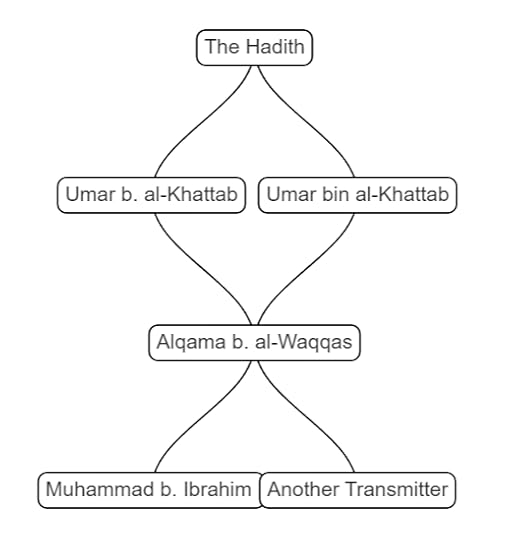
But there is no need to worry too much about getting spellings wrong, because the diagram will immediately make it obvious by making the transmitter show up twice (below we have erroneously spelled Umar b. al-Khattab’s name differently on different chains):
Then gather additional chains for this hadith using hadith search engines and/or takhrīj tools, for example Bukhari #6587 gives us another chain for the hadith:
6587 حَدَّثَنَا أَبُو النُّعْمَانِ ، حَدَّثَنَا حَمَّادُ بْنُ زَيْدٍ ، عَنْ يَحْيَى بْنِ سَعِيدٍ ، عَنْ مُحَمَّدِ بْنِ إِبْرَاهِيمَ ، عَنْ عَلْقَمَةَ بْنِ وَقَّاصٍ ، قَالَ : سَمِعْتُ عُمَرَ بْنَ الخَطَّابِ رَضِيَ اللَّهُ عَنْهُ ، يَخْطُبُ قَالَ : سَمِعْتُ النَّبِيَّ صَلَّى اللَّهُ عَلَيْهِ وَسَلَّمَ يَقُولُ : يَا أَيُّهَا النَّاسُ ، إِنَّمَا الأَعْمَالُ بِالنِّيَّةِ ، وَإِنَّمَا لِامْرِئٍ مَا نَوَى ، فَمَنْ كَانَتْ هِجْرَتُهُ إِلَى اللَّهِ وَرَسُولِهِ ، فَهِجْرَتُهُ إِلَى اللَّهِ وَرَسُولِهِ ، وَمَنْ هَاجَرَ إِلَى دُنْيَا يُصِيبُهَا أَوِ امْرَأَةٍ يَتَزَوَّجُهَا ، فَهِجْرَتُهُ إِلَى مَا هَاجَرَ إِلَيْهِ *
Now enter the new chain from this second hadith into a new line in the textbox, so that we have the following two lines:
Umar b. al-Khattab > Alqama b. al-Waqqas > Muhammad b. Ibrahim > Yahya b. Saeed > Sufyan > al-Humaydi
Umar b. al-Khattab > Alqama b. al-Waqqas > Muhammad b. Ibrahim > Yahya b. Saeed > Hammad b. Zayd > Abu al-Nu`man
Now we get the following diagram:
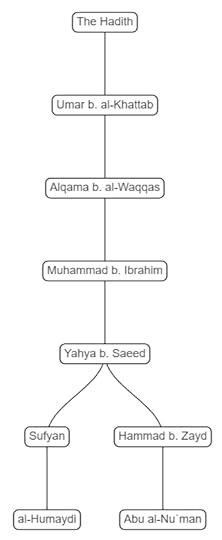
And below we have added a chain from a third hadith (Bukhari 3719):
Adding commentsUmar b. al-Khattab > Alqama b. al-Waqqas > Muhammad b. Ibrahim > Yahya b. Saeed > Sufyan > al-Humaydi
Umar b. al-Khattab > Alqama b. al-Waqqas > Muhammad b. Ibrahim > Yahya b. Saeed > Hammad b. Zayd > Abu al-Nu`man
Umar b. al-Khattab > Alqama b. al-Waqqas > Muhammad b. Ibrahim > Yahya b. Saeed > Hammad b. Zayd > Musaddad
Comments can be added for your own convenience; they have no effect on the diagram or probability calculation. Comments start with a “#” character. You can add comments before each chain as follows:
Setting custom probabilities# Bukhari 1
Umar b. al-Khattab > Alqama b. al-Waqqas > Muhammad b. Ibrahim > Yahya b. Saeed > Sufyan > al-Humaydi
# Bukhari 6587
Umar b. al-Khattab > Alqama b. al-Waqqas > Muhammad b. Ibrahim > Yahya b. Saeed > Hammad b. Zayd > Abu al-Nu`man
# Bukhari 3719
Umar b. al-Khattab > Alqama b. al-Waqqas > Muhammad b. Ibrahim > Yahya b. Saeed > Hammad b. Zayd > Musaddad
Each transmitter has a default probability 0.6 (i.e. 60%). Sometimes you are dealing with transmitters who are lower quality, although not totally unreliable. In those cases you can set a custom probability in brackets after the transmitter’s name, as follows:
Transmitter 1 > Transmitter 2 (0.4) > Transmitter 3
Above, Transmitter 2 gets a probability of 0.4 (40%) in the calculations.
Setting probabilities above 0.6 will be ignored.
We are verifying meaningsThis tool gives the probable authenticity of the text (matn) of the hadith. But some variant hadiths sometimes contain additional sentences or lack them. Make sure all of the chains are the chains of hadith texts that mention the meaning you are trying to verify, such as “all actions are judged (by God) by the intentions behind them”.
August 26, 2023
Just an update
The last time I did any serious work in Islamic studies was four years ago, in March-April 2019, when I was busy showing that, according to my hadith verification method, none of the pro-predestination hadiths were reliable. I was never able to finish that work.
I might possibly be “back” and I might be able to continue the kind of work I was busy with in 2017-19. But I cannot promise anything; only God knows what is in store for me.
I apologize to all the people I’ve failed to respond to. My condition worsened in 2019, and in 2020 due to Covid-19 I ended up being sick and fatigued for months at a time. Sometimes for months at time even reading a paragraph of text was more than I could do. In early 2021 I had a minor stroke during the fourth or fifth time that I had Covid-19, and I’m still recovering from that.
But I’ve still been able to do a lot of reading over the past four years in order to cure my lamentable ignorance about many things. A lot of my reading is in academic monographs and essay collections, so perhaps it’s not all entirely useless entertainment for myself. I’ve read 252 books since April 2019, if we count Quran re-readings too. Here are some of the books I’ve read in 2023 so far:
Ian Hodder, Studies in Human-Thing Entanglement (2016)C. S. Lewis, The Discarded Image: An Introduction to Medieval and Renaissance Literature (1964)Owen Barfield, History in English Words (1967 Eerdmans [1953])Neil Rhodes, Shakespeare and the Origins of English (2004)Ahmad al-Jallad, The Religion and Rituals of the Nomads of Pre-Islamic Arabia: A Reconstruction Based on the Safaitic Inscriptions (2022)Peter Magee, The Archaeology of Prehistoric Arabia: Adaptation and Social Formation from the Neolithic to the Iron Age (2014)Robert G. Hoyland, Arabia and the Arabs: From the Bronze Age to the Coming of Islam (2001)Norman Yoffee, Myths of the Archaic State: Evolution of the Earliest Cities, States and Civilizations (2004)Kay Redfield Jamison, Touched With Fire: Manic-Depressive Illness and the Artistic Temperament (1993)Leslie A. Marchand, Byron: A Portrait (1976 [1971])Second reading of C. S. Lewis’s Space Trilogy: Out of the Silent Planet (1938), Perelandra (1943), and That Hideous Strength (1945).C. S. Lewis, Till We Have Faces (1956) (second reading)C. S. Lewis, The Great Divorce (1945) (second reading)C. S. Lewis, The Pilgrim’s Regress (1933) (second reading) James Turner, Philology: The Forgotten Origins of the Modern Humanities (2014)John W. Chaffee, The Thorny Gates of Learning in Sung China: A Social History of Examinations (1985?)Johannes Pedersen, The Arabic Book (1984 [1946]) tr. Geoffrey French ed. Robert HillenbrandJim B. Tucker, Return to Life: Extraordinary Cases of Children Who Remember Past Lives (2013)Ian Stevenson, European Cases of the Reincarnation Type (2003)Ian Stevenson, Children Who Remember Previous Lives: A Question of Reincarnation (Revised Edition) (2001/1987)Ian Stevenson, Where Reincarnation and Biology Intersect (1997)James G. Matlock, Signs of Reincarnation: Exploring Beliefs, Cases, and Theory (2019)Bruce Greyson, After: A Doctor Explores What Near-Death Experiences Reveal About Life and Beyond (2021)Titus Rivas, Anny Dirven, and Rudolf H. Smit, The Self Does Not Die: Verified Paranormal Phenomena from Near-Death Experiences (2016)Jeffrey Long and Paul Perry, God and the Afterlife: The Groundbreaking New Evidence for God and Near-Death Experience (2016)Kenneth Ring, Lessons from the Light: What We Can Learn from the Near-Death Experience (1998, 2006)Raymond A. Moody, Life After Life (25th Anniversary Edition) (1975, 2001)Among these the most eye-opening one was al-Jallad’s The Religion and Rituals of the Nomads of Pre-Islamic Arabia. There’s something strange and wonderful about seeing inscriptions by pre-Islamic Arabians writing things in a very strange alphabet that, once deciphered, is very recognizably “Arabic”.
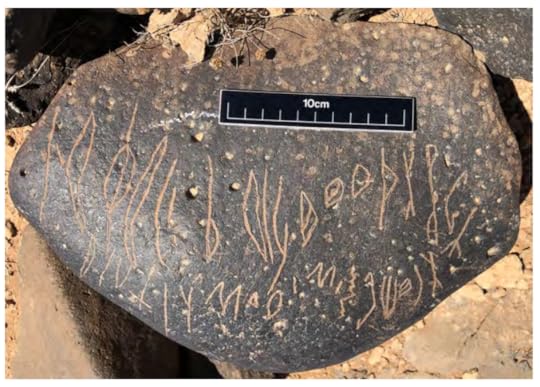
l mqm bn ymlk w wgd ʾṯr ḏʾb w ḥrśn f ngʿ f h lt slm
‘By Mqm son of Ymlk and he found the traces of Ḏʾb and Ḥrśn and grieved in pain
so, O Allāt, may he be secure.’
The transliteration above does not add vowels because it is not known how the people who made these inscriptions actually pronounced these words. Reconstructing the pronunciation from Arabic would be premature and unscholarly. But regardless of the pronunciation, turning these letters into Arabic makes most of the words make some kind of sense in Arabic:
C. S. Lewis
wgd ʾṯr = وَجَدَ أَثَرَ = "he found the traces of"
f h lt slm = فها الّات سَلِّم = O Allāt [the name of the pagan goddess] make safe / provide safety
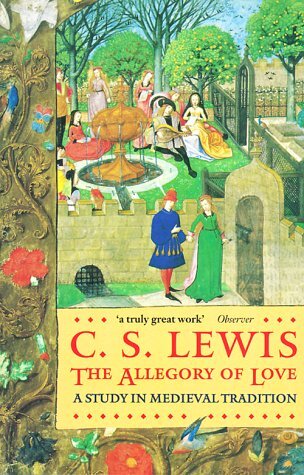
In August 2019 I read C. S. Lewis’s Allegory of Love (an academic book on medieval poetry), and I soon sensed that he was truly “a man after my own heart”. I went on to read over 30 other books by him, including his 4000-page collected letters. When I discover one of those extremely rare thinkers who show promise that they can teach me something new, I tend to read all of their books that I can get my hands on. There’s still an important book of his I haven’t read, the 600+ page Poetry and Prose in the Sixteenth Century.
TolstoyIn early 2021 I read Tolstoy’s War and Peace and saw that he was another one of the greats worth reading. Since then I have read War and Peace two more times. I have also read some of his other major works and his biography. I noticed during my first reading of War and Peace that despite his wonderful insights, there was something “off” about him, a kind of moral laxity. He was no C. S. Lewis or Dostoevsky, men who truly spent their days like candles burning for the greater glory of God.
DostoevskyBetween 2021 and 2022 I read all of Dostoevsky’s novels (starting with the definitive 900-page biography by Joseph Frank). I used to say that Dostoevsky fills in the missing pieces in C. S. Lewis’s worldview, writings, thinking, or what have you, and maybe that is true.
Dostoevsky’s last novel The Brothers Karamazov is considered his greatest by many, or even one of the greatest novels of all time, but I had to force myself to finish it because, having read all his previous novels, there wasn’t anything new or interesting left for me to learn from him. It felt like a reworked summary of his other works (when it comes to the ideas and feelings pushed forward, not the plot, which is of little interest to me).
And I agree with Joseph Frank that Dostoevsky’s The Adolescent was a really bad, or at least unentertaining, rambling and insight-poor novel. But poor Dostoevsky needed the money.
I will end this article here. I hope to have much more to say about all the interesting things I’ve read.
June 12, 2021
A possible spiritual cure for focus issues (ADD / ADHD)
For years now I have suffered from ADD/ADHD-like symptoms that make it difficult for me to initiate working on tasks or to focus on completing them. I have tried various medications and supplements and none of them has lived up to its promise. Since early 2021 I have switched my focus to seeking psychological cures, and have discovered many things that help (such as forcing myself to write poetry).
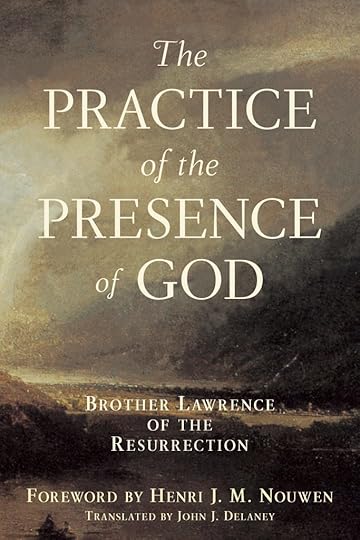
But in the last two weeks I have discovered something immensely powerful after remembering Brother Lawrence’s 1692 classic The Practicing the Presence of God (a very short book, link to free version). If I feel restricted by ADHD symptoms, I bring God fully to mind and remain with Him, and within seconds I feel the front and sides of my brain “waking up” (I seen to have a very sensitive brain and I can feel physical sensations in different parts of it when there is a strong stimulus that causes a mental shift). That, I believe, means that extra blood is flowing to the prefrontal cortex (needed for executive function / planning and remaining on tasks) and the temporal lobes (needed for doing any creative work).
And the reason it works is that the presence of this Person in the mind suddenly starts to activate the brain’s prefrontal circuits that are dedicated to tracking and analyzing a person who is present with us (to know their thinking and intentions). And as this Person can be spoken to, this also activates the creative temporal lobes, empowering us to carry out self-expression.
I realize that I have sometimes gone for months while almost always having God in mind with me, and those are probably my most productive months. Last year in August I realized that the only times when my mind was full of inspiration and I constantly took down notes on ideas coming into my head were times when I practiced God’s presence. I went to my notes app, took note of the periods in which many ideas were written, then compared them to my record of times when I had completed the reading of the Quran many times, and the times lined up. The times when I read the Quran often are also times when I have God the most in mind, the two go together although I do not know which one causes which.
How to do itThe way to practice the presence of God is simple. Simply start speaking to God in your mind, as you do when you are praying to Him for something. And at some point you are able to remain in contact with Him without having to say anything–He just becomes a friend who is with you. And as you do it more often it becomes easier and easier, just as when a stranger is in the house with you, at first their presence can distract you, but as you get to know them you can sense their presence without it taking away your attention from other things.
If you struggle to keep God in mind, merely go back to speaking with Him by praying for something, such as by saying astaghfirullāh (“I seek God’s forgiveness”). It should be done sincerely and with all your heart, as if you are really speaking to a person. If it’s merely a word you say, it will to bring you into His presence to reap the benefits.
If for whatever reason you feel unworthy of speaking to God and being in His presence, here’s something I wrote to a friend a few days ago:
Never let Satan make you think you are unworthy of speaking to God. Be brave when facing God and think "I'm unworthy but that doesn't matter, I'm still Your creature and You have to take care of me." He responds kindly when someone speaks to Him as if He really exists and is present even if the person is angry and upset at Him. Being spoken to is one of His greatest pleasures regardless of the person's mood. He is kind and has a sense of humor, like a father who laughs at his angry little 2 year old daughter when she attacks him physically in a tantrum, and only feels love for her.
You may think you need to do a lot of repentance before you are worthy of being in God’s presence. But in Islam the word for repentance, tawba, literally means “to return”, and to merely bring God to mind and speak to Him is to return to Him, thus achieving repentance. InshaAllah (God-willing) as you practice His presence more and more, it will become second nature to avoid anything that displeases Him.
Another possible reason it works is attachment (look up attachment theory). Being in the presence of a “caregiver” (an important term within attachment theory and it can be anyone whom we love and trust) calms us down, reduces inflammation, and increases cerebral blood flow, enhancing our thinking and self-expression and giving us confidence to explore. Meanwhile, the absence of a caregiver leads to anxiety, lack of curiosity, inflammation, fear of exploration, fear of self-expression, and reduced cerebral blood flow. And what caregiver is better than God?
Obviously there are a great many spiritual benefits from practicing the presence of God, but that’s a different topic and not the focus of this article.
May 14, 2021
An update and some books
I apologize for going missing for so long. I had a worsening of my chronic fatigue condition in early 2020 that made it impossible for me to write, or to even sit at my computer to do any kind of work or even casual browsing of websites I used to enjoy.
Now that I’m feeling healthy, it’s quite difficult to empathize with my former self who couldn’t even get out a sentence. How is it possible not to be able to write a single sentence?
It seems that I might be able to start doing my usual work again; writing articles and essays, answering questions and verifying hadiths. But it may still be too early to tell.
I have updated the site to require an account to comment to reduce spam and low-effort comments. InshaAllah I will also consider adding social login.
The most important breakthrough in recovering from my “chronic fatigue” (I’m not sure if it is the same as the famous chronic fatigue condition, but the condition has been chronic and it has involved extreme fatigue) was taking the psychological route of treatment. Learning about attachment theory provided me with the key I needed, and after months of thinking and experimenting I have been able to reorganize my mind, so to speak, in a way that allows me to be motivated and energetic again. I only really grasped the power of human psychology when after succeeding in feeling energetic and motivated I would slip into the old mindsets and instantly my muscles would weaken, my breathing would get shallow and I would again feel too tired to work at a computer.
But another breakthrough in the last few weeks has been elderberry extract. This is perhaps the strongest anti-viral supplement there is. In my teens I became ill with something that gave me a sore throat that has never gone away (it seems the same happened to Dostoevsky), and it seems that part of chronic fatigue is a viral infection, perhaps EBV. This is a virus that almost everyone in the world carries, but in the majority it causes no symptoms.
 Amazon link. WARNING: If you get elderberry extract capsules instead, only take them with a full meal. I got very serious liver overload symptoms after taking the capsules on an empty stomach.
To the right is the brand of elderberry extract I’m using. I have to take multiple tablespoons throughout the day. I’m also taking iodide (up to 12.5 mg a day), although I’m not sure yet if it’s needed. I’m also taking other things. Feel free to email me for more details (contact@hawramani.com), I’m happy if I can help anyone’s condition get better.
Alhamdulillah in June 2020 I had recovered enough to start reading again, and since then I have done a great deal of it. I was able to read thirty books by C. S. Lewis and such important classics as Moby Dick (I actually read it twice!) and War and Peace.
I even read Josef van Ess’s 4-volume Theology and Society in the Second and Third Centuries of the Hijra, a book every Islamic studies researcher wants to have read but finds too daunting to start. What an amazing book! In it you can read about Islam before it became the Islam we recognize today; before the 4 madhhabs were founded and almost every great scholar was his own “sect”, with various ideas and beliefs floating around among the most knowledgeable and pious scholars that today would be considered heretical.
But you may be happy to learn that I remain as dedicated to mainstream orthodox Islam as always. That 4-volume book might seem to be filled with weapons to attack today’s Islam and cause doubt among Muslims, but a well-read Islamic studies researcher will have already known before reading this book that that is how Islam was at the beginning and that that history is nothing to be ashamed about.
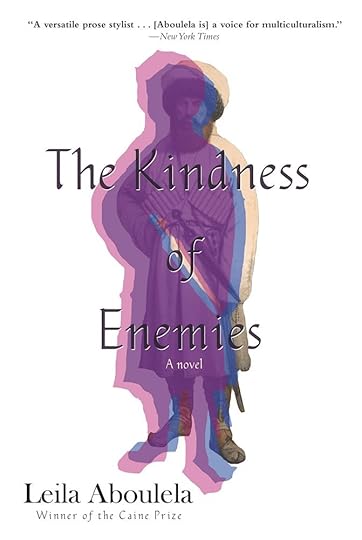
I read The Kindness of Enemies, a novel that I really, really liked (though the modern-day chapters not so much, perhaps due to not being a Western-raised Muslim immigrant myself like the heroine is). The novel alternates between modern-day chapters and historical chapters about Imam Shamil (a Chechen “freedom fighter” of the 1850’s, fighting against the Russian Empire). In one of those odd coincidences, I soon read Tolstoy’s The Cossacks, a novel about the conflict from a Russian soldier’s perspective.
The author’s treatment of Imam Shamil is extremely remarkable: here’s a woman writing about a man and his psychology with better understanding and empathy than the average male writer (reminding me of Edith Wharton); here’s a Muslim author writing about a hero of Islamic history without any melodrama or exaggeration (as far as I could tell), showing us the hero as merely a man, though a great man still. This is a breath of fresh air if you compare it to the typical stories about historical Muslim personalities found everywhere on Islamic sites. And here’s a Muslim author writing about the experiences of a non-Muslim Georgian princess with love and empathy.
I am hopeful that these remarkable features will soon stop being remarkable by becoming commonplace among Muslim writers and intellectuals, especially those living in the West.
That’s it for now. InshaAllah you will hear more from me.
December 2, 2020
She promised Allah not to talk to him then broke her promise
Asalam Walikum, I hope you are doing well. I really really need help
Can you read the Quran on a smartphone without wudu?
Hi! Do you think it is okay to read Quran through an app without performing ablution? The phone isn’t Quran after all, so does holding the phone without ablution, though reading Quran through it require to perform ablution?
Assalamu alaikum,
There is no need for wudu when reading the Quran from a computer or smartphone, or when reading a translation. Even menstruating women can use these methods, as discussed here.


