M. Scott Chambers's Blog
September 17, 2016
Can authors write characters from different cultural backgrounds?

First, take a look at this article from Vox from Constance Grady. Beneath the article’s main point, which is a lot seemingly arbitrary line drawing about cultural appropriation (in which the article confusingly suggests that purchasing and wearing Native American jewelry is okay, but a author wearing a sombrero to make a rhetorical point is offensive), there is substantial criticism of Lionel Shriver and her latest novel, The Mandibles. It seems Grady’s criticism, which is linked back to the cultural appropriation argument, is that Shriver, a white woman, is insensitive in her depiction of a black woman (because that woman suffers dementia and ultimately suffers a nasty fate in a post-apocalyptic landscape) and a Mexican-born president (because that president presides over the economic collapse of the United States).
First of all, I don’t agree with the assumption that writers can’t write a variety of narratives, even negative ones, about people with whom the writers don’t share cultures. That, to me is preposterous, and I don’t think that’s what Grady intends to say in the article. It certainly appears that way, though.
Second, let’s put this controversy in a bit of context. Lionel Shriver exploded onto the literary scene with her outstanding novel We Need to Talk About Kevin, a stunning and psychologically complex look at the relationship between a school shooter and his mother, who goes through the novel with the vague feeling that her maternal ambivalence somehow caused her son’s murderous actions. It was edgy, tense, and amazing.
I haven’t read The Mandibles yet. I don’t have any reason to think that Shriver has lured me into admiring her while she secretly harbored deplorable racism. Honestly, I don’t think that most critics are taking that position either, though I can’t be sure, though Grady does explicitly call at least one part of The Mandibles racist.
This charge arises from the fact that Mandibles apparently features characters and situations reflective of the currently racially charged politics of the United States today. If you have even a passing familiarity with American literature (particularly literature penned by Southern women), you may recall that Flannery O’Connor did a very similar thing. I doubt anyone can read O’Connor’s tales of a racially divided deep South with any level of comfort; I will vigorously maintain, though, that anyone who thinks O’Connor’s work was racist has completely missed her point. The comparison between her and Shriver is an apt one; O’Connor is an obvious influence on Shriver’s style and voice.
But then there’s currently something in our critical and political culture called identity politics. And for Shriver, that’s going to make a pretty big difference in how her novel is being received.
Perhaps my biggest issue with Grady’s Vox piece is framed best by her, in the middle of the article:
The question of whether writers can write well about cultures to which they do not belong — and whether they should even try to — is one that deserves some serious discussion.
Respectfully, Ms. Grady? No. No, it’s not. Limiting storytellers as to the kinds of stories they can tell based on their cultural identity, not their talent, is completely backwards. If Lionel Shriver writes something that’s racist or sexist, then by all means, call her out on it. (I would caution you, however, to carefully consider the nature of storytelling and literary construction before you levy such a serious accusation. It is an enormous mistake to assume that a writer personally approves of or likes anything that happens in a fictional story.)
I don’t think anyone would accuse Shriver’s fiction in general of being overly pleasant or optimistic. That’s not the kind of writer she is. But it’s not fair or legitimate criticism to cry foul the moment she writes something that makes you personally uncomfortable.
And what is the solution to this problem, exactly? Are we now going to start holding writers responsible for things their characters do and the skewed worldviews those characters may hold? Practically every novelist in the history of the world (including yours truly) would be a murderer, a racist, a homophobe, a coward, and worse several times over.
That’s the idea of writing fiction, of course: it’s terribly boring to only write about well-behaved people. Similarly, a world where writers are constrained only to narrate fully from one cultural point of view, and observe the rest with a respectful and bemused distance, is a storytelling handicap that is historically unprecedented.
I feel for Lionel Shriver. I really do. She’s a fantastic writer who wrote a racially charged book in these politically sensitive times. She also has the misfortune of being white while doing so. Her cultural identity is not, and will never be, a legitimate criticism of her work. She’s either written a lousy book or she hasn’t. The author’s personal characteristics should be off limits, period.
I suppose, had my own last book been just a tad (a lot) more visible, and I were straight, I would be subject to the same criticisms that she is now receiving, based on the fact that gay men have sex and are unfaithful to each other over the course of Future Imperfect. In Ms. Grady’s critical paradigm, I’m safe on that count by virtue of my own sexuality. But apparently, I had better never even try an in-depth examination of Yuki Tanaka, a significant Japanese character in Future Imperfect, or Grant Moncrief, who is half Inuit.
But I digress. This horribly unfair treatment of Shriver has nothing to do with the quality of her work; it just compares her personal cultural context to that of her characters and asks whether that makes literary critics uncomfortable. That’s messed up by any definition you want to use.
MSC
The Backlist
Image courtesy of Shutterstock. Cultural appropriation as medicine, which I can say with confidence is never okay from a treatment perspective.


September 10, 2016
Publishing news
No, I’m still not done with Judgment Day.
This is not, however, a George R.R. Martin-style kind of of announcement. Work is getting done. The revised Future Imperfect manuscript is completed. It just needs to be formatted. There is also the small matter of the rights being transferred from Caliburn, which will still be selling the older version until the distributors can pull it down. Once that happens, we can talk about the new edition, which will have at least some new material from Judgment Day. So there is that. And I believe (though I can’t promise) there will be hardcover editions. Still working that bit out. All versions, when available, will be on Amazon and other typical retailers.
I have the services of Future Imperfect’s cover artist available, and I am excited about working with her on some new material, both for Judgment Day and an upcoming short story collection.
My current goal is to have something new out by January 2017. That schedule depends on a lot of factors, including other people. Just trust that there is a plan, even if it all crashes and burns.
Now there’s something that could serve as a motto for my under-construction fictional universe.
MSC
The Backlist
September 4, 2016
Ch-ch-ch-changes
So, while I try to make progress on the next book, of course nothing else lets up. After a little over a year with Caliburn, I’ve decided (and Caliburn has agreed) to end my current publishing contract. The good news is that this will give me a little more freedom to publish my book that way I would like, as well as a tighter grip on what the distributors are doing. (The Barnes & Noble availability issues, for example, are going to be resolved once and for all in a very definitive way.) It also means we’re going to have a revised version of Future Imperfect soon, and that we’ll have Judgment Day out sooner rather than later, now that it’s not tied to the Caliburn publishing schedule.
The bad news is that you’ll all just have to wait a bit longer. A revised edition of Future Imperfect will take a bit of time in addition to the time I’m already taking to write the second book. On the whole, though, this move means that things will happen more quickly, not more slowly.
Also in the pipeline (as in, written and waiting for my attention) is a collection of short stories that I have to make a decision about publishing-wise. I think there may be a couple additions yet, but that’ll be available sometime soon.
MSC
The Backlist
August 6, 2016
Still writing...
Hello, to those of you still reading:
I’m aware that I have not posted in quite a while. It’s not that I’ve had nothing to say; it’s more that I have been working on other projects and the blog has fallen by the wayside while I worked on those. (The fact that it’s my son’s last summer before he starts big-kid school has also rendered this a travel-filled summer.) Judgment Day is still chugging along, though not as fast as I would like. I also wrote a longer-form essay I am shopping to another website right now. It’s not fiction, and therefore not the type of thing that goes here, but if it ever gets up I will post a link.
I have a couple more blog projects in mind, and will hopefully get those up sometime in the near future. Thanks for reading, and I’ll be more out in the open soon.
MSC
The Backlist
April 12, 2016
Judgment Day: a brief update
Work on the sequel to Future Imperfect, a novel entitled Judgment Day, continues. After some trial and error, I think I’ve found the most solid way forward for the book. Having made some critical decisions about the direction of the book, as well as the direction of the Future Imperfect series, I can share the following information:
1. Most of the major characters from Future Imperfect will return, as will a couple minor ones. Their roles in the upcoming story will be significantly different from the last book. For example, with the business of the Rahricht murder resolved, eight-year-old Sam will find himself with less to do. Other characters, though, will get the opportunity to tell their own distinct stories in this world.
2. Whereas Future Imperfect presented itself primarily as a murder mystery, the new book will be a bit more expansive. Science fiction, fantasy, and even horror elements will be much more prominent in the second volume.
3. Judgment Day will keep itself entirely within the confines of the 20th century. We won’t see any more of the 21st century until the third book, currently entitled Fragile Lives.
That’s it for now. Hopefully I’ll be making some more progress soon. In the meantime, those of you who haven’t yet can pick up the Kindle version of Future Imperfect at Amazon for the low, low price of $2.99. Why not give it a try?
MSC
The Backlist
Judgement Day: a brief update
Work on the sequel to Future Imperfect, a novel entitled Judgment Day, continues. After some trial and error, I think I’ve found the most solid way forward for the book. Having made some critical decisions about the direction of the book, as well as the direction of the Future Imperfect series, I can share the following information:
1. Most of the major characters from Future Imperfect will return, as will a couple minor ones. Their roles in the upcoming story will be significantly different from the last book. For example, with the business of the Rahricht murder resolved, eight-year-old Sam will find himself with less to do. Other characters, though, will get the opportunity to tell their own distinct stories in this world.
2. Whereas Future Imperfect presented itself primarily as a murder mystery, the new book will be a bit more expansive. Science fiction, fantasy, and even horror elements will be much more prominent in the second volume.
3. Judgment Day will keep itself entirely within the confines of the 20th century. We won’t see any more of the 21st century until the third book, currently entitled Brief Lives.
That’s it for now. Hopefully I’ll be making some more progress soon. In the meantime, those of you who haven’t yet can pick up the Kindle version of Future Imperfect at Amazon for the low, low price of $2.99. Why not give it a try?
MSC
The Backlist
April 10, 2016
Baskin: Sometimes questions without answers are just fine
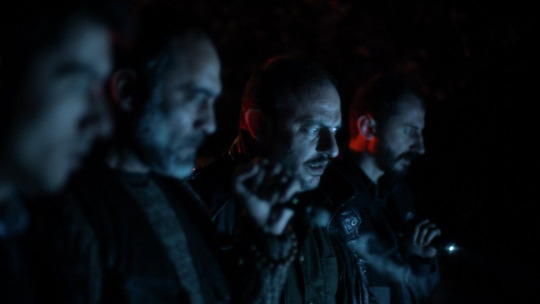
I finally got around to watching
All of those things are true, but I’m not sure they get to what makes this film both unique and well-grounded in cinema that came before it. I tried to think about to write about this film in an engaging way that wasn’t simply a plot summary or a description of its imagery, neither or which would do the film justice.
What I came up with, then, was a list of questions that I’d like to discuss with someone else who’s seen the film, along with a selection of other genre films that I believe inform what we have here.
1. The use of darkness actual darkness in film is extraordinarily rare. As far back as Muranu’s Nosferatu, directors have simply be “blue-lensing” (my term) outdoor daytime scenes and avoiding shots of the sky in order to suggest a scene at night. Baskin is a film that takes place entirely at night and the majority of its shots use darkness and shadow in ways that play to the genre. (See promotional still above.) I’m surprised more directors don’t do this. I suspect that shooting with low light is more difficult, even though it makes for better movies. I wonder if there is ever a good reason for blue-lensing (to create the illusion of low light) as opposed to actually shooting with low light?
2. On the heels of that question, consider this: Evrenol film several scenes with a technique that comes straight from Dario Argento and Suspiria: Bright splashes of artificial light with deep, jewel tones. I was unable to find a shot of the most memorable of these, when a haunted building standing in the middle of a nightscape was bathed in deep red light. A similar technique is used inside the building here, for a more action-oriented scene with one of the films many monsters.
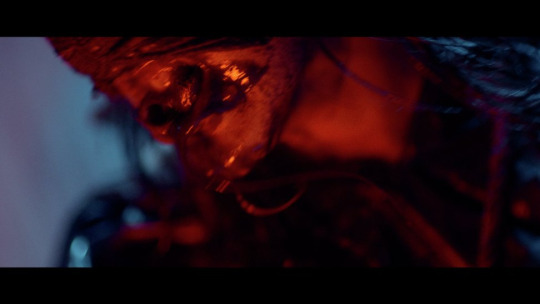
Argento used similar lighting in his interior nighttime scenes. Why is this technique so effective, and why do I love it so much when I hate blue-lensed nighttime scenes so much?
3. Without spoiling the details of Baskin, I noticed a lot of plot similarities to Jan Svankmajer’s Faust, including a preference for surrealist techniques and interesting distortions of time and space. The final shots of each film are even similar. Given that Faust adapts two centuries-old stories about Hell and Baskin is a more modern film about the concept, is it fair to say that each film explores the idea of damnation from its own perspective: Faust a classical Christian one, and Baskin a more modern one? What are the significant differences between the two depictions, and how are concepts like sex and demons handled in each?
4. As noted above, Clive Barker’s Hellraiser is a significant influence on Baskin. A notable difference between the films, though, is that the tortured characters in Hellraiser arguably deserved their fates in a way that the protagonists of Baskin don’t. This seems like a critical distinction when discussing what critics like to refer to as “torture porn.” Does either film deserve that label, and if so, doesn’t a film’s interest in demonstrating the relative guilt or innocence of the characters have a bearing on that question?
5. As an American watching Baskin, there were several mundane details of the character’s conversations that I found odd, like discussions about brothels. I understand that prostitution is generally legal in Turkey, and even the most sympathetic character casually admits to visiting a brothel in order to lose his virginity. This would literally never happen in notoriously puritanical American horror films, and an American character that makes such an admission would be seen to some degree and “deserving” of punishment by an antagonist due to the violation of our sexual mores. How much of our perception of characters and justice in horror films, then, is cultural? And how do we navigate that when experiencing a horror film from another culture?
As you can see, there’s a lot of stuff to unpack here. I haven’t even gotten to how Baskin depicts its villains or their philosophy, or the way it uses dreams and varying states of consciousness as connective tissue between its various scenes. It’s a fascinating film–one that is certainly worth more critical praise that it is receiving.
MSC
The Backlist
Images- promotional stills, Baskin (2015). Courtesy of IMDb.
April 3, 2016

April 2, 2016
Diversity in Fiction, Part II: When cultural appropriation attacks
(Image courtesy of Shutterstock.)
Our stories and their characters are getting more diverse. On the whole, that’s a good thing. Authors need to ensure, however, that their efforts at diversity don’t contribute to other, more insidious problems. A well-meaning attempt to work racial diversity into an otherwise white cast of characters can result in tokenism, or little more than a surface homage to diversity in characters. In that case, nothing about the story itself has changed. It simply pays lip service to the idea that multiple perspectives and backgrounds should be considered, then continues with telling the story that the author initially set out to tell. Perhaps the most egregious and highest-profile example of this idea is the Magical Negro, a black character who exists in fiction solely to guide and help white characters to the end of the story. This character persists in novels, film, and television even today.
Another problem with tokenism is that it lends itself easily to stereotypes, even by the most-well meaning of authors. Kathryn Stockett’s The Help doesn’t descend into stereotyping in the way that it could, but it does fall into some unfortunate tropes. For her part, white protagonist Skeeter is really a White Savior to the black characters in the story, a decision that makes some sense in terms of the novel’s setting, but ultimately robs the black characters of their agency.
My biggest pet-peeve at the moment, and an issue I struggle with in writing my own stories, is the specter of cultural appropriation, loosely defined here as taking characteristics of nondominant culture and using it for characters from privileged (usually white) backgrounds.
Comic reader that I am, I’ve been noticing one particularly egregious appropriation that’s over 20 years old making its way back into the public consciousness. With the release of the new X-Men movie comes the casting of one of the X-Men’s few Asian characters, the telepath Psylocke, portrayed here by Olivia Munn:

(Promotional still for X-Men: Apocalypse.)
Munn is a fine actress and, as I said above, Psylocke is one of very few Asian characters in the X-Men. So what’s the problem?
Psylocke, aka Elizabeth Braddock, isn’t actually Asian. In fact, she’s a white, British lady, who’s the twin sister of perhaps the whitest character in the Marvel Universe, Captain Britain. In fact, here’s an early appearance of the character in her brother’s book:
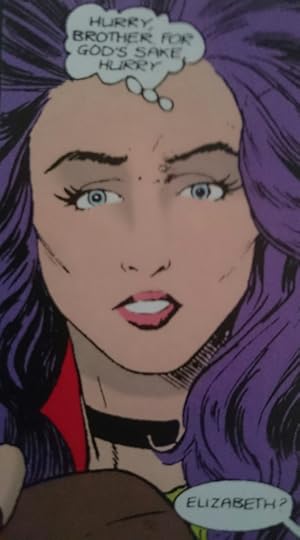
(Excerpt from The Daredevils no. 3.)
Explaining how we get from an upper-class, white, British lady to a Japanese ninja is a story that has its basis in Chris Claremont’s run of X-Men and is too complicated to reproduce here in its entirety. Suffice it to say that Elizabeth switches bodies with a young Japanese woman named Kwannon, and then continues on with her life. From that point on, Elizabeth is an Asian woman. This storytelling choice is odd, though, considering that if we wanted an Asian character, we could have just introduced Kwannon and let her have a story. The Asian experience, though, is being introduced and channeled through a white character.
Nor is that the only time X-Men adjacent characters have been involved with culturally questionable storylines. In the Demon Bear Saga run of Claremont’s New Mutants, two white supporting characters, Tom Corsi and Sharon Friedlander, are transformed into Native Americans. In the years afterwards, those characters begin adopting a more Native American style of dress. The adoption of that culture, and its presentation through characters not from that culture, is disconcerting.

(Excerpt from New Mutants no. 20.)
It should be noted, as well, that a Cheyenne New Mutants character, Danielle Moonstar, ultimately takes a power set from Norse mythology as a Valkyrie. Danielle herself remarks on this several times throughout the story as being a profoundly uncomfortable experience for her given her own ethnic and cultural heritage.
Given those examples, one might ask why cultural appropriation is bad. I am not certain that the judgment of “bad” is helpful. In fact, if I mention a film, show, or book, on this blog, I generally recommend it as being worth your time. But I do think that, as a practice, cultural appropriation is a very poor way to represent diverse cultures in fiction. It would be more work, for example, to represent the experience of being ethnically Japanese from the standpoint of Kwannon than from that of Elizabeth Braddock. If it is done well, though, it would certainly be a closer reflection of reality and a better representative of that perspective.
This is an issue I am currently wrestling with in my own work. As I write characters who are female or non-white, it’s difficult to ensure that they are being represented in ways that reflect that character’s experience rather than my own. I suppose if I don’t succeed, someone can always write a snarky blog post about it sometime in the future.
MSC
The Backlist
March 27, 2016
A horrible, dystopian alternate universe
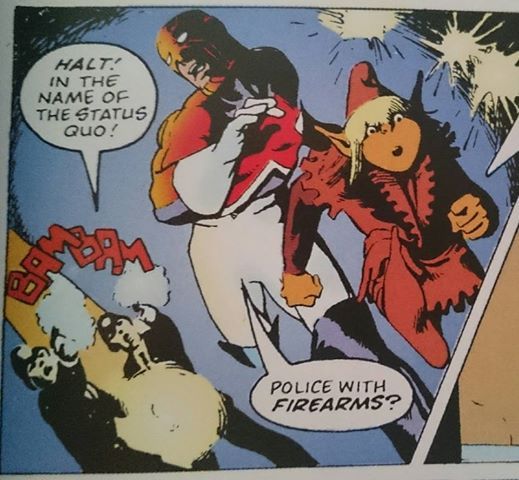
Oh, Captain Britain. What crazy alternate Earth will you fall into next?
MSC
The Backlist