Rajesh Seshadri's Blog
May 10, 2020
How the Bengal Famine led to American Independence
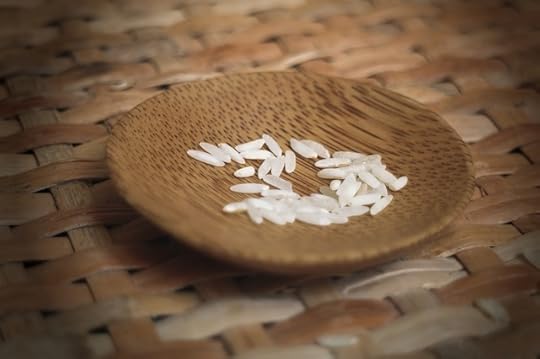 Did you know there has been no significant famine in India since Independence? That a famine in India was directly or indirectly responsible for the American Independence. And there have been twelve faminesduring the 200-year British rule? There is a lot of extremely interesting if not intriguing history that we do not know, primarily because we were taught the same old boring stuff repeatedly from Class 5 to 10. And there is no dearth to the horrors that the British perpetrated on us during their rule, in addition to reducing us from one of the richest countries in the world to one of the poorest countries in the world, as Shashi Tharoor has highlighted on several occasions. My blog has been versatile in terms of content, but till date it has never witnessed the write-up on a historical event. It was a suggestion from my son, who also provided some of the basic inputs – he avidly devours history and unlike his father – remembers it. That is how this post came into being, a short blog article on how a famine in India led to American independence. Most history is about human greed, individually or collectively and this one is no different. It also shows us how difficult it is to foresee the outcome of a particular action or a series of actions. It is always a challenge to know where to begin a story even if one has determined where to stop. Let me begin with Bengal in the 1760s and 1770s which included modern Indian states of Bihar and West Bengal, parts of Orissa and Jharkhand as well as the neighbouring country of Bangladesh. One of the major crops cultivated here was rice and considering that India was a land prone to occasional droughts, it was a practice for centuries to hoard rice and other essentials. The Mughal Emperor had the right to collect Diwani (or the tax paid by the peasant) and in 1765, the British East India Company (BEIC) acquired this right. Profit-maximisation has always been the objective of all ‘companies’ and this one was no different. In a bid to maximise their profits (or increase their collections), the BEIC increased the tax rate from 15% to 40% and outlawed the hoarding of rice. Additionally, they discouraged the cultivation of food crops and encouraged the cultivation of cash crops such as tea and sugarcane, which further enriched their coffers with regular tax collections. In their immediate greed, they hardly foresaw the chain of events that would emerge from this singular action.In 1769, drought hit Bengal again, however this time there were no stocks of rice as was the practice over centuries. This led to the first of the twelve famines that would wreak havoc and result in millions of deaths in India during the British rule. The emphasis on cash crops like sugarcane which consumed huge quantities of water aggravated the frequency and intensity of the droughts. The Great Bengal Famineis reported to have resulted in over 10 million deaths. There are terrible stories narrated by various newspapers and books, which are too horrible to be reproduced here. The BEIC did not, of course, care about the deaths of Indian human beings, but they did get immensely perturbed by the fact that their revenues plunged severely. One of their first actions was to increase the rate of tax to 60% and resort to violent means to collect it. Quite obviously the price of rice rose steeply during the drought, from Rs. 2.48 per maund (37.32 kgs) in 1769 to Rs. 8.64 in 1771 (almost 400% increase), but the produce was so little and the unaffordability so high, that despite the higher rate of tax, it could hardly compensate the loss of revenue. The next course of action was to derive higher revenues by way of taxes from their cash crops which they sold overseas including the Americas. Meanwhile, in America, owing to a string of protests that had broken out, Britain had repealed the taxes it had imposed on the colonists. However, it refused to repeal the tea tax due to their revenues being severely impacted by the Great Bengal Famine – it was estimated that the colonists drank more than a million pounds of tea each year. In protest, the colonists boycotted tea sold by BEIC and smuggled in Dutch tea, leaving BEIC with millions of pounds of surplus tea and facing bankruptcy.This in turn prompted BEIC to persuade the British parliament to pass the Tea Act in 1773, which permitted BEIC to sell tea to the colonies duty-free and much cheaper than other tea companies – but still tax the tea when it reached colonial ports. The vehement and obstinate refusal to pay tax on tea led not to the reduction but an increase in tea smuggling, even though the cost of the smuggled tea exceeded the cost of tea sold by the BEIC.Led by Samuel Adams, the Sons of Liberty rallied meetings against the British Parliament. In December 1773, even as several BEIC ships carrying tea arrived at Griffin’s Wharf, the colonists refused to pay taxes or allow the tea to be unloaded, stored, sold or used. The British Governor on his part refused to allow the ships to return to Britain and ordered the tea tariff be paid and the tea unloaded. That night, over a 100 colonists teamed up to empty 45 tons of tea (worth over a million dollars today) into Boston Harbour. This event eventually became famous as the ‘Boston Tea Party’. In retribution, the British Parliament passed a series of Acts which came to be known as the ‘Coercive Acts’ or ‘Intolerable Acts’. They hoped (erroneously) that these Acts would crush the rebellion and prevent the colonies from uniting, but the colonies viewed these reprehensive laws as tyranny and the resistance movement gained strength and momentum. The first Continental Congress was convened in 1774, to write ‘The Declaration and Resolves’ and prevent oppression by the British; which eventually sparked the beginning of the American Revolution. Thus, some stupid decisions in Bengal by the BEIC eventually led to American independence. Wasn’t that interesting?PS: 270 years later, we have still not learnt our lessons. If the Indian addiction to refined sugar does not reduce dramatically and significantly and we continue to grow such enormous quantities of sugarcane, not only would the drought-like conditions increase but several parts of India may turn into a desert. Do we really need all this sugar?


May 3, 2020
A Period of Ironies and Paradoxes
 It is the best of times for the environment, it is the worst of times for economic development, it is the age of wisdom for those willing to learn their lessons, it is the age of foolishness for those inclined to just condemn and criticize or forward fake news, it is the epoch of belief for those who turned to their respective faiths or science for a solution, it is the epoch of incredulity for those suddenly stricken with the disease, it is the season of Light for all those who recovered, it is the season of Darkness for those who didn't, it is the spring of hope that Gaia's revenge would eventually bring about a new world order, it is the winter of despair that once we conquered the virus - we would go back to our erring ways, we have everything before us including centuries of accumulated knowledge, we have nothing before us in terms of a concrete solution, we are all going direct to Heaven, we are all going direct the other way – in short, this period is so far a period of ironies and paradoxes.Irony has always been a part and parcel of my life, right from childhood. I was a voracious reader who was itching to devour books on every subject, but neither did the local libraries stock them nor could I afford to purchase comics or books. I had all the time in the world, but hardly anything to read. Over the years having climbed the greasy pole (at least partly), I can most certainly afford to buy books - paperbacks or digital is immaterial - but unfortunately can neither read them at the same pace as when I was young, neither retain them as I once used to do, nor find the time in the hyper-busy corporate world where we all lose ourselves. There are many other ironical stories but it can wait for another day.Meanwhile, it suddenly struck me today that this period - the year 2020 so far - has been a period of ironies and paradoxes just like my life. Let us take a look at several of them. Do write to me if you think of many more, you know where to find me on whatsapp, social media or email. Let us begin with the fact that no employee in India is commuting - saving him an invaluable hour to four hours each day, depending on which city or town he is residing in. It would be interesting to find out just how he is utilizing this extra time on this hands. Unlike many others I do know that this period is not just about 'staying at home' doing whatever the hell you like, but 'working from home' - possibly longer hours than you did on a normal day in 2019. There is so much that can possibly be accomplished like never before in the past and yet - just how many of us can get around to do it? There is so much time on our hands, but can it really be used to fulfill our dreams in a lockdown situation? Seems difficult if not impossible.The air pollution is at its lowest in the past few decades, many of us especially the millennial is breathing purer air than ever before and yet has to wear a mask. Instead of dragging in lungfulls of pure air devoid of smoke, smog, particulate matter and other trash, we are mandated to cover our nose and mouth with layers of cloth. In countries like India, for people like me who just love road trips, the roads have never been emptier and yet it is impossible to go on a drive - either interstate or intrastate. For the humongous human ego, a tiny little virus has held the world to ransom. For Gaia, which comes from the Greek work γαια meaning 'Earth' or 'Mother Earth', seems to be teaching us human beings that Planet Earth is not helpless and will stand by and silently witness the destruction that man is wreaking upon it and yet, the same Mother will help the human beings to eventually come up with a solution ensuring their survival - often at the cost of other living beings and Planet Earth itself.Never have people observed so much hygiene as they do now, washing their hands and every inconceivable opportunity and yet shaking hands which the Western cultures imposed on the rest of the world has been replaced by the humble 'Namaste' - the greeting with folded hands. As an only child whose world revolved around his friends to a largely unsocial adult, I cannot help but think that one now has all the time in the world for friends but unfortunately cannot have a 'get together'.Women were always more skilled and talented. Over these months, many men are slowly but surely learning to cook and bake (I was fortunate to be taught all those lessons early in my life, by choice or otherwise), but cannot invite their neighbors to their dining table so that they could either applaud or retch. It is also equally ironical that those who have tons of money cannot spend it in this period, whereas those who are struggling to make ends meet with their daily wages cannot earn it, even if they are willing - heart, mind and soul. Monday morning blues have also become a thing of the past because we cannot now, distinguish from interminable weekends for some who dont work to extended weekdays for those who work from home.PS: The original opening lines in Charles Dickens book, 'A Tale of Two Cities' from which the opening paragraph has been borrowed and embellished is - "It was the best of times, it was the worst of times, it was the age of wisdom, it was the age of foolishness, it was the epoch of belief, it was the epoch of incredulity, it was the season of Light, it was the season of Darkness, it was the spring of hope, it was the winter of despair, we had everything before us, we had nothing before us, we were all going direct to Heaven, we were all going direct the other way – in short, the period was so far like the present period, that some of its noisiest authorities insisted on its being received, for good or for evil, in the superlative degree of comparison only." For this article, I could of nothing more appropriate to adopt and adapt.
April 4, 2020
Eleven Lockdown Lessons for Posterity
It is that time of the year – where even the most incorrigible couch potatoes wish to venture out of their homes. It is ironic that during normal times, many prefer to sit at home with their eyes glued to the idiot box and when there is a national call for discipline, are itching to get out under one pretext or the other. Hopefully, the early #lockdown will keep more Indians ‘safer than sorrier’ and will also give them the time to introspect and reflect on the fact that every cloud has a silver lining. Notwithstanding the fact that it has also caused grave inconveniences to a host of people, viz., the ailing, the daily wage earners, the public transport operators, etc., in addition to the humongous impact on the economy and the GDP. However, on a more positive note, here are the various lessons that have become obvious over the past fortnight or so (please feel free to add your own insights) - I am not familiar with every town and city but would tend to believe that in major metropolitan cities in India, many individuals would be commuting for at least 2-4 hours each day from residence to office and back. They now have all the time in the world (3 weeks or more) to use this time wisely to inculcate new habits – meditation, reading, exercise, etc. This would certainly help them to live healthier, more fulfilled lives. It has also taken the stress out of driving – even those who love to drive or bike, would hardly enjoy the peak hour congestion on the Indian city roads, would they now? Suddenly people have more time on their hands – would it all go away once the lockdown is over? It is quite apparent that a majority of the people can actually work from home and still make the world go around on its axis. Oh yes, it has caused bandwidth issues and exposed the reprehensible quality of broadband internet and 4G wireless internet that is dished out by almost all the providers. Would organizations now realize that there is a potential win-win situation out here? ‘Work-from-office’ can be reduce to just 1 or 2 days per week. This essentially means hot desking can be expanded to include every employee. Office space can be reduced by 50% or more, leading to significant cost savings. Add to that the lower cost of internet, lower consumption of electricity and other utilities, lower administration costs, savings in passenger transportation, possibly higher productivity and most importantly – better wellbeing for their employees, which most companies aver they really care about. Last but not the least, if the avoidable human populace stays off the roads, it makes life far more bearable for the populace that cannot avoid commuting by public transportation for their daily livelihood. The impact on the environment was also expounded upon in an earlier post on this blog. It is not just about cleaner air and reversal of greenhouse gases. It is also about a dramatic reduction in the burning of fossil fuels including petrol and diesel. It is also a relief to all the flora and fauna around us. It puts a rest to controversies whether or not global warming is true – instead it gives us an ability to observe and note down the visible and invisible differences in the atmosphere during the period of lockdown. Lastly, it calls upon all the world leaders to take up as a number one priority – the task of building a cleaner, more sustainable but less avaricious world. In the past few decades, India has rapidly ascended to being the virtual diabetic and obesity capital of the world. The advent of processed food from the west is one of the root causes that has afflicted the growing affluence of the middle class. I have made a note to expand on this subject in a later post on this blog. There have been hundreds of jokes and memes floating around on the consequences of ‘sitting at home’ or ‘working from home’. Several jokes point towards the fact that one is expected to put on more weight during this period. Contrary to popular opinion, I would tend to think otherwise. I think this period has put an end to needless junk food and the growing menace of people wanting to dine out frequently. It should have also reduced the consumption of packaged processed food due to lack of availability. Not only does this highlight the fact that we can, actually, survive without junk food, it also seems to indicate that more people would actually get healthier by eating home-cooked meals and even home-made savouries and snacks. Will people learn from this and ensure that they continue sticking to their newly inculcated healthier food habits?Every crisis gives rise to a large number of altogether new subject matter experts. The COVID-19 crisis is no different. From the miserable media to a bunch of angry, frustrated people who vent their misery by cribbing and complaining and fabricating, it has become difficult for the common man to isolate fake news from the genuine; difficult to ascertain whom to support and whom not to. It is somewhat sad to see that the criticism is often not constructive but destructive and rarely (if at all) is accompanied by alternative suggestions. Even as the government was criticized for ignoring the poor, the migrant labour, the daily wage earner, in its haste to impose a lockdown, thousands and thousands of individuals, groups, organizations, NGOs, religious places, etc stepped in to help. They are trying their best to ensure that no one goes hungry and that they have a place to rest. Can we transform this into a state of permanency as well? This is perhaps the ideal time to ascertain just how much would it cost the nation to ensure that no citizen goes to sleep hungry. Then look at permanent (not temporary) establishments to take care of this and means to find the resources, that are not then mis-utilized. It is also the right time to ascertain what a common minimum program would call for? In a state of emergency, we were able to construct hospitals and new facilities in a matter of days. We have all the architects, technical expertise, professional advisors and skilled manpower in the world to plan, design, execute and administrate a world-class healthcare system for the citizens of India. Do we really need a crisis to prove our capabilities or propel us into action? Can we not undertake this on a war footing? Undoubtedly, it calls for resources and some deep thought as to how to make it financially viable and sustainable. But then, we also have some of the best brains in the world – even ignoring those Indians who have chosen to work for other countries.Indians are generally known to save a larger proportion of the income as compared to their counterparts in the west. This is driven by fear and insecurity, especially as one nears old age due to lack of a full-fledged healthcare and old age retiral system in India. The lockdown should enable each family (not just each individual) to increase his or her savings at this time. Sadly, this would only apply to those who continue to receive their salary and allowances during this period – but that could be a very large number in this country. Savings would result from not indulging in pubbing, clubbing and dining out, purchasing fewer number of packaged and processed food items, virtually no consumption of fuel, no visits to malls buying unnecessary stuff, no visits to multiplexes to spend large denominations on popcorn and samosas. This should be clearly discernible and set aside for the future. The learning is complete if it continues to be applied after the lockdown ends.Indians should be glad they generally have an intact family system. There are many nuclear families, but in a large number of cases, the parents are living with one child or the other, ensuring they all stay together at a time such as this one. The number of nuclear families further split by divorces may be quite small. This occasion should not just give rise to each one getting on the other’s nerves but also provide for some quality time together. This is also the right time for the spoilt brat to help out his spouse in the daily housekeeping, learn cooking or baking and make himself generally useful around the house (remember the extra hours per day he now has?)This unique global crisis has brought out the fact that developed nations seem to be more vulnerable and less immune as compared to poor and developing nations. It also seems to emphasize that elitism is shallow, that the rich are in fact, also less immune than the poor and therefore have a greater stake to contributing to build a better more inclusive India. It also appears that we can survive without making self-gratifying trips abroad. Can we then spend our vacations within the boundaries of the nation and boost tourism as well as enrich the local populace? The Corona virus crisis has also re-established the ancient Indian way of greeting another person – the ‘Namaste’. Whether it was intentional or otherwise, it undoubtedly kept contagion at bay. Let us look at a few other customary practices. The idea of purity and pollution (and somehow this sub-continent seems to have linked them) forms the foundation of Indian ethos. What was probably conceptualized and formulated thousands of years ago has been cemented over the centuries, although it is probably on the decline now (or would it rise like a Phoenix once more?). We always wash our hands with soap and water before and after meals. We always wash our hands and feet upon returning home. We always leave our footwear at the door and don’t traipse all over the house distributing dirt, dust, grime and filth (and yes - our streets are filthy). We have not used hand sanitizers or their equivalent from the beginning of time, even today it is clear that soap and water do a better job. We did not believe in sharing glasses and containers or plates or vessels – again for the sake of better personal hygiene. Even today, a large proportion of the Indian populace would not put a bottle directly to their lips – but their number is dwindling every day. And lastly, unlike their western counterparts, Indians use their hands and water to clean their bottoms after defecating. How on earth can a piece of paper render it clean? Also, they tend to use their left hand for this ‘dirty’ task, because 90% of the population is right-handed. One of those possible superstitions that has transcended centuries. So what is the learning? That we re-emphasize not just personal hygiene but also public hygiene – just as it was thousands of years ago.Unintended at conception, this has turned out to be a rather long article, but hopefully an insightful and reasonably entertaining one. So how do I end this? It would be inappropriate if I end this without speaking of the impact of the crisis on the stock markets – worldwide and in India. We Indians are also famous for the herd mentality. Logically, one would tend to think that with stock prices having fallen to their lowest levels, this was the time to buy and not sell or wait. Rationally though, one would say that timing the market perfectly is near impossible. So, what should we do then? We should continue to invest through SIPs, not sell in panic if we are holding value stocks and in case we have an extra bonus coming our way, carefully select and buy a few select stocks which are at their 52-week lows. Another alternative, is to carefully select and invest in a few equity-oriented mutual funds. Do remember, however, that mutual fund investments are subject to market risks.
I am not familiar with every town and city but would tend to believe that in major metropolitan cities in India, many individuals would be commuting for at least 2-4 hours each day from residence to office and back. They now have all the time in the world (3 weeks or more) to use this time wisely to inculcate new habits – meditation, reading, exercise, etc. This would certainly help them to live healthier, more fulfilled lives. It has also taken the stress out of driving – even those who love to drive or bike, would hardly enjoy the peak hour congestion on the Indian city roads, would they now? Suddenly people have more time on their hands – would it all go away once the lockdown is over? It is quite apparent that a majority of the people can actually work from home and still make the world go around on its axis. Oh yes, it has caused bandwidth issues and exposed the reprehensible quality of broadband internet and 4G wireless internet that is dished out by almost all the providers. Would organizations now realize that there is a potential win-win situation out here? ‘Work-from-office’ can be reduce to just 1 or 2 days per week. This essentially means hot desking can be expanded to include every employee. Office space can be reduced by 50% or more, leading to significant cost savings. Add to that the lower cost of internet, lower consumption of electricity and other utilities, lower administration costs, savings in passenger transportation, possibly higher productivity and most importantly – better wellbeing for their employees, which most companies aver they really care about. Last but not the least, if the avoidable human populace stays off the roads, it makes life far more bearable for the populace that cannot avoid commuting by public transportation for their daily livelihood. The impact on the environment was also expounded upon in an earlier post on this blog. It is not just about cleaner air and reversal of greenhouse gases. It is also about a dramatic reduction in the burning of fossil fuels including petrol and diesel. It is also a relief to all the flora and fauna around us. It puts a rest to controversies whether or not global warming is true – instead it gives us an ability to observe and note down the visible and invisible differences in the atmosphere during the period of lockdown. Lastly, it calls upon all the world leaders to take up as a number one priority – the task of building a cleaner, more sustainable but less avaricious world. In the past few decades, India has rapidly ascended to being the virtual diabetic and obesity capital of the world. The advent of processed food from the west is one of the root causes that has afflicted the growing affluence of the middle class. I have made a note to expand on this subject in a later post on this blog. There have been hundreds of jokes and memes floating around on the consequences of ‘sitting at home’ or ‘working from home’. Several jokes point towards the fact that one is expected to put on more weight during this period. Contrary to popular opinion, I would tend to think otherwise. I think this period has put an end to needless junk food and the growing menace of people wanting to dine out frequently. It should have also reduced the consumption of packaged processed food due to lack of availability. Not only does this highlight the fact that we can, actually, survive without junk food, it also seems to indicate that more people would actually get healthier by eating home-cooked meals and even home-made savouries and snacks. Will people learn from this and ensure that they continue sticking to their newly inculcated healthier food habits?Every crisis gives rise to a large number of altogether new subject matter experts. The COVID-19 crisis is no different. From the miserable media to a bunch of angry, frustrated people who vent their misery by cribbing and complaining and fabricating, it has become difficult for the common man to isolate fake news from the genuine; difficult to ascertain whom to support and whom not to. It is somewhat sad to see that the criticism is often not constructive but destructive and rarely (if at all) is accompanied by alternative suggestions. Even as the government was criticized for ignoring the poor, the migrant labour, the daily wage earner, in its haste to impose a lockdown, thousands and thousands of individuals, groups, organizations, NGOs, religious places, etc stepped in to help. They are trying their best to ensure that no one goes hungry and that they have a place to rest. Can we transform this into a state of permanency as well? This is perhaps the ideal time to ascertain just how much would it cost the nation to ensure that no citizen goes to sleep hungry. Then look at permanent (not temporary) establishments to take care of this and means to find the resources, that are not then mis-utilized. It is also the right time to ascertain what a common minimum program would call for? In a state of emergency, we were able to construct hospitals and new facilities in a matter of days. We have all the architects, technical expertise, professional advisors and skilled manpower in the world to plan, design, execute and administrate a world-class healthcare system for the citizens of India. Do we really need a crisis to prove our capabilities or propel us into action? Can we not undertake this on a war footing? Undoubtedly, it calls for resources and some deep thought as to how to make it financially viable and sustainable. But then, we also have some of the best brains in the world – even ignoring those Indians who have chosen to work for other countries.Indians are generally known to save a larger proportion of the income as compared to their counterparts in the west. This is driven by fear and insecurity, especially as one nears old age due to lack of a full-fledged healthcare and old age retiral system in India. The lockdown should enable each family (not just each individual) to increase his or her savings at this time. Sadly, this would only apply to those who continue to receive their salary and allowances during this period – but that could be a very large number in this country. Savings would result from not indulging in pubbing, clubbing and dining out, purchasing fewer number of packaged and processed food items, virtually no consumption of fuel, no visits to malls buying unnecessary stuff, no visits to multiplexes to spend large denominations on popcorn and samosas. This should be clearly discernible and set aside for the future. The learning is complete if it continues to be applied after the lockdown ends.Indians should be glad they generally have an intact family system. There are many nuclear families, but in a large number of cases, the parents are living with one child or the other, ensuring they all stay together at a time such as this one. The number of nuclear families further split by divorces may be quite small. This occasion should not just give rise to each one getting on the other’s nerves but also provide for some quality time together. This is also the right time for the spoilt brat to help out his spouse in the daily housekeeping, learn cooking or baking and make himself generally useful around the house (remember the extra hours per day he now has?)This unique global crisis has brought out the fact that developed nations seem to be more vulnerable and less immune as compared to poor and developing nations. It also seems to emphasize that elitism is shallow, that the rich are in fact, also less immune than the poor and therefore have a greater stake to contributing to build a better more inclusive India. It also appears that we can survive without making self-gratifying trips abroad. Can we then spend our vacations within the boundaries of the nation and boost tourism as well as enrich the local populace? The Corona virus crisis has also re-established the ancient Indian way of greeting another person – the ‘Namaste’. Whether it was intentional or otherwise, it undoubtedly kept contagion at bay. Let us look at a few other customary practices. The idea of purity and pollution (and somehow this sub-continent seems to have linked them) forms the foundation of Indian ethos. What was probably conceptualized and formulated thousands of years ago has been cemented over the centuries, although it is probably on the decline now (or would it rise like a Phoenix once more?). We always wash our hands with soap and water before and after meals. We always wash our hands and feet upon returning home. We always leave our footwear at the door and don’t traipse all over the house distributing dirt, dust, grime and filth (and yes - our streets are filthy). We have not used hand sanitizers or their equivalent from the beginning of time, even today it is clear that soap and water do a better job. We did not believe in sharing glasses and containers or plates or vessels – again for the sake of better personal hygiene. Even today, a large proportion of the Indian populace would not put a bottle directly to their lips – but their number is dwindling every day. And lastly, unlike their western counterparts, Indians use their hands and water to clean their bottoms after defecating. How on earth can a piece of paper render it clean? Also, they tend to use their left hand for this ‘dirty’ task, because 90% of the population is right-handed. One of those possible superstitions that has transcended centuries. So what is the learning? That we re-emphasize not just personal hygiene but also public hygiene – just as it was thousands of years ago.Unintended at conception, this has turned out to be a rather long article, but hopefully an insightful and reasonably entertaining one. So how do I end this? It would be inappropriate if I end this without speaking of the impact of the crisis on the stock markets – worldwide and in India. We Indians are also famous for the herd mentality. Logically, one would tend to think that with stock prices having fallen to their lowest levels, this was the time to buy and not sell or wait. Rationally though, one would say that timing the market perfectly is near impossible. So, what should we do then? We should continue to invest through SIPs, not sell in panic if we are holding value stocks and in case we have an extra bonus coming our way, carefully select and buy a few select stocks which are at their 52-week lows. Another alternative, is to carefully select and invest in a few equity-oriented mutual funds. Do remember, however, that mutual fund investments are subject to market risks.
March 30, 2020
Of Pandemics and Animals
Whilst blogging on the fact that the latest pandemic has taught us some valuable environmental lessons, it also dawned to me that there seems to be a distinct connection between animals and pandemics. I found this wonderful site which you must browse (I have reproduced one of their infographics below which is relevant to this subject). Then, I set about doing some basic internet research on the causes of these pandemics.In the previous article, I endeavoured to give a different perspective on the lockdown that has been necessitated due to the Corona Virus COVID-19, as it is called. I fervently hope that the honourable world leaders do wake up and realize the positive impact on the environment and the urgent imperative to reverse global warming and develop sustainable processes that do not harm the environment. In the present article, I am trying to make every person aware of the apparent connection between animals and pandemics, which seems to have been either ignored, intentionally or unintentionally. The past 2,000 years have seen several pandemics. The Antonine plague in the 2nd century is believed to be either smallpox or measles. And available research suggests the high probability that it originated in camels brought into Egypt and spread through rodents thereafter. The world population at that time was estimated to be about 160 million of which nearly 5 million died. The Japanese smallpox in the 8th century was an infection that had ostensibly been carried by a Japanese fisherman who had contracted the illness after being stranded on the Korean peninsula. More likely than not, it passed on from animal to human and thereafter to thousands of other humans. It is said to have killed 1/3rd of the entire population in Japan. This was followed by the Plague of Justinian which killed about 40 million people and the Bubonic Plague which killed almost 200 million people, a significant proportion of the world population at that time. The transmission was from rats and fleas. Image courtesy : https://www.visualcapitalist.com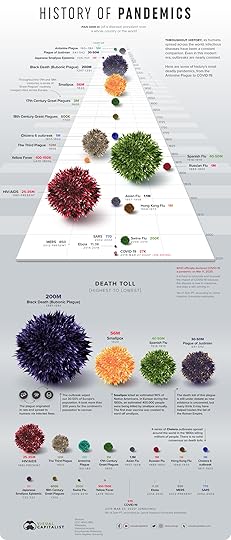 The Russian Flu or the Red Flu (H2N2) in the 19th century which killed over a million people is believed to have an avian (birds) origin, whereas the Spanish flu (H1N1) in the 20th century is believed to have an originated from pigs. The Hong Kong flu is also believed to have originated from swine/pigs. HIV/Aids originated from chimpanzees. The Swine flu pandemic as recent as 2009-10 also came from pigs. So far, going by available data on the internet, it appears that rats, pigs and birds were responsible.SARS in 2002-03 brought in the linkage with bats/civets and Ebola in 2014-16 with wild animals. MERS reinforced the link of diseases with bats and COVID-19, which is the most recent pandemic seems to have come from pangolins and bats. There seems to be a distinct connect between strains of human influenza and those from animals. One research from 1995 onwards traces H5N1 to chicken, H5N3 to terns, H7N3 and H5N9 to turkeys. Fortunately, none of them went to become pandemics. There are dozens of other diseases that could be borrowed from animals – this site lists most of them – from Anthrax to Zika. Potential pandemics for the future, depending on how we interact with and/or ingest animals in future. To me, it looks like a sword dangling over human necks. If these aren’t enough, the top 5 diseases linked to meat consumption are Heart Disease, Cancer, Stroke, Diabetes and Obesity. Obesity in turn leads to many other complications. The other common diseases associated with eating meat are E. coli from ground beef, BSE (bovine spongiform encephalitis) from beef cattle also known as Mad Cow Disease (100% fatal), Trichinosis from pork, Salmonella from poultry, Scrapie from lamb and mutton, etc. In this article I am not venturing into the environmental impact of meat. I am also not venturing into the steroids and antibiotics that are fed to most of the animals that are bred. However, considering the COVID-19 battle that the world is fighting right now, can human beings show greater restraint when it comes to devouring a variety of animals – at least to prevent pandemics? One can only conjecture.
The Russian Flu or the Red Flu (H2N2) in the 19th century which killed over a million people is believed to have an avian (birds) origin, whereas the Spanish flu (H1N1) in the 20th century is believed to have an originated from pigs. The Hong Kong flu is also believed to have originated from swine/pigs. HIV/Aids originated from chimpanzees. The Swine flu pandemic as recent as 2009-10 also came from pigs. So far, going by available data on the internet, it appears that rats, pigs and birds were responsible.SARS in 2002-03 brought in the linkage with bats/civets and Ebola in 2014-16 with wild animals. MERS reinforced the link of diseases with bats and COVID-19, which is the most recent pandemic seems to have come from pangolins and bats. There seems to be a distinct connect between strains of human influenza and those from animals. One research from 1995 onwards traces H5N1 to chicken, H5N3 to terns, H7N3 and H5N9 to turkeys. Fortunately, none of them went to become pandemics. There are dozens of other diseases that could be borrowed from animals – this site lists most of them – from Anthrax to Zika. Potential pandemics for the future, depending on how we interact with and/or ingest animals in future. To me, it looks like a sword dangling over human necks. If these aren’t enough, the top 5 diseases linked to meat consumption are Heart Disease, Cancer, Stroke, Diabetes and Obesity. Obesity in turn leads to many other complications. The other common diseases associated with eating meat are E. coli from ground beef, BSE (bovine spongiform encephalitis) from beef cattle also known as Mad Cow Disease (100% fatal), Trichinosis from pork, Salmonella from poultry, Scrapie from lamb and mutton, etc. In this article I am not venturing into the environmental impact of meat. I am also not venturing into the steroids and antibiotics that are fed to most of the animals that are bred. However, considering the COVID-19 battle that the world is fighting right now, can human beings show greater restraint when it comes to devouring a variety of animals – at least to prevent pandemics? One can only conjecture.
March 28, 2020
A Different Perspective on COVID-19
No pandemic, plague or epidemic has spread such devastation as the Black Death as far as recorded human history is concerned. Also known as the Great Bubonic Plague or the Pestilence, it resulted in almost 200 million deaths, peaking in Europe from 1347 to 1351. The world population at that time was estimated to be around 500 million and the scourge was believed to have decimated 50-60% of Europe's population.The plague, caused by Yersinia pestis, was carried by ground rodents (rats), including marmots and is believed to have originated in China 2000 years ago as shown by gene sequencing data (see links below for references). It was terrifying contagious - even clothes brushing against one another could transmit the disease. It was so outrageously quick and deadly - a person who went to bed perfectly healthy (apparently) could be dead the next morning. You can watch the brief video here.The Black Death was quickly followed by the New World Smallpox Outbreak (56 million deaths); Italian Plague, the Spanish flu, HIV/Aids, Swine flu, SARS, etc. The illustration below will give you a fair idea of all the major pandemics that the world has witnessed in the last 2000 years. In comparison, the Corona Virus Outbreak or COVID-19 has so far resulted in less than 40,000 deaths worldwide, but it is estimated to have a range of 16 million to 35 million as potential victims by some sources, mainly children and senior citizens, who for some reason seem to lack the immunity that the young adult population has. There are other estimates which place the range between 2 million to 20 million. At this stage, I don't think anyone has a clue. All countries are under a lockdown and only containment seems to be the solution. If it does spread (and not all that many have been tested so far), the mortality rate revised by WHO is now placed around 3.5-4.0%. I am not an expert on this, so shall desist from putting forth any statistics of my own. 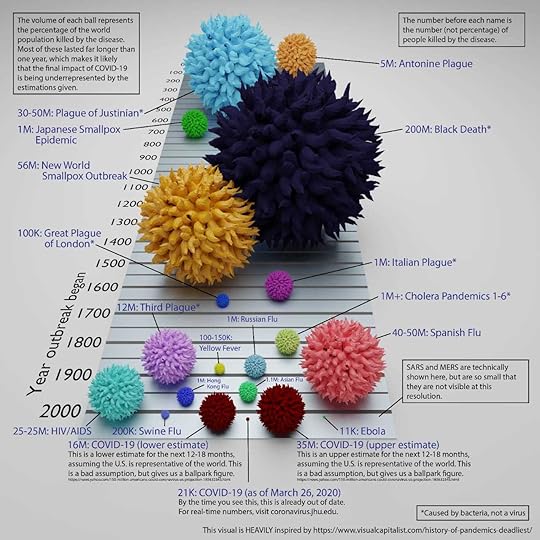 What is interesting is the fact that almost all of the previous pandemics resulted in religious, economic and social upheavals in varying degrees across the world, some of them limiting human interactions too, but none so far (as much as I can fathom) resulted in any environmental changes. However, the unprecedented lockdown to this extent in all major as well as minor countries has had far reaching consequences on the environment. The World Economic Forum has published satellite images of the (positive) environmental impact of COVID-19 - it is really something that each person needs to be aware of. However, whether there would be a sustained lasting impact on the environment is difficult to conjecture. I am not saying that this pandemic is a good thing - it is scary and human lives are at stake - however, I am saying that as we become cognizant of how much we influence the environment adversely, we should learn from this and global leaders should listen to Greta Thunberg and take immediate steps to minimize our carbon footprint.Here are a few things that have dramatically changed in the last month or so - Significant improvement in air quality (far lower air pollution).Nitrogen dioxide emissions, which are closely linked to factory output and vehicles on the roads, has gone down drastically.Steep drop in CO2 emissions across various countries.Clearer water, especially where water transport systems have come to a grinding halt.Slowing down economic activity, shutting down offices, schools, colleges and factories has also resulted in significantly reducing all greenhouse gas emissions.As people stay locked in at home, or in self-quarantine, there is lesser food waste and also a significant reduction in the daily urban waste generation by way of plastics, disposables, packaging material, takeaway containers, etc. However, the medical waste has gone up.The noise pollution levels have also gone down significantly, notably in countries with large population - there are no public events, no vehicles on the roads, no honking, no public transport. Airline emissions have gone down, although this has resulted at the airline industry staring at bankruptcy if they are not bailed out or suitable economic measures are not undertaken.Emissions from coal combustion are also falling across the world.Commercial use of energy has fallen rapidly, even as domestic consumption has gone up. However, it appears that the fall is far higher than the corresponding increase in domestic use.Particulate matter levels have dropped significantly.Human beings are spending more time at home with their families than they ever did before.Nature is sending us a message. For all those who did not believe in Global Warming or the disastrous effects of human economic activity, the message is loud and clear. If a couple of weeks can lead to such dramatic changes, imagine the quality of human life if this were to be made permanent. NOT by another virus or by Gaia's revenge, but merely by global leaders waking up to the (now) established facts and taking urgent steps to reverse the damage that has been done to this beautiful planet over the past few hundred years.References:https://www.history.com/topics/middle...
What is interesting is the fact that almost all of the previous pandemics resulted in religious, economic and social upheavals in varying degrees across the world, some of them limiting human interactions too, but none so far (as much as I can fathom) resulted in any environmental changes. However, the unprecedented lockdown to this extent in all major as well as minor countries has had far reaching consequences on the environment. The World Economic Forum has published satellite images of the (positive) environmental impact of COVID-19 - it is really something that each person needs to be aware of. However, whether there would be a sustained lasting impact on the environment is difficult to conjecture. I am not saying that this pandemic is a good thing - it is scary and human lives are at stake - however, I am saying that as we become cognizant of how much we influence the environment adversely, we should learn from this and global leaders should listen to Greta Thunberg and take immediate steps to minimize our carbon footprint.Here are a few things that have dramatically changed in the last month or so - Significant improvement in air quality (far lower air pollution).Nitrogen dioxide emissions, which are closely linked to factory output and vehicles on the roads, has gone down drastically.Steep drop in CO2 emissions across various countries.Clearer water, especially where water transport systems have come to a grinding halt.Slowing down economic activity, shutting down offices, schools, colleges and factories has also resulted in significantly reducing all greenhouse gas emissions.As people stay locked in at home, or in self-quarantine, there is lesser food waste and also a significant reduction in the daily urban waste generation by way of plastics, disposables, packaging material, takeaway containers, etc. However, the medical waste has gone up.The noise pollution levels have also gone down significantly, notably in countries with large population - there are no public events, no vehicles on the roads, no honking, no public transport. Airline emissions have gone down, although this has resulted at the airline industry staring at bankruptcy if they are not bailed out or suitable economic measures are not undertaken.Emissions from coal combustion are also falling across the world.Commercial use of energy has fallen rapidly, even as domestic consumption has gone up. However, it appears that the fall is far higher than the corresponding increase in domestic use.Particulate matter levels have dropped significantly.Human beings are spending more time at home with their families than they ever did before.Nature is sending us a message. For all those who did not believe in Global Warming or the disastrous effects of human economic activity, the message is loud and clear. If a couple of weeks can lead to such dramatic changes, imagine the quality of human life if this were to be made permanent. NOT by another virus or by Gaia's revenge, but merely by global leaders waking up to the (now) established facts and taking urgent steps to reverse the damage that has been done to this beautiful planet over the past few hundred years.References:https://www.history.com/topics/middle...
March 27, 2020
The Missive Forwarder
A true freight-forwarder does not find cargo, he finds the right client and then, the cargo finds him. A humorous and metaphorical post from a serious blogger.Over the 3 decades that I have spent in full-time employment, I have spent 50% of that time in the freight forwarding industry. Having nothing better to do today after completing my chores and checking my office emails for quadrant one stuff (read urgent and important), I was ruminating on how every person today is similar to a freight forwarder - I call him/her the missive forwarder.  One of the activities that engages me for not more than 20-30 minutes each day is forwarding - not freight, but missives. Why do I call it missives and not messages? The former sounds more important and erudite. An ex-colleague asked me recently, "from where do you get all these interesting posts from?" (sic). I replied, quite honestly, "I do not go searching for them. They find me. I just find a place in the right groups, the missives then find me." He thought this was a clever response, but actually it was just an honest one. Truth is not clever, lies are. It has been a complete mystery to me where some of these amazing videos and text messages originate. I get some awesome poetry, some great videos (ignoring the youtube and standard movie clips), some witty puns, some inspirational messages, some beautiful images, some humorous memes, some atrocious clips, some fake news, some political biases, some mouthwatering recipes, some visual treats. And it is a shame to keep them all to myself - so I forward them, just like others. After all, each one of us is unique, just as everyone else. Freight forwarding is restricted to a few global, local, organized and unorganized players - missive forwarding is unrestricted and free.During the #lockdown thanks to #COVID-19, a quote from Charles Dickens' 'A Tale of Two Cities' seems quite appropriate - "It was the best of times, it was the worst of times, it was the age of wisdom, it was the age of foolishness, it was the epoch of belief, it was the epoch of incredulity, it was the season of Light, it was the season of Darkness, it was the spring of hope, it was the winter of despair, we had everything before us, we had nothing before us, we were all going direct to Heaven, we were all going direct the other way."Most people think that forwarding is easy - it most certainly is not! It involves consolidating what you receive from different sources and determine where it needs to be forwarded to. It also involves 'breakbulk', i.e. de-consolidating the messages that you receive from a single source and determine who are the rightful recipients of different missives. It involves complying with local regulations - to ensure that no law is broken. It involves identifying the recipient with unerring regularity - so that the receiver is pleased to receive this particular missive and not annoyed. It involves judicious segregation of divisive and sociopathic missives to avoid conflicts and verbal combats. One of the important aspects of forwarding is the speed and the agility. So, once you have the direction set right, the next important task is to make sure the missive arrives at its destination before anyone else's does. This also frustrates other forwarders and makes them more likely to make mistakes - haste makes waste. Another important aspect is embargo and restricted parties - how to ensure that the wrong recipient does not receive what is not meant for him or her. This is another instance of acting in haste and repenting at leisure - especially when it comes to hate mails as compared to inspirational mails.Forwarding also means using different vehicles - so if you receive something on WhatsApp, be agile to share it on Facebook or Instagram or Twitter or even LInkedIn, if it is appropriate. Look for links on facebook and share it on LinkedIn. Check if you can download and store the images from one social network and use that to expand the knowledge of other social networks. All this is in a good cause. Speaking of social media and its posts, it has always seemed funny to me that some of the people who claim that other people are full of hatred, actually hate them.You also have to take into account just how critical the recipients' biases are. For example, what if you happen to send the intended recipient a pro-Didi post when he or she is unabashedly 'anti-Didi'? How do you absorb, swallow, regurgitate and expunge the emotions that arise when you receive an insidious stream of emails that can only see the negative in every situation? How do you retain your own sanity? Would you now take up the battle or would you ignore it altogether? A true forwarder always remembers never to wrestle with a pig - he gets dirty and the pig loves it!
One of the activities that engages me for not more than 20-30 minutes each day is forwarding - not freight, but missives. Why do I call it missives and not messages? The former sounds more important and erudite. An ex-colleague asked me recently, "from where do you get all these interesting posts from?" (sic). I replied, quite honestly, "I do not go searching for them. They find me. I just find a place in the right groups, the missives then find me." He thought this was a clever response, but actually it was just an honest one. Truth is not clever, lies are. It has been a complete mystery to me where some of these amazing videos and text messages originate. I get some awesome poetry, some great videos (ignoring the youtube and standard movie clips), some witty puns, some inspirational messages, some beautiful images, some humorous memes, some atrocious clips, some fake news, some political biases, some mouthwatering recipes, some visual treats. And it is a shame to keep them all to myself - so I forward them, just like others. After all, each one of us is unique, just as everyone else. Freight forwarding is restricted to a few global, local, organized and unorganized players - missive forwarding is unrestricted and free.During the #lockdown thanks to #COVID-19, a quote from Charles Dickens' 'A Tale of Two Cities' seems quite appropriate - "It was the best of times, it was the worst of times, it was the age of wisdom, it was the age of foolishness, it was the epoch of belief, it was the epoch of incredulity, it was the season of Light, it was the season of Darkness, it was the spring of hope, it was the winter of despair, we had everything before us, we had nothing before us, we were all going direct to Heaven, we were all going direct the other way."Most people think that forwarding is easy - it most certainly is not! It involves consolidating what you receive from different sources and determine where it needs to be forwarded to. It also involves 'breakbulk', i.e. de-consolidating the messages that you receive from a single source and determine who are the rightful recipients of different missives. It involves complying with local regulations - to ensure that no law is broken. It involves identifying the recipient with unerring regularity - so that the receiver is pleased to receive this particular missive and not annoyed. It involves judicious segregation of divisive and sociopathic missives to avoid conflicts and verbal combats. One of the important aspects of forwarding is the speed and the agility. So, once you have the direction set right, the next important task is to make sure the missive arrives at its destination before anyone else's does. This also frustrates other forwarders and makes them more likely to make mistakes - haste makes waste. Another important aspect is embargo and restricted parties - how to ensure that the wrong recipient does not receive what is not meant for him or her. This is another instance of acting in haste and repenting at leisure - especially when it comes to hate mails as compared to inspirational mails.Forwarding also means using different vehicles - so if you receive something on WhatsApp, be agile to share it on Facebook or Instagram or Twitter or even LInkedIn, if it is appropriate. Look for links on facebook and share it on LinkedIn. Check if you can download and store the images from one social network and use that to expand the knowledge of other social networks. All this is in a good cause. Speaking of social media and its posts, it has always seemed funny to me that some of the people who claim that other people are full of hatred, actually hate them.You also have to take into account just how critical the recipients' biases are. For example, what if you happen to send the intended recipient a pro-Didi post when he or she is unabashedly 'anti-Didi'? How do you absorb, swallow, regurgitate and expunge the emotions that arise when you receive an insidious stream of emails that can only see the negative in every situation? How do you retain your own sanity? Would you now take up the battle or would you ignore it altogether? A true forwarder always remembers never to wrestle with a pig - he gets dirty and the pig loves it!
The Outrageous Art
I picked up both books simultaneously – ‘The Subtle Art of Not Giving a F*ck’ and ‘Everything is F*cked’. Fortunately, I was also able to read them in succession. Notwithstanding the roaring success of both books - the first one I believe did better – undoubtedly the title of the books somehow appear to me to be arrogant and somewhat depressing respectively. It is only as I pored through ‘The Subtle Art’ that I realized there is nothing subtle at all – it is in fact crude and vulgar which I guess appeals to most people whose language and articulation these days seem to be incomplete without the use of expletives or simply rude words. 
 ‘The Subtle Art…’ claims that it is a ‘counterintuitive approach to leading a good life.’ The author is extremely clever – in fact he appeals to the reader who is sick of the ‘be a great human being’ books that perpetually tell him to raise his performance to a level that all the illustrative examples in the book do – who therefore picks up the book. At last the reader has something that he really would like to believe – why should he give a f*ck about anything. After tricking the reader with his language in the first few pages of the book, it emerges that it is actually a book about values.Essentially, the book tells us to set our priorities right (much like my own book ‘The Busyness Age’) and focus on things that matter the most to us, whilst letting go of everything else. The book had many parallels to my own – except that it was far more cleverer, was given the nod by a great publisher and marketed brilliantly. Whereas my own book would have far more tools to equip every office worker in actually setting out to achieve the priorities and keep away from distractions as compared to Manson’s book – the language, content, wit, and contemporariness of Manson’s book is far greater.Manson’s brilliant book goes against the over-hyped aspects of ‘positive thinking’, ‘extraordinary living’ and ‘happiness seeking’. However, it is not a practical guidebook to choosing what’s important as ‘The Busyness Age’ is. It is a brutally honest look at oneself and a much-needed reality check on our aspirations, expectations, fears and tribulations. Well, if one doesn’t call it a self-help book, what does one call it? I would call it an inspirational book, about living life fully based on our values and with a sense of purpose. The negativity that the book exudes is misleading, it is just clever so as to not ‘follow the herd’ of other similar books. It is a book that talks about accepting yourself as you are and accepting your dreams – which do not need to be grandiose or complex. It is about embracing the problems that life has cast upon you whilst yet striving to create goals and fulfil them.The ‘sequel’ to the first book has a bold subtitle, “A Book About Hope”. If the first book was about our own individual flaws and accepting them, the second book is about the flaws in the world around us – where nothing is right. The materialistic world is full of calamities and nothing ever seems to be right. A book about hope appears to be a book about despair! The vulgarity pours over from the first book even as the outrageous humour seems to have taken a back seat. And in the end, after reading 230 odd pages of erudition, psychological research and timeless wisdom from some of the greatest philosophical minds, it tells us nothing more than to face this world of misery, anxiety and stress with inner peace, happiness and hope. If I enjoyed reading the first book, the second one could have been given a miss.
‘The Subtle Art…’ claims that it is a ‘counterintuitive approach to leading a good life.’ The author is extremely clever – in fact he appeals to the reader who is sick of the ‘be a great human being’ books that perpetually tell him to raise his performance to a level that all the illustrative examples in the book do – who therefore picks up the book. At last the reader has something that he really would like to believe – why should he give a f*ck about anything. After tricking the reader with his language in the first few pages of the book, it emerges that it is actually a book about values.Essentially, the book tells us to set our priorities right (much like my own book ‘The Busyness Age’) and focus on things that matter the most to us, whilst letting go of everything else. The book had many parallels to my own – except that it was far more cleverer, was given the nod by a great publisher and marketed brilliantly. Whereas my own book would have far more tools to equip every office worker in actually setting out to achieve the priorities and keep away from distractions as compared to Manson’s book – the language, content, wit, and contemporariness of Manson’s book is far greater.Manson’s brilliant book goes against the over-hyped aspects of ‘positive thinking’, ‘extraordinary living’ and ‘happiness seeking’. However, it is not a practical guidebook to choosing what’s important as ‘The Busyness Age’ is. It is a brutally honest look at oneself and a much-needed reality check on our aspirations, expectations, fears and tribulations. Well, if one doesn’t call it a self-help book, what does one call it? I would call it an inspirational book, about living life fully based on our values and with a sense of purpose. The negativity that the book exudes is misleading, it is just clever so as to not ‘follow the herd’ of other similar books. It is a book that talks about accepting yourself as you are and accepting your dreams – which do not need to be grandiose or complex. It is about embracing the problems that life has cast upon you whilst yet striving to create goals and fulfil them.The ‘sequel’ to the first book has a bold subtitle, “A Book About Hope”. If the first book was about our own individual flaws and accepting them, the second book is about the flaws in the world around us – where nothing is right. The materialistic world is full of calamities and nothing ever seems to be right. A book about hope appears to be a book about despair! The vulgarity pours over from the first book even as the outrageous humour seems to have taken a back seat. And in the end, after reading 230 odd pages of erudition, psychological research and timeless wisdom from some of the greatest philosophical minds, it tells us nothing more than to face this world of misery, anxiety and stress with inner peace, happiness and hope. If I enjoyed reading the first book, the second one could have been given a miss.
December 17, 2019
The Busyness Age
 The TIMES OF INDIA has called it - 'A mini-bible' for every office worker, executive and B-school student. This concise book is filled with tools, tips and tricks and is completely devoid of unnecessary prose, jargon and technicalities - my endeavour is to help every corporate employee gain control over his life (read work-life balance or work-life continuum) and steer it in the direction one wants.
 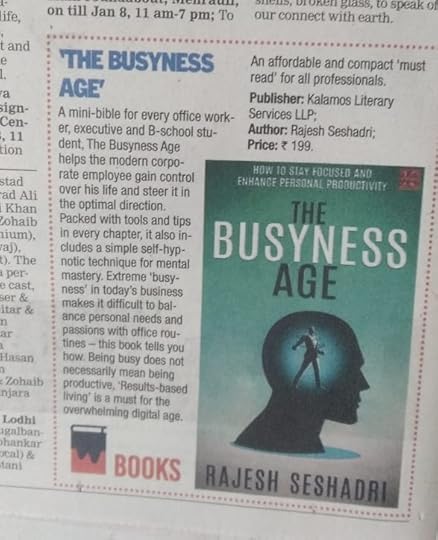 The contemporary work environment today has turned extremely hectic, the ‘tyranny of the urgent’ has you in its vicious grips and the 9 to 5 job metamorphoses into a 24/7. Yet, activity is not equal to productivity. And your dreams and aspirations, your hobbies and your passions need not recede into oblivion. There is always a way, and this book tells you – How to avoid ‘busywork’ How to embark on ‘results-based’ living. less.How you can achieve more with How you can enhance your personal productivity. How you can find the extra time you need. How to overcome procrastination, and the secret antidote for it. How you can use the Pomodoro technique to your advantage. How you can use the secret of compartmentalization to your advantage.How to use the power of your mind to gain energy and become more productive.Filled with tools, tips and tricks in every chapter, this simple book, devoid of jargon and technicalities, is meant for every office worker and executive to gain control over his life and steer it in the direction one wants. It includes an easy and simple self-hypnotic meditation technique, that can be practiced anywhere, anytime. The intent was to make this book affordable to the masses - and thanks to my publishers Kalamos who made it possible. This compact handbook is now available on Amazon and on other e-commerce websites and is priced at just Rs. 199 for the mass-market paperback edition. For those equipped with a Kindle and prefer an e-book over a paperback, you can grab it here for just Rs. 110. And lastly, for those with a Kindle Unlimited subscription, this book is FREE!
February 6, 2019
The New Psycho-Cybernetics and the 21-day Myth
Almost all the self-help books which pertain to ‘success mechanisms’ have to deal with the mind. And whenever any mental exercise relates to ‘thought conditioning’ in some form or the other, it always takes me back to Hypnosis. As a certified hypnotherapist (and do not confuse this with the fake stage hypnosis shows for entertainment), I can only say that the techniques one familiarizes oneself with whilst pursuing the extensive course (visualization, dramatization, affirmation, anchors, etc.) are often seen taking on different nomenclatures and being presented to the people.Some books such as ‘The Secret’ sell hundreds of millions of copies, but it is unclear how many actually benefited. Riding the popularity wave, several books follow on virtually the same topic which clearly means two things, viz., the first book was incomplete or the subsequent books have little substance and are often repetitive and boring. I am not sure how I came across “The New Psycho-Cybernetics” written by Dr. Maxwell Maltz but am glad I did. It is one of those books that stands the test of time, did not have any ‘sequels’ and applies to personal development and psychological theory even today. This is irrespective of whether or not you are a hypnotherapist or an advance NLP practitioner. It is a psychological masterpiece and I can now understand why trainers and facilitators picked up parts of this book for their personal empowerment programs for over two decades. This book was also responsible for the ’21-day myth’ that has become so popular amongst trainers and facilitators as well as those in the HR fraternity, many of whom may not even have read the book but merely heard about it or read about it someplace. The popular story that goes around that it takes ’21 days to form a habit’ is a myth, that has its origins in this book. Even today, most people believe that habits are formed by repeating a task for 21 days in a row. This, unfortunately is NOT true, although people desperately want it to be true, so it continues to gain popularity. Dr. Maltz did not say that 21 days of repetitiveness would result in the formation of a new habit. What he did infer was that it took approximately three weeks for the self-image of a person to change and that for various reasons, it did not necessarily result in a change of personality or behaviour in everyone. Maxwell says Personal Empowerment is all about self-image. Self-image is the ‘mental picture’ that every person has of himself or herself. This mental picture is the sum total of past experiences, emotions and behaviours, and thus it represents the foundation on which we build our personality. Borrowing from Hypnosis, the book goes on to say that the brain cannot differentiate between ‘imagination and reality’. And this in turn has been picked up by thousands of books and authors subsequently. Hypnosis established this fact centuries ago, when clients are led through ‘hypnodramas’ to resolve present-life situations. Maxwell then goes on to say that by changing the mental picture, we can change our reality – both in terms of our personality as well as our behaviour. Effectively we are replacing the old paradigm in our brain with a new paradigm using Maxwell’s techniques of relaxation and visualization – again no different from Hypnosis or the more modern NLP. Yet, unlike other books which leave you in the lurch, this one takes step-by-step through various techniques described through the book, viz., how to condition yourself for success, how to de-hypnotize yourself from limiting beliefs, how to live more courageously, how to sell or negotiate with confidence, etc. The ‘Success Mechanism’ according to Maxwell – one of the more important aspects of this book – is based on a strong sense of direction, the willingness to keep moving, the ability to comprehend and communicate, the courage to face challenges, being kind and charitable, and having the self-confidence to execute one’s plans.By all means, go ahead and read this book. It is not one of those that you read like a novel and place it back on the shelf, but perhaps one that you go back to from time to time and re-read once a year.
It is a psychological masterpiece and I can now understand why trainers and facilitators picked up parts of this book for their personal empowerment programs for over two decades. This book was also responsible for the ’21-day myth’ that has become so popular amongst trainers and facilitators as well as those in the HR fraternity, many of whom may not even have read the book but merely heard about it or read about it someplace. The popular story that goes around that it takes ’21 days to form a habit’ is a myth, that has its origins in this book. Even today, most people believe that habits are formed by repeating a task for 21 days in a row. This, unfortunately is NOT true, although people desperately want it to be true, so it continues to gain popularity. Dr. Maltz did not say that 21 days of repetitiveness would result in the formation of a new habit. What he did infer was that it took approximately three weeks for the self-image of a person to change and that for various reasons, it did not necessarily result in a change of personality or behaviour in everyone. Maxwell says Personal Empowerment is all about self-image. Self-image is the ‘mental picture’ that every person has of himself or herself. This mental picture is the sum total of past experiences, emotions and behaviours, and thus it represents the foundation on which we build our personality. Borrowing from Hypnosis, the book goes on to say that the brain cannot differentiate between ‘imagination and reality’. And this in turn has been picked up by thousands of books and authors subsequently. Hypnosis established this fact centuries ago, when clients are led through ‘hypnodramas’ to resolve present-life situations. Maxwell then goes on to say that by changing the mental picture, we can change our reality – both in terms of our personality as well as our behaviour. Effectively we are replacing the old paradigm in our brain with a new paradigm using Maxwell’s techniques of relaxation and visualization – again no different from Hypnosis or the more modern NLP. Yet, unlike other books which leave you in the lurch, this one takes step-by-step through various techniques described through the book, viz., how to condition yourself for success, how to de-hypnotize yourself from limiting beliefs, how to live more courageously, how to sell or negotiate with confidence, etc. The ‘Success Mechanism’ according to Maxwell – one of the more important aspects of this book – is based on a strong sense of direction, the willingness to keep moving, the ability to comprehend and communicate, the courage to face challenges, being kind and charitable, and having the self-confidence to execute one’s plans.By all means, go ahead and read this book. It is not one of those that you read like a novel and place it back on the shelf, but perhaps one that you go back to from time to time and re-read once a year.
January 27, 2019
Time to Abolish Income-tax on Salaries?
 It is a matter of hours before the next Union Budget is presented. And never has been there a better time to abolish income-tax on salaries once and for all. Despite all the propaganda, it has never resulted in any benefit for the poor. A controversial subject and one that would normally take a few thousand pages to be debated and discussed comprehensively, but this is a humble endeavour, within the scope of a blog article, to present a concise case to permanently abolish income-tax on the salaried employees and suggestions to recoup the losses. I also believe that it is only the present government which has the courage to introduce radical reforms, and there is no better time than now.I would not like to burden the reader of this article with voluminous statistics and complicated graphs, based on data available in the public domain and yet, some facts need to be mentioned here. During a post-budget meet and interview, Finance Secretary Shri Hasmukh Adhia mentioned that “salaried employees are paying more tax than business people.” He also added that, “50 per cent of the 7 lakh companies which file I-T returns show zero or negative income.” Another insight comes from the fact that there is an almost equal number of salaried individuals and individual business taxpayers – yet the salaried individuals pay an average of Rs. 76,306 per person as income-tax whereas the individual business taxpayer paid an average of Rs. 25,753 per person. Weird, huh?The reader should note that the salaried employee pays income-tax on his income whereas the business taxpayer pays income-tax on his profits after deducting all allowable business expenditure including depreciation on his car, computer, other moveable and immovable assets. This injustice has continued for years – not because it is fair – but due to the fact that whereas the business taxpayer has the scope to evade or manipulate his books of accounts, the salaried taxpayer faces the grim prospect of tax deduction at source. Be clear – individual income-tax is largely a tax on the middle class salary earner plus independent professionals and no other class. The poor don't pay any income tax – rightly so, and the rich (including the rich farmers) get a big chunk of their incomes from business, agriculture, dividends and capital gains - very little from salaries. It is an insult to call any section of the salaried class as ‘super rich’, whereas the ‘real rich’ get away scot free. For example (and I have several), do you think it is the salaried class purchasing all those high-end niche properties in various cities of India, grandly promoted by the big builders for the ‘elite’ and having a ticket price of Rs. 7.5 crores or more?The case for abolishing income-tax on salaries is simple –it is unfair and continues year after year because the salaried class is an easy pick and are not a majority of the vote-bank;it creates huge paperwork and administration for both the individual as well as the tax authorities;it drives savings based on tax-efficiency and not for the real needs of the economy and the individuals;it suppresses consumption in a consumption-driven economy;it has created a myriad of tax deductions, exemptions and complications that can simply be wiped out entirely.The question that would then arise is how does the government recoup the fiscal losses it would incur by doing away with income-tax on salaries? Let us examine that in a simple fashion – the numbers given below are a close approximation or estimate, in the absence of my having an insight into the actual numbers in various government departments and commercial institutions.Approximately 2 crore salaried individuals file their returns, of which the taxpayers number about 50 million and out of these, only 1 per cent or 500,000 pay the bulk of the taxes. We have also conservatively assumed that only 500,000 cars in India are sold/re-sold with a ticket price of Rs. 25 lakhs or more. For the sake of this article, we have also assumed that only 500,000 properties in India are sold/re-sold with a ticket price of Rs. 2.5 crores or more, with an average cost of Rs. 5 crores. Now let us look at the math.Total income-tax collected from salaried individuals is estimated to be around Rs. 150,000 crore. Rs. 50,000 crore or 1/3rd of this can be easily recouped by doing away with fuel subsidies altogether – this is most certainly not a benefit derived only by the salaried class. The LPG and Kerosene subsidies for the poor can continue. Another Rs. 50,000 crore or 1/3rd can be easily recouped by levying a 2% cess on purchase of all ‘super-rich’ properties – if one considers an average ticket size of Rs. 5 crores and about 500,000 sales/re-sales in India. We are now left with only 1/3rd to recoup. Another Rs. 50,000 crores. Of this Rs. 10,000 crore each will come in from the increased GST collection (presuming the salaried class only spend a portion of the tax saved) and another from levying a cess of 1% on all cars which are priced above Rs. 25 lakhs. There are many other expenses that can be considered based on their ticket size, which are indeed only purchased by the ‘real rich’. The balance savings, if still required, will come from savings in tax administration, and the ability to now focus on the tax evaders rather than salaried tax payers. By the way, this is also the time that more money can be channelized into the NPS by the salaried individual, who is often left with meagre resourced upon retirement and is dependent on his children. A part of the savings can also be channelized to social causes (Individual Social Responsibility in addition to Corporate Social Responsibility), through NGOs which work towards the poor and destitute and focus on education, child care and women’s issues.Not only would the honest taxpayers actually be rewarded, but the money they save can be more effectively channelled to the right causes.