Kevin Hancock's Blog
November 27, 2025
The Inner Work of Leadership in a Family Business with Kevin Hancock
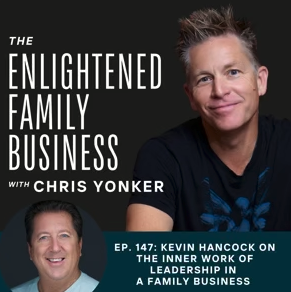
In this episode of the Enlightened Family Business Podcast, host Chris Yonker interviews Kevin Hancock, Chair of Hancock Lumber, about his journey and transformation in leadership. Kevin shares his personal and professional challenges, including losing his father to cancer, navigating a significant economic recession, and coping with a rare voice disorder.
Kevin’s experiences led him to initiate major cultural changes at Hancock Lumber—first by being the change he wished to see in the world and by focusing on putting employees first and fostering authentic, meaningful work environments + relationships. He also discusses his connection with the Pine Ridge Indian Reservation, where he found inspiration and a new perspective on leadership and the human experience. The episode delves into themes of self-discovery, healing, family business governance, and preparing future generations to lead with heart and authenticity.
Click Here to Listen on Apple PodcastsClick Here to Listen on SpotifyThe post The Inner Work of Leadership in a Family Business with Kevin Hancock appeared first on The Business of Shared Leadership.


November 20, 2025
Power Resides Where Men Believe It Resides
Game of Thrones
“Three great men sit in a room. A king, a priest, and a rich man. Between them stands a common cell sword. Each great man bids the cell sword kill the other two. Who lives, who dies? – Lord Verys
“Depends on the cell sword.” – Tyrion Lannister
“Does it? He has neither crown, nor gold, nor favor with the gods.” – Lord Verys
“He has a sword, the power of life and death.” – Tyrion Lannister
“But if it’s swordsmen who rule, why do we pretend kings hold all the power?” – Lord Verys
“I’ve decided I don’t like riddles.” – Tyrion Lannister
“Power resides where men believe it resides. It’s a trick, a shadow on the wall. And… A very small man can cast a very large shadow.” – Lord Verys
I love the television series Game of Thrones and this passage from Lord Verys is perhaps my favorite moment. His words strike at the heart of my passion for shared leadership and dispersed power. The goal of a great work culture should be to help people reclaim the innate power that dwells within us all.
We’ve been taught for centuries that true power resides ‘out there’ beyond us, in a distant castle or capital. In nature, power is dispersed and the sacred energy of the Universe dwells equally within us all. In the 21st Century transformational leadership is about dispersing power, not collecting it. It’s about giving other people a stronger voice.
Thank you for reading, watching, thinking, and acting! We must become the change we wish to see in this world.
Love and light to you! — Kevin
The post Power Resides Where Men Believe It Resides appeared first on The Business of Shared Leadership.
November 6, 2025
What You’re Not Changing, You’re Choosing
Hello! This 15 second video is one of my favorites. I’ve watched it now dozens of times and I think about it over and over again when I look at my life and this world.
“What you’re not changing, you’re choosing.”
This statement is so powerful in its simplicity—and, it’s actionable. Thanks for reading and watching. Reach out and let me know what you think of this message.
Love and light to you!
WHAT YOU’RE NOT CHANGING, YOU’RE CHOOSING
What’s your favorite quote?
What you’re not changing, you’re choosing.
You got something you don’t like, you’re complaining about
And you’re not changing it
Could be your relationships, your body, your health, your job,
You’re choosing it.
The post What You’re Not Changing, You’re Choosing appeared first on The Business of Shared Leadership.
September 22, 2025
Kevin Hancock Virtual Talk with Saco & Biddeford Savings
In April, I had a lovely opportunity to visit with my friend Mark Jones, CEO of Saco & Biddeford Savings Institution. This was a recorded conversation later shared with all their great employees at a company gathering. The subject of the conversation was making work meaningful for those who do it. We explored the idea of prioritizing the employee experience MORE and bringing LOVE into the world of work instead of checking it at the door.
One of the attendees at the event Lindsey Walker, Market Relationship Manager, later posted this powerful self-reflective reaction:
“Kevin spoke about how work and parenting a child can be similar and it really got my wheels turning as he and Mark Jones talked about bringing LOVE back into the place of work. I like to think I’m a good mom, but I bring a totally different skill set to the office typically. What if I didn’t? What if I didn’t turn it all of as soon as I got to work? What if I gave my coworkers the same grace as they learned as I give my almost two-year-old son. Spoke kindly to them. Poured confidence into them. Walked along side of them and then when the time was right…ran along side of them. It truly gave me a whole new meaning to being a working parent and letting these worlds collide a bit more. As Kevin said, ‘we can still be hard charging, we can still be competitive, attentive to details, we can hold ourselves to a high standard, but we are going to do it with love.” – Lindsey Walker
I later reposed Lyndsey’s remarks and added the following:
“This post by Lindsey Walker about bringing love to work instead of checking it at the door is inspiring! One person taking action from within themselves by choosing love changes the world. Go Lindsey!” – Kevin Hancock
This talk was later posted on-line by Saco & Biddeford Savings as a 20-minute video.
The post Kevin Hancock Virtual Talk with Saco & Biddeford Savings appeared first on The Business of Shared Leadership.
August 7, 2025
A Conversation with Corinne Watson of Tiny Homes of Maine and Kevin Hancock of Hancock Lumber

Corinne Watson, Co-Founder of Tiny Homes of Maine, and Kevin Hancock, Managing Owner of Hancock Lumber, sit down with MEREDA Vice President Jenn Small for MEREDA Matters – the podcast that lets you listen in on conversations with the people driving responsible development in Maine. In this episode, Watson and Hancock talk about their partnership and plans for scaling Tiny Homes of Maine. Now located in Dyer Brook, Maine, Watson founded the company with her husband to support their belief that everyone deserves a home.
After a fire burned down their facility in 2023, Hancock reached out to Watson to help. Aligned in what they cared about and their vision for scaling up the operation, the two forged a new partnership with their two businesses. Their conversation goes on to explore the process for buying a tiny home, and the two pieces of legislation – LD-1981 and LD-1530 – that Watson facilitated which helped open the floodgates for more tiny homes in Maine. The group also discusses commercial uses of tiny homes, how Tiny Homes of Maine are unique products – made in Maine with Maine materials – and how Watson developed a Lean Manufacturing Process to reduce the cost and production timeline.
Click Here to LisenThe post A Conversation with Corinne Watson of Tiny Homes of Maine and Kevin Hancock of Hancock Lumber appeared first on The Business of Shared Leadership.
July 31, 2025
Four Steps to Help People Feel Listened To

The following excerpts appeared in a syndicated column by Julia Minson in 2024 on the website Greater Good. Julia is a psychologist, negotiating scholar, and computational linguist who has spent years studying the ways that parties in conflict behave, and what she has learned from that research is transformational. I hope you find this as valuable as I have. Enjoy!
At home, at work and in civic spaces, it’s not uncommon to have conversations that make you question the intelligence and benevolence of your fellow human beings.
A natural reaction is to put forth the strongest argument for your own—clearly superior—perspective in the hope that logic and evidence will win the day. When that argument fails to have the intended persuasive impact, people often grow frustrated, and disagreement becomes conflict.
Thankfully, recent research offers a different approach.
For many years, psychologists have touted the benefits of making parties in conflict feel heard. Making someone you’re arguing with feel that you’re listening can calm the troubled waters, allowing both parties to get safely to the opposite shore. Two problems can get in the way, though.
First, when encountering disagreement, most people jump into “persuasion mode,” which doesn’t leave much room for listening. Second, and just as important, is that even when people do wish to make their counterparts feel heard, they don’t know how to do so.
Rather than trying to change how you think of or feel about your counterpart, research suggests that you should focus on changing your own behavior.
Our research has analyzed thousands of interactions between people who disagree with each other on hot-button social and political issues. Based on this analysis, we developed an algorithm that picks out specific words and phrases that make people in conflict feel that their counterpart is thoughtfully engaging with their perspective.
These words and phrases comprise a communication style we call “conversational receptiveness.” People who use conversational receptiveness in their interactions are rated more positively by their conflict counterparts on a variety of traits.
Then we experimented with training people to use the words and phrases that have the most impact. Those who received a brief conversational receptiveness training were seen as more desirable teammates and advisers by their counterparts. Training also turned out to make people more persuasive in their arguments.
We encapsulate this conversational style in the simple acronym HEAR:
H = Hedge your claims, even when you feel certain about your beliefs.E = Emphasize agreement. Find some common ground even when you disagree overall.A = Acknowledge the opposing perspective rather than jumping into your own argument.R = Reframing to the positive. Avoid negative words such as “no,” “won’t,” or “do not.”Conversational receptiveness is effective because it make the interaction less confrontational and therefore less unpleasant. At the same time, it allows both parties to express their perspective. As a result, it gives people confidence that if they approach a topic of disagreement, their partner will stay in the conversation, and the relationship will not sustain damage. By focusing on language that can be easily learned and precisely measured, we offer people a broadly applicable toolkit to live up to their best conversational intentions.
The post Four Steps to Help People Feel Listened To appeared first on The Business of Shared Leadership.
July 24, 2025
Legacy: Navigating Family Business with Anne Bauer
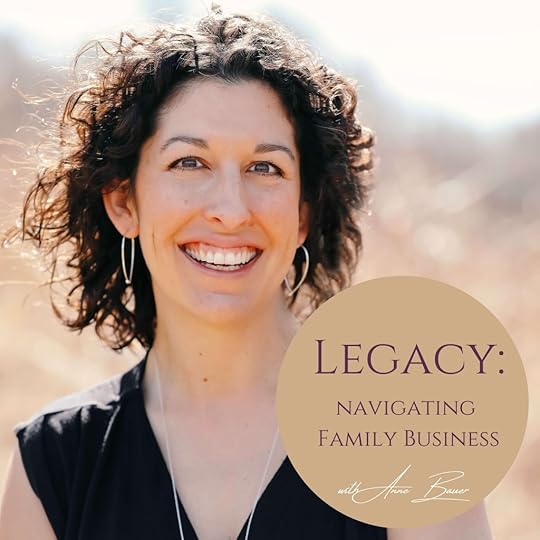
I recently sat down with Anne Bauer, host of the Legacy: Navigating Family Business Podcast, certified coach, and 6th generation family business owner to discuss my journey on trust, healing, and finding a shared voice in family business. Please enjoy the full podcast at the link below!
In this powerful episode of Legacy: Navigating Family Business, Anne Bauer sits down with sixth-generation family business owner Kevin Hancock, Chairman and Managing Owner of Hancock Lumber, one of the oldest family businesses in America. Together, they explore Kevin’s unexpected leadership journey, from aspiring college basketball coach to transformative business leader.
Click Here to Listen to the Full EpisodeThe post Legacy: Navigating Family Business with Anne Bauer appeared first on The Business of Shared Leadership.
July 17, 2025
Train Yourself to Always Show Up

The following excerpts are from a guest essay by Sharon Brous which appeared in the New York Times in January of 2024. Sharon is the founding and senior rabbi of Ikar, a Jewish community in Los Angeles, and the author of The Amen Effect. I keep these words close to me and have read them now many times. Blessings to you, and I hope you find modern relevance in this ancient wisdom:
A somewhat obscure text, about 2,000 years old, has been my unlikely teacher and guide for many years.
Buried deep within the Mishnah, a Jewish legal compendium from around the third century, is an ancient practice reflecting a deep understanding of the human psyche and spirit: When your heart is broken, when the specter of death visits your family, when you feel lost and alone and inclined to retreat, you show up. You entrust your pain to the community.
The text, Middot 2:2, describes a pilgrimage ritual from the time of the Second Temple. Several times each year, hundreds of thousands of Jews would ascend to Jerusalem, the center of Jewish religious and political life. They would climb the steps of the Temple Mount and enter its enormous plaza, turning to the right en masse, circling counterclockwise.
Meanwhile, the brokenhearted, the mourners, the lonely, and the sick, would make this same ritual walk, but they would turn to the left and circle in the opposite direction: every step against the current. And each person who encountered someone in pain would look into that person’s eyes and inquire: “What happened to you? Why does your heart ache?”
“My father died,” a person might say. “There are so many things I never got to say to him.” Or perhaps: “My partner left. I was completely blindsided.” Or, “My child is sick.”
Those who walked from the right would offer a blessing: “May the Holy One comfort you,” they would say. “You are not alone.” And then they would continue to walk until the next person approached.
This timeless wisdom speaks to what it means to be human in a world of pain. This year, you walk the path of the anguished. Perhaps next year, it will be me. I hold your broken heart knowing that one day you will hold mine.
I read in this text many profound lessons. First, do not take your broken heart and go home. Don’t isolate. Step toward those whom you know will hold you tenderly.
And on your good days—the days when you can breathe—show up then, too. Because the very fact of seeing those who are walking against the current, people who can barely hold on, and asking, with an open heart, “Tell me about your sorrow,” may be the deepest affirmation of our humanity.
It is an expression of both love and sacred responsibility to turn to another person in her moment of deepest anguish and say: “Your sorrow may scare me, it may unsettle me. But I will not abandon you. I will meet your grief with relentless love.”
Showing up for one another doesn’t require heroic gestures. It means training ourselves to approach, even when our instinct tells us to withdraw. Err on the side of presence.
Here’s the second lesson from that ancient text. Humans naturally incline toward the known. Our tribes can uplift us, order our lives, give them meaning and purpose, direction and pride. But the tribal instinct can also be perilous. The more closely we identify with our tribe, the more likely we are to dismiss or even feel hostility toward those outside it.
One of the great casualties of tribalism is curiosity. And when we are no longer curious, when we don’t try to imagine or understand what another person is thinking or feeling, our hearts begin to narrow.
Trauma exacerbates this trend. It reinforces an instinct to turn away from one another, rather than make ourselves even more vulnerable.
The ancient rabbis ask us to imagine a society in which no person is disposable. Even those who have hurt us, even those with views antithetical to ours, must be seen in their humanity and held with curiosity and care.
We desperately need a spiritual rewiring in our time. Imagine a society in which we learn to see one another in our pain, to ask one another, “What happened to you?” Imagine that we hear one another’s stories, say amen to one another’s pain, and even pray for one another’s healing. I call this the “amen effect”: sincere, tender encounters that help us forge new spiritual and neural pathways by reminding us that our lives and our destinies are entwined. Because, ultimately, it is only by finding our way to one another that we will begin to heal.
The post Train Yourself to Always Show Up appeared first on The Business of Shared Leadership.
July 10, 2025
Black Elk on the Power of Circles
As discussed in my last two posts, Black Elk, or Hehaka Sapa, is the most famous Oglala holy man of the nineteenth century. He was born free in December of 1863, and was with Crazy Horse and Sitting Bull at the Battle of the Little Bighorn. The following is a set of excerpts from the book Black Elk Speaks:
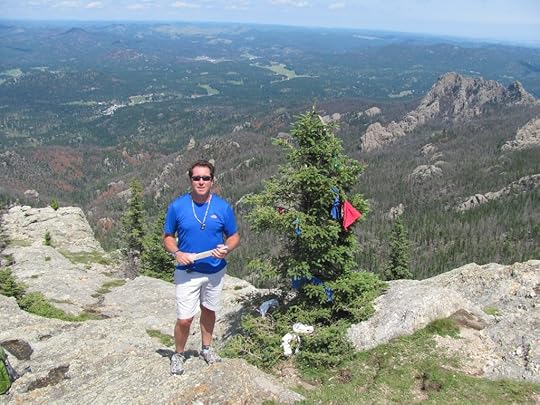 This is me in 2014, performing a personal ceremony in Black Elk’s honor on Black Elk Peak, which Black Elk himself referred to as the “highest point in the world.”
You have noticed that everything an Indian does is in a circle, and that is because the power of the world always works in circles, and everything tries to be round.
In the old days when we were a strong and happy people, all our power came to us from the sacred hoop of the nation, and so long as the hoop was unbroken, the people flourished. The flowering tree was the living center of the hoop, and the circle of the four quarters nourished it. The east gave peace and light, the south gave warmth, the west gave rain, and the north with its cold and mighty wind gave strength and endurance.
Everything the power of the word does is in a circle. The sky is round, and I have heard that the earth is round like a ball, and so are all the stars. The wind, in its greatest power, whirls. Birds make their nests in circles, for theirs is the same religion as ours. The sun comes forth and goes down again in a circle. The moon does the same, and both are round. Even the seasons form a great circle in their changing, and always come back again to where they were. The life of a man is a circle from childhood to childhood, and so it is in everything where power moves. Our tepees were round like the nests of birds, and these were always set in a circle, the nation’s hoop, a nest of many nests, where the Great Spirit meant for us to hatch our children.
But the Wasichus [white people] have put us in these square boxes. Our power is gone, and we are dying, for the power is not in us anymore. You can look at our boys and see how it is with us. When we were living by the power of the circle in the way we should, boys were men at twelve or thirteen years of age. But now it takes them very much longer to mature.
There was hunger among my people because the Wasichus did not give us all the food they promised in the Black Hills treaty. They made that treaty themselves; our people did not want it and did not make it.
My people looked pitiful. There was a big drought, and the rivers and creeks seemed to be dying. Nothing would grow that the people had planted, and the Wasichus had been sending less cattle and other food than ever before. The Wasichus had slaughtered all the bison and shut us up in pens. It looked as though we might all starve to death. We were penned up and could do nothing.
The post Black Elk on the Power of Circles appeared first on The Business of Shared Leadership.
June 26, 2025
Black Elk Speaks of the Making of Meat
As discussed in my last post, Black Elk, or Hehaka Sapa, is the most famous Oglala holy man of the nineteenth century. He was born free in December of 1863, and was with Crazy Horse and Sitting Bull at the Battle of the Little Bighorn. The following is a set of excerpts from the book Black Elk Speaks:
 This silhouette in the prairie grass is located at the Little Bighorn Battlefield National Monument on the Crow Reservation in present-day Montana.
Everyone began sharpening knives and arrows and getting the best horses ready for the great making of meat.
Then we started for where the bison were. The soldier band went first, riding twenty abreast, and anybody who dared go ahead of them would get knocked off his horse. After them came the hunters riding five abreast. The people came up in the rear. Then the head man of the advisers went around picking out the best hunters with the fastest horses, and to these he said: “Good young warriors, my relatives, your work I know is good. What you do is good always; so today you shall feed the helpless. Perhaps there are some old and feeble people without sons, or some who have little children and no man. You shall help these, and whatever you kill shall be theirs.”
Then when we had come to where the bison were, the hunters circled around them, and the cry went up, as in a battle, “Hoka hey!” which meant to charge. Then there was a great dust, and everybody shouted, and all the men went in to kill. They were all nearly naked, with their quivers full of arrows hanging on their left sides, and they would ride right up to a bison and shoot him behind the left shoulder. Everybody was very happy.
All over the flat, as far as I could see, there were men butchering bison now, and the women and the old men who could not hunt were coming up to help. And all the women were making the tremolo of joy for what the warriors had given them. That was in the Moon of Red Cherries [July]. It was a great killing.
This is the story of all life that is holy and is good to tell, and of us two-leggeds sharing in it with the four-leggeds and the wings of the air and all green things; for these are children of one mother and their father is one spirit.’
The post Black Elk Speaks of the Making of Meat appeared first on The Business of Shared Leadership.