Phyllis Clark Nichols's Blog
May 11, 2024
BISCUITS FOR BREAKFAST – OR ANYTIME
Bread and biscuit making are so satisfying. These sourdough biscuits require a bit of planning, but they’re worth it. This is my go-to recipe when I need to feed Sadie (that’s what I named my sourdough starter) and discard dough. Why discard when I can make biscuits? I enjoy these with butter, with sour cream and a drizzle of molasses, or with jelly or jam. They’re really tasty sliced and toasted the next morning with a slice of sharp cheddar cheese. I’ll just be honest. I even eat them cold and plain because they’re just plain good.
PHYLLIS’S SOUR DOUGH BISCUITS
20 servings
The night before making biscuits, mix the following dry ingredients in a mixing bowl and cover.
• 2 ½ cups all-purpose flour
• 2 teaspoons salt
• 1 teaspoon baking soda
• 1 Tablespoon baking powder
• ½ tablespoon sugar
Also, the night before, in a large bowl, mix the following ingredients:
• 2 cups all-purpose flour (I use White Lily.)
• 1 cup milk
• 1 cup buttermilk
• 1 cup sour dough starter
• Stir until blended.
• Then add ¼ cup unsalted melted butter stirring thoroughly.
Cover this with a tea towel and let it ferment for 8 to 12 hours. (I set the covered bowl in the oven. Turn on the oven light, close the door, and leave overnight.
The next morning:
• Preheat the oven to 400 degrees.
• Add your dry ingredients to the fermented biscuit dough.
• Once mixed, place on a well-floured clean work surface. At this point, you can add as much as ½ cup flour, but I rarely add that much.
• Roll or pat the dough out to ½ to 1 inch thickness into a rectangle.
• Using a bench knife or a sharp, serrated knife, cut into 20 biscuits. I use the bench knife and use it to smooth the edges.
• Place the biscuits on a well-greased baking sheet or use parchment paper.
Bake the biscuits for 15 – 18 minutes or until they are golden brown. I like to brush the tops with melted butter as they come out of the oven. The biscuits freeze well.
Enjoy and let me know how you like your biscuits.
Phyllis


April 6, 2024
A TASTE OF SPRINGTIME
This is one of my favorite Easter desserts. The berries make it tasty and pink, and the lemon curd makes it sunshine yellow. Who wouldn’t enjoy biting into springtime?
PINK VELVET CAKE WITH BERRY CREAM CHEESE FROSTINGINGREDIENTS
Cake Batter
2 c. granulated sugar½ cup vegetable oil1 tsp each vanilla, almond, lemon flavorings3 eggs1 ½ cups buttermilk2 ½ cups all-purpose flour¼ teaspoon baking soda1 ¾ teaspoons baking powder½ teaspoon salt 4 to 6 drops of red food coloringBerry Cream Cheese Frosting
1/2 c. (1 stick) unsalted butter, at room temperature4 oz. cream cheese, at room temperature1/2 c. fresh diced raspberries or strawberries1 tsp. pure vanilla extract1/2 tsp. salt3 cups confectioners’ sugarDIRECTIONS
Cake Batter
Preheat oven to 350°F. Grease and flour 3 (8-inch) cake pans.Combine the sugar, oil and flavorings in a large mixing bowl and whisk vigorously to combine.Add the eggs one at a time, whisking after each. Add the buttermilk and continue to mix.Sift the flour, baking soda, baking powder and salt into the mixing bowl. With a rubber spatula, folding gently to combine. Don’t over mix.Add the food coloring a drop at the time until it is the shade of pink you desire.Put the batter into the pans. Bake for 22 to 24 minutes until a toothpick comes out clean.Let the cake completely cool before frosting.Frosting:
Beat butter and cream cheese on medium speed with an electric mixer until creamy, 1 to 2 minutes.Beat in the berries, vanilla, and salt, until raspberries are broken down, 15 to 20 seconds.Reduce mixer speed to low and gradually add confectioners’ sugar until blended and smooth after each addition.Lemon Curd
I usually make this the day before or at least a few hours before I plan to assemble the cake.
Ingredients
3 eggs1 cup sugar½ cup lemon juice (usually 2 lemons will be enough)2 Tablespoons butter sliced into small pieces1 Tablespoon grated lemon zestDirections
In a heavy saucepan over medium heat, whisk eggs, sugar, and lemon juice until blended well.Add butter and lemon zest.Whisky constantly until mixture is thickened. When ready it will coat the back of a metal spoon.Pour into a small bowl and cool for a few minutes before refrigerating. Make sure it is covered.ASSEMBLE THE CAKE
On the bottom layer, spread a thin layer of the frosting and top with 1/3 of the lemon curd. Spread to cover.Do the same with the second layer.For the third layer, omit the frosting and only spread the lemon curd on the top.When all layers are together, frost the sides. Decorate with three berries and a sprig of mint on top.It is best to keep this cake refrigerated.
Enjoy and serve to someone you love to see a big smile,
Phyllis
April 9, 2022
Holy Week in Real Time
HOLY WEEK IN REAL TIME
Last year, during Holy Week, I shared my study I entitled “Holy Week in Real Time.” Each morning, I posted a brief description with the scriptures telling us where Jesus was and what He was doing that day of Holy Week.
I’ve had the great privilege to visit the land where our Lord physically walked on this earth. Walking where He walked made the scripture three dimensional for me. So, I thought you might join me this week, day by day, walking where Jesus walked as He’s heading to the cross. I invite you to read the scriptures each morning. Read them from each Gospel and see each writer’s personality and perspective. Meditate on them verses, and try to picture what Jesus was doing and what He might have been thinking and feeling. And imagine the other persons in these stories. Identify with them. With the confusion and chaos in the world today, emotionally we may be resonating more with Jesus’s disciples this week than we ever have.
So, what was Jesus doing on Sunday?
Read: Matthew 21:1-17, Mark 11:1-11, Luke 29:28-40, John 12:1-18
For several days, Jesus had been in Bethany at the home of Lazarus. In His way, Jesus was preparing those who loved for what was to come. On Sunday, Jesus journeyed the two miles to Jerusalem. As He neared city, He looked out over it and wept. Perhaps, He wasn’t just weeping over Jerusalem. Wouldn’t it be just like Jesus to weep over all those who refuse to recognize Him for who He truly is?
Before He entered Jerusalem, He instructed two of His disciples to go to a certain place and get a donkey. The crowds gathered for a royal welcome, a rolling out of the proverbial red carpet. Many of these had been with Jesus before. They had heard Him teach and had seen the miracles He performed. They were looking for Jesus to be their new king and to save them from Roman rule, but King Jesus entered the city riding the lowly animal, signifying He was a different kind of king. Still the people shouted their hosannas, which means please save us. (See Psalm 118:25-26.) They spread their coats and shawls on the path in front of Him as they would have done for a leader returning home from a military conquest. Jesus went to the temple. Let this scene from Matthew become real to you as Jesus reminded the religious leaders that His house was to be a house of prayer. Ponder that. Late in the day, Jesus and His disciples returned to Bethany for the night.
So, what was Jesus doing on Monday?
Read: Matthew 21:12–22 , Mark 11:12–19 , Luke 19:45–48
Jesus had made His entry into Jerusalem on Sunday, and things were astir. People were wondering about this Jesus. They were asking questions. There was something different in the air. Late on Sunday, He walked the two miles to Bethany with His disciples. But on Monday morning, apparently Jesus woke them and said, “We’re going back to Jerusalem.” That was risky business.
Read the Gospel accounts as to how Jesus established His authority, especially in the Temple. Imagine being there in Jerusalem, and you had shouted your “hosannas” on Sunday, but what would you be doing on Monday? Would you be excited? Would you be afraid or disappointed?
So, what was Jesus doing on Tuesday?
Read: Matthew 21:23–26:5 , Mark 11:27–14:2 , Luke 20:1–22:2 , John 12:37–50
Jesus literally had turned the tables, turned the tables over in the Temple on Monday with some strong reprimands. And now on Tuesday comes the direct confrontation with the high priests, the religious scholars, and the leaders. They pose questions. I’m not certain if they were sincerely looking for answers or for a way to trip Jesus up, but Jesus did something we were all taught not to do—He answered the question with a question of His own. His response was not something these religious leaders wanted to hear.
Jesus spends Tuesday in the Temple teaching, telling them parables, reminding the listeners of the Scriptures, answering questions, and telling them about the future events. Jesus knows this may well be His last opportunity to speak with them in the Temple, for He understands the fulfilling of His purpose is coming soon. Mark tells us how Jesus summed it all up in two great commandments. (Mark 12:29-31).
Can you even imagine being there, sitting at Jesus’s feet, hearing the Truth coming from His own voice? Can you imagine the expressions on His face as He told the parables? What questions might have you asked Jesus had you been there? How would you have responded to His answers?
So, what was Jesus doing on Wednesday?
Read: Matthew 26:6–16 , Mark 14:3–11 , Luke 22:3–6
Jesus has had three full days of being in the public eye – His entrance into Jerusalem on Sunday, His confrontations with religious leaders on Monday, and His teaching in the Temple on Tuesday. On Wednesday, He withdraws and is still and quiet. He continues trying to prepare His disciples for what is coming.
Sit there at the table in Simon the Leper’s house. Watch as Mary enters with her expensive bottle of perfume and bathes Jesus’ feet. Listen to His response. Which character in this story would you have been?
So, what was Jesus doing on Thursday?
Read: Matthew 26:17–75 , Mark 14:12–72 , Luke 22:7–71 , John 13:1–18:27
All four of the Gospel writers report about the events of Thursday. Read these passages as if you were in the Upper Room with the disciples. How would you have reacted if Jesus insisted on washing your feet? Would you have understood when He explained the meaning of the Passover? If you had been there at the table when He told them that one of them would betray Him, what would have been your response? Would you have followed Him to the Mount of Olives? He went to pray and to wait, for He knew what was coming. Imagine what you would have felt when He was led away from the garden by the soldiers. Picture yourself as Peter in the courtyard, wanting to be near Jesus and yet so afraid.
Good Friday
Read: Matthew 27:1–61 , Mark 15:1–47 , Luke 23:1–56 , John 18:28–19:42
We’ve all read this story so many times. Perhaps many of you have seen movies depicting the scenes on this day – the brutality, the beatings, the betrayal.
For six unimaginable hours, the Shepherd becomes the Lamb. Those at the foot of His cross had mixed reactions. Some jeered, others sneered, and those who loved Him could do nothing to stop it. They saw the man they thought would be their Messiah die a cruel death. They didn’t understand that Sunday was coming.
Return to the foot of the cross. See yourself there. Maybe you’re standing, gazing at Him with your arms reaching to heaven in despair. Maybe you’re crumpled on your knees on the ground, weeping over His suffering and your own pain and grief. But I hope somewhere in that experience, you can look into Jesus’s face and say, “Thank you, thank you.”
Saturday—It’s a dismal day, but Sunday’s coming.
Read: Matthew 27:57–66 , Mark 15:42-47, Luke 23:50-56, John 19:38-42
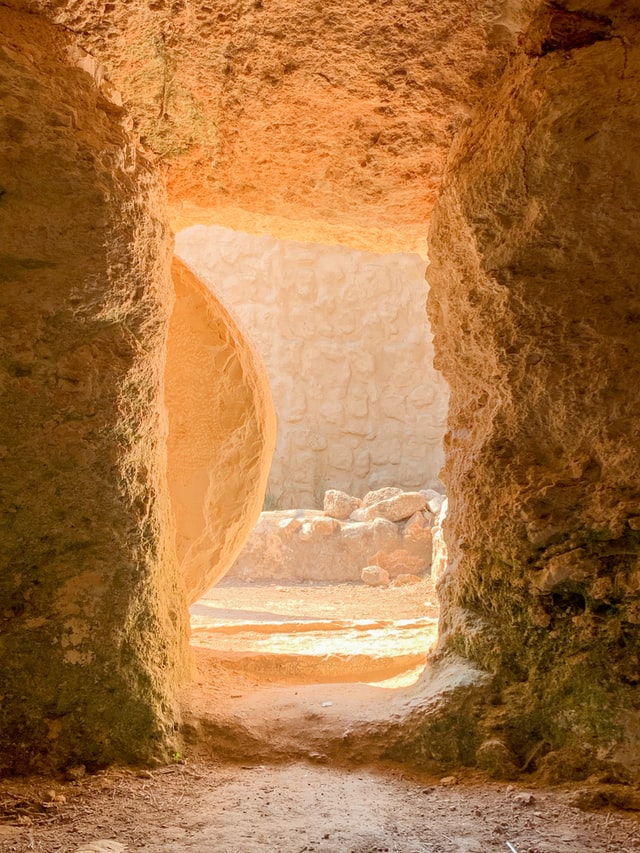
There isn’t much written about the day after Jesus was crucified. We know Joseph of Arimathea was allowed to take Jesus’s body, and he buried it in a tomb and sealed it with a rock late on Friday. Some of the women who were followers of Jesus were there and observed but went home at sundown, following the rules for the Sabbath. Many have speculated where Jesus was and what He was doing on Saturday, but the one thing we know is that He was quiet.
Jesus had told His disciples that He would die in Jerusalem but that He would rise on the third day. But on Saturday, they found themselves waiting and grieving. They had walked with Jesus, listened to His words, and observed His ways, but now He was gone. They felt abandoned with unfulfilled hope, unsure of Jesus’s return. I can imagine their fear, their grief, their confusion, and even their anticipation as they waited.
Jesus could have become immediately alive again after drawing His last breath, but He didn’t. The stone was still and in place for a whole day. Holy Saturday, as it is known, was the day of waiting. So we should look at Saturday as having meaningful significance and more than just the day between the crucifixion and the Resurrection. We’ve all had days of waiting, when God might have seemed absent to us—like the hours in a surgical waiting room, or the waiting for a prayer to be answered, or anticipating the birth of a baby, or waiting for our grief to subside. There is a certain quietness in the Holy Saturdays of our lives when all we have are our faith and the promises we find in God’s Word. Just as the disciples waited, we wait to see what God will do.
Think of how Jesus’s followers huddled together in their grief, afraid perhaps for even their lives. Imagine what they might have been doing. We know that some of the women prepared oils and spices so they could return to the tomb when the Sabbath was over. Probably some of them were so overcome, they sat in silence. Others might have attempted to give comfort or share stories of remembrance. Imagine how they tried to erase the images of what happened on Friday from their minds. Imagine their conversations as they waited. What do you during the waiting?
I leave this with you now. We know the end of the story, and Holy Saturday wasn’t it. For we know that Sunday’s coming.
SUNDAY—What we’ve been waiting for . . .
Read: Matthew 28:1-10 , Mark 16:1-20, Luke 24:1-12, John 20
The women who had stayed at the tomb until sundown on Friday returned early on Sunday morning after the Sabbath. They came with spices to finish their burial preparation of Jesus’s body but were met with yet something else they did not expect, or rather Someone they did not expect to see. Jesus. He was alive! What joy! What restoration of their hope. Dark Friday and dismal Saturday were over. Jesus was alive and the world was bright in the cascading light of Resurrection Morning.
I can imagine these women could hardly contain themselves and the news they were given. Jesus was alive and with them again. They were probably so happy to see Him that they had little time to ponder what His presence actually meant. That would come later, just like it does for us. What Jesus did changed everything forever.
So, celebrate! Be joyful and grateful! He is alive! And because He lives, we live today and forever! Hallelujah!
MONDAY:
So, what are you and Jesus doing on Monday?
Mark 16:9-20; John 10:9-10; Jeremiah 29:11
I hope that last week was a meaningful one for you as you followed Jesus through Jerusalem to Golgotha and then rising and walking away from the Empty Tomb. Truly the greatest story ever. Maybe you experienced deep emotion as you imagined what His followers experienced each step of the way. Perhaps you “pondered anew what the Almighty can do” as the hymn says.
Jesus was alive and walked with His followers for a time after His resurrection. I can only imagine how they soaked up every minute and every word that came from His lips. He had already given them the Greatest Commandments to love God with their whole beings and to love each other. And now before Jesus returned to heaven, He gives them the Great Commission to go and take His light into the dark places, spreading the good news of the Gospel. And so they went, and now two thousand years later, our marching orders are still the same.
I believe most of life is lived on “Saturday.” We don’t live continually in Friday’s crucifixion hours, and neither do we dwell daily in the mountaintop experience of Sunday’s Resurrection Morning. We are valley people, Saturday people, and we live mostly in the “in-between” times. Some of those times are wonderful, and other times are difficult. But we are to live with God’s purpose every day.
Sunday morning’s message said Friday’s events and Saturday’s waiting were not the end of the story. And two thousand years later, it’s still not the end of the story. God changed history and the human condition—my condition—forever. He’s still writing His story of freedom in our lives.
But now it’s Monday, and it’s real time. We’re Easter people, and that means Jesus’s Spirit dwells in us and our lives are supposed to be different. We are to make a difference by living out His purpose in us. So what difference will you allow Him to make in you today? And how will you let Him continue the writing of your story in real time?
September 8, 2021
PUMPKIN CARAMEL PECAN CAKE
Autumn is my favorite season of the year–all the warm colors, smells, and tastes that come from foods, especially desserts, that I associate with the Fall season. This is a favorite. So treat yourself and your family to this and celebrate autumn’s arrival.
PUMPKIN CARAMEL PECAN CAKE
Only something scrumptiously good can come from combining three of my favorite ingredients. Make yourself one and celebrate the coming of autumn
LAYERS
1 pkg. (2-layer size) yellow cake mix1/2 can (15 oz.) pumpkin – 100% pumpkin, not pumpkin pie filling1/2 cup milk1/3 cup oil4 eggs1-1/2 teaspoon pumpkin pie spice, dividedFROSTING
1 pkg. (8 oz.) cream cheese, softened3 tablespoons softened butter1/2 can (15 oz.) pumpkin – 100% pumpkin, not pumpkin pie filling1 cup powdered sugar1/2 cup chopped pecansCaramel ice cream toppingLAYERS:
Preheat oven to 350°FBEAT cake mix, ½ can of pumpkin, milk, oil, eggs and 1 tsp. spice in a mixer, or, beat in a large bowl with a hand mixer.Pour into 2 greased and floured 9-inch round pans.Bake for 28 to 30 minutes or until toothpick inserted in centers comes out clean. Cool cakes in pans 10 min. Remove the cakes from the pans and transfer to wire racks to completely cool.FROSTING:
BEAT cream cheese and butter in medium bowl until creamy. Add in the sugar, remaining pumpkin and spice; mix well.ASSEMBLY
Cut each cake layer horizontally in half with serrated knife making 4 layers.Drizzle ribbons of caramel over each layer and then spread the cream cheese frosting and sprinkle with pecans. Do this with each layer and then frost the sides.Drizzle caramel on top and sprinkle more pecans.
Enjoy and serve to someone you love to see a big smile,
Phyllis
June 27, 2021
Fruit Kuchen
In my research for writing SEARCHING FOR THE SONG, I found so many good pastry and dessert recipes from Austria and Germany. Fruit Kuchen is one of those. Kuchen is simply German for cake, and there are many variations of these treats. Kuchen can be savory or sweet and can be served for breakfast or dessert. This recipe is a favorite of ours — a sweet crust on the bottom, covered with a layer of fresh or canned fruit, and then topped with a sweet, custardy, cakey like topping. It’s delicious warm or cold.
FRUIT KUCHEN
CRUST:
1 cup all-purpose flour¼ cup confectioners’ sugar¼ teaspoon salt½ cup butterFILLING:
44 ¼ ounces (one 29 oz can, one 15 ¼ oz can) sliced peaches, pears, or mangos, drained. (NOTE: Fresh fruit of your choice can also be used. Slice or chop 4 cups of fruit and sprinkle with sugar.)2 large eggs1 cup sugar¼ teaspoon salt3 tablespoons all-purpose flour1 cup sour cream (Greek Yogurt works well, too)DIRECTIONS
In a small bowl, combine flour, confectioners’ sugar and salt. Cut in butter to form a dough. Pat lightly into an ungreased 11×7-in. baking pan.Arrange peaches over the crust; set aside. In another bowl, beat eggs. Whisk in the sugar, salt, flour, and sour cream until mixture is smooth. Pour over the peaches.Bake at 450° for 10 minutes. Reduce heat to 325°; bake 35 minutes more or until center is set. Serve warm or chilled. Store in the refrigerator.Enjoy and serve to someone you love to see a big smile,
Phyllis
January 15, 2021
Oatmeal Chewies
One of my New Year’s Resolutions for 2021 was to try twenty new cookies this year. I do need a bite of something to go with my afternoon tea. This is 2021 Cookie #2, and I think I will be making this one again before I get to #20. I prefer chewy cookies with a bit of a crispy outer layer, and these are perfect. Hope you enjoy them as much as we do. After all, they must be healthy with oatmeal and eggs.
OATMEAL CHEWIES
1 cup butter (2 sticks)
1 cup brown sugar
1 cup sugar
2 eggs
1 tsp. baking soda
1 tsp. salt
1 tsp. vanilla
1 ½ cups all-purpose flour
2 cups oatmeal (quick or old-fashioned)
½ cup chopped pecans
Preheat oven to 350 degreesSift together the dry ingredients — flour, baking soda, and salt. Set aside.Cream the butter, sugar, and eggs.Add the vanilla.Stir in dry ingredient, oats, and pecans. (You could use chopped walnuts or almonds or add raisins.)Drop by spoonsful on parchment paper-lined baking sheets.Check the cookies at 12 minutes. Remove from the oven when they start to brown around the edges. Let sit for 5 minutes before removing from cookie sheet. Move to a rack to cool. (Try one warm. I mean you must check them out before serving them, right?)Makes about 4 dozen cookies.
Enjoy!
Phyllis
August 24, 2020
PLANT THE SEED ANYWAY
For writers, there is always a story—even a story about something as simple as planting a lemon seed. Since I enjoy taking a second look at simple things to see if there just might be a kernel of Truth or a lesson for me, and perhaps for you, I will tell you the simple story of this lemon tree.
Five years ago, I read an article about the benefits of having living plants in your house. Well, that wasn’t a new thought for me, but what was new was learning of all the values of a lemon plant and how they could be grown from seeds. That idea sent me to research how best to do that.
There are certain items you’ll always find in my refrigerator, and a lemon is one of those. Who can cook without lemons and onions and buttermilk? So, I grabbed the largest, yellowest lemon out of the crisper drawer, sliced it carefully, and prepared the seeds according to the directions. This included rinsing them and drying them with paper towel to get rid of the pulp and the sugar coating which encourages the growth of fungus. Fungus will prevent the seeds from germinating. Then I soaked them for a few hours, which speeds up the germination process, and I spread them over the surface of moist soil in a ceramic pot and covered the seeds with about a half-inch of soil. I carefully misted the topsoil, covered the pot in plastic wrap, and put it in indirect sunlight. The seeds must have been happy and dying to come to life in that spot because I had sprouts and seedlings within a month.
As they grew, I thinned them until there were three healthy plants that grew for the next year to about a foot tall. I had the sense they needed repotting and thought about planting one outside. I called a gardening expert to inquire if it was feasible and how best to do that. He advised against wasting my time and said the tree would not survive weather in the Texas Hill Country even with the best of care. And then he said I would never have lemons on the tree anyway since it was grown from seed. WASTE MY TIME? NEVER HAVE LEMONS? Those comments just poked that beehive of stubborn in me.
Except for one small lemon tree, I had nothing to lose to try an experiment. I transplanted the healthiest looking plant into a larger pot and took it to the deck to enjoy some Texas sunshine. Long story short, five years later and three re-plantings to larger pots and moving in and out according to weather, I have a healthy six-foot tree with thirty-nine lemons on it. It brings me joy every day, especially as there is a hint of yellow now giving hope of what is to come.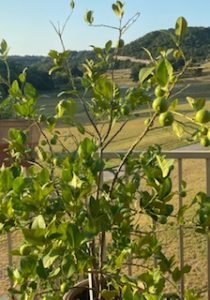
Somehow, I think there is a lesson here. There have been people who planted seeds in my life: seeds of faith, seeds of teaching, seeds of encouragement, seeds of hope. I’m sure some of those sowers must have wondered if those seeds would ever grow or amount to anything or if they were just wasting time. And perhaps you have done some seed-sowing with people in your life and you’ve wondered if those seeds would germinate and bear fruit. I know I have.
What I’ve come to understand is that maybe it’s just the sowing that is my task and the watering and nurturing will be someone else’s job. Remember what I was told—YOU’LL NEVER HAVE LEMONS? It was not true.
I’ve come to understand another truth. It is an absolute certainty that A SEED NEVER PLANTED WILL NEVER BEAR FRUIT. So, plant the seed anyway. I’m wondering one last thing. Would it be a matter of my stubborn pride, or instruction, or kindness if I took that gardening expert a lemon pie with a smile on my face and without saying a word?
May 20, 2020
BALM – BEARERS
NOTE: This is the third in the series of devotional thoughts on the BALM OF GILEAD
“Is there no balm in Gilead? Is there no physician here?” Jeremiah 8:22
As we are into month three of the Pandemic of 2020, we tune our eyes and ears to the latest news report, always looking for good news, some light and hope in this scary, unfamiliar way of life. One place I have found light and hope is the media’s attention on the health care workers across the country – Blue Angels flyovers, food deliveries to healthcare workers, nurses dancing in the hallway when a recovered patient leaves the hospital. You’ve seen those wonderful segments from nightly newscasts now ending with heart-warming stories of the good that is being done by people serving others.
I’m so prayerful and hopeful that this will become part of our new normal. It’s just sad that it took a plague to take the spotlight from Hollywood and the professional athletes and redirect that spotlight to show us who the real heroes are – the doctors, nurses, first responders, the workers that are considered “necessary,” teachers, and ministers. These are the ones I call “balm-bearers.”
 We continue to think about the balm in Gilead as we look at Jeremiah weeping and praying for his people. He is looking for hope and help. In ancient Bible times, the oils from the balsam trees from a region of Israel known as Gilead, were prized, healing oils. When the tree was wounded, the healing oils seeped through and were collected to make soothing salves. But there’s much more to this process if someone is to derive benefit from them.
God provided the healing oils, but someone had to be there to harvest them and to put them in vessels so they could be carried to those in need. And then someone had to carry those vessels to the hurting people. This was the way God designed it to be–people serving other people.
You don’t have to be a medical professional to give care to someone. Balm comes in many forms in addition to the medicinal. If you have chosen to live God’s way, then you are a balm-bearer. You are the vessel, God’s chosen vessel, to speak healing words, to lend a soothing hand, or to give a message of hope to someone who’s hurting.
Jesus told a story about dividing the sheep from the goats. When the sheep asked, “Lord, when did we see you hungry and feed you, or thirsty and give you something to drink? When did we see you a stranger and invite you in, or needing clothes and clothe you? When did we see you sick or in prison and go to visit you?’ Jesus said, ‘Truly I tell you, whatever you did for one of the least of these brothers and sisters of mine, you did for me.” Matthew 25:37
So, what’s on your calendar today? I hope your to-do list includes a bit of balm-bearing. Are you prepared when someone near you is looking for comfort? Do you have a cup of water or a shoulder or a time to pray? When you’re moving around you today, you may be bumping up against angry, hateful, bitter, frightened people. Will you see them as bad people or broken people? Will you see them as Jesus did? As people worthy of the balm of Gilead?
May 12, 2020
NEVERMORE TO EVERMORE
NOTE: This is the second in a series based on the Balm in Gilead.
“Is there no balm in Gilead? Is there no physician here?” Jeremiah 8:22
Well, here we are a full-blown three months into the Pandemic, something we would not have imagined. The first few weeks we were learning about this new enemy, and life was changing around us daily. Lately, the reality has settled in and a certain tiredness and weariness have accompanied that reality.
I find myself longing to go to the grocery store to pick out my own unbruised fruit. And I dream about sharing a basket of warm tortilla chips at lunch with a friend and having a maskless conversation with my neighbor. Oh, and having someone over, and serving a nice dinner out on the deck, taking advantage of these lovely spring evenings. And don’t get me started on not being able to enjoy family and the grandkids like we are accustomed to. Life is different these days, and I’m asking like Jeremiah, “Is there no balm in Gilead?” to get us either through or out of this mess.
Although the balm in Gilead is mentioned in the Scripture only a few times, it has inspired writers for centuries. As dark as Edgar Allan Poe’s writing was, he was a master at Biblical imagery. In his narrative poem, “The Raven,” the narrator is a young grieving, tormented man lamenting the loss of his beloved Lenore. As he sits in desolation one cold December evening, he is visited by the Raven. The narrator begs of his visitor.
“On this home by Horror haunted—tell me truly, I implore—
Is there—is there balm in Gilead?—tell me—tell me, I implore!”
Quoth the Raven, “Nevermore.”
 It’s not a dark, cold December evening. It’s a lovely spring morning, but perhaps it feels like a dark cold place. Perhaps you’re grieving the loss of someone you loved or the loss of some things that really gave meaning to your life. Maybe you’re feeling sad or stressed, and you’re wondering if things will ever get better. Listen, friends, don’t let the Raven perch in your window, especially the window of your soul.
When the Raven said “nevermore,” he brought no hope, just a somber, meaningless non-answer in one word—nevermore. But there is One whose “nevermore” gives us hope.
I invite you to open your Bible and read John 14. Jesus knows what is ahead for Him, and He knows that life is about to change for His followers when He is no longer with them on a day to day basis—accessible to them, working with them, teaching them, and allowing them to see Him at work. So, He spends this chapter preparing them for those changes. He gives them and us a comforting promise in John 14:16 when He says, “I will talk to the Father, and He’ll provide you another Friend so that you will always have someone with you.”
Jesus’ message to us is that nevermore will we be alone or forsaken or without hope. He did not promise lives void of stress or sadness, but He promised us we would not walk through those days without His presence and without hope. When we choose Jesus and His way of living, we are evermore His. Jesus turns nevermore into evermore.
Prayer: Lord, thank you that even when I don’t feel your presence, I am still not alone. Help me to know you are with me. Help me to listen and know your comforting voice. Help me feel the balm of Gilead today. In Jesus’ name, Amen.
May 7, 2020
BALM IN GILEAD
INTRODUCTORY NOTE: One of our dear friends, an infectious disease specialist and frontline medical professional, has been leading a drug trial for the drug Remdesivir, which appears to be a successful and viable treatment for the coronavirus. In learning more about this and praying for him and a medicine that would work, I had to ask myself, “Now what is the likelihood that this drug which could save so many lives is made by Gilead Sciences?” Call me strange, but somehow, I just don’t think that name’s coincidental. I grew up singing and playing the old spiritual “Balm in Gilead.” With all this ricocheting around in my head, I felt a little nudge to do a series on the subject of the Balm in Gilead. So, for the next three weeks, I’ll be adding to this study. I hope you’ll take a bit of time to read the book of Jeremiah. I think his questions will resonate with you, and I think you’ll find a lot of hope there. And the photo above is from our deck. I think one reason I love these hills so much is that they remind me of the places where Jeremiah and Jesus walked.
Bob Dylan was a prophet of sorts in 1964 when he wrote the song, “The Times They Are A-Changin’.” Go, look up the lyrics. They are chilling. He couldn’t have foreseen 2020 and the Pandemic as he wrote about the need for social change. Well, we’re experiencing some of those changes, and no one, not one, is insulated from them.
Our newsfeeds are drowning in dire reports of sickness, lack of supplies, unemployment, fearmongering, and reports of people profiting off the pain and fear of others. Some families are grieving the loss of someone they love or loss of jobs. Others are living in fear and under undue stress of just residing under the same roof.
And we’re all hoping and praying that these times will be a-changin’ too, and that life after the pandemic will be a better kind of different. We are clinging to the news of the hopes of a cure or a vaccine. But even with our hopes, we’re asking some of the same questions the prophet Jeremiah asked.
Jeremiah lived through some of the most tumultuous times in Hebrew history. It would behoove us to look at how he lived through it and what he has to say about surviving with grace in the worst of times. Jeremiah weeps as he asks the questions – “Is there no balm in Gilead? Is there no physician here? Why then is there no healing for the wound of my people?” Jeremiah 8:22
“Is there no balm in Gilead?”
 Gilead is a real place – a region north of the Dead Sea in Israel. In Bible times, this region was noted for trees whose oils had medicinal properties. Many scholars agree that the bark was slit on a balsam tree, and the resin or oil that seeped through had healing properties. It was a valuable commodity and used for trade.
No doubt, Jeremiah knew about Gilead’s balm. In this passage, the weeping prophet feels desperate for himself and for his people as they are in exile. He expresses his heartbreak and hopelessness. He asks the question, “Is there no hope? Will things ever be better? Is there nothing or no one who can help?”
Are you feeling like Jeremiah, abandoned or exiled or hopeless because of the plague of COVID-19? Are you feeling the stress of sheltering in place? Are you grieving loss? Are you feeling desperate about finances? And maybe your worries are for someone else you love, not just yourself. Nonetheless, these situations leave you asking the same questions. “Is there no hope? Is there no one who will help?” Maybe like the people of Jeremiah’s day, we need a balm, a spiritual balm.
I have good news. There is a balm in Gilead, and the balm has a name. His name is Jesus. He is the compassionate Great Physician and the ever-present Comforter and Healer. Here is what God says in Isaiah 41:10. “So do not fear, for I am with you: do not be dismayed, for I am your God. I will strengthen you and help you; I will uphold you with my righteous right hand.” What could be better news? The Great I AM is with us, strengthening us, and holding us in His hand.
Prayer: Thank you, Father, that there is healing in You. I ask for Your provisions, not those of my own. I ask for faith, not understanding. I ask for the peace, hope, and comfort of Your presence. In Jesus’ name, Amen.