
Noemí Lowe's Blog
March 1, 2016
The Great Whatever
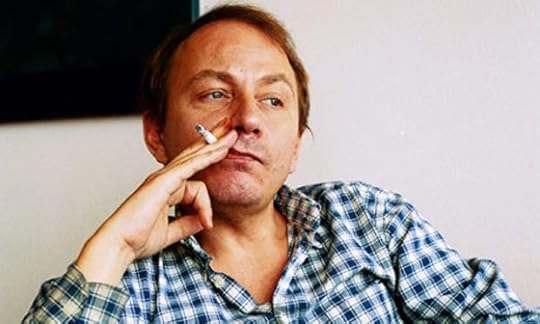
Michel Houellebecq is judging you...
Michel Houellebecq has been described as the enfant terrible of contemporary French writers. And I think that’s an apt description, in the same way that Macaulay Culkin in The Good Son or that rambunctious kid from The Omen were enfant terribles.
Whatever is my second journey into the mind of Houellebecq, after The Elementary Participles, which I found particularly (nailed it) brilliant. Much like the protagonist of The Elementary Particles the man who narrates Whatever is a young(ish) office worker in a technical field, reasonably professionally successful, on the cusp of middle age, and afflicted with equal parts self-loathing, self-awareness and social detachment. Indeed, I believe the repeated use of Houellebecq’s characters operating in technical fields is a method of forcing the characters into impersonal lifestyles, a way of increasing their levels of detachment, while also emphasizing the absurdity of human existence in an increasingly technical and numbers driven world. At one point, and I’m paraphrasing here, Houellebecq writes that the world needs many more things but information is not one of them.
At its heart Whatever is a very slightly defined narrative encompassing a social-political thesis. We meet our hero, if he can be called that, after the great events of his life have already occurred; he’s already experienced his one great love affair, his only great heartbreak. He’s settled into his job without any hope or desire to change or to earn a promotion. He’s actually somewhat satisfied in a very unhappy way. Over the course of the very short novel our hero is propelled forward, first by the whims of his job, which takes him all over France, and then by his own growing (and ever-darkening) impulses. Indeed these impulses become so deranged that even I, knowing pretty much what to expect from the author, felt shocked and a little frightened as I continued reading. But as unsettling and funny (and it does get quite funny in places) the narrative becomes, it is merely entertaining set dressing for Houellebecq’s thesis on humanity, the absurdity of which is illustrated by putting these thoughts forward as a series of dialogues between various animals, a cow, a stork, an ape, etc. At this point the narrative dissolves and it is as if the reader has entered Houellebecq’s living room, where he’s sat us down and has begun reading to us from some deranged children’s book that he’d written, perhaps hastily and using his own blood or feces in lieu of a pen. He is at once very earnestly proffering his dissatisfactions and observances of people and the world at large while laughing at his own absurd notions. It, of all things, makes the hero of Whatever and Houellebecq himself unaccountably likeable, even sympathetic. Quite a trick to pull off for a main character who gets a depressed co-worker drunk and tries to convince him to commit murder, and for a writer who seems so unabashedly prejudiced and vile.


February 26, 2016
#WhatImReadingNow
"Venice purple and gold, with her shot taffeta skies, her leaden skies, a shriek of death in her shadows, the horror of one who discovers a lethal incandescence in his own gut."
Off to a good start.
John Berger's The Shape of a Pocket
The Shape of a Pocket is a collection of Berger's essay's ranging from meditations on art, resistance, and what he calls "The New World Economic Order--essentially a coalition of like minded people and corporations bent on destroying individualism, culture, and freedom of movement and expression. Paraphrasing Berger's last essay (which is a transcript of a one man performance he put on for BBC Radio) he personifies the New World Economic Order in the guise of an auctioneer, selling off everything from human body parts to the human spirit. In the Reading those words I think it would be easy to mis-categorize Berger as a conspiracy theorist or paranoid. But as the X-Files has proven, you're only paranoid if you're wrong. And the Shape of the Pocket is definitely not wrong. When it was published at the turn of the century the western world was experiencing the beginning of the great recession and the time since publication has only affirmed Berger's view of the existence of an economic order based not on the needs of people but on making as much money as possible for a select few.
But all that being said, this is not a book about conspiracies, or a lament about the downfall of the western world. Like Michael Moore's new film, Where to Invade Next it's a very hopeful book, but as both Moore's film and Berger's book both iterate you can't have hope without problems.
The shape of the pocket in question is the shape of resistance. In one particular case it's the armed resistance of the Zapatistas in Mexico, but mostly Berger writes of art and free thinking. Berger is, first and foremost, an art critic, and it's through art that he projects the light of his ideas of resistance. Art as resistance is non-violent. It has no agency of its own. Instead it lends and inspires agency in the viewer. To Berger, Frida Kahlo's self portraits aren't reflections of the artist but a practice of putting her cheek to the canvas, to the world at large, and feeling it. Portraits of madmen aren't images of the deranged, nor spectacle, or some paltry attempt at elevation, but empathetic examinations of madness and humanity, an attempt to feel what those depicted might feel. And a somewhat kitsch depiction of an open market in Paris isn't just an overly-romanticized love letter, but an ode to a moment at the verge of eclipsing and becoming something else, a kind of memento mori.
With philosopher's it's sometimes difficult to know where to begin reading in their ouvre. Opinions and ideas change with age and the shifting times. And with Berger penetrating his ideas and commentary is further complicated by his vast knowledge of art, from painting to sculpture and poetry. It requires patience, but The Shape of a Pocket is an important book and one that's only grown in relevance since it was published fifteen or so years ago. If you have the time and opportunity, read it in your public library where you can go look up photos of the works of art Berger references. If you can't that's what the internet is for!


