EXO Books's Blog
September 15, 2016
Q & A with Tash
The following is a Q & A that originally appeared on The Bookie Monster blog. It has been reprinted with the permission of the blog's owner, Tash. The original post can be found here.
Q: Hi EXO Books! Thanks for taking part in this Q & A with me!A: It is my absolute pleasure, Tash.Q: The Last Day of Captain Lincoln is your debut novella. How did you come up with the premise?A: I never meant to be a writer. I had just graduated law school when the financial crisis hit at the end of 2008, which took out my high paying new job along with it. This sunk me into a pretty deep funk, unemployed and listless for almost all of 2009. I felt like a massive failure, even though none of it was my fault.And then, BAM. Life struck again. My grandmother Helen was diagnosed with cancer. Being the oldest grandchild from a close-knit family, this second blow was even worse. This was the first death of someone truly close to me, and it was extremely difficult to watch my strong willed grandmother wither away. And she fought gallantly, slowly wasting away in the hospital bed installed right in the living room of the house that my grandfather had built with his own hands, surrounded by family. It was tragic and yet beautiful all at once.I started writing The Last Day of Captain Lincoln at my grandparent’s kitchen table, just a few feet away from my grandmother during her last few days of life. I guess I was trying to put myself into her position, wondering how I would react if the same gruesome deadline were placed on my own life. What became the bones of the story poured out of me. Lincoln’s anguish was my anguish. Lincoln’s search for meaning among religion and art was my search for meaning.Career prospects improved over time and eventually I got back to being a lawyer–what I earnestly thought I still wanted to be doing with my life. Yet I had been bitten by the bug, as they say. Captain Lincoln remained lodged in my mind. The notebook filled with ideas on my desk became notebooks. The next time unemployment came I hit the ground running, further expanding the story. Then my father died unexpectedly, another massive family tragedy, but also more fuel for what was turning out to be a very emotional little novella. And then my grandfather died, in some ways a spiritual and emotional bookend to everything. I poured all of it into my little book.Looking back through it all, a gut-wrenching journey that I’d never expected to take, it’s still a bit surreal. I am a writer because of failure. If it wasn’t for both career failure and a tremendous family tragedy at the same time, I wouldn’t be sitting here now, writing these words that you’re reading. But for these hard times, I wouldn’t be the person, and the writer, that I am today. For this reason I consider myself very lucky to have found writing when I did. I don’t take it for granted. Q: I mentioned in my review that I felt like the novella was a love letter to Earth. What made you decide to mention the cultural references that you did, especially in regards to the choice of music?A: Well as I mentioned, Captain Lincoln’s struggles were my own struggles, so many of the songs and poems reflect that (Mozart’s Requiem, Paint It, Black by the Rolling Stones). These were songs I was listening to myself. I was also discovering many of the poems and quotes found in the book during this time. In a larger sense, even though the story takes place on a spaceship almost 1,000 years in the future, I wanted it grounded in a reality to which readers today could relate to. Hence many of the cultural references. A book about dealing with great loss, I think it turns out being a love letter to a great many things.Q: Your novella explores Captain Lincoln battling with his own mortality and I feel like it’s a prevalent theme in the book especially one that I came away with. Was this deliberate and if so did you want the reader to come away with this theme above the others?A: For sure. I figured out my problem very early on in the writing of this work. Lincoln was dying at the end—that was the main premise upon which everything in the book is based. So right there that took away the ability to have, say, a surprise ending. It also messes up the chance for any really suspenseful plot line, since I knew I wanted Lincoln to go out with grace in the end, no matter what his inner struggle was. What that left me with was what you say, the battle with mortality.Q: You’ve mentioned that you have further plans to expand on this Universe. Will any of the characters in The Last Day of Captain Lincoln be making an appearance or will you be focusing on past/future generations?A: I think that my one original thought when it comes to my writing was to create a frame story to tell the thousands-years-long journey of an interstellar spaceship. It’s not even that original, really, since it was a second reading of Isaac Asimov’s Foundation which keyed me on to this approach. In the most basic sense, a frame story is a series of stories which combine together to tell a much larger tale. Think about The Canterbury Tales, or Cloud Atlas as a contemporary (and far more complex) example. Inherent to this story within a story approach is certainly some sort of continuity across plot and/or characters.So I wouldn’t expect anything more from our dear old Captain, but I can tell you that a young Helen plays a small role in the next novella we’ll put out. Captain Adam (the first captain, mentioned several times) has his own novella, and I have a whole series of novellas following a generation of children on the Ship. And of course the one recurring character in everything is the Ship itself, a sentient consciousness which you’ll learn more about.Q: I’ve recently completed a University degree in writing and I’m torn between a variety of genres. How did you know you wanted to be a writer, and in particular how did you know you wanted to write specifically science-fiction?A: Well as I mentioned, I never wanted to be a writer, but once I’d started there was no going back. There is certainly a writing bug. As you’ve probably already experienced yourself, there’s a tremendous therapeutic value in putting pen to paper, pouring it out. It’s a combination of release, as you wrestle with all of the things floating around in your mind, with that cathartic buzz of creation, then wanting to share. And now I can’t stop.The Last Day of Captain Lincoln was the very first thing I’d ever written on my own volition—writing coming from just me alone, because I wanted to—but I can’t say that I ever made a conscious decision to write science fiction. It just came out that way. But thinking about it now, the reason seems simple enough: I am a writer because I’ve always been a reader, and I’ve always enjoyed science fiction most of all. I am also a scientist too, with an undergraduate and master’s degree in Biology (before I was a lawyer), so maybe I’m the wrong person to ask.Q: In your novella, Captain Lincoln and seven others are part of the Zeta Alpha generation. If you could choose seven other people to journey through space with (they can be people you know, authors, musicians, living or dead etc) who would you choose and why?A: Tash, you are killing me! This is a great question which I’ve been agonizing over for days now. So, I cheated! Even though I am positive that my spaceship could easily facilitate communication between anyone who’s ever lived on this planet, I am going to limit myself to English speaking people only–thereby eliminating some potential stalwart picks like Buddha and Jesus and Helen of Troy. I also thought hard about including my father, who died suddenly, and who I feel like I still have a lot to say to, but I decided against this route in the spirit of creativity. The last restriction I put on myself, true to form of the Ship, is 4 boys and 4 girls. So, without further ado, here are my shipmates:1. My wife–I married this smart, wonderful, beautiful woman for good reason!2. Paul McCartney and 3. John Lennon: Reunited, and it feels so good… I am a massive Beatles fan, so I couldn’t resist. To my mind, Paul McCartney is an absolute genius when it comes to melody. Combined with the lyrical and almost existential genius of John Lennon, the two lads from Liverpool will ensure not only a melodious ride as we travel Across the Universe, but a rollicking fun one as well.4. Lucille Ball: I thought hard about bringing along Lady Gaga, appealing to my super fan wife, but screw it—it’s my ship. I’ve been watching I Love Lucy since I was a kid. This is going to be one fun ass ride!5. Julia Child: We all have to eat of course, so why not bring one of the most influential chefs along with us and eat like kings and queens? I also love to cook myself, so it would be an amazing experience learning side-by-side, chopping vegetables next to one of the best. Not only that, but Julia Child was an all-around bad ass! Born in 1912, this woman was a college athlete in the 1930’s, a spy in WWII, and a world traveler, all long before she ever got on TV.6. Kurt Vonnegut: My favorite writer. To me it’s his combination of wit and wisdom with intent that makes him so impactful. He was an observer of the human condition, a bit of a moral philosopher, and a poet. And like so many great writers, he led such a rich life outside of writing; from his experiences in the War which permeated almost all of his work, to a life mostly dedicated to other people. Another person from whom I would learn tremendously.7. Hedy Lamarr: This last one was tough, but coming down to a ship with a bunch of flaky artist and writer types, I figured we’d need someone who could actually fix something, need be! Ms. Lamarr was not only a talented and beautiful actress, she was also a brilliant inventor too. She’d be a tremendous asset to our motley crew.Honorable mentions (women): Amelia Earhart, Ursula Le Guin (my sci-fi grandmother), Sally Ride, Mae West, Billy Holiday, Nina Simone, Hannah Arendt, Susan B Anthony.Honorable mentions (men): Carl Sagan, Martin Luther King Jr., Albert Einstein, Abraham Lincoln, Thomas Paine, George Orwell, Isaac Asimov.Q: There is a point in the book where Captain Lincoln sees Lady Liberty submerged, and the metal from the Brooklyn Bridge has been salvaged. Both of these images reminded me of disaster movies and novels. Would you ever consider writing a post-apocalyptic science-fiction novella/novel?A: NO! Well, never say never I guess, but personally I am so done with all of this post-apocalypse stuff everywhere you look. It’s easy to see where it all comes from, whether it’s The Hunger Games or Divergent or every friggen zombie movie–there is a growing darkness in this world, mostly fostered through greed and fear, which most of us can feel. The one positive message I see from dystopian literature seems to be the rising up part–the “I (or we) won’t take this shit anymore” revolutions–and there is certainly value to that.But to me, the vast weight of post-apocalyptic literature and movies are so disappointing because it’s all the same. In virtually every case it’s the breakdown of civil society with the predictable result: because shit hit the fan, it’s okay to be assholes to one another. I’m not interested in that at all. It’s not only been so overdone at this point, but in my opinion the primary message that the vast weight of post-apocalyptic storytelling is giving people is unacceptable. Contrary to what some may think, dystopia is not inevitable. And no matter what happens, no matter how dark it gets, we cannot lose our humanity, our regard for one another as fellow human beings. Darkness doesn’t defeat darkness. Only light can win. And this is in complete recognition that many if not most of the real heavy hitters of science fiction have a strong dystopian bent, from 1984 to Brave New World to Fahrenheit 451, and more. It’s just that for me, as a writer living here on planet Earth in 2016 AD with all the problems I see around us, I just don’t want to go there. I want to stay more on the protopian side of things, as a counterbalance to the descending darkness. For as depressing as things can seem, we mustn’t lose hope that we can make the world a better place, that things can be turned around by clear perception and conscious intent.I collect quotes, if you couldn’t already tell in my writing. I think that this one says it pretty well:Because I remember, I despair.But because I remember, I have a duty to reject despair. Elie Weisel
Nobel Lecture, 11 December 1986 AD
Oslo, Norway, Earth
Q: If you don’t mind carrying on the tradition of one of the final questions of my Q & A, could you tell me what you’re currently reading?A: I tend to switch off between fiction and nonfiction, roughly 2:1. Right now I am reading a nonfiction book called Homicide by David Simon. It was a gift from someone because of a shared love of Simon’s amazing TV show The Wire, and not something I’d typically read. I’m enjoying it though, despite the general grisliness of the content. The book was a precursor to the show, so it’s interesting for me as a writer to see how some of the true life characters and situations eventually made their way into show, how they changed, etc.I’m also reading some fiction on the side–mostly to cheer myself up. I prefer short fiction over anything else (I write mostly short fiction too), and so I picked up The Best American Short Stories of 1963 at a flea market for a couple of bucks. Alas! Nothing good so far, though the collection isn’t without its lessons.First of all, it reiterates how subjective short fiction especially can be (an important lesson, since I have a short story which I think is great but that has been rejected from a few of the sci-fi mags). It’s also instructive as a window into the times. I find most of the stories inside not only extremely straightforward, but generally nostalgic for times past (there’s quite a lot of “cowboy” stories in there, ie). This makes sense, as 1962-63 was obviously just a little before the tumultuous times that were about to start. It’s very interesting to me as a writer to see how fiction seems to change with the times. In “good” times, peaceful times, our stories tend to be far more linear; more straightforward in both plot and meaning. In darker, more complex and ambiguous times–like we’re living in today–our stories tend to change to reflect that complexity and that ambiguity. It’s important as creative writers to understand this point.Q: Thank you for answering my questions, EXO Books!A: Again–my absolute pleasure. Thanks for the opportunity, Tash.
Q: Hi EXO Books! Thanks for taking part in this Q & A with me!A: It is my absolute pleasure, Tash.Q: The Last Day of Captain Lincoln is your debut novella. How did you come up with the premise?A: I never meant to be a writer. I had just graduated law school when the financial crisis hit at the end of 2008, which took out my high paying new job along with it. This sunk me into a pretty deep funk, unemployed and listless for almost all of 2009. I felt like a massive failure, even though none of it was my fault.And then, BAM. Life struck again. My grandmother Helen was diagnosed with cancer. Being the oldest grandchild from a close-knit family, this second blow was even worse. This was the first death of someone truly close to me, and it was extremely difficult to watch my strong willed grandmother wither away. And she fought gallantly, slowly wasting away in the hospital bed installed right in the living room of the house that my grandfather had built with his own hands, surrounded by family. It was tragic and yet beautiful all at once.I started writing The Last Day of Captain Lincoln at my grandparent’s kitchen table, just a few feet away from my grandmother during her last few days of life. I guess I was trying to put myself into her position, wondering how I would react if the same gruesome deadline were placed on my own life. What became the bones of the story poured out of me. Lincoln’s anguish was my anguish. Lincoln’s search for meaning among religion and art was my search for meaning.Career prospects improved over time and eventually I got back to being a lawyer–what I earnestly thought I still wanted to be doing with my life. Yet I had been bitten by the bug, as they say. Captain Lincoln remained lodged in my mind. The notebook filled with ideas on my desk became notebooks. The next time unemployment came I hit the ground running, further expanding the story. Then my father died unexpectedly, another massive family tragedy, but also more fuel for what was turning out to be a very emotional little novella. And then my grandfather died, in some ways a spiritual and emotional bookend to everything. I poured all of it into my little book.Looking back through it all, a gut-wrenching journey that I’d never expected to take, it’s still a bit surreal. I am a writer because of failure. If it wasn’t for both career failure and a tremendous family tragedy at the same time, I wouldn’t be sitting here now, writing these words that you’re reading. But for these hard times, I wouldn’t be the person, and the writer, that I am today. For this reason I consider myself very lucky to have found writing when I did. I don’t take it for granted. Q: I mentioned in my review that I felt like the novella was a love letter to Earth. What made you decide to mention the cultural references that you did, especially in regards to the choice of music?A: Well as I mentioned, Captain Lincoln’s struggles were my own struggles, so many of the songs and poems reflect that (Mozart’s Requiem, Paint It, Black by the Rolling Stones). These were songs I was listening to myself. I was also discovering many of the poems and quotes found in the book during this time. In a larger sense, even though the story takes place on a spaceship almost 1,000 years in the future, I wanted it grounded in a reality to which readers today could relate to. Hence many of the cultural references. A book about dealing with great loss, I think it turns out being a love letter to a great many things.Q: Your novella explores Captain Lincoln battling with his own mortality and I feel like it’s a prevalent theme in the book especially one that I came away with. Was this deliberate and if so did you want the reader to come away with this theme above the others?A: For sure. I figured out my problem very early on in the writing of this work. Lincoln was dying at the end—that was the main premise upon which everything in the book is based. So right there that took away the ability to have, say, a surprise ending. It also messes up the chance for any really suspenseful plot line, since I knew I wanted Lincoln to go out with grace in the end, no matter what his inner struggle was. What that left me with was what you say, the battle with mortality.Q: You’ve mentioned that you have further plans to expand on this Universe. Will any of the characters in The Last Day of Captain Lincoln be making an appearance or will you be focusing on past/future generations?A: I think that my one original thought when it comes to my writing was to create a frame story to tell the thousands-years-long journey of an interstellar spaceship. It’s not even that original, really, since it was a second reading of Isaac Asimov’s Foundation which keyed me on to this approach. In the most basic sense, a frame story is a series of stories which combine together to tell a much larger tale. Think about The Canterbury Tales, or Cloud Atlas as a contemporary (and far more complex) example. Inherent to this story within a story approach is certainly some sort of continuity across plot and/or characters.So I wouldn’t expect anything more from our dear old Captain, but I can tell you that a young Helen plays a small role in the next novella we’ll put out. Captain Adam (the first captain, mentioned several times) has his own novella, and I have a whole series of novellas following a generation of children on the Ship. And of course the one recurring character in everything is the Ship itself, a sentient consciousness which you’ll learn more about.Q: I’ve recently completed a University degree in writing and I’m torn between a variety of genres. How did you know you wanted to be a writer, and in particular how did you know you wanted to write specifically science-fiction?A: Well as I mentioned, I never wanted to be a writer, but once I’d started there was no going back. There is certainly a writing bug. As you’ve probably already experienced yourself, there’s a tremendous therapeutic value in putting pen to paper, pouring it out. It’s a combination of release, as you wrestle with all of the things floating around in your mind, with that cathartic buzz of creation, then wanting to share. And now I can’t stop.The Last Day of Captain Lincoln was the very first thing I’d ever written on my own volition—writing coming from just me alone, because I wanted to—but I can’t say that I ever made a conscious decision to write science fiction. It just came out that way. But thinking about it now, the reason seems simple enough: I am a writer because I’ve always been a reader, and I’ve always enjoyed science fiction most of all. I am also a scientist too, with an undergraduate and master’s degree in Biology (before I was a lawyer), so maybe I’m the wrong person to ask.Q: In your novella, Captain Lincoln and seven others are part of the Zeta Alpha generation. If you could choose seven other people to journey through space with (they can be people you know, authors, musicians, living or dead etc) who would you choose and why?A: Tash, you are killing me! This is a great question which I’ve been agonizing over for days now. So, I cheated! Even though I am positive that my spaceship could easily facilitate communication between anyone who’s ever lived on this planet, I am going to limit myself to English speaking people only–thereby eliminating some potential stalwart picks like Buddha and Jesus and Helen of Troy. I also thought hard about including my father, who died suddenly, and who I feel like I still have a lot to say to, but I decided against this route in the spirit of creativity. The last restriction I put on myself, true to form of the Ship, is 4 boys and 4 girls. So, without further ado, here are my shipmates:1. My wife–I married this smart, wonderful, beautiful woman for good reason!2. Paul McCartney and 3. John Lennon: Reunited, and it feels so good… I am a massive Beatles fan, so I couldn’t resist. To my mind, Paul McCartney is an absolute genius when it comes to melody. Combined with the lyrical and almost existential genius of John Lennon, the two lads from Liverpool will ensure not only a melodious ride as we travel Across the Universe, but a rollicking fun one as well.4. Lucille Ball: I thought hard about bringing along Lady Gaga, appealing to my super fan wife, but screw it—it’s my ship. I’ve been watching I Love Lucy since I was a kid. This is going to be one fun ass ride!5. Julia Child: We all have to eat of course, so why not bring one of the most influential chefs along with us and eat like kings and queens? I also love to cook myself, so it would be an amazing experience learning side-by-side, chopping vegetables next to one of the best. Not only that, but Julia Child was an all-around bad ass! Born in 1912, this woman was a college athlete in the 1930’s, a spy in WWII, and a world traveler, all long before she ever got on TV.6. Kurt Vonnegut: My favorite writer. To me it’s his combination of wit and wisdom with intent that makes him so impactful. He was an observer of the human condition, a bit of a moral philosopher, and a poet. And like so many great writers, he led such a rich life outside of writing; from his experiences in the War which permeated almost all of his work, to a life mostly dedicated to other people. Another person from whom I would learn tremendously.7. Hedy Lamarr: This last one was tough, but coming down to a ship with a bunch of flaky artist and writer types, I figured we’d need someone who could actually fix something, need be! Ms. Lamarr was not only a talented and beautiful actress, she was also a brilliant inventor too. She’d be a tremendous asset to our motley crew.Honorable mentions (women): Amelia Earhart, Ursula Le Guin (my sci-fi grandmother), Sally Ride, Mae West, Billy Holiday, Nina Simone, Hannah Arendt, Susan B Anthony.Honorable mentions (men): Carl Sagan, Martin Luther King Jr., Albert Einstein, Abraham Lincoln, Thomas Paine, George Orwell, Isaac Asimov.Q: There is a point in the book where Captain Lincoln sees Lady Liberty submerged, and the metal from the Brooklyn Bridge has been salvaged. Both of these images reminded me of disaster movies and novels. Would you ever consider writing a post-apocalyptic science-fiction novella/novel?A: NO! Well, never say never I guess, but personally I am so done with all of this post-apocalypse stuff everywhere you look. It’s easy to see where it all comes from, whether it’s The Hunger Games or Divergent or every friggen zombie movie–there is a growing darkness in this world, mostly fostered through greed and fear, which most of us can feel. The one positive message I see from dystopian literature seems to be the rising up part–the “I (or we) won’t take this shit anymore” revolutions–and there is certainly value to that.But to me, the vast weight of post-apocalyptic literature and movies are so disappointing because it’s all the same. In virtually every case it’s the breakdown of civil society with the predictable result: because shit hit the fan, it’s okay to be assholes to one another. I’m not interested in that at all. It’s not only been so overdone at this point, but in my opinion the primary message that the vast weight of post-apocalyptic storytelling is giving people is unacceptable. Contrary to what some may think, dystopia is not inevitable. And no matter what happens, no matter how dark it gets, we cannot lose our humanity, our regard for one another as fellow human beings. Darkness doesn’t defeat darkness. Only light can win. And this is in complete recognition that many if not most of the real heavy hitters of science fiction have a strong dystopian bent, from 1984 to Brave New World to Fahrenheit 451, and more. It’s just that for me, as a writer living here on planet Earth in 2016 AD with all the problems I see around us, I just don’t want to go there. I want to stay more on the protopian side of things, as a counterbalance to the descending darkness. For as depressing as things can seem, we mustn’t lose hope that we can make the world a better place, that things can be turned around by clear perception and conscious intent.I collect quotes, if you couldn’t already tell in my writing. I think that this one says it pretty well:Because I remember, I despair.But because I remember, I have a duty to reject despair. Elie Weisel
Nobel Lecture, 11 December 1986 AD
Oslo, Norway, Earth
Q: If you don’t mind carrying on the tradition of one of the final questions of my Q & A, could you tell me what you’re currently reading?A: I tend to switch off between fiction and nonfiction, roughly 2:1. Right now I am reading a nonfiction book called Homicide by David Simon. It was a gift from someone because of a shared love of Simon’s amazing TV show The Wire, and not something I’d typically read. I’m enjoying it though, despite the general grisliness of the content. The book was a precursor to the show, so it’s interesting for me as a writer to see how some of the true life characters and situations eventually made their way into show, how they changed, etc.I’m also reading some fiction on the side–mostly to cheer myself up. I prefer short fiction over anything else (I write mostly short fiction too), and so I picked up The Best American Short Stories of 1963 at a flea market for a couple of bucks. Alas! Nothing good so far, though the collection isn’t without its lessons.First of all, it reiterates how subjective short fiction especially can be (an important lesson, since I have a short story which I think is great but that has been rejected from a few of the sci-fi mags). It’s also instructive as a window into the times. I find most of the stories inside not only extremely straightforward, but generally nostalgic for times past (there’s quite a lot of “cowboy” stories in there, ie). This makes sense, as 1962-63 was obviously just a little before the tumultuous times that were about to start. It’s very interesting to me as a writer to see how fiction seems to change with the times. In “good” times, peaceful times, our stories tend to be far more linear; more straightforward in both plot and meaning. In darker, more complex and ambiguous times–like we’re living in today–our stories tend to change to reflect that complexity and that ambiguity. It’s important as creative writers to understand this point.Q: Thank you for answering my questions, EXO Books!A: Again–my absolute pleasure. Thanks for the opportunity, Tash.


August 20, 2016
Gratitude
A hundred times every day I remind myself that my inner and outer life are based on the labors of other men, living and dead, and that I must exert myself in order to give in the same measure as I have received and am still receiving…
Albert Einstein The World As I See It , 1931 ADBern, Switzerland, Earth
I sit here on the eve of the release of my first hardcover book, contemplating a new blog post. It has been a start and stop and then start again journey seven years in the making. The rush of emotions I feel from this; the stress and anxiety from sharing some of my innermost thoughts with the entire English-speaking world clashing with an immense feeling of pride in the little work of art we’ve put together, a feeling of relief that it’s almost over in dissonance with the thought that it’s only just begun. Suffice to say, I haven’t been sleeping much. Yet more than any other emotion bouncing around in the jumble in my head the thing that I feel most of all is an intense feeling of gratitude. I wouldn’t be sitting here, writing these words that you read if it weren’t for a confluence of people and events which somehow, serendipitously added up to this very moment. I can’t forget this. There is so much to be thankful for.
I am a writer only because of failure. I’d been a (criminally underpaid) scientist for a few years before selling out and deciding to go to law school. Graduating in 2008, I managed to land a $160,000 a year job at a prestigious law firm until the financial crisis took out the firm, and many others, in its wide swath of destruction. The New York legal market in full meltdown, I was unemployed for nearly a year. This was a pretty devastating blow to my ego. Frankly, I thought I was kind of the shit. I had very suddenly begun making a ton of money, living the good life in a sweet spot in Manhattan when suddenly POOF—there it all went. The long bout of unemployment that followed was extremely depressing. I felt like a massive failure, even though none of what had happened was my fault at all. This was a hard lesson to take. Yet my greatest gifts were the people around me, a support network of family and friends who helped me through this time.
But then life struck again, as it does. It was right around this time that we learned that my grandmother had pancreatic cancer. Coming from a tight-knit family and being the oldest grandchild, this was another soul crushing blow. My grandmother’s slow withering was the first death I’d experienced of someone truly close. Devastating blow number two was much worse, deeper from an emotional sense but also far more visceral. Yet serendipity lies in the fact that I was unemployed and freely available. One of the greatest gifts in my life was being able to be there during my grandmother’s last few weeks. And she fought gallantry, slowly wasting away in the hospital bed installed in the middle of the living room of the house that my grandfather built with his own hands. It was tragic and yet beautiful all at once.
I started writing The Last Day of Captain Lincoln at my grandparent’s kitchen table during my grandmother’s last few days of life. I guess I was trying to put myself in her position, wondering how I would react if the same gruesome deadline were placed on my own life. What became the bones of the story poured out of me. Captain Lincoln’s search for meaning was my search for meaning. Yet it was only through this ordeal, a long-lasting family tragedy atop ego-busting career failure, that any thought of writing anything first entered my mind. It still feels random and surreal, even so many years later. It’s crazy how life works. I found writing the long way, and now I can’t let it go.
I will thank my family and friends for their support when I see most of them at our book launch party tonight (pictures coming soon too, I hope)! It is the love of the people around us that is our most valuable gift. I will save the rest of my words for them when I see them in person.
I will thank all of the authors I’ve ever read, and especially those science fiction writers who affected me the most, by trying to write original, forward-thinking fiction. I declare myself a science fiction writer and take on that mantle seriously, as a voice for the people of this planet in the perpetual battle against hate and greed.
I have been given much. Now is the time to give back.
Albert Einstein The World As I See It , 1931 ADBern, Switzerland, Earth
I sit here on the eve of the release of my first hardcover book, contemplating a new blog post. It has been a start and stop and then start again journey seven years in the making. The rush of emotions I feel from this; the stress and anxiety from sharing some of my innermost thoughts with the entire English-speaking world clashing with an immense feeling of pride in the little work of art we’ve put together, a feeling of relief that it’s almost over in dissonance with the thought that it’s only just begun. Suffice to say, I haven’t been sleeping much. Yet more than any other emotion bouncing around in the jumble in my head the thing that I feel most of all is an intense feeling of gratitude. I wouldn’t be sitting here, writing these words that you read if it weren’t for a confluence of people and events which somehow, serendipitously added up to this very moment. I can’t forget this. There is so much to be thankful for.
I am a writer only because of failure. I’d been a (criminally underpaid) scientist for a few years before selling out and deciding to go to law school. Graduating in 2008, I managed to land a $160,000 a year job at a prestigious law firm until the financial crisis took out the firm, and many others, in its wide swath of destruction. The New York legal market in full meltdown, I was unemployed for nearly a year. This was a pretty devastating blow to my ego. Frankly, I thought I was kind of the shit. I had very suddenly begun making a ton of money, living the good life in a sweet spot in Manhattan when suddenly POOF—there it all went. The long bout of unemployment that followed was extremely depressing. I felt like a massive failure, even though none of what had happened was my fault at all. This was a hard lesson to take. Yet my greatest gifts were the people around me, a support network of family and friends who helped me through this time.
But then life struck again, as it does. It was right around this time that we learned that my grandmother had pancreatic cancer. Coming from a tight-knit family and being the oldest grandchild, this was another soul crushing blow. My grandmother’s slow withering was the first death I’d experienced of someone truly close. Devastating blow number two was much worse, deeper from an emotional sense but also far more visceral. Yet serendipity lies in the fact that I was unemployed and freely available. One of the greatest gifts in my life was being able to be there during my grandmother’s last few weeks. And she fought gallantry, slowly wasting away in the hospital bed installed in the middle of the living room of the house that my grandfather built with his own hands. It was tragic and yet beautiful all at once.
I started writing The Last Day of Captain Lincoln at my grandparent’s kitchen table during my grandmother’s last few days of life. I guess I was trying to put myself in her position, wondering how I would react if the same gruesome deadline were placed on my own life. What became the bones of the story poured out of me. Captain Lincoln’s search for meaning was my search for meaning. Yet it was only through this ordeal, a long-lasting family tragedy atop ego-busting career failure, that any thought of writing anything first entered my mind. It still feels random and surreal, even so many years later. It’s crazy how life works. I found writing the long way, and now I can’t let it go.
I will thank my family and friends for their support when I see most of them at our book launch party tonight (pictures coming soon too, I hope)! It is the love of the people around us that is our most valuable gift. I will save the rest of my words for them when I see them in person.
I will thank all of the authors I’ve ever read, and especially those science fiction writers who affected me the most, by trying to write original, forward-thinking fiction. I declare myself a science fiction writer and take on that mantle seriously, as a voice for the people of this planet in the perpetual battle against hate and greed.
I have been given much. Now is the time to give back.
April 12, 2016
Tribalism and the Conservative Mind
America seems to be going insane. The looming potential rise of President Donald J. Trump has many people justifiably worried, but the fact of the matter is that this terrible situation has been building for decades. As always, from deep pre-history all the way up to these supposedly enlightened times here on planet Earth in 2016 AD, a large part of our problem comes down to a deeply primal tribalism—that “Us vs. Them” mentality that comes so natural to each and every one of us. Tribalism comes so easy because it’s natural. “Us vs. Them” is a default setting residing deep within the human mind as a natural way to group and act. Tribalism is also at the heart of the America politics too—that fact is clear enough, all throughout our history. Politics is our big American tribe breaking into smaller tribes and fighting over things. It's the two great tribes which scheme and lord over the power of the government of this land, the Democratic and Republican Parties, typically forcing us into the false choice between two bad options: our hypocrite vs their crazy liar—and no other choices allowed. Our two-headed political monopoly lives and dies by a political system predicated on “Us vs. Them.”
Looking back through time, the origin of deep-set tribalism is easy to understand. The planet that we human beings evolved on for roughly 160,000 years was extremely dangerous. It still is. Thinking tribally is a default setting, the natural way we are programmed to think and to act: to favor the people and situations we know over those we do not. Tribalism is basic prudence, trusting what you know (or think you know) over what you don’t; the Hippocratic Oath’s “do no harm” above all else. Yet it is an undeniable fact that some of us are more…susceptible… to tribalism than others. For some reason, some of us are more tribal than others—naturally more hostile to new people and new things, naturally more hostile to change. And this fact divides families, just as it divides cities and countries. It’s also nothing new. American culture, our societal mood and habits and norms, swings like a pendulum across time as WE, THE PEOPLE react and evolve to the changing world. It feels like we keep fighting the same battles decade after decade, generation after generation, but in many ways it’s tribalism which is making us fight. By nature we humans divide ourselves up—then we fight about it.
It’s very easy to see the tribalism in the rabid support of too many of the American people for Donald Trump. The Trump candidacy basically IS the growing divide in the Republican Party—a large mass of the true authoritarians among the American body politic lining up behind the most fear-mongering, xenophobic, demagogic daddy-figure there could be. The Donald’s simple, angry, finger-pointing messaging is deeply tribal: full of hostility against “others,” all about the projection of power, and purposefully and willfully targeted at some of the most fearful and reactionary among us. But Tribalism can certainly be seen in the Democrats too, especially in the durable support for the trusted Clinton brand (By the DNC establishment, by most Democratic politicians, and, it seems, by a large amount of African-Americans in the South). Tribalism is what the Clintons are especially good at, right? Not only in terms of Democratic Party “Us vs. Them” finger pointing, but also in the relatable, modest beginnings, “I feel your pain” stuff. You can see tribalism in Bernie Bros just like you can at a Tea Party rally.
The deeply tribal, finger-pointing politics of our two party system is a big part of the problem, and it seems to be getting worse. It’s like America is literally being torn asunder; fracturing into these different worlds with entirely different meanings of words and ideas, our societal mood and habits and norms all separating along with the rift. Is there any way to stop being so damn tribal all the time? Is “Us vs Them” finally going to doom America for good?
A house divided against itself cannot stand. I believe this government cannot endure, permanently, half slave and half free. I do not expect the Union to be dissolved- I do not expect the house to fall -but I do expect it will cease to be divided.
Abraham LincolnJune 16, 1858Springfield, USA, Earth
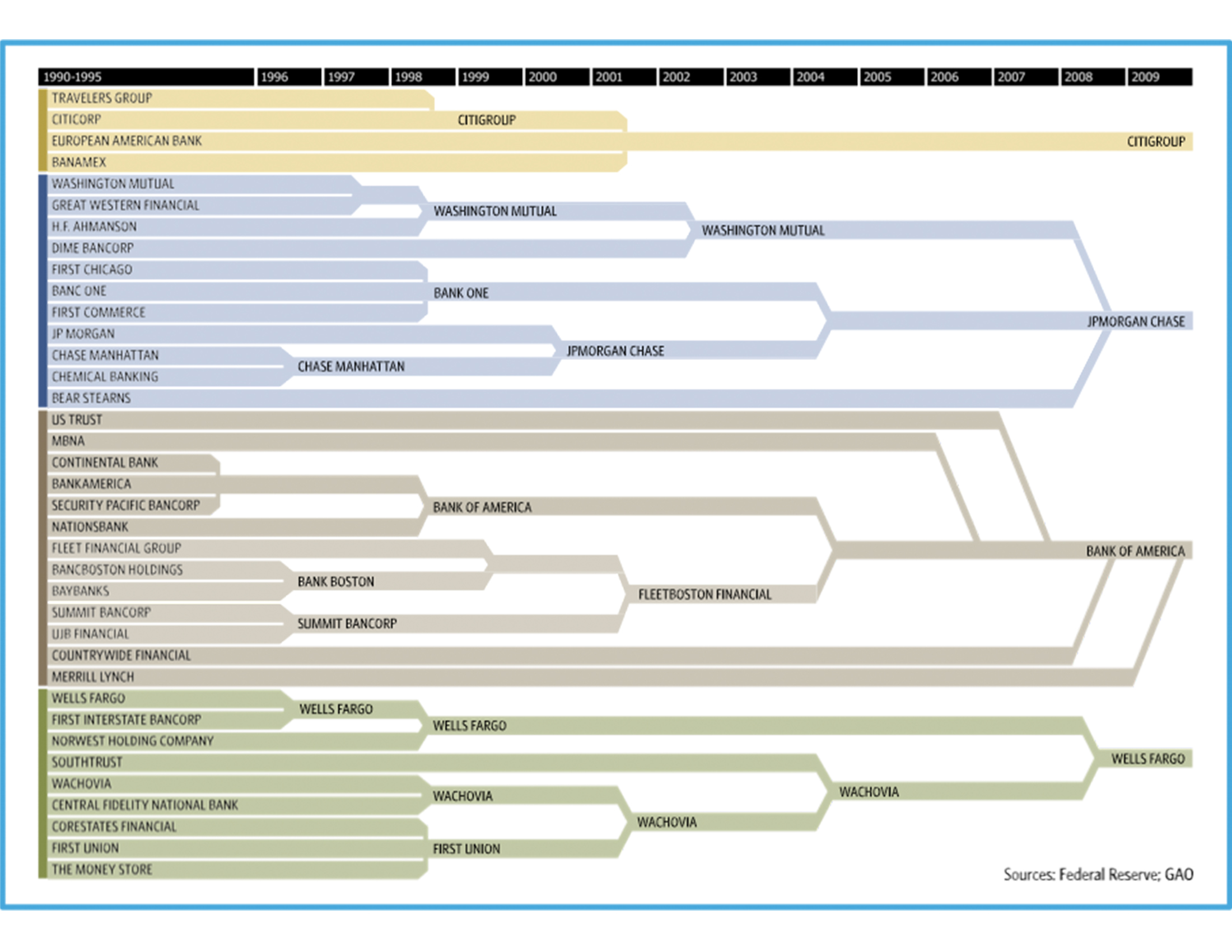
How did we get here, USA 2016 Edition? America’s politic framework has been drastically lurching to the right since at least the (first) Clinton years, though the prolonged assault on the pillars of the progressive left has been underway for far, far longer—many, many decades. The morally corrupt moral crusader/Speaker of the House Newt Gingrich accelerated the GOP’s push to the right, but President Clinton made it far worse with his “triangulation” approach—basically a fancy way of saying that the Democratic Party was open for business when it came to corporate influence. The result? The direct manifestation of so many of our current problems. Clinton’s repeal of the Glass-Steagal Act, a 60 year old law learned from the wisdom of the Great Depression that separated commercial and investment banks, literally created the Frankenstein monster "Too Big to Fail" banking consolidations which helped tank our economy in 2008-2009 (and certainly aren’t done yet). Since the deregulation of banking, America’s four largest banks have grown 65%, gobbling up thousands of smaller financial institutionsin their wake (aka “small businesses”). Slick Willy and crew also did another very bad thing by deregulating the FCC—the federal agency which regulates our airwaves, which have long been considered a public good owned by the American people. In 1983, 90% of the American media was owned by 50 companies. In 2011, after deregulation took its course, 90% of the media was owned by 6 companies! [GE, News-Corp (Fox), Disney, Viacom, Time Warner, and CBS]. Same exact idea on your radio dial. This is a YUGE problem. No wonder media coverage sucks so bad. These 6 massive “media” corporations are designed and run for one thing: to make profits for their owners (mostly large stock holders, many of which are other corporations). The unending quest for ratings explains many of the choices as to what these companies decide to air when it comes to the 24/7 “news” cycle, but it would be naïve to think that ratings were the only thing. The bottom line needs to be protected, after all, long term profits ensured. Political candidates who are good for the bottom line get positive coverage, while those hostile to these interests get ignored and/or attacked. We got to see Marco Rubio’s confusing Hurray! I got third place in Iowa! speech live on ALL the cable “news” networks, but arenas filled by 30,000 Bernie Sanders supporters are nary mentioned. And in terms of the Donald, no matter how crude and ugly the language gets, the ratings are so friggen YUGE that the “serious” “news outlets” can’t help themselves.
The never-ending push for profits at the heart of these giant “media” conglomerates has radically distorted both the quality and content of the “news” that we receive. For a very long time the news used to be a public service, first in radio and then television. Remember: the American people are supposed to own the airwaves—hence the existence of the FCC in the first place, licensing out the bandwidth to companies. I can’t help but think about Walter Cronkite when I think about how the news environment used to be. Uncle Walt came on every night and just read the damn news. This was based on the (now clearly lost) idea that a highly informed citizenry made for a better country. Now maybe Walt’s news was a lily-white vanilla overview of things, but everyone basically trusted that what he was saying was more or less the facts. 60 Minutes was the first television “news” program that actually ever made any money. Then came CNN, the first dedicated TV “news” network, creating the 24/7 “Breaking News” media cycle and exacerbating a quickly worsening case of cultural ADHD. Soon after came the “fair and balanced” [for-profit, right-wing] FOX News; quickly followed by the [corporate, for-profit] “liberal” MSNBC, trying to emulate Fox’s business model. And let’s understand the game, to be clear. Besides the massive influence from being considered a major and credible source of “the news,” the tangible thing that both FOX News and MSNBC are selling is advertising. The network’s true “customers” are other corporations (or the US Armed Forces… or politicians… or super Pacs…) trying to sell something to a measurable and deliverable block of viewers. Corporate advertising is where the money comes from. The network’s “viewers,” broken down by demographics, are only who the advertising is aimed at.
Frankly, this has put us in a really shitty fucking place. The American body politic is in a terribly fractured position, given the inherent need for the “media” to divide our people into discrete segments of like-minded “news entertainment” listeners and viewers, combined with our own natural proclivities to break into such groups. “Conservatives” only listen to and watch “conservative” “news entertainment” (ie FOX and Rush), while the “liberals” stick to MSNBC, or CNN, PBS, or maybe even NPR. The effects of these self-selecting bubbles is destroying us; building walls of words and ideas between family and friends, in every community across this country. I don’t know about you, but I am finding it harder and harder to have anything like a rational conversation with a few of my most conservative friends. And having different worldviews is understandable... It’s actually great. We are different people who’ve grown up in different circumstances seeing different things. Yet one highly dangerous fact seems inexplicable: even though we are still friends, and they are smart, compassionate people, we can no longer talk about politics anymore. It seems useless. The expressed worldviews of my most conservative friends are based not only on an entirely different set of vocabulary words which I thought I knew, but a completely different perspective that is very hard for me to see. Words and ideas that mean one thing to me mean something entirely different to them, making for these giant, meaninglessly garbled word clouds of nothing. We are no longer speaking the same language, and because of this our minds cannot meet. And this development is immensely worrying, because if you can’t speak with someone to try to settle your differences—if you can’t use words with shared meanings to compromise on a course of action—either those differences don’t get settled, or they get settled by things far more damaging than words, like bullets.
Men often hate each other because they fear each other;The fear each other because they don't know each other;They don't know each other because they can not communicate;They can not communicate because they are separated.
Martin Luther King, Jr. Speech, 1958 ADMontgomery, USA, Earth
Political Tribalism Divide and conquer is one of the oldest tricks in the books. The fracturing of the American people into different groups of “news” consumers with different vocabularies and different focuses and perspectives is made worse by the absolute lock the two political parties share in the monopoly control over our government. Indeed, divide and conquer plus a rigid two party system seem to be made for each other. One party points at the other, using its proven, poll-tested vocabulary words for how bad the other side is, kicking and screaming as it tries to rile up its “base.” The other party does the same exact thing back. A result of this perpetual back-and-forth is this voting for the lesser of two evils crap… hold your nose while your vote for Hillary, since Trump is such a hideous monster. Or, vice versa—vote for the outsider Trump, because the last thing you want is another 8 years of above-the-law Clinton cronyism (along with another too-big-to-fail bailout and maybe another war on the side to boot). It’s pathetic! The fact that America is this great democracy is pounded into our heads all our lives. How many people have fought and died to ensure all of our rights to vote? Yet our only “choices” are terrible options since the system has been rigged. Undying, international for-profit corporations are now considered people, and granted protection under the Bill of Rights just like you and me! And first amendment “free speech” has been redefined to include the act of giving money to politicians! How are we still even calling this a democracy at all?
Personally—as a frustrated, highly progressive science fiction writer—I am well past the point of picking the lesser of two evils. No mas. Can’t do it. If I voted for Hillary, and when she once again bails out the Mafioso banks and marches us to war, I know that my conscience would not let me alone [and as a science fiction writer I like to think my conscience pays my bills. Or at least maybe will...one day]. Yet whether the Republican nominee is Donald Drumph, or whether the GOP establishment somehow steals it from him and gives it to Cruz or Kasich or some other lily-white knight—no matter what, no matter who, there is a very strong subset of conservatives who will go out and vote for whoever is nominated on their “side.” “Conservative” voters are loyal, and they almost always vote. When push comes to shove, most will line up together—unlike many of us “liberals.”
There is certainly something going on here worth examining. It is not controversial to say that there are plainly identifiable differences between “conservative” and “liberal” minds, not only in what we say matters most to us and how we vote, but in how we perceive the world. The clearly pronounced loyalty of conservatives causes a very predictable result that is demonstrated with a simple analogy: it’s the difference between herding dogs and cats. [Dogs are naturally pack animals, so usually come along willingly. Cats? Not so much...] WHY IS THIS??? Why are some of my most conservative friends and family so frustratingly loyal to “leaders” like Trump or George W. Bush, when it’s clear to me that they’re nothing more than power-hungry sociopaths entirely not on “their side?” Why does xenophobia and other fears seem to affect them a little more? Why does xenophobia and fear affect us all?
Me against my brothers.
Me and my brothers against my cousins.
Me and my brother and my cousins against the world
Ancient Bedouin sayingSource and date unknownPlanet Earth
Tribalism is the Default SettingTribalism starts the moment we’re born. There is an innate wiring in our brains which makes us form groups. Our first “Us”is our family: first mommy and daddy, then any siblings, cousins, aunts, uncles, etc. and moving on out from there. Then it’s small communities like school, the neighborhood, or maybe church, and then any number of other groups like Little League or mathletes or Girl Scouts. We naturally start forming social groups once we’re in school: the nerds and the jocks and the band geeks all naturally finding one another, coalescing into smaller, like-minded bands. We do it at college and we do it at work. Forming into tribes is a natural thing. Indeed, if we look across the animal kingdom, we see that many (if not all) of the most intelligent species on the planet also self-divide into different, inter-species groups of “Us vs Them.” There are competing clans of wolves, herds of elephants, pods of dolphins, and bands of chimps. Did you know that orcas had different languages?!?
We humans spent 95% of our existence and development living in small family groups in the plains of Africa. Words and ideas, methods and skills—the essence of culture itself—were all carefully passed down through the generations, though word and song and deed for well over 100,000 years. Earth is a dangerous place, and if you study history at all you know how brutally vicious people can be. It makes perfect sense to be naturally suspicious of new people and new things. It makes perfect sense to be suspicious of a new anything, really. Conservative prudence was probably the best course in most situations across our development—especially considering the fact that people are kind of puny animals in the grand scheme of things. These small family groups usually followed what they knew or else they died. But as we know as a fact of our lives—some people are different. Some of us are naturally more cautious, wanting to adhere to the traditions and hierarchies already in place. Some of us are more naturally adventurous, more prone to try new things, to explore… to travel between the tribes. There is certainly a benefit of having both types in a group. Without the conservative mind in a tribe, the past is forgotten and unnecessary risks are taken—and traditions are usually there for tried and true reasons. But without the liberal mind, tribes don’t mingle and new ways of thinking don’t spread [nor do genes—there’s a reason why most of the religiously conservative tribes on this planet are also the most inbred]. Our small, family-based tribes survived the dangerous wilds of planet Earth by having the benefit of multiples ways of thinking about and doing things. A mix of brain types is beneficial to survival. In this regard, our differences make sense. It’s good for a community to have a range of opinions to choose from.
The Sources of our Tribalism—Nature vs NurtureAs previously mentioned—and something that should not be considered controversial—is the fact that “conservative” voters are more loyal to their groups and generally more resistant to change when compared to their “liberal” counterparts. And this cuts across continents, just as it cuts across history. When asked what values are most important to them, conservatives typically list loyalty, morality, and order. Liberals lists values like conscientiousness, justice, and inclusiveness. These aren’t just words, either… Our professed values form a large part of our perspectives, affecting not only how experiences are perceived when they come in, but in how we react to them, in our words and in our deeds after the fact. Our values directly shape our actions.
Corroborating what many of us already know from watching enough FOX News, new studies show that “conservative-minded” people are wired to be more reactive to fear :
According to the experts who study political leanings, liberals and conservatives do not just see things differently. They are different-in their personalities and even their unconscious reactions to the world around them. For example, in a study published in January, a team led by psychologist Michael Dodd and political scientist John Hibbing of the University of Nebraska-Lincoln found that when viewing a collage of photographs, conservatives' eyes unconsciously lingered 15 percent longer on repellent images, such as car wrecks and excrement--suggesting that conservatives are more attuned than liberal to assessing potential threats.
Meanwhile examining the contents of 76 college students' bedrooms, as one group did in a 2008 study, revealed that conservatives possessed more cleaning and organizational items, such as ironing boards and calendars, confirmation that they are orderly and self-disciplined. Liberals owned more books and travel-related memorabilia, which confirms with previous research suggesting they are more open and novelty seeking.
"These are not superficial differences. They are psychologically deep," says psychologist Jojn Jost of New York University, a co-author of the bedroom study. "My hunch is that the capacity to organize the political world into left or right may be a part of human nature."
Emily Laber-WarrenUnconscious Reactions Separate Liberals and ConservativesScientific American, September 1, 2012 ADUSA, Earth
Beyond our demonstrable behavior, brain anatomy also tells us something about our differences. It turns out that conservative and liberal brains have different anatomy. In people with higher fear-biased, “conservative” minds, the amygdala is more pronounced. This is an interesting fact, but what does it really tell us? Does the difference in amygdala size come strictly from genetics, or does it come from environment, like from exposure to something? A demonstrable bump forms in the pre-frontal cortex of practiced musicians. Given the elasticity of growing young minds in particular, it wouldn’t be a stretch to conclude that at least some of the fear-bias in people is learned, thus growing the part of the brain most responsive to it. Young minds are wired to watch and learn—and we learn the most from the people we love, right? Nurture, the environments we grow up in, has to account for at least part of the development between “liberal” and “conservative” minds. Maybe our brains are naturally wired more one way or the other, a little more liberal- or conservative-minded, but young brains are highly elastic, conforming to the impressions and molds given as examples before hardening with age. The physical and emotional environments we are placed in, by conscious choice or not, change us—from the very start to the very end. Our minds are changed by the situations in which they develop—and then they are continually tested, every waking moment until your last.
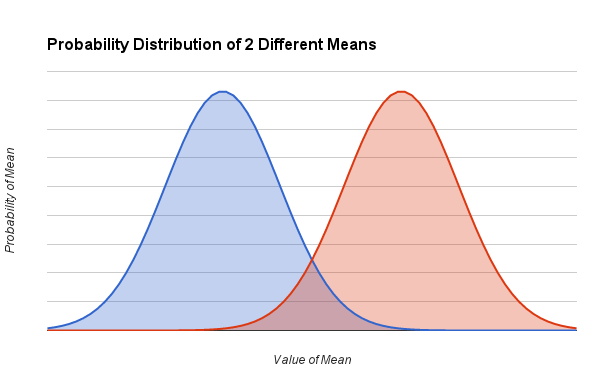
It is impossible to separate exactly what comes from genetics and what comes from environment, especially because of the proven plasticity of the human brain during early mental development. Yet these discrete differences in our brains make us “conservatives” and “liberals” think and act the way we do. Some of us far more susceptible to worrying about fearful and disgusting things, while many are less so. Likely, people fall on a bell curve when it comes to this (picture above—in this case two overlapping bell curves). A genetic proclivity from birth grants each of us a naturally more conservative or liberal mind along a spectrum, but environment plays a huge part in our development as well. An insular, fear-driven worldview can certainly be learned. To a naturally conservative mind already predisposed to worrying about things a little more, this type of worldview could come as positive reinforcement—the world is crazy, so we need to stick with what we know. Conservative minds want things in order, everything clearly labeled. This explains why the staunchest conservatives of every society want to stick so closely to the long-prescribed doctrines, religious or otherwise: they provide strict frameworks for how to view life. “Free market economics” is a religious doctrine (and another one of those garbled vocabulary words), just like “socialism” is (ditto)…just like Rastafarianism…just like Islam… All of these doctrinal frameworks play into the essence of tribalism itself. Religions are all about explaining the world to you… “This is what we believe in.” “This is how it is.” And you’re not supposed to question things, God forbid. You’re supposed to have faith and obey. Remember: if you take a bite out of the fruit from the tree of knowledge, you and your man get your asses kicked out of Eden…
 MichelangeloSistene Chapel ceiling, 1510 ADRome, Earth
Nature versus Nurture in Conservative Authoritarianism Thoughtlessly clinging to various “religions” can be a reason why so many people are acting so crazy, but this is not the only thing at play. The strictly bounded, hierarchical frameworks for life that doctrinal thinking provides is probably a large part of what we are seeing: naturally conservative-minded people incubated in these bubbles where the news entertainment and politics are largely driven by anxiety and fear. This is where nature and nurture meets. America’s most conservative-minded people are the most loyal tribes because they are naturally that way. And like all of us, their minds are made by and reinforced by the environments they’re placed in. A constant, 20+ year drip of a cynical, 24/7, for-profit “conservative” “news” cycle which leverages fear and anger has manifested into an extremely paranoid and angry right wing, with meanings for words and ideas very different from their original meanings.
Donald Trump’s finger-pointing messaging is the most atavistically tribal of all, his simple ideas based on the fear of other groups (Muslims, Mexicans, and China), the fear of economic loss, and of deep nostalgia (“Let’s make American great again”). Trump’s most fervent supporters are a tribe of America’s most conservative-minded people. They certainly seem to be driven by fear more than the rest of us… They are loyal to his many, many faults. And more than anything else they’re scared, made worse by the “news entertainment” they’re choosing to watch. Now let’s juxtapose this against the most famous quote of one of our most revered presidents at the height of the Great Depression:
This is preeminently the time to speak the truth, the whole truth, frankly and boldly. Nor need we shrink from honestly facing conditions in our country today. This great Nation will endure as it has endure, will revive and will prosper. So, first of all, let me assert my firm belief that the only thing we have to fear is fear itself - nameless, unreasoning, unjustified terror which paralyzes needed efforts to convert retreat into advance. In every dark hour of our national life a leadership of frankness and vigor has met with that understanding and support of the people themselves which is essential to victory.
Franklin Delano RooseveltFirst Inaugural Address, March 4, 1933 ADWashington DC, USA, Earth
All tribes have a reactive far right. We always have. The Trump tribe, a smaller tribe in our much larger American tribe, seems rock solid, buttressed by such vehemently loyal support, yet despite this perceived strength (and media coverage) all the people who have voted for Trump are only a small percentage of the American people (he’s got 7.5 million votes in the Republican primary). Places like Vox are already identifying who and what many of these voters are: true authoritarians. These voters are our most naturally reactive Americans. They have been and continue to be affected by a sensationalist, fear-laden media and political environment, and right now their shared worldview is demanding a strong, outside-of-the-corrupt-government leader above all else. And we are right to be afraid of the angry, violent undercurrent demonstrated by the Trump candidacy if we study history at all. An authoritarian worldview is extremely dangerous. “Shut up! I’m the best! We’re the best! Listen to me! This is the answer!” is the exact opposite of “It’s complicated,” I’m not sure,” and “think for yourself.”
Divide and rule, the politician cries; Unite and lead, is watchword of the wise.
Johann Wolfgang von GoetheGedichte, 1770 AD Strasbourg, German Federation, Earth
The Path to ChangeChanging pretty much anything seems like a colossal task right now, given how convoluted and shitty everything seems to be getting. Our feckless “leaders” are in the worst bubbles of them all, living in realities separate and apart from us common plebes—reading about how great the economy is in the New York Times while flying on private jets 20,000 feet above the wreckage. Yet history consistently and depressingly shows that fear-driven, xenophobic, reactionary movements during economically depressed, tumultuous times can bring about very, very bad things. Our most conservative-minded brothers and sisters are rabidly loyal and want order above all else—and honestly don’t care what you think. They are doing what they think is right based on the world as they see it, just like anybody else. Their politics are based on not only different words and ideas, but in entirely different perceptions of the world. And while I can certainly see and feel the growing canyon between me and my most conservative friends and family members, as our words and ideas grow further and further apart, I don’t see an answer to the root of the problem. We purposefully put ourselves into these highly-segmented “news” and thought bubbles, much of it due to natural tribal tendencies.
Thomas Paine said "to argue with a man who had renounced the use and authority of reason, and whose philosophy consists in holding humanity in contempt, is like administering medicine to the dead..." I talked about this in the beginning—when talking to some of my most conservative friends and family and politics inevitably comes up, first there’s this glazed eye thing and then very soon we’re spouting meaningless vocabulary words at each other that may as well be gibberish—no longer fuller communicating with a meeting of minds. History and now science show that there’s a certain percentage of every population who are the most conservative-minded folks: those with the most rigid, traditional, we-must-follow-the-rules viewpoints—and this is across whatever social construct we’re looking it, whether at a school or in a church, in a political party or in a country. Frankly, and with WAY too much time and effort, I’ve learned that there’s really no arguing with some of these people. Our words and ideas mean entirely different things, so communication is nearly impossible—and completely filled with digressions as we try to work through it.
The unchecked rise of 24/7, shock and fear-driven for-profit news entertainment is a big reason why Thanksgiving has gotten so painful for so many of us. I have some friends and family who are absolutely wonderful, thoughtful, caring people, yet it is impossible to talk to them about politics. And in many ways, it seems to be an impossible divide… and way too late. Not only do our words now mean entirely different things, but they’re structured around different environments which stress different ideas. Yet human beings are supposedly the smartest creature that the good Lord has ever created, and one of our greatest gifts is empathy, the ability to try to see through the eyes of other people to try to gain their perspective. Okay, so—Uncle Jim Bob may be unbearable to argue with, but what about little cousin Jimmy? He’s only 11, and he’s been listening to this crap his whole life—surrounded by it, in fact—and maybe he’s finally starting to question it as his young world quickly opens up... And maybe Aunt Bee is secretly on your side too, having heard and watched James Robert the last 30 years and is sick and tired of it.
So, don’t give up. We’re probably not going to change the minds of many of the people already in the Trump camp. Some people aren’t worth arguing with—but that doesn’t mean you should shut up. Our compassionate, understanding words may be aimed at them… but their real impact is on everyone else listening. Someof us are extremely scared and very confused right now—constantly barraged by a media and political establishment keeping us scared and very confused. The good news is that younger people may be a little more immune to our for-profit corporate “news” media predicament—they certainly don’t watch television for their news, though they’re not immune to the self-selected intellectual ghettos on the Internet. The bad news is that many older people still rely on this for-profit corporate media system for their “news,” and they vote in droves. But they’re our friends and family, and they may listen to us because they love us.
Understanding why and how we are different is paramount to coming together. Always keep in mind how and why we’re of different minds. More than anything, it is important to understand that liberals and conservatives don’t just have different opinions about things. Conservative and liberal minds are literally wired to see the world differently. We are differently thinking people who naturally value different things, which makes us think and act differently as we react to this crazy world. These innate differences can manifest in very different realities, with different stimuli and motivations causing different reactions. When we argue we’re not just disagreeing…we’re in different mindsets acting with different perspectives.
Your perspective, which includes your values, comes from how you are and how you grew up, and then you’re surroundings; from nature and nurture both. Yet your perspective is also within your control—you can chose to act a certain way, if you really want to. As conscious, thinking beings, with deliberate thought and intention we can pull ourselves out of our natural tribal mindsets—we can rise above it, if we choose. I believe the best way to do that is to always keep in mind the (paraphrased) words of the most influential thinker of the American Revolution, Thomas Paine: My country is the world and my religion is to do good. Consciously thinking about these words resets your mind to the largest tribe there is: the people of Earth. And once your mind is centered there, hovering there on the global level trying to do good for everybody, the finger-pointing games going on far below seem petty as hell.
And listen here. I know that this piece is going to raise some hackles. I will go further and predict the entirely brain-dead comment I’m going to get from that last paragraph ,specifically: “if you hate American so much, why don’t you move?” Thinking about the world first precludes nothing. I’m still a proud American (which is more of a social construct than anything else…), just like I’m a proud New Yorker. And I’m still loyal to my family and friends above everyone else in this world when push comes to shove. Yet an open perspective, understanding that things are far bigger than little ole me, requires me to try to look at the biggest possible picture first. An open perspective shows me that avarice—GREED—is the predominant enemy of the people of America, not each other. Ditto for the rest of the world.
In the end we can only control ourselves. YOU can choose to rise above tribalism—if you want to. Yet it’s also important to realize that some people don’t want to, at all. Finger-pointing and following is easy. Learning to think for yourself is difficult. We can rise above tribalism, bridging the gaps between the broken words and fractured ideas—but it starts with each of us. Use compassion and logic and understanding on your family and friends and know that you can help change the world.
Nations! What are nations? Tartars! And Huns! And Chinamen!Like insects they swarm. The historian strives in vain to make them memorable. It is for want of a man that there are so many men. It is individuals that populate the world.
Henry David ThoreauJournal Entry for May 1, 1851 ADConcord, USA, Earth
George Orwell complaining about the same stuff 60 years ago: http://www.orwell.ru/library/essays/politics/english/e_polit
January 21, 2016
Perspective
The universe is change; Our life is what our thoughts make it.
Marcus Aurelius Meditations, Book IV Chapter III, 170 AD Sirmium, Roman Empire, Earth
“Me” Perspective is everything.
Perspective springs from consciousness, the act of being self-aware. Indeed, one of the most basic tests for consciousness is called the Mirror Test. The test is simple enough: hold a mirror up in front of an animal. Does the animal try to greet its image? Does it attack it? Or does it run away in fear? Or, does the animal recognize its reflection as an image of itself? Recognizing that it’s “me” in the mirror is not something we adult Homo sapiens have to actively think about, yet our babies can’t pass this test until about 18 months old. But just like us, the other great apes (chimps, bonobos, orangutans, and gorillas) also recognize the fact that that’s “me” staring back in the mirror, as can rhesus macaques, dolphins, orcas, elephants (probably), and magpies. [It's also interesting to ponder the fact that self-awareness is believed to come from the neo-cortex region of the brain, which birds, non-mammalian descendants of dinosaurs, don't have. That means that magpies have developed a whole new brain pathway to consciousness, a very interesting case of convergent evolution. And I also wouldn't count out consciousness in animals that have failed the Mirror Test: like dogs, which as everybody knows rely heavily on their noses, not their eyes, to help decipher the world happening around them].
Along with self-awareness also comes the creation of the conscious mind; the state of awareness which allows us to understand that we are generally in control of these fine bodies of ours, able to will ourselves to perform all sorts of profoundly miraculous things. The conscious mind is opposed to the unconscious, although the line between the two is blurry at best, for the unconscious mind is mostly primal instinct. Think about a squirrel for a minute—scurrying around this very dangerous world without any real active train of thought. It’s all reaction all of the time; essentially ruled by their senses, which compel them to perform all sorts of generally prescribed actions (RUN! Hide these nuts! Freeze. RUN! Hey… go have sex with that lady squirrel! Then RUN! Freeze. Ooh… let’s chew the heads off all the sunflowers in EXO’s garden! Run!!!). The squirrel body does exactly what the unconscious control of the squirrel brain tells it to do based on these deeply hardwired instincts—instincts manifested from genes which have been honed from millions and millions of years’ worth of evolutionary pressures on squirrels and their kin. And like the squirrel brain demonstrates, the subconscious brain is all about survival.
The human mind is designed to interpret a constant flow of information coming in from all around us without consciously having to think about any of it. This is mostly handled by the subconscious. Our primal brains rule us in many ways—tempting us with our various hungers for comfort, sex, and dominance. It’s the unconscious mind that shocks us with adrenaline when we suddenly become afraid, and it’s why we fight like the vicious, murderous animals we are when we’re pushed to do so. You can see the work of the subconscious in a flash of anger, or pain, but you can also see it in a heartfelt smile. Indeed, much of human communication occurs on a subliminal level of awareness, laying right on the border of what is conscious and what is not. This is how a poker pro cleans up at a table of amateurs, reading excited faces and bodies filled with all sorts of revealing tells. It’s how you can learn to see when someone is lying to you. Yet the underlying fact is that we conscious beings can choose to override most of the things our primal squirrel brains are constantly telling us to do. We can decide not to run. Or not to fight. Or not to fuck (a stupid choice in most instances). We can control these fine bodies of ours to do what we want. This is why perspective is so important.
What I need is perspective. The illusion of depth, created by a frame, the arrangement of shapes on a flat surface. Perspective is necessary. Otherwise there are only two dimensions. Otherwise you live with your face squashed up against a wall, everything a huge foreground of details, close-ups, hairs, the weave of the bedsheet, the molecules of the face. Your own skin like a map, a diagram of futility, crisscrossed with tiny roads that lead nowhere. Otherwise you live in the moment. Which is not where I want to be.
Margaret Atwood The Handmaid's Tale, 1985 AD Toronto, Canada, Earth
“We” If consciousness is the understanding that you’re a being able to control your own actions, perspective is the filter with which we consciously process and perceive information as it comes in. And so much of our perspective is imposed on us at first; from our parents at home, from our teachers at school, from religion, television, from watching all of the people of our society all around us, much of it prescribing very specific and conventional ways to think and act. Yet perspective is a large part of the output as well, for our perspective determines how we react to the world. This is why perspective is everything: it permeates every conscious decision that we make, not only how information comes in as potential facts, but how they come out in our actions to them.
Now as a man is like this or like that, according as he acts and according as he behaves,
so will he be; a man of good acts will become good,
a man of bad acts, bad; he becomes pure by pure deeds,
bad by bad deeds;
And here they say that a person consists of desires, and as is his desire,
so is his will; and as is his will,
so is his deed; and whatever deed he does, that he will reap.
Brihadaranyaka Upanishad 7th Century BC (9,000 years ago) Vedic, India, Earth
The greatest human achievements have arisen from long term acts of consciousness; times where we have been able to collectively over-ride our squirrel brains to think beyond our puny selves, organizing together to create much grander things. This is how civilizations are formed, centered on a shared destiny. Consciousness is how a species of Earth monkey gets to the moon and back! It’s how great libraries are built, and wondrous cathedrals, and Grand Central Stations. But it’s also why we hold doors open for others. It’s why we give up our seats to old people on the subway and still idiotically rush to say “bless you!” whenever someone else sneezes. Consciousness is The Golden Rule and Karma (which are the same thing). But understanding that you are a conscious being able to will your body to perform actions beneficial to others is one thing. A next step is recognizing moral frameworks like Karma and The Golden Rule (or Socialism, or Rastafarianism, or Vegetarianism…) for what they really are, not just as wisdom but as particular lenses through which you view and experience the world around you. Perspective is everything because we’re constantly using it. That's because life never stops.
It’s an honest assessment when I tell you that looking back I feel like I was a squirrel for a good portion of my younger years: scurrying around this frenetic world on a much lower level of self-awareness, ostensibly making conscious decisions but not really able to understand the world and thus incapable of truly acting conscientiously. I am a much better man today because I’ve learned to see the world unfolding around me more clearly. I would call this process enlightenment, and here’s the point: with the right perspective, anyone can get there. It all depends on your state of mind.
All things are ready if our minds be so.
William Shakespeare Henry V, 1599 AD England, Earth
Getting Beyond “Me” Though we try very hard, things—this world and how it works—are not meant to be understood. Our brains struggle to piece together meaning through all that we hear and see. Our perspective, how we see the world, influences not only how we view things but also how we react to them, and our conscious intent can alter this perspective. If you are seeing the world clearly and act with the right intentions, then the right words and the right actions and the right lifestyle all naturally follow. Buddhists call this the Noble Eightfold Path, but it’s really just combining wisdom and experience with the right frame of mind. It’s not easy, but we can all change for the better if we want. And it all comes from perspective.
You become. It takes a long time. That's why it doesn't happen often to people who break easily, or have sharp edges, or who have to be carefully kept.
Margery Williams The Velveteen Rabbit, 1922 AD USA, Earth
Keeping my own life as an example, I can tell you that there are many things that can help change one’s perspective. Life experience certainly begets wisdom—as long as you don’t let it beat you. The most profound period of my life was the time after my father’s sudden death. Obviously it was plain terrible all around, yet my dad’s demise created more than a few previously unattainable insights into life which would never have occurred to me otherwise. A prime example, before my eyes the person who was my mother became a very broken woman whom I needed to take care of that instant. The worst career failure of my life also provided a heavy dose of perspective—and it was far beyond my control, which was part of the lesson. The financial meltdown in 2009 wiped out my first law firm job, plunging a newly minted king of lower Manhattan into a prolonged misery of joblessness and hopelessness (and then Grandma got cancer). Yet this didn’t break me, either. I took the beating from life while reading stacks of books, my eyes a little more open to the world while my brain desperately tried to play catch-up.
But there are other ways to gain perspective beyond the School of Hard Knocks. Perspective can certainly be gained from traveling, seeing how other people live, whether it’s around your state or around the world. Traveling beyond the confines of the Earth has revealed even greater shifts in awareness, as astronauts living in the International Space Station often report a life-changing shift in perspective upon seeing our planet from orbit. There is also inner travel, new perspective coming from deep meditation; or through the use of psychedelic substances, but great risk can certainly come with this approach.
An Economical Alternative? Traveling is a phenomenal experience that can certainly change your perspective, but it’s costly, and doing it right demands a lot of time as well as money. Most psychedelics are illegal (it’s worth asking why?), and can certainly be dangerous since you’re essentially performing a non-reversible experiment on your brain. The hard truth is that any good life experience worth a damn has a fairly deep cost. Whether it’s earning a degree, getting a divorce, bringing a new child into this world or losing a dear loved one, going through difficult and challenging times can greatly alter one’s perspective. But do you want to know a secret, one of the greatest life-hacks of all? What if I told you that there was a pretty easy way to gain extremely worthwhile experience, and on top of that it was relatively inexpensive and entirely safe, with the added ability to take you pretty much anywhere you wanted to go in the Universe? Do you know where I’m going with this??? Because you’re doing it right now.
Think about how reading works for a second. As you read a piece of fiction you cast these words into your brain. Your brain puts the words together, forming images in your mind. The crazy part is the fact that our brains actively make memories of what we’re reading as we’re imagining them! Maybe these memories aren’t as profound as a death in your family, or seeing war first hand, but they’re memories nevertheless. Books are experiences, you see. Their words are crafted by their authors, based on that person’s collective experiences and intent. Yet it’s the reader’s imagination that casts the characters and settings and ideas into this brand new creation, which springs to life in their mind and their mind alone. You can grow up with Harry Potter and Scout Finch and Paul Atreides, experiencing their worlds along with them through the lens of your own mind, with its unique perspective, with all of your particular life experiences. Reading these character’s stories allows us to see through their eyes, sometimes even read their thoughts. We gain knowledge and insight just as they do. Good books leave an impact on us, making impressions in our minds. Great books, and their great characters, may stick with us forever; cherished memories which we’ve totally imagined, cast across a veritable galaxy of otherwise impossible experiences.
This is why we have to read! Reading is an excellent way to gain entrance to all sorts of perspectives, all from the safety of your mind. If you don’t believe me look at this, and this, and this—or perhaps the depressing inverse if you’d like.
The conversation of perspective could certainly go on from here: For where there is no vision, the people perish. A glaring problem is the fact that so many adults seem to have settled on certain perspectives at some point in their lives and mindlessly stick to them pretty much no matter what. If you put yourself in these discretely labeled boxes, everything is easy—all you have to do is listen to what other people tell you to do without having to think too critically about it (that is discouraged, in fact). If you say that you’re a Catholic, or a Jew, or a Muslim, or a Southern Baptist, and then so you believe X, basically what the leader(s) of your particular sect says X is. But this is the exact same with Conservatives and Democrats, free market capitalists and anarchists. These are all labels that people apply to themselves that obviate the need for further conscious thought in the matter. And in terms of the religious specifically? Their constant naked hypocrisies show us how badly so many of them are missing the point. The Golden Rule—love personified as taught by Jesus H. Christ—isn’t a box you check so you don’t have to think anymore… it’s a perspective. It’s a mindset that you always need to be thinking about as you’re constantly evaluating your actions in this life. Yet, working towards a clear perspective requires a constant awareness of one’s own view first and foremost. We can’t really control others, after all. We can certainly influence them though. We can use all of our experiences, real or entirely imagined through literature, and combined with the right perspective we can show each other how to be better people. It all begins with the right state of mind.
Stay on the path my friend!
EXO
January 21, 2016 AD
NYC, USA, Earth
p.s. I learned quite a lot from the book Subliminal: How Your Unconscious Mind Rules Your Behavior by Leonard Mlodinow. A long time before that I read The Dragons of Eden by Carl Sagan.
You should also check out this great piece by Neil Gaiman, very much on topic.
Marcus Aurelius Meditations, Book IV Chapter III, 170 AD Sirmium, Roman Empire, Earth
“Me” Perspective is everything.
Perspective springs from consciousness, the act of being self-aware. Indeed, one of the most basic tests for consciousness is called the Mirror Test. The test is simple enough: hold a mirror up in front of an animal. Does the animal try to greet its image? Does it attack it? Or does it run away in fear? Or, does the animal recognize its reflection as an image of itself? Recognizing that it’s “me” in the mirror is not something we adult Homo sapiens have to actively think about, yet our babies can’t pass this test until about 18 months old. But just like us, the other great apes (chimps, bonobos, orangutans, and gorillas) also recognize the fact that that’s “me” staring back in the mirror, as can rhesus macaques, dolphins, orcas, elephants (probably), and magpies. [It's also interesting to ponder the fact that self-awareness is believed to come from the neo-cortex region of the brain, which birds, non-mammalian descendants of dinosaurs, don't have. That means that magpies have developed a whole new brain pathway to consciousness, a very interesting case of convergent evolution. And I also wouldn't count out consciousness in animals that have failed the Mirror Test: like dogs, which as everybody knows rely heavily on their noses, not their eyes, to help decipher the world happening around them].
Along with self-awareness also comes the creation of the conscious mind; the state of awareness which allows us to understand that we are generally in control of these fine bodies of ours, able to will ourselves to perform all sorts of profoundly miraculous things. The conscious mind is opposed to the unconscious, although the line between the two is blurry at best, for the unconscious mind is mostly primal instinct. Think about a squirrel for a minute—scurrying around this very dangerous world without any real active train of thought. It’s all reaction all of the time; essentially ruled by their senses, which compel them to perform all sorts of generally prescribed actions (RUN! Hide these nuts! Freeze. RUN! Hey… go have sex with that lady squirrel! Then RUN! Freeze. Ooh… let’s chew the heads off all the sunflowers in EXO’s garden! Run!!!). The squirrel body does exactly what the unconscious control of the squirrel brain tells it to do based on these deeply hardwired instincts—instincts manifested from genes which have been honed from millions and millions of years’ worth of evolutionary pressures on squirrels and their kin. And like the squirrel brain demonstrates, the subconscious brain is all about survival.
The human mind is designed to interpret a constant flow of information coming in from all around us without consciously having to think about any of it. This is mostly handled by the subconscious. Our primal brains rule us in many ways—tempting us with our various hungers for comfort, sex, and dominance. It’s the unconscious mind that shocks us with adrenaline when we suddenly become afraid, and it’s why we fight like the vicious, murderous animals we are when we’re pushed to do so. You can see the work of the subconscious in a flash of anger, or pain, but you can also see it in a heartfelt smile. Indeed, much of human communication occurs on a subliminal level of awareness, laying right on the border of what is conscious and what is not. This is how a poker pro cleans up at a table of amateurs, reading excited faces and bodies filled with all sorts of revealing tells. It’s how you can learn to see when someone is lying to you. Yet the underlying fact is that we conscious beings can choose to override most of the things our primal squirrel brains are constantly telling us to do. We can decide not to run. Or not to fight. Or not to fuck (a stupid choice in most instances). We can control these fine bodies of ours to do what we want. This is why perspective is so important.
What I need is perspective. The illusion of depth, created by a frame, the arrangement of shapes on a flat surface. Perspective is necessary. Otherwise there are only two dimensions. Otherwise you live with your face squashed up against a wall, everything a huge foreground of details, close-ups, hairs, the weave of the bedsheet, the molecules of the face. Your own skin like a map, a diagram of futility, crisscrossed with tiny roads that lead nowhere. Otherwise you live in the moment. Which is not where I want to be.
Margaret Atwood The Handmaid's Tale, 1985 AD Toronto, Canada, Earth
“We” If consciousness is the understanding that you’re a being able to control your own actions, perspective is the filter with which we consciously process and perceive information as it comes in. And so much of our perspective is imposed on us at first; from our parents at home, from our teachers at school, from religion, television, from watching all of the people of our society all around us, much of it prescribing very specific and conventional ways to think and act. Yet perspective is a large part of the output as well, for our perspective determines how we react to the world. This is why perspective is everything: it permeates every conscious decision that we make, not only how information comes in as potential facts, but how they come out in our actions to them.
Now as a man is like this or like that, according as he acts and according as he behaves,
so will he be; a man of good acts will become good,
a man of bad acts, bad; he becomes pure by pure deeds,
bad by bad deeds;
And here they say that a person consists of desires, and as is his desire,
so is his will; and as is his will,
so is his deed; and whatever deed he does, that he will reap.
Brihadaranyaka Upanishad 7th Century BC (9,000 years ago) Vedic, India, Earth
The greatest human achievements have arisen from long term acts of consciousness; times where we have been able to collectively over-ride our squirrel brains to think beyond our puny selves, organizing together to create much grander things. This is how civilizations are formed, centered on a shared destiny. Consciousness is how a species of Earth monkey gets to the moon and back! It’s how great libraries are built, and wondrous cathedrals, and Grand Central Stations. But it’s also why we hold doors open for others. It’s why we give up our seats to old people on the subway and still idiotically rush to say “bless you!” whenever someone else sneezes. Consciousness is The Golden Rule and Karma (which are the same thing). But understanding that you are a conscious being able to will your body to perform actions beneficial to others is one thing. A next step is recognizing moral frameworks like Karma and The Golden Rule (or Socialism, or Rastafarianism, or Vegetarianism…) for what they really are, not just as wisdom but as particular lenses through which you view and experience the world around you. Perspective is everything because we’re constantly using it. That's because life never stops.
It’s an honest assessment when I tell you that looking back I feel like I was a squirrel for a good portion of my younger years: scurrying around this frenetic world on a much lower level of self-awareness, ostensibly making conscious decisions but not really able to understand the world and thus incapable of truly acting conscientiously. I am a much better man today because I’ve learned to see the world unfolding around me more clearly. I would call this process enlightenment, and here’s the point: with the right perspective, anyone can get there. It all depends on your state of mind.
All things are ready if our minds be so.
William Shakespeare Henry V, 1599 AD England, Earth
Getting Beyond “Me” Though we try very hard, things—this world and how it works—are not meant to be understood. Our brains struggle to piece together meaning through all that we hear and see. Our perspective, how we see the world, influences not only how we view things but also how we react to them, and our conscious intent can alter this perspective. If you are seeing the world clearly and act with the right intentions, then the right words and the right actions and the right lifestyle all naturally follow. Buddhists call this the Noble Eightfold Path, but it’s really just combining wisdom and experience with the right frame of mind. It’s not easy, but we can all change for the better if we want. And it all comes from perspective.
You become. It takes a long time. That's why it doesn't happen often to people who break easily, or have sharp edges, or who have to be carefully kept.
Margery Williams The Velveteen Rabbit, 1922 AD USA, Earth
Keeping my own life as an example, I can tell you that there are many things that can help change one’s perspective. Life experience certainly begets wisdom—as long as you don’t let it beat you. The most profound period of my life was the time after my father’s sudden death. Obviously it was plain terrible all around, yet my dad’s demise created more than a few previously unattainable insights into life which would never have occurred to me otherwise. A prime example, before my eyes the person who was my mother became a very broken woman whom I needed to take care of that instant. The worst career failure of my life also provided a heavy dose of perspective—and it was far beyond my control, which was part of the lesson. The financial meltdown in 2009 wiped out my first law firm job, plunging a newly minted king of lower Manhattan into a prolonged misery of joblessness and hopelessness (and then Grandma got cancer). Yet this didn’t break me, either. I took the beating from life while reading stacks of books, my eyes a little more open to the world while my brain desperately tried to play catch-up.
But there are other ways to gain perspective beyond the School of Hard Knocks. Perspective can certainly be gained from traveling, seeing how other people live, whether it’s around your state or around the world. Traveling beyond the confines of the Earth has revealed even greater shifts in awareness, as astronauts living in the International Space Station often report a life-changing shift in perspective upon seeing our planet from orbit. There is also inner travel, new perspective coming from deep meditation; or through the use of psychedelic substances, but great risk can certainly come with this approach.
An Economical Alternative? Traveling is a phenomenal experience that can certainly change your perspective, but it’s costly, and doing it right demands a lot of time as well as money. Most psychedelics are illegal (it’s worth asking why?), and can certainly be dangerous since you’re essentially performing a non-reversible experiment on your brain. The hard truth is that any good life experience worth a damn has a fairly deep cost. Whether it’s earning a degree, getting a divorce, bringing a new child into this world or losing a dear loved one, going through difficult and challenging times can greatly alter one’s perspective. But do you want to know a secret, one of the greatest life-hacks of all? What if I told you that there was a pretty easy way to gain extremely worthwhile experience, and on top of that it was relatively inexpensive and entirely safe, with the added ability to take you pretty much anywhere you wanted to go in the Universe? Do you know where I’m going with this??? Because you’re doing it right now.
Think about how reading works for a second. As you read a piece of fiction you cast these words into your brain. Your brain puts the words together, forming images in your mind. The crazy part is the fact that our brains actively make memories of what we’re reading as we’re imagining them! Maybe these memories aren’t as profound as a death in your family, or seeing war first hand, but they’re memories nevertheless. Books are experiences, you see. Their words are crafted by their authors, based on that person’s collective experiences and intent. Yet it’s the reader’s imagination that casts the characters and settings and ideas into this brand new creation, which springs to life in their mind and their mind alone. You can grow up with Harry Potter and Scout Finch and Paul Atreides, experiencing their worlds along with them through the lens of your own mind, with its unique perspective, with all of your particular life experiences. Reading these character’s stories allows us to see through their eyes, sometimes even read their thoughts. We gain knowledge and insight just as they do. Good books leave an impact on us, making impressions in our minds. Great books, and their great characters, may stick with us forever; cherished memories which we’ve totally imagined, cast across a veritable galaxy of otherwise impossible experiences.
This is why we have to read! Reading is an excellent way to gain entrance to all sorts of perspectives, all from the safety of your mind. If you don’t believe me look at this, and this, and this—or perhaps the depressing inverse if you’d like.
The conversation of perspective could certainly go on from here: For where there is no vision, the people perish. A glaring problem is the fact that so many adults seem to have settled on certain perspectives at some point in their lives and mindlessly stick to them pretty much no matter what. If you put yourself in these discretely labeled boxes, everything is easy—all you have to do is listen to what other people tell you to do without having to think too critically about it (that is discouraged, in fact). If you say that you’re a Catholic, or a Jew, or a Muslim, or a Southern Baptist, and then so you believe X, basically what the leader(s) of your particular sect says X is. But this is the exact same with Conservatives and Democrats, free market capitalists and anarchists. These are all labels that people apply to themselves that obviate the need for further conscious thought in the matter. And in terms of the religious specifically? Their constant naked hypocrisies show us how badly so many of them are missing the point. The Golden Rule—love personified as taught by Jesus H. Christ—isn’t a box you check so you don’t have to think anymore… it’s a perspective. It’s a mindset that you always need to be thinking about as you’re constantly evaluating your actions in this life. Yet, working towards a clear perspective requires a constant awareness of one’s own view first and foremost. We can’t really control others, after all. We can certainly influence them though. We can use all of our experiences, real or entirely imagined through literature, and combined with the right perspective we can show each other how to be better people. It all begins with the right state of mind.
Stay on the path my friend!
EXO
January 21, 2016 AD
NYC, USA, Earth
p.s. I learned quite a lot from the book Subliminal: How Your Unconscious Mind Rules Your Behavior by Leonard Mlodinow. A long time before that I read The Dragons of Eden by Carl Sagan.
You should also check out this great piece by Neil Gaiman, very much on topic.
November 23, 2015
Why EXO?
“I AM WHAT I AM.”
GODThe BibleExodus 3:14
The act of writing is an act of creation. An author writes from the sum of his or her experiences, not only as a particular creature of a particular culture in a particular time, but also from the experiences they’ve absorbed through reading the words of all the other writers they’ve read. Yet the act of reading is an act of creation too. Each time a piece of fiction is read an entirely new thing is created: the writer's words are filtered through the mind’s eye of this new reader, who interprets the words and underlying ideas as they will, a particular creature of a particular culture in a particular time, with their own unique experiences. Authorship clashes with ownership when it comes to residence in the mind. The ownership of this newly created thing, made up of all sorts of ideas and mixed with all sorts of experiences, is really the new readers alone. The only place it exists is within the mind that creates it, and it will stay for a long time if it’s worthwhile, living with the reader as a genuine, valuable experience of their own.
Note that none of this has anything to do with image, beyond the formation of letters into sentences on the page. The weight of a piece of fiction comes from the supremacy of the ideas inside, not the appearance of the writer. The durability lies within the strength of the message. And the craziest part is that it’s all in our heads.
For the great majority of mankind are satisfied with appearances as though they were realities, and are often more influenced by the things that seem than by those that are.
Niccolo MachiavelliThe Prince, 1513 ADFlorence, The Republic of Florence, Earth
We live in a world of image over substance. It’s a world of manipulated appearances; an overly managed public spectacle of stunningly wide range not only wired directly into the televisions in our living rooms, but intertwined in just about everything we see—from the photoshopped women staring at us from every checkout line everywhere, to the stuff we’re looking at on our now hand-held phone/computers. Such an onslaught! And on a daily basis, hundreds and hundreds if not thousands and thousands of messages. Yet what do we learn that is useful? Not much. It’s frequency over amplitude, message without meaning. All of these forces are conspiring for our eyes and our attention—our precious time on this very planet—simply because money is to be made from it.
People constantly want to convince us of things. . . The media wants to sell us to their advertisers, who try to coerce us into buying this or that. Celebrities and corporations alike want us to love them, everyone and everything concerned with Brand®. Image is prime, in all of these messages that bound all around us: in the glitz and glamour of our beautiful people, in the scary words of our ugly politicians, in our ADHD for-profit news cycle; all of it swirling around planet Earth at the speed of light screaming out for our attention. This stuff—almost all of it based on a set of carefully curated images—calls to us from all possible angles, yet if you give just about any of it even one iota of thought you realize how worthless it really is. And while there’s plenty of thought going into all of this stuff—the behavioral psychology behind pushing us to think a certain way, to like this person and hate the other, or to want to buy this or that—not much thought comes out. That’s because there’s so little actual substance. Making it worse, we’ve been trained to love the spectacle: political pseudo-events where the politicians insult each other but say nothing of substance, the self-celebratory award shows for just about anything you can think of amidst the rest of the lineup of must-watch TV—and all of it now available 24/7, streamed into the palm of your hand (as long as you have phone service)! Yet the celebration of image over substance extends even deeper than the spectacle of television, our modern equivalent of the Roman circus, beyond the obligatory (and seemingly rapidly proliferating) Hallmark™ holidays that fill up our social calendars. In an era of profound narcissism, “the cult of the self”—Greed is Good, Yolo and selfie sticks—we’ve become hedonists. Yet it's a strange juxtaposition. We see all of this glitz and glamour everywhere we look, the obscene pageantry of flaunted wealth and excess all around us, but most of us plebes can also feel the creeping dread that something is just wrong here—that the land is covered in a darkness that can be felt—yet more and more people are looking at themselves first. We’re self-obsessed ostriches, burying our heads in the desert sands of Tweets and Facebook updates and fantasy sports and “news” tailored just for us. And even if you do manage to pull your head out of your ass, stand up, and try to figure out this crazy fucking world, the truth is hard to find in a place where everything is so manufactured and language so distorted. It’s very hard to know what's what. Indeed where does one even start?
It should … be borne in mind, that the enforcement of public opinion depends on our appreciation of the approbation and disapprobation of others; and this appreciation is founded on our sympathy, which it can hardly be doubted was originally developed through natural selection as one of the most important elements of the social instincts.
Charles DarwinThe Descent of Man, 1871 ADKent, England, Earth
Charles Darwin’s true genius was in being able to see how a species could adapt to its environment over the long course of time. This required a shift in perception coupled with a very long view—not something we human animals are necessarily wired to do. Yet the process of evolution is the very same with societies, too. We, our group of human beings living together in a (supposedly) mutually beneficial society, changes over time as a result of everything going on around us: from the conditions of our environment and the food that we eat, to the images set forth for us to watch and admire and thus become. The fabric and nature of a society can change over time, depending on how the people react to the conditions imposed on them. The Dark Ages was a closed Europe controlled with ignorance and fear, while the High Renaissance was a blossoming world of curiosity and wonder. The philosophy of abundance underlying the Roaring Twenties in the USA was quickly wiped away by the hardness of the Great Depression and atrocities of World War II. The ocean of human consciousness seems to move in tides; the civics and ethics and values and traditions of our tribes constantly sweeping back and forth, back and forth, in the constant battle between darkness and the light. This is because we forget the lessons of the past.
In terms of a Darwinian analysis, the most significant recent development in human culture is the extent that technology has influenced how we can communicate with each other. It’s a relatively open world when it comes to information, and that is a very good thing. Yet the largest mass of today’s global communications are corporately funded, celebrity fueled advertisements cranking out a huge part of what we consider our culture, almost all of it designed to steal our time and our money (which really is our time). And while it’s easy to become nostalgic—to long for times past—that can a dangerous thing because it’s so easy to do. Yet with that being said, most would not deny that a drastic sociological change has taken place in the matter of a generation or two—my generation, and all those behind me. In the relative blink of an eye from an anthropological stand point, we’ve grown far more narcissistic than we’ve ever been. Is this because of our technology? Is it because of a changing society? Whatever the case, we’re certainly far more distracted, living in several different fantasy worlds, replete with magical thinking, and seemingly incapable of facing any number of realities.
We are powerfully imprisoned in these Dark Agessimply by the terms in which we have been conditioned to think.
Buckminster FullerCosmography, 1992 ADLos Angeles, USA, Earth
How about a prime example? Our image driven society has re-invented the word celebrity itself. Now, the celebrities of my parent’s age were truly celebrated, famous for good reason because they were remarkably good at what they did. We’re talking Joe DiMaggio and Willie Mays, Elvis, Chuck Berry and The Beatles, Neil Armstrong, Muhammed Ali, and JFK. [Note that there were far less of them, too.] They were famous because they actually deserved to be, because of what they’d accomplished. When I was growing up our celebrities were truly celebrated, famous people, too: Michael Jackson and Sylvester Stallone, Michael Jordan, Michael J. Fox, Madonna and Oprah and even Bill Gates. They were famous because they actually did something to deserve it. Yet today is suddenly a very different world. A mutated strain of celebrity seems to have taken hold. Prime Example 1A: Kim Kardashian. Can somebody please finally explain this to me—what exactly can Kim do? She is well-manicured and photogenic, and connected to so many other famous people. But why? What’s her point? It all only seems to be one thing: look at me. The formula is easy enough too, oft repeated: somehow get yourself on television (and Youtube counts now too!). This makes you a small celebrity: getting you into other forms of the media like talk shows, or the tabloids, all of it building to make you an even bigger celebrity, getting you on television even more. Perversely, scandals are usually good news. Meanwhile, our culture is drowning, being sunk under the weight of all of these meaningless messages.
This new profession, “celebrity," is lucrative as hell. TV is chock full of examples, though the pervasive effect of celebrity-driven culture encompasses far more than that: from all the leaked celebrity sex tapes on the Internet, proving every crowd has a silver lining, to our particular brand of personality politics, all the way to the lapdog deference to authority of former print paragons like the New York Times. Especially given the ease of production and ubiquity of the Internet, combined with the proven sensibilities of reality style TV, all you have to be is a crazy and/or different enough to get enough other people to watch you for a while, then you’ve got the job. Even you can become a celebrity! There are housewife celebrities, cooking celebrities galore, pawn shop celebrities, New York City real estate broker celebrities, survival celebrities, religious freak parents having WAY too many kids celebrities. There’s even a millionaire redneck celebrity dynasty . . . and this is all only like three channels—we could go on! Every professional athlete can become at least a local celebrity if they so desire, since sports is a huge news/entertainment complex, literally spinning off into untold galaxies of fantasy worlds (especially on Sundays!). It may sound a little crazy at first, yet consider this thought: striving to become a celebrity may be one of the very few places in America where the American Dream still exists! Getting yourself on TV gets you paid in all sorts of ways! It’s the ultimate rags to riches journey for everyone else to see. And if you’re crazy and/or cool enough, you never have to leave! Once you’re a celebrity you can go on one of a million talk shows, or they’ll teach you how to dance the Cha-Cha. Or you can co-“write” a book, or you can even swap wives. Or, you can get fired by an even BIGGER celebrity! And if you’re a true celebrity? A miraculously emotive actress, or melodious songbird, or a spectacularly gifted athlete, truly deserving of our love and admiration? Well God-fucking bless. In today’s world our celebrity megastars are the new Gods; irreproachably successful cultural paragons, lifted into the untouchable pantheon and worshiped, basked in immense admiration and wealth. The 15-minute celebrities are our demi-gods, forced to constantly fight to maintain their oh-so precarious spots in the golden, gift-bearing constellation. And behind it all sit the enduring leviathans of consolidated corporate power creating most of this stuff: thousands of decision-making wizards lurking behind plush curtains, pulling all sorts of levers trying to do all sorts of things, yet all of them really puppets themselves. Celebrity culture is both a function and a byproduct of the ceaseless economic warfare being performed on us all of the time.
In the future everyone will be world-famous for 15 minutes.Andy Warhol1968 ADNYC, USA, Earth
The problem with all of this is that it’s based on manipulated imagery and mostly devoid of any but the most trivial of meanings: watch me, like me, buy me. The content delivered to us by our mass media is edited and filtered to suit any number of agendas. Yet the very nature of a system based on doctored imagery is that in order to survive the content must get more and more adventurous, abhorrent, or scandalous in order to continue to have an appeal—to be new and different enough to keep us watching. Our reality stars certainly know they’re getting paid to do crazy things on TV, creating a positive feedback loop of crazy behavior that only gets more and more debacherous and debased. Many politicians are rewarded in the exact same way. And of course there is that old adage: monkey see, monkey do. We are designed from infancy to emulate the behavior we see around us. Yet the consequences of the widespread manipulation of image is even worse when examined from an even larger perspective. Originally a corporate term, “public relations” is the management of propaganda in the form of high art: shaping words to no longer mean what everyone thought that they had once meant, or inventing new jargon altogether to somehow try to fool us that new means better. The blueprint of passive mind capture has been applied to nearly every aspect of modern life, completely distorting the newfound experience of human connectedness through our technology. Endless streams of information are now available through the Internet—a very good thing. Yet the stream of knowledge is being diluted and diverted, even intentionally poisoned in parts. And so much of it is worthless crap, created with the express purpose of stealing your time on this planet. Is it worth it? For them it is, whoever them is, exactly. Where is this going, though? And is it worth our collective sanity?
It’s clear that today’s world is a world of constantly changing meanings. As I suggest, the meaning of the word celebrity seems to have changed. It’s not simply a dilution, either; a cheapening of the word. This change in meaning is deeper, symptomatic of much more significant cultural trends. This evolution in meaning—from celebrated for good reason by virtue of what you accomplished, to merely appearing on television—shows cultural priority. It shows cultural priority towards becoming famous for being famous’ sake, to becoming a GOD, showered with attention and wealth and everything else that comes with it, further propagating the deeply systematic cycle of narcissism. It shows a priority for easy, quick, sensational content over thought-provoking work. And it buttresses the priority towards passive consumption—watching others instead of acting yourself. We, my friends, live in crazy times indeed. It’s no wonder so many people are out of touch and cannot deal with reality.
Yet here is my thesis, or as close to one as I’ve got:Books are kryptonite to an appearance obsessed society.This is because of a very particular characteristic that reading affords that other mediums of information delivery cannot replicate. When we process words they travel through our eyes into our brain and are filtered through our mind’s eye as we perceive their meaning. The process of understanding these words is part cognition, but most of it is imagination. You’re forming memories in your brain of things that are decidedly not real. It’s the most magical when we’re kids, when we’re at our most imaginative, our most open. You’re instantly teleported into a different world inside your own head, made up out of the author’s words trying to harnesses your imagination, where you live and learn along with the experiences of the characters. None of this is about appearances in any way—yours, or the author’s, or even what the outside of the book looks like. It’s about that precious link between the words on the page with another open mind, creating this whole new thing made from the readers idea of what they think the words build, refracted by the prism of their unique experiences and perspective. But the instant the ideas behind those words are in another person’s mind they belong to them as well, mixing in with all of the other experiences, impressions, and ideas already in there—real OR imagined. And if the ideas are worthwhile, they’ll stay there. I know Atticus Finch still lives somewhere inside of me, just like my father does. So do a lot of other people and things, real and imagined.
What an astonishing thing a book is. It's a flat object made from a tree with flexible parts on which are imprinted lots of funny dark squiggles. But one glance at it and you're inside the mind of another person, maybe somebody dead for thousands of years. Across the millennia, an author is speaking clearly and silently inside your head, directly to you. Writing is perhaps the greatest of human inventions, binding together people who never knew each other, citizens of distant epochs. Books break the shackles of time. A book is proof that humans are capable of working magic.
Carl Sagan,Cosmos: A Personal Voyage, 1990 ADNYC, USA, Earth
This link between a writer and a reader is an intimate bond. An author can have any number of reasons for putting words onto a page: getting a feeling out, or making a point, or just trying to make a living. Yet, inherently, all control, the ability to manipulate, is lost once the boundary of the new mind is crossed. Whatever the author’s intent, each and every time their words are read the result is a brand new creation, started in one mind and made to live in another—and staying there if it’s worthwhile. In fact, herein lies the kryptonite. Appearance doesn’t matter at all when it comes to the uploading of ideas into your mind—aka READING—as long as we writers can get you to crack open our covers. A work of fiction is by nature a transmission of ideas from one brain to another. This bond between an author and a reader is a bond of substance, not appearance. And today, giving the ease and ubiquity of communications, it doesn’t matter who you are or even when you live on the planet for you to be able to form this bond. Our world actually makes that very easy.
From this line of thinking a very interesting idea arose: Why not use the front of a publishing company as a pseudonym? That way, why certainly taking on an appearance—the very particularly managed appearance of EXO Books, with an agenda of my own—but at least it would be me, above all else, who could ultimately control it. Interesting, you may be thinking. It’s just a stunt, some of you may cry (and it is, to no small extent). In any case, I demand that you hear me out before you perform judgement. I hatched this crazy idea in 2009, just as the Kepler Space Observatory was launched, brandishing a seeking imagination with all sorts of new fodder. It was a bad time for me personally. My freshly-credentialed new professional life as a patent attorney was snatched away by the recession and there wasn’t a damn thing I could do about any of it; knocking a confident young overachiever thoroughly on his ass. I was disillusioned and pissed off and just starting to get my head out of my ass. Then hit Grandma’s pancreatic cancer. This idea began to creep into my head, dreaming about the stars while I was going through some seriously soul-wrenching stuff . . . a spaceship that leaves Earth and takes thousands of years to reach another planet. To this day I’m still not sure why I became obsessed with this. Yet the first story I ever wrote was The Last Day of Captain Lincoln, trying to imagine how difficult it must have been for my brave, hard-fighting grandmother to know that her clock was so very quickly ticking down.
“This rots.”
Grandma Helen2009 ADUpstate NY, USA, Earth
As I began to imagine it, the amount of storytelling that it would take to tell the story of my generation ship making this exodus was mind-bogglingly massive. Thinking back on it as a student of science fiction, it was Isaac Asimov’s Foundation which I used as, well . . . my foundation. You can tell a thousands of year long story with a collection of smaller stories, building a careful base then branching off in many directions from there. In that way, I guess the bible was always an example too. One day, a seeking mind in the stars, EXO Books was born. It tied everything together.
One seductive and ultimately always fatal path has been the development of protective armor. An organism can protect itself by concealment, by swiftness in flight, by effective counterattack, by uniting for attack and defense with other individuals of its species and also by encasing itself within bony plates and spines. . . Almost always the experiment of armor failed. Creatures adopting it tended to become unwieldy. They had to move relatively slowly. Hence they were forced to live mainly on vegetable food; and thus in general they were at a disadvantage as compared with foes living on more rapidly “profitable” animal food. The repeated failure of protective armor shows that, even at a somewhat low evolutionary level, mind triumphed over mere matter. It is this sort of triumph which has been supremely exemplified in Man.
E.W. Barnes,Scientific Theory and Religion, 1933 ADBirmingham, United Kingdom, Earth
EXO Books exists to tell stories. With the love and support of many others, the Company publishes the work of a single writer. He is a man who lives in New York City, USA, Earth.
An exodus is the departure of a people out of slavery, to a promised land. It is a journey punctuated with peaks and valleys of joy and sorrow, through darkness ever towards the light. Behind this journey is the idea that while we continue to search for a better life, the search may not be fruitful in our lifetimes. Through it all, we are sustained by hope, and love.
The road is long, my friends. We trek on together.
 November 23, 2015 ADNYC, USA, Earth