
Stan C. Smith's Blog
August 15, 2026
Washington State Treasures - Part 2
One of the great things about traveling is seeing wildlife that you cannot see in your home area. Here are a few more critters that we saw in Washington that do not live in Missouri.
THE FIRST PHOTO is a BANANA SLUG. These slugs are variable in color, sometimes bright yellow, sometimes with black spots, and sometimes various shades of brown or gold. They get their name not only from sometimes being yellow, but also from their immense size, growing to almost ten inches long.
THE SECOND PHOTO shows that this banana slug is close to six inches long. Slugs are terrestrial air-breathing gastropods. Gastropods include snails and slugs (which are basically snails without a shell).
While banana slugs are native to the Pacific Northwest, THE THIRD PHOTO is a EUROPEAN SLUG, which is an invasive species. Something about the climate in the northwest must be perfect for slugs to grow to enormous sizes, because these European slugs are also big (this one was also about six inches).
THE FOURTH PHOTO is a YELLOW-FACED BUMBLEBEE. We have bumblebees in Missouri, of course, but I immediately saw this this species looks different—the only place it has yellow is right behind the head (and just a touch of yellow on the tip of the abdomen) . The yellow-faced bumblebee, which only lives on the west coast, is an extremely important pollinator for agriculture.
THE FIFTH PHOTO is a WESTERN LEAFCUTTER BEE. These are larger than a honeybee, almost as big as a bumblebee. They live in many of the western states, but not as far east as Missouri. These bees are usually solitary, but at breeding time, a small group of them will work together to dig a burrow in the ground, where they lay their eggs.
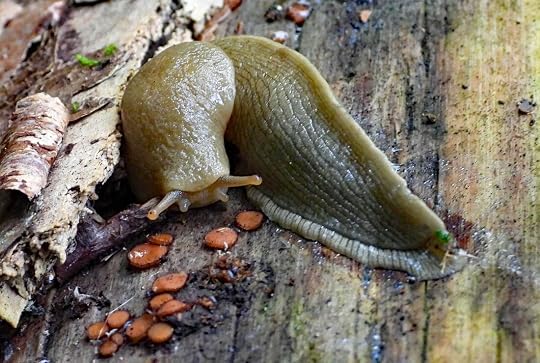
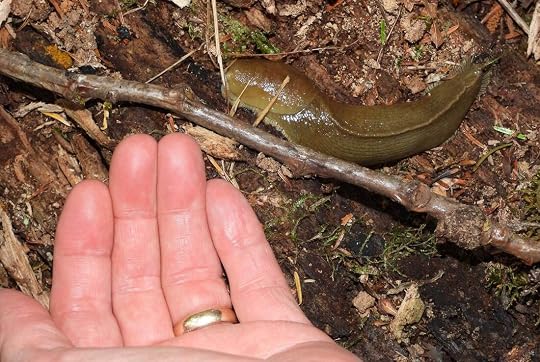
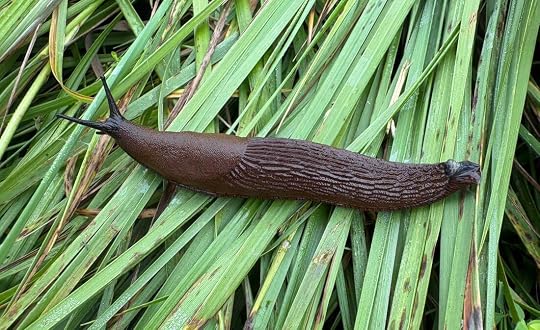
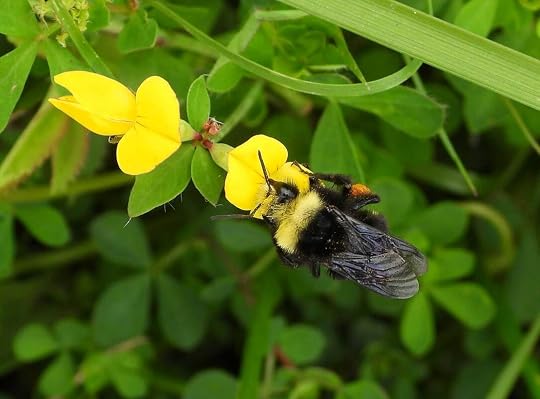
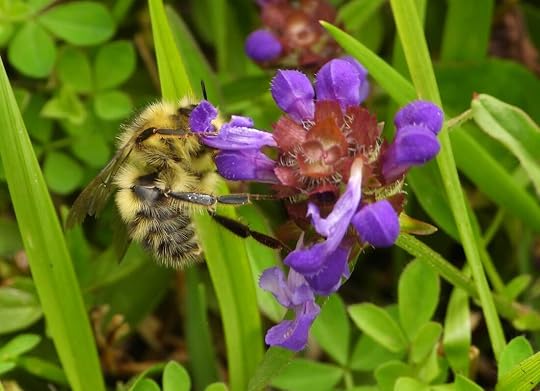 Photo Credits:
All photos by Stan C. Smith
THE FIRST PHOTO is a BANANA SLUG. These slugs are variable in color, sometimes bright yellow, sometimes with black spots, and sometimes various shades of brown or gold. They get their name not only from sometimes being yellow, but also from their immense size, growing to almost ten inches long.
THE SECOND PHOTO shows that this banana slug is close to six inches long. Slugs are terrestrial air-breathing gastropods. Gastropods include snails and slugs (which are basically snails without a shell).
While banana slugs are native to the Pacific Northwest, THE THIRD PHOTO is a EUROPEAN SLUG, which is an invasive species. Something about the climate in the northwest must be perfect for slugs to grow to enormous sizes, because these European slugs are also big (this one was also about six inches).
THE FOURTH PHOTO is a YELLOW-FACED BUMBLEBEE. We have bumblebees in Missouri, of course, but I immediately saw this this species looks different—the only place it has yellow is right behind the head (and just a touch of yellow on the tip of the abdomen) . The yellow-faced bumblebee, which only lives on the west coast, is an extremely important pollinator for agriculture.
THE FIFTH PHOTO is a WESTERN LEAFCUTTER BEE. These are larger than a honeybee, almost as big as a bumblebee. They live in many of the western states, but not as far east as Missouri. These bees are usually solitary, but at breeding time, a small group of them will work together to dig a burrow in the ground, where they lay their eggs.
Photo Credits:All photos by Stan C. Smith


Washington State Treasures - Part 1
Trish and I just got back from a few weeks in Washington. We had a great time visiting our son Micheal and daughter-in-law Megan. Another thing I love about traveling is that I can see wildlife that doesn't live here is Missouri. I'd like to share a few examples (Part 1).
THE FIRST PHOTO is a NORTHERN ALLIGATOR LIZARD, which only lives in the Pacific Northwest. I had to search for a while to find a few of these cool lizards. They are quite secretive, and I spotted this one peeking out from under a piece of loose bark.
THE SECOND PHOTO is a bizarre kind of lichen called METHUSELAH'S BEARD. A lichen is actually two kinds of organisms living together in partnership: fungus and algae. The fungus provides a moist place for the algae to live, and the algae provide food by doing photosynthesis. This lichen hangs from trees, and it is the longest type of lichen in the world.
THE THIRD PHOTO is a CHESTNUT-BACKED CHICKADEE. We see a lot of black-capped chickadees in Missouri, but this species only lives in the Pacific Northwest.
THE FOURTH PHOTO is a PACIFIC WREN. This wren species lives—you guessed it—only in the Pacific Northwest. Missouri has house wrens, Carolina wrens, and winter wrens, but it's always fun to see a new species.
THE FIFTH PHOTO is a ROOSEVELT ELK. Wild elk used to roam throughout Missouri, but by the 1880s, they were completely extirpated by humans. They were reintroduced in 2011 to 2013, and now we have several breeding populations in Missouri. The Roosevelt elk, however, is a subspecies that lives—you guessed it again—only in the Pacific Northwest.
I'll share a few more Washington critters in another post soon.
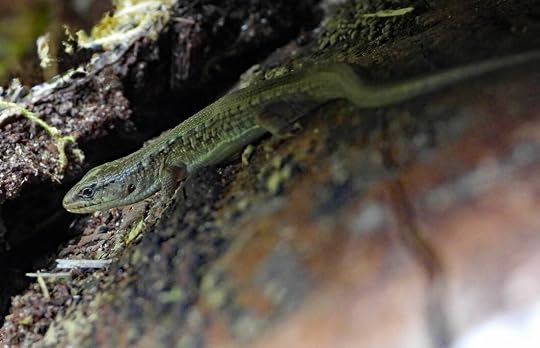
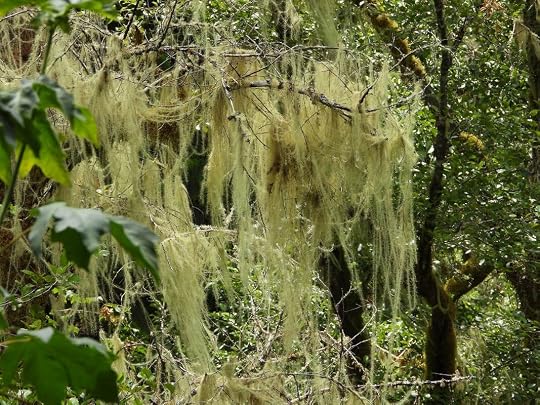
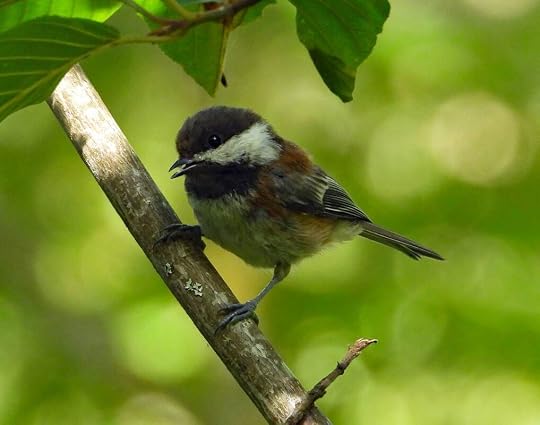
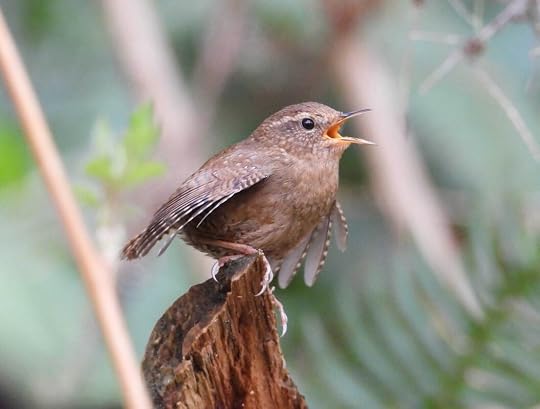
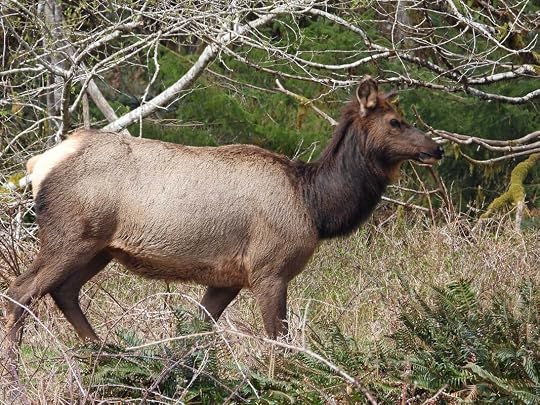 Photo Credits:
All photos by Stan C. Smith
THE FIRST PHOTO is a NORTHERN ALLIGATOR LIZARD, which only lives in the Pacific Northwest. I had to search for a while to find a few of these cool lizards. They are quite secretive, and I spotted this one peeking out from under a piece of loose bark.
THE SECOND PHOTO is a bizarre kind of lichen called METHUSELAH'S BEARD. A lichen is actually two kinds of organisms living together in partnership: fungus and algae. The fungus provides a moist place for the algae to live, and the algae provide food by doing photosynthesis. This lichen hangs from trees, and it is the longest type of lichen in the world.
THE THIRD PHOTO is a CHESTNUT-BACKED CHICKADEE. We see a lot of black-capped chickadees in Missouri, but this species only lives in the Pacific Northwest.
THE FOURTH PHOTO is a PACIFIC WREN. This wren species lives—you guessed it—only in the Pacific Northwest. Missouri has house wrens, Carolina wrens, and winter wrens, but it's always fun to see a new species.
THE FIFTH PHOTO is a ROOSEVELT ELK. Wild elk used to roam throughout Missouri, but by the 1880s, they were completely extirpated by humans. They were reintroduced in 2011 to 2013, and now we have several breeding populations in Missouri. The Roosevelt elk, however, is a subspecies that lives—you guessed it again—only in the Pacific Northwest.
I'll share a few more Washington critters in another post soon.
Photo Credits:All photos by Stan C. Smith
In our neck of the woods... Magical Forests
Trish and I just spent some time in the Pacific Northwest. If you've ever been in a forest in that area, you probably noticed that many of the trees are covered in green stuff. PHOTO ONE is from Ike Kinswa State Park, near Mossyrock, Washington. All this green stuff makes me think of a magical forest, where you might see gnomes or fairies.
The plants covering those branches are mostly mosses. The Pacific Northwest is home to about 1,000 species of mosses, many of which grow on the branches of trees. Mosses are what we call nonvascular plants—they do not have veins to carry water and nutrients up the plant. Therefore, they cannot grow very tall because they have to soak up water from rain and from the surface they are growing on.
Many trees in the Pacific Northwest are also covered by lichens. Check out the PHOTO TWO. The bright green and brown plant in the center of this photo is an example of moss. Surrounding the moss are two types of lichens—one type that grows in flat lobes, and another type that grows as long, thin, branching filaments.
Lichens are nothing like mosses. Lichens are actually a bizarre partnership, in which a fungus lives together with a type of algae (or sometimes a cyanobacteria). The fungus provides a moist, safe place for the algae to live. The algae provides food for both the organisms by doing photosynthesis. Nature is so cool!
Well, as I was looking into the forest from the balcony of a cabin we stayed in for a few days, I saw this tree with something long and stringy growing on it. PHOTO THREE.
This stringy stuff is NOT Spanish moss (which grows on trees in the southeast USA and is actually a type of air plant called a bromeliad). This stuff is also not a type of moss (there are some long stringy mosses that hang from trees in the Pacific Northwest).
How do I know it's not a moss? Because when I zoomed in on it, what I saw is shown in PHOTO FOUR.
These long strands with little filaments sticking out in all directions indicate that this is a lichen called bearded lichen, or Methuselah's beard lichen. It is the longest lichen in the world, growing to twenty feet in length!
This is why I love being outdoors. Every living thing you see—if you pay attention and learn more about it—is unique and spectacular in its own way.
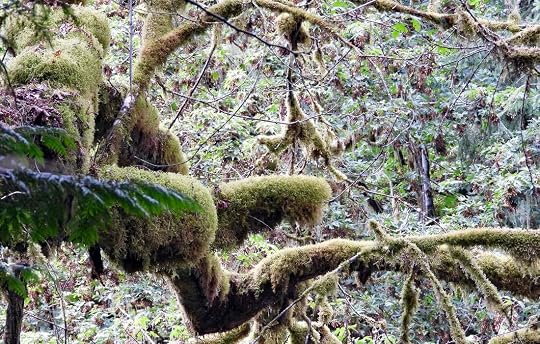
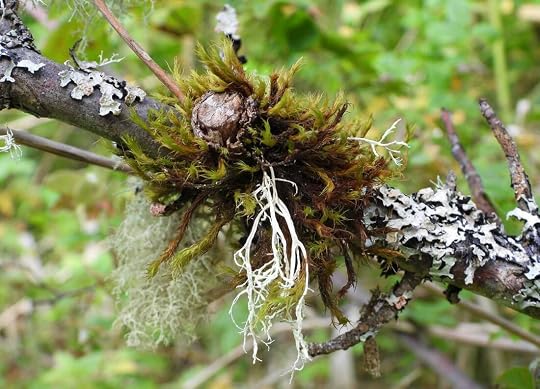
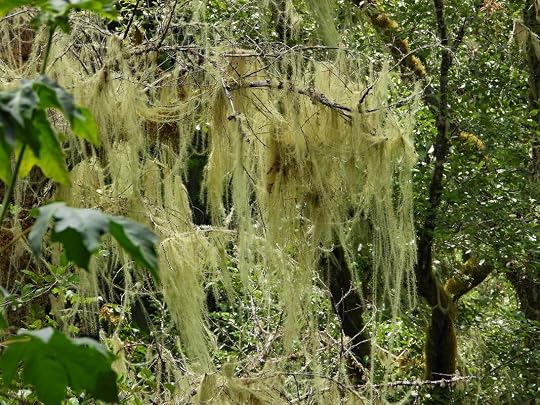
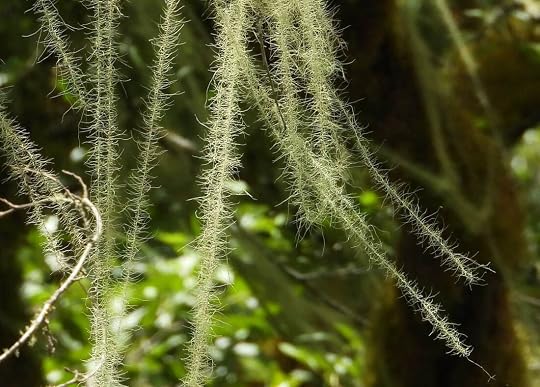 Photo Credits:
All photos by Stan C. Smith
The plants covering those branches are mostly mosses. The Pacific Northwest is home to about 1,000 species of mosses, many of which grow on the branches of trees. Mosses are what we call nonvascular plants—they do not have veins to carry water and nutrients up the plant. Therefore, they cannot grow very tall because they have to soak up water from rain and from the surface they are growing on.
Many trees in the Pacific Northwest are also covered by lichens. Check out the PHOTO TWO. The bright green and brown plant in the center of this photo is an example of moss. Surrounding the moss are two types of lichens—one type that grows in flat lobes, and another type that grows as long, thin, branching filaments.
Lichens are nothing like mosses. Lichens are actually a bizarre partnership, in which a fungus lives together with a type of algae (or sometimes a cyanobacteria). The fungus provides a moist, safe place for the algae to live. The algae provides food for both the organisms by doing photosynthesis. Nature is so cool!
Well, as I was looking into the forest from the balcony of a cabin we stayed in for a few days, I saw this tree with something long and stringy growing on it. PHOTO THREE.
This stringy stuff is NOT Spanish moss (which grows on trees in the southeast USA and is actually a type of air plant called a bromeliad). This stuff is also not a type of moss (there are some long stringy mosses that hang from trees in the Pacific Northwest).
How do I know it's not a moss? Because when I zoomed in on it, what I saw is shown in PHOTO FOUR.
These long strands with little filaments sticking out in all directions indicate that this is a lichen called bearded lichen, or Methuselah's beard lichen. It is the longest lichen in the world, growing to twenty feet in length!
This is why I love being outdoors. Every living thing you see—if you pay attention and learn more about it—is unique and spectacular in its own way.
Photo Credits:All photos by Stan C. Smith
July 29, 2026
In our neck of the woods: Ozark Streams
Trish and I recently joined our daughter Katie and her family for four days on the Jack's Fork River in southern Missouri. The Jack's Fork River is typical of many of the Ozark rivers of our state, with cool, clear water, scenic rocky bluffs, and nice gravel bars.
Missouri is in the center of the United States, far from any coasts. So, during warm months, Missourians flock to these rivers instead of flocking to the beach. You can swim, snorkel, fish, paddle the river in canoes or kayaks, or just relax on the gravel sand bars and enjoy the scenery. THE FIRST PHOTO was the view from the porch of our cabin. You can see that the sand bar on the far side of the river is a popular destination.
We spent one of our days paddling in a canoe and two kayaks down the river. We had a guide take us in a bus to the put-in spot about five miles upstream, then we floated our way back to the resort, stopping occasionally to swim or eat snacks. Confession: Trish and I dumped our canoe at one point as we tried to navigate a tricky bend in the river... not a big deal, but she did lose her favorite hat to the river! Notice she is hatless in THE SECOND PHOTO.
Missouri has about 110,000 miles of flowing streams and rivers. Because the Ozark region (the southern half of the state and into Arkansas) is an elevated plain of ancient bedrock, the streams here tend to run over gravel instead of mud, which makes the water clear. Many Ozark streams are spring fed, and the water coming from beneath the ground makes the stream water quite cold. This cold, clear water has resulted in numerous fish, amphibians, and invertebrates that are endemic (they aren't found anywhere else in the world) to Ozark streams.
Examples of endemic species are the Ozark hellbender (a large aquatic salamander that is so slimy it has earned the name "snot otter"), the Ozark cavefish (a translucent fish with no eyes that lives in underground springs), the Ozark madtom (a tiny catfish), and many others, including several endemic crayfish, like the longpincered crayfish.
THE THIRD PHOTO is an Ozark hellbender (snot otter). Unfortunately, this is not my photo... I've always wanted to find one of these, but they are rather rare and I haven't been lucky enough.
Of course, many Ozark streams are too small to canoe or swim in. But they still contain an astounding variety of wildlife, and they are beautiful to see. THE FOURTH PHOTO is a stream that runs through our property.
Do you have a favorite stream or river in your area? Do you have a fun story about an experience you've had there?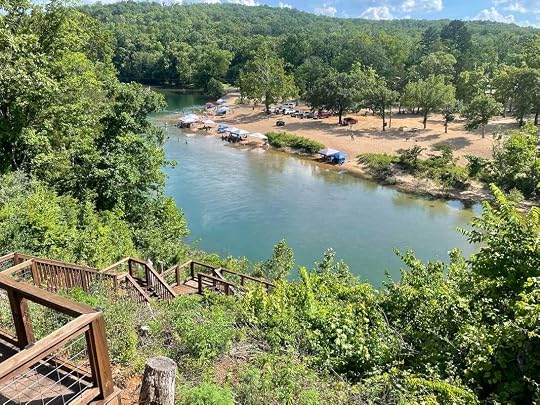
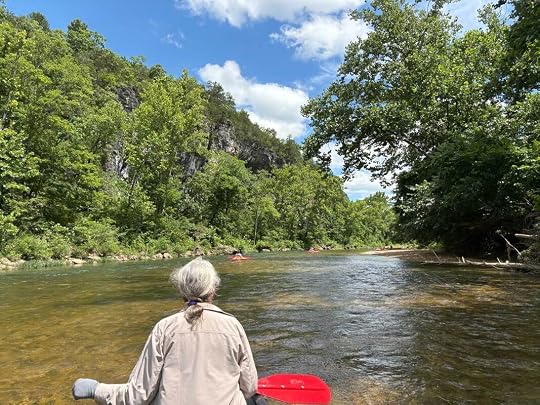
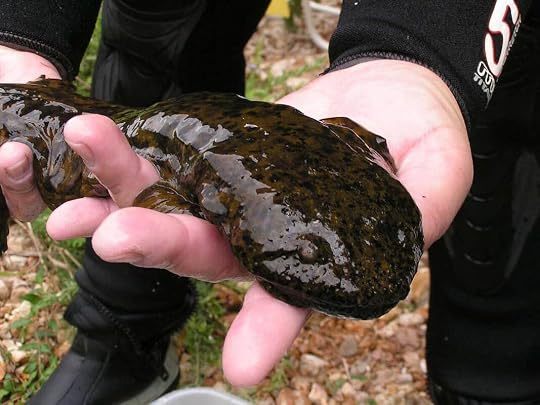
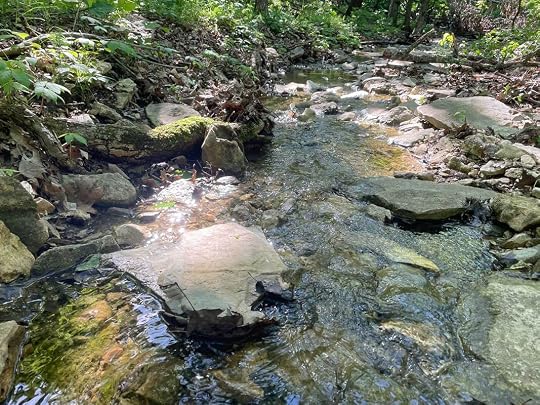
 Photo Credits:
- Ozark hellbender - U.S. Fish and Wildlife Service - Midwest Region, Public domain, via Wikimedia Commons
- All other photos - Stan C. Smith
Missouri is in the center of the United States, far from any coasts. So, during warm months, Missourians flock to these rivers instead of flocking to the beach. You can swim, snorkel, fish, paddle the river in canoes or kayaks, or just relax on the gravel sand bars and enjoy the scenery. THE FIRST PHOTO was the view from the porch of our cabin. You can see that the sand bar on the far side of the river is a popular destination.
We spent one of our days paddling in a canoe and two kayaks down the river. We had a guide take us in a bus to the put-in spot about five miles upstream, then we floated our way back to the resort, stopping occasionally to swim or eat snacks. Confession: Trish and I dumped our canoe at one point as we tried to navigate a tricky bend in the river... not a big deal, but she did lose her favorite hat to the river! Notice she is hatless in THE SECOND PHOTO.
Missouri has about 110,000 miles of flowing streams and rivers. Because the Ozark region (the southern half of the state and into Arkansas) is an elevated plain of ancient bedrock, the streams here tend to run over gravel instead of mud, which makes the water clear. Many Ozark streams are spring fed, and the water coming from beneath the ground makes the stream water quite cold. This cold, clear water has resulted in numerous fish, amphibians, and invertebrates that are endemic (they aren't found anywhere else in the world) to Ozark streams.
Examples of endemic species are the Ozark hellbender (a large aquatic salamander that is so slimy it has earned the name "snot otter"), the Ozark cavefish (a translucent fish with no eyes that lives in underground springs), the Ozark madtom (a tiny catfish), and many others, including several endemic crayfish, like the longpincered crayfish.
THE THIRD PHOTO is an Ozark hellbender (snot otter). Unfortunately, this is not my photo... I've always wanted to find one of these, but they are rather rare and I haven't been lucky enough.
Of course, many Ozark streams are too small to canoe or swim in. But they still contain an astounding variety of wildlife, and they are beautiful to see. THE FOURTH PHOTO is a stream that runs through our property.
Do you have a favorite stream or river in your area? Do you have a fun story about an experience you've had there?
Photo Credits:- Ozark hellbender - U.S. Fish and Wildlife Service - Midwest Region, Public domain, via Wikimedia Commons
- All other photos - Stan C. Smith
Life's Great Mysteries - Could a human and a Neanderthal fall in love?
I'm kind of a romantic. I don't write traditional romance novels, but nearly all my sci-fi books include a romantic relationship that develops over the course of whichever series it's in.
My most unusual fictional romantic relationship is in my Across Horizons series. Why is it unusual? Because the male is of the species Homo sapiens and the female is of the species Homo neanderthalensis.
That's right, they are two different species.
At first thought, this may seem weird. But that's probably because we live in a time in which there is only one surviving species of hominin. Hominins are the group of mammals that includes humans and all of the extinct species that are similar to us—Neanderthals, Australopithicus, Homo erectus, Denisovans, and others too numerous to list here.
Throughout history, there were long stretches of time when Homo sapiens existed at the same time as several other human-like species, including Neanderthals. And the different species interacted.
Is it possible that a human and a Neanderthal could fall in love? We can't know for sure, but we do know, with certainty, that before Neanderthals went extinct 40,000 years ago, humans and Neanderthals mated and produced hybrid offspring. How do we know this? Because almost all modern humans have remnant Neanderthal DNA. From 1% to about 4% of most people's DNA is Neanderthal, depending on the region of the world they are descended from. People with recent Sub-Saharan African ancestry have the least amount because their ancestors did not migrate north out of Africa and intermix with the Neanderthals living in Europe.
So, we know humans and Neanderthals had babies together, but we cannot know if they fell in love. I like to think they did. Which is one of the reasons I enjoyed writing the Across Horizons series.
Skyra is an extraordinary Neanderthal woman. Lincoln is an extraordinary human man who happens to have developed a device that allows him to transport drones back in time to collect environmental data from the past. When Lincoln is forced to use his device to send himself back in time 47,000 years... well, as you can guess, the two meet. But what you probably can't guess is how their relationship triggers a sequence of events that echo far into the future.
IMAGE ONE is Skyra and Lincoln talking to Lincoln's drone, named Ripple.
Interestingly, none of the Neanderthal DNA in modern humans is from female Neanderthals. We know this because no Neanderthal mRNA exists in humans today (I'm talking about mitochondrial DNA, which is only passed down from mother to offspring). I won't get into the details, but this means that all the Neanderthal DNA in humans today came from Neanderthal men mating with human women, instead of Neanderthal women mating with human men. This suggests it's possible that offspring from a Neanderthal woman impregnated by a human man may have been sterile (biologically incapable of reproducing). But we know offspring from a human woman impregnated by a Neanderthal man were not sterile.
The premise of my story is a male human and female Neanderthal falling in love and producing offspring. Does the information above make this premise impossible? Not really. It's possible that, in every instance of human men mating with Neanderthal women, the women and their offspring stayed with their Neanderthal tribes, and they and their offspring eventually went extinct along with all the other Neanderthals. It's also possible that the Neanderthal women and their hybrid offspring simply died due to other causes. After all, life was almost certainly harsh that long ago—predators, disease, war with human tribes, war with other Neanderthal tribes, and much more.
Back to the question that fascinates me... if a human male from the future appeared 47,000 years in the past and encountered a Neanderthal female, could they fall in love?
A lot of factors could reduce the chances of this happening. In my story, Skyra already hates humans. In her time (47,000 years ago), in the area that is now Spain, human tribes had traveled north out of Africa and had already been interacting with Neanderthals for thousands of years. Skyra hates humans because they frequently attack her tribe, and a ruthless band of humans captured and abused Skyra's sister. Skyra wants to kill every human man she encounters, especially the leader of her sister's tormentors.
IMAGE TWO is Skyra facing off with her sworn human enemy. This confrontation does not end well.
So, when Skyra encounters Lincoln, a strange human man from the future, her thoughts have nothing to do with attraction or passion. And I would imagine this was the case in real life when Neanderthal women encountered human men. More often than not, violence was probably the outcome.
But there can always be exceptions, right?
Maybe a more important question is, were Neanderthals even capable of experiencing love? We don't know. And we don't know if they had monogamous relationships. But if they did have monogamous relationships, we can assume that the male and female would instinctively protect each other and nurture each other through sickness and injury. And isn't that the foundation of love? Isn't that how humans developed strong bonds of affection for each other?
So, I like to believe Neanderthals could love. We already know humans experience love, so my opinion is that Lincoln and Skyra falling in love is not impossible.
Of course, their relationship is only one thread to the epic Across Horizons story, which is told in five novels—IMAGE THREE.
If you haven't read the series yet, I'm confident you will enjoy the adventure. Check it out here:
https://www.amazon.com/Across-Horizons/dp/B086PCFB68

 Photo Credits:
Images of Skyra with Lincoln and with her human enemy - Midjourney
My most unusual fictional romantic relationship is in my Across Horizons series. Why is it unusual? Because the male is of the species Homo sapiens and the female is of the species Homo neanderthalensis.
That's right, they are two different species.
At first thought, this may seem weird. But that's probably because we live in a time in which there is only one surviving species of hominin. Hominins are the group of mammals that includes humans and all of the extinct species that are similar to us—Neanderthals, Australopithicus, Homo erectus, Denisovans, and others too numerous to list here.
Throughout history, there were long stretches of time when Homo sapiens existed at the same time as several other human-like species, including Neanderthals. And the different species interacted.
Is it possible that a human and a Neanderthal could fall in love? We can't know for sure, but we do know, with certainty, that before Neanderthals went extinct 40,000 years ago, humans and Neanderthals mated and produced hybrid offspring. How do we know this? Because almost all modern humans have remnant Neanderthal DNA. From 1% to about 4% of most people's DNA is Neanderthal, depending on the region of the world they are descended from. People with recent Sub-Saharan African ancestry have the least amount because their ancestors did not migrate north out of Africa and intermix with the Neanderthals living in Europe.
So, we know humans and Neanderthals had babies together, but we cannot know if they fell in love. I like to think they did. Which is one of the reasons I enjoyed writing the Across Horizons series.
Skyra is an extraordinary Neanderthal woman. Lincoln is an extraordinary human man who happens to have developed a device that allows him to transport drones back in time to collect environmental data from the past. When Lincoln is forced to use his device to send himself back in time 47,000 years... well, as you can guess, the two meet. But what you probably can't guess is how their relationship triggers a sequence of events that echo far into the future.
IMAGE ONE is Skyra and Lincoln talking to Lincoln's drone, named Ripple.
Interestingly, none of the Neanderthal DNA in modern humans is from female Neanderthals. We know this because no Neanderthal mRNA exists in humans today (I'm talking about mitochondrial DNA, which is only passed down from mother to offspring). I won't get into the details, but this means that all the Neanderthal DNA in humans today came from Neanderthal men mating with human women, instead of Neanderthal women mating with human men. This suggests it's possible that offspring from a Neanderthal woman impregnated by a human man may have been sterile (biologically incapable of reproducing). But we know offspring from a human woman impregnated by a Neanderthal man were not sterile.
The premise of my story is a male human and female Neanderthal falling in love and producing offspring. Does the information above make this premise impossible? Not really. It's possible that, in every instance of human men mating with Neanderthal women, the women and their offspring stayed with their Neanderthal tribes, and they and their offspring eventually went extinct along with all the other Neanderthals. It's also possible that the Neanderthal women and their hybrid offspring simply died due to other causes. After all, life was almost certainly harsh that long ago—predators, disease, war with human tribes, war with other Neanderthal tribes, and much more.
Back to the question that fascinates me... if a human male from the future appeared 47,000 years in the past and encountered a Neanderthal female, could they fall in love?
A lot of factors could reduce the chances of this happening. In my story, Skyra already hates humans. In her time (47,000 years ago), in the area that is now Spain, human tribes had traveled north out of Africa and had already been interacting with Neanderthals for thousands of years. Skyra hates humans because they frequently attack her tribe, and a ruthless band of humans captured and abused Skyra's sister. Skyra wants to kill every human man she encounters, especially the leader of her sister's tormentors.
IMAGE TWO is Skyra facing off with her sworn human enemy. This confrontation does not end well.
So, when Skyra encounters Lincoln, a strange human man from the future, her thoughts have nothing to do with attraction or passion. And I would imagine this was the case in real life when Neanderthal women encountered human men. More often than not, violence was probably the outcome.
But there can always be exceptions, right?
Maybe a more important question is, were Neanderthals even capable of experiencing love? We don't know. And we don't know if they had monogamous relationships. But if they did have monogamous relationships, we can assume that the male and female would instinctively protect each other and nurture each other through sickness and injury. And isn't that the foundation of love? Isn't that how humans developed strong bonds of affection for each other?
So, I like to believe Neanderthals could love. We already know humans experience love, so my opinion is that Lincoln and Skyra falling in love is not impossible.
Of course, their relationship is only one thread to the epic Across Horizons story, which is told in five novels—IMAGE THREE.
If you haven't read the series yet, I'm confident you will enjoy the adventure. Check it out here:
https://www.amazon.com/Across-Horizons/dp/B086PCFB68
Photo Credits:Images of Skyra with Lincoln and with her human enemy - Midjourney
July 14, 2026
In our neck of the woods... Slugs and Snails
With all the recent warm, wet days here lately, certain creatures have become more active. On our porch, I saw this four-inch slug sliming its way across a decorative rock we keep there (FIRST PHOTO). Missouri has quite a few slug species, but I'm pretty sure this is called a mantleslug.
What the heck is a slug anyway? Is it just a snail without a shell? Let's dig into this a bit.
The answer is a bit complicated. Slugs (as well as snails) are in a group of mollusks called gastropods. You might assume that slugs are a specific group of gastropods and snails are a separate group of gastropods. But that's not the case. There are several families of slugs, and the families are not closely related to each other. Each of these families includes some that have shells... which means those species are actually called snails.
Confusing? Let me put it this way: Each of these unrelated families of gastropods have some with shells, some without, and some with very small or internal shells. So, the feature of having no shell has evolved separately in each of these families.
The word "slug" is just a generic name for any gastropods without shells (or with reduced shells) and "snail" is a generic name for any that do have shells. Even if they are not related to each other.
THE SECOND PHOTO is a beautiful little sea slug that we found recently while snorkeling in Belize:
Another interesting gastropod we found while snorkeling was this flamingo tongue snail (THIRD PHOTO). These have a shell... but, interestingly, the pretty color and pattern you see is not the shell itself. Instead, this snail has living tissue, called the mantle, that extends out from the body and covers the shell to give it that striking pattern. When the snail is attacked, it can pull the mantle inside, leaving the plain white or yellow bare shell to protect it.
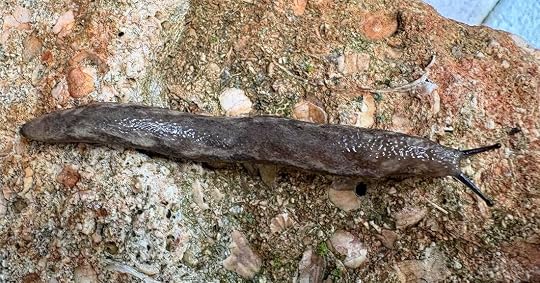
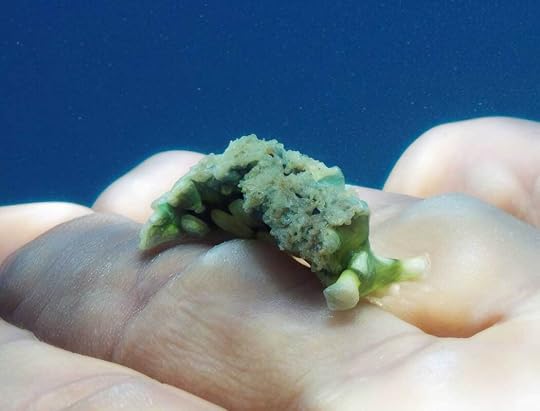
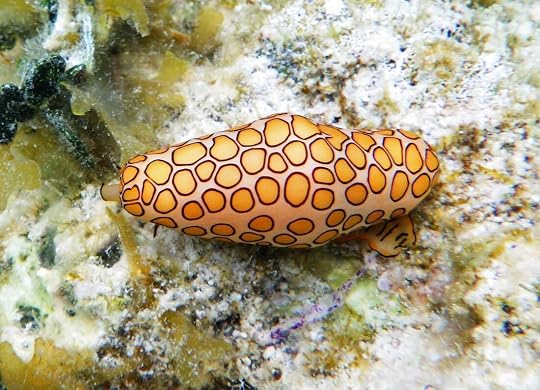 Photo Credits:
All photos by Stan C. Smith
What the heck is a slug anyway? Is it just a snail without a shell? Let's dig into this a bit.
The answer is a bit complicated. Slugs (as well as snails) are in a group of mollusks called gastropods. You might assume that slugs are a specific group of gastropods and snails are a separate group of gastropods. But that's not the case. There are several families of slugs, and the families are not closely related to each other. Each of these families includes some that have shells... which means those species are actually called snails.
Confusing? Let me put it this way: Each of these unrelated families of gastropods have some with shells, some without, and some with very small or internal shells. So, the feature of having no shell has evolved separately in each of these families.
The word "slug" is just a generic name for any gastropods without shells (or with reduced shells) and "snail" is a generic name for any that do have shells. Even if they are not related to each other.
THE SECOND PHOTO is a beautiful little sea slug that we found recently while snorkeling in Belize:
Another interesting gastropod we found while snorkeling was this flamingo tongue snail (THIRD PHOTO). These have a shell... but, interestingly, the pretty color and pattern you see is not the shell itself. Instead, this snail has living tissue, called the mantle, that extends out from the body and covers the shell to give it that striking pattern. When the snail is attacked, it can pull the mantle inside, leaving the plain white or yellow bare shell to protect it.
Photo Credits:All photos by Stan C. Smith
July 9, 2026
Life's Great Mysteries - Why do we think certain animals are cute?
You know what I'm talking about. We see certain animals, and we automatically say (or think), "Awww."
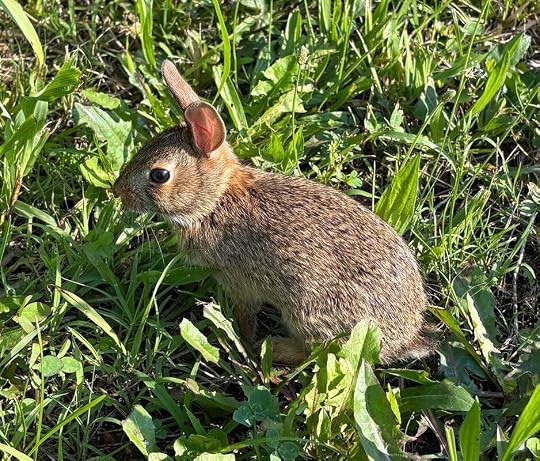
THE FIRST PHOTO is a juvenile cottontail rabbit I saw a few weeks ago, and it's a perfect example.
The leading explanation for this phenomenon comes from Konrad Lorenz, an ethologist (someone who studies animal behavior). In 1943, Lorenz suggested that almost all baby animals have certain physical characteristics in common. For example, a relatively large head compared to the body, rounded cheeks, a high forehead, a small nose and mouth, and rounder bodies. He called this the "baby schema," and the reason most people find these critters to be cute is because humans have a deeply ingrained instinct to nurture babies. After all, humans are animals too, and our babies have these same physical characteristics.
On a more fundamental level, when we perceive cuteness, this stimulates the pleasure center of the brain, releasing dopamine and oxytocin, which promote social bonding and reduce aggression. Cuteness actually triggers a physical response.
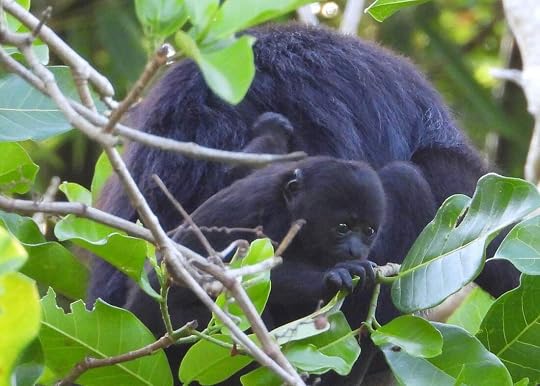
And, from my experience, I feel like the closer the baby animal is related to humans, the more we feel the cuteness factor. Baby non-human primates, for example. THE SECOND PHOTO includes a baby howler monkey that we saw in Belize a few weeks ago.
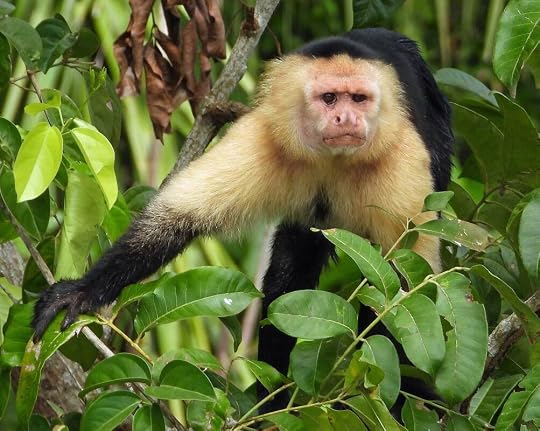
With many species of monkeys, we even perceive the adults as cute. THE THIRD PHOTO is an adult white-faced capuchin we saw in Panama. Even though this individual appears to be grouchy, its similarities to a human, and the overall baby-like proportions of its face, stimulate our brain to feel affection for it.
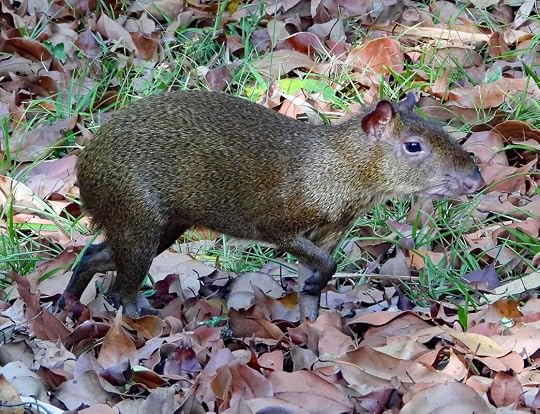
And a lot of other types of mammals that are not primates have body proportions as adults that strike us as cute. THE FOURTH PHOTO is an agouti (a large type of rodent) that we saw in Belize. Even though this is an adult, its proportions trigger our brain to feel affection for it.
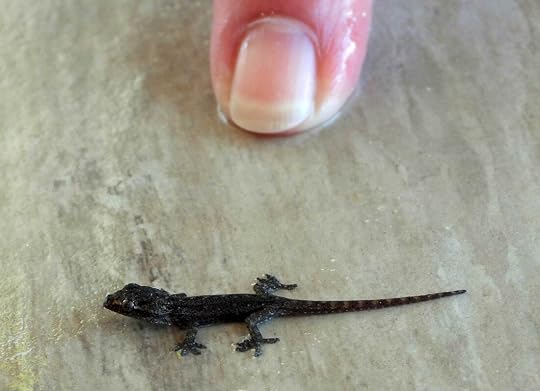
The animals don't even have to be mammals. THE FIFTH PHOTO is a baby gecko we found in Belize, barely larger than the tip of Trish's finger. Simply because its eyes were proportionally huge compared to its body, we both immediately thought of it as cute, and we went to considerable effort to move it safely to a place where it wouldn't get stepped on.
The cuteness factor is powerful!
 All photos by Stan C. Smith
THE FIRST PHOTO is a juvenile cottontail rabbit I saw a few weeks ago, and it's a perfect example.
The leading explanation for this phenomenon comes from Konrad Lorenz, an ethologist (someone who studies animal behavior). In 1943, Lorenz suggested that almost all baby animals have certain physical characteristics in common. For example, a relatively large head compared to the body, rounded cheeks, a high forehead, a small nose and mouth, and rounder bodies. He called this the "baby schema," and the reason most people find these critters to be cute is because humans have a deeply ingrained instinct to nurture babies. After all, humans are animals too, and our babies have these same physical characteristics.
On a more fundamental level, when we perceive cuteness, this stimulates the pleasure center of the brain, releasing dopamine and oxytocin, which promote social bonding and reduce aggression. Cuteness actually triggers a physical response.
And, from my experience, I feel like the closer the baby animal is related to humans, the more we feel the cuteness factor. Baby non-human primates, for example. THE SECOND PHOTO includes a baby howler monkey that we saw in Belize a few weeks ago.
With many species of monkeys, we even perceive the adults as cute. THE THIRD PHOTO is an adult white-faced capuchin we saw in Panama. Even though this individual appears to be grouchy, its similarities to a human, and the overall baby-like proportions of its face, stimulate our brain to feel affection for it.
And a lot of other types of mammals that are not primates have body proportions as adults that strike us as cute. THE FOURTH PHOTO is an agouti (a large type of rodent) that we saw in Belize. Even though this is an adult, its proportions trigger our brain to feel affection for it.
The animals don't even have to be mammals. THE FIFTH PHOTO is a baby gecko we found in Belize, barely larger than the tip of Trish's finger. Simply because its eyes were proportionally huge compared to its body, we both immediately thought of it as cute, and we went to considerable effort to move it safely to a place where it wouldn't get stepped on.
The cuteness factor is powerful!
All photos by Stan C. SmithJuly 6, 2026
Belize Treasures - Birds that Eat Fish
As I was browsing through my photos from our recent trip to Belize, I saw several photos of birds that are adapted to eating fish. No big deal, right? But doesn't this seem strange? Fish are masters of the water, birds are masters of the air. Two very different domains.
I suppose I shouldn't be too surprised that birds can eat fish. After all, birds are diverse, and various bird species have adapted to specialize on eating just about every type of food you can imagine. Hummingbirds drink flower nectar. Robins eat worms. Bearded vultures are experts at eating bones. African honeyguides eat bee's wax. Amazonian Hoatzins eat only leaves. European honey buzzards specialize in eating Asian hornets. Sharp-beaked ground finches consume blood. Snail kites and limpkins (we've seen both of these in Belize) eat only snails. The list could go on and on.
Here are a few kinds of fish-eating birds we saw in Belize as we drifted along a river in a boat.
Kingfishers seem like they are too small to catch fish, but they are master anglers. They sit on perches above the water, and when they see small fish swimming near the surface, they swoop down to snag one with their specialized beak.
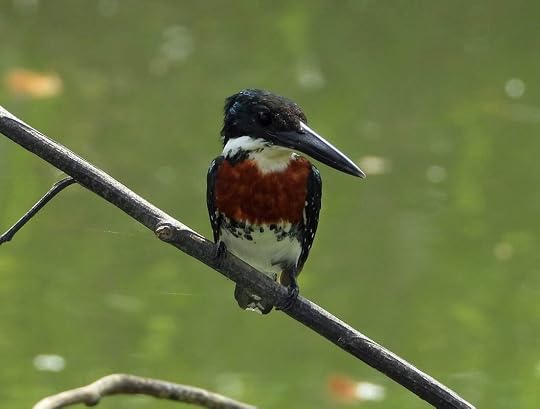
PHOTO ONE is a male green kingfisher. This small bird is only 7 inches from beak tip to tail tip, but that doesn't stop it from catching and swallowing surprisingly large fish.
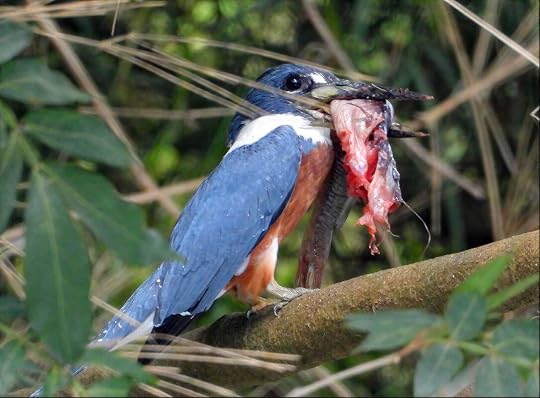
Speaking of catching large fish, PHOTO TWO is a ringed kingfisher (more than twice the size of the green kingfisher). This dude (yes, it's a male too) was working hard to soften a catfish it caught so that it could swallow it. I watched for a while, but the bird was still working on the fish when our boat drifted beyond sight. I'll never know if it got the fish down its throat.
By the way, neither of these two kingfisher species make nests in trees. Instead, they dig burrows in the mud at the shore using their strong beaks. Then they lay their eggs on the bare mud at the back end of the burrow.
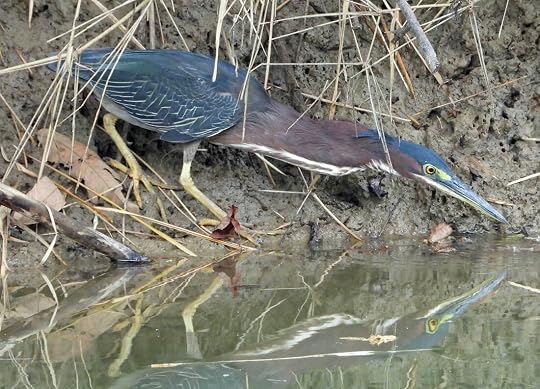
Let's consider a larger fish-eating bird. PHOTO THREE is a green heron. These birds don't hunt fish by flying down to scoop them up like kingfishers do. Instead, they creep along the edge of the water (like this one is doing), moving slowly and often holding very still. When they see a fish or frog, they shoot out their long beak and snatch the prey. They rarely wade in the water while hunting like larger herons do, I suppose because their legs aren't long enough.
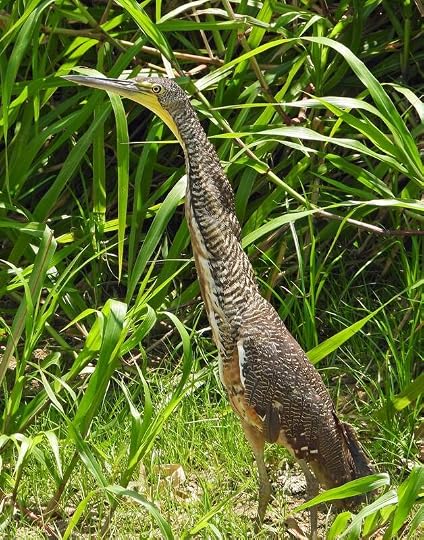
Let's go up in size even more. PHOTO FOUR is a bare-throated tiger-heron. They stand about 30 inches (76cm) tall. These beautiful birds not only eat fish (they stand very still in the water and ambush their prey), but they eat almost anything else they can swallow, including frogs, crayfish, rodents, snakes, lizards, small birds, and even baby turtles and crocodiles (we saw at least eight baby crocodiles while drifting on this river). Tiger-herons are not the least bit picky.
By the way... tiger-herons have a really weird bellowing call, very different from the croaks of many other herons. Listen to the call here: https://www.youtube.com/shorts/gp6tOCyGxjc
Wait! Something else just occurred to me. Are there any fish that eat birds? I mean, why not? Actually, there are. Northern pike and largemouth bass are known to prey on young ducks and geese that happen to be swimming on the surface. But this is nothing compared to the giant trevally. This large ocean fish can analyze the flight trajectory of low-flying seabirds, and then leap completely out of the water to catch them mid-flight. And the silver arowana, a fish of the Amazon Basin, can leap two meters out of the water to snatch birds from overhanging limbs.
As it shoots skyward to grab a bird, I wonder if the fish is thinking, "It's payback time!"
 Photos by Stan C. Smith
I suppose I shouldn't be too surprised that birds can eat fish. After all, birds are diverse, and various bird species have adapted to specialize on eating just about every type of food you can imagine. Hummingbirds drink flower nectar. Robins eat worms. Bearded vultures are experts at eating bones. African honeyguides eat bee's wax. Amazonian Hoatzins eat only leaves. European honey buzzards specialize in eating Asian hornets. Sharp-beaked ground finches consume blood. Snail kites and limpkins (we've seen both of these in Belize) eat only snails. The list could go on and on.
Here are a few kinds of fish-eating birds we saw in Belize as we drifted along a river in a boat.
Kingfishers seem like they are too small to catch fish, but they are master anglers. They sit on perches above the water, and when they see small fish swimming near the surface, they swoop down to snag one with their specialized beak.
PHOTO ONE is a male green kingfisher. This small bird is only 7 inches from beak tip to tail tip, but that doesn't stop it from catching and swallowing surprisingly large fish.
Speaking of catching large fish, PHOTO TWO is a ringed kingfisher (more than twice the size of the green kingfisher). This dude (yes, it's a male too) was working hard to soften a catfish it caught so that it could swallow it. I watched for a while, but the bird was still working on the fish when our boat drifted beyond sight. I'll never know if it got the fish down its throat.
By the way, neither of these two kingfisher species make nests in trees. Instead, they dig burrows in the mud at the shore using their strong beaks. Then they lay their eggs on the bare mud at the back end of the burrow.
Let's consider a larger fish-eating bird. PHOTO THREE is a green heron. These birds don't hunt fish by flying down to scoop them up like kingfishers do. Instead, they creep along the edge of the water (like this one is doing), moving slowly and often holding very still. When they see a fish or frog, they shoot out their long beak and snatch the prey. They rarely wade in the water while hunting like larger herons do, I suppose because their legs aren't long enough.
Let's go up in size even more. PHOTO FOUR is a bare-throated tiger-heron. They stand about 30 inches (76cm) tall. These beautiful birds not only eat fish (they stand very still in the water and ambush their prey), but they eat almost anything else they can swallow, including frogs, crayfish, rodents, snakes, lizards, small birds, and even baby turtles and crocodiles (we saw at least eight baby crocodiles while drifting on this river). Tiger-herons are not the least bit picky.
By the way... tiger-herons have a really weird bellowing call, very different from the croaks of many other herons. Listen to the call here: https://www.youtube.com/shorts/gp6tOCyGxjc
Wait! Something else just occurred to me. Are there any fish that eat birds? I mean, why not? Actually, there are. Northern pike and largemouth bass are known to prey on young ducks and geese that happen to be swimming on the surface. But this is nothing compared to the giant trevally. This large ocean fish can analyze the flight trajectory of low-flying seabirds, and then leap completely out of the water to catch them mid-flight. And the silver arowana, a fish of the Amazon Basin, can leap two meters out of the water to snatch birds from overhanging limbs.
As it shoots skyward to grab a bird, I wonder if the fish is thinking, "It's payback time!"
Photos by Stan C. SmithJuly 3, 2026
Belize Treasures - Arrow crabs and two kinds of lobsters.
Today, let's look at a few crustaceans we saw while snorkeling at Turneffe Atoll, about 35 miles (56 km) off the coast of Belize.
First, the arrow crab. This bizarre creature appears to be all legs. PHOTO ONE is an arrow crab I saw crawling on a boulder coral.
See what I mean? All legs. During the day, these long-legged critters hang around inside the openings of sponges, among the tentacles of anemones, and on corals. At night, they skitter around and feed on whatever tiny stuff they can find. Sometimes these crabs will decorate their bodies with bits of algae and sponges to make it harder for predators to see them.
PHOTO TWO is an arrow crab Trish was holding in her hands:
Now let's look at two species of lobsters. PHOTO THREE is the Caribbean spiny lobster, sometimes called the rock lobster. During the lobster season (July 1 through February 28), many of these huge crustaceans are harvested, and Belizeans have grand lobster festivals to celebrate the opening of the season.
We saw a number of these magnificent crustaceans, but this one came right out from its coral hiding place as if it wanted to pose for a photo.
Unlike the Maine (or Canadian) lobster and the European lobster, which have massive crusher claws (called chelae, for cracking open the hard shells of their prey), spiny lobsters have no claws on their front pair of legs. But... although they lack large claws, they have impressively long antennae. I've seen some spiny lobsters with antennae close to a meter long.
Caribbean spiny lobsters average about two pounds, but they sometimes grow to fifteen pounds (7 kg).
Fossils of spiny lobsters show that they have not changed much structurally in at least 110 million years.
Interestingly, in Australia and the surrounding islands, people refer to spiny lobsters as crayfish. Here in North America, we use the name crayfish for a group of much smaller (but structurally similar) freshwater crustaceans.
Finally, we also saw several Spanish lobsters (a type of slipper lobster), which are odd-looking relatives of the spiny lobster. Spanish lobsters are shy and often difficult to photograph. See PHOTO FOUR.
Two striking features you can see in this photo: first, notice the two tiny, blue antennae that have forked ends? These help the lobster sense its surroundings. Second, notice the flat, shovel-like things that extend out in front of the eyes? These are modified antennae, and the lobsters use them to dig in the sand to find food and to escape predators.
Those shovel structures are why some people call these shovel-nosed lobsters or bulldozers.
There you go... a few interesting crustaceans of the Caribbean!
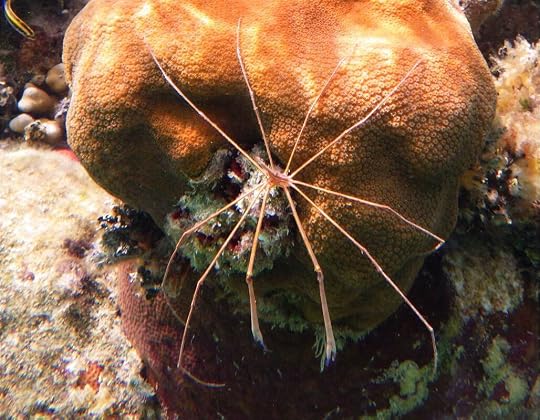
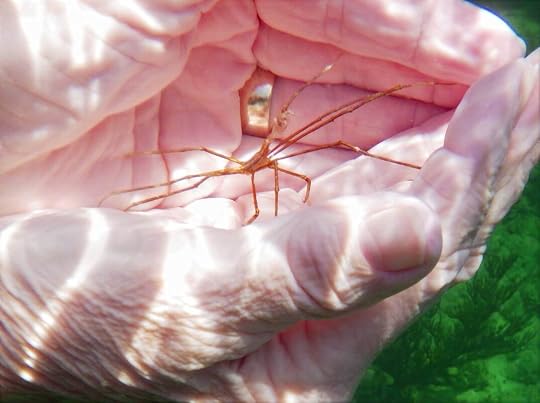
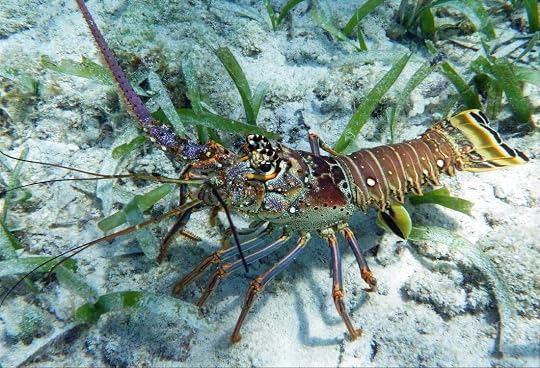 Photo credits:
All photos by Stan C. Smith
First, the arrow crab. This bizarre creature appears to be all legs. PHOTO ONE is an arrow crab I saw crawling on a boulder coral.
See what I mean? All legs. During the day, these long-legged critters hang around inside the openings of sponges, among the tentacles of anemones, and on corals. At night, they skitter around and feed on whatever tiny stuff they can find. Sometimes these crabs will decorate their bodies with bits of algae and sponges to make it harder for predators to see them.
PHOTO TWO is an arrow crab Trish was holding in her hands:
Now let's look at two species of lobsters. PHOTO THREE is the Caribbean spiny lobster, sometimes called the rock lobster. During the lobster season (July 1 through February 28), many of these huge crustaceans are harvested, and Belizeans have grand lobster festivals to celebrate the opening of the season.
We saw a number of these magnificent crustaceans, but this one came right out from its coral hiding place as if it wanted to pose for a photo.
Unlike the Maine (or Canadian) lobster and the European lobster, which have massive crusher claws (called chelae, for cracking open the hard shells of their prey), spiny lobsters have no claws on their front pair of legs. But... although they lack large claws, they have impressively long antennae. I've seen some spiny lobsters with antennae close to a meter long.
Caribbean spiny lobsters average about two pounds, but they sometimes grow to fifteen pounds (7 kg).
Fossils of spiny lobsters show that they have not changed much structurally in at least 110 million years.
Interestingly, in Australia and the surrounding islands, people refer to spiny lobsters as crayfish. Here in North America, we use the name crayfish for a group of much smaller (but structurally similar) freshwater crustaceans.
Finally, we also saw several Spanish lobsters (a type of slipper lobster), which are odd-looking relatives of the spiny lobster. Spanish lobsters are shy and often difficult to photograph. See PHOTO FOUR.
Two striking features you can see in this photo: first, notice the two tiny, blue antennae that have forked ends? These help the lobster sense its surroundings. Second, notice the flat, shovel-like things that extend out in front of the eyes? These are modified antennae, and the lobsters use them to dig in the sand to find food and to escape predators.
Those shovel structures are why some people call these shovel-nosed lobsters or bulldozers.
There you go... a few interesting crustaceans of the Caribbean!
Photo credits:All photos by Stan C. Smith
June 30, 2026
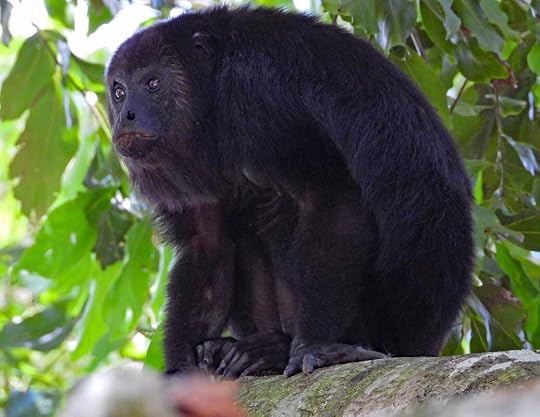
Belize Treasures - Yucatán black howler monkey
How could I not share a bunch of howler monkey photos? These animals are so cool! And yes... the males' calls are loud enough to hear a mile away. If you are near a river or a good-sized expanse of rainforest, this is a sound you will almost definitely hear first thing in the morning and in the evening. Most of the howling happens because these creatures are announcing their presence to other troops of howler monkeys. They are very territorial, and they have no tolerance for interlopers.
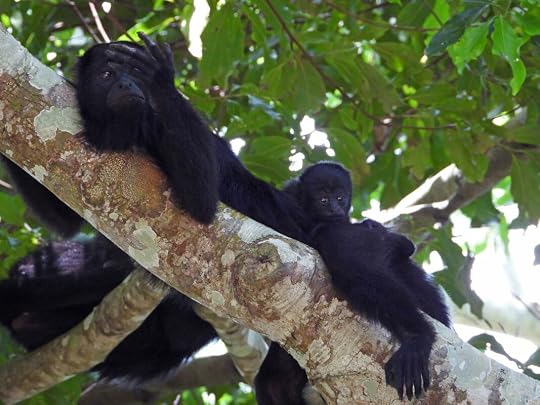
Fascinating animals, and I love photographing them, especially when the babies are hanging on to their mothers or following the adults around. The FIRST PHOTO is my favorite because the monkeys were lazing around in the heat of the day, and the mother howler appears to be studying her hand as her youngster studies me while lounging around on its mom's back.
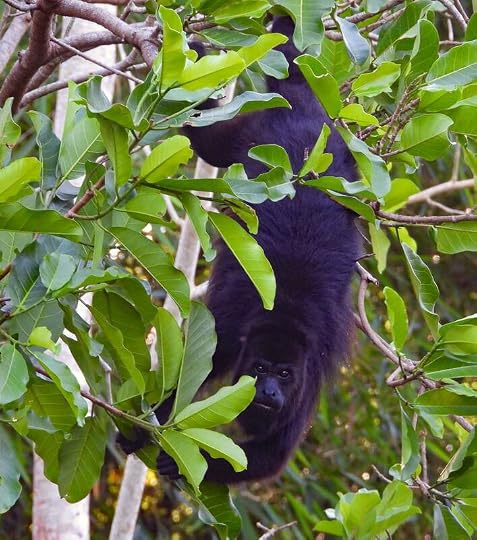
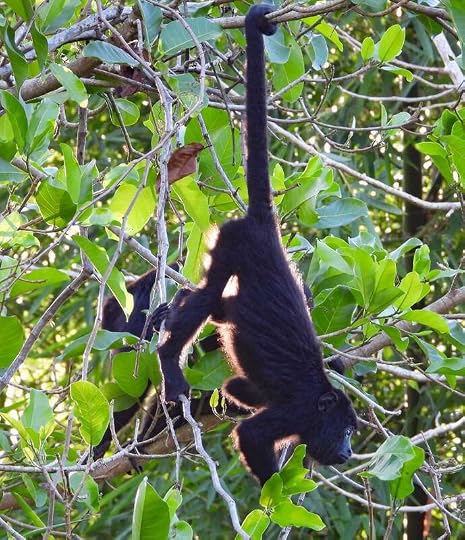
Anyway, here are a few howler photos. Just because.
 Photos by Stan C. Smith
Fascinating animals, and I love photographing them, especially when the babies are hanging on to their mothers or following the adults around. The FIRST PHOTO is my favorite because the monkeys were lazing around in the heat of the day, and the mother howler appears to be studying her hand as her youngster studies me while lounging around on its mom's back.
Anyway, here are a few howler photos. Just because.
Photos by Stan C. Smith

_(5371066350).jpg)