M. Tyler Gillett's Blog
February 10, 2020
Emergency Powers
In constitutional law class today* I argued against granting the president emergency powers at all, generally because emergency powers are too broad, too subject to abuse – as Justice Jackson said, “emergency powers . . . tend to kindle emergencies.” This was part of a discussion that rose out of the Youngstown Sheet & Tubecase, in which Truman tried to seize control of a steel company that was under a strike during the Korean War. He claimed this was an emergency, since loss of steel production during time of war was a threat to national security and would deprive the armed forces of necessary matérial to carry out their mission. While everyone in class was in general agreement that many “emergencies” declared by presidents are not, in fact, emergencies and are just politics under another name, some seemed worried that not permitting some grant of emergency power to the president would leave the country vulnerable when an actual emergency occurred. My question is, what sort of emergency could happen that could not wait for Congress to quickly convene and pass some sort of statutory authority for the president to act? The September 11 attacks came up a lot,** and Congress acted quickly then, in fact probably too quickly, because their grant of authority led to the Iraq War. An act by another global power indicating total war might count. Global thermonuclear conflict certainly would count. But to my thinking, that is about it. The founders may have been more a-feared of Congress overstepping its constitutional boundaries, but 200+ years on we have to fear the overstepping (goose-stepping?) executive as much or more. As Sarah Kendzior says, we don’t have an administration, we have an international crime syndicate. We have Nazis. We cannot give these bastards any more power – taking away what they already have is going to be hard enough.________
* Hey! I’m in law school!
** It occurs to me that many of my classmates were probably on 4-5 years old at the time, if that. They have always lived in the time of the war on terror, and I wonder how that shapes their feelings about safety and government power.


November 15, 2018
Sita Steps Into The Fire
Inspired by the Ramayanas of Tulsidas and Paley
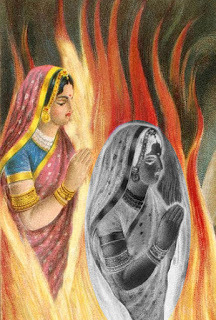
She was a beautiful woman. She was, in fact, the most beautiful woman in the world. This was not vanity nor boast but the literal truth: there was not now nor ever had been any woman more beautiful than Sita. She was also a princess, daughter of mighty king Janaka, his greatest source of pride but also, through no fault of her own, his greatest source of trouble, for he was almost literally besieged by men from both near and far pleading for Sita's hand. The offers they made were extravagant, as extravagant as each suitor could make them, but Janaka reckoned wealth of no account when it came to Sita. He was concerned only to make the ideal match for his peerless daughter, but he needed a way to judge that would eliminate every unsuitable match. It had to be a method as objective as possible, so no suitor could take offense at being rejected, for many of those seeking to make Sita their wife were sons of powerful kings, or were powerful kings in their own right, and there was a growing danger to Janaka every day he delayed his decision.
The solution lay deep within the vaults of his treasure: the Bow of Shiva. It had lain untouched for years beyond counting, for there was no one among men strong enough to pull it. Though it was a divine artifact, once wielded by the god Shiva himself, a weapon that cannot be used is useless, and so it had been stored away and forgotten. Reminded of its existence by his court sage, Janaka had it brought out and installed in the courtyard of his palace. He made an announcement to the assembled suitors, and had his decree carried by messengers to the four directions: he would only grant Sita's hand to the one who could draw Shiva's Bow.
There were objections, of course, to what was clearly an impossible task, and accusations that Janaka simply did not want Sita married to anyone at all. “What father doesn't want to see his daughter married?” he asked. “But Sita is incomparable, and it is my duty as her father to secure the best possible match.”
Every day men made the attempt, and many could not even lift the bow, and there were none who could draw it. While her father continued to fret, Sita was content to wait, for she knew there was a man who could draw the bow, and that he would come at the right time. And finally the day came when Prince Rama, son of King Dasaratha of Ayodhya, lifted the bow with ease and drew it back so far that the bow shaft split in half with a thunderous crack that could be heard for miles around. The other suitors, though dejected, all had to admit that Rama was the best choice for Sita, for together they made the perfect couple, ideal prince and ideal wife. The date was swiftly set, and they were married, and Sita returned to Ayodhya with Rama.
* * *
Years later, Sita prepared to accompany Rama into exile. They stood at the palace gates, facing all the people of Ayodhya who had gathered in their shock and grief at the news. Just days earlier Dasaratha, feeling his age, had made the decision to step down and crown Rama king in his place, a decision greeted with approval and joy by everyone save Kaikeyi, the most scheming of Dasaratha's three wives and mother to Rama's brother Bharata. Many years ago she had extracted a promise from the king that he would grant her any boon she desired, and what she desired was for Rama to be banished and Bharata installed on the throne in his place. It mattered little to Kaikeyi that no one, not even Bharata himself, wanted this to pass. But Dasaratha's word was his bond, and he could not deny her request, so Sita, the embodiment of the ideal wife, calmly walked behind her husband as the ideal wife should, leaving the palace and city behind. Accompanying them was Lakshmana, Rama's brother by Dasaratha's third wife Sumitra; he had demanded to join them because his devotion to Rama was absolute, regardless of whatever hardships he may have to endure.
Though grieving their loss, the people admired Rama's obedience as the dutiful son and praised Sita's decision to join him in exile as a dutiful wife, though they also feared for her. The forest was dangerous, filled with violent rakshasas and rakshasis, demon-men and -women from the distant south, and even though Rama and Lakshmana were renowned as warriors, the people worried for Sita's safety, especially given that they would have to remain exiles for fourteen years. But fourteen years or fourteen thousand, it would make no difference nor be any true hardship, for Rama and Sita were not merely the ideal couple, they were the divine couple – they were gods. She was the eternal feminine principle of the cosmos, just as Rama was the masculine principle. The mortals they walked among greatly admired their perfection but no one suspected their divinity. Incarnating on earth as two mortals, a prince and a princess destined for each other, had been Rama's idea. It was his lila, his play or sport, for what is the universe to God but his plaything? They were enacting this great lilafor the glory of Rama and the edification of humanity, all the generations who would forever after strive for the ideal that he and Sita represented for them. Maintaining their mortal pretense, Rama and Sita left Ayodhya and wandered into the untamed forest.
* * *
“Step into the fire,” Rama said to his wife, having kindled a great blaze. It was evening, and they had been living in the forest for several years, a simple life punctuated, for Rama and Lakshmana, by battles with rakshasas who were tormenting the sages living in hermitages deep in the forest, away from settled lands. Rama had sent Lakshmana off to hunt, and took this opportunity to engage an important step in his lila. “You will reside in the fire until it is time for you to return to me.” Divine Sita, ever-obedient wife, walked into the bonfire without hesitation. The flames were cool and soothing and folded her into their flickering embrace. Sita walked in and remained, but her shadow walked out and stood demurely before Rama. Sita's shadow was exactly the same as Sita in all aspects – beauty, grace, memories, even in her divine power. “None will know,” Rama said as he stared appreciatively at the shadow-Sita, “of this great deception. Everyone, even the demon-king of Lanka, will believe you are Sita, and he will take you back to his kingdom while my Sita remains in the fire, safe and inviolate. A great conflict will ensue, and all the world will witness and praise my honor and glory.” He continued to stare at shadow-Sita, for not even he with all his divine power could discern any difference between Sita and her shadow. Then Lakshmana returned, and as he and Rama set to skinning and butchering the deer he had caught, shadow-Sita did exactly as Sita would have done and began preparing the rest of their evening meal.
The two brothers noticed nothing out of the ordinary, for shadow-Sita betrayed no outward difference, but her innermost thoughts were revolving around an odd feeling: in all respects, from her physical form to her thoughts and memories and the essence and power of godhood, she was exactly like Sita, she would even say she wasSita, except she also knew she was not Sita, but her shadow. There had not even been any discontinuity, any gap in her memories or feelings, from the moment Sita entered the fire and she stepped out.
She knew the point of this deception was to safeguard Sita's honor. The lila required that she be kidnapped by Ravana and carried off to his palace in distant Lanka, across the sea, and held captive there until Rama arrived to defend his honor and kill Ravana. But despite the fact that both Rama and she knew Ravana would not, could not, violate her, and despite the fact that her chastity and fidelity were perfect and unquestionable, despite the fact that she would reside in the household of another man not of her own volition, indeed through no fault of her own at all, despite all of that, there would be a suspicion, a stain upon her honor nonetheless, and so the necessity of the deception. Sita would remain untouched in the fire, and Sita's shadow would endure the calumny instead.
But shadow-Sita was precisely like Sita in every way, including her purity, chastity, fidelity, and honor. If there was no difference between Sita and her shadow, could this ruse be said to actually protect Sita from defilement? You could say Sita would not be alone in the presence of another man, but when there is absolutely no difference between Sita and shadow-Sita, could you really say Sita would not be alone in the presence of another man? The point of shadow-Sita's existence was to protect Sita from even the possibility of impropriety, but did that protection mean anything when they were the same being? Was Sita – either Sita – actually protected by this ruse? Shadow-Sita outwardly displayed no confusion as she served dinner to her husband and brother-in-law, but she wondered if Sita-in-the-fire was also puzzled about the utility of this part of Rama's lila. Given that there was no difference between them, shadow-Sita knew that Sita-in-the-fire must be thinking the same thoughts.
* * *
It was not long after she had stepped out of the fire that shadow-Sita's part in Rama's lila began. She had spied a beautiful golden deer in the forest, knowing of course that it was not a deer but Lord Ravana's kinsman Mareecha in disguise. Still, she pleaded with her husband to catch it for her. After he had gone, she and her brother-in-law Lakshmana remained in their hut, he tending to some small game he had shot that morning, she preparing the dough for rotis, when they heard Rama's voice, far in the distance, crying out. “My dear husband is in trouble!” she exclaimed. “Lakshmana, you must go to him! Hurry!”
“No, Sita,” he said, “I vowed to my brother that I would stay and safeguard you, for the forest is full of beasts and rakshasas. Rama is the best warrior in the world, there is nothing to worry about.”
As he said this, they heard Rama cry out again. She knew it was an illusion cast by Ravana, who must be lurking nearby, but she betrayed no knowledge of this to her brother-in-law. “How can you be so cold! My husband, your own brother, the man dearest to us in the world, is in danger! He may be wounded, he may be suffering! You must go to him!” She fell to her knees in supplication before him. “Please!” A third time Rama's cry echoed through the forest, and Lakshmana's countenance grew troubled.
“Alright, Sita,” he said, “I will do this, but first I must keep my vow and not leave you defenseless.” He took an arrow and using arts he learned from the sage Viswamithra he drew a circle, the lakshmanrekha, around the hut, and enchanted it so no one who would do Sita harm could cross over. When he was done, he told Sita, “Do not step outside the circle – I shall return with Rama soon,” and he went off in search of Rama.
Now she was alone, and it was just a matter of waiting for Ravana to appear. What ploy would he use to lure her out of the circle, she wondered? She thought, for a single moment, of not leaving the lakshmanrekha, as that would be the truly sensible choice, but quickly put that thought out of her mind – it would not do to thwart Rama's lila. Soon enough, an old man wearing the spartan robes of a sage approached the hut, stopped well outside the lakshmanrekha, and sat down heavily on a stump. “Hello,” he called out, “what do you have for an old wandering sage?” Aha, shadow-Sita thought, this is how he will do it, with a demand for respect for a man both elder and a sage. Of course, divine Sita was far elder to him, but could the same be said of shadow-Sita, who had only stepped out of the fire a few days earlier? And did it even matter, she silently asked herself. The experience of stepping out of the fire had certainly prompted many questions about identity and being that Sita had never needed to consider before.
Shadow-Sita lowered her eyes, for it would be inappropriate to look upon a man while she was alone, even if he was supposedly a sage and therefore celibate and trustworthy. She went to the open doorway of their hut and said, “I am sorry, sir, but my husband and my brother-in-law are not at home, and I have been forbidden to step beyond the circle until their return.”
“To obey one's husband is a good trait in a wife, but it is unheard of to deny alms to a sage. Surely your good husband – what is his name, by the way?”
“My husband is Rama, prince of Ayodhya.”
“A prince!” the old man said. “Surely PrinceRama understands the necessity of the ancient custom which requires householders to give alms when asked, so that sage and householder both gain merit thereby and their stock of good karma increase? He would not, indeed, could notobject to you bringing me some food.”
“Of course,” she said under her breath, “this is a duty of all good people.” Louder, she said to the sage, “You are right, just a minute and I will prepare you a dish.” She quickly and neatly piled a plate with subji, roti, rice, daal and ghee. She stepped outside the hut, careful to keep her eyes averted, and she moved so no aspect of her dress or demeanor could be mistaken for boldness or an overture on her part. She walked right up to the lakshmanrekhaand stopped. “Again, I apologize, O sage, for I have been forbidden from crossing the circle, but I can place your food just here beyond the line.”
“How dare you!” the old man thundered. “Is this how you show hospitality to a holy man, making him crouch upon the ground for what is rightfully his? If you do not show me the proper respect, I shall lay a great curse upon you and all your generation!”
Sages, true sages, indeed built up a great store of power through their practice of austerities, power they could draw upon to bless or curse; this was true even of Ravana, who, while powerful in his own right as the lord of the rakshasas, had acquired even more power by spending years in devoted austerity to lord Shiva, patron of sages. Not that all his power could compare to her divine might; should I wish it, she thought, staring at the man's feet, I could banish him from the face of the earth. Shadow-Sita breathed a small sigh. “I'm sorry, great sage, I meant no offense, I'll bring it to you at once.”
She saw everything that happened before it happened, her stepping outside the lakshmanrekha, the visage of the sage disappearing, replaced by the menacing figure of Ravana, arrayed in armor, with sword and bow, his ten heads gathered in a massive cluster atop his bull-like neck, each head leering at her in unrestrained lust, his leaping in an instant and seizing both her arms in the grip of one mighty hand, pulling her back to his magic chariot, rising high into the air and rushing south, toward the island of Lanka. She saw each of these things before it happened, then experienced them happening , for this was the lilanow truly begun, a sport which would enmesh the mortal world in Rama's design.
Ravana released her once they were in the air, confident that she would not leap out of the chariot to her death. His heads turned this way and that, keeping a close watch all around, while also always staring lustfully upon her body.
A truly fidelitous wife wouldthrow herself out of the chariot, shadow-Sita thought. She maintained an outward pose of fear, but her mind was calm, confident in the fact that Ravana could not truly lay a hand upon her, and the knowledge that he would not, both because her power could prevent it and because his sense of honor demanded that she submit to him willingly. But both law and custom declared that a wife should kill herself, for being alone with another man besmirched both her honor and her husband's. “Why should circumstances beyond a woman's control dishonor her, or her husband for that matter?” she asked herself. “This may be my husband's lila, but there are flaws in his scheme.” Ravana watched her crouch in the rear of the chariot, her head bowed and her long dark hair a veil before her face. The rushing air blew some of her locks this way and that, and Ravana shifted his ten heads about, trying to catch a glimpse of her beautiful, terror-stricken face, unaware that her present thoughts were consumed more by the philosophical question of whether or not Rama truly was herhusband and she his wife.
The speeding sky-chariot came to an abrupt halt and hung suspended high in the air. A magnificent eagle, easily the same size as the chariot, blocked their progress. Shadow-Sita recognized him immediately – it was Jatayu, lord of eagles, and semi-divine in his own right. Each beat of his massive wings spawned a whirlwind which whipped around the chariot, and his talons flexed menacingly. “By my eagle-eye, I spied you carrying off Rama's fair wife, O Ravana,” the wise bird said. “Cease this wickedness at once, and behave as a king ought.”
Shadow-Sita could not help herself. She cried out, “Oh, be careful, good Jatayu, for Ravana is a most dangerous opponent!”
“That is right, old bird,” Ravana's ten mouths thundered. “Go tend to your nest, if you know what's good for you.”
But Jatayu was a warrior, full of pride and ready to defend both a woman in distress and avenge an insult to his own honor. With a single sweep of his wings he launched himself high above the chariot, then folded his wings and dove straight for Ravana, razor-sharp talons ready to rend the king to pieces. But Ravana was also a warrior, fierce and determined, and he grasped Jatayu's talons with both hands, stopping the great eagle's attack, though the sky-chariot fair shook with the impact. He kicked Jatayu in the chest and shouted words of power as the eagle tumbled backward. The power Ravana's voice unleashed, amplified ten times by his ten mouths, ripped and tore at Jatayu, and he was barely able to recover and keep himself from plummeting to the ground. Undaunted, Jatayu made another attack, but shadow-Sita knew how old and tired the king of the eagles was, and with every flap of his wings feathers and blood fell from his body to the earth below. She knew the outcome of this battle, even before it began, and in her heart she wished to help, to heal Jatayu's wounds or to unleash her divine glory and incinerate Ravana where he stood, but to intervene would be to dishonor Rama and ruin his lila, so she stood in silent horror in the rear of the chariot as Ravana drew his sword and cut Jatayu's wings off with two rapid swings of the blade. The magnificent bird cried out and fell, never to rise again. Ravana once more urged the sky-chariot forward, speeding even faster to Lanka, while shadow-Sita gazed back at the eagle king's corpse splayed out behind them. Tears streamed from her eyes and became jewels as they fell, leaving a glittering trail behind.
* * *
Ravana installed her in a beautiful garden attached to his palace in Lanka, but he himself did not touch her – her status as the epitome of the virtuous wife was a kind of a shield. He would accept her into his household (and his bed) only of her own volition, although he had no compunctions about how to obtain that consent. He would cajole her, threaten her, romance her, frighten her, tempt her. He would one day ply her with all the riches of his kingdom, and the next day starve her. Shadow-Sita endured all this with apparent equanimity, spending as much of her time as possible alone in the garden, sitting in seeming grief, contemplating her lost Rama.
It was an act, her part in the lila, for she was neither distressed nor grieving. If it was possible for her to feel tired – as opposed to merely acting tired – shadow-Sita would have been tired. Rama had insisted upon this epic plan, a grand struggle that would highlight his prowess and virtue, and by extension her chastity and fidelity, and so his search for her must be desperate and her plight equally woeful.
She could not help but be disappointed in Ravana. He had a prosperous kingdom full of loyal subjects, many wives already, and strong, manly sons, and he himself had gained the favor of many of the gods through his perfect devotions and austerities; Ravana was the only appropriate opponent for the seemingly-mortal Rama because ofthe favor and power the gods had granted him. All that wisdom, fortune, and privilege and he would destroy it all in a vain and useless attempt to make her his wife.
She even knew what Rama was doing at that very moment. While she languished in Ravana's garden, Rama feigned fear and sorrow over his lost Sita. He and Lakshmana would search far and wide for any sign of her or her captor. They would find Jatayu and the trail of jewels, and they would spend months acquiring allies, to raise an army to come for her. He would even have to act the engineer and design a vast bridge which his army would then build so they could cross the sea to Lanka's shore. While his part of the lilawas an adventure, her part was to withstand her imprisonment in stoic silence and embody the virtues of chastity and marital faithfulness. She sighed, and the rakshasis set to guard her mocked her, thinking she sighed out of longing for Rama.
* * *
Finally, after she had been in captivity for many months, Hanuman, one of the vanaras, the forest-dwelling monkey-people, andRama's most loyal follower and servant, found where Sita was being held. He had, through great prowess and supernatural power gifted him by his divine parentage, leapt across the ocean to Lanka and stealthily crept into the garden where shadow-Sita sat throughout night and day. The rakshasis who tormented her with threats and illusions, trying to break her will, marveled at how she was so accomplished at austerities, sitting without moving, sleeping, eating, or drinking. Ravana, an accomplished ascetic himself, also wondered at the ability of this woman to rival him in austerity. She simply told them that her long exile in the forest had provided ample time to practice seated meditation, and her current situation was no different. Then she fell silent again.
The truth, of course, was she was an immortal goddess – or the indistinguishable copy of an immortal goddess – and did not have to fulfill mortal needs. Indeed, she had only ever done so to satisfy Rama's desire that the whole of creation view them as mortal humans, the absolute epitome of human virtue, but still mortal. Having nothing to do all day but contemplate what was to come made keeping up mortal appearances seem futile, but no one suspected she was anything other than a princess and the most beautiful woman in the world. She did know that some of the rakshasis whispered to each other about her, because they did not know she could hear them from clear across the garden, and they admired her for being more than just pretty and chaste. They, and others throughout the city, were beginning to think that holding her prisoner was a mistake, and that Ravana should just end it and let her go.
And now it would end, for Hanuman had found her, and was recounting to her the travails of Rama, how he had despaired when he found her missing from their hut, then found hope in the trail of jewels she had dropped from the sky-chariot, then despaired again when the trail abruptly ended, then found renewed hope when he met Hanuman, and on and on. She knew he would find hope, and then despair again, once Hanuman returned to tell him he had found Sita, and that the monkey-army could not assemble and march until after the rainy season had ended. Such was the suffering of her husband, not that he was really suffering. Neither of them were, but those around them suffered or would suffer soon enough.
After Hanuman had finished regaling her with tales of Rama, he slipped out of the garden and was captured by Indrajit, one of Ravana's sons. Getting himself captured was simply a ruse so that he would be conveyed into Ravana's presence. He was in the throne room now, declaring to all how Rama would come for his wife and slay all who opposed him. Ravana wanted to kill him – would that prevent the coming tragedy or just delay it? shadow-Sita wondered. It did not matter; his courtiers had convinced Ravana that it was dishonorable to slay a messenger, but given how a monkey's tail was its pride he did order them to set the monkey's tail on fire. As the rakshasas wrapped oil-soaked cloth around his tail, Hanuman used his power to cause it to grow longer and longer. They did not know Agni, the god of fire, would not allow Hanuman to be burned. They lost count of how much cloth and how many jars of oil they used, but when they finally set flame to Hanuman's tail it was long enough to coil and snake throughout the entire city. He whipped and lashed his tail about until nearly every building was aflame, then he made a mighty leap and was gone, back across the sea. He missed the aftermath of his scheme, did not see the conflagration consume entire neighborhoods, did not hear the screams of rakshasas trapped inside their homes burning alive, nor witness in the coming days the grieving parents who lost children and the sobbing children who had lost parents.
“And to think,” shadow-Sita whispered from the walled sanctuary of the untouched garden, “there is still the battle to come.” Seated, silent and unmoving, shadow-Sita wept.
* * *
Shadow-Sita's gaze slowly took in the scene around her. The great kingdom of Lanka lay in ruins, its walls and towers tumbled down, the mighty gates smashed off their hinges, the gardens ablaze and the fountains polluted with blood. The bodies of monkeys and rakshasas alike filled the squares and plazas and streets of the city. The stench of death covered everything in an almost-visible miasma.
Before the survivors of his army, in front of Sugreeva, king of the monkeys, and loyal Hanuman and her brother-in-law Lakshmana, Rama, her husband, had denounced her, questioning her unquestionable virtue. The whole of the war had been to demonstrate Rama's prowess and defend his own honor, everything for his glory. “I release you,” he said. “Go, be with Lakshmana or Sugreeva or whoever you choose,” sweeping his arm in a gesture encompassing the surviving army. He would only take her back, he said, if she conclusively proved her enduring chastity and virtue by a trial by fire. Her brother-in-law was to pile kindling, of which the ruins provided more than enough, and set it alight. She was to step into the fire, and if she was not burned, she was proved chaste. This was all part of Rama's lila, of course. He knew there was no question of her virtue, but it was necessary for the shadow to return to the fire so that Sita, who had remained in the fire throughout the war, could reemerge and stand at Rama's side, ideal wife to ideal husband.
“Why bother with a bonfire?” shadow-Sita said in a quiet voice. “There are many fires here, any of which would suffice. Lighting one more is superfluous, is it not?”
Rama, who had adopted a stern gaze and defiant stance, playing along with his own sport, narrowed his eyes a bit, wrinkled his nose a bit, not enough for the monkey soldiers to notice, but Lakshmana and stalwart Hanuman saw it, and they realized something was amiss.
“Do not question my will, wife. I have told my brother to build a fire, and he will build it. I have told you to enter the fire, and you will enter it.” Lakshmana, ever-obedient younger brother, quickly moved to gather a pile of wood and dry grass. Hanuman, loyal Hanuman, remained as he was, kneeling before his lord.
“You sought me out after I was kidnapped. You slew Vali to win Sugreeva's aid and he assembled his people to fight and die for you. You fought to win my freedom, and now reject me. But still you call me wife?” She stood, arms at her sides, head slightly bowed, and spoke in an even tone, befitting what was an honest question on her part, and yet the eyes of all those assembled widened in surprise, and all leaned forward, the better to hear what would happen next.
“You are my wife,” Rama said. He had been light of heart, even during the final battle with Ravana, as it was the culmination of his sport, but shadow-Sita's questions now threatened his joy and pride. “You must do as I say. This is my command.” He put divine force behind his last sentence, a force the whole assembled army felt, and they dropped to their knees in involuntary response. Shadow-Sita also felt the power behind his words, but being fully divine herself, she remained unmoved – she might exemplify the ideal of the obedient wife, but she was also shakti, the eternal feminine, all-powerful.
“I have had much time to think while I was held captive these past months. I have thought deeply about this lilayou long ago planned. The rakshasa women of Ravana's court capered about me, taunting and tormenting me. Ravana himself promised to make me his most beloved queen and to devour me for dinner if I would not relent. I witnessed Hanuman set this great city aflame, destroying shops, gardens, and homes. I watched you and your army decimate the whole population of Lanka. After causing the greatest conflict and greatest suffering this world has ever known, all for my sake, you stand there, question my unimpeachable virtue, and reject me in front of the valiant monkeys that shed their blood for your crusade. I must ask, 'husband', was it worth it?”
Rama was taken aback. “How can you even ask this? What has overcome you?” He took a step toward her, but power flashed in her eyes and a divine radiance lit her smooth skin.
“In his heart of hearts even Ravana knew better than to try to touch me against my will – I could have ended him, and I regret that I did not.” She turned to Sugreeva, Hanuman, and the army. “I must apologize to you, for so many of your people have perished when there was no reason for it.”
“No reason!” Rama shouted. “They fought for me! They fought for my honor!”
“No good reason, then,” she said. She turned away from the assembly.
“What do you think you are doing?” Rama's voice thundered across the whole earth. The other gods, who had gathered on high to witness Sita's validation, now feared that Rama's wrath could shatter the cosmos. Shadow-Sita was not perturbed, however.
“Do not worry so, 'husband'. I willstep into the fire, and leave you and all this cosmos behind.”
“My Sita would never have spoken to me this way, nor questioned my lila,” he said to her, addressing her back as she faced the fire.
“You might think that,” shadow-Sita replied, “but you forget that I am exactly like her in all respects, and even though she has remained in the fire for the whole of the war, she knows as well as I the catastrophe your lilahas wrought, and she, too, will leave you behind.”
Shadow-Sita then stepped into the fire and vanished in its embrace. There was a long moment when everything was still save for the dancing flames, as everyone gazed at the fire. Rama, still shaken by shadow-Sita's defiance, expected his Sita to emerge and for everything to be set right, but then the fire flared and died, leaving only a pile of charred and smoking wood.

She was a beautiful woman. She was, in fact, the most beautiful woman in the world. This was not vanity nor boast but the literal truth: there was not now nor ever had been any woman more beautiful than Sita. She was also a princess, daughter of mighty king Janaka, his greatest source of pride but also, through no fault of her own, his greatest source of trouble, for he was almost literally besieged by men from both near and far pleading for Sita's hand. The offers they made were extravagant, as extravagant as each suitor could make them, but Janaka reckoned wealth of no account when it came to Sita. He was concerned only to make the ideal match for his peerless daughter, but he needed a way to judge that would eliminate every unsuitable match. It had to be a method as objective as possible, so no suitor could take offense at being rejected, for many of those seeking to make Sita their wife were sons of powerful kings, or were powerful kings in their own right, and there was a growing danger to Janaka every day he delayed his decision.
The solution lay deep within the vaults of his treasure: the Bow of Shiva. It had lain untouched for years beyond counting, for there was no one among men strong enough to pull it. Though it was a divine artifact, once wielded by the god Shiva himself, a weapon that cannot be used is useless, and so it had been stored away and forgotten. Reminded of its existence by his court sage, Janaka had it brought out and installed in the courtyard of his palace. He made an announcement to the assembled suitors, and had his decree carried by messengers to the four directions: he would only grant Sita's hand to the one who could draw Shiva's Bow.
There were objections, of course, to what was clearly an impossible task, and accusations that Janaka simply did not want Sita married to anyone at all. “What father doesn't want to see his daughter married?” he asked. “But Sita is incomparable, and it is my duty as her father to secure the best possible match.”
Every day men made the attempt, and many could not even lift the bow, and there were none who could draw it. While her father continued to fret, Sita was content to wait, for she knew there was a man who could draw the bow, and that he would come at the right time. And finally the day came when Prince Rama, son of King Dasaratha of Ayodhya, lifted the bow with ease and drew it back so far that the bow shaft split in half with a thunderous crack that could be heard for miles around. The other suitors, though dejected, all had to admit that Rama was the best choice for Sita, for together they made the perfect couple, ideal prince and ideal wife. The date was swiftly set, and they were married, and Sita returned to Ayodhya with Rama.
* * *
Years later, Sita prepared to accompany Rama into exile. They stood at the palace gates, facing all the people of Ayodhya who had gathered in their shock and grief at the news. Just days earlier Dasaratha, feeling his age, had made the decision to step down and crown Rama king in his place, a decision greeted with approval and joy by everyone save Kaikeyi, the most scheming of Dasaratha's three wives and mother to Rama's brother Bharata. Many years ago she had extracted a promise from the king that he would grant her any boon she desired, and what she desired was for Rama to be banished and Bharata installed on the throne in his place. It mattered little to Kaikeyi that no one, not even Bharata himself, wanted this to pass. But Dasaratha's word was his bond, and he could not deny her request, so Sita, the embodiment of the ideal wife, calmly walked behind her husband as the ideal wife should, leaving the palace and city behind. Accompanying them was Lakshmana, Rama's brother by Dasaratha's third wife Sumitra; he had demanded to join them because his devotion to Rama was absolute, regardless of whatever hardships he may have to endure.
Though grieving their loss, the people admired Rama's obedience as the dutiful son and praised Sita's decision to join him in exile as a dutiful wife, though they also feared for her. The forest was dangerous, filled with violent rakshasas and rakshasis, demon-men and -women from the distant south, and even though Rama and Lakshmana were renowned as warriors, the people worried for Sita's safety, especially given that they would have to remain exiles for fourteen years. But fourteen years or fourteen thousand, it would make no difference nor be any true hardship, for Rama and Sita were not merely the ideal couple, they were the divine couple – they were gods. She was the eternal feminine principle of the cosmos, just as Rama was the masculine principle. The mortals they walked among greatly admired their perfection but no one suspected their divinity. Incarnating on earth as two mortals, a prince and a princess destined for each other, had been Rama's idea. It was his lila, his play or sport, for what is the universe to God but his plaything? They were enacting this great lilafor the glory of Rama and the edification of humanity, all the generations who would forever after strive for the ideal that he and Sita represented for them. Maintaining their mortal pretense, Rama and Sita left Ayodhya and wandered into the untamed forest.
* * *
“Step into the fire,” Rama said to his wife, having kindled a great blaze. It was evening, and they had been living in the forest for several years, a simple life punctuated, for Rama and Lakshmana, by battles with rakshasas who were tormenting the sages living in hermitages deep in the forest, away from settled lands. Rama had sent Lakshmana off to hunt, and took this opportunity to engage an important step in his lila. “You will reside in the fire until it is time for you to return to me.” Divine Sita, ever-obedient wife, walked into the bonfire without hesitation. The flames were cool and soothing and folded her into their flickering embrace. Sita walked in and remained, but her shadow walked out and stood demurely before Rama. Sita's shadow was exactly the same as Sita in all aspects – beauty, grace, memories, even in her divine power. “None will know,” Rama said as he stared appreciatively at the shadow-Sita, “of this great deception. Everyone, even the demon-king of Lanka, will believe you are Sita, and he will take you back to his kingdom while my Sita remains in the fire, safe and inviolate. A great conflict will ensue, and all the world will witness and praise my honor and glory.” He continued to stare at shadow-Sita, for not even he with all his divine power could discern any difference between Sita and her shadow. Then Lakshmana returned, and as he and Rama set to skinning and butchering the deer he had caught, shadow-Sita did exactly as Sita would have done and began preparing the rest of their evening meal.
The two brothers noticed nothing out of the ordinary, for shadow-Sita betrayed no outward difference, but her innermost thoughts were revolving around an odd feeling: in all respects, from her physical form to her thoughts and memories and the essence and power of godhood, she was exactly like Sita, she would even say she wasSita, except she also knew she was not Sita, but her shadow. There had not even been any discontinuity, any gap in her memories or feelings, from the moment Sita entered the fire and she stepped out.
She knew the point of this deception was to safeguard Sita's honor. The lila required that she be kidnapped by Ravana and carried off to his palace in distant Lanka, across the sea, and held captive there until Rama arrived to defend his honor and kill Ravana. But despite the fact that both Rama and she knew Ravana would not, could not, violate her, and despite the fact that her chastity and fidelity were perfect and unquestionable, despite the fact that she would reside in the household of another man not of her own volition, indeed through no fault of her own at all, despite all of that, there would be a suspicion, a stain upon her honor nonetheless, and so the necessity of the deception. Sita would remain untouched in the fire, and Sita's shadow would endure the calumny instead.
But shadow-Sita was precisely like Sita in every way, including her purity, chastity, fidelity, and honor. If there was no difference between Sita and her shadow, could this ruse be said to actually protect Sita from defilement? You could say Sita would not be alone in the presence of another man, but when there is absolutely no difference between Sita and shadow-Sita, could you really say Sita would not be alone in the presence of another man? The point of shadow-Sita's existence was to protect Sita from even the possibility of impropriety, but did that protection mean anything when they were the same being? Was Sita – either Sita – actually protected by this ruse? Shadow-Sita outwardly displayed no confusion as she served dinner to her husband and brother-in-law, but she wondered if Sita-in-the-fire was also puzzled about the utility of this part of Rama's lila. Given that there was no difference between them, shadow-Sita knew that Sita-in-the-fire must be thinking the same thoughts.
* * *
It was not long after she had stepped out of the fire that shadow-Sita's part in Rama's lila began. She had spied a beautiful golden deer in the forest, knowing of course that it was not a deer but Lord Ravana's kinsman Mareecha in disguise. Still, she pleaded with her husband to catch it for her. After he had gone, she and her brother-in-law Lakshmana remained in their hut, he tending to some small game he had shot that morning, she preparing the dough for rotis, when they heard Rama's voice, far in the distance, crying out. “My dear husband is in trouble!” she exclaimed. “Lakshmana, you must go to him! Hurry!”
“No, Sita,” he said, “I vowed to my brother that I would stay and safeguard you, for the forest is full of beasts and rakshasas. Rama is the best warrior in the world, there is nothing to worry about.”
As he said this, they heard Rama cry out again. She knew it was an illusion cast by Ravana, who must be lurking nearby, but she betrayed no knowledge of this to her brother-in-law. “How can you be so cold! My husband, your own brother, the man dearest to us in the world, is in danger! He may be wounded, he may be suffering! You must go to him!” She fell to her knees in supplication before him. “Please!” A third time Rama's cry echoed through the forest, and Lakshmana's countenance grew troubled.
“Alright, Sita,” he said, “I will do this, but first I must keep my vow and not leave you defenseless.” He took an arrow and using arts he learned from the sage Viswamithra he drew a circle, the lakshmanrekha, around the hut, and enchanted it so no one who would do Sita harm could cross over. When he was done, he told Sita, “Do not step outside the circle – I shall return with Rama soon,” and he went off in search of Rama.
Now she was alone, and it was just a matter of waiting for Ravana to appear. What ploy would he use to lure her out of the circle, she wondered? She thought, for a single moment, of not leaving the lakshmanrekha, as that would be the truly sensible choice, but quickly put that thought out of her mind – it would not do to thwart Rama's lila. Soon enough, an old man wearing the spartan robes of a sage approached the hut, stopped well outside the lakshmanrekha, and sat down heavily on a stump. “Hello,” he called out, “what do you have for an old wandering sage?” Aha, shadow-Sita thought, this is how he will do it, with a demand for respect for a man both elder and a sage. Of course, divine Sita was far elder to him, but could the same be said of shadow-Sita, who had only stepped out of the fire a few days earlier? And did it even matter, she silently asked herself. The experience of stepping out of the fire had certainly prompted many questions about identity and being that Sita had never needed to consider before.
Shadow-Sita lowered her eyes, for it would be inappropriate to look upon a man while she was alone, even if he was supposedly a sage and therefore celibate and trustworthy. She went to the open doorway of their hut and said, “I am sorry, sir, but my husband and my brother-in-law are not at home, and I have been forbidden to step beyond the circle until their return.”
“To obey one's husband is a good trait in a wife, but it is unheard of to deny alms to a sage. Surely your good husband – what is his name, by the way?”
“My husband is Rama, prince of Ayodhya.”
“A prince!” the old man said. “Surely PrinceRama understands the necessity of the ancient custom which requires householders to give alms when asked, so that sage and householder both gain merit thereby and their stock of good karma increase? He would not, indeed, could notobject to you bringing me some food.”
“Of course,” she said under her breath, “this is a duty of all good people.” Louder, she said to the sage, “You are right, just a minute and I will prepare you a dish.” She quickly and neatly piled a plate with subji, roti, rice, daal and ghee. She stepped outside the hut, careful to keep her eyes averted, and she moved so no aspect of her dress or demeanor could be mistaken for boldness or an overture on her part. She walked right up to the lakshmanrekhaand stopped. “Again, I apologize, O sage, for I have been forbidden from crossing the circle, but I can place your food just here beyond the line.”
“How dare you!” the old man thundered. “Is this how you show hospitality to a holy man, making him crouch upon the ground for what is rightfully his? If you do not show me the proper respect, I shall lay a great curse upon you and all your generation!”
Sages, true sages, indeed built up a great store of power through their practice of austerities, power they could draw upon to bless or curse; this was true even of Ravana, who, while powerful in his own right as the lord of the rakshasas, had acquired even more power by spending years in devoted austerity to lord Shiva, patron of sages. Not that all his power could compare to her divine might; should I wish it, she thought, staring at the man's feet, I could banish him from the face of the earth. Shadow-Sita breathed a small sigh. “I'm sorry, great sage, I meant no offense, I'll bring it to you at once.”
She saw everything that happened before it happened, her stepping outside the lakshmanrekha, the visage of the sage disappearing, replaced by the menacing figure of Ravana, arrayed in armor, with sword and bow, his ten heads gathered in a massive cluster atop his bull-like neck, each head leering at her in unrestrained lust, his leaping in an instant and seizing both her arms in the grip of one mighty hand, pulling her back to his magic chariot, rising high into the air and rushing south, toward the island of Lanka. She saw each of these things before it happened, then experienced them happening , for this was the lilanow truly begun, a sport which would enmesh the mortal world in Rama's design.
Ravana released her once they were in the air, confident that she would not leap out of the chariot to her death. His heads turned this way and that, keeping a close watch all around, while also always staring lustfully upon her body.
A truly fidelitous wife wouldthrow herself out of the chariot, shadow-Sita thought. She maintained an outward pose of fear, but her mind was calm, confident in the fact that Ravana could not truly lay a hand upon her, and the knowledge that he would not, both because her power could prevent it and because his sense of honor demanded that she submit to him willingly. But both law and custom declared that a wife should kill herself, for being alone with another man besmirched both her honor and her husband's. “Why should circumstances beyond a woman's control dishonor her, or her husband for that matter?” she asked herself. “This may be my husband's lila, but there are flaws in his scheme.” Ravana watched her crouch in the rear of the chariot, her head bowed and her long dark hair a veil before her face. The rushing air blew some of her locks this way and that, and Ravana shifted his ten heads about, trying to catch a glimpse of her beautiful, terror-stricken face, unaware that her present thoughts were consumed more by the philosophical question of whether or not Rama truly was herhusband and she his wife.
The speeding sky-chariot came to an abrupt halt and hung suspended high in the air. A magnificent eagle, easily the same size as the chariot, blocked their progress. Shadow-Sita recognized him immediately – it was Jatayu, lord of eagles, and semi-divine in his own right. Each beat of his massive wings spawned a whirlwind which whipped around the chariot, and his talons flexed menacingly. “By my eagle-eye, I spied you carrying off Rama's fair wife, O Ravana,” the wise bird said. “Cease this wickedness at once, and behave as a king ought.”
Shadow-Sita could not help herself. She cried out, “Oh, be careful, good Jatayu, for Ravana is a most dangerous opponent!”
“That is right, old bird,” Ravana's ten mouths thundered. “Go tend to your nest, if you know what's good for you.”
But Jatayu was a warrior, full of pride and ready to defend both a woman in distress and avenge an insult to his own honor. With a single sweep of his wings he launched himself high above the chariot, then folded his wings and dove straight for Ravana, razor-sharp talons ready to rend the king to pieces. But Ravana was also a warrior, fierce and determined, and he grasped Jatayu's talons with both hands, stopping the great eagle's attack, though the sky-chariot fair shook with the impact. He kicked Jatayu in the chest and shouted words of power as the eagle tumbled backward. The power Ravana's voice unleashed, amplified ten times by his ten mouths, ripped and tore at Jatayu, and he was barely able to recover and keep himself from plummeting to the ground. Undaunted, Jatayu made another attack, but shadow-Sita knew how old and tired the king of the eagles was, and with every flap of his wings feathers and blood fell from his body to the earth below. She knew the outcome of this battle, even before it began, and in her heart she wished to help, to heal Jatayu's wounds or to unleash her divine glory and incinerate Ravana where he stood, but to intervene would be to dishonor Rama and ruin his lila, so she stood in silent horror in the rear of the chariot as Ravana drew his sword and cut Jatayu's wings off with two rapid swings of the blade. The magnificent bird cried out and fell, never to rise again. Ravana once more urged the sky-chariot forward, speeding even faster to Lanka, while shadow-Sita gazed back at the eagle king's corpse splayed out behind them. Tears streamed from her eyes and became jewels as they fell, leaving a glittering trail behind.
* * *
Ravana installed her in a beautiful garden attached to his palace in Lanka, but he himself did not touch her – her status as the epitome of the virtuous wife was a kind of a shield. He would accept her into his household (and his bed) only of her own volition, although he had no compunctions about how to obtain that consent. He would cajole her, threaten her, romance her, frighten her, tempt her. He would one day ply her with all the riches of his kingdom, and the next day starve her. Shadow-Sita endured all this with apparent equanimity, spending as much of her time as possible alone in the garden, sitting in seeming grief, contemplating her lost Rama.
It was an act, her part in the lila, for she was neither distressed nor grieving. If it was possible for her to feel tired – as opposed to merely acting tired – shadow-Sita would have been tired. Rama had insisted upon this epic plan, a grand struggle that would highlight his prowess and virtue, and by extension her chastity and fidelity, and so his search for her must be desperate and her plight equally woeful.
She could not help but be disappointed in Ravana. He had a prosperous kingdom full of loyal subjects, many wives already, and strong, manly sons, and he himself had gained the favor of many of the gods through his perfect devotions and austerities; Ravana was the only appropriate opponent for the seemingly-mortal Rama because ofthe favor and power the gods had granted him. All that wisdom, fortune, and privilege and he would destroy it all in a vain and useless attempt to make her his wife.
She even knew what Rama was doing at that very moment. While she languished in Ravana's garden, Rama feigned fear and sorrow over his lost Sita. He and Lakshmana would search far and wide for any sign of her or her captor. They would find Jatayu and the trail of jewels, and they would spend months acquiring allies, to raise an army to come for her. He would even have to act the engineer and design a vast bridge which his army would then build so they could cross the sea to Lanka's shore. While his part of the lilawas an adventure, her part was to withstand her imprisonment in stoic silence and embody the virtues of chastity and marital faithfulness. She sighed, and the rakshasis set to guard her mocked her, thinking she sighed out of longing for Rama.
* * *
Finally, after she had been in captivity for many months, Hanuman, one of the vanaras, the forest-dwelling monkey-people, andRama's most loyal follower and servant, found where Sita was being held. He had, through great prowess and supernatural power gifted him by his divine parentage, leapt across the ocean to Lanka and stealthily crept into the garden where shadow-Sita sat throughout night and day. The rakshasis who tormented her with threats and illusions, trying to break her will, marveled at how she was so accomplished at austerities, sitting without moving, sleeping, eating, or drinking. Ravana, an accomplished ascetic himself, also wondered at the ability of this woman to rival him in austerity. She simply told them that her long exile in the forest had provided ample time to practice seated meditation, and her current situation was no different. Then she fell silent again.
The truth, of course, was she was an immortal goddess – or the indistinguishable copy of an immortal goddess – and did not have to fulfill mortal needs. Indeed, she had only ever done so to satisfy Rama's desire that the whole of creation view them as mortal humans, the absolute epitome of human virtue, but still mortal. Having nothing to do all day but contemplate what was to come made keeping up mortal appearances seem futile, but no one suspected she was anything other than a princess and the most beautiful woman in the world. She did know that some of the rakshasis whispered to each other about her, because they did not know she could hear them from clear across the garden, and they admired her for being more than just pretty and chaste. They, and others throughout the city, were beginning to think that holding her prisoner was a mistake, and that Ravana should just end it and let her go.
And now it would end, for Hanuman had found her, and was recounting to her the travails of Rama, how he had despaired when he found her missing from their hut, then found hope in the trail of jewels she had dropped from the sky-chariot, then despaired again when the trail abruptly ended, then found renewed hope when he met Hanuman, and on and on. She knew he would find hope, and then despair again, once Hanuman returned to tell him he had found Sita, and that the monkey-army could not assemble and march until after the rainy season had ended. Such was the suffering of her husband, not that he was really suffering. Neither of them were, but those around them suffered or would suffer soon enough.
After Hanuman had finished regaling her with tales of Rama, he slipped out of the garden and was captured by Indrajit, one of Ravana's sons. Getting himself captured was simply a ruse so that he would be conveyed into Ravana's presence. He was in the throne room now, declaring to all how Rama would come for his wife and slay all who opposed him. Ravana wanted to kill him – would that prevent the coming tragedy or just delay it? shadow-Sita wondered. It did not matter; his courtiers had convinced Ravana that it was dishonorable to slay a messenger, but given how a monkey's tail was its pride he did order them to set the monkey's tail on fire. As the rakshasas wrapped oil-soaked cloth around his tail, Hanuman used his power to cause it to grow longer and longer. They did not know Agni, the god of fire, would not allow Hanuman to be burned. They lost count of how much cloth and how many jars of oil they used, but when they finally set flame to Hanuman's tail it was long enough to coil and snake throughout the entire city. He whipped and lashed his tail about until nearly every building was aflame, then he made a mighty leap and was gone, back across the sea. He missed the aftermath of his scheme, did not see the conflagration consume entire neighborhoods, did not hear the screams of rakshasas trapped inside their homes burning alive, nor witness in the coming days the grieving parents who lost children and the sobbing children who had lost parents.
“And to think,” shadow-Sita whispered from the walled sanctuary of the untouched garden, “there is still the battle to come.” Seated, silent and unmoving, shadow-Sita wept.
* * *
Shadow-Sita's gaze slowly took in the scene around her. The great kingdom of Lanka lay in ruins, its walls and towers tumbled down, the mighty gates smashed off their hinges, the gardens ablaze and the fountains polluted with blood. The bodies of monkeys and rakshasas alike filled the squares and plazas and streets of the city. The stench of death covered everything in an almost-visible miasma.
Before the survivors of his army, in front of Sugreeva, king of the monkeys, and loyal Hanuman and her brother-in-law Lakshmana, Rama, her husband, had denounced her, questioning her unquestionable virtue. The whole of the war had been to demonstrate Rama's prowess and defend his own honor, everything for his glory. “I release you,” he said. “Go, be with Lakshmana or Sugreeva or whoever you choose,” sweeping his arm in a gesture encompassing the surviving army. He would only take her back, he said, if she conclusively proved her enduring chastity and virtue by a trial by fire. Her brother-in-law was to pile kindling, of which the ruins provided more than enough, and set it alight. She was to step into the fire, and if she was not burned, she was proved chaste. This was all part of Rama's lila, of course. He knew there was no question of her virtue, but it was necessary for the shadow to return to the fire so that Sita, who had remained in the fire throughout the war, could reemerge and stand at Rama's side, ideal wife to ideal husband.
“Why bother with a bonfire?” shadow-Sita said in a quiet voice. “There are many fires here, any of which would suffice. Lighting one more is superfluous, is it not?”
Rama, who had adopted a stern gaze and defiant stance, playing along with his own sport, narrowed his eyes a bit, wrinkled his nose a bit, not enough for the monkey soldiers to notice, but Lakshmana and stalwart Hanuman saw it, and they realized something was amiss.
“Do not question my will, wife. I have told my brother to build a fire, and he will build it. I have told you to enter the fire, and you will enter it.” Lakshmana, ever-obedient younger brother, quickly moved to gather a pile of wood and dry grass. Hanuman, loyal Hanuman, remained as he was, kneeling before his lord.
“You sought me out after I was kidnapped. You slew Vali to win Sugreeva's aid and he assembled his people to fight and die for you. You fought to win my freedom, and now reject me. But still you call me wife?” She stood, arms at her sides, head slightly bowed, and spoke in an even tone, befitting what was an honest question on her part, and yet the eyes of all those assembled widened in surprise, and all leaned forward, the better to hear what would happen next.
“You are my wife,” Rama said. He had been light of heart, even during the final battle with Ravana, as it was the culmination of his sport, but shadow-Sita's questions now threatened his joy and pride. “You must do as I say. This is my command.” He put divine force behind his last sentence, a force the whole assembled army felt, and they dropped to their knees in involuntary response. Shadow-Sita also felt the power behind his words, but being fully divine herself, she remained unmoved – she might exemplify the ideal of the obedient wife, but she was also shakti, the eternal feminine, all-powerful.
“I have had much time to think while I was held captive these past months. I have thought deeply about this lilayou long ago planned. The rakshasa women of Ravana's court capered about me, taunting and tormenting me. Ravana himself promised to make me his most beloved queen and to devour me for dinner if I would not relent. I witnessed Hanuman set this great city aflame, destroying shops, gardens, and homes. I watched you and your army decimate the whole population of Lanka. After causing the greatest conflict and greatest suffering this world has ever known, all for my sake, you stand there, question my unimpeachable virtue, and reject me in front of the valiant monkeys that shed their blood for your crusade. I must ask, 'husband', was it worth it?”
Rama was taken aback. “How can you even ask this? What has overcome you?” He took a step toward her, but power flashed in her eyes and a divine radiance lit her smooth skin.
“In his heart of hearts even Ravana knew better than to try to touch me against my will – I could have ended him, and I regret that I did not.” She turned to Sugreeva, Hanuman, and the army. “I must apologize to you, for so many of your people have perished when there was no reason for it.”
“No reason!” Rama shouted. “They fought for me! They fought for my honor!”
“No good reason, then,” she said. She turned away from the assembly.
“What do you think you are doing?” Rama's voice thundered across the whole earth. The other gods, who had gathered on high to witness Sita's validation, now feared that Rama's wrath could shatter the cosmos. Shadow-Sita was not perturbed, however.
“Do not worry so, 'husband'. I willstep into the fire, and leave you and all this cosmos behind.”
“My Sita would never have spoken to me this way, nor questioned my lila,” he said to her, addressing her back as she faced the fire.
“You might think that,” shadow-Sita replied, “but you forget that I am exactly like her in all respects, and even though she has remained in the fire for the whole of the war, she knows as well as I the catastrophe your lilahas wrought, and she, too, will leave you behind.”
Shadow-Sita then stepped into the fire and vanished in its embrace. There was a long moment when everything was still save for the dancing flames, as everyone gazed at the fire. Rama, still shaken by shadow-Sita's defiance, expected his Sita to emerge and for everything to be set right, but then the fire flared and died, leaving only a pile of charred and smoking wood.
September 12, 2018
Why I Wrote The Testament of Judas, Part II
(Just occurred to me that I hadn't actually gotten around to writing this one.)
So, there is a semi-serious* inspiration to the Testament of Judas that came to me while I was writing my dissertation on the Gospel of Judas, which is an actual 2nd-century Christian text. It falls into the broad category of Gnostic Christianity, along with many other texts, such as the Gospel of Truth, the Apocryphon of John, and such ilk. Now, one opinion among ancient Christian proto-orthodox heresy-hunters was that the Gnostic Christians were writing their own texts to supplant the texts of the New Testament** and create their own scripture. Not a few modern biblical scholars seem to hold the same opinion.
However, I think that's wrong. The Gospel of Judas was not written to replace the New Testament gospels - it was written as a commentary on the New Testament gospels (in this particular case, I think it's a commentary on a specific theme the author of Gos. Jud. sees in the Gospel of Mark). I think the same can be said for all the Gnostic Christian texts. The four Gospels, along with Paul's letters, were extremely popular texts amongst all types of Christians almost from the get-go; where the disagreements come in is in how to read those texts. It's all about interpretation.
So the author of the Gospel of Judas reads Mark, and latches onto the statements about the Twelve, and that inspires him to write his gospel to emphasize and reinforce a message he sees in Mark that he thinks has been ignored until now ("now" being the middle of the second century CE). That got me to thinking about how whole theologies can hang on how one reads a particular theme, or how one reads a particular verse, even, which is where the Testament of Judas comes in.
Matthew 27:52-53 was the verse I latched onto for my interpretation of the canonical gospels, the lens through which I reread Matthew, Mark, Luke, and John (and a few other texts), interpreting that odd verse from Matthew as a zombie apocalypse. Obviously, there's a lot that gets left out when reading the gospels that way - there's no references to the Beatitudes in the Testament of Judas, for example, and many of the parables get left out as well. On the other hand, my interpretive lens has much more to hang on than, say, proponents of the Prosperity Gospel, because it's much harder to make Jesus look like a 21st century neoliberal economist than it is to make him look like an evil necromancer, based solely on verses from the New Testament.
Anyway, that's the semi-serious side to the Testament of Judas. Apologies for having you wait more than two years for the explanation.
* Semi-serious, because really, it's a zombie apocalypse story about necromancer Jesus, how serious can it be?
** Or the texts that would become the New Testament, since it was a couple of centuries at least before the NT canon was settled upon by most Christians.
So, there is a semi-serious* inspiration to the Testament of Judas that came to me while I was writing my dissertation on the Gospel of Judas, which is an actual 2nd-century Christian text. It falls into the broad category of Gnostic Christianity, along with many other texts, such as the Gospel of Truth, the Apocryphon of John, and such ilk. Now, one opinion among ancient Christian proto-orthodox heresy-hunters was that the Gnostic Christians were writing their own texts to supplant the texts of the New Testament** and create their own scripture. Not a few modern biblical scholars seem to hold the same opinion.
However, I think that's wrong. The Gospel of Judas was not written to replace the New Testament gospels - it was written as a commentary on the New Testament gospels (in this particular case, I think it's a commentary on a specific theme the author of Gos. Jud. sees in the Gospel of Mark). I think the same can be said for all the Gnostic Christian texts. The four Gospels, along with Paul's letters, were extremely popular texts amongst all types of Christians almost from the get-go; where the disagreements come in is in how to read those texts. It's all about interpretation.
So the author of the Gospel of Judas reads Mark, and latches onto the statements about the Twelve, and that inspires him to write his gospel to emphasize and reinforce a message he sees in Mark that he thinks has been ignored until now ("now" being the middle of the second century CE). That got me to thinking about how whole theologies can hang on how one reads a particular theme, or how one reads a particular verse, even, which is where the Testament of Judas comes in.
Matthew 27:52-53 was the verse I latched onto for my interpretation of the canonical gospels, the lens through which I reread Matthew, Mark, Luke, and John (and a few other texts), interpreting that odd verse from Matthew as a zombie apocalypse. Obviously, there's a lot that gets left out when reading the gospels that way - there's no references to the Beatitudes in the Testament of Judas, for example, and many of the parables get left out as well. On the other hand, my interpretive lens has much more to hang on than, say, proponents of the Prosperity Gospel, because it's much harder to make Jesus look like a 21st century neoliberal economist than it is to make him look like an evil necromancer, based solely on verses from the New Testament.
Anyway, that's the semi-serious side to the Testament of Judas. Apologies for having you wait more than two years for the explanation.
* Semi-serious, because really, it's a zombie apocalypse story about necromancer Jesus, how serious can it be?
** Or the texts that would become the New Testament, since it was a couple of centuries at least before the NT canon was settled upon by most Christians.
May 25, 2018
What is the Tipping Point?
From an article on Tucson.com:
I'm lead to wonder, how long until ICE detention centers become death camps? I mean, in one sense they already are, with the highest number of custodial deaths in nearly a decade and with the agency itself seeking to cover up evidence of its own crimes.
But with this administration's antipathy toward immigrants and ICE's flagrant disregard for both constitutional and human rights, there will be a point in time when some sort of order will be given, or implied, and the murders will begin in earnest.
At what point do we rise against it, and how?
Jacinto wore a yellow bracelet on her left wrist, which defense lawyers said identifies parents who are arrested with their children and prosecuted in Operation Streamline, a fast-track program for illegal border crossers.I would like to think the yellow bracelet was an unthinking oversight, and that's halfway believable given how bad most Americans are at history, but it's too much of a coincidence.
I'm lead to wonder, how long until ICE detention centers become death camps? I mean, in one sense they already are, with the highest number of custodial deaths in nearly a decade and with the agency itself seeking to cover up evidence of its own crimes.
But with this administration's antipathy toward immigrants and ICE's flagrant disregard for both constitutional and human rights, there will be a point in time when some sort of order will be given, or implied, and the murders will begin in earnest.
At what point do we rise against it, and how?
May 15, 2018
Bridging The Rachel Divide
We watched
The Rachel Divide
a few days ago, the new documentary about Rachel Dolezal that's on Netflix. She's a frustrating person to watch, because it seems clear to me that she really needs some therapy to address the root causes of her ethnic confusion. But she also seems to be the sort of person who really doesn't want to examine herself in any deep way. Therapy is often about confronting behaviors and beliefs about yourself that you're strongly attached to, no matter how damaging or untrue or wrong those beliefs may be. Rachel Dolezal doesn't want to confront herself.
If she had, this could have been sorted years ago. She grew up in a fucked-up conservative Christian household, one that held her in very low esteem. That fucked-up family decided to adopt black children (to "save them" from abortion) and she was given the task of reading up on "black culture," since the parents didn't seem to have any interest in these children beyond realizing their anti-abortion beliefs in a fucked-up kind of action.
Comparing the culture she was raised in versus the culture she was assigned to learn about, the former would certainly pale in comparison. I don't know what preachers or teachings her parents adhered to - the documentary is sadly lacking in that background material - but whatever they were, when set side-by-side with MLK and Langston Hughes and Maya Angelou and so on, it's easy to see why Dolezal would gravitate toward black culture and history rather than her own fucked-up heritage.
And she and her adoptive brothers and sister were abused by the parents and by her older (white, biological) brother. While she isn't always a reliable narrator, I have no problem believing the accusations of abuse, since abuse is part and parcel of the fucked-up conservative Christian culture her family was steeped in. So again, she would naturally be closer to, feel more connection with, her adoptive siblings.
White culture versus black culture, in her mind, becomes a struggle of evil versus good, and who wants to be evil? So she denies her own whiteness more and more, to the point that she ceases to self-identify as white, and only sees herself, only wants to see herself, as black. And no one called her out on it (though the documentary does interview black women activists who had doubts about her backstory) until a local TV reporter did some basic background on her.
If she had done some thorough soul-searching at that time, and laid all this out for everyone to see, I think much of the ensuing controversy could have been mitigated. I'm not saying the black community wouldn't still have had good reason to be angry at her, but her adoption of a black persona would at least have made more sense. But she was stubborn and doubled down on her self-identity, and continues to do so. I think it's a stubbornness born of fear, fear of actually facing herself and admitting where her "black" identity comes from, and acknowledging her actual, white heritage, and owning that as an important, if extremely painful, truth about herself.
As the documentary shows at the end, she will do anything to avoid facing herself and her past and how it has shaped her personality and history and the decisions she's made. She will never truly be free until she does.
Also, an apology to the black community for her past statements and behavior would not be inappropriate, to say the least.
If she had, this could have been sorted years ago. She grew up in a fucked-up conservative Christian household, one that held her in very low esteem. That fucked-up family decided to adopt black children (to "save them" from abortion) and she was given the task of reading up on "black culture," since the parents didn't seem to have any interest in these children beyond realizing their anti-abortion beliefs in a fucked-up kind of action.
Comparing the culture she was raised in versus the culture she was assigned to learn about, the former would certainly pale in comparison. I don't know what preachers or teachings her parents adhered to - the documentary is sadly lacking in that background material - but whatever they were, when set side-by-side with MLK and Langston Hughes and Maya Angelou and so on, it's easy to see why Dolezal would gravitate toward black culture and history rather than her own fucked-up heritage.
And she and her adoptive brothers and sister were abused by the parents and by her older (white, biological) brother. While she isn't always a reliable narrator, I have no problem believing the accusations of abuse, since abuse is part and parcel of the fucked-up conservative Christian culture her family was steeped in. So again, she would naturally be closer to, feel more connection with, her adoptive siblings.
White culture versus black culture, in her mind, becomes a struggle of evil versus good, and who wants to be evil? So she denies her own whiteness more and more, to the point that she ceases to self-identify as white, and only sees herself, only wants to see herself, as black. And no one called her out on it (though the documentary does interview black women activists who had doubts about her backstory) until a local TV reporter did some basic background on her.
If she had done some thorough soul-searching at that time, and laid all this out for everyone to see, I think much of the ensuing controversy could have been mitigated. I'm not saying the black community wouldn't still have had good reason to be angry at her, but her adoption of a black persona would at least have made more sense. But she was stubborn and doubled down on her self-identity, and continues to do so. I think it's a stubbornness born of fear, fear of actually facing herself and admitting where her "black" identity comes from, and acknowledging her actual, white heritage, and owning that as an important, if extremely painful, truth about herself.
As the documentary shows at the end, she will do anything to avoid facing herself and her past and how it has shaped her personality and history and the decisions she's made. She will never truly be free until she does.
Also, an apology to the black community for her past statements and behavior would not be inappropriate, to say the least.
March 19, 2018
Religions of Life, Religions of Death

In The Farthest Shore, Ursula Le Guin describes the afterlife of Earthsea as a land of perpetual shadow where nothing grows. It is a barren, rock-strewn plain that slopes down to an ever-dry riverbed, beyond which is a range of high mountains. Scattered throughout this expanse are towns and villages populated with the spirits of the dead – all the dead, regardless of their behavior during life, for the afterlife is not divided into Heaven and Hell in Earthsea. The dead wander about their towns, but they do nothing nor interact with each other, for in death there is nothing to be done. Nor do the dead feel anything, for there are no feelings in death. They are neither happy nor sad nor angry nor any other emotion. The dead simply are, for eternity.
Those familiar with Mesopotamian myths such as The Descent of Ishtar will recognize this vision of the afterlife. The underworld is nothing more than the land of the dead, where they consume mud and dust (Ged, Le Guin's archmage of Earthsea, says the dead drink dust, for there is no water in the afterlife, making it a sort of polar opposite to the living world of oceans and islands). In both Earthsea and Mesopotamia death is dreaded: Ged states that it is right to fear death, while even Ereshkigal, Mesopotamian goddess of the underworld, weeps for those she takes and laments the fact that she is as trapped as the dead. The reason the living should fear death is simple: it is the end of everything that defines life. All feelings and experiences, whether good or bad, cease at the moment of death, and the dead continue on in an emotionless eternity where nothing happens and nothing changes, because in the underworld nothing can ever change. Life is savored because it is only while alive that we can experience anything and everything, from pain to pleasure, joy and grief, happiness and anger. The key dichotomy between death and life can be boiled down to stasis versus change.
The western monotheisms, from Zoroastrianism up to Islam, alter the understanding of the afterlife and the realm of the dead by introducing the concepts of an eternal reward or an eternal punishment after death, which is to say, they split the land of the dead in two, creating Heaven and Hell. Where you end up after you die is no longer a certainty, and your final and everlasting disposition is dependent upon your actions and beliefs in this life. This revision of the concept of death is one of the worst things that could have happened to religion, not because it changes the meaning of death, but because it changes the meaning of life.
Under the ancient religions of the Near East life possesses ultimate meaning because it is the only thing we have, the only existence in which it is even possible to do anything and feel anything. Death, being the same destiny for all, is something to be avoided, not something to be dwelt on. This life is all that matters. But once death involves a choiceof eternities it becomes the focus of all endeavors. Beliefs and actions in life no longer matter in themselves, their ultimate importance now lies in where they lead in the afterlife. Life under such a belief system loses ultimate meaning and is no longer lived for its own sake but for what happens after. Heaven and Hell crowd out other concerns, and worry over the final fate of your spirit prevents you from being fully present in this world right now.
This is Ged's lesson from The Farthest Shore– death may be feared, but rather than focus on the fear of death we must instead be present to life, because this is the only existence in which there is the possibility of joy, even if it is also the only existence in which there is the possibility of pain. While death is a dreadful state of being, to be caught up in the fear of death draws all the pleasure out of life. The empty underworld of death is inevitable and becauseit is unavoidable it is better to focus on living your life.
Death is as inevitable and eternal in the Near Eastern monotheisms, but because one end is desirable and the other is not death becomes transformed into life's focus. Unlike the life-centered beliefs of Earthsea and Mesopotamia, the monotheisms are death-centered traditions in which death becomes life's ultimate concern. This is most vividly exemplified in Christianity, where much attention is paid to Christ's death and resurrection – Easter being the major Christian holiday – while less attention is paid to what he did while he was alive, his teachings both in word and deed which he said are the keys to the kingdom. For many Christians it is this wholehearted belief in the dying-and-rising Christ that defines their religion, and sincerely holding on to this right belief is the means of escaping Hell. But the focus is still death, the focus is still, “I want to go to Heaven, I don't want to go to Hell,” rather than “I want to live life.”
Perhaps what Christ meant when he said, “They know not what they do,” was his followers were going to misunderstand the meaning of his execution and look only to that event rather than live according to his teachings.
February 23, 2018
Servants of Death
Been thinking about school shootings and lockdown procedures in the wake of the Parkland massacre. I think about disaster/crisis scenarios a lot; the habit started after I saw Night of the Living Dead for the first time and ever since I have gauged how zombie-proof every building I've ever been in is. Aside from zombie apocalypse, I also try to plan what to do for real-world problems; I work part-time as a substitute teacher, so I've war-gamed active shooter situations in my head. In every classroom I think about what I need to do to secure it, where I need to be, where the students need to be. What I need to do, or try to do, in case a shooter breaches the room. I've never been in such a situation, obviously, I have no idea if any of the plans I've come up with would actually work. Nor do I know if in the event I would have the courage to do anything at all.
Here's the thing – I shouldn't have to entertain these thoughts. No teacher, no student, should have to entertain these thoughts. But there's an absolutely rabid obsession over guns and the supposed sanctity of the 2nd Amendment in this country. There's a segment of the population that values gun ownership over lives. The 2nd Amendment may have made sense when we were a young nation without a professional army, but times have changed, in ways the Founders couldn't possibly have imagined. Because of guns, we have far higher rates of murder and suicide per capita than any other first-world nation, and because of guns we live in terror of ourselves. We need to stop valuing guns more than children, we need to stop valuing death more than life, because make no mistake – those who value guns over people are the servants of death.
Here's the thing – I shouldn't have to entertain these thoughts. No teacher, no student, should have to entertain these thoughts. But there's an absolutely rabid obsession over guns and the supposed sanctity of the 2nd Amendment in this country. There's a segment of the population that values gun ownership over lives. The 2nd Amendment may have made sense when we were a young nation without a professional army, but times have changed, in ways the Founders couldn't possibly have imagined. Because of guns, we have far higher rates of murder and suicide per capita than any other first-world nation, and because of guns we live in terror of ourselves. We need to stop valuing guns more than children, we need to stop valuing death more than life, because make no mistake – those who value guns over people are the servants of death.
December 16, 2017
"Sacrifices" - Short Story Now Available

A short read (about 2300 words), available for free if you're a subscriber to Kindle Unlimited, otherwise it's .99¢ - cheap!
From the Amazon description: "The Bible tells us that after Adam and Eve were expelled from the Garden of Eden, they had two sons, Cain and Abel, and that Cain killed his brother out of jealousy. But what if the first murder was committed for another reason? "Sacrifices" offers an alternate look at the first family, one that suggests a very different motive for Cain's act.
If you've ever read Genesis and asked yourself "why?" then this story is for you."
The story was inspired when I was rereading Genesis (as one does), and came across a couple of details that don't match up about who gets to eat what at the beginning of time, as I have written about previously. That got me to thinking about the whole Cain/Abel story and seeking an alternate explanation for why Cain kills his brother. This also gave me the opportunity to rethink Adam and Eve's relationship and present it in (I hope) a more sympathetic light.
November 4, 2017
Why Do Fish - Fall From The Sky - Every Time - You Walk By?
I'm wondering what to make of all the accounts of "damned things" Charles Fort collected during his lifetime. ("Damned" because the scientific establishment in his day either completely ignored these events, or denied the validity of the reports.) Mostly I'm wondering why we don't hear of such things anymore. As far as I know, there's no cell phone footage of falls of fish or frogs, nor pictures of thousands of yellow and black worms upon a glacier.
(Such weird details in Fort's data, like he found multiple accounts of rains of frogs over the centuries, but never tadpoles. And lots of reports of worms on glaciers, or found after heavy snow.)
A cursory look at Youtube doesn't reveal any videos of these things actually falling from the sky, and the scientific establishment still says when it happens, it's due to waterspouts (which still doesn't answer Fort's question: why are the falls of animals always of a single species? Are the waterspouts discriminating in what they lift up?)
Fort had some odd suggestions as to why these sorts of things happened, including the possibility of "super-constructions" that periodically pass over the earth's surface and drop things. Also, that there's an area of null gravity some miles above the earth's surface, in which there are floating fields of ice and gelatin. (I do wonder how much he believed any of his own proposals; my impression is he didn't, really, but he didn't accept the received wisdom of the scientific establishment either.)
In any case, this sort of thing doesn't appear to happen much, if at all, any more. I think I know why.
Suppose the world as we know it is actually a simulation, one that has been running for a very long time. Perhaps all the unusual data Fort collected, all the "damned things" that could not be reconciled with scientific laws and known natural phenomena, were simply glitches in the simulation.
Why don't these "glitches" happen anymore? Whoever - or whatever* - is running the simulation has upgraded the system, replaced their hardware or software or both.
* Fort also wrote, "I think we're property."
(Such weird details in Fort's data, like he found multiple accounts of rains of frogs over the centuries, but never tadpoles. And lots of reports of worms on glaciers, or found after heavy snow.)
A cursory look at Youtube doesn't reveal any videos of these things actually falling from the sky, and the scientific establishment still says when it happens, it's due to waterspouts (which still doesn't answer Fort's question: why are the falls of animals always of a single species? Are the waterspouts discriminating in what they lift up?)
Fort had some odd suggestions as to why these sorts of things happened, including the possibility of "super-constructions" that periodically pass over the earth's surface and drop things. Also, that there's an area of null gravity some miles above the earth's surface, in which there are floating fields of ice and gelatin. (I do wonder how much he believed any of his own proposals; my impression is he didn't, really, but he didn't accept the received wisdom of the scientific establishment either.)
In any case, this sort of thing doesn't appear to happen much, if at all, any more. I think I know why.
Suppose the world as we know it is actually a simulation, one that has been running for a very long time. Perhaps all the unusual data Fort collected, all the "damned things" that could not be reconciled with scientific laws and known natural phenomena, were simply glitches in the simulation.
Why don't these "glitches" happen anymore? Whoever - or whatever* - is running the simulation has upgraded the system, replaced their hardware or software or both.
* Fort also wrote, "I think we're property."
October 25, 2017
Testament of Judas now $0 for a limited time only!
"What's that?" you say. "Zero dollars, as in free?"
Yes, indeed, totally free copies of the ebook available right now!
"What's the catch?"
Not much of one, my friend. Just go to bookgobbler.com right now, and you can get one of 13 copies of The Testament of Judas, with the understanding that if you do download a free copy, you will in return post a review once you've read it.
That's it! Easy-peasy!
But! Once the thirteenth copy is gone, that's it. If you've been on the fence about reading this book, don't pass up this opportunity.
Yes, indeed, totally free copies of the ebook available right now!
"What's the catch?"
Not much of one, my friend. Just go to bookgobbler.com right now, and you can get one of 13 copies of The Testament of Judas, with the understanding that if you do download a free copy, you will in return post a review once you've read it.
That's it! Easy-peasy!
But! Once the thirteenth copy is gone, that's it. If you've been on the fence about reading this book, don't pass up this opportunity.