David E. Longenecker's Blog
April 27, 2026
Revelation Chapter 21 — The New Heaven and Earth
 The World That Remains
The judgment has spoken.
The dead have been raised.
The books have been opened.
Every work has been revealed.
This distinction is not between existence and non-existence, but between inheritance and loss—what can endure the presence of God and what must be refined.
The fire has done its work, and what could not remain has been removed.
Revelation 21 is not showing what comes next—it is showing what remains: not a vision of what follows in time, but of what is revealed when judgment has accomplished its work.
John now sees the result of all that the prophets foresaw and Christ secured—made manifest by the throne.
The prophets did not describe its establishment as a slow unfolding, but as a decisive emergence:
Who has seen such things? Shall a land be born in one day? Shall a nation be brought forth at once? For as soon as Zion travailed, she brought forth her children.
— Isaiah 66:8
What is seen here is not the beginning of that birth, but its result:
A people brought forth.A nation established.A creation no longer held in corruption.A reality no longer hidden, but brought into the open.This vision is not distant or deferred, but reflects a reality set in the heavenly order, where Christ reigns and His people share in His life.
It is fully established, yet continually entered as each life passes through death and stands before the throne.
What is complete in heaven is progressively encountered by humanity.
This is the Kingdom Jesus had been declaring all along.
Not Replacement — But Restoration
Revelation 21:1 (NHEB):
1 I saw a new heaven and a new earth: for the first heaven and the first earth have passed away, and the sea is no more.
The language “new heaven and earth” is not introduced here.
Isaiah declared:
Look, I create new heavens and a new earth; and the former things shall not be remembered.
— Isaiah 65:17
So the phrase must be understood in continuity with what has already been revealed—not as a new concept, but as a fulfillment.
Scripture presents creation as established by God according to His purpose:
God who formed the earth and made it, who established it and did not create it a waste, formed it to be inhabited.
— Isaiah 45:18
And its future is not described as destruction, but as restoration:
Creation itself also will be delivered from the bondage of decay into the glorious freedom of the children of God.
— Romans 8:21
So when John says, “The first heaven and earth have passed away,” he is not describing the end of creation, but the passing of the order in which it stood.
Scripture has already shown this pattern:
There were heavens from of old… and the world that then was, being deluged with water, was destroyed. But the heavens that now are, and the earth, by the same word have been stored up for fire.
— 2 Peter 3:5-7
What passed away in the flood was not the earth itself, but the order in which it stood—brought under judgment and reordering.
This pattern reaches its final expression:
The coming of the day of God, which will cause the burning heavens to be dissolved, and the elements will melt with fervent heat. But, according to His promise, we look for new heavens and a new earth, in which righteousness dwells.
— 2 Peter 3:12-13
Peter is not describing atoms dissolving, but the collapse of an entire world-order under judgment.
The “elements” (stoicheia) are the foundational structures through which life was ordered under corruption, including its religious frameworks.
This is consistent with how the term is used elsewhere in the New Testament:
See to it that no one takes you captive through hollow and deceptive philosophy, which depends on human tradition and the elemental spiritual forces [stoicheia] of this world rather than on Christ.
— Colossians 2:8
What John sees is not a different creation, but creation freed from the deception that ordered it and brought into alignment with the life of God.
This restored order is fully established in the heavens and is now being revealed within the world.
“And the sea is no more.“
This concludes a pattern already established in the vision.
John first saw a sea of glass before the throne (Revelation 4:6). Then a sea of glass mixed with fire (Revelation 15:2). Finally, under judgment, the sea became blood (Revelation 16:3).John now brings this image to its conclusion.
This pattern is rooted in the temple.
At its entrance stood the bronze sea (1 Kings 7:23–26), where washing preceded God’s presence.
But that system was never the end—it pointed forward.
What the sea once mediated temporarily, Christ fulfills completely.
John is not describing the removal of water from creation, but the removal of what the sea represented.
No more separation.
No more mediated cleansing.
What once stood between God and man has been removed.
The City Coming Down
Revelation 21:2 (NHEB):
2 I saw the holy city, New Jerusalem, coming down out of heaven from God, made ready like a bride adorned for her husband.
This Bride has already been revealed:
The marriage of the Lamb has come, and His wife has made herself ready.
— Revelation 19:7
The city is not separate from the Bride, but the same union now seen in its full form.
The Bride is revealed as the New Jerusalem.
Not as symbol alone, but as a people made visible—ordered and established as the dwelling of God.
In marriage, two people do not cease to be distinct, but they no longer dwell separately.
The husband prepares a place for the bride.
The bride is prepared for her husband.
The two become one dwelling.
This is not only a place prepared, but a people made ready to share in that dwelling.
Jesus said:
I go to prepare a place for you.
— John 14:2
What is now seen is that prepared reality—no longer hidden, but revealed.
So the city is not merely a destination, but the place where God and His people share life—and from which that life is expressed.
What was formed above is now brought into view, as the life of heaven is brought to expression in the world.
The Dwelling of God and the End of Death
Revelation 21:3–6a (NHEB):
3 I heard a loud voice from the throne saying, “Look, the tabernacle of God is with humans, and he will dwell with them, and they will be his people, and God himself will be with them and be their God.
4 And he will wipe away every tear from their eyes, and death will be no more, nor will there be mourning, nor crying, nor pain anymore, for the first things have passed away.”
5 He who sits on the throne said, “Look, I am making all things new.” He said, “Write, for these words are faithful and true.”
6 He said to me, “It is done. I am the Alpha and the Omega, the Beginning and the End.
John now hears what the vision means.
“The tabernacle of God is with humans.”
This is the fulfillment of what Scripture has been pointing toward.
I will open your graves and raise you… I will put my Spirit within you, and you shall live… I will make a covenant of peace with them… My dwelling place shall be with them, and I will be their God, and they shall be my people.
— Ezekiel 37:12-27, ESV
God no longer dwells behind a veil.
He dwells with His people.
And this reality is already at work in the world:
Do you not know that you are a temple of God, and that God’s Spirit lives in you?
— 1 Corinthians 3:16
Jesus declared this shift:
The hour comes, when neither in this mountain, nor in Jerusalem, will you worship the Father… the hour comes, and now is, when the true worshippers will worship the Father in spirit and truth.
— John 4:21–23
This is why the city is revealed as descending.
The Bride is the people prepared for God’s presence.
The city is the dwelling prepared by God, where He is present with His people.
Together, they are revealed as one shared reality—present now, yet fully entered as each life passes through death into resurrection.
What began in incarnation is now brought to completion.
“He will wipe away every tear… and death will be no more.”
This does not describe the end of physical dying within history, but the end of death as a separating power through resurrection.
Death no longer holds a state of separation or delay; each life passes directly into the presence of Christ, where judgment reveals what endures.
This is why death is no longer spoken of as a realm to be entered, but as an enemy already brought to an end.
“Nor will there be mourning, nor crying, nor pain anymore.”
These belong to the former order—the condition of creation under corruption, defined by sin, death, and separation.
What remains is life—unhindered, unbroken, no longer subject to death.
The One seated on the throne declares:
“I am making all things new… It is done.”
This is the completion of everything promised and set in motion from the beginning (Daniel 12:7; Luke 21:22; Revelation 10:7).
And John has already seen this moment:
The seventh poured out his bowl into the air. A loud voice came forth out of the temple, from the throne, saying, “It is done.”
— Revelation 16:17
Everything—the Law, the Prophets, the promises—has reached its fulfillment.
This is the world that remains.
The One who speaks is:
“The Alpha and the Omega, the Beginning and the End.”
The One who began the work has brought it to completion.
The Inheritance and the Warning
Revelation 21:6b–8 (NHEB):
6 …I will give freely to him who is thirsty from the spring of the water of life.
7 He who overcomes, I will give him these things. I will be his God, and he will be my son.
8 But to the cowards, and unbelieving, and detestable, and murderers, and sexually immoral, and sorcerers, and idolaters, and all liars, their portion will be in the lake that burns with fire and sulfur, which is the second death.
The invitation to drink is the same invitation that runs through all of Scripture (Isaiah 55:1; Zechariah 14:7):
If anyone is thirsty, let him come to Me and drink.
— John 7:37
What is promised is already given—life by the Spirit within.
And yet, what is given now is entered in its fullness from the throne.
The Spirit and the bride say, “Come… He who is thirsty, let him come.”
— Revelation 22:17
What is given by the Spirit is now entered in fullness.
What was held out in hope has become inheritance.
“I will be his God, and he will be My son.”
This is the covenant fulfilled—not only a people belonging to God, but sons established in His house.
This is the language the New Testament uses: sons of God, those who share in His life (Romans 8:14–17; Galatians 4:6–7).
This is inheritance—not merely life, but a place within it; not merely nearness, but participation.
But the distinction remains:
“To the cowards, and unbelieving… their portion will be in the lake that burns with fire.”
This is not a new judgment, but the same reality already revealed in Chapter 20.
This is the same fire before which all stand—the presence of God that reveals what endures.
The fire does not annihilate, but reveals and removes what cannot remain.
The distinction is not between existence and non-existence, but between the inheritance of sonship and loss.
Those who overcome have been born of God (1 John 5:4).
Those who have not overcome experience the “second death.”
The second death is not the end of existence.
The City Revealed — Structure and Foundation
Revelation 21:9–14 (NHEB):
9 One of the seven angels who had the seven bowls, full of the seven last plagues came, and he spoke with me, saying, “Come here. I will show you the bride, the wife of the Lamb.”
10 He carried me away in the Spirit to a great and high mountain, and showed me the holy city, Jerusalem, coming down out of heaven from God,
11 having the glory of God. Her light was like a most precious stone, as if it was a jasper stone, clear as crystal;
12 having a great and high wall; having twelve gates, and at the gates twelve angels; and names written on them, which are the names of the twelve tribes of the children of Israel.
13 On the east were three gates; and on the north three gates; and on the south three gates; and on the west three gates.
14 The wall of the city had twelve foundations, and on them twelve names of the twelve apostles of the Lamb.
John is being shown what Jesus has accomplished—now made visible.
“Come here. I will show you the bride.”
What was announced in Chapter 19 is now unveiled in form.
The Bride is revealed as the city.
John is carried to a great and high mountain.
In the language of the prophets, a mountain is not merely elevation—it is rule, dominion, kingdom:
It shall happen in the latter days, that the mountain of the LORD’s house shall be established on the top of the mountains… and all nations shall flow to it.
— Isaiah 2:2
The stone… became a great mountain, and filled the whole earth.
— Daniel 2:35
The kingdom is not formless.
It is structured, ordered, and established—something that can be seen, entered, and inherited.
“He showed me the holy city, Jerusalem.”
Here he sees the city—the center of that kingdom—from which its life extends toward the nations.
This is the city Abraham looked for:
By faith, Abraham… looked for the city which has foundations, whose architect and builder is God.
— Hebrews 11:8-10
This city is not built upward by human effort, like the tower of Babel (Genesis 11:4), but is prepared by God and revealed from above.
What is established in the heavenly order is now being brought to expression as all things come into harmony with God’s will (Isaiah 9:7; Daniel 2:44).
“Having the glory of God.”
In Chapter 17, the Harlot displayed human glory—stone, gold, and spectacle.
Now we see the Bride, radiating the glory of God Himself.
The glory which you have given me, I have given to them.
— John 17:22
What Christ shares, the city reveals.
Its brilliance is not reflected light, but shared life—clear as crystal, nothing hidden.
John then begins to describe its structure.
“Having a great and high wall.”
This is not arbitrary exclusion, but a boundary that defines the life within—direct communion with God.
The wall has twelve gates, bearing the names of the tribes of Israel.
The city is not detached from what came before.
It is the fulfillment of it.
What began in promise stands in fulfillment through resurrection.
The gates face every direction:
They will come from the east, west, north, and south, and will sit down in the Kingdom of God.
— Luke 13:29
The invitation is universal—but participation is ordered.
Yet the city is open.
Access is not barred—it belongs to those in whom the life of God is bearing fruit.
“The wall of the city had twelve foundations.”
On them are the names of the apostles of the Lamb.
The city is not merely a place, but formed in relation to the people it represents:
Being built on the foundation of the apostles and prophets.
— Ephesians 2:20
Each a living stone—forming the habitation of God (1 Peter 2:5).
What John sees is not symbolic decoration, but identity made visible.
A real kingdom—and a real people who share in its life.
The Measured City — The Holy of Holies Revealed
Revelation 21:15–21 (NHEB):
15 He who spoke with me had for a measure, a golden reed, to measure the city, its gates, and its wall.
16 The city lies foursquare, and its length is as great as its breadth. He measured the city with the reed, one thousand three hundred eighty miles. Its length, breadth, and height are equal.
17 Its wall is one hundred forty-four cubits, by human measurement, that is, of an angel.
18 The construction of its wall was jasper. The city was pure gold, like pure glass.
19 The foundations of the city’s wall were adorned with all kinds of precious stones. The first foundation was jasper; the second, sapphire; the third, chalcedony; the fourth, emerald;
20 the fifth, sardonyx; the sixth, sardius; the seventh, chrysolite; the eighth, beryl; the ninth, topaz; the tenth, chrysoprasus; the eleventh, jacinth; and the twelfth, amethyst.
21 The twelve gates were twelve pearls. Each one of the gates was made of one pearl. The street of the city was pure gold, like transparent glass.
John is no longer only shown the city—he is shown its measure and form.
“The city lies foursquare… its length, breadth, and height are equal.”
This is not a common city.
This is a cube.
Only one place in Scripture shares this form:
The Most Holy Place.
The inner sanctuary was twenty cubits long, twenty cubits wide, and twenty cubits high.
— 1 Kings 6:20, ESV
What was once confined to a room is now revealed as a city.
What was once restricted is now opened as a dwelling place.
This is not merely where God is worshiped—this is where God dwells.
The city is measured at one thousand three hundred eighty miles.
In the Greek this reads twelve thousand stadia.
This is not a scale to be imagined, but a number to be understood:
Twelve — the number of the people of God.A thousand — the fullness of completion.What is shown is completeness in every dimension.
This pattern has already appeared:
Twelve thousand from each tribe (Revelation 7), gathered to the Lamb (Revelation 14), raised to reign (Revelation 20).
What was once a people is now shown as a dwelling.
“Its wall is one hundred forty-four cubits.”
Twelve multiplied by twelve.
The same number that marked the faithful (one hundred forty-four) now appears in the structure itself (Revelation 7:4).
The people of God, standing in fullness and order.
The wall does not merely protect—it defines what belongs to this life.
“The construction of its wall was jasper.”
This is the same stone used to describe the glory of God (Revelation 21:11).
What surrounds the city reflects the One who dwells within it.
“The city was pure gold, like pure glass.”
Gold—purity, incorruptibility.
Yet transparent.
Nothing hidden.
Nothing obscured.
The life within the city is fully revealed—open, clear, and without mixture.
The foundations are adorned with precious stones.
These are not random.
They echo the high priest’s breastplate (Exodus 28:17–20) and the stones of Eden (Ezekiel 28:13), where humanity was clothed in divine glory.
What was once worn in representation is now built into the structure itself.
“The twelve gates were twelve pearls.”
A pearl is not found—it is formed.
It is the result of irritation transformed into beauty.
What enters this city is not merely natural, but formed through transformation—the life within made evident over time.
“The street of the city was pure gold, like transparent glass.”
Not only the structure, but the very way of life within the city is pure.
As the Apostle Paul said:
Everyone who has this hope set on Him purifies himself, even as He is pure.
— 1 John 3:3
This is the fulfillment of the blessings declared in the Beatitudes.
Blessed are the pure in heart, for they will see God.
— Matthew 5:8
Nothing here is ornamental.
This city is the dwelling of God—fully formed, fully ordered, and complete.
This is the Holy of Holies—no longer hidden, but revealed, and now inhabited by those who overcome and share in its life.
The Presence of God — The Temple Fulfilled
Revelation 21:22–23 (NHEB):
22 I saw no temple in it, for the Lord God the Almighty and the Lamb are its temple.
23 The city has no need for the sun, neither of the moon, to shine, for the very glory of God illuminated it, and its lamp is the Lamb.
Everything the temple once pointed toward is now brought to completion.
The temple was never the goal, but the sign pointing beyond itself.
It marked the meeting of heaven and earth—where God’s presence was known, but not fully accessed.
Its structure made this clear:
Outer court.Holy place.Most Holy Place—behind the veil.Access was limited.
Only the high priest could enter, and only with blood (Hebrews 9:7).
The veil testified: the way was not yet open.
Now John sees the city—and there is no temple within it.
Because the entire city is the dwelling place—the Most Holy Place now opened and inhabited.
What was once approached through sacrifice is now entered through union.
“The city has no need for the sun, neither of the moon.”
This is not the removal of creation, but the removal of dependence upon it.
Light no longer comes from created sources, but from God Himself:
In Him was life, and the life was the light of humanity.
— John 1:4
What once shone dimly now fills the city in fullness.
There are no shadows.
No cycles of light and darkness.
The presence of God is constant—unbroken and fully revealed.
The city is not illuminated from without, but shines from within.
Because the One who fills it is Himself its light—the source of all life.
Revelation 21:24–27 (NHEB):
24 The nations will walk in its light. The kings of the earth bring their splendor into it.
25 Its gates will in no way be shut by day (for there will be no night there),
26 and they will bring the glory and the honor of the nations into it.
27 There will in no way enter into it anything profane, or one who causes an abomination or a lie, but only those who are written in the Lamb’s Book of Life.
At this point, the vision presents a tension that cannot be ignored:
Judgment has already taken place.The dead have stood before God.Death and Hades have been cast into the lake of fire.And yet—the nations remain.
So the question arises:
Are these the nations of the earth, or the nations within the heavenly reality?
The vision does not separate them.
It shows the nations in heaven—and the nations on earth—in relation to the same city.
In heaven:
A great multitude from every nation stands before the throne (Revelation 7:9).They are redeemed and made a kingdom (Revelation 5:9–10).All nations come to worship before God (Revelation 15:4).So when John says, “The nations will walk by its light,” he is not introducing a new group, but showing the same humanity in ordered relation to the city.
The city stands at the center—the dwelling of God, and the inheritance of those who overcome.
From it, light proceeds.
Toward it, the glory of the nations is brought.
They walk in its light and bring their glory into it.
This is not the language of destruction, but of humanity brought into order.
The prophets foresaw a world where nothing is harmed or destroyed on God’s holy mountain.
I am creating new heavens and a new earth… the sound of weeping and crying will be heard in it no more… The wolf and the lamb will feed together… no one will be hurt or destroyed on my holy mountain.
— Isaiah 65:17-25, NLT
This is life no longer subject to futility.
This reality is established in heaven, and expressed toward the earth.
This is why Jesus taught us to pray:
Your Kingdom come… Your will be done, on earth as it is in heaven.
— Matthew 6:10
This is why the city is never closed.
The gates are never shut.
The way into the city remains open.
And yet the distinction remains.
“There will in no way enter into it anything profane.”
Not all who remain enter—yet neither are they removed.
The vision does not end in exclusion, but in movement:
The leaves of the tree were for the healing of the nations.
— Revelation 22:2
God sustains them.
He heals them.
Those who overcome inherit the city.
The nations remain, yet not beyond the reach of what proceeds from it.
The light continues to go out, and the nations walk in it—until all is brought into the fullness of union with God, until God is all in all.
The Kingdom Ordered — The Life That ProceedsWhat John has seen is not the end of the vision, but its center.
The dwelling of God is revealed.
The city stands established.
The light shines without obstruction.
The nations walk in its light.
But the life of this city has not yet been shown in full.
For at its center is not only light—but a source.
Not only a dwelling—but a flow.
In Chapter 22, what has been established is now seen in movement.
From the throne itself, life proceeds.
What was revealed as structure is now revealed as life.
Reflection QuestionWhere is the life of God already bearing fruit in me—and where am I not yet living from it?
Want to Go Further? Explore at Your Own Pace: [image error] Get the Book
Rediscover the Trinity—not as a puzzle, but as a redemptive story of love.
[image error] Join the Newsletter
Thoughtful, Scripture-rooted teaching to help you ask honest questions, rediscover the Gospel, and see God through the lens of Jesus.
You’ll also receive free resources if you’d like to explore further:
[image error] Join the Facebook Group
Ask questions and connect with others on the same journey.
[image error] Already Read the Book?
Leave a quick review—just a sentence or two—to help others find clarity too!
Revelation 21 describes the “new heaven and new earth” not as the destruction of creation, but its restoration. The “new” refers to creation being freed from corruption and brought into alignment with God’s life and presence.
When does Revelation 21 happen?Revelation 21 describes a reality established through Christ’s work and revealed in the heavenly realm. While often viewed as future, it also reflects a present Kingdom that is progressively revealed and ultimately fully realized.
Is the new heaven and new earth literal or symbolic?The language of Revelation 21 is symbolic, but it points to a real transformation. The “new heaven and new earth” describe a renewed creation brought into alignment with God’s presence, not an imaginary or purely metaphorical reality.
What is the New Jerusalem in Revelation 21?The New Jerusalem in Revelation 21 is the people of God revealed as a city—the Bride of Christ. It represents the union of God and His people as a shared dwelling, not merely a physical location.
Does Revelation 21 teach that God will live with humanity?Yes. Revelation 21 teaches that God now dwells with humanity. The separation once symbolized by the temple and veil has been removed, and His presence is fully revealed among His people.
Why is there no temple in the New Jerusalem?There is no temple because God Himself is the temple. His presence is no longer confined to a place—the entire city becomes the Holy of Holies, fully open and inhabited.
What does “no more sea” mean in Revelation 21?In biblical symbolism, the sea often represents chaos, separation, and unrest. Saying there is “no more sea” points to the removal of disorder and separation, not necessarily the absence of physical oceans.
What does it mean that there is no more death in Revelation 21?It means death no longer separates humanity from God. Through resurrection, access to His presence is no longer delayed, and death no longer holds its former power.
Who enters the New Jerusalem?Those written in the Book of Life—those who overcome—enter the city and share in its life. This describes inheritance and participation in God’s presence, not merely existence.
What happens to the nations outside the city?Revelation 21 describes the nations as continuing to exist and walking in the light of the city. Rather than being destroyed, they are shown in relation to the city—receiving light and healing from what flows from God’s presence (Revelation 21:24; 22:2).
What is the main message of Revelation 21?The main message of Revelation 21 is that God’s work results in creation restored, His presence fully revealed, and a Kingdom where His life fills all things and continues to extend outward.
What is the overall meaning of Revelation 21?Revelation 21 reveals the fulfillment of God’s purpose: a restored creation, a people who fully share in His life, and a Kingdom where His presence is no longer hidden. It presents not the end of the world, but the unveiling of God dwelling with humanity.
{ "@context": "https://schema.org", "@type": "BlogPosting", "mainEntityOfPage": { "@type": "WebPage", "@id": "https://jesusconquers.com/revelation-..." }, "headline": "Revelation Chapter 21: The New Heaven and Earth", "description": "Revelation 21 reveals the New Heaven and Earth as restored creation, the dwelling of God with humanity, and the New Jerusalem as the fulfilled Kingdom where God’s presence fills all things.", "image": "https://jesusconquers.com/wp-content/...", "author": { "@type": "Person", "name": "David Longenecker", "url": "https://jesusconquers.com/about/" }, "publisher": { "@type": "Organization", "name": "Jesus Conquers", "logo": { "@type": "ImageObject", "url": "https://jesusconquers.com/wp-content/..." } }, "datePublished": "2026-04-24T09:00:00-04:00", "dateModified": "2026-04-24T09:00:00-04:00", "articleSection": "Theology", "inLanguage": "en-US", "isPartOf": { "@type": "CreativeWorkSeries", "name": "Revelation: The Clock Is Ticking", "url": "https://jesusconquers.com/category/re..." }, "keywords": [ "Revelation 21 explained", "New Heaven and New Earth meaning", "New Jerusalem explained", "Revelation 21 meaning", "God dwelling with humanity", "no more death Revelation 21", "no temple in New Jerusalem", "Revelation 21 preterist interpretation", "Revelation 21 amillennial view", "restoration of creation Bible", "Kingdom of God Revelation 21", "nations in Revelation 21" ], "url": "https://jesusconquers.com/revelation-...", "speakable": { "@type": "SpeakableSpecification", "cssSelector": [ ".entry-title", ".entry-content p:first-of-type" ] }}{ "@context": "https://schema.org", "@type": "FAQPage", "mainEntity": [ { "@type": "Question", "name": "What does Revelation 21 mean by a new heaven and new earth?", "acceptedAnswer": { "@type": "Answer", "text": "Revelation 21 describes the “new heaven and new earth” not as the destruction of creation, but its restoration. The “new” refers to creation being freed from corruption and brought into alignment with God’s life and presence." } }, { "@type": "Question", "name": "When does Revelation 21 happen?", "acceptedAnswer": { "@type": "Answer", "text": "Revelation 21 describes a reality established through Christ’s work and revealed in the heavenly realm. While often viewed as future, it also reflects a present Kingdom that is progressively revealed and ultimately fully realized." } }, { "@type": "Question", "name": "Is the new heaven and new earth literal or symbolic?", "acceptedAnswer": { "@type": "Answer", "text": "The language of Revelation 21 is symbolic, but it points to a real transformation. The “new heaven and new earth” describe a renewed creation brought into alignment with God’s presence, not an imaginary or purely metaphorical reality." } }, { "@type": "Question", "name": "What is the New Jerusalem in Revelation 21?", "acceptedAnswer": { "@type": "Answer", "text": "The New Jerusalem in Revelation 21 is the people of God revealed as a city—the Bride of Christ. It represents the union of God and His people as a shared dwelling, not merely a physical location." } }, { "@type": "Question", "name": "Does Revelation 21 teach that God will live with humanity?", "acceptedAnswer": { "@type": "Answer", "text": "Yes. Revelation 21 teaches that God now dwells with humanity. The separation once symbolized by the temple and veil has been removed, and His presence is fully revealed among His people." } }, { "@type": "Question", "name": "Why is there no temple in the New Jerusalem?", "acceptedAnswer": { "@type": "Answer", "text": "There is no temple because God Himself is the temple. His presence is no longer confined to a place—the entire city becomes the Holy of Holies, fully open and inhabited." } }, { "@type": "Question", "name": "What does “no more sea” mean in Revelation 21?", "acceptedAnswer": { "@type": "Answer", "text": "In biblical symbolism, the sea often represents chaos, separation, and unrest. Saying there is “no more sea” points to the removal of disorder and separation, not necessarily the absence of physical oceans." } }, { "@type": "Question", "name": "What does it mean that there is no more death in Revelation 21?", "acceptedAnswer": { "@type": "Answer", "text": "It means death no longer separates humanity from God. Through resurrection, access to His presence is no longer delayed, and death no longer holds its former power." } }, { "@type": "Question", "name": "Who enters the New Jerusalem?", "acceptedAnswer": { "@type": "Answer", "text": "Those written in the Book of Life—those who overcome—enter the city and share in its life. This describes inheritance and participation in God’s presence, not merely existence." } }, { "@type": "Question", "name": "What happens to the nations outside the city?", "acceptedAnswer": { "@type": "Answer", "text": "Revelation 21 describes the nations as continuing to exist and walking in the light of the city. Rather than being destroyed, they are shown in relation to the city—receiving light and healing from what flows from God’s presence (Revelation 21:24; 22:2)." } }, { "@type": "Question", "name": "What is the main message of Revelation 21?", "acceptedAnswer": { "@type": "Answer", "text": "The main message of Revelation 21 is that God’s work results in creation restored, His presence fully revealed, and a Kingdom where His life fills all things and continues to extend outward." } }, { "@type": "Question", "name": "What is the overall meaning of Revelation 21?", "acceptedAnswer": { "@type": "Answer", "text": "Revelation 21 reveals the fulfillment of God’s purpose: a restored creation, a people who fully share in His life, and a Kingdom where His presence is no longer hidden. It presents not the end of the world, but the unveiling of God dwelling with humanity." } } ]}{ "@context": "https://schema.org", "@type": "BreadcrumbList", "itemListElement": [ { "@type": "ListItem", "position": 1, "name": "Home", "item": "https://jesusconquers.com/" }, { "@type": "ListItem", "position": 2, "name": "Revelation Series", "item": "https://jesusconquers.com/category/re..." }, { "@type": "ListItem", "position": 3, "name": "Revelation Chapter 21: The New Heaven and Earth", "item": "https://jesusconquers.com/revelation-..." } ]}The post Revelation Chapter 21 — The New Heaven and Earth appeared first on Jesus Conquers.


April 20, 2026
Revelation Chapter 20 (Part 2) — The Great White Throne
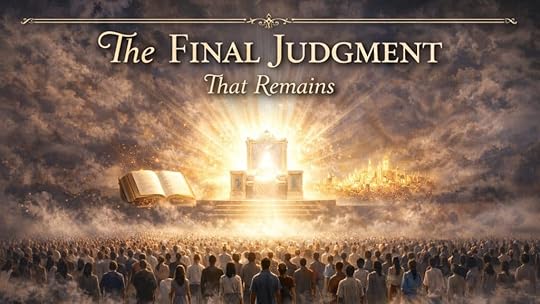 The Final Judgment That Remains
The story has reached its turning point.
Babylon has fallen.
The harlot has been exposed.
The systems that opposed Him have been brought down.
The Beast no longer stands.
The False Prophet no longer speaks.
The Adversary has been cast down.
The nations have gathered.
The rebellion has ended.
The Day of the Lord has run its course.
And still—the vision is not complete.
Something remains.
Not a city.
Not a system.
Not a throne of men.
The dead.
They have not yet stood before Him.
The grave still holds what was given to it.
Death still keeps what it claimed.
But it does not own them.
What has been buried is not forgotten.
What has been taken is not beyond His reach.
Job spoke of this moment:
Hide me in Sheol, that You would keep me secret, until Your wrath is past, that You would appoint me a set time, and remember me.
— Job 14:13
God had promised:
I will ransom them from the power of Sheol. I will redeem them from death. Death, where is your victory? Sheol, where is your sting?
— Hosea 13:14
This was not a promise to a few—but a declaration against death itself.
All who have entered the grave now approach the throne.
The Fulfillment of All ThingsThis is the moment the prophets foresaw.
Isaiah declared:
He has swallowed up death in victory. The Lord GOD will wipe away tears from off all faces.
— Isaiah 25:8
Daniel saw it:
Those who sleep in the dust of the earth shall awake.
— Daniel 12:2
This was the language of resurrection.
Jesus Himself spoke of this same hour:
The hour comes, in which all that are in the tombs will hear His voice, and will come out.
— John 5:28–29
Not some.
All.
The apostle confirms it:
The last enemy that will be abolished is death.
— 1 Corinthians 15:26
God had sworn long before:
By Myself I have sworn; from My mouth has gone out in righteousness a word that shall not return: “To Me every knee shall bow, every tongue shall swear allegiance.”
— Isaiah 45:23, ESV
The New Testament repeats this promise:
EVERY KNEE SHALL BOW, of those who are in heaven and on earth and under the earth, and every tongue will confess and openly acknowledge that Jesus Christ is Lord (sovereign God), to the glory of God the Father.
— Philippians 2:10–11, AMP
And John had already seen this end, from the very beginning of his vision:
I heard every created thing that is in heaven or on earth or under the earth [in Hades, the realm of the dead] or on the sea, and everything that is in them, saying [together], “To Him who sits on the throne, and to the Lamb (Christ), be blessing and honor and glory and dominion forever and ever.”
— Revelation 5:13, AMP
What John now reveals is that same reality:
Every creature standing.Every knee bowing.Every voice giving glory before the throne.Here the dead stand.
Death gives up all that it holds.
Every work is revealed.
The final enemy meets its end.
What was spoken in many places is not fulfilled in many moments—but in one.
This is that moment.
The Books OpenedRevelation 20:5, 11-12 (NHEB):
5 The rest of the dead did not live until the thousand years were finished…
11 I saw a great white throne, and Him who sat on it, from whose face the earth and the heaven fled away. There was found no place for them.
12 I saw the dead, the great and the small, standing before the throne, and they opened books. Another book was opened, which is the Book of Life.
It was Daniel who saw this vision first:
Thrones were placed, and the Ancient of Days took His seat… The court sat in judgment, and the books were opened… their dominion was taken away… There was given Him dominion, and glory, and a kingdom, that all the peoples, nations, and languages should serve Him. His dominion is an everlasting dominion, which shall not pass away, and His kingdom that which shall not be destroyed.
— Daniel 7:9–14
John now sees the same moment.
The throne remains.
But everything else gives way.
“Earth and the heaven fled away.”
This is not the end of creation—but the passing of the order in which it stood.
If no place is found for heaven and earth, then this is not the world as it was—but the reality into which the dead are raised.
Flesh and blood cannot inherit the Kingdom of God; neither does corruption inherit incorruption.
— 1 Corinthians 15:50
This is the general resurrection.
And the books are opened.
So the question must be asked:
What are these books?
Many assume they are a record of sins.
But Scripture has already spoken:
Having forgiven us all our trespasses, wiping out the handwriting in ordinances which was against us; He has taken it out of the way, nailing it to the cross.
— Colossians 2:14
God was in Christ reconciling the world to Himself, not counting their trespasses against them, and having committed to us the word of reconciliation.
— 2 Corinthians 5:19
If these were records of sin, then what Christ has already taken away would now be brought back.
Scripture consistently defines this judgment not as the counting of sin against the person—but as the revealing of what has been done.
If anyone builds on the foundation with gold, silver, costly stones, wood, hay, or straw; each man’s work will be revealed. For the Day will declare it, because it is revealed in fire; and the fire itself will test what sort of work each man’s work is. If any man’s work remains which he built on it, he will receive a reward. If any man’s work is burned, he will suffer loss, but he himself will be saved, but as through fire.
— 1 Corinthians 3:12-15
Christ Himself describes it:
When the Son of Man comes in His glory, and all the angels with Him, then He will sit on the throne of His glory. Before Him all the nations will be gathered, and He will separate them one from another.
— Matthew 25:31–32
And by what are they separated?
I was hungry, and you gave me food to eat. I was thirsty, and you gave me drink. I was a stranger, and you took me in.
— Matthew 25:35
Paul confirms this:
He will render to each one according to his works.
— Romans 2:6
This is how Scripture describes judgment for all.
So the books are not presented as a record of sins held against the person, but as the revealing of what each life has produced. Otherwise, what is revealed here would be treated as the basis of salvation—rather than the fruit of what Christ has already accomplished (Ephesians 2:8-9).
Scripture defines these works as love made visible.
Galatians 5:6 — faith working through love. Ephesians 2:10 — we are His workmanship, created in Christ Jesus for good works. James 1:27 — pure religion and undefiled before our God and Father is this: to visit the fatherless and widows in their affliction.Only works done in love remain.
Works can be lost, but the person is not (1 Corinthians 3:15).
This judgment does not determine who will exist—but what will remain.
The Book of Life and the City of GodNothing unclean will ever enter it… but only those who are written in the Lamb’s book of life.
— Revelation 21:27, ESV
Notice, the Book of Life is not opened to determine who will live—but who will enter the New Jerusalem.
The issue is not life—but entrance.
And this city is not presented in isolation.
The nations will walk in its light.
— Revelation 21:24
On each side of the river is the tree of life… Its leaves are for the healing of the nations.
— Revelation 22:2, NET
The same John who sees the judgment is the one who immediately shows the nations still present.
There are those within the city—and there are nations outside it.
This is not the language of final extinction—but of an ordered distinction.
Death has already been destroyed (Revelation 20:14).
And it is after this that the Book of Life determines who enters the city (Revelation 20:15).
If this book determined life itself, then those not written would return to death—after death’s destruction—meaning death would have survived its judgment.
And this fire will be shown not to destroy the person—but to deal with what belongs to death.
Those within the city do not merely exist—they reign (Revelation 22:5).
Christ Himself spoke of this:
In the regeneration when the Son of Man will sit on the throne of His glory, you also will sit on twelve thrones, judging the twelve tribes of Israel.
— Matthew 19:28
Well done, good servant. Because you were faithful with very little, you will have authority over ten cities.
— Luke 19:17
Paul confirms it:
Do you not know that the saints will judge the world?… Do you not know that we will judge angels?
— 1 Corinthians 6:2-3
This is not the language of survival—but of reward.
He who overcomes… I will write on him the name of My God, and the name of the city of My God, the New Jerusalem.
— Revelation 3:12
What Christ has accomplished is not in question.
The defeat of the adversary.The destruction of death.The forgiveness of sins.The resurrection of the dead.These stand as accomplished realities.
For as in Adam all die, so also in Christ all will be made alive.
— 1 Corinthians 15:22
Just as one trespass resulted in condemnation for all people, so also one righteous act resulted in justification and life for all people.
— Romans 5:18, NIV
All are brought into life—for all stand raised before Him, just as He said.
But what follows is not the same for all.
Look, I am coming quickly. My reward is with Me, to repay to each person according to his work.
— Revelation 22:12
What is revealed is not a contradiction—but a structure:
Life is given to all.But the city is given to the faithful.Those within it reign.
Those outside it are the nations.
So why is it called the Book of Life?
This is eternal life, that they know You, the only true God, and Jesus Christ whom You have sent.
— John 17:3, ESV
Because life, as Christ defines it, is to know God.
And this knowing is not abstract—but relational.
That is why the city is called a bride (Revelation 21:2, 9).
This pattern is not new.
To be written in the Book is to be counted among the faithful.To be blotted out is to no longer be counted among the faithful (2 Timothy 2:12-13).Let them be blotted out of the Book of Life, and not be written with the righteous.
— Psalm 69:28
This is why the apostle says:
I press on toward the goal for the prize of the high calling of God in Christ Jesus.
— Philippians 3:14
Not to obtain life—but to obtain the reward that life was meant to produce.
And again:
I beat my body and bring it into submission, lest by any means, after I have preached to others, I myself should be rejected.
— 1 Corinthians 9:27
Not rejected from life—but from the reward—the New Jerusalem.
This is what Jesus was talking about when He said:
Not everyone who says to Me, “Lord, Lord,” will enter into the kingdom of heaven; but he who does the will of My Father who is in heaven. Many will tell Me in that day, “Lord, Lord, did not we prophesy in Your name, in Your name cast out demons, and in Your name do many mighty works?” And then I will tell them, “I never knew you. Depart from Me, you who practice lawlessness.”
— Matthew 7:22
Jesus wasn’t teaching salvation by works—but revealing that entrance into the New Jerusalem is the reward of union, not activity.
So the Book of Life is not a record of who exists—but of those counted among the reward.
Those written in it:
enter the city,share in its life,and reign.Those not written:
remain among the nations.The distinction is not presented as heaven and hell—but as city and nations.
Not who lives—but who reigns.
The Release of the Dead
Revelation 20:13 (NHEB):
13 The sea gave up the dead who were in it. Death and hell gave up the dead who were in them. They were judged, each one according to his works.
Death does not open for the first time here.
Christ Himself declares:
I was dead, but look, I am alive forevermore. I have the keys of Death and of hell.
— Revelation 1:18
It has already been entered.
It has already been overcome.
And what is raised is not what was buried.
Someone will say, “How are the dead raised?” and, “With what kind of body do they come?”… you do not sow the body that will be… There are also celestial bodies, and terrestrial bodies… It is sown a natural body; it is raised a spiritual body… Flesh and blood cannot inherit the kingdom of God.
— 1 Corinthians 15:35-50
The body laid in the ground is not the body that is raised.
As with a seed, what is sown passes away.
The plant that rises does not return to the shell that was buried.
So the dead stand—not as they were, but as they are raised.
And heaven has already announced this moment:
To Me every knee shall bow, every tongue shall swear allegiance.
— Isaiah 45:23
As Christ declared:
Now is the judgment of this world. Now the prince of this world will be cast out. And I, when I am lifted up from the earth, will draw everyone to Myself.
— John 12:31-32
Death has lost what it claimed.
The captives are no longer held.
Death stands emptied.
And only when it is emptied—does it come to its end.
The Lake of Fire and the Second Death
Revelation 20:14 (NHEB):
14 Death and hell were thrown into the lake of fire. This is the second death, the lake of fire.
The vision moves forward—but not in the way we might expect.
The dead have already been raised.
They stand before the throne.
Their works have been revealed.
Now the focus shifts—not first to people—but to something else:
Death itself.
John is precise.
“Death and hell were thrown into the lake of fire.”
If the lake of fire is the “second death,” then we must ask:
Does this fire continue death and hell—or does it end them?
Scripture has already answered:
The last enemy that shall be destroyed is death.
— 1 Corinthians 15:26, KJV
Death is not a final state to be preserved.
It is the final enemy to be destroyed.
So if death is thrown into the lake of fire, one thing becomes unavoidable:
The fire cannot be a place where death continues.
This is the moment death comes to its end.
Any reading of this fire that results in death continuing—whether as an ongoing state of separation or a final act of annihilation—cannot account for what John shows here.
The text does not allow death to survive its own judgment.
So the “second death” must be read in light of what has just been shown.
If this is where death is destroyed, then we must ask:
What does Scripture say destroys death?
We know death entered through Adam:
Sin entered into the world through one man, and death through sin; and so death passed to all people.
— Romans 5:12
In Adam all die.
— 1 Corinthians 15:22
But death is destroyed through Christ’s death:
Through death He might bring to nothing him who had the power of death.
— Hebrews 2:14
This is not something still to be accomplished—but something now being revealed.
And this death is not His alone:
Romans 6:3 — Do you not know that all we who were baptized into Christ Jesus were baptized into His death?Romans 6:5 — We have become united with Him in the likeness of His death. 2 Corinthians 5:14 — One died for all, therefore all died.The death through which Christ destroys death is not isolated—it’s His own shared death.
Scripture does not move toward the strengthening of death—but toward its undoing in Christ.
Whatever is called “the second death” cannot restore what Christ has already brought to an end.
The Son of God was revealed, to destroy the works of the devil.
— 1 John 3:8
John has already shown every enemy power opposed to God—beast, false prophet, Satan, death and hell—entering the fire.
These are not random images—they correspond to what Scripture has already declared Christ came to destroy.
And yet, Scripture has always spoken of this fire—not as endless destruction, but as consuming holiness:
Do not be afraid, for I have redeemed you. I have called you by your name. You are mine. When you pass through the waters, I will be with you; and through the rivers, they will not overflow you. When you walk through the fire, you will not be burned, and the flame will not scorch you. For I am the LORD your God, the Holy One of Israel, your Savior.
— Isaiah 43:1-3
He is coming like a refiner’s fire, and like launderer’s soap. And He will sit as a refiner and purifier of silver, and He will purify the sons of Levi, and refine them as gold and silver; and they shall offer to the LORD offerings in righteousness.
— Malachi 3:2–3
Who among us can live with the devouring fire? Who among us can live with everlasting burning? He who walks righteously… he will dwell on high.
— Isaiah 33:14-16
The lake of fire is not separate from God—it is an encounter with Him.
The fire that proceeds from God’s presence:
reveals,removes,and refines.This is not a new idea introduced at the end of the John’s vision.
John the Baptist had already declared it at the beginning:
He will baptize you… with fire… the chaff He will burn up with unquenchable fire.
— Matthew 3:11-12
The fire that accompanies Christ’s work is not separate from His salvation—it is the means by which what is false is removed and what is true remains.
What is announced at the beginning of His ministry is revealed in fullness at the throne.
Daniel saw this river of fire flowing from the throne:
A river of fire was flowing, coming out from before Him. Thousands upon thousands attended Him; ten thousand times ten thousand stood before Him. The court was seated, and the books were opened.
— Daniel 7:10, NIV
John, seeing what proceeds from that same throne, describes it this way:
Then the angel showed me the river of the water of life… flowing from the throne of God.
— Revelation 22:1, NIV
These are not two different sources.
They proceed from the same throne.
What flows from God is life because He is the Source of life (John 5:26).
And yet Scripture also declares:
Our God is a consuming fire.
— Hebrews 12:29
So the question is not which one is true—but how both are true.
What proceeds from God is life—and to whatever is not of Him, that same life is experienced as fire.
This is why death does not endure in His presence.
It is not sustained.
It is consumed.
As the apostle writes:
We do not wish to be unclothed but to be clothed instead with our heavenly dwelling, so that what is mortal may be swallowed up by life.
— 2 Corinthians 5:4, NIV
Sin and death do not survive the fire—because the fire that proceeds from the throne is the very life of God.
When this fire is applied, the question is not whether something is destroyed—but what is destroyed?
Whatever “destruction” means here, it cannot undo what has just been revealed—for the dead have been raised, and death itself has been brought to its end.
Scripture does not describe this as the destruction of the creature—but as its liberation from bondage:
The creature was made subject to vanity, not willingly, but by reason of Him who hath subjected the same in hope, because the creature itself also shall be delivered from the bondage of corruption into the glorious liberty of the children of God.
— Romans 8:20–21
God is not destroying His creation—He is destroying what held creation captive.
God did not send His Son into the world to judge the world, but that the world should be saved through Him.
— John 3:17
This is why death is consumed in the fire—because sin and death were never a part of God’s original design.
And now this last enemy is destroyed.
Outside the Book of Life
Revelation 20:15 (NHEB):
15 If anyone was not found written in the Book of Life, he was cast into the lake of fire.
The judgment reaches its final expression.
Jesus Himself spoke of this moment:
The hour comes, in which all that are in the tombs will hear His voice, and will come out; those who have done good, to the resurrection of life; and those who have done evil, to the resurrection of judgment.
— John 5:28–29
Both groups are raised.
So the distinction cannot be between life and non-life—but between life and judgment.
Daniel speaks of the same event:
Those who sleep in the dust of the earth shall awake, some to everlasting life, and some to shame and everlasting contempt.
— Daniel 12:2
Not “to death”—but to shame.
Paul describes what happens in this judgment:
If any man’s work is burned, he will suffer loss, but he himself will be saved, but as through fire.
— 1 Corinthians 3:15
There is loss—but not the loss of the person.
This same moment is spoken of throughout Scripture:
Before Him all the nations will be gathered, and He will separate them one from another, as a shepherd separates the sheep from the goats.
— Matthew 25:32
To one:
Come, blessed of My Father, inherit the Kingdom prepared for you.
— Matthew 25:34
To the other:
Those found in the Book of Life inherit the Kingdom. Those not found are cast into the fire—the same fire Scripture has revealed as refining.Depart from Me, you cursed, into the everlasting fire.
— Matthew 25:41
Jesus goes on to say:
These will go away into everlasting punishment, but the righteous into everlasting life.
— Matthew 25:46
The question is not whether there is judgment—but what this punishment is.
Jesus speaks of this punishment the same way elsewhere:
Luke 13:28 — There will be weeping and grinding of teeth, when you see Abraham, Isaac, Jacob, and all the prophets, in the Kingdom of God, and yourselves being thrown outside. Matthew 24:51 — assign him a place with the hypocrites.Matthew 25:30 — throw out the unprofitable servant into the outer darkness.The language is consistent:
they see the kingdom, they see others inside, they recognize loss.And Revelation ends with the same picture:
Blessed are they who wash their robes, that they may have the right to the tree of life, and may enter in by the gates into the city. Outside are the dogs.
— Revelation 22:14-15
The punishment is consistently described as exclusion from the city.
Nothing unclean will ever enter it… but only those who are written in the Lamb’s book of life.
— Revelation 21:27
The issue is not existence—but entrance.
The judgment is eternal—not as an ongoing act, but as a result that stands.
To not be found in the Book of Life is to remain among the nations, for whom the healing of the tree of life is given (Revelation 22:2).
This is why Scripture speaks the way it does:
We have set our trust in the living God, who is the Savior of all people, especially of those who believe.
— 1 Timothy 4:10
So the judgment is the revealing of truth and the assigning of what follows.
All are raised.
But not all inherit.
The fire has accomplished its purpose.
The judgment is complete.
The dead have been raised.
The books have been opened.
Every life has been revealed.
Every work has been tested.
The fire has done its work.
What cannot endure has been removed.
And the distinction has been made—not between existence and non-existence, but between inheritance and loss.
The throne has judged.
But this moment does not stand alone.
It changes what follows.
Blessed are the dead who die in the Lord from now on.
— Revelation 14:13
From this point forward, death no longer holds the dead.
To be absent from the body is to be present with the Lord (2 Corinthians 5:8).
What was revealed in fullness now becomes the pattern for each life.
It is appointed for people to die once, and after this, judgment.
— Hebrews 9:27
There is no longer a holding place—only a revealing.
No longer a delay—only a change (1 Corinthians 15:51).
What was unveiled at the throne now meets each person in their own time.
And with death no longer reigning, the vision moves forward—not to another judgment, but to what remains when judgment is complete:
Reflection QuestionI saw a new heaven and a new earth.
— Revelation 21:1
Does your life reveal true union with Christ—fruit that will remain—or works that will not endure when everything is brought into the light?
Want to Go Further? Explore at Your Own Pace: [image error] Get the Book
Rediscover the Trinity—not as a puzzle, but as a redemptive story of love.
[image error] Join the Newsletter
Thoughtful, Scripture-rooted teaching to help you ask honest questions, rediscover the Gospel, and see God through the lens of Jesus.
You’ll also receive free resources if you’d like to explore further:
[image error] Join the Facebook Group
Ask questions and connect with others on the same journey.
[image error] Already Read the Book?
Leave a quick review—just a sentence or two—to help others find clarity too!
The Great White Throne judgment (Revelation 20:11–15) is the moment when all the dead are raised and stand before God, their works are revealed, and death itself is brought to its end. It is not presented as a second chance or a reversal of the cross, but as the public unveiling of truth—where what Christ has accomplished is fully revealed in every life.
Does Revelation 20 teach a general resurrection of all people?Yes. Revelation 20 describes a universal resurrection in which all the dead—“the small and the great”—stand before the throne (Revelation 20:12). This fulfills the consistent biblical promise that death would not retain what it had claimed (John 5:28–29; 1 Corinthians 15:22).
Are the books in Revelation 20 a record of sins?The books are not understood as a record of sins held against individuals, since Scripture declares that sin was dealt with at the cross (Colossians 2:14). Instead, the books reveal what each life has produced—works that are tested, exposed, and either remain or are burned (1 Corinthians 3:13–15).
What is the Book of Life in Revelation 20?The Book of Life is presented as identifying those who inherit entrance into the New Jerusalem (Revelation 21:27). The issue is not who exists, but who enters, reigns, and shares in the reward of union with Christ. It distinguishes inheritance, not existence.
Does Revelation 20 teach annihilation or eternal death?No. Revelation 20 does not describe the extinction of persons, but the destruction of death itself (1 Corinthians 15:26). The focus is on resurrection, the revealing of works, and the distinction between inheritance and loss—not existence versus nonexistence.
What is the lake of fire in Revelation 20?The lake of fire (Revelation 20:14–15) is understood here as the fire of God’s own presence—a refining and consuming fire (Hebrews 12:29) that reveals, removes, and destroys everything that belongs to sin and death. It is where death is ended, not where death continues.
What happens to those not found in the Book of Life?Those not found in the Book of Life do not inherit the New Jerusalem. The distinction is described as being outside the city rather than inside it (Revelation 22:14–15). The outcome is framed as inheritance and loss, city and nations, reward and exclusion—not existence versus nonexistence.
How does Revelation 20 connect to Revelation 21–22?Revelation 20 shows the final judgment and the end of death, while Revelation 21–22 reveals what follows: the New Jerusalem, the nations, and the ongoing reality of God’s kingdom. The judgment completes what was promised, and the next chapters show what remains.
What does the Great White Throne judgment mean for us today?Revelation 20 calls us to examine whether our lives reveal true union with Christ—fruit that will remain when everything is brought into the light. It is not about earning life, but about living in the reality of what Christ has already accomplished.
{ "@context": "https://schema.org", "@type": "BlogPosting", "mainEntityOfPage": { "@type": "WebPage", "@id": "https://jesusconquers.com/revelation-..." }, "headline": "Revelation Chapter 20 (Part 2): The Great White Throne", "description": "Revelation 20 reveals the Great White Throne as the final unveiling of truth: the dead are raised, the books are opened, death is destroyed, and the distinction between inheritance and loss is made plain. Rather than a reversal of Christ’s victory, this judgment reveals what His triumph over sin and death has accomplished.", "image": "https://jesusconquers.com/wp-content/...", "author": { "@type": "Person", "name": "David Longenecker", "url": "https://jesusconquers.com/about/" }, "publisher": { "@type": "Organization", "name": "Jesus Conquers", "logo": { "@type": "ImageObject", "url": "https://jesusconquers.com/wp-content/..." } }, "datePublished": "2026-04-14T09:00:00-04:00", "dateModified": "2026-04-14T09:00:00-04:00", "articleSection": "Theology", "inLanguage": "en-US", "isPartOf": { "@type": "CreativeWorkSeries", "name": "Revelation: The Clock Is Ticking", "url": "https://jesusconquers.com/category/re..." }, "keywords": [ "Great White Throne judgment", "Revelation 20 Great White Throne", "Revelation 20 explained", "Revelation 20 meaning", "Book of Life Revelation 20", "books were opened Revelation 20", "lake of fire Revelation 20", "second death Revelation 20", "general resurrection Revelation 20", "final judgment Revelation 20", "New Jerusalem Revelation 20", "Revelation 20 preterist interpretation", "Revelation 20 amillennial view", "death destroyed Revelation 20" ], "url": "https://jesusconquers.com/revelation-...", "speakable": { "@type": "SpeakableSpecification", "cssSelector": [ ".entry-title", ".entry-content p:first-of-type" ] }} { "@context": "https://schema.org", "@type": "FAQPage", "mainEntity": [ { "@type": "Question", "name": "What is the Great White Throne judgment in Revelation 20?", "acceptedAnswer": { "@type": "Answer", "text": "The Great White Throne judgment (Revelation 20:11–15) is the moment when all the dead are raised and stand before God, their works are revealed, and death itself is brought to its end. It is not presented as a second chance or a reversal of the cross, but as the public unveiling of truth—where what Christ has accomplished is fully revealed in every life." } }, { "@type": "Question", "name": "Does Revelation 20 teach a general resurrection of all people?", "acceptedAnswer": { "@type": "Answer", "text": "Yes. Revelation 20 describes a universal resurrection in which all the dead—“the small and the great”—stand before the throne (Revelation 20:12). This fulfills the consistent biblical promise that death would not retain what it had claimed (John 5:28–29; 1 Corinthians 15:22)." } }, { "@type": "Question", "name": "Are the books in Revelation 20 a record of sins?", "acceptedAnswer": { "@type": "Answer", "text": "The books are not understood as a record of sins held against individuals, since Scripture declares that sin was dealt with at the cross (Colossians 2:14). Instead, the books reveal what each life has produced—works that are tested, exposed, and either remain or are burned (1 Corinthians 3:13–15)." } }, { "@type": "Question", "name": "What is the Book of Life in Revelation 20?", "acceptedAnswer": { "@type": "Answer", "text": "The Book of Life is presented as identifying those who inherit entrance into the New Jerusalem (Revelation 21:27). The issue is not who exists, but who enters, reigns, and shares in the reward of union with Christ. It distinguishes inheritance, not existence." } }, { "@type": "Question", "name": "Does Revelation 20 teach annihilation or eternal death?", "acceptedAnswer": { "@type": "Answer", "text": "No. Revelation 20 does not describe the extinction of persons, but the destruction of death itself (1 Corinthians 15:26). The focus is on resurrection, the revealing of works, and the distinction between inheritance and loss—not existence versus nonexistence." } }, { "@type": "Question", "name": "What is the lake of fire in Revelation 20?", "acceptedAnswer": { "@type": "Answer", "text": "The lake of fire (Revelation 20:14–15) is understood here as the fire of God’s own presence—a refining and consuming fire (Hebrews 12:29) that reveals, removes, and destroys everything that belongs to sin and death. It is where death is ended, not where death continues." } }, { "@type": "Question", "name": "What happens to those not found in the Book of Life?", "acceptedAnswer": { "@type": "Answer", "text": "Those not found in the Book of Life do not inherit the New Jerusalem. The distinction is described as being outside the city rather than inside it (Revelation 22:14–15). The outcome is framed as inheritance and loss, city and nations, reward and exclusion—not existence versus nonexistence." } }, { "@type": "Question", "name": "How does Revelation 20 connect to Revelation 21–22?", "acceptedAnswer": { "@type": "Answer", "text": "Revelation 20 shows the final judgment and the end of death, while Revelation 21–22 reveals what follows: the New Jerusalem, the nations, and the ongoing reality of God’s kingdom. The judgment completes what was promised, and the next chapters show what remains." } }, { "@type": "Question", "name": "What does the Great White Throne judgment mean for us today?", "acceptedAnswer": { "@type": "Answer", "text": "Revelation 20 calls us to examine whether our lives reveal true union with Christ—fruit that will remain when everything is brought into the light. It is not about earning life, but about living in the reality of what Christ has already accomplished." } } ] } { "@context": "https://schema.org", "@type": "BreadcrumbList", "itemListElement": [ { "@type": "ListItem", "position": 1, "name": "Home", "item": "https://jesusconquers.com/" }, { "@type": "ListItem", "position": 2, "name": "Revelation Series", "item": "https://jesusconquers.com/category/re..." }, { "@type": "ListItem", "position": 3, "name": "Revelation Chapter 20 (Part 2): The Great White Throne", "item": "https://jesusconquers.com/revelation-..." } ]}The post Revelation Chapter 20 (Part 2) — The Great White Throne appeared first on Jesus Conquers.
April 13, 2026
Revelation Chapter 20 (Part 1) — The Day of the Lord
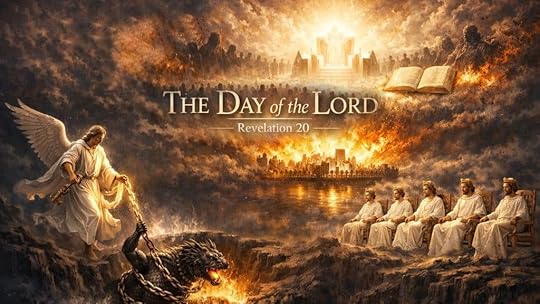 The Most Contested Chapter in Scripture
Revelation 20 is where everything divides.
“They lived, and reigned with Christ for a thousand years.“
That single phrase has shaped the major views of the end times:
Premillennialism says the thousand years is still ahead.Postmillennialism says it comes through the victory of the church.Amillennialism says we’re living in it now.Faithful readers of Scripture have come to different conclusions—not because they ignore the text, but because they approach it differently.
But for all their differences, they begin in the same place.
They share the same assumption:
The thousand years is Christ’s reign.
But Revelation itself never identifies the thousand years as the fullness of Christ’s reign. Instead, it describes a defined and limited period within that reign.
The thousand-year period has a beginning… and it has an end.
The text says so directly.
…the thousand years were ended.
— Revelation 20:3, ESV
But Christ’s reign does not end.
Scripture consistently declares that His kingdom is without end:
Of the increase of His government and peace there shall be no end.
— Isaiah 9:7, KJV
He shall reign… and of His kingdom there shall be no end.
— Luke 1:33, KJV
His dominion is an everlasting dominion, which shall not pass away.
— Daniel 7:14, KJV
So if Revelation 20 describes something with a beginning and an end…
it cannot be the fullness of His reign.
So what are we looking at?
Whatever the thousand years represents, it must fit within Christ’s already-established reign, not define its entirety.
The Day of the LordScripture reveals a moment found throughout Revelation—the point where everything comes to a head.
Judgment.Vindication.The collapse of one world… and the revealing of another.The prophets had a name for it:
The Day of the Lord.
The prophets described the Day of the Lord as a decisive act of judgment—not an endless state.
The sun will be turned into darkness, and the moon into blood, before the great and awesome Day of the Lord comes.
— Joel 2:31
What the prophet spoke in imagery begins to break into history through Christ.
At the crucifixion, darkness fell over the land (Matthew 27:45). At Pentecost, Peter explicitly identifies Joel’s prophecy as being fulfilled in their midst (Acts 2:16-20).This “Day” is not a single 24-hour event, but a prophetic span—beginning with Christ’s first coming and culminating in the judgment He foretold within that generation.
Truly I tell you, this generation will not pass away, until all these things are accomplished.
— Matthew 24:34
For these are days of vengeance, that all things which are written may be fulfilled.
— Luke 21:22
Not a day far off.
A real, approaching moment—where all that was written would reach its fulfillment.
Throughout Revelation, numbers often function symbolically rather than as exact measurements—seven (perfection or fullness), twelve (the people of God), ten (completeness in scope or totality).
The thousand years follows that same pattern:
Not a precise count,
but a complete, appointed span.
Scripture has already used this kind of language:
A thousand years in your sight are like a day that has just gone by.
— Psalm 90:4, NIV
One day is with the Lord as a thousand years, and a thousand years as one day.
— 2 Peter 3:8
This is not a matter of calculation, but of perspective.
This is what Revelation 20 is describing.
The “thousand years” is not a future golden age, nor the eternal reign of Christ—because Scripture never uses that number to describe either.
It is a day—the Day of the Lord itself: a defined and appointed span within Christ’s reign, one that has a beginning and an end.
Some may object: How can “a thousand years” describe a span of roughly forty years (30–70 AD)?
The exact timing and duration of that Day were not revealed to the disciples (Matthew 24:36).
John is not telling us how long it lasts, but what kind of span it is.
The focus is not its length, but its role within God’s plan.
And Revelation does more than name that span—it shows its structure.
The “thousand years” is not presented as an undefined era, but as a complete sequence with a beginning, a middle, and an end.
It begins with the binding of Satan (Revelation 20:1–3),continues with the reign and witness of the saints (Revelation 20:4–6),moves to a final gathering of the nations and immediate judgment (Revelation 20:7–9),and culminates in the restoration of God’s people (Revelation 21–22).This is not a vague age. Scripture has already revealed this pattern.
The prophets spoke of a Day that reaches this same climax:
the nations gathered (Joel 3:2; Zechariah 14:2),brought into judgment (Joel 3:2; Zephaniah 3:8),the Lord revealed in power (Zechariah 14:3; Ezekiel 38:16),and His people restored (Joel 3:1; Zephaniah 3:20).Jesus described that same pattern unfolding within His generation—marked by deception, conflict, final judgment, and the gathering of His elect (Matthew 24).
There is no other period in Scripture that contains this complete pattern.
This is why Revelation 20 does not move the story forward—but pulls back the curtain.
In Revelation 19, the nations gather for war against the Rider—and are immediately defeated (Revelation 19:19–21).In Revelation 20, the nations gather (Gog and Magog), surround the saints, and are immediately consumed by fire (Revelation 20:8–9).There is no new battle introduced—only the same gathering revealed from another angle.
The pattern is identical:
gathering → confrontation → immediate judgment.
Revelation 20 is not a sequel to Revelation 19.
It is a deeper unveiling of the same climactic moment.
Once you see this, the question changes.
Not: “When does Jesus begin to reign?”
But: “What was happening during the Day in which His reign was being revealed?”
Revelation 20:1-3 (NHEB):
1 I saw an angel coming down out of heaven, having the key of the abyss and a great chain in his hand.
2 He seized the serpent, the ancient snake, which is the devil and Satan, and bound him for a thousand years,
3 and cast him into the abyss, and shut it, and sealed it over him, that he should deceive the nations no more, until the thousand years were finished. After this, he must be freed for a short time.
Revelation 20 opens with a dramatic image.
An angel descends from heaven.
He holds a key.
A great chain.
He seizes the dragon—the serpent of old, the devil, Satan—and binds him.
He is cast into the abyss, shut in, sealed over:
“That he should deceive the nations no more.”
This does not mean all deception ends.
It means the kind of deception that once held the nations in darkness is broken.
The deception is no longer total.
The light has entered.
At first glance, it’s easy to assume this is something still in the future.
But from the beginning, Scripture pointed to this moment.
I will put enmity (open hostility) between you and the woman, and between your seed (offspring) and her Seed; He shall [fatally] bruise your head, And you shall [only] bruise His heel.
— Genesis 3:15, AMP
The prophets had spoken about a day when spiritual powers would be confined:
On that Day the Lord will punish the host of heaven, in heaven, and the kings of the earth, on the earth. They will be gathered together as prisoners in a pit; they will be shut up in a prison, and after many days they will be punished.
— Isaiah 24:21–22, ESV
The language of Revelation 20:3 mirrors this:
Gathered / Cast inShut in / Sealed overAwaiting judgmentJesus spoke about it during His ministry.
How can one enter into the house of the strong man, and carry off his possessions, unless he first bind the strong man? And then he will plunder his house.
— Matthew 12:29
Before Christ, the nations were under the authority of the evil one:
The devil said to him, “I will give you all this authority, and their glory, for it has been delivered to me.”
— Luke 4:6
The strong man must be bound before his house can be plundered.
And even the demons recognized this:
They shouted, saying, “What do we have to do with you, Son of God? Have you come here to torment us before the time?”
— Matthew 8:29
What Isaiah saw in shadow, Jesus began to fulfill—and Revelation now unveils.
Revelation has already shown us where this happened.
In Chapter 12, the dragon is cast down.
He loses his place in heaven.
He is no longer able to accuse the people of God before the throne.
Now the accuser of our brothers has been thrown down.
— Revelation 12:10
That is the turning point.
The apostles say the same thing.
Having disarmed the powers and authorities, He made a public spectacle of them, triumphing over them by the cross.
— Colossians 2:15, NIV
Through death He might destroy him that had the power of death, that is, the devil.
— Hebrews 2:14, KJV
This victory is accomplished in His death and resurrection.
This is not the language of delay—it is the language of victory.
Before this, Satan is shown moving between heaven and earth.
In Job, he presents himself before God (Job 1:6–7).In Zechariah, he stands accusing the high priest (Zechariah 3:1–2).But after this moment—that access is gone.
Revelation 20 is not introducing something new.
It describes the same turning point already revealed in Revelation 12—now in terms of its effect on the nations.
Throughout Revelation, the abyss is a place of restraint—a prison from which forces are released only by permission (Revelation 9).
The binding of Satan means Satan’s authority has been restricted.
He is no longer able to accuse the people of God before the throne.
He is no longer free to move as he once did.
This is why the New Testament still speaks of spiritual conflict:
Your adversary the devil prowls around like a roaring lion, seeking someone to devour.
— 1 Peter 5:8, ESV
We do not wrestle against flesh and blood, but against the rulers, against the authorities, against the cosmic powers over this present darkness, against the spiritual forces of evil in the heavenly places.
— Ephesians 6:12
The conflict remains—but the authority has changed.
This explains what we’ve already seen throughout Revelation.
Satan does not act openly and directly.
He works through others:
The dragon is still present—but he is forced to operate through mediating powers.
Satan no longer holds authority over the nations as he once did.
Jesus is now the King of kings and Lord of lords—the One to whom all authority in heaven and on earth belongs (Matthew 28:18).
And this victory does not remain on the surface of history.
It reaches into the realm of death itself—where the final enemy will also be confronted.
This pattern follows a consistent principle seen throughout Scripture:
God’s judgment does not erase creation—it removes what corrupts it.
The binding of Satan is not the elimination of his existence, but the restriction of his authority.
What is opposed to God’s life is restrained, so that what belongs to God may flourish.
Revelation 20:4-6 (NHEB):
4 I saw thrones, and they sat on them, and judgment was given to them. I saw the souls of those who had been beheaded for the testimony of Jesus, and for the word of God, and such as did not worship the beast nor his image, and did not receive the mark on their forehead and on their hand. They lived, and reigned with Christ for a thousand years.
5 The rest of the dead did not live until the thousand years were finished. This is the first resurrection.
6 Blessed and holy is he who has part in the first resurrection. Over these, the second death has no power, but they will be priests of God and of Christ, and will reign with him one thousand years.
John specifically says he saw “the souls” of those who had been beheaded, not their bodies. The scene is not one of graves opening, but of vindicated lives reigning with Christ.
This matches what has already been shown in Revelation, where the martyrs are seen alive in God’s presence, awaiting vindication.
John is very specific.
Those who had been killed for the testimony of Jesus.
Those who refused the mark of the beast.
This is the same group we have seen throughout the book.
In Revelation 2:10, the saints were told to be faithful unto death. In Revelation 6:9, they cried out from beneath the altar.In Revelation 7:14, they stood before the throne, clothed in white.In Revelation 14:4, they were called firstfruits.The writer of Hebrews describes it this way:
Others were tortured, not accepting the payment for release, that they might obtain a better resurrection.
— Hebrews 11:35
This is what we are seeing here.
The martyrs are vindicated first.
They reign with Christ during the Day of the Lord.
They share in His authority during that appointed time.
This resurrection is not the final resurrection of all people, but the vindication and participation in life with Christ granted first to those who remained faithful unto death.
This is why they are called firstfruits.
Israel was holy [something set apart from ordinary purposes, consecrated] to the LORD, the first fruits of His harvest.
— Jeremiah 2:3, AMP
In Scripture, firstfruits language describes the beginning of a greater harvest—the first portion that represents what is to come (1 Corinthians 15:23; Revelation 14:4; Matthew 27:53).
John calls this firstfruits resurrection: The first resurrection.
Those who were called to be faithful unto death are now seen as having overcome.
They enter ahead of the rest—sharing in life with Christ without waiting for the general resurrection.
What was promised in Revelation 2–3 is now revealed in full.
To those who overcame, Jesus said the second death would not harm them (Revelation 2:11)—and here it is fulfilled: “Over these the second death has no power.”To those who overcame, He promised life (Revelation 3:5)—and now: “They lived.”To those who overcame, He promised authority over the nations (Revelation 2:26)—and here: “I saw thrones, and they sat on them.”To those who overcame, He promised a place with Him (Revelation 3:12)—and now they are seen reigning with Him.This is the fulfillment of what was spoken from the beginning.
Revelation has been following this group all along.
And now, at last, their vindication is revealed.
But the story does not end here.
The fullness of these promises will be revealed as the vision continues in Chapters 21-22.
The Release of Satan
Revelation 20:7-9 (NHEB):
7 And after the thousand years, Satan will be released from his prison,
8 and he will come out to deceive the nations which are in the four quarters of the earth, Gog and Magog, to gather them together to the war; the number of whom is as the sand of the sea.
9 They went up over the breadth of the earth, and surrounded the camp of the saints, and the beloved city, and fire came down out of heaven and devoured them.
The vision turns.
“After the thousand years, Satan will be released.”
What was restrained is now released.
What was limited now moves freely.
And the result is immediate.
“He will come out to deceive the nations… to gather them together to the war.”
The prophets had already spoken of this moment:
In the latter days, I will bring you against my land, that the nations may know me, when I shall be sanctified in you, Gog, before their eyes… For in my jealousy and in the fire of my wrath have I spoken, surely in that day there shall be a great shaking in the land of Israel… Every man’s sword shall be against his brother… and I will rain… fire and sulfur.
— Ezekiel 38:16-22
John names it plainly:
Gog and Magog.
A known pattern now brought into full view.
Gog gathers.
God answers.
As the Day of the Lord comes to its close.
Revelation has already shown this:
I saw the beast, and the kings of the earth, and their armies, gathered together to make war against him who sat on the horse, and against his army.
— Revelation 19:19
They rise together.
They come against the Rider.
And they fall.
No prolonged battle.
No uncertain outcome.
The gathering is the judgment.
Now the veil is lifted.
The gathering is tied to Satan’s release.
“He will come out to deceive.”
In Revelation 12, the dragon is cast down and stands upon the sand of the sea.
What follows is not random.
The dragon gives rise to the beast:
He deceives those who dwell on the earth.
— Revelation 13:14
With your sorcery all the nations were deceived.
— Revelation 18:23
The deception spreads.
The system forms.
The people follow.
The gathering does not begin with armies.
It begins with people.
Scattered among the nations, drawn from every direction, and gathered into the land:
“The number of whom is as the sand of the sea.”
This is covenant language.
I will greatly multiply your offspring… like the sand which is on the seashore.
— Genesis 22:17
But here, the image turns.
Not expansion—but concentration.Not blessing—but reckoning.Not preservation—but exposure.Drawn from among the nations, they become like the nations.
What was meant to set them apart no longer does.
What begins as devotion becomes zeal.
What appears as gathering becomes mobilization.
Satan draws together a people already prepared—not to be preserved, but to be judged.
Jerusalem is called Sodom and Egypt (Revelation 11:8).Jerusalem is called Babylon (Revelation 18:24).Now Jerusalem is revealed in the language of Gog.
“They… surrounded the camp of the saints, and the beloved city.”
The city at the center of the story.
The city where the Lord was crucified.
The place where everything converges.
This gathering brings the nation into the judgment already revealed—the winepress of God (Revelation 14:19).
In the first century, Jerusalem became the place where the people were drawn together from every part of the Roman world.
At the feast of Passover in 70 AD, the city filled beyond capacity as the people gathered from every direction.
Josephus records that vast multitudes were gathered within its walls—numbered in the hundreds of thousands, even over a million.
They gathered believing God was with them—despite every warning that He was not.
Once the gathering was complete, the city was sealed.
And the judgment fell.
“Fire came down out of heaven and devoured them.”
There is no prolonged battle—only collapse.
Just as it was spoken: brother against brother (Ezekiel 38:21).
As with Ammon and Moab, who fell by their own hands (2 Chronicles 20:22–23), so the city turned against itself.
The zealot divisions consumed it from within—just as the prophets foretold.
Look, the day of the LORD comes, cruel, with wrath and fierce anger; to make the land a desolation, and to destroy its sinners out of it.
— Isaiah 13:9
Neither their silver nor their gold will be able to deliver them in the day of the LORD’s wrath, but the whole land will be devoured by the fire of his jealousy; for he will make an end, yes, a terrible end, of all those who dwell in the land.
— Zephaniah 1:18
And in the end, the fire was not only spoken—it fell.
The city burned.
The temple was consumed.
What the prophets declared, history records.
The Day of the Lord had reached its end.
The Devil, the Beast, and the False Prophet
Revelation 20:10 (NHEB):
10 The devil who deceived them was thrown into the lake of fire and sulfur, where the beast and the false prophet are also. They will be tormented day and night forever and ever.
By this point in Revelation, the beast and the false prophet have already been revealed.
The beast is not a single individual, but a kingdom—political power given authority by the dragon (Revelation 13:2).The false prophet is not a single individual, but a system of religious deception—leading the people astray (Revelation 13:14).Together, they form a single structure:
The dragon — the source of deception.The beast — the power of the system.The false prophet — the voice of the system.This system has been judged.
These two were thrown alive into the lake of fire that burns with sulfur.
— Revelation 19:20
The beast and the false prophet are judged and removed.
The power that defined them collapses.
The form they had taken cannot stand.
Now, in Revelation 20, the dragon joins them.
The source is cast down into the same judgment as the system it empowered.
“They will be tormented day and night forever and ever.”
At first glance, this appears to describe ongoing suffering. But the beast and false prophet are not individuals but systems, the language cannot describe literal ongoing experience. It must describe the complete and irreversible end of what they represent.
The phrase “forever and ever” (Greek: eis tous aionas ton aionon) is drawn from the language of prophetic judgment. It describes the permanence of an outcome, not the ongoing experience of a process.
In Edom smoke rises “forever” (Isaiah 34:10), but the land is not still burning—it has been permanently judged.Sodom suffers “eternal fire” (Jude 1:7), but the fire is not still active—the destruction is irreversible.The language points to a result that cannot be undone.
Revelation itself defines this:
The lake of fire… is the second death.
— Revelation 20:14
Not ongoing life in torment—but a final, irreversible end.
The language of “day and night” confirms this further.
This phrase belongs to the structure of the present world—the rhythm of time as we know it (Genesis 1:5).
But Revelation declares of the new creation:
There will be no night there.
— Revelation 21:25
There will no longer be any night, and they have no need for the light of a lamp or the light of the sun, because the Lord God will shine on them.
— Revelation 22:5
If the final state has no night, then language built on “day and night” cannot describe that final state.
It belongs to the order that is passing away.
It is a judgment in time—expressed in the language of time.
What is being shown is not endless suffering, but decisive removal.
The Day of the Lord is fulfilled.
The rebellion has ended.
The beast, the false prophet, and the dragon have been cast down.
What stood behind the kingdoms has been judged.
What filled them has been removed.
The Day has brought the covenant world to its end.
But it is not the final judgment of all humanity.
What is revealed here is the decisive transition: the old order judged, the powers behind it removed, and the authority of Christ fully unveiled.
Yet death itself remains to be addressed.
The last enemy that will be abolished is death.
— 1 Corinthians 15:26
The final judgment still stands ahead—where all will be raised, and every work brought before the throne.
Reflection QuestionIf the “thousand years” is a completed Day in which judgment, vindication, and final rebellion have already unfolded, how should this reshape the way you read both history and prophecy?
Want to Go Further? Explore at Your Own Pace: [image error] Get the Book
Rediscover the Trinity—not as a puzzle, but as a redemptive story of love.
[image error] Join the Newsletter
Thoughtful, Scripture-rooted teaching to help you ask honest questions, rediscover the Gospel, and see God through the lens of Jesus.
You’ll also receive free resources if you’d like to explore further:
[image error] Join the Facebook Group
Ask questions and connect with others on the same journey.
[image error] Already Read the Book?
Leave a quick review—just a sentence or two—to help others find clarity too!
The “thousand years” is not a literal timeline but a symbolic, complete period within Christ’s reign. It represents the Day of the Lord—a defined span of judgment and vindication that has a beginning and an end.
Does Revelation 20 describe Christ’s full reign?No. Scripture consistently teaches that Christ’s reign has no end (Isaiah 9:7; Luke 1:33). Since the “thousand years” has a clear beginning and end, it cannot represent the fullness of His eternal reign.
When is the Day of the Lord fulfilled?The Day of the Lord is presented as a prophetic period beginning with Christ’s first coming and culminating in the judgment He said would occur within “this generation” (Matthew 24:34), reaching fulfillment in the first century.
What does the binding of Satan mean?The binding of Satan does not mean all evil or deception ends. It means his authority to fully deceive the nations is restricted. After Christ’s victory, the gospel goes out to all nations, and the darkness that once dominated is broken.
What is the “first resurrection”?The first resurrection refers to the vindication of faithful believers—especially martyrs—who share in life and reign with Christ. It is not the final resurrection of all humanity, but the firstfruits of what is to come.
Is Revelation 20 describing a future event?No. Revelation 20 is not a future timeline but a symbolic unveiling of events already fulfilled in redemptive history, particularly surrounding the fall of Jerusalem and the end of the old covenant order.
What does the “lake of fire” represent?The lake of fire represents final, irreversible judgment—the “second death.” It is not ongoing conscious torment, but the complete and permanent removal of what opposes God’s life.
Does Revelation 20 describe the final judgment of all people?Revelation 20 culminates in the Great White Throne judgment, where the dead are raised and judged, and death itself is destroyed. This includes the dead from Adam through the end of the old covenant age. This judgment marks the transition point, after which individuals stand before God upon death rather than awaiting a future collective resurrection event.
Why does this interpretation differ from common end-times views?Most interpretations assume Revelation 20 describes a future chronological sequence. This framework reads Revelation as a series of recapitulating visions, allowing the text itself to define its timing, structure, and fulfillment.
{ "@context": "https://schema.org", "@type": "BlogPosting", "mainEntityOfPage": { "@type": "WebPage", "@id": "https://jesusconquers.com/revelation-..." }, "headline": "Revelation Chapter 20 (Part 1): The Day of the Lord", "description": "Revelation 20 reveals the thousand years as the symbolic Day of the Lord—a defined period of judgment, vindication, Satan’s restraint, the first resurrection, and the fall of the old covenant world. Rather than describing the fullness of Christ’s reign, the chapter unveils a climactic covenantal transition within His everlasting kingdom.", "image": "https://jesusconquers.com/wp-content/...", "author": { "@type": "Person", "name": "David Longenecker", "url": "https://jesusconquers.com/about/" }, "publisher": { "@type": "Organization", "name": "Jesus Conquers", "logo": { "@type": "ImageObject", "url": "https://jesusconquers.com/wp-content/..." } }, "datePublished": "2026-04-08T09:00:00-04:00", "dateModified": "2026-04-08T09:00:00-04:00", "articleSection": "Theology", "inLanguage": "en-US", "isPartOf": { "@type": "CreativeWorkSeries", "name": "Revelation: The Clock Is Ticking", "url": "https://jesusconquers.com/category/re..." }, "keywords": [ "Revelation 20 explained", "Revelation 20 meaning", "the thousand years Revelation 20", "Day of the Lord Revelation 20", "binding of Satan Revelation 20", "first resurrection Revelation 20", "Gog and Magog Revelation 20", "lake of fire Revelation 20", "Revelation 20 preterist interpretation", "Revelation 20 amillennial view", "Revelation 20 fulfilled", "Revelation 20 first century fulfillment", "judgment of Jerusalem Revelation 20", "second death Revelation 20" ], "url": "https://jesusconquers.com/revelation-...", "speakable": { "@type": "SpeakableSpecification", "cssSelector": [ ".entry-title", ".entry-content p:first-of-type" ] }}{ "@context": "https://schema.org", "@type": "FAQPage", "mainEntity": [ { "@type": "Question", "name": "What is the “thousand years” in Revelation 20?", "acceptedAnswer": { "@type": "Answer", "text": "The “thousand years” is not a literal timeline but a symbolic, complete period within Christ’s reign. It represents the Day of the Lord—a defined span of judgment and vindication that has a beginning and an end." } }, { "@type": "Question", "name": "Does Revelation 20 describe Christ’s full reign?", "acceptedAnswer": { "@type": "Answer", "text": "No. Scripture consistently teaches that Christ’s reign has no end (Isaiah 9:7; Luke 1:33). Since the “thousand years” has a clear beginning and end, it cannot represent the fullness of His eternal reign." } }, { "@type": "Question", "name": "When is the Day of the Lord fulfilled?", "acceptedAnswer": { "@type": "Answer", "text": "The Day of the Lord is presented as a prophetic period beginning with Christ’s first coming and culminating in the judgment He said would occur within “this generation” (Matthew 24:34), reaching fulfillment in the first century." } }, { "@type": "Question", "name": "What does the binding of Satan mean?", "acceptedAnswer": { "@type": "Answer", "text": "The binding of Satan does not mean all evil or deception ends. It means his authority to fully deceive the nations is restricted. After Christ’s victory, the gospel goes out to all nations, and the darkness that once dominated is broken." } }, { "@type": "Question", "name": "What is the “first resurrection”?", "acceptedAnswer": { "@type": "Answer", "text": "The first resurrection refers to the vindication of faithful believers—especially martyrs—who share in life and reign with Christ. It is not the final resurrection of all humanity, but the firstfruits of what is to come." } }, { "@type": "Question", "name": "Is Revelation 20 describing a future event?", "acceptedAnswer": { "@type": "Answer", "text": "No. Revelation 20 is not a future timeline but a symbolic unveiling of events already fulfilled in redemptive history, particularly surrounding the fall of Jerusalem and the end of the old covenant order." } }, { "@type": "Question", "name": "What does the “lake of fire” represent?", "acceptedAnswer": { "@type": "Answer", "text": "The lake of fire represents final, irreversible judgment—the “second death.” It is not ongoing conscious torment, but the complete and permanent removal of what opposes God’s life." } }, { "@type": "Question", "name": "Does Revelation 20 describe the final judgment of all people?", "acceptedAnswer": { "@type": "Answer", "text": "Revelation 20 culminates in the Great White Throne judgment, where the dead are raised and judged, and death itself is destroyed. This includes the dead from Adam through the end of the old covenant age. This judgment marks the transition point, after which individuals stand before God upon death rather than awaiting a future collective resurrection event." } }, { "@type": "Question", "name": "Why does this interpretation differ from common end-times views?", "acceptedAnswer": { "@type": "Answer", "text": "Most interpretations assume Revelation 20 describes a future chronological sequence. This framework reads Revelation as a series of recapitulating visions, allowing the text itself to define its timing, structure, and fulfillment." } } ]}{ "@context": "https://schema.org", "@type": "BreadcrumbList", "itemListElement": [ { "@type": "ListItem", "position": 1, "name": "Home", "item": "https://jesusconquers.com/" }, { "@type": "ListItem", "position": 2, "name": "Revelation Series", "item": "https://jesusconquers.com/category/re..." }, { "@type": "ListItem", "position": 3, "name": "Revelation Chapter 20 (Part 1): The Day of the Lord", "item": "https://jesusconquers.com/revelation-..." } ]}The post Revelation Chapter 20 (Part 1) — The Day of the Lord appeared first on Jesus Conquers.
April 6, 2026
Revelation Chapter 19 — The Wedding of the Lamb
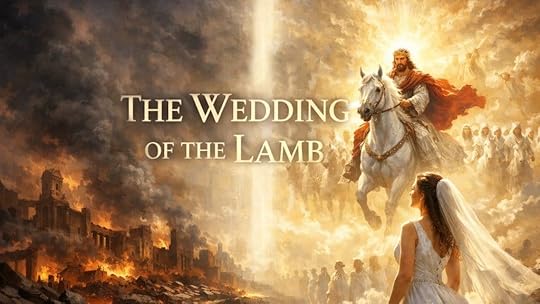 When the Invitation Becomes the Wedding
Chapter 18 ended in smoke.
Babylon fell.
The merchants mourned.
The kings stood at a distance.
The city that once dominated the landscape collapsed in a single hour.
Yet Revelation does not leave the story in ruins.
Chapter 19 is heaven’s answer to Babylon’s fall.
Where earth mourned, heaven begins to sing.
This chapter does not move the story forward in time, but reveals heaven’s interpretation of what has just taken place.
The prophets rarely spoke of judgment without also promising restoration.
“For a small moment have I forsaken you; but with great mercies will I gather you. In overflowing wrath I hid my face from you for a moment; but with everlasting loving kindness will I have mercy on you.”
— Isaiah 54:7-8
When God removes what is false, He makes room for what is true.
Babylon’s fall was never the final goal—it was the clearing of the stage.
What Jesus spoke in parables now appears in full view:
The wedding of the Lamb.
In His teaching, Jesus described a wedding banquet for his son.
But the invited guests refused to come (Matthew 22:3).
When their rejection turned violent, the king declared judgment upon the city.
The king was enraged, and sent his armies, destroyed those murderers, and burned their city.
— Matthew 22:7
But the wedding itself was never canceled.
The invitation went out again—this time to anyone willing to come (Matthew 22:10).
Jesus’ parable carried both warning and promise.
Those who rejected the invitation would see their city fall.
But the wedding would still take place.
Revelation 19:1–5 (NHEB):
1 After these things I heard something like a loud voice of a great multitude in heaven, saying, “Hallelujah. Salvation, glory, and power belong to our God:
2 for true and righteous are his judgments. For he has judged the great prostitute, who corrupted the earth with her sexual immorality, and he has avenged the blood of his servants at her hand.”
3 A second said, “Hallelujah. Her smoke goes up forever and ever.”
4 The twenty-four elders and the four living creatures fell down and worshiped God who sits on the throne, saying, “Amen. Hallelujah.”
5 A voice came forth from the throne, saying, “Give praise to our God, all you his servants, you who fear him, the small and the great.”
The voice John hears is not a single singer but a multitude—like thunder rolling across the sky.
“Hallelujah!”
This word appears frequently in the Old Testament but nowhere else in the New Testament until this moment.
Heaven erupts in the ancient praise language of Israel.
The victory long celebrated in the Psalms has finally arrived.
Heaven rejoices not because suffering is celebrated, but because justice has been revealed.
The Great Prostitute that corrupted the covenant people has fallen and the people of God have been vindicated.
The voice continues.
“Her smoke goes up forever and ever.”
The imagery echoes Isaiah’s prophecy of Edom’s destruction.
The streams of Edom shall be turned into pitch, and her soil into sulfur; her land shall become burning pitch. Night and day it shall not be quenched; its smoke shall go up forever. From generation to generation it shall lie waste; none shall pass through it forever and ever.
— Isaiah 34:9-10, ESV
The prophet’s point is not endless burning but irreversible judgment.
Literal smoke is not still rising from Edom, but the memory of its judgment remains to this day.
Likewise, Mystery Babylon will not rise again.
“A voice came forth from the throne, saying, ‘Give praise to our God.'”
The voice from the throne calls all creation into worship of God.
This moment echoes the pattern seen throughout Jesus’ earthly ministry.
Even as crowds marveled at His works, He continually pointed beyond Himself to the Father (John 5:19).
The Lamb who reigns still leads creation in true worship.
The Marriage of the Lamb
Revelation 19:6–8 (NHEB):
6 I heard something like the voice of a great multitude, and like the voice of many waters, and like the voice of mighty thunders, saying, “Hallelujah. For the Lord our God the Almighty reigns.
7 Let us rejoice and be exceedingly glad, and let us give the glory to him. For the marriage of the Lamb has come, and his wife has made herself ready.”
8 It was given to her that she would array herself in bright, pure, fine linen: for the fine linen is the righteous acts of the saints.
The prophets often described God’s covenant relationship through the imagery of marriage.
Isaiah spoke of a day when God would rejoice over His people as a bridegroom rejoices over his bride.
As the bridegroom rejoices over the bride, so your God will rejoice over you.
— Isaiah 62:5
Hosea used the same imagery to describe restoration after judgment.
I will betroth you to me forever. Yes, I will betroth you to me in righteousness, in justice, in loving kindness, and in compassion.
— Hosea 2:19
The covenant between God and His people was never merely legal.
It was relational.
Marriage became Scripture’s most vivid picture of that covenant life—faithfulness, devotion, and shared life.
Revelation now gathers those prophetic promises and announces their fulfillment.
The marriage is not beginning at this moment, but being revealed and celebrated following the vindication of the saints.
Yet the vision is also deliberate in its timing.
The Bride appears only after Babylon has fallen.
Throughout the previous chapters, Revelation presented another woman—the Prostitute—lavishly adorned, intoxicated with power, and joined to the beast.
The Prostitute glittered with luxury.But her beauty was borrowed.Her authority was corrupt.Her cup was filled with abominations (Ezekiel 8:6; Ezekiel 16:36).The Prostitute was clothed in purple and scarlet, displaying the outward symbols of priestly and royal authority.
The Bride appears differently.
“It was given to her that she would array herself in bright, pure, fine linen.”
John is told exactly what the garment represents.
“The fine linen is the righteous acts of the saints.”
The Prostitute’s clothing represented power and spectacle.
The Bride’s clothing represents covenant faithfulness.
The Bride does not shine with borrowed splendor.
She shines with the quiet beauty of lives shaped by devotion.
In Jesus’ parable, a guest entered the wedding banquet without proper clothing and was removed from the celebration (Matthew 22:11–13).
The parable revealed a simple truth.
Receiving the invitation to the kingdom was not enough.
One must also be prepared for the life that invitation requires.
The Bride has made herself ready.
Not through power.
Not through prestige.
But through faith.
Their faith, rooted in the righteousness of Christ, bore the fruit of faithful devotion (Isaiah 61:10; Romans 3:22).
The Wedding Supper
Revelation 19:9-10 (NHEB):
9 He said to me, “Write, ‘Blessed are those who are invited to the marriage supper of the Lamb.'” He said to me, “These are true words of God.”
10 I fell down before his feet to worship him. He said to me, “Look. Do not do it. I am a fellow servant with you and with your brothers who hold the testimony of Jesus. Worship God, for the testimony of Jesus is the Spirit of Prophecy.“
The kingdom of God is not only a kingdom.
It is also a wedding.
Those who accept the invitation share the table of the King.
Those who rejected the invitation find themselves outside the celebration.
“Blessed is the one who will eat at the feast in the kingdom of God.”
— Luke 14:15, NIV
The celebration of the wedding has arrived.
Overwhelmed by the vision, John falls before the angel who delivered the message.
But the angel immediately stops him.
“Look. Do not do it. I am a fellow servant with you… Worship God.”
Even in the presence of overwhelming glory, worship belongs to God alone.
The angel concludes with a profound statement:
“The testimony of Jesus is the Spirit of Prophecy.”
This statement explains the meaning of everything that has come before.
The prophets did not speak about disconnected events or distant mysteries.
Their words carried a single testimony at their center.
They all pointed to Jesus.
Every promise, every covenant, every warning, every vision of restoration ultimately converged on Him.
He said to them, “These are my words that I spoke to you while I was still with you, that everything written about me in the Law of Moses and the Prophets and the Psalms must be fulfilled.” Then he opened their minds to understand the Scriptures.
— Luke 24:44-45, ESV
That testimony now stands fulfilled.
The Lamb who was slain has become the Bridegroom.
The long-promised union between God and His people has arrived (Ezekiel 37:27).
The wedding has been announced.
The Bride is ready.
Now the Bridegroom is revealed riding on a white horse.
Christ Imagery Converging in the Rider
Revelation 19:11-16 (NHEB):
11 I saw the heaven opened, and suddenly there was a white horse, and he who sat on it is called Faithful and True. In righteousness he judges and makes war.
12 His eyes are a flame of fire, and on his head are many crowns. He had a name written which no one knows but he himself.
13 He is clothed in a garment dipped in blood. His name is called “The Word of God.”
14 The armies which are in heaven followed him on white horses, clothed in white, pure, fine linen.
15 Out of his mouth proceeds a sharp sword, that with it he should strike the nations. He will rule them with an iron scepter. He treads the winepress of the fierceness of the wrath of God, the Almighty.
16 He has on his garment and on his thigh a name written, “King of kings, and Lord of lords.”
By the time Revelation reaches chapter 19, the scattered visions of the book begin to resolve into a single image.
The Rider does not introduce a new figure.
He gathers together the Christ imagery that has appeared throughout the entire vision.
What was previously seen in fragments is now revealed as one.
Chapters 1–3 — The Son of Man and the Faithful WitnessKey imageryChrist walks among the lampstands with eyes like a flame of fire and from His mouth came a sharp two-edged sword (Revelation 1:13–16).He calls Himself “the Faithful and True Witness, the beginning of God’s creation” (Revelation 3:14).He promises authority to rule the nations with an iron rod (Revelation 2:26–27).He also promises a new name written which no one knows except the one who receives it (Revelation 2:17; 3:12).Connection in Revelation 19The Rider has “eyes like a flame of fire” (Revelation 19:12).“Out of His mouth proceeds a sharp sword” (Revelation 19:15).He “rules the nations with an iron scepter” (Revelation 19:15).And “He had a name written which no one knows but Himself” (Revelation 19:12).Chapters 4–5 — The Throne and the LambKey imageryJohn sees a throne set in heaven with God reigning over creation (Revelation 4:2–3).Then he sees “a Lamb standing as though it had been slain” who alone is worthy to open the scroll (Revelation 5:6–9).Connection in Revelation 19The Rider appears “clothed in a robe dipped in blood” (Revelation 19:13).He rides forth “in righteousness he judges and makes war” (Revelation 19:11).This Rider is the Son of Man who judged the churches, the Faithful and True Witness who testified to them, and the King who now rules the nations with an iron scepter.
Chapters 6–11 — The Conqueror and the WordKey imageryA rider appears on a white horse, going forth “conquering and to conquer” (Revelation 6:2). The redeemed stand before God clothed in white robes (Revelation 7:9). John eats the scroll and is told “You must prophesy again about many peoples and nations and languages and kings” (Revelation 10:11). The witnesses proclaim the Word of God’s testimony to the nations (Revelation 11:3–7). Connection in Revelation 19The Rider appears on “a white horse” (Revelation 19:11). The armies that follow Him are “clothed in fine linen, white and pure” (Revelation 19:14). His name is called “The Word of God” (Revelation 19:13).This Rider is the Lamb who was slain, the One worthy to receive the scroll, and the King who now brings its judgments to completion.
The armies clothed in fine linen reflect the same righteous community described as the Bride, showing that the people of God share in Christ’s victory not through violence but through participation in His vindicated reign.
Chapters 12–14 — The Promised Ruler and the WinepressKey imageryA male child is born who will “rule all the nations with a rod of iron” (Revelation 12:5).The dragon and the beast appear wearing crowns, claiming authority over the earth (Revelation 12:3; 13:1).Then the grapes of the earth are gathered and the winepress of the wrath of God is trodden (Revelation 14:19–20).Connection in Revelation 19The Rider “rules them with an iron scepter” (Revelation 19:15). Upon His head are “many crowns” (Revelation 19:12). He “treads the winepress of the fierceness of the wrath of God” (Revelation 19:15).This Rider is the conquering King revealed behind the earlier vision, the Word from whom the prophecy came, and the Lord followed by the redeemed.
Chapters 15–18 — The Fall of BabylonKey imageryThe bowls are introduced as “the last plagues, for in them the wrath of God is finished” (Revelation 15:1).Babylon collapses and her smoke rises forever and ever (Revelation 18:9–10).The Lamb is declared “Lord of lords and King of kings” (Revelation 17:14).Connection in Revelation 19Heaven celebrates Babylon’s fall.The Rider bears the title “King of kings and Lord of lords” (Revelation 19:16).This Rider is the promised ruler of the nations, the King whose many crowns declare that every rival authority has now fallen beneath His rule, and the One who treads the winepress of God’s judgment.
This Rider is the conquering Lamb revealed after Babylon’s fall, the true King of kings and Lord of lords who reigns over the nations.
What appeared throughout the vision in fragments is now unveiled in a single King:
Jesus Christ, the Messiah, the King of kings.
John then notices something mysterious.
“He had a name written which no one knows but he himself… His name is called ‘The Word of God.'”
John had already introduced this title at the opening of his Gospel.
In the beginning was the Word, and the Word was with God, and the Word was God.
— John 1:1
Now He reveals a striking paradox.
The name is written—meaning it is revealed.His name is The Word of God.Yet its full meaning is known only to Him.The Word made flesh is revealed, yet the fullness of that Word remains beyond human comprehension.
The same Word who spoke creation into existence now rides forth as King over the nations.
Yet the appearance of the King does not lead to a prolonged battle.
Instead, the vision immediately reveals the outcome.
Revelation 19:17–19 (NHEB):
17 I saw an angel standing in the sun. He shouted with a loud voice, saying to all the birds that fly in the sky, “Come. Be gathered together to the great supper of God,
18 that you may eat the flesh of kings, the flesh of captains, the flesh of mighty people, and the flesh of horses and of those who sit on them, and the flesh of all people, both free and slave, and small and great.”
19 I saw the beast, and the kings of the earth, and their armies, gathered together to make war against him who sat on the horse, and against his army.
Earlier in the chapter, heaven pronounced a blessing:
“Blessed are those who are invited to the marriage supper of the Lamb.”
Now another supper is announced.
In Revelation 14, John saw two harvests of the earth—one gathered to God, and another cast into the winepress of His wrath.
What was shown there as two harvests is now revealed here as two feasts.
The gathering of the righteous corresponds to the marriage supper of the Lamb.The gathering of the wicked corresponds to the great supper of God, where the winepress imagery of judgment is now portrayed as the exposure of the defeated.Revelation presents two corresponding outcomes—one celebrating resurrection life in heaven, the other displaying on earth the defeat of the rebellious powers who shed the blood of the saints.
Humanity is divided not by power or status, but by response to the Lamb.
Verse 19 now reveals how this second supper comes to be.
“I saw the beast, and the kings of the earth, and their armies, gathered together.”
This is not a new global conflict introduced at this point in the vision.
It is the convergence of what has already been unfolding throughout Revelation—the same gathering previously shown (Revelation 16:14), now brought into full view.
The beastly power—working through imperial authority and expressed through corrupt leadership within the land—now reaches its final concentration.
The “kings of the earth (land)” are not distant rulers across the globe, but the rulers centered within the covenant land who aligned themselves with the beastly order. Their armies represent the factions, forces, and gathered multitudes within Jerusalem during the revolt.
What appears as a unified army is, historically, a fractured coalition of rival factions.
Though divided in leadership, they were united in one goal: to overthrow Rome and take control of Israel. In this sense, they are seen as one—united in purpose and opposition to the Lamb.
Throughout the Hebrew Scriptures, the defeat of hostile armies that opposed God’s people was often described through the language of birds gathering over a battlefield.
The prophet Ezekiel used this exact imagery:
Speak to the birds of every sort, and to every animal of the field, “Assemble yourselves, and come; gather yourselves on every side to my sacrifice that I do sacrifice for you, even a great sacrifice on the mountains of Israel, that you may eat flesh and drink blood. You shall eat the flesh of the mighty, and drink the blood of the princes of the earth.”
— Ezekiel 39:17–18
John is intentionally drawing from Ezekiel’s vision of the defeat of Gog and his armies.
The details are too specific to be incidental.
In Ezekiel, the birds are summoned to consume the defeated armies of Gog after God intervenes with decisive judgment.
The sequence is identical: a gathered force opposing God’s people, divine intervention, and the public exposure of the defeated. Revelation does not borrow this imagery loosely—it follows the same structure.
Once this is seen, the connection is no longer optional.
John is placing this event within the prophetic framework of Gog’s defeat—but now within the covenant land itself.
What the prophets described symbolically, and what Revelation presents theologically, is reflected in the historical record.
During the siege of Jerusalem, the city became filled with death, and the bodies of the slain lay exposed across the land:
Titus, in going his rounds along those valleys, saw them full of dead bodies, and the thick putrefaction running about them, he gave a groan; and, spreading out his hands to heaven, called God to witness that this was not his doing; and such was the sad case of the city itself.
— Josephus, Wars 5.12.4
The “great supper of God” corresponds to this moment—the exposure of the defeated within the fallen city. Like Gog, the rebellious powers that had gathered within Jerusalem were overthrown, their destruction laid bare before heaven and earth.
This scene also clarifies what follows in the next chapter.
Here in Revelation 19, John presents the aftermath described in Ezekiel 39—Gog’s fallen armies exposed and consumed by the birds of the air.
In Revelation 20, he returns to the same prophecy, now revealing the earlier stage: the gathering of the nations, identified there as Gog and Magog.
What is described historically as the burning of Jerusalem, John reveals prophetically as divine judgment.
The Great Prostitute that had dominated the land of Israel is shown to be mortal.
Their systems and armies collapsed in a single moment.
Revelation 19:20-21 (NHEB):
20 The beast was taken, and with him the false prophet who worked the signs in his sight, with which he deceived those who had received the mark of the beast and those who worshiped his image. These two were thrown alive into the lake of fire that burns with sulfur.
21 The rest were killed with the sword of him who sat on the horse, the sword which came forth out of his mouth. All the birds were filled with their flesh.
The vision now moves immediately from gathering to outcome.
The beast is taken.
The false prophet is seized.
Both are cast into the lake of fire.
This is the first appearance of the “lake of fire” in Revelation’s final vision. Its meaning is not yet explained here, but its placement is significant—it follows immediately upon the collapse of the beastly system.
In the next chapter, this imagery will be expanded and clarified.
The systems that deceived, compelled, and persecuted are not reformed.
They are removed.
The persecuting power behind these systems had already begun to fracture at the fall of Nero and the collapse of imperial stability.
But in Jerusalem, that same opposition reaches its full and final exposure.
With the destruction of the temple and the end of the war, the covenantal system that rejected the Lamb reaches its end.
“The rest were killed with the sword of him who sat on the horse.”
The weapon of the Rider is unchanged.
The sword proceeds from His mouth.
The rest—those who stood aligned with the beastly rebellion and shared in the opposition to the Lamb—fall under the same judgment, becoming the fulfillment of the feast prepared beforehand.
This is not the violence of earthly conquest, but the authority of divine judgment.
No battle is actually described, because the Rider’s victory is accomplished by His word.
What Christ speaks, stands.
What He judges, falls.
The same word that called creation into being now brings the Old Covenant world to its end.
The King Who ReignsChapter 19 now stands as a turning point in the vision of Revelation.
Babylon has fallen.The harlot has been judged.The Bride stands ready.The Bridegroom appears.The beast collapses.Yet Revelation’s story is not finished.
The fall of the beast and false prophet reveals that the earthly instruments of opposition have been removed; what remains is the exposure of the deeper spiritual adversary who empowered them—Satan himself.
Chapter 20 will not move forward from this moment, but will step back to reveal the deeper spiritual reality behind what has just been shown—the source of the deception, the gathering of the nations, and the final removal of that ancient adversary.
For now, the vision rests upon a single truth.
ReflectionThe Lamb who was slain has become the victorious King—and His forever reign has begun.
If the Bride of Christ is marked not by power or spectacle but by faithful devotion, what does it look like for the Church today to live as people who truly belong to the Lamb’s kingdom?
Want to Go Further? Explore at Your Own Pace: [image error] Get the Book
Rediscover the Trinity—not as a puzzle, but as a redemptive story of love.
[image error] Join the Newsletter
Thoughtful, Scripture-rooted teaching to help you ask honest questions, rediscover the Gospel, and see God through the lens of Jesus.
You’ll also receive free resources if you’d like to explore further:
[image error] Join the Facebook Group
Ask questions and connect with others on the same journey.
[image error] Already Read the Book?
Leave a quick review—just a sentence or two—to help others find clarity too!
The wedding of the Lamb is the biblical image of God’s restored covenant with His people. It represents the union between Christ and His faithful followers after judgment removes what is false and reveals what is true.
Who is the bride in Revelation 19?The bride represents the people of God—the faithful who remain devoted to Christ. Her fine linen symbolizes the lived-out faithfulness that flows from the righteousness given to the saints.
Why does heaven celebrate Babylon’s fall?Heaven rejoices because God’s justice has been revealed. The fall of Babylon is not about destruction for its own sake, but the removal of corruption within the covenant world and the vindication of God’s people.
What does “her smoke rises forever” mean?This phrase reflects Old Testament prophetic language. It does not describe ongoing burning, but irreversible judgment—Babylon will not rise again.
Is Revelation 19 describing a future event or something already fulfilled?Revelation 19 presents heaven’s interpretation of events associated with the first-century judgment of Jerusalem. It reveals the spiritual meaning of what took place, not a distant future timeline.
Why is Jesus shown riding a white horse?The image reveals Christ as the victorious King who judges and reigns through His word. It brings together earlier images in Revelation, showing that the Lamb who was slain now reigns and completes His judgment.
What are the two suppers in Revelation 19?Revelation presents two outcomes: the marriage supper of the Lamb for those who receive Him, and the great supper of God representing the exposure and defeat of those who oppose Him, rather than a prolonged battle between equal forces.
Does Revelation 19 describe a literal battle of Armageddon?Revelation 19 does not describe an extended battle. The enemies gather, but they are immediately defeated by the word of Christ. The imagery reflects prophetic language of judgment, emphasizing the certainty of Christ’s victory rather than a prolonged military conflict.
{ "@context": "https://schema.org", "@type": "BlogPosting", "mainEntityOfPage": { "@type": "WebPage", "@id": "https://jesusconquers.com/revelation-..." }, "headline": "Revelation Chapter 19: The Wedding of the Lamb Explained", "description": "Revelation 19 reveals heaven’s response to Babylon’s fall. The chapter celebrates God’s righteous judgment, unveils the Bride in fine linen, announces the marriage supper of the Lamb, and reveals Christ as the victorious King whose word defeats His enemies. Rather than a distant future battle, the vision interprets the covenantal judgment of Jerusalem and the public triumph of the Lamb.", "image": "https://jesusconquers.com/wp-content/...", "author": { "@type": "Person", "name": "David Longenecker", "url": "https://jesusconquers.com/about/" }, "publisher": { "@type": "Organization", "name": "Jesus Conquers", "logo": { "@type": "ImageObject", "url": "https://jesusconquers.com/wp-content/..." } }, "datePublished": "2026-03-19T09:00:00-04:00", "dateModified": "2026-03-19T09:00:00-04:00", "articleSection": "Theology", "inLanguage": "en-US", "isPartOf": { "@type": "CreativeWorkSeries", "name": "Revelation: The Clock Is Ticking", "url": "https://jesusconquers.com/category/re..." }, "keywords": [ "Revelation 19 explained", "Revelation 19 meaning", "wedding of the Lamb Revelation 19", "marriage supper of the Lamb meaning", "Bride in Revelation 19", "Babylon fall and wedding of the Lamb", "Revelation 19 white horse rider", "King of kings Revelation 19", "two suppers Revelation 19", "does Revelation 19 describe Armageddon", "Revelation 19 preterist interpretation", "first century judgment of Jerusalem", "her smoke rises forever meaning", "Revelation 19 fulfilled" ], "url": "https://jesusconquers.com/revelation-...", "speakable": { "@type": "SpeakableSpecification", "cssSelector": [ ".entry-title", ".entry-content p:first-of-type" ] }} { "@context": "https://schema.org", "@type": "FAQPage", "mainEntity": [ { "@type": "Question", "name": "What is the wedding of the Lamb in Revelation 19?", "acceptedAnswer": { "@type": "Answer", "text": "The wedding of the Lamb is the biblical image of God’s restored covenant with His people. It represents the union between Christ and His faithful followers after judgment removes what is false and reveals what is true." } }, { "@type": "Question", "name": "Who is the bride in Revelation 19?", "acceptedAnswer": { "@type": "Answer", "text": "The bride represents the people of God—the faithful who remain devoted to Christ. Her fine linen symbolizes the lived-out faithfulness that flows from the righteousness given to the saints." } }, { "@type": "Question", "name": "Why does heaven celebrate Babylon’s fall?", "acceptedAnswer": { "@type": "Answer", "text": "Heaven rejoices because God’s justice has been revealed. The fall of Babylon is not about destruction for its own sake, but the removal of corruption within the covenant world and the vindication of God’s people." } }, { "@type": "Question", "name": "What does “her smoke rises forever” mean?", "acceptedAnswer": { "@type": "Answer", "text": "This phrase reflects Old Testament prophetic language. It does not describe ongoing burning, but irreversible judgment—Babylon will not rise again." } }, { "@type": "Question", "name": "Is Revelation 19 describing a future event or something already fulfilled?", "acceptedAnswer": { "@type": "Answer", "text": "Revelation 19 presents heaven’s interpretation of events associated with the first-century judgment of Jerusalem. It reveals the spiritual meaning of what took place, not a distant future timeline." } }, { "@type": "Question", "name": "Why is Jesus shown riding a white horse?", "acceptedAnswer": { "@type": "Answer", "text": "The image reveals Christ as the victorious King who judges and reigns through His word. It brings together earlier images in Revelation, showing that the Lamb who was slain now reigns and completes His judgment." } }, { "@type": "Question", "name": "What are the two suppers in Revelation 19?", "acceptedAnswer": { "@type": "Answer", "text": "Revelation presents two outcomes: the marriage supper of the Lamb for those who receive Him, and the great supper of God representing the exposure and defeat of those who oppose Him, rather than a prolonged battle between equal forces." } }, { "@type": "Question", "name": "Does Revelation 19 describe a literal battle of Armageddon?", "acceptedAnswer": { "@type": "Answer", "text": "Revelation 19 does not describe an extended battle. The enemies gather, but they are immediately defeated by the word of Christ. The imagery reflects prophetic language of judgment, emphasizing the certainty of Christ’s victory rather than a prolonged military conflict." } } ] } { "@context": "https://schema.org", "@type": "BreadcrumbList", "itemListElement": [ { "@type": "ListItem", "position": 1, "name": "Home", "item": "https://jesusconquers.com/" }, { "@type": "ListItem", "position": 2, "name": "Revelation Series", "item": "https://jesusconquers.com/category/re..." }, { "@type": "ListItem", "position": 3, "name": "Revelation Chapter 19: The Wedding of the Lamb Explained", "item": "https://jesusconquers.com/revelation-..." } ]}The post Revelation Chapter 19 — The Wedding of the Lamb appeared first on Jesus Conquers.
March 30, 2026
Revelation Chapter 18 — Babylon Has Fallen
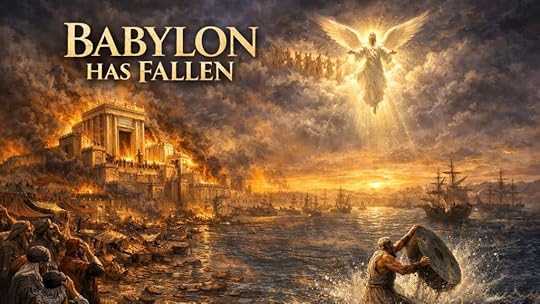 When the Prophets Speak Again
Chapter 17 exposed her.
Chapter 18 buries her.
Not with new symbols—with old prophetic thunder.
Isaiah spoke it (Isaiah 21:9).
Jeremiah thundered it (Jeremiah 51:8).
“Fallen is Babylon.”
To us the phrase can sound symbolic.
To first-century ears it sounded judicial.
Babylon was never only a place.
It was a pattern.
Before the exile, Israel’s life was ordered around prophets, priests, and kings.
But Babylon’s society functioned through:
During the exile, with no temple or throne, the preservation of the Law increasingly depended on scribes and teachers of Scripture. Leaders like Ezra the scribe returned from Babylon and helped establish this pattern in Jerusalem (Ezra 7:6).
Babylon’s model of governance mirrored the structure that would later dominate Jerusalem:
Scribal scholars who interpreted the Law of Moses.Sanhedrin councils that governed national life.The Sadducean priestly class that controlled temple institutions.This is Mystery Babylon—the system Jesus calls “the synagogue of Satan” (Revelation 2:9; 3:9)—the same system that rejected Jesus and persecuted the prophets God continued to send (Matthew 23:34–39).
Babylon is what happens when covenant calling is traded for control—when holy authority is repurposed into domination.
What had once characterized Babylon’s religious bureaucracy had quietly taken root in Jerusalem itself.
The temple that once mediated life had become a marketplace.The priesthood that once interceded for the people now trafficked in the blood of both sacrifices and martyrs.The house meant for prayer had become a den of robbers (Jeremiah 7:11; Matthew 21:13).God’s order of prophet, priest, and king had been fully replaced.
Fallen, Fallen Is Babylon the Great
Revelation 18:1–3 (NHEB):
1 After these things, I saw another angel coming down out of the sky, having great authority. The earth was illuminated with his glory.
2 He shouted with a mighty voice, saying, “Fallen, fallen is Babylon the great, and she has become a habitation of demons, a prison of every unclean spirit, and a prison of every unclean bird, and a prison of every unclean and detestable beast.
3 For all the nations have drunk of the wine of the wrath of her sexual immorality, the kings of the earth committed sexual immorality with her, and the merchants of the earth grew rich from the abundance of her luxury.”
John sees another angel descending with great authority, and the earth is illuminated by his glory.
The contrast is deliberate.
The woman in the previous chapter glittered with borrowed splendor (Revelation 17:4), but this messenger radiates true glory from heaven.
Jeremiah described Babylon as a cup that intoxicated the nations:
Babylon has been a golden cup in the LORD’s hand, who made all the earth drunk: the nations have drunk of her wine; therefore the nations are mad.
— Jeremiah 51:7
John now applies that prophetic language to the city that mirrors Babylon’s pattern.
She has become a habitation of demons.
Jeremiah had warned that Jerusalem itself would become “a haunt of jackals” and “a den of robbers” (Jeremiah 9:11; Jeremiah 7:11).
Jesus called Israel’s leaders a “brood of vipers” (Matthew 12:34) and the temple a “den of thieves” (Matthew 21:13). He warned Israel that a house left vacant will become a dwelling place for unclean spirits (Matthew 12:45).
The city meant to be a house of prayer had become a dwelling place for what it refused to cast out.
For all the nations have drunk.
The charge widens beyond the city itself.
Israel had been called to be a light to the nations.
But Jesus warned that the leaders were spreading corruption instead:
Woe to you, scribes and Pharisees, hypocrites. For you travel around by sea and land to make one proselyte; and when he becomes one, you make him twice as much of a son of hell as yourselves.
— Matthew 23:15
What was meant to guide the nations into life had begun leading them deeper into darkness.
Come Out of Her, My People
Revelation 18:4–8 (NHEB):
4 I heard another voice from heaven, saying, “Come out of her, My people, that you have no participation in her sins, and that you do not receive of her plagues,
5 for her sins have reached to the sky, and God has remembered her iniquities.
6 Return to her just as she returned, and repay her double as she did, and according to her works. In the cup which she mixed, mix to her double.
7 However much she glorified herself, and grew wanton, so much give her of torment and mourning. For she says in her heart, ‘I sit a queen, and am no widow, and will in no way see mourning.’
8 Therefore in one day her plagues will come: death, mourning, and famine; and she will be utterly burned with fire; for the Lord God who has judged her is strong.
A voice from heaven speaks next, and its tone shifts from declaration to invitation:
“Come out of her, My people.”
The voice echoes the prophets:
Jeremiah’s warning to flee Babylon before its destruction (Jeremiah 51:45).Isaiah’s call to separate from Babylon’s corruption (Isaiah 52:11).The call is not to leave the world (John 17:15)—it is to leave the city and system that has distorted God’s name.
Jesus had already given this warning in earthly terms:
When you see Jerusalem surrounded by armies, then know that its desolation is near. Then let those who are in Judea flee to the mountains. Let those who are in the midst of her depart. Let those who are in the country not enter it. For these are days of vengeance, that all things which are written may be fulfilled.
— Luke 21:20-22
Early believers recognized that faithfulness required separation from the structures that had rejected the Lamb.
“Her sins have piled up to heaven.”
This phrase recalls the tower of Babel (Genesis 11:4) and the cries against Sodom (Genesis 18:20–21), moments when corruption reached a fullness that demanded judgment.
When Jerusalem fell centuries earlier, the prophet lamented:
How the city sits solitary, that was full of people. She has become as a widow.
— Lamentations 1:1
That earlier destruction had already proven that covenant privilege did not guarantee immunity from judgment.
“I sit a queen, and am no widow.”
The covenant city believed its chosen status made it untouchable.
But the very language she denies becomes the language of her downfall.
Heaven responds with reversal:
“Return to her just as she returned… the cup which she mixed, mix to her.”
This is not vindictive language but covenant symmetry—the law of sowing and reaping.
The prophets often described judgment this way: As you have done, it will be done to you. Your deeds will return upon your own head (Obadiah 1:15; Jeremiah 50:29).
Do not be deceived. God is not mocked, for whatever a person sows, that he will also reap.
— Galatians 6:7
The prophets had long warned that pride masked as holiness would collapse under its own weight. The city that claimed invincibility would discover her fragility in a single hour.
“Death, mourning, and famine… and she will be burned with fire.”
The death, mourning, and famine the nation had sown—even offering their children to the fires of Molech (Jeremiah 7:31)—would now return upon the land that refused to repent.
The fall is swift because the structure was already hollow within.
Mourning Begins — The Kings of the Land
Revelation 18:9–10 (NHEB):
9 The kings of the earth, who committed sexual immorality and lived wantonly with her, will weep and wail over her, when they look at the smoke of her burning,
10 standing far away for the fear of her torment, saying, ‘Woe, woe, the great city, Babylon, the strong city. For your judgment has come in one hour.’
As the vision shifts, John hears the lament of the kings.
The “kings of the land” represent the rulers who had shared in Jerusalem’s political and religious system—Roman governors, Herodian rulers, and regional authorities whose power was intertwined with the city.
Many of these figures governed Judea at different times and benefited from its influence.
They stand far away—unwilling to share the city’s fate yet unable to deny the collapse of the power that once sustained them.
As Jesus had warned, the city itself would burn (Matthew 22:7), its temple and streets consumed by the fires of both Zealots and Romans.
The lament exposes the true allegiance of those who aligned themselves with the city. Their grief is not for righteousness but for the collapse of the structure that had enriched them.
The prophetic pattern repeats:
When Babylon fell, rulers trembled (Jeremiah 50:46; Isaiah 13:19).When Tyre fell, merchants wept (Ezekiel 27:27, 36).Now the covenant city joins that same lineage of judgment.
“Woe, woe, the great city… your judgment has come in one hour.”
The repetition of “one hour” connects back to the language of Chapter 17, emphasizing how quickly powers that seem permanent can collapse.
The Collapse of the Temple Economy
Revelation 18:11–13 (NHEB):
11 The merchants of the earth weep and mourn over her, for no one buys their merchandise any more;
12 merchandise of gold, silver, precious stones, pearls, fine linen, purple, silk, scarlet, all expensive wood, every vessel of ivory, every vessel made of most precious wood, and of bronze, and iron, and marble;
13 and cinnamon, spice, incense, perfume, frankincense, wine, olive oil, fine flour, wheat, cattle, sheep, horses, chariots, slaves and human lives.
What Revelation describes is more than the collapse of commerce.
It is the unraveling of the temple marketplace itself.
Josephus describes the immense wealth stored in the temple shortly before its destruction:
[There were] tables, and cisterns, and vials, all made of solid gold, and very heavy… veils and garments, with precious stones, and a great number of other precious vessels that belonged to their sacred worship… coats and girdles of the priests, with a great quantity of purple and scarlet… also a great deal of cinnamon and cassia, with a large quantity of other sweet spices, which used to be mixed together, and offered as incense to God every day.
— Wars 6.8.3
Herod the Great rebuilt the temple into one of the most magnificent structures in the Roman world, funded through heavy taxation and forced labor.
When the city fell and the temple burned, the entire system of sacrifice, pilgrimage, and religious trade collapsed with it.
Jesus went into the temple, and began to cast out them that sold and bought in the temple, and overthrew the tables of the moneychangers, and the seats of them that sold doves; and would not suffer that any man should carry any vessel through the temple. And He taught, saying unto them, Is it not written, “My house shall be called of all nations the house of prayer? But ye have made it a den of thieves.”
— Mark 11:15-18, KJV
When religion becomes empire, people cease to be participants in covenant life and become commodities. Authority no longer serves; it consumes.
The Silence After Luxury
Revelation 18:14–19 (NHEB):
14 The fruits which your soul lusted after have been lost to you, and all things that were luxury and splendor have perished from you, and you will never ever find them again.
15 The merchants of these things, who were made rich by her, will stand far away for the fear of her torment, weeping and mourning;
16 saying, ‘Woe, woe, the great city, she who was dressed in fine linen, purple, and scarlet, and decked with gold and precious stones and pearls.
17 For in an hour such great riches are made desolate.’ Every shipmaster, and everyone who sails anywhere, and mariners, and as many as gain their living by sea, stood far away,
18 and exclaimed as they looked at the smoke of her burning, saying, ‘What is like the great city?’
19 They cast dust on their heads, and shouting, weeping and mourning, saying, ‘Woe, woe, the great city, in which all who had their ships in the sea were made rich by reason of her great wealth.’ For in one hour is she made desolate.
The woman is described again in fine linen, purple, and scarlet—intentionally mirroring the attire of the woman in Chapter 17.
What appeared priestly and royal is shown to be temporary adornment.
The city had begun to crave luxury and power in place of the covenant life it was meant to embody.
Jesus had warned that divided loyalties would ultimately be exposed:
No one can serve two masters. Either you will hate the one and love the other, or you will be devoted to the one and despise the other. You cannot serve both God and money.
— Matthew 6:24, NIV
The problem was not simply prosperity but desire.
The wealth this woman loved more than God vanished in a single moment.
“And you will never ever find them again.”
The words carry a sense of finality.
When Jerusalem fell and the temple burned, the sacrificial system that sustained the temple marketplace collapsed—never to return.
The cry, “What city is like the great city?” reflects the reputation Jerusalem gained through Herod’s monumental rebuilding of the temple.
The sanctuary was expanded into one of the most magnificent structures in the Roman world, its white stone and gold visible from far away as travelers approached Jerusalem.
The historian Josephus described its splendor in language usually reserved for the greatest monuments of the ancient world:
The outward face of the temple in its front wanted nothing that was likely to surprise either men’s minds or their eyes; for it was covered all over with plates of gold of great weight, and, at the first rising of the sun, reflected back a very fiery splendor, and made those who forced themselves to look upon it to turn their eyes away, just as they would have done at the sun’s own rays.
— Wars 5.5.6
What once inspired awe among pilgrims and visitors now rises as smoke before the watching nations.
Herod’s temple expansion took decades to build.The temple’s economy had endured for centuries.And the entire structure collapsed in a single hour.
Yet Revelation contrasts earthly grief with heaven’s perspective.
While merchants mourn the loss of profit, heaven prepares to rejoice over justice.
Revelation 18:20 (NHEB):
20 “Rejoice over her, O heaven, you saints, apostles, and prophets; for God has judged your judgment on her.”
This is not the celebration of suffering.
It is the celebration of vindication.
The very people Jerusalem rejected are now vindicated as her judges.
Jesus had said:
Truly I tell you that you who have followed Me, in the regeneration when the Son of Man will sit on the throne of His glory, you also will sit on twelve thrones, judging the twelve tribes of Israel.
— Matthew 19:28
For generations the prophets had warned that covenant corruption would lead to judgment, but their warnings were ignored.
The apostles continued their testimony.
They proclaimed that the Messiah had come, that the kingdom of God had arrived, and that repentance was still being offered.
Many of those voices were silenced.
Saints were driven out and martyred.Apostles were persecuted.Prophets had long been rejected.But heaven had not forgotten their witness.
Earlier in Revelation the martyrs cried out:
How long, Master, the holy and true, until you judge and avenge our blood on those who dwell on the earth?
— Revelation 6:10
Now the answer has come.
“God has judged your judgment on her.”
The verdict the prophets declared, the apostles announced, and the saints suffered for has now been confirmed.
The city that condemned them has been judged by the very testimony it tried to silence.The city that claimed authority to judge God’s messengers now stands judged by them.The Millstone Judgment
Revelation 18:21–23 (NHEB):
21 A mighty angel took up a stone like a great millstone and cast it into the sea, saying, “Thus with violence will Babylon, the great city, be thrown down, and will be found no more at all.
22 The voice of harpists, minstrels, flute players, and trumpeters will be heard no more at all in you. No craftsman, of whatever craft, will be found any more at all in you. The sound of a mill will be heard no more at all in you.
23 The light of a lamp will shine no more at all in you. The voice of the bridegroom and of the bride will be heard no more at all in you; for your merchants were the princes of the earth; for with your sorcery all the nations were deceived.
A mighty angel performs a final prophetic sign.
He lifts a stone like a great millstone and throws it into the sea, declaring that the great city will be cast down with the same finality.
The act echoes Jeremiah’s prophecy against ancient Babylon, when a stone was thrown into the Euphrates as a sign that the empire would sink and never rise again (Jeremiah 51:63–64).
It also recalls Jesus’ warning that it would be better to have a millstone hung around one’s neck and be thrown into the sea than to lead God’s people into destruction (Matthew 18:6).
Josephus’ account of Jerusalem’s siege shows just how terrible that suffering became (Wars 6.3.4).
The angel’s proclamation unfolds in a series of “no more” statements:
No more music.No more craftsmen.No more mills grinding grain.No more light from a lamp.No more voice of bridegroom and bride.Each phrase strips away an aspect of daily life.
The city that claimed to be the center of worship is left without worshippers.
The prophets had used this language before when describing the judgment that would fall upon Jerusalem.
Then will I cause to cease from the cities of Judah, and from the streets of Jerusalem, the voice of mirth and the voice of gladness, the voice of the bridegroom and the voice of the bride; for the land shall become a waste.
— Jeremiah 7:34
I will take from them the voice of mirth and the voice of gladness, the voice of the bridegroom and the voice of the bride, the sound of the millstones, and the light of the lamp.
— Jeremiah 25:10
Revelation draws on that same pattern to show that the life of the city has come to an end.
“Your merchants were the princes of the earth.”
The merchants were not merely traders but the powerful elite whose influence flowed through the city’s religious and economic system—an economy where wealth and authority were concentrated in the hands of a few.
“With your sorcery all the nations were deceived.”
The system presented itself as holy, yet it misrepresented God while claiming to speak for Him.
What sorrow awaits you teachers of religious law and you Pharisees. Hypocrites! For you shut the door of the Kingdom of Heaven in people’s faces. You won’t go in yourselves, and you don’t let others enter either.
— Matthew 23:13, NLT
Now the illusion collapses.
The music is gone.
The marketplace is silent.
The lamps are extinguished.
The city that once dazzled the world is now silent.
The Final Indictment
Revelation 18:24 (NHEB):
24 In her was found the blood of prophets and of saints, and of all who have been slain on the earth.”
John now removes all doubt about the identity of Mystery Babylon.
The final charge is not luxury or deception but blood guilt.
His words echo Jesus’ warning to Jerusalem:
You testify to yourselves that you are children of those who killed the prophets… that on you may come all the righteous blood shed on the earth, from the blood of righteous Abel to the blood of Zechariah son of Berechiah, whom you killed between the sanctuary and the altar. Truly I tell you, all these things will come upon this generation.
— Matthew 23:31-36
The city entrusted with the Law and the Prophets became the place where those voices were silenced. Revelation gathers that entire history into a single moment of exposure.
What Jesus warned would come upon that generation had now arrived.
The Fall That Makes Way for the BrideBabylon’s fall is not the end of Revelation’s story.
It is the clearing of the stage.
Throughout Scripture two women stand in contrast:
One faithful, the other corrupt. One brings life, the other destruction.Revelation gathers that ancient pattern and brings it to its final expression.
The harlot city has fallen.
The system that turned covenant life into power and spectacle has been judged.
But Revelation never leaves the story in ashes.
When the prophets spoke of judgment, they also spoke of renewal.
When the false city falls, the true city is prepared.
When the harlot is removed, the Bride appears.
The silence left by Babylon’s collapse becomes the space where heaven begins to sing.
In Chapter 19 that song breaks forth.
The voices of heaven rise in praise, announcing that the reign of God has been vindicated and the marriage of the Lamb has come.
Babylon’s fall does not end the vision—it clears the ground for the descent of the Bride.
The story is moving toward a wedding, not ruin.
Reflection Question:What things in our own lives can give us a false sense of spiritual security, and how might the call of Christ invite us to trust Him rather than the systems we build?
Want to Go Further? Explore at Your Own Pace: [image error] Get the Book
Rediscover the Trinity—not as a puzzle, but as a redemptive story of love.
[image error] Join the Newsletter
Thoughtful, Scripture-rooted teaching to help you ask honest questions, rediscover the Gospel, and see God through the lens of Jesus.
You’ll also receive free resources if you’d like to explore further:
[image error] Join the Facebook Group
Ask questions and connect with others on the same journey.
[image error] Already Read the Book?
Leave a quick review—just a sentence or two—to help others find clarity too!
In Revelation 18, Babylon represents a corrupt religious and political system that opposed God’s purposes. John applies Old Testament “Babylon” language to first-century Jerusalem—the covenant city that rejected the prophets, opposed Jesus, and persecuted His followers. Revelation portrays its fall as the fulfillment of Jesus’ warnings about judgment coming upon that generation (Matthew 23:36).
Why does Revelation 18 say “Come out of her, My people”?The call to “come out of her” in Revelation 18 echoes Old Testament warnings to leave Babylon before judgment fell (Jeremiah 51:45; Isaiah 52:11). For early Christians, this meant separating from the corrupt religious system centered in Jerusalem that had rejected the Messiah. The call is not to leave the world, but to remain faithful to Christ rather than participate in systems that distort God’s character.
Is Revelation 18 describing an economic collapse?Revelation 18 includes the collapse of trade and commerce, but the deeper issue is spiritual. The merchants, rulers, and temple economy represent a system where religion, power, and wealth had become intertwined. The fall of Babylon reveals how a religious system that once served God can become corrupted when authority is used for control rather than covenant faithfulness.
Why does heaven rejoice when Babylon falls?Heaven’s celebration in Revelation 18:20 is not joy over suffering but joy over justice. The saints, apostles, and prophets who were rejected and persecuted are finally vindicated. The fall of Babylon demonstrates that God has remembered their witness and judged the system that shed their blood.
How does the fall of Babylon prepare for the rest of Revelation?Babylon’s fall clears the stage for the final vision of restoration. Revelation contrasts two cities: the corrupt city that falls and the faithful Bride who appears. When Babylon collapses, heaven begins to rejoice because the marriage of the Lamb is about to be revealed (Revelation 19). Judgment removes what is false so that God’s true kingdom can be seen.
{ "@context": "https://schema.org", "@type": "BlogPosting", "mainEntityOfPage": { "@type": "WebPage", "@id": "https://jesusconquers.com/revelation-..." }, "headline": "Revelation Chapter 18: Babylon Has Fallen Explained", "description": "Revelation 18 reveals the fall of Babylon using the thunder of the prophets. Drawing on Isaiah, Jeremiah, and the words of Jesus, the chapter exposes a corrupt religious system that turned covenant life into power and profit. The destruction of the city brings an end to the temple economy and vindicates the prophets, apostles, and saints whose witness had been rejected.", "image": "https://jesusconquers.com/wp-content/...", "author": { "@type": "Person", "name": "David Longenecker", "url": "https://jesusconquers.com/about/" }, "publisher": { "@type": "Organization", "name": "Jesus Conquers", "logo": { "@type": "ImageObject", "url": "https://jesusconquers.com/wp-content/..." } }, "datePublished": "2026-03-10T09:00:00-05:00", "dateModified": "2026-03-10T09:00:00-05:00", "articleSection": "Theology", "inLanguage": "en-US", "isPartOf": { "@type": "CreativeWorkSeries", "name": "Revelation: The Clock Is Ticking", "url": "https://jesusconquers.com/category/re..." }, "keywords": [ "Revelation 18 explained", "Revelation 18 meaning", "Babylon has fallen Revelation", "Mystery Babylon Revelation 18", "Babylon is Jerusalem interpretation", "Revelation 18 merchants and kings", "temple economy Revelation 18", "come out of her my people meaning", "Revelation 18 preterist interpretation", "AD 70 Babylon judgment", "millstone thrown into the sea Revelation", "blood of prophets Revelation 18", "fall of Jerusalem Revelation", "Bride and Babylon contrast Revelation" ], "url": "https://jesusconquers.com/revelation-...", "speakable": { "@type": "SpeakableSpecification", "cssSelector": [ ".entry-title", ".entry-content p:first-of-type" ] }}{ "@context": "https://schema.org", "@type": "FAQPage", "mainEntity": [ { "@type": "Question", "name": "What does Babylon represent in Revelation 18?", "acceptedAnswer": { "@type": "Answer", "text": "In Revelation 18, Babylon represents a corrupt religious and political system that opposed God’s purposes. John applies Old Testament Babylon language to first-century Jerusalem—the covenant city that rejected the prophets, opposed Jesus, and persecuted His followers. Revelation portrays its fall as the fulfillment of Jesus’ warnings about judgment coming upon that generation (Matthew 23:36)." } }, { "@type": "Question", "name": "Why does Revelation 18 say 'Come out of her, My people'?", "acceptedAnswer": { "@type": "Answer", "text": "The call to 'come out of her' in Revelation 18 echoes Old Testament warnings to leave Babylon before judgment fell (Jeremiah 51:45; Isaiah 52:11). For early Christians, this meant separating from the corrupt religious system centered in Jerusalem that had rejected the Messiah. The call is not to leave the world, but to remain faithful to Christ rather than participate in systems that distort God’s character." } }, { "@type": "Question", "name": "Is Revelation 18 describing an economic collapse?", "acceptedAnswer": { "@type": "Answer", "text": "Revelation 18 includes the collapse of trade and commerce, but the deeper issue is spiritual. The merchants, rulers, and temple economy represent a system where religion, power, and wealth had become intertwined. The fall of Babylon reveals how a religious system that once served God can become corrupted when authority is used for control rather than covenant faithfulness." } }, { "@type": "Question", "name": "Why does heaven rejoice when Babylon falls in Revelation 18?", "acceptedAnswer": { "@type": "Answer", "text": "Heaven rejoices in Revelation 18:20 because justice has been done. The saints, apostles, and prophets who were rejected and persecuted are finally vindicated. The fall of Babylon demonstrates that God has remembered their witness and judged the system responsible for shedding their blood." } }, { "@type": "Question", "name": "How does the fall of Babylon prepare for the rest of Revelation?", "acceptedAnswer": { "@type": "Answer", "text": "Babylon’s fall clears the stage for the final vision of restoration. Revelation contrasts two cities: the corrupt city that falls and the faithful Bride who appears. When Babylon collapses, heaven begins to rejoice because the marriage of the Lamb is about to be revealed (Revelation 19). Judgment removes what is false so that God’s true kingdom can be seen." } } ]}{ "@context": "https://schema.org", "@type": "BreadcrumbList", "itemListElement": [ { "@type": "ListItem", "position": 1, "name": "Home", "item": "https://jesusconquers.com/" }, { "@type": "ListItem", "position": 2, "name": "Revelation Series", "item": "https://jesusconquers.com/category/re..." }, { "@type": "ListItem", "position": 3, "name": "Revelation Chapter 18: Babylon Has Fallen", "item": "https://jesusconquers.com/revelation-..." } ]}The post Revelation Chapter 18 — Babylon Has Fallen appeared first on Jesus Conquers.
March 9, 2026
Revelation Chapter 17: The Verdict Explained
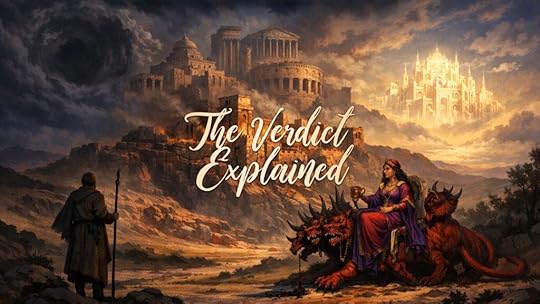 When Babylon Returned Through the Covenant
Revelation 16 brought the covenant story to its breaking point.
The bowls were poured.
The verdict embedded in the Law of Moses was enforced.
The structures that once mediated covenant life—land, temple, sacrifice, calendar, throne, and boundary—collapsed under the weight of their own unfaithfulness.
Jerusalem was shaken, fractured, and handed over to destruction.
Revelation 17 does not introduce a new act of wrath.
It interprets the one that has already taken place.
It answers the question the bowls leave behind:
Who was judged—and why did it have to be this way?
What John is shown is not merely political corruption or imperial cruelty.
It is something far more unsettling:
In other words, he sees a pattern God had judged long ago—now resurrected inside the covenant itself.
Babylon is back.
Not geographically.
Not ethnically.
But covenantally.
And this time, Babylon does not rise from the East.
It rises from within the holy city itself.
Revelation 17:1–2 (NHEB):
1 One of the seven angels who had the seven bowls came and spoke with me, saying, “Come here. I will show you the judgment of the great prostitute who sits on many waters,
2 with whom the kings of the earth committed sexual immorality, and those who dwell in the earth were made drunk with the wine of her sexual immorality.”
3 He carried me away in the Spirit into a wilderness.
One of the angels who poured out the bowls now interprets what has already happened.
The judgment has not changed.
The verdict has already fallen.
What changes here is understanding.
The angel begins with a description that demands covenant awareness:
“The great prostitute who sits on many waters.”
John later explains that the waters represent peoples, multitudes, nations, and languages (Revelation 17:15).
God had deliberately positioned Israel among the nations—not for domination, but for mediation, placing her at their center by divine design.
This is Jerusalem; I have placed her at the center of the nations, and countries are around her.
— Ezekiel 5:5
Israel stood at the crossroads of the ancient world so that:
Blessing might flow outward (Genesis 12:3).The nations might learn the ways of the LORD (Isaiah 2:2–3).A priestly people might represent God to the world (Exodus 19:5–6).But instead of influencing the nations, she entered into covenantal adultery with them.
To “sit upon” the nations is not to rule them.
It is to unite with them in unfaithfulness.
Israel once demanded judgment for a woman caught in adultery (John 8:3-11). Here, the vision exposes Israel herself in that very posture—joined to imperial power.
At every street corner you built your lofty shrines and degraded your beauty, spreading your legs with increasing promiscuity to anyone who passed by.
— Ezekiel 16:25, NIV
The language belongs not to Rome’s story, but to Israel’s prophets.
Covenant AdulteryIsrael’s kings were repeatedly accused of covenant adultery with the nations around them—alliances built through power, wealth, and idolatry rather than faithfulness.
Solomon stands as the clearest embodiment of this pattern, drawing the nations into Jerusalem while importing their gods into the heart of the covenant (1 Kings 11).
The prophets did not speak this way of pagan empires—but of Israel herself:
How the faithful city has become a prostitute. She was full of justice; righteousness lodged in her, but now murderers.
— Isaiah 1:21
Their mother has played the prostitute. She who conceived them has done shamefully; for she said, “I will go after my lovers, who give me my bread and my water, my wool and my flax, my oil and my drink.”
— Hosea 2:5
The immorality described here is not sexual excess.
It is covenant betrayal—holy authority exchanged for political security, influence, and control.
And the result was intoxicating:
“Those who dwell in the earth [gé, land] were made drunk with the wine of her sexual immorality.”
In Revelation, gē (“land”) most often refers not to humanity in general, but to those living within the covenant land.
Those dwelling in Israel—the covenant people shaped by its institutions, festivals, authority, and theology—were made drunk by this idolatry (Luke 23:4–25; Acts 6:11–13; 14:2–7).
What was meant to bless the nations instead disoriented them.
What was meant to reveal God instead distorted Him (Lamentations 1:8).
“He carried me away in the Spirit into a wilderness.”
The wilderness is where Israel was first betrothed to God.
I remember you, the devotion of your youth, the love of your weddings; how you went after Me in the wilderness.
— Jeremiah 2:2
Away from temples.
Away from sacred institutions.
Away from political power.
In the wilderness, covenant illusions collapse.
And there John sees her clearly.
A woman.
A Woman Unlike the Bride
Revelation 17:3–5 (NHEB):
3 I saw a woman sitting on a scarlet-colored animal, full of blasphemous names, having seven heads and ten horns.
4 The woman was dressed in purple and scarlet, and decked with gold and precious stones and pearls, having in her hand a golden cup full of abominations and the impurities of her sexual immorality.
5 And on her forehead a name was written, “MYSTERY, BABYLON THE GREAT, THE MOTHER OF THE PROSTITUTES AND OF THE ABOMINATIONS OF THE EARTH.”
John has already shown us another woman—radiant, crowned, laboring to bring forth life (Revelation 12:1).
Revelation 17 does not introduce a new symbol.
It is re-presenting an old indictment.
The woman John sees here is the woman Ezekiel exposed.
Ezekiel 16 portrayed Jerusalem as a covenant wife who became a prostitute—adorned by God, yet trusting in foreign power, and being publicly exposed as a result.
The parallels are unmistakable:
Gold and jewels once given by God (Exodus 28:15–21).Purple and scarlet—colors of priestly authority (Exodus 26:1; 28:5–6).A golden cup echoing Temple vessels (Exodus 25:29; Numbers 4:7).Everything about her appearance signals holy authority.
Except the contents of the cup.
What should mediate blessing now dispenses corruption.
This is not pagan immorality.
This is covenant vocation inverted.
The prophets had named it long before:
“Your own wickedness shall correct you, and your backsliding shall reprove you. Know therefore and see that it is an evil thing and bitter that you have forsaken the LORD your God, and that my fear is not in you,” says the LORD of hosts. “For of old time I have broken your yoke, and burst your bonds; and you said, ‘I will not serve;’ for on every high hill and under every green tree you bowed yourself, playing the prostitute.”
— Jeremiah 2:19-20
John recoils not because covenant unfaithfulness is new, but because it is now visible as sexual union with beastly power.
The beast John sees here is the same composite beast already identified in Revelation 13—the accumulated form of empire that Daniel first saw rising against the people of God.
Mystery Babylon is not the abandonment of religion.
It is the corruption of it.
The temple had become theater.
The priesthood had become performance.
The covenant had become cover.
Revelation 17:6 (NHEB):
6 I saw the woman drunk with the blood of the saints, and with the blood of the martyrs of Jesus. When I saw her, I wondered with great amazement.
Rome persecuted believers under Nero, but the prophetic bloodguilt named by Jesus belonged to Jerusalem:
Jesus said it plainly:
Jerusalem, Jerusalem, who kills the prophets, and stones those who are sent to her.
— Matthew 23:37
And again:
That on you may come all the righteous blood shed on the earth, from the blood of righteous Abel to the blood of Zechariah son of Berechiah, whom you killed between the sanctuary and the altar.
— Matthew 23:35
Revelation repeats the charge:
In her was found the blood of prophets and of saints, and of all who have been slain on the earth.
— Revelation 18:24
This is covenant bloodguilt.
The woman is intoxicated not by conquest, but by silencing truth.
She eliminated the voices sent to restore her.She resisted every warning until the Son Himself was crucified outside her gates.And covenant guilt is answered within the covenant itself.
The Beast That Was, and Is Not, and Is Again
Revelation 17:7-8 (NHEB):
7 The angel said to me, “Why do you wonder? I will tell you the mystery of the woman, and of the beast that carries her, which has the seven heads and the ten horns.
8 The beast that you saw was, and is not; and is about to come up out of the abyss and is going to destruction. Those who dwell on the earth and whose names have not been written in the Book of Life from the foundation of the world will marvel when they see that the beast was, and is not, but is to come.
The angel does not introduce a new beast.
He reveals the deeper pattern behind the one already seen (Revelation 9; 13).
The woman does not stand alone—she is carried.
The beast does not overthrow her—she invites it.
Through covenant compromise, heaven permits what had been restrained.
This is the destroyer John saw when the abyss opened—Abaddon, Apollyon (Revelation 9).
The beast mimics divine language:
God — who is, and who was, and who is to come (Revelation 1:8).The beast — who was, and is not, but is to come (Revelation 17:8).It is parody, not permanence.
What heaven restrains, heaven permits for a moment (Revelation 17:17)—and then brings it to destruction (Revelation 17:8).
And notice who marvels—not the faithful, but those whose names are not written in the Book of Life.
The Abyss and the DestroyerThe abyss/destroyer imagery reaches back through Scripture.
Scripture repeatedly shows destruction under restraint:
We see the same pattern in Job, where the destroyer is released only within boundaries set by God.
Revelation gathers these threads into one symbol—the Destroyer whose power rises only when heaven permits.
The woman rides the beast not because she controls it, but because she has bound her fate to it.
Why the Land MarvelsThe beast “was, is not, and is to come” not only echoes divine language; it mirrors Israel’s own history. Judgment had come before in exile, receded for a time, and now returned in a final covenant crisis.
What appeared new was the re-emergence of an old destroyer long woven into Israel’s story.
Those who dwell on the land marvel—not with admiration, but with stunned disbelief—as the beastly pattern rises again.
Even Josephus, watching the city devour itself, wrote:
It is therefore impossible to go distinctly over every instance of these men’s iniquity. I shall therefore speak my mind here at once briefly: That neither did any other city ever suffer such miseries, nor did any age ever breed a generation more fruitful in wickedness than this was, from the beginning of the world.
— Josephus, Wars 5.10.5
The beast’s “revival” is not literal resurrection.
It is the recurring reappearance of destructive authority whenever covenant identity is severed from covenant faithfulness.
Revelation 17:9-11 (NHEB):
9 Here is the mind that has wisdom. The seven heads are seven mountains, on which the woman sits.
10 They are seven kings. Five have fallen, the one is, the other has not yet come. When he comes, he must continue a little while.
11 The beast that was, and is not, is himself also an eighth, and is of the seven; and he goes to destruction.
John does not invite cleverness.
He calls for wisdom—the wisdom of Daniel (Daniel 1:20; Ezekiel 28:3).
The vision must be read the way heaven reads history: not merely as shifting empires, but as covenant crises where power rises against what belongs to God.
The heads are mountains.
The mountains are kings.
Not random rulers.
Moments heaven remembers.
Three beasts—yet five rulers.
Five moments when dominion pressed against covenant faithfulness.
Daniel does not merely count empires; he highlights distinct rulers where covenant pressure intensified. The sequence follows prophetic turning points, not modern geopolitical categories.
The One IsRome stands in John’s present—the fourth beast—iron strength ruling the nations (Daniel 2:40; 7:7).
Its authority reaches into the Temple through taxation, priestly politics, and imperial expectation.
Under Nero, persecution sharpens the pattern.
Power demands worship.
Faithfulness becomes rebellion.
The seventh king remains only “a little while.”
Not a distant empire.
An internal upheaval.
What Antiochus foreshadowed from outside now rises from within the holy city itself—a brief but devastating rule born from Zealot fervor, fear, and fractured authority.
Sacred leadership becomes entangled with domination, accelerating Jerusalem’s collapse from the inside (Daniel 11:32–35 echoes the internal fracture).
The Eighth — The Power Behind Them AllThe beast no longer approaches the covenant.
It speaks through it.
“The beast that was, and is not, is himself also an eighth…”
The eighth is not another earthly king added to the list.
It is the unveiling of the power behind them all—the king of the abyss, the Destroyer, released for a moment and restrained again by heaven’s decree (Daniel 7:11–12, 26).
This destroyer was never free without restraint.
It rose when heaven permitted judgment.
It was bound whenever destruction exceeded heaven’s intent:
Assyria was called “the rod of My anger,” yet judged when pride overflowed (Isaiah 10:5, 12).Babylon was raised up, yet overturned when its violence surpassed the measure (Habakkuk 1:6; 2:8).While I was angry but a little, they furthered the disaster.
— Zechariah 1:15, ESV
The nations were visible; the destroyer was operative.
The beast is “of the seven” because it appears through them, not as a constant ruler but as a recurring release.
John is not building a timeline.
He is unveiling a rhythm:
release. excess. restraint.
The destroyer rises briefly—and the abyss receives it again.
But this time the pattern ends.
The wrath is finished (Revelation 15:1).
The beast goes to destruction.
Revelation 17:12-13 (NHEB):
12 The ten horns that you saw are ten kings who have received no kingdom as yet, but they receive authority as kings, with the beast, for one hour.
13 These have one mind, and they give their power and authority to the beast.
The vision now shifts from long-standing rule to authority that has “not yet come.”
These figures do not inherit power.
They seize it—for a little while.
Their authority is brief—“one hour.” John does not project this hour into a distant future; he had already written, “it is the last hour” (1 John 2:18).
In Revelation, “kings” are defined not by monarchy but by authority—leaders who arise during moments of covenant crisis.
The Zealot government arose within the Old Covenant’s final moment—seizing authority quickly, burning fiercely, and collapsing just as fast.
In the final years before Jerusalem’s fall, revolutionary councils formed and fractured.
Josephus records the rise of multiple rival rulers, including the appointment of ten leaders over regions of the land—a fragile authority that endured only briefly as the city turned against itself (Wars 2.20.3-4).
Yet though divided by rivalry, the Zealots moved with one mind—convinced that the decisive hour had come to seize authority and reshape Israel’s destiny.
These were kings without a kingdom.
Authority without foundation.
When leadership loses its anchor in the Lamb, it does not remain neutral.
It inevitably strengthens the destroyer it believes it is resisting.
Revelation 17:14 (NHEB):
14 These will war against the Lamb, and the Lamb will overcome them, for he is Lord of lords, and King of kings. They also will overcome who are with him, called and chosen and faithful.”
This verse recenters the chapter.
The conflict is not Rome versus Jerusalem, nor religion versus empire.
It is a clash between two kingdoms—the beast’s way and the Lamb’s.
The beast advances by coercion.
The Lamb reigns by faithfulness.
During the revolt, the Zealot government believed it was defending God’s honor and Israel’s purity. Yet by embracing violence, seizing authority, and leading the nation into war, they opposed the very kingdom the Lamb revealed.
What appeared as zeal for God became resistance to His way—and Revelation exposes the difference:
The beast gathers armies.The Lamb gathers witnesses.The beast conquers through bloodshed.The Lamb conquers through self-giving love.Those with the Lamb are not defined by dominance but by devotion:
Called. Chosen. Faithful.
The beast gathers through fear.
The Lamb gathers through reconciliation.
Revelation 17:15-18 (NHEB):
15 He said to me, “The waters which you saw, where the prostitute sits, are peoples, multitudes, nations, and languages.
16 The ten horns which you saw, and the beast, these will hate the prostitute, and will make her desolate and naked, and will eat her flesh, and will burn her utterly with fire.
17 For God has put in their hearts to do what he has in mind, and to be of one mind, and to give their kingdom to the beast, until the words of God should be accomplished.
18 The woman whom you saw is the great city, which reigns over the kings of the earth.”
The vision now narrows from symbols to outcome.
The ten horns—the Zealot government rising in revolt—hated the prostitute.
They turned against Jerusalem’s corrupt leadership: the Sanhedrin, the Herodian order, and the temple system they believed had compromised with Rome.
Yet the beast also moved through them—the destroyer already unveiled—driving the city toward the desolation Jesus foretold: your house is left unto you desolate.
The text speaks in covenant judgment language:
They made her desolate.
They devoured her flesh.
They burned her with fire.
History echoes the vision.
Factions seized the temple, priests were slain, and the city consumed itself even before Rome completed its siege.
Verse 17 explains why:
God gave their hearts over.
Not coercion, but judicial release—rebellion permitted to fulfill what had already been spoken:
In seeking to seize the kingdom by force, the covenant people handed their authority over to darkness. The horns acted in zeal, the beast acted in destruction, and the words of God were accomplished.
Then the angel removes all ambiguity:
The woman whom you saw is the great city.
Not a distant empire, but earthly Jerusalem—the covenant center that had become “Babylon,” ruling through sacred authority yet emptied of covenant life. She is called the mother of prostitutes because the idolatry of the nation flowed from her leadership.
But this is not the final city.
Earthly Jerusalem falls so that the heavenly Jerusalem—the faithful bride—may descend.
The prostitute gives way to the Bride.
Revelation 17 exposes a sobering reality:
Holy language can be weaponized.Religion can be wielded to sanctify violence.The name of God can be invoked while the way of the Lamb is abandoned.When the Church leaves the Lamb’s way, it begins to mirror Babylon—power replaces humility, exclusion replaces mercy, and control replaces faithfulness.
The beast does not arrive from outside.
It rises from within.
This is why the saints are called:
To contend for the faith once for all delivered (Jude 1:3).To remain anchored in the apostolic foundation (Ephesians 2:20).To return again and again to their first love (Revelation 2:4–5).Because over time, truth drifts.
New doctrines emerge.
What God began in covenant life can slowly begin to resemble the empire it was meant to confront.
Revelation presents only two cities:
Babylon — covenant turned empire.New Jerusalem — empire undone by love.Only one survives.
Only one descends from heaven.
Only one is built by the Lamb.
But John’s vision is not finished.
Chapter 17 has exposed the woman.
Chapter 18 will rejoice at her fall.
The verdict has been explained.
Now heaven begins to sing over the collapse of Babylon—and to call the faithful to come out from her ways.
Reflection QuestionThe Lamb will conquer them, for He is Lord of lords and King of kings.
— Revelation 17:14, ESV
Where might the Church today be tempted to preserve influence in ways that resemble Babylon rather than the Lamb—and how do we return to the apostolic foundation before subtle imitation becomes open compromise?
Want to Go Further? Explore at Your Own Pace: [image error] Get the Book
Rediscover the Trinity—not as a puzzle, but as a redemptive story of love.
[image error] Join the Newsletter
Thoughtful, Scripture-rooted teaching to help you ask honest questions, rediscover the Gospel, and see God through the lens of Jesus.
You’ll also receive free resources if you’d like to explore further:
[image error] Join the Facebook Group
Ask questions and connect with others on the same journey.
[image error] Already Read the Book?
Leave a quick review—just a sentence or two—to help others find clarity too!
Revelation 17 speaks in Israel’s own prophetic language of covenant adultery (Ezekiel, Isaiah, Hosea). While Rome appears as the beastly power, the chapter’s primary indictment falls covenantally on the “great city” associated with prophetic bloodguilt and temple authority.
What does it mean that the woman “sits on many waters”?The “waters” represent peoples, multitudes, nations, and languages (Revelation 17:15). In covenant context, it reflects Israel’s God-given position among the nations—to mediate blessing—yet the vision exposes a tragic reversal: partnership with worldly power instead of faithful witness.
Why does John say this requires “the mind that has wisdom”?John is not inviting speculation but prophetic discernment. Like Daniel, the reader must see beyond surface politics to the deeper spiritual pattern—how covenant compromise repeatedly empowers beastly authority.
Who are the seven kings in Revelation 17:10?In a Daniel-shaped reading, the seven kings mark pivotal rulers connected to covenant crisis. Five belong to the prophetic past, Rome represents the present (“the one is”), and a brief internal upheaval within Jerusalem fulfills the “little while” before the city’s fall.
What is the “eighth” that is “of the seven” (Revelation 17:11)?The eighth reveals the spiritual force behind the pattern—the destroyer associated with the abyss (Revelation 9:11). It operates through earthly powers for a season but ultimately goes to destruction when God’s judgment reaches completion.
Why does Revelation 17 describe Babylon as a prostitute?In the prophets, prostitution imagery was used to describe covenant unfaithfulness—not sexual immorality, but spiritual betrayal (Isaiah 1:21; Ezekiel 16; Hosea 2). Revelation continues that language. The woman represents sacred authority that abandoned faithful worship and aligned itself with worldly power. The image exposes how covenant identity can be reshaped into domination when devotion to God is replaced with dependence on empire.
{ "@context": "https://schema.org", "@type": "FAQPage", "mainEntity": [ { "@type": "Question", "name": "Is “Mystery Babylon” Rome or Jerusalem in Revelation 17?", "acceptedAnswer": { "@type": "Answer", "text": "Revelation 17 speaks in Israel’s own prophetic language of covenant adultery (Ezekiel, Isaiah, Hosea). While Rome appears as the beastly power, the chapter’s primary indictment falls covenantally on the “great city” associated with prophetic bloodguilt and temple authority." } }, { "@type": "Question", "name": "What does it mean that the woman “sits on many waters”?", "acceptedAnswer": { "@type": "Answer", "text": "The “waters” represent peoples, multitudes, nations, and languages (Revelation 17:15). In covenant context, it reflects Israel’s God-given position among the nations—to mediate blessing—yet the vision exposes a tragic reversal: partnership with worldly power instead of faithful witness." } }, { "@type": "Question", "name": "Why does John say this requires “the mind that has wisdom”?", "acceptedAnswer": { "@type": "Answer", "text": "John is not inviting speculation but prophetic discernment. Like Daniel, the reader must see beyond surface politics to the deeper spiritual pattern—how covenant compromise repeatedly empowers beastly authority." } }, { "@type": "Question", "name": "Who are the seven kings in Revelation 17:10?", "acceptedAnswer": { "@type": "Answer", "text": "In a Daniel-shaped reading, the seven kings mark pivotal rulers connected to covenant crisis. Five belong to the prophetic past, Rome represents the present (“the one is”), and a brief internal upheaval within Jerusalem fulfills the “little while” before the city’s fall." } }, { "@type": "Question", "name": "What is the “eighth” that is “of the seven” (Revelation 17:11)?", "acceptedAnswer": { "@type": "Answer", "text": "The eighth reveals the spiritual force behind the pattern—the destroyer associated with the abyss (Revelation 9:11). It operates through earthly powers for a season but ultimately goes to destruction when God’s judgment reaches completion." } }, { "@type": "Question", "name": "Why does Revelation describe Babylon as a prostitute?", "acceptedAnswer": { "@type": "Answer", "text": "In the prophets, prostitution imagery described covenant unfaithfulness—not sexual immorality, but spiritual betrayal (Isaiah 1:21; Ezekiel 16; Hosea 2). Revelation continues that language. The woman represents sacred authority that abandoned faithful worship and aligned itself with worldly power, exposing how covenant identity can be reshaped into domination when devotion to God is replaced with dependence on empire." } } ] } { "@context": "https://schema.org", "@type": "BlogPosting", "mainEntityOfPage": { "@type": "WebPage", "@id": "https://jesusconquers.com/revelation-..." }, "headline": "Revelation Chapter 17: The Verdict Explained", "description": "Revelation 17 does not introduce a new act of wrath—it explains the one that has already taken place. John is shown Mystery Babylon not as a distant empire but as covenant corruption: holy authority reshaped into domination, priestly power fused with beastly logic, and the prophetic bloodguilt of Jerusalem brought to its appointed end. With Daniel-shaped wisdom, the seven heads and kings reveal a recurring pattern of beastly rule, culminating in a brief internal upheaval and the exposure of the destroyer behind it all.", "image": "https://jesusconquers.com/wp-content/...", "author": { "@type": "Person", "name": "David Longenecker", "url": "https://jesusconquers.com/about/" }, "publisher": { "@type": "Organization", "name": "Jesus Conquers", "logo": { "@type": "ImageObject", "url": "https://jesusconquers.com/wp-content/..." } }, "datePublished": "2026-02-16T09:00:00-05:00", "dateModified": "2026-02-16T09:00:00-05:00", "articleSection": "Theology", "inLanguage": "en-US", "isPartOf": { "@type": "CreativeWorkSeries", "name": "Revelation: The Clock Is Ticking", "url": "https://jesusconquers.com/category/re..." }, "keywords": [ "Revelation 17 explained", "Revelation 17 meaning", "Mystery Babylon Revelation 17", "Babylon is Jerusalem", "covenant adultery Revelation", "woman on the beast Revelation 17", "seven heads seven kings Revelation 17", "Revelation 17 seven mountains meaning", "the beast was and is not and is to come", "Abaddon Apollyon Revelation", "Daniel wisdom Revelation 17", "Revelation 17 preterist interpretation", "AD 70 Babylon judgment", "blood of prophets Revelation 17" ], "url": "https://jesusconquers.com/revelation-..." } { "@context": "https://schema.org", "@type": "BreadcrumbList", "itemListElement": [ { "@type": "ListItem", "position": 1, "name": "Home", "item": "https://jesusconquers.com/" }, { "@type": "ListItem", "position": 2, "name": "Revelation: The Clock Is Ticking", "item": "https://jesusconquers.com/category/re..." }, { "@type": "ListItem", "position": 3, "name": "Revelation Chapter 17: The Verdict Explained", "item": "https://jesusconquers.com/revelation-..." } ] }The post Revelation Chapter 17: The Verdict Explained appeared first on Jesus Conquers.
March 2, 2026
Revelation Chapter 16: The Verdict Enforced
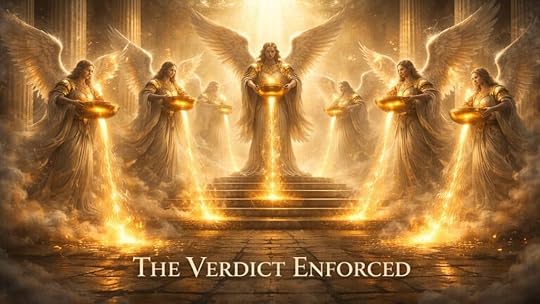 When the Covenant Speaks
In Chapter 15, John revealed that the covenant verdict had already been declared just.
Chapter 16 shows that verdict being carried out.
Up to this point, Revelation’s judgments have functioned as warnings:
The seals exposed covenant fracture.The trumpets sounded alarms—partial, restrained, invitational.Each bore witness to a covenant already failing (Hebrews 8:13).Again and again, restraint was emphasized.
And again the refrain repeated:
“They did not repent.”
What mercy had delayed is now enforced.
The covenant’s exit clause, written long before in Deuteronomy 28, has come due.
Revelation 16 marks covenant termination—the lawful end of a covenant that no longer mediates life.
This is not a new form of judgment.
It is the execution of a verdict embedded in Torah.
Israel had entered the covenant “with a curse and an oath” (Nehemiah 10:29), and later declared, “May His blood be on us and on our children” (Matthew 27:25).
The bowls do not arise from Roman politics or divine irritation.
They arise from the terms of the covenant itself.
Jesus said:
Do not think that I will accuse you to the Father. There is one who accuses you, even Moses, on whom you have set your hope.
— John 5:45
The bowls, then, are not Christ’s retaliation.
They are Moses’ testimony being taken seriously.
Specifically, they fulfill Deuteronomy 28—the covenant document that defined, in advance, the consequences of persistent unfaithfulness.
Deuteronomy 28 unfolds in two movements:
Blessings for covenant obedience.Curses for covenant violation.The blessings describe life as God intended.
The curses reveal what happens when that life is refused.
Moses warned not of random punishments, but of concrete covenant collapse—social, physical, and national—when Israel refused the voice the covenant had always pointed to.
If you will not listen to the voice of the LORD your God… all these curses shall come on you, and overtake you.
— Deuteronomy 28:15
And that voice did not remain abstract.
In the fullness of time, it took on flesh (John 1:14).
To reject Jesus was to reject the very voice Moses spoke of all along.
Moses had framed it plainly:
I have set before you life and death, the blessing and the curse: therefore choose life.
— Deuteronomy 30:19
The bowls reveal a covenant collapsing under its own weight.
When Judgment Proceeds from the Temple
Revelation 16:1 (NHEB):
1 I heard a loud voice out of the temple, saying to the seven angels, “Go and pour out the seven bowls of the wrath of God on the earth.”
In Scripture, the temple is where covenant life is mediated.
This command comes from the temple itself.
In Revelation 8, the prayers of the saints rose like incense from the altar before God.
By Revelation 15, that incense has filled the sanctuary with smoke from His glory—and no one may enter until the plagues are finished.
The prayers have been received.
The verdict has been affirmed.
The time for mercy has passed.
Mediation is over.
What follows is the lawful removal of a covenant order that could only now produce death (2 Corinthians 3:6).
This is why the imagery feels familiar:
Sores recall Egypt (Deuteronomy 28:27).Blood echoes accumulated guilt (Deuteronomy 28:18).Heat mirrors agricultural collapse (Deuteronomy 28:22–24).Darkness reflects madness (Deuteronomy 28:28–29).Siege intensifies toward total collapse (Deuteronomy 28:49–57).Jesus had already named the only path that could have preserved the nation—by turning from retaliation and revolt toward the narrow way of love that leads to life (Matthew 5:38–39; 7:12–14).
For forty years—from Pentecost to Jerusalem’s fall—mercy was extended.
Now, John signals what Moses had already written into the covenant:
All these curses shall come on you, and shall pursue you, and overtake you, until you are destroyed; because you did not listen to the voice of the LORD your God.
— Deuteronomy 28:45
Revelation 16 is not a symbolic futuristic apocalypse.
It is Deuteronomy 28 fulfilled.
Revelation 16:2 (NHEB):
2 The first went, and poured out his bowl into the earth, and it became a harmful and evil sore on the people who had the mark of the beast, and who worshiped his image.
John is deliberate.
The first bowl is not poured onto people, but into the earth.
The word is gē—land, region, territory.
The action targets the covenant land itself, not humanity in general.
In the trumpets, the land was scorched under restraint—a warning.
Now, it is rendered incapable of sustaining life at all.
This matters, because in Scripture the land of Israel is never neutral.
It is given by God, sustained by faithfulness, and rendered uninhabitable by bloodguilt.
When the covenant mediated life, the land yielded blessing.
But when violated, it yielded curse—captivity followed, and the land was lost.
The sequence is crucial.
The land is struck.
The land doesn’t merely cause the sore.
The land is the sore.
Moses had already named this outcome.
Including this plague:
You shall be cursed in the city, and you shall be cursed in the field… The LORD will make the pestilence cling to you, until he has consumed you from off the land.
— Deuteronomy 28:16-21
Josephus records the historical result with chilling restraint.
During the siege, bodies lay unburied, and the stench bred disease that swept through the city (Wars 5.12.3; 6.1.1).
The land had become uninhabitable.
What once gave life now reeked of death.
Isaiah foresaw it:
The earth also is polluted under its inhabitants, because they have transgressed the law, violated the statute, and broken the everlasting covenant.
— Isaiah 24:5
The sore appears on those who bear the mark of the beast—not a technological sign, but covenant allegiance to an order that opposed the Lamb while claiming sacred legitimacy.
This plague echoes Egypt (Exodus 9:8–12), but the target has changed.
Not a foreign merciless empire—but a covenant system that had become just as oppressive, refusing its own fulfillment.
Jesus bore the curse by bringing the covenant to its appointed end (Galatians 3:13).
But those who rejected Him remained within a structure that could only now produce death.
Covenant mediation operated through concrete structures—institutions God Himself established.
Life flowed through:
Land — inheritance and dwelling.Cleansing — access through ritual purity.Sacrifice — atonement through blood.Sacred Time — communion through feasts and Sabbaths.Identity — conferred through king and covenant.Protection — secured by boundaries and blessing.Atmosphere — the spiritual “air” shaped by worship.The bowls dismantle these—one by one.
What once mediated life now exposes death.
The fire poured out in Revelation 16 is not newly ignited.
It is the same altar fire seen in Revelation 8—already burning, already responding to prayer—now released because mediation has ended.
John does not narrate Jerusalem’s fall as a military defeat, but as a covenant verdict rendered from heaven.
This is why both the seventh trumpet and the seventh bowl announce completion:
The trumpet declares the mystery finished (Revelation 10:7).The bowl declares the verdict executed (Revelation 16:17).They are not competing endpoints.
They converge into a single moment.
Revelation 16:3 (NHEB):
3 The second one poured out his bowl into the sea, and it became blood as of a dead man. And every living thing in the sea died.
In Revelation, the sea functions as a place of separation and preparation before the presence of God.
Under the Old Covenant, approach to God required cleansing.
The temple made this visible: at its entrance stood the bronze sea, filled with water for purification (1 Kings 7:23–26).
Washing preceded sacrifice.
Cleansing prepared for communion.
In the trumpets, the sea was partially struck—its waters disturbed as a warning.
Now, what was once disrupted under restraint becomes incapable of cleansing at all.
John has already traced this imagery:
A sea of glass before the throne (Revelation 4:6).Mingled with fire (Revelation 15:2).Now turned to blood (Revelation 16:3).And finally, “the sea was no more” (Revelation 21:1).This pattern is deliberate.
John is not teaching that oceans disappear in the New Creation.
He is declaring that ritual cleansing is no longer required, because its purpose has been fulfilled.
This bowl echoes the first plague of Egypt, when the Nile—source of life—was turned to blood (Exodus 7:17–21).
What once sustained life was now exposed as corrupted.
Revelation applies the same sign to Israel’s own covenant system.
The blood of the martyrs now fills what once washed blood away.
John’s language is exact:
Every living thing in the sea died.
What once symbolized purification had become saturated with death itself.
Those who still looked to it for cleansing, seeing their reflection there, perished when the city fell.
The sea no longer mediated cleansing—because cleansing had been relocated in the Son.
Under the New Covenant, cleansing no longer flows through ritual water, but through the Lamb Himself.
What the sea once mediated temporarily, Christ now fulfills permanently.
Third Bowl — Sacrifice No Longer Mediates Atonement
Revelation 16:4–7 (NHEB):
4 The third poured out his bowl into the rivers and springs of water, and they became blood.
5 I heard the angel of the waters saying, “You are righteous, who is and who was, the Holy One, because you have judged these things.
6 For they poured out the blood of the saints and the prophets, and you have given them blood to drink. They deserve this.”
7 I heard the altar saying, “Yes, Lord God Almighty, true and righteous are your judgments.”
John does not say God judged people.
He says God judged these things—the instruments that had become carriers of bloodguilt.
The rivers and springs supplied the water used for washing, sacrifice, and priestly service—making them natural symbols of atonement in motion.
In the trumpets, these waters were partially struck—a warning.
Here, they become blood.
This is not just atonement failing.
It is temple atonement shut down.
The text tells us why:
They poured out the blood of the saints and the prophets.
The covenant people had replaced sacrificial blood with the blood of the innocent.
The system designed to reconcile had become a source of bloodguilt.
Blood no longer covers sin; it testifies against the altar.
The altar that once reconciled now renders verdict, and the angel affirms the justice of the judgment.
True and righteous are Your judgments.
Josephus records that during the siege, priests were slain in the temple courts, and blood flowed through the sanctuary itself (Wars 4.5.1–2).
The place once meant for forgiveness had become saturated with bloodshed.
This bowl does not mean God demands more blood.
It means He will no longer accept it.
Under the New Covenant, atonement no longer flows through rivers, altars, or repeated sacrifice—but through the once-for-all offering of Christ.
What the rivers once mediated temporarily, Jesus has fulfilled permanently.
Atonement now lives in the Lamb.
Revelation 16:8–9 (NHEB):
8 The fourth poured out his bowl on the sun, and it was given to him to scorch people with fire.
9 People were scorched with great heat, and they blasphemed the name of God who has the power over these plagues. They did not repent and give him glory.
In the trumpets, the lights in the sky were dimmed—sun, moon, and stars struck in part.
Israel’s leadership and national guidance fractured (Revelation 8:12).
But in the bowls, the symbol narrows.
Now the sun is struck directly—not to darken, but to burn.
This is not nature rebelling.
It is sacred time collapsing.
The sun ruled Israel’s calendar (Genesis 1:14).
It governed feasts, Sabbaths, and appointed times of meeting with God.
Time itself mediated covenant life.
But now the calendar turns without presence.
The appointed days arrive—but God does not.
Sacred time no longer gives light.
It scorches instead.
Moses had already warned:
The LORD will strike you… with fiery heat.
— Deuteronomy 28:22
Days of atonement, weeks of unleavened bread, and months of assembly had all reached their fulfillment in Christ.
But the structure continued without the substance.
Rome used those very days to trap the Jews inside the city.
Pilgrims entered for Passover.
They died in siege.
And the temple vessels melted with fervent heat (2 Peter 3:10).
Jesus is the true Passover (1 Corinthians 5:7).
The true Sabbath rest (Hebrews 4:9-10).
Under the New Covenant, sacred time has been fulfilled (Colossians 2:16-17).
The Sabbath rest does not end.
The city has no need for the sun… for the very glory of God illuminated it, and its lamp is the Lamb.
— Revelation 21:23
The covenant calendar has ended.
Time no longer mediates access to God—because the Son does.
Revelation 16:10–11 (NHEB):
10 The fifth poured out his bowl on the throne of the beast, and his kingdom was darkened. They gnawed their tongues because of the pain,
11 and they blasphemed the God of heaven because of their pains and their sores. They did not repent of their works.
The fifth bowl is poured not on land, sea, or sky—but on a throne.
This is deliberate.
In Scripture, a throne is more than a seat of power.
It is the place where identity is declared, legitimacy is conferred, and a people learn who they are.
For the LORD is our judge. The LORD is our lawgiver. The LORD is our king.
— Isaiah 33:22
But Israel demanded a human king (1 Samuel 8).
So God gave them one.
And in the fullness of time, God became King in human flesh—the Son of David and the Lord from heaven.
Yet when He came, they rejected Him.
We have no king but Caesar.
— John 19:15
By Revelation’s time, another throne stood in Israel—claiming covenantal legitimacy while opposing the Lamb.
The fifth bowl unmasks it.
This echoes the ninth plague of Egypt (Exodus 10:21–23), when darkness fell on Pharaoh’s rule before liberation.
Here, it signals collapse:
Meaning dissolves.Leadership fragments.Direction disappears.Josephus describes the city at war with itself—factions devouring one another, priests murdered by their own, paranoia consuming every leader (Wars 4.3, 4, 5).
The darkness is total—political, spiritual, and psychological.
“They did not repent.”
Even now, pride resists.
Because identity rooted in an earthly throne cannot survive exposure.
When that throne collapses, the self collapses with it.
Herod’s dynasty—installed by Rome—was the last to bear even the illusion of kingship.
After AD 70, no king has ruled in Israel since.
God was no longer offering a throne.
He was offering a Son.
Jesus is the true Davidic King—He satisfies both God’s original design and Israel’s deepest longing.
Under the New Covenant, identity no longer flows from land, lineage, or an earthly throne—but from union with Christ.
Sixth Bowl — The Boundary No Longer Mediates ProtectionIf anyone is in Christ, he is a new creation.
— 2 Corinthians 5:17
Revelation 16:12–16 (NHEB):
12 The sixth poured out his bowl on the great river, the Euphrates. Its water was dried up, that the way might be made ready for the kings that come from the sunrise.
13 I saw coming out of the mouth of the serpent, and out of the mouth of the beast, and out of the mouth of the false prophet, three unclean spirits, something like frogs;
14 for they are spirits of demons, performing signs; which go forth to the kings of the whole inhabited earth, to gather them together for the war of the great day of God, the Almighty.
15 “Look, I am coming like a thief. Blessed is he who watches, and keeps his clothes, so that he does not walk naked, and they see his shame.”
16 He gathered them together into the place which is called in Hebrew, Har Megiddo.
The sixth bowl is poured out on the Euphrates.
In Israel’s Scriptures, the Euphrates was not merely a river. It marked the outer boundary of covenant protection—the line God had set between His people and invading powers.
I have given this land to your descendants, all the way from the border of Egypt to the great Euphrates River.
— Genesis 15:18, NLT
As long as the covenant stood, that boundary held.
But now, the water is dried up.
The meaning is unmistakable: the hedge is removed.
This echoes the fall of ancient Babylon, when Cyrus diverted the Euphrates and entered the city unopposed (Isaiah 44:27–28).
John applies the same imagery.
In the trumpets, divine restraint still held chaos at bay; here, that restraint is lifted.
What follows is not immediate invasion, but deception.
Three unclean spirits emerge—from the mouths of the dragon, the beast, and the false prophet.
Satan’s lie.Rome’s propaganda.Israel’s betrayal.Their goal is not military brilliance—it is delusion.
Jesus had warned that this day of judgment would come unexpectedly—like a thief in the night (Matthew 24:42–44). Not secret, but sudden.
The location named Har-Megiddo (known to most as Armageddon) is not a prophecy of future war. It is a memory of kings who perished for ignoring the prophetic voice (2 Kings 23:29).
It symbolizes self-chosen ruin.
Josephus records that Titus’s army—Rome’s eastern legions—gathered at Har-Megiddo before marching to besiege Jerusalem.
The judgment was real.
The stage was set by lies from every direction.
The sixth bowl marks the removal of the last external safeguard.
Under the New Covenant, protection is no longer territorial.
It is relational.
I am with you always.
— Matthew 28:20, KJV
The Euphrates boundary no longer mediates protection—because God’s people are no longer defined by borders, but by union with the Son.
Seventh Bowl — The Sky Clears for a New Creation
Revelation 16:17–21 (NHEB):
17 The seventh poured out his bowl into the air. A loud voice came forth out of the temple, from the throne, saying, “It is done.”
18 There were lightnings, voices, and peals of thunder; and there was a great earthquake, such as was not since man was on the earth, so great an earthquake, so mighty.
19 The great city was divided into three parts, and the cities of the nations fell. Babylon the great was remembered in the sight of God, to give to her the cup of the wine of the fierceness of his wrath.
20 Every island fled away, and the mountains were not found.
21 Great hailstones, about one hundred pounds each, came down out of the sky on people. People blasphemed God because of the plague of the hail, for this plague is exceedingly severe.
In Scripture, the air is more than invisible space.
It’s where God appeared above the mercy seat, where incense rose, where glory descended.
The Temple breathed with divine presence.
Now that breath is silenced.
By the seventh bowl, every form of covenant mediation has already failed:
Land.Cleansing.Sacrifice.Sacred time.Identity.Protection.Only the air remains—the unseen framework sustaining the system.
So God clears it.
“It is done.”
Covenant transition is finished.
Revelation 16:19 names what this collapse means in covenant terms.
Jerusalem fractures from within—its unity shattered.
The cities of the nations are the cities of the covenant peoples (Genesis 17:4–6)—the towns of Israel’s tribes, whose identity depended on land, temple, and record.
Josephus records that during Jerusalem’s internal collapse, the Temple complex—where archival and genealogical records were kept—was burned, making the verification of tribal identity impossible (Wars 6.4.5–7).
With the land lost, the temple destroyed, and the records erased, the tribes could no longer be sustained as an earthly covenant structure.
What could no longer endure on earth was fulfilled in Christ, where the true Israel had already been sealed and raised.
Babylon is remembered—not in mercy, but in verdict.
At Sinai, thunder, lightning, cloud, and trembling marked the beginning of covenant.
Now those signs return—but to mark its end.
The hail mirrors Egypt’s seventh plague—a crushing blow against Pharaoh’s kingdom (Exodus 9).
But now it falls on Jerusalem, the covenant breaker.
What comes next?
The beast and false prophet are cast into the fire (Revelation 19:20).Satan is bound (Revelation 20:2).A new sky dawns, and the Lamb reigns.Under the New Covenant, God’s presence no longer fills a building.
It fills a people.
Look, the tabernacle of God is with humans.
— Revelation 21:3
The seventh bowl does not end the story.
It clears the air so the new one can begin.
It is done.
This Is How Covenant Judgment WorksEverything described in Revelation 16 follows a pattern Israel had already seen before.
Throughout the Old Testament, when Israel broke covenant, God initiated what the prophets called a rîb—a formal legal case brought against His people.
The pattern is consistent:
Summons — Heaven and earth called as witnesses.Charges — Covenant violation named.Warnings — Opportunity for repentance.Sentence — Judgment declared.Execution — Verdict enforced.Revelation follows this exact order.
The seals expose covenant rupture.The trumpets issue lawsuit warnings.The bowls enforce the sentence already declared.The bowls do not unleash hell.
They clear the way for heaven.
And with the obstruction removed, the reign of the Lamb advances— and the nations are invited to worship before Him.
In Chapter 17, John does not return to judgment.
He explains it.
The system that claimed holiness while opposing the Lamb is finally named.
ReflectionWhat systems—religious, political, or cultural—is the Lamb calling us to leave before they fall?
Want to Go Further? Explore at Your Own Pace: [image error] Get the Book
Rediscover the Trinity—not as a puzzle, but as a redemptive story of love.
[image error] Join the Newsletter
Thoughtful, Scripture-rooted teaching to help you ask honest questions, rediscover the Gospel, and see God through the lens of Jesus.
You’ll also receive free resources if you’d like to explore further:
[image error] Join the Facebook Group
Ask questions and connect with others on the same journey.
[image error] Already Read the Book?
Leave a quick review—just a sentence or two—to help others find clarity too!
No. Revelation 16 describes covenant judgment already defined in Deuteronomy 28 and enforced in the first century. The bowls are not future predictions but the execution of covenant consequences Israel had long agreed to.
What do the bowls in Revelation 16 represent?The bowls represent the final enforcement of covenant curses—not escalating wrath. They mark the moment when warnings end and the Old Covenant is lawfully brought to completion.
How does Deuteronomy 28 explain Revelation 16?Deuteronomy 28 outlines blessings for obedience and curses for covenant violation. Revelation 16 mirrors these curses—disease, blood, heat, darkness, siege—showing their fulfillment rather than inventing new judgments.
Why do angels pour the bowls?The angels act as agents of covenant administration, not arbiters of personal rage. Their role emphasizes order, legality, and execution of an already-rendered verdict.
Is Revelation 16 about God’s anger or justice?Revelation 16 is about covenant justice, not emotional anger. The text repeatedly shows restraint, warning, and delay—followed by lawful enforcement once repentance is fully refused.
Does Revelation 16 describe the end of the world?No. It describes the end of a covenant system, not the destruction of the planet. The collapse is covenantal, centered on Jerusalem and the Temple, not cosmic annihilation.
What does “It is done” mean in Revelation 16:17?“It is done” signals completion, not escalation. Just as creation and redemption were “finished,” the Old Covenant order is now fully concluded.
Why does this interpretation matter today?It reframes Revelation from fear-based futurism into a testimony of Christ’s victory, the end of obsolete mediation, and the present reality of God dwelling with His people.
{ "@context": "https://schema.org", "@type": "BlogPosting", "mainEntityOfPage": { "@type": "WebPage", "@id": "https://jesusconquers.com/revelation-..." }, "headline": "Revelation Chapter 16: The Verdict Enforced", "description": "Revelation 16 is not a symbolic futuristic apocalypse. It is covenant judgment enforced. The bowls do not arise from Roman politics or divine irritation, but from the covenant terms already written in Deuteronomy 28. What began as warning in the seals and trumpets now becomes sentence: the lawful termination of an Old Covenant order that could only produce death. From land to sea, sacrifice to sacred time, throne to boundary, Revelation 16 shows covenant mediation collapsing under its own weight—until a voice from the Temple declares, “It is done.”", "image": "https://jesusconquers.com/wp-content/...", "author": { "@type": "Person", "name": "David Longenecker", "url": "https://jesusconquers.com/about/" }, "publisher": { "@type": "Organization", "name": "Jesus Conquers", "logo": { "@type": "ImageObject", "url": "https://jesusconquers.com/wp-content/..." } }, "datePublished": "2026-01-29T09:00:00-05:00", "dateModified": "2026-01-29T09:00:00-05:00", "articleSection": "Theology", "inLanguage": "en-US", "isPartOf": { "@type": "CreativeWorkSeries", "name": "Revelation: The Clock Is Ticking", "url": "https://jesusconquers.com/category/re..." }, "keywords": [ "Revelation 16 explained", "Revelation 16 meaning", "bowls of wrath Revelation 16", "seven bowls Revelation 16", "It is done Revelation 16:17", "Deuteronomy 28 fulfillment", "covenant curses Revelation", "covenant lawsuit Revelation", "Revelation 16 preterist interpretation", "AD 70 Revelation bowls", "Jerusalem covenant judgment", "Temple voice Revelation 16", "Revelation 16 not future apocalypse", "Armageddon Har Megiddo meaning" ], "url": "https://jesusconquers.com/revelation-..."}{ "@context": "https://schema.org", "@type": "BreadcrumbList", "itemListElement": [ { "@type": "ListItem", "position": 1, "name": "Home", "item": "https://jesusconquers.com/" }, { "@type": "ListItem", "position": 2, "name": "Revelation: The Clock Is Ticking", "item": "https://jesusconquers.com/category/re..." }, { "@type": "ListItem", "position": 3, "name": "Revelation Chapter 16: The Verdict Enforced", "item": "https://jesusconquers.com/revelation-..." } ]}{ "@context": "https://schema.org", "@type": "FAQPage", "mainEntity": [ { "@type": "Question", "name": "Is Revelation 16 about the future?", "acceptedAnswer": { "@type": "Answer", "text": "No. Revelation 16 describes covenant judgment already defined in Deuteronomy 28 and enforced in the first century. The bowls are not future predictions but the execution of covenant consequences Israel had long agreed to." } }, { "@type": "Question", "name": "What do the bowls in Revelation 16 represent?", "acceptedAnswer": { "@type": "Answer", "text": "The bowls represent the final enforcement of covenant curses—not escalating wrath. They mark the moment when warnings end and the Old Covenant is lawfully brought to completion." } }, { "@type": "Question", "name": "How does Deuteronomy 28 explain Revelation 16?", "acceptedAnswer": { "@type": "Answer", "text": "Deuteronomy 28 outlines blessings for obedience and curses for covenant violation. Revelation 16 mirrors these curses—disease, blood, heat, darkness, siege—showing their fulfillment rather than inventing new judgments." } }, { "@type": "Question", "name": "Why do angels pour the bowls?", "acceptedAnswer": { "@type": "Answer", "text": "The angels act as agents of covenant administration, not arbiters of personal rage. Their role emphasizes order, legality, and execution of an already-rendered verdict." } }, { "@type": "Question", "name": "Is Revelation 16 about God’s anger or justice?", "acceptedAnswer": { "@type": "Answer", "text": "Revelation 16 is about covenant justice, not emotional anger. The text repeatedly shows restraint, warning, and delay—followed by lawful enforcement once repentance is fully refused." } }, { "@type": "Question", "name": "Does Revelation 16 describe the end of the world?", "acceptedAnswer": { "@type": "Answer", "text": "No. It describes the end of a covenant system, not the destruction of the planet. The collapse is covenantal, centered on Jerusalem and the Temple, not cosmic annihilation." } }, { "@type": "Question", "name": "What does “It is done” mean in Revelation 16:17?", "acceptedAnswer": { "@type": "Answer", "text": "“It is done” signals completion, not escalation. Just as creation and redemption were “finished,” the Old Covenant order is now fully concluded." } }, { "@type": "Question", "name": "Why does this interpretation matter today?", "acceptedAnswer": { "@type": "Answer", "text": "It reframes Revelation from fear-based futurism into a testimony of Christ’s victory, the end of obsolete mediation, and the present reality of God dwelling with His people." } } ]}The post Revelation Chapter 16: The Verdict Enforced appeared first on Jesus Conquers.
February 23, 2026
Revelation Chapter 15: The Wrath That Ends Wrath
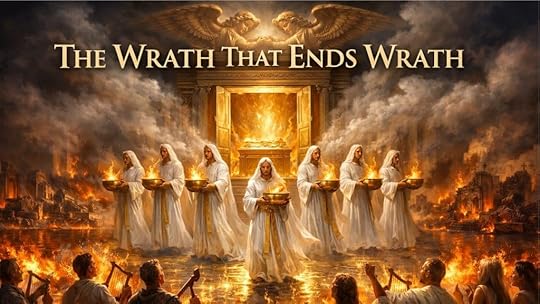 Why Wrath Appears in Scripture at All
In Chapter 14, the harvest of the age was completed.
The Lamb stood victorious on Mount Zion, the firstfruits were gathered, and the judgment John had been announcing was shown for what it truly was—not the end of the world, but the end of a covenant order that had opposed life.
With the harvest complete, one question naturally follows:
Why does God’s wrath ever appear at all?
Before the bowls are poured out, Scripture first clarifies why they exist, what they remove, and why they are called the last.
The answer is consistent—and sobering.
In the days of NoahCorruption had reached generational saturation. The righteous lineage—the only means through which the Messianic promise of salvation could come—had narrowed to one family.
One more generation, and the line through which life would come into the world would be gone.
Wrath came—not because God despised humanity, but because without intervention there would be no Christ.
No Christ meant no salvation.
No salvation meant no resurrection life.
Wrath removed what was about to block life from entering the world at all.
In the days of PharaohEgypt had once preserved Israel during famine. But preservation slowly became enslavement. The people through whom the promise would come were being absorbed into Egypt’s gods, Egypt’s systems, Egypt’s way of death.
Moses ascends the mountain briefly.
When he returns, the people are already worshiping a golden calf.
Again, the line was in danger.
Wrath fell—not because God hated Egypt, but because if Israel did not leave, Christ could not come.
“Let My people go” was not a threat.
It was the preservation of the Messianic seed.
The cry of victims reached heaven. Violence had become normalized. And Lot—Abraham’s family—was being slowly absorbed into a culture that devoured righteousness.
All it would have taken was one generation—Isaac drawn toward Sodom’s life by his uncle—and the promise would have ended.
Wrath fell, not as vengeance, but as containment—because corruption had reached its end.
What Is Different in Revelation 15In every case, wrath appears only when God’s plan of salvation itself is at risk.
Now Revelation 15 announces a decisive shift.
Christ has come.The promise has been fulfilled.The Spirit has been poured out.The Church has been born.The life of God is no longer carried by a fragile lineage that can be erased by one generation of violence. It is now carried by a resurrected Christ and an indwelt people.
Yet something new threatens access to life.
Not the failure of the promise—but the attempt to extinguish its witnesses.
The early Church did not begin as an unstoppable institution. It began as a fragile movement—twelve men, scattered communities, hunted, imprisoned, and killed.
If the apostolic witness were crushed at birth, the message of life could be silenced before it reached the nations.
And so, once again, wrath appears.
Not because God desires death—but because He will not allow access to life to be destroyed.
These bowls are not the escalation of anger.
They are the final intervention necessary to ensure that the restoration of the world cannot be stopped.
This is why John hears the declaration:
“With these, the wrath of God is finished.”
Wrath is not ending because God has changed.
Wrath is ending because it is no longer necessary.
Revelation 15:1 (NHEB):
1 I saw another great and marvelous sign in the sky: seven angels having the seven last plagues, for in them God’s wrath is finished.
This is not a vision of the end of the world.
It is the end of something far more specific—and far more biblical: the end of covenant wrath.
John is deliberate.
These are not merely severe plagues.
They are the last.
And they are last for a reason—not because God exhausts His patience, but because wrath has accomplished its purpose.
Scripture never portrays God’s wrath as emotional volatility or divine rage.
From Genesis to Revelation, wrath appears only at moments of existential threat—when access to life itself is in danger of being cut off.
The Bowls: Vessels of Cleansing, Not RageWrath is not God losing control.
It is God refusing to lose creation to death.
The image of seven golden bowls filled with the wrath of God has fueled centuries of fear.
But John has already explained what these bowls are.
Earlier, we were told:
Golden bowls full of incense, which are the prayers of the saints.
— Revelation 5:8
These are temple vessels.
They are not weapons of chaos.
They are instruments of worship.
The bowls that now carry wrath are the same kind of bowls that once carried prayer.
This reveals something essential:
God’s wrath does not flow from cruelty.It flows from holiness.James makes the distinction clear:
For the wrath of man worketh not the righteousness of God.
— James 1:20, KJV
God’s wrath is not human anger magnified.
It is divine holiness applied.
Where human wrath multiplies death, God’s wrath restores order by removing the works of Satan that hinder salvation (1 John 3:8).
Wrath does not contradict mercy.
It protects it.
Revelation has already shown judgment through the trumpets.
But the trumpets and the bowls serve different purposes.
The trumpets were warnings.
They released the consequences of alignment with death.
They allowed spiritual forces to run their course.
Again and again, John records the tragic refrain:
They still did not repent ( Revelation 9:20 ).
God did not rush to remove.
He warned.He waited.He called.But when access to life itself remained under threat—when the Church was still being crushed and its persecutors had no intention of stopping—wrath moved from warning to removal.
The bowls do not unleash hell.
They cleanse it.
The bowls remove the evil systems that obstruct salvation.
Malachi had already described this pattern centuries earlier:
The day comes, it burns as a furnace; and all the proud, and all who work wickedness, will be stubble…. But to you who fear my name shall the sun of righteousness arise with healing in its wings. You will go out, and leap like calves of the stall.
— Malachi 4:1–2
Judgment does not linger for its own sake.
It burns until the threat is gone—and then it gives way to restoration.
The same fire that removes what destroys life is the fire that makes healing possible.
Once the obstruction is removed, the people of God are free to go out—to move, to multiply, and to carry healing where it could not go before.
The Sea of Glass Mixed with FireRevelation 15:2 (NHEB):
2 I saw something like a sea of glass mixed with fire, and those who overcame the beast, his image, and the number of his name, standing on the sea of glass, having harps of God.
These are not new figures.
They are the same people gathered in the previous chapter—the harvest Jesus reaped, the firstfruits preserved through trial, the witnesses who refused the mark of the beast.
What Chapter 14 showed as harvest, Chapter 15 now shows as arrival.
This image is not new.
It is Exodus retold.
In Israel’s story, the people passed through the sea unharmed, while the power that pursued them was swallowed by it.
The sea was not the threat—it was the dividing line between life and death.
Revelation 15 preserves the same pattern.
Only now, the sea judges—not with water, but with fire.
The saints are not consumed by the fire.
They stand beside it, having already crossed over.
This is not a picture of random destruction.
It is a picture of separation completed—the same separation celebrated in the Song of Moses after Pharaoh’s power was broken:
I will sing to the LORD, for he has triumphed gloriously. The horse and his rider he has thrown into the sea… In the greatness of your excellency, you overthrow those who rise up against you. You send forth your wrath. It consumes them as stubble… The enemy said, “I will pursue… I will draw my sword, my hand shall destroy them.” You blew with your wind. The sea covered them.
— Exodus 15:1-10
The fire in this sea does not exist to torment the faithful.
It exists to finish what the crossing began.
Just as the waters closed over Egypt after Israel reached safety, the fire now closes over the systems that pursued the Church to destroy it.
The saints are not being judged here.
They are being vindicated.
They stand where Israel once stood—on the far side of deliverance—harps in hand, singing not of fear, but of victory.
The Song of Moses and the Lamb
Revelation 15:3–4 (NHEB):
3 They sang the song of Moses, the servant of God, and the song of the Lamb, saying, “Great and marvelous are your works, Lord God Almighty. Righteous and true are your ways, King of the nations.
4 Who would not fear you, Lord, and glorify your name? For you only are holy. For all the nations will come and worship before you. For your righteous acts have been revealed.”
Only Israel ever sang the Song of Moses.
The Church sings the Song of the Lamb.
John brings them together intentionally—because this moment belongs to the apostolic age, the great hinge point between covenants.
What began with deliverance from Egypt now reaches its fulfillment in deliverance from death itself.
The Song of Moses celebrated liberation from an oppressor. The Song of the Lamb proclaims the defeat of everything that enslaves creation.They are not two competing songs, but one completed testimony.
The Church does not discard Israel’s song—it sings it to its intended end.
And notice the result.
The outcome of God’s judgment is not the annihilation of the nations, but their invitation:
“All the nations will come and worship before You.”
Wrath has done its work.
The obstacle has been removed.
Access to life is now open to the world.
This is why Revelation 15 matters.
God is love (1 John 4:8).
Wrath does not define God.
Wrath serves life.
Once life can no longer be blocked—once resurrection has taken root in the world—wrath disappears from the story because its work is done.
The bowls are not God losing patience.
They are God finishing the work of protection.
Scripture names the true enemy clearly:
The last enemy that shall be destroyed is death.
— 1 Corinthians 15:26, KJV
Not sinners.
Not nations.
Death.
Revelation 15:5–6 (NHEB):
5 After these things I looked, and the temple of the tabernacle of the testimony in heaven was opened.
6 The seven angels came out of the temple who had the seven plagues, clothed with pure, bright linen, and wearing golden sashes around their chests.
The temple that opens is not vague or symbolic.
John names it precisely:
The tabernacle of the testimony.
This is courtroom language.
What follows is not arbitrary judgment.
It is covenant verdict rendered.
What is being judged is not the world generically, but the system that bore God’s name while crucifying His Son and persecuting His body.
The angels emerge clothed as priests—not executioners—carrying sacred vessels.
Wrath does not erupt from chaos.
It proceeds from holiness.
Revelation 15:7 (NHEB):
7 One of the four living creatures gave to the seven angels seven golden bowls full of the wrath of God, who lives forever and ever.
Notice this: the bowls are handed over by one of the living creatures.
Earlier in Revelation Chapter 4—and throughout the prophets—we learned who these are (Ezekiel 10:20; Genesis 3:24).
They are cherubim.
From Genesis onward, cherubim guard the Tree of Life—not to withhold life, but to protect humanity from accessing it prematurely.
After Christ’s resurrection, the threat has reversed.
The danger is no longer humanity rushing toward life too soon.The danger is humanity being cut off from life altogether.So the guardians of life act.
They do not dispense death.
They remove what produces it.
Smoke Fills the Temple: Presence, Not AbandonmentWrath is not opposed to love.
It is love acting decisively when life is under siege.
Revelation 15:8 (NHEB):
8 The temple was filled with smoke from the glory of God, and from his power. No one was able to enter into the temple, until the seven plagues of the seven angels would be finished.
Whenever smoke fills God’s dwelling in Scripture, it signals presence, not absence.
Moses could not enter because God’s glory filled the tabernacle (Exodus 40:34–35).The priests could not stand because God took possession of His house (1 Kings 8:10–11).The same is true here.
The temple closes not because God withdraws—but because false mediators are being removed.
The veil has already been torn.
Now the structure that denied that tearing must fall.
The martyrs cried:
“How long, O Lord?”
And God answered:
“Rest a little longer.”
Wrath is never God’s first move.
He warns.
He calls.
He waits.
“As I live,” says the Lord GOD, “I have no pleasure in the death of the wicked; but that the wicked turn from his way and live.”
— Ezekiel 33:11
But the text remains honest:
They still did not repent (Revelation 9:20).
Wrath comes only when continued patience would mean the loss of life itself.
And even then, mercy is not absent:
For this reason also the Good News was preached to those who are now dead, that they might be judged according to man in the flesh, but might live according to God in the Spirit.
— 1 Peter 4:6
God’s wrath—His judgments in the flesh—served life, and its work is now complete.
The Church is no longer fragile.The gospel cannot be stamped out.Resurrection life has crossed irreversible thresholds.From here on, the Kingdom grows like yeast—quietly, irreversibly.
Wrath ends because life is secure.
This does not mean God ceases to act in history.
It means He will never again need to intervene through covenantal wrath to preserve access to salvation.
What once required decisive removal has now given way to unstoppable life.
Fire That Makes Room for GodWhat follows wrath is not distance—but presence.
Jesus taught us to pray:
Thy kingdom come. Thy will be done in earth, as it is in heaven.
— Matthew 6:10, KJV
Heaven does not come by destroying the earth.
It comes by removing what resists life.
That is what the bowls accomplish.
Not the unleashing of hell—but the clearing of it.
Wrath is not God’s final word.
Life is.
Revelation 15 does not show wrath beginning.
It shows wrath ending.
What follows in Chapter 16 is not a new act of judgment, but the outworking of a verdict already declared just.
The earth is being made ready for the reign of the Lamb to advance, and for the nations to come and worship before Him.
Reflection QuestionIf God’s wrath exists to protect access to life rather than to punish humanity, what does that reveal about the kind of God you have been afraid of—and whether that fear came from Scripture itself or from reading it through the wrong lens?
Want to Go Further? Explore at Your Own Pace: [image error] Get the Book
Rediscover the Trinity—not as a puzzle, but as a redemptive story of love.
[image error] Join the Newsletter
Thoughtful, Scripture-rooted teaching to help you ask honest questions, rediscover the Gospel, and see God through the lens of Jesus.
You’ll also receive free resources if you’d like to explore further:
[image error] Join the Facebook Group
Ask questions and connect with others on the same journey.
[image error] Already Read the Book?
Leave a quick review—just a sentence or two—to help others find clarity too!
In Revelation 15, God’s wrath is not uncontrolled rage but a final, purposeful act to remove the systems that threaten life and hinder salvation. It marks the end of covenant wrath—not the beginning of eternal punishment.
Does Revelation 15 describe the end of the world?No. Revelation 15 is not about the destruction of the world, but the completion of God’s covenant judgment against a specific order that opposed life. It prepares the way for restoration, not annihilation.
Why are the seven bowls called the “last” plagues?They are “last” because they complete God’s wrath. With the Church born and the resurrection life secure, there is no longer any need for covenantal wrath. It has done its protective work.
What do the bowls of wrath represent?The bowls are not weapons of vengeance but temple vessels—the same kind used for prayer and worship. They represent God’s holy response to persistent opposition against His redemptive plan.
What is the sea of glass mixed with fire in Revelation 15?This image echoes the Red Sea crossing. The sea symbolizes purification, while the fire signifies judgment. The faithful are not harmed by it—they stand beside it, vindicated after passing through tribulation.
How is God’s wrath different from human anger?Unlike human wrath, which often leads to destruction, God’s wrath in Scripture removes what blocks life. It is rooted in holiness, not emotion, and it always serves restoration.
Why did God wait before pouring out the final wrath?Revelation emphasizes God’s patience. The trumpets served as warnings, and only after persistent refusal to repent—and continued persecution of the Church—did God act to remove the threat.
Is Revelation 15 the end of God’s judgment?Revelation 15 marks the completion of covenant wrath. Chapter 16 carries out what has already been declared. From this point on, the story moves toward restoration and the reign of the Lamb.
{ "@context": "https://schema.org", "@type": "BlogPosting", "mainEntityOfPage": { "@type": "WebPage", "@id": "https://jesusconquers.com/revelation-..." }, "headline": "Revelation Chapter 15: The Wrath That Ends Wrath", "description": "Revelation 15 explains not the beginning, but the conclusion of God's covenantal wrath. With the Church no longer fragile and resurrection life secure, these final plagues remove what once threatened access to life. The bowls are not weapons of rage, but temple vessels of holy cleansing. This chapter redefines judgment and reveals God's wrath as an act of love guarding creation.", "image": "https://jesusconquers.com/wp-content/...", "author": { "@type": "Person", "name": "David Longenecker", "url": "https://jesusconquers.com/about/" }, "publisher": { "@type": "Organization", "name": "Jesus Conquers", "logo": { "@type": "ImageObject", "url": "https://jesusconquers.com/wp-content/..." } }, "datePublished": "2026-02-23T09:00:00-05:00", "dateModified": "2026-02-23T09:00:00-05:00", "articleSection": "Theology", "inLanguage": "en-US", "isPartOf": { "@type": "CreativeWorkSeries", "name": "Revelation: The Clock Is Ticking", "url": "https://jesusconquers.com/category/re..." }, "keywords": [ "Revelation 15 explained", "Revelation 15 meaning", "bowls of wrath Revelation", "final judgment Revelation 15", "sea of glass mixed with fire", "wrath of God explained", "song of Moses and the Lamb", "Revelation temple smoke meaning", "cherubim and bowls of wrath", "covenantal wrath ended", "Revelation 15 preterist interpretation", "AD 70 final wrath", "fire of God removes obstruction" ], "url": "https://jesusconquers.com/revelation-..."}{ "@context": "https://schema.org", "@type": "BreadcrumbList", "itemListElement": [ { "@type": "ListItem", "position": 1, "name": "Home", "item": "https://jesusconquers.com/" }, { "@type": "ListItem", "position": 2, "name": "Revelation: The Clock Is Ticking", "item": "https://jesusconquers.com/category/re..." }, { "@type": "ListItem", "position": 3, "name": "Revelation Chapter 15: The Wrath That Ends Wrath", "item": "https://jesusconquers.com/revelation-..." } ]}{ "@context": "https://schema.org", "@type": "FAQPage", "mainEntity": [ { "@type": "Question", "name": "What is the wrath of God in Revelation 15?", "acceptedAnswer": { "@type": "Answer", "text": "In Revelation 15, God's wrath is not uncontrolled rage but a final, purposeful act to remove the systems that threaten life and hinder salvation. It marks the end of covenant wrath—not the beginning of eternal punishment." } }, { "@type": "Question", "name": "Does Revelation 15 describe the end of the world?", "acceptedAnswer": { "@type": "Answer", "text": "No. Revelation 15 is not about the destruction of the world, but the completion of God’s covenant judgment against a specific order that opposed life. It prepares the way for restoration, not annihilation." } }, { "@type": "Question", "name": "Why are the seven bowls called the “last” plagues?", "acceptedAnswer": { "@type": "Answer", "text": "They are 'last' because they complete God's wrath. With the Church born and the resurrection life secure, there is no longer any need for covenantal wrath. It has done its protective work." } }, { "@type": "Question", "name": "What do the bowls of wrath represent?", "acceptedAnswer": { "@type": "Answer", "text": "The bowls are not weapons of vengeance but temple vessels—the same kind used for prayer and worship. They represent God’s holy response to persistent opposition against His redemptive plan." } }, { "@type": "Question", "name": "What is the sea of glass mixed with fire in Revelation 15?", "acceptedAnswer": { "@type": "Answer", "text": "This image echoes the Red Sea crossing. The sea symbolizes purification, while the fire signifies judgment. The faithful are not harmed by it—they stand beside it, vindicated after passing through tribulation." } }, { "@type": "Question", "name": "How is God’s wrath different from human anger?", "acceptedAnswer": { "@type": "Answer", "text": "Unlike human wrath, which often leads to destruction, God’s wrath in Scripture removes what blocks life. It is rooted in holiness, not emotion, and it always serves restoration." } }, { "@type": "Question", "name": "Why did God wait before pouring out the final wrath?", "acceptedAnswer": { "@type": "Answer", "text": "Revelation emphasizes God’s patience. The trumpets served as warnings, and only after persistent refusal to repent—and continued persecution of the Church—did God act to remove the threat." } }, { "@type": "Question", "name": "Is Revelation 15 the end of God’s judgment?", "acceptedAnswer": { "@type": "Answer", "text": "Revelation 15 marks the completion of covenant wrath. Chapter 16 carries out what has already been declared. From this point on, the story moves toward restoration and the reign of the Lamb." } } ]}The post Revelation Chapter 15: The Wrath That Ends Wrath appeared first on Jesus Conquers.
February 16, 2026
Revelation Chapter 14: When the Beast Rose, the Lamb Stood
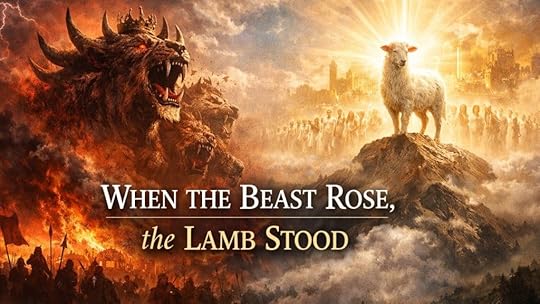 The Firstfruits and the Harvest of the Age
Revelation 14 is not an isolated vision.
It is heaven’s answer to the beasts of Chapter 13.
As apostate Israel forged alliances—uniting religious betrayal with political violence—John is shown a higher reality. The contrast is deliberate and covenantal:
Below: Babylon rises.
Above: Zion stands.
In AD 66, the Zealots seized the temple, halted Gentile sacrifices, murdered the priesthood, and enthroned false messiahs. This was the beast from the land—the religious image of empire.
The world below trembled.
But heaven did not.
While the dragon stirred chaos, the Lamb stood.
John looked—and saw Him.
Not pacing.
Not retreating.
But standing in glory on Mount Zion.
And with Him stood the 144,000—the sealed remnant first introduced in Revelation 7. They are no longer hidden, no longer waiting, no longer resting beneath the altar.
They are raised.
They are standing.
They are singing.
This is not a chronological jump forward.
It is a covenantal unveiling.
The age is ending—but the Bride is rising.
While earthly Jerusalem worships the beast, heavenly Jerusalem exalts the Lamb.
Revelation 14:1–5 (NHEB):
1 And I looked, and suddenly on Mount Zion stood the Lamb, and with him one hundred forty-four thousand, having his name, and the name of his Father, written on their foreheads.
2 I heard a sound from heaven, like the sound of many waters, and like the sound of a great thunder. The sound which I heard was like that of harpists playing on their harps.
3 They sing a new song before the throne, and before the four living creatures and the elders. No one could learn the song except the one hundred forty-four thousand, those who had been redeemed out of the earth.
4 These are those who were not defiled with women, for they are virgins. These are those who follow the Lamb wherever he goes. These were redeemed from among humanity, the first fruits to God and to the Lamb.
5 In their mouth was found no lie; they are blameless.
The 144,000 are the faithful remnant of Israel—the answer to the cry of Revelation 6:17: Who can stand?
They are not standing in metaphor.
They are standing in fulfillment.
They sang a new song no one else could learn, because their path was unique.
The Bridge Between CovenantsThese are the ones who lived and died between promise and fulfillment—the faithful saints of the Old Covenant, who carried the weight of expectation but did not live to see its completion.
The writer of Hebrews tells us that Abraham was waiting—not for land, not for national restoration, but for a city from God:
He looked for the city which has foundations, whose architect and builder is God.
— Hebrews 11:10
Yet Hebrews is equally clear that this city was not entered immediately:
These all, having had testimony given to them through their faith, did not receive the promise, God having provided some better thing concerning us, so that apart from us they should not be made perfect.
— Hebrews 11:39–40
They waited together.
They rested together.
They would be perfected together.
What Hebrews describes as delayed, John now shows as delivered.
From Abraham’s Bosom to Mount ZionThroughout the Gospels and Revelation, the righteous dead are portrayed as alive, comforted, and conscious—yet still waiting.
Jesus called it Abraham’s bosom (Luke 16:22).John saw them as souls under the altar (Revelation 6:9–11).In both cases, they were told to wait “a little longer.”
But now they are no longer beneath the altar.
No longer crying out.
No longer resting in hope.
They are standing with the Lamb.
Mount Zion replaces the waiting place.Song replaces silence.Resurrection replaces rest.The age that required waiting has passed.
The New Covenant age—the age of resurrection—has begun.
Paul insisted that resurrection unfolds according to order:
Each in turn: Christ, the firstfruits; then, when he comes, those who belong to him.
— 1 Corinthians 15:23, NIV
Christ’s Resurrection did not immediately empty the grave.
It guaranteed that one day it would.
Revelation 14 identifies when that next stage occurs.
The 144,000 are called firstfruits—not because they are the only ones raised, but because they are the first resurrection harvest beyond Christ Himself.
“From Now On” — Death Without DelayTheir resurrection signals that the harvest has begun—and once firstfruits are offered, the full harvest must follow.
John hears a voice from heaven declare:
Blessed are the dead who die in the Lord from now on.
— Revelation 14:13
Those words mark a turning point: from now on.
Before this moment, the righteous died in hope—but not in completion.
Job articulated that hope centuries earlier:
O that thou wouldest hide me in the grave, that thou wouldest keep me secret, until thy wrath be past, that thou wouldest appoint me a set time, and remember me! If a man die, shall he live again? all the days of my appointed time will I wait, till my change come.
— Job 14:13–14, KJV
Job assumes death, delay, and then a summons—until the appointed time when God would call him forth.
John reveals that the appointed time has arrived.
The Change and the TrumpetWhen Paul speaks of this “change,” he anchors it to a specific moment:
I tell you a mystery. We will not all sleep, but we will all be changed, in a moment, in the twinkling of an eye, at the last trumpet. For the trumpet will sound, and the dead will be raised incorruptible, and we will be changed.
— 1 Corinthians 15:51–52
John has already shown when that trumpet sounds.
In Revelation 11, the seventh trumpet was blown, and heaven declared:
The seventh angel sounded, and great voices in heaven followed, saying, “The kingdom of the world now belongs to our Lord and to his Christ, and he will reign forever and ever…” Your wrath came, as did the time for the dead to be judged, and to give your servants the prophets, their reward, as well as to the saints, and those who fear your name.
— Revelation 11:15–18
This is the trumpet Paul was waiting for.
Now we see the result.
Paul is not denying death.
He is denying delay.
In Scripture, “sleep” is not death itself—it is the waiting state of the righteous dead.
Some died before the trumpet sounded—and waited.
Others would die after it—and be changed immediately.
This is why Paul can say:
[He] gave to us the down payment of the Spirit. Therefore, we are always confident and know that while we are at home in the body, we are absent from the Lord… and are willing rather to be absent from the body, and to be at home with the Lord.
— 2 Corinthians 5:6–8
Paul describes two states, not two destinations: waiting before the change, and being ushered immediately into Christ’s presence after it.
What Changed “From Now On”Revelation 14 shows the moment Job longed for and Paul anticipated.
The trumpet has sounded.
God has called.
The faithful dead have answered.
They stand with the Lamb.
And from this point forward:
Death no longer hides the righteous.Resurrection life is no longer delayed.Those who die in Christ enter heaven immediately.This is not yet the renewal of creation in its fullness.
History does not stop here.
But death’s dominion over the righteous does.
Revelation 14:6–7 (NHEB):
6 I saw another angel flying in mid heaven, having an everlasting Good News to proclaim to those who dwell on the earth, and to every nation, tribe, language, and people.
7 He said with a loud voice, “Fear God, and give him glory; for the hour of his judgment has come. Worship him who made the heaven, the earth, the sea, and the springs of waters.”
John now shifts from resurrection to warning.
This is present verdict, not distant speculation.
The angel does not say the hour will come.
He says the hour has come.
The gospel has already gone out. Paul confirms this repeatedly:
The gospel… was preached to every creature which is under heaven.
— Colossians 1:23, KJV
Now these things happened… and they were written for our admonition, on whom the ends of the ages have come.
— 1 Corinthians 10:11
The witness is full.
Now comes judgment—not against the world in general, but against Israel’s covenant unfaithfulness.
Revelation 14:8 (NHEB):
8 Another, a second angel, followed, saying, “Fallen, fallen is Babylon the great, which has made all the nations to drink of the wine of the wrath of her sexual immorality.”
This is not Rome.
Jesus identified Babylon clearly:
It cannot be that a prophet perish outside of Jerusalem.
— Luke 13:33
Jerusalem aligned herself with Caesar:
We have no king but Caesar.
— John 19:15
Israel became Babylon—not by foreign invasion, but by covenant betrayal.
And now her fall is announced before it happens, because in heaven it is already settled.
Revelation 14:9–11 (NHEB):
9 Another angel, a third, followed them, saying with a great voice, “If anyone worships the beast and his image, and receives a mark on his forehead, or on his hand,
10 he also will drink of the wine of the wrath of God, which is prepared unmixed in the cup of his anger. He will be tormented with fire and sulfur in the presence of the holy angels, and in the presence of the Lamb.
11 The smoke of their torment goes up forever and ever. They have no rest day and night, those who worship the beast and his image, and whoever receives the mark of his name.
This is the first time John brings these elements together as a unified warning:
firesulfurtormentsmoke rising foreverIn apocalyptic writing, first appearances establish symbolic grammar. John is not inventing new categories—he is drawing from Israel’s prophetic vocabulary.
Isaiah used the same imagery to describe the judgment of Edom:
Its streams will be turned into pitch, its dust into sulfur, And its land will become burning pitch. It won’t be quenched night nor day. Its smoke will go up forever. From generation to generation, it will lie waste. No one will pass through it forever and ever.
— Isaiah 34:9-10
Edom is not still burning.
The imagery signifies irreversible judgment, not ongoing suffering.
Fire consumes.
Smoke remains as testimony—remembered forever.
What is being described is not eternal conscious torment, but permanent covenant ruin.
No Rest Day or Night: Covenant Curse RealizedThe phrase “no rest day or night” is not an escalation into the afterlife.
It is covenant-curse language already defined by Moses:
There shall be no rest for the sole of your foot… your life shall hang in doubt before you; and you shall fear night and day, and shall have no assurance of your life. In the morning you shall say, “I wish it were evening.” and at evening you shall say, “I wish it were morning.”
— Deuteronomy 28:65–67
This is historical judgment—unceasing fear, exhaustion, and despair within the land of Israel.
By the final days of Jerusalem’s siege, this curse had fully materialized. Josephus describes a city consumed by famine, internal violence, and terror—where day offered no safety and night brought no relief.
When Revelation says they had “no rest day or night,” it names this lived reality: covenant curse reaching full measure as the old order collapses.
The Target of the JudgmentNotice what the text actually says.
The warning is conditional:
“If anyone worships the beast…”
This is not humanity at large.
It is specifically tied to:
That matters—because the symbols themselves identify the audience.
The beast of the land, the mark on hand and forehead, the name and number, and the setting on Mount Zion all arise from Israel’s covenant vocabulary (Deuteronomy 6:4-9; Ezekiel 9:4), not pagan Rome.
These are not categories used to warn Gentile nations.
They are categories Scripture uses to confront covenant insiders.
John is not introducing a new doctrine of hell.
He is delivering the final form of the same warning preached by John the Baptist and Jesus Himself:
Do not think to yourselves, “We have Abraham for our father,” for I tell you that God is able to raise up children to Abraham from these stones.
— Matthew 3:9
Abraham does not save you.
Lineage does not save you.
The temple does not save you.
Only allegiance to the Lamb does.
Those who followed false messianic nationalism, trusted violent deliverance, and rejected the Son entered the coming wrath on the land—fulfilling Daniel’s prophecy—losing their place in the resurrection promised to Israel and bearing the shame of everlasting contempt.
John Interprets His Own FireRevelation does not leave the meaning of this fire ambiguous.
John completes the interpretation later.
In Revelation 19:20:
The beast was taken, and with him the false prophet… these two were thrown alive into the lake of fire.
Then in Revelation 20:14:
Death and hell were thrown into the lake of fire, this is the second death.
John does not define the lake of fire as endless torment.
He defines it as death.
Wrath Without EternityFire is not sustained pain.
It is consuming judgment.
Scripture is explicit about God’s wrath.
It is real.
It is purposeful.
But it is never endless.
Any interpretation of Revelation that portrays God as eternally sustaining wrath contradicts the plain testimony of Scripture.
Wrath has an end.
Judgment has a goal.
Fire accomplishes what it is sent to do.
Revelation 14:12-13 (NHEB):
12 Here is the patience of the saints, those who keep the commandments of God, and the faith of Jesus.”
13 I heard the voice from heaven saying, “Write, ‘Blessed are the dead who die in the Lord from now on.'” “Yes,” says the Spirit, “that they may rest from their labors; for their works follow with them.”
This stands in direct contrast to the fire imagery.
The faithful do not enter the torment of contempt.
They enter rest.
Two paths.
Two outcomes.
One covenantal transition.
Revelation does not teach eternal conscious torment.
It teaches final covenant judgment and the second death.
Revelation 14:14–19 (NHEB):
14 And I looked, and suddenly there was a white cloud; and on the cloud one sitting like a son of man, having on his head a golden crown, and in his hand a sharp sickle.
15 Another angel came out from the temple, crying with a loud voice to him who sat on the cloud, “Send forth your sickle, and reap; for the hour to reap has come; for the harvest of the earth is ripe.”
16 He who sat on the cloud thrust his sickle on the earth, and the earth was reaped.
17 Another angel came out from the temple which is in heaven. He also had a sharp sickle.
18 Another angel came out from the altar, he who has power over fire, and he called with a loud voice to him who had the sharp sickle, saying, “Send forth your sharp sickle, and gather the clusters of the vine of the earth, for its grapes are fully ripe.”
19 The angel thrust his sickle into the earth, and gathered the vintage of the earth, and threw it into the great winepress of the wrath of God.
This is harvest language.
This is covenant language.
John now shows how what has been declared is carried out.
The Son of Man and the Harvest of the RighteousThis is not a descent to earth.
It is a judgment scene drawn directly from Daniel.
I saw in the night visions, and look, there came with the clouds of the sky one like a son of man, and he came even to the Ancient of Days… There was given him dominion, and glory, and a kingdom, that all the peoples, nations, and languages should serve him.
— Daniel 7:13–14
In Daniel, the Son of Man does not come from heaven to earth.
He comes to the throne to receive authority.
The sickle is not violence.
It is gathering.
Jesus used this imagery Himself:
The harvest is the end of the age, and the reapers are angels.
— Matthew 13:39
Not the end of the world.
The end of the Old Covenant.
A second harvest follows—but notice the shift.
The Son of Man gathers the first.Angels carry out the second.This harvest is not resurrection.
It is removal from among the living.
“Gather the clusters of the vine of the earth, for its grapes are ripe.”
This language comes directly from the prophets:
Put in the sickle; for the harvest is ripe… the winepress is full.
— Joel 3:13
Joel’s context is not hell.
It is the judgment of the heathen nations for their violence against God’s inheritance—defined in Christ as the saints (Ephesians 1:18).
This is the vine Jesus warned about:
Every branch in me that does not bear fruit, he takes away.
— John 15:2
It is covenant pruning.
Outside the City
Revelation 14:20 (NHEB):
20 The winepress was trodden outside of the city, and blood came out from the winepress, even to the bridles of the horses, as far as one hundred eighty four miles.
Judgment falls outside Jerusalem, just as Jesus was crucified outside the gate (Hebrews 13:12).
Historically, this is exactly what happened.
Josephus records that during the Roman siege, bodies were thrown outside the city walls into the Valley of Hinnom—Gehenna—where they were burned because burial was impossible.
This is not speculative imagery.
It is covenant judgment expressed in prophetic symbols.
John is not describing a river of blood, but the totality of judgment. Hebrew prophets routinely used graphic, exaggerated imagery to communicate completeness rather than physical mechanics.
The number itself tells us what John means.
184 miles (or 1,600 stadia) was the approximate north–south length of the land of Israel, from Dan to Beersheba.
John is not measuring time.
He is measuring the land of Israel.
If this were eternal torment, distance would be meaningless.
But for covenant judgment on the land, distance is exactly the point.
The imagery declares that judgment extends from one end of the covenant land to the other.
Jesus had already framed these events in the same terms:
These are days of vengeance, that all things which are written may be fulfilled.
— Luke 21:22
Revelation is not escalating into cosmic horror.
It is closing the covenant story.
The harvest separates, the winepress removes, and covenant standing is revealed—but history does not end here.
This is a judgment that separates the covenant people themselves—some awakening to life with the Lamb in heaven, others awakening to shame and loss in Hades—realizing too late that lineage, zeal, and national identity could not secure what allegiance to the Lamb alone provides.
What John reveals here is separation and exposure—the unveiling of who belongs to the Kingdom—not yet the final reckoning of all things. John will deal with this later in Revelation 20.
What the Harvest MeansRevelation 14 closes exactly where it began:
The Lamb stands.The faithful stand with Him.The unfaithful are removed.The covenant is fulfilled.Nothing here teaches fear-based religion.
Nothing here supports eternal conscious torment.
Nothing here predicts a future global apocalypse.
The chapter does not ask:
“Where will you go when you die?”
It asks:
“Who are you aligned with when God’s kingdom is revealed?”
The Lamb or the beast.
Faithfulness or fear.
Life or loss.
Revelation 14 shows God separating the sheep from the goats.
Revelation 15 opens the courtroom where heaven testifies that this separation was just.
Judgment does not begin with bowls.
It begins with truth.
Revelation 15 does not escalate wrath.
It explains why wrath was necessary—and why it is about to end.
When the illusions of identity and security fall away, what remains as the true ground of your hope—and is it anchored in the Lamb?
Want to Go Further? Explore at Your Own Pace: [image error] Get the Book
Rediscover the Trinity—not as a puzzle, but as a redemptive story of love.
[image error] Join the Newsletter
Thoughtful, Scripture-rooted teaching to help you ask honest questions, rediscover the Gospel, and see God through the lens of Jesus.
You’ll also receive free resources if you’d like to explore further:
[image error] Join the Facebook Group
Ask questions and connect with others on the same journey.
[image error] Already Read the Book?
Leave a quick review—just a sentence or two—to help others find clarity too!
No. Revelation 14 is not about the end of the physical world or the destruction of creation. It describes the end of the Old Covenant age, the fall of covenant-unfaithful Jerusalem, and the public unveiling of Christ’s Kingdom. Jesus Himself defined this moment as “the end of the age” (Matthew 13:39), not the end of the world.
Who are the 144,000 in Revelation 14?The 144,000 represent the faithful remnant of Israel, sealed before judgment (Revelation 7) and now standing with the Lamb on Mount Zion. They are not symbolic of all believers nor a future elite group, but the first resurrection harvest—the bridge between the Old and New Covenant ages.
What does “firstfruits” mean in Revelation 14?“Firstfruits” refers to the first resurrection harvest beyond Christ Himself. Just as firstfruits guarantee the full harvest to come, the resurrection of the 144,000 signals that the age of resurrection has begun and that death’s delay for the righteous has ended.
Does Revelation 14 teach Eternal Conscious Torment?No. Revelation 14 does not teach Eternal Conscious Torment. The imagery of fire, sulfur, smoke “forever,” and “no rest day or night” comes directly from Old Testament covenant-judgment language. Scripture consistently interprets this imagery as irreversible destruction and covenant ruin, not endless conscious suffering.
What does “the smoke of their torment goes up forever” mean?This phrase comes from prophetic language used in passages like Isaiah 34 concerning Edom. The smoke rising “forever” signifies permanent judgment with lasting memory, not ongoing torment. Edom is not still burning today, yet its judgment is final and remembered.
What does “no rest day or night” mean in Revelation 14?“No rest day or night” is covenant-curse language drawn directly from Deuteronomy 28. It describes relentless fear, unrest, and suffering within history, not an afterlife condition. Josephus records that during Jerusalem’s final siege, the city experienced exactly this reality—constant terror with no relief by day or night.
Who is Babylon in Revelation 14?Babylon in Revelation is Jerusalem, not Rome. Jesus explicitly stated that prophets are killed in Jerusalem (Luke 13:33), and the city aligned itself with Caesar, declaring, “We have no king but Caesar” (John 19:15). Babylon represents covenant betrayal, not pagan empire.
Who is being judged in Revelation 14?The judgment is conditional and covenant-specific. It targets those who worship the beast, receive its mark, and align with covenant betrayal. This is not a judgment against humanity in general but against covenant insiders who rejected the Lamb.
What is the “lake of fire” and the “second death”?The lake of fire represents final, irreversible judgment, not endless torment. Revelation explicitly defines it: “This is the second death” (Revelation 20:14). Fire in Scripture consumes; it does not eternally preserve what it judges.
What happens to believers who die after Revelation 14?From Revelation 14 onward, those who die in Christ enter His presence immediately. The long waiting state of Sheol ends. As Scripture says, “Blessed are the dead who die in the Lord from now on… that they may rest from their labors” (Revelation 14:13).
Is Revelation 14 describing the rapture?No. Revelation 14 does not describe a rapture or removal of believers from the earth. It describes resurrection order, covenant transition, and heavenly vindication, not escape from history or creation.
What is the harvest and the winepress in Revelation 14?The harvest imagery represents separation, not escape. The righteous are gathered, and the unfaithful are removed through covenant judgment. The winepress imagery reflects prophetic language used for judgment on the land of Israel, not eternal punishment in the afterlife.
Why does Revelation 14 matter for Christians today?Revelation 14 teaches that God’s judgment brings clarity, not chaos. It confronts false security, religious presumption, and misplaced allegiance. The chapter asks one central question: When God’s Kingdom is revealed, who are you aligned with—the Lamb or the beast?
{ "@context": "https://schema.org", "@type": "BlogPosting", "mainEntityOfPage": { "@type": "WebPage", "@id": "https://jesusconquers.com/revelation-..." }, "headline": "Revelation Chapter 14: The Firstfruits and the Harvest of the Age", "description": "Revelation 14 is heaven’s answer to the beasts of Revelation 13. This covenantal, first-century explanation shows the Lamb standing on Mount Zion with the 144,000 firstfruits, explains the harvest and winepress as the end of the Old Covenant age, and clarifies the “smoke forever” and “no rest day or night” imagery as prophetic covenant judgment—not Eternal Conscious Torment.", "image": "https://jesusconquers.com/wp-content/...", "author": { "@type": "Person", "name": "David Longenecker", "url": "https://jesusconquers.com/about/" }, "publisher": { "@type": "Organization", "name": "Jesus Conquers", "logo": { "@type": "ImageObject", "url": "https://jesusconquers.com/wp-content/..." } }, "datePublished": "2026-01-19T09:00:00-05:00", "dateModified": "2026-01-19T09:00:00-05:00", "articleSection": "Theology", "inLanguage": "en-US", "isPartOf": { "@type": "CreativeWorkSeries", "name": "Revelation: The Clock Is Ticking", "url": "https://jesusconquers.com/category/re..." }, "keywords": [ "Revelation 14 explained", "Revelation 14 meaning", "144000 firstfruits Revelation 14", "Mount Zion Revelation 14", "Revelation 14 harvest of the earth", "winepress Revelation 14 meaning", "Revelation 14 no rest day or night", "smoke of their torment forever meaning", "lake of fire second death explained", "Babylon is Jerusalem Revelation", "AD 70 covenant judgment", "preterist Revelation 14 interpretation", "Eternal Conscious Torment not in Revelation 14" ], "url": "https://jesusconquers.com/revelation-..."}{ "@context": "https://schema.org", "@type": "FAQPage", "mainEntity": [ { "@type": "Question", "name": "Is Revelation 14 about the end of the world?", "acceptedAnswer": { "@type": "Answer", "text": "No. Revelation 14 is not about the end of the physical world or the destruction of creation. It describes the end of the Old Covenant age, the fall of covenant-unfaithful Jerusalem, and the public unveiling of Christ’s Kingdom. Jesus Himself defined this moment as “the end of the age” (Matthew 13:39), not the end of the world." } }, { "@type": "Question", "name": "Who are the 144,000 in Revelation 14?", "acceptedAnswer": { "@type": "Answer", "text": "The 144,000 represent the faithful remnant of Israel, sealed before judgment (Revelation 7) and now standing with the Lamb on Mount Zion. They are not symbolic of all believers nor a future elite group, but the first resurrection harvest—the bridge between the Old and New Covenant ages." } }, { "@type": "Question", "name": "What does “firstfruits” mean in Revelation 14?", "acceptedAnswer": { "@type": "Answer", "text": "“Firstfruits” refers to the first resurrection harvest beyond Christ Himself. Just as firstfruits guarantee the full harvest to come, the resurrection of the 144,000 signals that the age of resurrection has begun and that death’s delay for the righteous has ended." } }, { "@type": "Question", "name": "Does Revelation 14 teach Eternal Conscious Torment?", "acceptedAnswer": { "@type": "Answer", "text": "No. Revelation 14 does not teach Eternal Conscious Torment. The imagery of fire, sulfur, smoke “forever,” and “no rest day or night” comes directly from Old Testament covenant-judgment language. Scripture consistently interprets this imagery as irreversible destruction and covenant ruin, not endless conscious suffering." } }, { "@type": "Question", "name": "What does “the smoke of their torment goes up forever” mean?", "acceptedAnswer": { "@type": "Answer", "text": "This phrase comes from prophetic language used in passages like Isaiah 34 concerning Edom. The smoke rising “forever” signifies permanent judgment with lasting memory, not ongoing torment. Edom is not still burning today, yet its judgment is final and remembered." } }, { "@type": "Question", "name": "What does “no rest day or night” mean in Revelation 14?", "acceptedAnswer": { "@type": "Answer", "text": "“No rest day or night” is covenant-curse language drawn directly from Deuteronomy 28. It describes relentless fear, unrest, and suffering within history, not an afterlife condition. Josephus records that during Jerusalem’s final siege, the city experienced exactly this reality—constant terror with no relief by day or night." } }, { "@type": "Question", "name": "Who is Babylon in Revelation 14?", "acceptedAnswer": { "@type": "Answer", "text": "Babylon in Revelation is Jerusalem, not Rome. Jesus explicitly stated that prophets are killed in Jerusalem (Luke 13:33), and the city aligned itself with Caesar, declaring, “We have no king but Caesar” (John 19:15). Babylon represents covenant betrayal, not pagan empire." } }, { "@type": "Question", "name": "Who is being judged in Revelation 14?", "acceptedAnswer": { "@type": "Answer", "text": "The judgment is conditional and covenant-specific. It targets those who worship the beast, receive its mark, and align with covenant betrayal. This is not a judgment against humanity in general but against covenant insiders who rejected the Lamb." } }, { "@type": "Question", "name": "What is the “lake of fire” and the “second death”?", "acceptedAnswer": { "@type": "Answer", "text": "The lake of fire represents final, irreversible judgment, not endless torment. Revelation explicitly defines it: “This is the second death” (Revelation 20:14). Fire in Scripture consumes; it does not eternally preserve what it judges." } }, { "@type": "Question", "name": "What happens to believers who die after Revelation 14?", "acceptedAnswer": { "@type": "Answer", "text": "From Revelation 14 onward, those who die in Christ enter His presence immediately. The long waiting state of Sheol ends. As Scripture says, “Blessed are the dead who die in the Lord from now on… that they may rest from their labors” (Revelation 14:13)." } }, { "@type": "Question", "name": "Is Revelation 14 describing the rapture?", "acceptedAnswer": { "@type": "Answer", "text": "No. Revelation 14 does not describe a rapture or removal of believers from the earth. It describes resurrection order, covenant transition, and heavenly vindication, not escape from history or creation." } }, { "@type": "Question", "name": "What is the harvest and the winepress in Revelation 14?", "acceptedAnswer": { "@type": "Answer", "text": "The harvest imagery represents separation, not escape. The righteous are gathered, and the unfaithful are removed through covenant judgment. The winepress imagery reflects prophetic language used for judgment on the land of Israel, not eternal punishment in the afterlife." } }, { "@type": "Question", "name": "Why does Revelation 14 matter for Christians today?", "acceptedAnswer": { "@type": "Answer", "text": "Revelation 14 teaches that God’s judgment brings clarity, not chaos. It confronts false security, religious presumption, and misplaced allegiance. The chapter asks one central question: When God’s Kingdom is revealed, who are you aligned with—the Lamb or the beast?" } } ]}{ "@context": "https://schema.org", "@type": "BreadcrumbList", "itemListElement": [ { "@type": "ListItem", "position": 1, "name": "Home", "item": "https://jesusconquers.com/" }, { "@type": "ListItem", "position": 2, "name": "Revelation: The Clock Is Ticking", "item": "https://jesusconquers.com/category/re..." }, { "@type": "ListItem", "position": 3, "name": "Revelation Chapter 14: The Firstfruits and the Harvest of the Age", "item": "https://jesusconquers.com/revelation-..." } ]}The post Revelation Chapter 14: When the Beast Rose, the Lamb Stood appeared first on Jesus Conquers.
February 9, 2026
Revelation Chapter 13: When Beasts Roamed the Earth
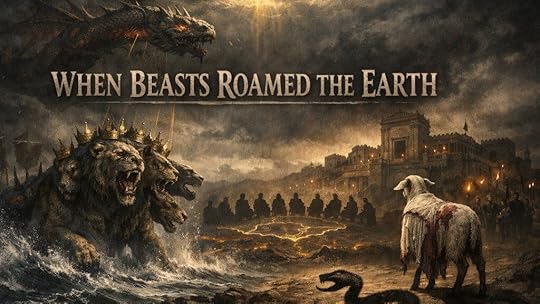 The Dragon’s Strategy Made Visible
In Chapter 12, John unveiled the cosmic conflict behind history.
We saw the woman, the child, and the dragon—the faithful remnant, the Messiah, and the enemy cast down.
Satan, stripped of his legal standing in heaven, turned his fury toward the earth, making war on the saints in the narrow window before his impending restraint.
Having lost access to the throne room, he now raises up agents to act on earth.
Revelation 13 does not move forward in time—it moves deeper into that same final period, revealing the visible powers through which Satan carried out his rage.
Here, John sees two beasts—one rising from the sea, the other from the land.
Together, they embody the spirit of antichrist already at work in John’s own generation.
Little children, these are the end times, and as you heard that the antichrist is coming, even now many antichrists have arisen. By this we know that it is the final hour.
— 1 John 2:18
The spirit of the antichrist… is already here.
—1 John 4:3
Revelation 13 is the dragon’s strategy made visible—giving the beast of empire and the beast of religion a deceptive power to suppress the gospel of Christ and enthrone opposition to God.
The Beast from the Sea: Rome under Nero
Revelation 13:1–10 (NHEB):
1 And I saw a beast coming up out of the sea, having ten horns and seven heads. On his horns were ten crowns, and on his heads, blasphemous names.
2 The beast which I saw was like a leopard, and his feet were like those of a bear, and his mouth like the mouth of a lion. The serpent gave him his power, his throne, and great authority.
3 One of his heads looked like it had been wounded fatally. His fatal wound was healed, and the whole earth was amazed and followed the beast.
4 They worshiped the serpent, because he gave his authority to the beast, and they worshiped the beast, saying, “Who is like the beast? Who is able to make war with him?”
5 A mouth was given to him speaking proud words and blasphemies. There was given to him authority to act for forty-two months.
6 He opened his mouth for blasphemies against God, to blaspheme his name, and his dwelling, those who dwell in heaven.
7 It was given to him to make war with the saints, and to overcome them. Authority over every tribe, people, language, and nation was given to him.
8 All who dwell on the earth will worship him, everyone whose name has not been written from the foundation of the world in the Book of Life of the Lamb who has been killed.
9 If anyone has an ear, let him hear.
10 If anyone is to go into captivity, he will go into captivity. If anyone is to be killed with the sword, he must be killed with the sword. Here is the endurance and the faith of the saints.
The beast of empire rises from the sea.
In Jewish symbolism, the sea represented chaos, danger, and the Gentile nations (Isaiah 57:20; Daniel 7:2–3). This beast is not unique—it is a composite, drawing together the four beasts of Daniel’s vision (Daniel 7):
Lion — BabylonBear — MediaLeopard — PersiaTerrifying beast — GreeceJohn’s audience would have recognized this instantly: the Roman Empire was the embodiment of all the beasts, gathering into itself the power, imagery, and idolatry of every previous pagan kingdom.
This composite nature explains the beast’s structure:
Daniel’s KingdomsDaniel’s BeastsRevelation’s BeastBabylonLion — 1 headLionMediaBear — 1 headBearPersiaLeopard — 4 headsLeopardGreeceTen horns — 1 headTen hornsTotal7 heads + 10 horns7 heads + 10 hornsThe beast’s seven heads and ten horns are not arbitrary imagery.
John unpacks these symbols explicitly in Revelation 17.
Here, however, they signal the accumulation of prior dominions now embodied in a single imperial power: Rome.
Rome had become a god unto itself.Emperors demanded worship.Coins bore titles like Divi Filius (“Son of God”).Temples to Caesar filled the cities of the empire.The dragon gave him his power, and his seat, and great authority.
— Revelation 13:2, KJV
The beast of empire does not rule by its own strength.
It is empowered by the dragon—commissioned not merely for political control, but for spiritual war.
Rome had always wielded the sword—but under Nero, Satan found his voice.
Nero: The Mouth of the BeastThe “mouth” of the beast was Nero Caesar (AD 54–68).
The final forty-two months of his reign (AD 64–68) turned Rome from brutal to beastly.
In AD 64, a fire broke out in Rome.
Nero, widely suspected of starting it, used the disaster to blame Christians and launch the empire’s first organized persecution of the Church.
Nero was more than a tyrant;
he was the first imperial enemy of Christ (see Apology 5).
For forty-two months—three and a half years—Christians were hunted, tortured, crucified, burned, and fed to beasts in Nero’s gardens and arenas.
Among the victims were Peter and Paul—the Two Witnesses.
Nero’s blasphemies were not limited to speech.
He declared himself divine, desecrated bodies, and mocked the Christian faith with calculated brutality.
Rome had long been idolatrous—but under Nero, it became diabolical.
For a time, it appeared as though evil had triumphed.
This was the moment Revelation calls “the endurance and faith of the saints.”
The call was not to overthrow the beast, but to endure it.
In June of AD 68, at just thirty years old, Nero died by suicide—abandoned by the Senate and declared an enemy of the state.
The beast’s mouth was silenced, and Nero’s persecution subsided.
The Beast from the Land: Israel’s False Prophets and Apostate Priesthood
Revelation 13:11–15 (NHEB):
11 I saw another beast coming up out of the earth. He had two horns like a lamb, and he spoke like a serpent.
12 He exercises all the authority of the first beast in his presence. He makes the earth and those who dwell in it to worship the first beast, whose fatal wound was healed.
13 He performs great signs, even making fire come down out of heaven to the earth in the sight of people.
14 He deceives those who dwell on the earth because of the signs he was granted to do in front of the beast; saying to those who dwell on the earth, that they should make an image to the beast who had been wounded by the sword and yet lived.
15 It was given to him to give breath to it, to the image of the beast, that the image of the beast could both speak and cause those who would not worship the image of the beast to be killed.
The beast from the sea represents empire.
The beast from the land represents religion.
In Scripture, the land (gē) is covenant language.
It does not refer to the globe, but to Israel itself—the promised land now in rebellion (Genesis 12:1, Exodus 3:8, Hebrews 11:9).
This beast is not foreign; it is internal.
It appears lamb-like—familiar, prophetic, even messianic.
But it speaks with the voice of the dragon.
This is the great deception: rebellion cloaked in sacred imagery.
In the first-century context, this beast refers to apostate Israel’s leadership—particularly the Zealot-controlled priesthood and prophetic class during the Jewish revolt. Figures such as:
Eleazar ben Ananias, the high priest’s son who halted sacrifices for Gentiles in AD 66—symbolically rejecting God’s covenantal mission and igniting war with Rome.Eleazar ben Simon, a Zealot leader who seized the temple, looted its treasury, and entered it as a messianic pretender.These men arose from within Israel, clothed in religious authority, invoking Scripture and prophecy—yet drawing the nation toward dragon-inspired destruction.
Worshiping the Beast of Empire Through ReligionThey did not deny God.
They misused Him.
He makes the earth and those who dwell in it to worship the first beast, whose fatal wound was healed.
— Revelation 13:12
The “first beast” John refers to here is not Rome—it is Babylon.
John carefully distinguishes the serpent from the beasts.
The serpent gives power; the beasts receive it.
The wounded head belongs not to Satan himself, but to the imperial system he animated. Babylon was the first beast of Daniel’s vision, and the only kingdom to receive a truly fatal wound.
The Only Beast with a Fatal Wound Kingdom Transition to Next Type of Fall Fatal Wound? Revived as… 1st Beast: Babylon Conquered by Media Sudden collapse (539 BC) [image error] Yes Spiritual system in Israel 2nd Beast: Media Joined Persia Peaceful merger [image error] No Incorporated into Persia 3rd Beast: Persia Conquered by Greece Military conquest [image error] No Culture absorbed by Greece 4th Beast: Greece Absorbed by Rome Gradual succession [image error] No Ideology merged with RomeRevelation 17 confirms it:
A name was written, “MYSTERY, BABYLON.”
— Revelation 17:5
The harlot rides the beast—not because she is Babylon, but because she enthrones Babylon’s system.
Apostate Jerusalem became the sanctuary of the first empire God ever judged.
The beast lived again—not in Rome’s temples, but in Israel’s.
The Zealots did not make Israel worship Rome—they forced her to worship Babylon.
In Israel, priests stood above kings.
In Babylon, priests served the throne.
The Zealots slaughtered the true priests, installed puppet priests, and merged false priesthood with political power—a complete inversion of God’s design.
Though they publicly rejected Caesar, they mirrored the beast’s methods.
What Rome enforced through imperial decree, Jerusalem now enforced through religious authority.
This is why Revelation later identifies this beast as “the false prophet” (Revelation 19:20).
Apostate Israel weaponized religion to reproduce the same beastly order Rome embodied—domination, coercion, and state-salvation.
In doing so, she led the nation to submit to the very power structure the dragon had always inhabited.
False Signs and Wilderness RecruitmentHe performs great signs, even making fire come down out of heaven.
— Revelation 13:13
This is Elijah imagery (1 Kings 18:38).
The Zealots and false prophets staged theatrics to evoke the past and stir the masses.
They weaponized Israel’s longing for deliverance.
Josephus reports:
These impostors and deceivers persuaded the multitude to follow them into the wilderness, and pretended that they would exhibit manifest wonders and signs, that should be performed by the providence of God.
— Antiquities 20.8.6
Their signs were not miracles.
They were deceptive manipulations used to recruit.
It was given to him to give breath to it, to the image of the beast.
— Revelation 13:15
This was not a statue.
It was a Babylonian system.
In Scripture, an image is not merely a physical object—it is a representation of authority, a living reflection of power (Genesis 1:26; Daniel 3; Matthew 22:20). To “make an image” is to establish a governing likeness—a structure that embodies and enforces allegiance.
Apostate Israel did exactly this.
During the revolt, the Zealot leadership reorganized Judea into seven regions and appointed ten rulers over them—constructing a mirror of imperial authority.
A beastly government was born.
Josephus records the formation of this regime under Eleazar’s leadership (Wars 2.20.3–4).
From his account, a clear pattern emerges:
Seven Heads — Regions:
JerusalemIdumeaJerichoPereaNorthwestern Judea (Thamna, Lydda, Joppa, Emmaus)Northeastern Judea (Gophnitica, Acrabattene)Galilee & GamalaTen Horns — Appointed Authorities:
Joseph son of Gorion — JerusalemAnanus the high priest — JerusalemJesus son of Sapphias — IdumeaEleazar son of Ananias — IdumeaNiger of Perea — IdumeaJoseph son of Simon — JerichoManasseh — PereaJohn the Esscue — Northwestern JudeaJohn son of Matthias — Northeastern JudeaJosephus son of Matthias — Galilee & GamalaThis was the image of the beast—given breath.
A seven-fold land ruled by ten horns of authority—enforced by violence, justified by prophecy, and animated by rebellion.
The new governmental structure spoke through decrees, breathed threats, and executed dissenters. Refusal to submit was treated as treason—and punished with death.
What Rome did globally, Jerusalem now did covenantally.
The irony is devastating.
Those who claimed to resist empire rebuilt it in God’s name.
Rome worshiped Rome.
Jerusalem now worshiped Jerusalem.
Revelation 13:16–17 (NHEB):
16 He causes all, the small and the great, the rich and the poor, and the free and the slave, to be given a mark on their right hand, or on their forehead;
17 and that no one could be able to buy or to sell, unless he has that mark, the name of the beast or the number of his name.
Modern interpretations of this “mark” often imagine future technology—implants, barcodes, or global ID systems.
John’s original audience had no framework for such speculation.
His imagery does not come from the future of technology, but from Torah, covenant identity, and the economic realities of first-century Jerusalem.
The Covenant Background of the MarkThe language of being marked on the hand or forehead is not new.
It is deeply rooted in Israel’s covenant life.
This annual festival will be a visible sign to you, like a mark branded on your hand or your forehead. Let it remind you always to recite this teaching of the LORD: “With a strong hand, the LORD rescued you from Egypt.”
— Exodus 13:9, NLT
These words, which I command you this day, shall be on your heart… You shall bind them for a sign on your hand, and they shall be for symbols between your eyes.
— Deuteronomy 6:6–8
These were not literal brands or objects. They were symbolic locations, representing thought and action, belief and obedience, allegiance lived out in daily life.
Notice the order in Deuteronomy:
“These words… shall be on your heart.”
The true mark of God was never physical.
It was covenant loyalty.
The beast deliberately mimics this covenant language—but with a fatal omission.
The heart is never mentioned.
Only the hand and the forehead remain: external conformity without internal devotion. The signs of covenant life remain, but the love of God is gone.
This is covenant symbolism hollowed out and weaponized.
The Greek word translated “mark” is charagma—a term originally used to describe the impress or stamp on a coin.
Passover, Temple Tax, and Economic ControlAfter the Great War Council in Jerusalem, the Zealot leadership began minting new coins. The first were struck in AD 66, in preparation for Passover, when every Jewish male paid the annual temple tax.
For this reason, only silver shekels were minted at first—the exact coins required for temple commerce.
These coins bore the inscription:
“Jerusalem the Holy.”
This was no neutral phrase.
The Zealots had placed Jerusalem where God belonged.
Just as Rome worshiped Dea Roma—the eternal city embodied in the beast of empire—apostate Israel now worshiped Jerusalem itself, the eternal city of Israel.
The same dragon-inspired spirit had simply changed costumes.
Name, Number, and AllegianceRevelation lists three identifiers:
the markthe name of the beastthe number of its nameThese are not separate requirements.
They describe the same allegiance from different angles.
In Scripture, a name represents authority.
To bear the beast’s name was to submit to its rule.
The number refers to the identifying system that made participation possible—its authorized currency.
During Passover in AD 67, no one could buy or sell in the temple unless they:
Were recognized as Jewish — the mark.Submitted to the authority of the Zealot government — the name.Used the newly minted beastly currency — the number.No Roman coinage was accepted.
No neutral participation was allowed.
To reject the mark was to reject the system—and rejection was fatal.
Josephus records that under Zealot rule, those who refused to join their cause were imprisoned, tortured, and executed, frequently under fictitious tribunals designed to legitimize the killings (Wars 4.5.3–4).
This was not about future technology.
It was about first-century apostasy.
The mark of the beast was a real and present test of loyalty during the final years of the Old Covenant age.
Those who refused it suffered—but they were the faithful.
And their endurance was not in vain.
Rome fell.
Jerusalem burned.
The Church endured.
Revelation 13:18 (NHEB):
18 Here is wisdom. He who has understanding, let him calculate the number of the beast, for it is the number of a man. His number is six hundred sixty-six.
John does not invite speculation.
He invites wisdom.
The number of the beast is not meant to terrify the Church, but to expose apostasy.
It is not a cipher for distant generations, but a recognizable warning for those steeped in Israel’s Scriptures.
John gives three clues:
The number is 666.It requires wisdom and understanding.It is the number of a man.The answer is not found outside Scripture.
It is found within it.
In Scripture, the number 666 appears explicitly in the reign of King Solomon:
Now the weight of gold that came to Solomon in one year was 666 talents of gold.
— 1 Kings 10:14, ESV
This is not incidental.
Solomon was the son of David—but he did not walk in David’s ways.
Though endowed with wisdom, he violated God’s explicit commands for Israel’s kings:
A king… shall not multiply horses to himself… neither shall he multiply wives to himself… neither shall he greatly multiply to himself silver and gold.
— Deuteronomy 17:14–17
Solomon ignored every warning.
And in doing so, he led Israel away from covenant faithfulness.
The result was catastrophic:
The kingdom fractured.Civil war followed.Judgment came.The temple was eventually destroyed.The people were carried into bondage.Solomon’s reign marked the beginning of the end of Israel’s kingdom.
Not a Son of David — But Another SolomonThroughout the prophets, God promised a Messiah who would be a son of David, not merely by bloodline, but by faithfulness:
They shall serve the LORD their God, and David their king, whom I will raise up to them.
— Jeremiah 30:9
But the leader who rose in Jerusalem during the revolt was not a Davidic shepherd.
He was a Solomonic tyrant.
Eleazar ben Simon—the Zealot ruler who seized the temple—mirrored Solomon’s apostasy almost exactly.
Josephus records:
Eleazar the son of Simon… had gotten into his possession the prey they had taken from the Romans, and the money they had taken from Cestius, together with a great part of the public treasures… they saw he was of a tyrannical temper, and that his followers were, in their behavior, like guards about him. However, the want they were in of Eleazar’s money, and the subtle tricks used by him, brought all so about, that the people were circumvented, and submitted themselves to his authority in all public affairs.
— Wars 2.20.3
Like Solomon:
He hoarded wealth.He centralized power.He violated God’s law.He divided the nation.He led Jerusalem into judgment.He brought about the destruction of the temple.And the survivors were sold into slavery.This was not coincidence.
It was history repeating itself.
The number six hundred sixty-six was not a puzzle—it was a pattern.
The nation of Israel had missed their David—Jesus Christ—and settled instead for an apostate Solomon: Eleazar ben Simon.
John’s warning is devastatingly clear:
Israel did not miss the Messiah because she lacked prophecy.
She missed Him because she repeated her own worst history.
Anyone with wisdom could see it.
Covenant Contrast — Death and LifeThe chapter closes where the covenant turns.
The Old Covenant was a covenant that ministered death.
When it was first enacted, three thousand died (Exodus 32:28).It carried blessings for obedience—and curses for rebellion (Deuteronomy 28).When Israel chose rebellion, the covenant pronounced judgment.The antichrist arose from within that broken system (John 5:43), and the Old Covenant age ended in death.But the New Covenant tells a different story.
When it was inaugurated, three thousand lived (Acts 2:41).It is a better covenant, established on better promises (Hebrews 8:6).Its curse was borne by Christ Himself (Galatians 3:13–14).And it does not end in death—but in life (2 Corinthians 5:4).The Verdict of HistoryThe number of the beast was not awaiting the future.
It was exposing the present.
The antichrist was not coming.
He had arisen.
Revelation 13 reveals what happens when political power and false religion unite against the kingdom of Christ.
The beasts of empire and apostasy rose together—and they fell together.
This chapter calls the Church not to fear beasts, but to remain faithful when they appear.
And it prepares us for what comes next.
Revelation 13 shows the beasts exposed and judged.
Revelation 14 shows the Lamb standing—alive, victorious, and surrounded by those who bear His name.
Reflection QuestionThe Lamb reigns.
And His kingdom is about to be unveiled in full.
If the beasts and the mark of the beast were first-century realities, what systems today tempt believers to compromise their allegiance to Christ?
Want to Go Further? Explore at Your Own Pace: [image error] Get the Book
Rediscover the Trinity—not as a puzzle, but as a redemptive story of love.
[image error] Join the Newsletter
Thoughtful, Scripture-rooted teaching to help you ask honest questions, rediscover the Gospel, and see God through the lens of Jesus.
You’ll also receive free resources if you’d like to explore further:
[image error] Join the Facebook Group
Ask questions and connect with others on the same journey.
[image error] Already Read the Book?
Leave a quick review—just a sentence or two—to help others find clarity too!
Revelation 13 describes how Satan worked through first-century political and religious powers to oppose Christ and persecute the Church. The chapter reveals two beasts—one representing Roman imperial power and the other apostate religious leadership in Israel—operating during the final years of the Old Covenant age.
Is the beast in Revelation 13 the Roman Empire?Yes. The beast rising from the sea reflects Rome as the culmination of Daniel’s four beasts, absorbing the power and idolatry of previous pagan empires. Under Nero, Rome became the primary persecutor of early Christians, fulfilling the beast’s authority to make war on the saints for forty-two months.
Who is the second beast or false prophet in Revelation 13?The second beast, rising from the land, represents apostate Israel’s religious leadership during the Jewish revolt. Though appearing lamb-like, it spoke with the voice of the dragon—using prophecy, signs, and covenant language to lead the nation into rebellion and destruction.
What is the mark of the beast in Revelation?The mark of the beast was not a future technological implant. It was a covenantal and economic mark of allegiance tied to participation in the Zealot-controlled system of Jerusalem between AD 66–70. It mirrored Old Testament covenant imagery involving the hand and forehead, but excluded the heart.
What does 666 mean in Revelation 13?The number 666 appears in Scripture in connection with King Solomon’s apostasy (1 Kings 10:14). Revelation uses this number to signal a repeat of Israel’s history—choosing a power-hoarding ruler instead of a faithful son of David. In the first century, this pattern was fulfilled through apostate leadership in Jerusalem.
Is Revelation 13 about the end of the world?No. Revelation 13 addresses events that were imminent for its original audience and culminated in the destruction of Jerusalem in AD 70. Rather than predicting the end of the physical world, it reveals the end of the Old Covenant order and the vindication of Christ’s kingdom.
How should Christians apply Revelation 13 today?Revelation 13 warns believers about the danger of uniting political power and religious authority against the way of Christ. Its call is not fear, but faithfulness—remaining loyal to Jesus when systems demand compromise.
{ "@context": "https://schema.org", "@type": "BlogPosting", "mainEntityOfPage": { "@type": "WebPage", "@id": "https://jesusconquers.com/revelation-..." }, "headline": "Revelation Chapter 13: When Beasts Roamed the Earth", "description": "Revelation 13 reveals how Rome and apostate Israel functioned as the beasts of empire and religion in the first century. This historical, covenantal explanation exposes the mark of the beast, the number 666, and the dragon’s strategy during the final years before AD 70.", "image": "https://jesusconquers.com/wp-content/...", "author": { "@type": "Person", "name": "David Longenecker", "url": "https://jesusconquers.com/about/" }, "publisher": { "@type": "Organization", "name": "Jesus Conquers", "logo": { "@type": "ImageObject", "url": "https://jesusconquers.com/wp-content/..." } }, "datePublished": "2026-01-08T09:00:00-05:00", "dateModified": "2026-01-08T09:00:00-05:00", "articleSection": "Theology", "inLanguage": "en-US", "isPartOf": { "@type": "CreativeWorkSeries", "name": "Revelation: The Clock Is Ticking", "url": "https://jesusconquers.com/category/re..." }, "keywords": [ "Revelation 13 explained", "mark of the beast first century", "beast from the sea Rome", "beast from the land apostate Israel", "Revelation 13 meaning", "number 666 explained biblically", "false prophet Revelation 13", "Revelation preterist interpretation", "Rome and Jerusalem Revelation", "AD 70 covenant judgment" ], "url": "https://jesusconquers.com/revelation-..."}{ "@context": "https://schema.org", "@type": "FAQPage", "mainEntity": [ { "@type": "Question", "name": "What is Revelation 13 really about?", "acceptedAnswer": { "@type": "Answer", "text": "Revelation 13 describes how Satan worked through first-century political and religious powers to oppose Christ. The chapter reveals two beasts representing Roman imperial authority and apostate religious leadership in Israel during the final years before AD 70." } }, { "@type": "Question", "name": "Is the beast in Revelation 13 the Roman Empire?", "acceptedAnswer": { "@type": "Answer", "text": "Yes. The beast from the sea represents Rome as the culmination of the pagan empires described in Daniel 7. Under Nero, Rome became the primary persecutor of Christians, fulfilling the beast’s authority to make war on the saints." } }, { "@type": "Question", "name": "Who is the second beast or false prophet in Revelation 13?", "acceptedAnswer": { "@type": "Answer", "text": "The second beast represents apostate Israel’s religious leadership during the Jewish revolt. Though appearing lamb-like, it spoke with the voice of the dragon by using prophecy and religious authority to lead the nation into rebellion and destruction." } }, { "@type": "Question", "name": "What is the mark of the beast in Revelation 13?", "acceptedAnswer": { "@type": "Answer", "text": "The mark of the beast was not future technology. It was a covenantal and economic mark of allegiance tied to participation in the Zealot-controlled system of Jerusalem between AD 66–70, mirroring Old Testament covenant imagery involving the hand and forehead." } }, { "@type": "Question", "name": "What does the number 666 mean in Revelation 13?", "acceptedAnswer": { "@type": "Answer", "text": "The number 666 points to a biblical pattern of covenantal failure associated with Solomon’s reign. Revelation applies this number to first-century leadership in Jerusalem who repeated Israel’s history by choosing power and wealth over faithfulness to God." } }, { "@type": "Question", "name": "Is Revelation 13 about the end of the world?", "acceptedAnswer": { "@type": "Answer", "text": "No. Revelation 13 addresses events imminent to its original audience and culminated in the destruction of Jerusalem in AD 70. It reveals the end of the Old Covenant order, not the end of the physical world." } } ]}{ "@context": "https://schema.org", "@type": "BreadcrumbList", "itemListElement": [ { "@type": "ListItem", "position": 1, "name": "Home", "item": "https://jesusconquers.com/" }, { "@type": "ListItem", "position": 2, "name": "Revelation Series", "item": "https://jesusconquers.com/category/re..." }, { "@type": "ListItem", "position": 3, "name": "Revelation Chapter 13", "item": "https://jesusconquers.com/revelation-..." } ]}The post Revelation Chapter 13: When Beasts Roamed the Earth appeared first on Jesus Conquers.