Denver Michaels's Blog
January 31, 2025
Petrified Giant Human?
 Around the turn of the twentieth century, the story of petrified giants in the Grand Canyon went public. Samuel Hubbard visited the Grand Canyon with a guide named William Hull. Hull had told Hubbard of a petrified giant he saw while prospecting in Grand Canyon. An Indian guide led Hull and a partner to a ledge where a petrified giant lay that measured between eighteen and twenty feet in length. Hull took Hubbard to the spot in 1895, and on October 2, 1896, the Los Angeles Times ran article about the affair. I have reprinted the article below:
Does anybody believe that there ever has been a race of giants in the world? Does anybody believe that a race of gigantic) men who were from twelve to twenty feet high ever lived in these United States of America? And yet the proof that such a race of people did live in this country is to be found in the Grand Canyon of the Colorado River, in Northern Arizona. This proof consists of, first:
Footprints in the red sandstone. Footprints that appear to have been made by the moccasined feet of gigantic men. Men whose tracks measured twenty inches in length, and who stepped five feet at a stride.
The second proof is that there is the petrified body of such a man likewise in the red sandstone of the Grand Canon district. This body was that of a living, breathing man, but after death the flesh was replaced by lime or silica, held in solution in the water. There is ample evidence that nature was able to perform this feat, as the petrifying process is being carried on in the canyon to this day.
The third fact is that there is, and was, a strong and almost universal tradition among the ancient people of Mexico and Peru that such a race of giants lived in their country.
Perhaps it is almost too much to call this proof, but it is at least corroborative testimony.
Now, aside from the interest which attaches to these tracks on account of their size, there is a geological puzzle involved which will set scientific men to thinking. The tracks of men and animals in the red sandstone of the carboniferous period is more than a geological puzzle; it is a geological crime…
… Now, nature is the greatest author and bookkeeper that the world has ever seen. She has kept an exact record of all the transactions and the writing is done on tablets of stone. Therefore, we may consider each of these periods as a volume in the great library of nature. Each volume has Its own story to tell, yet each story blends into the one which follows it with a harmony and a precision which is nothing short of divine.
I. Archean time: (1) Azoic age; (2) Eozoic age.
II. Paleozoic: (1) Invertebrates or Silurian; (2) age of fishes or Devonian; (3) age of coal plants or carboniferous.
III. Mesozoic: (1) The age of reptiles.
IV. Cenozoic: (1) Tertiary, or age of mammals; (2) quaternary, or age of man.
“Dana” makes an estimate of the length of time these periods endured, as follows:
Paleozoic time, 36,000,000 years; Mesozoic time, 9,000,000 years; Cenozoic time, 3,000,000 years.
Volume 1 deals with Archean time. With the (beginning of things and chaos. This book was written so long ago that the writing Is obscure and difficult to read. The rocks of this period are mainly granite. In them are found no fossils, which would indicate that there was no life on earth at that time.
Vol. II deals with the age of invertebrates, or the Silurian period.
Vol. Ill, the age of fishes, or the Devonian period.
Vol. IV, the age of coal plants, or the carboniferous period.
Vol. V, the age of reptiles.
Vol. VI, the tertiary period, or age of mammals.
Vol. VII, the quaternary period, or age of man.
The rocks of these periods succeeding the Archean, are mainly sedimentary in character, and are filled with fossils indicative of the life of the period.
Now, in the lower end of the Grand Canyon of the Colorado, which has only the first volumes, we find footprints that appear to be those of men and animals which geologists say should appear in the sixth and seventh volumes.
That is what footprints In the red sandstone of the carboniferous period means.
Now, if scientific men investigate these footprints, they will have to find some means by which the tracks can be made to fit geology, otherwise, geology is all wrong, which is unthinkable.
This interesting matter which has resulted in the two discoveries mentioned was drawn to my attention In the following way.
Last June I visited the Grand Canyon as a tourist. The Atlantic and Pacific Railroad to Flagstaff, thence by stage seventy miles to the “Hance” trail, on the brink of the gorge. There I met Mr. Guide, who was acting as guide into the canyon, and who was a pioneer of Northern Arizona. He told me the following story, and, with apologies for my credulity, I believe him.
Three years ago he and a companion named Jim Lavelle, had been prospecting In this part of the country. They found a ledge which they thought was valuable, and had started out of the cafion with samples of the ore, expecting to return in a few days. One of the Indians was with them. Mr. Guide speaks the Indian language fluently, and the Indians have a great admiration for him. The Indian said: “Have you ever seen the Big Indian up there,” volunteering to show it. They followed him up a foot trail which led “through a crevice in the red wall, thence onto a bench-like formation above, but still in the midst of red sandstone.” They came to a place where a projecting rock formed a shelter over a sloping table-like slab of stone which was covert! with a white incrustation of lime. Outstretched on this slab was the body of a gigantic man. The body was entirely nude, and laid face downward. They estimated his height to be 18 or 20 feet. The left arm was at full length while the right arm was doubled under the head. The left leg was perfect, but the foot was Jammed into a crack in the slab. The right leg was broken off just below the knee and the broken part was missing. They looked at it ten or fifteen minutes and then continued their journey, intending to return and make a more complete Investigation. Plans changed, and they failed to return.
Mr. Guide told the story to several people, but they either disbelieved him or discouraged him, so it happened that he had never been back there and had never tried to do anything with his discovery.
He also told me that reliable Indians had described to him tracks of both men and animals in the solid rock not far from this body and In the same formation. These he had never seen, but he had no doubt of their existence.
This was startling information, but it had been, in a measure, prepared for it. In the first place, it had always seemed reasonable to me that the prehistoric primeval hunting savage should have been of large stature. Geology tells us that there was a period in the history of the world called the Tertiary or Mammalian Age, that was peculiarly favorable to animal life. It Is the age of the mammoth, the great cave bear, the cave lion, the wooly rhinoceros, the primeval ox, the giant Irish elk, the gigantic sloths and other familiar animals, that were far larger than than now. Was man to be left entirely out amid all this list of giants?
Los Angeles Times. October 2, 1896.
This story is covered in the fourth book of my Detours Into the Paranormal series.
For an in-depth look at the subject of giants, check out my book Giants: Men of Renown.


January 9, 2025
Kangaroos in the United States

Is there a hidden population of kangaroos in the United States? Sounds crazy. But the answer is....maybe.
A while back, the now-defunct website Cryptozoology News ran a report from northeastern Tennessee (http://cryptozoologynews.com/kangaro-like-creature-seen-in-tennessee/). A witness spotted a kangaroo-like creature crossing the road late at night.
This is a description of the animal from the article:
The female passenger in his cab asked upon passing the spot where the car had swerved if my driver had seen “it”. When he told her he had not, she described the creature as something about 2 feet tall, running at a high rate of speed across the road on only its hind legs, and had the overall body shape of a Kangaroo. She said the creature was running towards the woods.
Tennessee is no stranger to kangaroo reports; in 1934, two police dogs were killed leading to a hunt for a kangaroo in Hamburg.
In the 1960s, a couple of noteworthy kangaroo incidents occurred. A kangaroo escaped from a circus in Hagerstown, Maryland in 1960. It was observed hoping through a shopping center parking lot. The kangaroo was captured in a nearby field after giving birth to a joey. After a “six-day fling,” an escaped kangaroo was captured in Fort Wayne, Indiana in 1965.
There were reports of kangaroos in Illinois and Indiana during the mid-1970s. In 1974, two Chicago police officers corralled a kangaroo in an alley but it escaped by leaping over a fence.
Kangaroo sightings occur to this day in West Milford, New Jersey, long after the Jungle Habitat theme park closed its doors. (https://weirdnj.com/stories/abandoned/jungle-habitat/)
Police in New Jersey’s Raritan Township received a strange call in 2009. A caller reported a dead kangaroo on the side of the road. Two wallabies, named Wally and Polly were killed when they tried to escape from their pens.
An illegally kept kangaroo escaped from a home in Staten Island and was seen bouncing down the streets. Videos of the event can be viewed on YouTube. The story has a sad ending; the animal died recently in a New Jersey zoo.
For more on escaped kangaroos and "phantom kangaroos," consider reading my book Wild & Wonderful (and Paranormal) West Virginia.
Must watch videos:
Scary kangaroo: https://youtu.be/RpXxWQeho3M
Another scary kangaroo: https://youtu.be/YjJqro2xNm8
Kangaroo attacks car: https://youtu.be/VUF5RIDj1H4?t=23s
Kangaroo in Oklahoma: https://youtu.be/CriuV-yNqv4
Kangaroo on Staten Island: https://youtu.be/eseOkjgKgos
Sources:
“Escaped Kangaroo is Recaptured after Giving Birth to Joey.” Sedilia Democrat, July 27, 1960.
“Kangaroo Back in Hoosier Cage.” Rushville Republican, August 6, 1965.
http://www.atlasobscura.com/articles/does-america-have-a-secret-kangaroo-population
“Illinois Man Sees Escaped Kangaroo.” New Castle News, April 7, 1976.
http://www.nj.com/hunterdon-county-democrat/index.ssf/2009/12/report_of_dead_kangaroo_along.html
December 26, 2024
Alkali Monster

Western Nebraska is home to a lake monster tradition believed to predate the arrival of white settlers to the region. It has been said that Walgren Lake, formerly known as Alkali Lake, has its own version of the Loch Ness Monster. The creature—Nebraska’s only lake monster—is called the Alkali Monster, and alternately, the Walgren Lake Monster. Generic terms used to refer to the beast include, "horse-head alligator" and "great horned alligator." These descriptions refer to the bony protrusion, a single horn, like that of a rhinoceros, said to jut out of the creature's head.
Walgren Lake is the centerpiece of the Walgren Lake State Recreation Area, located southeast of the town of Hay Springs, Nebraska. Walgren Lake makes up about 50 acres of the 80 acre recreational area. The Walgren Lake State Recreation Area is reached by gravel roads and has 40 primitive campsites—a perfect place for a weekend fishing trip.
Origins of the Monster
The Alkali Monster, if it exists, inhabits a very small lake—less than ideal for a large, aquatic cryptid. There are very few reported sightings of the creature, some of which are questionable at best. That being said, the indigenous people of the area are said to have had encounters with a beast in the lake.
For quite some time the monster has been well established in the local folklore. According to the Nebraska State Historical Society, author Mari Sandoz (1896-1966) wrote a novelette about the Alkali Monster titled, Ossie and the Sea Monster. The monster is also referenced in a book that Sandoz penned called Old Jules, published in 1935.1
The Alkali Monster gained notoriety in 1923 when J. A. Johnson had an encounter with the beast. Johnson’s story was told by the newspaper, The Omaha World-Herald.According to Johnson, he and two friends saw the massive animal while camping by the lake. The beast was said to have been about 20 yards from the campers when they observed it. According to Johnson, when the creature noticed the men, it let out a “dreadful roar.” Before it dove into the water and disappeared, it thrashed its mighty tail. The men described the creature as looking similar to an alligator, though much larger. They estimated the length of the animal to be 40 feet, and it was a dull grayish brown in color. The monster had a single horn that protruded from its head between its eyes and nostrils. Some have proposed that what Johnson and his companions saw was an abnormally large beaver.2This would be quite the case of misidentification! I find it easier to believe that Johnson made the story up, that the encounter never happened, than to believe that he thought a large beaver was a 40 foot alligator-like monster.
Talk of the Alkali Monster was not confined to western Nebraska. A St. Petersburg, Florida newspaper,The Evening Independent,ran an article titled, “Anglers’ Club to Wage War on Nebraska Lake Monster,” on July 24, 1923. According to the report, a fishing club had ordered a harpoon and whaling gun from a mail order catalogue. Apparently, people in the area had become fed up with the beast. Two weeks before the article went to print, three tourists, who claimed to have been chased for several yards by the monster, implored the Hay Springs chamber of commerce to rid the lake of the creature. For over two years the animal had been terrorizing swimmers on the lake and had even been snatching livestock. On two occasions a posse was formed to search for the creature. In each case, nothing was found.3
Colonel John G. Maher is credited, or blamed, for creating the hoax of the Alkali Monster. Maher was a sensationalist writer for eastern newspapers, and was known to have perpetrated hoaxes.4The outlandish stories that he wrote were often picked up by papers looking to boost their readership.
The Nebraska State Historical Society has a picture from around 1950 of the supposed monster. The picture is an obvious fake, a poorly edited picture of a mudpuppy salamander made to look like an enormous monster possibly going after a car.5Interestingly, the mudpuppy is a salamander known to make noise, and the Alkali Monster has a reputation for letting out a dreadful roar. The picture is ridiculous to say the least, although some might find it amusing.
The Alkali Monster in Contemporary Times
Outdoor Nebraskamagazine ran a piece on the monster in their January 1962 issue. An artist’s depiction of the beast attacking livestock is featured on the cover. In 1985, Hay Springs, Nebraska celebrated its one hundredth birthday. A likeness of the legendary monster from Walgren Lake was featured on centennial promotional items such as t-shirts.6Interestingly, also in 1985, the monster made a reappearance. A report in the May 28 edition of The Milwaukee Journalsaid that visitors to the lake on Memorial Weekend saw a creature matching Alkali Monster descriptions. The onlookers saw a green creature over thirty feet in length in the middle of the lake.7
It is hard to know how seriously to take this report. On its face, it seems as though it is not a coincidence that this sighting occurred around the time of the Hay Springs centennial celebration. Maybe the sighting occurred out of a sense of expectancy. All of the attention around the legendary monster could easily cause well-meaning people to mistakenly see something that wasn’t there. There may have been a more nefarious motive—perhaps the attention around the legend was sufficient reason for someone to make up a sighting and report it to the media. I’ve said before—it is hard to understand the mind of a hoaxer. Why do they do it? What enjoyment do they get out of fooling people?
Perhaps though, there is another explanation to the 1985 sighting. Conceivably, it could have occurred exactly as reported. Maybe an unexplained creature was spotted in the lake just as the report states. Could it be possible? After all, legends of a mysterious creature living in the lake predate settlers from the East, newspapers, ridiculously doctored photographs, and hoaxes. Could there be something to these legends?
As stated earlier, Walgren Lake is less than an ideal home for a large, Loch Ness Monster type of creature. It is a small lake, maybe even a large pond by some standards. During periods of drought, especially in the late 1800s, Walgren Lake nearly went dry. The reduced water level, down to almost a puddle, would have made it easy to find evidence of the creature, if not the creature itself. However, nothing was ever reported. Long after the water levels were replenished and the creature came to fame in the 1920s, how would it have gotten there? A similar case has been recorded in Southern California’s Lake Elsinore. Extended periods of drought, exposing a lake bottom void of a large carcass, have made it seem unlikely that Lake Elsinore was ever inhabited by a lake monster.
As unlikely as the existence of the Alkali Monster appears to be, I am decidedly noncommittal on the issue. I prefer to keep an open mind to the possibility. If pressed for an answer though, I would have to say that the Alkali Monster probably exists only in folklore.
End Notes1. Greg Wagner. "Throwback Thursday: MONSTER!" NEBRASKAland Magazine. April 3, 2014. Accessed August 1, 2015. http://neblandvm.outdoornebraska.gov/2014/04/throwback-thursday-monster/.
2. Wagner, "Throwback Thursday: MONSTER!"
3. "Anglers' Club to Wage War on Nebraska Lake Monster." The Evening Independent, July 24, 1923.
4. Wagner, "Throwback Thursday: MONSTER!"
5. Nebraskahistory.org. Accessed August 1, 2015. http://nebraskahistory.org/images/sit....
6. Wagner, "Throwback Thursday: MONSTER!"
7. "Nebraska Revisited by 'Lake Creature'" The Milwaukee Journal, May 28, 1985.
December 9, 2024
Badlands Horror

In June 2021, my wife and I spent some time in the Dakotas while traveling the nation in our RV. While I was in the town of Medora, North Dakota, located on the border of Theodore Roosevelt National Park, I began thinking of the "Badlands Horror."
I first learned of the Badlands Horror from a guy who contacted me through my website. He told me the story of a strange creature that went on a rampage killing livestock in the North Dakota badlands during the early 1930s. He also sent the text from news articles mixed with his own commentary. I posted the article on my blog and asked that anyone with more information contact me, but no one did.
I ended up putting the story out of my mind, but upon my arrival to Medora, I began thinking of the strange tale once again. The article that the fellow sent me is printed below. Again, if you have any information regarding it, I would love to hear from you.
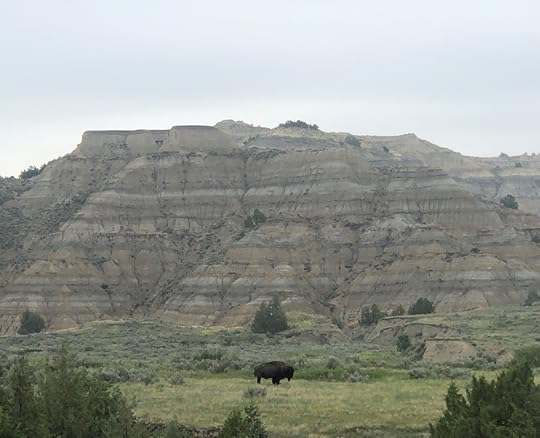 Theodore Roosevelt National Park.
THE BADLANDS HORROR
The Badlands, in North Dakota, deserved their sinister name. The area around the Little Missouri River [in western North Dakota] is a forbidden land, lonely and dry, plenty of arid cliffs. The timid green from the spring is soon burned dry under the hot summer's sun. Winters, on the other hand, are extremely cold and snowy. This land is inhabited by the offspring of the intrepid pioneers who terraformed the land, even forcing the elemental laws in order to achieve it. Those hard-spirited people were not easily intimidated, but during the early 30s events transpired there. Events that gave fear to the hearts of such courageous persons.
In the middle of 1931, the Dickenson Sun reported a series of UFO appearances over Northwest Dakota. From June 4 to June 11, five incidents with "strange lights crossing the sky, coming down the land just to move upside, until disappear from sight” were reported. Many explanations came from scientists, in the hope to find an explanation to the phenomenon. Even the well-known weather- balloon theory was used. As soon as the weird lights disappeared, they forgot such incidents, leaving just the miserable depression-era news to the people. Anyway, the calm of the summer was soon interrupted and was later known as the Badlands Horror.
In June 13, Mr. John Milfred informed that four of his cows were found crippled and death. As he established in his report:
"They looked just like if someone had taken them and tear them to pieces. The head of one bullock was completely teared apart and other had its legs totally broken. It looked just like the attack of a grizzly bear, but I never heard about grizzlies in this area.”
Later, in an interview with the Sun, added:
"Never, ever had I seen jaw marks like those before. Whatever it may have been,
it cut the cattle wide open, bones and all, just like a hot knife over butter.”
Two days later, a similar attack transpired in the Tjaden´s farm. Five cows were killed, their bodies literally were torn to pieces. Milford and Tjaden assembled a crowd to hunt down whatever it may be attacking the cattle. Amazingly, they were unable to find any trace of the beast. Tjaden remembered later:
"Their bodies seemed to had been moved or dragged. We thought they were rustlers doings, trying to hide their traces, but we never heard of rustlers tearing the cattle to pieces just for the fun of it.”
They were convinced it was someone or something intelligent the one behind the attacks. The crowd went through almost the whole Badlands area, with no luck.
Dr. Phillip Morgan was the first one to obtain a visual perspective of the creature:
"I was driving, coming back from the Calumet ranch, after a childbirth. It was dark outside and the dawning sun was hurting my eyes. I took a turn in the highway, when I saw that thing on the road. I pushed the brakes in order to avoid a collision. That thing looked at my car coming and jumped. I was astonished. That thing jumped at least 30 to 40 feet in the air, over a rock near the highway. Then it jumped again, but I was unable to see for its destination. That was such an ugly beast. I never have seen something like that before. It looked like a big kangaroo, with part of its skin covered with hair and part covered with scales. Unfortunately, the sun was hurting my eyes, so I couldn't have a good visual of the creature. I've got no idea what the hell was that…I just know I don´t want to see that again.”
The reports about the creature sightings were full with contradictions.
Immanuel Stevens, who witnessed the creature many nights after that report, described it like a gorilla with a long and hairy tail.
John McLaughlin witnessed it too at daybreak, days later, saying it seemed a big lizard with fur. Both men assured that the thing seemed to be in a hurry. Likewise, both said it moved by means of long jumps, covering the ground with awesome long leaps, from about 50 to 100 feet. Unfortunately, soon there were dozens of untrustworthy reports, that gave the creature supernatural powers. Some tourist said he saw the thing as an airplane (!?) another said that it had the shape of an octopus. The sheriff's office was full with callings from people reporting the creature in all the whole state. One person said he saw the creature in Hawaii!
Many of the reports were lies or contradictions. In certain occasions, the thing was reported in two locations, 30 miles away one from the other, and with five minutes between calls.
In June 15 and June 19 more cattle attacks were reported. By that time, the local newspapers were in the brisk of a battle with the story, adding new twists and turns to each new attack. Some newspaper named the creature as "…Satan's offspring, making the ground ready for a second coming…” A Minneapolis newspaper discarded the creature as "…a ridiculous attempt to look for attention…”
The authorities thought in solve the mystery by June 20. Someone informed about the destruction of an enormous truck, near the Little Missouri river, around the Medora area. When the police arrived to the accident, they discovered a big truck with six mutilated and dead cows near it. They discovered the cattle belonged to Hiram Jacobs, who had been previously accused of being a rustler himself. The police soon discarded the Horror as a clever attempt of Jacobs to cover up his illegal activities. The newspapers don’t delay to expose Jacobs as the Horror and promised to find new articles of public interest.
The Badlands Horror returned with violence two days later, when some students that were hanging around the Badlands, discovered the dismembered bodies of Jacobs and his comrades. They were torn to pieces, just like the cattle…and parts of their bodies were eaten. It seemed Jacobs wanted to use the Horror as a scapegoat to uncover his illegal activities, when just by chance, the awful creature appeared in his way. It attacked the truck with wild frenzy. While it was busy killing the cattle, Jacobs and his comrades tried a futile escape. The Horror found them far from the truck and killed them. Now the police department was before a murder. However, even before they could do anything, the Badlands Horror appeared once again. When the police agents were in the process of transport the bodies to the morgue, the Henderson´s farm was before a night of terror.
Jim and Mary Anne Henderson had a small ranch near the little Missouri. They had some cattle, that were bound for the barn, to keep them safe from the incursions of the Creature. Judy, their little daughter, was inside the barn, cleaning a newborn yearling. They were ready to dinner.
"I don´t know how much time it took me to wake up. Everything after that hour are blurred in my mind. I discovered that I was alone in the barn. The cattle must be outside, I thought. Carefully I looked outside the barn. The house…the house was broken down. There was an enormous hole in the place the kitchen´s door should be. I saw parts of the cattle in the yard. That's all I can remember.”
Judy was pretty fortunate. The creature moved inside the house by means of brute force and attacked the Hendersons. Their bodies were found teared apart in the house and in the yard. The cattle was its main interest, since it killed them all.
Judy was found by the police the next morning, severely shocked. That was years before she was able to talk again, and much time before she could remember her night of terror. The attack to the Henderson's farm was the last report of the Beast. It could die among the desolate badlands or maybe it was moved out.
In June 22, the strange lights were reported once again over the badlands skies. Mr. Herbert Moore, from Willinstone, witnessed the creature for the last time.
"I was seated at the porch, gun in hand, drinking a Jack Daniels, when I saw the light moving fast in the sky, from east to west. It was relatively near the ground, no more then 100 feet. Whatever it was…it stood still at the distance. I presume it could have been between 300 to 400 feet length. Suddenly, I saw that thing on the ground, running anguished, like fleeing from the light. I´ve never had seen something like that before. That thing moved with very long leaps. In a matter of seconds, the thing and tha light disappeared, then I saw when the light released some lighting in the sky, far away. I swear that after that night I won't drink whisky any more.”
Judy Henderson told, years after the incident:
"The first thing I heard was a violent and distant noise. It was like the hollow sound of an ax over dry wood. I was hugging Minnie (the yearling) trying to take more attention. Mom called me to dinner, so I moved outside the barn. I walked some steps out, when I saw the Thing approaching. It was moving through the prairie with long leaps, right to me. I yelled and ran back to the barn, closing the door noisily. That thing reached the barn´s door scarcely seconds later. That thing must have travel at a fantastic speed. It stopped for a moment. I heard its grunts. It sounded like a big ogre with nasal voice. I was extremely afraid to cry for help, afraid that any noise could call for its attention toward me. I was praying my father move outside, looking for me, then discover the beast and use his gun against it. When I heard at its heavy breathing. I saw the barns door being slightly pushed. I heard a big roar and suddenly It broke the door, piercing it with Its hand, like if it was paper made. Its hand was awful. I clearly remember the black hair over Its scaly hand and the long talons on Its three fingers. It roared once again and threw itself against the wall and the door, breaking it into pieces. The last thing I can remember is the sound of a rifle shooting. I presume that was my father.”
If you would like to read about the fascinating places I visit in my travels, consider checking out my Detours Into the Paranormal series of books.
November 28, 2024
Kipsy

I spent early May 2022 at a campground in Ulster County, New York. The campground lies between the Shawangunk and Catskill mountains and the scenery is gorgeous. About thirty minutes away lies the town of Poughkeepsie which sits on the banks of the Hudson River. The town is home to Kipsy, the Hudson River Monster, and I had every intention of visiting.
They say life comes at you fast. Life hit me like a freight train in New York. I had to rush my dog to the emergency veterinarian in Kingston. Sadly, he did not come back home with me. My ole buddy had an aggressive form of cancer, and a tumor caused his spleen to rupture.
Understandably, I spent a good bit of my time in New York moping around. I just didn't feel like doing much. So, my trip to Kipsy's stomping grounds didn't happen.
 Rest in peace ole buddy.
Well, anyway, I wanted this post to be about my trip to Poughkeepsie where I had hoped to learn a little more about Kipsy, the Hudson River Monster. But since I have nothing to report, this is an excerpt from my book People are Seeing Something: A Survey of Lake Monsters in the Unites States and Canada:
Kipsy, the Hudson River Monster
New York’s Hudson River, particularly the stretch that runs between Poughkeepsie and Manhattan, seems the most unlikely of places to have a cryptid dwelling in its waters. However, the exact opposite is true—there is a long history of a mysterious creature being spotted in and around the river. Nicknamed Kipsy, presumably after the city of Poughkeepsie, the monster has left its impression upon the local folklore.
The Hudson River, named after the famed explorer Henry Hudson, starts in New York’s Adirondack Mountains and flows south for 315 miles, ultimately dumping into the Atlantic Ocean. The lower portion of the Hudson River is a tidal estuary—a transitional area serving as a buffer between the oceanic environment and the river environment. Estuaries are characterized by their brackish waters.
It is a safe bet that since the Hudson has open access to the Atlantic Ocean, cryptids that are spotted in the river most likely enter from the sea and swim upstream. This opens a world of possibilities.
Sightings of a sea serpents in the Hudson River are not of recent origin; they date back hundreds of years. Documented reports exist in which sailors aboard several notable vessels claim to have seen something in the Hudson. A creature was spotted from the vessel, The Clermont, which belonged to the prominent New York family, the Livingstons.1
Reports of a sea serpent are also attributed to Henry Hudson’s ship, The Half Moon.2 It is unclear if Henry Hudson or his crewmembers saw anything resembling a sea serpent in or around the Hudson River. However, further south, in present-day New Jersey, an interesting encounter occurred when sailors aboard a long boat saw something strange while exploring Barnegat Bay. The incident, which occurred in September of 1609, is recorded in the log of The Half Moon. According to the sailors, they saw a creature which had “three humps and a snake’s head.” As is common with modern-day sightings, the animal moved swiftly in the water. The witnesses claimed that the serpentine beast moved with the speed of a small boat.3
This was not the only time that Henry Hudson’s crew saw something bizarre—something extraordinary. During Hudson’s second attempt at finding a northeastern passage, two members of his crew reported seeing a mermaid. Thomas Hilles and Robert Raynar saw the creature off the coast of Novaya Zemlya, an archipelago in the Arctic Ocean, bordered to the west by the Barents Sea and to the east by the Kara Sea. The two sailors described the mermaid as having long black hair and white skin. The creature was human-sized, with the back and breasts of a woman. When the mermaid dove into the water, the pair observed that it had a tail much like that of a porpoise.4
Getting back to Kipsy, the monster of the Hudson River, a “blurb” in a newspaper spoke matter-of-factly about the creature in its January 4, 1887 issue. A Crawfordsville, Indiana newspaper, The Daily Argus News, said this in their “The News in Brief” section:
The first man this year to discover a sea serpent in the Hudson River is “Mr. Brown, who lives out back of Saugerties.”
The Daily Argus News, January 4, 1887.
A newspaper article in 1906 equated a large eel caught in the Hudson River with a sea serpent. The New York Sun published an article on May 31, 1906, titled “Caught Baby Sea Serpent?” The article states that an eel that was caught was so large, that if it would have been permitted to attain its full size, it could obtain the stature of a sea serpent. The following is an excerpt:
Manatees in the Hudson!Inwood, not being a seaside resort, there was naturally some skepticism expressed when the rumor spread along the Hudson last night that a sea serpent had been caught in the neighborhood. John McDonald, watchman at the mantle works of Rufus Darrow & Co., at the foot of Dyckman Street, who captured the creature, said it was not a sea serpent, but might have been if it had been allowed at large a little longer and permitted to attain its full growth.
"The Sea Monster of Old Inwood." My Inwood. July 25, 2012. Accessed July 18, 2015. http://myinwood.net/the-sea-monster-of-old-inwood/.
Perhaps it fully explains the sea serpent phenomenon in the Hudson River or maybe it doesn’t, but a fascinating anomaly has been documented in recent years—manatees have made an unlikely journey into the waters of New York. Although manatees typically do not travel so far north, they have been spotted as far as Rhode Island and Cape Cod. Though unusual, manatees have also been reported off the coast of Long Island. It is really odd however, for a manatee to swim up the Hudson—so far inland in New York.7
In August of 2006, a manatee alert was issued by John H. Vargo, publisher of the magazine, Boating on the Hudson. Vargo claimed that many boaters laughed at the alert thinking that it could not possibly be true. A manatee was seen however at various locations and by several people. Randy Shull, a boater from Ossining, spotted the manatee. Shull described the animal as gigantic and said, “When we saw it surface, its back was just mammoth.”8
A recent, documented, and highly publicized account of a manatee visiting the Hudson River certainly lends support to the theory of Kipsy’s identity being that of a wayward manatee. Manatees can have a multi-humped appearance at times as they swim and dive in the water. Moreover, their size, often exceeding 1,000 pounds, presents a monster-like stature to puzzled onlookers unfamiliar with manatees.
Something in the river as out of place as a manatee, could probably be mistaken for many things, including a sea serpent. It is a reasonable assumption to believe that if a manatee was spotted in 2006, this probably wasn’t the first time that a manatee has made an unlikely and lengthy journey to the Hudson River. It is a strong possibility that the sightings hundreds of years old were of wayward manatees as well. Perhaps.
Notes1. Bruce G. Hallenbeck. Monsters of New York: Mysterious Creatures in the Empire State, (Mechanicsburg, Pennsylvania: Stackpole Books, 2013), 29.
2. Hallenbeck, Monsters of New York: Mysterious Creatures in the Empire State, 29.
3. Donald Launer. A Cruising Guide to New Jersey Waters (New Brunswick, New Jersey: Rutgers University Press, 1995), 101.
4. George M. Eberhart, Mysterious Creatures: A Guide to Cryptozoology. Vol. 2. (Santa Barbara, Calif.: ABC-CLIO, 2002), 329.
7. Jennifer 8. Lee. "Massive Manatee Is Spotted in Hudson River." The New York Times. August 6, 2006. Accessed July 18, 2015. http://www.nytimes.com/2006/08/07/nyregion/07manatee.html?_r=1&.
8. Lee, "Massive Manatee Is Spotted in Hudson River."
October 31, 2024
Tzilacatzin
 Most are familiar with the story of David and Goliath, found in the Old Testament, but most do not know Goliath had a counterpart of sorts in Mesoamerica named Tzilacatzin. In this post I will discuss
the two stories
.
Most are familiar with the story of David and Goliath, found in the Old Testament, but most do not know Goliath had a counterpart of sorts in Mesoamerica named Tzilacatzin. In this post I will discuss
the two stories
.David and Goliath, one of the first Bible stories taught to young children in Sunday school, is a timeless tale that has permeated our culture. It is spoken of metaphorically—how many motivational speeches have referred to the hero David rising to the challenge and confronting the evil giant?
Let’s take a look at the David and Goliath story as recounted in the Old Testament in 1 Samuel 17:
4 And there went out a champion out of the camp of the Philistines, named Goliath, of Gath, whose height was six cubits and a span.
5 And he had an helmet of brass upon his head, and he was armed with a coat of mail; and the weight of the coat was five thousand shekels of brass.
6 And he had greaves of brass upon his legs, and a target of brass between his shoulders.
7 And the staff of his spear was like a weaver's beam; and his spear's head weighed six hundred shekels of iron: and one bearing a shield went before him.
8 And he stood and cried unto the armies of Israel, and said unto them, Why are ye come out to set your battle in array? am not I a Philistine, and ye servants to Saul? choose you a man for you, and let him come down to me…(KJV)
The size of Goliath cannot be overstated. His spear was likened to a weaver’s beam, used in looms of the day, and would have been about 2.5 inches (6.35 cm) in diameter. For comparison, a soda can measures 2.6 inches in diameter. The spearhead weighed 15 pounds (6.8 kg)! Goliath wore a coat of mail armor which weighed 125 pounds (57 kg). At the time of this writing, the United States Army’s Improved Outer Tactical Vest (IOTV)—the standard issue body armor worn by ground combat units—weighs about 33 pounds (15kg). Obviously it took a man of incredible physical stature to wield such an enormous spear, wear armor weighing the equivalent of an average 15-year-old American male, and to have a normal-sized man carry a shield in front of him.
Goliath’s height is described using cubits and a span. A cubit is a unit of measurement, used by ancient people, in which the forearm length from the tip of the middle finger to the bottom of the elbow equals a cubit. A span is the distance measured from the tip of the thumb to the tip of the little finger. Cubits vary among cultures; an Egyptian Royal cubit was about 20.6 inches long, whereas a Roman cubit was 17.5 inches. The Babylonian Royal cubit is thought to have been 19.8 inches. It is hard to know exactly the cubit measurements for biblical verses. Some say there were two Hebrew cubits, the long and the short. The long cubit was 20.4 inches; the short cubit was 17.5. To muddy the waters, I have read in several places that length of the cubit in the Bible is 25.025 inches in length. To add further confusion, it is generally accepted among biblical scholars that Moses wrote the first five books of the Old Testament. Moses, of course, was raised in the Egyptian Royal court; did he use an Egyptian Royal cubit for his measurements?
So how tall was Goliath? If we use an Egyptian Royal Cubit, Goliath would have been 11 feet tall—he would have been a foot taller that a regulation basketball rim! If we were to accept the 25.025 inch cubit, Goliath would have stood at an incredible 13 feet. From this point forward, I will use the “common cubit” which is 18 inches (45.72 cm). According to this unit of measure, Goliath would have stood at close to 10 feet (3 meters) in height.
When looking at the story of David and the enormous Philistine, the question always arises: Is this an allegorical account or is a literal interpretation in order? Perhaps a bit of both? One aspect of the tale that sticks out to me is the specific weights and measures recorded regarding Goliath and his armaments. We find this in Deuteronomy 3:11 as well when Og, the king of Bashan is described:
For only Og king of Bashan remained of the remnant of giants; behold his bedstead was a bedstead of iron; is it not in Rabbath of the children of Ammon? nine cubits was the length thereof, and four cubits the breadth of it, after the cubit of a man. (KJV)
Here we have a bed described that was constructed from iron. The king’s bed was 13.5 feet long and 6 feet wide, or 4.1 x 1.8 meters. This is an enormous bed! I sleep on a queen-sized mattress; the measurements are 6’8” x 5’. I am 5’10’ tall, so I have nearly a foot extra on the length of my mattress. If we apply roughly the same criteria to Og’s bed, then he would have stood at an approximate height of 12 feet.
Continuing on with the David and Goliath story:
16 And the Philistine drew near morning and evening, and presented himself forty days…
…23 And as he talked with them, behold, there came up the champion, the Philistine of Gath, Goliath by name, out of the armies of the Philistines, and spake according to the same words: and David heard them.
24 And all the men of Israel, when they saw the man, fled from him, and were sore afraid. (KJV)
Clearly the Israelites feared Goliath and were greatly intimidated by his stature. David, though, a small shepherd boy, strengthened by his faith in God, is not afraid. He volunteers to fight the giant:
32 And David said to Saul, Let no man's heart fail because of him; thy servant will go and fight with this Philistine. (KJV)
Something else to note in the David and Goliath story, is that Goliath lived among the Philistines. He did not live in a castle in the clouds or in a cave on the outskirts of a village—he lived among average-sized people. This coincides with other legends especially those from the Americas. In North America, there is a tradition of an elite class—shamans, chiefs, and warriors—who were giants. Large skeletal remains, buried in an elaborate manner, have been found in Mound Builder sites throughout the United States.
Finishing the tale of David and Goliath, an epic battle takes place. The mother of all underdog stories unfolds:
44 And the Philistine said to David, Come to me, and I will give thy flesh unto the fowls of the air, and to the beasts of the field…
49 And David put his hand in his bag, and took thence a stone, and slang it, and smote the Philistine in his forehead, that the stone sunk into his forehead; and he fell upon his face to the earth. (KJV)
50 So David prevailed over the Philistine with a sling and with a stone, and smote the Philistine, and slew him; but there was no sword in the hand of David.
Goliath was not the only giant who lived among the Philistines. 2 Samuel 21 says the following:
15 Moreover the Philistines had yet war again with Israel; and David went down, and his servants with him, and fought against the Philistines: and David waxed faint.
16 And Ishbibenob, which was of the sons of the giant, the weight of whose spear weighed three hundred shekels of brass in weight, he being girded with a new sword, thought to have slain David.
17 But Abishai the son of Zeruiah succoured him, and smote the Philistine, and killed him. Then the men of David sware unto him, saying, Thou shalt go no more out with us to battle, that thou quench not the light of Israel.
18 And it came to pass after this, that there was again a battle with the Philistines at Gob: then Sibbechai the Hushathite slew Saph, which was of the sons of the giant.
19 And there was again a battle in Gob with the Philistines, where Elhanan the son of Jaareoregim, a Bethlehemite, slew the brother of Goliath the Gittite, the staff of whose spear was like a weaver's beam.
20 And there was yet a battle in Gath, where was a man of great stature, that had on every hand six fingers, and on every foot six toes, four and twenty in number; and he also was born to the giant.
21 And when he defied Israel, Jonathan the son of Shimeah the brother of David slew him.
22 These four were born to the giant in Gath, and fell by the hand of David, and by the hand of his servants. (KJV)
The Bible is full of tales of giants; we might owe these stories a closer look. Perhaps there are elements of truth in the accounts. Now I would like to look at another account of a Goliath-like character—this time, from Mesoamerica.
An Aztec GoliathIn 1519, Hernán Cortés landed on the Yucatan Peninsula with about 500 soldiers. His arrival was eerily similar to a prophesy set to be fulfilled that year of the return of the Aztec god Quetzalcoatl. Quetzalcoatl, the feathered serpent, promised to return after being banished long ago. Cortés, though, was no deity; Cortés was a man, driven by a lust for gold and power, who would bring the once mighty Aztec empire to its knees.
The conquistadors laid Tenochtitlan, the capital of the Aztec Empire, to siege in 1521. This was the decisive event that facilitated the fall of the Aztecs. For the purposes of this book, there was a hero—a giant—who fought against the Spanish.
Like the Philistines, the Aztecs also had giants who lived among them. One of these giants, named Tzilacatzin, was a member of an elite class of warriors, known as the Otomi.
Tzilacatzin showed no fear of the Spanish; in fact, the giant struck fear into their hearts. According to the account of Bernardino de Sahagún, a Franciscan friar who came to the New World to convert the indigenous people to Christianity studied the beliefs of the Aztecs:
Then Tzilacatzin, a very brave warrior, came forth with three great, huge stones, one in his hand, two carried upon his shield. They were white wall stones. He cast them and thereupon pursued the Spaniards, scattering them and dispersing them into the water. They were soaked.
Hernán Cortés, in his letters to Charles V, said this about Tzilacatzin:
The Aztecs had one formidable warrior of giant stature, called Tzilacatzin, who was wonderfully skillful with his sling, every stone he sent bringing down its man. He was made aim of all the Spanish archers and musketeers, his great stature making him easily distinguishable, but they could never hit him. On one of these days eighteen Spaniards were captured alive and sacrificed, their bodies afterwords cut up and distributed to be eaten.
Unlike the account of Goliath, who was killed by the lowly shepherd David, there is little said about the death of Tzilacatzin. It is assumed that he was killed as Tenochtitlan fell.
The story of Tzilacatzin is not an isolated incident; tales of giants permeate the legends of Mesoamerica. A group of giants known as the Quinametzin lived on the earth during a previous age. These giants, who stood at over 10 feet in height, were responsible for building the city of Teotihuacan and the pyramid at Cholula and founded various other cities:
The end of the reign of giants is something we have heard before in other myths. The gods sent a series of catastrophes to punish the giants because they refused to worship them. This is similar to the giants who ran amok in the days of Noah before the Great Flood. In an Andean myth, the creator fashioned people from large stones. These were giants who greatly displeased their god. They were wiped out with a flood.
The world over, the similarities in the myths are too much to ignore. It cannot be simple coincidence. So the question becomes, what is the truth behind the stories?
October 21, 2024
Haunted Bridges

Among the innumerable legends of haunted places, haunted bridges play a prominent role. Horrible accidents occur on bridges; corpses have been dumped off of bridges to hide evidence of horrible crimes; countless desperate people have chosen to jump off of bridges to end their lives. Think of it, how many ghost stories have you heard centered around a bridge with a phantom jumper? There are categories of bridges known as crybaby bridges and suicide bridges. Crybaby bridges are usually attached to legends of a mother drowning her child or babies being thrown into the water below—the angry spirit of the infant stays behind to haunt passersby. It is obvious what the other category, suicide bridges, are all about.
In the early part of the 20th century, there was a bridge in Chicago that served as a perfect example of a suicide bridge. The bridge was simply known as the High Bridge or the Lincoln Park Arch—because of the large arch that allowed sailboats to pass underneath—it was also referred to as the “Bridge of Sighs.”
Built in 1892, in Lincoln Park, the bridge was the site of over 80 suicides until being torn down in 1919. The rusty bridge fell into a state of disrepair and was condemned; when no funds were available for repairs, the structure was demolished.
A Zanesville, Ohio newspaper penned the following in 1919:
Meanwhile the ghosts of those restless souls who faltered at the guard rail, then leaped, continue to haunt the famous arch. Ever since it was built in 1892 the bridge has been a trysting place for those who had a rendezvous with death. Disappointed old men and girls who were crossed in love, despondent youths, and the lurid ladies from the streets—all have sought the mysteries of the beyond from its heights. One man hanged himself from its girders, but all the rest chose to jump.
The same article stated that according to the chief of park police, spring and fall were peak times for suicides. The bulk of the suicides, according to police, were carried out by the broken-hearted after a failed romantic relationship.
It seems that in at least a small number of cases, depression and hopelessness, and the desperate feeling they bring, was not behind the suicide attempts. Rather, the bridge had a way of drawing people to it; there was a fascination and morbid curiosity. Consider the case of 21-year-old Alice Witte. According to a story in the Alexandria Gazette that appeared in theSeptember 19, 1907 issue, Witte jumped off the bridge but she survived the plunge. Witte claimed to have had a dreadful fascination and was overcome by a desire to leap from the bridge. Police charged her with disorderly conduct.
Another famous suicide bridge, this one still standing, lies in the Parc des Buttes-Chaumont, a park in Paris that opened in 1867. One of the bridges in the park became such a hub for suicides, that it had to be covered with a mesh material to keep would-be jumpers from leaping to their deaths.
In the United States, renowned bridges, such as the Golden Gate Bridge, tend to serve as suicide bridges. The Golden Gate Bridge is among the world leaders in suicides; over 1,600 people have jumped to their deaths. After years of debate and fights for funding, construction of a suicide barrier system began in 2017. The New River Gorge Bridge, in West Virginia, is another popular spot for those seeking to end their lives; about 3–4 people take the life-ending plunge into the great unknown each year.
I often wonder, are these bridges haunted? Could they be haunted, but the whizzing cars and volume of traffic keeps us from noticing?
In my book, Detours Into the Paranormal: Atlantic City Road Trip, I examine haunted bridges and ask if a well-known bridge that spans the Delaware River might become known as a haunted bridge someday.
October 11, 2024
Largest Skull Ever Discovered

In 1937, a site along Potomac Creek in Stafford County, Virginia yielded a skull “which far exceeds in brain capacity any skull previously recorded.” The Washington Post reported:
A primitive Algonquin Indian who hunted and fished along the Potomac River 300 years ago and was probably a friend of the princess Pocahontas, probably was the brainiest man the world has ever seen. The skull of this man, which far exceeds in brain capacity any skull previously recorded, was found in Stafford County, Va., by presiding judge W. J. Graham, of the United States Count of Customs and Patent Appeals, a prominent amateur archaeologist. He announced his discovery yesterday.
Judge Graham found the skull about two weeks ago. It was in several pieces, and he sent it, as he has his other archaeological finds, to the Smithsonian Institution. There it was assembled and officials were astounded to find that it exceeds the brain capacity of any skull on record.
Judge Graham said when he saw the skull after its mounting, he was astounded. “It looked almost as big as a watermelon,” he said. Its owner would have had a hat size well over eight, he estimated.
Examination of the skull shows it was healthy and not an abnormality, Judge Graham said. The skeleton of the mental giant was found, but it has not yet been assembled and measured, so the scientists do not know whether the bearer of the skull was also a man of tremendous stature. Of all the 16,000 skulls of all races of people at the Smithsonian only one approaches the capacity of Judge Graham’s discovery. That is the skull of a prehistoric American found on a lonely Aleutian Island by Dr. Ales Hrdlička. It has a brain capacity of 2000 cubic centimeters.
The skull discovered by Judge Graham has a capacity of 2,200 cubic centimeters. The man who possessed it would have been a mental giant when compared with most persons today who have only 600 to 800 cubic centimeters of brain space.
Although intelligence is said to be in part dependent upon the amount of blood reaching to the brain, large brain size is also needed for great mental powers, scientists say. They point to two great men who are among those with largest brain capacity known, Napoleon Bonaparte and Count Leo Tolstoy, the Russian novelist.
The site where Judge Graham is excavating was once the village of “Patowoameke,” largest Indian settlement on the Potomac. This was the way in which the Indian name for both the village and the river was originally spelled by the early explorers.
Captain John Smith visited the village and described it as a place housing about 1,500 souls.
More than 300 years ago the princess Pocahontas visited the chief of the village. It was while she was at Patowoameke that Capt. Argyle, an early explorer, kidnapped her, history declares.
Judge Graham has been interested in archaeology for many years. He has done explorations in Illinois and at Port Tobacco, Md. He published a book on his findings at the latter place.
Washington Post. “Largest Skull Ever Recorded Is Discovered by Archaeologist in Stafford County, Virginia.” June 4, 1937.
Although it was never determined if the skull belonged to a person of great physical stature, one would have to think that such a large skull would need to be supported by a proportionally large frame. It is interesting to note that scientific papers and other writings speak extensively about archaeological finds at the site, including large ossuaries filled with human bones, but there is little to no mention of the enormous skull.
I discussed this find in my book Strange Tales from Virginia's Mountains. For an in-depth look at the worldwide legends and lore of giants, check out my book Giants: Men of Renown.
October 1, 2024
Devil Monkeys

Given the sheer number of Sasquatch sightings throughout North America, it certainly seems plausible that an uncategorized large ape is roaming the forests. With that in mind—if a large ape exists in North America—could there be other primates as well? Could there be some sort of smaller monkey yet to be discovered? Believe it or not, and as strange as it sounds, this might be the case—devil monkeys.
There are reports of strange, baboon-like primates that lurk in the forests of Appalachia and beyond. These creatures, nicknamed “devil monkeys,” appear from time to time leaving behind intrigue and mystery—and sometimes carnage.
Devil Monkey sightings in the Appalachians can be traced back as far as the 1920s. Descriptions of the creatures vary; however, certain characteristics are commonly reported: dark hair with white hair on the neck and belly, a dog-like snout, pointed ears, and long claws and teeth. Some reports state that the creatures look like a wild dog from a distance. The size of devil monkeys varies greatly; witnesses have described the creatures being anywhere from three to eight feet in height. Sometimes tails are reported, but, again, descriptions vary.
A commonly reported trait among devil monkeys is aggressiveness. They seem to be very territorial and are vicious predators. During the 1930s, the deaths of livestock, cats, and dogs were blamed on devil monkeys in Virginia, Tennessee, and Kentucky.
Crazed Monkey in Saltville, VirginiaProbably the best devil monkey accounts come from Smyth County, in southwestern Virginia. In 1959, a devil monkey attacked motorists! Paulette Boyd’s parents were driving early in the morning when something sprang toward their car window. The creature pressed its face against the passenger window, grasped the side of the car with its claws, and kept speed with the vehicle for a while. The animal had taffy-colored hair and a white underbelly. It had muscular legs and its front legs (or arms) were shorter than the back legs. After the incident, Boyd’s parents examined the car—three scratches, down to the base metal, ran the length of the car.1
Several days later, two nurses in Saltville, Virginia were attacked by the vicious monkey while driving home from work. The monster ripped the convertible top from their car! Luckily, the pair escaped before being harmed. Locals formed a search party to look for the creature. Strangely, though, the dogs brought in to track the monkey refused to follow its trail.2
In 1973, driving along a mountain road between Tazewell and Marion, Virginia, a man was attacked by a devil monkey. He was driving with his window down and his arm was hanging out the window. Suddenly, something matching devil monkey descriptions rushed his car and swiped at his arm.3
Devil monkeys were sporadically reported in and around Smyth County, Virginia through the 1990s.
Goochland County, Virginia ReportsSeveral hours to the east, in Goochland County, devil monkeys were being spotted by residents in 2010.4Something similar was again spotted in 2014 in Goochland.
Also in 2010, Lacie Hall, who lives in a small town in West Virginia, saw something that looked like a lemur run out in front of the vehicle she was riding in.5 Interestingly, some of the Saltville, Virginia area reports describe the creature as looking similar to a lemur.
More SightingsIn Dunkinsville, Ohio, in 1997, Debbie Cross spotted a monkey outside her home. The animal stood between three and four feet tall and had long arms and a short tail.6
Far to the north, in New Hampshire, a devil monkey was on the loose in 2001. David Kimball, the Fire Chief of the town of Danville, and 11 other people saw the creature in town. From head to tail, the creature was about eight feet long with dark, wooly hair. Vivian Wicker claimed to hear the animal screaming; it was unlike anything she had heard before. Local residents became concerned about the creature and search parties were formed to try and find it. Like other devil monkey stories, the animal was never found.7
What are we to think of these devil monkey stories? How do we explain them? Are the creatures escaped lab animals? Escaped zoo animals? Exotic pets released into the wild? Or, and this is a chilling thought—is there a small, breeding population, possible a native population, of aggressive monkeys living in the forested hills of Appalachia?
If you would like to read more, I devoted a section to devil monkeys in my books, Strange Tales from Virginia's Mountains, Strange Tales from Virginia's Foothills to the Coast, and Wild & Wonderful (and Paranormal) West Virginia.
Notes“Kanawha ValleyMysteries and Legends.” Kanawha Valley Mysteries and Legends. Accessed December 22, 2016. http://mysteriouskanawhavalley.weebly... Arment, “Virginia Devil Monkey Reports,” North American BioFortean Review2, no. 1 (2000).Ibid.Ibid.The Goochland Devil Monkey Official Sightings Blog, accessed December 22, 2016, https://goochlanddevilmonkey.wordpres... Morphy, “DEVIL MONKEYS: (NORTH AMERICA),” Cryptopia, December 06, 2010, accessed December 22, 2016, http://www.cryptopia.us/site/2010/12/... Devil Monkey,” Strange New England, accessed December 22, 2016, http://strangene.com/monsters/dmonkey....September 22, 2024
Flathead Lake Monster

In the summer of 2021, I spent a week in Kalispell, Montana, a short drive from the crystal clear waters of Flathead Lake. I was excited to be here, as Flathead Lake holds a legendary water monster. According to eyewitnesses, the creature moves with vertical undulations and is seen at times frolicking in the lake. The Flathead Lake Monster is about 10–20 feet in length, although some witnesses have reported that it could reach a length of up to 40 feet. Observers often describe the monster as having several vertical humps visible above the water. It has smooth skin that is gray to black in color and large, dark eyes. When the Flathead Lake Monster swims, it is known for leaving a wake in the water up to 12 inches tall, similar to that of a motorboat.
Flathead LakeIt would be difficult to find a lake surrounded by scenery that is more gorgeous and breathtaking than Flathead Lake. Moreover, the waters of the lake are enormous in size, and splendid in beauty. The lake is world renowned for its crystal-clear waters. The cleanliness of the lake and its pure waters are nothing short of remarkable. Flathead Lake owes its untainted waters to several factors: low human populations around the lake; its watershed predominately lies within managed lands such as National Park and designated wilderness areas; high precipitation in the form of snow melt from the mountains, and a rapid flushing time. Flushing time is the amount of time that it would take for all of the water in the lake to be replaced. Flathead Lake could replace its water in less than three years. The rapid flushing time helps Flathead Lake to rid itself of pollutants and contaminants.
Flathead Lake is a large, deep lake—quite the suitable habitat for an aquatic cryptid. The lake has a surface area of over 190 square miles and a maximum depth of just over 370 feet. The mean water depth in Flathead Lake is 164 feet. With an average water depth of over 160 feet, the lake is rather deep—which would help a large creature avoid detection. The maximum length of the lake is 27 miles and the maximum width is 15 miles. Flathead Lake is home to several species of trout, as well as other fish, which could serve as a viable food source for a monster.
SightingsThe first verified sighting of the Flathead Lake Monster dates back to 1889, when Captain James C. Kerr, skipper of the passenger steamboat, the U.S. Grant, saw the creature. Captain Kerr, a veteran captain, who once made his living sailing the Great Lakes, skippered steamboats on Flathead Lake from 1886–1909. On the fateful day that would come to be the first documented sighting of the Flathead Lake Monster, Kerr noticed a 20-foot-long creature directly in the path of his boat.
The chance meeting between the U.S. Grant and the Flathead Lake Monster was also a mass-sighting, as many of the passengers aboard the steamer saw the beast as well. The creature was described as a “whale-like monster” and frightened one of the passengers so badly that he opened fire on the animal with his rifle. Fortunately for the creature, and a century's worth of legends to follow, the animal was not hit by the gunfire and was able to dive into the water, escaping unharmed.
Sightings, or at least authenticated sightings of the creature, were sporadic after Captain Kerr’s encounter. It seems that some reports attributed to the Flathead Monster might even be unrelated to the creature. Take for instance an encounter that occurred on May 27, 1937. A man named L. J. Eakins saw something swimming in the Flathead River that he said resembled a large dog. Eakins yelled at the animal, and it raised its head up out of the water at looked at him. It is hard to tell what Eakins saw on the river, and tougher yet to categorize it—but it does not match the description of what Captain Kerr and the crew and passengers of the U.S. Grant encountered or modern-day sightings.
In another seemingly unrelated occurrence, H.W. “Buck” Black claimed to have seen what he believed to be a 10–12-foot sturgeon. While traveling across the lake on a boat with his family, Black saw a large fish with its head under the water and about six feet of its back showing. The gargantuan fish was about 150 feet away from Black’s boat when he saw it.
Black’s sighting certainly lends credence to the theory that many people hold—the Flathead Lake Monster is merely a sturgeon. Another large fish type of sighting, one similar to what H.W. Black saw, occurred on June 12, 1955. Howard Gilbert and his wife saw two extremely large fish swimming and jumping in the water while driving along the lake. One of the fish was estimated to be 8–10 feet long. After watching the fish for a couple of minutes, one dove into the water and was not seen again by the couple. The other fish swam toward the bank.
A report that may or may not be related to the Flathead Lake Monster happened on August 19, 1965. E. E. Funke and his family saw a creature that left a wake in the water the size of a boat. Whatever they saw swam directly toward their boat. It had a dorsal fin and its skin was shiny and black. It seems as though this report could be seen as evidence for the sturgeon hypothesis.
One Hundred Documented ReportsLaney Hanzel, a retired biologist who spent 30 years working on Flathead Lake, collects and records sightings of the Flathead Lake Monster. There are about 100 documented sightings. Although Hanzel has never seen the creature himself, he takes sightings of the animal, and the people who report them very seriously. In an interview, Hanzel said, “With the evidence that I’ve seen, I would say they have been telling me the truth.”
Among the most intriguing reports that Hanzel has collected, is that of the Flathead Lake Monster being observed on two separate occasions by the same witnesses. Seeing the Flathead Lake Monster even one time is incredible—after all, Hanzel has spent over 30 years on the lake without a sighting. Getting a glimpse of the monster twice would almost be equivalent to being struck by lightning two times! However, this is exactly what happened to George Cote and his son Neal. On May 25, 1985, the pair saw a dark creature which they described as being twice as thick as a telephone pole. They claim that the animal was also about the length of a telephone pole. The creature had a snake-like head, and a tail reminiscent of an eel. Incredibly, on July 1, 1987, George and Neal Cote observed a creature matching the description of their earlier encounter.
Sightings of the Flathead Lake Monster hit their crescendo in 1993 when Laney Hanzel received seven reports. Paul Fugelberg, former editor of the Flathead Courier, who has also cataloged sightings— particularly early reports—received several witness statements as well. Hanzel could not point to anything, such as the weather or other factors, that would lead to such a rise in activity in the monster.
In 2005, Jim and Julia Manley were stranded on the lake after their boat had broken down. The couple were relaxing on the deck as they waited for help to arrive. Suddenly, they began to hear splashing in the water. The Manley’s then noticed a creature with several humps moving against the current!
Fortunately, Jim and Julia Manley came forward with their report so that it could be properly documented. Not everyone does. The fear of ridicule and the thought of damage to one’s reputation is a strong disincentive. Jim Manley said, “So many people afterwards came up to us and said, ‘You know, we saw something just like that but we never told anybody because we didn’t want everybody laughing at us.”
Did I Spot the Flathead Lake Monster?During one of my visits to Flathead Lake, I was driving north on Montana Highway 35, just north of Bear Dance. Something about thirty feet long caught my eye in the lake. I slowed down and watched the water. I saw something dark in color that appeared to have a couple of humps suddenly dart beneath the surface. My wife asked, “Did you see that?” I told her I did, and asked her to keep watching. The road is narrow where we were driving and all the property is privately owned and there aren’t any pull-offs. Neither of us saw whatever it was come back up out of the water, and to this day, we wonder what we saw.
Did we see the Flathead Monster? I’m not ready to say that we did, perhaps it was a wake from boaters on the lake (although there were no boats nearby at the time), but whatever we saw was odd. I’ll leave it at that.
“You have a better chance of winning the Power Ball Lottery than experiencing a rare opportunity of sighting the Flathead Lake Monster.”
—Laney Hanzel
If you would like to read about the fascinating places I visit in my travels, consider checking out my Detours Into the Paranormal series of books.
The Flathead Lake Monster is featured in my first book, People are Seeing Something: A Survey of Lake Monsters in the United States and Canada.
Works Cited:
Baumler, Ellen. "Spirited History." In Montana Moments: History on the Go. (Helena, Mont.: Montana Historical Society Press, 2010), 147.
Eberhart, George M. Mysterious Creatures: A Guide to Cryptozoology. Vol. 2. (Santa Barbara, Calif.: ABC-CLIO, 2002), 352.
Hanzel, Laney. "Flathead Lake Monster." Flathead Lakers. July 1, 1995. Accessed June 27, 2015. http://www.flatheadlakers.org/index.p....
"'Monsters and Mysteries in America': Flathead Lake Monster." Aol.on. Accessed June 27, 2015. http://on.aol.com/video/monsters-and-....
Lawrence, Ed. "Meet Flessie, the Monster of Flathead Lake." In Mysteries and Legends of Montana: True Stories of the Unsolved and Unexplained. (Guilford, Conn.: TwoDot, 2007), 101.
Zoltan, Scott. "Tracking Flathead Lake Monster, Kalispell Man Records Sightings." NBCMontana. July 6, 2012. Accessed June 27, 2015. http://www.nbcmontana.com/news/Tracki....