Greg Krojac's Blog
September 11, 2018
What People are Saying about: The Girl With Acrylic Eyes
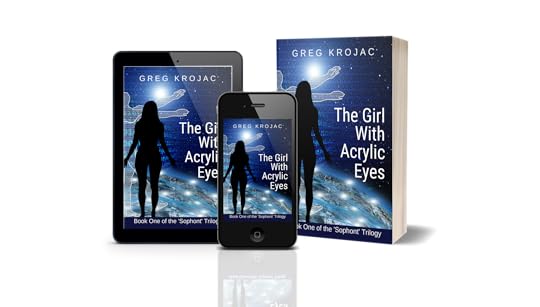 Without people who take the time to read our books, writing our stories would be even more of a ‘guilty’ pleasure and they would languish on our Hard Drives or in The Cloud and get forgotten. So when readers take the trouble to leave a review on Amazon or other similar online bookstores, it means the world to us. Waking up to find a good review of a book we’ve written is a wonderful way to start the day.Here are some things people have said about my latest book, ‘The Girl With Acrylic Eyes’, that really made my day.“This book starts out like an episode of SVU and quickly becomes so much more. What makes a person a person and can a machine ever be one? This story explores humanity, friendship, and the far reaches of space. I enjoyed it from beginning to end and was left wanting more.”(Daphne L Thompson, Amazon.com)“Science has given humans the technology to create robots that can do their job and make their lives easier. One could say that Coppelia, one of these robots, stole my heart. What's not to like about an artificial intelligence that is actually more than a robot? One that can think for herself? One that knows what she likes and dislikes, yet Coppelia is innocent and sweet. She has higher intelligence than others of her kind too. The main characters are well developed and the story is different from most of its kind. I don't want to talk to much about the it because I am afraid of giving spoilers, but if you are a fan of robots, don't miss this one. I loved the story so much I had to share my thoughts.)”(Miri, Amazon.com)“What would happen if a machine became sentient or even sapient? What if a machine could experience emotions just as fully as any human being, one that could produce creative solutions to problems? No such machine exists now, but it is only a matter of time before it occurs. What would happen then? Many folks would immediately call out "SkyNet!" thinking they had correctly assessed the question, but they would be wrong. The Girl with the Acrylic Eyes takes an entirely different look at what an artificial consciousness might be like. In this story, the android Coppelia is an artificial consciousness with no ill feelings at all for humanity. A refreshing break from the rampaging robot trope. Author Greg Krojac explores how humanity as a whole might respond to a machine that feels just as much as any human being. Predictably, humanity's response is not all uniform. A policewoman finds a friend she can connect to, even love, more than anyone else before. Others, and I don't want to give anything away, see her as no more unique than a toaster. Who is right? How will humanity respond to something we've had no experience with before? The science in this book is real science, producing a believable story you can dive into and believe will one day come true. A trip to Proxima Centauri uses current technologies now in development and takes a believable amount of time to reach Earth's closest stellar neighbor. For anyone interested in what the future of artificial consciousness will bring, I highly recommend this book!”(E A Wicklund, Amazon.com)“This is my favorite book of the year. I can’t wait to read the sequel. The questions it poses about AI are intriguing, and disturbing at the same time. It’s a story about improbable friendship and human mistakes with dire consequences. I can’t get enough of Coppélia. Please, give us more of her story soon!”(Keyla D, Amazon.com)“Can an android ever be a true person? Karen never thought so, but her time as a Detective Inspector in the Sexdroid Unit never prepared her for meeting Coppélia. Never prepared her for having her world turned upside down. The Girl With Acrylic Eyes is an excellently crafted genre-bending tale of the near future, part police procedural, part extrasolar space adventure, all about the meaning of being a person, the meaning of friendship, and the lengths to which a true friend will go.”(Martin Frowd, Amazon.co.uk)“An extraordinary and great story about AI and what it means to be alive. As para-phrased in the book ‘it’s life, Jim, but not as we know it’.”(RichF, Amazon.co.uk)“Un libro avvincente su un possibile futuro per l'intelligenza artificiale. Se siete in grado di leggere in Inglese e vi piace la fantascienza, averlo nella vostra libreria è indispensabile. Resto in attesa del seguito per scoprire il mistero irrisolto. An engaging novel from a British Indie on a possible future for AI. If you can read in English and you like sci-fi you must have this one in your bookshelf. I'm looking forward to reading the sequel to find out more about the unresolved mystery.”(Shuren, Amazon.it)The reviews can be found on Amazon atAmazon.comAmazon.co.ukAmazon.it


August 28, 2018
The Birth of The Sophont Trilogy
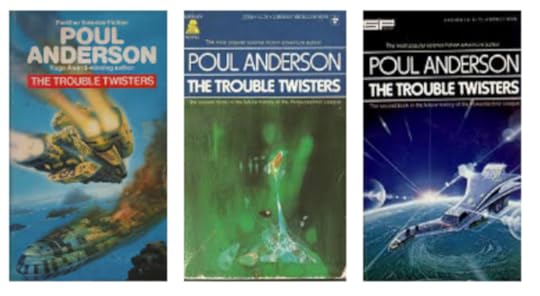 My most recent novel, ‘The Girl With Acrylic Eyes’, was always intended to be a standalone novel; I had a concept, and I knew the destination, but not the journey. As what we call a ‘pantser’ (someone who doesn’t outline their stories in detail beforehand), this is my normal writing process.However, this time, I left an unresolved mystery – deliberately – that didn’t prevent the book from standing on its own two feet, but would need to be explained later. To not do so would be disrespectful to the reader. It was also clear to me that I couldn’t tie up the loose end in the novel; if I did attempt to, it would have both damaged the novel’s structure and moved focus away from the main theme. It would have been distracting.And so the short story, ‘The Coppélia Paradox’ was written – providing the back-story to the incident and giving it meaning. Once the first draft was completed, I took a deep breath, had a cup of tea, and sent it off to my team of beta-readers who, as usual, made excellent observations to improve the story. I was satisfied that I had resolved the mystery and the readers wouldn’t feel cheated.Then, one of my beta-readers, Eric Wicklund, commented:“Coppélia is the Sophonts' Eve. Someone to be revered almost like a god.”That observation (which hadn’t occurred to me) inspired me and spurred me into action. Against my ‘pantser’ instincts, I quickly wrote a very basic outline – mainly so that I wouldn’t lose track of my idea – and got to work writing the sequel, integrating ‘The Coppélia Paradox’ into the new book. I initially thought that the short story could be a prologue to the second book but then decided to separate it into three chapters – at over six thousand words, I felt it was probably too long for a prologue anyway.Cool, I thought. Two books.But more was yet to come.Knowing how book two was going to end, I suddenly realised that a door had been opened to a third book which would incorporate elements of the two previous books and bring the story to a natural but unexpected close.And so, the ‘Sophont’ trilogy was born. ‘The Girl With Acrylic Eyes’ became Coppélia’s story, and the second book (working title ‘MetalHeads and MeatHeads’) will be Paul’s story. The third book has no working title as yet, but I can promise that – along with the other two books – it will take the reader on a unique and unexpected journey into the relationship between humans and sapient humanoid Artificial Intelligence. Forget the Terminator movies, this trilogy will take you down a completely different rabbit hole.I will try to get ‘MetalHeads and MeatHeads’ ready for release by the end of the year, and follow up with the final book in the trilogy in early to mid 2019.SOPHONT DEFINITIONA sophont is an intelligent being; a being with a base reasoning capacity roughly equivalent to or greater than that of a human being. The word does not apply to machines unless they have true artificial intelligence, rather than mere processing capacity. First used in the 1966 work 'The Trouble Twisters' by Poul Anderson, and coined by his wife Karen Anderson..
August 16, 2018
Why the Illuminati?
 Usually, when a writer needs an evil organization to provide the antagonist for his or her story, they create their own (think T.H.R.U.S.H from 'The Man from U.N.C.L.E. or SPECTRE from the Bond films). However, I decided to use one that may or may not really exist (according to whom you believe).The 'RECARN CHRONICLES' trilogy centres around the actions of The Illumninati, an organization which is probably a myth but... who knows?.This is the mother of all conspiracy theories – one which has survived for centuries.Of course, using the Illuminati as my source of evil required some research. Consequently, the Pindar (the leader of the Illuminati) is a real position in the Order and the Pindar that the reader first encounters in the trilogy is Nathan Smith. In Illuminati lore, its heirarchy is based on a continuing bloodline but Nathan Smith is not the descendant of the founder (Adam Weishaupt) but rather is the actual founder reincarnated. I have adhered to the organizational structure too, including the Council of Thirteen, (the families at the top of the heirarchial tree, who control the actions of their subordinates).who – on my story – are the original members reincarnated.The Illuminati wasn't always called by that name. It was originally known as The Order of Perfectibilists, but Weishaupt quickly changed it to The Order of the Illuminati. In my books, this led to the political wing of The Illuminati being called 'The Order of New Perfectibilists, or the ONP (which rolls off the tongue much easier). The great majority of Illuminati members are Recarns – part of the 5% of humanity who remember their past lives – and have a great advantage over the other 95% who cannot draw on their past life experiences..You can visit Amazonto find out more about the trilogy THE RECARN CHRONICLES.Here's an interesting article about the Illuminatihttps://answersafrica.com/illuminati-history-meaning-conspiracy-members.html
August 9, 2018
Shape-Shifting? That's Sci-Fi isn't it?
Science fiction has had its fair share of shape-shifters; from Odo the shape-shifting alien security officer in Star Trek's Deep Space Nine, to John Carpenter's deadly alien in 'The Thing'' i to the Prototype T-1000 Terminator in Terminator 2: Judgement Day.. But shaoe-shifting's not really possible... is it?A reader of 'The Girl With Acrylic Eyes' was surprised to discover that the shape-shifting technology that occurs in the story isn't just the product of a fertile imagination, but is based upon technology that is actually being researched.Claytronics is an abstract future concept that combines nanoscale robotics and computer science to create individual nanometer-scale computers called claytronic atoms, or catoms, which can interact with each other to form tangible 3D objects that a user can interact with.Programmable matter – in the form of claytronics – is currently being researched and developéd at Carnegie Mellon University in the USA. For more information, watch the video for an introduction to this amazing new technology and/or visit the Claytonics Project website at Carnegie Mellon here.The Girl With Acrylic Eyes is available at Amazon
August 6, 2018
Will Cockroaches Inherit the Earth?
My post-apocalyptic romance 'REALITY SANDWICH' is set in a world after an apocalyptic event. We don't know what happened (the incident is only referred to as 'The Event') but we do know that it's believed that the only things that have survived outside of the protective cacoons of Jerome and his five friends' individual apartments are cockroaches,, which have continued their lives unabated and free of the threat of canned pesticides or heavy boots stamping on them. Jerome and his five friends are kept separate from each other by the fear that these insects have mutated and will kill the humans if they ever set foot outside the safety and comfort of their own apartments, thus forcing the survivors to communicate by video-chat only.And if the cockroaches don't kill any errant human, the relentless and persistent acid rain will!But, if the nightmare were to come true and the planet were engulfed in a nuclear war, could these disgusting but hardy insects really survive? Watch the video to find out...'Reality Sandwich' is available in paperback and eBook at Amazon
August 3, 2018
Kate Darling - Mistress of Machines
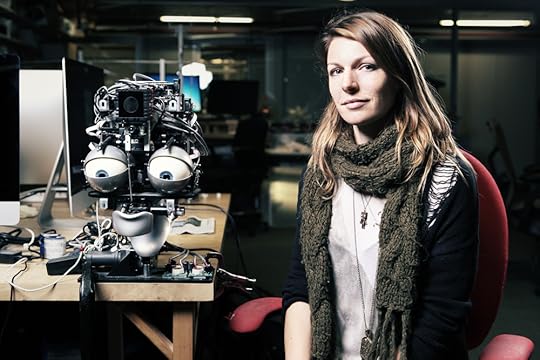 If you’re writing about science fiction, and you want your technology to be based upon current technology or, at least, technology that is being theorised about or researched at the moment, you really need to do some basic research as there will always be someone out there who can spot when you’re making something up completely not always a bad thing – plenty of scifi uses technology that's pure imagination). Of course, readers of science fiction that generally leans towards the harder side of the genre are not averse to suspending their belief for a while for the benefit of the story, but they do like to know that you have done your research and haven’t just gone careering into the depths of your imagination with no concern for what we perceive as reality.In THE GIRL WITH ACRYLIC EYES, one of the two main characters – Coppélia – is a gynoid (a robot created in the aesthetic form of a female human).. However, she is not your average android (the term given to a robotic humanoid, regardless of its perceived gender), being a one-of-a-kind sapient machine. I needed to research not only the difference between sentience and sapience, but also dig deeper into the kind of relationship that humanity might have with humanoid artificial intelligence.It would have been easy to have followed the well-trodden trope of a malevolent A.I. turning against its creators, but I wanted to write something different, something that said more about how a human might interact with artificial intelligence and the attitude of human society towards such a being – and, indeed, if a machine could or should be considered a being).A very important resource was the work of Mistress of Machines. Human-robot interaction, robot ethics, IP theory & policy at MIT Media Lab – Dr. Kate Darling, a leading expert in Robot Ethics. I read through numerous articles and watched several YouTube videos where she examines ‘the emotional connection between we humans and life-like machines', something that must be considered now that Pandora’s box is opening ever wider.She is very busy juggling her time between work and a young family but I sent her a copy of the eBook as a thank you, and she in turn has promised to read it when she gets a chance. Hopefully she’ll like what she reads.You can find out more about Dr Kate Darling and gain access to her interviewsm academic articles, etc at http://www.katedarling.org'The Girl With Acrylic Eyes' is available in paperback and eBook at
July 31, 2018
Why ‘The Girl With Acrylic Eyes’?
My new scifi novel is called ‘The Girl With Acrylic Eyes’, but why did I choose that particular title?The title of the book is actually an homage to the ballet Coppélia, which tells the story of what happens when a doctor makes a life-size dancing doll, and Franz, a village youth, becomes infatuated with it, setting aside his true heart's desire, Swanhilda. The android in my book is named Coppélia after the doll in the ballet.The alternative title of the ballet ‘Coppélia’ is ‘The Girl With Enamel Eyes’. Of course, a modern android wouldn’t have eyes made of enamel so I changed the material to acrylic.The accompanying video shows a scene from the ballet, when Coppélia comes to life.'The Girl With Acrylic Eyes' is available in paperback and eBook at Amazon
July 28, 2018
A Muslim Scientist...
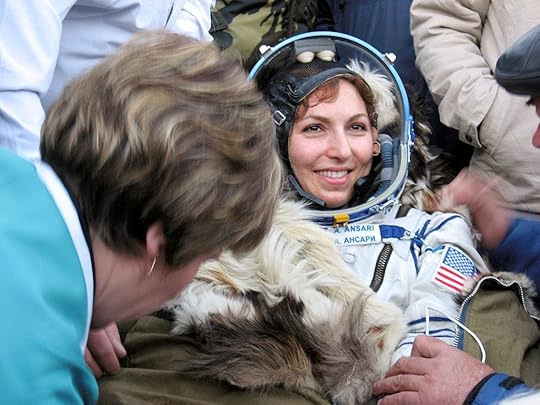 One of the main members of the ensemble of survivors in THE SCHRÖDINGER ENIGMA is a Muslim scientist. Sitara Khan is part of the Mission Control team for NASA’s Voyager project and based at the Jet Propulsion Laboratories in Pasadena, California. I made a deliberate character choice as I wanted to portray a positive image not only for girls to aspire to, but also to show that being a Muslim doesn’t automatically preclude you from becoming a professional scientist. A belief in God and being a scientist aren’t automatically mutually exclusive from each other (although non-believers do appear to be in the majority in the world of science).However, there are (at the time of writing) a total of ten Muslims who have gone one step further and actually travelled to space.The eighth of these was a woman, an Iranian-born American, Anousheh Ansari, who visited the International Space Station in September 2006.Writing the part of Sitara would have been impossible for me – a white male in his late fifties without the input of someone who could advise me on how a modern (non-traditional) Muslim woman might behave. I was fortunate to know just the right person, Sahar Ansari (no relation), who gave valuable cultural guidance – herself being a modern Muslim woman who lives in Rio de Janeiro, Brazil. It was fascinating to hear about how a Muslim woman from Pakistan balances her behaviour between the more traditional conventions when she visits family in Pakistan and her life in Brazil, a much more relaxed and liberal environment.You can find out more about Anousheh Ansari at http://www.anoushehansari.com/
July 26, 2018
Magic is not an option in Sci-Fi...
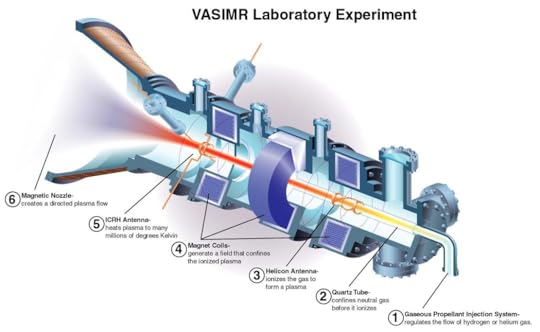 If I can, I try to keep the science in my books based on reality or, at least, within the realms of possibility. I don’t believe in using generous portions of ‘unobtainium’ or ‘hand-waverism’, preferring the technology in my stories to be theoretically possible, and then to let my imagination take over and expand from that initial starting point towards (as yet) undiscovered solutions. This, for me, is a fundamental difference between science fiction and fantasy – magic is not an option in science fiction.Whilst researching spacecraft propulsion systems for use in one of my books (to tell you which book would spoil an important plot twist), I decided that the VASIMR (Variable Specific Impulse Magnetoplasma Rocket) was the most suitable for the story. Theoretically, it has the capacity to reduce space journey times dramatically but – for my purposes – needed the intervention of a serendipitous rapid advance in its capabilities in order to satisfy my story’s needs.You can find out more about VASIMR here…http://www.spaceflightinsider.com/con... by NASA [Public domain], via Wikimedia Commons)
November 1, 2017
The Quantum Experiment That Broke Reality
I'm having to do a lot of research for my upcoming scifi novel 'The Schrödinger Enigma', especially Quantum Mechanics. I hated regular Physics at school - maybe because I wasn't any good at it - but I'm really enjoying discovering the wild and whacky world of the Quantum environment.