
Kyle Parton's Blog: Working Hypothesis
October 30, 2016
Who are Your Patron Saints?
A brief tribute to the luminaries that embody the causes and legacies that I identify with most. Includes a quick contemplative exercise to help you discover your own patron saints.
Recommended pregame coffee intake: 2 cups (of 4)

What are Patron Saints?
Traditionally, patron saints are key religious figures that act as heavenly advocates for those engaged in specific causes, activities, roles, or even afflictions. Found in various religious traditions, these figures are actively involved in the endeavors that affected them most on Earth. Many were martyrs for their respective causes. To me, the concept makes sense: If Saint X was passionate about (for or against) a certain cause here on Earth, she is most likely still passionate about that cause in the hereafter. She may even pay special attention to those who are also involved in that cause. This points to a special connection between the patron saint and the devotee. Said plainly, patron saints are heroes or bodhisattvas that we personally identify with.
[And here’s a comparative religion fun-fact: The Christian church doesn’t hold the patent on canonizing saints. We can find comparable examples in cases like Green Tara, a Buddhist bodhisattva who vowed to always appear as a woman, and seems to have a special place in her heart to aid the students of Atisha’s lineage.]
Figuratively, a patron saint can be anyone who: embodies the causes, legacies, or conflicts you care about most; has previously walked a path similar to yours in a way that encourages you; serves as a muse of sorts in that they inspire ambitious creativity and gratitude. In this figurative sense, patron saints can be the champions and alumni of the most significant themes of your life. This is the context of my “saints” that I’ve identified below.
What Do Patron Saints Do for You?
It can be surprisingly meaningful to identify your personal patron saints (in either the literal or figurative sense). The primary reason for this is, as outlined above, they inspire, teach, and encourage by their example. However, there is a much more subtle and meaningful reason. Identifying your personal patron saints is a valuable exercise in that they can prevent you from feeling alone in your cause or plight. If someone has blazed a controversial trail in the past that is parallel to your trajectory, it gives you permission and courage to move forward. For instance, those who work in environmental care may find inspiration in learning about St. Francis of Assisi. Similarly, those enduring fertility issues may find strength in learning about St. Anne. In this, patron saints validate and infuse context into your mission (as well as your suffering). They walk our path with us.
My Patron Saints
These are the “saints” that embody the causes and legacies that I identify with most, as well as a rhetorical prayer to each of them:
William James: A uniquely American philosopher, psychologist, physician, educator, and mystic, James was one of the first to pioneer a scientific dialogue between religion and modern psychology. He advocated a challenging theory of truth (pragmatism) and immersively studied religious mysticism through this framework. James was a remarkably prolific writer who directly influenced several fields of knowledge, and as such inspires me greatly. Read: The Varieties of Religious Experience
St. William, protect us from ineffective,
fruitless beliefs that have no cash value.
Teach us to see when our concepts
distort rather than reveal reality.
Stephen Batchelor: An inconvenient and controversial disrobed monk, Batchelor champions the worldview of Secular Buddhism (meaning he rejects the magical aspects of karma and rebirth, yet still practices the core teachings of the Buddha). He demonstrates a sincere post-Buddhist practice, which regards the Buddha’s teachings as tasks to be completed rather than metaphysical propositions to be affirmed. This framework is the candle I use to guide my journey as a post-evangelical. Read: Buddhism without Beliefs
St. Stephen, protect us from magical thinking.
When we have outgrown a certain system of belief,
teach us to transcend and include it
rather than condemn and reject it.
Fr. Thomas Merton: A Trappist Monk, passionate social activist, and keen student of comparative religion, Merton’s writings and campaigns to promote interfaith understanding were monumental in popularizing the Christian contemplative path. Arguably, he was the first contemporary Christian to successfully engage with Buddhism and Taoism (among other faiths). Such investigation earned him enmity from many in the Church and endearment from those attracted to eastern thought. Merton’s deep conviction to reconcile the east and west canonizes him as the champion of investigative mystics – a population of contemplatives I dearly identify with. Read: Zen and the Birds of Appetite
St. Merton, protect us from justifying our
ignorance about other faiths.
Teach us to find beauty and
meaning in paradox.
Padmasambhava: A (legendary?) 8th-century Indian monk, Padmasambhava introduced Buddhism into Tibet. As the mythos goes, he encountered many fierce demons (see: Bon) in this campaign; but rather than destroy, damn, or exercise the demons, he essentially converted them to Buddhism. In my mind, this represents the highest soteriology. Do we believe that “demons” (e.g. destructive people, bits of ourself, primal desires) are categorically damned? Or is redemption available and open to all living beings? Our answer to that says more about our prejudice than it does about Divine grace. After all, real saints do not slay dragons; they ride them. Read: Natural Liberation
St. Padmasambhava, protect us from
concepts of salvation that misdiagnose a
part of us as permanently bent or sinful.
Teach us to domesticate our inner demons
rather than waste our life trying to
surgically remove our shadow.
Rumi: A beloved 13th-century Sufi mystic, Rumi is perhaps the world’s best-known spiritual poet. It’s difficult to explain why I admire him so much, but here’s a shot: There is a certain point on the spiritual path where the little self is unconditionally absorbed by the Divine (known a thousand names, or by no name). Where some mystics then strive to step out of the illusory world, Rumi turned and dove in to it, face first. The result? Experiencing this life as rich, sensual art in the mind of God. Oh that I could one day know the world the way he knew it. Read: The Essential Rumi
St. Rumi, protect us from a cheap Gnosticism
that dismisses this world as profane.
Teach us the folly of frantically searching for the
jeweled necklace that peacefully hangs around our neck.
Angulimala: A sadistic murderer in 4th-century India, Angulimala was notorious in that he wore a bloody garland of his victim’s fingers around his neck. He had murdered 999 victims and was seeking to kill his mother as the 1000th when he was instead intercepted by the Buddha. Angulimala tried to strike him down but, after the Buddha displayed a miracle and questioned his unnerved attacker, Angulimala yielded and became a monk. As a bloody-handed murderer turned saint, he is perhaps the one I hold most dear on this list (distantly comparable to St. Jude, the patron saint of lost causes). Read: Angulimala Sutta of the Majjhima Nikaya
St. Angulimala, protect us from our
capacity to inflict violence – both physical and psychological – on others.
And if we falter, teach us to stop
locking our identity in the remorseful prison of our
flawed past decisions, and teach us to
extend that same grace to others.
Johnny Depp: Ok, this one is a little more lighthearted. But seriously, I think he’s brilliant. He models what it means to unreservedly become something. I think he wholeheartedly embraces his roles, and that constantly inspires me. I also admire his mystique, his eccentricity. See: Anything he’s been in, but especially Into the Woods, Sweeny Todd, or any of the Pirates of the Caribbean movies.
St. Johnny, protect us from being normal.
Teach us to truthfully embrace the
roles we play.
Who are Your Patron Saints?
Comment below and let me know: Who are your top three patron saints? Who’s legacy do you follow? What key figures do you feel a special connection to in your faith, profession, or overall mission here on earth?
Click here to download a brief contemplative exercise to help you identify your personal patron saints.





September 5, 2016
A Model for Personal Development
An adaptable personal development strategy that you can use to balance work/life, strengths/weaknesses, and create on-/off-seasons. Download a free copy and see if it works for you.
Recommended pregame coffee intake: 2 cups (of 4)
Intro
I love learning about personal development plans, but I’ve never found one that perfectly manages my bad habits and cognitive disorganization. After about a year of tinkering with the common elements found in many models, I finally drafted a developmental strategy that seems to work for me.
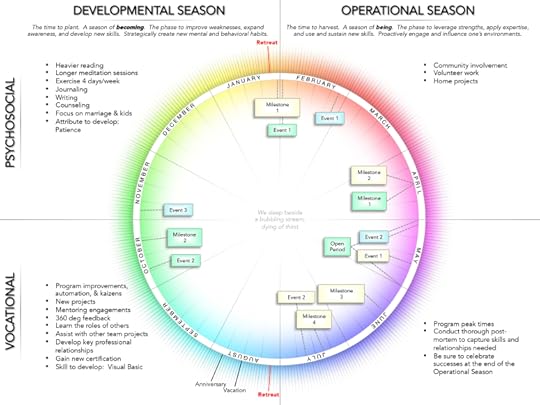 I redacted the specifics from my milestones (the boxes inside the cyclical calendar), but the rest is my personal strategy. If the content of my plan doesn’t make sense to you, just ignore it — the point is the structure.
This model provides a broad structure to balance personal development and personal achievement. It splits the year into two seasons (the vertical line): one season to influence oneself and another to influence one’s environment. I’ve found it difficult to do both really well, simultaneously, over an extended period of time. I believe it’s better to be strategic and focus on each element in separate phases.
The model also splits one’s activities into two dimensions (the horizontal line): one addressing any external work we do (vocational) and one addressing any internal or relational work we do (psychosocial).
[Design note: While the four components of the model (Vocational, Psychosocial, Developmental, and Operational) form a meaningful quadrant, the point is not necessarily to divide the year into quarters. This is an unintended implication. So rather than think of the year in 3-month quarters, emphasize splitting the year in half with the vertical line when looking at the calendar.]
Why this Model Works for Me
Maybe you don’t need to be this premeditated in how you spend your time and energy. Good for you. I do.
Here’s the problem: I put an enormous amount of pressure on myself to constantly grow. I also feel an unbearably intense desire to “change the world.” While these two impulses are not mutually exclusive, they do need to be balanced. This model is one way to do that. I hope those who feel a similar urge to continuously develop and also feel driven to make a difference in the world will find that this model can help partition some of those pressures. Yes, there are 15 books I want to read — I’ll start those in August. Yes, I want to volunteer at the suchandsuch nonprofit — I’ll start that in February. This structure referees the noble forces that violently battle for our time and attention.
This format also helps me see the whole year in one glance. Because time seems to be moving at a multiplier of 1.5 these days, I need to keep the big picture before me.
Here’s How it Works
The model operates on the following core assumptions. If you don’t agree with the majority of them, it may not be the right approach for you.
Assumptions
If you are going to change the world, it will be from leveraging your strengths.
If you have amazing analytical skills (a strength) but terrible teaching skills (a weakness), you should seek to positively influence your environment on the basis of your analytical aptitude. It takes substantial time and energy to learn to become a great teacher, and even then, there’s no guarantee teaching will be an activity that is rewarding and energizing for you. So seek to create change on the basis of your strengths.
If you are going to achieve healthy relationships and inner peace, it will be from overcoming your weaknesses.
Let’s say you realize the primary reason you’re a crappy teacher is because you have no patience. By developing more patience, you may very well nourish your relationships and reduce your irritation when helping others learn. However, to again reemphasize the first assumption, it’s unlikely you’ll change the world on the basis of your newly cultivated saintly patience.
Thoughts become actions, actions become habits, habits become path.
So if you want to influence your ultimate path and identity (downstream), it begins by deliberately managing your thoughts (upstream). You must create the causes of who you want to be. This allows you to operate on habits rather than willpower, and that is a gamechanger.
If you don’t learn new skills, you will burn out.
Many high-performers fail to make this connection. The tricks and tactics that got you where you are won’t necessarily work in the face of future obstacles and constraints. You will plateau.
If you don’t develop (and sustain) key relationships, your success will ultimately be limited.
This isn’t about getting someone reputable to write a letter of recommendation to a college; it’s about the mutually beneficial exchange of resources, advocacy, support, and challenge.
Here are the definitions of the key components of this model.
Definitions
Developmental Season: The time to grow. This season is focused on improving oneself, learning to manage existing weaknesses, and creating new habits. Ideally, few major events or milestones occur in this season, which hopefully means a little more whitespace on the calendar.
Operational Season: The time to execute. This season is focused on influencing one’s environment by leveraging one’s strengths. Ideally, the majority of key events or milestones occur in this season, which means this is the peak busy season of the year.
Vocational Dimension: This is the “work” in work/life balance, but it’s more than just your day job. I’m using this term in a more Catholic sense, which ties to your greater purpose on this planet. It refers to anything you physically do. In this definition, “work” is simply anything that needs to change. The result is that work and personal life become less segregated and more of a spectrum. The Vocational dimension of this model refers to anything you might externally change.
Psychosocial Dimension: This is the “life” in work/life balance, and it specifically emphasizes your psychological and social habits. It refers to the combined elements of your mental routines, emotional wellbeing, personal relationships, and even spiritual practice. This encompasses areas like your education, self-awareness, emotional intelligence, and the amount of energy and attention you invest into your relationships. The Psychosocial dimension of this model refers to anything you might internally change.
Retreats: These are special events, trips, or workshops where attention is exclusively given to growth and refocus. Retreats are a time to take one step back so that we may take two steps forward. Many spiritually inclined people enjoyed retreats in their youth (church camp, etc.), but seem to outgrow them at some point. Why do we stop doing this? Do we think we don’t need it any more? Consider, the key figures of almost every religious tradition took retreats — even in their prime. Christ withdrew to the desert. Buddha withdrew to the forest. Muhammad withdrew to the mountains. We’re fooling ourselves if we think we don’t need an occasional retreat to recalibrate our souls. (And it needn’t be seven days in an ancient monastery; a two-day local retreat can often do the trick.)
With those assumptions and definitions in mind, this model is also structured around one other major concept.
The Off-Season
Professional athletes have an off-season. This developmental model operates under the same premise: You are not a machine. You have to recharge, recover, rebuild, and replenish. After ultramarathon world record holder Croix Sather ran across the entire US, he took six months off. Olympic triathlete Matt Reed uses his off-season to plan his race schedule for the next year and play with his kids. He says this is critical to recharging himself mentally and rekindling his enthusiasm for the sport. If your annual milestones and events allow you to engineer in an off-season, it’s in your best interest to do so.
Do you know what will happen if you try to save the world 24/7?
You will become sensually intimate with four new sadistic lovers: Obsession, Burnout, Anxiety, and Depression. It doesn’t even matter how altruistic your endeavor or mission is. Once your enthusiasm has burned all the fat off your body, it will start to consume muscle. Then bone. Then relationships. Then soul. Many people know they need a break, but fail to implement it. It won’t happen automatically. You have to force it.
Every peak is followed by a valley — or it wasn’t a peak in the first place. So you can leave it up to your environment to introduce these valleys, or you can schedule them yourself. I choose the latter.
I know, I know, “My schedule is so busy that the concept of an off-season is absurd.” Welcome to the club. There is a solution: Cultivate the skills and relationships that will empower you to create an off-season. That’s what this whole model is about. Create the causes of an off-season. But again, you have to force it.
How to Use this Model
Use these six steps as a starting point to develop your own personal development strategy. Wherever my method stops making sense for you, stop and design your own structure from that point on. I doubt my model will work perfectly for everyone, but you should be able to find a few helpful concepts in it.
Identify and list out all annual major milestones or events in your life, job, and relationships.
What are the recurring tasks or occasions that are most significant for you? These will be the boxes inside the calendar.
Plot these milestones and events on the calendar.
Rotate the calendar graphic so that the Operational Season contains as many of these milestones as possible. This creates your peak time.
For the Developmental Season, identify a desired frame of mind, attribute, or habit to cultivate (for instance, patience).
Don’t simply try to develop patience outright — that is impossible. Rather, create the causes of patience (perspective taking, self-awareness, and compassion). These are the perspectives you will deliberately practice during the Developmental Season, eventually resulting in the desired outcome.
Identify a skill to develop that will be needed in the Operational Season.
These can be soft skills such as conflict mediation or hard skills such as learning to use new software.
Identify and list key activities for the Developmental Phase that provide you the knowledge, awareness, and relationships most critical to your mission.
Mine include heavier reading, longer meditation sessions, counseling, investing time into my wife and kids, etc.
If there is a phrase, verse, or image that captures what you ultimately want to do or become, enshrine that thought in the middle of the calendar.
Mine is a line from a Rumi poem. It reminds me to set an intention for everything I do, which in this case is to help all living beings reconnect with the Divinity that is closer than their skin.
Free Download
If you think this model has some potential to help you, please download a free customizable copy. Opt-in to my email list and I’ll send you a file that you can edit to create your own tailored calendar. And don’t worry — the point of the email list is to pass along tools and resources like this (rather than push spammy affiliate products and propaganda).
So tell me your thoughts! Do you take retreats? Is this model usable to you? What is unclear? This format is definitely Version 1.0, so let me know what changes might be helpful.
May this tool help others enrich their environments,
strengthen their relationships,
and cultivate inner peace.
Related Resources
Flow (Mihaly Csikszentmihalyi)
A classic discussion of how we can structure the information in our mind upstream to create happiness downstream. Great for the Developmental Season.
Mindset: The New Psychology of Success (Carol Dweck)
An overview of how to structure our attitudes and thoughts for maximum success and fulfillment. May help you create the mental habits and routines needed to be successful in the Operational Season.
(Affiliate links)





June 4, 2016
Four Developmental Milestones
What does it mean to psychologically, socially, and spiritually develop? While the question of why we develop remains speculative, the question of how is surprisingly approachable. Within the various fields of human development and contemplative spiritual traditions, we can identify four shared developmental phases. As a general model, we must meet these four criteria to progress to a new developmental stage: mastery, crisis, insight, and catalysis. Examples are given in the context of identity development (who is “me”?) as well as worldview development (specifically, how we read scripture). Applications are explored in the contexts of marketing strategy, coaching/mentoring, and spiritual direction.
Recommended pregame coffee intake: 4 cups (of 4)

Intro
Writing this has been complete and inconsolable anguish. Can’t write. Must write. Don’t write. Did write. Wrong write. Rewrite. Lip bite. Post. To begin with, my mind is a rusty iron chariot pulled by four feral horses in four different directions, so getting everything moving in the same direction takes a titanic effort. Factor in my overanalytical and perfectionistic tendencies, and I could easily self-edit this entire blog out of existence. I could self-edit any project into the Void, really. Accordingly, I’ve forced myself to stop and just post it, so please be generous and gracious here.
This post is essentially a beta test of a model that will be included in an upcoming book on mentoring. This is a chance to calibrate it and describe its applications. It’s got a very formal foundation, so I’ve tried my best to strip it of academic paraphernalia and make it palatable. (If you want to keep up with the book and my other undercooked writing projects, please honor my infantile, premature author Facebook page with your esteemed Like. It will probably be 2018-2019, though, before anything significant happens).
Now on to the topic! Developmental scientists tend to study three categories of human development: physical, cognitive, and psychosocial. Integral theorists keep going past such minute human perimeters and study development in at least two other contexts: spiritual (beyond body and mind), and evolutionary or teleological (where is all this heading?). I’m most interested in the last three in this list. By default, that’s what I’m referencing when I use the generalized term “development” here. (As an aside, my favorite author, Ken Wilber, has done revolutionary work in systematically mapping this stuff. If I ever contribute anything of value to the world, it will likely be mere editorial garnish to his work.)
Lastly, there are some immediately practical uses for this model in the contexts of marketing strategy, coaching/mentoring, and spiritual direction (among others). If anyone employs it, I’m curious to hear some feedback. Another way to use it is this: Think back to your last major life change and see if you can identify these four milestones. Let me know in the comments!
Random Disclaimers:
This post is longer than I intended, so I’ve quarantined nonessential commentary to footnotes in an effort to keep it readable.
It’s easy to perceive talk of “higher” or more “advanced” developmental stages as better or more elite. That’s not my intention. An organ isn’t inherently better than a cell. A cell isn’t inherently better than a molecule. So don’t get defensive here.
Click here for a printable pdf version (9 pages).
I promise future posts will be shorter and easier to digest!
The Four Milestones
The intriguing question of what primes developmental changes remains open to speculation. In scientific communities, developmentalists generally credit a tailored combination of genetic, environmental, and sociocultural variables. In religious communities, most western spiritual traditions credit a personal causal agent like the Holy Spirit, while most eastern traditions credit an impersonal causal agent like Karma. Regardless of our approach, human development is rarely a nice, neat, transparent, linear process (so forgive me if I portray it that way). Development is cyclical and four-dimensional, at least. So let’s shy away from the “why?” and focus on the “how?” for a moment.
Four broad developmental phases or milestones[1] emerge in the interdisciplinary dialogue between the various approaches to human development and contemplative spiritual traditions. If we look for them,[2] these phases can be found in any major model of psychosocial and spiritual development (many are linked throughout this post).[3] While the terms and contexts are different in each field, the four broad criteria required to progress are:
Phase 1 – Mastery: First, you’ve been at your current stage long enough that you’ve fully “explored the terrain.” There’s an element of satisfaction to this, because you’ve mapped the territory. Temporary homeostasis is achieved. Your needs are met and you can generally explain the world and your experience from this point of view.
Phase 2 – Crisis: Then you hit a wall. You become aware of limitations. Dissatisfaction sets in. Either your old needs are no longer met or new needs emerge. Your precious homeostasis is lost. You’re no longer able to completely explain the world or your experience from your previous point of view. You don’t know where to go, but you know you can’t stay here. This dissonance culminates in a full-blown crisis. Welcome to the Dark Night of the Soul.
Phase 3 – Insight: Next, you see there’s more available. You have a moment of insight. Maybe you see others operating at the next stage, or maybe the doors are opened firsthand in psychotherapy or a contemplative practice. Either way, you see that your new needs can be met. Homeostasis may be possible again (one day). There are other valid, more comprehensive ways to explain the world and your experience.
Phase 4 – Catalysis: Lastly, you encounter some kind of catalyst. Some kind of “straw” breaks the camel’s back and you completely shift from your current frame of reference. Interestingly enough, catalysts can be negative or positive. They can accelerate change through strong attraction or aversion. It may be a conversation, a book, a conflict, or really anything that definitively triggers your jump up and out of your current perspective. The entire world is new at this point. Now you’ve come full circle and, once again, you’re off to pursue homeostasis and mastery of the new terrain.
This might be a little too vague and simplistic to be believable, so let’s look at two specific examples.
Example 1: Identity Development (Who is “Me”?)
Contemplating identity entails 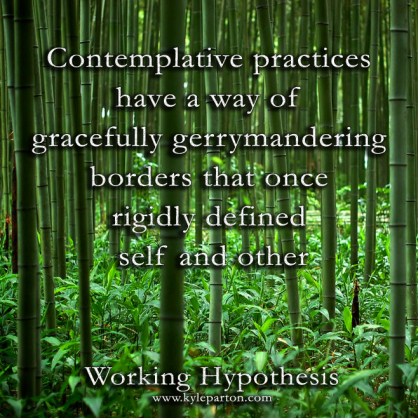 more than just pondering the existential plum, “Who am
I?”[4] A more comprehensive approach to identity entails asking, “Where do I end, and others begin?” The answer to this question gradually changes as we walk our path—especially if we have a meditative practice. Contemplative practices have a way of gracefully gerrymandering the borders that once rigidly defined self and other. To explore the expansion and evolution of one’s identity, we will use Ken Wilber’s terms. In this context, identity development is the gradual “widening” of one’s self concept through the following stages:
Egocentric (just me)
Ethnocentric (those like me)
Sociocentric (my country or class)
Worldcentric (all people)
Planetcentric (all living beings), and
Cosmoscentric (all reality)
As our identity widens, our sense of self correspondingly expands. Literally, what it means to be “you” transcends what it once entailed. What was once the subject becomes the object.[5]
We can easily illustrate the four developmental phases in one’s identity expansion from egocentric to ethnocentric. As a nice developmental starting point[6] (although there are pre-egoic states), the egocentric me seeks power, status, gratification, and self-preservation at the expense of just about everyone else. I’ll stay at this level (Phase 1) for as long as I can meet my needs and thrive in my environment by acting and thinking from this perspective.
Later on, I’ll make a self-cherishing decision that significantly hurts someone dear to me. In a powerful moment of clarity, I’m faced with the limits of my egocentric outlook (Phase 2). The perspective that helped me survive so well in the past has finally betrayed me. Sincere regret is an infallibly sobering developmental mirror. Don’t dismiss it until you’ve got your money’s worth. I’m deeply unsettled because, although I know I can’t continue to treat others this way, I don’t know how to change.
Next, I experience reorienting insight (Phase 3). I realize that the needs, well-being, and preservation of my tribe are not only real, but they are just as important as my own. These moments can have a number of causes, but they all yield a common result: I gain the ability to perspective-take.[7] I become self-aware of the fact that I’m being egocentric. As my identity widens from just my narrow individualistic self (ego) to those very similar to me (ethno), I start to see value in communal roles, rules, and controls. My identity becomes richer and more comprehensive than it’s ever been before.
Lastly, a catalyst (Phase 4) may be something like a scenario where I see a member of my tribe in need and, for the first time, I delay my own gratification to help them. With that decision, I’ve just stepped up and out of my egocentric identity. The little me has expanded, and the developmental cycle restarts. I’m now in Phase 1 from an ethnocentric perspective (queue Elton John’s Circle of Life). On this same scale, similar but more complex developments can cause my “me” to expand to a sociocentric, worldcentric, planetcentric, and eventually cosmoscentric perspective. However, that’s another story, best told to quietly smoldering incense.
(For those that see this as too abstract and theoretical, take a moment to explore some of the profound contemplative spiritual practices that plunge one directly into the widest contexts of identity [and consciousness], such as Big Mind. As a form of facilitated meditation that can quickly dissolve the perimeters of one’s self concept, many regard this practice as one of the most revolutionary spiritual exercises to emerge in the last several hundred years.)
That’s still a little broad. Let’s look at a more specific (yet even more grandiose) example in the context of worldview development.
Example 2: Worldview Development (How I Read Scripture)
A more concrete example is the development of worldview structures using the (slightly modified) terms of the eminent anthropologist, Jean Gebser. These structures actually work on two scales: the historical unfolding of humanity’s anthropological worldviews, as well as individual worldview changes over one’s lifespan. These stages are:
Archaic (truth from instinct [primitive])
Magic (truth from symbols)
Mythic (truth from story)
Rational (truth from logic)
Pluralistic (truth from coexisting perspectives), and
Integral (truth from all previous structures, intermeshed)
These terms describe our progression from the Stone Age to the Information Age (macrostructures), and from little bald babies to gray-haired sages (microstructures). Let’s describe a worldview shift from mythic-literal to rational-scientific in the context of how we read scripture (I’m slightly modifying James Fowler’s terms here).
To clarify, we are reading scripture from a mythic-literal worldview when we affirm that Krishna literally lifted Mount Govardhan with his pinky for seven days; Lao-Tzu was literally conceived when his mother gazed upon a falling star; Buddha literally caused the floods to recede and walked on dry land; Muhammad literally split the moon in two; and the sun literally stood still in the sky when Joshua prayed (which would probably kill everything on the planet, unfortunately). There’s really no room for symbolism or mistranslation in the mythic-literal worldview. The story is either completely true as is, or completely false as isn’t.[8]
Jumping in to the example, let’s say I’m reading the Bible from this worldview. With the right help from authority figures, I can map out a pretty consistent framework to explain the universe, pain, purpose, salvation, and everything. Since I take scripture at face value, it’s completely possible to master the text (Phase 1). Over time, I can squeeze my everyday experience (as well as other’s experience!) into this paradigm. I’m more than able to explain the world.
At some point, a tiny crack in my system (and in my confirmation bias[9]) occurs. This may happen because gradually the system required to account for face-value contradictions gets so complex and nonintuitive[10] (e.g. Satan buried dinosaur bones), that it gets wobbly and fractures. Or it may happen in a moment of perspective taking where I see that someone else’s nonliteral interpretation seems to be troublingly valid. If this happens enough, I’ll start to look at my system with slightly different eyes—eyes I’ve never had before.[11] I see that my system works perfectly if I make it work perfectly. But what happens if I stop micromanaging the logic? Will it hold together on its own? These are questions I’ve never asked before. We know our worldview is shifting when we can no longer explain the world as we once could with any intellectual integrity; we know our bias is shifting when we no longer want to. I can expect a full-blown crisis of faith (Phase 2) the moment I get curious about these other seemingly valid approaches. Because my beliefs are still anchored in mythic-literal thought, it will certainly feel like I’m betraying my faith to explore other approaches. What in the world am I supposed to do now? Hello, crisis.
Next, temporary relief may come in the form of a scholar or book that patiently walks me through the other methodologies available. Metaphor. Allegory. Infallibility vs. inerrancy. My guide, my Virgil, holds my white-knuckled hand until I realize (Phase 3) that there are other more objective ways to engage with the text. I clearly see that a different yet valid relationship to the text is possible. Hello, insight.
Lastly, a catalyst (Phase 4) may be something like a conversation with one of my mythic-literal peers where, for the first time, I take the side of a nonliteral explanation. Although I’ve been privately exploring a nonliteral interpretation for a while, I finally come out of the closet and fully embrace the exciting reorientation to a vast new rational-scientific worldview (back to Phase 1). This worldview is the first stage of development that can find salvation through my personal concept of truth, but also allow that others might find salvation through a slightly different perspective (think Vatican II). It intermeshes nicely with worldcentric stages.[12]
With the examples of identity and worldview development in mind, let’s look at how to move forward through these phases.
How to Move Forward in the Developmental Process
Unfortunately, it’s easy to lose momentum and stall in the developmental process. To further complicate it, each phase has its own unique requirements that must be met in order to sustain or rekindle momentum. If we want to move forward (and help others do the same), it helps to recognize what elements are required, and when they are specifically needed. In loose sequence, the main ingredients are education, inspiration, consultation, and motivation.
If I’m stuck in Phase 1 (meaning I haven’t completely formulated my newest identity or worldview just yet), then I need to know more about what’s out there at my current stage. I need education. Exploring new terrain is easiest if you have a map. Furthermore, if I start to stagnate after all my informational needs are met, I need inspiration. I need to be reminded why I want to master this stage in the first place. I need to reconnect with my muses.[13]
Perhaps the easiest place to get stuck is when we hit the wall in Phase 2. Temporary paralysis is a perfectly understandable reaction to seeing that our resources no longer meet the needs of our environment. Once I reach my limits and don’t know where to go from here, I need consultation because the noise and dissonance make it almost impossible to find the next steps (quickly, at least). A proven way to regain our bearings and explore valid options is in talking with a more objective third party, ideally someone who as mastered the territory.
Fortunately, it’s much harder to stagnate at Phase 3 (we finally catch a break!). It’s difficult, but not impossible, to unknow the insight I gained with the help of the consulting party. Realistically, Phase 3 is more of an event than a stage. I see the way forward, but one final step is needed.
To move through the last phase, I need something to compel me to action (in chemistry, a catalyst is that which accelerates the rate of change). I need a lit match dropped into the gasoline. At a fork in the road, I need a catalyst to energize me to take the first steps in my new direction and transcend my current perspective. I need motivation (the actual word would be catalysis, but that doesn’t fit my nifty convention here).
We find ourselves back at Phase 1 after the initial momentum of the catalyst slows. Once the honeymoon is over, I’ll likely need education and inspiration again to keep puttering along.
Recap
I confess, these examples are caricatures. They are unforgivably simplistic and two-dimensional by any academic standard (but hey, it’s a blog). Shifting to a new developmental stage is a gloriously messy, asymmetrical, slow process. It takes years (often, at least 5) for an adult to move from one stage to the next. This means development is a slow enough continuum that you probably won’t see it unless you’re looking for it. However, these milestones are conveniently easier to spot, so this model can help us make sense of the process in ourselves and in others.
I can actually think of several fields and professions that are compatible with this model, to include the training and education professions, business management, and the broader fields of technology and economics. There is also an (almost) direct parallel to the way Thomas Kuhn outlines the process of paradigm shifts in scientific revolutions. We can even see a comparable (although sequentially different) process in Evelyn Underhill’s seminal work on mysticism, which traces spiritual growth through purgation, illumination, dark night, to unity. But rather than keep this as mere theory, here are three practical applications for this model.
Applications for Marketing Strategy
This model is immediately useful in the development of marketing strategy (and many other aspects of business, e.g. product development). At some point early on in formulating a strategy, we must engage with the fundamental question of, “What need does this product/service meet?” Because our needs are meaningfully analyzed in the context of our location in the developmental phases outlined here, it may provide a novel perspective to view the product/service through this context. Is this product/service meant to educate, inspire, disrupt, consult, or catalyze the target market? The implications for branding and advertising are immediate and vivid. The branding of a product meant to inspire deserves a much different tone than one meant to disrupt.
Another consideration for marketing strategy is in terms of moving a consumer through the buying cycle. In terms of the transition from casual interest in a product to a purchasing decision, what influence would the consumer’s position in the developmental phases have on their urgency to take action? Someone who is already well-educated and well-inspired may be less likely to quickly buy than one who is in crisis and seeking new resources (although this may be completely reversed in other markets and fields).
We can use this model to enrich basic demographic analysis into a more comprehensive psychographic analysis. In exploring the developmental psychographics of a market, market strategists may also find useful insights into product integration, market expansion, and competitive analysis. In this, market strategists would do well to consider, “Where is my ideal consumer, developmentally?”
Applications for Coaching/Mentoring
I offer these narrow but usable definitions for coaching and mentoring: A coaching relationship is meant to help the learner develop skills in a very specific field; a mentoring relationship (which may involve coaching) helps the learner develop wisdom—the ability to see how things really work—in a specific field. For instance, I meet with my coach to develop and refine my public speaking skills; I meet with my mentor to explore strategic ways to integrate public speaking into my existing career, as well as note any lessons she learned along her career.
Coaches can use this model to identify “where” a learner is in the developmental process, and then help them discover the resources needed to move forward. It can help pinpoint how far along the learner may be in the process in relation to their specific goals. With that in mind, a coach or mentor can then recognize if the student needs to be educated, inspired, disrupted, consulted, or motivated. This prevents the coach or mentor from trying to motivate (Phase 4) someone who is in crisis (Phase 2), which will actually just intensify their confusion and slow their progress.[14]
As we grow in self-awareness, we can even use this model to self-coach (not a long-term developmental solution, by the way). When we gain the ability to take multiple perspectives, we will see our obstacles from fresh, broader angles. This often allows us to recognize where we may be stuck. Here’s how to do it: When you next sit down to work on the goals you’ve mapped out, self-monitor your reaction to the work. Are you uninspired? Then you need to reconnect with your muses. Are you pulled in a thousand new directions? Then you need to sit down with someone wiser than yourself and talk strategy. Those who can observe self can manage self. As always, use extreme caution in self-diagnosing. If you trust your self-diagnosis too much, you’ll just lead yourself further into a circular maze.
Applications for Spiritual Directors/Pastors
Everything discussed for coaches/mentors also applies here. The difference is that I reference the spiritual direction and pastoral fields as developmental relationships meant to facilitate growth and wisdom in nearly all contexts (where coaching/mentoring is more topical). So in the context of psychosocial and spiritual development, spiritual directors and pastors can use this model to identify where individuals are, what they need to move forward, as well as help them prepare for future needs that may arise. It’s not just the question of “where are they?” but also, “what new needs are arising that they may not even recognize yet?”[15]
It should also be noted that these developmental phases apply to communities (congregations, project teams, etc.) as well as individuals. We move from pseudocommunity, to conflict, to resolution, to authentic community. It’s an understandable impulse to try to keep a group in seemingly harmonious pseudocommunity—especially when many spiritual leaders think of conflict as an indicator of disunity. To be fair, it’s easy to overlook the longitudinal value of fertilizer. However, remaining in pseudocommunity is a glass ceiling, and may actually prevent the full maturation of one’s community.
To summarize, we must realize we cannot simply catalyze (Phase 4) those who are satisfied (Phase 1) and expect them to grow. Not to be too blunt, but this is poking a rock with a cattle prod. To make the analogy even more direct, it’s adding electrical current to something that is grounded. Within Buddhist thought there’s a wonderful term, “skillful means,” that references a teacher’s ability to discern what approach to take with a student, and the realization that this is of a subjective nature. It’s the concept of a good spiritual doctor who recognizes that situational diagnoses warrant situational prescriptions. In this context, spiritual directors and pastors can use this framework to explore and address developmental needs within their particular tradition. For instance, what are the most effective and available educational resources in your tradition? What are the most powerful sources of inspiration? What is the most compassionate way to introduce controlled dissonance? What are the most potent catalysts? As we become skilled in mapping developmental terrain, we become better guides and companions in our role to help others map (and navigate) their specific journey.[16]
Conclusion
I have yet to find a model of human development that is incompatible with this approach. As a general use multi-purpose tool of sorts, it’s served me well in many contexts, and I hope it’s something you can use as well. My hope and prayer here is that these examples, references, and ideas pique an increasingly insatiable interest in the more psychosocial, spiritual, and teleological aspects of human development. It’s a remarkably exciting field that is making swift progress in answering my favorite question: What is the ultimate trajectory of human development? (Spoiler alert: Theosis.)
Thank you for reading. I hope this model makes sense. Think back to your last major life change: Can you spot these four milestones? Does it marry up with your experience? Comment and tell me your thoughts!
Freebies
Big Mind podcast (Buddhistgeeks)
Dark Night of the Soul (St. John of the Cross)
Mysticism: A Study in Nature and Development of Spiritual Consciousness (Evelyn Underhill)
Squirrels worth Chasing
A Theory of Everything (Ken Wilber)
Spiral Dynamics (various sources)
Stages of Faith (James Fowler)
Theosis (various sources)
The Structure of Scientific Revolutions (Thomas Kuhn)
Footnotes
1. I’m using the terms “phases” and “milestones” interchangeably. The former emphasizes the processes that drive development; the latter emphasizes the events that serve the same purpose. Wave or particle? Depends how you measure it.
2. Dividing human development into phases or periods like these is a social construction: a concept or model that appears sound and obvious to those who accept it, but in actuality is an invention of a particular community or culture.
3. This model also remains sound regardless of developmental influences (e.g. demographics), although such variables will affect the speed of changes.
4. This is a critical, yet misguided, question to ask. A more liberating question is, “What am I?”
5. One of the pillars of integral theory is that each level transcends and includes (never excludes) its previous level. It’s similar to how a brain surgeon “contains” a medical student, who contains a college student, who contains a high school student.
6. Like describing any ongoing cycle, it’s easiest to just jump in somewhere and start. There’s not really a clean beginning.
7. Those committed to lifelong learning likely gain sneak peeks of higher developmental levels early on. While these observations/anomalies may just be filed away for later, they foreshadow future stages and plant the seeds of development. This is often referred to as the ecology of learning. Genuine interest in a topic frequently results in cross-boundary learning, which creates favorable conditions for identity expansion and perspective taking.
8. I will tread lightly here, because it’s almost impossible to critique the mythic-literal structure without deeply offending those who are there (or recently moved from that worldview). This stage is absolutistic in its beliefs, so you will either believe the word exactly as written, or you will face the steep soteriological consequences. It’s all or nothing, story or no story.
9. The pace of our development is directly proportional to our self-awareness of bias.
10. A great indicator of bias: How much cognitive work does it take to explain a complicated experience or data set in terms of our current paradigm? The longer it takes us to shoehorn it into our worldview, the more of a confirmation bias we have—and the less we’re likely using Ockham’s Razor.
11. Transformational learning can result in the sense of being someone new (identity development).
12. As I shift from the mythic to rational worldview structure, I’m seeing new value in deductive reasoning and objective experimentation. I’m growing critical of rigid social hierarchies (which are usually patriarchal—sorry guys) that are built on the mythic worldview, as well as their imperative to conform. I’m ready for scientific truth. As a matter of fact, with enough time and coffee, I can inductively study the scriptures and objectively discover their meaning. And upon this worldview I will write volumes of systematic theology, and the gates of postmodernism shall not prevail against it. What could possibly go wrong? (Oh little scientist—how innocent you are.)
13. It is critical to learn (and relearn) how to tap into our muses. And not just the little cute, affirming Pinterest quotes—the deep ones. The ones that push us through any obstacle. Personally, I am almost completely uninspirable. I’ve had to work very hard to find muses. For complex reasons, my personal muses include Eminem, James Bond movies, and mentoring others (if I see that they’re inspired, my mirror neurons copy/paste this into my experience as well).
14. New needs emerge as we develop. Since I’m narrowly referencing coaching as helping others meet very specific skill needs, I place a bookend on the role of coaching when categorically new needs arise that are well outside the initial scope of the coaching relationship. For instance, as one starts to master public speaking skills, one may discover a desire to write a book or teach. A good coach/mentor knows when to refer a student to someone else who can help them address their new needs.
15. I feel strongly that spiritual directors and pastors should become masters of these developmental phases (or a functionally comparable model). We cannot just encourage people. We cannot just teach. Nor can we only challenge. Nor can we only reform. It’s imperative that we cultivate the wisdom to recognize the right contexts for each of these, lest we unintentionally contribute to delayed or arrested development.
16. It seems many of the pastors I know think it’s the Holy Spirit’s role to be the catalyst, while they are primarily agents of inspiration and consultation. I disagree. The Holy Spirit can fulfill any of these roles. So can pastors.
Staircase photo by Aaron Yeoman





Working Hypothesis

These posts and projects are open, ongoing experiments. They are breadcrumbs quietly dropped along my journey to reverse engineer ideas like self and other; ...more
- Kyle Parton's profile
- 5 followers
