Colin D. Ellis's Blog
November 30, 2025
The personal touch
Our son quit his job last week. One of his key reasons for doing so, was that in the 9 months he’d been employed not only had he not physically seen his line manager, but they had never even spoken with him.
Every employee, of every skill set, in every organisation in every country needs the personal touch. That's not to say that they need constant supervision or hand-holding. But they do need to feel seen, heard, and valued.
A brief check-in, a genuine conversation about their progress, how they feel, what they enjoy, what they don’t or just something that simply acknowledges their existence. These aren't time-consuming luxuries. They're the foundation of human-centred leadership.
Without the personal touch, you're not building a team. You're creating an environment where good people will vanish the moment a better opportunity appears.
Subscribe to Colin on Culture Sign up with your email * indicates required Email Address *

November 27, 2025
Is your messaging positive or negative?
I took an Easyjet flight earlier this year. Once we had boarded, an announcement told us ‘Your phone cannot be used at any time unless flight mode is switched on.’
Not long after that I took a flight with Emirates, their message was the same, yet it was delivered differently, ‘Phones may be used at all times, providing that flight mode is switched on.’
Which message do you prefer?
Many organisations and leaders make this mistake. The messages they deliver are important, they need to be heard, yet they don’t think about how they’re framed such that they are received positively. Instead they blame staff for not being open to change.
Here’s a great example. I had the pleasure of working with a start-up in Switzerland last week. They have just received further investment and, recognising the need to scale their culture, their leadership team is introducing systems to achieve consistency in the way things are done, whilst maintaining its entrepreneurial spirit.
One such system is performance management. Their messaging was ‘It’s how we build a culture where brilliant people thrive; how we reward, promote and how we make tough calls when our standards aren’t maintained.’
A similar client three years ago introduced something similar and called it ‘A necessary evil to ensure that we don’t let one bad egg spoil our culture for everyone else.’
Again, similar messaging, but the former promotes the change in a positive way, whilst the latter is more blunt.
Your preference will likely link to your communication style. However, research shows that positive messaging leads to better engagement, stronger commitment and more favourable behavioural responses.
Studies demonstrate that positively framed messages are more persuasive than negatively framed ones, particularly when people are focused on achieving goals rather than avoiding problems.
Nobel Prize-winning research by Kahneman and Tversky on Prospect theory revealed that people evaluate decisions based on how information is framed. The same message can produce entirely different reactions depending on whether it emphasises what's gained or what's lost.
The startup company understood this. Positioning performance management as how brilliant people thrive creates psychological buy-in. Whilst the 'necessary evil' framing generated resistance before they'd even started.
So the next time you're crafting a message to your team, ask yourself: am I telling them what's possible, or what's prohibited? The answer might determine whether your message lands or falls flat.
Subscribe to Colin on Culture Sign up with your email * indicates required Email Address *November 26, 2025
Getting better
Focus on getting incrementally better at what you do
Accept that as a human you’re going to fail every now and then
Have confidence in the fact that you can always materially improve how good you are at something
Focus only on what you can influence
Treat people with respect
Create micro, rather than macro goals e.g. ‘Write a one-minute introduction’ rather than ‘Get better at public speaking’
Be proud or motivated by where you’ve come from not hindered by it
Don’t conform to cultural norms that waste time or energy
Be kind and thoughtful
Manage your emotions
Finish something before you move onto the next thing
Be patient
Listen
Stay focussed
Put your phone down
Protect your productive time
Ask people if they are OK
Get plenty of rest
Make time for laughter
Be determined
Practice the art of saying ‘no’
Be a good teammate
Learn from the past, live for the now and be curious about the future
Recognise that you can always be a positive influence on those around you.
Subscribe to Colin on Culture Sign up with your email * indicates required Email Address *November 25, 2025
Don’t lose hope
If history and experience have taught us anything, it’s that when we lose hope or stop caring about our culture it will erode to the point where it’s difficult to recover.
Whilst ‘hope isn’t a strategy’ might be a popular phrase to wheel out in the absence of a plan, hope is still important to generate motivation and a sense of what’s possible.
When hope is lost, then care and attention are replaced by apathy, which inevitably inhibits action, leading to cultural stagnation.
Some days hope is all that we have to maintain our sense of purpose and self. No matter how bad our days become, we should protect the hope that we have for a better tomorrow.
Subscribe to Colin on Culture Sign up with your email * indicates required Email Address *November 24, 2025
Forming, storming, norming, performing?
Many managers still use Bruce Tuckman’s team development stages as the basis for team building days. If you’re not familiar with it, here’s a short history.
Bruce Tuckman conducted a systematic literature review of a series of published studies on small groups from the 1960s, mostly examining therapy and laboratory training groups.
Working as a Research Psychologist at the Naval Medical Research Institute, he was tasked by his supervisor to analyse these studies because the Navy needed to understand small group behaviour (what I call ‘subcultures’) for future operations with smaller crews.
By 1965 he’d identified consistent patterns across the studies relating to interpersonal relationships and task activity, which he synthesised into four stages (Forming, Storming, Norming, Performing). He later added the fifth stage, Adjourning, in 1977 alongside Mary Ann Jensen to account for the dissolution phase of teams. Although we don’t really talk about that one!
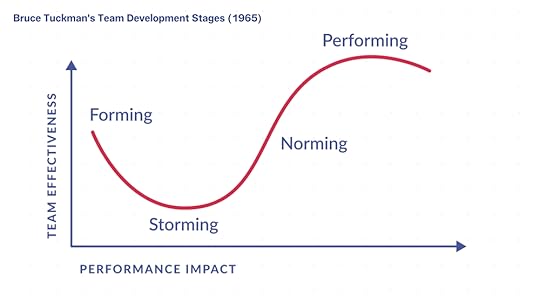
Forming is like the awkward first day. Everyone's polite, no one really knows what they're doing, and people are figuring out who's who. It's all a bit surface-level, with lots of smiling and nodding.
Storming is when it gets a little ‘messy’. People start clashing because they want to do things in different ways or else people try to assume control. Egos and personalities clash and frustrations bubble up. This is where teams either fall apart or push through.
Norming is when you've had your rows and now you're actually sorting yourselves out. You've agreed how you'll behave, communicate, work together, be creative and you've built some trust. The team starts to gel and things start to happen.
Performing is when you're firing on all cylinders. Everyone knows their role, there's proper trust, healthy conflict, a commitment to hit targets and work gets done without constant drama. The team's humming.
In my experience, very few teams manage to get to and stay at the performing stage. Most will shuttle between norming and performing, constantly looking for ‘consistency’ or some secret sauce that will unlock repeatability.
Some get there quite by chance. Nothing unites a team like a crisis. Everyone pulls together quickly to resolve the issue, yet when it’s done, things revert to the way they were before.
It’s not that Tuckman’s model is wrong. In my experience it’s a simple way to explain the stages that new teams go through. It’s just that managers assume that the longer a team is together the greater the likelihood that they’ll simply become a performing team. However, time alone doesn't create high performance.
What’s missing to maintain this consistency is a formal team agreement and a commitment from everyone to stick to it. This should be written in the norming phase. Often referred to as a Team Charter of Culture Deck, it is the ‘north star’. A practical description of the culture for team members to own.
This where belonging lives. A written account of everything that we hold to be true. Something to be proud of, to continually evolve and to protect from those that seek to destroy the culture the team has built. When the team owns its culture, it defines what psychological safety means in practice and you don’t have to tell them to be entrepreneurial or to take risks. It becomes perpetually good, seeking ways to continually improve.
Without this agreement, there is nothing to refer back to, nothing to guide behaviour, no basis for expectation setting and therefore no opportunity for the courageous conversations required to maintain progress.
Many organisations try to address this by imposing the agreement; telling people what the culture is, rather than involving employees in the process of defining it. This inevitably leads to a loss of autonomy and accountability (‘it’s not my culture’) and keeps teams in the norming stage as they are never clear what’s actually required to uphold values or practice behaviours.
As I’ve written before, no employee or team wants to perform poorly. Everyone wants to go home after their work, proud of what they’ve accomplished and how they’ve achieved it.
This consistency is only achievable through autonomy over culture definition and a commitment from every team member to uphold it. Then and only then, can it be a truly high-performing team.
Subscribe to Colin on Culture Sign up with your email * indicates required Email Address *November 23, 2025
Getting started
When it comes to changing culture most teams don’t lack the ideas required to do so, they lack the determination to take action. This is often a result of the fact that there are simply too many things to attend to or else the items chosen require too many hours to complete.
This is why, whenever I run workshops, I always get teams to select no more than 3 things to focus on and from this short list they pick one thing they can immediately do. Not ‘one thing to investigate and plan’, but one thing that can be done now.
When that one thing has been done, change feels easier to achieve, the success is celebrated and we move to quickly select another achievable action then repeat the process. Sometimes this happens on the day itself!
Change is only possible when you stop creating a long list of things to do and get started.
Subscribe to Colin on Culture Sign up with your email * indicates required Email Address *November 20, 2025
That doesn’t suit me
I was on the train going to London a couple of weeks ago and overheard a work conversation. Actually the person was speaking so loudly that half the train overheard it! Which reminded me of the statistic that when we speak on the phone/video conference, unless we practice self-awareness, we tend to talk 15% louder than we would in-person.
Anyway, from the sounds of things, the organisation had announced a return to office on Tuesdays, Wednesdays and Friday, to which this person’s response was to boldly state ‘that doesn’t suit me’.
They had many issues which they ran through over a 15-minute call, which were as follows:
‘I have uni work to do on Tuesdays and Thursdays’
‘We always work from home on Fridays, it’s the best way to start the weekend’
‘In office doesn’t work for me’
‘I can be on calls on Teams, but I can’t come into the office with everyone else’
It’s easy to assume that the person in question is being entitled, however, there may be other issues at play that I’m not aware of, so empathy is important.
Also, I’m not a fan of the mandated return to office. I much prefer - and have worked with many organisations successfully on this - a collaborative approach between employer and employee, such that decisions like this are never a surprise.
However, regardless of your take on a return to office mandate, the inference from this individual is that work conditions should suit them and them alone; which is the antithesis of teamwork.
When you take pay from an organisation that you don’t own, then the leaders get to determine the working conditions and hours.
In an ideal world, they would heed the advice in this blog (😂) and work with you to create a fantastic place to work, which requires you to engage with your teammates in ways that generate engagement and productive work. This will likely include a mix of in-person and online working for office-based companies.
However, if they don’t - and there’s no opportunity for team-based autonomy or greater individual flexibility to suit your needs - then there are only really three decisions; 1) find a company that does; 2) leave and start your own business, so that you can create the hours and lifestyle that works best for you; or 3) accept that you are part of a team and become comfortable with the hours and locations required.
It’s impossible for organisations to create the conditions to suit every individual. All they can do is to try to create an environment where everyone gets a little bit of what they require. This ensures that not only does the work get done by the team to generate the results required (to sustain the company and motivate employees), but also that everyone can have a good balance between work and life.
The best teams aren't built by accommodating every individual’s needs; they're built by everyone accommodating each other.
Subscribe to Colin on Culture Sign up with your email * indicates required Email Address *November 19, 2025
The stay interview
Most organisations wait until someone resigns to ask why they're leaving. By then, it's too late. Stay interviews flip this logic, asking employees what keeps them engaged whilst they're still committed.
The case for this proactive approach has never been stronger. Mental health issues amongst employees jumped from 44% to 77% between 2023 and 2024 amongst large US employers. Yet workplace wellness conversations still place the burden on individuals to change their habits, rather than understanding the stresses and strains they deal with day-to-day, regardless of how trivial they may seem.
Adam Grant argues that stay interviews help organisations identify these hidden stressors e.g. under-utilised skills, unclear career progression, competing priorities, personality clashes and mixed signals about psychological safety. These conversations shouldn't be formal reviews, they should be chats where employees can speak candidly without fear.
The returns are tangible. When employees feel heard and valued, retention improves and the cost to re-hire is avoided.
When employees understand their development path and see meaning in their work, stress diminishes and the ability to perform increases. Stay interviews reveal what would make someone leave before they've updated their CV or changed their status on LinkedIn.
Subscribe to Colin on Culture Sign up with your email * indicates required Email Address *November 18, 2025
Doing nothing
It’s easy to get locked into a cycle - as individuals or teams - of continual busyness. We tell ourselves that we need to stay busy to stay productive and yet often, this is the worst thing we can do.
When our brains aren't focused on a task, they return to a default state, making unusual connections and solving problems we didn't know we had.
Yet we never create any space for the mind to wander; which is why our best ideas often come when we’re in the shower!
So if you feel overwhelmed or paralysed by action, then maybe spend 15 minutes doing nothing and see what creative thinking it unlocks.
Subscribe to Colin on Culture Sign up with your email * indicates required Email Address *November 17, 2025
Basic training
Today’s blog is inspired by three events that have occurred over the last month.
Our daughter joined the army. Her ultimate goal is to be a lawyer and she sees the army as a great way to gain an education whilst also building camaraderie and (it has to be said) saving money!
My wife and I caught up with friends for a walk and brunch. We talked about children, holidays, the weather (we’re British, so we started with this) and work.
I met my friend and fellow culture obsessive Shane Hatton for lunch. As well as catching up we talked about the things that we are seeing in our work currently.
So what’s the common thread between these events? Basic training.
When you join the army - regardless of what you wish to do - you have to do 13 weeks of basic training, which is literally that. How to march, how to iron, how to dress, how to polish shoes, how to cook, how to collaborate, how to fire a weapon (😰) and so on. They don’t assume that you already have the knowledge. They teach everyone the same thing in exactly the same way, so that everyone has the same practical skills and there is consistency and discipline around the way things are done.
The day before we caught up with our friends, he had been on a ‘mandatory’ email training course. He was taught when to write an email, when not to write, when to copy people in (and not), the language to use and of course, the language not to use. His general feeling was ‘it was fine, but it would’ve been better when I started with the organisation’ as habits were now ingrained.
When Shane and I caught up, the single biggest opportunity that most organisations stillI have, is training their managers on how to be managers. When Shane wrote Let’s Talk Culture, one of the statistics that he and the research team uncovered was that only 3% of people leaders said they feel completely confident in their ability to build great culture. Yet, these are the people that are the difference between success and failure.
When it comes to work, I can’t emphasise enough the importance of basic training. This should start at induction into a new organisation/team and be updated regularly to ensure that consistency is maintained.
Development is not an exercise to be overlooked, every employee expects it. Neither can you ‘set and forget’ i.e. send everyone on a training program and assume that’s it. Forever.
Of course, there is a cost to basic training and if you are lucky enough to have it, it’s generally the first thing to get cut when money is tight!
Yet the ROI is compelling. Organisations investing in training achieve 218% higher income per employee and 24% higher profit margins than those that don't. MIT Sloan research demonstrated that a 12-month soft skills programme delivered 250% return within eight months. Companies with robust basic training programmes also experience 12% productivity increases and significantly lower turnover costs.
Email is a great example. Almost every office-based team that I work with complains not only about the quantity of email, but also the quality too. When I ask how much time it consumes, it’s anything from 5-25 hours per week! Yet, when I ask how many hours were spent training them on how the organisation uses it, it’s almost always zero. The same applies to meetings.
It’s a fact that organisations will invest millions in acquiring new technology, yet almost nothing on the basic skills required to not only use the technology, but also improve how people work together to get the maximum value from it.
If you work in learning and development this is your greatest opportunity for legacy building. Create a program to provide everyone with a basic skill level to make life at work easier and more predictable.
Everyone wants to do the best they can with what they have, which is only possible if ‘what they have’ is fit for purpose for your organisation and the goals that you have. Without that, then you can expect to continually struggle with ‘the basics’.
If you’re looking to train your managers on creating an environment of continual success, then drop me a note to find out about my Management Mastery programme.
Subscribe to Colin on Culture Sign up with your email * indicates required Email Address *